Adequate reading ability is well recognized to be an essential element for academic and career success in this modern literate era. In particular, being able to understand written text is of paramount importance as it is a basic tool for acquiring new information and advancing one’s knowledge. Thus, reading comprehension is the ultimate goal of learning to read. Given its significance for our learning and development, many studies have been conducted to understand the core components of reading comprehension (e.g., Joshi, Tao, Aaron, & Quiroz, Reference Joshi, Tao, Aaron and Quiroz2012; Yeung, Ho, Chan, & Chung, Reference Yeung, Ho, Chan and Chung2016). These research findings generally show that decoding and language comprehension skills are the core components of reading comprehension across many writing systems. However, vocabulary has often been used as the main measure of language comprehension. Does vocabulary capture most language skills important for reading comprehension? Are we missing any language comprehension skills that are essential for text comprehension? Are language correlates of reading comprehension in nonalphabetic Chinese the same as those in alphabetic languages? The present study examined in particular whether some discourse-level skills, that is, language-related skills beyond word and sentence level (e.g., inference making and topic knowledge), may play a unique important role in reading comprehension in Chinese in addition to that of decoding and vocabulary.
THE SIMPLE VIEW OF READING COMPREHENSION
Reading comprehension can be defined as gaining an understanding of written text through a series of processes of extracting and constructing meaning (RAND Reading Study Group, 2002). Various models of reading comprehension have been put forward to define and explain the core components of text comprehension. Among these, the simple view of reading (SVR) is the most prevalent, and has been examined in various writing systems such as English, French, Hebrew, and Italian (e.g., Chen & Vellutino, Reference Chen and Vellutino1997; Gentaz, Sprenger-Charolles, & Theurel, Reference Gentaz, Sprenger-Charolles and Theurel2015; Joshi, Ji, Breznitz, Amiel, & Yulia, Reference Joshi, Ji, Breznitz, Amiel and Yulia2015; Tobia & Bonifacci, Reference Tobia and Bonifacci2015). The SVR hypothesizes that decoding (or written word recognition) and listening comprehension are the two core components of reading comprehension (Gough & Tunmer, Reference Gough and Tunmer1986; Hoover & Gough, Reference Hoover and Gough1990). The original account has suggested that the process of reading comprehension is similar to that of listening comprehension when the text is decoded (Hoover & Gough, Reference Hoover and Gough1990). Some researchers have highlighted critical differences between listening and reading comprehension, such as the degree of social interaction, complexities of syntax, and purposes of communication (Uppstad & Solheim, Reference Uppstad and Solheim2012). Apart from using listening comprehension as a measure of the comprehension component, later studies also included a wide range of language measures such as vocabulary, syntactic skills, and discourse skills. The SVR has been supported by both behavioral and genetic studies (e.g., Chen & Vellutino, Reference Chen and Vellutino1997; Ho, Chow, Wong, Waye, & Bishop, Reference Ho, Chow, Wong, Waye and Bishop2012; Johnston & Kirby, Reference Johnston and Kirby2006; Keenan, Betjemann, Wadsworth, DeFries, & Olson, Reference Keenan, Betjemann, Wadsworth, DeFries and Olson2006). Past behavioral studies have shown that the two core components in the SVR account for around 40% to 80% of variance in reading comprehension between Grades 2 and 10 (Catts, Adlof, & Weisner, Reference Catts, Adlof and Weismer2006; Johnston & Kirby, Reference Johnston and Kirby2006; Joshi & Aaron, Reference Joshi and Aaron2000; Savage, Reference Savage2006). In a Chinese twin study, Ho et al. (Reference Ho, Chow, Wong, Waye and Bishop2012) reported that both vocabulary and word reading had significant independent genetic influences on reading comprehension in Chinese, and the two factors together accounted for most of the genetic influences on reading comprehension (Ho et al., Reference Ho, Chow, Wong, Waye and Bishop2012). Findings are similar in English behavioral genetic studies (e.g., Keenan et al., Reference Keenan, Betjemann, Wadsworth, DeFries and Olson2006). Despite its simplicity, the model helps to explain both reading development and reading difficulties. For instance, poor readers could be differentially impaired in decoding or language comprehension skills (Aaron, Joshi, & Williams, Reference Aaron, Joshi and Williams1999). Some studies have also reported that providing intervention to the weak component may enhance overall reading achievement (e.g., Aaron, Joshi, Gooden, & Bentum, Reference Aaron, Joshi, Gooden and Bentum2008).
Decoding skills in the SVR often mean efficient word recognition or the ability to use phonological decoding (e.g., Kirby & Savage, Reference Kirby and Savage2008). A range of cognitive–linguistic skills, including orthographic and semantic skills, may be important for developing decoding skills. As accurate and fluent word retrieval is essential for processing and integration of meaning in text, the decoding component should include both word recognition accuracy and fluency, especially for readers who already have some reading experiences. In a meta-analysis of 33 studies on the SVR, Florit and Cain (Reference Florit and Cain2011) reported that decoding skills (both accuracy and fluency) are more important for reading comprehension in early years of schooling than in later years. This is not unexpected given the fact that children normally spend the first few years of schooling learning the grapheme–phoneme conversions and learning some sight words. However, linguistic (or language) comprehension becomes important for readers of transparent orthographies even for beginning readers after only 1–2 years of instruction. Chinese children in Hong Kong learn to read at an early age (i.e., at the age of 3 to 4). Fluent word recognition may be important for text comprehension in these Chinese children in elementary grades with several years of reading exposure. Therefore, both word recognition accuracy and fluency were measured in the present study with Hong Kong Chinese elementary school children as participants. Next we will examine how the language comprehension component may contribute to reading comprehension and what skills should be included in this component.
The role of vocabulary
Some reading comprehension studies used vocabulary as the only or major measure of language comprehension (e.g., Duff, Reen, Plunkett, & Nation, Reference Duff, Reen, Plunkett and Nation2015; Spencer, Quinn, & Wagner, Reference Spencer, Quinn and Wagner2014). Studies of individual differences in reading development and reading difficulties show that vocabulary associated considerably with reading comprehension, with correlations ranging from .3 to .8 (e.g., Muter, Hulme, Snowling, & Stevenson, Reference Muter, Hulme, Snowling and Stevenson2004; Tannenbaum, Torgesen, & Wagner, Reference Tannenbaum, Torgesen and Wagner2006; Yovanoff, Duesbery, Alonzo, & Tindal, Reference Yovanoff, Duesbery, Alonzo and Tindal2005). The correlation tends to be stronger when children get older (e.g., Torgesen, Wagner, Rashotte, Burgess, & Hecht, Reference Torgesen, Wagner, Rashotte, Burgess and Hecht1997). In a recent large-scale study, Spencer, Quinn, and Wagner (Reference Spencer, Quinn and Wagner2014) reported the analyses of reading comprehension difficulties in over 425,000 first, second, and third graders. Among the children with poor reading comprehension, fewer than 1% were found to be adequate in both decoding and vocabulary. Their results show that most poor comprehenders could be accounted for by inadequate decoding and/or weak vocabulary. Vocabulary appears to be an important subcomponent of language comprehension. Why is vocabulary so important for reading comprehension?
Vocabulary generally refers to the knowledge of lexical meanings of words. Vocabulary appears to be an important language comprehension skill, and it plays a role both in learning to recognize individual words (e.g., Kirby, Desrochers, Roth, & Lai, Reference Kirby, Desrochers, Roth and Lai2008; Nation & Snowing, Reference Nation and Snowling1998; Plaut, McLelland, Seidenberg, & Patterson, Reference Plaut, McClelland, Seidenberg and Patterson1996) and in text comprehension (e.g., McKeown, Beck, Omanson, & Perfetti, Reference McKeown, Beck, Omanson and Perfetti1983). Infants begin communicating in the human world by acquiring the sounds and meanings of some spoken words. Although they have to learn how to combine words according to some grammatical rules in order to have effective communication, oral vocabulary is the very first language skill for oral communication. When children later learn to read printed words, knowledge of the meanings of spoken words helps them to build better associations of print–sound–meaning. Vocabulary also helps word learning through recognition of less familiar words when sounded out. Efficient access of word meaning also helps children to extract meaning from text. Duff et al. (Reference Duff, Reen, Plunkett and Nation2015) have reported in a longitudinal study that infant vocabulary was a significant predictor of later word reading and reading comprehension. Although early vocabulary may be a predictor of reading comprehension, the relations between vocabulary and reading comprehension are likely to be reciprocal (e.g., de Jong & van der Leij, Reference de Jong and van der Leij2002; Muter et al., Reference Muter, Hulme, Snowling and Stevenson2004). More reading experience will facilitate acquisition of vocabulary knowledge, and vice versa.
Vocabulary has been well established to be important for reading comprehension. However, is vocabulary alone sufficient for understanding text, especially those that involve different text structures, and paragraphs that require knowledge or inferences not directly given in texts?
The role of discourse-level skills or knowledge
Although the two components in the SVR can account for a substantial portion of variance in reading comprehension, there is still a considerable amount of variance left unexplained. In particular, the model does not specify the important component processes in language comprehension that makes understanding the complex reading comprehension processes less complete and in turn hinders the development of appropriate reading intervention. Perfetti’s (Reference Perfetti1999) “blueprint of the reader” has given us some clues about factors involving in text comprehension. According to Perfetti, Landi, and Oakhill (Reference Perfetti, Landi and Oakhill2005), in order to build a mental representation and to understand a text message, linguistic systems at the word level (e.g., lexical retrieval), sentence level (e.g., grammatical parsers), and text or discourse level (e.g., sensitivity to story structure, inference making, and comprehension monitoring) are involved in the comprehension processes. In addition, Perfetti et al. also proposed that general knowledge helped a reader to build up the situation model of the text. So far, four major discourse-level skills or kinds of knowledge have been found in different studies to play important roles in reading comprehension. These skills include sensitivity to story or text structure, inference making, comprehension monitoring (e.g., Cain & Oakhill, Reference Cain and Oakhill1999; Perfetti et al., Reference Perfetti, Landi and Oakhill2005; Perfetti, Marron, & Foltz, Reference Perfetti, Marron and Foltz1996; Yuill & Oakhill, Reference Yuill and Oakhill1991), and topic knowledge (e.g., Carr & Thompson, Reference Carr and Thompson1996; Rydland, Aukrust, & Fulland, Reference Rydland, Aukrust and Fulland2012). We consider them to be factors specific for text comprehension in addition to general listening comprehension. These four discourse-level skills or kinds of knowledge will be explained below.
There are different genres of texts (e.g., narrative and expository passages), and each may have different structures or schemas. Knowledge of text structure is expected to be fundamental for a reader to understand the main points and theme of a passage. There are different ways in which text structure knowledge can be measured. It has been found that good and poor comprehenders in reading differed in the quality of story structure they produced in a topic prompt condition (Cain & Oakhill, Reference Cain and Oakhill1996). Other studies measured text (story) structure knowledge by asking the participants to arrange sentences into a coherent and meaningful story or paragraph (e.g., Chik et al., Reference Chik, Ho, Yeung, Wong, Chan, Chung and Lo2012; Oakhill & Cain, Reference Oakhill and Cain2012). Knowledge of text structure measured by a sentence order task at age 7 to 8 was found to predict unique variance of reading comprehension 1 year later beyond word reading, vocabulary, IQ and the autoregressive effect of reading comprehension (Oakhill & Cain, Reference Oakhill and Cain2012).
Apart from text structure knowledge, other “higher level” comprehension processes, such as inference making, are also needed to help a reader to build a mental model of the text. The ability to make inferences, that is, getting the intended meaning not explicitly stated in text, may help to differentiate who can understand text better (e.g., Bloom, Reference Bloom2000). Children who were poor in reading comprehension had been found to make fewer cohesive and elaborative inferences than same-age skilled readers and comprehension-age matched readers. When being prompted where to look for text information, poor comprehenders showed improvement in answering text-connecting inference questions (e.g., making a referential link between noun phrases in successive sentences), but not the gap-filling inference ones (e.g., an inference about the setting of a story; Cain & Oakhill, Reference Cain and Oakhill1999). It appears that the ability to make inferences at a global scope may be crucial for developing comprehension skills in the long run.
It has been argued that the ability to make inferences may, to some extent, depend on a reader’s topic knowledge, that is, a specific type or depth of background knowledge in relation to a particular selection of text. If a reader is familiar with the topic of the text, it would be easier for him/her to retrieve relevant information or meaning that is not given but relevant to the text. It has been found that readers with high topic knowledge can recall and understand a text better than those with low topic knowledge (e.g., Carr & Thompson, Reference Carr and Thompson1996). Cain, Oakhill, Barnes, & Bryant, (Reference Cain, Oakhill, Barnes and Bryant2001) found that when available knowledge was experimentally controlled, good comprehenders were still able to answer more inference questions than less skilled comprehenders. They observed that the less skilled comprehenders failed to retrieve the relevant textual information to make the inference, while skilled comprehenders were better at acquiring new knowledge, constructing an integrated representation of text, and linking relevant text information with knowledge base.
Another comprehension process that helps a reader to build a coherent representation of a text is the ability to monitor his/her comprehension. Comprehension monitoring is a set of metacognitive processes by which a reader evaluates his/her understanding of incoming textual information with his/her mental representation of the text (i.e., internal consistency) or with prior knowledge (i.e., external consistency). This allows him/her to verify and repair understanding inconsistent with his/her representation. Comprehension monitoring has typically been measured by anomaly detection. For example, Oakhill, Hartt, and Samols (Reference Oakhill, Hartt and Samols2005) reported that children poor in reading comprehension performed worse in detecting word level, sentence level, and intra-sentence level inconsistencies than skilled readers matched on word decoding and sight vocabulary.
Oakhill and Cain (Reference Oakhill and Cain2012) examined three of these discourse-level skills in a 3-year longitudinal study of English-speaking children from ages 7–8 (Time 1) to 10–11 years (Time 3). They reported that vocabulary and story (text) structure at Time 1 were significant direct predictors of reading comprehension at Time 2. Inference making and comprehension monitoring at Time 2 were significant direct predictors of reading comprehension at Time 3 over and above the autoregressor (i.e., reading comprehension at earlier time points). Inference making and monitoring at Time 2 were predicted by vocabulary and monitoring respectively at Time 1. It appears that some language skills (e.g., vocabulary and text structure) may be more fundamental and thus essential for understanding simpler text in earlier grades while other discourse-level skills (e.g., inference making and monitoring) may help understanding of more complex text in higher grades. It is likely that vocabulary knowledge and word recognition skills may help to acquire these discourse-level skills through their facilitation in formal or informal reading. Having learned about these correlates of reading comprehension, how much could they be applicable in Chinese?
FEATURES OF CHINESE AND STUDIES OF READING COMPREHENSION IN CHINESE
The Chinese writing system differs from alphabetic systems mainly in how graphic units are mapped onto sound and meaning. Chinese is morphosyllabic in that each Chinese syllable maps onto a morpheme and a character. Chinese is also a noninflectional language with no case markings, tense suffixes, or subject–verb agreement in terms of number or gender. Consequently, the semantic and grammatical information embedded in Chinese sentences are conveyed by word order and sentence context rather than inflection (Chang, Reference Chang1992; Li & Thompson, Reference Li and Thompson1981). In addition, Chinese is a topic-prominent language (Chao, Reference Chao1968; Li & Thompson, Reference Li and Thompson1981). Once a topic word or phrase has been established, it can be extended across succeeding sentences. In Chinese the subject noun/phrase can be omitted when a topic is established among a group of sentences, for example: 瑪莉我見過了。很漂亮。也很能幹。 Mary [the topic] I have just met. [The topic, i.e., Mary is] very pretty. [The topic, i.e., Mary is] very capable as well. Given these language differences, it would be interesting to understand whether language comprehension skills may play a similar or different role in reading comprehension in Chinese.
The role of vocabulary and text structure knowledge for reading comprehension in Chinese has been examined in several studies. For instance, Chik et al. (Reference Chik, Ho, Yeung, Wong, Chan, Chung and Lo2012) have reported that oral vocabulary, word semantics, and text structure knowledge significantly predicted reading comprehension in Chinese junior graders after controlling for age, IQ, and Chinese word reading, while text structure knowledge and morphosyntax were significant predictors among senior graders (Chik et al., Reference Chik, Ho, Yeung, Wong, Chan, Chung and Lo2012). Similarly, Yeung, Ho, Chan, Chung, and Wong (Reference Yeung, Ho, Chan, Chung and Wong2013) reported that text structure knowledge, word order knowledge, and verbal working memory contributed significantly to reading comprehension in Chinese fourth graders with age, IQ, and word reading considered in the model. These findings suggest that text structure knowledge may be a kind of basic discourse-level knowledge for reading comprehension for elementary children of all levels.
For testing the SVR in Chinese with a longitudinal study of 392 Chinese children aged from 7 to 9 years, Yeung et al. (Reference Yeung, Ho, Chan and Chung2016) reported that decoding (measured by word recognition accuracy and fluency) and language comprehension (measured by syntactic skills and oral narrative skills) explained 64% of variance in Chinese reading comprehension across time. Findings so far appear to support that decoding and language comprehension are also core components of reading comprehension in Chinese. However, discourse-level skills or knowledge other than text structure knowledge are much less examined in Chinese. Discourse-level skills appear to be generic across different languages at first sight. However, some unique features of the Chinese language may tap on particular discourse-level skills during text reading. For the topic-prominent feature of Chinese language mentioned above, it is important for a reader to identify the topic of a Chinese sentence for comprehension. The topic specifies the time, place, or circumstances to which the rest of the sentence may apply. Once the topic of the sentence or discourse is established, the subject or object of the sentence can be omitted. A series of connected sentences that share the same topic makes up a topic chain in the text. Readers often need to refer to the subject or object in the first sentence to identify the topic. It is expected that much monitoring process and inference making may be required to identify the sentence topics and relate them to the discourse context and the theme. Another feature of the Chinese language is the extensive use of connectives. Connectives signal how to link and integrate the meanings of different sentences and guide readers’ interpretation of text (e.g., Cain, Reference Cain2010). Event sequences and causal relationships implicated between sentences may rely heavily on a reader’s understanding of different connectives. The ability to organize a coherent text structure from randomized sentences may partly depend on how well a reader could make sense of connectives, and hence text structure knowledge may be particularly important for understanding Chinese text.
AIMS OF THE PRESENT STUDY
Based on the above review, aims of the present study are (a) to examine the role of discourse-level skills or knowledge in reading comprehension in Chinese, and (b) to develop and test a model of reading comprehension in Chinese with decoding and an elaborated language comprehension component based on the SVR framework. Although the various language and discourse-level skills may be found important in separate studies, they are seldom examined together in a single study for comprehensive understanding of their interrelationships and relative contributions to reading comprehension.
METHOD
Participants
A total of 117 Chinese children (54 boys and 63 girls) in Grade 2 (n = 58) and Grade 3 (n = 59) from three representative primary schools in Hong Kong participated in this study. The three schools were government aided, and were located in low-, medium-, and high-socioeconomic status (SES) neighborhoods in Hong Kong. The mean ages of the children were 8.03 years (SD = 0.38) in Grade 2 and 9.04 years (SD = 0.44) in Grade 3. All of the children were native Cantonese speakers who started to read Chinese characters from age 3 in Hong Kong, and they had been exposed to text reading from first grade onward. It was expected that some discourse-level skills were important for their comprehension of written text.
Measures
The children were assessed on reading and reading-related skills, which included a vocabulary definition task, four discourse-level measures (inference making, comprehension monitoring, text-structure knowledge, and topic knowledge), a verbal working memory task, and three literacy measures (Chinese word reading, Chinese 1-min word reading, and Chinese reading comprehension). A standardized test of nonverbal intelligence was also administered to the participants.
Raven’s Standard Progressive Matrices
Raven’s Standard Progressive Matrices was used to assess participants’ nonverbal reasoning ability (Raven, Court, & Raven, Reference Raven, Court and Raven1996). As a potential correlate of reading comprehension and other cognitive skills, IQ score was used as a control variable in the analyses of the present study. There were 60 items in this standardized measure, with five sets (Sets A to E) of 12 items each. Each set involves different principles of matrix transformation, and within each set the items become progressively more difficult. According to the test user manual, participants who were less than 8.5 years old at the time of testing were administered the short form with 36 items (Sets A to C) while older participants were given the full version. Each item was made up of a target geometric matrix with a missing piece. Participants were asked to pick the best piece out of six to eight choices to complete the target matrix. All correct items were summed up to form a total raw score. Raw scores were then converted to IQ scores based on local norms at the participants’ respective age groups (Hong Kong Education Department, 1986). The internal consistency of the full version of the test was 0.83 and 0.89 for the short form.
Vocabulary.
Following Ouellete (Reference Ouellette2006), an oral word definition task was used to assess participants’ oral vocabulary knowledge. In this task, the participants were presented with 20 Chinese words and were asked to define each given word orally. The stimuli were selected from the Hong Kong Corpus of Primary School Chinese (Leung & Lee, 2002), with frequencies ranging from middle to unfamiliar for Grade 2 students, and arranged in ascending order of difficulty. Probes were delivered to participants twice at most for brief or vague initial responses. An answer for each trial was awarded 0, 1, or 2 points depending on the appropriateness of the answer given. For example, for the stimulus word, “畫家 painter”, the answer “精於畫畫既人 someone who is good at painting” was given 2 points, the answer “精於畫畫 good at painting” was given 1 point, and other irrelevant responses were given 0 points. The maximum score of this task was 40. Two practice items were given to the participants with feedback before formal testing. The task ended when participants answered “don’t know” for five consecutive trials. Two native Cantonese speaking adults rated the response of all the participants independently. When there was a disagreement between the two raters, the average of the two raters’ scores was used. The interrater reliability was sufficiently high (r = .87). The internal consistency reliability of this task was 0.96.
Discourse-level skills
Comprehension Monitoring.
An inconsistency detection task was developed, with reference to Baker (Reference Baker1984) and Cain, Oakhill, and Bryant (Reference Cain, Oakhill and Bryant2004)’s studies, to assess participants’ ability of understanding and evaluating orally presented texts. Eight short narrative passages, with each comprising 4–6 complete sentences and 92–153 words, were audio-recorded beforehand and played to the participants. Each passage, of topics and situations familiar to the participants, was an independent short story with an inconsistency designed. For example, a story talked about a boy who did not like egg waffles. One day he was hungry after school and visited a snack shop. Among many choices, he ordered an egg waffle and said that was his favorite food. The story was presented by an MP3 player. After hearing the narrative, participants were asked “故事有無唔合理或者奇怪既地方?” (“Is there anything that doesn’t make sense or is strange in the story?”) in order to assess if they were able to identify the conflicting information. For example, in the above story, the boy who did not like egg waffle but ended up enjoying eating it was the conflicting information. A practice trial was given to the participants. One point was given for correctly identifying the inconsistency. A half of a point was given to answers pointing out something strange but not accurately on the inconsistency. Participants were given no points for incorrect or irrelevant answers. The maximum score of this task was 8. Two trained psychology undergraduate research assistants, both of whom were native Cantonese speakers, rated the response of all the participants independently, and the average of the two raters’ scores was used when there was a disagreement. The interrater reliability was good (r = .86) and the internal consistency reliability of this task was acceptable (α = 0.65).
Inference Making.
This task was administered together with the comprehension monitoring task (Cain & Oakhill, Reference Cain and Oakhill1999; Cain et al., Reference Cain, Oakhill and Bryant2004). Following each inconsistency identifying question in the comprehension monitoring task, further questions were asked to assess participants’ ability of making inferences from the stories they heard. Using the same example given earlier, we played a story about a boy who did not like egg waffle but ended up enjoying eating it. After participants answered the question regarding the conflict in the story, they were asked two more comprehension questions: “Why did the boy visit the snack shop?” and “What snacks did the boy order in the shop?” There were altogether 17 inference-making questions. One point was given for correct answers in each question, 0.5 point for incomplete but sensible answers, and 0 point for incorrect or irrelevant answers. Two native Cantonese speakers rated the response of all the participants independently, and the average of the two raters’ scores was used when there was a disagreement. The interrater reliability was high (r = .91). Five questions were dropped later due to low item-to-total correlation. The internal reliability of the remaining 12 items was 0.55.
Text-Structure Knowledge.
Following Chik et al.’s (2012) study, a text-structure knowledge task was used to assess the participants’ understanding of coherent sequences and structures of paragraphs or short stories. There were 1 practice and 11 test items ranging from three to six sentences each (see a sample item below). In each item, participants were required to arrange the sentences to form a coherent and meaningful paragraph. Each sentence was given a number. Instead of writing the answers word by word, participants only had to indicate their answers by writing the corresponding numbers in the order they deemed fit. To minimize the effect of word recognition ability on the task, each item was read aloud to the participants. A total of 1 point, 2 points, 3 points, and 4 points were given for correctly ordered three-sentence, four-sentence, five-sentence, and six-sentence items, respectively. There was no partial scoring for three-sentence items. Like the sample item below, no score was given for answers other than 3–1–2. For longer items, partial scoring applied in which 1 point was given for any correctly sequenced three sentences in a paragraph, 2 points for a correct four-sentence sequence, and 3 points for a correct five-sentence sequence. The maximum score for this task was 26. The internal consistency reliability of this task was 0.71.
A sample item
1. 然後, 拿起杯子。Then, pick up [the] glass [of water].
2. 最後加上蓋子。Finally, cover [it] with a lid.
3. 首先, 把水放進杯子裏。First, pour water into [a] glass.
Answer: (3) (1) (2)
Topic Knowledge.
Participants’ general knowledge regarding the topic and related issues of two expository passages in the Chinese reading comprehension task was measured (similar to Carr & Thompson, Reference Carr and Thompson1996). Participants were asked to give some information on the topic related to the two passages. This task was administered before the Chinese reading comprehension task so as to assess how much did the participants know about the topic described in the passages. For example, one passage in the Chinese reading comprehension task was related to the Great Wall in China, and participants were asked if they knew some specific information about the Great Wall (e.g., its history, purpose of building it, its architecture and location, etc.). They were required to elaborate their responses to each question. Marks were given according to the richness and relevance of the content that the participants provided. Four points were given as the full mark to the question for one passage topic, while 3 points were given for the question on another passage topic. Two native Cantonese speakers rated the response of all the participants independently, and the average of the two raters’ scores was used when there was a disagreement. The interrater reliability was high (r = .80).
Verbal working memory
Backward Digit Span.
Backward Digit Span was adopted to assess participants’ verbal working memory (Wong, Ho, & Tang, Reference Wong, Ho and Tang2015). There were 8 levels of items in this task, with each comprising 2 trials of the same span length, and thus constituting 16 test items in total. For each trial, it was a sequence of random one-syllable Cantonese digits played via a MP3 player at the rate of one digit per second. Participants were required to recall orally the sequence of digits in the reverse order. The task started with two-digit sequences, and the number of digits increased for each following subsequent level. A practice trial of two-digit sequence was given to the participants before the test items. One point was given to each correct backward recall of the sequence. The task was stopped for 2 consecutive failures at the same difficulty level. The total score of this task was 16. The internal reliability (Cronbach’s α) of this task was 0.78.
Reading skills
Chinese Word Reading.
Participants’ word recognition skill was assessed by the Chinese word reading subtest of the Hong Kong Test of Specific Learning Difficulties in Reading and Writing for Primary School Students—Second Edition (Ho et al., Reference Ho, Chan, Chung, Tsang, Lee and Cheng2007), a widely used diagnostic test to assess Hong Kong primary school children suspected of having developmental dyslexia with local norms. The participants were asked to read aloud the words one by one in a word list of 150 Chinese two-character words in the order of graded difficulty. One point was given to each correctly read two-character word. The test was discontinued after 15 consecutive failures. The maximum score was 150 in this task. The Cronbach’s alpha of this task was 0.97.
Chinese 1-Min Word Reading.
Participants’ reading fluency was assessed by a 1-min word reading task. This task was modeled after the 1-min word reading subtest of the Hong Kong Test of Specific Learning Difficulties in Reading and Writing for Primary School Students—Second Edition (Ho et al., Reference Ho, Chan, Chung, Tsang, Lee and Cheng2007). In this task, participants were asked to read 90 high-frequency Chinese two-character words aloud as quickly and as accurately as possible within 1 min. The total number of words read correctly within 1 min was recorded. If a participant finished the task in less than 1 min, the time duration to complete the task was also recorded. The score was calculated as (number of words read correctly×60)/(duration in seconds). The maximum possible score was 90 or more depending on the completion time of the task.
Chinese Reading Comprehension.
The passage comprehension task in the studies by Yeung et al. (Reference Yeung, Ho, Chan, Chung and Wong2013) and Chik et al. (Reference Chik, Ho, Yeung, Wong, Chan, Chung and Lo2012) was adapted to assess participants’ competencies in understanding passage contents. In this task, the participants were presented with three narrative and two expository passages. The content and length of the passages were of an appropriate level of difficulty for the participants with reference to the textbook and reading materials written for Grade 2 and Grade 3 students in Hong Kong. The mean length of the passages was 261.2 Chinese characters (ranging from 228 to 308 Chinese characters). Each passage was followed by 4 to 5 multiple-choice questions and 1 open-ended question, which constituting a total of 24 multiple-choice questions and 5 open-ended questions. There were four types of questions: (a) explain vocabularies from the text in which its meaning could be derived from understanding the passage, (b) focus on and retrieve explicitly stated information and ideas, (c) make straightforward inferences, and (d) interpret and integrate ideas and information (Yeung et al., Reference Yeung, Ho, Chan, Chung and Wong2013). To arrive at the correct answer, the participants needed not only to integrate and infer information from various parts of the text but also to make use of their prior knowledge to interpret the passage appropriately. All of the questions and answer options were presented in print, and participants were required to write down their answers. Participants were allowed to ask the experimenter for words that they did not know how to write. There was no time limit, and the participants completed the task at their own pace. One point was given for each correct answer in the multiple-choice section. For open-ended questions, 0, 0.5, 1, 1.5, or 2 points were possible scores depending on the appropriateness of the answer. The total score of this task was 34. Two native Cantonese speakers rated the response of all the participants independently, and the average of the two raters’ scores was used when there was a disagreement. The interrater reliability was high (r = .84) and the internal consistency reliability of this task was 0.79.
Procedures
The tasks were administered to the participants in group testing (around 80 min) and individual testing (around 60 min) sessions with breaks. Raven’s Standard Progressive Matrices, text-structure knowledge, and Chinese reading comprehension were administered in groups, while other measures were administered individually.
RESULTS
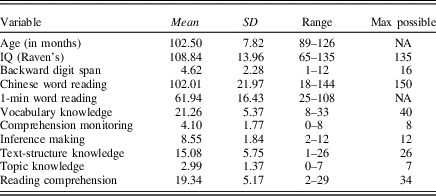
Table 1 shows the mean scores, standard deviations, range, and maximum possible scores of all the measures. There were three children with IQ below 80 in the sample. We did not include them in our analyses because our target sample were ordinary students studying in the mainstreamed classrooms without special support. Correlation analyses were first done to show the general pattern of associations among the various measures. Multiple regression analyses were performed to examine the contributions of decoding, vocabulary, and discourse-level skills to reading comprehension, and path analyses were conducted to develop a model of reading comprehension in Chinese. These analyses were done with the two grades combined for two reasons. First, Grade 2 and Grade 3 are both at the same stage of learning to read (Tse, Lam, Lam, & Law, Reference Tse, Lam, Lam and Law2005). Second, the sample size would be relatively small for separate grade analyses. Combining the two grades would give us more statistical power. Results of these analyses are reported below.
Means, standard deviations, ranges, max and reliabilities for measures in the study (N = 117)

Correlation analyses
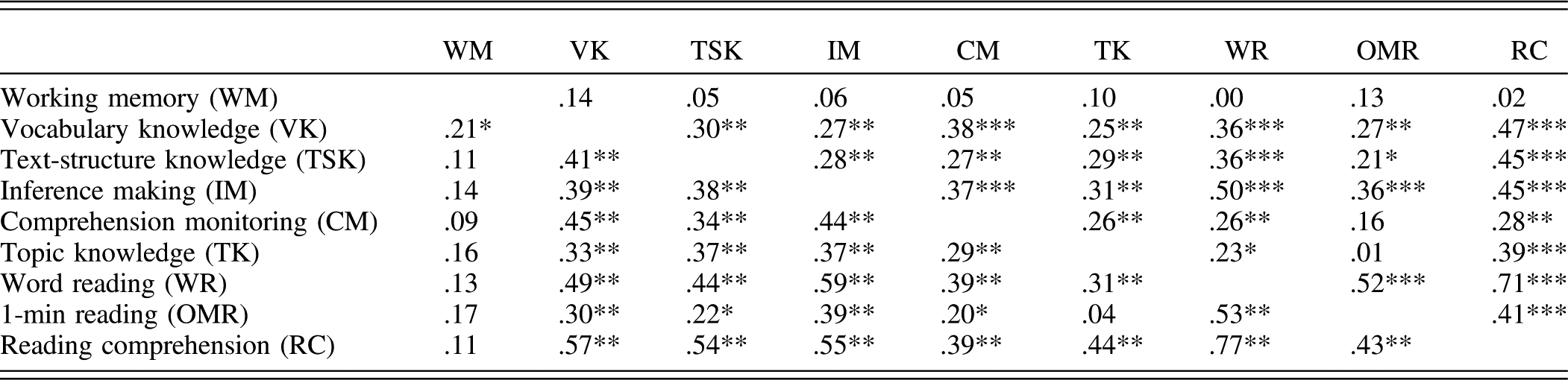
Table 2 shows the zero-order correlation (below the diagonal) and partial correlation coefficients among the various measures after controlling for age, grade level, and IQ (above the diagonal). Overall, word reading and reading comprehension correlated significantly with vocabulary and the four discourse-level skills after controlling for the covariates (rs = .23 to .50, all ps<.05). Reading fluency correlated significantly with word reading, reading comprehension, and some of the language measures (rs = .21 to .52, all ps<.05) except with comprehension monitoring or topic knowledge. Backward digit span did not correlate with any measures.
Zero-order correlation and partial correlation among all the measures after controlling for age, grade level, and IQ (N = 117)

Note: The lower triangle shows zero-order correlation coefficients, and the upper triangle shows partial correlation coefficients among all measures after age, grade, and IQ adjustment.
* p<.05.
** p<.01.
*** p<.001.
Multiple regression analyses
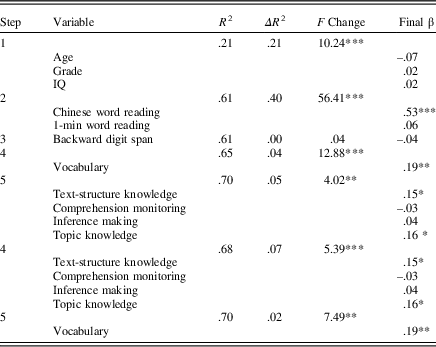
Table 3 shows the results of two fixed-order multiple regression analyses with reading comprehension as the outcome variable. Age, grade level, and IQ were entered as the first step. The two decoding measures, Chinese word reading accuracy and fluency, were in the second step. Backward digit span was entered in the third step. The fourth and fifth steps were vocabulary knowledge or discourse-level skills with reverse order in separate analyses. These factors accounted for a total of 70% variance in reading comprehension. Decoding contributed a unique variance of 40% over age, grade level, and IQ. Verbal working memory did not contribute significant unique variance. Vocabulary contributed an additional unique variance of 4% in the fourth step and 2% in the fifth step, and discourse-level skills a unique variance of 7% in the fourth step and 5% in the fifth step.
Results for two fixed-order multiple regression analyses with reading comprehensionas the outcome variable (N = 117)

Note:
* p<.05.
** p<.01.
*** p<.001.
Path analyses
To further examine the role of discourse-level skills or knowledge in reading comprehension in Chinese, we performed several path analyses to model their relationship along with decoding and vocabulary in the framework of SVR. Path analysis allows simultaneous, instead of separate, evaluation of all model constructs. This is a big advantage over the above multiple regression analysis because it allows both direct and indirect effects of multiple variables tested in the same model.
We performed path analyses using Mplus 7.0 (Muthén & Muthén, Reference Muthén and Muthén2012), and modeled only variables that were shown significant in the regression analysis. Specifically, we used Chinese word reading accuracy as the decoding measure because 1-min word reading was not a significant predictor of reading comprehension in the regression analyses. Likewise, only text-structure knowledge and topic knowledge were included as discourse-level measures in the path analyses. Furthermore, though the regression analysis showed that age, grade level, and IQ did not make significant unique contributions, they needed to be kept in the path model because they contributed to the overall variance in explaining reading comprehension. The three terms also had significant influences on word reading, vocabulary, and discourse-level skills, and thus needed to be in the model as control variables. An alternative method is to regress all constructs on age, grade level, and IQ first and use the residualized data in the model. The two methods should give equivalent results; however, we prefer the first method because it has better control of measurement error with all variables in the model.
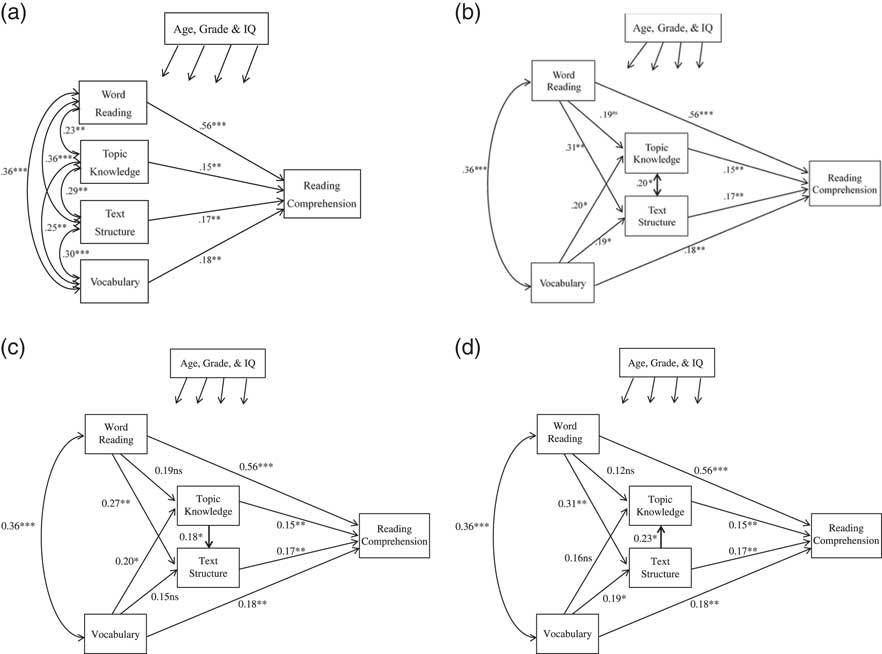
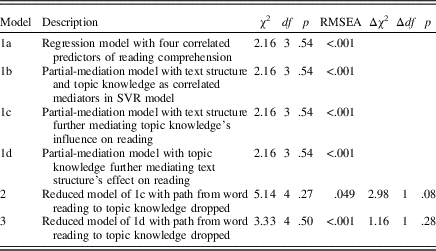
In the path analysis, we first predicted reading comprehension with word reading, vocabulary, text-structure knowledge, and topic knowledge as in a multiple regression model. Figure 1 Model 1a shows the hypothesized paths and parameter estimates. Note age, grade, and IQ were included in the model as exogenous and control variables. They predicted all measures except reading comprehension. In other words, age, grade, and IQ were linked to reading comprehension only through their influence on word reading, vocabulary, text-structure knowledge, and topic knowledge. Model 1a in Table 4 is the fit result of dropping three direct paths from control variables to reading comprehension. This model fit the data well (χ2 = 2.16, df = 3, p = .54 and root mean square error of approximation<.001). The path estimates are comparable to the standardized regression coefficient (β) in regression analysis and confirmed the importance of word reading, vocabulary, text-structure knowledge, and topic knowledge in explaining reading comprehension.
Four equivalent models of the simple view of reading in Chinese. Model 1a is a multiple regression model with word reading, vocabulary, text structure, and topic knowledge as four correlated predictors of reading comprehension. Model 1b is a mediation model with text structure and topic knowledge partially mediating the effect of word reading and vocabulary on reading comprehension. Models 1c and 1d are similar to 1b except that in Model 1b text structure and topic knowledge are correlated as represented by a double-headed arrow, while in Models 1c and 1d their relation is represented by a single-headed arrow. In Model 1c, there is a direct path from topic knowledge to text structure, and the direction is reversed in Model 1d. All path coefficients are standardized values. *p<.05, **p<.01, ***p<.001, and ns is “not significant.” Age, grade, and IQ were added as control variables in the regression equations explaining word reading, vocabulary, text structure, and topic knowledge. All regression paths from the three control variables were not shown, for simplicity and clarity.

Model fitting results of reading comprehension explained by word reading, vocabulary, text structure, and topic knowledge

The regression model (Figure 1 Model 1a) fits the data well but only represents a tentative explanation of the data. It does not mean that there could not be other models that also fit the data and provide plausible explanation to the observed relationship among variables. One particularly interesting alternative hypothesis is text-structure knowledge and topic knowledge, as discourse-level knowledge, played mediator roles in the SVR framework. Past findings have shown that vocabulary correlated significantly with discourse-level skills, including text structure knowledge and comprehension monitoring (Oakhill & Cain, Reference Oakhill and Cain2012). In our present results, both vocabulary and word reading correlated significantly with the discourse-level skills. We suspect that oral and written word knowledge may help readers to acquire more world knowledge and be familiar with different text structures through formal and informal reading. Therefore, we proposed three alternative models represented by Models 1b to 1d in Figure 1. All three models hypothesized that the influence of word reading and vocabulary on reading comprehension was partially mediated by text structure and topic knowledge. The three models differ only in terms of whether there is a causal path rather than a simple correlation between the two mediators and, if there is a causal path, what is the direction of the causality. In Model 1b their relation is depicted as a two-headed arrow meaning that text structure and topic knowledge are only correlated constructs. In Model 1c, there is a direct path from topic knowledge to text structure, suggesting text structure is also partially explained by topic knowledge. However, in Model 1d, the path direction is reversed, implying topic knowledge is partially explained by text structure. The three mediation models, 1b to 1d, cannot be distinguished from Model 1a and from each other with regard to model fit statistics because all the paths between word reading, vocabulary, text-structure knowledge, and topic knowledge have been specified. All models have the same number of parameters and thus have exactly the same χ2, as seen in Table 4, but they are all unique because their path estimates are different.
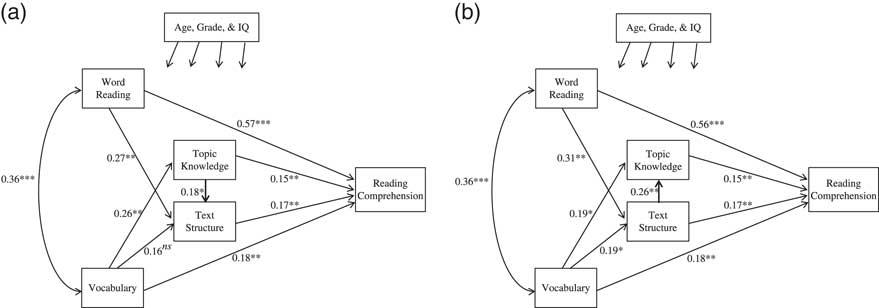
Although we are not able to compare the overall fit of the four models, we can test whether there is a plausible simpler model with fewer estimated parameters that can explain the data equally well. In path analysis, we can compare a full model with its nested model by dropping a path or by fixing the paths to zero. A nested model is rejected if its fit statistic is significantly different from the full model and cannot be rejected if the difference is nonsignificant. Among the four models in our study, we are particularly interested in the nested models of Model 1c and 1d because they imply causal relationship rather than simple correlation between text structure and topic knowledge. To simplify the two mediation models, we dropped the path from word reading to topic knowledge. By dropping this path, we proposed that word reading ability was not directly linked to topic knowledge, but only indirectly linked through its association with vocabulary understanding and might also be linked through its effect on text structure knowledge. Then we used the tests based on differences in χ2 to compare Model 1c and 1d with their lower nested models. The nested models are shown in Figure 2. Model 2 is nested within Model 1c, and Model 3 is nested within Model 1d. A comparison of model fit statistics shows that Model 3 fits the data better with a lower model fit statistic (χ2 = 3.33, df = 4, p = .50) compared to Model 2, a nonsignificant χ2 change from model 1c (Δχ2 = 1.16, Δdf = 1, p = .28), and a small root mean square error of approximation (<.001). Model 3 is therefore a preferred model in our study because it is simpler than Models 1a to 1d with fewer parameters, and it explains the data better than Model 2. Model 3 indicates that text structure knowledge and topic knowledge are two mediators in the SVR model, with text structure mediating the effect of word reading and vocabulary on reading comprehension whereas topic knowledge only mediating the relationship between vocabulary and reading comprehension.
Reduced partial-mediation models of reading comprehension with the path from word reading to topic knowledge dropped. Model 2 is a nested model of Model 1c in Figure 1, and Model 3 is a nested model of Model 1d. All path estimates are standardized values. *p<.05, **p<.01, ***p<.001, and ns is “not significant.” Age, grade, and IQ remain as control variables in the analysis. All regression paths from the control variables are not shown, for simplicity and clarity.

Discussion
To recap, the primary goal of the present study was to examine the role of discourse-level skills or knowledge to reading comprehension in Chinese and to evaluate the SVR model with an elaborated language comprehension component. To the best of our knowledge, this is the first study to examine the role of several discourse-level skills in Chinese simultaneously and to propose a model of reading comprehension specifying the relationship among word reading, vocabulary, and the discourse-level knowledge. Results of the multiple regression analyses show that decoding and language comprehension together accounted for around 49% of variance in reading comprehension on top of age, grade level, and IQ. Decoding, vocabulary, and discourse-level skills all contributed significant unique variance to reading comprehension. The best fitted model in the path analyses further shows that word reading and vocabulary contribute to reading comprehension directly and indirectly through the mediation of text structure knowledge and topic knowledge. We will first discuss below the role of discourse-level knowledge in reading comprehension.
The role of text-structure knowledge and topic knowledge in reading comprehension
Text comprehension is a complex and dynamic process by which a reader makes sense of the text by developing a coherent mental model. Apart from recognizing words in the text, a range of language comprehension skills and knowledge are essential. Among the four examined discourse-level skills or kinds of knowledge, only text-structure knowledge and topic knowledge were found to be significant for reading comprehension among the Chinese second and third graders in the present study.
According to Kintsch and Kintsch (Reference Kintsch and Kintsch2005), there are two levels of comprehension: the textbase (called the microstructure) and the situation model (called the macrostructure). The textbase is a propositional representation of the information expressed in a text (i.e., its literal meaning). A recent study with Chinese children reported that word reading fluency and syntactic skills predicted significantly the understanding of microstructure of passages, while text structure knowledge, morphological awareness, and syntactic skills contributed significantly to understanding of macrostructure (Lo, Ho, Wong, Chan, & Chung, Reference Lo, Ho, Wong, Chan and Chung2015). It appears that text structure knowledge as measured by the sentence-order task may tap some deeper level understanding beyond mere textbase information. Being able to organize randomized sentences into a coherent paragraph implies that the reader has an understanding of the main theme of the paragraph and is able to organize the flow of events or ideas corresponding to the theme. This may explain why the sentence-order task has been found to be a significant contributor of Chinese reading comprehension in various studies. In addition, the present study and Lo et al.,’s (2015) study employed both narrative and expository passages in the reading comprehension task. Our own and their findings suggest that text-structure knowledge may be important for understanding passages of various genres.
We believe that the sensitivity to story or text structure may develop quite early when young children begin listening to stories. Findings of the present study are in line with past findings that text-structure knowledge is a significant correlate of reading comprehension from Grade 1 to Grade 5 after controlling for age, IQ, and Chinese word reading (Chik et al., Reference Chik, Ho, Yeung, Wong, Chan, Chung and Lo2012). Together with other past findings and pedagogical recommendations (e.g., Oakhill, Cain, & Elbro, Reference Oakhill, Cain and Elbro2014), it would be a good idea to explicitly teach some features of typical text structures (e.g., formats of beginnings and endings) to those poor in reading comprehension.
For the role of topic knowledge, the present findings are consistent with past research evidence that high topic knowledge (sometimes called prior knowledge, background knowledge, or domain knowledge) contributes to better understanding of text (e.g., Baldwin, Peleg-Bruckner, & McClintock, Reference Baldwin, Peleg-Bruckner and McClintock1985; Carr & Thompson, Reference Carr and Thompson1996; Priebe, Keenan, & Miller, Reference Priebe, Keenan and Miller2012; Rydland et al., Reference Rydland, Aukrust and Fulland2012). Schema theorists (e.g., Norman & Bobrow, Reference Norman and Bobrow1975) have suggested that activating a reader’s existing knowledge prior to reading would improve his/her reading comprehension. With knowledge relevant to the topic of a passage, a reader would have a more accurate understanding of the meaning of specific words in the text and be able to build a mental model of the situation or event. Therefore, topic knowledge may play a special role in developing the situation model in reading comprehension. The importance of topic knowledge is further highlighted as it may affect other discourse-level processing like inference making. The ability to make inferences appears to be affected by the availability of the required background knowledge (e.g., Cain & Oakhill, Reference Cain and Oakhill1999). The partial correlation between topic knowledge and inference making in the present study was .31 (p<.01) after controlling for age, grade level, and IQ score. There seems to be some support for the enhancement of inference making from knowledge. Development of topic or general knowledge may depend to a large extent on home environment and school instruction. It is likely to be sensitive to some global environmental factors such as SES. This may be a direction for future research to examine how SES may contribute to general knowledge and in turn affects children’s development of reading comprehension. In addition, topic knowledge for reading different text genres (e.g., expository and narrative texts) may be explored in the future.
The nonsignificant contributions of inference making and monitoring to reading comprehension in the present study may be understood from the findings of Oakhill and Cain’s study (2012). Some language skills such as vocabulary and text structure are more fundamental and essential for understanding simpler text in earlier grades while other discourse-level skills (e.g., inference making and monitoring) may help understanding of more complex texts in higher grades. Therefore, more complicated passages with comprehension questions tapping understanding from drawing meaning beyond the given text in senior graders may be tested in future research. Furthermore, the relatively low reliability of the comprehension-monitoring and inference-making measures might be a reason for their nonsignificant contribution to reading comprehension in the present study. Future studies with improved discourse-level measures may examine their roles in comprehending topic-prominent Chinese texts.
The SVR in Chinese
Model 3 in Figure 2 shows the best-fitted model of reading comprehension in Chinese using the framework of the SVR. Components of decoding and language comprehension make significant and unique contributions to reading comprehension. The language comprehension component is elaborated using vocabulary and several discourse-level skills or kinds of knowledge. In the present model, we have found that vocabulary is a foundational language skill (as in Lepola, Lynch, Laakkonen, Silven, & Niemi, Reference Lepola, Lynch, Laakkonen, Silvén and Niemi2012) for text comprehension, and it impacts on reading comprehension through its role on discourse-level knowledge. This is in line with past findings that vocabulary supports higher level comprehension skills such as inference making (Silva & Cain, Reference Silva and Cain2015). Children with richer vocabulary knowledge are more able to activate a greater set of associated concepts that may support higher level processing such as drawing implicit meaning. Both word recognition skills and vocabulary knowledge may enhance the awareness of text-structure or general knowledge acquisition in everyday exposure or reading. For second and third graders, text-structure knowledge and topic knowledge are important for passage comprehension, and these may be fundamental and acquired early as discussed in previous sections.
Although the important role of vocabulary for reading comprehension has been well established, its role on facilitating the development of text structure and topic knowledge was less demonstrated before. The actual mechanism of how vocabulary may contribute to the development of various discourse-level skills may be examined further in future research.
Regarding the role of discourse-level skills in the structure of SVR, given the significant correlation between vocabulary and all the discourse-level skills, we consider that vocabulary and the discourse-level skills may be subskills of the same language comprehension component. However, even within the same component, they may be acquired at different times and play different roles.
It is also noteworthy that verbal working memory, as measured by the backward digit span, was not contributing to reading comprehension or discourse-level knowledge in the present study. Although memory of digits may be a measure of general verbal memory, it may not relate directly to the processing of words and meaning in text reading. Some studies have found a significant contribution of verbal working memory to reading comprehension by using a sentence span task measuring working memory (e.g., Leong, Tse, Loh, & Hau, Reference Leong, Tse, Loh and Hau2008; Yeung et al., Reference Yeung, Ho, Chan, Chung and Wong2013). The sentence span task may be a better measure, capturing the memory capacity for processing verbal information during text reading. We therefore suggest future studies to use this task as a measure of verbal working memory when examining the process of reading comprehension.
Similarly, decoding fluency does not play a role in reading comprehension for the Chinese second and third graders in the present study. We suspect that this is due to the large number of graphic units in Chinese and the arbitrary script–sound associations so that children may spend a long time learning the pronunciation of the characters at the logographic stage. We expect that reading fluency may play a more important role for older children.
Educational implications
The present findings suggest that the SVR may be a useful conceptual framework for developing reading instruction programs. Apart from developing basic word recognition skills, building a strong oral vocabulary network through enriched language learning environment and activities should be fruitful for beginning readers (e.g., Oakhill et al., Reference Oakhill, Cain and Elbro2014). Improving vocabulary knowledge may be the first intervention target for helping poor comprehenders as enhanced vocabulary may boost the development of other discourse-level skills or knowledge in the long run. Based on empirical evidence, Oakhill et al. (Reference Oakhill, Cain and Elbro2014) have suggested ways of teaching text-structure knowledge of narrative and expository texts explicitly. When children are taught to read passages of specific topics, information related to the topics may be introduced before reading the actual text. This will help children to develop a well-connected knowledge base, which is helpful for meaningful text understanding.
Conclusions
SVR has been the most prevalent model of reading comprehension across languages, but vocabulary has been used as the major or single measure of language comprehension in some studies. The present study has developed a version of the SVR with an elaborated language comprehension component and has specified the relationship among different levels of the language component. The present findings showed that the decoding and language comprehension components made significant and unique contributions to reading comprehension in Chinese. Within the language component, vocabulary was found to be a foundational skill that contributed to discourse-level knowledge and reading comprehension. The present (elaborated) SVR in Chinese suggests that decoding and language comprehension (both basic language and discourse skills) as the core components of reading comprehension for young readers seem to be universal across different writing systems. Reading instruction may consider rich learning activities on developing vocabulary knowledge and discourse-level skills for promoting reading comprehension skills.
ACKNOWLEDGMENTS
This research was supported by an internal grant of the University of Hong Kong and the Collaborative Research Fund of the Hong Kong Special Administrative Region Research Grants Council (CUHK8/CRF/13 G). We thank the children, their parents, and teachers for their participation in this study.