The proportion of dual language learning (DLL) students in the United States from homes where a non-English language is spoken is projected to nearly double from 21% in 2009 to 40% in 2030; the majority of them come from primarily Spanish-speaking homes (71%; National Center for Education Statistics, 2010; Thomas & Collier, Reference Thomas and Collier2002). Given that most US schools instruct only in English, limited English proficiency hinders DLL children's learning insofar that they must acquire enough English to comprehend teachers’ instructions, engage in classroom content, and participate in classroom discussions before they can begin succeeding academically. In addition, two-thirds of DLL children with limited English proficiency come from low-income homes, elevating their risk of struggling academically (Capps et al., Reference Capps, Fix, Murray, Ost, Passel and Herwantoro2005; Kieffer, Reference Kieffer2008). The challenges faced by DLL students, particularly Spanish speakers, is evident in the fact that many of them persistently lag behind English monolinguals in vocabulary, literacy, and mathematics, with the performance gap widening over time (Mancilla-Martinez & Lesaux, Reference Mancilla-Martinez and Lesaux2011; National Center for Education Statistics, 2011) and a heightened risk for dropping out of school (Alexander, Entwisle, & Kabbani, Reference Alexander, Entwisle and Kabbani2001). For the 2013–2014 academic year, the high school graduation rate for students with limited English proficiency (of whom the vast majority are Spanish speakers) was 62% compared with an 82% graduation rate among all students (US Department of Education, 2015).
Spanish-speaking children who enter kindergarten proficient in English are able to keep pace academically with English monolinguals over time, whereas those who enter with limited English proficiency are likely to lag behind (Halle, Hair, Wandner, McNamara, & Chien, Reference Halle, Hair, Wandner, McNamara and Chien2012; Kieffer, Reference Kieffer2008). Thus, it is critical to identify the best ways to foster their English proficiency prior to entering school. Preschool programs are ideal settings for preparing DLL children to meet the demands of school by fostering their English knowledge and providing a foundation for later learning (Duncan et al., Reference Duncan, Dowsett, Claessens, Magnuson, Huston and Klebanov2007; Hammer, Lawrence, & Miccio, Reference Hammer, Lawrence and Miccio2007; Magnuson, Lahaie, & Waldfogel, Reference Magnuson, Lahaie and Waldfogel2006; NICHD Early Child Care Research Network, 2005; Yoshikawa et al., Reference Yoshikawa, Weiland, Brooks-Gunn, Burchinal, Espinosa and Gormley2013). However, due to a lack of research, there is a critical gap in our understanding of the associations among Spanish-speaking children's academic skills in Spanish and English and the changes they exhibit in those skills during preschool. Filling this gap is important because, for many Spanish-speaking children, preschool represents the first time that they are exposed to a dominantly English learning environment, and their Spanish skills may provide essential scaffolding for building English knowledge. Such scaffolding is most likely to occur in the early stages of acquiring a second language, when children are first exposed to it and have fewer resources in that language to build upon (Castilla, Restrepo, & Perez-Leroux, Reference Castilla, Restrepo and Perez-Leroux2009; Paradis, Genesee, & Crago, Reference Paradis, Genesee and Crago2010). Thus, the goals of the present study were to examine (a) the cross-language associations among Spanish-speaking preschoolers’ English and Spanish vocabulary, letter–word, and math skills; (b) the changes they exhibit in those skills during 1 year of preschool; and (c) the extent to which Spanish skills associate with English skill gains.
CHILDREN'S ENGLISH AND SPANISH ACADEMIC ABILITIES
Many Spanish-speaking children gain valuable English vocabulary, literacy, and math skills in preschool that facilitate the transition into formal schooling (US Department of Health and Human Services [DHHS], 2006; Páez, Tabors, & López, 2007; Winsler, Diaz, Espinosa, & Rodriguez, Reference Winsler, Díaz, Espinosa and Rodriguez1999). For example, Barnett, Yarosz, Thomas, Jung, and Blanco (Reference Barnett, Yarosz, Thomas, Jung and Blanco2007) found that Spanish-speaking children in English-only and two-way bilingual preschool programs achieved significant gains in English vocabulary, letter–word, and math skills during an academic year. Similarly, Hammer et al. (Reference Hammer, Lawrence and Miccio2007) found that Spanish-speaking children exhibited growth in English and Spanish receptive vocabulary during 2 years of preschool, and that growth enhanced their English reading performance in kindergarten. What is less clear is the interdependence between DLL preschoolers’ Spanish and English academic skills, with linguistic interdependence defined as the transfer of academic skills between children's first and second languages (Castilla et al., Reference Castilla, Restrepo and Perez-Leroux2009; Cummins, Reference Cummins1979, Reference Cummins2000).
The interdependence hypothesis suggests that some language skills and concepts share underlying proficiencies that transfer across first and second languages (Cummins, Reference Cummins1979, Reference Cummins2000; Paradis et al., Reference Paradis, Genesee and Crago2010). In other words, children's acquisition of a second language is partly a function of their first language competence, with well-developed concepts and skills in the first language facilitating the development of those in the second language. Language-related skills that involve higher order thinking, such as literacy and math, are particularly likely to transfer because they draw on common underlying proficiencies across children's first and second languages. One exception is the transfer of linguistic structures (e.g., phonetics and syntax), which can enhance or delay second language acquisition, depending on the compatibility of the structures (Lleó, Kuchenbrandt, Kehoe, & Trujillo, Reference Lleó, Kuchenbrandt, Kehoe and Trujillo2003). Nevertheless, the transfer of skills is enhanced in languages that share orthographic systems, such as Spanish and English, and in sociocultural contexts (e.g., schools) that value bilingualism and support second language acquisition by attempting to add to children's first language skills, as opposed to attempting to replace them with second language skills (August, Carlo, Dressler, & Snow, Reference August, Carlo, Dressler and Snow2005; Bialystok, Luk, & Kwan, Reference Bialystok, Luk and Kwan2005). Researchers have also noted that individual differences in language learning capabilities may underlie the transfer of skills between languages (Castilla et al., Reference Castilla, Restrepo and Perez-Leroux2009). From this perspective, children who exhibit well-developed first language skills succeed in the acquisition of a second language, not because of skill transfer per se, but because they may be good language learners.
Support for the interdependence hypothesis stems mostly from cross-sectional research consistent with the idea of transfer between children's first and second language literacy skills, including letter–word decoding, print concepts, and reading comprehension (Dickinson, McCabe, Clark-Chiarelli, & Wolf, Reference Dickinson, McCabe, Clark-Chiarelli and Wolf2004; Durgunoglu, Nagy, & Hancin-Bhatt, Reference Durgunoğlu, Nagy and Hancin-Bhatt1993; Gottardo, Reference Gottardo2002). For example, Cobo-Lewis, Eilers, Pearson, and Umbel (Reference Cobo-Lewis, Eilers, Pearson, Umbel, Oller and Eilers2002) used exploratory factor analysis to examine the relations among children's Spanish and English letter–word skills (i.e., knowledge of letters, their sounds, and the ability to blend those sounds together to form words), reading comprehension, and spelling during kindergarten and second and fifth grades. After controlling for socioeconomic status, school program (i.e., English-only or two-way bilingual), and parents’ language use, they found that Spanish and English literacy skills formed a single factor, suggesting linguistic interdependence. Tabors, Paez, and Lopez (Reference Tabors, Paez and Lopez2003) found positive correlations among Spanish-speaking preschoolers’ letter–word skills, writing ability, and memory for sentences in English and Spanish. There is also growing longitudinal evidence suggesting that Spanish and English literacy skills are interdependent (Reese, Garnier, Gallimore, & Goldenberg, Reference Reese, Garnier, Gallimore and Goldenberg2000). Lindsey, Manis, and Bailey (Reference Lindsey, Manis and Bailey2003) found that enhanced Spanish phonological awareness, letter–word skills, and print concepts in kindergarten associated positively with the learning of those skills in English during first grade. Thus, Spanish-speaking preschoolers’ letter–word skills in Spanish and English may be positively associated.
Regarding children's vocabulary, studies have generally found nonsignificant linkages between concurrent measures of Spanish and English receptive and expressive skills (Gottardo, Reference Gottardo2002; Verhoeven, Reference Verhoeven1994). This is partly because the relation between words and their meaning is arbitrary (Saussure, Reference Saussure, Baskin, Meisel and Saussy2011/1916). For instance, there are generally no obvious connections between the way words sound in a given language and the concepts they represent. To this end, Cobo-Lewis et al. (Reference Cobo-Lewis, Eilers, Pearson, Umbel, Oller and Eilers2002) found that children's Spanish and English receptive and expressive vocabulary skills formed two separate and unrelated language-specific factors. Marchman, Fernald, and Hurtado (Reference Marchman, Fernald and Hurtado2010) found that bilingual children's concurrent receptive and expressive vocabulary skills did not correlate across Spanish and English, nor did their speech processing efficiency (i.e., the time it took children to understand familiar spoken words in each language). Thus, receptive and expressive vocabulary skills may be unassociated across Spanish and English when measured concurrently. However, Jackson and colleagues (Reference Jackson, Schatschneider, Leacox, Schuele and Davison2014) found that the Spanish-speaking children who exhibited high levels of Spanish receptive vocabulary in preschool were likely to achieve greater growth in English receptive vocabulary through second grade than those who exhibited low levels of Spanish receptive vocabulary, despite their Spanish and English receptive vocabulary skills being uncorrelated in preschool. Such findings are consistent with Castilla et al.’s (Reference Castilla, Restrepo and Perez-Leroux2009) individual differences perspective by suggesting that Spanish-speaking children who exhibit enhanced Spanish vocabulary skills at the start of preschool may have a greater propensity to learn English vocabulary at a faster rate, not because of skill transfer per se, but because they may be good language learners.
Alongside vocabulary and literacy, math knowledge is also a critical indicator of academic readiness. This is because individual differences in preschool math skills persist into school, with the children who exhibit high levels of math knowledge exhibiting greater reading and math performance over time than those who exhibit low levels of math knowledge (Aunola, Leskinen, Lerkkanen, & Nurmi, Reference Aunola, Leskinen, Lerkkanen and Nurmi2004; Duncan et al., Reference Duncan, Dowsett, Claessens, Magnuson, Huston and Klebanov2007). Relative to vocabulary and literacy, however, the cross-language associations between math skills in Spanish and English have been much less studied. Filling this gap is crucial. Without knowing whether math skills are language specific or interdependent, it is difficult to know how best to support Spanish-speaking children's learning of math. On the one hand, if math skills are language specific, a potential way to enhance Spanish-speaking preschoolers’ performance in school may be to foster their math skills in English. On the other hand, if math skills are interdependent, then the best way to enhance their math skills in English may be to foster their math skills in Spanish. Numbers and arithmetic principles are independent of language and involve comprehension of abstract concepts and procedural competencies that are common across languages (Duncan et al., Reference Duncan, Dowsett, Claessens, Magnuson, Huston and Klebanov2007; Francis, Rivera, Lesaux, Kieffer, & Rivera, Reference Francis, Rivera, Lesaux, Kieffer and Rivera2006). Consequently, preschoolers’ math skills may be positively associated across Spanish and English (Cummins Reference Cummins1979, Reference Cummins2000).
At the same time, vocabulary skills underlie children's learning of math, in part because math skills are conveyed to students primarily via teachers’ language use (Klibanoff, Levine, Huttenlocher, Vasilyeva, & Hedges, Reference Klibanoff, Levine, Huttenlocher, Vasilyeva and Hedges2006). That is, for math instruction in English to be effective, children need enough English proficiency to comprehend teachers’ math-related speech, such as counting and ordering. There is also evidence that limited English proficiency may hinder Spanish-speaking children's performance in English math assessments (Abedi & Lord, Reference Abedi and Lord2001). Thus, English vocabulary skills are likely to be a key correlate of Spanish-speaking preschoolers’ learning of math skills in English.
Regarding Spanish-speaking children's learning of academic skills in Spanish during preschool, the literature is inconclusive. Some studies suggest that Spanish-speaking children gain Spanish vocabulary skills in preschool (Winsler et al., Reference Winsler, Díaz, Espinosa and Rodriguez1999), whereas other studies suggest that those skills hold steady (DHHS, 2006) or decline (Aikens et al., Reference Aikens, Tarullo, Hulsey, Ross, West and Xue2010; Paez et al., 2007). Mixed findings have been reported not only across studies but also within studies. For example, Barnett et al. (Reference Barnett, Yarosz, Thomas, Jung and Blanco2007) found that while children in bilingual preschool programs exhibited gains in Spanish receptive vocabulary, they exhibited declines in Spanish expressive vocabulary. Similarly, some studies suggest that children gain Spanish letter–word skills in preschool (Aikens et al., Reference Aikens, Tarullo, Hulsey, Ross, West and Xue2010), whereas others suggest that those skills are likely to decrease (Paez et al., 2007) or stay the same (DHHS, 2006). Few studies have examined the extent to which children's math skills in Spanish change during preschool. However, Barnett et al. (Reference Barnett, Yarosz, Thomas, Jung and Blanco2007) found that Spanish-speaking children in English-only and two-way bilingual preschool programs gained math skills in Spanish during 1 academic year. The mixed findings are likely a function of the levels of Spanish and English support that preschoolers receive from parents in the home and teachers and peers in preschool classrooms. Those who receive high levels of Spanish support from parents at home and teachers and peers in preschool are likely to exhibit gains in Spanish skills (Barnett et al., Reference Barnett, Yarosz, Thomas, Jung and Blanco2007; Chesterfield, Hayes-Latimer, Chesterfield, & Chavez, Reference Chesterfield, Hayes-Latimer, Chesterfield and Chavez1983; Duursma et al., Reference Duursma, Romero-Contreras, Szuber, Proctor, Snow and August2007). However, more research is necessary.
THE PRESENT STUDY
The present study examined the cross-language associations among Spanish-speaking children's English and Spanish vocabulary, letter–word, and math skills; the changes they exhibited in those skills during 1 year of preschool; and the extent to which Spanish skills accounted for English skill gains. Three research questions guided this study:
-
1. What are the cross-language associations among Spanish-speaking preschoolers’ vocabulary, letter–word, and math skills in Spanish and English?
-
2. What are the changes in Spanish-speaking children's vocabulary, letter–word, and math skills in Spanish and English during 1 year of preschool?
-
3. To what extent do Spanish-speaking children's Spanish skills associate with their English skill gains during 1 year of preschool?
It was expected that Spanish-speaking preschoolers’ letter–word and math skills would be positively correlated across Spanish and English (Cobo-Lewis et al., Reference Cobo-Lewis, Eilers, Pearson, Umbel, Oller and Eilers2002; Cummins, Reference Cummins1979, Reference Cummins2000). However, children's vocabulary skills in English and Spanish were expected to be uncorrelated (Cobo-Lewis et al., Reference Cobo-Lewis, Eilers, Pearson, Umbel, Oller and Eilers2002, Marchman et al., Reference Marchman, Fernald and Hurtado2010). It was also expected that Spanish-speaking children would gain vocabulary, letter–word, and math skills in English during 1 year of preschool, and that letter–word and math skills in Spanish would associate positively with the development of those skills in English (Cummins, Reference Cummins1979, Reference Cummins2000; Lindsey et al., Reference Lindsey, Manis and Bailey2003; Reese et al., Reference Reese, Garnier, Gallimore and Goldenberg2000). Given the mixed findings in the literature, it was unclear whether children's Spanish vocabulary, letter–word, and math skills would increase, decrease, or stay the same in preschool (Aikens et al., Reference Aikens, Tarullo, Hulsey, Ross, West and Xue2010; Barnett et al., Reference Barnett, Yarosz, Thomas, Jung and Blanco2007; Paez et al., 2007). As such, we examined the changes in children's Spanish skills in an exploratory manner. When testing these hypotheses, we controlled for children's gender, nonverbal cognitive abilities, home Spanish and English exposure levels, and parents’ educational levels. With the exception of gender, these variables reflect individual differences in children's intellectual ability and environmental experiences that may underlie the transfer of skills between languages (Castilla et al., Reference Castilla, Restrepo and Perez-Leroux2009).
METHOD
Participants
The Spanish-speaking children who participated in this study were drawn from 10 Head Start preschool classrooms in a southwest metropolitan area. Two cohorts of five classrooms were recruited, with each cohort representing a year of data collection. All classrooms operated for 3.5 hr a day, 5 days a week. Classroom sizes ranged from 15 to 20 students. The proportion of Spanish-speaking students per classroom ranged from 70% to 100%. All teachers and aides were female and participated during the 2 years of the study, with the exception of one pair who started participating in the second year due to staff changes. At least one staff member per classroom (the lead teacher and/or aide) spoke Spanish fluently, with the lead teachers in 3 of the classrooms fluent in Spanish but not the teacher aides, the teacher aides in 3 other classrooms fluent in Spanish but not the lead teachers, and both the lead teachers and aides fluent in Spanish in the remaining 4 classrooms. In the fall of preschool, the lead teachers and aides reported conducting classroom activities in English on a daily basis. They reported conducting classroom activities in Spanish approximately 1–2 times per week.
Parental consent was obtained from 143 children (out of 161; permission rate = 89%). Children with missing data on all study variables were excluded from the present study (n = 16). These children were mainly those who left, enrolled in a participating classroom at midyear, or were frequently absent. Children from non-Spanish-speaking homes were also excluded (n = 2).
The final study sample consisted of 125 Spanish-speaking children. For the children who attended a participating classroom for 2 years, only their first year of data was used to focus on the skill changes that occurred during 1 year of preschool (n = 9). According to parents (mostly mothers), the children were mainly Mexican American (95%). The remainder were of Central/South American (2%) or unknown descent (3%). The majority of the children were born in the United States (90%). Their ages ranged from 43 to 60 months (M = 52.67, SD = 4.39) at the start of preschool. More than half were boys (58%). The majority lived in two-parent households (70%), with most mothers (83%) and fathers (89%) born outside of the United States. In addition, 43% of the parents reported speaking only Spanish at home, 48% used “more Spanish than English,” and 9% used “more English than Spanish.” Moreover, 42% of the parents reported that they did not complete high school, 27% completed high school, 21% spent some time in college, and 10% completed a college degree. Finally, most families earned less than $30,000 annually (86%). The remainder earned $30,000–$40,000 (7%), $40,000–$50,000 (3%), or more than $50,000 (4%).
Procedures
Bilingual research assistants (three females, one male) administered English and Spanish assessments in the fall (October–November) and spring (March–May) of preschool. To control for order effects, the language of the first test was randomly chosen for each child. Thus, on average, children's performance in the English and Spanish assessments did not vary based on which version they were administered first. To minimize practice effects across the English and Spanish versions, 2 weeks were allowed to pass between administrations. We also gauged children's fall (October–November) nonverbal cognitive skills and gathered demographic data from parents who received $20 for completing a questionnaire.
Measures
Children's vocabulary, letter–word, and math abilities in English were assessed using the Woodcock–Johnson Achievement—3rd Edition (WJ; Woodcock, McGrew, & Mather, Reference Woodcock, McGrew and Mather2000). The same abilities were assessed in Spanish using the Spanish version of the WJ, the Batería III Woodcock–Muñoz (WM; Woodcock, Muñoz-Sandoval, McGrew, & Mather, Reference Woodcock, Muñoz-Sandoval, McGrew and Mather2004). Both assessments are commonly used in research conducted in educational settings, including research on DLL preschoolers (Paez et al., 2007). The WJ was normed using a representative sample of US preschoolers, whereas the WM was normed using a sample of preschoolers who spoke primarily Spanish and who resided in and outside of the United States (McGrew, Schrank, & Woodcock, Reference McGrew, Scrhank and Woodcock2007; Shrank et al., Reference Schrank, McGrew, Ruef, Alvarado, Muñoz-Sandoval and Woodcock2005). The WM subscales used in this study (described below) were adapted by the test developers for use with Spanish-speaking individuals from the parallel WJ subscales to ensure that the measurement concepts remained the same across versions. We used the W scaled scores provided by the test developers in our analyses. The W scores are mathematical transformations of the raw scores based on the Rasch model to create equal-interval scaled scores based on children's actual performance (not relative to the norming samples), making them ideal for examining changes over time and for comparing children's skills across Spanish and English (Mather & Woodcock, Reference Mather and Woodcock2001; Shrank et al., Reference Schrank, McGrew, Ruef, Alvarado, Muñoz-Sandoval and Woodcock2005).
Vocabulary skills
Children's vocabulary skills were assessed using the picture vocabulary subscale (α = 0.81 for the WJ and 0.89 for the WM; Woodcock et al., Reference Woodcock, McGrew and Mather2000, Reference Woodcock, Muñoz-Sandoval, McGrew and Mather2004). This subscale gauges expressive vocabulary knowledge by having the examiner point to the image of an object and asking children to name it in the relevant language.
Letter–word skills
To assess children's English and Spanish letter–word skills, the letter–word identification subscale in the WJ (α = 0.94; Woodcock et al., Reference Woodcock, McGrew and Mather2000) and WM (α = 0.95; Woodcock et al., Reference Woodcock, Muñoz-Sandoval, McGrew and Mather2004) was used. The subscale gauged children's ability to recognize letters, name them, and decode words.
Math skills
We used the applied problems subscale in the WJ (α = 0.93; Woodcock et al., Reference Woodcock, McGrew and Mather2000) and WM (α = 0.92; Woodcock et al., Reference Woodcock, Muñoz-Sandoval, McGrew and Mather2004) to gauge children's math skills in English and Spanish. The subscale tapped children's ability to count, tell time, and solve simple arithmetic problems.
Control variables
Several home- and child-level variables were considered potential covariates, including children's gender, nonverbal cognitive abilities, home Spanish and English exposure levels, and parents’ educational levels. Children's nonverbal cognitive abilities were measured using the Naglieri Nonverbal Ability Test, which uses matrix items of shapes and geometric designs interrelated via spatial or logical organization to gauge cognitive abilities in a culturally neutral manner because it can be administered in English or Spanish (Naglieri, Reference Naglieri2003). It is a reliable (α = 0.89) and valid measure that correlates (r > .50) with tests of intelligence, such as the Wechsler Intelligence Scale for Children—Fourth Edition (Naglieri, Reference Naglieri2003; Naglieri, Booth, & Winsler, Reference Naglieri, Booth and Winsler2004). Given that it was normed for use starting with kindergarten-aged children, we used the raw scores in our analyses. To gauge children's Spanish and English exposure levels at home, parents completed eight items from the PAVEd for Success home literacy inventory (Hamilton, Restrepo, Neuharth-Pritchett, & Schwanenflugel, n.d.). Four of the items asked how often children heard Spanish from mothers, fathers, siblings/other family members, and friends. The remaining four items were the same, except that they focused on English exposure. Responses ranged from never (1) to all of the time (4), and were averaged by language to create separate Spanish (α = 0.68) and English (α = 0.70) exposure scores. These average scores were used to describe children's dual language environment at home and control for those individual differences in our analyses.
RESULTS
Preliminary analyses were conducted to examine the normality of the study variables, handle cases with partial missing data, describe children's Spanish and English skills, and identify covariates. Confirmatory factor analysis (CFA) was used to examine the cross-language associations among children's English and Spanish skills. Model parameters were estimated using maximum likelihood. The fit of the CFA model was assessed using multiple fit indices, including the χ2 statistic, the root mean square of approximation (RMSEA), and the comparative fit index (CFI). Nonsignificant (p > .05) chi-square values indicate good model fit, as well as RMSEA values less than 0.05, and CFI values above 0.90 (Hu & Bentler, Reference Hu and Bentler1999). Finally, mixed-model repeated measures analysis of covariance was used to examine the changes in children's English and Spanish abilities during preschool and the extent to which prior Spanish skills were associated with their English skill gains.
Preliminary analyses
All study variables were normally distributed, with skewness values ranging from –1.38 to 1.00 (values ranging from +3 to –3 indicate a normal distribution; Kline, Reference Kline1998). The proportion of missing data values per variable ranged from 2% to 16%. Multiple imputation was used to handle cases with partial missing data (Enders, Reference Enders2011). Specifically, 10 data sets were created with varying plausible estimates for the missing values in each data set. Next, we conducted the CFA and mixed-model repeated measures analyses on each of the 10 complete data sets, producing multiple sets of parameter estimates for each model tested. Finally, the multiple parameter estimates for each model were pooled into a single set of results that adjusted for the uncertainty created by the missing data.
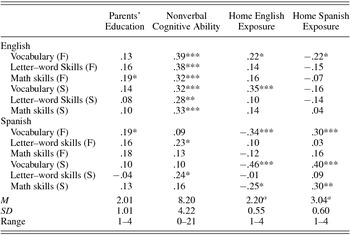
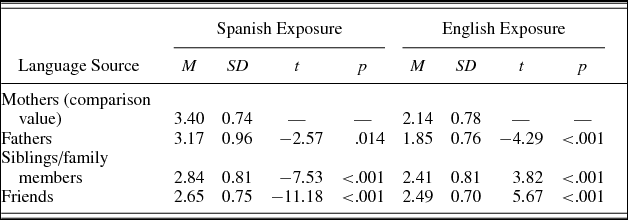
No evidence was found that children's English and Spanish skills varied by gender; thus, subsequent analyses did not control for it. Table 1 contains the means, standard deviations, and ranges of children's home English and Spanish exposure levels, nonverbal cognitive abilities, and parents’ educational levels, and their bivariate correlations with children's English and Spanish skills. Parents’ educational levels were positively correlated with children's fall math skills in English and vocabulary skills in Spanish. Nonverbal cognitive ability was positively correlated with children's fall and spring vocabulary, letter–word, and math skills in English, and with their letter–word skills in Spanish. Home English exposure levels were positively correlated with children's fall and spring vocabulary skills in English and negatively correlated with their fall and spring vocabulary and spring math skills in Spanish. With respect to Spanish exposure levels, the opposite pattern of correlations was generally evident. In addition, the children received, on average, more exposure to Spanish than English at home, but the amounts of exposure to each language varied by interlocutor (see Table 2). On average, the children received higher levels of Spanish exposure from mothers compared to that of fathers, siblings/other family members, and friends. With respect to English, compared with mothers, the children received lower levels of exposure from fathers, but higher levels from siblings/other family members and friends. As such, we controlled for parents’ educational levels, children's nonverbal cognitive ability, and English and Spanish exposure levels at home in our analyses.
Means, standard deviations, ranges, and bivariate correlations of covariates with children's English and Spanish skills

Note: F, Fall; S, spring.
a Mt (124) = 9.40, p < .001.
*p < .05. **p < .01. ***p < .001.
Mean comparisons of children's Spanish and English exposure levels at home by speaker

Note: English and Spanish exposure levels ranged from never (1) to all of the time (4). Degrees of freedom = 124.
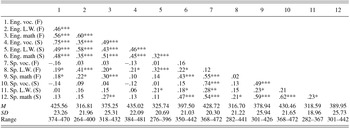
Table 3 contains the bivariate correlations, means, standard deviations, and ranges for children's English and Spanish academic skills. Children's vocabulary, letter–word, and math skills in English were positively correlated within and across the fall and spring of preschool. Their Spanish skills were similarly correlated, except for a few nonsignificant correlations regarding letter–word skills. However, children's letter–word skills in English and Spanish were positively correlated across the fall and spring. This was also the case for their math skills.
Bivariate correlations, means, standard deviations, and ranges of Spanish-speaking preschoolers’ English and Spanish skills

Note: Eng., English; voc., vocabulary; L.W., letter–word; F, fall; S, spring; Sp., Spanish.
*p < .05. **p < .01. ***p < .001.
Next, to describe children's dual language abilities, we compared their fall and spring English and Spanish skills to that of the WJ and WM norming samples. Such data provide useful information, but they should be interpreted with caution because the norming samples are not representative of DLL children (Peña & Halle, Reference Peña and Halle2011). Nonetheless, compared with the 4-year-old norms, the children in this study entered preschool performing, on average, about 1.5 SD below the mean on Spanish and English vocabulary, 1 SD below the mean on Spanish and English math, and 0.5 SD below the mean on Spanish and English letter–word skills (McGrew et al., Reference McGrew, Scrhank and Woodcock2007; Schrank et al., Reference Schrank, McGrew, Ruef, Alvarado, Muñoz-Sandoval and Woodcock2005). In the spring, compared with the 5-year-old norms, they performed about 1.5 SD below the mean on English vocabulary and letter–word skills and about 1 SD below the mean on English math. No Spanish norms are provided by the WM test developers for children 5 years of age. Thus, consistent with prior research, the children in this study entered and exited preschool performing, on average, below the normative samples of the WJ and WM assessments (Paez et al., 2007).
Associations between English and Spanish academic abilities
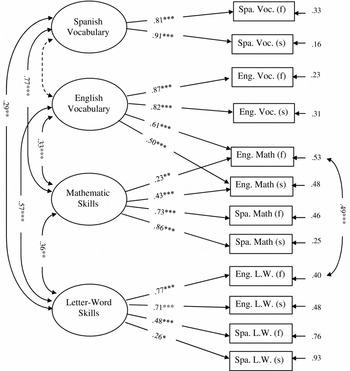
To address the first research question and examine the cross-language relations between children's English and Spanish skills, a CFA was conducted. All variables in the CFA were standardized (M = 0, SD = 1). Based on the interdependence hypothesis and prior research (Cobo-Lewis et al., Reference Cobo-Lewis, Eilers, Pearson, Umbel, Oller and Eilers2002; Cummins, Reference Cummins1979, Reference Cummins2000), we tested a CFA model with four latent factors (see Figure 1). Two of the latent factors tested whether vocabulary skills were language specific. Each of these two latent factors was indicated by the fall and spring vocabulary test scores in the relevant language. The other two latent factors tested whether letter–word and math skills were cross-linguistic, with each factor indicated by the fall and spring letter–word or math skills test scores in both languages. Because English oral proficiency has been associated with children's English math assessment performance (Abedi & Lord, Reference Abedi and Lord2001), we tested whether children's fall and spring math test scores in English loaded on the English vocabulary latent factor. Finally, the four latent factors were allowed to covary.
Confirmatory factor analysis of the associations among Spanish-speaking preschoolers English and Spanish vocabulary, letter–word, and math skills. Covariate effects are eliminated to facilitate the interpretation of the model. Standardized parameter estimates are shown. The dashed path represents a nonsignificant covariance. The measurement error terms are the proportion of unexplained variance. Eng., English; Spa., Spanish; Voc., vocabulary; L.W., letter–word; f, fall; s, spring. χ2 = 90.34, p = .124; RMSEA = 0.039, CFI = 0.978. *p < .05, **p < .01, ***p < .001.

To control for English and Spanish exposure levels at home, we calculated a relative Spanish–English exposure variable by subtracting parents’ reports of Spanish exposure from that of English; positive values indicated greater English exposure and negative values indicated greater Spanish exposure. We controlled for children's relative Spanish–English exposure levels by including paths from that variable to each latent factor. Parents’ educational levels and children's nonverbal cognitive ability were controlled for in the same manner.
The hypothesized CFA model fit the data moderately well, χ2 (70) = 95.06, p = .024; RMSEA = 0.05, and CFI = 0.96. However, six covariate paths were nonsignificant, including the paths from parents’ educational levels to each latent factor and from children's nonverbal cognitive ability to the math and Spanish vocabulary latent factors. The covariance between the Spanish and English vocabulary latent factors was also nonsignificant. These paths and covariance were set to zero. Based on the modification indices, we allowed the measurement errors of children's fall English letter–word and math test scores to covary, which implies significant task-specific variance that was unaccounted for by the latent factor covariance.
As shown in Figure 1, the resulting CFA model fit the data well. Regarding covariate effects (not depicted in Figure 1), children's relative Spanish and English exposure at home was positively linked with the letter–word skills and English vocabulary latent factors and negatively linked with the Spanish vocabulary latent factor. In addition, children's nonverbal cognitive ability was positively linked with the letter–word and English vocabulary latent factors. More important, the positive indicator loadings and nonsignificant covariance between the Spanish and English vocabulary latent factors suggest that these skills may develop independently during preschool. Letter–word and math skills, however, appeared to be interdependent given that children's English and Spanish test scores loaded on the respective latent factor, regardless of language. The indicator loadings of fall and spring math skills on the English vocabulary latent factor suggest that children's performance on the English math assessments relied partly on their English vocabulary skills. Finally, the positive covariances among the latent factors suggest that letter–word and math skills vary together with English and Spanish vocabulary skills.
Changes in English and Spanish academic abilities
To address the second and third research questions, we used mixed-model repeated measures analyses to examine the changes in children's vocabulary, letter–word, and math skills in English and Spanish and the transfer of skills from Spanish to English. Mixed-model repeated measures analyses are ideal for examining changes over time with multiply imputed data sets. Separate models were tested by skill type and language. To assess the changes in children's skills, time of year (fall and spring) served as the within-subjects factor. In the models examining the changes in vocabulary, letter–word, and math skills in English, we included children's prior Spanish skills as between-subjects factors to test hypotheses of cross-linguistic transfer. Finally, in all the models tested, we controlled for children's nonverbal cognitive ability, relative Spanish and English exposure at home, and parents’ educational levels.
Given that children were sampled from 10 different preschool classrooms, we controlled for classroom-level effects as a random factor, in part to serve as a proxy for varying levels of English and Spanish support in the classrooms. However, the classroom effect (averaged across the 10 multiply imputed data sets) was nonsignificant (p > .05) across all the repeated measures models tested. In addition, the patterns of fixed effects did not vary between the repeated measures models that included classroom as random factor and those that excluded it. As such, we present the results that excluded classroom as a random factor. Finally, no statistically significant (p < .05) interaction effects were found among the fixed factors. Thus, we present only main effects.
Vocabulary skills
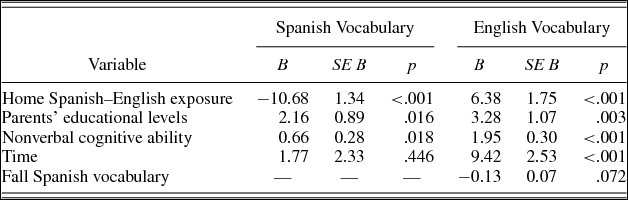
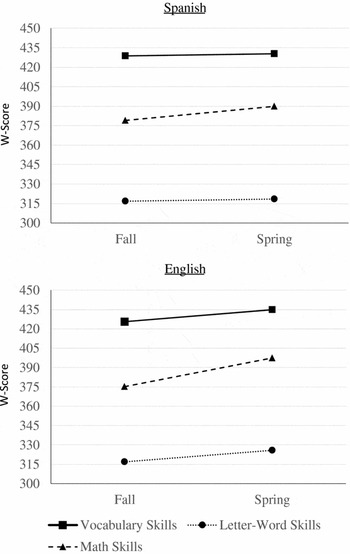
As shown in Table 4, the relative Spanish–English exposure levels at home had a negative effect on children's Spanish vocabulary, whereas their nonverbal cognitive ability and parents’ educational levels had positive effects. The effect of time, however, was nonsignificant, indicating that children's Spanish vocabulary skills did not change throughout preschool (see Figure 2). With respect to English vocabulary, home Spanish–English exposure levels, parents’ educational levels, and children's nonverbal cognitive ability had positive effects. More important, the time factor had a positive effect, indicating that children exhibited gains in English vocabulary across the fall (M = 425.56, SD = 23.26) and spring (M = 435.02, SD = 22.09) of preschool. The nonsignificant effect of fall Spanish vocabulary suggests that these Spanish skills may not contribute to children's English vocabulary gains.
Mixed-model repeated measures analysis of the changes in Spanish-speaking children's vocabulary skills in English and Spanish from beginning to end of preschool

Changes in Spanish-speaking children's vocabulary, letter–word, and math skills in Spanish and English across the fall and spring of preschool.

Letter–word skills
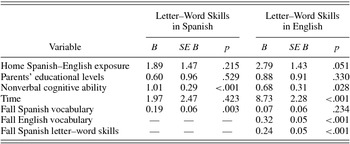
Nonverbal cognitive ability and fall Spanish vocabulary skills had positive and significant effects on children's Spanish letter–word skills (see Table 5). However, the effect of time was nonsignificant, suggesting that children's Spanish letter–word skills did not change during preschool (see Figure 2). With respect to English, as shown in Table 5, the positive effect of home Spanish–English exposure approached significance. Children's nonverbal cognitive ability had a positive effect. The positive effect of time indicated that children gained English letter–word skills from the fall (M = 316.81, SD = 21.96) to the spring (M = 325.74, SD = 20.69), and their fall Spanish letter–word skills had a positive effect on English letter–word skills, suggesting cross-linguistic transfer. Children's fall English vocabulary skills also had a positive effect. However, the effects of parents’ educational levels and children's fall Spanish vocabulary skills were nonsignificant.
Mixed model repeated measures analysis of the changes in Spanish-speaking children's letter–word skills in English and Spanish from beginning to end of preschool

Math skills
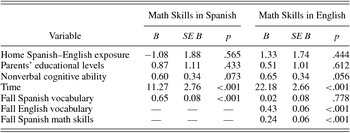
As shown in Table 6, the positive effect of nonverbal cognitive ability on children's math skills in Spanish approached significance. Moreover, time had a significant and positive effect, indicating that children made significant math skill gains in Spanish across the fall (M = 378.94, SD = 25.94) and spring (M = 389.95, SD = 25.73; see Figure 2). Children's fall Spanish vocabulary skills also had a significant and positive effect, whereas their home Spanish–English exposure and parents’ educational levels had nonsignificant effects. With respect to math skills in English, the positive effect of children's nonverbal cognitive ability approached significance. Time also had a positive effect. Thus, children gained math skills in English across the fall (M = 375.25, SD = 87.92) and spring (M = 397.50, SD = 21.03). Their fall math skills in Spanish also had a positive effect on their math skill gains in English, suggesting cross-linguistic transfer. In addition, fall English vocabulary skills had a positive effect on children's math skills in English. Finally, the effects of home Spanish–English exposure, parents’ educational levels, and children's fall Spanish vocabulary skills were nonsignificant.
Mixed model repeated measures analysis of the changes in Spanish-speaking children's mathematic skills in English and Spanish from beginning to end of preschool

DISCUSSION
In the present study, we examined the associations among Spanish-speaking children's vocabulary, letter–word, and math skills in English and Spanish and the changes that they exhibited in those skills after 1 year of preschool (controlling for parents’ use of Spanish and English at home, their educational levels, and children's nonverbal cognitive ability). Based on the confirmatory analysis, children's vocabulary knowledge appeared to be unassociated across languages. However, the same analysis suggested that letter–word and math skills were linguistically interdependent. With respect to the changes in English and Spanish skills, children gained vocabulary and letter–word skills in English and math skills in English and Spanish throughout 1 year of preschool. Children's Spanish vocabulary and letter–word skills, however, did not appear to change. Regarding the cross-linguistic relations, Spanish vocabulary at the start of preschool did not appear to associate with children's English vocabulary gains, whereas letter–word and math skills in Spanish at the start of preschool were positively associated with their English letter–word and math gains. Finally, English vocabulary skills at the start of preschool were positively associated with letter–word and math skill gains in English.
Cross-language associations and academic skill changes
Our findings add to the literature suggesting that Spanish-speaking preschoolers’ English and Spanish expressive vocabulary skills (i.e., sound–meaning associations) may be unassociated concurrently, and that children are likely to gain valuable English vocabulary skills during 1 year of preschool (Miccio, Tabors, Paez, Hammer, & Wagsaff, Reference Miccio, Tabors, Paez, Hammer and Wagstaff2005; Paez et al., 2007; Tabors et al., Reference Tabors, Paez and Lopez2003). That is, consistent with prior research on school-age Spanish-speaking children, we did not find that preschoolers’ expressive vocabulary skills excelled in one language at the expense of the other, nor that their expressive vocabularies excelled or diminished in both languages simultaneously (Cobo-Lewis et al., Reference Cobo-Lewis, Eilers, Pearson, Umbel, Oller and Eilers2002). Prior Spanish vocabulary skills did not appear to sway the development of English vocabulary. This is key because preschool English vocabulary skills have been shown to enhance Spanish-speaking children's English reading performance in school (Hammer et al., Reference Hammer, Lawrence and Miccio2007; Kieffer, Reference Kieffer2012). As such, enhancing Spanish-speaking children's English vocabulary skills in preschool appears critical to maximize their English academic readiness.
In addition, preschoolers’ letter–word skills in English and Spanish were positively associated, with the Spanish skills possibly scaffolding the building of English skills. That is, entering preschool with high levels of Spanish letter–word skills appeared to enhance children's learning of English letter–word skills. Prior research has reported similar findings with school-age Spanish-speaking children (Cobo-Lewis et al., Reference Cobo-Lewis, Eilers, Pearson, Umbel, Oller and Eilers2002; Gottardo, Reference Gottardo2002; Lindsey et al., Reference Lindsey, Manis and Bailey2003), but the generalizability to preschool-age children was unclear. Our findings are also consistent with the idea that the transfer of literacy knowledge between children's first and second language is enhanced when both languages share an orthographic system, such as Spanish and English (Bialystok et al., Reference Bialystok, Luk and Kwan2005). Reading skills in languages with a high correspondence between sounds and orthographic phonemes, such as Spanish, may facilitate the learning of reading in languages with a low correspondence between sounds and orthographic phonemes, such as English (Murphy, Macaro, Alba, & Cipolla, Reference Murphy, Macaro, Alba and Cipolla2015). Alongside research with English monolinguals suggesting that preschool letter–word skills are likely to foster letter–word and reading comprehension skills in school (NICHD Early Child Care Research Network, 2005), the present study suggests that strengthening Spanish-speaking children's Spanish letter–word skills in preschool may enhance their English letter–word skills prior to entering school. In addition, by enhancing their Spanish letter–word skills, they might be able to capitalize on the orthographic and semantic similarities between some Spanish and English words, which has been shown to facilitate the learning of English literacy (Hancin-Bhatt & Nagy, Reference Hancin-Bhatt and Nagy1994).
We also found that Spanish-speaking children made significant gains in their math skills in Spanish and English over the course of 1 year of preschool. Moreover, children's math skills appeared to be interdependent across languages, with their math skills in Spanish at the start of preschool seemingly enhancing the learning of math skills in English. Thus, children's math skills in Spanish and English developed simultaneously. Alongside other research suggesting that individual differences in preschool math skills persist into school, our findings demonstrate that strengthening Spanish-speaking preschoolers’ math skills in Spanish might be a potential avenue toward fostering their math skills in English (Aunola et al., Reference Aunola, Leskinen, Lerkkanen and Nurmi2004; Duncan et al., Reference Duncan, Dowsett, Claessens, Magnuson, Huston and Klebanov2007). However, further research is necessary.
Given the mixed findings of past research, the present study examined the changes in children's Spanish skills in an exploratory manner. The Spanish vocabulary and letter–word skills of the Spanish-speaking children did not change after 1 year of preschool; although they made no gains in these areas, they also did not exhibit losses in their skills. However, this means that, despite the positive association between letter–word skills in Spanish and English, children's letter–word skills in Spanish and English did not develop simultaneously during the course of the preschool year. This might have been a function of the classroom language environment. Although we found no significant classroom-level effects (which served as a proxy for varying levels of English and Spanish support in the classrooms), the preschool teachers in this study reported conducting classroom activities in English more than in Spanish. This might explain children's lack of gains in Spanish vocabulary and letter–word skills. The work of Barnett et al. (Reference Barnett, Yarosz, Thomas, Jung and Blanco2007) is consistent with this idea. They found that Spanish-speaking children in bilingual preschool programs were likely to achieve gains in Spanish vocabulary knowledge throughout a year of preschool, whereas the children in English-only preschool programs did not make gains in Spanish vocabulary knowledge.
Implications and limitations
The possibility of language-specific expressive vocabulary knowledge highlighted in this study has implications for early childhood educators. Our findings are consistent with the idea that Spanish-speaking children who enter preschool with limited English proficiency rely on the classroom setting to build their English vocabularies. Research with school-age Spanish-speaking children has shown that teaching a few English words at a time and using them in meaningful and varying contexts in classroom settings is likely to foster their English vocabulary skills, and this approach may also work with preschoolers (Carlo et al., Reference Carlo, August, Mclaughlin, Snow, Dressler and Lippman2004; Lesaux, Kieffer, Faller, & Kelley, Reference Lesaux, Kieffer, Faller and Kelley2010). In classrooms with both English- and Spanish-speaking preschoolers, this approach would provide opportunities for both groups to acquire new English words and strengthen their knowledge of familiar ones.
Another important finding is that letter–word and math skills in Spanish at the start of preschool were positively associated with letter–word and math skill gains in English throughout the academic year. This might have implications for educational interventions at home. Our findings suggest that strengthening children's Spanish literacy skills at home may facilitate their learning of English literacy in preschool. Similarly, strengthening their math skills in Spanish may facilitate their learning of those skills in English. Parents can foster Spanish-speaking preschoolers’ early mathematical skills at home by including math-related speech in Spanish conversations, such as counting and ordering elements (Klibanoff et al., Reference Klibanoff, Levine, Huttenlocher, Vasilyeva and Hedges2006). Teachers can encourage parents to engage in these types of activities with children in whichever language they prefer. In addition, interventions designed to foster literacy and math skills in the home can be delivered and use materials in Spanish.
Several limitations of this study are noteworthy. First, our study sample comprised Spanish-speaking children enrolled in preschool classrooms with a majority of Spanish-speaking students. Consequently, the extent to which the findings can be generalized to Spanish-speaking children enrolled in preschool classrooms with different distributions of English- and Spanish-speaking students may be limited. Preschool classrooms with more English-speaking students may provide greater English exposure than Spanish-majority classrooms, which may foster Spanish-speaking children's English academic skills (Palermo et al., Reference Palermo, Mikulski, Fabes, Hanish, Martin and Stargel2014). Second, because we focused on Spanish and English skills, the extent to which our findings are generalizable to DLL children whose first language is not Spanish or who are acquiring two other languages may be limited, especially if the two languages do not share an orthographic system. Third, we did not measure classroom quality or the relative use of English and Spanish by teachers during instructional times. Thus, we were unable to gauge whether the classroom quality or the amounts of time that teachers spent instructing students in English or Spanish was associated with children's English and Spanish skills. Fourth, although our measure of cognitive ability may be associated with children's language learning capabilities, we did not measure those capabilities directly. As such, we were unable to assess the extent to which language learning capabilities underlie the transfer of skills between languages (Castilla et al., Reference Castilla, Restrepo and Perez-Leroux2009). Fifth, it is possible that the positive cross-language associations among letter–word and math skills found in this study may be due to the similarity in content between the English and Spanish assessments and not entirely about language. Sixth, this study followed children over the course of a preschool year only, so it does not provide insight into the development of their English and Spanish abilities in kindergarten and beyond.
Directions for future research
Given the aforementioned limitations, future research should investigate whether the cross-linguistic linkages between preschoolers’ English and Spanish skills and the changes they make in those skills during the academic year vary by classroom-level differences, such as the level of support they receive for Spanish and English. Future studies should also examine the variability in Spanish-speaking children's English gains and identify the environmental and personal characteristics of those who achieve the largest gains. Our findings highlight the possibility that Spanish-speaking preschoolers who exhibit high levels of nonverbal cognitive ability at the start of preschool may have a greater propensity to gain English vocabulary, letter–word, and math skills than those who exhibit low levels of nonverbal cognitive ability, but further research is necessary. Furthermore, because our findings may be specific to DLL preschoolers, it is important to conduct longer term follow-ups to assess whether (a) the extent to which letter–word and math skills associate across Spanish and English diminishes over time as children's English skills increase and (b) whether some aspects of vocabulary (e.g., cognates) become interdependent across languages as children acquire increasingly complex and abstract vocabulary skills that involve higher order thinking, including the ability to define words, distinguish word classes, and comprehend substitutional word relations (Carlisle, Beeman, Davis, & Spharim Reference Carlisle, Beeman, Davis and Spharim1999; Ordóñez, Carlo, Snow, & McLaughlin, Reference Ordóñez, Carlo, Snow and McLaughlin2002). Studies with older DLL children that consider varying aspects of vocabulary, literacy, and math knowledge may reveal different patterns of associations across Spanish and English skills.
As the number of Spanish-speaking children in US schools grows, it is increasingly important to understand the factors associated with their academic readiness for school, particularly their English skills. The present study built on previous research by following a sample of predominantly Mexican-origin children over the course of a single year in preschool and identifying the connections between their English and Spanish vocabulary, letter–word, and mathematic skills and examining the extent to which Spanish skills associated with their English skill gains. Consistent with observations about the importance of preschool for DLL children (Yoshikawa et al., Reference Yoshikawa, Weiland, Brooks-Gunn, Burchinal, Espinosa and Gormley2013), the findings highlight the key role that preschool programs may play in enhancing Spanish-speaking children's English academic readiness and potential avenues toward advancing their English abilities by teaching them vocabulary in English and letter–word and math skills in both languages, and thereby increasing our understanding of the best ways to foster Spanish-speaking children's English acquisition, school readiness, and academic success.
ACKNOWLEDGMEMTS
This work was supported by US Department of Health and Human Services Grant 90YF0062 (to A.M.M., R.A.F., C.L.M., L.D.H., and F.P.).