“A thief is someone who takes things and who returns them later,” said determinedly one of our 4-year-old participants. This might not be the best definition for a thief, but it can certainly teach us something about the syntactic abilities of this child. For example, it teaches us that he is able to use the subject relative construction. This study looked at definitions from a new angle: as a valuable tool for assessing the syntactic ability of children as it develops throughout various stages of language acquisition.
Definition tasks are traditionally used to assess semantic and pragmatic abilities of children. They provide information regarding their categorization abilities and about lexical knowledge and lexical retrieval abilities (Aram, Reference Aram2005; Benelli, Arcuri, & Marchesini, Reference Benelli, Arcuri and Marchesini1988; Litowitz, Reference Litowitz1977; Markowitz & Franz, Reference Markowitz and Franz1988; Snow, Reference Snow1990; Wehren, De Lisi, & Arnold, Reference Wehren, De Lisi and Arnold1981; Wolman & Barker, Reference Wolman and Barker1965). Providing definitions is an ability that is valued in classrooms and on intelligence tests (Wechsler, Reference Wechsler1974). Children's definitions have been found to be related to the formation of the concept of the word (Dickinson & Tabors, Reference Dickinson and Tabors1991), as well as to reading comprehension achievements (Aram & Levin, Reference Aram and Levin2004; Snow, Reference Snow and Daiute1993).
It is important that the definitions might also be revealing with respect to syntactic abilities, because a common definition usually uses the structure “An X is a Y that. . . .”, namely, a structure of a relative clause. Relative clauses have drawn much attention in language acquisition research, because although they occur frequently in the input, children acquire them relatively slowly, and with intriguing differences between production and comprehension (Günzberg-Kerbel, Shvimer, & Friedmann, Reference Günzberg-Kerbel, Shvimer and Friedmann2008) and between various types of relative clauses (Corrêa, Reference Corrêa1982, Reference Corrêa1995; de Villiers, Tager Flusberg, Hakuta, & Cohen, Reference de Villiers, Tager Flusberg, Hakuta and Cohen1979; Diessel & Tomasello, Reference Diessel and Tomasello2000; Friedmann, Belletti, & Rizzi, Reference Friedmann, Belletti and Rizzi2009; Friedmann & Costa, Reference Friedmann and Costa2010; Friedmann et al., Reference Friedmann, Belletti, Tuller, Costa, Guasti and Lobo2010; Guasti & Cardinaletti, Reference Guasti and Cardinaletti2003; Kidd & Bavin, Reference Kidd and Bavin2002; Sheldon, Reference Sheldon1974; Tavakolian, Reference Tavakolian and Tavakolian1981).
Relative clauses are derived by movement of a phrase from within the embedded clause, which is related to the head of the relative clause. For example, in the subject relative (1) below, the head of the relative clause, “the girl,” moves from the subject position of the embedded clause, leaving behind an empty position, marked here by an underline. In sentence (2), which is an object relative, “the girl” moves from the embedded object position, and in sentence (3), an indirect object relative clause, it is the indirect object that moved.Footnote 1
(1) Subject relative: This is the girl that __ is drawing the grandmother.
(2) Object relative: This is the girl that the grandmother is drawing __.
(3) Indirect object relative: This is the girl that the grandmother talked about __.
Relative clauses may thus be used as a window to the acquisition of structures that are derived by movement of a phrase. Their higher frequency in the input of children (compared to passives or clefts, e.g., which are also derived by phrase movement but are far less frequent in Hebrew) makes them a good candidate for research in language acquisition: in our count of 6,047 sentences in Hebrew children's books, 14.4% of the sentences were relative clauses (Friedmann & Novogrodsky, Reference Friedmann and Novogrodsky2004). Maschler and Shaer (Reference Maschler, Shaer, Auer and Pfänder2011) found 178 relative clauses (115 with a referential head and 63 free relatives) in 158 min of free conversations of Hebrew-speaking adults with their friends and relatives, namely, more than one relative clause per minute.
In the course of language acquisition, children produce relative clause sentences as early as around age 3 years (Berman, Reference Berman and Shimron1997; Crain, McKee, & Emiliani, Reference Crain, McKee, Emiliani, Frazier and de Villiers1990; de Villiers, de Villiers, & Hoban, Reference de Villiers, de Villiers, Hoban and Tager-Flusberg1994; Labelle, Reference Labelle1990, Reference Labelle1996; McKee & McDaniel, Reference McKee and McDaniel2001; McKee, McDaniel, & Snedeker, Reference McKee, McDaniel and Snedeker1998; Varlokosta & Armon-Lotem, Reference Varlokosta and Armon-Lotem1998; Varlokosta & Crain, Reference Varlokosta and Crain1997).
Findings from spontaneous speech analysis and from elicited production tests indicate that Hebrew-speaking children start producing relative clauses around the age of 3 years, similarly to reports from other languages. Berman (Reference Berman1986; Berman & Neeman, Reference Berman, Neeman, Berman and Slobin1994) found that one-quarter of the Hebrew-speaking children aged 3 to 4 years produced relatives in a story telling task, half of the children aged 5 to 8 years produced relatives in their stories, and most of the fourth graders aged 9 to 10 years produced relative clauses, in a proportion similar to that of adults. Clark and Berman (Reference Clark and Berman1987) found that children use relatives from the age of 3 in a description task for novel noun compounding.
Some researchers have suggested that although these early relative clauses superficially look like the adult structures, at least some of them are represented by the children as structures without movement. This is reflected in the preference to produce relative clauses with a resumptive pronoun (such as “This is the girl that the grandmother is drawing her”), which creates a structure without movement (Shlonsky, Reference Shlonsky1992). This overuse of pronouns at the gap position in relative clauses is characteristic of early relative clauses in various languages (English: de Villiers, Reference de Villiers1988; Pérez-Leroux, Reference Pérez-Leroux1995; French: Ferreiro, Othenin-Girard, Chipman, & Sinclair, 1976; Labelle, Reference Labelle1990; Greek: Varlokosta & Armon-Lotem, Reference Varlokosta and Armon-Lotem1998; and Spanish: Ferreiro et al., Reference Ferreiro, Othenin-Girard, Chipman and Sinclair1976; Pérez-Leroux, Reference Pérez-Leroux1995; for discussions of movement in early relative clauses, see Guasti & Shlonsky, Reference Guasti and Shlonsky1995; Varlokosta & Armon-Lotem, Reference Varlokosta and Armon-Lotem1998; Varlokosta & Crain, Reference Varlokosta and Crain1997; for the report of different rates of resumptive pronouns in different relative clause structures, see Guasti & Cardinaletti, Reference Guasti and Cardinaletti2003).
Suñer (Reference Suñer1998) showed that whereas children use resumptive pronouns also in languages and structures in which resumptive pronouns are ungrammatical in the adult target languages, they actually use an option that is grammatical in some adult languages. Hebrew is one such language in which resumptive pronouns are sometimes grammatical. In Hebrew, resumptive pronouns are ungrammatical in subject relatives, optional in object relatives, and obligatory in indirect object relatives. Young children who acquire Hebrew, however, use resumptive pronouns in all types of relatives. Varlokosta and Armon-Lotem (Reference Varlokosta and Armon-Lotem1998) reported that children aged 2 years, 8 months (2;8) to 5;5 produced 24% of their subject relatives with resumptive pronouns in subject position, 93% of their object relatives, and 91% of the indirect object relatives. Günzberg-Kerbel et al. (Reference Günzberg-Kerbel, Shvimer and Friedmann2008) found that 9% of the subject relatives produced by 22 Hebrew-speaking children aged 3;7 to 5;0 included an (ungrammatical) resumptive pronoun in the embedded subject position, and 62% of the object relatives were produced with a resumptive pronoun. The heavy reliance on resumptive pronouns in relative clauses decreases when the children reach school age (Friedmann & Costa, Reference Friedmann, Belletti, Tuller, Costa, Guasti and Lobo2011; Friedmann, Novogrodsky, Szterman, & Preminger, Reference Friedmann, Novogrodsky, Szterman, Preminger, Armon-Lotem, Danon and Rothstein2008; Friedmann & Szterman, Reference Friedmann and Szterman2006; Novogrodsky & Friedmann, Reference Novogrodsky and Friedmann2006).
Further studies reported interesting differences between four types of relatives in Hebrew: subject relatives, object relatives, object relatives with resumptive pronouns, and indirect object relatives. In a picture description task aimed to elicit various types of relative clauses (Berman, Reference Berman1986), 3- to 4-year-olds produced 37% of the target subject relatives, 28% of the object relatives, and only 13% of the indirect object relatives. Significantly better production of subject relatives compared to object relatives was also reported by Günzberg-Kerbel et al. (Reference Günzberg-Kerbel, Shvimer and Friedmann2008) for Hebrew-speaking children aged 3;7 to 5;0: of 616 utterances they produced in a relative clause elicitation task, 28.7% were subject relatives, and only 18.5% were object relatives (see also Friedmann et al., Reference Friedmann, Belletti and Rizzi2009, for the comparison between subject and object relatives). By the age of 5 to 6 years the children in Berman's study already produced 65% of the subject relatives and 62% of the object relatives but only 36% of the indirect object relatives, indicating a relatively delayed acquisition of indirect relative clauses. Varlokosta and Armon-Lotem (Reference Varlokosta and Armon-Lotem1998) used a toy elicitation task in Hebrew-speaking children aged 2;8 to 5;5 years to elicit relative clauses. Out of the 72 target relatives of each type, their participants produced 42 subject relatives, 38 object relatives, and 35 indirect object and prepositional phrase relatives. Although Varlokosta and Armon-Lotem's study did not divide the participants into age groups as Berman's study did (3–4, 5–6), the developmental pattern was similar, with indirect object relatives and prepositional phrase relatives acquired later than subject and object relatives. Armon-Lotem, Botwinik-Rotem, and Birka (Reference Armon-Lotem, Botwinik-Rotem, Birka, Belletti, Bennati, Chesi, Di Domenico and Ferrari2006) showed that the resumptive pronoun in locative and oblique indirect object relatives is frequently omitted in children aged 3;4 to 6;0.
Why are indirect object relatives acquired later? In Hebrew, indirect object relatives include a preposition inflected for the relevant pronoun. For example, the preposition “on” inflects for the various third person pronouns (singular masculine, singular feminine, plural masculine, plural feminine) in the following manner: alav, aleiha, aleihem, and aleihen, respectively. According to Berman (Reference Berman1978, Reference Berman1986) the difficulty in the acquisition of indirect object relatives lies in the association between the preposition and the pronoun.Footnote 2
One way to explore this suggestion is to test when pronouns with and without prepositions are produced outside of a relative clause context (“you sit on-it”), compared to these pronouns in relative clauses, an analysis we will conduct in the current study.
Another aim of this study was to see whether the later acquisition of relative clauses in general relates to the acquisition of embedding. Relative clauses include not only movement of a phrase, but also embedding, using “that” or “who.” We will test whether relative clauses appear in children's speech together with embedded sentences that do not require syntactic movement, or later. Previous studies of Hebrew report that children start producing embedded sentences already after the age of 2 years, and that the first embedded clauses are not relative clauses. The assessment of relative clause production using narrative analysis and story telling indicated that the use of embedded sentences increases with age: from 10% at the age of 3 years to 15% at the age of 4 and 18% at the age of 9 to 10 years. As for adult sentences, 23% of the sentences produced are embedded (Berman, Reference Berman1988, Reference Berman and Shimron1997; Dromi & Berman, Reference Dromi and Berman1986).
Berman (Reference Berman and Shimron1997) concluded that a consistent increase in the use of embedding with age is strong evidence that the amount of embedded clauses produced is a reliable index for the level of language development within and between age groups. She further noted that from the age of 3 this is a better index than mean length of utterance, because at this age children reach grammatical mastery that cannot be defined by the mean length of utterance index (p. 77). The participants in the current study are at this age range. It is interesting to see if the syntactic analysis of the definition task supports this trend.
With respect to the order of acquisition of embedded clauses without movement and relative clauses, which are embedded sentences with movement, an analysis of speech samples of Hebrew-speaking children indicates that embedded clauses without movement precedes the production of relative clauses: in a longitudinal analysis of spontaneous speech corpora of 5 children between the ages of 1;4 and 3;0 (encompassing 21,285 utterances), sentential embedding appeared in their spontaneous speech before relative clauses, except for 1 child who produced one subject relative 12 days before her first production of an embedding without movement (Friedmann, Reznick, & Lavi, in press; but see Armon-Lotem, Reference Armon-Lotem, Diskin Ravid and Shyldkrot2005). An analysis of speech samples from 56 children aged 1;6 to 6;1 (including 6,400 utterances) yielded similar results: all the children who produced relative clauses also produced embedding without movement (43% of the children), but there were children who already produced embedding without movement who did not produce any relative clause (34% of the children). There was no child who produced relatives but did not also produce embedding without relatives (Friedmann et al., in press).
Finally, dependencies between two constituents can occur both in sentences that are derived by syntactic movement, as is the case in relative clauses, and in sentences without movement that include pronouns. Syntactic movement creates a dependency between the moved element and its original position (its “trace”). Pronouns also create a dependency to a noun that appeared earlier. Is the difficulty in the production of relative clauses at an early age and the gradual mastery of relative clauses with age related to the ability to create long distance dependencies in general, or is it related to the specific ability to create movement dependency between the trace and the element that has moved? If it is related to dependencies, both types of structures should appear only later and should develop in parallel, but if the difficulty is specifically related to syntactic movement rather than to syntactic dependencies in general, then sentences without movement with pronouns are expected to appear before sentences that require movement. For this aim we analyzed the use of pronouns and compared it to the use of relative clauses.
Thus, this study used a traditional task for a novel aim: we used the analysis of children's responses to a definition task to evaluate the course of acquisition of various aspects of relative clauses, embedding, and pronoun use in Hebrew-speaking children.
METHOD
Participants
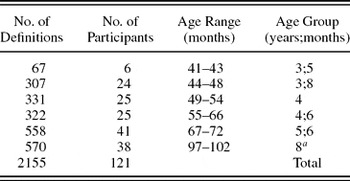
The study included 121 Hebrew-speaking children. There were 64 girls and 57 boys, who were aged 41 to 72 months (3;5–6;0, M = 57.7 months, SD = 9.8 months). Thirty-eight of the children who participated in the 67- to 72-month age group (20 girls, 18 boys) were first tested when they were in kindergarten (in January) and were then retested 2.5 years later when they were at the end of second grade (in June). This allowed for the testing of correlations and differences between their production abilities in the two ages. In the tables throughout the article, the participants were subdivided into six age groups, as shown in Table 1.
Descriptions of the age groups

aRetested.
The children were recruited from two low socioeconomic status Israeli townships: one in central Israel, geographically adjacent and administratively affixed to the major city of Tel Aviv, and the second from the northern periphery of Israel.Footnote 3
Procedure
Each child was requested to define 14 nouns (e.g., “What is a clock?”) using an adaptation of the definitions task (Snow, Cancino, Gonzalez, & Shriberg, Reference Snow, Cancino, Gonzalez, Shriberg and Bloome1989) to Hebrew (Aram & Levin, Reference Aram and Levin2001). The nouns were alef-bet, ofanayim, cipor, sha'on, yahalom, xamor, perax, regel, kova, sakin, masmer, shrafraf, ganav, mitriya (alphabet, bicycle, bird, clock, diamond, donkey, flower, foot, hat, knife, carpentry-nail, stool, thief, umbrella).
The instruction for the child (translated from Hebrew) was the following: “Now I will say several words, and you will tell me what is the meaning of each word—what is each thing.” Then, the experimenter asked about each word: “What is . . .” (e.g., ma ze mitriya?, “what is an umbrella?”). No time limit was set. The experimenter did not give the participants any response-contingent feedback as to their success or failure on the test items, only general encouragement. The examiner gave the next target word when the participant finished her previous definition.
Analysis
A total of 2,155 definitions were collected. For each definition each child produced, we analyzed whether it included a relative clause or not, and whether it included an embedded sentence. A definition was classified as including a relative clause with a head when it included a nominal head, a complementizerFootnote 4 (the Hebrew complementizer she-, that), and a clause with a verb and a resumptive pronoun agreeing with the head, or a trace. A definition was classified as a headless relative clause when it had the same structure but included no head, but rather started with the complementizer.
For sentences that included a relative clause, we analyzed the type of the relative clause: subject, object, or indirect object relative clause; we also assessed for each relative clause whether it was grammatical or not, and if it was ungrammatical, we coded the type of ungrammaticality. Within the responses that included an embedded sentence we counted how many of them included relative clauses, and which types of embedding were used (including purpose clause, temporal clause, and sentential embedding to a verb). We also analyzed other indications of dependency that did not include a relative clause, such as the use of sentences with pronouns that did not include embedding (such as “one rides on it” for bicycle). Some children provided no response for some of the target words, and some children provided more than a single definition for a target noun. Therefore, for each participant, the total number of definitions produced was counted.
RESULTS
Production of relative clauses in general
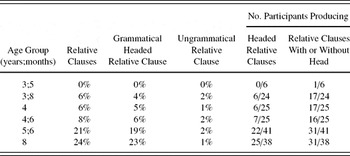
The six youngest children, aged 3;5 to 3;7, did not produce any headed relative clause in the 67 definitions they provided. However, already at age 3;8, children used relative clauses in their definitions (6%), and the rate of relative clauses out of the total number of definitions increased with age (r = .32, p < .0001). Table 2 reports the rate of production of full relative clauses with a relative head by age group, the rate of ungrammatical relatives per age group, and the number of participants in each age group who produced relative clauses with and without a relative head.
General production of grammatical and ungrammatical relative clauses out of the total number of definitions and the number of participants producing relative clauses out of the number of children in this age group

Production of grammatical and ungrammatical relative clauses. As seen in Table 2, the rate of grammatical relative clauses out of the total number of definitions produced also increased with age (r = .39, p < .0001). It is important that there were hardly any ungrammatical relative clauses. In all age groups, the rate of ungrammatical relative clauses did not exceed 2% of the definitions produced, and there was no difference in the rate of ungrammatical relative clause production between the groups, and no correlation with age (r = −.02, p = .77).
The few errors that occurred related exclusively to resumptive pronouns: productions of a pronoun where it is ungrammatical, and omissions of an obligatory pronoun. In Hebrew, resumptive pronouns are ungrammatical in subject relatives (*“A thief is someone who he steals.”); are obligatory in indirect object relatives (“A knife is something that mommy can cut with-it.”); and are optional in direct object relative clauses. Out of 152 subject relatives produced, there were 13 errors of inserting a resumptive pronoun at the embedded subject position; see Example (4). Out of 97 indirect object relatives, 15 were produced without the obligatory prepositional phrase that includes a resumptive pronoun; see Examples (5) and (6).
(4) M.D., 4;6, defining a donkey:
mishehu she-hu doher
somebody that-he gallops
“Someone who he gallops.”
(5) M.Y., 4;9, defining a knife:
mashehu she-xotxim
something that-(arbitrary pro)Footnote 5-cutting (omitted: with-it)
“Something that one cuts.”
(6) M.Y., 4;9, defining a nail:
mashehu she-metaknim
something that-(arbitrary pro)-fixing (omitted: with-it)
“Something that one fixes.”
None of the children produced ungrammatical subject, object, or indirect object relatives with doubling of the relative head at the gap position (i.e., they did not produce ungrammatical sentences like *The horse that the horse jumps, or *The furniture that one puts legs on the furniture), which are characteristic of the relative clauses produced by school-age children with a hearing impairment (Friedmann et al., Reference Friedmann, Novogrodsky, Szterman, Preminger, Armon-Lotem, Danon and Rothstein2008; Friedmann & Szterman, Reference Friedmann and Szterman2006), and also occur, to a lesser extent, in young children acquiring Hebrew in relative clause elicitation tasks. For example, the age 3;7 to 5;0 children in Günzberg-Kerbel et al. (Reference Günzberg-Kerbel, Shvimer and Friedmann2008) produced 7.5% and 2.1% doubling at the gap position in subject and object relatives, respectively.
Another interesting finding is that the children in our study never omitted the complementizer in a relative clause. Whereas in English relative clauses can occur without a complementizer (A flower is something you pick), in Hebrew complementizerless relative clauses like maxshir xotxim ito (*a tool cut-arbitrary-pro with-it), and mashu merixim ve-kotfim (*something smell- arbitrary-pro and pick-arbitrary-pro) are completely ungrammatical without the complementizer she- (and perfectly grammatical with this complementizer). In a study of English relative clauses, Diessel and Tomasello (Reference Diessel and Tomasello2000) reported that the children did produce relative clauses without a complementizer. The difference between the findings probably results from the fact that in English some relative clauses without a complementizer are possible and are “produced in natural conversations by adult native speakers of English,” and “This construction is . . . so widely attested that its existence cannot be disputed” (Diessel & Tomasello, Reference Diessel and Tomasello2000, p. 140).
Thus, the gradual acquisition of relative clause production is evinced in the rate of relative clauses produced, but not in the number of errors—young children usually produce definitions without a relative clause, but when they do produce a relative clause, it is usually grammatical. It seems that this stems from the relatively free nature of the definition task, which, unlike relative clause elicitation tasks, does not force the child to produce a relative clause when it is not yet mastered, and allows the use of varied structures instead.
Embedding
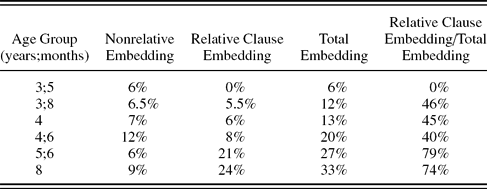
Relative clauses are embedded structures. Is the increase in the rate of relative clauses produced with age a result of an improved ability to embed sentences? For this aim we divided all embedded sentences into embedded sentences with a relative clause and embedded sentences without relative clauses.Footnote 6 The embedded sentences without relative clauses were 89 sentences that included a temporal clause (she-/ kshe-/ axrei she-/matai she- = when/after), 66 purpose clauses (she-/bishvil she-/kedei she- = in order to), as well as three sentential complements of verbs.
The striking finding was that whereas the production of embedded structures that include relative clauses increased with age, the number of embeddings without relative clauses showed no effect of age (r = .09, p = .25) and remained steady throughout the ages tested. This was manifested also in the increase in the rate of relative clauses out of the total number of embedded sentences produced in the definitions (r = .36, p < .0001; see Table 3).
Embedding with and without relative clause of the definitions produced
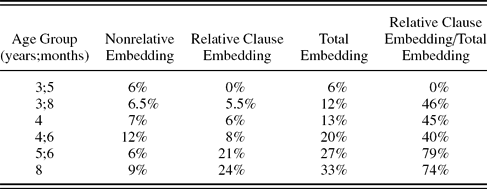
Thus, relative clauses and embedded structures without movement share the embedding of a complementizer phrase (CP, a full sentence) and the embedding marker in CP and differ with respect to movement. Our results indicate that it is not the shared property of CP embedding that delays the production of relative clauses. Because embedded structures without movement are produced very early on and do not show an increase with age within the ages tested, it should rather be something that is specific to relative clauses that delays the production of these structures, such as syntactic movement.
Relative clauses with and without a relative head
One characteristic that changed significantly with age was the production of the relative clause with a head noun. Relative clauses without a relative head, as shown in Example (7), were more characteristic of early relative clause definitions, whereas the older participants produced mainly relative clauses with a relative head. Examples (7) and (8) show definitions of the word flower without a relative head and with a relative head, respectively.
(7) She-merixim oto
that-(arbitrary-pro)-smelling it
“That one smells it.”
(8) Mashehu she-godel ba-sadot
something that-grows in-the-fields
“Something that grows in the fields.”
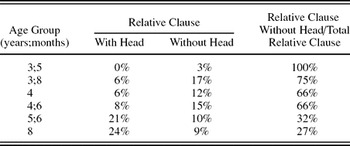
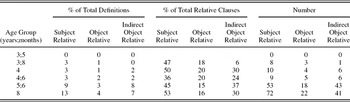
With age, more relative clauses included a head, and the rate of relative clauses that did not include heads out of all definitions decreased. There was a significant reversed correlation between the production of headless relative clauses and the production of relative clauses with a head noun (r = −.25, p = .03). The rate of headless relative clauses from the total number of relative clauses with and without a head decreased with age (r = −.33, p = .04), as seen in Table 4.
Relative clauses with and without a head noun out of the total number of definitions

Production of long distance dependencies with and without movement
To test whether the delayed use of relative clauses stems from a delay in the ability to use dependencies, we compared relative clauses to sentences without movement that include pronouns. Syntactic movement in relative clauses creates a dependency between the moved element and its original position (its “trace”), as seen in (9), where the gap refers to the head of the relative clause, “something.” In (10), the pronoun “oto” (= it or him) creates a dependency to the word hat, given by the experimenter.
Definition of a hat:
(9) Dependency with movement:
mashehu she-xovshim __ al ha-rosh
something that-(arbitrary-pro)-wearing on the-head
“Something that one wears on the head.”
(10) Dependency without movement: (a response to “what's a hat?”)
xovshim oto al ha-rosh
(arbitrary-pro)-wearing it on the-head
“One wears it on the head.”
If the difficulty in the production of relative clauses in the early ages and the gradual mastery of relative clauses with age is related to the ability to create dependencies in general, both relative clauses and sentences with pronouns should appear only later and should develop concurrently. If, however, the delay is related to the acquisition of syntactic movement, rather than to syntactic dependencies in general, sentences without movement such as (10) are expected to appear before the sentences that require movement.
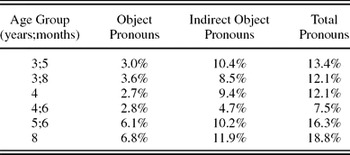
We analyzed the use of pronouns that refer to the target word, both object pronouns (him/it), and indirect object pronouns (with-him/it, in-him/it). Many (grammatical) responses were produced with pronouns but without a relative clause, with a total of 315 responses: 204 indirect object pronouns, 104 object pronouns, and 7 possessive pronouns. We compared the use of these structures with the use of relative clauses.
The production of relative clauses did not correlate with the ability to produce either object pronouns without movement (r = .06, p = .67) or indirect pronouns without movement (r = .09, p = .38). Unlike the use of relative clauses, which increased with age, the percentage of use of direct and indirect object pronouns in sentences without movement out of the total number of definitions did not show a linear increase with age, as seen in Table 5. These results are in line with previous studies that found that Hebrew-speaking children use singular pronouns correctly at an early age (Berman, Reference Berman and Slobin1985; Rom & Dgani, Reference Rom and Dgani1985).
The rate of sentences with pronouns out of the total number of productions

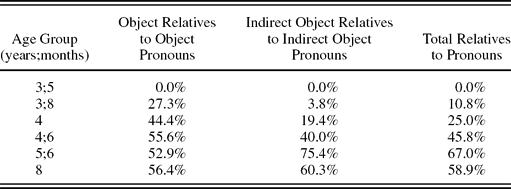
A reversed correlation was found between the production of indirect object relatives and indirect pronouns without movement (r = −.22, p = .006), namely, the more relative clauses with indirect pronouns were produced, the fewer indirect pronouns were produced without a relative clause, and a marginally significant reversed correlation was found between the production of object relatives and the production of object pronouns without movement (r = .14, p = .07). The rate of production of relative clauses to sentences with pronouns but without relative clauses increased significantly with age (r = .30, p = .002.) That is, in the early ages children preferred to use sentences with pronouns without relative clauses, and with age they started to be able to increasingly use relative clauses. In the two older age groups relative clauses outnumbered sentences with pronouns without a relative. Table 6 presents the rates of relative clauses to sentences with a pronoun of the relevant type (the number of relative clauses of a certain type divided by the number of sentences with pronouns of this type): direct object relatives to sentences with direct object pronouns, and indirect object relatives to sentences with indirect object pronouns.
The rate of relative clauses of a certain type to sentences with pronouns of the same type
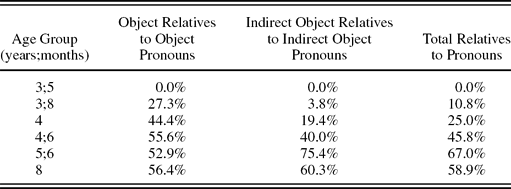
Subject relatives, object relatives, and indirect object relatives
The definition task required the children to provide definitions for various words, some lending themselves to a definition using subject relative, some calling more for a direct or an indirect object relative. Thus, the nature of the task makes it impossible to use the number of relatives of each type that was produced as a measure of its difficulty. However, we can still see whether there is a difference in trends, namely, whether all relative clause types depend on age in the same way, and whether the rate of production of the three types changes across different ages. In general, the production of each of the three structures increased with age for subject (r = .37, p < .0001), object (r = .25, p = .002), and indirect object (r = .31, p < .0001) relatives.
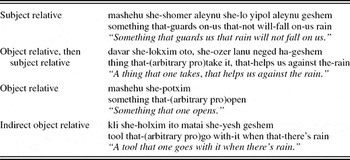
Note that the definition task is flexible enough to reflect preferences between relative clause types. This is because definitions for the same target word can be made using various types of relative clause. For example, the word umbrella elicited definitions in the form of subject relatives, object relatives, and indirect object relatives, as seen on Table 7. The preference for various relative clause types in the various ages can thus be telling.
Definitions children gave to the word “umbrella”

Keeping this relatively free choice of relative clause types in mind, we can take the ratio of the production of the three relative clause types in the second grade participants as some indication of the target ratio. This ratio was approximately 3:2:1 subject relative/indirect object relatives/object relative. As seen in Table 8, throughout all ages subject relatives outnumbered the other two types, but the near adult trend of twice as many indirect object relatives than direct object relatives only appeared around age 5. Until this age object relatives were produced more or less at the same rate as indirect object relatives. This might indicate a difficulty in the production of indirect object relatives in the early ages.
Types of relative clauses

Note that the results reported in the previous section, according to which even the youngest participants already produced indirect pronouns, which are inflected prepositions, and at a rate similar to the oldest participants, suggest that the relatively late development of indirect object relatives is not related to a difficulty in the production of inflected prepositions (in contrast to Berman's Reference Berman1978, Reference Berman1986, explanation). The results of these analyses should be taken cautiously, however, because of the relatively small number of object and indirect object relatives produced (a total of 149 sentences).
The production of object relatives
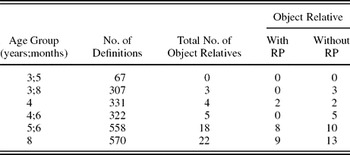
In general, very few object relatives were produced in the definition task. Until age 5;5 only 12 object relatives were produced overall out of 1,027 definitions. After age 5;6, 40 object relatives were produced, and there was no longer any correlation with age (r = .08, p = .49). The object relatives that were produced included both object relatives with a resumptive pronoun and object relatives without a resumptive. As shown in Table 9, the production of object relatives both with and without resumptive pronouns increased with age (r = .20, p = .01; r = .18, p = .03, respectively).
Number of object relative clauses produced with and without resumptive pronouns

Note: RP, resumptive pronoun.
The relation between the production of relative clauses in kindergarten and in second grade
For the 38 children that were tested in kindergarten and retested 2.5 years later when they were at second grade, we analyzed the correlation between their production of relative clauses in the two ages. The rate of production of relative clauses in the definition task (for each child out of the total number of responses s/he produced) at age 5;7 to 6;0 correlated significantly with the rate of production of relative clauses of the same children when they were 8;1 to 8;6 (r = .39, p = .01).
No correlation was found between the production of relative clauses without a head in kindergarten and the production of either relative clauses without a head or relative clauses in general in the second grade (r = .06, p = .74; r = −.07, p = .67, respectively).
This group of children did not show significant differences between the two ages in the number of ungrammatical relative clauses, in the rate of headless relative clauses to all relative clauses, in the number of object relatives with resumptive pronouns, in the rate of embedding with and without relative clause, or in the rate of object relatives to subject relatives (using t tests, all comparisons p > .14). It is important that no difference was detected in the general rate of grammatical relative clauses (out of the responses produced) in the younger and older time points (M = 18% and 22%, respectively), t (37) = 5.29, p = .32. This finding indicates that the ability to produce relative clauses of the types produced in this task already stabilizes by the age of 5;6 to 6, and does not change when retested 2.5 years later.
DISCUSSION
The analysis of the definitions children produced in various ages indicated that definitions can be a useful tool for the assessment of syntactic development. The detailed analysis of children's definitions suggests some interesting insight into the development of syntactic abilities. Specifically, the results indicated that Hebrew-speaking children start using relative clauses in their definitions before the age of 4 years, and the rate of relative clauses as well as the rate of headed relative clauses increase with age up to age 6, when this ability seems to stabilize. This is also the age at which all three types of relative clauses (subject relatives, object relatives, and indirect object relatives) are produced, whereas in younger ages indirect object relatives and object relatives are scarce. Children very seldom produce an ungrammatical relative clause. They prefer to avoid a structure at the age they do not yet master it. When they do produce an ungrammatical structure this is usually due to the insertion of a resumptive pronoun in subject relatives, and to the omission of obligatory resumptive pronouns in indirect object relatives, in line with previous research on relative clauses in spontaneous speech and elicited production. The developing ability to produce relative clauses is not related to improved embedding ability, which remains constant throughout the ages tested, nor is it associated with a general ability to use dependencies, as the use of pronouns does not change and is actually in reversed correlation with the use of relative clauses. Rather, it seems that it is the ability to construct syntactic movement that supports the ability to produce well-formed relative clauses.
The development of relative clauses
The results indicate that the rate of production of relative clauses (and grammatical relative clauses) out of the total number of definitions increases with age, until around age 5;6, and then stabilizes. This result is consistent with previous studies that examined the development of relative clauses in Hebrew (Berman, Reference Berman1986). It is interesting that the definition task yielded hardly any ungrammatical relative clauses in the children's productions. In all age groups, even for the youngest children, the rate of ungrammatical relative clauses did not exceed 2% of the definitions produced. These results are different from studies that used elicitation tasks and found a higher rate of ungrammatical relatives (Berman, Reference Berman1986; Günzberg-Kerbel et al., Reference Günzberg-Kerbel, Shvimer and Friedmann2008; Håkansson & Hansson, Reference Håkansson and Hansson2000; Pérez-Leroux, Reference Pérez-Leroux1995). This difference probably arises from the difference in the task requirements. In more formal relative clause elicitation methods the child is required to produce the target sentences as relative clauses, and if some of the abilities that underlie relative clause production are not mastered yet, relative clauses can be produced with errors. But in tasks like the definition task, when children have other options to respond, they simply refrain from using syntactic structures that they do not master yet. Thus, in the younger ages, the incomplete acquisition of relative clauses reflects in a much lower rate of relative clauses rather than in the production of ungrammatical relative clauses.Footnote 7
Another result that stems from the analysis of definitions is that the delayed use of relative clauses does not originate in a delay in the acquisition of the ability to embed. A comparison of embedded structures with and without relative clauses showed that whereas the production of embedded structures that include relative clause was absent in the young age groups and increased with age, the rate of embedded sentences without relative clauses did not show an effect of age, it existed already in the young groups, and remained steady throughout the ages tested. Because relative clauses and embedding without movement share the inclusion of an embedded CP and an embedding marker in CP, but differ in whether they include Wh-movement, the findings that the ability to produce embedding without movement is present very early on suggest that the embedded CP and the embedding marker in CP are present already in the earliest ages we tested. The delay in the production of relative clauses thus cannot be ascribed to a difficulty in CP embedding. An additional ability beyond CP embedding is required in order to start producing relative clauses.
We suggest that this further ability that should be added to CP embedding in order to allow the production of relative clauses is the ability to represent and process syntactic movement. Which part of syntactic movement is relevant in this case? Is it the ability to leave a trace and assign thematic roles via a chain to the trace, or is it related to a more general ability to form dependencies? Toward this goal, we analyzed the ability of our participants to produce utterances that include dependencies but do not include movement. We analyzed their use of sentences that include pronouns that relate to the target word, but without relative clauses. This also allowed us to see whether the acquisition of the pronouns themselves and their paradigms were responsible for the later development of indirect object relative clauses. This analysis showed that pronouns were already used in the very young age groups, and that the percentage of object pronouns and indirect pronouns did not increase with age within the ages tested (see also Berman, Reference Berman and Slobin1985; Rom & Dgani, Reference Rom and Dgani1985). The rate of object and indirect object relative clauses to direct and indirect pronouns in sentences without movement increased with age. In the beginning children used more pronouns, and then they started using relative clauses more and more frequently. That is, whereas the ability to use pronouns and dependencies is present already early on, relative clauses start to emerge only later and show an increase with age. Therefore, the scarce use of relative clauses in the early stages of language acquisition cannot be ascribed to a difficulty in forming dependencies in general or to a difficulty in using pronouns, but rather to some additional ability, presumably the ability to form syntactic movement of phrases.
One source of evidence that links the development of relative clauses to syntactic movement can be seen in the error pattern. Although only few ungrammatical sentences were produced, an analysis of these errors can be revealing with respect to the bits of syntactic ability that have not matured yet. Two types of ungrammatical sentences were produced. One involved the insertion of a resumptive pronoun at the embedded subject position, which is ungrammatical in Hebrew. This addition of a resumptive pronoun in subject position was also reported in Varlokosta and Armon-Lotem's (Reference Varlokosta and Armon-Lotem1998) for 24% of the subject relatives their participants produced, and in Günzberg-Kerbel et al. (Reference Günzberg-Kerbel, Shvimer and Friedmann2008) for 4.4% of the subject relatives. Such an error indicates a failure in the construction of a movement-derived structure, because a resumptive pronoun is produced in the position of the trace. Shlonsky (Reference Shlonsky1992) suggested, for normal syntax, that resumptive pronouns are used when syntactic movement is blocked. The use of resumptive pronouns by young children who are in the course of acquiring syntax (as well as by children with an impairment in syntactic movement) might be explained by the fact that the construction of a syntactic structure with movement is unavailable to them, and they therefore use a resumptive pronoun to salvage the sentence and produce it without movement (see Friedmann & Costa, Reference Friedmann, Costa and Rouveret2011).
The second error type was omission of the obligatory preposition with a resumptive pronoun from indirect object relatives. The children always obeyed the restriction that a preposition cannot appear without a pronoun in a Hebrew relative clause, but they did omit the whole prepositional phrase, including both the preposition and the pronoun (for similar findings, see Berman, Reference Berman1986). This type of error might also indicate a deficit that is related to movement and cannot be ascribed to a problem with indirect pronouns, which were produced correctly outside the context of relative clauses.
Another structure that appeared in a nonadult way in the children's definitions and gradually disappeared with age is the headless relative, such as “That brays” instead of “An animal that brays” as a definition of a donkey. Although this structure is pragmatically correct and appropriate for the definition task, as it can be taken as a continuation of the noun produced by the experimenter, it is syntactically incomplete, and was clearly disfavored by the older children. Children start out producing only headless relative clauses, and then the rate of headless relatives to relatives with a head significantly decreases with age. Sentences with relative clauses include two chains: one is the chain of movement of an element (the relative head or an operator, depending on the analysis; see note 1) within the relative clause to the left periphery of the clause (spec-CP), and the other relates the left periphery of the embedded clause to the relative head (by coindexation or by a further movement). It might be that the production of headless relatives in the early stages of acquisition enables the children to refrain from at least one of these complex operations, the second one. Another possibility, in line with Friedmann et al. (Reference Friedmann, Belletti and Rizzi2009), is that headless relatives are easier for the children because they only include one lexically restricted noun phrase (in contrast with fully headed relative clauses, which include two). This tendency to avoid two lexically restricted noun phrases can also account for Diessel and Tomasello's (Reference Diessel and Tomasello2000) finding that most of the early relatives in their corpus included an intransitive verb.
The results of the current study bear not only on the change in relative clause production with age but also on when this change stops. Children aged 5;6 to 6;0 who were retested 2.5 years later, at second grade, showed no difference in the rate of grammatical relative clauses produced between the two time points. Other measures for syntactic movement and embedding development also remained unchanged between these ages: no significant difference was found in the production of ungrammatical relative clauses, in the rate of headless relative clauses to all relative clauses, in the number of object relatives with resumptive pronouns, in the rate of embedding with and without relative clause, or in the rate of object relative to subject relative clauses. These findings indicate that the ability to produce relative clauses of the types examined in this task already stabilizes by age 5;6 to 6;0, and does not change when retested 2;6 years later. This finding might indicate that at the age of 5;6 to 6;0 children already master the syntactic abilities required for the definition of words. Note, that it is still possible that further development that is related to formal teaching and world knowledge might manifest in further change in definitions in older ages (for discussion of formal learning of conversational relatives in Romance, see also Guasti & Cardinaletti, Reference Guasti and Cardinaletti2003). These results are also consistent with results regarding the comprehension of relative clauses in Hebrew: whereas children aged 4 to 5 years were still unable to understand right branching object relatives (Friedmann et al., Reference Friedmann, Belletti and Rizzi2009; Fattal, Friedmann, & Fattal-Valevski, in press), children at the age of 6 already show good comprehension of this structure (Friedmann & Novogrodsky, Reference Friedmann and Novogrodsky2004).
Clinical markers for abnormal syntactic development
The current results can be used not only to indicate the course of normal syntactic development but are also suggestive of clinical markers for abnormal language development. Several indices emerge from these results. First, because children in this study produced less than 2% ungrammatical relative clauses, the production of a larger number of ungrammatical relatives in the definition task, especially of errors that do not involve resumptive pronouns, might indicate a deficit in syntactic development. Furthermore, as the general rate of embedding showed a clear development over time, as did the rate of relative clauses, a low rate of embedded sentences and of relatives in comparison to the child's age group might indicate abnormal syntactic development. It is important that, because the rate of embedding without relatives did not change with age, the relevant marker within this age range relates to the rate of embedded clauses including relatives, or only relatives. Embedded clauses without relatives cannot serve as a developmental index for syntactic development in this task. If, however, embedded sentences of any kind do not occur in a child's definition, this can clearly serve as an additional marker for a syntactic difficulty.
Furthermore, some ungrammatical forms never appeared in the children's definitions. The production of these ungrammatical forms can also be taken as a marker for syntactic difficulty. Specifically, we refer here to doubling of the relative head at the gap position, which did not occur in the definitions of the participants in the current study, but which is characteristic of relative clauses produced by school-aged children with hearing impairment who have difficulties in the comprehension and production of movement-derived sentences (Friedmann et al., Reference Friedmann, Novogrodsky, Szterman, Preminger, Armon-Lotem, Danon and Rothstein2008; Friedmann & Szterman, Reference Friedmann and Szterman2006; Geis, Reference Geis1973). Doubling errors occur in the speech of hearing-impaired individuals both in relative clause elicitation tasks and in spontaneous production. The production of doubling errors in young children might be related to the nature of the task, with doubling errors occurring in constrained tasks that directly target relative clauses, such as the relative clause elicitation task in Günzberg-Kerbel et al. (Reference Günzberg-Kerbel, Shvimer and Friedmann2008), in which young typically developing Hebrew-speaking children (aged 3;6–5;6) did produce some doubling errors. However, in structured tasks that are less constraining to the production of relative clauses, such doubling errors are not witnessed, probably because children find other ways to produce the sentence. In the definition task reported in the current study, none of the participants, not even the younger ones, made this error. Thus, doubling in spontaneous production or in structured tasks that do not directly trigger relative clause, such as the definition task in Hebrew, might indicate a syntactic impairment.
Finally, another index for the abnormal development of relative clauses can be the rate of headless relatives compared to relatives with a head noun. With age, this rate significantly decreases. Thus, a rate of headless relatives that is higher than the rate typical to the age range might be taken as another clinical sign for a syntactic difficulty (see also Håkansson & Hansson, Reference Håkansson and Hansson2000).
To summarize, this study indicated that much can be learned about language acquisition from definitions children produce. Whereas definitions have been traditionally used to test the semantic ability of children and their vocabulary, this study suggests another way to look at definitions: a definition is a task that can serve as a window to syntactic ability.
ACKNOWLEDGMENTS
This research was supported by the Israel Science Foundation (Grant 1296/06, to N.F.) and by the Lieselotte Adler Laboratory for Research on Child Development. We thank João Costa and Maya Yachini for discussion of the research and for their helpful comments on the article.