The acquisition of tense-aspect marking has been extensively investigated for the past 30 years or so, and has been a center of debate for the roles of cognitive development (e.g., Bronckart & Sinclair, Reference Bronckart and Sinclair1973), innate predisposition in learning (e.g., Bickerton, Reference Bickerton1981, Reference Bickerton1984), and input-based learning (Shirai & Andersen, Reference Shirai and Andersen1995; Tomasello, Reference Tomasello1992). Despite much controversy, one generalization has emerged: the strong effect of verb semantics (i.e., lexical aspect) on the acquisition of grammatical marking of tense and aspect, a phenomenon that has entered into the literature as the aspect hypothesis (e.g., Li & Shirai, Reference Li and Shirai2000; Shirai, Reference Shirai1998a; Shirai, Slobin, & Weist, Reference Shirai1998). The explanation of the effect of lexical aspect is still an open issue. Are they simply an artifact of verb-specific memory based learning (Pinker, Reference Pinker1984; Tomasello, Reference Tomasello1992)? Are there semantic biases in children's learning (Shirai & Andersen Reference Shirai and Andersen1995)? Or are they simply a reflection of innate predisposition, for example, as claimed in Bickerton's (Reference Bickerton1981) bioprogram hypothesis that children are preprogrammed with such distinctions as state versus process and punctuality versus nonpunctuality, and they therefore mark these distinctions differently early on in language acquisition?
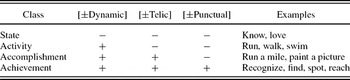
The aspect hypothesis is based on a four-way distinction of the inherent aspectual meaning of predicates, “state,” “activity,” “accomplishment,” and “achievement” (Vendler, Reference Vendler1967), which are defined by three binary semantic features: [±dynamic], [±telic], and [±punctual], as in Table 1. It makes the following generalizations for the acquisition of tense-aspect markers (Andersen & Shirai, Reference Andersen, Shirai, Ritchie and Bhatia1996; Shirai, Reference Shirai1991; Shirai & Andersen, Reference Shirai and Andersen1995):
A. Children first use past or perfective marking on achievement and accomplishment verbs, eventually extending its use to activity and stative verbs.
B. In languages that encode the perfective/imperfective distinction, imperfective past develops later than perfective past.
C. In languages that have progressive aspect, children first use progressive aspect marking mostly with activity verbs, then extend to accomplishment and achievement verbs.
D. Children do not incorrectly overextend progressive aspect markings to stative verbs.
Previous research on the acquisition of French (Bronckart & Sinclair, Reference Bronckart and Sinclair1973), Italian (Antinucci & Miller, Reference Andersen and Shirai1976), English (Bloom, Lifter, & Hafitz, Reference Bloom, Lifter and Hafitz1980; Shirai & Andersen, Reference Shirai and Andersen1995), Turkish (Aksu-Koç, Reference Aksu-Koç1998), and Russian (Stoll, Reference Stoll1998), among others, has confirmed the claims of the aspect hypothesis as listed above (Li & Shirai, Reference Li and Shirai2000). The study of Japanese children, although confirming Predictions B and D of the aspect hypothesis, reveals some deviations, for example, the Japanese children use the past marker with stative verbs at an early learning stage, and only the development of one of the three children confirms Prediction C (Shirai, Reference Shirai1998a). Shirai proposes that the universal tendencies as predicted by the aspect hypothesis are still valid, but they are mediated by multiple factors: typological factors and input. He suggests that a weaker version of the aspect hypothesis may better illuminate the acquisition of grammatical aspect and lexical aspect cross-linguistically.
Vendler's four verb classes

Note: Vender's verb classes are according to Andersen (1991). Mandarin adjectives can be regarded as verbs when they function as predicates in a sentence, because they can directly be the predicate or center of the predicate without a copular verb (Chao, Reference Chao1968, p. 663).
Concerning the acquisition of the Mandarin aspectual system, only a small number of studies have investigated the acquisition of grammatical aspect and lexical aspect. Some of these studies find learning patterns similar to the predictions of the aspect hypothesis (Li, Reference Li1990; Li & Bowerman, Reference Li and Bowerman1998; Li & Shirai, Reference Li and Shirai2000), but others show a weaker association of telicity with perfectivity (Chang, Reference Chang2002; Jin & Hendriks, Reference Jin and Hendriks2005). Divergence in the findings may have resulted from methodological differences. For example, difficulty in classifying verbs (predicates) results in different operational procedures to classify the verbs in these studies. In addition, there are no studies that have examined the input systematically. Thus, it is still questionable whether the aspect hypothesis captures the acquisition of the aspectual system in Mandarin.Footnote 1
This study investigates the acquisition of aspect in Mandarin, for which comparable research on naturalistic longitudinal data has been lacking, to address the predictions of the aspect hypothesis and the issue of what factors determine the effect of lexical aspect on grammatical aspectual marking. The remainder of this paper is organized as follows. The second section discusses the aspectual system in Mandarin; the third section reviews the previous studies of the acquisition of aspect in Mandarin; and the fourth and fifth sections discuss our data analysis, the findings, and their theoretical significance.
ASPECTUAL SYSTEM IN MANDARIN
Mandarin is known as a tenseless language, rich in aspectual expressions but lacking grammatical tense. Tense is deictic in nature and locates a situation in relation to some other time (e.g., speech time), whereas aspect characterizes different ways of viewing the internal temporal constituency of a situation (Comrie, Reference Comrie1976). Aspect is compositional in nature and represents an interaction between its two components, inherent lexical aspect (i.e., Aktionsart or situation aspect) and grammatical aspect (i.e., viewpoint aspect). The former refers to the intrinsic aspectual properties of idealized situations, wehreas the latter refers to the speaker's choice of a perspective where a situation is presented, typically conveyed by grammatical marking such as auxiliary and inflection.
In Mandarin, temporal relations are either inferred from context, or typically marked with time adverbials (deictic, like tense) and aspect markers (nondeictic and dependent on a speaker's viewpoint). Children acquiring Mandarin have been observed to mark temporal information with time adverbials rather late: when the mean length of utterance (MLU) reaches 4.31 (around age 31–32 months); in contrast, they begin the use of aspect markers from as young as 25 months (Erbaugh, Reference Erbaugh1978). In the following sections we discuss the Mandarin aspectual system on the basis of the previous studies.
Grammatical aspect
Mandarin uses grammaticalized morphemes (i.e., aspectual particles) to mark grammatical aspect. It is inconclusive how many aspect markers there are in Mandarin (e.g., Li & Bowerman, Reference Li and Bowerman1998; Li & Thompson, Reference Li and Thompson1981). In the current study, we will discuss four major aspect markers, that is, the imperfective aspect markers -zhe and zai and the perfective aspect markers -le and -guo.Footnote 2
Imperfective aspect markers. Progressive aspect in Mandarin is marked by the morpheme zai, and durative aspect by the morpheme -zhe. The main function of zai is to indicate that an action or event is in progress, whereas -zhe indicates that a situation is viewed as enduring or continuing, often as a background event in discourse. As a durative marker, -zhe is most naturally used with verbs that specify a state. Progressive zai, in contrast, is a dynamic imperfective marker, and does not occur with stative verbs.
Perfective aspect markers. Perfective aspect can be marked in Mandarin by the perfective aspect marker -le, and the experiential aspect -guo. The perfective -le presents a situation in its entirety, as an event bounded at the beginning and the end. It has been argued that -le by itself may indicate completion or termination, depending on the predicates with which it occurs (Li, Reference Li1990). When the predicate encodes a situation with a clear temporal boundary, -le indicates that the situation comes to its natural end point, that is, completed. For example, in Ta ti-po le men “he kick-break LE door” (he broke the door by kicking), the verb ti-po “kick-break,” a resultative verb compound, encodes an endpoint (i.e., the door getting broken), and the perfective -le indicates that the end result has been achieved and the event is completed. However, when the verb encodes a situation without a natural boundary, that is, an atelic predicate, -le signifies the termination of the situation, as in Ta pao le bu “he run LE steps” (he did running), in which the atelic verb pao-bu “run” does not encode any endpoint, and -le indicates that the event took place and terminated at some indefinite point.
The semantic function of -le is also influenced by its syntactic position in a clause. Syntactically -le can occur in verb-final (VF-le), sentence-final (SF-le), and both verb- and sentence-final (VF/SF-le) positions as in Examples 1a, b, and c, respectively.
1.


The VF-le has been unanimously recognized as a perfective aspect marker, signaling the completion or termination of a situation with respect to a past, present, or future reference time and presents the situation as a whole, as we just discussed. The SF-le may indicate a change into a new situation and signals its current relevance state, that is, CRS le.Footnote 3 The SF-le in Example 1b relates that past event to the present or any reference time, similar to English perfect (Smith, Reference Smith1991).
The semantic function of VF/SF-le can be generally disambiguated by the semantics of the predicates it occurs with. It has been observed (e.g., Jin & Hendriks, Reference Jin and Hendriks2005) that when the predicate is an accomplishment or an achievement, the sentence with SF-le indicates the resultative state after the attainment of the goal as in Example 1b, and when the predicate is atelic such as states and activities, SF-le presents an inchoative reading, that is, the coming about of a situation as in Example 1c.
The other perfective marker, -guo, has generally been characterized as an experiential marker: it indicates that an event has been experienced at some indefinite time, usually in the past, and that the resulting state no longer obtains at the time of speech (Chao, Reference Chao1968; Li & Thompson, Reference Li and Thompson1981). Example 2 illustrates the differences between the perfective -le and -guo:
2.
Sentence 2a may refer to a situation in which he is still in Shanghai; -le indicates a completed action of going and arriving at Shanghai. Sentence 2b, however, is appropriate only when it refers to an experience that he had before: that he has once been in Shanghai (at some indefinite time in the past), and that he is no longer in Shanghai at the time of speech. This characteristic of -guo, indicating that the resulting state no longer obtains, is what Chao (Reference Chao1968) and Smith (Reference Smith1991) called the “discontinuity” meaning of -guo.
Lexical aspect in Mandarin
Lexical aspect or situation aspect is the inherent temporal meaning of a verb or verb phrase that describes a particular situation. Lexical aspect is the composite result of the interaction between verb classes and complements (e.g., push vs. push the door open), arguments (e.g., run vs. run a mile) and nonarguments such as peripheral adjuncts (e.g., run vs. run to the station).
Does Mandarin distinguish verbs into Vendler's (Reference Vendler1967) four categories of lexical aspect? Previous studies have shown that Mandarin distinguishes verbs into those categories, for example, stative versus dynamic verbs in Mandarin (e.g., Smith, Reference Smith1991; Tai, Reference Tai, Testen, Mishra and Drogo1984; Teng, Reference Teng1974), and accomplishment versus achievements (e.g., Li, Reference Li1990; Li & Bowerman, Reference Li and Bowerman1998; Wu, Reference Wu2002; Xiao & McEnery, Reference Xiao and McEnery2004a; for an earlier counterargument, see Tai, Reference Tai, Testen, Mishra and Drogo1984). Predicates like hua yi fu hua “draw a picture” and gai yi suo fangzi “build a house,” show features typical of accomplishment verbs: they encode both a process and an end point semantically. They can take progressive marker zai to denote the action in progress meaning, and the end point component is indicated by their compatibility with adverbial phrases like in an hour (e.g., Tamen yi ge xiaoshi hou hua le yi fu hua “they one CLF hour in draw LE one CLF picture” (they drew a picture in an hour). The end point meaning is also tested by the almost test. For example, Tamen jihu gai le yi suo fangzi “they almost build LE a CLF house” is ambiguous; it can mean they have started building a house but have not finished it (i.e., only the end point, a completed house, is not realized), or they did not even start building a house (i.e., the starting point is not even realized; cf. Smith, Reference Smith1991). This ambiguity suggests that gai yi zuo fangzi “build a house” is an accomplishment.
However, Mandarin accomplishment verbs behave differently from their English counterparts, as in Example 3:
3.
The felicity of Example 3 suggests that in Mandarin drew a picture does not entail an end point of the completion of a picture. We suggest that the atelic reading in sentences like Example 3 does not indicate there is no end point encoded in the predicate; rather, this indicates that the end point is only implied, not entailed.Footnote 4 It is important to make a distinction between atelicity, implied end point and entailed end point. Talmy (Reference Talmy2000) shows that languages differ in their lexicalization of state change (i.e., a particular type of end point). He notes that the majority of Mandarin verbs are implied- or moot-fulfillment verbs that do not assure or say anything about the realization of a state change, for example, hua yi fu hua “draw a picture” only implies the completion of a picture (i.e., the picture may be either completed or not); and to entail the completion of the picture (i.e., realization of a state change), a resultative verb compound hua-wan “draw-finish” (i.e., hua-wan yi fu hua entails the completion of the picture). English, in contrast, has many monomorphemic state-change verbs that entail a state change, for example, break and wake. Talmy's entailed state-change verbs (accomplishment and achievement verbs) are resultative verb compounds in Mandarin: the attainment of an end point is realized by the addition of a second verb of a resultative verb compound.Footnote 5 In this paper, we retain Vendler's (Reference Vendler1967) distinctions of accomplishment verbs and achievement verbs in Mandarin.
In addition to the four major predicate types, Smith (Reference Smith1991) proposes another category “semelfactive.” Semelfactive verbs are punctual (like achievements) but atelic, indicating repeated events when combined with progressive aspect, such as jump, knock and kick in English, and tiao “jump,” qiao “knock,” and ti “kick” in Mandarin. For example, the sentence Ta zai qiao men “he is knocking on the door” indicates a continually repeated action of knocking at the door.
THE ACQUISITION OF ASPECT IN FIRST LANGUAGE (L1) MANDARIN
Erbaugh (Reference Erbaugh1982, Reference Erbaugh and Slobin1992) examined the longitudinal speech data of four Taiwan Mandarin-speaking children (age range = 1 year, 9 months [1;9] to 3;9). She found that -le was the earliest aspect marker acquired, and the imperfective aspect markers zai and -zhe appeared before the experiential aspect marker -guo. The perfective aspect marker -le was also used more predominantly than other aspect markers: children produced up to 2,300 -le in contrast to the total of 108 zai, 50 -zhe, and 34 experiential -guo. She also found that the children used -le selectively: 85% of -le referred to the immediate past, the progressive aspect marker zai was used solely with activity verbs, and it was never used incorrectly with a stative verb.
Li and Bowerman (Reference Li and Bowerman1998; see also Li, Reference Li1990; Li & Shirai, Reference Li and Shirai2000) conducted three experiments to test children's (aged = 2;9–6;4) knowledge of the aspect markers with verbs of six different categories of lexical aspect: states, activities, accomplishments, achievements, semelfactives, and mixed telic-statives.Footnote 6 Their findings are consistent with the aspect hypothesis: in all three tasks children of all ages associated the perfective aspect marker -le more frequently with telic verbs (achievement and accomplishment verbs) than with atelic verbs (activity and semelfactive verbs), and they associated the progressive aspect marker zai more often with atelic verbs than with telic ones. For stative verbs, children understood the imperfective aspect marker -zhe better than -le, whereas for the mixed telic-stative verbs, children understood it well with both -zhe and -le.
Chang (Reference Chang2002) examined the aspect hypothesis in the naturalistic speech of two Taiwan Mandarin-speaking children, one from 2;0 to 2;6, and the other from 2;9 to 3;3. She grouped verbs into two major categories, stative, and eventives, with the latter including activity, accomplishment and achievement verbs. Eventives (i.e., dynamic verbs) were further subdivided into [+resultative] and [−resultative] according to their compatibility with the progressive aspect marker zai: nonresultative verbs, but not resultative verbs, are compatible with zai. Her classification was based on the following reasons. The MLU of the children is rather low; and because Mandarin allows argument dropping, if the arguments were dropped it was difficult to distinguish an activity verb from an accomplishment verb. Her findings generally support the aspect hypothesis (Predictions A and C): about 79% of perfective -le occurs with resultative verbs and 94% of imperfective zai occurs with nonresultative verbs. The children used -le with resultative verbs for both completed (72%) and noncompleted events (7%), as well as with atelic verbs from an early age (21%). The major problem with Chang's study, however, is her criterion for distinguishing verb categories: she may have counted telic accomplishment verbs as atelic because they are compatible with zai and thus overcounted activity verbs, and some resultative verbs are also compatible with zai (Wu, Reference Wu2002; Xiao & McEnery, Reference Xiao and McEnery2004a).
Jin and Hendriks (Reference Jin and Hendriks2005) analyzed elicited story telling of picture books by both L1 and second language (L2) learners of Mandarin. Their findings support the aspect hypothesis in general. Here, we summarize their findings concerning the L1 acquisition only. They studied L1 children at mean ages of 5, 7, and 10 years. All the children showed a dominant use of aspectual marking on achievement verbs: more than 60% of the predicates marked were achievements. The 5- and 7-year-olds used -le exclusively with achievements and accomplishments, and the 10-year-olds spread -le to activities and states to express terminations. However, the children's use of the imperfective aspect markers zai and -zhe deviate from the aspect hypothesis: although zai had been used mostly with activities, the 5- and 10-year-olds also used stative verbs with zai (20%). With regard to -zhe, the children used it with activity and stative verbs with increased age, but they also ungrammatically used -zhe with achievement verbs (14% for the 5-year-olds, 11% for the 7-year-olds, and 5% for the 10-year-olds).
Jin and Hendriks (Reference Jin and Hendriks2005) also found that more than 60% of the predicates were used without any aspect markers in the narratives of all age groups, and the temporal relationship was expressed through temporal adverbials and discourse organization. Similar patterns are found in two other studies of temporal marking in spontaneous adult-to-adult speech and child-directed speech (Huang, Reference Huang2003; Wu, Reference Wu2002). Huang (Reference Huang2003) compared the temporal markings in the spontaneous speech of two children (aged 3;2 and 3;3), their mother's speech addressed to the children, and their mothers’ spontaneous conversations with other adults. She identified utterances that established past reference, and found distinct patterns: both children relied heavily on aspect markers (61% and 57% for each), but in the child-directed speech and in the adult-to-adult speech of their mothers the majority of the temporal information was conveyed by temporal adverbials. Only about 21 to 28% predicates were marked with aspect particles in the child-directed speech; and in the adult-to-adult speech it dropped even more (only 2–4%). These studies provides empirical evidence that aspect markers are often optional in Mandarin (see also Klein, Li, & Hendriks, Reference Klein, Li and Hendriks2004): temporal adverbials, context, shared knowledge, and discourse organizations, as well as the lexical semantics of predicates all contribute to the establishment of the time frame. At the early stages of temporal marking, children differ from adults in the most favored device for marking temporal information.
In sum, previous studies support two predictions of the aspect hypothesis (A and C): children mark the perfective aspect with grammatical aspect particles before marking the imperfective aspect (Chang, Reference Chang2002; Erbaugh, Reference Erbaugh and Slobin1992), and among the verbs marked with grammatical aspect particles, telic verbs attract the majority of aspectual marking and they are often associated with the perfective aspect markers (Chang, Reference Chang2002; Jin & Hendriks, Reference Jin and Hendriks2005; Li, Reference Li1990; Li & Bowerman, Reference Li and Bowerman1998; Li & Shirai, Reference Li and Shirai2000). However, inconsistencies with the predictions of the aspectual hypothesis are also shown: Mandarin children also tend to mark atelic verbs with the perfective aspect marker -le from a young age (Chang, Reference Chang2002) and the overall percentage of marking telic verbs with a perfective aspect marker is not as high as those observed in English-speaking children's data (Shirai & Andersen, Reference Shirai and Andersen1995). In addition, children mark stative verbs with the progressive aspect marker zai (Jin & Hendriks, Reference Jin and Hendriks2005).
Some methodological problems pose difficulties in interpreting the findings. The first problem concerns the variation in the operational procedures for the classification of verbs (or verb phrases). For example, Jin and Hendriks adopt the traditional four-way distinction in their study; Li and Bowerman make a six-way distinction; Chang makes a three-way distinction (stative, [−result] and [+result]). It is therefore difficult to compare the data without consistent diagnoses for verb categories. A second concern is the age of children sampled in these studies. For example, in Jin and Hendriks’ study, the youngest group of children is 5 years old, by which age they should have used different aspect markers for a long time. In other studies, the youngest children under study were mostly around 3. There has also been no systematic work examining and comparing the distribution of lexical semantic categories and the aspectual marking in both child-directed speech and child speech.
The current study will attend to these methodological issues and pursue the following research questions:
1. Is there a correlation between the acquisition of grammatical aspect marking and the inherent lexical semantics?
2. How different are the parents and the children in their grammatical aspect marking with verbs of different lexical aspect?
If the aspect hypothesis holds in Mandarin, we hypothesize that Mandarin children will follow the same learning patterns like those observed in English (Shirai & Andersen, Reference Shirai and Andersen1995). That is, we expect a strong correlation between telicity (achievements and accomplishments) and the perfectivity -le, later extending it to atelic verbs; the progressive aspect marker zai should appear first on activity verbs and gradually extend to telic verbs; and there should be an absence of erroneous uses of zai with stative verbs.
THE PRESENT STUDY
Data
This study used data from a longitudinal corpora of three girls (MDY, DAN, and LIA; Min, Reference Min1994), and one boy WX from the Child Language Data Exchange System (CHILDES) Beijing corpora (MacWhinney, Reference MacWhinney2000; Tardif, Reference Tardif1993). We refer to each child by the abbreviation of her or his name. The data consist of transcribed speech samples of these children acquiring Mandarin in their home environment: (a) MDY from age 1;4 to 3;5, (b) DAN from 1;4 to 1;10, (c) WX from 1;9 to 2;1, and (d) LIA from 3;2 to 3;5. The transcripts are in Pinyin, the official Mandarin Romanization system used in China, and follow the transcription format of the Codes for the Human Analysis of Transcripts (CHAT) used by the CHILDES (MacWhinney, Reference MacWhinney2000). These data cover an extended period of acquisition, and they include relatively early stages of development, which are necessary to see the emergence and subsequent development of aspectual marking in both children's speech and child-directed speech. Because caregivers typically include not only the parents, but also the grandparents, or live-in aunts or nannies in China, the child-directed speech (input) includes the utterances from all the caregivers, as well as occasional visitors that happened to be in the data session (cf. Min, Reference Min1994; Tardif, Reference Tardif1993). We coded all the child-directed utterances from these adults.
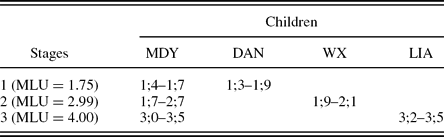
Among the numerous sets of sample files, we chose groups of samples to represent different stages of development, based on the following considerations: (a) obtaining the maximum differences between stages; (b) obtaining comparable data representing the same level of development for the five children for each stage, measured by MLU, because MLU measurement has been argued to be as valid for Mandarin as for English (Cheung, Reference Cheung1998; Erbaugh, Reference Erbaugh1978); and (c) obtaining a comparable amount of data for each stage for each child. In total, we analyzed about 14 hr of data and the total number of utterances was 6,083: 2,359 utterances from the child MDY, 1,537 from LIA, 423 from DAN, and 1,764 from WX). The total number of utterances in the caregivers’ speech is 8,139: 3,995 utterances from the input to MDY, 1,099 to LIA, 1,023 to DAN, and 1,764 to WX. At each developmental stage (measured by MLU), we have data from two children. Table 2 lists the ages of the children in the sample files coded and analyzed for this study.
Ages of the children (years;months) in the data samples coded and analyzed and broken down by MLU

Note: MLU, mean length of utterance. Each child is indicated by the abbreviations of her name, for example, MDY.
In terms of linguistic development as measured by MLU, Stage 1 in this study corresponds to Brown's (Reference Brown1973) Stage I (MLU = 1.75), Stage 2 corresponds approximately to Stage III (MLU = 2.75), and Stage 3 corresponds to Stage V (MLU = 4.00).
Coding
We coded the utterances associated with an aspect marker for two parameters: inherent aspect and past versus nonpast -le (see discussion in the section below). First, we coded the predicates for inherent aspect: state, activity, accomplishment, achievement, or semelfactive.Footnote 7 The steps taken to code for inherent aspect were as follows: (a) read a small subset of discourse until you are reasonably sure about the interpretation of the sentences being coded; (b) remove grammatical aspect marker from the sentence (e.g., Ta tiao le “he jump LE” or Ta zai tiao “he ZAI jump” should both be Ta tiao “he jump”; and (c) apply Steps 1–4 of the operational tests (see Appendix A) to determine the sentence's inherent aspect (Shirai & Andersen, Reference Shirai and Andersen1995).Footnote 8
Then we coded whether the predicate with -le referred to a completed/past event or a noncompleted/nonpast event. This coding category is included for two reasons. First, a predicate with -le may refer to a noncompleted/nonpast event, as in conditional clauses like Chi le fan zai qu “eat LE food then go” (Go after you eat) or in imperatives like Chi fan le “eat food LE” (Let's eat dinner). Second, children have been observed to make errors in using perfective -le to describe noncompleted/nonpast events, for example, Tiao le “jump LE” to ask someone to jump (Erbaugh, Reference Erbaugh1978). If the use of -le refers to a completed/past event identifiable from the context, we coded it as CE (completed event); if not, we coded it as NCE (noncompleted event); and for cases that cannot be determined from the context, we coded them as UCE (undetermined completed event).
RESULTS
We identified 755 predicate tokens with the four aspect markers in the speech of the four children and 1,748 in their caregivers. We further excluded immediate exact repetitions of the same utterance in the same turn (e.g., The verb chi “eat” in “Chi le. Chi le.” “eat LE. eat LE.” was counted as only one token). We also excluded cases of unintelligible utterances, -le with nominal phrases (discussed later), -le immediately preceded by a wh-word (e.g., Zenme le “how LE,” meaning “what's wrong?”), Ji hao le “which date LE,” meaning “what's the date?”), and idiomatic or formulaic expressions in which -le does not encode any temporal meaning and the expressions have a frozen conventional meaning (e.g., Suan le “calculate LE,” meaning “forget it”). This results in the exclusion of 30 cases out of 755 (4%) in the children's speech and 154 out of 1,748 (9%) in the speech of their caregivers. We analyzed the remaining predicates based on the operational tests and quantitatively analyzed them using the Computerized Language Analysis program (MacWhinney, Reference MacWhinney2000). Recall that the total number of utterances is 6,083 from the children and 8,139 from their caregivers. The mean number of an aspect marker per utterance is then 0.11 (725/6,083) for the children and 0.19 (1,594/8,139) for the adults. These figures suggest that both the children and the adults overall used aspect markers quite infrequently across all the contexts. The adults, however, seem to use aspect marker more frequently than the children overall. This may suggest that even if the adults do not use them very frequently, children can still get adequate input to acquire aspectual marking properly.
Development of -le, zai, -zhe, and -guo
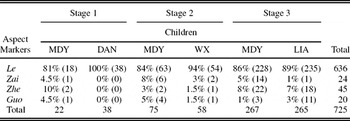
Table 3 shows the distribution of -le, zai, -zhe, and -guo in each child's speech. Recall that we have data from two children at each stage, but only the child MDY's data are available across all three stages, and the other three children have data only for one stage. The aspect marker -le was used most frequently by all the children, and the other three aspect markers were used only marginally, comprising about 2% to 7% of the overall aspectual marking. With increased age, there is no obvious change in the overall distribution of the use of the four aspect markers: -le remains the most frequent aspect marker, and the other three did not increase dramatically. That is, even though raw token frequencies of zai, -zhe, and -guo increased, -le also increased its frequency and therefore the proportion of each aspect marker remains stable.
Distribution of all the aspectual markers, -le, zai, -zhe, and -guo, in the child speech

Note: The token frequency is in parentheses. Each child is indicated by the abbreviations of her name, for example, MDY.
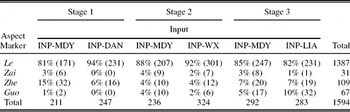
The dominance of -le is also evident in the input. Table 4 shows the distribution of the four aspect markers in the child-directed speech. Similar to the overall use by the children, the adults also used -le most frequently, and this dominant use did not change with increased age of the children. The other three aspect markers, although more frequently used by the adults than the children, were not very frequent, comprising 1% to 15% of their overall aspectual marking at each developmental stage of the children. Obviously, -le appears the earliest and is the most frequent aspect marker in children's early aspectual marking. Children remarkably resemble their caregivers in their overall use of the four aspect markers.
Distribution of the aspectual morphemes, -le, zai, -zhe, and -guo, in the adults’ speech

Note: The token frequency is in parentheses. INP, input, for example, INP-MDY, which is speech directed to the child MDY.
Emergence of zai, -zhe, and -guo
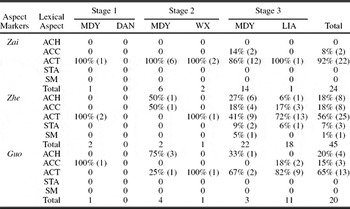
Table 5 summarizes the token frequencies of the verbs of different lexical aspect used with each of the three aspect markers, zai, -zhe, and -guo, broken down by age and child. It shows that the children used the two imperfective aspect markers zai and -zhe mostly with atelic activity verbs across the three stages, and there is no notable developmental change. Overall, 22 out of a total of 24 tokens of the predicates with zai were activity verbs and the very early uses of zai (i.e., at Stages 1 and 2) were all activity verbs (9 tokens). For example, the earliest and only verb that MDY used with zai was an activity verb wan “play” as in zai wan “ZAI play” (I am playing) at age 1;10 (Stage 1); and between age 1;11 and 2;7 (Stage 2) six different verbs were used with zai and they are all activity verbs, such as shui-jiao “sleep” as in Zai shui-jiao “ZAI sleep” (I am sleeping), zai kan shu “ZAI read book” (I am reading a book), and Zai wan da gungun “ZAI play big stick” (I am playing with a big stick). Above age 3, MDY used more verbs with zai: 9 activity verbs (12 tokens) at Stage 3, for example, Zai chi fan “ZAI eat food” (I am eating) and Ni zai lu yin “you ZAI record sounds” (you are recording); and she also began to use zai with accomplishment verbs: two accomplishment verbs were identified, gai fangzi “build a house” and zhi maoyi “knit a sweater.”
Distribution of predicate types with zai, -zhe, and -guo in the child speech

Note: The token frequency is in parentheses. ACH, achievement; ACC, accomplishment; ACT, activity; STA, state; SM, semelfactive.
Early uses of -zhe are also with activity verbs at Stages 1 and 2 (4 out of a total of 5 tokens), for example, the activity verb bao4 “carry, hold” as in Mengmeng bao zhe mama “Mengmeng carry ZHE mommy” (Mengmeng is carrying mommy) (MDY, age 1;10). At Stage 3, even though the majority of the verbs used with -zhe were still activity verbs (9 out of 22 for MDY and 13 out of 18 for LIA), both MDY and LIA have begun to use -zhe with telic verbs. For example, MDY used achievement verbs with zhe; for example, lu “expose” as in Dudu lu zhe le “tummy expose ZHE LE” (my tummy is exposed) (age 3;1), and accomplishment verbs, for example, shuan “bind” as in Zhe ge houpijin shuan zhe zhe ge “this CLF rubber.band bind ZHE this CLF” (this rubber band bound these [tickets]) (age 3;2). In contrast, the early uses of the experiential perfect -guo are with telic verbs at Stages 1 and 2 (5 out of a total of 6 tokens), for example, at age 1;11 MDY used -guo with achievement verb jian4 “see” as in jian guo “see GUO” (I have seen it); and at Stage 3, the children began to use -guo with atelic activity verbs, fop example, the activity verb xi “wash” as in Wo xi guo (yifu) “I wash GUO (clothes)” (I have the experience of washing clothes before; LIA, age 3;3).
These results suggest that children's early uses of the imperfective aspect markers emerge with atelic activity verbs and then extend to telic accomplishment and achievement verbs. The experiential perfect aspect marker, -guo, emerges with telic accomplishment and achievement verbs, and only later spreads to atelic verbs.
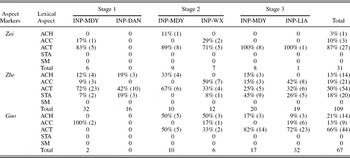
Let us now examine whether the adults show similar patterns of uses of zai, -zhe, and -guo. Table 6 summarizes the token frequencies of the verbs with these three aspect markers in the child-directed speech across three developmental stages, broken down by age and caregivers of each child. The adults, similar to the children, used zai, -zhe, and -guo rather infrequently: the total tokens of zai, -zhe, and -guo were 31, 109, and 76, respectively, by all the caregivers across the three stages. The progressive aspect marker zai was used mostly with activity verbs (27 out of a total of 31 tokens). The imperfective aspect marker -zhe was used with verbs of different lexical aspect, but the majority of these verbs at each stage were activity verbs (54 out of a total of 109 tokens). The perfective aspect marker -guo was used mostly with accomplishment verbs and achievement verbs at Stages 1 and 2, and extended to activity verbs at Stage 3.
Distribution of predicate types with zai, -zhe, and -guo in the adults’ speech

Note: The token frequency is in parentheses. INP, input, for example, INP-MDY, which is speech directed to the child MDY; ACH, achievement; ACC, accomplishment; ACT, activity; STA, state; SM, semelfactive.
The adults’ use of zai, -zhe, and -guo with different verb types is obviously biased in the direction predicted by the aspect hypothesis. This pattern is also similar to those in the children's speech. The close correspondence between the two suggests that the children's use of zai, -zhe, and -guo is strongly influenced by the distributional patterns in the child-directed speech. Now let us move on to examine the use of -le, the most frequent among the four aspect markers.
Developmental patterns in the children's use of -le
As mentioned, we coded a total of 636 tokens of predicates used with -le in the children's speech. Among these uses, we further excluded the nontemporal uses of -le, including the emphatic uses,Footnote 9 as in Zhe tai gui le “this too expensive LE” (this is too expensive), and modal verbs such as neng2 “can,” hui4 “be able to” and ying-gai “should.” This results in the exclusion of 20 out of 636 (3%) predicate tokens in the children's speech and 13 out of 1,387 (1%) in the caregivers’ speech.
Distribution of -le with predicate types. Among the total of 616 tokens of -le in the child speech, the majority of the -le occurs at both VF- and SF-positions, that is, VF/SF-le 66% (407/616); VF-le accounts for only 8% (52/616), and SF-le 26% (157/616). Among the total of 1,374 -le in the caregivers’ speech, VF/SF-le accounts for 75% (1,030/1,374), VF-le 10% (139/1,374), and SF-le 15% (205/1,374).
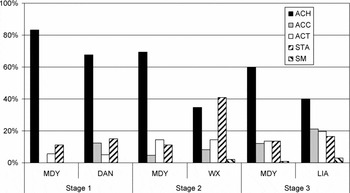
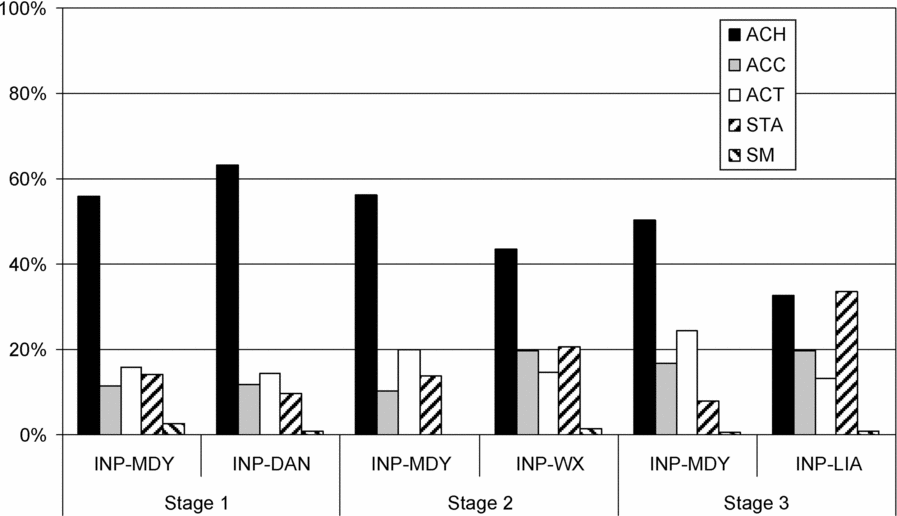
Now let us examine the predicate types that -le was used with. Figure 1 shows the percentage of the predicates of different lexical aspect used with -le in the children's speech and Figure 2 shows that in the child-directed speech. Obviously the children follow the predictions of the aspect hypothesis. This is revealed by the individual child's overall use of -le with different verbs at each stage. The initial use of -le is predominantly with achievement verbs and later spreads to other predicate types. At Stage 1, 83–68% of their predicates are with achievement verbs (83% for MDY, 68% for DAN). This gradually decreases with the increase of the child's age, especially in the case of MDY, whose data are available across three stages (indicated by the dark bars of MDY in Figure 1).
The distribution of predicate types with -le in the child speech. ACH, achievement; ACC, accomplishment; ACT, activity; STA, state; SM, semelfactive.

The distribution of predicate types with -le in the adults’ speech. INP, input, for example, INP-MDY, speech directed to the child MDY. ACH, achievement; ACC, accomplishment; ACT, activity; STA, state; SM, semelfactive.
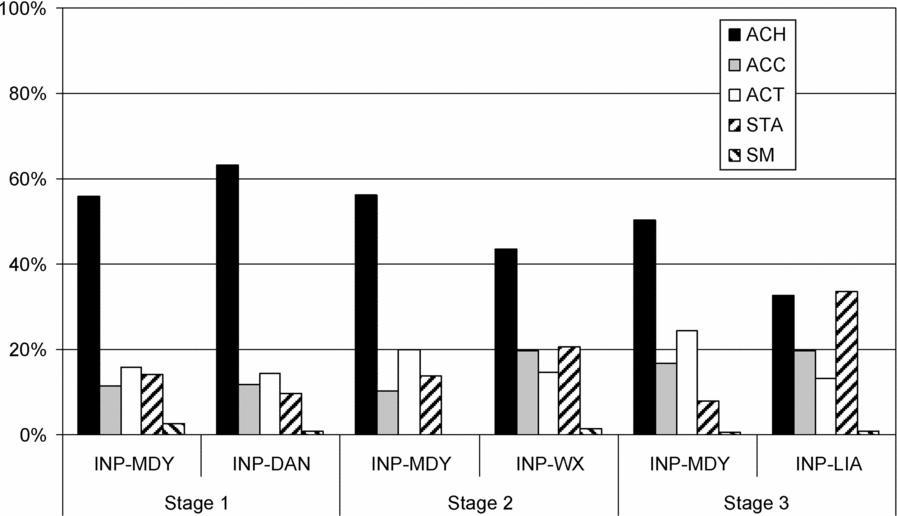
But when comparing children within each developmental stage, we find deviations from the predictions of the aspect hypothesis. As shown in Figure 1, the children used -le with stative verbs quite frequently, even more frequently than with activity and accomplishment verbs: about 11–17% for MDY, DAN, and LIA, and 41% for WX. These stative verbs are mostly adjectival verbs, such as liang “bright,” hong “red,” and huai “be.broken.” In Mandarin, a stative verb (which has no boundaries in time), when combined with -le, gets a dynamic inchoative reading,Footnote 10 that is, there is a change of state and the focus is on the beginning point of the situation, as in Xiaomao gaoxing le “little cat happy LE,” meaning “Kitty became happy.” Children learn to use -le with stative verbs very early. For example, Zhe po le “this broke LE” (this is broken; MDY, 1;10); and Zhe qiang huai le “this gun bad LE” (this gun broke; WX, 2;1). This is an important deviation from the aspect hypothesis, which predicts that perfective marking emerges with telic verbs and is only later on extended to atelic verbs such as statives (cf. prediction A).
Furthermore, we see big individual variations on the overall use of -le with verb types across the children, even though the general learning pattern of each child fits the predictions of the aspect hypothesis. For example, at Stage 1, 83% of the predicates with -le are achievement verbs in MDY's speech, whereas it is only 68% in DAN's speech; at Stage 2, 69% of the predicates with -le are achievement verbs for MDY, as contrasted to only 35% in WX's speech; and at Stage 3, 60% versus 40% in MDY's speech and in LIA's, respectively. Similar contrasts can also be seen in the use of -le with accomplishment verbs and stative verbs. Such big individual variations seem to suggest that the verb semantics cannot account for the whole story of the acquisition of aspectual marking in Mandarin. There might be other factors contributing to these variations. One possibility is the input. Let us examine the adults’ uses of the perfective -le with different predicates.
The distributional pattern in the children's speech resembles that in the child-directed speech. As revealed by Figure 2, all the caregivers used -le more frequently with achievement verbs (33–63%) than with the other predicate types, although the proportion is lower than that in the children's speech. The different distribution of verb types with -le in the child-directed speech also mirrors the individual variations in the children's use of -le. As discussed, at Stage 2, in the child WX's speech only 35% of the predicates is achievement verbs, which contrasts sharply with the 69% in MDY's speech. In the child-directed speech to WX, we see a lower percentage of achievement verbs with -le, only 43%. Stative verbs used with -le comprise 17–33% in all the caregivers’ speech across three stages. There is a similar distribution of stative verbs in the children's speech. Given such a close correlation of the distribution of verb types with -le between the parent speech and the child's speech, we can conclude that the input pattern plays a decisive role in the early uses of the stative verbs with -le.
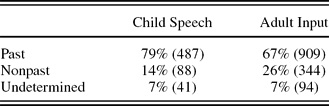
Distribution of -le for past events. We determined from the context whether each predicate with -le denotes an event having happened. Table 7 summarizes the use of -le for past and nonpast events, across the four children and their caregivers. Both the children and the adults have used -le dominantly to describe past events: 79% in the children's speech and 67% in their caregivers’ speech. The nonpast uses were found to occur in imperative clauses and conditional clauses, as in Bie kai hezi le “not open box LE” (Don't open the box) and Bing hao le zai qu “disease good LE then go” (After the disease is cured, we will go).
Distribution of -le for past and nonpast events
Table 7 also reveals that 14% of the use of -le is for nonpast events (cf. Chang, Reference Chang2002, study). Most of these uses are appropriate, as in imperatives and conditional clauses. This seems to suggest that the children's early uses of -le do not necessarily encode pastness and they may learn to disassociate past from perfectivity from early on.
Errors in aspectual marking in child speech
Errors are indicators of productivity and the incomplete knowledge of the grammatical rules in language acquisition. One type of errors involves the use of a noun phrase as a predicate with an aspect marker. These are not included in our original analysis because they are not verbal tokens. Five cases of such ungrammatical uses of “Noun + le” were identified, as in Examples 4 and 5.
4.
5.
Both verbs dao “fall” and lai “come” have been used by each child at this age. So errors like these may not be a lack of knowledge of the target verbs; rather, it may reflect children's strategy of focusing on the resultant change of state by highlighting the affected object in their speech.Footnote 11
Another interesting error was the use of both zai and -le in the same clause: MDY (2;0): *Zai qi-chuang le “ZAI get.up LE” (?I have been getting up). Note that qi-chuang “get up” is an accomplishment verb. The adult form is either Zai qi-chuang “ZAI get.up” (I am getting up) or Qi-chuang le “get.up LE” (it's time to get up or I got up, depending on context). In the actual context, the child meant “I have started getting up.” However, the progressive meaning of zai obviously conflicts with the perfective meaning of -le and thus they cannot co-occur. The child's creative error suggests that although she has a good grasp of the meaning of each aspect marker, she probably has not fully understood the co-occurrence restrictions of zai and -le.
DISCUSSION
In what follows, we discuss the results in relation to the issues concerning the aspect hypothesis. Of the four predictions, three of them (A, C, D) are relevant. In particular, we compare the results with data from English (Shirai, Reference Shirai1994; Shirai & Andersen, Reference Shirai and Andersen1995) and Japanese (Shirai, Reference Shirai, Nakajima and Otsu1993, Reference Shirai1998a), which used comparable methodology.
Perfective -le
It was found that perfective aspect marker -le is strongly associated with achievement verbs especially at the earliest stage, and the strong association weakens as the child's language develops, which is consistent with the prediction of the aspect hypothesis. Also important is the observation that child-directed speech is not so strongly associated with achievement verbs (generally, children's associations are stronger by 10%), suggesting the possibility that children initially create the semantic prototype of the perfective aspect in strong association with achievement verbs. It was also found that children's use of -le is more strongly associated with past time reference than caregivers (79% vs. 67%), consistent with the observation that prototype of perfective aspect is [+past] (Andersen & Shirai, Reference Andersen, Shirai, Ritchie and Bhatia1994; Dahl, Reference Dahl1985). That is, although children can separate pastness and perfectivity as noted above, they still prefer to use the perfective aspect marker -le for past time reference compared to adults.
However, the difference between English and Mandarin needs to be accounted for. For English data, the initial restriction of the past tense form to achievements is almost absolute (95% or higher), whereas in mothers’ speech the association is about 60% (Shirai & Andersen, Reference Shirai and Andersen1995). We will come back to this point later in this section.
Progressive zai
Progressive zai was almost exclusively associated with activity verbs, which is consistent with the aspect hypothesis: 92% (22 out of 24 tokens) of zai was used with activity verbs, and the 2 tokens that were used with accomplishments appeared only at Stage 3. This is in a sense natural in that caregivers’ use of zai is also restricted to activities (27 out of 31 tokens = 87%, see Table 6), but the difference is that caregivers’ use of zai with verbs other than activities appear at Stage 1. Further, Xiao and McEnery's (Reference Xiao and McEnery2004b, p. 355) analysis of the written corpus of Chinese shows 83% of zai being used with activities. This indicates that although both children's and adults’ use of zai is highly associated with activities, children's are more strongly and developmentally constrained, especially at the early stages. This is consistent with the prototype hypothesis (Li & Shirai, Reference Li and Shirai2000; Shirai & Andersen, Reference Shirai and Andersen1995) that children tend to create more dramatic association based on skewed distribution in the adults’ input.
Development of zai is also consistent with the aspect hypothesis in that children never used it with stative predicates at an early age. Erbaugh (Reference Erbaugh and Slobin1992, p. 429) also reported that all tokens of zai were used with activity verbs, and that none were used with statives. This contrasts with Li's (Reference Li1990; see also Li & Bowerman, Reference Li and Bowerman1998) study, which reported that children do make overgeneralization errors of attaching zai to stative posture verbs in his production experiment. Shirai (Reference Shirai1994) accounted for this overuse of zai by the prototype hypothesis and the performance limitations in experimental productions: children in a production experiment may have to perform beyond their capacity, and they thus make errors of attaching zai to the nonprototypical members of stative verbs like posture verbs, which in other languages are actually prototypical members of activity verbs. (For example, posture verbs are dynamic in English.) The observation in the present study (and also in Erbaugh, Reference Erbaugh and Slobin1992) supports this interpretation that children do go through prototype-based learning of progressive marking and they use zai only with activity verbs in early natural production data, even though in experimental production this may be violated and results in overextension. This is consistent with data from English, which report quite a few errors of stative progressives in experimental conditions (Mapstone & Harris, Reference Mapstone and Harris1985), whereas they are rare in natural speech (Bickerton, Reference Bickerton1981, Brown, Reference Brown1973, but for an exception, see Shirai, Reference Shirai1994).
Imperfective -zhe
The status of imperfective -zhe is ambiguous with respect to the aspect hypothesis, because it is not clear whether it is resultative imperfective or stative imperfective (Smith, Reference Smith1991). Furthermore, it is grammaticizing to encode progressive meaning in the northern dialects (Shirai, Reference Shirai1998b; Smith, Reference Smith1991). Accordingly, it is used with various types of verbs both in children's and caregivers’ speech. What is interesting is the observation that children rarely use -zhe at Stages 1 and 2 (4 tokens), even though caregivers use it quite frequently (70 tokens). This gap disappears at Stage 3 (children 40 vs. caregivers 39). This may indicate that -zhe is developmentally more difficult than zai, which increases its frequency gradually from Stage 1 (1 token) to Stage 2 (8 tokens), and to Stage 3 (15 tokens). This is natural in the sense that zai has a straightforward form-function mapping (almost always with activity to denote action in progress), whereas -zhe is more complex (attached to verbs of various aspectual classes). In addition, -zhe is often used in background clauses, which is not very common in child language. Thus, even though adult use of -zhe is three times more frequent than zai (109 -zhe vs. 31 zai), the frequency of children's uses are not very different (45 -zhe vs. 24 zai).
Experiential perfect -guo
In terms of the aspect hypothesis, a straightforward prediction is that -guo emerges with telic verbs because the grammatical category of “perfect” has close semantic affinity with perfective and simple past (the perfective path; Bybee et al., Reference Bybee, Perkins and Pagliuca1994), which are associated with telic verbs, and indeed many researchers call it “perfective” -guo (e.g., Xiao & McEnery, Reference Xiao and McEnery2004b). At the same time, however, it is also true that perfect is a grammatical category that can be used not only with telic, change of state verbs, but also with atelic verbs (Bybee et al., Reference Bybee, Perkins and Pagliuca1994), thus parting itself from the prototypical perfecive (Dahl, Reference Dahl1985).
The development of -guo appears to start with telic verbs: at Stage 1, only 1 token of -guo was used, which was with accomplishment. At Stage 2, three achievements (telic) and two activities (atelic) were used. Finally, at Stage 3, 3 telic verbs and 11 atelic (activity) verbs were used. What is interesting is that this distribution is very similar to that observed in the caregivers’ speech. It appears that adults do not talk about past experience displaced from the present when the child is very young. Shirai (Reference Shirai1991) also reports that mothers do not refer to habitual situations until children are older. Thus, displaced reference is still more difficult, although not impossible as Weist et al. (Reference Weist, Wysocka, Witkowska-Stadnik, Buczowska and Konieczna1984) show.
Frequency of aspect markers in child and adult speech
Huang (Reference Huang2003) found that children use aspect markers more frequently than adults, although the present study apparently found the reverse (see earlier). This appears to be due to methodological differences. Huang's (Reference Huang2003) analysis was limited to contexts where temporal reference was shifted to past, whereas ours looked at all uses of the four aspect markers regardless of temporal reference. Huang (Reference Huang2003) showed that children tend to rely more on aspect markers than adults (in this case, -le and -guo for both children and adults), whereas adults tend to rely more on temporal adverbials and discourse/pragmatics than children to establish past time reference. Children's high reliance on aspect markers may be due to the universal tendency for children to start using morphological marking of temporal reference before adverbials (Shirai, Reference Shirai, Klein and Li2009; Weist, Reference Weist, Fletcher and Garman1986), that is, aspectual marking is developmentally earlier than temporal adverbials, and therefore children rely on grammatical means for establishing past time reference because their control of other means is still limited. However, it still appears that children overall use aspect markers less frequently than adults simply because their control of aspect markers are limited compared with adults. The exact nature of the frequency difference of aspect markers between children and adults needs to be investigated in future research with extensive functional analysis of how children and adults use aspect markers in caretaker–child discourse.
Deviation from the aspect hypothesis
One important deviation from the prediction of the aspect hypothesis in this study is the early use of stative verbs with the perfective marker -le. According to the hypothesis, stative predicates are not supposed to be associated with perfective aspect and simple past tense markers. The ratio of stative verbs is not extremely high (less than 20% for most cases), but the child WX (Stage 2) used 40% of -le with stative predicates. This frequency ratio of statives with -le is quite comparable to that in the caregivers’ speech, which ranges from 10% to 20%, except for one case (37%, LIA, Stage 3).
Shirai (Reference Shirai1998a) discusses how and why different languages show different levels of adherence to the prototype (i.e., achievements/accomplishments) of perfective/past. English past tense marking shows almost exclusive restriction to the prototype at the earliest stage, whereas Japanese past tense -ta allows quite a few stative predicates with the past tense form at the earliest stage. Shirai (Reference Shirai1998a) suggested that Japanese verbs do not have unmarked zero forms and always have to be inflected for tense–aspect–modality, and Japanese children use unanalyzed rote-learned forms more frequently than in the case of children acquiring English. Because English allows the base form, this presumably makes it relatively easier for children to engage in rule learning. If this is the case, Mandarin children should behave similarly to children acquiring English because Mandarin has zero forms. However, the results of the present study show that this is not the case. How can we account for the difference between Mandarin and English?
One possibility is the fact that Mandarin aspect markers are optional (Klein et al., Reference Klein, Li and Hendriks2004) and temporal marking can be conveyed by time adverbials or inferred from the context (see earlier), whereas in English, past tense is obligatory; that is, grammatical marking is consistent. If the marking is always there when a particular meaning is intended, it should be much easier for the child to create the form-function mapping than when it is optional. Therefore, children may tend to associate the “verb + -le” form as a whole directly to the intended meaning, as in the case of Japanese, but for a different reason.
The aspect hypothesis, the prototype hypothesis, and the distributional bias hypothesis
To account for deviation from the prediction of the aspect hypothesis in L1 Japanese, Shirai (Reference Shirai1998a) appealed to strong lexical learning at the beginning stage. In fact, Japanese children show very high association of past tense form -ta with stative verbs at the beginning: almost 100%. Then, when -ta is more productively used, the frequency of past -ta with achievement verbs stabilizes to around 60–70%.
The aspect hypothesis, although it presupposes some type of primacy of aspect, mainly makes descriptive predictions regarding the correlation between tense-aspect markers and lexical aspect of the verb to which they are attached, although in its strong version, it makes the case that children are redundantly marking lexical aspect by grammatical tense or aspect markers (e.g., Bloom et al., Reference Bloom, Lifter and Hafitz1980).
The explanation for this phenomenon has been very controversial, and many explanations have been offered, such as cognitive deficits (Antinucci & Miller, Reference Antinucci and Miller1976; Bronckart & Sinclair, Reference Bronckart and Sinclair1973), innate constraints (Bickerton, Reference Bickerton1981, Reference Bickerton1984; Olsen & Weinberg, Reference Olsen, Weinberg, Greenhill, Littlefield and Tano1999), and primacy of linguistic category of aspect over tense (Bloom et al., Reference Bloom, Lifter and Hafitz1980; Sano & Hyams, Reference Sano, Hyams and Gonzales1994; Wagner, Reference Wagner2001).
One weakness of these explanations is their inability to account for cross-linguistic variations regarding the level of conformity to the predicted association. Shirai and associates (Li & Shirai, Reference Li and Shirai2000; Shirai, Reference Shirai1991, Reference Shirai1994, Reference Shirai1997; Shirai & Andersen, Reference Shirai and Andersen1995) proposed a prototype account based on input distribution, which can deal with such variations.
It is well known in aspectology (e.g., Comrie, Reference Comrie1976) that the way tense and aspect markers are used with different types of verbs is not uniform. Both in adult-to-adult speech and child-directed speech, there are strong associations between (perfective) past forms and telic verbs, general imperfective forms with atelic verbs, and dynamic imperfective (i.e., progressive) forms with activity verbs (the distributional bias hypothesis; for comprehensive review, see Andersen & Shirai, Reference Andersen, Shirai, Ritchie and Bhatia1996). The developmental claim is that children create (restricted) semantic representations based on input they receive. In the case of English, this scenario works very well: based on about 60% association of lexical aspect and tense-aspect markers, children create almost absolute association. This scenario has been tested by a connectionist simulation, in which a self-organizing network (i.e., no negative evidence, unlike standard backpropagation networks) was exposed to realistic input taken from the CHILDES database. It yielded a pattern of acquisition very similar to human children (see Li & Shirai, Reference Li and Shirai2000, chap. 7).
Although this model works very well with the acquisition of English tense-aspect morphology, when applied to Japanese, it did not work as neatly, as noted above. Thus, Shirai (Reference Shirai1998a) proposed a multiple-factor account, where input-based prototype formation as a fundamental process of rule learning (i.e., systematic process of form-meaning association) interacts with rote learning (i.e., direct association of inflected forms with salient scenes of discovering something, in the case of Japanese), which is mediated by cognitive saliency of some situations, as well as the status of particular tense-aspect markers of the target language (e.g., Japanese past tense is still grammaticizing from a perfect marker to a simple past tense marker).
The findings in the present study are generally consistent with the prediction of the aspect hypothesis, except for the early use of perfective -le with statives. As noted above, it can be accounted for by typological features of Mandarin, that is, its aspect markers are not obligatory, which facilitated rote learning of the verb forms with -le, as in gaoxing-le “has become happy.” It is also possible that these are used for highly salient scenes for children, as in the case of Japanese Atta (Lit. “It's been there!” [I found it!]), which appeared very early even though past tense -ta with stative verbs is predicted to emerge late.
The picture we present after comparing English, Japanese, and Mandarin in a comparable methodology would be this: children make semantic representations predicted by the aspect hypothesis, but the degree to which each language (or even each tense-aspect marker) does this is highly influenced by the way the language is organized, and multiple factors, including input frequency, complexity of form-function mapping, saliency to children and typological characteristics, determine the degree to which the data conform to the hypothesis.
One important point that needs to be stressed is that the account proposed here is essentially based on bottom-up, input-based learning. Although the results differ, especially regarding past tense marking, between English on the one hand, and Mandarin and Japanese on the other, the acquisition patterns are heavily influenced by input frequency, the difference being how “closely” learners reflect it, which is mediated by multiple factors.
CONCLUSION
The present study reported a detailed analysis of how children acquiring Mandarin use aspect markers across different levels of developmental stages. The important feature of the present study is a systematic comparison of both the children's speech and their input in Mandarin with those in English and Japanese, in the spirit of the cross-typological approach (Slobin, Reference Slobin and Slobin1997) where typologically distant languages are compared, by using a comparable methodology that make a cross-linguistic comparison possible. It was found that children's learning of aspect markers are generally consistent with the aspect hypothesis, and that deviations can be explained by multiple factors.
The results of the present study generally support the tenet of the usage-based approach to language acquisition. This approach emphasizes the role of input frequency and typological features of the language to be acquired and proposes explanations of acquisition patterns based on the interaction of these multiple factors (e.g., Diessel, Reference Diessel2004; Goldberg, Casenhiser, & Sethuraman, Reference Goldberg, Casenhiser and Sethuraman2004; Lieven, Pine, & Baldwin, Reference Lieven, Pine and Baldwin1997; Stoll, Reference Stoll2005; Tomasello, Reference Tomasello2000). Needless to say, we need to test the hypotheses generated by our naturalistic studies with experimental studies. For example, are Mandarin children good at handling stative verbs attached to -le even when the experimental materials include the verbs that are not the ones they usually produce with -le? That is, are they learning “inchoative meaning of -le” in a generalizable form rather than as memorized chunks? How about English-speaking children who rarely produce stative + past tense at early stages? Such experimental studies may shed light on the difficult problem of teasing out rote learning versus rule learning, a thorny methodological as well as theoretical issue for language acquisition research.
APPENDIX A OPERATIONAL TESTS FOR THE ASPECTUAL CATEGORIES OF PREDICATES
Predicates are indicated in bold italics.
Step 1: State or nonstate (nondynamic vs. dynamic)
The verb (or verb phrase) cannot have a habitual interpretation without any aspect marker attached, can it?
If it cannot → state (e.g., Wo ai ni “I love you” → no habitual reading)
If it can → nonstate (e.g., Wo tiantian chi mifan “I every day eat rice” (I eat rice every day) → habitual reading possible) → Go to Step 2
Step 2: Punctual or durative
[If test (a) does not apply, apply test (b)]
(a) Can you say “X kaishi VP” (= “X begin to VP”) without an iterative interpretation?
— If you cannot → Achievement (e.g., #Ta kaishi si “he begins to die”) → Go to step 4.
— If you can → Accomplishment (e.g., Ta kaishi xie yi feng xin “he begins to write a letter”) or Activity (e.g., Ta kaishi paobu “he begins to run”) → Go to Step 3
(b) Can you say “X will VP at Y o'clock (e.g., 2 o'clock) sharp”?
— If you can → Achievement (e.g., Huiyi hui zai 2 dian zheng kaishi “Lit: meeting will at 2 o'clock sharp begin” (The meeting will begin at 2 o'clock sharp) → Go to step 4
— If you cannot → Accomplishment or Activity → Go to Step 3
Step 3: Accomplishment or Activity/semelfactive (Telic vs. atelic)
[If test (a) does not apply, apply test (b)]
(a) Can “X chadianr VP le” (= “X almost VP le”) mean “X started V but did not complete it”?
— If it can → Accomplishment (e.g., Ta chadianr pao dao xuexiao le “Lit: he almost run arrive school le” (he almost ran to the school) can mean that he started running but he didn't reach the school).
— If it cannot → Activity or semelfactive (e.g., Ta chadianr pao le bu “he almost ran le” (he almost ran) can only be interpreted as he almost started running) → Go to Step 4.
(b) Can you say “X will VP for Y time” (e.g., 10 min)?
— If you can → Activity (e.g., Ta hui zuo 10 fenzhong “he will sit for 10 minutes”) or semelfactive (Ta kesou le 10 fenzhong “he coughed for 10 minutes”).
— If you cannot →Accomplishment (e.g., #Ta pao dao xuexiao 10 fenzhong “he run arrive school 10 minutes” (#He ran to school for 10 minutes) → Go to Step 4.
Step 4: Achievement or Semelfactive
Can you say “X zai VP” with iterative/repetitive (i.e., iteration on one occasion. Not habitual) interpretation?
— If you can → Semelfactive (e.g., Ta zai kesou “he zai cough” [he is coughing])
If you cannot → Achievement (e.g., #Ta zai si “he zai die”)
ACKNOWLEDGMENTS
This research is supported by a Direct Grant for Research from the Chinese University of Hong Kong. We thank Karen Mistry and Brian Agbayani for helpful comments on the draft and Asifa Majid for discussion of possible statistic methods. Preliminary findings of this study were presented at the Child Language Seminar in Newcastle upon Tyne, UK, in 2006.