Bilingualism has become an important research area in the last decades. Despite the increasing number of studies exploring the effects of bilingualism on cognitive processes (Bialystok, Klein, Craik, & Viswanathan, Reference Bialystok, Klein, Craik and Viswanathan2004; Bialystok, Luk, & Kwan, Reference Bialystok, Luk and Kwan2005; Colzato et al., Reference Colzato, Bajo, van den Wildenberg, Paolieri, Nieuwenhuis, La Hajj and Hommel2008; Paap, Johnson, & Sawi, Reference Paap, Johnson and Sawi2015), the impact of bilingualism on language learning has received less attention, and even less so in children. Previous work has suggested that bilinguals (adults and children) may be better at word learning than monolinguals due to their experience with language learning (see Hirosh & Degani, Reference Hirosh and Degani2018, for a review). However, it is unclear whether word learning in bilinguals is improved by overall previous experience of language learning as such or by the specific language combinations spoken by the bilinguals. Effects on word learning could also be related to the specific characteristics of the languages the bilinguals master. This study therefore aims to investigate whether experience acquiring any second language affects novel word learning in children or whether effects of bilingualism depend on the linguistic experience dealing with specific differences between the language pairs (i.e., language pairs sharing similar orthotactic systems vs. language pairs with orthotactic differences).
Many properties of speakers have a direct impact on how infants process known and new words. Even unspoken properties of speakers, such as their race and accent, may influence infants’ speech processing (e.g., Weatherhead & White, Reference Weatherhead and White2018). However, not only intrinsic properties of the speakers modulate word processing and learning, at fundamental facets of the receivers of the message also determine the manner in which known and new content are treated. It has been shown that bilingual children are willing to accept that novel words may correspond to a familiar object, whereas monolingual children are biased toward assigning a novel word to a new object (Kandhadai, Hall, & Werker, Reference Kandhadai, Hall and Werker2017; Markman & Wachtel, Reference Markman and Wachtel1988). This suggests that from early childhood bilinguals know that objects may have different names in each of their languages, and for this reason they may be able to link translations in another new language to a known concept more easily than monolinguals (Au & Glusman, Reference Au and Glusman1990; Kaufman, Reference Kaufman2004). Along these lines, studies focusing on bilingual and monolingual children’s capacity to learn novel words have suggested that bilingual children show a general advantage in learning compared to their monolingual peers in situations that require many-to-one mappings (Kalashnikova, Mattock, & Monaghan, Reference Kalashnikova, Mattock and Monaghan2015; Kaushanskaya, Gross, & Buac, Reference Kaushanskaya, Gross and Buac2014). Benefits in word learning have been observed both for bilingual children who learned their languages in a classroom environment (Kaushanskaya et al., Reference Kaushanskaya, Gross and Buac2014; Mady, Reference Mady2014), as well as for bilingual children who acquired both languages from birth (Kahn-Horwitz, Kuash, Ibrahim, & Schwartz, Reference Kahn-Horwitz, Kuash, Ibrahim and Schwartz2014; Yoshida, Tran, Benitez, & Kuwabara, Reference Yoshida, Tran, Benitez and Kuwabara2011). These experiments suggested that the experience of managing two languages, in general, may enhance learning and may change how novel words are acquired.
This has been found in bilinguals speaking two languages with distinct orthographic systems. Yoshida et al. (Reference Yoshida, Tran, Benitez and Kuwabara2011) found that bilingual children (English–Chinese, English–French, English–Spanish, English–Russian, English–Urdu, and English–Vietnamese) around the age of 3 outperformed English monolingual children in a novel word learning task in which children had to associate novel words with a corresponding referent. The authors concluded that using different languages in daily life enhanced new word learning. Those findings are in line with the studies by Kaushanskaya and Marian (Reference Kaushanskay and Marian2009a, Reference Kaushanskaya and Marian2009b), in which English–Spanish bilingual and English–Mandarin bilingual young adults learned novel words better than English monolinguals. Bilinguals in those experiments had highly contrasting language combinations. For instance, English–Spanish and English–French share similar printed systems but English–Mandarin and English–Vietnamese use different orthographic codes.
The previously cited studies (e.g., Kaushanskaya & Marian, Reference Kaushanskay and Marian2009a, Reference Kaushanskaya and Marian2009b; Yoshida et al., Reference Yoshida, Tran, Benitez and Kuwabara2011) showed that participants learned novel words when these were auditorily presented and they did not have access to the written words. Those studies involved bilinguals whose language combinations entailed large differences in orthotactics as well as phonotactics (e.g., Spanish–English) or even use different scripts (e.g., English–Mandarin). With this in mind, it is expected that these bilinguals are unconsciously trained to constantly manage differences in orthographic and phonological patterns that clearly differentiate the languages they know. It could be tentatively hypothesized that the expertise gained in managing these differences in their languages makes these bilinguals better prepared to accept and learn new patterns. Thus, it could have been the case that the sensitivity developed to deal with such extreme differences between languages could have driven the difference in performance between the groups in vocabulary learning. The question that remains open is whether or not bilinguals whose known written languages are closer at the orthographic and orthotactic level would also show an advantage in word learning as compared to other bilinguals with more distant language combinations. In this line, recent adaptations of the models of bilingual visual word recognition have proposed two separate sublexical language routes, orthographic and phonological, which are expected to be mediated by the intrinsic characteristics of the languages (Casaponsa et al., Reference Casaponsa, Thierry and Duñabeitia2020).
In line with these thoughts, Werker and Byers-Heinlein (Reference Werker and Byers-Heinlein2008) underscore the importance of the specific language pairs in the bilingual language system and their interaction dealing with its differences. The characteristics of the specific languages may affect how known pieces of information are processed. More important, the specific similarity or differences between the characteristics of the languages may affect processing new information. Along these lines, Kahn-Horwitz, Schwartz and Share (Reference Kahn-Horwitz, Schwartz and Share2011) asked three groups of children between 6 and 11 years old to complete a series of spelling, decoding, and reading tasks in English. They found that bilingual Russian–Hebrew triliterates (with English as a third langauge) outperformed Russian–Hebrew-speaking biliterates (with no literacy in Russian) and Hebrew-speaking biliterates in the spelling and reading tasks. They suggested that similaraties between English and Russian, such as the gramatical structures, helped bilinguals learn English with greater ease than Hebrew monoliterates. It should be noted that this study did not involve learning, but it suggests that the differences in the systems and structures of the known languages may mediate the process of approaching a new language. Thereby, we hypothesized that dealing with more distinctive structures between the languages known to a bilingual also at the orthographic level may influence their ability to learn novel words.
Learning new orthographic patterns that also exist in one’s native language(s) is expected to be easier than learning completely different patterns (see Ellis & Beaton, Reference Ellis and Beaton1993; Speciale, Ellis, & Bywater, Reference Speciale, Ellis and Bywater2004). In this study, we focus not only on the acquisition of words that follow the orthotactic patterns that exist in the native language(s) but also especially also on the acquisition of words with illegal orthotactic patterns. Thus, the current study aims to examine how bilingual and monolingual children with orthotactically similar or dissimilar languages learn novel words that violate or respect the orthotactic legality of the languages they know (i.e., the language-selective pattern of grapheme combinations in written words). Furthermore, we examine whether this learning is affected by bilingualism in general or by the linguistic experience with the specific characteristics of the bilinguals’ two languages. To this end, the performance of two groups of bilinguals (one with orthotactically similar languages and the other with orthotactically dissimilar languages) was compared to that of a group of monolinguals. We hypothesized that when bilinguals have to learn new orthotactic patterns that do not exist in their languages, the degree of dissimilarity between the two languages could improve the learning of these different structures or patterns due to their experience with orthotactic distinctiveness. Daily experience with different orthotactic patters could make these bilinguals more flexible when encountering new patterns. Thus, we also conjectured that bilinguals that know languages with different orthotactic rules are more prone to accept and learn new words with different orthotactic characteristics than bilinguals with orthotactically similar languages.
Recent research with adults has highlighted the critical role played by the orthotactic structure of words during bilingual visual-word recognition (Casaponsa & Duñabeitia, Reference Casaponsa and Duñabeitia2016; Lemhöfer, Koester, & Schreuder, Reference Lemhöfer, Koester and Schreuder2011; Oganian, Conrad, Aryani, Heekeren, & Spalek, Reference Oganian, Conrad, Aryani, Heekeren and Spalek2016; van Kesteren, Dijkstra, & de Smedt, Reference van Kesteren, Dijkstra and de Smedt2012). Words from a given language that include certain letter combinations that are illegal in the other language known to a bilingual (viz., marked words containing language-specific orthotactic regularities) are processed differently than words whose orthotactic pattern is also plausible in the other language (viz, unmarked words; Vaid & Frenck-Mestre, Reference Vaid and Frenck-Mestre2002). Language detection is mediated by the regularities of the sublexical representations of the words that are being read. Along these lines, research has demonstrated that marked words are easier to detect than unmarked words (Casaponsa, Carreiras, & Duñabeitia, Reference Casaponsa, Carreiras and Duñabeitia2014, Reference Casaponsa, Carreiras and Duñabeitia2015; Vaid & Frenck-Mestre, Reference Vaid and Frenck-Mestre2002). In this regard, models of bilingual visual word recognition (Casaponsa et al., Reference Casaponsa, Thierry and Duñabeitia2020; van Kesteren et al., Reference van Kesteren, Dijkstra and de Smedt2012) have noted the importance of individual letters and of combinations of letters in order to identify the language of the words and to reduce parallel activation of the nontarget language. Readers use this sublexical information in order to recognize the language of the word more quickly as demonstrated by the fact that specific letter sequences elicit lower cross-language activation levels than unmarked words (Casaponsa & Duñabeitia, Reference Casaponsa and Duñabeitia2016). This suggests that language-specific orthotactic patterns represent an important clue in bilingual language processing. Therefore, it is possible that bilinguals who speak more orthotactically distinct languages are able to use their experience in managing two different sets of orthographic rules (sublexical information) to accept and integrate alternative orthographic patterns more easily.
With this in mind, we investigated if new vocabulary acquisition is easier for all types of bilinguals as compared to monolinguals (see Kaushanskaya & Rechtzigel, Reference Kaushanskaya and Rechtzigel2012), or if this benefit depends on the specific sublexical characteristics of the language combination of the bilinguals, paying special attention to the orthotactic level. We hypothesized that a key factor influencing novel word learning is whether bilinguals do or do not have to deal with distinctive orthographic sequences in their languages. We focused on two language pairs: Spanish–Catalan and Spanish–Basque. While these three languages all share the same Roman alphabet, their sublexical structures vary. Spanish and Catalan share most orthotactic patterns, whereas Spanish and Basque are very dissimilar in their graphemic structure, and Basque has many bigram combinations that are illegal according to the Spanish (and Catalan) orthotactic rules. These bilingual communities coexist with both languages in printed materials in the same school context as well as permanently exposed in daily life. Besides, we also explored whether the learning benefit of the bilinguals depends on the specific sublexical characteristics of the words that are being learned. To this end, we created nonexisting novel orthographic representations that either respected the orthotactic structure of all the languages (e.g., the new word “aspilto,” which could perfectly be a word in any of the three languages according to the graphemic patterns) or violated the orthotactic rules of these languages (e.g., the nonword “ubxijla,” containing the bigrams “bx” and “jl” that do not exist in Spanish, Catalan, or Basque). We predicted that the learning benefit would be maximal for bilingual children with more dissimilar languages at the orthotactic level on the illegal bigram combinations as they could find it easier to deal with different orthotactic patterns due to their linguistic experience.
Experiment 1
Method
Participants
A total of 72 children (45 females; M age = 12.9 years, SD age = 0.8) took part in this experiment. Children were divided into three languages groups. The selected languages were Spanish, Basque and Catalan. Spanish–Catalan and Spanish–Basque concur in the same environment in specific bilingual areas in Spain. Children were recruited from three schools located in different autonomous communities in Spain. First, a group of 24 Spanish monolinguals was recruited in Santander (Cantabria), which is a monolingual region located in the North of Spain. Second, a group of 24 Spanish–Catalan bilinguals was recruited in Barcelona (Catalunya), a bilingual community on the North East coast. Third, a group of 24 Spanish–Basque bilinguals was recruited in Vitoria (Basque Country), a bilingual community on the North coast.
The three autonomous communities selected for this study represent markedly different language environments. Spanish monolinguals lived in a Spanish-only environment and attended a Spanish monolingual school. Monolinguals were not consistently exposed to Catalan or Basque in any form in daily life. However, as participants all lived in the same country, they could have had indirect contact with these languages at some point in their lives (while traveling, for instance). Even if learning English is the norm in all schools in Spain, this group’s exposure to English was very low. Participants were asked to rate on a scale from 0 to 100 the percentage of time that they spoke and listened to the languages that they used daily, 100 being the percentage corresponding to all the hours in a week (percentage of exposure to Spanish, M = 93.7%, SD = 1.56; percentage of exposure to English, M = 6.3%, SD = 2.43). Spanish–Catalan bilingual children had acquired both languages before the age of 6. They were raised in a bilingual community and educated in a Spanish–Catalan bilingual school (percentage of exposure to Spanish, M = 47.9%, SD = 6.96; percentage of exposure to Catalan, M = 45.2%, SD = 5.54; percentage of exposure to English, M = 6.9%, SD = 3.48). Spanish–Basque bilinguals had also acquired both languages before the age of 6, and they were also attending a Spanish–Basque bilingual school (percentage of exposure to Spanish, M = 52.8%, SD = 2.54; percentage of exposure to Basque, M = 39.9%, SD = 2.46; percentage of exposure to English, M = 7.3%, SD = 2.79).
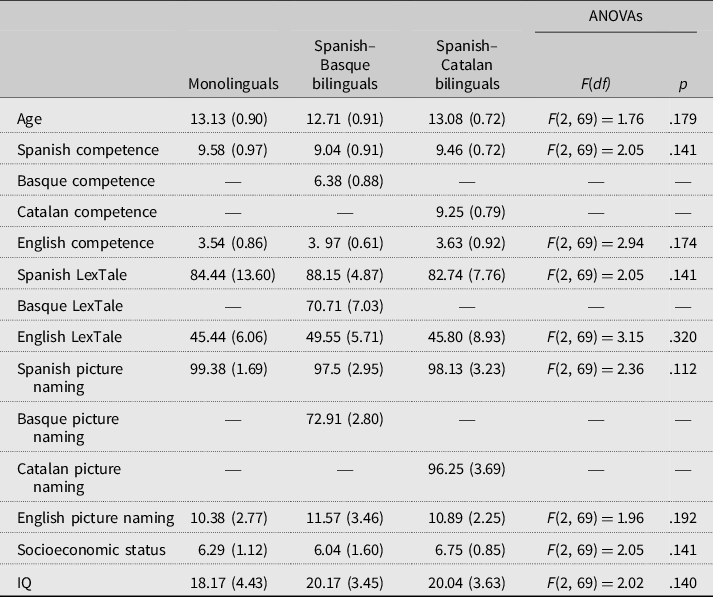
We assessed language proficiency with three different measurements (see Table 1): a subjective scale, in which participants rated their language competence on a scale from 0 to 10; a 20-item adapted version of a picture-naming task (de Bruin, Carreiras, & Duñabeitia, Reference de Bruin, Carreiras and Duñabeitia2017); the LexTale, Lexical Test for Advanced Learners of English (a lexical decision task, cf., for the English version, Lemhöfer & Broersma, Reference Lemhöfer and Broersma2012; for the Spanish version, Izura, Cuetos, & Brysbaert, Reference Izura, Cuetos and Brysbaert2014; and the Basque version, de Bruin et al., Reference de Bruin, Carreiras and Duñabeitia2017, note that the Catalan version does not exist). In addition to measuring proficiency in Spanish, Basque, and Catalan, we also made sure that, despite English being a mandatory subject in all Spanish schools (Age of Acquisition = 8.67, SD = 2.14), the participants’ English level was relatively low as assessed by the English subjective scale, LexTale, and the picture-naming task (see Table 1).
Descriptive statistics of assessments

Note: Values reported are means and standard deviations in parenthesis of age (in years), subjective language competence (0–10 scale), LexTale (%), picture naming (% correct), socioeconomic status (1–10 scale), and IQ (correct answers). The last column shows the results from one-way analyses of variance (ANOVAs) comparing the three language groups on the different assessments.
Participant groups were matched in age, language proficiency in Spanish, socioeconomic status, and IQ (see Table 1). Socioeconomic status was measured with a short parental questionnaire in which they were asked to indicate on a scale from 1 to 10 how they perceived their socioeconomic situation as compared to other members of their community (Adler & Stewart, Reference Adler and Stewart2007). IQ was measured with a 6-min abridged version of the Kaufman Brief Intelligence Test (Kaufman, Reference Kaufman2004), using only the matrices test (a total of 34 matrices that were presented in increasing difficulty order for 6 min). Participants had to complete as many matrices as they could in the time provided. As IQ was only used to control that all participants were in the same range of nonverbal intelligence, the whole test (verbal and nonverbal intelligence tests) was not administered. As seen in Table 1, bilingual participants could not be fully matched on their second language competence (i.e., Basque and Catalan). Spanish–Basque bilinguals were less proficient in Basque than Spanish–Catalan bilinguals were in Catalan. While no differences were found in the picture-naming task, t(24) = 1.89, p = .118, Cohen’s d = 0.378, a significant difference was observed in the subjective competence scale, t(24) = 9.54, p < .001, Cohen’s d = 0.906. This may be due to the origin of the Spanish–Basque bilinguals, who came from and were tested in a city in which Basque is mainly used at school, while the Spanish–Catalan participants used Catalan in daily life outside school as well.
All participants were right-handed, and none were diagnosed with language disorders, learning disabilities, or auditory impairments. They and their families were appropriately informed, and legal guardians signed consent forms before the experiment. The protocol was carried out according to the guidelines approved by the Basque Center on Cognition, Brain and Language Ethics Committee in line with the Helsinki Declaration, and the studies reported in Experiments 1 and 2 were approved with the ethics approval number 220317.
Materials
Thirty novel words were created for this experiment (see Appendix A). Fifteen legal and 15 illegal novel words were created following the same orthographic structure: vowel, consonant bigram, vowel, consonant bigram, and vowel (i.e., VCCVCCV). The critical manipulation determining whether a novel word was legal or illegal was the embedded consonant bigram (CC). Legal critical bigrams were those that existed in all three critical languages, Spanish, Basque, and Catalan, whose frequency of use did not differ statistically across languages, F(2, 22) = 0.697, p = .499,
 $$\eta _{\rm{p}}^2 = .001$$
. Illegal critical bigrams did not appear in any of the languages, such that frequency of use was 0.
To identify critical legal and illegal bigrams, we first compiled a corpus of bigrams from three language databases: Spanish (Davis & Perea, Reference Davis and Perea2005); Basque (Perea et al., Reference Perea, Urkia, Davis, Agirre, Laseka and Carreiras2006); and Catalan (Guasch, Boada, Ferré, & Sánchez-Casas, Reference Guasch, Boada, Ferré and Sánchez-Casas2013). Bigram frequency of use per million was calculated as the average frequencies of use of all words containing that bigram across all three languages. Bigrams that contained letters that did not exist in one or more of the critical languages, such as ñ, c, v, and w, were excluded. Considering that individual letters may present different distributional properties between languages, we also calculated the relative frequency of each letter in each of the three critical languages (Spanish, Basque, and Catalan). Results showed that the frequency distributions did not differ between the languages, F (2, 50) = 1.00, p = .375, and all Bonferroni-corrected planned pairwise comparisons corroborated this (all ts < 1.3 and ps >.65).
In total, 23 legal critical CC bigrams and 19 illegal critical CC bigrams were selected (see Appendix B for a list of selected CC bigrams). Next, in order to construct the novel words, we selected a second set comprising noncritical legal bigrams. These bigrams contained only one of the two letters from the critical legal CC bigrams and were either preceded by or followed by a single vowel (VC or CV). These bigrams were selected to ensure that all noncritical bigrams used to compose novel words existed in all three languages. Bigram frequencies of use for noncritical legal bigrams were not significantly different across the three languages, F (2, 78) = 0.341, p = .711,
 $$\eta _{\rm{p}}^2 = .001$$
. In total, 79 noncritical legal bigrams were selected (see Appendix B for a list of the selected noncritical bigrams). Finally, a total of 30 novel words conforming to the VCCVCCV structure were created using the legal noncritical CV and VC bigrams and the legal or illegal CC bigrams.
For instance, the 15 novel words containing legal critical bigrams (e.g., “ASPILTO”) included bigram combinations that were plausible in Spanish, Catalan and Basque (e.g., the consonant cluster “SP” appears in “avispa,” the Spanish for wasp, “ispilu,” mirror in Basque, and “espai,” which corresponds to space in Catalan), and therefore they were pronounceable. The other 15 novel words contained illegal critical bigrams, (e.g., “UBXIJLA”, where the bigrams “BX” and “JL” do not exist in any of the three critical languages). All novel words were fragmented in three pronounced syllables (see Appendix A for the phonotactic clusters). Novel words were presented both in written and auditory format. Novel words stimuli were recorded in a soundproof room with a Marantz® professional PMD671. They were recorded by a native Spanish (and English as a second language) female with neutral intonation. Legal and illegal novel words followed the Spanish phonology, which is the common language for the three groups. Moreover, each of the 30 novel words was paired with a different video clip. The video clip was an invented three-dimensional (3D) object that rotated on three axes (see Antón, Thierry, & Duñabeitia, Reference Antón, Thierry and Duñabeitia2015). Each 3D object was different from the rest, and there were the same number of 3D invented objects in the same color range. Novel words were presented with an invented 3D object to facilitate learning because it is demonstrated that children learn new words better when they learn words with a referent (Fennell & Waxman, Reference Fennell and Waxman2010; Mani & Plunkett, Reference Mani and Plunkett2008).
Procedure
Participants were individually tested during school hours. The entire experiment lasted about 1 hr, including the initial assessment and the two experimental phases, learning and test. All visual stimuli were presented on a 13-inch MacBook® running with Experiment Builder®. Auditory materials were presented to both ears simultaneously using Sennheiser® headphones.
The experiment was divided into learning and test phases. First, participants saw and heard the 30 novel words in association with a 3D invented object. A trial began with a fixation cross, which appeared for 500 ms, followed by a word-object pair, which was presented for 6500 ms on the screen. Each 3D invented object was visually presented together and aligned in time with the onset of the presentation of the visual (written) and auditory representations of the corresponding novel word to show how they could sound. Participants did not have to press any key to pass to the next screen. Each object association was presented three times during the learning phase, leading to 90 trials that were presented in random order. After this learning phase, participants were presented with another learning task. They had to type on the keyboard the name of the invented object. The object was presented with its auditory representation again, but this time a writing box appeared. Participants were instructed to write the novel word paying attention to the novel word that was still on the screen. They could only continue to the next trial if the novel had been written correctly (mean of incorrectly typed items = 2.46, SD = 1.89). Participants had to type string-objects pairs twice in a random order.
Right after the learning phase, participants performed the testing phase. They had a couple of minutes to rest while the experimenter prepared the computer for the testing phase. The testing phase included a recognition task. They were asked to complete a recognition task (2AFC task). In each of the trials of the recognition task, participants were presented with a fixation cross displayed for 500 ms, immediately followed by the centered presentation of the 3D invented object accompanied by two response options (a correct and an incorrect novel word) displayed at the lower right and left sides. The incorrect option corresponded to strings that were presented during the learning phase but that did not match the 3D objects, with the response options being legal or illegal. The location of correct and incorrect options was counterbalanced across trials. Participants responded by pressing one out of two buttons on the keyboard corresponding to the location of the correct response. If no answer was given in 10000 ms, the next 3D object was presented.
Data analysis
One task of interest was analyzed in this experiment, the recognition task. Error rates and reaction times for correct responses were collected (see means in Table 2). Before data analysis, outliers were excluded using R (R Core Team, 2013). Responses below 250 ms (4.44%) and timeouts above 10000 ms (0.18%) were initially excluded from the analyses. In addition, responses above or below 2.5 SD from the participant-based (0.58%) and item-based (1.35%) mean for all within-factors were excluded from the analyses, leading to an overall exclusion of 1.15% of the data. Furthermore, only correct responses were included in the reaction time analysis.
Descriptive statistics for the Recognition task

Note: Means and standard deviations in parenthesis of percentages of errors and reaction times in milliseconds for legal and illegal orthotactic sequences for the three language groups. RT, reaction time.
Data analysis was conducted with Jamovi 0.9.6.7. A series of repeated measures analyses of variance (ANOVAs) on reaction times for correct responses and error rates were conducted following a 3 (Group: Spanish monolinguals, Spanish–Catalan bilinguals, Spanish–Basque bilinguals) × 2 (Orthotactic Structure: Legal, Illegal) design. Accuracy (Percentage of Errors) and reaction times of correct responses (in milliseconds) were used as the dependent variables of interest.
To support the absence and presence of an illegality effect in each of the language groups, we also conducted a Bayesian analysis. A Bayes factor (
 $$B{F_{10}}$
) shows the ratio of the probability that the data were observed under the alternative hypothesis versus the null hypothesis. For instance,
 $B{F_{10}} = 5$
indicates that the observed data were five times more likely to have occurred under the alternative than the null hypothesis, or oppositely, a
 $B{F_{10}} = 0.2$
shows that the data were more likely to be observed under the null than the alternative hypothesis.
Results and discussion of Experiment 1
Results from the reaction time analysis of the recognition task showed no significant differences in reaction times identifying legal and illegal sequences, F
1 (1, 69) = 1.80, p = .184,
 $$\eta _{\rm{p}}^2 = .004$$
; F
2 (1, 14) = 0.471, p = .504,
 $$\eta _{\rm{p}}^2 = .013$$
. Participants reacted equally fast to legal and illegal sequences (see Table 2). The main effect of group was not significant, F
1 (2, 69) = 0.01, p = .987,
 $$\eta _{\rm{p}}^2 = .001$$
; F
2 (2, 28) = 0.134, p = .875,
 $$\eta _{\rm{p}}^2 = .002$$
, and the interaction between orthotactic structure and group was not significant either, F
1 (2, 69) = 0.04, p = .960,
 $$\eta _{\rm{p}}^2 = .001$$
; or F
2 (2, 28) =0.146, p = .865,
 $$\eta _{\rm{p}}^2 = .003$$
. These findings suggest that all groups invested the same amount of time in all responses.
In terms of accuracy, there was a significant main effect of orthotactic structure (see Table 2), F
1 (1, 69) = 17.35, p < .001,
 $$\eta _{\rm{p}}^2 = .060$$
; F
2 (1, 14) = 6.66, p = .022,
 $$\eta _{\rm{p}}^2 = .096$$
. Overall, participants were more accurate at recognizing the correct word for the object when it was a legal orthotactic sequence than an illegal one. In contrast, the main effect of group was not significant, F
1 (2, 69) = 0.047, p = .953
 $$\eta _{\rm{p}}^2 = .001$$
; F
2 (2, 28) = .207, p = .814,
 $$\eta _{\rm{p}}^2 = .002$$
, but the interaction between the two factors was significant, F
1 (2, 69) = 4.82, p = .011,
 $$\eta _{\rm{p}}^2 = .022$$
; F
2 (2, 28) =3.87, p = .033,
 $$\eta _{\rm{p}}^2 = .044$$
. This interaction suggests that the illegality effect differs between the three groups.
Therefore, we assessed this effect for participants in each group separately. Spanish–Catalan bilinguals, t
1 (23) = 3.79, p = .001, Cohen’s d = 0.756,
 $B{F_{10}}$
= 8.78; t
2 (14) = 2.25, p = .041, Cohen’s d = 0.581,
 $B{F_{10}}$
=1.79, and monolinguals, t
1 (23) = 3.70, p = .001, Cohen’s d = 0.756,
 $B{F_{10}}$
= 8.57; t
2 (14) = 2.33, p = .035, Cohen’s d = 0.602,
 $B{F_{10}}$
= 2.02, showed a significant effect of illegality. In contrast, this effect was not observed for Spanish–Basque bilinguals, t
1 (23) = 0.120, p = .906, Cohen’s d = 0.024,
 $B{F_{10}} = 0.21$
; t
2 (14) = 0.06, p = .953, Cohen’s d = 0.016,
 $B{F_{10}} = 0.26$
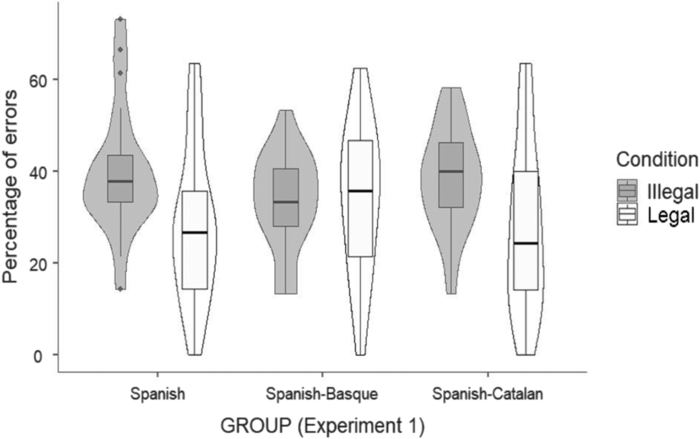
, showing that they had learned illegal orthotactic sequences to the same extent as legal ones (see Figure 1). To follow up on this interaction, we also looked at the simple main effects of group on each level of orthotactic structure (i.e., on legal and illegal patterns separately). In a one-way ANOVA, we found no significant effect of group for the legal, F
1 (2, 69) = 1.08, p = .349,
 $$\eta _{\rm{p}}^2 = .017$$
; F
2 (2,42) = 0.54, p = .586,
 $$\eta _{\rm{p}}^2 = .025$$
, or the illegal orthotactic sequences, F
1 (2, 69) = 1.87, p = .166,
 $$\eta _{\rm{p}}^2 = .045$$
; F
2 (2, 42) = 1.02, p = .371,
 $$\eta _{\rm{p}}^2 = .046$$
. This means that the interaction between group and orthotactic structure was not driven by the Spanish–Basque bilinguals performing better on the illegal sequences nor doing worse on the legal ones. Instead, it suggests that they perform similarly on legal and illegal patterns, whereas the other language groups perform worse on the illegal than on the legal sequences.
Violin plot of the percentage of errors in the recognition task for legal and illegal orthotactic sequences for each of the language groups (Spanish, Spanish–Basque, and Spanish–Catalan). Shapes represent the density plot of each condition, horizontal lines represent the low and high interquartile range, and the middle line is the mean of each condition. Vertical lines represent the adjacent values.

Experiment 1 aimed to examine if and how bilingual children’s linguistic experience affects the way they learn new words that violate or respect the orthotactic patterns of the languages they know. Therefore, we compared monolingual children’s performance to that of two groups of bilinguals: one group of Spanish–Catalan bilinguals who speak two languages with similar orthotactic patterns and one group of Spanish–Basque bilinguals speaking two languages that have different orthotactic patterns. Results in the recognition task showed an interaction between language group and illegality on the accuracy, suggesting that Spanish monolinguals, Spanish–Catalan bilinguals, and Spanish–Basque bilinguals differ in the way they learned new legal and illegal sequences. While monolinguals and Spanish–Catalan bilinguals recognized illegal sequences worse than the legal ones, Basque–Spanish bilinguals did not show this effect. This result suggests that group differences in word learning are not due to bilingualism as such but rather related to the two specific languages that they know. Spanish and Basque are more dissimilar (e.g., in grammar, letter sequences, and phonology) than Spanish and Catalan. Therefore, the absence of a legality effect in the Spanish–Basque bilinguals could be due to their linguistic experience with the two distinct languages and the process of literacy acquisition (having already acquired the two languages).
In the next experiment (Experiment 2), we wanted to replicate the null result of illegality in Spanish–Basque bilinguals. Furthermore, as can be seen in Table 1, Basque proficiency in the group of Spanish–Basque bilinguals was lower than the Catalan proficiency in the Spanish–Catalan bilinguals. For this reason, we included two groups of Spanish–Basque bilinguals in Experiment 2: one similar to the previous study and one group with higher Basque proficiency. If the absence of an illegality effect is only found in the group of Spanish–Basque bilinguals with a lower Basque proficiency level, the effect in Experiment 1 may be driven by proficiency differences between the two bilingual groups. In contrast, if we do not observe an illegality effect in either group of Basque speakers in Experiment 2, this would support our interpretation that the findings in Experiment 1 are related to linguistic experience.
Experiment 2
Methods
Participants
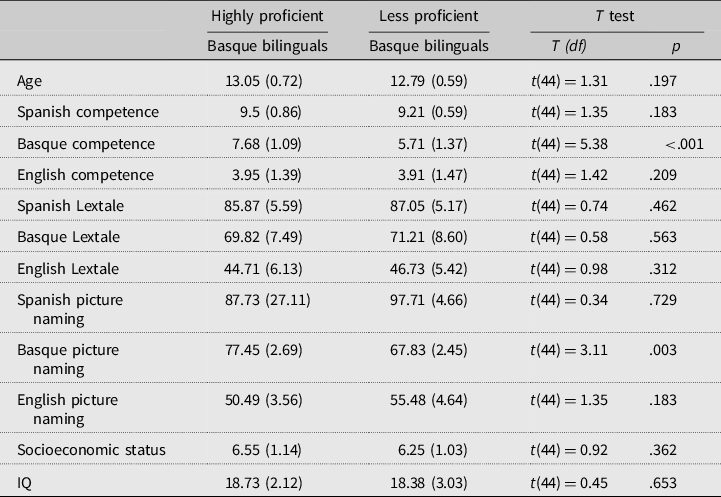
Forty-six Spanish–Basque bilingual children took part in this experiment (34 females; M age = 12.9 years, SD age = 0.6). Participants were recruited from two different Basque communities in the Basque Country, in which Spanish and Basque coexist at all levels, including in the school environment. The first group of participants consisted of 22 Spanish–Basque bilinguals from Donostia-San Sebastian, a dense bilingual environment (percentage of exposure to Spanish, M = 39.7.8%, SD = 5.47; percentage of exposure to Basque, M = 53.6%, SD = 7.38; percentage of exposure to English, M = 6.7%, SD = 3.27). The other group was composed of 24 Spanish–Basque bilinguals from Vitoria-Gasteiz, as in Experiment 1 (percentage of exposure to Spanish, M = 51.64%, SD = 3.54; percentage of exposure to Basque, M = 40.76%, SD = 2.87; percentage of exposure to English, M = 7.6%, SD = 2.26). All participants acquired both critical languages before the age of 6. Participants were matched on their language proficiency in Spanish and English, their socioeconomic status, and their IQ, as in Experiment 1 (see Table 3). However, the two Basque groups differed in their subjective measure of competence in Basque and their picture-naming performance in Basque (see Table 3). It should be mentioned that despite the fact that Basque LexTale did not identify differences between the two groups, the other tests showed a reliable difference in Basque proficiency between these two groups. Not surprisingly, the use of multiple sources of information to characterize bilinguals’ language use and knowledge provides a better reflection of the sociolinguistic realities of the two groups.
Descriptive statistics of assessments

Note: Means and standard deviations in parenthesis of age (in years), subjective language competence (0–10 scale), LexTale (%), picture naming (% correct), socioeconomic status (1–10 scale), and IQ (number of correct answers in the timed test). The last column shows the results from the t tests comparing the two Spanish–Basque groups on the different assessments.
As in Experiment 1, all participants’ parents received an information letter and a parental written informed consent, which was signed and returned before testing. The study was approved by the Basque Center on Cognition, Brain and Language Ethics Committee. None of the children was left-handed, and none were diagnosed with language disorders, learning disabilities, or auditory impairments.
Materials, procedure and data analysis
Materials, procedure, and data analysis were identical to those used in Experiment 1.
Results and discussion of Experiment 2
We performed repeated measures ANOVAs with group (highly proficient Basque bilinguals and less proficient Basque bilinguals) and orthotactic structure (legal, illegal) on percentage of error and reaction times in the recognition task (Table 4). In the recognition task, participants did not require more time to recognize illegal words than legal ones F
1 (1, 44) = 3.78, p = .078,
 $$\eta _{\rm{p}}^2 = .211$$
; F
2 (1, 14) = 3.27, p = .087,
 $$\eta _{\rm{p}}^2 = .112$$
, and no differences between groups were observed, F1 (1, 44) = 1.12, p = .296,
 $$\eta _{\rm{p}}^2 = .025$$
; F
2 (1, 14) = 3.76, p = .098,
 $$\eta _{\rm{p}}^2 = .112$$
, nor an interaction, F
1 (1, 44) = 0.11, p = .742,
 $$\eta _{\rm{p}}^2 = .002$$
; F
2 (1, 14) = 0.87, p = .366,
 $$\eta _{\rm{p}}^2 = .009$$
. In terms of accuracy, we observed that participants recognized legal and illegal words equally, F
1 (1, 44) = 0.86, p = .357,
 $$\eta _{\rm{p}}^2 = .019$$
; F
2 (1, 14) = 0.407, p = .534,
 $$\eta _{\rm{p}}^2 = .005$$
, and no differences between groups were found, F
1 (1, 44) = 0.19, p = .665,
 $$\eta _{\rm{p}}^2 = .004$$
; F
2 (1, 14) = 0.24, p = .626,
 $$\eta _{\rm{p}}^2 = .017$$
, nor an interaction, F
1 (1, 44) = 0.15, p = .699,
 $$\eta _{\rm{p}}^2 = .003$$
; F
2 (1, 14) = 0.22, p = .625,
 $$\eta _{\rm{p}}^2 = .018$$
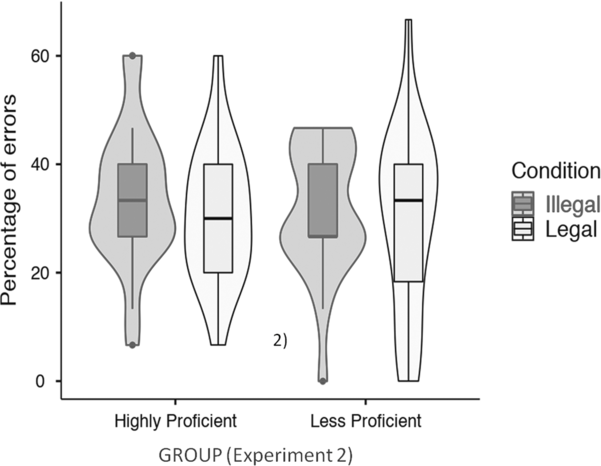
, showing that the lack of illegality effect was similar for both groups of Spanish–Basque bilinguals (see Figure 2).
Descriptive statistics for the Recognition task

Note. Means and standard deviations in parenthesis of percentage of errors and reaction times in milliseconds for legal and illegal orthotactic sequences for the two language groups. RT, reaction time.
Violin plot of the percentage of errors in the recognition task for legal and illegal orthotactic sequences for each of the Spanish–Basque bilingual groups. Shapes represent the density plot of each condition, horizontal lines represent the low and high interquartile range, and the middle line is the mean of each condition. Vertical lines represent the adjacent values.

We investigated whether the effects were due to the characteristics of the languages or the proficiency of the children. Thus, Experiment 2 aimed to replicate the findings from the Spanish–Basque bilingual children tested in Experiment 1 in two new samples of Spanish–Basque bilinguals (a group of more balanced bilinguals and a group with the same proficiency as in Experiment 1). Similar to Experiment 1, these bilingual children recognized legal and illegal words to the same extent. Furthermore, no differences were observed between these two groups regardless of their proficiency differences, suggesting that the (absence of an) illegality effect was not modulated by proficiency in Basque. Thus, these findings provide support to the results from Experiment 1, suggesting that linguistic experience with languages that differ from each other at the orthotactic level may modulate word learning in bilingual children.
General Discussion
Previous research suggests that bilinguals may be more efficient than monolinguals at word learning due to their experience with language learning (Kaushanskaya & Marian, Reference Kaushanskay and Marian2009a, Reference Kaushanskaya and Marian2009b; Yoshida et al., Reference Yoshida, Tran, Benitez and Kuwabara2011). The present study aimed to examine whether new word learning in children is driven by the bilingual experience itself, or rather by the specific linguistic experience with the particular languages. Specifically, we were interested in whether greater language differences can affect novel word learning. We asked whether dealing with more distinctive orthographic systems may change how bilinguals who are biliterate learn novel words. Note that the above-mentioned studies did not observe differences between the bilingual groups because the language pairs already had large differences. Therefore, we conducted two experiments to test this hypothesis. In Experiment 1, we asked children who have dissimilar orthotactic patterns in their language pairs (Spanish–Basque) and orthotactically similar languages (Spanish–Catalan) and a group of Spanish monolinguals to learn new words containing legal or illegal patterns. Note that Spanish was the common language for all our participants and the other languages had either similar (Catalan) or different (Basque) orthotactics. In Experiment 2, we carried out the same task as in Experiment 1, but with two additional groups of Spanish–Basque bilinguals in an attempt to replicate the findings and control for the effects of proficiency.
Reaction times in Experiment 1 revealed that the three groups reacted similarly when they had to recognize legal and illegal novel words. The results from Experiment 2 were consistent with this finding, showing that both Basque groups with different proficiency levels reacted to the same extent to legal and illegal novel words. Although, previous research has shown that marked words are typically recognized faster than unmarked ones (Casaponsa et al., Reference Casaponsa, Carreiras and Duñabeitia2014) and that markedness effects are modulated by age (Duñabeitia, Borragán, de Bruin, & Casaponsa, Reference Duñabeitia, Borragán, de Bruin and Casaponsa2020), it should be noted that those data mainly come from experiments using language detection tasks in which marked strings elicit lower cross-language activation (Casaponsa & Duñabeitia, Reference Casaponsa and Duñabeitia2016; Casaponsa et al., Reference Casaponsa, Thierry and Duñabeitia2020).
While performance as measured by reaction times associated with the recognition of legal and illegal novel words was similar across conditions and groups, significant differences emerged in the accuracy pattern. Spanish–Catalan bilinguals and Spanish monolingual children showed a recognition advantage of legal items, whereas Spanish–Basque bilingual children did not. In other words, the Spanish–Catalan bilingual and the monolingual children recognized unmarked items better than illegal marked ones, in line with prior literature showing that it is easier to learn items corresponding to one’s prior knowledge (Ellis & Beaton, Reference Ellis and Beaton1993). In sharp contrast, Spanish–Basque bilingual children did not show such legality or markedness effect, recognizing legal and illegal (viz., orthographically unmarked and marked) novel words similarly.
Of importance, the results of Experiment 2 with two additional groups of Spanish–Basque bilingual (high and low proficient) children demonstrated that the absence of a legality effect in this population is a stable phenomenon that does not depend on the level of proficiency. These results are in line with previous research showing that early balanced bilingual (Bartolotti & Marian, Reference Bartolotti and Marian2012; Kaushanskaya & Marian, Reference Kaushanskay and Marian2009a), early unbalanced bilinguals (Kaushanskaya, Yoo, & van Hecke, Reference Kaushanskaya, Yoo and van Hecke2013) as well as late bilinguals (Nair, Biedermann, & Nickels, Reference Nair, Biedermann and Nickels2016) learn new words different than monolinguals. Although in our study bilinguals did not outperform monolinguals in terms of overall word learning, linguistic experience with the specific orthographic combinations in a bilingual’s language pairs did modulate how novel legal and illegal words were learned.
We hypothesize that the driving factor leading to this differential effect is the specific linguistic experience and training with particular written language combinations, meaning that by learning (or knowing) two languages that differ very strongly in their orthotactic rules, bilinguals can be less affected by the legality of new words. That is, Spanish–Basque children may show no preference for learning items matching the patterns they already know (i.e., unmarked legal strings) over patterns that are not known (i.e., marked illegal strings) probably as a consequence of their experience in managing two systems with conflicting orthotactic rules. Languages pairs with contrasting differences at the sublexical information level may result in a lesser degree of cross-language activation (see Casaponsa et al., Reference Casaponsa, Carreiras and Duñabeitia2014, Reference Casaponsa, Thierry and Duñabeitia2020; Casaponsa & Duñabeitia, Reference Casaponsa and Duñabeitia2016), and this can in turn modulate new word learning. The experience with managing two different sets of orthographic rules may be what sets this group of Spanish–Basque bilinguals apart, and this capacity may have allowed them to learn words equally well regardless of whether the orthotactic patterns of the words violated rules in their already known languages.
Furthermore, the role of managing different sets of rules for orthographic forms may play an important role in learning. This is the case in the study conducted by van Gelderen et al. (Reference van Gelderen, Schoonen, de Glopper, Hulstijn, Snellings, Simis and Stevenson2003) with Dutch–Turkish, Dutch–Moroccan bilingual children and Dutch monolingual children on English reading tasks. They did not observe a bilingual advantage in English reading because all groups performed equally on tests of word recognition, vocabulary, and grammatical knowledge on English. The authors suggested that the lack of differences between bilingual and monolingual groups responded to the fact that bilingual participants were Dutch monoliterate (viz., they had acquired literacy only in Dutch). This result is in line with the current findings, suggesting the importance of considering differences in bilinguals’ orthographic knowledge when assessing new vocabulary learning. As we initially hypothesized, the degree of dissimilarity between the two languages could improve the learning of different patterns, and daily management with different orthotactic patters could lead bilinguals to be more flexible when they have to learn new patterns.
In sum, having experience with languages that differ at the orthographic (or orthotactic), but also the phonotactic, level can affect word learning. Bilingual children who are exposed to two languages that have clearly different orthotactic regularities and immersed in a school context with a strong presence of written text in both languages, perform differently on word learning tasks as compared to other bilingual or monolingual children, providing them with a specific form of learning flexibility with respect to orthographic markedness. Further studies should try to disentangle the immediate causes and limitations of this phenomenon, particularly throughout the life span.
Acknowledgments
This research has been partially funded by Grants PGC2018-097145-B-I00 and RED2018-102615-T from the Spanish Government and H2019/HUM-5705 from the Comunidad de Madrid to J.A.D., by an individual grant from “la Caixa” Foundation (ID 100010434–LCF/BQ/ES16/11570003) to M.B., and by Grant Centro de Excelencia Severo Ochoa SEV-2015-0490 by the Spanish government. The funders had no role in study design, data collection and analysis, decision to publish, or preparation of the manuscript. The authors want to thank Julen Cristti for the creation of the 3D objects that we used for the referent stimuli, Candice Frances who kindly provided critical comments on the manuscript, and Magda Altman who helped with the proofreading.
Appendix A

Materials: thirty novel words with their orthographic form and phonotictics below with their average bigram frequency (appearance per percentage)
Appendix B

Materials: Hundred and two legal bigrams and 19 illegal bigrams with their bigram frequency of use (appearance per percentage)