From very early in development, simultaneous bilingual children can differentiate their two languages (see review in Genesee & Nicoladis, Reference Genesee, Nicoladis, Hoff and Shatz2007). This is not to say that bilingual children learn their two languages like two monolinguals (see discussion in Paradis & Genesee, Reference Paradis and Genesee1996). Bilingual children's language development shows at least two marked differences from that of monolingual children: (a) lag in the age of acquisition of some aspects of language and (b) transfer from their other language or cross-linguistic transfer. The present study tested whether these differences are observable in bilingual children's acquisition of tense marking in English.
In comparison to monolingual children of the same age, bilinguals show some lags in language acquisition. For example, bilingual preschool children often have smaller vocabularies within either of their languages than monolingual children of the same age (e.g., Nicoladis, Reference Nicoladis2002, Reference Nicoladis2003, Reference Nicoladis2006; Pearson, Fernández, & Oller, Reference Pearson, Fernández and Oller1993). In some aspects of morphology, such as compound production, bilingual children produce fewer target constructions relative to monolingual children of the same age (e.g., Nicoladis, Reference Nicoladis2007). Bilingual children do not show lags relative to same-age monolingual children in all domains of language. For example, Paradis and Genesee (Reference Paradis and Genesee1996) showed that simultaneous French–English bilingual children ordered negative markers and pronouns relative to the verb at about the same degree of accuracy as reported for monolingual children of the same age. Some researchers have argued that the domains of language acquisition that are particularly strongly related to input frequency may be those domains in which bilingual children are likely to show lags (e.g., Nicoladis, Reference Nicoladis, Altarriba and Heredia2008). Many researchers have argued that, on average, bilingual children probably hear and/or use each language less often than monolingual children (e.g., Marchman, Martínez-Sussman, & Dale, Reference Marchman, Martínez-Sussman and Dale2004). For example, input frequency is highly predictive of monolingual children's vocabulary acquisition (e.g., Goodman, Dale, & Li, Reference Goodman, Dale and Li2008). Because bilingual children's exposure to language is divided between two languages (see, e.g., David & Li, Reference David and Li2008), it follows that their vocabulary size within a language would be lower than that of monolingual children. Similarly, Gathercole (Reference Gathercole1997) showed that 7-year-old Spanish–English bilingual children lagged behind English monolinguals in their interpretation of mass/count noun distinctions, whereas 9-year-old bilingual children were on par with their monolingual peers. The acquisition of the mass/count noun distinction may partly rely on hearing enough exemplars in the input to acquire general patterns.
When bilingual children show lags in acquisition relative to monolingual children, one corollary is that they acquire those aspects of language at a later age than monolinguals. In that case, the bilingual children may have matured and/or developed socially and cognitively to a greater extent when they acquired those aspects relative to monolingual children, who usually acquire those aspects at a younger age (e.g., Ionin & Wexler, Reference Ionin and Wexler2002; Wexler, Reference Wexler1998). For example, in the Gathercole (Reference Gathercole1997) study mentioned previously, 9-year-old bilingual children were on par with monolingual children in the use of mass/count noun distinction. Similarly, Paradis and Nicoladis (Reference Nicoladis, Altarriba and Heredia2008) have shown that French–English bilingual children in Canada score at the norm for monolingual children of the same age on vocabulary tests in both languages, starting around 9 years of age. These studies suggest that bilingual children's language acquisition is not simply dependent on input frequency.
Bilingual children's language use also differs from monolinguals' in that they sometimes show cross-linguistic transfer, that is, influence from their other language, in the production or interpretation of the target language. Young bilingual children show signs of transfer in phonology (e.g., Barlow, Reference Barlow, Skarabela, Fish and Do2002; Brulard & Carr, Reference Brulard and Carr2003; Holm & Dodd, Reference Holm and Dodd1999; Paradis, Reference Paradis2001), morphology (e.g., Nicoladis, Reference Nicoladis2002, Reference Nicoladis2003), and syntax (e.g., Döpke, Reference Döpke1998; Hulk & Müller, Reference Hulk and Müller2000; Müller, Reference Müller1998; Nicoladis, Reference Nicoladis2006; Paradis & Navarro, Reference Paradis and Navarro2003; Yip & Matthews, Reference Yip and Matthews2000). For example, Döpke (Reference Döpke1998) examined verb placement in the spontaneous speech of German–English bilingual children. In main clauses, German typically requires a second verb (V2), whereas English requires subject–verb–object (SVO); in dependent clauses, both German and English allow SVO. The children's verb placement was influenced by their knowledge of the other language; for instance, the children did not stringently use V2 placement in German main clauses. Transfer in simultaneous bilingual children can often be observed in both of their languages (e.g., Nicoladis, Reference Nicoladis2002). Not all domains of language acquisition show signs of transfer in young bilingual children (e.g., Paradis & Genesee, Reference Paradis and Genesee1996). It is not yet clear why some domains of language acquisition are affected by cross-linguistic transfer and others are not.
In sum, the research to date has shown that bilingual children can sometimes lag in language acquisition relative to same-age monolingual children, particularly in domains of acquisition related to input frequency. In some cases, bilingual children seem to catch up, suggesting that maturational or developmental factors also play a role. Bilingual children also show cross-linguistic transfer with some domains of language acquisition and not with others. The present study focuses on the acquisition of tense marking in English by young bilinguals. Our goal was to test whether bilinguals' past tense acquisition resembles that of monolinguals (only later) and/or whether their past tense acquisition is affected by knowledge of another language. In order to understand how bilingual children acquire tense marking, we must first review what is known about first-language (L1) acquisition of tense marking.
L1 ACQUISITION OF TENSE MARKING IN ENGLISH
The past tense of most English verbs is formed by adding -ed to the stem, as in jumped. The -ed is considered the regular form of the past tense (for discussion of how to identify regular forms, see Marcus, Brinkman, Clahsen, Wiese, & Pinker, Reference Marcus, Brinkman, Clahsen, Wiese and Pinker1995). The past tense of some English verbs is irregular, often involving a vowel change relative to the stem (e.g., sang, bit, ate, flew), although consonants can change as well (e.g., brought, went).
When English-speaking children first start producing verbs, they are usually produce bare verbs, unmarked for tense, even when talking about events from the past (Marchman & Bates, Reference Marchman and Bates1994; Paradis & Crago, Reference Paradis and Crago2001; see Wexler, Reference Wexler1998). For example, a child might say, “I eat banana” to refer to an event that happened last week. Children start using past tense morphemes on verbs around the age of 2 years (Brown, Reference Brown1973; Philips, Reference Philips1995). Most of the verbs that English-speaking children produce at around this age are irregular (e.g., ate) and children make very few errors in production (Marcus et al., Reference Marcus, Pinker, Ullman, Hollander, Rose and Xu1992). After that initial stage, children start to produce many more regular verbs (e.g., jumped) and they make some errors in using past tense morphology (Kuczaj, Reference Kuczaj1977; Marcus et al., Reference Marcus, Pinker, Ullman, Hollander, Rose and Xu1992). Around the same age, children can also extend the use of the morpheme -ed to novel verbs, although they often still produce many bare stems with novel verbs (Berko, Reference Berko1958). The most frequent error in past tense marking on familiar verbs among English-speaking children is overregularization of irregular verbs (such as ringed instead of rang; Berko, Reference Berko1958; Marcus et al., Reference Marcus, Pinker, Ullman, Hollander, Rose and Xu1992), although some irregularizations have been observed (such as brang instead of brought; Xu & Pinker, Reference Xu and Pinker1995). The rates of errors vary widely across studies, depending to some extent on how they are calculated (e.g., compare, Kuczaj, Reference Kuczaj1977; Marcus et al., Reference Marcus, Pinker, Ullman, Hollander, Rose and Xu1992). English-speaking children continue producing some overregularizations until around 6 or 7 years of age (Kuczaj, Reference Kuczaj1977; Marcus et al., Reference Marcus, Pinker, Ullman, Hollander, Rose and Xu1992).
Some of the patterns seen in L1 acquisition can be explained by the relative type and/or token frequency of irregular and regular past tense forms in English (see discussion of the role of input frequency in Gathercole & Hoff, Reference Gathercole, Hoff, Hoff and Shatz2007; see also Legate & Yang, Reference Legate and Yang2007). For example, many irregular past tense forms are, on average, high in token frequency in child-directed speech. High token frequency can lead to children's acquiring that form by entrenchment or rote memory (Bybee, Reference Bybee1995; Marchman, Reference Marchman1997; see also Pinker & Ullman, Reference Pinker and Ullman2002). Regular past tense forms are high in type frequency but not necessarily in token frequency. High type frequency can lead to children's productive use of regular forms (Bybee, Reference Bybee1995; Marchman, Reference Marchman1997; Marchman & Bates, Reference Marchman and Bates1994; Plunkett & Marchman, Reference Plunkett and Marchman1993). Children produce past tense morphemes productively only after they have reached a critical mass in vocabulary (Jackson-Maldonado, Reference Jackson-Maldonado and Goldstein2004). Overregularizations occur when children do not immediately access the entrenched or memorized irregular form and apply the regular past tense formation (e.g., Marchman & Bates, Reference Marchman and Bates1994; Marcus et al., Reference Marcus, Pinker, Ullman, Hollander, Rose and Xu1992; Plunkett & Marchman, Reference Plunkett and Marchman1993).
L1 acquisition of tense marking is highly related to frequency in the input: high token frequency seems to lead to memorization and high type frequency seems to lead to productive use of morphemes. To the extent that young bilinguals acquire their languages like monolinguals, the less frequent exposure, on average, to either language should lead to lags in their acquisition of tense marking. So, even school-aged bilingual children might not yet have reached ceiling in their accuracy of past tense marking. Their accuracy might be related to the number of verbs they can use in the past tense, predicting a positive correlation between numbers of different verbs used and accuracy in marking the past tense. Also, regardless of the children's other language, they might also use bare verbs for a more prolonged period of time than monolinguals. Furthermore, we expect to see children's most frequent error to be overregularization of the most common pattern of English past tense marking, -ed.
ACQUISITION OF TENSE MARKING IN YOUNG BILINGUALS
Most of the research on young bilinguals' acquisition of past tense marking has pointed to the same acquisition patterns in young bilinguals as L1 acquisition, only later. For example, in a longitudinal study, Gavruseva (Reference Gavruseva2002) showed that a child with L1 Russian and second-language (L2) English showed some of the same patterns of tense acquisition as monolingual children. This child initially did not mark for tense at all, then used many irregular verbs correctly and later produced some overregularizations. This pattern of acquisition corresponds with what has been observed with monolingual children.
Nicoladis, Palmer, and Marentette (Reference Nicoladis, Palmer and Marentette2007) compared the use of past tense in simultaneous French–English bilinguals (4–6 years of age) relative to same-age English and French monolinguals. They found that the children marked tense correctly in both languages less often than monolinguals, suggesting a lag. In English, they found that the children were more accurate with regular forms than irregular forms and most of the errors were overregularizations, as would be the case with younger monolingual children. In French, they found that the children were more accurate with regular forms than irregular forms but that most of the errors were not overregularizations, but present or stem forms. The authors attributed the cross-linguistic differences in error patterns to differing type/token frequency of regular and irregular tense markings in French and English. The authors further argued that there was no evidence of cross-linguistic transfer in the bilinguals' use of tense marking. They based this argument on the past tense in French is a compound form and there was no higher rate of the bilinguals using compound past forms in English than with the monolinguals.
Other studies have suggested that there may be some small differences between bilinguals and monolinguals in the acquisition of morphology. For example, Shirai (Reference Shirai2003) argues that there may be small differences between L1 and L2 in terms of the semantics of regular and irregular morphology. Other researchers have pointed to the possibility of greater individual variation in morphological acquisition (e.g., Paradis, Rice, Crago, & Marquis, Reference Paradis, Rice, Crago and Marquis2008; see also Jia, Reference Jia2003, for similar results with the acquisition of plural morphology). Still other studies suggest some qualitative differences. For example, Jacobson and Schwartz (Reference Jacobson and Schwartz2005) showed that typically developing sequential Spanish–English bilingual children between 7 and 9 years produced past tense verbs in English with a high degree of accuracy, but made no overregularization errors, one of the most frequent error types observed with monolingual children.
In sum, the research evidence to date suggests that bilingual children acquire morphology like monolinguals, only later (e.g., Nicoladis et al., Reference Nicoladis, Palmer and Marentette2007). There is little evidence for cross-linguistic transfer affecting past tense markings in young bilinguals. However, there is no study comparing two groups of young bilinguals, one with two tense-marking languages (like English and French) and one with one tense-marking language and one nontense-marking language (like English and Chinese). In this study, we make precisely this comparison. The results will allow us to understand to what extent bilinguals develop past tense marking from their exposure to the target language and to what extent bilinguals' acquisition is affected by their knowledge of another language.
If transfer did affect bilingual children's past-tense production, what would transfer? One possibility is that there is syntactic transfer of tense marking (e.g., Hawkins & Liszka, Reference Hawkins, Liszka, van Hout, Hulk, Kuiken and Towell2003; Lardiere, Reference Lardiere1998). Adult late learners of English whose first language is Chinese often have difficulty with tense in English, presumably because Chinese does not mark verbs for tense (e.g., Goad, White, & Steele, Reference Goad, White and Steele2003; cf. Leung, Reference Leung2006). For example, Yang and Huang (Reference Yang and Huang2004) showed that as their proficiency in L2 English increased, Cantonese L1 speakers (both children and adults) switched gradually from using Cantonese-like strategies for marking temporality (such as adverbs) to marking verbs for tense. The low suppliance of tense marking by Chinese L1 learners of L2 English can persist, for at least up to 18 years of living in an English-speaking country (e.g., Lardiere, Reference Lardiere1998). If syntactic transfer affected tense marking, we would expect that Chinese–English bilinguals would be less accurate than French–English bilinguals in producing tense markers in English.
Another possibility is that there is morphophonological transfer from Chinese (e.g., Goad et al., Reference Goad, White and Steele2003; cf. Hawkins & Liszka, Reference Hawkins, Liszka, van Hout, Hulk, Kuiken and Towell2003), specifically with Chinese favoring one-syllable words and French multisyllable words. If this were the case, then Chinese–English bilinguals might try to mark tense word internally (e.g., as in the vowel change involved in many irregular English verbs) more often then French–English bilinguals, who might produce multisyllabic past tense forms (as in some regular verbs).
THIS STUDY
We elicited past-tense forms from bilingual children between 5 and 12 years by asking them to watch a cartoon and tell the story back. This methodology replicates that of Nicoladis et al. (Reference Nicoladis, Palmer and Marentette2007), who showed that both English and French monolinguals between 4 and 6 years of age used the past tense to tell the story over 90% of the time and with over 90% accuracy for both regular and irregular verbs.
The primary purpose of this study was to test if there were any differences between Chinese–English and French–English bilingual children in their use of the English past tense. If bilingual children acquire the English past tense like monolinguals, then the two bilingual groups should use the past tense with equivalent rates of accuracy to each other.Footnote 1 The most frequent error in English for both groups should be overregularizations, although there may still be (equivalent) rates of using verb stems (i.e., unmarked for tense), as observed in younger monolingual children, and, because accuracy is thought to be related to the number of different verbs known (see, e.g., Jackson-Maldonado, Reference Jackson-Maldonado and Goldstein2004), then the number of verb types children spontaneously use might be a better correlate of correct inflection use than age.
If there were cross-linguistic transfer effects, the Chinese–English bilinguals might be less accurate in marking tense than the French–English bilinguals. If the transfer effects were due to the lack of tense marking in Chinese, we might expect equivalent rates of accuracy in regular and irregular verbs for the Chinese–English bilinguals because tense marking would be used primarily when a form was memorized. In contrast, the French–English bilinguals would be more accurate with regular verbs, because regularity is a property of both French and English past-tense markings. If the transfer effects were due to morphophonology, we might find that Chinese–English bilinguals are more accurate with irregular verbs than regular verbs and make more errors by using root verbs than overregularizations compared to the French–English bilinguals.
The primary focus of this study was on the children's use of tense marking in English. For the sake of interest, we also present the results for the children's tense marking in French, expecting to replicate previous studies showing that bilinguals are more likely to overregularize the regular past tense marker in English than in French.
METHODS
Participants
All of the participants in the present study were growing up in Edmonton, Alberta, Canada. The majority language in this city is English. Chinese represents the most populous minority language spoken in Edmonton. According to the 2006 census, 3.8% of the population of the greater Edmonton area spoke Chinese as a mother tongue (www.statcan.gc.ca). There are five elementary schools in Edmonton with a Mandarin–English bilingual program. According to the same census, French is spoken as at least one of the languages at home by 0.9% of the population (www.statcan.gc.ca). Although the French-speaking population of Edmonton is smaller than the Chinese-speaking population, French is an official language of Canada. Edmonton is the capital of the province and so many federal institutions, often requiring French–English bilingual employees, are seated here. There are five French-only elementary schools catering to L1 French-speaking children (not counting the popular French Immersion programs that cater to L1 English-speaking children).
All of the children in this study were simultaneous bilinguals, having been exposed to both of their languages from at least the age of 2 years or earlier (for a discussion of what constitutes a simultaneous bilingual, see Meisel, Reference Meisel, Bhatia and Ritchie2004). All of the children heard the minority language (i.e., Chinese or French) from at least one parent in the home. All of the children were deemed to be typically developing by their parents. All of the children were born in Canada.
Fourteen Mandarin Chinese–English bilinguals between the ages of 5 and 11 years (M = 7.6 years, SD = 2.0) participated in this study. There were 8 boys and 6 girls. All of the children heard Chinese at home from both parents. They were all enrolled in English daycares or schools and were integrated in the class with the rest of the English-speaking students (i.e., none was receiving English as a second language [ESL] instruction). The children produced an average of 24.5 (SD = 5.9) verb types in their English narratives.
We matched these participants as closely as we could on age, gender, and the number of verb types they used to tell the story with French–English bilinguals from a database of 32 children. These data were collected at the same time as the data from the Chinese–English bilinguals and were collected originally to test hypotheses related to their use of manual gestures. We chose to match on age, gender, and number of verb types (in English) because these variables are important in L1 acquisition of past tense marking (Jackson-Maldonado, Reference Jackson-Maldonado and Goldstein2004; Marcus et al., Reference Marcus, Pinker, Ullman, Hollander, Rose and Xu1992; Ullman et al. Reference Ullman, Estabrooke, Steinhauer, Brovetto, Pancheva, Ozawa, Mordecai and Maki2002). The 14 children included in the analyses ranged between 5 and 12 years of age, averaging 7.8 years (SD = 2.0). There were 8 boys and 6 girls. At least one of their parents spoke French with them at home. The school-aged children were enrolled in French schools; the preschool children attended French daycares. Not all the children had easily identifiable regular sources of English; in our experience, school-aged children from this population hear English from a variety of contexts, including TV, internet, neighborhood children, and so forth. The children produced an average of 23.1 (SD = 9.0) verb types in their English narratives and 21.7 (SD = 8.2) in their French narratives.
Materials
The participants watched two short segments of Pink Panther cartoons, one from “In the Pink of the Night” and the other from “Jet Pink.” In the first segment, the Pink Panther tries to get rid of a bothersome cuckoo bird but ends up liking the bird. In the second segment, the Pink Panther accidentally takes off in an experimental jet that subsequently seems to fly itself with the Pink Panther on board. The two segments, shown one directly after the other, were about 5 min in total. There is some written English in the segments, but no spoken words.
Procedure
The participants watched the two segments of the Pink Panther cartoons. A native speaker of the relevant language then asked the participants to recount what he or she had seen in the cartoon. The participants were videotaped as they recounted the stories. The participants were interviewed twice: once in English and once in either French or Chinese. The order of the language was counterbalanced and the two sessions were separated by about a week. The order of the languages had no significant effect on any of our dependent measures.
Transcription and coding
The speech used to tell the stories was transcribed in orthographic words. We counted all the verbs that were used to tell the story (i.e., excluding metanarrative remarks like, “I'm not sure if I remember what happens after . . .”). We assumed that the verbs to tell the story were meant to be in the past tense (as it is a common convention to tell stories in the past tense; see Berman & Slobin, Reference Berman and Slobin1994) and coded as errors any verbs that were not in the past tense.
To count verb types, we counted each infinitive form as a single type (e.g., if a child said “was,” “were,” “is,” and “be” as the main verb of a sentence, these were all classified as a single type). To count verb tokens, we counted the total number of main verbs used to tell the story. To calculate the rate of accuracy, we used the number of verb tokens as the denominator because children were not necessarily consistent across verb types.
In English, we coded as regular all the verbs that usually took -ed in the past tense in English in the form used in the story. All other verbs were coded as irregular. Appendix A lists the verbs used by children in both groups to tell the story. Note that the two groups of children used a very similar pool of verbs.
In French, we coded as regular all the verbs whose past participles end in -é. All other verbs were coded as irregular. The list of verbs the children used to tell the story in French appears in Appendix B. Two children code-mixed two different verbs in French: smash and drop. The verb smash was included in the analysis, as a regular verb (the child said “il a smashé”). The verb drop was excluded from the analysis (the child said “il drop”) because it was unclear if the child said the stem as an error with the past tense or because it was code-mixed (for discussion of code-mixing possibilities, see Myers-Scotton, Reference Myers-Scotton1993).
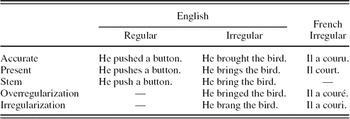
In English, we coded for four kinds of errors: present, stem, overregularization, and irregularization (see examples in Table 1). Note that in English, only two kinds of errors were observed for regular verbs: present and stem. In French, it was not always possible to distinguish between the present and the stem (e.g., il mange could be the present “he eats” or the stem of the verb manger “to eat”) so in analyzing French errors, we present the errors as present/stem. The only kind of error the children made with French regular verbs was the use of present/stem, so no examples are presented in Table 1. No child told the story exclusively or mostly in the present tense, justifying the categorization of the “present” as an error. Almost all subjects were third person singular; the few exceptions were always marked accurately for past tense and so were included in the analyses.
Examples of error codings

Although we recorded the Chinese stories, we do not present any analyses because they were not relevant to our research questions. Recall that Chinese does not mark verbs for past tense.
RESULTS
The average number of verb types that the Chinese–English bilinguals used to tell events from the story was 24.5 (SD = 5.9), whereas the average for the French–English bilinguals was 23.1 (SD = 9.0). There was no significant difference between the two groups (F < 1, η2p = 0.009).
The French–English bilinguals used an average of 21.7 (SD = 8.2) verb types in French to tell the story. There was no significant difference between the bilinguals' number of verb types in French and in English on a paired t test (t < 1).
Accuracy
The Chinese–English bilinguals' overall rate of accuracy on past tense usage averaged 77.1% (SD = 18.1%). The French–English bilinguals' overall rate of accuracy averaged 70.5% (SD = 36.7%). There was no significant difference between the two groups (F < 1, η2p = 0.014).
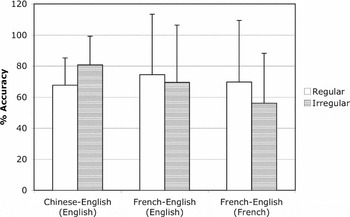
Figure 1 shows the average (standard deviation) percentage accuracy for regular and irregular verbs. To analyze the English results, we compared the rate of accuracy between the two groups, with regular and irregular verbs as a repeated measure. This analysis revealed no significant main effects for either group, F (1, 26) = 0.04, ns, η2p = 0.002, or for regular/irregular, F (1, 26) = 1.78, ns, η2p = 0.064. There was, however, a significant interaction between accuracy with regular/irregular tense markings and group, F (1, 26) = 8.88, p = .006, η2p = 0.255. As can be seen in Figure 1, this interaction is due to the Chinese–English bilinguals' greater accuracy with irregular verbs than with regular verbs and the French–English bilinguals' greater accuracy with regular verbs than with irregular verbs.
The percentage of accurate production of past tense markings with regular and irregular verbs. Error bars indicate standard deviations.

In French, the children were significantly more accurate with the regular past tense than the irregular past tense, t (13) = 2.40, p < .05. We next compared the French–English bilingual children's accuracy in their two languages with regular and irregular verbs, with both measures as repeated measures. The only significant result was a main effect for regular/irregular, F (1, 13) = 5.54, p < .05, η2p = 0.222. As can be seen in Figure 1, this effect was due to the children's greater accuracy with regular verbs than irregular verbs in both languages.
English errors: Regular and irregular verbs
To compare the groups on regular verbs, we compare exclusively the use of verb stems (because the use of the present tense is virtually identical to 100% of the errors minus the percentage of verb stems). All of the Chinese–English bilinguals made at least one error with a regular verb while only six of the French–English bilinguals made at least one error. The average percentage of stem errors for the Chinese–English bilinguals was 82.9% (SD = 26.4%) and for the six French–English bilinguals 23.8% (SD = 39.4%). This difference was significant, F (1, 18) = 15.81, p = .001, η2p = 0.467.
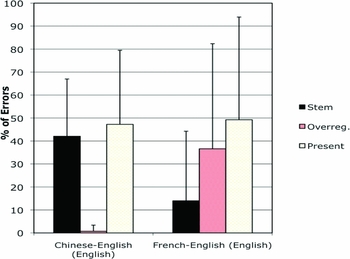
Over 95% of the children's errors with irregular verbs fell into three categories: verb stems, overregularization, and present tense. The rates of these errors (out of the total number of errors made) are presented in Figure 2. The percentages were calculated out of all the errors so the rates presented in Figure 2 do not total 100% per group. Note that one French–English bilingual child did not make any errors with irregular forms so this child's data were dropped from the analysis. The rates of errors were compared on a 2×3 (group×error type) analysis of variance, with error type as a repeated measure. This analysis showed a significant main effect for group, F (1, 25) = 4.27, p = .049, η2p = 0.146, and a significant main effect for error type, F (2, 50) = 3.83, p = .028, η2p = 0.133, and a significant interaction effect, F (2, 50) = 4.29, p = .019, η2p = 0.147. To see the source of the interaction, the groups were compared on planned univariate F tests. These analyses revealed a significant difference in the rate of stems, F (1, 25) = 6.95, p = .014, η2p = 0.218, and in the rate of overregularizations, F (1, 25) = 8.63, p = .007, η2p = 0.257, but no difference in the rate of present tense (F < 1, η2p = 0.001). In other words, the Chinese–English bilingual children used significantly more stems and significantly fewer overregularizations with irregular past tense forms than the French–English bilingual children.
The rate of errors with irregular verbs in English. Error bars indicate standard deviations. [A color version of this figure can be viewed online at journals.cambridge.org/aps]

Three of the Chinese–English bilingual children produced at least one irregularization error (six in total). For example, one child said “he flow,” meaning he flew. None of the French–English bilingual children produced an irregularization error in English.
French versus English errors: Regular and irregular verbs
For regular verbs in French, seven French–English bilinguals made at least one error. Recall that it was not possible to reliably distinguish between the root and present in French. The seven French–English bilinguals used an average of 99.6% (SD = 1.0%) stem/present verbs in French when they did not use the correct form. Collapsing across the use of stem and present in English, the six French–English bilinguals who had errors with regular verbs used an average of 94.4% (SD = 13.6%) in the stem/present when they did not use the correct form.
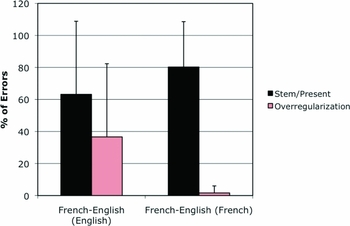
Figure 3 summarizes the rate of errors for French–English bilingual children with irregular verbs. Note that one child did not produce any errors with irregular verbs in English and this child is excluded from the analysis. To compare the error types in the two languages, we included the two error types and the two languages, both as repeated measures. This analysis revealed a significant main effect for error type, F (1, 12) = 14.77, p < .01, η2p = 0.359, and a near-significant main effect for language, F (1, 12) = 4.22, p = .062, η2p = 0.211. The interaction effect did not quite attain significance, F (1, 12) = 4.63, p = .052, η2p = 0.223. These results show that the children made more stem/present errors than overregularizations in both languages, but that there was a tendency to use more overregularizations in English than in French.
The rate of errors with irregular verbs for French–English bilingual children in both languages. Error bars indicate standard deviations. [A color version of this figure can be viewed online at journals.cambridge.org/aps]

One child produced one irregularization in French (i.e., “il a survi” for il a survécu). Recall that no French–English bilingual child produced an irregularized form in English.
Correlation with age and verb types
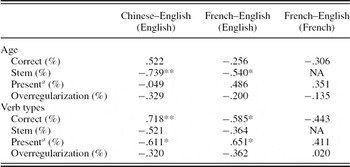
Within each group, age was positively correlated with the number of verb types used by the children: the Chinese–English bilinguals, r (12) = .528, p = .053, the French–English bilinguals in English, r (12) = .680, p < .02, and the French–English bilinguals in French, r (12) = .577, p < .05. The correlations between age and verb types with the most important dependent variables (i.e., rate of accuracy, rate of the use of the present tense [and stems, in French], and the rate of errors with irregular verbs that were overregularizations) in this study are summarized in Table 2.
Correlations with age and number of verb types

aFor French, this rate includes both the present and verb stems.
*p < .05. **p < .01.
The age of the children only correlated significantly with the rate of stems, for both groups of bilingual children. That is, as the children got older, they were less likely to use verb stems. In contrast, the number of verb types used by the children correlated significantly with accuracy and the use of the present. The correlations were in opposite directions in the two language groups. The more verb types the Chinese–English bilingual children used, the more likely they were to be correct and less likely they were to use the present in English. In contrast, the more verb types the French–English bilingual children used in English, the less correct they were and the more likely they were to use the present. That latter trend was observed in French as well, although the correlations did not reach significance.
DISCUSSION
We originally posed the question guiding this study as an either/or question: Do young bilingual children acquire tense like monolinguals or do they show evidence of cross-linguistic transfer? We reasoned that if we compared French–English bilingual children with Chinese–English bilingual children, we would see evidence of L1-like acquisition in English if both groups did not differ in accuracy, were more accurate with regular than irregular past tense forms and made mostly overregularization errors with irregular verbs. Furthermore, the children's accuracy should be highly correlated with the number of verb types they chose to use and not necessarily age. French marks for tense whereas Chinese does not. For that reason, if there was evidence of transfer, we might expect less accuracy in marking tense in English among the Chinese–English bilinguals than among the French–English bilinguals and a greater use of verb stems (i.e., not marking verbs for tense) than overregularization errors. We argue that, in fact, the results of this study suggest that the answer is yes to both of these questions. That is, the children were largely acquiring the past tense in English like monolinguals (only later) and there were also some small signs of transfer from the other language.
Which results supported the claim that both groups of young bilinguals were acquiring their languages like monolinguals, only later? First, both groups were quite accurate (70%–77% accurate) at producing the past tense and there were no differences in the rate of accuracy of marking past tense forms between the two groups. So, even though French marks for tense and Chinese does not, both groups of bilingual children accurately marked tense at equivalent rates. Both groups are notably lower in accurately marking past tense than has been reported for younger monolingual children on a similar task (i.e., over 90%; Nicoladis et al., Reference Nicoladis, Palmer and Marentette2007). Second, the rate of accuracy in past tense inflection suppliance by the Chinese–English bilinguals was far higher than has been reported for late English L2 learners with L1 Chinese (see, e.g., Goad et al., Reference Goad, White and Steele2003; Lardiere, Reference Lardiere1998). In addition, there were correlations with verb types rather than age for the Chinese–English bilinguals (we discuss below why the French–English bilinguals did not show this pattern). This result suggests that the children's degree of accuracy was highly related to the number of verbs that they knew and is consistent with the explanation that productivity is related to type frequency (e.g., Bybee, Reference Bybee1995; Jackson-Maldonado, Reference Jackson-Maldonado and Goldstein2004). Thus, the results of this study suggest that young bilinguals learn past tense markings largely like monolinguals, only with a lag, perhaps due to less frequent exposure, on average, to English (Nicoladis et al., Reference Nicoladis, Palmer and Marentette2007; see also Jia, Reference Jia2003).
Note that there was also some evidence that maturation and/or development is also playing a role in bilingual children's acquisition of past tense marking. For both groups of bilingual children, age was correlated negatively with their use of verb stems in English. This finding suggests that as the children got older, they became more sensitive to the verbs needing to be marked in some way. In contrast, the correlations between stem use and word types were not significant, suggesting that greater exposure to or practice with English was a less important factor in avoiding stems than maturation or development.
There is one possible alternative explanation that we cannot rule out, namely, that young bilinguals acquire their morphology in a qualitatively different way from monolinguals. Paradis et al. (Reference Paradis, Rice, Crago and Marquis2008) found that children aged 4 to 7 years learning ESL produced tense markings at a lower rate than monolinguals, matched on mean length of utterance. The ESL children had a variety of L1s, including some languages that marked for tense grammatically and others that did not and had been exposed to English for an average of 9 months. They argued that their results showed that L2 learners pass through a fundamentally different acquisition process compared to L1 learners. That is, the overall pattern of results with several inflectional morphemes in English suggested that the L2 learners were generally omitting surface inflections. In contrast, the L1 learners' use corresponded to the use of nonfinite, or optional infinitive, usage. They argued that their results could not be explained by transfer from L1 because they observed the same pattern of acquisition in children from a variety of L1s. To rule out the possibility of qualitatively different acquisition in young bilinguals would require further evidence from a variety of inflections and a monolingual comparison group (of the same linguistic ability in English as the bilinguals; see Paradis et al., Reference Paradis, Rice, Crago and Marquis2008). Nevertheless, for the children who participated in the present study, their past tense usage showed some striking similarities to that of younger monolinguals.
Although there were similarities of the bilingual children's past tense marking with what has been reported for younger monolingual children, there were also some differences, many of these likely due to transfer from their other language. First, the Chinese–English bilinguals were more accurate with irregular verbs in English than regular verbs, whereas French–English bilinguals were more accurate with regular than irregular verbs. The finding with the Chinese–English bilinguals replicates what has been reported for adult late learners of English with L1 Chinese (Goad et al., Reference Goad, White and Steele2003; Hawkins & Liszka, Reference Hawkins, Liszka, van Hout, Hulk, Kuiken and Towell2003). Monolingual English children, after an initial short-lived stage of greater accuracy with irregular verbs, are generally more accurate at producing regular past tense markings than irregular verbs (Kuczaj, Reference Kuczaj1977; Marcus et al., Reference Marcus, Brinkman, Clahsen, Wiese and Pinker1995; see also Berko, Reference Berko1958). There were also differences between the groups in terms of the errors that they made. When the Chinese–English bilinguals made errors with regular verbs, they were more likely to use verb stems (rather than the present tense), whereas the French–English bilinguals were more likely to use the present tense (rather than verb stems). When they made errors with irregular verbs, the Chinese–English bilinguals were more likely to use verb stems than overregularized forms, whereas the French–English bilinguals showed the reverse pattern. Although there were few irregularization errors in English, they were all made by Chinese–English bilinguals. Irregularization errors arguably mark for tense but do not involve the suppliance of an inflection morpheme. Thus, there was a slightly higher rate of marking tense word-internally or not marking tense at all among the Chinese–English bilinguals than among the French–English bilinguals.
These results suggest that what is transferring may be primarily morphophonological in nature. We cannot completely rule out a possible effect of transfer of tense features (cf. Lardiere, Reference Lardiere1998) because the Chinese–English bilinguals used a relatively high rate of verb stems and a low rate of overregularizations in English, compared to the French–English bilinguals. However, it is unlikely that it is only the ± tense feature that is transferred: recall that the Chinese–English bilinguals were not significantly less accurate in marking tense that French–English bilinguals. In addition, as noted above, the Chinese–English bilinguals had a greater tendency to mark tense word-internally (i.e., higher rate of accuracy with irregular verbs than regular and some irregularizations). These results suggest that there may be some phonological transfer at work as well. Goad et al. (Reference Goad, White and Steele2003) have argued that the low suppliance of past tense morphemes in adult L2 learners of English is due to transfer of what constitutes a prosodic word from their L1 Chinese (see discussion in Bliss, Reference Bliss, O'Brien, Shea and Archibald2006). We did not analyze the children's prosody in this study, but it would be an interesting line of future research. A third possible contributor to the transfer could have been some aspect of semantics or concepts. For example, telicity can play a role in children's likelihood to mark a verb for the past (see Gavruseva, Reference Gavruseva2004; see also Collins, Reference Collins2002). We could not analyze the children's suppliance of past tense markings on the basis of telicity in this study because their rates of accuracy were too high. Future studies that included speakers with lower proficiency could check for the effect of telicity. Nevertheless, we have sufficient evidence to argue that the small effects transfer observed here were largely due to morphophonology.
We noted earlier that the children's rates of accuracy with past tense markings was very high relative to reported rates with adult L2 learners. Although we only have cross-sectional data on these children, we have observed that adults in Edmonton who have grown up in similar language situations to the children in this study sound like native speakers in English. In other words, we expect the children to grow out of the stage of marking tense with less than 100% accuracy, unlike late adult L2 learners (e.g., Lardiere, Reference Lardiere1998). Convergent with our expectations, Wang and Geva (Reference Wang and Geva2003) reported on a study with Cantonese–English bilingual children's spelling in Grades 1 and 2. The children's spelling performance was linked to their auditory discrimination. As a result, the bilinguals were poorer spellers in L2 English than native speakers in Grade 1 but by Grade 2 showed no differences. If we are correct in assuming that young bilingual children can outgrow tense marking errors, why children and not adults? This issue has been extensively discussed in the literature (e.g., Herschensohn, Reference Herschensohn2007; see also review in Schwartz, Reference Schwartz2004). We mention one possibility here. Children older than 4 years of age have been shown to benefit from the production of their own linguistic errors (i.e., they often correct themselves), whereas adults tend to simply repeat errors (Ramscar & Gitcho, Reference Ramscar and Gitcho2007). Ramscar and Gitcho (Reference Ramscar and Gitcho2007) attribute this difference to developmental changes in neuronal connectivity. This possibility could be particularly relevant for the bilingual children in this study, growing up in an English majority-language context. These children may be strongly motivated to practice their English and then correct for any of their own linguistic errors that they hear.
There was one curious set of results in the present study that we have never seen reported in the literature before. For the French–English bilinguals, there was a significant negative correlation between the number of verb types they used and the correct past tense markers they used. Recall that we had predicted a positive correlation because the number of verb types would be related to the acquisition of a critical mass of verbs over which they could generalize. One possible explanation comes from the positive correlation between the use of the present and the number of verb types. The more verb types might indicate that the more comfortable in English that they were, the more likely the French–English bilinguals were to switch to the present tense in order to create a more vivid narrative. Another possible explanation is that French monolinguals are more likely to use the present tense in recounting a narrative. If this were the case, the increasing use of the present could reflect transfer from French.
The main focus of this study was the children's use of English. The French results replicated previous studies with French–English bilinguals, suggesting some cross-linguistic differences in the acquisition of past tense morphemes (e.g., Nicoladis et al., Reference Nicoladis, Palmer and Marentette2007). The French–English bilinguals were equally accurate in marking the past in French and in English. However, they were more likely to overregularize English irregular verbs than French irregular verbs. The most frequent error type in French was the use of the present or verb stems. These results could be due to properties of French irregular verbs that tend to cluster into families with highly predictable phonological patterns (see Nicoladis et al., Reference Nicoladis, Palmer and Marentette2007).
We raise two caveats in interpreting the results of the present study. First, because we relied on narratives, we had no control over which verbs the children used. The children's high accuracy rate could be due to their use of familiar verbs for which they felt sure of the past tense. An important follow-up study would compare two groups of young bilinguals on past tense production of a particular set of verbs. Second, although there was some variation in the age of first exposure to the two languages (i.e., between birth and 2 years), we have treated the children as if they formed a homogenous group of simultaneous bilinguals. A more systematic study, controlling for initial age of exposure as well as continued exposure to the language, could verify if this assumption were valid.
In closing, we conclude that young bilinguals acquire past tense marking in English largely like L1 monolinguals only later and with some small effects of transfer, most likely morphophonological in nature, from their other language.
APPENDIX A
English verbs the children used

Note: The numbers in parentheses indicate the number of children who used that verb in their retelling. There were 14 children in each group.
APPENDIX B
French verbs the French–English bilingual children used

Note: The numbers in parentheses indicate the number of children who used that verb in their retelling. There were 14 children in this group.
aThis is not a standard word in Canadian French in the way the child used it; the child seems to have used it partly perhaps as a borrowing from English and partly for the onomatopoeic quality. The meaning we present here was derived from the context of usage.
ACKNOWLEDGMENTS
This study received funding from a grant from the Social Sciences and Humanities Research Council of Canada to the first and third authors. We thank the children who participated so enthusiastically in this study. Carrie Jansen, Nathalie Savoie, and Natasha Tuck helped collect the data.