Although the distinction between explicit and implicit knowledge has long attracted the attention of applied linguists in terms of their contributions to language learning, the focus in second language research has been predominantly on linguistic development in general, with comparisons made between first-language (L1) and second-language (L2) acquisition. Examples can be found in a special issue of Studies in Second Language Acquisition (Hulstijn, Reference Hulstijn2005), which offers several articles dealing with conceptual and empirical issues concerning the role of explicit and implicit knowledge in the differential attainment of L1 and L2 proficiency viewed as “grammar.” In this context, what has been neglected is a focus on the distinct functions of explicit and implicit knowledge in the acquisition of specific language skills, that is, how explicit and implicit knowledge sources and the corresponding explicit and implicit processes of learning play a role in the acquisition of a language skill in the L2.
Similarly, the limited research into the role of working memory (WM) in L2 skill acquisition has largely ignored the delineation of the specific interactions between WM and the multiple memory systems underlying long-term memory (LTM; Geva & Ryan, Reference Geva and Ryan1993; Harrington & Sawyer, Reference Harrington and Sawyer1992; Leeser, Reference Leeser2007; Miyake & Friedman, Reference Miyake, Friedman, Healy and Bourne1998; Walter, Reference Walter2004). If, as indicated by N. C. Ellis (Reference Ellis2005), explicit and implicit processes are dynamically involved in “every cognitive task and in every learning episode” (p. 340) and if WM (at least in its capacity as the “central executive”) is responsible for scheduling cognitive processing (Baddeley, Reference Baddeley1986), then the interactions between WM operations and the declarative and procedural dimensions of LTM that sustain these operations are crucial for a thorough understanding of skill acquisition in the L2. Hence, descriptions of ways in which declarative and procedural dimensions of LTM underpin WM processes in the L2 remain inadequate, which in turn renders explanations concerning the role of WM in L2 skill acquisition unsatisfactory or, at best, incomplete.
THE EXPLICIT/IMPLICIT DISTINCTION IN L2 KNOWLEDGE AND LEARNING
The distinct knowledge sources of implicit and explicit systems map roughly onto the dissociated components of LTM's procedural and declarative memory networks. Despite the consensus on some form of approximate equivalence, conflicting views exist concerning whether the mapping between the two systems is isomorphic. Ullman's declarative/procedural (DP) model (2001a, 2001b, 2005), for instance, considers the pairs of concepts not isomorphic, referring to procedural memory (PM) as one type of “implicit, non-declarative, memory system” rather than “all non-declarative or implicit memory systems” (2004, p. 237). Likewise, declarative memory (DM) refers to an essentially but not thoroughly explicit system, sustaining the learning, representation, and use of relevant data, rather than all the brain structures underlying the learning of new memories (2004, p. 235). Ullman (Reference Ullman and Sanz2005) states that the knowledge stored in DM is “at least partly (but not completely) . . . explicit, that is, available to conscious awareness” (p. 143). In a similar vein, DeKeyser (Reference DeKeyser, Long and Doughty2009) rejects the view equating the distinction between implicit and explicit knowledge with that between procedural and declarative knowledge, conceding nevertheless that the two pairs of concepts overlap considerably and “can often be equated in certain contexts” (p. 121). One such fundamental context seems to be the domain of language in which the distinction between DM and PM is said to largely parallel “the distinction between the mental lexicon on the one hand and the rule-governed mental grammar that underlies the composition of complex linguistic forms on the other” (Ullman, Reference Ullman and Gaskell2007, pp. 278–279), with the caveat (already mentioned) that no one to one equivalence exists between the two systems. In contrast, Paradis (Reference Paradis2009) argues for isomorphic relationships between explicit knowledge and DM on the one hand and between implicit knowledge and PM on the other hand, associating consciously controlled processes of awareness with the former type of networks and the automatic processes, impervious to consciousness, with the latter. Nevertheless, he also concedes that not all linguistic knowledge that is unconscious is procedural in that what is strictly procedural involves the computational procedures that yield the comprehension and production of grammatical (phonological, morphological, syntactic) structures (p. 12). In the final analysis, the pairs of concepts are generally used interchangeably in the L2 domain and, as suggested by Dörnyei (Reference Dörnyei2009, p. 147), the need for distinctions often stems from researchers’ theoretical focus and background.
However, it is important to emphasize that any account of knowledge representations subserved by memory systems will be inadequate if it falls short of including the cognitive processes known to be associated with the modes of operation of the memory systems themselves.Footnote 1 From a language acquisitional viewpoint, even though the DM and PM systems normally subserve explicit and implicit knowledge sources, respectively, it is not impossible for knowledge stored in PM to be at least partially explicit if it happens to be the outcome of the proceduralization of declarative knowledge, as might be the case at advanced levels of L2 proficiency (Ullman, Reference Ullman2004, Reference Ullman and Sanz2005). Similarly, from the perspective of language use, knowledge that ordinarily relies on PM may also rely on DM due to its being wholly or partially memorized as chunks. Finally, knowledge stored in the DM system may not necessarily be completely explicit in the event part of it is inaccessible to consciousness. For example, it is perhaps uncommon but not unlikely for explicitly learned knowledge to be used implicitly when L2 learners lose awareness of its rule-based essence over time. By the same token, implicit knowledge may be expressed explicitly (DeKeyser, Reference DeKeyser, Doughty and Long2003) or even partially explicitly (De Jong, Reference De Jong2005) when the need arises for learners to make it consciously accessible. It follows that the DM and PM networks should be viewed as being neuroanatomically dissociated yet functionally cooperating and competing neural structures having a complementary relationship with the cognitive systems of explicit and implicit knowledge. Specifically, these networks underlie the acquisition, storage, and retrieval of explicit and implicit knowledge through a combination of alternating control and automatic processes guided by circumstances that require modification in one's behavior.
In general, evidence suggests that the procedural system stores implicit memories, whereas the declarative system stores explicit ones (Reber & Squire, Reference Reber and Squire1998; Squire, Reference Squire1986, Reference Squire1987, Reference Squire1992, Reference Squire2004), with implicitly acquired knowledge tending to remain implicit and explicitly acquired knowledge tending to remain explicit. Implicit knowledge, which is not consciously accessible, is subserved by implicit procedures of doing things automatically in both motor and cognitive terms. Accordingly, implicit learning is associated with input processing that takes place naturally and without awareness. The outcome is referred to as the “know-how” type of knowledge, comprising automated motor and cognitive skills (commonly referred to as habits and routines) that are necessary to operate on the environment. On the other hand, explicit learning is the processing of input in a consciously controlled way, with a view to generating the “know-that” type of knowledge, which consists of semantic components about facts and episodic components about events. Knowing how to play backgammon, for example, although difficult to express verbally, can be manifested by means of skillful performance, dependent on the player's PM. In contrast, based on factual information of an encyclopedic nature, a formal explanation of the theory of relativity to a group of students is an illustration of the teacher's explicit knowledge, resting on DM.
With specific reference to language learning, it is generally acknowledged that the distinct neurocognitive systems that subserve particular nonlanguage functions also underlie particular language functions (Hulstjin, 2002; Pinker & Ullman, Reference Pinker and Ullman2002; Ullman, Reference Ullman2001a). That is, language functions should not be viewed as being domain specific, at least from a neurocognitive perspective. For instance, DM, which is specialized for learning, storing, and retrieving arbitrarily related information about facts and events, is implicated in the acquisition and use of the mental lexicon as well. Similarly, PM, which is responsible for established motor and cognitive skills and habits, is implicated in the acquisition, storage, and retrieval of rule-governed sequential and hierarchical computations of complex grammatical forms. As Ullman (Reference Ullman2001b) indicates, there are associations among facts, events, and lexicon on the one hand, and among skills, habits, and grammar on the other hand. Word forms, after all, are like facts or events by virtue of their being arbitrary and “informationally encapsulated,” unlike grammatical rules that “are like skills in requiring the coordination of procedures in real time” (Ullman et al., Reference Ullman, Corkin, Coppola, Hickok, Growdon and Koroshetz1997, p. 267).
Another central issue in L2 learning involves the interface between explicit and implicit knowledge of language. Interface refers to the notion that one type of knowledge can be transformed into the other as part of the learning process, despite the knowledge sources being distinct and even dissociated. In the L2 domain, it refers specifically to the conversion of explicit knowledge into implicit knowledge, with corresponding changes from controlled to automatic processes. In contrast, noninterface rejects the possibility of any such conversions in L2 learning. The literature on interface reveals a spectrum of views ranging from a strong to weak to noninterface positions (e.g., DeKeyser, Reference DeKeyser1997, Reference DeKeyser2000, Reference DeKeyser, Doughty and Long2003, Reference DeKeyser, Long and Doughty2009; N. C. Ellis, Reference Ellis2004, Reference Ellis2005; R. Ellis, Reference Ellis, VanPatten, Williams, Rott and Overstreet2004, Reference Ellis, Ellis, Loewen, Elder, Erlam, Philp and Reinders2009; Hulstijn, Reference Hulstijn2002; Krashen, Reference Krashen1981; Paradis, Reference Paradis2004, Reference Paradis2009; Sharwood Smith, Reference Sharwood Smith1981).
As a case in point, Ullman (Reference Ullman2004) speaks of a shift that may take place from the declarative system to the procedural one for late L2 learners because, with extensive language use, they are likely to become nativelike in their performance (pp. 256–257).Footnote 2 Whether this corresponds to a qualitative change, however, is less certain. First, as indicated earlier, it is not impossible for explicit knowledge representations that normally depend on DM to also rely on PM. Memorizing as chunks morphologically complex forms, for instance, is “not all or nothing” because the reliance on memorized versus computed representations is based on a combination of item-, task-, and subject-specific factors (Walenski & Ullman, Reference Walenski and Ullman2005, p. 337). In line with this view, both lexicalized and combinatorial representations of the same form might be found in the same individual (Bowden, Gelfand, Sanz, & Ullman, 2010). Second, based on evidence concerning the neuroanatomical dissociation of the declarative and procedural systems, Ullman (Reference Ullman and Sanz2005) believes that at advanced levels of L2 experience and proficiency, the procedural system will be able to acquire grammatical knowledge, resulting in a neurocognitive pattern similar to that of the L1. Evidently, proceduralization in this context does not refer to a steady pattern of declarative rules becoming chunked and stored as procedural routines as a result of extensive language practice. That is, declarative rules, as Dörnyei (Reference Dörnyei2009) points out, are not automatized. The process instead lies in the gradual “replacement of the controlled application of explicit rules by the automatic use of implicit procedures” (p. 157). This is suggestive of an important change at the process level in that, as the learner's proficiency in the L2 increases, a qualitative shift takes place in the type of processing that is relevant to the linguistic task at hand. Where it is needed, controlled processes may thereby be replaced by the corresponding automatic processes, as suggested by Paradis (Reference Paradis2009, p. 25), who considers a change in the type of processing possible while refuting the notion of explicit knowledge becoming implicit on account of the distinct nature of the memory networks that sustain the two knowledge systems. Whether this process-based change that occurs parallel to the L2 learner's improving proficiency is the outcome of a new neural network that sustains a separate procedural system of implicit knowledge, with automaticity being merely an incidental feature of language use (Hulstijn, Reference Hulstijn2002), is an open-ended question. Another open-ended question is whether the process-based change is indicative of a conversion from explicit to proceduralized knowledge, which is thought to be qualitatively different from yet functionally equivalent to implicit knowledge (DeKeyser, Reference DeKeyser, Doughty and Long2003) on account of its being automatized (DeKeyser, Reference DeKeyser, Long and Doughty2009). A final open-ended question, particularly in the light of Paradis’ (2009) serious critique of the explanatory power of the model, involves the connectionist and emergentist account of interface according to which individuals’ explicit knowledge emerges from the explicit memories of constructions in language use and their abstraction of regularities underlying such constructions. What is thus initially learned as explicit knowledge contributes to the conscious creation of utterances whose subsequent extensive use generates both implicit acquisition and proceduralized knowledge (Ellis, Reference Ellis2005).Footnote 3
It is obvious that a great deal of further research, particularly of a neurocognitive essence, is needed to shed more light on the issue of interface. On the whole, it appears that conversion from one type of knowledge to the other is at best difficult, given the distinct epistemic nature of the sources of knowledge and the dissociated status of the memory systems that sustain them. Nonetheless, because the two systems are complementary to each other, the possibility exists for qualitative shifts to occur in processing, particularly from controlled to automatic, as a result of further exposure to and experience with the L2. The jury is still out on whether processing shifts accompanying increasing L2 proficiency are symptomatic of the relatively more frequent use of the procedural system (where necessary) or suggest a conversion of rule-based explicit knowledge of the L2 into implicit procedures. Irrespective of the outcome, the fact remains that as L2 proficiency improves, controlled processes of explicit rules are gradually replaced by the automatic use of implicit procedures. These process-based changes point to a reasonable degree of interaction between cognitive procedures and knowledge sources, at least at the level of performance (R. Ellis, Reference Ellis2004, p. 235). In this context, mention should be made of recent brain-scanning research, that is, work done to measure blood flow in particular regions of the brain through functional magnetic resonance imaging or positron emission tomography or to measure electrical-activity patterns through magnetoencephalography or event-related potentials (ERPs). Such methods that are currently used to study the biology of language seem to offer interesting insights on language processing mechanisms that, if synthesized with results from behavioral studies on the subject, may generate a whole new understanding in the field of L2 learning and use (Dowens, Vergara, Barber, & Carreiras, 2010; Morgan-Short, Sanz, Steinhauer, & Ullman, 2010; Newman, Ullman, Pancheva, Waligura, & Neville, 2007; Pliatsikas, Reference Pliatsikas2010; van Hell & Tokowicz, 2010).
NEUROCOGNITIVE PERSPECTIVES ON THE EXPLICIT/IMPLICIT DISTINCTION
The explicit/implicit distinction, viewed strictly from a neurocognitive standpoint, offers interesting insights. Fabbro (Reference Fabbro1999), for example, advocates the view that the crucial difference between late L2 learning and L1 acquisition lies in the use of DM in L2 learning, implicating different cortical structures from those used in child language acquisition. In the same vein, Ullman's DP model (2001b, 2004) indicates that following puberty, while we experience a gradual attenuation of our PM, we experience an enhancement on the part of our DM. One important consequence of this shift is that late L2 learning begins to be regulated by the processing mechanisms of the declarative system, located in the left temporal lobe structures, which now underpins not only those linguistic functions for which it is neuroanatomically designed but also those that were once sustained by the procedural system, which is rooted in the left frontal–basal ganglia circuits. More precisely, the morphosyntactic and phonological elements of language, which are processed implicitly by the procedural system in L1 acquisition, are processed by the declarative system in late L2 learning, which is normally responsible for controlled lexical/semantic processing, among other cognitive functions. The DP model thus presents an interesting case of noninterface for late L2 learners acquiring the target language in formal educational settings, although it seems to allow for interface at higher levels of L2 experience and proficiency.
Given the divergence of L1 and L2 neural representations in the DP model, it is not surprising that the nature of processing that subserves encoding and decoding information in the two languages is different. With DM as a distinct system playing an important role in late L2 learning, it is natural for conscious awareness and controlled processing to govern the ways in which explicit learning takes place (e.g., DeKeyser, Reference DeKeyser1997; DeKeyser & Juffs, Reference DeKeyser, Juffs and Hinkel2005; Ellis, Reference Ellis2005; Hulstijn, Reference Hulstijn2002; Paradis, Reference Paradis2004, Reference Paradis2009; Pinker & Ullman, Reference Pinker and Ullman2002; Ullman, Reference Ullman2001a, Reference Ullman2001b, Reference Ullman2001c, Reference Ullman2004, Reference Ullman and Sanz2005; Ullman et al., Reference Ullman, Corkin, Coppola, Hickok, Growdon and Koroshetz1997). In particular, lexical/semantic processing becomes responsible for the acquisition of not only vocabulary knowledge through an associative network linking arbitrary sounds and meanings, as the case is with L1, but also the morphosyntactic and phonological properties of the L2—properties that are ordinarily handled by the procedural system in the L1 (e.g., Bowden et al., Reference Bowden, Gelfand, Sanz and Ullman2010; Clahsen & Felser, Reference Clahsen and Felser2006; Clahsen & Neubauer, Reference Clahsen and Neubauer2010; Morgan-Short et al., Reference Morgan-Short, Sanz, Steinhauer and Ullman2010; van Hell & Tokowicz, 2010). Furthermore, language skills, which depend primarily on the “know-how” type of knowledge associated with PM, are acquired chiefly through the “know-that” type of knowledge characterizing DM. Overall, late L2 learning in the formal classroom setting, then, constitutes a process of target language acquisition based on the exploitation of explicit knowledge accompanied by the predominant use of controlled processes of cognition that are conscious and effortful. It is to be expected that through extensive L2 use, morphosyntactic and phonological associations are gradually strengthened in declarative terms, paving the way to their being gradually deployed by the PM by the time the learner attains a high level of proficiency in the L2.
In contrast, if one takes the view that late L2 learning, like L1 acquisition, does not occur in the context of a dual-memory system, then a somewhat different interpretation of the learning process is possible. This is the view underlying Green's (2003) convergence hypothesis, which maintains that the neural regions mediating lexis, morphosyntax, and phonology in the L2 are identical to those used to represent the L1. That is, the processing of the L2 will make use of the same neural networks and control circuits deployed by native speakers of the target language. In this single-system context, differences between native speakers and L2 learners in performing identical linguistic tasks are said to result from variations in the patterns of activation of the same neural networks. Whereas native speakers are less dependent on the controlled processes subserved by the prefrontal cortex, as evidenced by functional neuroimaging studies (Abutalebi & Green, Reference Abutalebi and Green2007), L2 learners, especially those at low proficiency levels, show a high degree of prefrontal activity. Once again, the intense prefrontal activity is symptomatic of the excessive use of explicit knowledge, as the prefrontal cortex is engaged when information that is processed is consciously known and actively controlled.
Irrespective of the divergence or convergence of the LTM systems in L2 acquisition, there are two factors that underpin both views. One is the construct of proficiency and the other is the notion of control. Leaving aside control, which will be discussed below in connection with its role in WM operations, and focusing on proficiency at this point, suffice it to say that both views agree that by the time nativelike or a very high degree of proficiency is attained in the target language, L2 representations and processes acquire a nativelike essence because “any qualitative differences between native speakers of a language and L2 speakers of that language disappear” due to learners’ increasing use of the same cognitive means involving the same neural networks as native speakers (Green, Reference Green, van, Hulk, Kuiken and Towell2003, pp. 204–205). This suggests that in nonnativelike levels of L2 proficiency, declarative representations of morphosyntactic knowledge play an important role in acquisition, as shown by functional neuroimaging techniques of cortical activation patterns (e.g., De Diego-Balaguer & Rodriguez-Fornells, Reference De Diego Balaguer and Rodriguez-Fornells2010; McLaughlin et al., Reference McLaughlin, Tanner, Pitknen, Frenck-Mestre, Inoue and Valentine2010; Newman et al., Reference Newman, Ullman, Pancheva, Waligura and Neville2007; van Hell & Tokowicz, 2010; Wartenburger, Heekeren, Burchert, De Bleser, & Villringer, Reference Wartenburger, Heekeren, Burchert, de Bleser and Villringer2003). Similarly, the DP model, while emphasizing the major role played by the age of exposure to the L2, points to the relationship between the level of proficiency in the L2 and the replacement of DM-based applications of explicit knowledge by PM-based manipulations as a result of extensive language use: “an increasing amount of experience (i.e., practice) with a language should lead to better learning of grammatical rules in PM, which in turn should result in higher proficiency in the language” (Ullman, Reference Ullman2001a, p. 118). This advanced degree of L2 knowledge “is expected to become L1-like in its grammatical dependence on the procedural system” (Ullman, Reference Ullman and Sanz2005, p. 152) because the system itself gradually becomes more available “to acquire grammatical knowledge . . . resulting in a neurocognitive pattern similar to that of the L1” (p. 153).Footnote 4
In brief, whether one has a divergent or convergent perspective, it is safe to posit that until late L2 learners in formal instructional settings develop a high degree of proficiency in the target language, the morphosyntactic and phonological features of the L2 are likely to be processed explicitly through lexical/semantic means, the DM system being chiefly in charge of acquisitional processes. This is not surprising given that, even in the broader framework of educational practices, the powerful mechanisms of implicit learning remain untapped as the emphasis lies with conscious processes of explicit learning (Reber, Reference Reber1993).
WM, THE EXPLICIT/IMPLICIT DISTINCTION, AND L2 LEARNING
As a limited-capacity system utilizing resources associated with attention and awareness, WM is responsible for the dynamic manipulation and temporary storage of information that is necessary to cope with a variety of complex activities and tasks (Baddeley, Reference Baddeley2003). The WM operations of processing and storage are carried out simultaneously and are in constant interaction with conscious contents. In fact, all active elements of WM (e.g., recall, rehearsal, inner speech, report) can be described as manifesting different degrees of high-level conscious cognition. It is no surprise, then, that Baars (Reference Baars and Osaka2003) asserts that WM requires conscious processes, not vice versa, representing a common view among several researchers who relate consciousness to attention and awareness (e.g., Baars & Franklin, Reference Baars and Franklin2003; Cowan, Reference Cowan, Miyake and Shah1999; Kintsch, Healy, Hegarety, Pennington, & Salthouse, Reference Kintsch, Healy, Hegarety, Pennington, Salthouse, Miyake and Shah1999), with the understanding that conscious knowledge refers to explicit knowledge (e.g., Dienes & Perner, Reference Dienes and Perner1999) and is associated with the construct of control (Vokey & Higham, 1999). Control is therefore the main descriptor of WM capacity in the sense that the degree to which WM tasks correlate with complex cognition depends on the demand for controlled attentional processing (Engle, Kane, & Tuholski, Reference Engle, Kane, Tuholski, Miyake and Shah1999).
Irrespective of late L2 learning representing a single or a dual network of acquisition, the fact remains that until a high degree of proficiency is attained, the construct of control in processing is essential for a better understanding of L2 acquisition. As indicated above, WM operates within the context of conscious control, being a key component of the prefrontal cortex (the center of cognitive control at the neural level), in addition to being a component of the parietal cortex, which is implicated in the selection of competing responses and in the context of task switching (Abutalebi & Green, Reference Abutalebi and Green2007, p. 250).
WM's effects are independent of any specific L1 or L2 (Kane et al., Reference Kane, Hambrick, Tuholski, Wilhelm, Payne and Engle2004; Osaka & Osaka, Reference Osaka and Osaka1992; Osaka, Osaka, & Groner, Reference Osaka, Osaka and Groner1993; Trofimovich, Ammar, & Gatbonton, Reference Trofimovich, Ammar, Gatbonton and Mackey2007) and performance of its tasks in the L1 or L2 show significant correlations (Alptekin & Erçetin, Reference Alptekin and Erçetin2010; Mackey, Adams, Stafford, & Winke, 2002; Miyake & Friedman, Reference Miyake, Friedman, Healy and Bourne1998; van den Noort, Bosch, & Hughdal, Reference van den Noort, Bosch and Hugdahl2006).Footnote 5 Research findings generally suggest that, at least in highly skilled L2 users, the processing of the L2 shares the same pool of WM resources as the processing of the L1 (Carpenter, Miyake, & Just, Reference Carpenter, Miyake and Just1994, p. 1111).
In the context of the DP model's dual network of acquisition, the interactions between the DM and WM systems are more likely to represent the controlled processes of handling explicit linguistic tasks, some of which could also implicate the contribution of the procedural system and implicit processing, given the lack of one to one equivalence between the memory systems, knowledge sources, and learning procedures, as mentioned earlier. Nevertheless, many researchers in cognitive psychology advocate the view that the active components of WM are predominantly conscious and its tasks are openly explicit (for a critical review, see Hassin, Bargh, Engell, & McCulloch, 2009). In the L2 domain, Paradis (Reference Paradis2009), similarly, claims that WM is responsible solely for the conscious processing of explicit information among L2 learners, its processes being closed to implicit linguistic knowledge (p. 50). In contrast, if the neural representation of the L2 is thought to converge with the representation of the L1, WM as a language-independent “central executive” (Baddeley, Reference Baddeley1986) will still schedule cognitive processing based on selective attention, focusing on relevant aspects of the input while inhibiting those considered irrelevant. At the neural level, this corresponds to prefrontal–cortical connections maintaining the relevant information online, while the basal ganglia's selection mechanisms prevent the intrusion of distractions in order to keep all irrelevant information out.Footnote 6 Given that the language performance of late L2 learners is predominantly, if not completely, based on their explicit knowledge, the manipulation of the combinatorial rules of L2 morphosyntax is likely to be largely dependent on controlled lexical/semantic processing in the case of systemic divergence, or else it will be subject to the automatic processes of L1 representations of syntactic knowledge and whatever L2 explicit knowledge the learner has been able to proceduralize if one subscribes to the systemic convergence view.
It follows that late L2 learning, particularly in its initial stages, is chiefly dependent on cognitive processes of explicit linguistic knowledge, with control playing a major role in acquisition. Implicit knowledge and the corresponding automatic processes do not seem to contribute much to the learner's developing proficiency, and in the event they do, they may be based largely on L1 procedural knowledge. Triggered by the L2 input, L1 procedural knowledge is activated involuntarily, that is, beyond learner intent, and it involves reliance on L1 sentence processing mechanisms that aim at the formation of L2 sentence-processing procedures (Koda, Reference Koda2005, p. 111). Notwithstanding its appropriateness for task resolution, such cross-linguistic transfer leads to sentence processing in the L2 through automatic and unconscious processes, freeing up, to some extent, the learner's WM capacity, which is often overloaded due to the need to tackle linguistic tasks requiring controlled processing (for an extensive treatment of the role of L1 linguistic processing procedures in L2 linguistic processing, see Koda, Reference Koda2005, pp. 112–118).
Unlike processing in the L1, in which both declarative and procedural components of the LTM system are activated, with WM operations involving both explicit and implicit mechanisms depending on the nature of the task (Baars & Franklin, Reference Baars and Franklin2003), L2 learners are constrained by the predominant use of controlled processes of explicit knowledge, particularly of a lexical/semantic nature, or automatic processes of L1-based procedural knowledge, which are not necessarily relevant for L2 task resolution and, as such, are likely to create extraneous difficulties (see below). It should be noted that these processes, being relatively more sensitive to capacity limitations, tend to impose higher loads on WM, leading to problems of accuracy and fluency in L2 use. As a result, an increase at the neural level is observed in prefrontal activity, which is to be expected, given that novel (unpracticed) WM tasks seem to recruit more brain activation owing to the need for control (Koziol & Budding, Reference Koziol and Budding2009, p. 52). It should further be noted that the processing of explicit information concerning specific L2 morphosyntactic features or the processing of implicit information guided by L1 morphosyntactic routines may not necessarily pave the way for corresponding implicit knowledge of those features in the L2 (Elder, Warren, Hajek, Manwaring, & Davies, Reference Elder, Warren, Hajek, Manwaring and Davies1999), which is necessary for their application in real-life contexts. For instance, when WM operations in the L2 draw on strongly entrenched L1 implicit knowledge in cases where the learner perceives L2 data through mechanisms optimized for the L1, L1-based routines that are not optimal for proper linguistic performance in the L2 are known to occur. As Ellis (Reference Ellis, Cenoz and Hornberger2007) puts it, “[t]he L1 implicit representations conspire in a ‘learned attention’ to language and automatized processing of the L2 in non-optimal L1-tuned ways” (p. 126).
THE EFFECTS OF EXPLICIT KNOWLEDGE AND CONTROLLED PROCESSING ON L2 READING COMPREHENSION
The overwhelming cognitive reliance on explicit knowledge and controlled processing constitutes a serious handicap in the development of reading comprehension in the L2. To begin with, linguistic tasks that depend on implicit processing and are therefore automatic in the L1 are handled by controlled processes in the L2, imposing excessive loads on WM's limited capacity. To put it differently, implicit tasks whose processing demands for WM are low in the L1, due to their being normally handled by “established or stereotyped procedures” (Halford, Cowan, & Andrews, 2007, p. 271), are processed in the L2 as if they were explicit, thereby becoming overly effortful. For example, syntactic parsing, which is handled implicitly in the L1 as a computational routine, is likely to be carried out through explicit procedures reminiscent of item-specific lexical decoding. Clearly, this tends to pave the way for an overloaded WM, which could easily become incapacitated and therefore seriously hamper efficient processing of larger portions of a text.Footnote 7
Given that lexical memory, as a subdivision of the declarative system (Pinker & Ullman, Reference Pinker and Ullman2002), is chiefly responsible for handling L2 reading tasks that normally depend on the procedural system in the L1, the L2 reader tends to focus on textbound linguistic operations that reflect the processing of surface-level features of the text (e.g., decoding words). This characteristic symptom of L2 readers (Alptekin, Reference Alptekin2006; Alptekin & Erçetin, Reference Alptekin and Erçetin2009; Pulido, Reference Pulido2009) is actually an offshoot of the declarative system's modus operandi of processing arbitrarily related pieces of information with a view to achieving “associative binding” (Ullman, Reference Ullman2001a). This type of contextual association of individual vocabulary items can at best set up a “microstructure” of the text, which primarily involves lexical decoding and local-level proposition binding. As such, it is quite difficult to generate a “macrostructure” (an overall topical structure), which is necessary for the construction of a textbase and a situation model, as required by currently upheld construction–integration models of reading (Kintsch, Reference Kintsch1998).
In sum, L2 reading could be hampered by more than one source. First, as mentioned earlier, the problems caused by the intervention of mechanisms optimized for the implicit processing of L1 use could be in the way of L2 reading fluency. Internalizing syntactic regularities implicit in input as a result of input frequency and input experience, as is done in L1 reading, may not occur properly in the L2 due to obstacles created by L1-guided mechanisms of implicit processing. Second, due to the reader's predominant use of lexical/semantic processing, L2 reading involves the conscious processing of textual information as if it were wholly explicit. The resulting surface-level processing of the text takes up so much of the reader's attentional control that the restricted capacity of WM becomes unavailable or partially available for implementing the higher order reading tasks the reader has to perform. The reader's excessive focus on lexical decoding or syntactic parsing, for instance, often takes place at the expense of generating bridging and elaborative inferences, which are necessary to form a coherent text model of comprehension and an accurate situation model of text interpretation (Kintsch, Reference Kintsch1998). Even if L2 readers, particularly those in early L2 learning stages, are able to decipher authors’ propositional messages, they often fail in forming a situation model of the text. What further exacerbates L2 reading difficulties comes from lexical memory having to conduct morphosyntactic operations in the L2, for which it is ill-suited (Morgan-Short et al., Reference Morgan-Short, Sanz, Steinhauer and Ullman2010). Morphosyntactic knowledge is by definition procedural, being implicitly and unconsciously acquired in the L1, in the same way that motor and cognitive skills and habits are formed (Ullman, Reference Ullman2001a, Reference Ullman2001c). The learner's lack of a procedurally designed morphosyntactic knowledge base in the L2 necessitates its being rebuilt in declarative terms through controlled processes of learning. Clearly, this is a difficult and tedious process that requires L2 learners to recruit adequate consciousness to overcome the L1-based “implicit routines that are nonoptimal for L2” (Ellis, Reference Ellis, Cenoz and Hornberger2007, p. 126) and to conform to L2 rule-based forms whose incremental familiarity and recurrent usage could promote the development of implicit knowledge in the L2. Ullman (Reference Ullman2004), for example, believes that L2 morphosyntactic elements become dependent on learners’ procedural systems in the event they possess an advanced proficiency level in the target language, indicative of adequate input frequency, extensive language use, and probably a solid basis in explicit L2 knowledge. Until a high level of L2 experience and proficiency is achieved, however, L2 learners’ grammatical processing is proven to rely on lexical/semantic processing mechanisms associated with DM (Morgan-Short et al., 2010), resulting in their overreliance on nonstructural information when parsing the L2 input (e.g., Clahsen & Felser, Reference Clahsen and Felser2006; Papadopoulou, Reference Papadopoulou2005), to the extent that they are likely to treat syntactic violations as word-level problems (van Hell & Tokowicz, 2010). One may thus conjecture that for L2 reading performance to become L1-like, a very high degree of L2 proficiency is necessary.
Nevertheless, there are critics who have a relatively skeptical perspective of whether proceduralization of morphosyntactic knowledge reaches a nativelike degree of implicitness and automaticity in the L2. For example, Sabourin and Haverkort (Reference Sabourin, Haverkort, van, Hulk, Kuiken and Towell2003) claim that for the advanced learner's procedural system to sustain the L2 morphosyntactic elements, the L1 and the L2 should be structurally similar. This view is shared by van Hell and Tokowicz (Reference van Hell and Tokowicz2010), who maintain that unless the L1 and the L2 are morphosyntactically similar, L2 learners will not be able to perform automatic structure building processes during L2 sentence processing. Based on a review of studies that made use of ERPs in L2 acquisition, they conclude that the main difference between moderately proficient L2 learners and native speakers or highly proficient L2 users is that the former group's sentence processing is characterized by the absence of components indexing early automatic structure building and word-internal morphological processes. Even highly proficient L2 users are shown not to be identical to native speakers in terms of their morphosyntactic processing in the L2 (Dowens et al., Reference Dowens, Vergara, Barber and Carreiras2010) and, as indicated earlier, rely primarily on different, more controlled, neural mechanisms—given the sensitivity of syntactic processes to maturational constraints (Pakulak & Neville, Reference Pakulak and Neville2011). These findings are in line with those by Hyltenstam and Abrahamsson (Reference Hyltenstam and Abrahamsson2000), who note that even those L2 users “who have been identified as indistinguishable from native speakers characteristically exhibit non-native features that are unperceivable except in detailed and systematic linguistic analyses” (p. 150).
In the final analysis, it appears that L2 reading, particularly in its early stages, is a cumbersome process for late L2 learners not merely because of language- and discourse-related problems. The paucity of automaticity in processing L2 data and the overuse of controlled lexical procedures irrespective of their appropriateness in specific L2 contexts increase the processing load on WM's limited capacity which, in turn, becomes incapable of tackling reading tasks that require both higher and lower order attentional processes, such as generating inferences on the higher end of the control continuum and developing syntactic knowledge on the lower end.
The discussion thus far suggests that there are more questions than answers concerning the role of explicit and implicit knowledge sources in L2 learning and use, with clear implications for LTM's neural networks that sustain these distinct knowledge sources and interact with WM mechanisms. With reference to L2 reading, in particular, research on the role of explicit and implicit knowledge in WM processing as well as research on the effects of LTM systems, knowledge sources, and WM capacity on L2 reading comprehension cannot be considered adequate and comprehensive.
THE PRESENT STUDY
The present study aimed to explore the relationships between WM capacity in the L2 and L2 explicit/implicit knowledge sources, embedded in the declarative/procedural memory systems. It further aimed to explore the relationship between L2 WM and L2 reading comprehension as well as that between L2 explicit/implicit knowledge and L2 reading comprehension. To this end, the following research questions were investigated.
1. Are there significant relationships between explicit/implicit sources of linguistic knowledge in the L2 and L2 WM capacity?
2. Are there significant relationships between L2 reading and explicit/implicit sources of linguistic knowledge in the L2 on the one hand, and L2 WM capacity on the other hand?
3. Do these variables form coherent subsets that are relatively independent of one another?
It was hypothesized that there should be a statistically significant relationship between explicit knowledge and WM capacity, as cognitive processes underlying the operations of DM, involving the learning, representation, and use of explicit linguistic knowledge, and typical WM functions are characterized by consciousness and attentional control. By contrast, a nonsignificant relationship was expected to be the case in what concerns the connections between implicit knowledge and WM functions (Hypothesis 1) because, in the final analysis, all active components of WM, such as input, rehearsal, visuospatial operations, recall, and report, are said to be conscious in the L1 (e.g., Baars & Franklin, Reference Baars and Franklin2003) and also in the L2 (e.g., Paradis, Reference Paradis2009). Next, it was assumed that explicit knowledge would be closely related to L2 reading comprehension rather than implicit knowledge, considering that late L2 readers rely mostly on explicit knowledge as a result of their formal educational experience with L2 learning, not to mention the fact that PM, known to be responsible for implicit knowledge, attenuates with age, its linguistic functions being taken over chiefly (Ullman Reference Ullman2001b, Reference Ullman2004) or perhaps initially (Green, Reference Green, van, Hulk, Kuiken and Towell2003) by DM, at least until the learner reaches a high level of proficiency in the L2. As for the relationship between L2 reading and L2 WM capacity, a meaningful relationship was expected between the two constructs (Hypothesis 2) in view of available research findings (Alptekin & Erçetin, Reference Alptekin and Erçetin2009, Reference Alptekin and Erçetin2010; Harrington & Sawyer, Reference Harrington and Sawyer1992; Miyake & Friedman, Reference Miyake, Friedman, Healy and Bourne1998; Walter, Reference Walter2004). Based on these hypothesized relationships, it was assumed that explicit knowledge, L2 WM capacity, and L2 reading comprehension would form a coherent subset in an exploratory factor analysis, as these variables are characterized by controlled explicit processes whereas measures of implicit knowledge would form a separate subset (Hypothesis 3).
METHOD
Participants
The participants in the study were 51 Turkish university students enrolled in an English-medium university in Turkey. They had been successful on the university's English proficiency test, whose minimum pass mark is accepted as the equivalent of 550 on the paper and pencil version of the Test of English as a Foreign Language. Moreover, they had obtained high scores on the verbal sections of the countrywide university entrance examination (ÖSS), which is administered in Turkish and is similar to the “Critical Reading Section” of the SAT Reasoning Test. Their ages ranged from 20 to 23. Of the 51 participants 45 were female and 6 were male. They formed a homogeneous group in terms of their educational background in that they had all successfully completed a teacher training high school and were enrolled in university-level English language teaching courses in order to become teachers of English.
Materials
Materials for the study consisted of a reading span task (RST) to measure WM capacity (Daneman & Carpenter, Reference Daneman and Carpenter1980) in the L2, a number of tests measuring explicit and implicit linguistic knowledge in the L2 (Ellis, Reference Ellis, Ellis, Loewen, Elder, Erlam, Philp and Reinders2009), and a standardized reading comprehension test of English (the Nelson–Denny).
RST. The RST was administered in English, considering the substantial relationship between L2 WM and L2 reading comprehension, as mentioned earlier. It should be made explicit that span tasks, of which reading span is a variety, are designed to assess WM's processing and storage functions. They are considered common measures of attentional capacity and control corresponding to the central executive component of WM (Baddeley, Reference Baddeley1986, Reference Baddeley2000, Reference Baddeley2003). The test used in the present study was a variation of Daneman and Carpenter's (1980), whose wide popularity in WM research stems from its construct validity (Conway et al., Reference Conway, Kane, Bunting, Hambrick, Wilhelm and Engle2005) and reliability (Whitney, Arnett, Driver, & Budd, Reference Whitney, Arnett, Driver and Budd2001). It consisted of 42 unrelated simple sentences in the active voice, each 11–13 words in length. Every sentence ended with a different word. The test involved four levels, starting at two and extending up to five, with each level containing three trials. A grammaticality judgment task was incorporated into the RST to ensure that participants processed every sentence for syntax and did not focus simply on the final words. There were 21 grammatical (e.g., Her younger son may apply for a job in another town) and 21 ungrammatical sentences (e.g., Our next-door neighbors have recently going abroad by a cruise boat), arranged randomly. Each sentence appeared only once. Participants were tested on the same sets of sentences. After they finished reading all three sets at one level, they moved on to Set 1 of the next level. Using Cronbach α, the internal consistency reliability coefficients for the processing and storage tasks were found to be 0.83 and 0.79, respectively.
The RST, administered in a computer lab, was delivered on-line by displaying one sentence after another at 7-s intervals until all the sentences in a set had been viewed. While processing the sentences, the participants pressed one of two computer keys to indicate whether a given sentence was grammatical or ungrammatical. After all the sentences in a set had been viewed, a field box appeared on the screen for the participants to enter the sentence-final words that they were able to recall.Footnote 8 The participants’ judgments concerning the grammaticality of the sentences represented the processing measure of their reading span. The total number of accurately recalled sentence-final words was taken as the measure of storage.Footnote 9
Tests of explicit and implicit knowledge. An untimed grammaticality judgment test (UGJT), a timed grammaticality judgment test (TGJT), and an elicited oral imitation test (EI) were adapted from Ellis and colleagues (Reference Ellis, Loewen, Elder, Erlam, Philp and Reinders2009).Footnote 10
The UGJT and TGJT aimed to measure explicit and implicit linguistic knowledge, respectively. Both tests contained 68 common sentences, half of which were grammatical while the other half were ungrammatical. Specifically, the tests were designed to measure the knowledge of 17 grammatical structures that comprised both morphological and syntactic features “known to be universally problematic to learners,” and corresponding to “a broad range of proficiency levels” (Ellis, Reference Ellis, Ellis, Loewen, Elder, Erlam, Philp and Reinders2009, p. 42). Among the structures included in the tests were such features as verb complements, regular past tense, question tags, yes/no questions, modal verbs, unreal conditionals, indefinite articles, ergative verbs, relative clauses, embedded questions, dative alternation, comparatives, and adverb placement.
The participants were presented the sentences on a computer screen and were asked to press “T” if the sentence was grammatically correct and “F” if the sentence was incorrect. Each item was scored dichotomously as correct or incorrect. A percentage accuracy score was calculated for each test. No time limit was imposed for the UGJT, whereas 3.5 s was given for each item on the TGJT. The reason for the timing of the latter test was that, as indicated by Ellis and Loewen (Reference Ellis and Loewen2005), “learners would only be able to judge the sentences on the basis of their implicit knowledge because the speed of the response required preclude[s] access to their explicit knowledge” (p. 125).
The EI, another test designed to measure implicit linguistic knowledge, was also used, as implicit knowledge is largely unconscious and nonverbalizable, thereby being difficult to operationalize and measure. Moreover, it was thought appropriate to include the EI because it has been shown to be the “best” measure of implicit knowledge (Ellis, Reference Ellis, Ellis, Loewen, Elder, Erlam, Philp and Reinders2009, p. 59). The test consisted of 34 belief statements. Half of these statements were grammatically correct, whereas the other half were incorrect. The sentences were presented orally to the participants, who were asked to first indicate whether they agreed with, disagreed with, or were not sure about the content of each statement. They were then asked to repeat the sentence orally in correct English. In other words, the participants were first required to pay attention to meaning and then to form. Scoring involved allocating a score of 1 if the target structure was supplied and 0 if it was not supplied or supplied in a different form.
L2 reading comprehension test. The comprehension section of the Nelson–Denny Reading Test (NDRT) was administered to measure the participants’ L2 reading comprehension. The test consisted of 38 multiple-choice questions requiring the test taker to read paragraphs and answer questions based on their literal and inferential understanding.Footnote 11
Procedure
The tests were administered in the following order: TGJT, RST, UGJT, EI, NDRT. Each test was administered on a different day, the entire process taking two weeks. For tests of WM capacity and explicit/implicit knowledge, the participants were given a number of practice sentences. Except for the NDRT, the tests were administered to participants individually.
Analysis
Descriptive statistics for the five tests were obtained. In order to determine their internal consistency reliability, Cronbach α for each test was calculated. Pearson product-moment correlations were computed to examine the intercorrelations among the measures. Finally, a principal component analysis (PCA) with varimax rotation was carried out in order to identify the underlying dimensions among the variables.
RESULTS
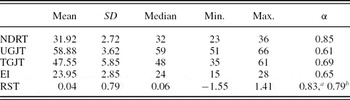
Descriptive statistics for all the measures are provided in Table 1. As can be seen from the standard deviations, the group was rather homogeneous in terms of their performance on the given tests. An examination of the distributions revealed that there were no severe violations from normality for each variable.
Descriptive statistics for the five tests

Note: NDRT, Nelson–Denny Reading Test; UGJT, untimed grammaticality judgment test; TGJT, timed grammaticality judgment test; EI, elicited oral imitation test; RST, reading span task.
a Value for the processing component.
b Value for the storage component.
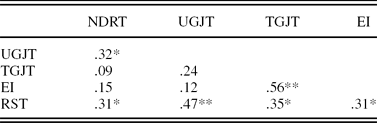
Pearson product-moment correlations among the scores on the five tests (see Table 2) indicate that both implicit and explicit knowledge correlate with WM capacity. However, the strength of the relationship is stronger in the case of explicit knowledge. This finding partially confirms our first hypothesis, which predicted no relationship between implicit knowledge and WM capacity.
Correlational matrix for the five tests
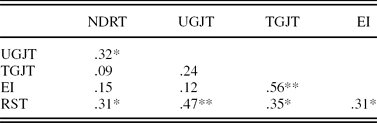
Note: NDRT, Nelson–Denny Reading Test; UGJT, untimed grammaticality judgment test; TGJT, timed grammaticality judgment test; EI, elicited oral imitation test; RST, reading span task.
*p < .05. **p < .01.
Table 2 further indicates that L2 reading comprehension has statistically significant positive relationships with both explicit linguistic knowledge and WM. Measures of implicit knowledge, in contrast, are not correlated with reading comprehension, confirming the predictions in our second hypothesis.
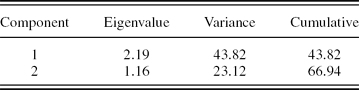
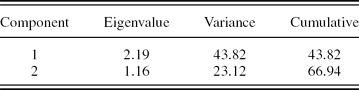
In order to determine whether these variables form coherent subsets that are relatively independent of one another, a PCA with varimax rotation was conducted (see Table 3). As predicted, a two-factor solution was obtained based on the scree test, explaining almost 67 percent of the variance.
Principal components analysis summary table
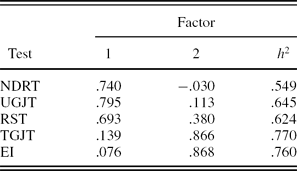
In interpreting the rotated factor pattern (Table 4), an item was said to load on a given factor if the factor loading was 0.40 or greater (Hatcher, Reference Hatcher1994). Accordingly, explicit linguistic knowledge, WM capacity, and L2 reading comprehension were found to load on a single factor, whereas implicit linguistic knowledge loaded on a separate factor. Table 4 shows that the variables load heavily on their respective factors and they have weak loadings on the other factor. However, the loading of WM capacity on the second factor is particularly worth noting as it is quite close to the cutoff loading of 0.40. In sum, two independent factors are obtained, the first factor involving chiefly explicit knowledge sources characterized by conscious control processes and the second involving those that are primarily implicit. These findings confirm our third hypothesis.
Rotated factor matrix and final communality estimates
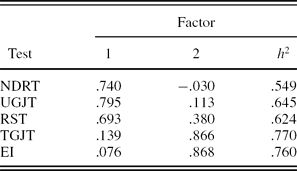
Note: NDRT, Nelson–Denny Reading Test; UGJT, untimed grammaticality judgment test; RST, reading span task; TGJT, timed grammaticality judgment test; EI, elicited oral imitation test.
DISCUSSION
In terms of the associations among the three variables in the present study, as investigated in the first question, the findings point to a significant relationship between the use of explicit knowledge and WM operations in the L2. The PCA has shown that these two variables load heavily on a single factor. As pointed out in the first hypothesis, this was expected given that conscious and intentional processes of selective attention that are implicated in the control, regulation, and temporary storage of task-relevant information in WM are also indicative of cognitive processes of explicit knowledge that direct learners to focus on what they consider to be the relevant features of the L2 input.
What is perhaps unexpected is the presence of a significant correlation between implicit knowledge and WM operations, disconfirming the second part of the first hypothesis. That certain WM operations can actually take place outside of conscious awareness and without intention is further suggested by the results of the PCA, with WM's moderate loading on the second factor that characterizes implicit processes. This seemingly counterintuitive finding is not without precedence, however, as there is some research in cognitive psychology whose results refute the prevalent position that WM operates intentionally and consciously only on tasks that appear to be explicit (e.g., Halford et al., Reference Halford, Cowan and Andrews2007; Hassin et al., Reference Hassin, Bargh, Engell and McCulloch2009; Reber & Kotovsky, Reference Reber and Kotovsky1997). Evidently, although WM is primarily responsible for the controlled processing and temporary storage of explicit linguistic data, it also attends to the input that could be processed automatically because the particular input is “deemed” to be of the kind that may be processed through the mediation of unconscious resources recruited by WM's conscious components (Baars, Reference Baars and Osaka2003). In a way, the conscious components of WM help mobilize and guide unconscious routines that carry out automatic processing of implicit tasks (Baars & Franklin, Reference Baars and Franklin2003) while they sustain controlled attentional processing and temporary storage for complex explicit tasks. It is even possible for certain explicit tasks to have aspects that could be operated on without conscious intention and outside of conscious awareness in the event WM's limited capacity is not able to handle the cognitive overload stemming from task complexity (Hassin et al., Reference Hassin, Bargh, Engell and McCulloch2009; Reber & Kotovsky, Reference Reber and Kotovsky1997). Hassin and colleagues (2009) go one step further and criticize the current paradigm of WM on the grounds that it views all active components of WM as predominantly conscious and all major WM tasks as “blatantly explicit” (p. 665). They propose a change in the paradigm so as to accommodate an “implicit working memory,” which they consider to be equally operative even in higher order cognitive processes (p. 667). They maintain that WM is capable of operating outside conscious awareness, handling tasks that require implicit processing and that are less sensitive to capacity constraints. Thus, technically speaking, WM appears to be the central executive for both controlled and automatic types of processing, whose operations require attentional processing and temporary storage, or what is succinctly referred to as “attentional resource capacity/allocation” (Montgomery, Polunenko, & Marinellie, Reference Montgomery, Polunenko and Marinellie2009, p. 488). In a way, its operating mode is reminiscent of the metaphorical manner in which Dörnyei (Reference Dörnyei2009) describes the functionality of explicit knowledge in L2 use as creating “a conscious channel for unconscious flow of implicit processing” (p. 171). In sum, WM can be said to play an important role in handling lower and higher level explicit linguistic tasks through controlled processes in addition to determining those implicit linguistic tasks that could be handled automatically.
It appears that the interaction between the two complementary systems of knowledge takes place within the control/automaticity continuum, with the “central executive” allowing for automaticity to manage those tasks that can be handled implicitly while inhibiting the controlled processes of explicit information. The presence of the meaningful association between implicit L2 knowledge and L2 WM capacity, albeit moderate, in addition to the substantial relationship between L2 explicit knowledge and L2 WM capacity, could be interpreted as being indicative of the coexistence of explicit and implicit knowledge sources and their underlying processes in the WM. These results are, in principle, consonant with the DP model. They suggest that late L2 learners with an advanced degree of target language proficiency, such as the sample in the present study, are able to perform WM operations that represent the rule-governed forms of L2 explicit knowledge as well as the implicit, combinatorial procedures of L2 morphosyntax.
In connection with the second research question, the significant correlation between L2 WM capacity and L2 reading comprehension on one hand and, on the other, the high loading of WM capacity and L2 reading comprehension on the first factor corroborate previous evidence obtained between the two constructs (e.g., Alptekin & Erçetin, Reference Alptekin and Erçetin2010; Harrington & Sawyer, Reference Harrington and Sawyer1992; Leeser, Reference Leeser2007; Walter, Reference Walter2004). WM, in fact, contributes significantly to reading comprehension as it processes and temporarily stores information to tackle complex cognitive tasks, which reading comprehension equally entails.Footnote 12
On a different level, the significant relationship between explicit knowledge and L2 reading comprehension and their high loadings on a single factor confirm our prediction in the second hypothesis and stands in stark contrast to the lack of a relationship between implicit knowledge and reading. In the light of this finding, it is safe to posit that L2 reading comprehension relies fundamentally on the use of explicit linguistic knowledge, characterized by the consciously controlled processes of the DM system, with a focus on the lexical/semantic features of the text. This reliance is in tune with the propensity for text boundedness and the resulting vocabulary-biased processing for which L2 readers are generally known (Alptekin, Reference Alptekin2006; Horiba, Reference Horiba1996; Taillefer, Reference Taillefer1996). McDonald (Reference McDonald2000), for instance, describes how additional memory loads are imposed on late L2 learners because of their strenuous efforts to decode surface forms in texts, particularly in those instances in which the forms represent structures that are also relatively more difficult for native speakers themselves.
The lack of a relationship between implicit L2 knowledge and L2 reading performance brings a number of possibilities to mind. One is that, despite their advanced level of L2 proficiency and their WM processing both explicit and implicit information, the participants were not able to make use of the implicit aspects of their L2 competence in reading texts in the target language because, as indicated by VanPatten (Reference VanPatten and VanPatten2004), skill development constitutes a completely separate phenomenon from the creation of a specific linguistic system (p. 27). A developing linguistic system, such as an implicit (chiefly morphosyntactic) knowledge base, does not necessarily lead to the fluent and accurate performance of a skill such as reading. It is likely that the transferability of implicit linguistic knowledge to the ability to apply its proceduralized routines to L2 reading performance is quite narrow, in view of the need for “extensive amount of exposure to print and frequent encounters with repeated units [of formal features] in consistent contexts” (Grabe, Reference Grabe2009, p. 62). Admittedly, despite their advanced proficiency level in the L2, the participants in the present study appeared to lack the relevant practice effects that would have enabled them to apply their implicit knowledge of linguistic parsing, routines, habits, and associations into reading comprehension processes. A second reason could have been their self-perception of inadequacy in the kind of “socioculturally appropriate background knowledge shared between L1 writers and readers” (Nassaji, Reference Nassaji2002, p. 643), which likely compelled them to rely more on their lexical/semantic resources in extracting meaning from L2 texts, thereby relegating the role of morphosyntactic features in comprehension to an insignificant status. Finally, this finding should perhaps lead us into pondering on DeKeyser's (2009) concern over L2 learners’ highly automatized knowledge not necessarily being qualitatively identical to implicit knowledge—in the restricted sense the latter construct has often been defined in cognitive psychology in terms of its relationship to language (i.e., L1) use.
CONCLUDING REMARKS
The aim of this study was to explore the relationships between explicit/implicit knowledge sources and memory systems with reference to L2 reading comprehension. The findings point to positive relationships between L2 readers’ WM capacity in the L2 and both their explicit and implicit linguistic knowledge of the L2. They further point to L2 reading comprehension being closely associated with explicit linguistic knowledge and L2 WM capacity. In fact, the PCA reveals that these three variables load on a single factor. By contrast, implicit knowledge appears not to be related to L2 readers’ comprehension processes, even for those with a relatively high level of L2 proficiency (such as the sample in the present study), despite the role it plays in their L2 WM operations along with L2 explicit knowledge.
These findings suggest that the L2 learner's linguistic knowledge and WM operations involving the computation and maintenance of both explicit and implicit information are associated with L2 reading performance. It is possible for those learners with a high degree of WM capacity to process L2 texts more efficiently because they may generate more and better inferences, integrate accessed knowledge with the new information, and be more cognizant of new information in the text—those aspects of reading that WM capacity is said to account for (Daneman & Hannon, 2007). In this context, the manipulation and maintenance of explicit information is the basis for WM operations, as the learner has to attend to the input consciously. However, WM's conscious components may mobilize and guide unconscious routines of implicit knowledge to process certain reading tasks if they “see fit.”
In contrast, the absence of the implicit components of L2 knowledge in L2 reading performance, along with the participants’ propensity for text-bound processing through lexical/semantic means in the L2, is likely to hamper reading comprehension processes. For instance, surface-level (e.g., syntactic parsing) and textbase-level (e.g., anaphoric resolution) procedures subserved by controlled processes may be in the way of higher level conceptual aspects of reading (e.g., generating inferences). As controlled processes of explicit knowledge make high processing demands and are subject to capacity constraints, they may overload WM resources in general.
In the final analysis, the present study is not without its limitations. To begin with, caution should be exercised in generalizing the results to all L2 learners irrespective of their degrees of L2 proficiency. It needs to be emphasized that although the participants in this study were proficient L2 learners, their command of the L2 was not nativelike. It seems that late L2 learners need to become highly proficient in their L2 in order to be able to perform reading tasks more like efficient native speakers. Hence, it is suggested that future research on the subject take the proficiency factor into account as an important variable and replicate the present research with late L2 learners at different proficiency levels. Another reason why these findings should be treated cautiously has to do with the relatively small size of the sample (51) and the correlational (vs. causal) nature of the factor analysis results themselves. A third reason may be attributed to instrumentation in that the lack of “pure” measures of implicit and explicit knowledge might pave the way for problems involving construct validity and instrument reliability, as suggested by DeKeyser (Reference DeKeyser, Doughty and Long2003, Reference DeKeyser, Long and Doughty2009). With these caveats in mind, it nevertheless seems fairly well established that explicit lexical/semantic knowledge and L2 WM have robust relationships with L2 reading comprehension, particularly among late L2 learners who have an advanced proficiency level in the L2 but who do not possess near-native fluency. Fourth, and finally, given the treatment of reading as a global construct in this study, future work should focus on different components of L2 reading, such as literal understanding versus inferential comprehension, in order to explore whether knowledge sources and WM capacity affect each component differentially. It is possible, at least in the construction–integration framework of reading paradigms (Kintsch, Reference Kintsch1998), that in the absence or paucity of implicit knowledge contributing to reading, it will be difficult to form a microstructure of the text at the level of literal understanding, which in turn is likely to impede the process of generating a macrostructure embodying the textbase and a situation model.
ACKNOWLEDGMENTS
The research underlying the study was supported by a Bogaziçi University Research Fund grant (Project No. 5016). The authors thank two anonymous reviewers for their insightful comments on an earlier version of this paper.