Research on bilingualism has found that thinking in a foreign language activates systematic reasoning processes whereby one’s first and foreign language can differentially affect decision making; this phenomenon is aptly termed the foreign language effect (FLE). While much of this work has focused on how reasoning in a foreign language influences bilingual decision making in contexts such as risk and loss aversion, including investment decisions (e.g., Keysar, Hayakawa, & An, Reference Keysar, Hayakawa and An2012), or how it reduces other heuristic biases (e.g., Costa et al., Reference Costa, Foucart, Hayakawa, Aparici, Apesteguia, Heafner and Keysar2014), a growing body of work has extended the FLE to moral decision making (moral foreign language effect; Brouwer, Reference Brouwer2019; Cipolletti, McFarlane, & Weissglass, Reference Cipolletti, McFarlane and Weissglass2016; Corey et al., Reference Corey, Hayakawa, Foucart, Aparici, Botella, Costa and Keysar2017; Costa et al., Reference Costa, Foucart, Hayakawa, Aparici, Apesteguia, Heafner and Keysar2014; Geipel, Hadjichristidis, & Surian, Reference Geipel, Hadjichristidis and Surian2015; Hayakawa, Tannenbaum, Costa, Corey, & Keysar, Reference Hayakawa, Tannenbaum, Costa, Corey and Keysar2017). This latter body of work has shown that a reduced emotional connection to a second language (L2), differences in processing an L2 compared to a native language, or both, may be responsible for the discrete treatment of moral decisions in a bilingual’s languages.
Early work on emotion word judgments among bilinguals lends credence to the FLE’s main tenets, showing that emotive words or topics in a foreign language are judged as less abrasive than the same words and topics presented in a native language (Pavlenko, Reference Pavlenko2007). Dewaele (Reference Dewaele2004, Reference Dewaele2006, Reference Dewaele2008) found that swearing, saying I love you, and expressing anger are less impactful to the speaker in a foreign language than in a native language, and taboo words and childhood reprimands are also less emotional in a nonnative language (Harris, Reference Harris2004; Harris, Ayçiçegi, & Gleason, Reference Harris, Ayçíçeğí and Gleason2003). However, there are also many differences between first language (L1) and L2 processing that are plausible explanations for the FLE’s emergence. For example, Hasegawa, Carpenter, and Just (Reference Hasegawa, Carpenter and Just2002) found that foreign language comprehension requires more cognitive resources than native language comprehension and, according to Miller and Keenan (Reference Miller and Keenan2011), such resources appear to be allocated to lower level processes such as lexical identification, semantic association and access, and syntactic processing. Thus, foreign language processing may reduce perceived emotion stemming from specific stimuli given a combination of semantic accessibility and processing limitations in bilingualism.
Bilinguals deal with mental tasks that monolinguals do not, which include inhibition from either language, correction of automatic reflexes from language systems that are not relevant for use, and multiple lexicons (e.g., Abutalebi et al., Reference Abutalebi, Della Rosa, Green, Hernandez, Scifo, Keim and Costa2012; Bialystok, Reference Bialystok2009; Green, Reference Green2011). Bilinguals must maintain processing-specific routines based on comparatively less input than monolinguals, which may contribute to linguistic features and lexical items, including their semantics, that are more weakly represented or less activated than those of monolinguals (Gollan, Montoya, Fennema-Notestine, & Morris, Reference Gollan, Montoya, Fennema-Notestine and Morris2005; Gollan et al., Reference Gollan, Slattery, Goldenberg, Van Assche, Duyck and Rayner2011; Hopp, Reference Hopp2013). Similarly, recent work has shown that proficiency regulates the accessibility of meaning and partly determines the implication of the left insula, a region of the brain known to regulate empathy and social cognition. Bilinguals are also known to have limitations in working memory, processing capacity or efficiency, and attentional resource allocation (see Rothman & Slabakova, Reference Rothman and Slabakova2011; Sorace, Reference Sorace2011, for discussion). In light of the above, even in highly proficient bilinguals, the activation of multiple linguistic systems makes bilingual language processing, production, and comprehension a challenging task (e.g., Sorace & Serratrice, Reference Sorace and Serratrice2009), and one that influences even moral judgments. The purpose of the present study, therefore, is to examine the core tenets of the FLE, namely, that processing information in one’s L2 can result in blunted emotional reactions. However, we do this by considering the FLE’s role in the evaluation of political ideas valued by participants and further measuring its effects on offense taking and prosocial sentiment.
Along with L2 learners, we also tested heritage speakers (HSs) who grew up speaking Spanish at home, but who either became dominant in English after entering the school system or who remained dominant in the heritage language (Rothman, Reference Rothman2009). HSs have communicative and grammatical competence in both of their languages, though their linguistic abilities may differ from other HSs and monolinguals depending on factors such as access to formal education (literacy) in the native language, how frequently they use their native language, differences in exposure to various types of input, and many of the same processing-related challenges an L2 speaker would face (e.g., Bayram et al., Reference Bayram, Rothman, Iverson, Kupisch, Miller, Puig-Mayenco and Westergaard2017; Kupisch, Reference Kupisch2013; Kupisch & Rothman, Reference Kupisch and Rothman2016; Pascual y Cabo, Reference Pascual y Cabo2013; Pires & Rothman, Reference Pires and Rothman2009; Putnam & Sánchez, Reference Putnam and Sánchez2013; Scontras, Fuchs, & Polinsky, Reference Scontras, Fuchs and Polinsky2015). Recent research also shows that when the default balance of exposure to L1 input and opportunity to use it are imbalanced, as in immigrant immersion contexts, the L1 of bilinguals, in this case HSs, is much more susceptible to change (Schmid & Kopke, Reference Schmid and Köpke2017). Thus, HSs present a unique test case to examine the FLE as it relates to dominance and language identity. By ensuring that our HSs have similar proficiency scores but unique dominance and identity scores in their heritage language, we can assess the effects of language dominance on the FLE in the heritage language. We propose that with greater dominance in and identity with the heritage language comes greater emotional attachment to it (see Schmid, Reference Schmid2011) and, therefore, more reason to suspect modulation of the FLE’s emergence. In this sense, HSs open the door for preliminary research on the FLE in bilingual populations undergoing both attrition of the L1 and a shift in dominance from L1 to L2 during formative years of language acquisition.
The FLE
According to dual-systems theory, the brain is said to process information with two separate reasoning systems: System 1, the intuitive, emotional, and fast processing involved in routine; and System 2, the slower (supervisory), more deliberate and analytical processing involved in conscious choice (Alter, Oppenheimer, Epley, & Eyre, Reference Alter, Oppenheimer, Epley and Eyre2007; Greene & Haidt, Reference Greene and Haidt2002; Kahneman, Reference Kahneman2011; Kahneman, Lovallo, & Sibony, Reference Kahneman, Lovallo and Sibony2011; see Frankish, Reference Frankish2010, for review). Many studies examining the FLE couch their experimental assumptions within the dichotomy framed by System 1 and System 2 processing. Because bilingualism is associated with slower processing, weaker emotional connection, and increased cognitive load, bilinguals using the L2 are predicted to make emotional moral choices differently from their monolingual counterparts or other bilinguals using their L1.
One prominent study presented bilinguals from various language pairings with the trolley dilemma, a philosophical moral quandary in which participants are asked whether or not they would end the life of a stranger to save some others (Costa et al., Reference Costa, Foucart, Hayakawa, Aparici, Apesteguia, Heafner and Keysar2014). The authors found that bilinguals performing the task in either their L1 or their L2 were equally likely to kill a stranger to save several others when the mode of intervention was impersonal. However, when intervention meant personal involvement, thus becoming more emotional, only bilinguals performing the task in the L2 maintained a greater willingness to kill a stranger to save the others. While the effect was more prominent for bilinguals of lower proficiency, the authors attributed the FLE to an overall increase in utilitarian choice—the option that maximizes the well-being of those involved—stemming from a reduced emotional reaction to the stimuli. Such a reduction in emotionality ultimately led to a cost–benefit analysis more typical of System 2 processing. Notwithstanding, various studies since Costa et al. (Reference Costa, Foucart, Hayakawa, Aparici, Apesteguia, Heafner and Keysar2014) have disagreed on whether or not bilinguals approach moral choice with increased utilitarianism (System 2) or weakened deontological strategy (System 1). Hayakawa et al. (Reference Hayakawa, Tannenbaum, Costa, Corey and Keysar2017), however, adapted a process-dissociation technique (see Conway & Gawronski, Reference Conway and Gawronski2013) to tease apart utilitarian and deontological choice given that they are conceptually unique, though not always treated as such. The authors found that blunted emotional sensitivity, rather than increased utilitarianism, was at the root of the FLE.
Whatever the cause, the emergence of the FLE and the conclusion that it leads either to increased utilitarian or decreased deontological judgments seem to be contingent on methodological factors and the type of bilingual being examined, such as lower versus higher proficiency learners (Čavar & Tytus, Reference Čavar and Tytus2018; Hayakawa et al., Reference Hayakawa, Tannenbaum, Costa, Corey and Keysar2017) or simultaneous bilinguals with differing degrees of language dominance (Wong & Ng, Reference Wong and Ng2018). Moreover, studies measuring the moral FLE through the conceptual distinction between utilitarian and deontological strategy are obligated to examine binary moral choice: do you make a decision based on the greater good, or do you make a decision based on a set of moral rules rather than consequences? As such, it is necessary to determine what an individual’s default moral decision-making strategy is and how it may change both by experimental manipulation and language of testing. In so doing, researchers must first determine the participants’ strategy in the L1 and examine how it changes in the L2. However, bilinguals make many decisions on a daily basis, only some of which are potentially of a moral nature, and few of them are likely to be similar to the trolley dilemma in reality. Moral choice can be affected by a host of factors such as an odorous environment (Mitchell, Kahn, & Knasko, Reference Mitchell, Kahn and Knasko1995), hunger (de Ridder, Kroese, Adriaanse, & Evers, Reference de Ridder, Kroese, Adriaanse and Evers2014), contextual framing (Tversky & Kahneman, Reference Tversky and Kahneman1981), stress (see Starcke & Brand, Reference Starcke and Brand2012, for review), and more. An individual’s response preference may not remain the same from moment to moment, especially across an array of methodological designs. The present study thus examines whether the FLE extends beyond philosophical moral dilemmas to relevant political value judgments and what effect, if any, it has on prosocial sentiment after taking offense.
The present study
A question asked in early research on moral decision making was whether emotion was more fundamental than reason or vice versa (see Greene, Reference Greene and Gazzaniga2015, for review). However, research now shows that reason and emotion, or System 1 and System 2, are neurobiologically intertwined (Sapolsky, Reference Sapolsky2017, for review). For example, the systems and regions of the brain responsible for various types of decision making are preferentially, though not solely, activated depending on the context in which decisions are made (see Zheng, Lu, & Huang, Reference Zheng, Lu and Huang2018, on the dorsolateral prefrontal cortex; Greene, Reference Greene2007, on the ventromedial prefrontal cortex; Blair, Reference Blair2017, on the amygdala; Greene & Haidt, Reference Greene and Haidt2002, on the orbitofrontal cortex; Huebner, Dwyer, & Hauser, Reference Huebner, Dwyer and Hauser2009, on the insular cortex; Greene, Nystrom, Engell, Darley, & Cohen, Reference Greene, Nystrom, Engell, Darley and Cohen2004, on the anterior cingulate). Of importance, this research highlights the links between the contexts that elicit emotions and their effects on behavior, such that an emotion-laden context is likely to produce an emotional reaction.
In the present study, we assume the FLE will blunt emotional sensitivity to intrinsically evocative information and, by extension, neutralize certain behaviors that are known to follow negative emotions. One such behavior is the tendency to seek the punishment of others to the extent one feels offended (Caprara, Barbaranelli, Pastorelli, Cermak, & Rosza, Reference Caprara, Barbaranelli, Pastorelli, Cermak and Rosza2001; Dickinson & Masclet, Reference Dickinson and Masclet2015; Raihani & McAuliffe, Reference Raihani and McAuliffe2012; see Sapolsky, Reference Sapolsky2017, for review). Another is to double down in cherished views upon encountering threatening information (e.g., Knobloch-Westerwick, Mothes, & Polavin, Reference Knobloch-Westerwick, Mothes and Polavin2020; see Knobloch-Westerwick, Reference Knobloch-Westerwick2015, for review), a hallmark of cognitive dissonance (Festinger, Reference Festinger1957). However, if the FLE blunts emotional sensitivity to evocative stimuli, we predict that the negative emotions emerging from offense taking will be minimized and less likely to lead an individual to seek the punishment of others. In order to examine this prediction, we presented bilinguals with specifically designed value-inconsistent political information in either their native or a foreign language and assessed their willingness to be prosocial immediately after. Prosocial sentiment was measured by specific altruistic behaviors, such as willingness to hold the door for a stranger, donate money to charity, or perform volunteer service (e.g., Batson, Reference Batson2011; Batson & Powell, Reference Batson, Powell, Weiner, Scinka, Velicer and Weiner2003; see Appendix A).
To examine strong emotional contexts, we capitalized on linguistic framing and the ideological idiosyncrasies of Democratic Party membership in the United States. In the former case, scalar quantifiers such as some and universal quantifiers such as all carry distinct informational weight, as demonstrated by scalar implicatures (Grice, Reference Grice1967; Horn, Reference Horn1972). Scalar implicatures are meanings implied by the speaker and/or inferred by the listener, derived on the basis of scaled lexical items and specific communicative strategies. During communication, interlocutors may strive for maximal cooperation and assume that each other is being truthful, relevant, and informative to the extent necessary. Thus, when Speaker A utters Some people are bilingual, Speaker B may interpret it as Not all people are bilingual because if Speaker A had wished to convey all, he or she would have said so. Given the distinct informational weights between some and all, we expect experimental contexts headed by each to be distinctly emotional, where some trials serve as a baseline to all trials (e.g., Some foreigners hurt this country vs. All foreigners hurt this country).
We built the experimental trials around common values held by many members of the Democratic Party in the United States in order to instigate sufficiently emotional responses. Unlike the trolley dilemma or tasks like it, questions of current political import are relevant to the everyday beliefs—and the behaviors they affect—of millions of people. We investigated two groups of participants: (a) ideal candidates not to experience the FLE, such as advanced (to near native) L2 speakers and/or heritage bilinguals whose dominance and identity has shifted from the L1 to the L2; and (b) ideal candidates for it, such as beginner–intermediate L2 learners who primarily have classroom experience and whose dominance and identity are still very much centered around the L1.
Our design serves to shed light on the effects of proficiency, dominance, identity, and learner type, as well as linguistic and belief manipulations, by selecting only two uniquely homogenous groups. If blunted emotional reactivity in a nonnative language also stems from proficiency-related effects, we predict that higher level learners will not experience as drastic of a reduction in emotional reactivity as beginner learners. By further investigating HSs (Rothman, Reference Rothman2009) we might determine what happens when the L1 becomes less dominant as the majority language becomes the preferred one, a process in which language identities are known to shift (Schmid, Reference Schmid2011). Examining HSs, thus, allows us to ask some preliminary questions about how language attrition and/or dominance shifts affect emotional decision making among such bilinguals.
The role cognitive dissonance in decision making
As originally proposed by Festinger (Reference Festinger1957), cognitive dissonance differed from theories of a similar era (e.g., Heider, Reference Heider1946, Reference Heider1958) in that it outlined a concrete reason to resist changes in cognition(s), whereby the resistance determined how specific cognitive inconsistencies were reduced. For example, if an individual holds two or more components of knowledge that are mutually relevant but also fundamentally inconsistent with one another, the resultant cognitive state is one of discomfort or dissonance. Many individuals update their belief framework when confronted with new information, and many others deny new information and double down in an already stable belief. Historically, for most researchers, distinct cognitions have been measured predominantly via attitudinal changes, where attitude changes in response to a particular state of dissonance are most often measured in the direction of the cognition that is least malleable (see Harmon-Jones & Harmon-Jones, Reference Harmon-Jones and Harmon-Jones2008).
In order to measure dissonance, participants must have a strong belief in a valued topic, given that such belief has a direct influence on behavior (see Aspinwall, Richter, & Hoffman, Reference Aspinwall, Richter, Hoffman and Chang2001; Booth, Johnson, Branaman, & Sica, Reference Booth, Johnson, Branaman and Sica1995; for religion; Kilbourne & Pickett, Reference Kilbourne and Pickett2008; Poortinga, Steg, & Vlek, Reference Poortinga, Steg and Vlek2004 for the environment; O’Connor, Martin, Weeks, & Ong, Reference O’Connor, Martin, Weeks and Ong2014 for physical and mental health; and DeMarree, Clark, Wheeler, Briñol, & Petty, Reference DeMarree, Clark, Wheeler, Briñol and Petty2017; LaDonna, Ginsburg, & Watling, Reference LaDonna, Ginsburg and Watling2018, for beliefs about ourselves). The empirical motivation for expecting that specific linguistic stimuli will impact political judgments stems from a model of belief maintenance positing that negative emotions are borne of a dispute between the recognized value of a held belief and the unpredictability of new but challenging information (Burris, Harmon-Jones, & Tarpley, Reference Burris, Harmon-Jones and Tarpley1997; Harmon-Jones, Reference Harmon-Jones2000; Zuwerink & Devine, Reference Zuwerink and Devine1996). Thus, exposing subjects to value-inconsistent political information is expected to heighten (negative) emotions.
In a similar vein, if an idea threatens a worldview, there is ample reason to resist it (e.g., Ringold, Reference Ringold2002). If the idea aligns with a worldview, it may be more readily taken on board (e.g., Rucker, Tormala, & Petty, Reference Rucker, Tormala, Petty, Knowles and Linn2004). While there are various strategies that govern the limits of persuasion (see Fransen, Smit, & Verlegh, Reference Fransen, Smit and Verlegh2015, for review), particularly when an individual has personal reasons not to change (Ahluwalia, Reference Ahluwalia2000; Jacks & Devine, Reference Jacks and Devine2000; Pomerantz, Chaiken, & Tordesillas, Reference Pomerantz, Chaiken and Tordesillas1995), cognitive dissonance outlines some very likely outcomes, such as punishing people to the extent one feels angered, threatened, or put off by what is perceived to be a lack of ethics/morals (D’Errico & Paciello, Reference D’Errico and Paciello2018; see Sapolsky, Reference Sapolsky2017, for thorough review). Given that identity-threatening ideas generate robust resistance to change (Unsworth & Fielding, Reference Unsworth and Fielding2014), and matters of morality and politics are associated with identity and emotion (Brader, Reference Brader2005; Marcus, MacKuen, & Neuman, Reference Marcus, MacKuen and Neuman2011), it is likely that some form of dissonance will surface following our emotive contexts. We predict that if bilinguals have a reduced emotional connection to their nonnative language, however, they will not exhibit such a human susceptibility to the effects of dissonance in the L2, remaining at least neutral in their behaviors after being offended.
Research questions and hypotheses
-
1. Is there a difference between the some and all conditions such that all elicits more emotionally charged judgments? Given that some is found to be informationally weaker than all on tasks measuring implicature derivation and semantic entailments (see Huang & Snedeker, Reference Huang and Snedeker2018, for review), we expect that some trials will be less evocative than all trials.
-
2. Do dominance, proficiency, ideology, and learner type affect bilingual judgments? Given that lower level learners are known to produce, comprehend, and process information in their nonnative language with some difficulty/difference as compared to more advanced learners, we expect that the FLE will be most visible at lower proficiency and least visible at higher proficiency. That is, advanced learners are predicted to be less prosocial after offense than their beginner counterparts given their connection to their L2. Likewise, we expect HSs who are dominant in the heritage language will be less prosocial after taking offense in their heritage language than nondominant ones. Furthermore, the model of belief proposed herein posits that more entrenched views are more sensitive to emotion. Thus, individuals on the more Liberal side of the spectrum are expected to have stricter views than those who are on the less Liberal side. A detailed overview of the political typology quiz is given below.
Materials and procedures
Participants
Participants were primarily students from University of Illinois at Chicago, but some were recruited by word of mouth and/or online. Included in the analysis were 69 native English speakers of L2 Spanish (47 females, 22 males; mean age = 21.7, SD = 1.3). A total of 30 participants in the L2 group were beginner–intermediate learners (M = 29/50), and 39 were advanced learners (M = 47/50) as measured by the Diploma of Spanish as a Foreign Language (DELE; e.g., Duffield & White, Reference Duffield and White1999), and self-reported scores. The DELE is a widely used proficiency measure issued by the Ministry of Education, Culture, and Sport of Spain. It is composed of 50 questions in three sections: a cloze test, a vocabulary test, and a multiple-choice grammar test, where participants receive 1 point for each correct answer and 0 for incorrect answers.
All beginner L2 speakers reported that their first and primary exposure to Spanish was in the classroom. The beginners also reported using Spanish 10% per week or less in three contexts: with friends, at work/school, and self-speak. All beginners reported identifying with and feeling most like themselves in English, and two had done a semester study abroad in a Spanish-speaking country at the time of testing. All advanced L2 speakers reported that their first exposure to Spanish was in the classroom, though 7 had spent time in a Spanish-speaking country through a semester study abroad and 14 others were returned missionaries from either a Spanish-speaking country or a Spanish-speaking mission in the United States. The advanced learners reported using their L2 at least 20% per week in the same three aforementioned contexts. Though the advanced learners also reported identifying with English, as a group they also reported feeling slightly more like themselves using either language than the beginner learners (see Appendix B).
An additional 31 heritage Spanish speakers were included (18 females; mean age = 20.3, SD = 1.7), who all performed the experiment in Spanish, their heritage language. The HSs, unlike the L2 learners, were all early learners of English. As all HSs scored as advanced on the DELE (M = 48/50), proficiency was not included as a variable in their model. However, as is common among many HSs, roughly half of our HSs reported being dominant in and identifying with English (n = 17) and the other half were dominant in and identified with Spanish (n = 14). As such, we use (self-reported) dominance as a predictor for the analysis in lieu of proficiency.
To assess specific political values held by our participants, we used the Pew Research Center’s Political Typology Quiz (2017), which bins individuals into one of four groups on the Left: Devout and Diverse, Disaffected Democrats, Opportunity Democrats, and Solid Liberals. In all participant groups, roughly half of the participants scored on the Left-most end of the liberal scale (n = 47) and the other half scored on the Right-most end of the liberal scale (n = 53). That is, nearly half were Devout and Diverse or Disaffected Democrats (weak Democrats), and the other half were Opportunity Democrats or Solid Liberals (strong Democrats). This was done in order to examine effects of ideological strength on prosocial sentiment. Although the typology quiz also scores individuals on the Right side of the political spectrum, and some of our participants scored on the Right, they were insufficient in number to perform proper statistical analyses and were not included. Roughly half of the L2 participants performed the experiment in English (n = 34), their native language, and the other half performed it in Spanish (n = 35).
Stimuli
Participants read 90 statements on a Qualtrics survey, 60 of which were target trials designed to clash with the participants’ sociopolitical views (see Appendix C): 30 trials were of the some-type to serve as a baseline and 30 were of the all-type to serve as emotive trials. An additional 30 fillers consisted of sentences probing the extent to which participants agreed or disagreed with certain behavioral norms, such as It is generally wise/unwise to tip a server, followed by a judgment that was not aimed at assessing prosocial sentiment. The stimuli were framed (e.g., Tversky & Kahneman, Reference Tversky and Kahneman1981) such that through the use of a single lexical item, that is, the scalar quantifiers some and all, the language would regulate higher versus lower emotion contexts given the informational weight each lexical item carries.
Procedure
To begin the session, each participant took the political typology quiz, after which they were administered the experimental task. After each experimental trial, participants were prompted to respond to a question probing their willingness to engage in prosocial behavior, which was evaluated on a Likert scale from 1 to 7, 1 being totally agree and 7 being totally disagree. Participants were asked to read the targets carefully—though quickly—and then move on to the subsequent prosocial evaluations. The same some- and all-type trials preceded the same prosocial evaluations, though randomized throughout. This was done in order to measure the effect of quantifier type, which served as the baseline and emotive conditions, on the FLE. Following the experimental task, participants took the DELE as a measure of proficiency. As a final way to ensure participants understood the sociopolitical content of the target sentences (e.g., abortion, capital punishment, etc.), they were given a brief multiple-choice task in which they were asked to determine the correct definition(s) of the target content. No participant scored below 91% on this task and, therefore, all were included in the analysis.
Results
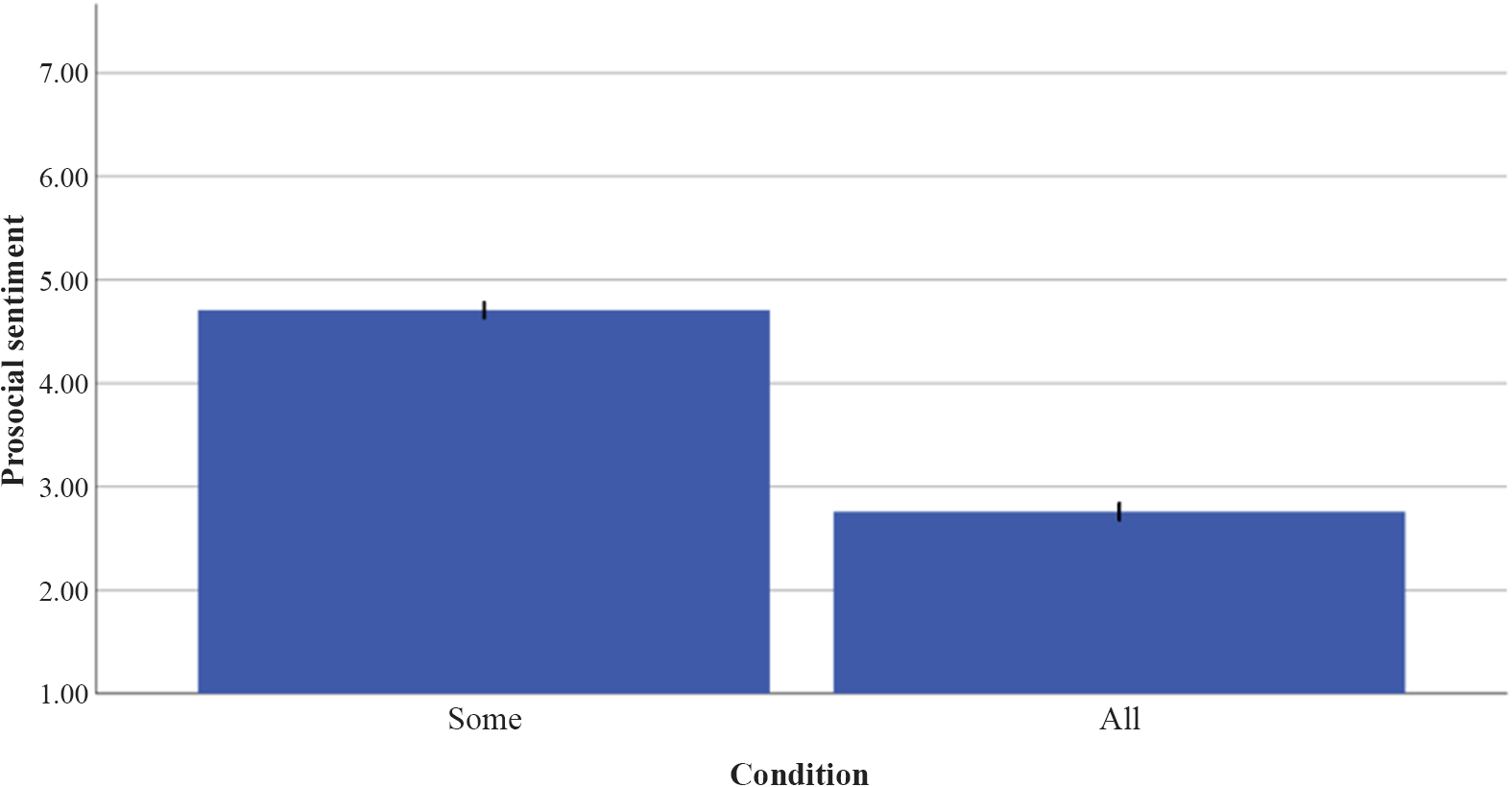
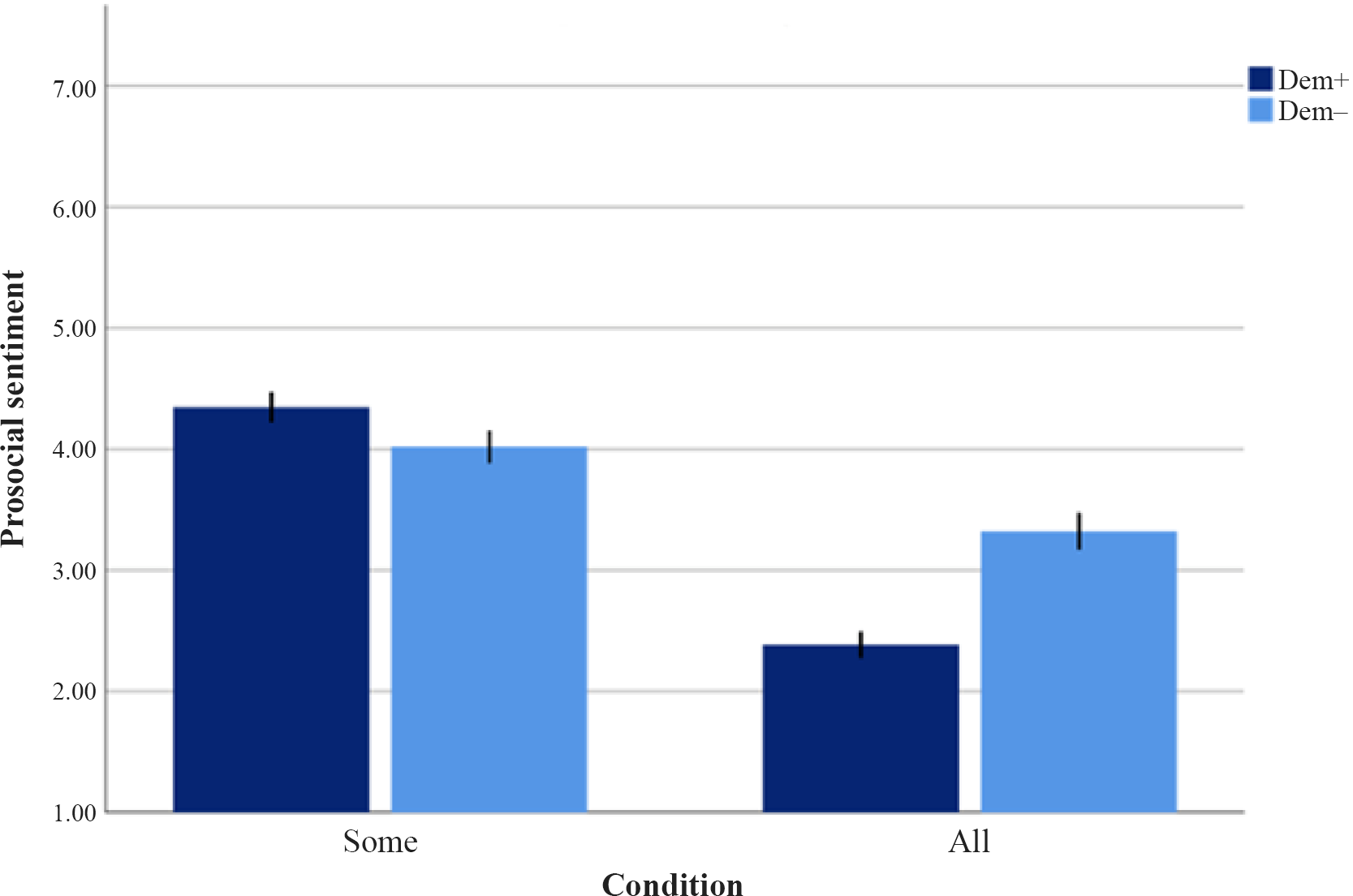
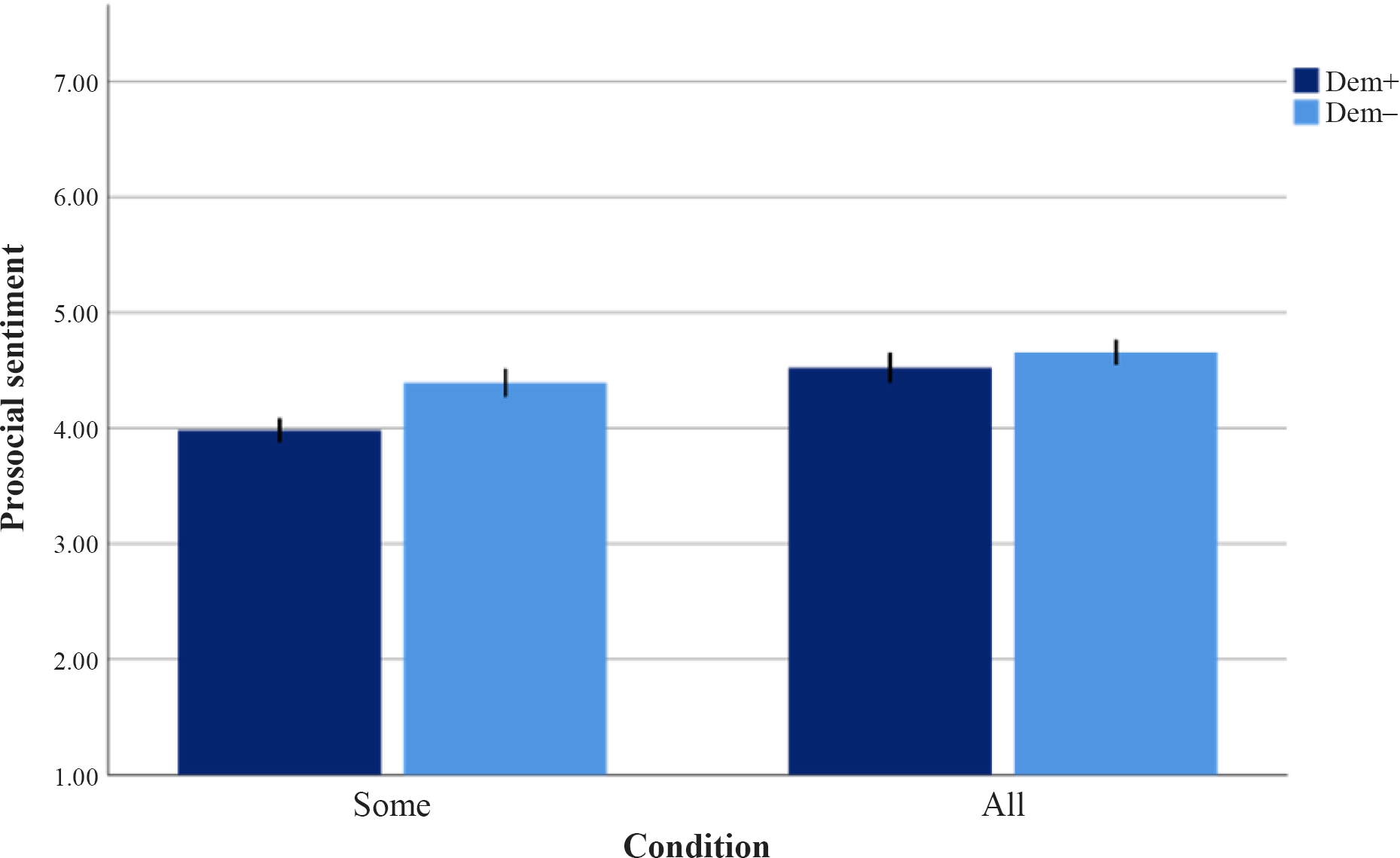
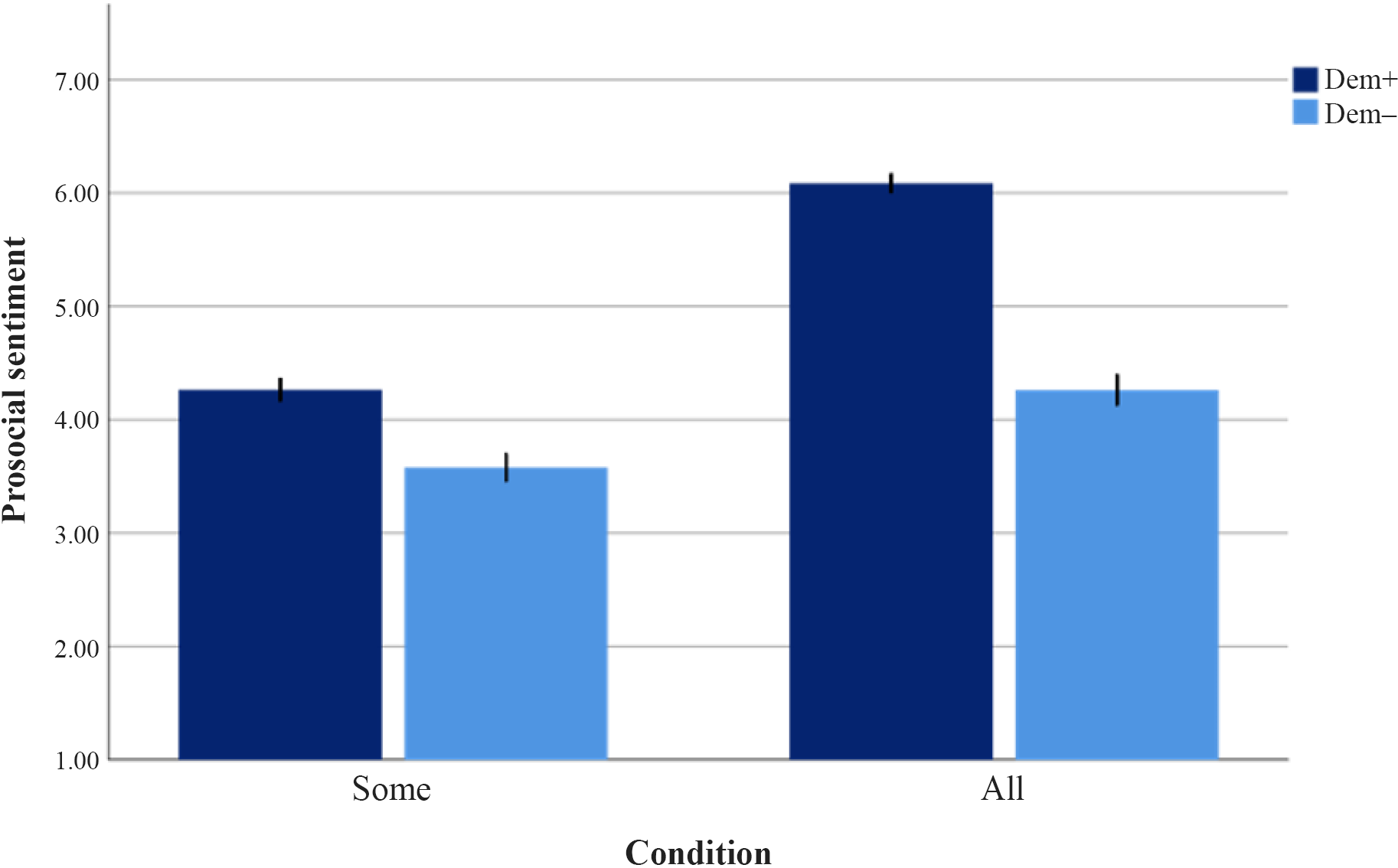
The results are discussed descriptively first and then followed by a detailed description of the statistical models. Bilinguals who performed the task in their L1 showed lower overall prosocial sentiment on all-type trials than some-type. When broken down by political strength, however, prosociality was lower for strong Democrats than weak Democrats, indicating a potential effect of political strength (see Figures 1 and 2).
Observed mean difference in prosocial response by condition. Bilinguals performing task in L1. +/−1 SE.

Observed mean difference in prosocial response by condition and ideological strength. Bilinguals performing task in L1. +/−1 SE.

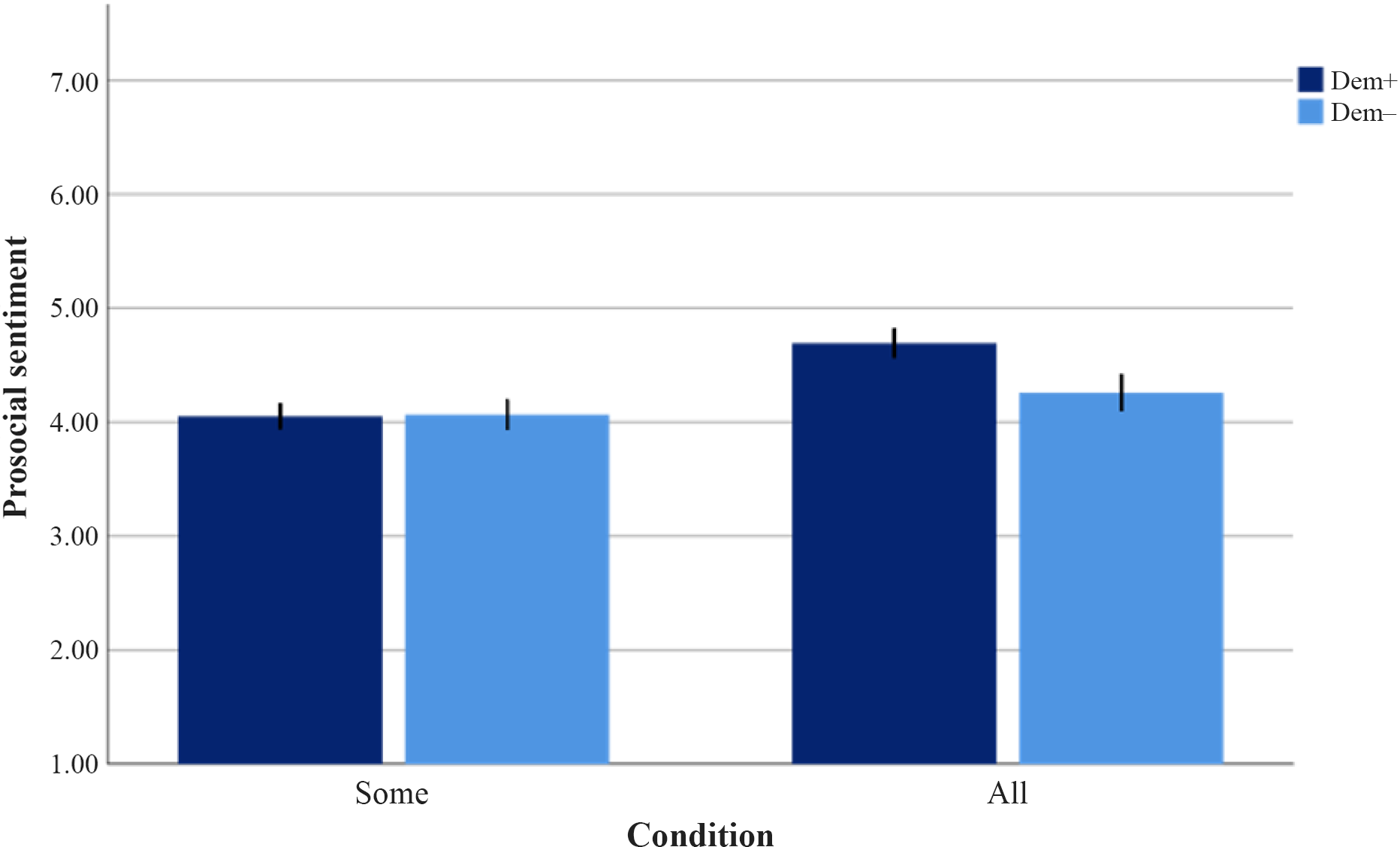
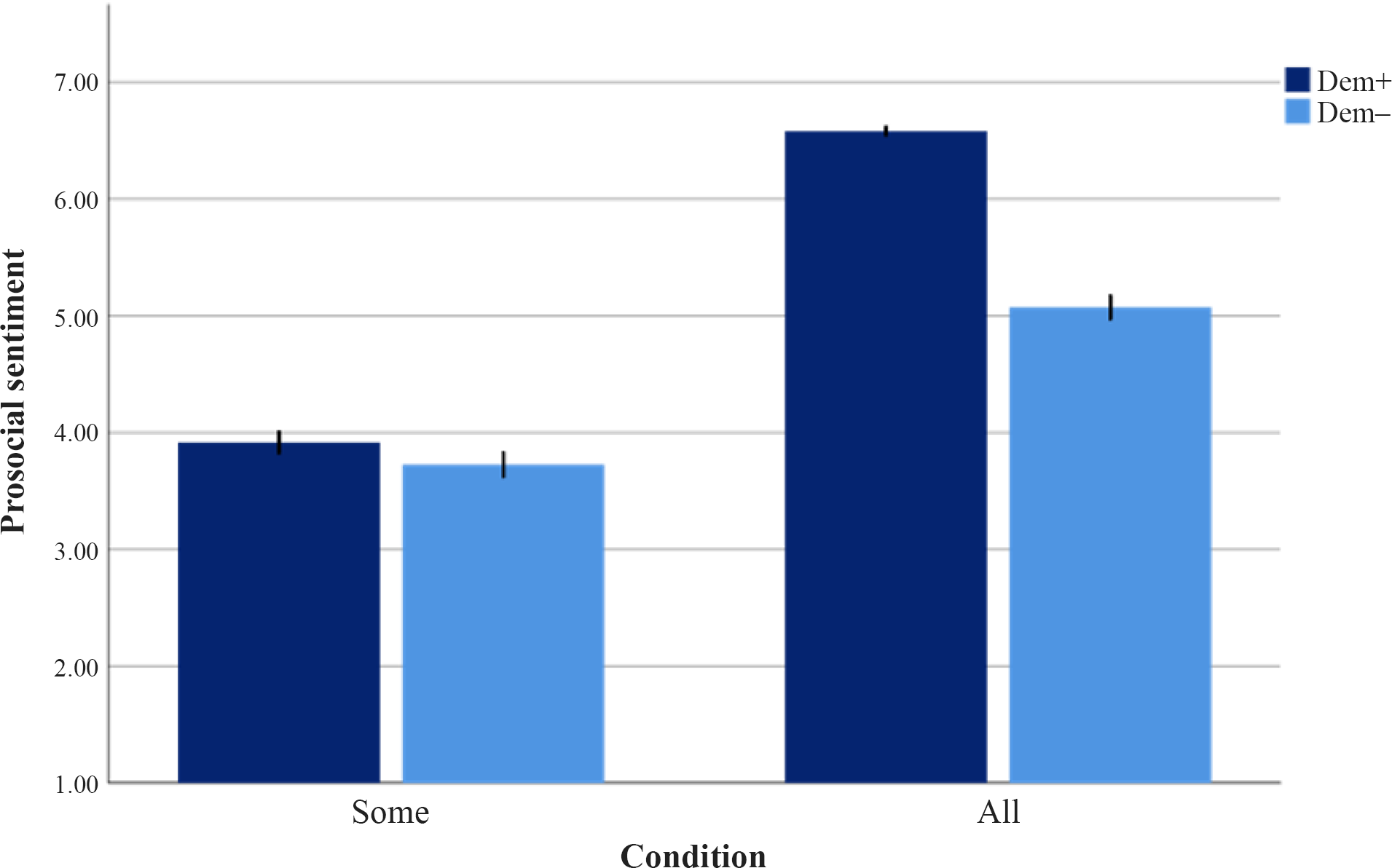
The beginner learners performing the task in their L2 showed similar response patterns among themselves for some-type and all-type trials, regardless of their political strength. When broken down by proficiency, however, the advanced learners showed higher overall prosocial ratings after all-type trials than some-type trials, the trend being higher for strong Democrats than for weak Democrats (see Figures 3 and 4).
Observed mean difference in prosocial response by condition and ideological strength. Beginner–intermediate bilinguals performing task in L2. +/−1 SE.

Observed mean difference in prosocial response by condition and ideological strength. Advanced bilinguals performing task in L2. +/−1 SE.

In order to assess the effects of condition (some vs. all), language (L1 vs. L2), political strength (Dem+ vs Dem–) and their interactions on prosocial sentiment, we ran a linear mixed model and allowed intercepts and slopes to vary randomly for participants. Model fit was assessed going from a model with only fixed parameters to one with random intercepts and then random slopes, where fit was determined by significant differences between the Akaike information criterion, the Bayesian information criterion, and –2LL across models (e.g., Field, Miles, & Field, Reference Field, Miles and Field2012). The final model showed a relationship between condition and prosocial response with significant variance in intercepts across participants, var(u 0j ) = 2.14, χ2 = 19.03, p < .01, and significant variance in slopes across participants, var(u 1j ) = 1.39, χ2 = 27.55, p < .01.
The model showed main effects of condition, F (1, 178.34) = 67.4, p < .01, such that some-type conditions elicited greater prosocial sentiment than all-type conditions; language, F (1, 1507.24) = 14.34, p < .01, such that performing the task in the L1 led to significantly lower overall prosocial sentiment than in the L2; and political strength, F (1, 52.18) = 10.80, p = .002, such that strong Democrats had higher overall prosocial sentiment than weak Democrats; as well as a three-way interaction between condition, political strength, and language, F (1, 1106.1) = 114.30 p < .01. The three-way interaction was broken down by separate multilevel models on the political strength and condition variables, revealing that strong Democrats had higher prosocial sentiment in the L2 following all-type trials than some-type trials, b = –1.94 t (376.4) = –15.29, p < .01, the opposite being true in their L1, and that all-type trials elicited lower prosociality in the L1 than in the L2 across each political category, b = 2.31 t (164.62) = –11.82, p < .01.
An additional analysis was performed on the bilinguals who were given the experiment in their L2 to assess the effects of proficiency. The model contained the same parameters as mentioned above without the language variable given that L2 proficiency was relevant only for participants performing the task in their L2. There was significant variance in intercepts, var(u 0j ) = 9.72, χ2 = 11.91, p < .01, and slopes across participants, var(u 1j ) = 7.42, χ2 = 18.60, p < .01. The model showed a significant main effect of condition, F (1, 2506.1) = 4.31, p = .038, an interaction effect of Proficiency × Condition, F (1, 2506.4) = 6.291, p = .012; and a three-way interaction of Proficiency × Condition × Political Strength, F (2, 197.6) = 41.56, p < .01. The two-way interaction was broken down by a separate multilevel model on the proficiency variable, revealing that beginner learners had an overall lower prosocial sentiment following all-type trials than advanced learners, b = 1.30 t (2504.7) = 13.7, p < .01. However, the three-way interaction broken down by proficiency showed that advanced learners had higher prosocial sentiment following all-type trials than beginners of the same political strength, b = 1.79 t (219.3) = –2.01, p = .045.
HSs
The results are discussed descriptively first and then followed by a detailed description of the statistical models. Nondominant HSs performed similarly on all trials, regardless of political strength, while dominant strong Democrats showed higher prosocial sentiment after all-type trials than weak Democrats (see Figures 5 and 6).
Observed mean difference in prosocial response by condition and ideological strength, nondominant heritage speakers. +/−1 SE.

Observed mean difference in prosocial response by condition and ideological strength – dominant heritage speakers. +/−1 SE.

A linear mixed model was conducted to determine the effects of dominance, condition, and political strength on prosocial sentiment within the HS group. Model fit was assessed going from a model with only fixed parameters to one with random intercepts and then random slopes, where fit was determined by significant differences between AIC, BIC and –2LL across models (e.g., Field, Miles, & Field, Reference Field, Miles and Field2012). The final model showed a relationship between condition and prosocial response with significant variance in intercepts across participants, var(u 0j ) = 13.21, χ2 = 9.83, p < .01, and variance in slopes across participants, var(u 1j ) = 3.70, χ2 = 6.33, p < .05. The model revealed a significant main effect of Dominance, F (1, 1203.75) = 3.83, p = .05, such that dominant speakers had higher prosocial sentiment overall in their heritage language, and a near significant interaction of Dominance × Political Strength × Condition, F (1, 93.37) = 3.13, p = .08: prosocial sentiment was higher overall for dominant strong Democrat HSs than nondominant speakers, particularly after all-type trials.
Discussion
This study examined the FLE in the context of bilinguals using their L1 and L2 on a political judgment task. In an effort to corroborate previous findings and extend them beyond the domain of morality, we designed an experiment that examined the FLE among bilinguals engaging in a political judgment task.
We argue that while moral predicaments such as the trolley dilemma provide evidence of decision-making differences among bilinguals in each of their languages, they are largely irrelevant to everyday decisions and beliefs. To ensure we tested one main tenet of the FLE, which is that emotion is kept at bay during decision making, our experiment was designed to be both maximally evocative and maximally relevant by offending specific values participants are known to have. After such offense, we are able to determine whether and if bilingualism, as an emotional buffer, affects emotional spillover into prosocial sentiment.
Beginner learners
Previous work has shown that at the lower levels of proficiency bilinguals tend to decrease their reliance on emotion when making decisions, whether it is increased utilitarian or decreased deontological choice. Our beginner bilinguals gave neutral responses for both the some and all conditions, regardless of the strength of their ideological framework. In this respect, the FLE minimizes offense and perhaps even the dissonance stemming from a clash between esteemed political values and uncongenial ones, leading to little or no decrease in one’s willingness to be prosocial after being offended.
Advanced learners
We predicted that the FLE would be least influential in this group given that increased proficiency is often correlated with richer and, perhaps, more meaningful experience with language. Over time, learners acquire language in a conceptually (e.g., Jackendoff, Reference Jackendoff1987), semantically, and pragmatically relevant way, learning not only grammatical properties but also how to change their usage of the language given specific contextual and discursive factors. Thus, more advanced learners are expected to be more psychologically connected to the foreign language than beginners. Our data show that advanced learners are more sensitive to emotion-laden contexts than beginners, corroborating previous work, and they show the differential effect of language and ideology most clearly. However, contrary to our predictions, increased sensitivity in this group led to more prosocial sentiment, not less, showing also an effect of ideology. Opportunity Democrats and Solid Liberals (i.e., strong Democrats) had generally higher prosocial sentiment after being offended than Disaffected Democrats and Devout and Diverse democrats (weak Democrats), thus the FLE’s emergence on similar tasks can be modulated by one’s idiosyncratic social views much like proficiency and dominance in an L2. Of interest, the advanced learners did not punish people to the extent they felt offended, rather they favored helping them. Such a result could stem from the experimental design. That is, we did not measure the filtering of negative emotions through bilingualism by asking whether someone would kill an assumed stranger to save several others. Instead, we incited emotions by offending personal, humanistic beliefs among Liberal bilinguals and then asked them to assess their willingness to be personal, humanistic, and Liberal.
The typology quiz highlights one shared belief among many Liberals, which is the fair treatment of humans regardless of race, gender, sexual preference, and so on. The stimuli, therefore, were designed to be inconsiderate of progressive ideals. We hypothesize that though offense is initially a negative emotion, it is first attenuated through bilingualism and ideological strength. Then, the nature of the experiment redirects the negative emotion as a function of a prohuman value being offended. Perhaps when offending Liberal bilinguals’ values, they double down on the side of generosity and not punishment, not only because of the foreign language, but also because the stimuli are not prohuman and they are. Such an effect is not incongruent with the assumptions of cognitive dissonance in that value-inconsistent information may be forcing participants to rearrange their ideas and behaviors to reduce psychological discomfort. The result is still a double-down effect, though one that favors helping people rather than punishing them due to the background of the participants and the nature of the task. Of interest, the same result does not hold for bilinguals performing the task in their L1. Thus, activating the nonnative language might activate more than just the L2 grammar and its correlates and spill over into deeper connections a bilingual has with the L2.
Often, bilinguals are not only bilingual, they are also bi- or multicultural and develop an acute sensitivity to cultural and societal aspects of everyday life (Grosjean, Reference Grosjean2015; Palmer, Cervantes-Soon, Dorner, & Heiman, Reference Palmer, Cervantes-Soon, Dorner and Heiman2019; Potowski, Reference Potowski2010), thus exaggerating an already held prohuman view. One possible way to test this directly would be to collect data from Conservatives whose values tend to oppose the progressive ones held by the political Left. In analyzing results from the Pew Research Center Political Typology Quiz (2017), many tenets of Conservative ideology in the United States are egocentric in that they are concerned with self and country, and many others demonstrate an inflexibility on the political Right to change in areas such as obstacles for women, affirmative action, abortion, same-sex marriage, and foreign religion. Liberal ideals, according to the same survey, are more concerned with collective humanity, opening the United States to outside culture to strengthen its identity, and flexibility in areas deemed important for change. Thus, assessing Conservative’s behavior on a similar task might provide insight into whether the present study’s design was what resulted in increased prosocial sentiment among advanced learners or it was something else entirely. Future research should, therefore, include the assessment of the political Right.
Experiment given in L1
Bilinguals who were given the experiment in their native language, regardless of proficiency and, perhaps connection to the nonnative language, behaved in line with our original predictions. That is, they were more prone to punishing others to the extent they felt offended. More specifically, they decreased prosocial sentiment after offense. The language in which a bilingual performs a task seems to carry the brunt of the responsibility for the FLE’s emergence. However, the effects are prosocial in a nonnative language and antisocial in a native one, bilingualism notwithstanding.
HSs
It is not uncommon for some bilinguals to reevaluate their identity as they become more entrenched in the nonnative language environment (Schmid, Reference Schmid2011). With respect to Spanish in the United States, many HSs abandon their native language, or minimally ignore it, given the social status of many Spanish-speaking immigrants and the general perception of Spanish in the United States. Notwithstanding, some HSs opt for making connections in the majority language and others retain strong connections to their roots. Thus, measuring dominance among HSs and its effect on decision making served as an initial probe into what happens to decision making among bilinguals when the native language becomes the second language in the sense of shifting dominance from the L1 to the L2. Our data show that dominance, like proficiency, modulates prosocial sentiment. Crucially, the pattern that emerged among advanced L2 speakers holds in the HS group. That is, prosocial sentiment increases after evaluating uncongenial information for those HSs who remain dominant in their native language, while those who are dominant in English behave similarly to the beginner L2 group. While the L2 group showed a three-way interaction between political strength, proficiency, and condition, the HSs did not. However, the trend is similar to that of the advanced L2 strong Democrat group in that prosocial sentiment generally increases for this group after emotive trials compared to the weak Democrat group. HSs thus provide insight into how language dominance and identity affect bilingual decision making.
Conclusion
The FLE can be found among bilinguals making moral or evaluative judgments. However, the extent to which it emerges is related to both the sociolinguistic background of the participants and task design. Many FLE studies examine moral decision making among bilinguals judging the acceptability of ending a single life in an effort to save many others. Such tasks are often designed to examine the differences between utilitarian and deontological judgments and the results suggest that decreased deontological choice underlies bilingual outcomes. Our study, however, was not designed to examine deontological and utilitarian choice on a binary moral judgment task, but rather the effects of negative emotions in offense taking on prosocial sentiment. Politically Liberal bilingual respondents either increased their prosocial sentiment after evaluating value-inconsistent information or remained neutral. In both cases, the emotional reaction, though perhaps initially negative in sentiment being born of offense, ultimately leads to a prosocial sentiment that can be modulated by an individual being a second language learner or a heritage bilingual, as well as his or her proficiency, language dominance, and ideological strength. These data corroborate the reality of decision-making differences in bilinguals using one or the other of their languages.
Appendix A List experimental of stimuli
Some/All homosexuality is unacceptable.
Some/All Democratic ideals impede societal progress.
Some/All religions positively impact social progress.
Some/All Democratic standards are unethical.
Some/All immigrants are bad for our country.
Some/All Democrats are bigots and racists.
Some/All schools should be required to teach that God created the earth.
Some/All homosexuals should have restricted rights.
Some/All abortions are murder.
Some/All Democratic views are racist.
Some/All Conservative ideals are good for our society.
Some/All of Donald Trump’s behavior is ethical.
Some/All Conservative ideals are better for society than Democratic ones.
Some/All taxes should be spent on military operations.
Some/All immigrants should be deported.
Some/All needy people just don’t work hard enough.
Some/All government is wasteful and inefficient.
Some/All military operations are justified.
Some/All African Americans are to blame for their condition.
Some/All government regulation does more harm than good.
Some/All homosexual behavior should be discouraged by society.
Some/All large corporations are fair and reasonable.
Some/All environmental laws are senseless.
Some/All science is flawed and meaningless.
Some/All immigration is a burden to our country.
Some/All homeless people are personally responsible for their circumstances.
Some/All aspects of our economic system are fair and just.
Some/All criminals deserve the death penalty.
Some/All minorities are dangerous.
Some/All women are personally responsible for their treatment.
Appendix B List of altruistic (prosocial) judgments
I want to help start a stranger’s dead car.
I want to open the door for a stranger.
I want to help pick up trash on the street.
I want to help an elderly person with his/her shopping.
I want to donate money to a charity.
I want to give my time to build a school for children.
I want to help my neighbor clean his/her yard.
I want to help clean up my community after a big storm.
I want to help a stranger facing a difficulty.
I want to be more open to new ideas.
I want to praise a local business on social media.
I want to start a fund-raiser to help children in need.
I want to donate used books to the local library.
I want to ship a care-package to someone.
I want to help the homeless community.
I want to be an organ donor.
I want to volunteer at a shelter.
I want to participate in a disaster relief program.
I want equality among citizens of our country.
I want to be a cooperative member of society.
I want to gift a gift to someone in need.
I want to provide aid to local charity.
I want to offer a ride to a friend without transportation.
I want to visit a shelter for people in need.
I want to fight for equal rights.
I want to be more accommodating to other’s needs.
I want to improve the lives of others.
I want to pursue a more selfless lifestyle.
I want to recycle more frequently to help the planet.
I want to be a good Samaritan.
Appendix C Additional participant information
Mean percent of Spanish spoken in three contexts each week: with friends, at work/school, with one’s self.

Mean identity ratings (scale 0–6) where 0 is not at all and 6 is completely. Feel Span = “I feel like myself when speaking Spanish.” Feel Eng = “I feel like myself when speaking English.” Ident Span = “I identify with Spanish-speaking culture.” Ident Eng = “I identify with English-speaking culture.”.