





Introduction
Research has shown that multimedia-supported reading can benefit language learning more than monomodal or less media-rich reading conditions (Alzahrani & Alghamdi, Reference Alzahrani and Alghamdi2025; Guichon & McLornan, Reference Guichon and McLornan2008; Mayer et al., Reference Mayer, Lee and Peebles2014). Reading in video games represents a particularly interactive form of multimedia-supported reading, since players read while navigating through computer interfaces. In-game reading is thus often connected to problem-solving, agency, and participation. The agency and identities in video games create excitement and increase motivation for language learners (Ebrahimzadeh & Alavi, Reference Ebrahimzadeh and Alavi2016; Gee, Reference Gee2003, Reference Gee2010; Jabbari & Eslami, Reference Jabbari and Eslami2019; Soyoof et al., Reference Soyoof, Reynolds, Chan, Tseng and McLay2025). For second-language (L2) learners, video games increase exposure to the foreign language and transform informal contexts into intentional learning activities (Chik, Reference Chik2014). More specifically, some game genres were found to improve reading skills for first-language (L1) readers (Antzaka et al., Reference Antzaka, Lallier, Meyer, Diard, Carreiras and Valdois2017), L2 learners (Amin & Wahyudin, Reference Amin and Wahyudin2022; Ostovar-Namaghi et al., Reference Ostovar-Namaghi, Moghaddam and Rad2024), and dyslexic children (Bertoni et al., Reference Bertoni, Andreola, Mascheretti, Franceschini, Ruffino, Trezzi, Molteni, Sali, Salandi and Gaggi2024; Franceschini et al., Reference Franceschini, Trevisan, Ronconi, Bertoni, Colmar, Double, Facoetti and Gori2017).
The pedagogical value of in-game text reading can be understood through the task complexity view (Robinson, Reference Robinson1995, Reference Robinson2001). Learning tasks that gradually approximate the cognitive demand of authentic real-world performance may better prepare learners to complete meaningful performance objectives (Robinson, Reference Robinson2001). From this perspective, in-game text reading is not passively receptive but simulates a task-oriented activity embedded in action, navigation, and problem-solving. During gameplay, learners need to analyze in-game text, adjust their understanding, and restructure their developing language system to complete gaming tasks. In this sense, video gameplay may support deeper processing of in-game text and potentially facilitate the internalization of language skills. Despite the pedagogical relevance of in-game reading, very little research has examined text processing during gameplay.
Even fewer studies compare L1-L2 reading patterns in video games. This line of research is important, as recognizing the distinctions between L1 and L2 reading patterns can identify pressure points and the skill sets required for L2 reading in interactive multimedia. This can help instructors guide readers to adopt the most effective reading and metacognitive strategies for online reading and enhance content comprehension and the efficient use of digital reading resources (Anderson, Reference Anderson2003; Sheorey & Mokhtari, Reference Sheorey and Mokhtari2001).
Methodologically, previous studies on digital game-based reading have largely relied on post-hoc tests such as psychometric instruments or questionnaires (Amin & Wahyudin, Reference Amin and Wahyudin2022; Antzaka et al., Reference Antzaka, Lallier, Meyer, Diard, Carreiras and Valdois2017; Ostovar-Namaghi et al., Reference Ostovar-Namaghi, Moghaddam and Rad2024). These measures provide useful outcome-based insights. However, they offer limited information on reading during gameplay. Reading is a mental process; understanding the real-time processing helps analyze how players comprehend text and identify text processing difficulties. In contrast, eye-tracking technology is well known for its ability to capture the temporal and spatial features of visual attention (Rayner, Reference Rayner1998) through the “eye-mind link” (Just & Carpenter, Reference Just and Carpenter1980), providing objective and real-time information without interrupting reading. Eye-movement measures offer a comprehensive means of assessing reading behavior, including reading fluency, reading accuracy, and reading strategies (Rayner, Reference Rayner1998, Reference Rayner2009; Rayner et al., Reference Rayner, Li, Williams, Cave and Well2007).
Against this background, the current eye-tracking study aims to compare how L1 and L2 players process subtitles during gameplay. Unlike previous outcome-based studies, this study focuses on online processing by identifying and comparing subtitle reading patterns between the two groups. Given the limited research on subtitle reading in gameplay, the current study draws on insights from digital reading and multimodal processing to formulate hypotheses. This approach provides a principled basis for understanding and predicting players’ subtitle reading behavior in gameplay. The following sections outline three factors framing subtitle reading in gameplay: (1) task-oriented processing, (2) multimodal processing, and (3) language background.
Task-oriented processing in gameplay
Digital reading is embedded with explicit or implicit purposes (Britt et al., Reference Britt, Britt, Rouet, Jean-François, Amanda, Durik, Braasch, Bråten and McCrudden2018; Rouet et al., Reference Rouet, Britt and Durik2017). Both intrinsic features of the readers (e.g., skills, knowledge, and motivation) and extrinsic features of the reading environment (e.g., social and physical contexts) drive how readers interpret the reading goals, which in turn regulate their reading behavior (Britt et al., Reference Britt, Britt, Rouet, Jean-François, Amanda, Durik, Braasch, Bråten and McCrudden2018; Rouet et al., Reference Rouet, Britt and Durik2017).
As one of the digital media, video gameplay involves a reading function and is highly task-oriented. Video game players tend to pursue tasks and engage task-oriented attentional processes (Cutting & Deterding, Reference Cutting and Deterding2022). In other words, players prioritize information that is most relevant to current in-game goals. These task-related attentional sets then guide both top-down attentional selection and active information sampling for task performance and gaming skill improvement (Cutting & Deterding, Reference Cutting and Deterding2022).
Thus, reading on subtitles, one of the most prevalent in-game text (O’Hagan & Mangiron, Reference O’Hagan and Mangiron2013), is assumed to be selective in gameplay. Whether to process subtitles in video games depends on the immediate and changing goals (von Gillern, Reference von Gillern2016). This is because subtitles often play a more secondary role in completing gaming tasks than other visual input and motor response. For example, Inal et al. (Reference Inal, Volden, Norgaard, Roksvag, Sommerfelt and Sæth2024) found that experienced gamers were less likely to fixate on written text for game rules. In another initial study, players gazed longer and more frequently at the relevant subtitles and words loaded with immediate action-related information (Lan et al., Reference Lan, Liao, Kruger and Richardson2025). Another gaming study found that higher text reading demand in gameplay elicited higher fixation counts, longer fixation durations, and more regressions on subtitles (Lan et al., Reference Lan, Kruger and Richardson2026).
Taken together, these findings suggest that players process subtitles based on the interpretation of the broader demand of gameplay. Building on the task-oriented view, the current study examines how players selectively allocate attention to subtitles during gameplay.
Multimodal processing in gameplay
Completing the game requires players to process multimodal input as a central task, with subtitle reading constituting one component of the process.
Multimodal inputs are generally assumed to be processed in separate capacity-limited channels but work together at distinct stages involving sensory memory, working memory, and long-term memory (Cohn, Reference Cohn2014; Liao et al., Reference Liao, Yu, Kruger and Reichle2022; Loschky et al., Reference Loschky, Larson, Smith and Magliano2020; Mayer, Reference Mayer2005; Paivio, Reference Paivio1990; Schnotz, Reference Schnotz2005). For example, working memory is a limited-capacity construct that supports cognition and action via functionally distinct but integrated components (Baddeley & Hitch, Reference Baddeley, Hitch and Bower1974; Baddeley et al., Reference Baddeley, Hitch and Allen2021; Hitch et al., Reference Hitch, Allen and Baddeley2025). Multimodal inputs are processed in the visuospatial sketchpad, phonological loop, and perceptual-motor systems, while executive control and episodic buffer bind and coordinate these processes (Baddeley et al., Reference Baddeley, Hitch and Allen2021; Hitch et al., Reference Hitch, Allen and Baddeley2025). In gameplay, subtitles place demands on verbal processing, whereas dynamic visuals and action control load visuospatial and perceptual-motor processing. Language background influences subtitle reading via linguistic representations in the long-term memory, which in turn regulates text processing in working memory. Processing multimodal inputs results in attentional trade-offs under the limited capacity of working memory.
Moreover, when players process multimodal inputs in gameplay, three types of cognitive load are involved. According to cognitive load theory (Sweller, Reference Sweller1988, Reference Sweller2011), intrinsic cognitive load arises from the linguistic and task complexity of the game content; extraneous cognitive load is imposed by irrelevant or poorly coordinated multimodal information; and germane cognitive load reflects players’ deeper integration of auditory cues, visual cues, and motor control. In the current study, “processing effort” refers to the attentional resources that players allocate to manage the combined demands of cognitive load during gameplay.
When these combined demands become excessive, processing effort can overload attention and working memory, thereby compromising information retention (Baggini & Ricciardelli, Reference Baggini and Ricciardelli2025; Mayer et al., Reference Mayer, Lee and Peebles2014). Similarly, the interactions triggered by complex tasks may lead participants to interrupt themselves, thereby reducing their attempts to produce syntactically complex language (Robinson, Reference Robinson2001). As a coping strategy, players may skip subtitles and rely more on the concurrent soundtrack during gameplay, thereby reducing visual processing demand when processing effort exceeds their limited visual attention.
Alternatively, processing effort can also enhance subtitle reading for deeper linguistic engagement and meaning construction. When processing multimodal input, users actively select, organize, and integrate information across visual/pictorial and auditory/verbal channels (Mayer, Reference Mayer2005). More broadly, L2 learning research suggests that effortful engagement with input can support deeper processing and learning (Hulstijn & Laufer, Reference Hulstijn and Laufer2001; Robinson, Reference Robinson2001). For example, Hulstijn and Laufer (Reference Hulstijn and Laufer2001) propose that language retention is enhanced when learners experience a need to understand input, search for meaning, and evaluate linguistic information. By extension, L2 subtitles in games may induce similar involvement: players need to understand game-relevant information, search for meaning across subtitles, speech, images, and gameplay context, and evaluate linguistic cues in relation to the ongoing task. Such processing effort may therefore encourage L2 players to allocate greater attention to integrating in-game text with auditory and visual information, rather than simply disrupting subtitle reading. In this sense, gameplay-induced effort may facilitate attention to input, output modification, and the analysis or restructuring of interlanguage, ultimately supporting L2 development (Robinson, Reference Robinson2001). Thus, greater processing effort among L2 players may reflect not only increased cognitive burden but also deeper linguistic engagement with subtitles.
In sum, L2 players may experience greater processing effort than L1 players when processing multimodal information. Given the limited capacity of cognitive resources, this effort may disrupt subtitle reading and lead to a higher subtitle skipping rate among L2 players. Alternatively, it may reflect more effortful but deeper reading for information integration, as indicated by higher fixation counts, longer fixation durations, and shorter saccades. These two possibilities are not mutually exclusive, because reading involves multiple concurrent cognitive and metacognitive processes.
Language background and reading
Language background could influence subtitle reading during gameplay. Although the cognitive components involved in L1 and L2 reading are generally thought to be similar (Cao et al., Reference Cao, Kim, Liu and Liu2014; Kim et al., Reference Kim, Liu and Cao2017), L2 readers consistently showed lower reading comprehension performance than L1 readers (Babayiğit, Reference Babayiğit2014; Pasquarella et al., Reference Pasquarella, Gottardo and Grant2012), spelling and vocabulary scores (Nisbet et al., Reference Nisbet, Bertram, Erlinghagen, Pieczykolan and Kuperman2022), and reading fluency (e.g., slower reading speed and longer reading time) (Dirix et al., Reference Dirix, Vander Beken, De Bruyne, Brysbaert and Duyck2020; Nisbet et al., Reference Nisbet, Bertram, Erlinghagen, Pieczykolan and Kuperman2022).
Some researchers argue that L2 readers are more constrained by linguistic knowledge, especially vocabulary (Berzak & Levy, Reference Berzak and Levy2023; Taki, Reference Taki2016; Van Gelderen et al., Reference Van Gelderen, Schoonen, De Glopper, Hulstijn, Simis, Snellings and Stevenson2004), which places greater demand on working memory and attention during reading than for L1 readers. This affects their reading strategies (Nisbet et al., Reference Nisbet, Bertram, Erlinghagen, Pieczykolan and Kuperman2022; Perfetti & Stafura, Reference Perfetti and Stafura2014; Serafini & Sanz, Reference Serafini and Sanz2016; Van Gelderen et al., Reference Van Gelderen, Schoonen, De Glopper, Hulstijn, Simis, Snellings and Stevenson2004). For example, L2 readers may have a reduced ability to use parafoveal information during word processing than L1 readers, due to their limited linguistic knowledge (Fernandez & Allen, Reference Fernandez and Allen2025). This constraint in parafoveal word processing could be reflected in early stages of linguistic processing, such as word skipping and first-pass reading times (e.g., gaze duration).
Some suggest that the linguistic constraints in L2 readers have a more global impact. Our language comprehension can be detailed and accurate with the inputs, or fast and heuristic (Ferreira et al., Reference Ferreira, Bailey and Ferraro2002). L2 readers often construct shallower and less structurally detailed representations and may compensate for reduced structural parsing by making more efficient use of lexical-semantic information (Clahsen & Felser, Reference Clahsen and Felser2006, Reference Clahsen and Felser2018). L2 readers thus may display more superficial reading patterns, including shorter total reading time, longer saccades, shorter average fixation durations, and more word skipping (Pulido, Reference Pulido2021; Strukelj & Niehorster, Reference Strukelj and Niehorster2018). This eye-movement pattern challenges the view that L2 readers would engage in more careful reading under the greater processing effort in gameplay, as more effortful reading in static reading contexts is typically characterized by longer fixations and shorter saccades (Kaakinen & Hyönä, Reference Kaakinen and Hyönä2010; White et al., Reference White, Warrington, McGowan and Paterson2015).
Some propose that the L2 readers’ performance is a complex interaction of language proficiency, meta-cognitive abilities, and the linguistic distance between L1 and L2 (Dirix et al., Reference Dirix, Vander Beken, De Bruyne, Brysbaert and Duyck2020; Li & Clariana, Reference Li and Clariana2019; Nisbet et al., Reference Nisbet, Bertram, Erlinghagen, Pieczykolan and Kuperman2022; Serafini & Sanz, Reference Serafini and Sanz2016). Consequently, the L1-L2 differences in reading behavior also emerge in reading strategies (Anderson, Reference Anderson2003; Habók et al., Reference Habók, Oo and Magyar2024; Sheorey & Mokhtari, Reference Sheorey and Mokhtari2001; Taki, Reference Taki2016). Some recent eye-tracking studies on L1-L2 differences in subtitled videos may provide indirect evidence of reading in gaming contexts. These eye-tracking studies consistently showed that L2 viewers exhibited more effortful and deeper subtitle-reading patterns than L1 viewers, including longer gaze durations, longer total reading times, higher proportional reading time, and lower skipping rate (Liao et al., Reference Liao, Kruger and Doherty2020; Szarkowska et al., Reference Szarkowska, Ragni, Szkriba, Orrego-Carmona and Black2025; Wang & Pellicer-Sánchez, Reference Wang and Pellicer-Sánchez2023). The reading performance is not only attributed to linguistic features of subtitles but also to the metacognitive strategies for content comprehension and multimodal trade-offs (Liao et al., Reference Liao, Yu, Kruger and Reichle2022; Szarkowska et al., Reference Szarkowska, Ragni, Orrego-Carmona, Black, Szkriba, Kruger, Krejtz and Silva2024).
Thus, it can be inferred that L2 players may allocate more attention to linguistic input during gameplay than L1 players at both the word and subtitle levels. This may be because L2 players’ less automatic linguistic processing leads them to rely more heavily on subtitles to support task performance. Examining L1-L2 differences in video games can therefore extend existing reading research by showing how language background impacts reading in interactive contexts.
Research question
Given the limited research on subtitle reading during gameplay, the present study examines how players process subtitles in a commercial video game. Using eye-tracking measures, it compares online subtitle reading patterns between L1 and L2 players. Building on the literature reviewed above, the study addresses the following research questions:
RQ How do L1 and L2 players differ in their subtitle-reading behavior during video game play?
RQ(a) Do L2 players show eye-movement patterns indicative of greater processing effort than L1 players when processing subtitles during gameplay?
RQ(b) Are L2 players’ subtitle-reading patterns more consistent with disruption from subtitles or with effortful and deeper engagement from subtitles?
Methods
Materials
Chapter 1 in Detroit: Become Human (Quantic Dream, 2018) is chosen as a case study. Detroit: Become Human is a widely-applauded video game that has been successful in sales in recent years (Wikipedia, 2026). Detroit: Become Human is set in a future where androids work in every aspect of human lives. Chapter 1 in Detroit: Become Human is a tutorial chapter that provides rich communicative and well-structured situations (Wildfeuer & Stamenković, Reference Wildfeuer and Stamenković2022). In Chapter 1, “The Hostage,” Connor (an android played by the participant) is sent as a negotiator to a hostage situation where he faces a deviant android who killed his owner and took his owner’s child hostage. Connor’s success depends on quickly finding information about the incident and calming the deviant down via exchanges with the deviant android. The negotiation is a menu-based communication presented with subtitles. The subtitles are accompanied by concurrent soundtracks in the same language during gameplay. Similar to subtitled videos, subtitles in the current game appear and disappear within a fixed timeframe by default setting in the game.
The Lexical Test for Advanced Learners of English (LexTALE) (Lemhöfer & Broersma, Reference Lemhöfer and Broersma2012) and the Australian version of the Language Experience and Proficiency Questionnaire (LEAP-Q) (Marian et al., Reference Marian, Blumenfeld and Kaushanskaya2007) were used to capture the L2 language background. Importantly, the LexTALE test is a word-form recognition task that requires participants to indicate whether presented letter strings are words or non-words (Lemhöfer & Broersma, Reference Lemhöfer and Broersma2012). It is often used in psycholinguistic studies to quickly and reliably measure vocabulary knowledge as a proxy for English lexical proficiency, which correlates strongly with broader measures of L2 proficiency (Hopp, Reference Hopp2016; Ito, Reference Ito2024; Lee et al., Reference Lee, Godwin, Blythe and Drieghe2025; Szarkowska et al., Reference Szarkowska, Ragni, Orrego-Carmona, Black, Szkriba, Kruger, Krejtz and Silva2024; Vermeiren & Brysbaert, Reference Vermeiren and Brysbaert2024).
Participants
A total of 104 participants were recruited in the current study. The sample included 56 native English speakers (25 males, 31 females), aged 18–32 years (M = 19.23, SD = 2.58), and 48 Asian participants who were L2 English learners (13 males, 35 females), aged 18–36 years (M = 24.48, SD = 3.46). The current study only included international students whose native languages are linguistically distant from English to avoid the facilitation effect of close linguistic similarity. The L2 participants all reported that they were late second-language learners who began to learn English in elementary schools, and they grew up in Asian countries (33 Chinese, 5 Korean, 5 Japanese, 1 Vietnamese, 2 Malaysian, 1 Hindi, 1 Sri Lankan). Participants began learning English at a mean age of 6.79 years (SD = 2.97). Their LexTALE scores ranged from 40.00 to 95.00 (M = 65.89, SD = 12.64). Thirty-one of the L2 players scored equal to or above 60, placing them in the upper-intermediate English level. The English proficiency in our participants reflects the variability in proficiency levels among international student cohorts in local communities.
The participants were all from Macquarie University or universities in the same city and participated in this study in exchange for research course credits or $25 gift vouchers. Participants identified themselves as non-dyslexic with normal or corrected-to-normal vision. This study was approved by Human Research Ethics Committees (HRECs) of Macquarie University (ethics approval number: 52024645755523).
Apparatus
The game was played in sound-isolated booths equipped with over-ear headphones, a monitor, a standard keyboard, and a mouse. An EyeLink Portable Duo eye-tracker with a sampling rate of 1,000 Hz was used to record participants’ eye movement during gameplay. SR Research WebLink software was used to present the stimuli. The game was downloaded from Steam and presented and played by participants on an HP computer with Intel i7 processor, 16GB of RAM, RTX3070 GPU, and on 27-inch monitors.
Procedure
Participants were tested individually. After entering the laboratory, participants were provided with written consent forms. Participants were seated 75 cm away from the screen and were asked to keep their overt eye movements within the focal range of the eye tracker. A 9-point calibration and eye-tracking validation process was performed. Only eye-tracking calibrations that resulted in an average error value of less than 0.50 degrees and a maximum error value of less than 1.00 degrees were accepted to maximize tracking accuracy. Recalibration was performed until this criterion was met. The participants were then introduced to the background of the story, and they were told the key to completing Connor’s mission was to collect as many details as possible. They were asked to finish the game in 30 minutes; otherwise, the game would end automatically. This time limit was determined based on our previous study with the same experimental design. Finally, participants completed a language background questionnaire, answered questions about their gaming experience, completed the NASA Task Load Index (NASA-TLX) (Hart, Reference Hart2006) to report perceived workload, and took the LexTALE (Lemhöfer & Broersma, Reference Lemhöfer and Broersma2012) to assess English vocabulary proficiency. The entire experiment took approximately 60 minutes to complete (including equipment set-up).
Analyses
The area of interest (AOI) for subtitles was defined with fixed upper and lower boundaries, with a few exceptions for two-line subtitles. Specifically, the vertical boundaries were set at [1150, 1380], while the horizontal boundaries extended 50 pixels beyond the leftmost and rightmost words. These boundary settings accounted for systematic errors and saccadic mislanding, based on the visualized eye-movement data in Data Viewer (SR Research). At the word level, AOIs were divided according to the subtitle-level boundaries (using the same upper and lower limits), while the horizontal space between words was distributed evenly. See Figure 1 for subtitle-level AOI and Figure 2 for word-level AOI.
Example of subtitle-level AOI (screenshot from Detroit: Become Human in Data Viewer by SR research).

Example of word-level AOI (screenshot from Detroit: Become Human in Data Viewer by SR research).

Subtitle-level eye-movement measures
The subtitle-level eye-movement measures aim to detect the patterns and differences in subtitle processing between L1 and L2 groups. For the fixation-related measures, fixation counts are the total number of fixations on each subtitle. Proportional reading time is the proportion of the total fixation time on each subtitle relative to its total presentation time. Mean fixation duration is the average duration of all fixations on a subtitle. These fixation-related eye-movement measures also reflect the reading speed of the readers, which is a compound measure of reading expertise (Nárai et al., Reference Nárai, Amora, Vidnyánszky and Weiss2021). For the saccade-related measures, subtitle skipping rate is the proportion of subtitles that were not fixated, relative to the total number of subtitles presented to each participant. Progressive saccade length is the amplitude of each forward saccade on each subtitle. Regression rate is the proportion of the saccades that move backward (against the reading direction) relative to the total number of saccades on each subtitle. And regression length is the amplitude of each backward saccade on each subtitle. These saccadic eye-movement measures were considered as the saccadic programming directly impacting the success with which information is extracted from an attended word. Readers may execute larger saccades and/or skip words when the orthographic properties of an upcoming word are short or familiar to the readers (Inhoff et al., Reference Inhoff, Gregg and Radach2018; Rayner et al., Reference Rayner, Liversedge and White2006). In sum, these eye-movement measures reflect where and how much attention is allocated to subtitles and are widely used in sentence-reading (monomodal) or subtitle-reading (multimodal) studies.
Word-level eye-movement measures
The local measures aim to measure more fine-grained word-reading patterns on subtitles in each group. First is the word skipping rate, which is defined as the proportion of words that are not fixated once during the gameplay session. Second are the two eye-movement measures closely related to the word frequency effect: gaze duration (the sum of all fixations on a word before the eyes move away for the first time) and total fixation time (the sum of all fixations on a word, including regressions and rereading) (Rayner et al., Reference Rayner, Liversedge and White2006).
The word frequency effect describes the phenomenon where infrequent and long words typically receive longer fixations than frequent words, while frequent and short words are more likely to be skipped (Rayner & Duffy, Reference Rayner and Duffy1986). Word skipping rate is assumed to reflect the early stage of lexical processing (Reichle, Reference Reichle2021) and efficiency of parafoveal processing guided by covert attention in reading (Reingold et al., Reference Reingold, Sheridan, Meadmore, Drieghe and Liversedge2016; Slattery & Yates, Reference Slattery and Yates2018). The word frequency effect was found to explain around 30–40% of the variance in word recognition tasks (Brysbaert et al., Reference Brysbaert, Mandera and Keuleers2018) and is one of the most robust markers of language performance across reading contexts (Cop et al., Reference Cop, Drieghe and Duyck2015; Schilling et al., Reference Schilling, Rayner and Chumbley1998; Yan et al., Reference Yan, Meng, Liu, He and Paterson2018). Word frequency thus has a direct effect on lexical access and oculomotor control, affecting first-pass reading measures for word recognition, such as gaze duration (Hyönä et al., Reference Hyönä, Pollatsek, Koski and Olkoniemi2020; Rayner, Reference Rayner1998; Schilling et al., Reference Schilling, Rayner and Chumbley1998; Yan et al., Reference Yan, Meng, Liu, He and Paterson2018; Zhang et al., Reference Zhang, Miller, Cleveland and Cortina2018). Gaze duration is regarded as the effort required to process a word and involves other cognitive resources, such as working memory (Unger & Sloutsky, Reference Unger and Sloutsky2025). Conversely, late measures such as total fixation time reflect more delayed processing (Hyönä et al., Reference Hyönä, Pollatsek, Koski and Olkoniemi2020). Total fixation time is influenced not only by lexical factors but also by more delayed lexical processes related to integrating the word meaning into a broader linguistic structure (Hyönä et al., Reference Hyönä, Pollatsek, Koski and Olkoniemi2020; Rayner, Reference Rayner2009).
As the current study was conducted in Australia, the Australian wordlist from the Corpus of Global Web-Based English (GloWbE) was selected to calculate word frequency, which has 1.9 billion words/1.8 million text (https://www.corpusdata.org/corpora.asp). Word frequencies were incorporated into the models as scaled and centered continuous variables, based on the Zipf scale or log10 (frequency per billion words).
Before model fitting, exploratory data analysis was conducted by using histograms to inspect variable distributions and to identify potential transformations needed to improve model fit. Based on the distribution of the outcome variables, generalized or linear mixed-effects models (G/LMMs) (Baayen et al., Reference Baayen, Davidson and Bates2008; Faraway, Reference Faraway2016; Nakagawa & Schielzeth, Reference Nakagawa and Schielzeth2013) were used. Both subtitles and participants were included as random effects. The models were built using the “lme4” (Bates et al., Reference Bates, Mächler, Bolker and Walker2015) and “lmerTest” (Kuznetsova et al., Reference Kuznetsova, Brockhoff and Christensen2017) packages in R (version 4.5.2, R Core Team, 2025), using restricted maximum likelihood estimation (REML) for LMMs and maximum likelihood (ML) for GLMMs to handle uneven datasets, ensure unbiased estimates of variance components, and thus improve the accuracy of fixed effects. To correct positive skew, the dependent measure was computed as log-transformed or square-rooted based on the distribution of the histograms. We first attempted to fit maximal mixed-effects models including the fixed effects of theoretical interest and random intercepts and slopes for participants and subtitles where theoretically justified. When the maximal models failed to converge, the random-effects structure was progressively simplified by removing random slopes until a converged model was obtained. No additional covariates were included, and no fixed-effect predictors were removed during model simplification. Where multiple converged models with different random-effects structures were available, model fit was compared using AIC. The final models included random intercepts for participants and subtitles.
Results
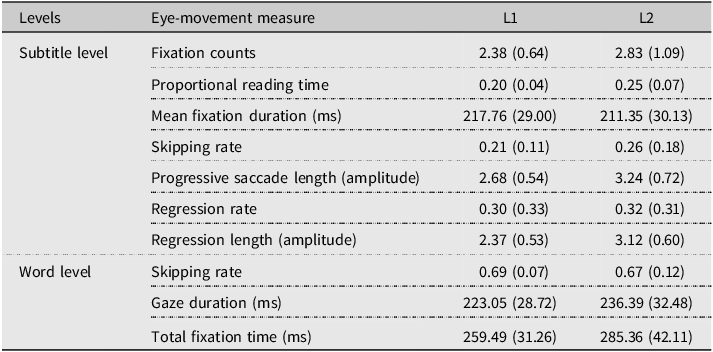
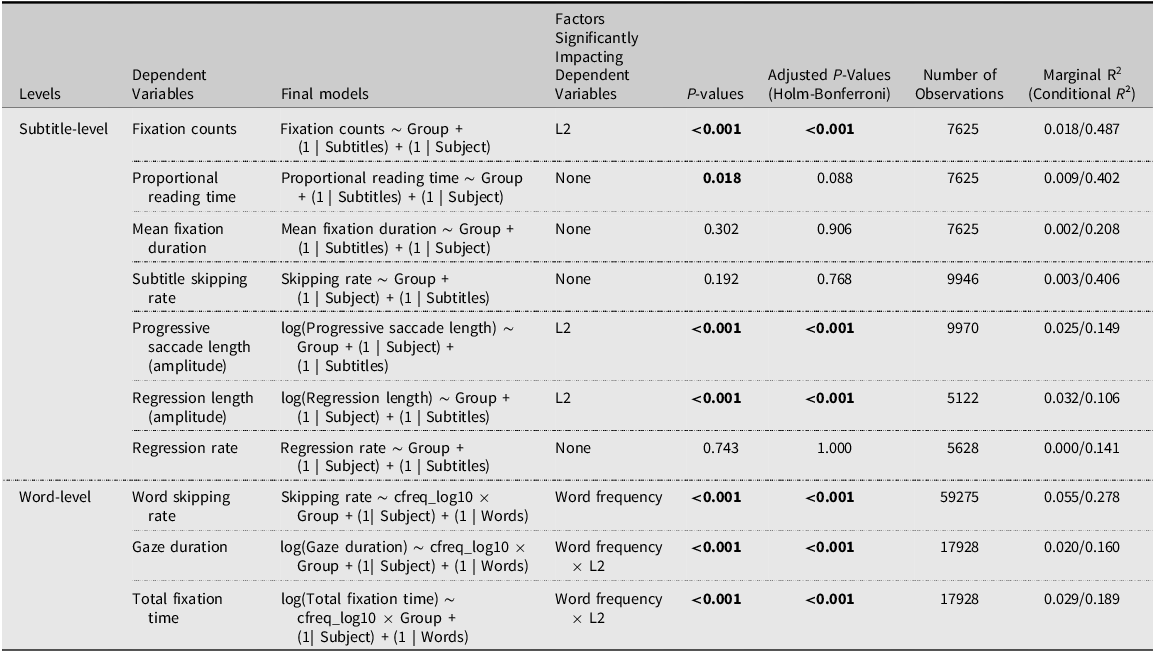
On average, each participant encountered 95.63 subtitles (SD = 7.85), which totaled around 608.37 words (SD = 51.87) during the gameplay. Fixation durations shorter than 60 ms or longer than 800 ms were removed from analyses to ensure the gazes were meaningful in reading (Eskenazi, Reference Eskenazi2024; Negi & Mitra, Reference Negi and Mitra2020). There were no significant differences in NASA-TLX cognitive load between L1 and L2 groups, either overall or on any subscales (ps ≥ 0.1). Descriptive statistics of subtitle-level and word-level eye movement measures between the two groups are shown in Table 1. The results of the analysis for each eye-movement measure are presented in Table 2. The reported p-values below were adjusted with the Holm-Bonferroni correction to control the family-wise error rate (Von der Malsburg & Angele, Reference Von der Malsburg and Angele2017).
Descriptive statistics of sentence-level and word-level eye-movement measures (L1 vs. L2)

Table 1. Long description
A table comparing eye-movement measures at subtitle and word levels for two language groups, L1 and L2. The table has two main sections: subtitle level and word level, each with various eye-movement measures. The subtitle level includes fixation counts, proportional reading time, mean fixation duration, skipping rate, progressive saccade length, regression rate, and regression length. The word level includes skipping rate, gaze duration, and total fixation time. Each measure is presented with values for L1 and L2, along with standard deviations in parentheses. Row 1: Fixation counts, L1: 2.38 (0.64), L2: 2.83 (1.09). Row 2: Proportional reading time, L1: 0.20 (0.04), L2: 0.25 (0.07). Row 3: Mean fixation duration (ms), L1: 217.76 (29.00), L2: 211.35 (30.13). Row 4: Skipping rate, L1: 0.21 (0.11), L2: 0.26 (0.18). Row 5: Progressive saccade length (amplitude), L1: 2.68 (0.54), L2: 3.24 (0.72). Row 6: Regression rate, L1: 0.30 (0.33), L2: 0.32 (0.31). Row 7: Regression length (amplitude), L1: 2.37 (0.53), L2: 3.12 (0.60). Row 8: Skipping rate, L1: 0.69 (0.07), L2: 0.67 (0.12). Row 9: Gaze duration (ms), L1: 223.05 (28.72), L2: 236.39 (32.48). Row 10: Total fixation time (ms), L1: 259.49 (31.26), L2: 285.36 (42.11).
Note: Values represent means, with standard deviations in parentheses.
Summary of G/LMMs and major impact factors on L1 versus L2 subtitle reading (reference level: L1)

Table 2. Long description
A table summarizing the factors significantly impacting dependent variables in subtitle and word-level eye movement measures. The table is divided into two main sections: Subtitle-level and Word-level. Each section lists dependent variables, final models, factors significantly impacting the dependent variables, P-values, adjusted P-values (Holm-Bonferroni), number of observations, and marginal R-squared (conditional R-squared). The Subtitle-level section includes rows for fixation counts, proportional reading time, mean fixation duration, subtitle skipping rate, progressive saccade length (amplitude), and regression length (amplitude). The Word-level section includes rows for word skipping rate, gaze duration, and total fixation time. Each row provides detailed information on the factors and their statistical significance. For example, fixation counts are modeled by Group, Subtitles, and Subject, with L2 being a significant factor with P-values less than 0.001. Progressive saccade length and regression length also show significant impacts with P-values less than 0.001. Word skipping rate, gaze duration, and total fixation time are influenced by word frequency and other factors, all with P-values less than 0.001. The table provides a comprehensive overview of the statistical analysis of eye movement measures during subtitle reading.
Note: Significant main effects of word frequency (ps < 0.001) were also observed for gaze duration and total viewing time at the word level. No main effect of language background was observed in word skipping (p = 0.543). As these effects were qualified by a significant word frequency × language background score interaction, only the interaction effects are reported in Table 2. Bold values indicate statistical significance at p < 0.05.
Subtitle-level eye-movement measures
Fixation-related measures. Linear mixed effects models showed that the two groups did not differ in proportional reading time (estimate = 0.133, 95% CI [0.025, 0.241], p = 0.088) and mean fixation duration (estimate = −0.026, 95% CI [−0.076, 0.023], p = 0.906). A generalized linear mixed model (with a Poisson distribution) showed that participants in the L2 group made significantly higher fixation counts than those in the L1 group (estimate = 0.200, 95% CI [0.107, 0.293], p < 0.001).
Saccade-related measures. The L2 players had significantly larger progressive saccade amplitudes than L1 players (estimate = 0.168, 95% CI [0.092, 0.244], p < 0.001) and larger regressive saccade amplitudes (estimate = 0.229, 95% CI [0.152, 0.307], p < 0.001). In contrast, there was no significant difference between the two groups in regression rate (estimate = 0.027, 95% CI [−0.135, 0.189], p = 1.000) or subtitle skipping rate (estimate = 0.254, 95% CI [−0.127, 0.636], p = 0.768).
In sum, integrating the fixation and saccade-related findings, L2 players showed a distinctive pattern of subtitle processing compared with L1 players during gameplay. L2 players had significantly higher fixation counts on subtitles, indicating greater reliance on subtitle information. It could also indicate more effortful subtitle reading in L2 players than in L1 players. They also produced significantly larger progressive and regressive saccade amplitudes, suggesting more extensive scanning of subtitle text. Together, these patterns indicate that L2 players sampled subtitle content more widely and frequently, reflecting greater processing effort during subtitle reading in gameplay.
Word-level eye-movement measures
The word skipping rate did not differ significantly between the two language groups (p = 0.543) or the interaction between word frequency and language group (p = 1.000). A significant main effect of word frequency was found in both word skipping rate and gaze duration. For word skipping, higher-frequency words were skipped more often (estimate = 0.503, 95% CI [0.474, 0.532], p < 0.001).
Gaze duration and total fixation time were used to examine how L1 and L2 process subtitles on different stages of linguistic processing, with gaze durations reflecting early stages and total fixation time reflecting relatively late stages of linguistic processing in subtitle reading (Liao et al., Reference Liao, Yu, Kruger and Reichle2022). For gaze duration, higher-frequency words (vs. lower-frequency words) received shorter fixation durations (estimate = −0.037, 95% CI [−0.045, −0.030], p < 0.001). No significant main effect of language group was found for gaze duration (estimate = 0.039, 95% CI [−0.009, 0.086], p = 0.121). However, the interaction between word frequency and language group was significant in gaze duration, indicating that the magnitude of word frequency effect (i.e., the lower-frequency words elicited longer gaze duration than the higher-frequency words) was larger in L2 players than in L1 players (estimate = −0.040, 95% CI [−0.052, −0.028], p < 0.001).
For total fixation time, a significant main effect of word frequency was found, where higher-frequency words had shorter total fixation durations (estimate = −0.054, 95% CI [−0.064, −0.045], p < 0.001). Unlike gaze duration, the main effect of language group was significant (estimate = 0.069, 95% CI [0.015, 0.122], p = 0.012), with L2 players showing longer total fixation times than L1 players. The interaction between word frequency and language group was also significant, indicating that the magnitude of the word frequency effect (i.e., the lower-frequency words elicited longer total fixation time than the higher-frequency words) was larger in L2 players than in L1 players (estimate = −0.045, 95% CI [−0.059, −0.032], p < 0.001).
In sum, L2 players show a stronger sensitivity to word frequency than L1 players at both early lexical processing and more delayed post-lexical processing stages. As indicated by the slope differences between the L1 and L2 groups, L2 players showed a larger increase in gaze duration and total fixation time per word for the lower-frequency words (see Figure 3). These word-level effects further suggest that linguistic constraints in L2 players at least partly contribute to their subtitle-level reading patterns.
Gaze duration and total fixation duration using LMMs. The shaded ribbons indicate the 5% lower and 95% upper confidence intervals for the estimated marginal means.

Figure 3. Long description
Two line graphs depict gaze duration and total fixation time against Zipf frequency for two groups, L1 and L2. Panel A: The line graph shows gaze duration in milliseconds on the vertical axis and Zipf frequency on the horizontal axis. Two groups, L1 and L2, are represented by different symbols: circles for L1 and triangles for L2. The gaze duration decreases as Zipf frequency increases for both groups, with L2 having generally higher gaze durations than L1. The shaded ribbons indicate the 5% lower and 95% upper confidence intervals for the estimated marginal means. Panel B: The line graph shows total fixation time in milliseconds on the vertical axis and Zipf frequency on the horizontal axis. Similar to Panel A, two groups, L1 and L2, are represented by circles and triangles, respectively. The total fixation time also decreases as Zipf frequency increases for both groups, with L2 having generally higher total fixation times than L1. The shaded ribbons again indicate the 5% lower and 95% upper confidence intervals for the estimated marginal means.
Exploratory analysis on L2 proficiency
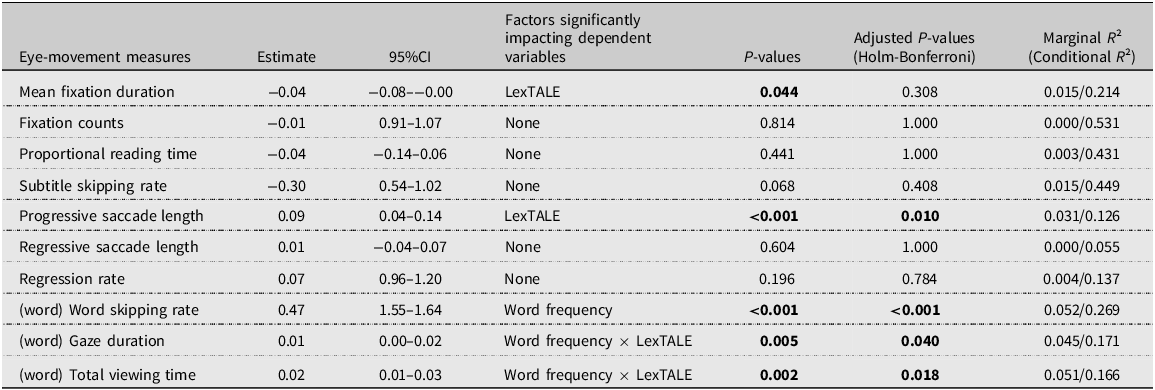
The current study aimed to compare L1 and L2 players’ subtitle-reading behavior during gameplay. Although participants were all international students from universities in the same area, the L2 participants’ LexTALE scores, as a quick check on L2 vocabulary size, unexpectedly showed considerable variation during data collection. As the L1 players were not required to complete the LexTALE test in the original experiment design, we thus conducted a post-hoc exploratory analysis to assess whether proficiency-related differences existed within the L2 group. LexTALE was used as a continuous variable and scaled before being put into the G(L)MMs. If necessary, the scaled scores were log-transformed to improve model fit. Holm–Bonferroni correction was applied to the p-values. The results are summarized in Table 3.
Summary of G/LMMs for within-L2 differences in subtitle reading by LexTALE scores

Table 3. Long description
A table summarizing the results of G/LMMs for within-L2 differences in subtitle reading by LexTALE scores. The table has 10 rows and 7 columns. The columns are labeled as Eye-movement measures, Estimate, 95%CI, Factors significantly impacting dependent variables, P-values, Adjusted P-values (Holm-Bonferroni), and Marginal R^2 (Conditional R^2). The rows list different eye-movement measures such as Mean fixation duration, Fixation counts, Proportional reading time, Subtitle skipping rate, Progressive saccade length, Regressive saccade length, Regression rate, (word) Word skipping rate, (word) Gaze duration, and (word) Total viewing time. Each row provides the estimate, 95% confidence interval, factors significantly impacting the dependent variables, P-values, adjusted P-values, and marginal R^2 values for each eye-movement measure. Notable trends include significant factors like LexTALE and Word frequency impacting various eye-movement measures, with corresponding P-values and adjusted P-values indicating the significance of these factors.
Note: The same model structure as in the main L1–L2 comparison was used to ensure comparability across analyses. Significant main effects of word frequency (ps < 0.001) and LexTALE score (ps = 0.001) were also observed for gaze duration and total viewing time at the word level. However, as these effects were qualified by a significant word frequency × LexTALE score interaction, only the interaction effects are reported in Table 3. Bold values indicate statistical significance at p < 0.05.
As shown in Table 3, the exploratory analyses revealed two main findings. First, the subtitle-level effects within the L2 cohort were limited overall, with a significant effect emerging only for progressive saccade length. This isolated effect should therefore be interpreted with caution, as eye-movement measures are best understood as part of a broader pattern rather than in isolation. Second, robust word-level effects were observed within the L2 cohort. Word frequency effect was significantly observed in all three word-level measures, and the word frequency effect interacted significantly with LexTALE score at gaze duration and total viewing time. Lower-frequency words elicited longer viewing times than higher-frequency words, and this frequency effect was stronger among L2 players with lower LexTALE scores than among L2 players with higher LexTALE scores.
Importantly, the direction of the word-level effects within the L2 cohort was consistent with the overall L1-L2 comparison. The broader L1-L2 analysis suggested that L2 players engaged more deeply and more effortfully with subtitles than L1 players, as reflected in higher fixation counts and longer forward and backward saccades. The exploratory analysis within the L2 cohort further suggested that the greater processing effort was most pronounced among L2 players with lower proficiency. Taken together, these findings indicated that subtitle processing in gameplay may be modulated both by language background and L2 proficiency. The findings tentatively suggested that, compared with L1 players, L2 players appeared to rely more heavily on subtitle information, and within the L2 group, lower-proficiency players showed greater sensitivity to lexical processing difficulty.
Discussion
Although reading in noninteractive media has been widely studied, less is known about how players from different language backgrounds read text in interactive multimedia such as video games. This is important given its pedagogical potential for reading and language learning. The current study compared how L1 and L2 read subtitles in the tutorial chapter of a commercial video game. The main findings of the current study were twofold. First, compared with L1 players, L2 players showed broader and more frequent textual information sampling at the subtitle level, as reflected in higher fixation counts and longer forward/backward saccade lengths. Second, the word frequency effect was stronger among L2 players than L1 players. The subtitle-level and word-level results suggest more effortful and in-depth lexical processing in the L2 group. The exploratory analysis further showed that L2 proficiency modulated word-level processing. Similar to noninteractive reading, language background and L2 proficiency both impact subtitle processing in video games. The following sections discuss the main findings in terms of language background and multimodal processing, L2 proficiency, task demand in interactive media, and individual variance.
Role of language background and multimodal processing
Prior work in noninteractive reading paradigms has consistently shown that L2 readers adopt more sustained and effortful reading strategies to compensate for the linguistic constraints. Such reading strategies are characterized by longer fixation duration, higher fixation counts, smaller saccades, and more regressions (Conklin et al., Reference Conklin, Alotaibi, Pellicer-Sánchez and Vilkaitė-Lozdienė2020; Dirix et al., Reference Dirix, Vander Beken, De Bruyne, Brysbaert and Duyck2020; Nisbet et al., Reference Nisbet, Bertram, Erlinghagen, Pieczykolan and Kuperman2022; Szarkowska et al., Reference Szarkowska, Ragni, Szkriba, Orrego-Carmona and Black2025). The L2 reading pattern in the current study partly replicated the previous findings. In the current study, L2 players had higher fixation counts and longer progressive and regressive saccades. Together, these two features suggest that L2 players adopted a broader and more frequent sampling of textual information under time constraints, reflecting a stronger reliance on textual cues than L1 players.
Interpreting the similarities and differences between the current findings and prior studies echoes two central issues raised in the Introduction. First, whether L2 players had experienced greater processing effort than L1 players. Second, whether such processing effort disrupts players from subtitle reading or supports deeper engagement, especially for L2 players. The current findings suggest that the two accounts were not completely exclusive.
L2 players had greater processing effort in gameplay
L2 players appeared to experience greater processing effort than L1 players. L2 players had higher fixation counts at the subtitle level. The external conditions and intrinsic features of the readers influence how readers interpret the task demand and regulate their reading strategies (Britt et al., Reference Britt, Durik and Rouet2022; Rouet et al., Reference Rouet, Britt and Durik2017). In the present study, the gameplay environment intensified processing effort as players had to process subtitles alongside dynamic visual scenes, auditory information, and manual control requirements under time constraints. Such multimodal processing imposes intrinsic, extraneous, and germane cognitive load (Mayer, Reference Mayer2005; Sweller, Reference Sweller1988, Reference Sweller2011). Given that working memory has limited capacity (Baddeley & Hitch, Reference Baddeley, Hitch and Bower1974; Hitch et al., Reference Hitch, Allen and Baddeley2025), L2 players may have needed to devote more attentional resources to subtitle processing than L1 players. Therefore, the higher subtitle-level fixation counts among L2 players provide evidence of greater processing effort in managing subtitles within a cognitively demanding multimodal environment.
At the word level, L2 players also showed eye-movement patterns more typically associated with greater processing effort in noninteractive reading media than L1 players. Specifically, L2 players had lower word skipping rates, longer gaze durations, and longer total viewing time. The interaction between the word frequency and word fixation durations further suggests that linguistic constraints imposed additional processing effort on word processing in subtitles. This is consistent with prior work where L2 readers showed a stronger word frequency effect than L1 readers in paragraph reading on monomodal screens (Whitford & Titone, Reference Whitford and Titone2012). It could be due to the processing effort imposed by linguistic representations (Clahsen & Felser, Reference Clahsen and Felser2006), such as the quantitatively reduced parafoveal word processing during reading (Fernandez & Allen, Reference Fernandez and Allen2025).
Greater processing effort: a source of disruption or deeper engagement with subtitle reading
Greater processing effort is probably a resource for deeper engagement with subtitle reading in L2 players. The deeper engagement can lead to better content comprehension for L2 readers (Hulstijn & Laufer, Reference Hulstijn and Laufer2001; Mayer, Reference Mayer2005; Robinson, Reference Robinson1995, Reference Robinson2001; Sweller, Reference Sweller1988, Reference Sweller2011). The higher fixation counts and longer progressive and regressive saccades on subtitle reading in L2 players indicated more frequent and wider spatial sampling of textual information. This information extraction pattern suggested that L2 players had a stronger reliance on textual cues than L1 players and engaged more actively and deeply with subtitles. This active engagement echoes previous findings that L2 readers rely more on contextual cues than L1 readers when processing sentences (Clahsen & Felser, Reference Clahsen and Felser2006, Reference Clahsen and Felser2018; Huck et al., Reference Huck, Thompson, Cruice and Marshall2017; Kosaka, Reference Kosaka2024; Mor & Prior, Reference Mor and Prior2022; Mu, Reference Mu2024). The word-level analysis can also support the interpretation of deeper engagement due to greater processing effort, as shown by a lower word skipping rate and longer fixation durations in L2 players.
The current findings differ from the eye-movement patterns reported in previous studies. This may indicate that increased re-reading is not a prioritized strategy for deeper engagement. For L1 players, the coping strategy could be offloading more visual load onto the auditory channel. For L2 players, active processing was instead reflected in more frequent fixations and wider-ranging saccadic sampling of subtitles.
The possibility of disruption caused by greater processing effort cannot be completely excluded. This is because subtitle skipping rate and regression rate did not differ between the L1 and L2 groups, suggesting the universal attentional trade-offs under the processing effort of gameplay. Players may limit re-reading and maintain a relatively stable level of subtitle skipping to allocate attention to other multimodal information. This could reflect that reading was constantly disrupted in gameplay.
Taken together, L2 players in the current study adopted a more frequent and extensive sampling of textual information. It could also indicate that L2 players had greater reliance on subtitles for content comprehension and task completion than L1 players. In sum, reading is a complex activity that may involve multiple metacognitive processes simultaneously, while greater processing effort may help L2 players to read subtitles more frequently and deeply.
Role of L2 proficiency
Our exploratory analysis within the L2 cohort further found that L2 proficiency appears to lead to considerable divergence in lexical processing. The interaction between word frequency effect and LexTALE score remained significant in gaze duration and total viewing time at the word level after Holm–Bonferroni correction, suggesting that lower-proficiency L2 players gaze longer on the lower-frequency words. The direction of the word-level effect within the L2 cohort was consistent with the overall L1-L2 comparison. Thus, our findings may support the view that vocabulary learning remains fundamental for improving linguistic knowledge (Calafato & Clausen, Reference Calafato and Clausen2024; Pan et al., Reference Pan, Nakayama, McBride, Cheah, Zheng and Yeung2023; Pujadas & Muñoz, Reference Pujadas and Muñoz2024; Zou et al., Reference Zou, Huang and Xie2021).
Role of reading media
No main effect of language background was found in subtitle skipping rate or word skipping rate. The subtitle skipping rate was 0.21 for L1 players and 0.26 for L2 players, while the word skipping rate was 0.67 for L2 players and 0.69 for L1 players, which are substantially higher than the 30% word-skipping rate in the literature (Rayner, Reference Rayner2009; Rayner et al., Reference Rayner, Schotter, Masson, Potter and Treiman2016; Slattery & Yates, Reference Slattery and Yates2018). Specifically, the skipping rate is about 10% for long and unpredictable words, compared to around 36% for short and predictable ones in sentence reading (Rayner et al., Reference Rayner, Slattery, Drieghe and Liversedge2011) in monomodal and noninteractive reading. While reading subtitles in videos, the word skipping rate was around 30–50% at different subtitle speeds (Szarkowska et al., Reference Szarkowska, Ragni, Szkriba, Orrego-Carmona and Black2025). In contrast, the regression rate (the proportion of saccades moving backward relative to all saccades) found in the current study was 0.32 for L2 players and 0.30 for L1 players, which is also higher than the 5–20% regression rate observed in reading of static texts in monomodal and noninteractive contexts (Inhoff et al., Reference Inhoff, Kim and Radach2019; Rayner, Reference Rayner1998, Reference Rayner2009).
These relatively high skipping and regression rates should be interpreted cautiously, as most benchmark data come from monomodal and noninteractive reading. In gameplay, subtitles are presented in a dynamic, multimodal, and interactive environment, where players can obtain information from soundtracks, visual events, sound effects, and game feedback. Therefore, a higher skipping rate may not simply indicate poorer or more superficial reading. Instead, players may skip subtitles because they do not need to rely on in-game text alone when other semiotic resources provide overlapping or complementary information, or because they cannot complete subtitle reading when immediate responses are required. The high regression rate may suggest that subtitle processing was frequently interrupted, with players returning to earlier subtitle information when task conditions allowed.
Together, these patterns suggest that subtitle reading in gameplay is regulated by real-time task demand rather than by linguistic processing demand alone. Players’ self-perceived task demand may derive from multiple contextual factors in gameplay and guide their subtitle-reading behavior as they coordinate linguistic input with ongoing visual monitoring and action execution (Britt et al., Reference Britt, Durik and Rouet2022; Rouet et al., Reference Rouet, Britt and Durik2017). Under the limited capacity of working memory, such coordination creates attentional trade-offs among reading, perception, and motor response (Baddeley & Hitch, Reference Baddeley, Hitch and Bower1974; Baddeley et al., Reference Baddeley, Hitch and Allen2021; Cutting & Deterding, Reference Cutting and Deterding2022; Hitch et al., Reference Hitch, Allen and Baddeley2025; Sweller, Reference Sweller2011; von Gillern, Reference von Gillern2016).
Role of individual variance
Including participants and subtitles as random factors at the subtitle and word level greatly improved all models’ explanatory power (see Tables 2 and 3 for the marginal R-squared and conditional R-squared in the full models), again emphasizing the role of individual differences in reading across media. Besides language background and L2 proficiency, individual differences impacting reading may arise from other factors such as working memory capacities, metacognitive regularities, and gaming training.
Limitations
First, the present study used a commercial adventure video game as the experimental material. Such games create highly individualized player experiences and do not provide fixed criteria for assessing gaming performance or content comprehension. Therefore, it remains unclear how the subtitle-reading patterns of L1 and L2 players influence their performance and comprehension of game content. Future research could use more controlled research-based or education-oriented games to investigate these issues further.
Second, the LexTALE score was originally used only as a supplementary measure to describe variation within the L2 group. It was not treated as a predictor in the main mixed-effects models, as it is not our primary research question. Moreover, only L2 players completed the LexTALE test, as it was not designed to provide comparable proficiency scores for L1 speakers. The variation found during data collection was unexpected, as all L2 participants were enrolled international students who had met English-language university admission requirements. Future studies should use more comprehensive tests on language background and L2 proficiency.
Lastly, gaming experience was not included as a predictor or covariate. Unlike formal education, which typically involves systematic training, gaming experience is highly individualized. Our pilot data showed that years of gaming experience, gaming hours over the previous three months, and self-identified gamer type based on preferred game genres did not reliably predict eye-movement patterns in our selected video game.
Conclusion
The current study is conceptualized as video gaming is a popular entertainment and educational tool. Previous reading experiments show that L2 readers typically exhibit more effortful and restorative processing than L1 readers (e.g., more and longer fixations, shorter saccades, lower word-skipping rates, more regressions). The current study partly replicated the eye-movement patterns observed in the previous reading studies. In the current study, L2 players displayed a more extensive and in-depth strategic scanning pattern than L1 players, which may be partially due to linguistic limitations. This pattern was reflected in subtitle-level measures (i.e., a higher fixation count and longer progressive/regressive saccades) and word-level measures (i.e., stronger word-frequency effects in gaze duration and total viewing time). The current study helps address a gap in interactive reading and provides exploratory evidence beyond previous outcome-based studies for game-based reading.
Our findings also have practical implications for reading and learning in multimedia. Conventional multimedia learning design often aims to minimize unnecessary processing effort; the current findings suggest that not all processing effort in gameplay is detrimental. In commercial video games, subtitles are embedded in multimodal, contextualized, and goal-directed activities. Under these conditions, a moderate level of processing effort can promote deeper engagement with subtitle reading, particularly in L2 players. This indicates that video games may offer interactive reading environments in which language learners process in-game text through analysis, reasoning, and goal-directed problem solving. From the task complexity perspective (Robinson, Reference Robinson2001), such cognitively demanding tasks can encourage players to allocate attention to meaning, form, and task goals simultaneously, potentially supporting deeper language processing and internalizing language skills.
Replication package
All data, supplementary materials, and analysis code for this study are available at the first author’s Open Science Framework repository https://doi.org/10.17605/OSF.IO/AGJRY.
Competing interests
The authors declare that there is no conflict of interest concerning the authorship or the publication of this article.
Ethics statement
This study was approved by Macquarie University Human Research Ethics Committee (ethics approval number: 52024645755523).




 Open access

