Children from migrant families need to acquire oral language skills in the majority language (their second language; L2) as a foundation for literacy skills, academic achievement, and social inclusion more broadly (Clarke, Snowling, Truelove, & Hulme, Reference Clarke, Snowling, Truelove and Hulme2010; National Academies of Sciences, Engineering, and Medicine, 2017; Whiteside, Gooch, & Norbury, Reference Whiteside, Gooch and Norbury2017). In addition, these children should continue to develop their first/heritage language (L1) because of the psychosocial and cultural benefits for identity and family relationships and because their L1 abilities can form a foundation for their L2 learning and additive bilingualism (Cummins, Reference Cummins2000; Extra & Yagmur, Reference Extra and Yagmur2010; Jia, Reference Jia, He and Xiao2008; Oh & Fuligni, Reference Oh and Fuligni2010; Tseng & Fuligni, Reference Tseng and Fuligni2000). Much research has shown that home language environment factors are determinants of bilingual children’s acquisition of their L2, as well as maintenance of their heritage L1.
Between 2015 and 2018, 58,650 refugees from Syria arrived in Canada, and the majority are children and youth, as most have migrated in family groups (Immigration, Refugees and Citizenship Canada, 2018; Statistics Canada, 2019). More than half are government-assisted refugee families, meaning UNHCR convention refugees, with the next biggest group being privately sponsored refugees (Korntheuer, Maehler, & Pritchard, Reference Korntheuer, Maehler and Pritchard2017). Refugee children, especially those fleeing conflict, can have adverse premigration experiences, for example, interrupted schooling, witnessing violence, and time in refugee camps. Refugee children and youth face challenges in the education system and in societal integration more generally due to adverse pre- and postmigration factors (Hadfield, Ostrowski, & Ungar, Reference Hadfield, Ostrowski and Ungar2017; Kanu, Reference Kanu2008; MacNevin, Reference MacNevin2012). Furthermore, the recently arrived Syrian families tend to be larger, to have less well-educated parents, to have lower fluency in English, and to be less likely employed when compared with other refugee groups who have migrated to Canada (Statistics Canada, 2019). These distinct characteristics of Syrian refugee children and families could influence their home language environments, and in turn, their language learning (cf. Prevoo et al., Reference Prevoo, Malda, Mesman, Emmen, Yeniad, van Ijzendoorn and Linting2014).
In spite of their distinct characteristics, there is very little research focussed on bilingual development specifically in recently arrived children from refugee backgrounds. Studies on the impact of language environment factors on bilingual development typically group children from families with diverse migration and residency backgrounds together, for example, studies might include refugee and skills-based immigrant families, families with long and short residency in the host country, and parents who are first and second generation (e.g., Chondrogianni & Marinis, Reference Chondrogianni and Marinis2011; Hammer et al., Reference Hammer, Komaroff, Rodriguez, Lopez, Scarpino and Goldstein2012; Paradis, Reference Paradis2011; Place & Hoff, Reference Place and Hoff2016; Prevoo et al., Reference Prevoo, Malda, Mesman, Emmen, Yeniad, van Ijzendoorn and Linting2014; Sorenson Duncan & Paradis, Reference Sorenson Duncan and Paradis2020a). In the Canadian context, economic immigrants undergo a separate selection process from refugees: the former is a competitive process based on skills, education, and resources and the latter is a process based on humanitarian concerns. Furthermore, the bulk of research on language environment and bilingual development has been conducted with young children, mainly 3–8 years old, (e.g., Pham & Tipton, Reference Pham and Tipton2018; Place & Hoff, Reference Place and Hoff2016; Prevoo et al., Reference Prevoo, Malda, Mesman, Emmen, Yeniad, van Ijzendoorn and Linting2014; Sorenson Duncan & Paradis, Reference Sorenson Duncan and Paradis2020a) and research with older bilingual children and youth focuses mainly on those with longer residency and who have had most or all their education in the host country (e.g., Bayram et al., Reference Bayram, Rothman, Iverson, Kupisch, Miller, Puig-Mayenco and Westergaard2017; Flores, Santos, Jesus, & Marques, Reference Flores, Santos, Jesus and Marques2017; Kaltsa, Prentza, & Tsimpli, Reference Kaltsa, Prentza and Tsimpli2019; except see Jia & Aaronson, Reference Jia and Aaronson2003 and Jia & Fuse, Reference Jia and Fuse2007). Syrian families have recently migrated to Canada as refugees with children and youth of various ages. These families include older children and youth who are beginner learners of English, as well as parents who might not possess the cultural capital and resources of economic immigrants and/or families who have resided longer in Canada. In sum, existing research is insufficient for informing our expectations of the language environments and bilingual development of the thousands of Syrian refugee children who have recently arrived in Canada and elsewhere.
Accordingly, the objectives of this study were as follows: (a) to examine the language environments and the English and Arabic lexical and morphological development of children from Syrian refugee families at the early stage of their settlement in Canada, and (b) to determine how language environment factors shape children’s English and Arabic development at this early stage, in addition to factors such as, age, amount of schooling, and cognitive capacity.
Language Environment and Bilingual Development
It is widely understood that more input in the L1 and L2, particularly at school, is related to greater proficiency in the L1 and the L2 for bilingual children (Chondrogianni & Marinis, Reference Chondrogianni and Marinis2011; Hammer et al., Reference Hammer, Komaroff, Rodriguez, Lopez, Scarpino and Goldstein2012; Oller & Eilers, Reference Oller and Eilers2002; Paradis, Reference Paradis2011; Paradis, Rusk, Sorensen Duncan, & Govindarajan, Reference Paradis, Rusk, Sorenson Duncan and Govindarajan2017; Pham & Tipton, Reference Pham and Tipton2018; Place & Hoff, Reference Place and Hoff2016; Prevoo et al., Reference Prevoo, Malda, Mesman, Emmen, Yeniad, van Ijzendoorn and Linting2014; Sorenson Duncan & Paradis, Reference Sorenson Duncan and Paradis2020a; Unsworth et al., Reference Unsworth, Argyri, Cornips, Hulk, Sorace and Tsimpli2014). More at issue is the differential impact of the sources and qualitative aspects of this input, such as language use with different interlocutors at home, richness of the L2 and L1 environment outside school, and parent factors like maternal L2 fluency and maternal education.
Relative use of L1 and L2 at home
In Paradis (Reference Paradis2011) and Paradis et al. (Reference Paradis, Rusk, Sorenson Duncan and Govindarajan2017), how much 4- to 7-year-old bilingual children from diverse L1 backgrounds heard and used their English L2 at home was not predictive of their L2 acquisition of vocabulary, morphology, and syntax, but amount of L2 exposure in school was a strong predictor. Quality differences between the English at school (native-speaker teacher and many native-speaker classmates; rich level of language being used; language input through reading) and at home (input from nonnative-speaker parents) was suggested as a reason. In these studies, aggregate scores were used to gauge total home input in the L2, and interlocutors at home might not all have had the same levels of proficiency in the L2. Input in the L2 from parents who are less fluent/not native speakers is less supportive of English L2 development than input from fluent/native English-speaking parents in preschool- and school-age children (Chondrogianni & Marinis, Reference Chondrogianni and Marinis2011; Hammer et al., Reference Hammer, Komaroff, Rodriguez, Lopez, Scarpino and Goldstein2012; Paradis, Reference Paradis2011; Place & Hoff, Reference Place and Hoff2016; Sorenson Duncan & Paradis, Reference Sorenson Duncan and Paradis2020a). In addition to qualitative properties of the input, interlocutor makes a difference. Bridges and Hoff (Reference Bridges and Hoff2014) found that older siblings spoke more in English to their toddler brothers and sisters than the parents in Spanish–English bilingual households. In a study with 224 Spanish–English kindergarteners, Rojas et al. (Reference Rojas, Iglesias, Bunta, Goldstein, Goldenberg and Reese2016) found that stronger English L2 expressive skills (MLUw and lexical diversity) were predicted by more interactions with siblings and peers (who used more English than parents). Similarly, Sorenson Duncan and Paradis (Reference Sorenson Duncan and Paradis2020b) found that L2 input-output with older siblings positively influenced lexical and morphosyntactic skills in 5-year-old English L2 learners from diverse L1 backgrounds, but there was limited evidence that L2 input-output from mothers had an effect.
Use of the L1 at home could be even more predictive of L1 development as bilingual children have access to the majority L2 in the community and at school, but more restricted access to the L1 outside the home. Several studies have found a positive relationship between more L1 input-output at home, and stronger abilities in the L1 for bilingual children (Altman, Burstain Feldman, Yitzhakim, Armon Lotem, & Watters, Reference Altman, Burstein Feldman, Yitzhaki, Armon Lotem and Walters2014; Flores et al., Reference Flores, Santos, Jesus and Marques2017; Hammer et al., Reference Hammer, Komaroff, Rodriguez, Lopez, Scarpino and Goldstein2012; Pham & Tipton, Reference Pham and Tipton2018; Place & Hoff, Reference Place and Hoff2016; Prevoo et al., Reference Prevoo, Malda, Mesman, Emmen, Yeniad, van Ijzendoorn and Linting2014; Rojas et al., Reference Rojas, Iglesias, Bunta, Goldstein, Goldenberg and Reese2016; Sorenson Duncan & Paradis, Reference Sorenson Duncan and Paradis2020a). Hammer et al. (Reference Hammer, Komaroff, Rodriguez, Lopez, Scarpino and Goldstein2012) found fathers’ language use to have separate effects than mother’s language use; specifically, children of fathers who used less English with them had superior Spanish abilities. Altman et al. (Reference Altman, Burstein Feldman, Yitzhaki, Armon Lotem and Walters2014) found that pro-Russian family language policies led to superior Russian skills in Russian–Hebrew children in Israel; however, regardless of family language policy, parents and children spoke more Russian with each other, and siblings spoke more Hebrew with each other. Rojas et al. (Reference Rojas, Iglesias, Bunta, Goldstein, Goldenberg and Reese2016) found the mirror image of their results for English in Spanish: interactions with siblings and peers had negative effects on children’s L1 Spanish expressive skills in kindergarten (presumably because these are happening in English). Language use among siblings can have long-term effects on the L1 beyond these early years. Flores et al. (Reference Flores, Santos, Jesus and Marques2017) reported that, among Portuguese–German bilinguals in Germany aged 6–16 years, first borns had stronger Portuguese skills than later borns, a pattern attributed to the families’ long-term residency in the host country where older siblings bring the L2 into the home through schooling. Studies of Arabic–English and Mandarin–English young adults in the United States showed that stronger Arabic and Mandarin skills were predicted by participants using Arabic and Mandarin more frequently with more interlocutors, especially family, over time (Albirini, Reference Albirini2014; Jia, Reference Jia, He and Xiao2008).
Because the Syrian families who have recently arrived in Canada tend to be large, opportunities for sibling interaction is greater than in some existing studies. Therefore, we examined relative use of the L1 and L2 at home separated by younger and older siblings and parents in this study.
Richness of the language environment
Researchers have also examined the richness of children’s home language environments beyond use of the L1 and L2 in conversations among family members. Richness refers to the amount of diverse and complex input and output children experience, for example, the frequency of children’s engagement in L2 print and audiovisual media, extracurricular activities in the L2 and socializing with friends in the L2. Studies including a composite richness variable have shown this to positively promote stronger L2 vocabulary, morphology, syntax, and narrative skills (Govindarajan & Paradis, Reference Govindarajan and Paradis2019; Jia & Aaronson, Reference Jia and Aaronson2003; Jia & Fuse, Reference Jia and Fuse2007; Paradis, Reference Paradis2011; Paradis et al., Reference Paradis, Rusk, Sorenson Duncan and Govindarajan2017). Jia and Aaronson (Reference Jia and Aaronson2003) is particularly relevant to our study because it included children aged 5–16 at arrival and followed them for 3 years. The richness of the L2 environment increased over this time, but more so for the child versus youth arrivals; for the latter, preference for the L1 and a richer L1 environment outside school persisted longer. Jia and Fuse (Reference Jia and Fuse2007) found that, after 5 years of residency for the same participants, richness of the L2 environment predicted more variance in L2 outcomes than age of arrival. Regarding home literacy practices in particular, Prevoo et al. (Reference Prevoo, Malda, Mesman, Emmen, Yeniad, van Ijzendoorn and Linting2014) found that reading in Dutch increased the Dutch vocabulary of Turkish–Dutch 5- and 6-year-olds. Kaltsa et al. (Reference Kaltsa, Prentza and Tsimpli2019) found that language and frequency of early and current home literacy practices in Greek had a positive impact on 8- to 10-year-old Albanian children’s syntactic abilities in their Greek L2.
Like language use with family members, richness of the L1 environment is possibly more vital to the acquisition of the heritage language than to the L2 because it is a minority language (Jia, Reference Jia, He and Xiao2008). Jia and Aaronson (Reference Jia and Aaronson2003) found richness of the L1 environment to correlate with parents’ report on child and youth L1 proficiency. Greater frequency in an average week of media, extracurricular activities, and socializing in Mandarin was associated with stronger Mandarin narrative abilities in bilingual children in Canada (Jia & Paradis, Reference Jia and Paradis2015). Pham and Tipton (Reference Pham and Tipton2018) found a positive association between L1 richness at home and L1 vocabulary in 5- to 8-year-old Vietnamese–English children in the United States. Access to schooling and/or having literacy in the L1 can be considered a component of L1 richness, and adult retrospective studies have found that being literate in the L1 and having access to written media in the L1 promotes long-term maintenance (Albirini, Reference Albirini2014; Jia, Reference Jia, He and Xiao2008). Bayram et al. (Reference Bayram, Rothman, Iverson, Kupisch, Miller, Puig-Mayenco and Westergaard2017) found that being literate in Turkish predicted stronger abilities with Turkish complex syntax (passives) in Turkish–German bilingual youth in Germany.
Most previous studies have not focussed specifically on children from recently arrived families who are coping with transitions and have limited financial resources, so examining the role of language environment richness in Syrian families would contribute uniquely to understanding the role of this factor at the early stages of L2 development and L1 maintenance.
Maternal education
Maternal education is associated with greater quantity and quality of linguistic input to children, and indexes family environment and cultural capital more broadly; therefore, it has been found be a robust predictor of children’s linguistic growth (Hoff, Reference Hoff2006; Prevoo et al., Reference Prevoo, Malda, Mesman, Emmen, Yeniad, van Ijzendoorn and Linting2014). Higher maternal education is associated with greater proficiency in English among Spanish–English preschoolers (Hammer et al., Reference Hammer, Komaroff, Rodriguez, Lopez, Scarpino and Goldstein2012; Place & Hoff, Reference Place and Hoff2016; Rojas et al., Reference Rojas, Iglesias, Bunta, Goldstein, Goldenberg and Reese2016). Golberg, Paradis, and Crago (Reference Golberg, Paradis and Crago2008) found that higher maternal education predicted larger L2 vocabularies across five time points in a 2-year longitudinal study on school age, English L2 children with diverse L1 backgrounds. Sorenson Duncan and Paradis (Reference Sorenson Duncan and Paradis2020a) found that maternal education levels were associated with higher English L2 fluency and this, in turn, was associated with stronger English L2 morphosyntax in 5-year-old children from diverse L1 backgrounds. Prevoo et al. (Reference Prevoo, Malda, Mesman, Emmen, Yeniad, van Ijzendoorn and Linting2014) found that mothers of Turkish–Dutch bilingual children with higher levels of education provided more reading input in Dutch to their children and had more books in the home, and this in turn, boosted children’s Dutch vocabulary. Most mothers had received all their education in Dutch.
In contrast, the connection between maternal education levels and bilingual children’s L1 development has produced conflicting findings. There was no evidence for an impact of maternal education on the L1 (but there was on the L2) in Place and Hoff (Reference Place and Hoff2016), Prevoo et al. (Reference Prevoo, Malda, Mesman, Emmen, Yeniad, van Ijzendoorn and Linting2014), and Rojas et al. (Reference Rojas, Iglesias, Bunta, Goldstein, Goldenberg and Reese2016). In contrast, Jia and Paradis (Reference Jia and Paradis2015) found that higher maternal education predicted stronger Mandarin skills. Sorenson Duncan and Paradis (Reference Sorenson Duncan and Paradis2020a) reported that mothers who received their education mainly in the L1 used more L1 with their children, and in turn, use of more L1 was associated with great L1 proficiency. Thus, the impact of maternal education on L1 abilities seemed to be mediated by the association between language of education and language choice (Prevoo et al., Reference Prevoo, Malda, Mesman, Emmen, Yeniad, van Ijzendoorn and Linting2014).
Because the Syrian families in this study have recently arrived in Canada, it is possible that maternal education would have impact on the L1 as well as the L2 because the impact on the L1 would have accumulated over time in a functionally monolingual environment. Furthermore, previous research on monolinguals and bilinguals tends to look at maternal education only, but for the Syrian families, fathers might be at home more because most families were receiving social assistance and parents had not yet integrated into the workforce. Therefore, we investigated L2 fluency and education effects of both fathers and mothers on children’s language.
Age, Cognitive Factors, and Bilingual Development
Not only language environment factors, but also child-internal factors, such as age of L2 acquisition onset (AOA) and cognitive capacities, influence bilingual development. Studies that have controlled for the amount of L2 input have shown that older AOA within the early childhood years is associated with more advanced L2 development in vocabulary and morphosyntax for children in L2-majority contexts (Chondrogianni & Marinis, Reference Chondrogianni and Marinis2011; Golberg et al., Reference Golberg, Paradis and Crago2008; Paradis, Reference Paradis2011), as well as for children in instructed L2 contexts (Rothman et al., Reference Rothman, Long, Iverson, Judy, Lingwall and Chakravarty2016). These researchers hypothesized that the older-learner advantage is likely due to beginning L2 acquisition with greater linguistic and cognitive maturity. However, Jia and Aaronson (Reference Jia and Aaronson2003) and Jia and Fuse (Reference Jia and Fuse2007), who included participants with AOAs ranging from 5 to 16 years, found that the older-learner advantage was not borne out over time and younger arrivals surpassed the older arrivals in L2 abilities after 5 years.
Regarding maintenance of the heritage L1, younger AOA children have had a shorter period of being functionally monolingual in the L1, which is a risk factor for variable attainment in the L1 long term (Jia, Reference Jia, He and Xiao2008; Montrul, Reference Montrul2016). Furthermore, younger heritage language children have had less exposure to the language than their older peers/siblings, and so age at testing is also an important factor (Flores et al., Reference Flores, Santos, Jesus and Marques2017). Older age and AOA were associated with stronger L1 narrative and complex syntax abilities in Mandarin L1–English L2 school-age children in Canada (Jia & Paradis, Reference Jia and Paradis2015, Reference Jia and Paradis2018). Flores et al. (Reference Flores, Santos, Jesus and Marques2017) also found that performance on a task measuring Portuguese morphosyntax in Portuguese–German children and youth increased with age. Finally, in a retrospective study with Mandarin–English bilingual adults in the United States, self-rated proficiency in Mandarin was related to AOA (Jia, Reference Jia, He and Xiao2008).
Aside from age, cognitive capacities that are implicated in language learning predict variation in children’s bilingual development. In Paradis (Reference Paradis2011) and Paradis et al. (Reference Paradis, Rusk, Sorenson Duncan and Govindarajan2017), both phonological short-term memory and nonverbal analytic reasoning were strong predictors of lexical, morphological, and syntactic abilities in children aged 4–7 with 1–3 years of learning English as an L2 in Canada. Pham and Tipton (Reference Pham and Tipton2018) found that phonological short-term memory predicted both English and Vietnamese vocabulary in bilingual children aged 5–8 years in the United States. Jia and Paradis (Reference Jia and Paradis2018) also found that individual differences in phonological short-term memory were associated with bilingual children’s syntactic abilities in L1 Mandarin.
Because the Syrian families in this study have children of various ages, understanding variance in bilingual development attributed to age factors needs to be considered. In addition, while refugee children are likely to have different language environments from other groups of bilingual children, there is no reason to assume their inherent cognitive capacities for language learning would be different.
The Present Study
With the objective of addressing the gap in existing research on bilingual acquisition in children from refugee backgrounds, this study examined the language environment and the lexical and morphological abilities in English and Arabic of recently arrived Syrian refugee children in Canada. This study reports Wave 1 data from an ongoing longitudinal study. The role of language environment factors, alongside age and cognitive factors, in shaping children’s L1 and L2 abilities at this early stage was our central focus. We included both a vocabulary and a grammar measure to assess whether these individual difference factors predicted separate linguistic subdomains in unique ways (cf. Paradis et al., Reference Paradis, Rusk, Sorenson Duncan and Govindarajan2017). Our specific research questions were
1. What are the characteristics of Syrian refugee children’s language environments? What is the relative use of L1 and L2 with parents and siblings? How frequently do children engage in language-rich activities in English and Arabic? What is the distribution of education levels among mothers and fathers and what is their L2 fluency? As newly arrived families with limited resources, our expectations were that the home language environment might include characteristics that pose challenges for supporting bilingual development.
2. To what extent do language environment, age, and cognitive factors determine individual differences in Arabic and English? Do the same factors predict lexical and morphological abilities? Do the same factors predict development in the L1 as in the L2? Based on the previous research reviewed above, we anticipated that environment, age, and cognitive factors would predict both lexical and morphological abilities, but not necessarily in the same way for the societal and the heritage language.
Method
Participants
One hundred and thirty-three children in 73 families from three Canadian cities (Edmonton, Toronto, and Waterloo) participated in this study. Children had a mean age of 9.36 years (SD = 1.96, range = 6–13) and 83.5% of the children in the study had siblings who also participated. The average number of children per family was 4.33 (SD = 1.44, range 2 to 8). All families were resettled in Canada as refugees in 2015–2017 and had a mean length of residency in Canada of 23.05 months (SD = 7.44; range = 2–37) at Wave 1. While we do not have a precise breakdown, the families were a mix of government assisted and privately sponsored refugees (for more details on these categories, see Korntheuer et al., Reference Korntheuer, Maehler and Pritchard2017). Government assisted refugees are UNHCR convention refugees selected on the basis of humanitarian concerns and this group often includes parents with relatively lower levels of education (cf. Statistics Canada, 2019). All families were Arabic-speaking, that is, no Kurdish- or Assyrian-speaking families. Children were attending English-medium schools and had approximately 2 years on average of English schooling at time of testing, ranging from kindergarten (first year of schooling in Canada) to Grade 7, with most children in Grades 3 and 4. Because of the civil war in Syria and their migration experience, many of the older children had their schooling in Arabic interrupted, and most of the younger ones had no opportunity to attend school in Arabic. Only 67.7% of children had any schooling before arriving in Canada and 34.6% had spent time in a refugee camp before their arrival.
Procedures
Children and their parents were either visited in their homes or at the children’s schools by two research assistants, one of whom spoke Arabic fluently. Parents were administered a questionnaire in Arabic, as an interview, to gather information on family demographics and the home language environment (Alberta Language Environment “Questionnaire”—4). Children’s English vocabulary and grammatical abilities were assessed through standardized measures administered by an assistant who spoke English fluently (Peabody Picture Vocabulary Test or the Test of Early Grammatical Impairment). Children’s Arabic vocabulary and grammatical abilities were also assessed through measures developed for the Levantine variety of Arabic administered by a fluent speaker of Levantine Arabic (Arabic Language Assessment Battery or Arabic Morphological Awareness). Finally, nonverbal analytic skills were measured using the Matrix Analogies Test.
Alberta Language Environment Questionnaire—4 (ALEQ-4, adapted from Paradis, Reference Paradis2011)
Parents were asked questions about the family’s premigration experiences, about their education background (including English training) and their self-rated fluency in English and use of English outside the home (5-point scale with descriptors; see Appendix A). Parents were also asked to indicate how much Arabic versus English they used with their children and which languages the children used with older and younger siblings (5-point scale with descriptors; see Appendix A). Language input to the child and language output from the child were assessed separately. Finally, parents were asked about the frequency with which their children engaged in language rich activities in English and Arabic in a given week (5-point scale with descriptors; see Appendix A). Activities included listening/speaking activities (television, YouTube, What’s App, and music), reading/writing activities (books, websites, and messaging), playing with friends, and extracurricular activities (homework clubs, sports, and religious activities). Individual rating scale scores were obtained and composite scores, estimating the richness of the English and Arabic environments, were calculated by adding the rating scale numbers and dividing by the total number of scales answered to generate a proportion score. The complete ALEQ-4 is available as part of the online-only Supplemental materials.
Peabody Picture Vocabulary Test (PPVT; Dunn & Dunn, Reference Dunn and Dunn2007)
Children were shown an array of four pictures and asked to point to the picture best matching the word given by the experimenter. Raw scores can be converted to standard scores for comparison with monolingual norms. The coefficient alpha of internal consistency for the PPVT for the age range tested is between .96 and .98.
Test of Early Grammatical Impairment (TEGI; Rice & Wexler, Reference Rice and Wexler2001)
Originally designed for use in a clinical setting, this test includes a subtest for accuracy with verbal inflection in English, an aspect of grammar that poses difficulty for English L2 learners (Chondrogianni & Marinis, Reference Chondrogianni and Marinis2011; Jia & Fuse, Reference Jia and Fuse2007; Paradis, Reference Paradis2011). Children were asked to produce sentences describing pictures to elicit the use of verbal suffixes. For third person singular [–s], children were asked questions like “What does a dentist do?” with expected answers like “A dentist cleans teeth” or “A dentist looks in your mouth” when viewing a picture of a dentist in an office. For past tense [–ed], children were shown pictures of an activity that was ongoing, followed by a picture with the activity completed. They were asked the following, “The boy is raking and now he is done. Tell me what he did,” with the expected answer, “The boy raked.” The reliability of this standardized test is measured through test–retest stability. The stability coefficient for the third person singular [–s] subtest is .92, and for past tense, .82.
Arabic Language Assessment Battery—Vocabulary subtest (ALAB; Assadi, Shany, Ibrahim, Khateb, & Ben Simone, Reference Assadi, Shany, Ibrahim, Khateb and Ben Simone2015)
Similar to the PPVT, children were asked to point at the picture of an array of four that best matched the word given by the experimenter. This test has no standardized monolingual norms and raw scores are on a different scale from the PPVT, so no direct comparisons can be made between the vocabulary tests. The ALAB is based on Levantine Arabic, which includes the varieties spoken in Syria. The Cronbach’s α index of reliability for this test was .90.
Arabic Morphological Awareness (AMA; Tibi, Reference Tibi2016)
Children read a stimulus word and were asked to indicate what words, from an array of four, were related to the stimulus word. The words included both inflectional and derivational morphological variants, reflecting the productive infix morphological patterns of Arabic. An example would be the word “funny.” Participants were asked to indicate which of the following four words (“laughter,” “became,” “he sacrifices,” and “they laugh”) were related to the first one. Note that “funny” shares the same root with “laughter” and “they laugh” in Arabic, and thus are related words. If children could not read in Arabic, the experimenter produced all the words aurally. The test is based on Levantine Arabic, which includes the varieties spoken in Syria. The AMA test has no standardized monolingual norms. The Cronbach’s α index of reliability for this test was .85.
Matrix Analogies Test (MAT; Naglieri, Reference Naglieri1985)
This test measures nonverbal analytical skills. Children were administered two subtests of the MAT: reasoning by analogy and spatial visualization. Both subtests asked the children to select the picture that best completed a matrix. As only two subtests were used, a standard score could not be computed. Instead, a compound raw score of the two tests was calculated to be used as a predictor. The Cronbach’s α coefficient of reliability for the compound scores was .87.
Results
Language environment characteristics
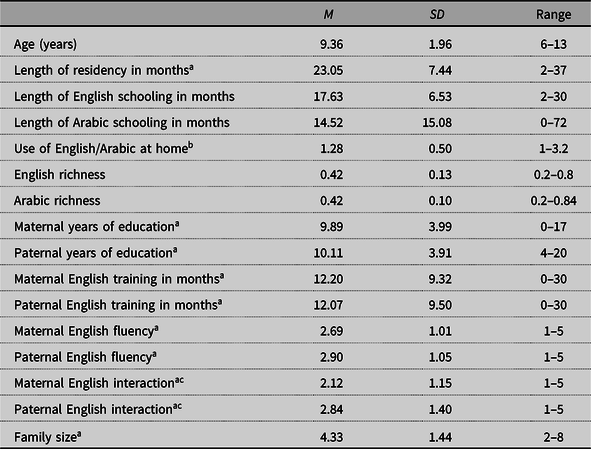
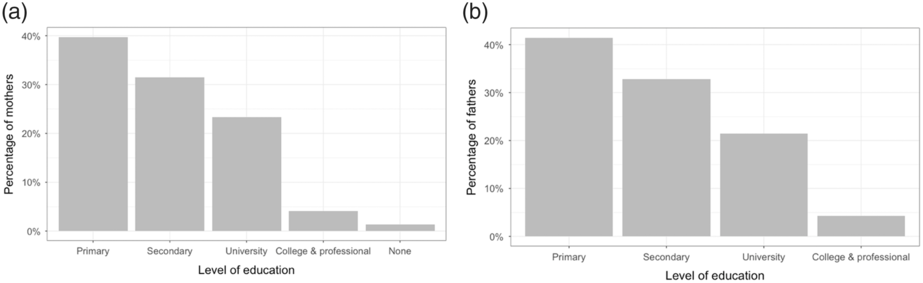
Participant characteristics are summarized in Table 1. Nonparametric Wilcoxon signed rank tests were used to compare variables, due to some violations of normality. Children had more schooling in English than in Arabic (V = 5421; p = .007). There was a moderate positive correlation between age and schooling in Arabic (r = .569, p < .001), indicating that older children had more schooling in Arabic. Arabic predominated in language use at home since the overall score was 1.28 on a 5-point scale where lower numbers indicate more Arabic. However, there was a difference in language use among family members (see Language Use at Home section). The overall richness of children’s home language environments was similar in English and Arabic, but comparisons of individual rating scales revealed uneven distribution of activities across languages (see Environment Richness section). Mothers and fathers had similar total years of education, and the majority had primary education only; distribution of education levels is displayed in Figure 1. Mothers and fathers reported having spent the same amount of time studying English in Canada and also reported self-ratings of English fluency between “limited fluency” and “somewhat fluent” on average. However, mothers indicated that they interacted in English outside the home significantly less frequently than fathers (V = 282, p < .001).
Participant and family characteristics

aDescriptive statistics per family, not per child. bUse of English/Arabic at home is a relative composite score that considers patterns of English/Arabic use by the parents, children, their siblings, and other adults living in the household. Scales are 1–5 (1 = Mainly or only Arabic; 2 = Arabic usually/English sometimes; 3 = Arabic and English equally; 4 = English usually/Arabic sometimes; 5 = Mainly or only English). English/Arabic richness is a proportion score between 0 (lowest richness) –1.0 (highest richness) (see Procedures above). Maternal/paternal English fluency is a self-rating on the scale 1 = Not fluent; 2 = Limited fluency; 3 = Somewhat fluent; 4 = Quite fluent; 5 = Very fluent. cScales are 1–5 (1 = 0–1 hr [never/almost never]; 2 = 1–5 hr [a little]; 3 = 5–10 hr [regularly]; 4 = 10–20 hr [often]; 5 = 20+ hours [very often].)
Mothers’ (left) and fathers’ (right) level of educational attainment. Primary and secondary education are based on the Syrian system. “College & professional” refers to diploma and certification programs beyond secondary school.

Language use at home
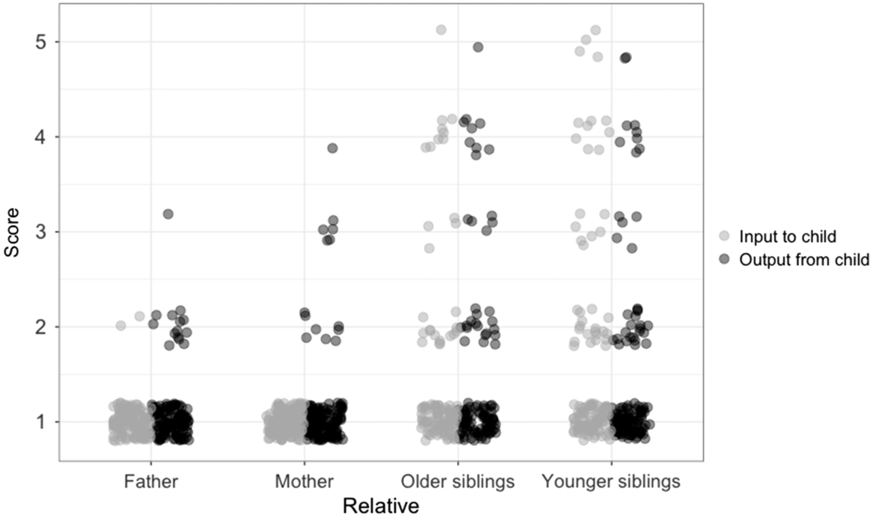
Individual scores for language choice in input to children from parents and siblings and output from children to parents and siblings are plotted in Figure 2. Recall that lower numbers indicate more use of Arabic. A series of paired-samples Wilcoxon tests showed that parents used less English with the children than their older siblings did (father-older siblings: 1.02 vs. 1.46; V = 17, p < .001; mother-older siblings: 1 vs. 1.46; V = 0, p < .001) and their younger siblings did (father-younger siblings: 1.02 vs. 1.62; V = 22, p < .001; mother-younger siblings: 1 vs. 1.62; V = 0, p < .001). Similarly, the children used more English with their older siblings than with their parents (father-older siblings: 1.12 vs. 1.51; V = 40, p < .001; mother-older siblings: 1.16 vs. 1.51; V = 21, p < .001) and with their younger siblings than with their parents (father-younger siblings: 1.12 vs. 1.51; V = 46, p < .001; mother-younger siblings: 1.16 vs. 1.51; V = 24, p < .001). No differences emerged in language choice for input and output between children and their older versus younger siblings.
Language choice in input to/output from child and parents and siblings. Lower values indicate more Arabic. Points are jittered to avoid overplotting.

Environment richness
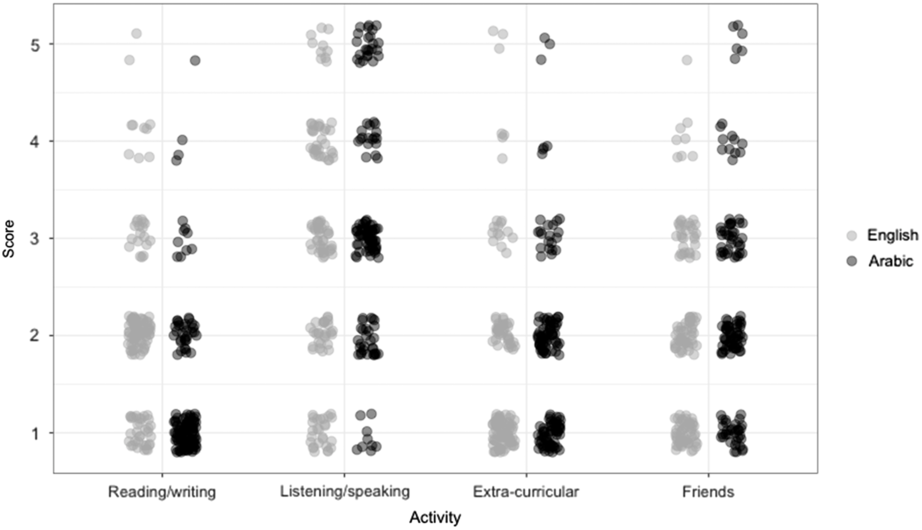
Individual scores for each language-rich activity in English and Arabic are plotted in Figure 3. The frequency of language-rich activities was not high in either language, since means were in the 1–3 range, that is, “never/almost never” to “regularly,” for each scale. Children spent significantly more time reading and writing in English than in Arabic (2.05 vs. 1.47; V = 2483.5, p < .001). However, children engaged significantly less in speaking/listening activities in English than in Arabic (2.77 vs. 3.14; V = 1985, p = .020) and also spent less time playing with friends in English than in Arabic (1.97 vs. 2.32; V = 985, p = .003). Children also spent significantly less time on extracurricular activities in English than in Arabic (1.65 vs. 1.87; V = 1122, p = .018). Extracurricular activities in Arabic mainly consisted of Koran study classes.
Individual scores of language-rich activities by language. Lower values indicate less frequency of the activity. Points are jittered to avoid overplotting.

Modeling children’s lexical and morphological abilities in English and Arabic
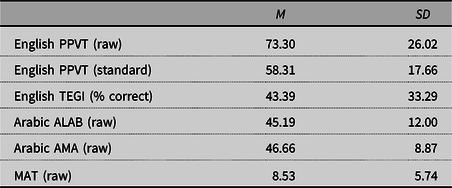
The mean score for all language outcome tests and for MAT (nonverbal analytical reasoning) are given in Table 2. Note that we report both the raw and standard English PPVT score; the standard score indicates that children performed –2 SD below the standard mean for their age. Only 8 children achieved a standard score of 85 or higher on the PPVT. For children of 6 years and older, the criterion score for monolingual performance on the TEGI is between 85% and 97%. Therefore, the group mean was well below the lowest criterion score. Only 11 children were at or above the criterion score for their age.
Scores for language tests and MAT

Note: PPVT, Peabody Picture Vocabulary Test. TEGI, Test of Early Grammatical Impairment. ALAB, Arabic Language Assessment Battery—Vocabulary subtest. AMA, Arabic Morphological Awareness. MAT, Matrix Analogies Test.
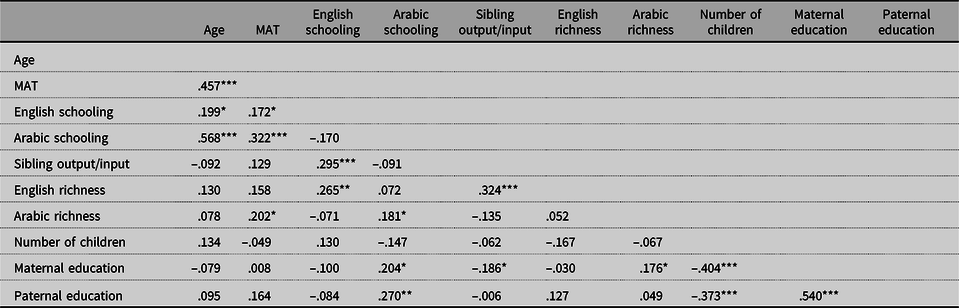
In order to determine which factors predict vocabulary and morphological outcomes in children’s English and Arabic, we used linear-mixed effects regression models, fit with the lme4 package in R (Bates, Mächler, Bolker, & Walker, Reference Bates, Mächler, Bolker and Walker2015). A correlation matrix with all the fixed effects used in the models appears in Table 3 (Spearman’s ρ). Correlations were small to moderate and, thus, not a concern for multicollinearity in any of the models. Note that age, rather than AOA, was entered in the models. This is because for L1, age is an index of cumulative exposure. Chronological age and AOA was strongly correlated in our sample (r = .951; p < .001), so either variable would be expected to behave in a similar way in the models. Note also that the input and output variables for the siblings are combined. Because input and output are strongly correlated in this sample (r = .84, p < .001), we used combined scores instead of entering them separately in the models also to avoid collinearity issues. We did not include parental input/output in the modeling because parents reported speaking only or almost only Arabic to the children (see Figure 1). For the same reason, parental English fluency was similarly omitted from the modeling. Finally, family was entered as a random intercept in the regressions (i.e., children were nested within families). This allowed us to take into account variation differences within families as many of the child participants were siblings.
Correlation table of all fixed effects with corresponding p values

*p < .05. **p < .01. ***p < .001.
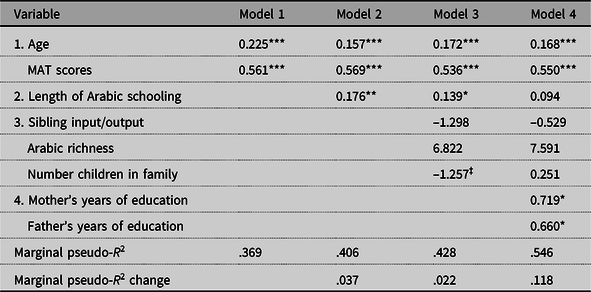
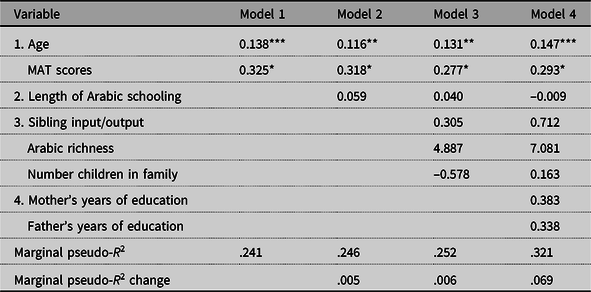
Models were created in a hierarchical manner, meaning fixed effects were introduced in steps. In all models, internal factors (age and MAT scores) were introduced in Step 1 (Model 1). (Note that age in Arabic indexes both internal cognitive maturity as well as cumulative quantity of exposure to Arabic.) The length of English/Arabic schooling was introduced in Step 2 (Model 2), followed by proximal home factors (sibling input/output, English/Arabic richness, and number of children in the family; Model 3). Distal home/parent factors (maternal and paternal years of education) were introduced last (Model 4). Hierarchical modeling enables us to determine whether home environment factors (Steps 3 and 4) explain additional variance not already explained by internal and school factors (Steps 1 and 2). It also reveals how variance predicted by each fixed effect can change as a function of adding more fixed effects to the model.
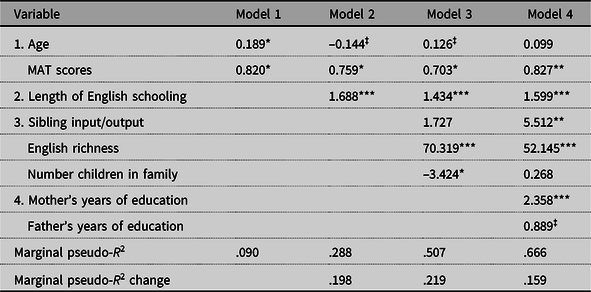
The models for the English vocabulary task, PPVT (raw scores) are given in Table 4. The model fit increased significantly at every step: Model 1–Model 2: χ2 (1, 6) = 22.614, p < .001; Model 2–Model 3: χ2 (3, 9) = 35.087, p < .001; Model 3–Model 4: χ2 (2, 11) = 34.338, p < .001. Model 4 had a marginal pseudo-R 2 of .666, indicating it explained around 67% of the variance in PPVT scores.Footnote 1 Significant effects in Model 4 were MAT, English schooling, sibling input/output, English richness, and mother’s education.
Hierarchical linear mixed regression for English vocabulary: Peabody Picture Vocabulary Test raw scores; nonstandardized beta coefficients

Note: Significance codes: ‡< 0.1. *<0.05. **<0.01. ***<.001.
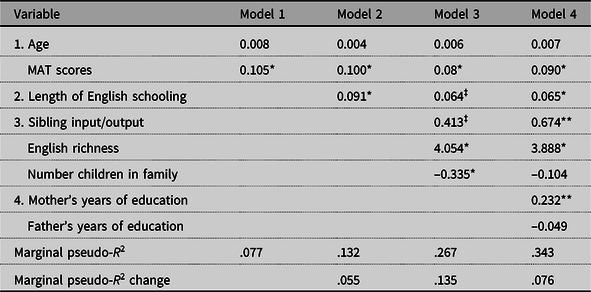
The models for the English morphology task, TEGI, are presented in Table 5. TEGI scores were log-transformed because they violated the assumption of normally distributed residuals. Thus, the coefficients in these models are not directly interpretable. As with the model for the PPVT, model fit increased with each step: Model 1–Model 2: χ2 (1, 6) = 6.668, p = .01; Model 2–Model 3: χ2 (3, 9) = 21.245, p < .001; Model 3–Model 4: χ2 (2, 11) = 13.013, p = .001. The full model accounted for 34% of the variance in TEGI scores. Significant fixed effects in Model 4 included MAT, English schooling, sibling input/output, English richness, and mother’s education.
Hierarchical linear mixed regression for English morphology: Test of Early Grammatical Impairment scores; nonstandardized beta coefficients based on transformed scores

Note: Significance codes: ‡< 0.1. *<0.0. **< 0.01.
Table 6 contains the models for the Arabic vocabulary task, ALAB. The model fit increased significantly at Step 2 with the addition of length of Arabic schooling: χ2 (1, 6) = 6.8532, p = .008, but it did not improve with the addition of proximal home factors at Step 3, χ2 (3, 9) = 5.7459, p = .12. However, adding parental education at Step 4 improved the model fit significantly, χ2 (2, 11) = 20.7, p < .001. The full model accounted for 55% of the variance in the ALAB scores, with age, MAT, and mother’s and father’s education as significant fixed effects.
Hierarchical linear mixed regression for Arabic vocabulary: Arabic Language Assessment Battery—Vocabulary subtest scores; nonstandardized beta coefficients

Note: Significance codes: ‡< 0.1. *< 0.05. **< 0.01. ***<0.001.
The hierarchical regression for the Arabic morphology task, AMA appears in Table 7. For this test, model fit did not improve significantly with the addition of Arabic schooling at Step 2, χ2 (1, 6) = 1.0831, p = .30, or with the addition of proximal home environment factors at Step 3, χ2 (3, 9) = 1.894, p = .59. Despite the lack of significance of the parental years of education in Model 4, adding these factors increased the model fit significantly, Model 3–Model 4: χ2 (2, 11) = 8.4837, p = .014. The full model explained 32% of the variance in the AMA scores.
Hierarchical linear mixed regression for Arabic morphology: Arabic Morphological Awareness scores; nonstandardized beta coefficients

Note: Significance codes: *< 0.05. **< 0.01. ***< .001.
Discussion
This study examined the home language environments and the lexical and morphological abilities of Syrian refugee children recently arrived in Canada. Regression modeling was undertaken to determine how language environment factors, along with age and cognitive factors, predicted variance in children’s lexical and morphological abilities in each language. While prior research shows that both internal and external factors can support bilingual acquisition, language environment was a key focus in this study because it is sensitive to different family experiences and backgrounds, while cognitive capacities and age effects are likely to be more constant across such differences.
Language environment of Syrian refugee children
Our analysis of the home language environment indicates that our sample of families is reasonably representative of Syrian refugee families in Canada, as demographic characteristics such as parent education and family size, are line in with a Statistics Canada report based on all Syrian families who arrived in 2015–2016 (Statistics Canada, 2019); this was expected, in part, because many participant families were government-assisted refugees. This representativeness suggests that our findings could generalize beyond our sample, but research with a larger sample is needed to be certain.
We predicted that the language environments might be weaker for the Syrian children in our study compared to other Canadian bilingual children from diverse migration backgrounds and lengths of residency. This prediction was borne out by our analyses. Richness of the L1 and L2 environment and maternal education was lower in this study than in studies of other Canadian English L2 children who had similar amounts of schooling in Canada (Jia & Paradis, Reference Jia and Paradis2015; Paradis, Reference Paradis2011; Paradis et al., Reference Paradis, Rusk, Sorenson Duncan and Govindarajan2017). These other studies by Paradis and colleagues included predominantly immigrant and not refugee families and, consistent with Canada’s competitive immigration system, most mothers in these other studies had postsecondary education. Even though overall richness was similar between English and Arabic (.42 and .42) in this study, language activities were not distributed evenly across the two languages. Children engaged in fewer literacy activities in Arabic than English, a likely result of interrupted or no schooling in Arabic. The lower richness of the L1 and L2 environment of this sample may be related to the low education of the parents: around 40% of mothers and fathers had primary education only. While we did not examine the parents’ literacy skills, we could hypothesize that less educated parents have lower literacy skills, thus limiting their opportunities to provide rich home literacy practices. However, in our sample there were no significant correlations between parental education and English-L2 richness and there was a weak correlation between maternal education and Arabic-L1 richness (rs = .176, p = .042). It is possible that other factors, such as limited financial resources, played a role in determining richness of the home language environment; this would be a worthy topic for future research.
At time of testing, the children had more schooling on average in English in Canada than schooling in Arabic (Table 1), which is noteworthy since children were 9 years old on average. Limited reading/writing in Arabic could be a risk factor for variable attainment in the L1 (Albirini, Reference Albirini2014; Bayram et al., Reference Bayram, Rothman, Iverson, Kupisch, Miller, Puig-Mayenco and Westergaard2017; Jia, Reference Jia, He and Xiao2008). However, parents reported that children socialized with friends more in the L1 than in the L2, and this could be a potential protective factor for L1 maintenance long term (Albirini, Reference Albirini2014; Jia, Reference Jia, He and Xiao2008). Regarding language use at home, akin to other studies, we found that L2 use was driven by sibling interactions (Altman et al., Reference Altman, Burstein Feldman, Yitzhaki, Armon Lotem and Walters2014; Rojas et al., Reference Rojas, Iglesias, Bunta, Goldstein, Goldenberg and Reese2016; Sorenson Duncan & Paradis, Reference Sorenson Duncan and Paradis2020b), although at the time of testing, even among siblings, Arabic use dominated for most families.
Sources of individual differences in children’s English and Arabic acquisition
The primary goal of this study was to determine how much home environment factors predicted children’s language abilities after other factors were accounted for: age, cognitive capacity, and schooling. Our analyses showed that one or more environment factors emerged as significant predictors in the full model for vocabulary in both languages and morphology in English. Therefore, the environmental characteristics of these Syrian refugee families are having an impact on children’s bilingual development.
Models of vocabulary outcomes had a higher pseudo-R 2 than models of morphological outcomes in both languages, meaning that the predictor factors accounted for more individual variance in vocabulary than morphological acquisition. For example, pseudo-R 2 values for vocabulary models in English and Arabic were .67 and .55, respectively; whereas, pseudo-R 2 values for morphology models in English and Arabic were .34 and .32, respectively. This discrepancy is consistent with findings from Chondrogianni and Marinis (Reference Chondrogianni and Marinis2011) and Paradis (Reference Paradis2011) and signals that there are other factors contributing to morphological acquisition than the ones identified in these studies, including the present study. In contrast to overall variance explained, there were clear similarities in terms of the significant predictors for vocabulary and morphology. Maternal education, cognitive capacity (MAT), and cumulative quantity of exposure (schooling for English and age for Arabic) were strong predictors of outcomes in both linguistic subdomains. Regarding comparisons between languages, models of English outcomes included more significant fixed effects than models for Arabic outcomes. More specifically, proximal home environment factors like use of English among siblings and richness of the English environment predicted English-L2, but not Arabic-L1, skills.
Cognitive, age and school factors
Nonverbal analytical skills (MAT) was the only factor that significantly predicted scores for vocabulary and morphology in both languages. MAT was one of just two factors significantly associated with higher performance on the Arabic morphology task (AMA). The relationship between cognitive capacity and child L2 acquisition has been found in other studies (Chondrogianni & Marinis, Reference Chondrogianni and Marinis2011; Paradis, Reference Paradis2011; Paradis et al., Reference Paradis, Rusk, Sorenson Duncan and Govindarajan2017; Pham & Tipton, Reference Pham and Tipton2018), but cognitive factors are not included as frequently as input factors in research on individual differences in bilingual children. The robustness of this factor in this study suggests it should be included more often. Once individual variance in cognitive capacity was controlled for, older age was associated with better Arabic outcomes but not better English outcomes. For English, it was length of schooling that was strongly associated with higher scores. This is unsurprising as age indexes L1 exposure as much as it indexes cognitive maturity. Therefore, age for Arabic and L2 schooling for English both estimate cumulative quantity of input. Schooling in Arabic did not predict variance in Arabic vocabulary and morphology consistently; it was significantly associated with vocabulary only at Steps 2 and 3. The limited impact could be due to many children having limited or no schooling in Arabic. It is relevant to ask why older age was not associated with stronger L2 outcomes, in contrast to previous research (Chondrogianni & Marinis, Reference Chondrogianni and Marinis2011; Golberg et al., Reference Golberg, Paradis and Crago2008; Paradis, Reference Paradis2011; Rothman et al., Reference Rothman, Long, Iverson, Judy, Lingwall and Chakravarty2016). Perhaps the cognitive capacity variance due to older age was specified mainly by MAT; there was a moderate correlation between MAT and age (Table 3). Another reason could be that the age/AOA range in this study was much wider and included much older children than in previous L2 studies and the older age advantage pertains more to younger children.
Proximal home environment factors
More English use with siblings was associated with better English outcomes, parallel to the findings of Rojas et al. (Reference Rojas, Iglesias, Bunta, Goldstein, Goldenberg and Reese2016) and Sorenson Duncan and Paradis (Reference Sorenson Duncan and Paradis2020b). More use of English with siblings did not have a significant and negative association with Arabic outcomes, in contrast to findings from Rojas et al. (Reference Rojas, Iglesias, Bunta, Goldstein, Goldenberg and Reese2016). However, Rojas et al. did not separate siblings from peers in their analyses. The lack of relationship between English use at home and Arabic outcomes might change if use of English surpasses Arabic among siblings as length of residency increases. Jia and Aaronson (Reference Jia and Aaronson2003) and Jia (Reference Jia, He and Xiao2008) found that a shift to preference for using English at home emerged after 3 years of residency, and children in this study had 2 years on average.
As use of English with siblings has a positive effect, one might expect that having more siblings—conversation partners—might also have a positive effect (cf. Place & Hoff, Reference Place and Hoff2016). However, number of children in the household was not significantly associated with higher/lower scores once maternal education was accounted for at Step 4 in the models. Because family size and parent education were moderately correlated (Table 3), this could explain why both family size and maternal education were not significant in the final model. Nevertheless, family size had a significant and negative effect on English vocabulary and morphology at Step 3. Therefore, it is possible that having many siblings is not supportive of a child’s bilingual development, but further research to disentangle parent education from family size is needed.
Richness of the language environment, as estimated by the frequency of engagement in language-rich activities, was a significant predictor of English vocabulary and morphology, but did not predict either in Arabic. A likely explanation is that Arabic is the more established language, and thus, variations in concurrent richness activities would have less impact than for a language that is being newly learned. Limited schooling in Arabic before migration could explain, in part, the low frequency of reading–writing activities in Arabic. In turn, the low frequency of Arabic reading–writing activities could diminish the potential of language environment richness to boost L1 abilities in children in the 6–13 year age range.
In Jia and Aaronson’s (Reference Jia and Aaronson2003) study of English–Mandarin bilinguals, their L1 richness variable included use of the L1 at home, peer interaction, and preference for language activities in the L1. They found that younger arrivals (AOA = 9 or younger) used more English at home, with peers and switched to preference for English activities more rapidly than older arrivals during the first 3 years of residency in the United States. By contrast, there was no correlation between the Arabic richness, sibling interaction, and age variables in our study (Table 3). After 2 years of residency, the Syrian children in this study are still Arabic dominant in terms of sibling interaction, peer socialization and listening–speaking activities at all ages. It is possible that a dominant language shift, and differences in this shift as a function of age, will emerge with longer residency.
Distal home/parent factors
Maternal education played a significant role in both L1 and L2 outcomes in this study. Even for Arabic morphology, parental education variables were not significant as fixed effects, but entering these variables at Step 4 significantly increased model fit, suggesting some influence. Note that maternal education matters for English L2 acquisition even though mothers do not use English with their children. This result is consistent with the notion that maternal education indexes broader familial resources beyond specific properties of target language use (cf. Golberg et al., Reference Golberg, Paradis and Crago2008; Prevoo et al., Reference Prevoo, Malda, Mesman, Emmen, Yeniad, van Ijzendoorn and Linting2014). Our findings showing an association between maternal education and language outcomes is in line with much previous research on bilingual children (e.g., Golberg et al., Reference Golberg, Paradis and Crago2008; Hammer et al., Reference Hammer, Komaroff, Rodriguez, Lopez, Scarpino and Goldstein2012; Jia & Paradis, Reference Jia and Paradis2015; Place & Hoff, Reference Place and Hoff2016; Prevoo et al., Reference Prevoo, Malda, Mesman, Emmen, Yeniad, van Ijzendoorn and Linting2014; Rojas et al., Reference Rojas, Iglesias, Bunta, Goldstein, Goldenberg and Reese2016; Sorenson Duncan & Paradis, Reference Sorenson Duncan and Paradis2020a). A more unique finding of our study is the contribution of paternal education to children’s language development. We hypothesized that fathers might have more of an impact on the home language environment, and in turn, on children’s language in these Syrian families because many were at home rather than in the work force and could interact more with the children. In support of this hypothesis, higher paternal education levels significantly predicted Arabic vocabulary, once other sources of variation were accounted for.
Conclusion
The home language environment of the Syrian children in this study appeared to be weaker than what has been observed in studies with more diverse samples of Canadian bilingual children in terms of parent factors and children’s engagement in language-rich activities outside school. In addition to cognitive factors and amount of English schooling, proximal and distal home environment factors predicted individual differences in English–L2 lexical and morphological abilities. Furthermore, cognitive factors, age (cumulative Arabic exposure) and parent factors predicted Arabic lexical and morphological abilities. The lack of evidence for an influence of proximal home factors on individual differences in the Arabic–L1 was attributed to the children being Arabic dominant and having relatively short residency in the host country. Because language environment supports bilingual development, if home language environments are weak for certain refugee children, additional language enrichment for children’s L1 and L2 from schools and communities could be of benefit to them academically and for broader social inclusion.
Acknowledgments
We would like to first thank the families for the taking the time and effort to participate in this research. We also acknowledge the important contribution of the student assistants in all three cities who collected the data. This research was funded by the Social Sciences and Humanities Research Council of Canada through a Partnership Grant (PI: Ungar) and an Insight Developmental Grant (PI: Chen), for which we are grateful.
Supplementary material
To view supplementary material for this article, please visit https://doi.org/10.1017/S014271642000017X
APPENDIX A
Selected rating scales from the ALEQ-4 for language input-output in L1 versus L2 among family members, frequency of engagement in language rich activities in an average week, parent self-rated fluency in English and parent interactions in English outside the home
1. Language input-output among family members: Scales like those below for fathers, older siblings, and younger siblings were also included.
1.1. What language does the mother speak to the child?

1.2. What language does the child speak to the mother?

2. Frequency of engagement in language rich activities in English and Arabic.
2.1. How much time does your child spend doing speaking/listening activities in English in a week?
Examples: watching TV shows, movies, YouTube, Netflix, music, phone, Skype, What’s App (oral), singing, poetry, story-telling

2.2. How much time does your child spend doing speaking/listening activities in Arabic in a week?
Examples: watching TV shows, movies, YouTube, music, ?, phone, Skype, What’s App (oral), singing, poetry, story-telling
2.3. How much time does your child spend doing reading/writing activities in English in a week?
Examples: reading books (for school or pleasure), websites, messaging (texts, email, Facebook, Instagram, Snapchat), homework
2.4. How much time does your child spend doing reading/writing activities in Arabic in a week?
Examples: reading books (for school or pleasure), websites, messaging (texts, email, Facebook, Instagram, Snapchat), homework, Koran
2.5. How much time does your child spend attending religious services, prayers, or community events in Arabic in a week?
2.6. How much time does your child spend doing extracurricular activities in English in a week?
Examples: sports, dance, music, after-school programs (Boys & Girls Club, homework club)
2.7. How much time does your child spend in heritage language classes in Arabic in a week? (Outside school)
2.8. How much time does your child spend playing with friends in English in a week?
Example: before/after school or at recess, family friends, neighbourhood friends
2.9. How much time does your child spend playing with friends in Arabic in a week?
Example: before/after school or at recess, family friends, neighborhood friends
3. Parent self-rated fluency in English. An identical scale for fathers was included.
3.1. How well does the mother speak/understand English? (self-rating)
Note: Top row has descriptors of categories. Bottom row has examples of language use in each category.

4. Parent interactions in English outside the home. An identical scale for fathers was included.
4.1. How often does the mother interact with people in English outside the home? (e.g., waiting at swimming lessons, teachers, neighbors, work, etc.)