



Introduction
Reading is an essential skill for any academic ability. Reading acquisition is challenging for children with hearing impairment (HI) due to the consequences of their hearing sensory limitation at the level of language development and cognitive skills, including phonological abilities (Perfetti & Sandak, Reference Perfetti and Sandak2000).
Reading achievement in individuals with HI remains in lag with that of their hearing peers, although, through time, some children with HI reach secondary classes and attend university. Qi and Mitchell (Reference Qi and Mitchell2012) indicated trends in reading performance for individuals with HI over three decades (1974–2003). They found that the mean reading age of 15- to 17-year-old children with severe to profound hearing loss is about that of a 9-year-old hearing child, equivalent to the 4th Grade. This lag in reading performance was observed in opaque orthographies like English (Conrad, Reference Conrad1979; Holt, Reference Holt1993; Karchmer & Mitchell, Reference Karchmer and Mitchell2003), and transparent orthographies like Spanish (Domínguez & Alegria, Reference Dominguez and Alegria2010; Domínguez et al., Reference Domínguez, Carrillo, González and Alegria2016; Moreno-Pérez et al., Reference Moreno-Pérez, Saldaña and Rodríguez-Ortiz2015). Despite the multiple changes in educational interventions and the use of advanced technologies such as cochlear implants, reading performance of children with HI remains behind compared to their hearing peers (Harris et al., Reference Harris, Terlektsi and Kyle2017; Mayberry et al., Reference Mayberry, del Giudice and Lieberman2011; Pimperton et al., Reference Pimperton, Blythe, Kreppner, Mahon, Peacock, Stevenson, Terlektsi, Worsfold, Yuen and Kennedy2016; Spencer & Marschark, Reference Spencer and Marschark2010). Moreover, the delay in reading in children with HI has been shown to increase by age in comparison to hearing children (Domínguez et al., Reference Domínguez, Carrillo, González and Alegria2016; Trezek et al., Reference Trezek, Wang, Woods, Gampp and Paul2007).
Some children with HI reach a reading level corresponding to their chronological age when optimal conditions (e.g., early diagnosis, early intervention, good prosthetic gain, and regular intervention sessions throughout the year) are available. Most of these children are with strong auditory abilities, mainly communicate using spoken language, and are enrolled in mainstream schools (Mayer et al., Reference Mayer, Trezek and Hancock2021). However, many children with HI do not benefit from these optimal conditions. Physical, economic, cultural, and social factors influence the effectiveness of interventions and educational approaches ensured at schools and homes (Knoors et al., Reference Knoors, Brons and Marschark2019).
The objectives of the present study are (a) to investigate the oral reading processes in Lebanese children with HI using spoken language or total communication (the use of sign and oral languages) in primary school by comparing their reading accuracy and speed measures in transparent Arabic orthography to younger hearing children and (b) to explore the reading difficulties encountered in the sublexical route in transparent Arabic orthography by analyzing reading errors in children with HI and hearing children. We used the reading model “Dual Route Cascaded” (DRC) (Coltheart et al., Reference Coltheart, Curtis, Atkins and Haller1993, Reference Coltheart, Rastle, Perry, Langdon and Ziegler2001), characterized by the use of the sublexical route (phonological decoding) and lexical route (orthographic representation) that account for some effects such as the word frequency, length, and lexicality.
Up till now, most research examining the reading performance in children with HI has been conducted in Western Europe, North America, and Australia. Findings of this research cannot be generalized since they do not represent countries with specific contexts, such as lower socioeconomic status and different cultures. Consequently, the reading performance of individuals with HI from countries with specific contexts lags behind their hearing peers (Knoors et al., Reference Knoors, Brons and Marschark2019). This lag in reading performance may be found in Lebanese children with HI for two reasons. Firstly, many Lebanese children with HI are educated in a context characterized by low engagement in therapy sessions and the maintenance of the hearing device because of insufficient environmental implications. This specific context is also characterized by the heavy sociolinguistic dimension represented by the learning of a foreign language other than Arabic (English or French) and by the diglossia. Diglossia, the use of two forms of Arabic language in different settings, the spoken one and the written one, decelerates the written language acquisition, including the oral reading process (Saeigh-Haddad & Schiff, Reference Saiegh-Haddad and Schiff2016). Secondly, many Lebanese adults with HI using oral or sign language have a low literacy level and are excluded from proper education (Bakhos et al., Reference Bakhos, Sleilaty, Khalaf, Bou Serhal, El Boustani, Lattouf, Bakhos, Samaha and Abou-Mrad2022), because of their substandard reading. Among 133 Lebanese individuals with HI aged from 18 to 80 years, only 5% terminated elementary school education, 28% middle school, 8% high school, 7% received a bachelor’s degree, 1% received a doctorate, and 42% were enrolled in vocational schools (Bakhos et al., Reference Bakhos, Sleilaty, Khalaf, Bou Serhal, El Boustani, Lattouf, Bakhos, Samaha and Abou-Mrad2022).
Besides the deprivation of optimal conditions for hearing and efficient reading skills in Lebanese children with HI, the complex Arabic orthography can increase the difficulties to acquire and develop the sublexical and the lexical routes. Thus, children with HI may have difficulties in building up accurate grapheme-phoneme conversion that is substantial for the development of the sublexical route. In fact, the use of the phonological decoding is crucial specifically in early reading stages due to the presence of the short vowel diacritics, a characteristic of the Arabic writing system that renders the Arabic orthography transparent. Likewise, children with HI may have difficulties to develop the lexical route because of the weakness in the development of the orthographic input and phonological output lexicon related to the lack of the phonological representation of the word. Therefore, children with HI face challenges in reading.
Arabic linguistic and orthographic systems
The Arabic language has linguistic and orthographic systems that differ from the orthographies of alphabetic languages such as French and English. Modern Standard Arabic (MSA) is the written Arabic language. It belongs to the Semitic language family (e.g., Arabic and Hebrew). The Arabic alphabet called “Abjad” contains twenty-eight consonants including two glides /w/ and /j/, and three long vowels /a:/, /u:/, and /i:/. The Arabic writing system is characterized by its cursive writing, going from right to left and resulting in four shapes for each letter except for six, which connect only with the letter preceding them. These shapes depend on the position of the letter in the word (e.g., /h/ initial letter هـ, medial letter ـهـ, final letter in two shapes ـه or ه) (Khateb et al., Reference Khateb, Khateb-Abdelgani, Taha and Ibrahim2014). Arabic orthography is distinguished by letters identical in their basic form but different in the number of diacritical points or dots (e.g., ت /t/, ث /Ɵ/). These orthographic features emphasize the visual complexity of Arabic orthography, which decelerates the automaticity of reading Arabic compared with Hebrew and English orthography (Eviatar et al., Reference Eviatar, Ibrahim, Karelitz and Simon2019). Moreover, the Arabic writing system consists of an optional system of infra- or supra-linear diacritics represented by the short vowels, ـَ /a/, ـُ /u/, and ـِ /i/. Diacritics representing the short vowels are lexical and morphosyntactic markers. The diacritics system includes other features of word articulation such as the null vowel “soukoun” ـْ indicating that the consonant is not accompanied by a vowel and the gemination “shadda” ـّ which is written above the consonant indicating the doubling of the consonant or the extra length. The writing of the gemination is obligatory, unlike the short vowel diacritics transcription.
The presence of short vowel diacritics in written words (vowelled words) makes Arabic orthography transparent for most words, except for some orthographic characteristics considered a source of opacity (Saiegh-Haddad & Henkin-Roitfarb, Reference Saiegh-Haddad and Henkin-Roitfarb2014). Nevertheless, short vowel diacritics are usually omitted and appear only in religious texts and children’s books for didactic purposes. Consequently, readers need to turn to their lexical morpho-orthographic knowledge and syntactic and semantic information to find the correct pronunciation of the word and distinguish between numerous homographs. For example, the word درس [drs] may correspond to the word دَرَسَ /darasa/ (he studied) or to the word دَرْس /dars/ (lesson) (Saiegh-Haddad & Henkin-Roitfarb, Reference Saiegh-Haddad and Henkin-Roitfarb2014).
Another particularity of the Arabic language concerns its non-concatenative morphology. Forming words (e.g., /mudarres/ teacher) necessitates combining a consonantal root conveying meaning (d.r.s linked to study/teach) and a word pattern (muCaCCeC in which C represents root consonants). The word pattern specifies the phonological templates of the word.
In addition to orthographic and morphological specificities, the Arabic language is characterized by the sociolinguistic context of diglossia. According to Ferguson (Reference Ferguson1959), diglossia means the existence of two forms of the same language, “the spoken form” and the “literary form,” that are used in different contexts of social interaction and have complementary functions. In the Arabic diglossia context, the spoken form is the mother tongue of native Arabic speakers; it is used for communicating and varies from one country to another. The MSA is the Arabic literary form, the unified written language used by all Arabic countries in reading and writing (Maamouri, Reference Maamouri1998; Saiegh-Haddad, Reference Saiegh-Haddad, Leikin, Schwartz and Tobin2012; Saiegh-Haddad & Henkin-Roitfarb, Reference Saiegh-Haddad and Henkin-Roitfarb2014). These two forms of Arabic linguistic expressions differ in the phonological, morphosyntactic, and lexical-semantic domains (Saiegh-Haddad, Reference Saiegh-Haddad2005). The Arab child is exposed to MSA around the age of 5–6 years, the age at which reading acquisition begins (Asadi & Ibrahim, Reference Asadi and Ibrahim2014). Both Lebanese children with HI and hearing children are exposed to the transparent Arabic orthography from Kindergarten 3 (5–6 years old) till Grade 9 (14–15 years old), whereas written texts become unvowelled in other Arab countries in Grade 4 (9–10 years). Lebanese children might rely on phonological decoding since the vowelled Arabic completes phonological information while some are omitted in the unvowelled words.
The Arabic orthographic and language features constitute a multidimensional source of complexity in acquiring reading. Multidimensional source of Arabic complexity includes the non-concatenative morphology, diglossia, and orthographic features encompassing the graphemes’ different forms, joining of letters, and the spatial arrangement of consonants and diacritic signs. These Arabic orthographic and language features have large implications for understanding the word recognition process in Arab children (Daniels & Share, Reference Daniels and Share2018; Saiegh-Haddad, Reference Saiegh-Haddad2017).
“Dual Route Cascaded” model
The DRC includes two distinct routes: the sublexical route and the lexical route (Coltheart et al., Reference Coltheart, Curtis, Atkins and Haller1993, Reference Coltheart, Rastle, Perry, Langdon and Ziegler2001). The sublexical route consists of decoding the letter strings by applying the grapheme-phoneme conversion rules to obtain a phonological output for words and nonwords (Coltheart et al., Reference Coltheart, Curtis, Atkins and Haller1993). This phonological representation activates the meaning of the written word. The lexical route consists of accessing the orthographic lexicon after activating the word’s letter units through the letters’ features. The word’s orthographic representation leads to the corresponding phonological stored representations and the word’s meaning. The two routes are interactive, despite their unique functional components. The lexical route can be used in oral reading when a nonword resembles words in the orthographic lexicon. For example, the nonword “SARE” which has many orthographic neighbors like “CARE, SORE, SANE” consequently activates the phonological lexicon, thus the phoneme output stage which is common in both procedures (Snowling & Hulme, Reference Snowling and Hulme2005).
The DRC model explains the processing system used for single-word oral reading, whether the orthography is transparent or opaque (Coltheart et al., Reference Coltheart, Rastle, Perry, Langdon and Ziegler2001). In Arabic, vowelled written Arabic is generally considered phonologically transparent from the reading point of view. Grapheme-phoneme correspondences in Arabic are consistent except for a few particularities (Saiegh-Haddad & Henkin-Roitfarb, Reference Saiegh-Haddad and Henkin-Roitfarb2014). The grapheme-phoneme transparency favors the use of sublexical route in beginner readers. It facilitates later access to larger morpho-orthographic (root and pattern morphemes) and lexico-orthographic units that characterize lexical processing (El Akiki & Content, Reference El Akiki and Content2020). Morpho-orthographic access is essential in Arabic reading acquisition because it allows retrieving the missing word’s phonological information when short vowel diacritics are omitted (Bar-On et al., Reference Bar-on, Shalhoub-Awwad and Tuma-Basila2018; Saiegh-Haddad & Schiff, Reference Saiegh-Haddad and Schiff2016).
Word frequency, length, and lexicality effects in hearing individuals
Experiments with skilled adult readers showed that high-frequency words are read aloud through the lexical route, in which processing time is not sensitive to word length. However, low-frequency words and pseudowords are decoded through the sublexical route in which processing time is affected by word length (Valdois et al., Reference Valdois, Carbonnel, Juphard, Baciu, Ans, Peyrin and Segebarth2006; Yap & Balota, Reference Yap and Balota2009). Thus, short low-frequency words and pseudowords are better and faster read than long ones. The pronunciation of regular words may be possible through both routes. Regular words are faster read than irregular ones, and the regularity effect is larger for low-frequency words than for high-frequency ones (Coltheart et al., Reference Coltheart, Rastle, Perry, Langdon and Ziegler2001). The DRC model offers an interpretation of frequency, length, and lexicality effects in terms of processing.
The effects of word frequency, length, and lexicality on oral reading in hearing children have been examined in transparent and opaque orthographies (Burani et al., Reference Burani, Marcolini and Stella2002; Cossu et al., Reference Cossu, Gugliotta and Marshall1995; Davies et al., Reference Davies, Rodríguez-Ferreiro, Suárez and Cuetos2013; Gerhand & Barry, Reference Gerhand and Barry1998; Ibrahim, Reference Ibrahim2013; Leybaert & Content, Reference Leybaert and Content1995; Spinelli et al., Reference Spinelli, De Luca, Di Filippo, Mancini, Martelli and Zoccolotti2005; Sprenger-Charolles et al., Reference Sprenger-Charolles, Siegel and Bonnet1998; Zoccolotti et al., Reference Zoccolotti, De Luca, Di Pace, Gasperini, Judica and Spinelli2005). We summarize hereafter some experimental results related to these three effects in opaque and transparent orthographies since our interest is to investigate how these variables impact children’s reading in transparent Arabic orthography. First, high-frequency words are more accurately and faster read aloud than low-frequency words, suggesting the use of the lexical route in primary school in transparent orthography such as Italian (Burani et al., Reference Burani, Marcolini and Stella2002; Zoccolotti et al., Reference Zoccolotti, De Luca, Di Pace, Gasperini, Judica and Spinelli2005; Verhoeven & Perfetti, Reference Burani, Thornton, Zoccolotti, Verhoeven and Perfetti2017), and in opaque orthographies such as English and French (Gerhand & Barry, Reference Gerhand and Barry1998; Leybaert & Content, Reference Leybaert and Content1995; Sprenger-Charolles et al., Reference Sprenger-Charolles, Siegel and Bonnet1998). Second, the lexicality effect on reading accuracy, reaction time (time required to prepare the oral response), and response duration (time needed to say the word) in Spanish fifth and sixth graders was established by Davies et al. (Reference Davies, Rodríguez-Ferreiro, Suárez and Cuetos2013) (see also Leybaert & Content, Reference Leybaert and Content1995; Sprenger-Charolles et al., Reference Sprenger-Charolles, Siegel and Bonnet1998 for data on French-speaking children). In Arabic oral reading, the lexicality effect was demonstrated in children in the earliest stages of reading acquisition (El Akiki & Content, Reference El Akiki and Content2020), and in eighth graders children (Abu-Leil et al., Reference Abu-Leil, Share and Ibrahim2014). Vowelled words were read aloud with more accuracy and faster than vowelled pseudowords indicating the use of the sublexical route for pseudoword reading and of the lexical route for word reading. Third, word length effects in children’s reading were also observed in both opaque and transparent orthographies. Cossu et al. (Reference Cossu, Gugliotta and Marshall1995) found that first graders read short words and pseudowords more accurately than longer words and pseudowords. The word length effect was also observed in naming time in older Italian children (Spinelli et al., Reference Spinelli, De Luca, Di Filippo, Mancini, Martelli and Zoccolotti2005). It has an essential role in making the transition from the use of the sublexical route to the lexical route with age evident. The word length effect decreased through age development (Barca et al., Reference Barca, Burani and Arduino2002), in opaque (Bijeljac-Babic et al., Reference Bijeljac-Babic, Millogo, Farioli and Grainger2004), as well as in transparent orthographies (Zoccolotti et al., Reference Zoccolotti, De Luca, Di Pace, Gasperini, Judica and Spinelli2005); its effect disappeared on high-frequency words (Lowell & Morris, Reference Lowell and Morris2014). Less skilled readers in Grade 3 showed word length effect like typically developing younger children in Grade 1 (Zoccolotti et al., Reference Zoccolotti, De Luca, Di Pace, Gasperini, Judica and Spinelli2005), which suggests that they continue to rely on the sublexical strategy.
Word frequency, length, and lexicality effects in children with HI
Research investigating the length, word frequency, and lexicality effects on oral reading in the transparent orthographies in participants with HI was conducted on adults and children. Marinelli et al. (Reference Marinelli, Vizzi and Zoccolotti2019) found frequency and length effects in word reading in Italian adults with HI, indicating the reliance on the lexical route on one hand and the sublexical route on the other hand. In opaque orthography, the effects of word frequency, regularity, and lexicality on oral reading accuracy and speed were examined by Leybaert (Reference Leybaert, Marschark and Clark1993) in French-speaking readers with HI aged from 14 to 20 years. Reading accuracy was better for words than for pseudowords, suggesting an advantage of the lexical route over the sublexical route. Reading accuracy was also better for regular words than for irregular words, especially for low-frequency ones. This result suggested that participants with HI preferentially rely on the lexical procedure for word reading and that the sublexical procedure was used in reading low-frequency words and pseudowords. Similarly, studies demonstrated that primary school children with a cochlear implant used the lexical route (Geers, Reference Geers2003; Fagan et al., Reference Fagan, Pisoni, Horn and Dillon2007), and the sublexical route (Fagan et al., Reference Fagan, Pisoni, Horn and Dillon2007). The effect of word length on oral reading in children with HI received little attention in the literature. More specifically, the effects of variables such as length, word frequency, and lexicality in oral reading accuracy and speed in Arabic-speaking readers with HI have not been previously examined.
Difficulty related to short vowels diacritics oral reading
To specify the reading difficulties in the sublexical route, we shed light on the short vowel diacritics that render the Arabic orthography transparent. Studies showed that short vowel diacritics are difficult to pronounce in oral reading in hearing children. Short vowel diacritics errors were observed in reading aloud words and pseudowords in Arabic-speaking young readers with typical reading development (Abu-Rabia & Taha, Reference Abu-rabia and Taha2004; El Akiki & Content, Reference El Akiki and Content2020), and dyslexic readers (Abu-Rabia & Taha, Reference Abu-rabia and Taha2004). Moreover, some researchers demonstrated that vowelled words are read less accurately and more slowly than unvowelled words in Arabic-speaking children starting Grade 3 (Asadi, Reference Asadi2017; Ibrahim, Reference Ibrahim2013; Saiegh-Haddad & Schiff, Reference Saiegh-Haddad and Schiff2016; Taha, Reference Taha2016). This finding was also observed in Arab children with dyslexia showing a larger effect of short vowel diacritics on the reading speed of partially vowelled words and pseudowords than in children of the same age having a typical reading development (Layes et al., Reference Layes, Lalonde and Rebaï2014). The short vowel diacritics’ impact on reading has been interpreted by the visual load required by their processing. A similar interpretation has been advanced regarding Hebrew in poor and dyslexic readers: reading accuracy is hindered by the overloaded visual reading vowelled conditions (Maroun et al., Reference Maroun, Ibrahim and Eviatar2019; Taha, Reference Taha2016; Shany et al., Reference Shany, Bar-On and Katzir2012). Ibrahim (Reference Ibrahim2013) argued that when children develop morpho-orthographic representations, they use direct lexical access to word recognition. The addition of short vowel diacritics rendering the orthography transparent would inhibit the lexical route in favor of the sublexical route.
The present study
The present study aimed at comparing the oral reading processes in Lebanese children with HI using spoken language or total communication to those of younger, typically hearing children. We compared the effects of word frequency, length, and lexicality on reading accuracy and speed of words and pseudowords in transparent Arabic orthography in children with HI in Grades 4 to 6 (educated in schools for the deaf and hard of hearing) to that of younger hearing children in Grades 2 and 3. We matched the two groups of children on the sentence reading comprehension performance. The reading comprehension skill is a reading measure represented by the product of the decoding and the oral comprehension according to the “Simple View of Reading” (SVR) model (Gough & Tunmer, Reference Gough and Tunmer1986). We also matched the participants with HI and the hearing participants on the oral comprehension performance at the receptive vocabulary and the receptive morphosyntactic levels (see “Participants” section). We anticipated that both the phonological decoding procedure and the orthographic procedure would be underdeveloped in children with HI than in hearing children based on two factors. The first factor is that children with insufficient hearing skills in a specific context are deprived of optimal conditions for hearing (Knoors et al., Reference Knoors, Brons and Marschark2019), and efficient reading skills (Bakhos et al., Reference Bakhos, Sleilaty, Khalaf, Bou Serhal, El Boustani, Lattouf, Bakhos, Samaha and Abou-Mrad2022). The second factor is that reading comprehension may be related to word and nonword decoding differently in children with HI and in hearing children. The underdevelopment of the two reading procedures would negatively affect the reading accuracy, especially in low-frequency and pseudoword reading. We predicted that children with HI and hearing children would read more accurately and faster high-frequency words than low-frequency words; words than pseudowords and short low-frequency words, and pseudowords than long ones. We also predicted that the frequency, lexicality, and length effects would be more marked in children with HI than in hearing children. Therefore, we expected that children with HI would use both, the lexical and sublexical routes that would be less or differently developed than in hearing children. A last prediction related to reading difficulties in the sublexical route is that children with HI and hearing children would have a large amount of short vowel diacritics errors affecting the sublexical route. Short vowel diacritics are not easily identified in reading vowelled words.
Method
Participants
A group of children with HI and a group of hearing children were recruited. The participants of the two groups were carefully matched on the sentence reading comprehension performance and the oral comprehension performance of the spoken Lebanese.
Thirty-two Lebanese children with HI, 18 boys and 14 girls, with a mean age of 11.94 years (SD = 1.52, Min = 9.25, Max = 15.16) were recruited from three schools for deaf and hard of hearing with the collaboration of their speech therapists who filled out a questionnaire for each participant. Children with HI were enrolled in three different school levels: Grade 4 (n = 11), Grade 5 (n = 14), and Grade 6 (n = 7). They were benefiting from six to seven Arabic language learning hours per week, besides the foreign language sessions (English or French). All had benefited from speech and language therapy sessions for at least five years. Twenty-seven were congenitally hearing impaired, four had an acquired hearing loss and one lacked data. Twenty-one had sensorineural hearing loss, five from a conducted hearing loss, and six lacked data. Based on the degree of hearing loss of the Bureau International d’Audiophonologie (BIAP 02/1 bis, 1997), six participants had moderate hearing loss, nine had severe hearing loss, and 15 had profound hearing loss. Twenty-one children benefited from bilateral hearing aids and 11 from a unilateral cochlear implant. The data about the prosthetic gain and the aided hearing threshold were almost absent in the participants’ files. Regarding the modes of communication, 11 used the oral language and 21 adopted the total communication.
The control group comprised of 32 Lebanese participants, 17 girls and 15 boys, with a mean age of 7.95 years (SD = 0.53, Min = 6.83, Max = 8.75). Participants were enrolled in Grades 2 and 3 in three private schools. Hearing participants were bilingual, studying both Arabic and French, and exclusively used spoken Lebanese with their family and surroundings. They had no learning difficulties and were not followed in psychomotor or speech and language therapy.
The present study was approved by the Ethics Committee of the Faculty of Psychology, Educational Sciences and Speech and Language Therapy of the Université libre de Bruxelles before the start of data acquisition.
Material and procedure
Control measures
Seven tests, hereafter labeled “control measures,” were administered to verify that there was no outlier participant in some of the skills essential for the oral reading. The Raven’s Progressive Matrices test was used to evaluate nonverbal intelligence (Raven et al., Reference Raven, Raven and Court1998), with the three sets (two colored sets and one black and white set) administered to each participant. The Barrage de cloches test from the BALE battery (Jacquier-Roux et al., Reference Jacquier-Roux, Lequette, Pouget, Valdois and Zorman2010), was used to assess visual attention. A receptive vocabulary test adapted from the EVIP (Échelle du Vocabulaire en Images de Peabody) test was used (Dunn et al., Reference Dunn, Thériault-Whalen and Dunn1993). The “TMRL” (Test Morphosyntaxique Réceptif Libanais), an unpublished test elaborated by Kassir (Reference Kassir2015) at the Lebanese University, was used to assess oral morphosyntactic comprehension. The Phonological production tasks were used to assess the speech intelligibility of children with HI in different situations. The tasks include a picture naming task of 28 items, a word repetition task of 40 items, and a pseudoword repetition task of 10 items. The success of producing each item was evaluated independently of the children’s articulatory difficulties. These tests are not yet standardized but are regularly used by the Speech Therapy Department of the Lebanese University.
Table 1 shows the independent sample t-test analyses and the means of correct responses for the control measures tasks in both participants’ groups. The difference is significant for visual attention, t(62) = −2.77, p = 0.007, Cohen’s d = −0.691 and is marginally significant for nonverbal intelligence (Raven), t(62) = −1.95, p = 0.055, Cohen’s d = −0.488. The two groups of participants were matched on the oral comprehension performance of the spoken Lebanese at the receptive vocabulary performance (EVIP), t(62) = 1.44, p = 0.156, 95% CI [−0.01, 0.07], Cohen’s d = 0.359, and the receptive morphosyntactic performance (TMRL), t(62) = 1.62, p = 0.111, 95% CI [−0.01, 0.08], Cohen’s d = 0.404.
Independent samples t-test analyses and means of correct responses of the control measures (standard deviation) with the minimum and the maximum scores in children with HI and hearing children

Note: Word (W), Pseudoword (PW), Échelle du vocabulaire en images de Peabody (EVIP), Test Morphosyntaxique Réceptif Libanais (TMRL).
Written comprehension of sentences
A sentence reading comprehension test was developed from the French silent reading sentence completion test (Lobrot & Adnet-Piat, Reference Lobrot and Adnet-Piat1973), as a reading measure on which children with HI and hearing children were matched, t(62) = 0.24, p = 0.815, 95% CI [−1.17, 1.48], Cohen’s d = 0.059. Our Lebanese version consists of completing a written vowelled sentence after having read it silently (لَبِسَ الصّبيُ الصَّغيرُ /labisa sˁsˁabijju ʔasˁsˁaɣi:ru/ (القِرْميد، المِقَص، السّفارة، القَميص، الفَسْتان /ʔalqˁirmi:d, ʔalmiqˁasˁ, ʔassafa:ra, ʔalqˁami:sˁ, ʔalfasta:n/) (The little boy wore (the bricks, the scissors, the embassy, the shirt, the dress), by the appropriate word (القَميص /ʔalqˁami:sˁ/ (the shirt)) proposed together with four other distractors: a semantic distractor (الفَسْتان /ʔalfasta:n/ (the dress)), a phonological one (القِرْميد /ʔalqˁirmi:d/ (the bricks)), an orthographic and phonological one (المِقَص /ʔalmiqˁasˁ/ (the scissors)) and a word phonologically close to the semantic distractor (السّفارة /ʔassafa:ra/) the embassy)). In order to make the test appropriate for different school levels at the lexical and syntactic aspects, we consulted various Arabic books used by schools for the deaf and hard of hearing. The test contains four practice sentences and 25 item sentences which increase in complexity as the task progresses in terms of sentence length, syntactic structure, implicit sentences, and suggested words that become less familiar. Children had to complete as many item sentences as they could in a precise time of five minutes. The raw score of correct answers was calculated.
Experimental measure
Word and pseudoword reading
Children were asked to read aloud four word lists and two pseudoword lists. Thirty-two regular vowelled words representing nouns were selected and classified into four lists of eight nouns each, according to the frequency (high vs. low frequency) and length (two vs. three syllables). Thus, two lists of words represented high-frequency words, one was for disyllabic (e.g., خُروج /xuru:Ʒ/ (exit)) and the other for trisyllabic (e.g., سَيّارة /sajjāra/ (car)), and two lists of words represented low-frequency words, one was for disyllabic (e.g., وارِث /wa:reθ/ (heir)) and the other for trisyllabic (e.g., دُرّاقَة /durra:qˁa/ (peach)). All words were selected from Arabic school books. The frequency of words was estimated through a written evaluation on a five-point scale by hearing students from Grade 6 to Grade 8 (in total 80). Sixteen vowelled pseudowords were classified into two lists, one with disyllabic items and the other with trisyllabic items. Disyllabic stimuli were composed of three to four letters and trisyllabic stimuli were composed of five to six letters. The lists were strictly matched according to the syllabic structure complexity, the semi-consonants, the gemination, the emphatic sounds, and the graphemes which phonemes are specific to the MSA such as the interdental phonemes, and some uvular phonemes. Four stimuli were prepared for practice for each list of words and pseudowords.
The reading task requires the child to read aloud each list as fast and accurately as possible. The lists were presented in a hard copy. For each list, reading speed and accuracy were recorded. Measurement includes the total time to read each list of eight items and the accuracy of the responses. For reading accuracy, the oral response taken into consideration was the first given, not self-corrections. The oral response was transcribed at least twice to make sure of the transcription of the participant’s production, which is essential for judging the accuracy and analyzing errors. The first time was done by the examiner simultaneously with the participant reading and the second one took place through the recordings. Another examiner’s revision of the transcription was necessary when the participant’s production led to confusion. A response with a substitution was considered accurate if the substitution was related to an articulatory problem exhibited by the child. Before reading the target words and pseudowords, each participant with HI and hearing participant had to pronounce all the phonemes to identify the articulatory modifications.
For the reading speed, the stopwatch was turned on manually once the list of stimuli was presented to the participant and stopped directly by the examiner after the production of the last item.
Two scores were calculated. The reading accuracy score represented the mean proportions of correct responses read correctly per list (number of correct responses divided by 8). The reading speed score (in seconds) represented the means of the speed to read each item per list (total time of reading a list divided by 8).
Reading error analysis
Vowelled Arabic renders the orthography transparent and reading requires the phonological output of each grapheme and each short vowel diacritic. Errors made on word and on pseudoword reading were considered together. Omissions, insertions, and substitutions are the identified errors classified into two main categories of errors. The consonant errors category “C” included all stimuli with errors affecting one or more consonants (e.g., /daftar/ (notebook) → */dastar/). The short vowel diacritics error category (SV) revolved around one or more errors of the three short vowel diacritics that can be pronounced as long vowels (e.g., /minhaƷ/ (method) → */minha:Ʒ/) or can be substituted between themselves (e.g., /bari:d/ (mail) → */biri:d/) or by the “null vowel” (e.g., /wabad/ (pseudoword) → */wabd/).
The errors percentage of the “C” category represented the conversion into percentage of the sum of words with at least one consonantal error divided by the total number of erroneous words. The errors percentage of the “SV” category represented the conversion into percentage of the sum of words with at least one vocalic error divided by the total number of erroneous words.
Procedure
Each child was seen individually during four sessions of 30–40 minutes. Control measures assessment was done in two individual sessions of 30 minutes each with an interval of one week. The order of the control measures was the same for all participants. Word and pseudoword reading lists were administered over two sessions (which also included other neuropsychological tests). The reading of disyllabic stimuli was the first test administered during the first session and the reading of trisyllabic stimuli was the first test of the second session. The two sessions took place in a quiet school environment. For children with HI, the instructions were conveyed using the individual’s preferred mean of communication (oral language or total communication). For hearing participants, test instructions were conveyed orally.
Results
Oral reading measures: accuracy and speed
Repeated measures ANOVAs on length and frequency as within-subjects factors and hearing status as a between-subjects factor were performed to compare the reading accuracy and reading speed between children with HI and hearing children. When the interactions of the length and/or frequency with the group were significant in reading accuracy or speed, repeated measures ANOVAs were computed separately for children with HI and hearing children to investigate the variable effects in question on oral reading in each group. The repeated measure ANOVAs were accompanied by a descriptive analysis of oral reading errors according to the two categories of errors as described below. All statistical analyses were performed with JASP (JASP Team, 2022). The mean proportions of correct responses, standard deviations of reading accuracy, and the mean and standard deviations of reading speed in both children with HI and hearing children are presented in Table 2. Results of the repeated measure ANOVAs for the reading accuracy and speed are shown in Table 3.
Mean proportion of correct response (standard deviations) and mean of reading speed of each item in seconds (standard deviations) in children with HI and hearing children as function of length, word frequency and lexicality
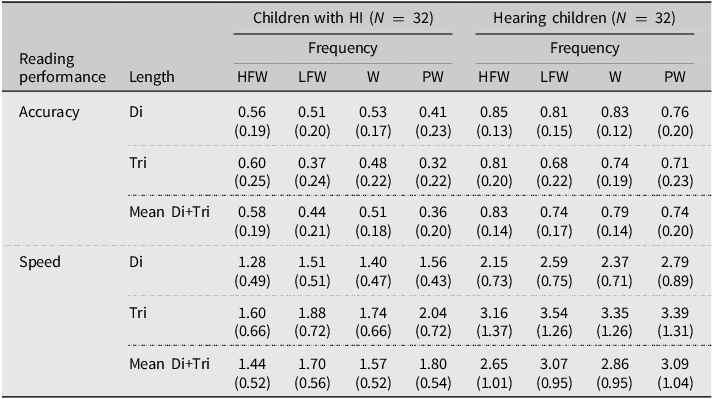
Note: High-frequency word (HFW), Low-frequency word (LFW); Word (W), calculated as the mean of HF and LF; Pseudoword (PW); Disyllabic (Di), Trisyllabic (Tri).
Repeated measure ANOVA on length and on frequency as within-subjects factors and hearing status as a between-subjects factor comparing the reading accuracy and speed between children with HI and hearing children

Note: Group (G), Length (L), Frequency (F).
Reading accuracy
Inspection on Table 2 shows that mean proportions of correct responses in reading words and pseudowords are lower in children with HI (M words = 0.51, SD = 0.18; M pseudowords = 0.36, SD = 0.20) than in hearing children (M words = 0.79, SD = 0.14; Mpseudowords = 0.74, SD = 0.20). Children with HI read high-frequency (M= 0.58, SD = 0.19) and low-frequency words (M = 0.44, SD = 0.21) with less accuracy than hearing children (M high-frequency words = 0.83, SD = 0.14; M low-frequency words = 0.74, SD = 0.17). Likewise, the oral reading of disyllabic and trisyllabic stimuli is less accurate in children with HI (M disyllabic words = 0.53, SD = 0.17; M trisyllabic words = 0.48, SD = 0.22; M disyllabic pseudowords = 0.41, SD = 0.23; M trisyllabic pseudowords = 0.32, SD = 0.22) than in hearing children (M disyllabic words = 0.83, SD = 0.12; M trisyllabic words = 0.74, SD = 0.19; M disyllabic pseudowords = 0.76, SD = 0.20; M trisyllabic pseudowords = 0.71, SD = 0.23). Table 2 shows that reading words is more accurate than reading pseudowords, high-frequency words are better read than low-frequency words, and short stimuli are better read than long stimuli in children with HI and younger hearing children.
To study the variables’ effects on reading accuracy, we conducted a 2 (Length) × 3 (Frequency) × 2 (Hearing status group) repeated measures ANOVA (see Table 3). The results revealed a significant group effect, F(1, 62) = 54.48, p < .001, η²p = .468; children with HI reached lower accuracy scores than hearing children. The difference in reading accuracy means between the two groups of participants indicated that hearing children read words and pseudowords better than children with HI, respectively by 28% and 38%. The length effect was significant overall, with a large effect size indicating that short stimuli were better read than long stimuli, F(1, 62) = 20.24, p < .001, η²p = .246. The length by group interaction was not significant, F(1, 62) = 0.08, p = 0.775, η²p = .001. The frequency effect was significant overall with a large effect size, F(2, 124) = 42.49, p < .001, η²p = .407, and the group and frequency interaction was significant with a medium effect size, F(2, 124) = 6.57, p = 0.002, η²p = .096. Separate repeated measures ANOVAs revealed significant effects of the frequency with a large effect size in children with HI, F(2, 62) = 36.58, p < .001, η²p = .541, and in hearing children, F(2, 62) = 9.81, p < .001, η²p = .240. The frequency effect was further analyzed by two orthogonal contrasts. The first contrast tested the lexicality effect by comparing the accuracy of words (high and low-frequency words) to the accuracy of pseudowords. The contrast revealed a significant difference in children with HI, t = −6.65, p < .001, and in hearing children, t = −2.44, p = 0.018, indicating that words were read more accurately than pseudowords. The second contrast tested the frequency effect by comparing the accuracy of high-frequency to the accuracy of low-frequency words. This contrast also showed a significant difference in children with HI, t = −5.39, p < .001, and in hearing children, t = −3.70, p < .001, indicating that the two groups of children read high-frequency words more accurately than low-frequency words. The difference between means proportions of correct responses of high- and low-frequency words converted into percentages is 14% in children with HI and 9% in hearing children. The difference between means proportions of correct responses of words and pseudowords converted into percentages is 15% in children with HI and 5% in hearing children.
Thus, descriptively, the frequency effect was larger in children with HI than younger hearing children. The significance of the length by frequency interaction overall with a large effect size showed that the impact of length is dependent on frequency. Short stimuli are better read than long stimuli and this difference increases as the frequency decreases. The length × frequency × group was not significant.
Figure 1 shows the significant effects in terms of length, word frequency, and lexicality on reading accuracy in children with HI and hearing children.
Mean proportion (0–1) of correct reading response per list as a function of length, word frequency and lexicality in children with HI and hearing children.
Note. High-frequency word (HFW), Low-frequency word (LFW), Pseudoword (PW); Disyllabic (Di), Trisyllabic (Tri).

Reading speed
Inspection on Table 2 shows that children with HI and hearing children read short words and pseudowords (M children with HI = 1.40, SD = 0.47; M hearing children = 2.37, SD = 0.71) faster than long ones (M children with HI = 1.74, SD = 0.66; M hearing children = 3.35, SD = 1.26). It shows also that children with HI and hearing children respectively read faster high-frequency words (M children with HI = 1.44, SD = 0.52; M hearing children = 2.65, SD = 1.01) than low-frequency words (M children with HI = 1.70, SD = 0.56; M hearing children = 3.07, SD = 0.95) and words (M children with HI = 1.57, SD = 0.52; M hearing children = 2.86, SD = 0.95) than pseudowords (M children with HI = 1.80, SD = 0.54; M hearing children = 3.09, SD = 1.04). Table 2 also shows that children with HI read faster than younger hearing children.
The variables’ effects appear in Table 3. A 2 (Length) × 3 (Frequency) × 2 (Hearing status group) repeated measures ANOVA revealed a significant group effect with a large effect size, F(1, 62) = 45.53, p < .001, η²p = .423. The difference in reading speed between the two groups of participants indicated that children with HI read both words and pseudowords faster than hearing children by 1.29 sec. The analysis also revealed a significant length effect overall with a large effect size, F(1, 62) = 78.53, p < .001, η²p = .559. The length × group interaction was also significant with a large effect size, F(1, 62) = 11.02, p = 0.002, η²p = .151. Separate repeated measures ANOVAs revealed significant effects of length with a large effect size in children with HI, F(1, 31) = 33.40, p < .001, η²p = .519 and hearing children, F(1, 31) = 48.17, p < .001, η²p = .608. The length effect was larger in hearing children than in children with HI according to Table 2. The frequency effect was significant overall, with a large effect size indicating that high-frequency words were read faster than low-frequency words and words were read faster than pseudowords, F(2, 124) = 32.02, p < .001, η²p = .341. The frequency by group interaction was not significant, F(2, 124) = 1.14, p = 0.324, η²p = .018 and the length by frequency interaction was not significant either, F(2, 124) = 1.35, p = 0.263, η²p = .021. The interaction involving length, frequency, and group was significant with a medium effect size, F(2, 124) = 5.80, p = 0.004, η²p = .086. Separate repeated measures ANOVA revealed that the length by frequency interaction was significant with a large effect in hearing children, F(2, 62) = 5.06, p = 0.009, η²p = .140 but not in children with HI, F(2, 62) = 1.10, p = 0.340, η²p = .034. This result indicates that the impact of length is larger for words (difference of 0.98 sec. between disyllabic and trisyllabic words) than for pseudowords (difference of 0.6 sec. between disyllabic and trisyllabic pseudowords) in hearing children. The post hoc Tukey test showed that a significant length effect was present for high-frequency words, t = −6.88, p < .001, Cohen’s d = −0.93, low-frequency words, t = −6.50, p < .001, Cohen’s d = −0.88, and for pseudowords, t = −4.13, p = 0.002, Cohen’s d = −0.56. Thus, hearing children read short stimuli faster than long stimuli with different frequencies.
Figure 2 shows the significant effects of length, word frequency, and lexicality on reading speed in children with HI and hearing children.
Mean of reading speed (in sec. per item) as a function of length, word frequency and lexicality in children with HI and hearing children.
Note. High-frequency word (HFW), Low-frequency word (LFW), Pseudoword (PW); Disyllabic (Di), Trisyllabic (Tri).

In conclusion, the reading accuracy speed of children with HI and hearing children are affected by the length, word frequency, and lexicality. The frequency effect on reading accuracy was the largest in children with HI than younger hearing children. The length effect on reading speed was the largest in hearing children than in children with HI, and the length by frequency interaction was significant only in hearing children.
Reading error analysis
Children with HI
The total number of words and pseudowords entailing a reading error of children with HI reached 820, more than half the total number of stimuli to read (1536). The “C” category covered 59% of the total number of erroneous words (505 words with consonant errors out of 820 words read incorrectly). The percentage of “SV” errors was 62% of the total number of erroneous words (517 words with vocalic errors out of 820 words read incorrectly). Therefore, children with HI in advanced grades in primary school had difficulties correctly identifying the consonants and the short vowel diacritics.
Hearing children
The total number of words and pseudowords reading errors of hearing children reached 338, almost equivalent to a quarter of the number of stimuli to read for all hearing children which is 1536. The percentage of the “C” category was 30% of the total number of erroneous words (103 words with vocalic errors out of 338 words read incorrectly). Errors involving the “SV” category covered 57% of the total number of erroneous words (194 errors out of 338 errors). Therefore, hearing children in Grades 2 and 3 have difficulties correctly identifying the short vowel diacritics more than the consonants.
Discussion
The main aim of our study was to investigate the oral reading processes in Lebanese children with HI who use the spoken language or total communication and who were enrolled in schools for the deaf and hard of hearing. We compared the effects of length, word frequency, and lexicality on reading accuracy and speed between hearing children with HI and hearing children. In addition, we analyzed the reading errors shedding light on the short vowel diacritics errors to explore the reading difficulties encountered in the sublexical route in transparent Arabic orthography.
Overall, the findings show consistency with our hypotheses for second and third graders Lebanese hearing children suggesting an adequate use of the sublexical and lexical routes. The accuracy and the speed of oral reading in hearing children are affected by word frequency, length, and lexicality. Hearing children read better and faster high-frequency words than low-frequency words, short stimuli than long stimuli, and words than pseudowords. They mainly relied on a well-developed sublexical route. Lebanese children achieved a good performance for reading pseudowords, which means the proportion of correct responses (0.74) is like the one of reading words (0.79). Moreover, the impact of word length was larger for words than for pseudowords in their reading speed. The reading of pseudowords was slow; there was no difference between disyllabic and trisyllabic pseudowords. As predicted for the Lebanese children with HI, the findings showed that their oral reading is affected by word frequency, length, and lexicality on reading accuracy and speed, as per younger hearing children. However, the findings did not match all the hypotheses for Lebanese children with HI. Children with HI proceed differently when reading in comparison to hearing children. Interestingly, they showed a larger frequency effect on reading accuracy. They also showed a smaller length effect on reading speed than the hearing children without any interaction with the frequency. Moreover, Lebanese children with HI read less accurately and more rapidly than younger hearing children, even though the former were older and thus more exposed to reading in MSA than the latter. Short vowel diacritics and consonant errors were numerous in children with HI. Results are discussed according to the oral reading mechanisms.
Sublexical procedure
The results showed that short stimuli are better and faster read than long stimuli, suggesting the use of the sublexical route by the participants of the two groups. However, several aspects of the data revealed that the sublexical route in children with HI is less developed than in hearing children. Reading accuracy of pseudowords was significantly worse in children with HI than in younger hearing children (0.36 vs. 0.74 as means proportions of correct responses, see Table 2). This result indicates that children with HI made many errors when reading unfamiliar grapheme sequences without semantic representation. Therefore, the low accuracy suggests a deficit in the grapheme-phoneme rule system. This system is necessary for the use of the sublexical route (Coltheart et al., Reference Coltheart, Curtis, Atkins and Haller1993, Reference Coltheart, Rastle, Perry, Langdon and Ziegler2001), and is an essential component for reading aloud in Arabic (Abu-Rabia & Siegel, Reference Abu-Rabia and Siegel2003; Geva & Siegel, Reference Geva and Siegel2000). The deficit in the grapheme-phoneme rule system is also revealed by the percentage of consonant errors in children with HI (59% of the total number of erroneous words), which is larger than that of younger hearing children (30% of the total number of erroneous words). However, the percentage of reading errors of consonants in hearing children is not to be neglected. The Arabic writing system alphabet “Abjad” is consonantal; it highlights the large dimension of the consonants in Arabic orthography. The Arabic orthography is characterized by its visual complexity, emphasized by the graphic similarity of Arabic letters and the different shapes of one letter according to its position in the word (Daniels & Share, Reference Daniels and Share2018; Saeigh-Haddad & Henkin-Roitfarb, Reference Saiegh-Haddad and Henkin-Roitfarb2014). Children with HI have more difficulty in building up accurate grapheme-phoneme conversion than hearing children. Moreover, they may have difficulty programming a motor response related to pronouncing a phoneme that can be a consonant or a vowel (see phoneme system in Coltheart, Reference Coltheart2005), when the reading speed condition is required. In this case, children with HI may not be able to pronounce the phonemes correctly in a word or pseudoword even though they can pronounce them in isolation (examined before the administration of the main reading tasks in this study). Consequently, the sublexical route will be affected because of the lack of training to program an oral motor response quickly. To verify whether difficulties in programming an oral motor response are related to a speech production problem or reading time pressure, it would be necessary to compare reading speed in two oral reading situations, with and without a speed condition. Despite the obvious deficit in grapheme-phoneme conversion in children with HI, our results show a small length effect and an absence of interaction length × frequency on reading speed, unlike the reading treatment in hearing children. Thus, children with HI read short stimuli slightly faster than long stimuli, and their reading speed of stimuli of different frequencies was not affected by the stimuli length. These results show that children with HI proceed differently in oral reading than hearing children; their reading procedure is developed in the flow of the discussion.
Lexical procedure
The results indicated that reading is more accurate and faster for high-frequency words than for low-frequency words. Likewise, the lexicality effect showed that words are read more accurately and faster than pseudowords. These results suggest the activation of the lexical route in both groups, at least for familiar words. As expected, the frequency effect was larger on reading accuracy in children with HI than in younger hearing children.
However, the low mean proportions of correct responses for high-frequency words in children with HI (0.58) compared to hearing children (0.83) suggest that the lexical route is largely underdeveloped in children with HI. Several factors may hinder the development of the lexical route in children with HI. Firstly, the underdeveloped sublexical route negatively affects the “self-teaching” mechanism that consists of developing the orthographic representations through the good use of phonological decoding in typically developing readers (Share, Reference Share1995, Reference Share1999), as well as in children with HI benefiting from optimal educational conditions (Wass et al., Reference Wass, Ching, Cupples, Wang, Lyxell, Martin, Button, Gunnourie, Boisvert, McMahon and Castles2019). The underdevelopment of the sublexical route negatively influences the lexical route, as has also been postulated for Semitic languages by Share & Bar-On (Reference Share and Bar-On2018). Indeed, the development of Arabic reading is characterized by the transition from phonological decoding (sublexical route) to morpho-orthographic reading (lexical route). Hearing children develop phonological representations of transparent Arabic orthography (vowelled words) that imply the alphabetic mechanisms. Through reading training, they build up phonological representations of morphological patterns including short vowels, which can be used to identify larger phonological or orthographic representations (Saeigh-Haddad, Reference Saiegh-Haddad2017). However, children with HI are deprived of a part of the word’s phonological information, and consequently, they are unable to construct the phonological representations necessary in oral reading. Therefore, children with HI could have difficulties developing the orthographic input and phonological output lexicon, two components of the lexical route. In addition, the visual written information in Arabic is not salient (short vowels, close diacritical dots, words visually close derived from the same root), which renders the construction of accurate orthographic representations difficult. Moreover, phonological awareness which is highly related to phonological decoding in hearing children (Goswami et al., Reference Goswami, Wang, Cruz, Fosker, Mead and Huss2010; Hulme et al., Reference Hulme, Bowyer-Crane, Carroll, Duff and Snowling2012; Schiff & Saeigh-Haddad, Reference Schiff and Saiegh-Haddad2018; Tibi & Kirby, Reference Tibi and Kirby2018), is poorer in children with HI (Johnson & Goswami, Reference Johnson and Goswami2010; Harris et al., Reference Harris, Terlektsi and Kyle2017; Spencer & Tomblin, Reference Spencer and Tomblin2009). Future studies should examine the correlation between phonological awareness and oral reading in Lebanese children with HI. Secondly, oral reading errors could be explained by the quality of the phonological output of children with HI. The phonological output resulting from activating the orthographic representation could be the outcome of the ‘frozen’ phonological representation for a word in children with HI more than in hearing children. As in the case of speech production, the ‘frozen’ phonological representation represents the use of an inaccurate previously stored phonological production for a word despite the present ability of the child to correctly treat and produce the target word (Bryan & Howard, Reference Bryan and Howard1992). Therefore, the insufficient lexical route could be related to the alteration of the phonological output lexicon that is essential for developing the lexical route according to the DRC model. To verify whether the lexical procedure inefficiency in children with HI is correlated to their phonological output storage, it would be interesting to further analyze the phonological representations at the output stage through picture naming and reading tasks containing the same words (see Rees, Reference Rees2009). Thirdly, the diglossia situation could have an impact. The phonological distance between spoken Arabic and MSA makes reading difficult in hearing children (Daniels & Share, Reference Daniels and Share2018), and obviously in children with HI since it involves phonological memory. Indeed, studies showed that words in MSA with the same phonological representation in spoken Arabic are better and faster read by hearing children than words with different phonological representations in spoken Arabic (Saeigh-Haddad & Schiff, Reference Saiegh-Haddad and Schiff2016). We suggest that diglossia has a larger impact on children with HI than on hearing children. A post hoc analysis of our material revealed that 62.5% of the words with the same phonological representations in spoken Lebanese and MSA were read correctly in children with HI vs. 86% in hearing children, 49.22% of the words with close phonological representations to the spoken Lebanese were read correctly in children with HI vs. 77% in hearing children, and 39.38% of the words with different phonological representations were correctly identified in children with HI vs. 74.38% in hearing children. It would be important to verify this finding in Arab children with HI in a study considering the diglossia as a main variable.
Reading inaccuracy in children with HI: Is speed responsible?
An interesting finding emerging from our data is that children with HI read quickly and inaccurately, providing implications on the model of reading disabilities in the Arabic language. Usually, reading speed increases with school age demonstrating more efficient word identification (Perfetti, Reference Perfetti, Gough, Ehri and Treiman1992). The correlation between reading accuracy and reading speed is not significant (p = 0.577, r = −0.102), thus eliminating the hypothesis that children with HI committed more reading errors because they privileged the reading speed. Consequently, the fact that Lebanese children with HI read faster and with less accuracy suggests a genuine deficit in their reading accuracy. In this case, the model of reading disability would be characterized by a deficit of reading accuracy and the absence of the developmental correlation between accuracy and speed. The reading deficit in HI children is characterized by difficulties in visually processing several letters simultaneously in a short time frame.
The reading process in children with HI may be more overloaded by the short vowel diacritics that are not placed on the baseline of writing than the younger hearing children. Our analysis of errors revealed a striking observation regarding short vowel diacritics. Short vowel diacritics seemed to be difficult to identify in children with HI and hearing children although they represent three phonemes only and have one visual representation in transcription for each short vowel diacritic. The error percentages are slightly higher in children with HI (62% of the total number of erroneous words) than in younger hearing children (57% of the total number of erroneous words), noting that the latter are in less advanced school levels and thus, are less trained to orally read words. Consequently, the high error percentages of the short vowel diacritics in children with HI, together with their reading speed, suggest that children with HI do not allocate enough attention to short vowel diacritics when reading. Indeed, studies showed that short vowel diacritics require visual attention load (Abu-Rabia, Reference Abu-Rabia2019; Taha, Reference Taha2016), hindering hearing children’s reading speed (Bar-On et al., Reference Bar-on, Shalhoub-Awwad and Tuma-Basila2018; Ibrahim, Reference Ibrahim2013; Saiegh-Haddad & Schiff, Reference Saiegh-Haddad and Schiff2016; Taha, Reference Taha2016). Therefore, the new finding of the present study is that short vowel diacritics are neglected or mistaken by children with HI.
To sum up, Lebanese children with HI mainly overuse the lexical route, although it is underdeveloped since they read quickly and have insufficient reading accuracy. We suggest that Lebanese children with HI with advanced grade levels in primary schools sometimes rely on a partial guessing procedure based on recognizing part of the word. Lebanese children with HI seem to differ from poor readers with dyslexia of Arabic and European orthographies who have slow reading speed compared to children with typical reading development (Layes et al., Reference Layes, Lalonde and Rebaï2014; Valdois et al., Reference Valdois, Reilhac, Ginestet and Line Bosse2021). However, it would be interesting to compare the reading measures in poor hearing readers with learning disabilities and in readers with HI to determine whether the difficulties in identifying the short vowel diacritics relate to hearing loss or a reading delay.
All the difficulties affecting the reading processes in children with HI that are exposed in the flow of the discussion are related to the poor acoustic-phonetic perception caused by the individual’s hearing impairment. These difficulties are highlighted by the lack of optimal conditions for reading caused by the insufficient environment’s implications (Knoors et al., Reference Knoors, Brons and Marschark2019). Many Lebanese children with HI stop the intervention sessions during summer vacation when schools are closed, occasionally follow up with the audiologist, and do not regularly adjust their hearing devices. The heavy sociolinguistic dimension also affects the acquisition of their reading skills (Saeigh-Haddad & Schiff, Reference Saiegh-Haddad and Schiff2016). Lebanese children with HI are exposed to the spoken and written languages in the diglossia context, to a foreign language other than the native Arabic (English or French) in their schools, and to sign language since they are enrolled in schools for the deaf and hard of hearing.
Limitations
The lack of standardized reading tests in MSA is the main limitation of this study. This absence necessitated matching children with HI with younger hearing children on the scores of the reading comprehension test developed for this study instead of on the reading age. The number of participants was limited although all students with HI, using spoken language or total communication, enrolled from Grade 4 till Grade 6 in schools for the deaf and hard of hearing in Beirut and its suburbs, and agreed with the inclusion criteria, participated in this study. Another limitation is the activation and the stop of the stopwatch manually. The manual mode may create differences in the reaction time to start and stop the stopwatch for each participant.
Conclusion
Although researchers showed that the hallmark of adequate reading acquisition is the constant increase in reading speed when reading is accurate (Carver, Reference Carver1990), the current study’s findings indicate that Lebanese children with HI do not show the same reading development as typical readers in transparent Arabic orthography. Children with HI read aloud words and pseudowords less accurately and faster than younger hearing children with whom they are matched on the reading comprehension and oral comprehension performances. If their poor accuracy level clearly shows that they are poor readers, how to explain their fast reading? We suggest that Lebanese children with HI recognize part of the word, leading them to rely on a partial guessing procedure. This procedure could explain their fast reading.
The results are interpreted in terms of DRC model (Coltheart et al., Reference Coltheart, Curtis, Atkins and Haller1993, Reference Coltheart, Rastle, Perry, Langdon and Ziegler2001), with children with HI using the sublexical route and overusing the lexical route noting that both reading routes are deficient. Children with HI had difficulties with the grapheme-phoneme rules system and the phonological and orthographic representation of the words. These difficulties are related to the hearing deficit. They are highlighted by the diglossia and the features of the Arabic orthography, such as the spatial arrangement and nonlinearity due to short vowel diacritics, supporting the multidimensional source of complexity in the Arabic writing system suggested by Daniels and Share (Reference Daniels and Share2018).
At the practical level, the present data have implications for teachers of children with HI. They must be fully informed that children with HI using the spoken language could reach high levels of education when optimal conditions are met (Mayer et al., Reference Mayer, Trezek and Hancock2021). Thus, they can support reading development by emphasizing the proper use of the sublexical route in the early stages of reading acquisition. Children with HI could be trained for oral reading and for giving meaning to the vowelled word since early reading stages, implying the short vowel diacritics identification that plays a role at this level. Another implication relates to the importance of preparing Lebanese children with HI for the MSA in the diglossic context since kindergarten classes by sharing books and stories (Dowdall et al., Reference Dowdall, Melendez-Torres, Murray, Gardner, Hartford and Cooper2020; Swanwick & Watson, Reference Swanwick and Watson2007).
Our study is the first to explore oral reading accuracy and speed according to the DRC model in Arab children with HI. The findings of this study indicate that the reading ability of children with HI in schools for the deaf and hard of hearing differs from that of hearing children. This deserves to get expanded research on reading development in children with HI through a longitudinal study.
Replication package
The material of the word and pseudoword reading task can be found in the Appendix and at https://osf.io/mbhzj/. The analysis code and data can be found at https://osf.io/bqrtm/.
Acknowledgments
We would like to appreciate all participants who participated in the study and thank the schools for deaf and hard of hearing and for hearing children for their support and collaboration. We would also like to thank the speech therapists Elisa Mikhael and Therese Azar for their help in the testing.
Competing interests
The authors declare none.
Appendix: (Material: Reading stimuli)
Task: Word and pseudoword reading



