The relationship between the first (L1) and the second language (L2) in the linguistic/cognitive development of emergent bilinguals is a critical issue in countries where the populations of children with an immigrant/minority background continue to rise. García and Kleifgen (Reference García and Kleifgen2010) define emergent bilinguals (the first focus of this article) as children who, through school and acquiring L2, become bilingual, and continue to function in both L1 and L2, developing mastery of the two languages. Yet in the course of time, they may shift to dominance in L2 (Jia, Chen, Kim, Chan, & Jeung, Reference Jia, Chen, Kim, Chan and Jeung2014; Pham & Kohnert, Reference Pham and Kohnert2014). Generally, it is well documented that bilingual children from lower socioeconomic status (SES) show on average less well developed academic language skills in L1 and L2 upon their entry to (pre)school, and hence, they are at risk of underachieving as they progress through school (Farver, Xu, Lonigan, & Eppe, Reference Farver, Xu, Lonigan and Eppe2013; Hammer et al., Reference Hammer, Hoff, Uchikoshi, Gillanders, Castro and Sandilos2014; Oller & Eilers, Reference Oller and Eilers2002). Nonetheless, we highlight that educational underachievement of minority students is largely the outcome of mechanisms reproducing inequalities in schools. Linguistic and socioeconomic inequalities are intertwined (Collins, Reference Collins2009), as is testified to, among other things, by restrictive language policies in mainstream schools (Gándara & Hopkins, Reference Gándara and Hopkins2010; Pulinx, Van Avermaet, & Agirdag, Reference Pulinx, Van Avermaet and Agirdag2017).
Vocabulary, our second focus, is an essential medium to understand the meaning of spoken and written language. Investigating vocabulary in young children can aid our understanding of the linguistic/cognitive processes in early language learning (Sénéchal, Ouellette, & Rodney, Reference Sénéchal, Ouellette, Rodney, Dickinson and Neuman2006; Whitehurst & Lonigan, Reference Whitehurst, Lonigan, Neuman and Dickinson2001). Marchman, Fernald, and Hurtado (Reference Marchman, Fernald and Hurtado2010) point out that lexical knowledge is a key building block of language development, operating jointly with a host of language-general skills that enable children to make sense of the linguistic input they experience and put information to use in constructing a working system of language. Vocabulary growth in monolingual and bilingual children is positively associated with early efficiency in spoken language understanding and with long-term language and cognitive outcomes (Marchman & Fernald, Reference Marchman and Fernald2008). Lexical knowledge is also a core part of what makes early grammatical acquisition possible (Marchman, Martínez-Sussman, & Dale, Reference Marchman, Martínez-Sussmann and Dale2004).
The relationship between L1 and L2 is our third focus. Understanding this relationship in the vocabulary development of emergent bilinguals may help educators improve learners’ linguistic and academic outcomes (Branum-Martin et al., Reference Branum-Martin, Mehta, Francis, Foorman, Cirino, Miller and Iglesias2009; Genesee & Geva, Reference Genesee, Geva, August and Shanahan2006; Snow & Kim, Reference Snow, Kim, Wagner, Muse and Tannenbaum2007). An ongoing issue is whether supporting academic L1 development in emergent bilinguals leverages the acquisition of linguistic/cognitive skills in L2. Early oral language skills in L1 like vocabulary, listening comprehension, and phonological awareness are proven to predict later oral language, literacy, and school outcomes in L2 (August & Shanahan, Reference August and Shanahan2006; Edele & Stanat, Reference Edele and Stanat2016; Genesee, Lindholm-Leary, Saunders, & Christian, Reference Genesee, Lindholm-Leary, Saunders and Christian2006; Hammer et al., Reference Hammer, Hoff, Uchikoshi, Gillanders, Castro and Sandilos2014; Prevoo, Malda, Mesman, & van IJzendoorn, Reference Prevoo, Malda, Mesman and van IJzendoorn2016). While the evidence is generally strong for positive cross-language relations regarding literacy and metalinguistic skills (Hammer et al., Reference Hammer, Hoff, Uchikoshi, Gillanders, Castro and Sandilos2014; Melby-Lervåg & Lervåg, Reference Melby-Lervåg and Lervåg2011; Oller & Eilers, Reference Oller and Eilers2002; Riches & Genesee, Reference Riches, Genesee, Genesee, Lindholm-Leary, Saunders and Christian2006; Yang, Cooc, & Sheng, Reference Yang, Cooc and Sheng2017), studies into the oral language of bilingual children at preschool and primary school levels show correlations between L1 and L2, which range from positive over zero to negative (see reviews by Branum-Martin et al., Reference Branum-Martin, Mehta, Francis, Foorman, Cirino, Miller and Iglesias2009; Castilla, Restrepo, & Perez-Leroux, Reference Castilla, Restrepo and Perez-Leroux2009; Genesee & Geva, Reference Genesee, Geva, August and Shanahan2006; Sandhofer & Uchikoshi, Reference Sandhofer, Uchikoshi, Ong and McLean2013; Snow & Kim, Reference Snow, Kim, Wagner, Muse and Tannenbaum2007). Yang et al.’s (Reference Yang, Cooc and Sheng2017) meta-analysis discovered a weak significant correlation between Chinese and English oral vocabulary (r = .10, n = 15), being similar to Melby-Lervåg and Lervåg’s (Reference Melby-Lervåg and Lervåg2011) meta-analysis, which identified a small significant correlation between L1 and L2 vocabulary (r = .16, n = 36). Scheele, Leseman, and Mayo (Reference Scheele, Leseman and Mayo2010) revealed a positive significant L1–L2 correlation in vocabulary in 3-year-old Moroccan children (r = .30, p < .05) and a small positive but nonsignificant correlation in 3-year-old Turkish children (r = .19, p < .10). However, Cobo-Lewis, Eilers, Pearson, and Umbel (Reference Cobo-Lewis, Eilers, Pearson, Umbel, Ollers and Eilers2002) found that oral vocabulary in the two languages of Spanish–English bilingual children in the United States was largely independent at the individual level. Goodrich, Lonigan, Kleuver, and Farver (Reference Goodrich, Lonigan, Kleuver and Farver2016) reported a negative cross-language transfer of vocabulary knowledge in Spanish–English preschool children.
Many scholars interpret positive cross-language correlations as lending support to linguistic interdependence theories. Cobo-Lewis et al. (Reference Cobo-Lewis, Eilers, Pearson, Umbel, Ollers and Eilers2002) point out that interdependence between bilinguals’ two languages is conditional and may depend on the type of skills being assessed, the child’s age, and socioeconomic and environmental factors that affect linguistic and academic performance (see also Simon-Cereijido & Gutiérrez-Clellen, Reference Simon-Cereijido and Gutiérrez-Clellen2009; Verhoeven, Reference Verhoeven1994). Prevoo, Malda, Emmen, Yeniad, and Mesman (Reference Prevoo, Malda, Emmen, Yeniad and Mesman2015) found support for the context dependence of interdependence of vocabulary growth in emergent bilingual children. This brings up the central question of this study: what are the factors that influence the cross-language relationship between vocabulary development in emergent bilinguals? Various factors have been correlated with L1 and/or L2 vocabulary, but few studies have examined their concurrent influence on the relationship between L1 and L2 proficiencies. From previous research, we can glean evidence for the influence of three contextual factors: type of measure/task (Branum-Martin et al., Reference Branum-Martin, Mehta, Francis, Foorman, Cirino, Miller and Iglesias2009; Gathercole, Thomas, Roberts, Hughes, & Hughes, Reference Gathercole, Thomas, Roberts, Hughes, Hughes and Gathercole2013; Kan & Kohnert, Reference Kan and Kohnert2008; Scheele et al., Reference Scheele, Leseman and Mayo2010); typological distance (i.e., cognate vocabulary; Baird, Palacios, & Kibler, Reference Baird, Palacios and Kibler2016; Dressler, Carlo, Snow, August, & White, Reference Dressler, Carlo, Snow, August and White2011; Kelley & Kohnert, Reference Kelley and Kohnert2012; Pérez, Peña, & Bedore, Reference Pérez, Peña and Bedore2010; Pham, Donovan, Dam, & Contant, Reference Pham, Donovan, Dam and Contant2018; Proctor & Mo, Reference Proctor and Mo2009; Sheng, Lam, Cruz, & Fulton, Reference Sheng, Lam, Cruz and Fulton2016); and instructional (monolingual/bilingual) context (Branum-Martin et al., Reference Branum-Martin, Mehta, Francis, Foorman, Cirino, Miller and Iglesias2009; Cárdenas-Hagan, Carlson, & Pollard-Durodola, Reference Cárdenas-Hagan, Carlson and Pollard-Durodola2007; Goodrich, Lonigan, & Farver, Reference Goodrich, Lonigan and Farver2013; Melby-Lervåg & Lervåg, Reference Melby-Lervåg and Lervåg2011; Pham & Kohnert, Reference Pham and Kohnert2014; Snow & Kim, Reference Snow, Kim, Wagner, Muse and Tannenbaum2007; Tabors, Páez, & López, Reference Tabors, Páez and López2003). Theoretically, we can link a wider range of potential factors to linguistic interdependence. Factors that relate to language and cognition, and children’s individual characteristics, may influence the level of variation of the cross-language relationship. These factors generally relate to the availability of linguistic resources for both L1 and L2 development (Prevoo et al., Reference Prevoo, Malda, Emmen, Yeniad and Mesman2015).
The purpose of this study is to consider the theoretical plausibility of a number of factors, and empirically examine the contingency of linguistic interdependence between L1 and L2 vocabulary upon them. The factors included in the present study are theoretically linked in that they relate to levels of input and usage-based resources in both languages. The factors that will be examined are sex, age, preschool grade, onset of schooling in L2, maternal education, and language use at home. Sex, age, and onset of schooling in L2 are child-internal factors; the other factors are contextual. We will investigate the extent to which they act as conditions for the cross-language relationship between receptive vocabulary size in a sample of emergent bilingual preschool children from Turkish background inhabiting a Flemish city.
Theoretical background
Empirical cross-language correlations
Several empirical studies on preschool and primary school bilingual children from various linguistic backgrounds show statistically nonsignificant cross-linguistic correlations between vocabulary skills, providing support for the relative independence of vocabulary development across languages, which suggests that time spent learning L1 vocabulary does not facilitate learning L2 vocabulary (Spanish/English: Cobo-Lewis et al., Reference Cobo-Lewis, Eilers, Pearson, Umbel, Ollers and Eilers2002; Goodrich et al., Reference Goodrich, Lonigan and Farver2013; Marchman et al., Reference Marchman, Fernald and Hurtado2010; Proctor, Harring, & Silverman, Reference Proctor, Harring and Silverman2017; Hmong/English: Kan & Kohnert, Reference Kan and Kohnert2008; Kohnert, Kan, & Conboy, Reference Kohnert, Kan and Conboy2010; Turkish/Dutch: Prevoo et al., Reference Prevoo, Malda, Emmen, Yeniad and Mesman2015; Verhoeven, Reference Verhoeven1994). Findings from studies with Spanish–English bilinguals indicate that L1 and L2 vocabulary sizes are negatively correlated in the early stages of bilingual development, implying cross-linguistic inhibitory or competition effects (Goodrich et al., Reference Goodrich, Lonigan, Kleuver and Farver2016; Hammer et al., Reference Hammer, Komaroff, Rodriguez, Lopez, Scarpino and Goldstein2012; Ordóñez, Carlo, Snow, & McLaughlin, Reference Ordóñez, Carlo, Snow and McLaughlin2002). On the contrary, past studies have also reported significant weak to modest positive L1–L2 correlations between vocabulary skills in Turkish–Dutch (Leseman, Reference Leseman2000; Scheele et al., Reference Scheele, Leseman and Mayo2010; Verhoeven, Reference Verhoeven2007), Spanish–English (Atwill, Blanchard, Gorin, & Burstein, Reference Atwill, Blanchard, Gorin and Burstein2007; Branum-Martin et al., Reference Branum-Martin, Mehta, Francis, Foorman, Cirino, Miller and Iglesias2009; Conboy & Thal, Reference Conboy and Thal2006; Farver et al., Reference Farver, Xu, Lonigan and Eppe2013; Solari et al., Reference Solari, Aceves, Higareda, Richards-Tutor, Filippini, Gerber and Leafstedt2014), Chinese–English (Yang et al., Reference Yang, Cooc and Sheng2017), and Vietnamese–English children (Pham, Reference Pham2016).
Linguistic interdependence
Current linguistic interdependence theories offer two major explanatory models for positive cross-language correlations: common underlying proficiency (CUP) and individual differences (ID). The developmental linguistic interdependence hypothesis (Cummins, Reference Cummins1979) assumes that concepts, skills, and linguistic knowledge that have been developed in Lx can be in part transferred to Ly through a CUP. The CUP is a shared central processing system from which both languages operate, although not necessarily for all areas of language. The CUP comprises cognitive (e.g., memory, auditory discrimination, and abstract reasoning) and (meta)linguistic abilities (e.g., phonological awareness), and specific conceptual and linguistic knowledge derived from experience and learning (Cummins, Reference Cummins2000). Riches and Genesee (Reference Riches, Genesee, Genesee, Lindholm-Leary, Saunders and Christian2006) conclude that the existing research provides evidence for parallel abilities across languages, thereby supporting the construct of a CUP for L1 and L2 literacy.
However, causal evidence for the CUP model leaves much to be desired. Castilla et al. (Reference Castilla, Restrepo and Perez-Leroux2009) assert that the conceptual basis for the CUP has been challenged. Primarily, it remains unclear which mechanisms underlie the positive L1–L2 association, and under which conditions children can utilize a CUP to transfer knowledge across languages. Riches and Genesee (Reference Riches, Genesee, Genesee, Lindholm-Leary, Saunders and Christian2006) note that the relationship of oral proficiency in both L1 and L2 needs to be considered more specifically in terms of how they might contribute to a CUP. Moreover, there is a conceptual problem with the CUP model because of the mixed nature of the construct of language skills. These encompass both linguistic skills, such as vocabulary and grammar, and nonlinguistic skills, such as cognitive/academic skills. While it is clear that literacy skills in L1 can help in acquiring such skills in L2, this view of transfer becomes problematic when acquisition of core linguistic features is considered. Linguistic transfer across languages can lead to patterns of either delay or acceleration in acquisition. Presumably, mastery of compatible features may facilitate L2 acquisition, but mastery of typologically incompatible features may lead to delay. In short, linguistic transfer is as likely to hinder as it is to facilitate cross-language association. Therefore, linguistic transfer through a CUP may not be the source of successful interdependence in language learning. Nevertheless, Goodrich and Lonigan (Reference Goodrich and Lonigan2017) note that the lack of a CUP does not rule out all types of transfer of language skills; prior evidence suggests that children transfer some word-specific information across languages (Goodrich et al., Reference Goodrich, Lonigan, Kleuver and Farver2016). Summarizing the results of available studies conducted with young Spanish–English bilinguals, Patterson and Pearson (Reference Patterson, Pearson and Goldstein2004) conclude that there is no consistent evidence that knowing a word in L1 will make it easier to learn it in L2. In addition, the vocabulary knowledge of bilingual learners often develops a distributed characteristic. Thus, learners acquire concepts in one language that are not acquired in the other language, which impedes cross-language transfer (Marchman et al., Reference Marchman, Fernald and Hurtado2010; Oller & Eilers, Reference Oller and Eilers2002).
As an alternative for the CUP model Castilla et al. (Reference Castilla, Restrepo and Perez-Leroux2009) have put forth the ID model, which fits in with a learning psychology perspective. They assert that interdependence is primarily the result of underlying differences in language learning abilities in typical children, and it is not based on cross-linguistic transfer of what has been learned already. In other words, a child who has difficulties with language learning in general is going to have difficulties with learning L2 (see Gathercole et al., Reference Gathercole, Thomas, Roberts, Hughes, Hughes and Gathercole2013).
Potential factors
Over the years, it has become clear that interdependence theories could be extended by taking into account potential factors that influence the cross-language relationship in bilinguals. This comes down to determining under which conditions linguistic interdependence is valid (Cobo-Lewis et al., Reference Cobo-Lewis, Eilers, Pearson, Umbel, Ollers and Eilers2002; Prevoo et al., Reference Prevoo, Malda, Emmen, Yeniad and Mesman2015; Verhoeven, Reference Verhoeven1994). As noted, Prevoo et al. (Reference Prevoo, Malda, Emmen, Yeniad and Mesman2015) have provided empirical support for a context-dependent view of interdependence. However, as language acquisition is driven by experience and is mediated by maturation and individual differences in learning abilities (Castilla-Earls et al., Reference Castilla-Earls, Restrepo, Perez-Leroux, Gray, Holmes, Gail and Chen2016), interdependence may not only depend on contextual factors. Internal factors may influence variation of the cross-linguistic relationship, too. These are factors that language learners personally contribute to their learning situation and are linked to individual characteristics (e.g., age, language aptitude, and learning strategies; Dörnyei, Reference Dörnyei2009). Contextual factors relate to the environment in which language learning occurs (e.g., language use at home, status of L1 and L2, similarities/differences between languages; see Goldenberg, Reese, & Rezaei, Reference Goldenberg, Reese, Rezaei, Durgunoğlu and Goldenberg2011).
In this respect, we infer from the ID model that, as variation in individual abilities underlying language learning abilities is the primary basis of interdependence, it would be less prone to influencing factors. According to Genesee, Geva, Dressler, and Kamil (Reference Genesee, Geva, Dressler, Kamil, August and Shanahan2006), Cummins’s notion of CUP is language dependent and developmental in nature. In contrast, underlying cognitive abilities are thought to be fundamentally cognitive. They are part of one’s innate endowment (they are not learned), and largely independent of specific language experiences or other experiential factors. It can, thus, be assumed that the cognitive abilities underlying language development are more stable through time and across different ages in childhood and beyond. This appears to contrast with experience-driven processes of acquisition of language skills, which show more fluctuations and change over time, experience, and context; they are more dependent on variable factors related to the frequency and quality of language interactions in different environments (home, school, and community). This suggests that the ID model, which maintains that cross-language correlations arise from individual differences in language learning abilities, can at most claim that individual children vary in their sensitivity to fluctuations in contextual language support. In what follows, we will discuss a number of internal and contextual factors affecting the cross-language relationship between vocabularies, which have been hypothesized or investigated in previous research. As mentioned, factors that relate to language and cognition as well as children’s individual characteristics pertain to the availability of resources for L1/L2 development and determine children’s bilingual proficiencies.
Internal factors
Sex
The literature does not list sex as a factor moderating interdependence. Nevertheless, a main association between sex and language outcomes is plausible. Studies have found that in early childhood, boys are a little behind girls in language development (Bouchard, Trudeau, Sutton, & Boudreault, Reference Bouchard, Trudeau, Sutton and Boudreault2009; Huttenlocher, Haight, Bryk, Seltzer, & Lyons, Reference Huttenlocher, Haight, Bryk, Seltzer and Lyons1991).
Age/grade
Children’s age and grade are closely linked factors that predict the level of lexical abilities. We consider preschool grade as an internal factor (grade placement in preschool is generally based on age). Age in early childhood predicts L2 proficiency, for it goes hand in hand with growing cognitive-linguistic maturity and accumulating language experience (Jia et al., Reference Jia, Chen, Kim, Chan and Jeung2014; Kohnert et al., Reference Kohnert, Kan and Conboy2010; Prevoo et al., Reference Prevoo, Malda, Emmen, Yeniad and Mesman2015). Grade level can be seen as a proxy for duration of L2 learning and, by extension, L2 proficiency (Yang et al., Reference Yang, Cooc and Sheng2017).
Concerning interdependence, Yang et al. (Reference Yang, Cooc and Sheng2017) claim that the revised hierarchical model (RHM; Kroll & Stewart, Reference Kroll and Stewart1994) provides a theoretical foundation for the hypothesis of the relationship between L1 and L2 vocabulary. According to the RHM, the bilinguals’ L2 learning duration and L2 proficiency should moderate the L1–L2 vocabulary relationship. Bilinguals possess a shared conceptual store along with two separate word–form lexicons when learning two languages. In the earlier stage of L2 learning, bilinguals typically need their L1 vocabulary as the mediator to access L2 vocabulary due to weak direct links between conceptual representation and L2 lexicon. The use of L1 lexicon as a bridge will fade away as bilinguals gain more L2 proficiency (see Lugo-Neris, Jackson, & Goldstein, Reference Lugo-Neris, Jackson and Goldstein2010; Ordóñez et al., Reference Ordóñez, Carlo, Snow and McLaughlin2002). However, existing studies provide mixed results on the relation between age/grade and the cross-language association between vocabularies. Branum-Martin et al.’s (Reference Branum-Martin, Mehta, Francis, Foorman, Cirino, Miller and Iglesias2009) meta-analysis (n = 21) examining relations between Spanish–English vocabularies revealed a slightly negative trend for correlations in receptive vocabulary across grades from prekindergarten to fifth grade, which is consistent with the RHM hypothesis. Longitudinal studies on Turkish- and Spanish-speaking children confirm this trend: positive correlations between receptive vocabulary skills dropped or became negative with increasing age or grade (Leseman, Reference Leseman2000 [1 year; M = 3 years, 3 months {3;3} to 4;2 years; Solari et al., Reference Solari, Aceves, Higareda, Richards-Tutor, Filippini, Gerber and Leafstedt2014 [kindergarten–second grade]; Verhoeven, Reference Verhoeven2007 [1 schoolyear in kindergarten; M = 5;4 years]). However, Prevoo et al.’s (Reference Prevoo, Malda, Emmen, Yeniad and Mesman2015) longitudinal study shows no clear age trend in interdependence of vocabulary growth over a 2-year period in initially 5-year-old Turkish–Dutch children. A study of receptive vocabulary in Welsh–English children over a wider age range demonstrates an opposite trend: cross-language scores at ages 2–3, 4–5, and 7–8 were uncorrelated, but correlated at ages 13–15 (Gathercole et al., Reference Gathercole, Thomas, Roberts, Hughes, Hughes and Gathercole2013). Reich (Reference Reich and Söhn2005) in a longitudinal study on Turkish–German children aged 5–10 found that L1–L2 interdependence between speech tasks did not exist initially, but emerged during the following years. Correlation coefficients were growing while mean scores converged. Altogether, we hypothesize that age and preschool grade will not affect interdependence between vocabulary skills in preschool-aged children.
Onset of schooling in L2
The age at which the child starts learning L2 determines the course of bilingual development (Castilla-Earls et al., Reference Castilla-Earls, Restrepo, Perez-Leroux, Gray, Holmes, Gail and Chen2016). Bilingual children entering preschool at a later date have experienced less prior exposure to L2 than their counterparts who entered preschool at starting age. A later age of onset of schooling in L2 is typical for newly arrived immigrant school entrants (NAISE). Parents of NAISE children are often less familiar with preschool in the new country and tend to enroll them comparatively late (DOV, 2016). The resulting lower amount of L2 learning time signifies that NAISE children had fewer opportunities to use and enlarge their vocabulary in L2, and hence have fewer L2-usage resources available.
Contextual factors
SES
Studies on monolingual children evidence a positive relation between SES and early vocabulary development (Gathercole, Reference Gathercole, Siiner, Hult and Kupisch2018; Hoff, Reference Hoff2003). Prior research has documented that family SES, especially maternal education, relates positively to bilingual students’ academic L2 skills (Bohman, Bedore, Peña, Mendez-Pérez, & Gillam, Reference Bohman, Bedore, Peña, Mendez-Perez and Gillam2010; Cobo-Lewis, Pearson, Eilers, & Umbel, Reference Cobo-Lewis, Pearson, Eilers, Umbel, Ollers and Eilers2002a; Golberg, Paradis, & Crago, Reference Golberg, Paradis and Crago2008; Oller, Pearson, & Eilers, Reference Oller, Pearson and Cobo-Lewis2007). The assumption is that SES exerts its influence on language skills via maternal speech and stimulation in the home environment (Hoff, Reference Hoff2003; Prevoo et al., 2014, Reference Prevoo, Malda, Emmen, Yeniad and Mesman2015). This means that SES as an indicator of the sociolinguistic home environment is associated with the level of language interactions in the home. Higher order language interactions are operationalized in various ways in the literature. Leseman (Reference Leseman2000) lists the following cognitively complex, context-reduced activities: intimate face-to-face conversations of parent and child, the child reporting past experiences to the parent, oral storytelling, and reading story books to the child. These interactions may be quantitatively and qualitatively reduced in low-SES contexts, restraining children’s language development, including the vocabulary that is required to execute cognitively complex tasks (Golberg et al., Reference Golberg, Paradis and Crago2008; Leseman, Reference Leseman2000).
Concerning the linkage between SES and the cross-language relationship, Verhoeven (Reference Verhoeven1994) and Proctor, August, Snow, and Barr (Reference Proctor, August, Snow and Barr2010) point to SES as a family-context factor that potentially plays a role in linguistic interdependence. Melby-Lervåg and Lervåg (Reference Melby-Lervåg and Lervåg2011) argue that the association between L1 and L2 oral proficiency might be stronger in higher SES children, because more privileged children are presumed to possess more academic L1 that could leverage the learning of L2 in school settings. Therefore, we could expect linguistic interdependence to be stronger in families with a middle/high-SES background that values and uses academic L1, compared to families with a low-SES background. Nevertheless, Prevoo et al. (Reference Prevoo, Malda, Emmen, Yeniad and Mesman2015) found that interdependence was similar across SES groups. Furthermore, the supposed positive relation between maternal education and L1 skills was not revealed in some studies (Cobo-Lewis, Pearson, Eilers, & Umbel, Reference Cobo-Lewis, Pearson, Eilers, Umbel, Ollers and Eilers2002b; Hammer et al., Reference Hammer, Komaroff, Rodriguez, Lopez, Scarpino and Goldstein2012; Prevoo et al., Reference Prevoo, Malda, Emmen, Yeniad and Mesman2015; Quiroz, Snow, & Zhao, Reference Quiroz, Snow and Zhao2010). Overall, additional studies are needed that examine the effects of SES on cross-linguistic relations (Branum-Martin et al., Reference Branum-Martin, Mehta, Francis, Foorman, Cirino, Miller and Iglesias2009; Hammer et al., Reference Hammer, Hoff, Uchikoshi, Gillanders, Castro and Sandilos2014).
Language use at home
Another family-context factor that, according to Verhoeven (Reference Verhoeven1994) and Proctor et al. (Reference Proctor, August, Snow and Barr2010), may have differential effects on the cross-language relationship is language use at home. The amount and nature of parental language usage are related to language development, as is extensively evidenced for bilingual children (Hammer et al., Reference Hammer, Komaroff, Rodriguez, Lopez, Scarpino and Goldstein2012; Huttenlocher et al., Reference Huttenlocher, Haight, Bryk, Seltzer and Lyons1991; Patterson & Pearson, Reference Patterson, Pearson and Goldstein2004; Prevoo et al., Reference Prevoo, Malda, Mesman, Emmen, Yeniad, van IJzendoorn and Linting2014; Scheele et al., Reference Scheele, Leseman and Mayo2010; Uchikoshi Reference Uchikoshi2006). The L2 use in the home has been proven to predict L2 proficiency in emergent bilinguals (e.g., Cobo-Lewis, Pearson, et al., Reference Cobo-Lewis, Pearson, Eilers, Umbel, Ollers and Eilers2002b; Jia et al., Reference Jia, Chen, Kim, Chan and Jeung2014; Mancilla-Martinez & Lesaux, Reference Mancilla-Martinez and Lesaux2011; Prevoo et al., Reference Prevoo, Malda, Emmen, Yeniad and Mesman2015). In addition, L2 use at home is likely to have negative correlations with L1 abilities (sometimes resulting in L1 loss; Anderson, Reference Anderson and Goldstein2004; Scheele et al., Reference Scheele, Leseman and Mayo2010; Tabors et al., Reference Tabors, Páez and López2003). Although many studies focus on the language input that children receive at home as a factor influencing bilingual children’s development of their two languages (Hammer et al., Reference Hammer, Hoff, Uchikoshi, Gillanders, Castro and Sandilos2014; Sandhofer & Uchikoshi, Reference Sandhofer, Uchikoshi, Ong and McLean2013), few investigations have looked at the connection between relative language use and the cross-language relationship in itself. Marchman et al. (Reference Marchman, Fernald and Hurtado2010) reported a nonsignificant negative correlation between Spanish and English vocabulary sizes in Spanish–English bilingual children aged 2.5, suggesting that most children had unbalanced Spanish–English exposure. Prevoo et al. (Reference Prevoo, Malda, Emmen, Yeniad and Mesman2015) found that positive L1–L2 transfer in vocabulary growth was only present for Turkish–Dutch preschool children who at home used L1 more than L2. Cha and Goldenberg (Reference Cha and Goldenberg2015) in a longitudinal study with Spanish-speaking kindergarten children report a positive association between Spanish and English oral proficiencies in Spanish-dominant homes, but a negative or nonassociation in English-dominant homes. Drawing on these studies, we hypothesize that high use of L2 at home weakens linguistic interdependence.
Bilingual asymmetry
A postulate unifying some of the above hypotheses would be that the strength of linguistic interdependence is reduced as a result of bilingual asymmetry or high dominance in L1 or L2. Reich (Reference Reich and Söhn2005) argued that linguistic interdependence does not occur if the language abilities are too differently developed, but is likely to emerge in case of abilities developed in parallel. Different development of abilities would be present in, respectively, NAISE children and children from homes showing high L2 use. The factors onset of schooling and high L2 use at home are thus conditions that augment bilingual asymmetry. In other words, linguistic input is a factor that enhances language dominance (Unsworth, Reference Unsworth, Silva-Corvalán and Treffers-Daller2015), which, in turns, reduces the cross-language relationship in strength.
The present study
The question of the impact of potential factors on the cross-language relationship can benefit from further investigation. By presenting new data, the current study contributes to the discussion on the conditions under which the linguistic interdependence hypothesis would be valid. The factors examined in the present study are theoretically linked in that these relate to levels of vocabulary input and usage-based language resources. The underlying postulate is that variation in input and resources is associated with variation in the strength of L1–L2 interdependence. In addition, investigating a language pair without lexical overlap provides an interesting case, because it largely excludes the influence of cognate vocabulary (Gathercole, Reference Gathercole, Siiner, Hult and Kupisch2018; Pham, Reference Pham2016).
Three research questions are addressed:
1. Does the size of receptive vocabulary in L1 predict the size of receptive vocabulary in L2?
2. Do the variables sex, age, preschool grade, onset of schooling in L2, maternal education level, and language use at home predict receptive vocabulary in L2?
3. Under what conditions does the relation between L1 vocabulary and L2 vocabulary vary?
For each research question, we outline correspondent hypotheses:
1. L1 vocabulary size positively predicts L2 vocabulary size.
2. The following variables predict L2 vocabulary size: sex (positive), age (positive), preschool grade (positive), delayed onset of schooling in L2 (negative), maternal education (positive), and L2 use at home (positive).
3. Given that the following variables significantly predict L2 vocabulary size, we predict variable moderator effects for
Age/preschool grade: The relation between L1 and L2 vocabularies is of equal strength between children of a lower age/preschool grade and children of a higher age/preschool grade;
Delayed onset of schooling in L2: The relation between L1 and L2 vocabularies is weaker for NAISE children because of higher L1 dominance;
Maternal education level: The relation between L1 and L2 vocabularies is stronger for children whose mothers have a higher education level; these children, who are growing up in a stimulating home environment, experience richer L1 interaction, and are more likely to use L1 as a basis for L2 learning; this hypothesis supposes a positive relation between maternal education and L1 vocabulary size;
Language use at home: The relation between L1 and L2 vocabularies is weaker in children who use more L2 at home, because these children have more L2 usage-based resources available, and are less likely to rely on L1 in their L2 learning.
Study setting
We examined a group of Turkish preschool children in Flanders, the Dutch-language part of Belgium, who were similar in socioeconomic and sociocultural terms. In Flanders, the educational achievement of low-SES immigrant-background students, including those of Turkish origin, remains behind that of their Flemish-origin, Dutch-speaking peers (Baert & Cockx, Reference Baert and Cockx2013; OECD, 2010; Van Laere, Aesaert, & van Braak, Reference Van Laere, Aesaert and van Braak2014). At present, people from Turkish background constitute the largest non-EU immigrant group in Flanders. The use of Turkish as the primary family and community language shows high vitality across generations (Altinkamis & Agirdag, Reference Altinkamis and Agirdag2014), creating multiple opportunities for Turkish children to learn and use their L1 in everyday contexts outside school. Most decision makers in Flemish education favor immersion in Dutch as a way of minimizing the presumed negative effects of the lack of Dutch use in immigrant-background families on L2 acquisition and school outcomes. A monolingual ideology prevailing in Flemish education and society underpins the central policy line of maximally expanding exposure to Dutch (Agirdag, Reference Agirdag2010; Pulinx et al., Reference Pulinx, Van Avermaet and Agirdag2017; Van Gorp & Moons, Reference Van Gorp and Moons2014).
The present study was conducted in the midsize city of Ghent, which over the past six decades has gone through consecutive immigration influxes and is marked by growing levels of ethnolinguistic diversity. In 2011, 29.8% of the preschool population was estimated to be “non-Dutch speaking.” Turkish households constitute the city’s largest ethnic minority (approximately 9% of its population) and remain mostly concentrated in low-SES neighbourhoods (Verhaeghe, Van der Bracht, & Van de Putte, Reference Verhaeghe, Van der Bracht and Van de Putte2012).
To understand the educational context of the study, some basic information on Flemish preschool is necessary. Preschool is universal, free, and nonmandatory. It is fully incorporated in the elementary school system, mainstreaming all children irrespective of background. Preschool children, aged between 2.5 and 6 years, are usually placed in three grades according to age: Grade 1 (ages 2.5/3), Grade 2 (age 4), and Grade 3 (age 5). The official language of instruction in Flemish education is Standard Dutch. Most preschool teachers are Dutch L1 speakers with variable proficiency in one or more prestige foreign languages. Participation of children in preschool is exceptionally high in comparison to other high-income countries. During the 2010–2011 schoolyear, 97.6% of all the 3-year-olds and 99% of all the 5-year-olds in Flanders were enrolled in preschool (FEC, 2012).
Method
Participants
The current study involved 154 Turkish children (80 boys/74 girls) recruited from seven schools showing +80% proportions of immigrant-background pupils with predominantly low-educated mothers and speaking other languages than Dutch (Turkish, Slovakian, Arabic, Bulgarian, Berber, French, Albanian, Somali, English, Farsi, Chechen, and Russian). The participants were part of a larger sample (N = 337) that was pretested in a quasi-experimental study called “Home Language in Education,” involving 10 schools (Slembrouck, Van Avermaet, & Van Gorp, Reference Slembrouck, Van Avermaet, Van Gorp, Van Avermaet, Slembrouck, Van Gorp, Sierens and Maryns2018). In four intervention schools, all children in second and third preschool grades were pretested; in six comparison schools, children from these grades were in general selected randomly. Among the participants, 142 (92.2%) were born in Belgium; the remaining children were born in Bulgaria (8), Turkey (3), and Denmark (1). All children were early sequentially bilingual: they learned L1 Turkish from birth and, subsequently, started to learn L2 Dutch in preschool. Turkish and Dutch are distinct language systems in terms of vocabulary, morphology, and syntax, making the sample homogeneous in terms of linguistic distance.
Measures
Vocabulary
Vocabulary is commonly measured using instruments that assess receptive and expressive vocabulary, and listening comprehension (Yang et al., Reference Yang, Cooc and Sheng2017). In this study, receptive vocabulary in Dutch and Turkish was assessed using the Bilingual Concept Comprehension Test (BCCT), a 65-item subtest of the Diagnostic Test for Bilingual Development (Verhoeven, Narain, Extra, Konak, & Zerrouk, Reference Verhoeven, Narain, Extra, Konak and Zerrouk1995). The BCCT measures receptive knowledge of cognitive concepts such as “all,” “in,” or “equal,” which are considered linguistic features that are common to all languages and can be assumed to reflect some innate predispositions for perception and cognition (Verhoeven, Reference Verhoeven2007). The test covers comprehension of references to concepts in five categories: color (15 items), shape (15), quantity (15), space (10), and relations (10). The BCCT is designed as a picture-identification task. On each page, the children are presented three or four pictures and a stimulus sentence. They are instructed to choose the picture that visually depicts the orally presented sentence. The test items are identical in the two languages. The internal consistency between the five test categories was acceptable for Dutch (Cronbach’s α = .72) and Turkish (Cronbach’s α = .71).
Other measures
Covariates were entered in the multiple regression models. Hereunder, we describe the variables that were expected to predict the L2 outcome.
Sex
Sex is a binary control variable (coded as 1 = female).
Age
Age determined in months at the time of the Dutch parallel-test is a continuous variable.
Preschool grade (psg)
PSG is a binary variable indicating PSG2 and PSG3.
Newly arrived immigrant school entrant (naise)
NAISE is a binary predictor identifying children who were born abroad and entered preschool after PSG1 or PSG2. It is a proxy for delayed onset of schooling in L2.
Maternal education level (mel)
The MEL dummy predictors are indicators of the sociolinguistic home environment. The source is an official indicator surveyed by the schools, distinguishing five levels: 1 = primary education not finished; 2 = primary; 3 = lower secondary; 4 = higher secondary; and 5 = higher. We computed MEL first as a continuous variable, resulting in very low, nonsignificant betas. Instead, we computed three dummy variables: primary education; lower secondary education; and higher secondary or higher education; here, primary education not finished is the reference.
Language use at home (luh)
LUH was operationalized in terms of relative language use. A continuous LUH predictor was constructed using two components. First, we relied on an official indicator, that is languages (“Dutch,” “French,” or “other language”) spoken with the child by mother, father, and siblings. This represents data collected by the schools from the parents (using a standard form). Second, in order to identify the nonspecified “other languages” in the official data, we drew upon existing supplementary data collected by the schools. If information was missing, we asked teachers to ask the parents about the languages spoken at home. LUH was coded on a 3-point scale (0 = mostly/all L1; 1 = more or less equal amount of L1/Dutch; 2 = mostly/all Dutch) for mother, father, and siblings. Total scores (0–6) were calculated next.
Procedure
The testing for this study was conducted near the beginning of schoolyear 2008–2009. Two researchers and five test administrators, that is, two native-Turkish teachers and three higher education students (one being a Turkish–Dutch bilingual) were trained to administer the BCCT in a standardized way. Following the designers’ instructions (Verhoeven et al., Reference Verhoeven, Narain, Extra, Konak and Zerrouk1995), the testing language was not counterbalanced. The children were assessed individually in a quiet room at preschool, first in Turkish, and 2 to 4 weeks later in Dutch. Instructions were provided in the language of testing.
Analyses
The sample was examined using a cross-sectional correlational design. There were no missing data. Ordinary least squares linear regressions were conducted in SPSS 24 with BCCT Dutch as the predicted variable. Regressions were performed with multiple predictors and, subsequently, interaction terms entered into the models. We used a .05 alpha level for the statistical tests except for the interaction terms, for which we used a less stringent .10 level. According to Moyé (Reference Moyé2006), if the purpose of the research is to tease out expected interactions, the alpha level may be justifiably raised. As preschool participation rates in Flanders among Belgium-born immigrant children are very high from first PSG, we assumed that the participating children had experienced a relatively equivalent amount of L2 exposure during previous preschool years. Nonetheless, we aimed to attain more homogeneity in prior preschool attendance by excluding outliers: five Belgium-born children who were from the previous birth year due to repeating a PSG, and three children who obtained a zero score on the Dutch parallel-test (both are indicators of special needs or learning disabilities).
Research Question 1
This question addresses the cross-language relationship between receptive vocabularies. We performed simple regressions to estimate the bivariate relationship between Turkish and Dutch outcomes. Next, we conducted multiple regressions, entering the covariates simultaneously in the models. We did this for the entire sample (Table 1: Models 1a and 1b) and the two PSG subsamples separately (Table 2: Model 1a). Because of high multicollinearity, we decided to enter age and PSG in two distinct models.
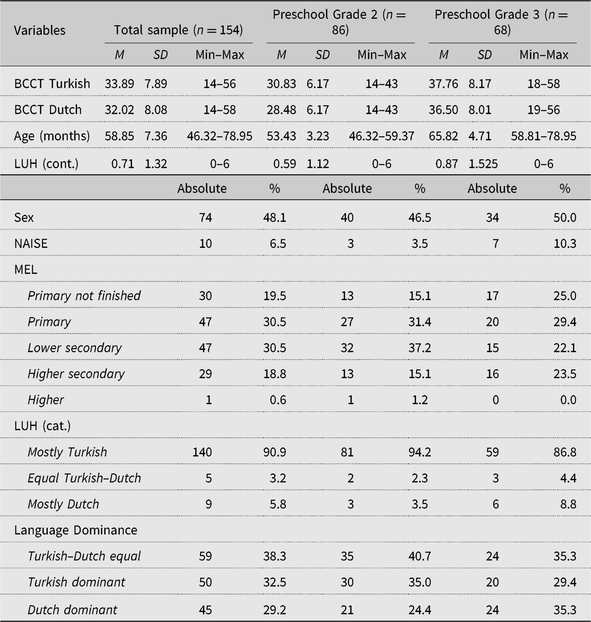
Descriptive statistics: BCCT raw scores and covariates

Note: BCCT, Bilingual Concept Comprehension Test (maximum score = 65). LUH, language use at home. MEL, maternal education level. NAISE, newly arrived immigrant school entrant.
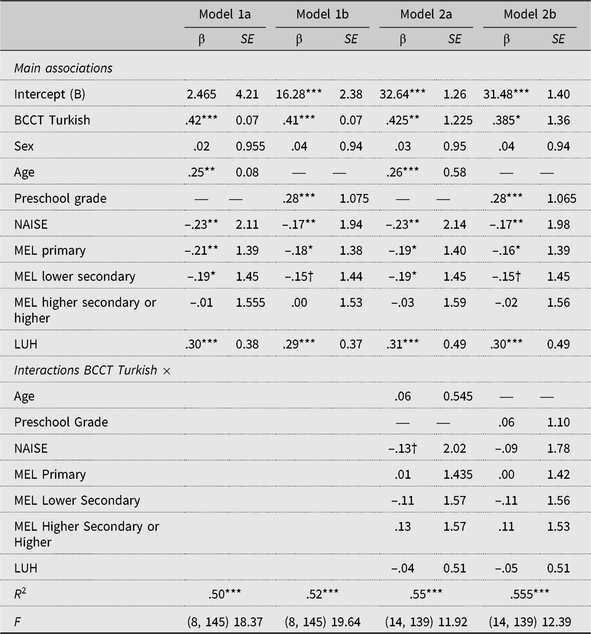
Linear regression models predicting Dutch vocabulary size: Standardized coefficients and standard errors (n = 154)

Note: BCCT, Bilingual Concept Comprehension Test. LUH, language use at home. MEL, maternal education level. NAISE, newly arrived immigrant school entrant. †p < .10. *p < .05. **p < .01. ***p < .001.
Research Question 2
This question addresses the relations between the covariates other than the vocabulary measures in the multiple regressions.
Research Question 3
This question addresses the moderation effects of factors on the L1–L2 relation. The moderation model examines the conditions under which the X–Y relation varies, testing whether the prediction of a dependent variable, Y, from an independent variable, X, differs across levels of a third variable, Z. In a basic moderation model, Y = i 5 + β1X + β2Z + β3XZ + e 5, if β3 is statistically different from zero, then there is significant moderation of the X–Y relation in the data (Fairchild & MacKinnon, Reference Fairchild and MacKinnon2009). We estimated moderation by entering two-way interaction terms in the multiple regressions. Continuous predictors were standardized to reduce multicollinearity (Cohen, Cohen, West, & Aiken, Reference Cohen, Cohen, West and Aiken2003). We computed partial interaction terms between Turkish performance and covariates that significantly predicted the Dutch outcome in the prior multiple regressions (Table 1: Models 2a and 2b; Table 2: Models 2c and 2d).
Results
Descriptives
The descriptives are presented in Table 1. The children’s ages ranged between 3;10 and 6;7 years (M = 4;11, SD = 0;7), attending PSG2 (3;10 to 4;11, M = 4;5, SD = 0;3) or PSG3 (4;10 to 6;7, M = 5;6, SD = 0;5). All participants used Turkish at home; 9 in 10 children used mostly Turkish; nearly 7 in 10 children (68.2%) used Turkish exclusively. In the bilingual Turkish–Dutch families, 42 children (27.3%) used Turkish as the primary language; 7 children (4.5%) used Dutch as the primary language. There were no participants whose Turkish use at home was so low that they could be considered Dutch monolingual. Notable is a 10% shift across the grades toward Dutch dominance, while Turkish–Dutch equality and Turkish dominance each decreased 5%. Of the 10 NAISE children, 5 were Turkish dominant, 1 was Dutch dominant, and 4 were equally proficient. Noteworthy is also the low education level of the children’s mothers in this sample: 19.5% had a diploma of higher secondary education, a low percentage compared to 83% for the entire female population in Flanders in the 25–49 age category (data for 2008 retrieved from statbel.fgov.be). Finally, we note that in PSG3, a higher number of children used more Dutch at home than the PSG2 children; however, the difference calculated through cross-tabulation was nonsignificant, χ2 (1) = 2.53, p = .158.
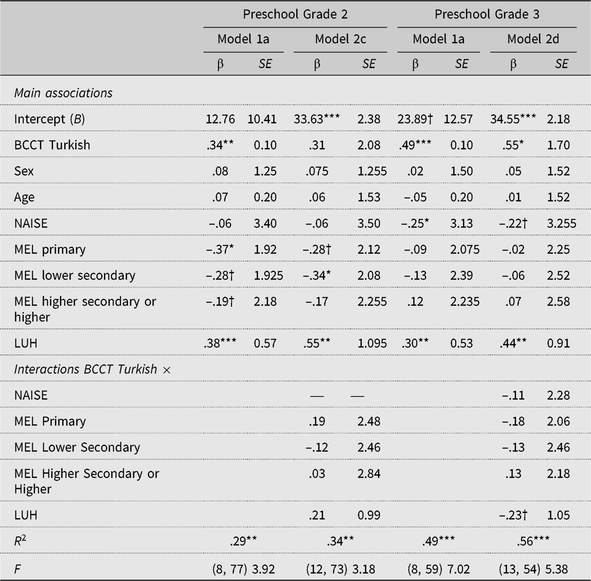
Linear regression models predicting Dutch vocabulary size: Standardized coefficients and standard errors for preschool Grades 2 (n = 86) and 3 (n = 68)

Note: BCCT, Bilingual Concept Comprehension Test. LUH, language use at home. MEL, maternal education level. NAISE, newly arrived immigrant school entrant. †p < .10. *p < .05. **p < .01. ***p < .001.
Research Question 1: Associations between vocabulary sizes
Total sample
The simple regression showed Turkish performance to be a significant strong positive predictor of the Dutch outcome, b = 0.57, t (152) = 8.21, p < .001. Turkish performance explained a significant proportion of variance in Dutch, R 2 = .31, F (1,152) = 67.47, p < .001. After entering the other covariates (Table 1: Model 1a), the relation between Turkish and Dutch performance became modest, b = 0.43, t (145) = 6.16, p < .001. A similar result was noted in Model 1b, b = 0.42, t (145) = 6.31, p < .001. Models 1a and 1b explained around half of the variance in the Dutch outcome, indicating a strong fit (Table 1: bottom rows, Model Summary statistics). Turkish performance showed unique variances of 17.6% (Model 1a) and 17.0% (Model 1b).
PSG
The results of the analyses conducted for each PSG are presented in Table 2. In PSG2, the positive relation between the Turkish and the Dutch outcomes was significantly modest in the simple regression, b = 0.29, t (84) = 2.77, p = .007; it gained some strength after entering the other covariates in the regression, b = 0.34, t (77) = 3.32, p = .001 (Table 2: Model 1a). At the PSG3 level, the positive relation between Turkish and Dutch outcomes was significantly strong in the simple regression, b = 0.53, t (66) = 5.19, p < .001, and remained practically so after entering the other covariates, b = 0.48, t (59) = 4.92, p < .001 (Table 2: Model 1a). Model 1a had a relatively strong fit for PSG3, but a poorer fit for PSG2 (Table 2: Model Summary statistics). The poor model fit may result from omitted-variable bias, which occurs when a statistical model incorrectly leaves out one or more relevant variables (Cohen et al., Reference Cohen, Cohen, West and Aiken2003). Variation in L2 exposure, which may be larger for children in PSG2, would better predict the variation in the Dutch outcome.
Research Question 2: Main associations with other covariates
For the entire sample, we detected significant positive weak effects of age and PSG on the Dutch outcome (Table 1: Models 1a and 2a). Age did not predict the Dutch outcome within each PSG (Table 2: Models 1a and 2a). Sex did not significantly predict Dutch performance (Tables 2 and 3). We observed significant negative weak relations between NAISE status and Dutch performance (Table 1: Models 1a and 2a). Furthermore, we found a significant positive weak relation with LUH. MEL primary and MEL lower secondary were both significant negative weak predictors; MEL higher secondary/higher yielded a zero beta-coefficient. Substituting PSG for age in Model 1b showed similar results to Model 1a for all other dummy variables (Table 1). The results of the separate PSGs (Table 2) showed trends similar to the entire sample. Striking differences are at PSG2 level: the zero beta of NAISE and the negative, weak/moderate effects of the three MEL dummy predictors, although only MEL primary was significant at the .05 alpha level (p = .013). All MEL predictors were nonsignificant in the PSG3 subsample.
Research Question 3: Interaction effects
Interaction Turkish Performance × Age/PSG
The two estimated interaction terms were nonsignificant positive weak, age: p = .361; PSG: p = .522 (Table 1: Models 2a and 2b).
Interaction Turkish Performance × NAISE
The interaction term was negative and very weak yet significant at the .10 alpha level in the model including age (Table 1, Model 2a: p = .082); the main association between NAISE and the Dutch outcome was weak yet significant (p = .001); the model including PSG revealed no significance (Model 2b: p = .183). At PSG3 level (Table 2: Model 2d), the interaction term was negative very weak and nonsignificant (p = .348). These results indicate a buffering moderator effect (Cohen et al., Reference Cohen, Cohen, West and Aiken2003), albeit very weak and inconsistent across the models. In other words, the NAISE status reduced somewhat the positive effect of Turkish performance on the Dutch outcome.
Interaction Turkish Performance × MEL
None of the interaction terms was significant in any of the models in Tables 2 and 3 (p > .10). Main associations between MEL predictors and Turkish performance were nonsignificant (analysis is not shown here).
Interaction Turkish Performance × LUH
The interaction terms were negative very weak and nonsignificant in Models 2a and 2b (Table 1). Models 2c and 2d with separate PSGs (Table 2) showed a nonsignificant positive weak effect of LUH for PSG2 (p = .162). For PSG3, the positive main association between LUH and the Dutch outcome (p = .002) and the significant negative weak interaction term (p = .093) together indicate an antagonistic moderator effect of LUH on the L1–L2 relationship (Cohen et al., Reference Cohen, Cohen, West and Aiken2003). This means that LUH reverses the effect of Turkish performance on the Dutch outcome.
Discussion
The purpose of this investigation has been to address the potential influence of internal and contextual factors on the interdependence of receptive vocabulary skills in a sample of Turkish–Dutch emergent bilingual children attending Flemish preschool. A cross-sectional regression model was designed to examine the cross-language relationship, and the interaction effects of L1 performance and various factors on the L2 outcome.
Linguistic interdependence
A first salient finding emerging from this study is that in the area of cognitive concept comprehension, a higher level of vocabulary size in L1 Turkish predicted a higher level of vocabulary size in L2 Dutch, controlling for other variables. This result bears out our hypothesis. Hence, our study provides support for linguistic interdependence regarding oral language, particularly receptive vocabulary. Of note, we observed modest to strong levels of linguistic interdependence, notwithstanding the average low level of maternal education and the absence of formal preschool education in L1. Admittedly, this finding is neither novel nor surprising, replicating results of past studies reporting positive L1–L2 correlations between receptive vocabulary skills in preschool-age Turkish-speaking children in the Netherlands (Leseman, Reference Leseman2000; Prevoo et al., Reference Prevoo, Malda, Emmen, Yeniad and Mesman2015; Scheele et al., Reference Scheele, Leseman and Mayo2010; Verhoeven, Reference Verhoeven2007) and Spanish-speaking children in the United States (Atwill et al., Reference Atwill, Blanchard, Gorin and Burstein2007; Branum-Martin et al., Reference Branum-Martin, Mehta, Francis, Foorman, Cirino, Miller and Iglesias2009; Farver et al., Reference Farver, Xu, Lonigan and Eppe2013; Solari et al., Reference Solari, Aceves, Higareda, Richards-Tutor, Filippini, Gerber and Leafstedt2014).
This finding suggests that at these early stages of language learning emergent bilingual children develop oral academic language skills in both L1 and L2 to relatively equal proficiency levels. What is more, bilingual preschool children are able to develop receptive academic skills in L1 in the absence of school tasks that require such language skills (Kang, Reference Kang2013). The L1 development arises from high levels of L1 input, which can be attributed to the continued usage across generations of the native language within Turkish families in Flanders (Altinkamis & Agirdag, Reference Altinkamis and Agirdag2014). Such L1 vitality may counteract the strong societal pressure on immigrant families and children to shift to the L2 as early as possible. Only future research will tell whether this in the long run can attenuate the negative effects of subtractive bilingualism on language minority children, such as L1 loss and higher risk of educational failure (Kan & Kohnert, Reference Kan and Kohnert2005; Leseman, Reference Leseman2000; Tabors et al., Reference Tabors, Páez and López2003, Wong Fillmore, Reference Wong Fillmore1991).
Age/preschool grade
As hypothesized, age and PSG significantly predicted L2 vocabulary size. The absence of significant age effects within each PSG suggests that the age effect on the entire sample can be interpreted as a grade effect. Thus, a significant part of the variation in the L2 outcome was attributable to grade rather than age.
Furthermore, we found that there was no significant difference in the magnitude of the cross-language relation between PSG2 and PSG3 children. In other words, the interdependence of vocabulary knowledge did not depend on grade. These findings corroborate our hypothesis, but are unlike those from longitudinal studies, which reported that positive cross-language correlations between vocabulary skills in emergent bilingual children became smaller or dropped with increasing age or grade (Leseman, Reference Leseman2000; Solari et al., Reference Solari, Aceves, Higareda, Richards-Tutor, Filippini, Gerber and Leafstedt2014; Verhoeven, Reference Verhoeven2007; see also Branum-Martin et al., Reference Branum-Martin, Mehta, Francis, Foorman, Cirino, Miller and Iglesias2009). Our finding accords with Prevoo et al. (Reference Prevoo, Malda, Emmen, Yeniad and Mesman2015), who found no age trend over a 2-year period in the interdependence of vocabulary growth in Turkish–Dutch preschool children. In addition, our finding does not affirm the weakening of interdependence with increasing age predicted by the RHM framework (Kroll & Stewart, Reference Kroll and Stewart1994; Yang et al., Reference Yang, Cooc and Sheng2017). It is likely that the age bracket of only a few years in our study was too small to detect any distinct age/grade trend. Moreover, it is conceivable that interdependence persists at some level in preschool-aged children and only decreases at higher ages (but for opposite findings: Gathercole et al., Reference Gathercole, Thomas, Roberts, Hughes, Hughes and Gathercole2013; Reich, Reference Reich and Söhn2005).
Delayed onset of schooling in L2
The relation between L1 and L2 vocabulary was reduced in NAISE children, affirming our hypothesis. Yet this was only significant in the regression model including age. In interpreting this result, caution is necessary, because of the low amount of NAISE children in our sample and the nonsignificant estimate that appeared in the alternative model with PSG. Taking this into account, the result might be explained within the framework of MacWhinney’s (Reference MacWhinney2005) competition model, which proposes that language development is driven by input. This would mean that NAISE children make more errors in L2 word comprehension by more frequently applying relevant L1 input cues to L2 words for which these cues are not valid, resulting in more negative transfer effects (Peña & Kester, Reference Peña, Kester and Goldstein2004). Another explanation may lie in the relation between interdependence and L2 proficiency. In the instance of NAISE children, this means that a lower level of L2 vocabulary would have a weakening effect on interdependence. This could be examined by relating language proficiency levels to the L1–L2 association and interpreting the results within the framework of linguistic “threshold” hypotheses, which assume a relationship between interdependence and language proficiency levels in L1 and/or L2 (Cummins, Reference Cummins1976; Skutnabb-Kangas & Toukomaa, 1976, as cited in Verhoeven, Reference Verhoeven1994). However, the examination of this hypothesis falls outside the scope of this study (but see, e.g., Ardasheva, Tretter, & Kinney, Reference Ardasheva, Tretter and Kinney2012; Cha & Goldenberg, Reference Cha and Goldenberg2015; Pham et al., Reference Pham, Donovan, Dam and Contant2018).
Maternal education
In contrast to the predicted positive association, significant negative associations were observed between maternal primary and lower secondary levels on the one hand and L2 vocabulary on the other (the association with higher secondary/higher was nonsignificant). These results contradict the consistent evidence of a positive connection between SES and L2 proficiency in bilingual learners (e.g., Bohman et al., Reference Bohman, Bedore, Peña, Mendez-Perez and Gillam2010; Cobo-Lewis, Pearson, et al., Reference Cobo-Lewis, Pearson, Eilers, Umbel, Ollers and Eilers2002a; Golberg et al., Reference Golberg, Paradis and Crago2008; Oller et al., Reference Oller, Pearson and Cobo-Lewis2007). Furthermore, our analysis revealed that the partly negative effects of MEL on L2 vocabulary can be attributed exclusively to the PSG2 subsample (the PSG3 estimates were nonsignificant). The absence of significant relations between MEL and Turkish performance (analysis is not shown) corresponds with extant research findings (Cobo-Lewis, Pearson, et al., Reference Cobo-Lewis, Pearson, Eilers, Umbel, Ollers and Eilers2002b; Hammer et al., Reference Hammer, Komaroff, Rodriguez, Lopez, Scarpino and Goldstein2012; Prevoo et al., Reference Prevoo, Malda, Emmen, Yeniad and Mesman2015; Quiroz et al., Reference Quiroz, Snow and Zhao2010).
These negative associations are counterintuitive, not to say puzzling, and pose quite a few difficulties for interpretation. The interpretation we will propose here is merely tentative. Given that our data show a significant yet weak positive correlation between MEL and LUH (analysis not shown here), it may be that higher Dutch input actually had a negative impact on the Dutch outcome. The reason for this would be that mothers with primary or lower secondary degrees drew upon insufficiently developed Dutch language skills in communicating with the child. It is in this group of mothers in particular, which was well represented in our sample (almost one in three mothers), that half of the participants were from families where mostly Turkish and some Dutch was spoken. Presumably, low Dutch input involved low quality of interactions in L2, which resulted in relatively “weak” cognitive input to the child. The data suggest that especially the younger children (PSG2) would be prone to this condition. Nevertheless, it is also possible that certain mothers who were schooled in Turkish in the country of origin and immigrated to Belgium as an adult had acquired limited skills in Dutch, which they used occasionally with their children, thus exposing them to low-quality Dutch input. We infer from this that the language in which the mother has been schooled and the academic language proficiency level may be mediating factors affecting the relation between quality of L2 input and L2 proficiency. Regrettably, the official data on education level employed in this study do not contain information on the country/countries where mothers were schooled. Such data may also help shed light on the nonsignificant relations between MEL and L1 vocabulary. This absence of data prevented us from teasing out the intricate interconnection of parental education, language of schooling, language proficiency, and parent–child language interactions. Further investigation with more detailed sociolinguistic data (Hammer et al., Reference Hammer, Komaroff, Rodriguez, Lopez, Scarpino and Goldstein2012) would be needed to verify this interpretation.
Another interesting result of our study is the lack of significant linguistic interdependence effects across maternal education levels. This result is consistent with Prevoo et al.’s (Reference Prevoo, Malda, Emmen, Yeniad and Mesman2015) finding that SES did not moderate interdependence in vocabulary growth. Hence, our study does not confirm the hypothesis advanced by Verhoeven (Reference Verhoeven1994) and Proctor et al. (Reference Proctor, August, Snow and Barr2010), among others, that SES context would play a role in linguistic interdependence, at least not in relation to receptive vocabulary in emergent bilingual children. The lack of interdependence can be explained, evidently, by the absence of significant relations between the MEL covariates and L1 performance (Cobo-Lewis, Pearson, et al., Reference Cobo-Lewis, Pearson, Eilers, Umbel, Ollers and Eilers2002b; Hammer et al., Reference Hammer, Komaroff, Rodriguez, Lopez, Scarpino and Goldstein2012; Prevoo et al., Reference Prevoo, Malda, Emmen, Yeniad and Mesman2015; Quiroz et al., Reference Quiroz, Snow and Zhao2010), or, conceivably, the absence of academic L1 input in a context of formal instruction (Branum-Martin et al., Reference Branum-Martin, Mehta, Francis, Foorman, Cirino, Miller and Iglesias2009; Cárdenas-Hagan et al., Reference Cárdenas-Hagan, Carlson and Pollard-Durodola2007; Goodrich et al., Reference Goodrich, Lonigan and Farver2013; Tabors et al., Reference Tabors, Páez and López2003).
Language use at home
The results for the LUH predictors need to be interpreted with caution due to the small subsample of Turkish children using Dutch at home. We found that higher use of Dutch at home positively predicted children’s Dutch outcome. This result is consistent with our hypothesis and with studies on Spanish–English bilingual preschool children in the United States (Mancilla-Martinez & Lesaux, Reference Mancilla-Martinez and Lesaux2011; Oller & Eilers, Reference Oller and Eilers2002). Furthermore, no significant negative impact was observed of higher use of Dutch at home on children’s Turkish performance (analysis not shown here), which parallels findings from investigations with Spanish–English preschool children (Hammer, Davison, Lawrence, & Miccio, Reference Hammer, Davison, Lawrence and Miccio2009; Mancilla-Martinez & Lesaux, Reference Mancilla-Martinez and Lesaux2011). However, a significant weak negative correlation between LUH and Turkish performance was revealed for PSG2, indicating that L2 use at home negatively impacted L1 vocabulary knowledge in the younger children.
The observed significant antagonistic effect of high use of Dutch at home on the relation between Turkish and Dutch outcomes in PSG3 children replicates the (inverse) positive moderator effect found in previous studies of high L1 use on the relation between L1 and L2 vocabulary (Cha & Goldenberg, Reference Cha and Goldenberg2015; Marchman et al., Reference Marchman, Fernald and Hurtado2010; Prevoo et al., Reference Prevoo, Malda, Emmen, Yeniad and Mesman2015). At the same time, the LUH variables did not significantly predict Turkish performance. This can be explained by an increased amount of competition occurring between L1 and L2 vocabulary development (Goodrich et al., Reference Goodrich, Lonigan, Kleuver and Farver2016; Hammer et al., Reference Hammer, Komaroff, Rodriguez, Lopez, Scarpino and Goldstein2012; Ordóñez et al., Reference Ordóñez, Carlo, Snow and McLaughlin2002). That is, the effort that young bilingual preschool children have to invest in learning L2 vocabulary is partly invested at the expense of their L1 vocabulary and vice versa (Scheele et al., Reference Scheele, Leseman and Mayo2010).
We should note that the variable of dominant/exclusive use of Turkish was represented by roughly 90% of the children, demonstrating a lack of variation in our sample. Within the subgroup of high users of Turkish at home, there may be variation in the quality of L1 interactions. However, this aspect remained hidden in this study, also because none of the MEL variables was able to predict significantly L1 vocabulary, disclaiming our expectation that MEL would be a proxy for the level of L1 interactions at home.
Language dominance
In the end, we did not examine the moderation effect of language dominance on linguistic interdependence. The reason for this was that no independent measure was available in our data to assess language dominance. The vocabulary measures could not be used to assess language dominance by means of the regression model used because this would lead to circular statistical analysis. More specifically, the L2 outcome, being the dependent variable, would codetermine the relative proficiency of L1 and L2, being an independent variable.
Revisiting linguistic interdependence
On the basis of the results of this study, we can say something about the validity of the CUP (Cummins, Reference Cummins1979) versus the ID model (Castilla et al., Reference Castilla, Restrepo and Perez-Leroux2009). Our data revealed that interdependence in the examined sample of children was weakly dependent on language use at home and onset of schooling, yet not dependent on age, grade, and maternal education. Overall, our evidence provides no indications for a strong influence of the examined internal and contextual factors on linguistic interdependence. Particularly, the equality of interdependence correlations within the age/grade range of the children in our study seems to suggest that there is a relatively stable system underlying language development in emergent bilinguals. This indicates relative independence of cross-language interactions on specific language experiences of a developmental nature, including contextual language support. This suggests that fundamental underlying cognitive abilities are at work, such as those abilities that specifically determine language learning, being more in line with the ID interpretation of interdependence.
Limitations
We note various limitations to this study. First, the moderating effects of type of skills, linguistic distance, and instructional context were not examined. Second, the quantity and quality of the L2 input in the children’s prior preschool career could not be measured, nor the general amount of prior preschool attendance as a proxy for the size of the L2 input. Third, we used only a single construct of vocabulary knowledge, which can be a threat to construct validity. Fourth, we did not assess general cognitive abilities (nonverbal intelligence or working memory) to control for their effect on children’s language performance. Fifth, due to the applied cross-sectional method, the cross-grade and cross-age comparisons cannot be interpreted as developmental data. Sixth, for the assessment of the sociolinguistic family background, we relied on a parent-report method, which provides only rough frequency estimates of language use at home. More important, it is unclear how variability in vocabulary skills was related to the quality of language interactions in the home environment.
Summary and practical implications
The present study set out to investigate the influence of potential internal and contextual factors on the cross-language relationship in young emergent bilinguals from Turkish background attending Flemish preschool. The results indicate that in emergent bilingual children who were learning academic L2 in an immersion-like context, there was a modest positive yet significant relationship between receptive vocabulary knowledge in L1 and L2. This finding appears to support the linguistic interdependence hypothesis regarding oral vocabulary. High L2 use at home and delayed onset of schooling in L2 had small negative effects on interdependence, albeit inconsistently. Apart from this, linguistic interdependence does not seem to depend on age, preschool grade, or maternal education. Taken together, linguistic dependence depends on the examined factors to a limited degree only. Finally, the results of this study implicate consistence with the individual differences model of linguistic interdependence, rather than the common underlying proficiency model.
Bearing in mind the correlational nature of the evidence, we cautiously advance some implications for practice. First, our findings inform family language policies, particularly for parents who raise preschool-age children in a minority/low-status L1 in a societal context where the majority/high-status L2 prevails. Parents who opt for a bilingual upbringing can expect their children to perform better in academic vocabulary in L2 at preschool, although this may cause limited harm to the L1 vocabulary development of younger children. In addition, there may be a small price to pay for high L2 input in the form of weakened interdependence, but only with older children. In addition, high maternal education is not a stringent condition for the presence of linguistic interdependence. Finally, parents who feel insecure about practicing bilingualism at home, because it is experienced as too challenging or because they feel their L2 competence falls short, better opt for maximum use of L1 with their children. In other words, if parents wish their preschool child to do well in L2, it may be better to use no L2 at all than to use some low-quality L2 at home. Second, there is definitely experimental evidence that cross-language transfer takes place in bilingual education, improving language and literacy proficiencies in both L1 and L2, and that this can be key in boosting the school outcomes of language minority students (August & Shanahan, Reference August and Shanahan2006; Cummins, Reference Cummins2000; Genesee, Lindholm-Leary, et al., Reference Genesee, Lindholm-Leary, Saunders and Christian2006; Prevoo, Malda, Mesman, & van IJzendoorn, Reference Prevoo, Malda, Mesman and van IJzendoorn2016). However, apart from the conditions of languages with cognates (Gathercole, Reference Gathercole, Siiner, Hult and Kupisch2018; Riches & Genesee, Reference Riches, Genesee, Genesee, Lindholm-Leary, Saunders and Christian2006) and cross-language transfer of some word-specific information (Goodrich et al., Reference Goodrich, Lonigan, Kleuver and Farver2016), the jury is still out on the claim that promoting oral vocabulary proficiency in L1 can facilitate oral vocabulary learning in L2 in emergent bilingual children of preschool age through cross-language transfer of vocabulary skills.
Acknowledgments
This work was supported financially by the Department of Education of the City of Ghent, Belgium. We thank the anonymous reviewers and Dr. Annie Tremblay for the insightful and valuable comments. Special thanks go to Elke Flament, Ayşe İşçi, Tuğba Kalaz, Liesbet Philippaert, Kathleen Pisman, and Çiğdem Vandegehuchte for the test administration. We are grateful to Katrien Bultynck, Nell Foster, Kathleen Pisman, and Machteld Verhelst for their vital contributions to this study.