Reading acquisition is fundamentally metalinguistic (Nagy & Anderson, Reference Nagy, Anderson, Wagner, Venezky and Street1999). Because print encodes spoken language, the ability to reflect on and manipulate different linguistic units or metalinguistic awareness plays a critical role in learning to read (Adams, Reference Adams1990; Perfetti, Reference Perfetti2003). In other words, children must work out how written symbols correspond to structural units of a given language. Two types of metalinguistic awareness have received particular attention in research on reading acquisition. One of them is phonological awareness, which pertains to students’ sensitivity to sound units at different levels (e.g., syllable, onset-rime, and phoneme). While there is a general consensus that phonological awareness plays a fundamental role in learning to read (Melby-Lervåg, Lyster, & Hulme, Reference Melby-Lervåg, Lyster and Hulme2012), variations exist in how these different units are prioritized across languages and orthographies due to differences in psycholinguistic grain-size (Ziegler & Goswami, Reference Ziegler and Goswami2005). The other type of metalinguistic awareness is morphological awareness, which refers to the sensitivity to morphemes (i.e., the smallest unit of meaning) and morphological structures of words (Carlisle, Reference Carlisle2003). Given that in all languages, print encodes meaning, and most words are multimorphemic, morphological awareness is also essential to reading acquisition (Carlisle, Reference Carlisle2003; Nunes & Bryant, Reference Nunes, Bryant, Vadasy and O'Connor2011; Verhoeven & Perfetti, Reference Verhoeven and Perfetti2011). Overall, there has been a general consensus, too, that morphological awareness is a unique, significant predictor of word reading (e.g., Deacon, Benere, & Pasquarella, Reference Deacon, Benere and Pasquarella2013; Deacon & Kirby, Reference Deacon and Kirby2004; Mahony, Singson, & Mann, Reference Mahony, Singson and Mann2000).
Under the mandates of the linguistic and language-to-print mapping properties of a given language, the critical import of phonological and morphological awareness should apply not only to monolingual readers but also to second language (L2) or bilingual readers (Geva & Wang, Reference Geva and Wang2001; Koda, Reference Koda2005). However, the functioning of these two types of metalinguistic awareness can be inherently more complex in L2 or bilingual reading than in monolingual reading because the former necessarily involves two languages (thus two linguistic systems) and often different orthographies as well (Koda, Reference Koda2005). Recently, there has been increasing interest in cross-linguistic relationships between reading-related abilities in the two languages of L2 or biliteracy learners. It is suggested that metalinguistic awareness is a resource that can be transferred from one language to facilitate the development of reading and its related abilities in the other language (Durgunoglu, Reference Durgunoglu2002; Genesee, Geva, Dressler, & Kamil, Reference Genesee, Geva, Dressler, Kamil, August and Shanahan2006; Geva, Reference Geva2014; Koda, Reference Koda2005).
Around transfer of metalinguistic awareness, a number of studies have been conducted on diverse languages, contexts of learning, and groups of learners (Genesee et al., Reference Genesee, Geva, Dressler, Kamil, August and Shanahan2006; Melby-Lervåg & Lervåg, Reference Melby-Lervåg and Lervåg2011). Many issues, however, still remain unclear, including the developmental mechanism of transfer, or how transferred metalinguistic awareness becomes serviceable in reading development in a target language. To examine cross-linguistic transfer facilitation, cross-sectional studies that only provide concurrent cross-linguistic relationships are inadequate; longitudinal studies that can account for developmental change in reading are necessary (Deacon & Cain, Reference Deacon and Cain2011; Genesee et al., Reference Genesee, Geva, Dressler, Kamil, August and Shanahan2006). To this end, we conducted this 1-year cross-lagged panel (CLP) study that examined phonological and morphological awareness in bilingual reading development, focusing on young Malay children learning to become literate concurrently in Malay and English through formal instruction in Singapore. Malay is a language of the Austronesian family; English and Malay are both alphabetic but differ in orthographic depth. In addition, both languages are characterized by a productive derivational morphological system. These similarities and variations in linguistic and language-to-print mapping properties suggest that Malay–English biliteracy could be an interesting case to further our knowledge about the metalinguistic underpinnings of reading acquisition, particularly transfer of metalinguistic awareness in biliteracy acquisition. CLP, as a longitudinal data analysis method, has an advantage in testing developmentally reciprocal relationships between variables with autoregressor control (Biesanz, Reference Biesanz and Hoyle2012; Selig & Little, Reference Selig, Little, Laursen, Little and Card2012). Despite being often used to account for gains in reading development (e.g., Deacon et al., Reference Deacon, Benere and Pasquarella2013), it has been rarely applied to bilingual reading research, such as examination of the developmental mechanism of cross-linguistic transfer. In this study, using CLP, we aimed to examine how phonological and morphological awareness in one language would predict developmental change in the corresponding type of metalinguistic awareness as well as word reading in the other language.
CROSS-LINGUISTIC TRANSFER FACILITATION: A DEVELOPMENTAL PERSPECTIVE
Researchers have long been interested in cross-linguistic transfer in L2 reading or biliteracy development (Durgunoglu, Reference Durgunoglu2002; Geva, Reference Geva2014; Koda, Reference Koda2005). Different frameworks have been proposed in the literature with varied levels of attempt to account for, and often with different views on, what transfer is, what transfers or is transferrable, when and how transfer happens, and how transferred competence becomes functional in reading development in a target language. These conceptualizations include, for example, the linguistic interdependence hypothesis (Cummins, Reference Cummins1979, Reference Cummins and Bialystok1991), L2 reading being a reading or language problem (Alderson, Reference Alderson, Alderson and Urquhart1984), and common underlying cognitive processes (Geva & Ryan, Reference Geva and Ryan1993). (A detailed review of these conceptualizations is beyond the scope of this paper. For recent reviews, interested readers can refer to Geva, Reference Geva2014, and Hipfner-Boucher and Chen, Reference Hipfner-Boucher, Chen, Chen, Dronjic and Helms-Park2016.) More recently, with metalinguistic awareness foregrounded as a transferrable skill, Koda (Reference Koda, Koda and Zehler2008) proposed the transfer facilitation model to account for the nature, mechanism, and conditions of cross-linguistic transfer in L2 or bilingual reading development.
A central tenet of the transfer facilitation model is that metalinguistic awareness can be transferred from the source language as a resource to facilitate the development of reading and its related abilities in the target language. However, transfer facilitation from the source language is not necessarily the only mechanism to account for any development in the target language, and it does not occur without conditions. To begin with, learning to read in any language requires extensive print processing. Target language competencies are thus developmentally an outcome of the complex interplay between transferred metalinguistic awareness from the source language and learners’ print exposure or reading experience in the target language. In addition, because languages can differ in linguistic and language-to-print mapping properties (Geva & Wang, Reference Geva and Wang2001; Perfetti, Reference Perfetti2003), cross-linguistic variations in metalinguistic awareness should be expected. Presumably, only “shared” facets or aspects of metalinguistic awareness that are critical to reading acquisition in both languages would and could be transferred and exert a facilitation effect. Finally, facilitation through transfer should also be conditioned upon the sophistication of learners’ metalinguistic insights in the source language. In other words, source language proficiency and the relative proficiency in the source and the target language could also have an impact on whether transfer happens and, if so, how it happens.
The transfer facilitation model provides a conceptual framework that accommodates print/reading experience, linguistic distance, and language proficiency for examining cross-linguistic transfer of metalinguistic awareness in L2 or bilingual reading. Some hypotheses inherent to the model have been tested in studies on diverse cases of biliteracy and groups of learners. In those studies, focal metalinguistic awareness and reading measures parallel in the two languages are typically administered at the same time; metalinguistic awareness in one language is then used to predict corresponding metalinguistic awareness and/or reading in the other language (Hipfner-Boucher & Chen, Reference Hipfner-Boucher, Chen, Chen, Dronjic and Helms-Park2016; Kuo & Anderson, Reference Kuo, Anderson, Koda and Zehler2008). In general, there has been consistent evidence that supports transfer of “shared” facets of metalinguistic awareness, such as phonological and derivational awareness in Spanish and English (e.g., Durgunoglu, Nagy, & Hancin-Bhatt, Reference Durgunoglu, Nagy and Hancin1993; Ramirez, Chen, Geva, & Kiefer, Reference Ramirez, Chen, Geva and Kiefer2010; Sun-Alperin & Wang, Reference Sun-Alperin and Wang2011); phonological awareness and awareness of inflectional morphology in French and English (e.g., Deacon, Wade-Woolley, & Kirby, Reference Deacon, Wade-Woolley and Kirby2007; Jared, Cormier, Levy, & Wade-Woolley, Reference Jared, Cormier, Levy and Wade-Woolley2011); and rime and compound awareness in Chinese and English (e.g., Gottardo, Yan, Siegel, & Wade-Woolley, Reference Gottardo, Yan, Siegel and Wade-Woolley2001; Wang, Cheng, & Chen, Reference Wang, Cheng and Chen2006; Zhang, Reference Zhang2013; Zhang & Koda, Reference Zhang and Koda2014). Some studies also explored the effects of linguistic distance (e.g., Wang et al., Reference Wang, Cheng and Chen2006; Zhang, Reference Zhang2013) and learners’ proficiency repertoire (e.g., Ramirez et al., Reference Ramirez, Chen, Geva and Kiefer2010) on patterns of transfer.
Despite the increasing interest in transfer of metalinguistic awareness, the developmental mechanism of transfer, as emphasized in the transfer facilitation model (Koda, Reference Koda, Koda and Zehler2008), remains unclear. This seems to be attributable to the cross-sectional nature of existing research. Understanding transfer facilitation requires longitudinal research to examine how metalinguistic awareness in one language may explain change in the other language, over and beyond concurrent cross-linguistic relationships. However, studies designed for such a purpose are very limited in the literature (Deacon & Cain, Reference Deacon and Cain2011; Genesee et al., Reference Genesee, Geva, Dressler, Kamil, August and Shanahan2006; Melby-Lervåg & Lervåg, Reference Melby-Lervåg and Lervåg2011). From a developmental perspective, we still know little about how transferred competence becomes facilitative. Two issues seem particularly important.
First, does transfer facilitation happen only at the construct level (i.e., metalinguistic awareness), or does transferred metalinguistic awareness also directly facilitate reading development in the target language? While concurrent cross-linguistic relationships in the literature tend to provide a positive answer for both questions (Hipfner-Boucher & Chen, Reference Hipfner-Boucher, Chen, Chen, Dronjic and Helms-Park2016; Kuo & Anderson, Reference Kuo, Anderson, Koda and Zehler2008), the insights based on this type of evidence are necessarily limited. In addition, contrary to the evidence from concurrent relationships, a few recent longitudinal studies suggested that a direct transfer facilitation effect on reading abilities may not be possible; instead, such transfer facilitation may only be manifested at the level of metalinguistic awareness (e.g., Luo, Chen, & Geva, Reference Luo, Chen and Geva2014; Zhang, Koda, & Leong, Reference Zhang, Koda and Leong2016).
Second, in which direction does transfer facilitation happen? Presumably, it would be unidirectional from the stronger to the weaker language, but in view of the diverse contexts of L2 or bilingual reading, the issue could be more nuanced and complex. For example, in a foreign language context, it is reasonable to expect transfer facilitation from the native language (Zhang, Reference Zhang2013; Zhang & Koda, Reference Zhang and Koda2014). In an L2 context where the target language is the societal language (e.g., English as a second language [ESL] in the United States), directionality of transfer could be sensitive to the socioeducational experience of minority students: from ethnic language to English at the early stage of ESL reading acquisition (e.g., Sun-Alperin & Wang, Reference Sun-Alperin and Wang2011), but from English to ethnic language as a result of students’ increased English experiences, especially formal literacy experiences through schooling (e.g., Wang et al., Reference Wang, Cheng and Chen2006). These findings lead to a question about directionality of transfer in a bilingual or multilingual context that has been rarely examined in the literature from a developmental perspective. In a notable longitudinal study, Deacon et al. (Reference Deacon, Wade-Woolley and Kirby2007) found bidirectional transfer of morphological awareness between English and French among biliteracy learners in a French immersion program in Canada. In this study, we aimed to further examine such an issue with a focus on concurrent biliteracy learners of Malay and English in Singapore.
ENGLISH AND MALAY: PHONOLOGY, ORTHOGRAPHY, AND MORPHOLOGY
The focal languages of the present study were English and Malay. Malay belongs to the Austronesian language family and is used in Brunei, Malaysia, and Singapore (the variety used in Indonesia is called Indonesian; Prentice, Reference Prentice and Comrie1987; Tadmor, Reference Tadmor and Comrie2009). English and Malay (Rumi or the Romanized script) are both alphabetic and follow the rule of grapheme-to-phoneme correspondence but differ in orthographic depth (Katz & Frost, Reference Katz, Frost, Forst and Katz1992). English is a deep orthography, whereas the Rumi, like Italian and Spanish, is a shallow orthography characterized by highly regular letter-to-phoneme mapping relationships. In Malay Rumi, each letter represents one phoneme, with the exception of the letter e, which corresponds to two phonemic forms (i.e., /e/ and /ə/, but predominantly the latter; Lee, Low, & Mohamed, Reference Lee, Low and Mohamed2012). Syllable structures in Malay can be of various types (e.g., vowel [V], vowel–consonant [VC], VCC, CCV, CV, CVC, CVCC, and CCVC), but most syllables are CV and CVC (Lee et al., Reference Lee, Low and Mohamed2012; Rickard Liow & Lee, Reference Rickard Liow and Lee2004). Unlike English, monosyllabic words are very few in Malay; most Malay words are multisyllabic (Prentice, Reference Prentice and Comrie1987). Lee et al. (Reference Lee, Low and Mohamed2012) found that multisyllabic words in textbooks for beginning readers in Malaysia are most commonly formed through different CV and CVC combinations. In contrast to the prevalence of irregularities in English, which pose challenges to English-speaking children's learning to read (Rayner, Foorman, Perfetti, Pesetsky, & Seidenberg, 2011), the transparent letter–phoneme mappings in Malay Rumi should make it a very easy orthography to learn. However, it is interesting that phoneme-level skills are not instructionally emphasized; instead, teachers work at the syllable level (or a large-size unit; Ziegler & Goswami, Reference Ziegler and Goswami2005), such as syllable segmentation and blending, in teaching children to learn to read in Malay (Lee, Reference Lee2008; Rickard Liow & Lee, Reference Rickard Liow and Lee2004; Winskel & Widjaja, Reference Winskel and Widjaja2007).
In addition to both being alphabetic, English and Malay also show linguistic proximity in morphology, that is, a productive derivational system. In English, morphologically complex words are largely formed through three processes: inflection, derivation, and compounding (Plag, Reference Plag2003). A majority of English words are formed by adding a prefix(es) and/or a suffix(es) to a base word. Despite the lack of transparency in letter–phoneme mappings, English is more regular at the morphological level (Nunes & Bryant, Reference Nunes, Bryant, Vadasy and O'Connor2011). For example, the pronunciation of –ive varies in single-morpheme words (e.g., /ɪv/ in give and /aɪv/ in arrive), but is consistently /ɪv/ when it serves as a derivational suffix such as in preventive. Nevertheless, derivational suffixation in English is not always regular at the morphophonemic or morphographic level in that adding a suffix can result in change to the sound and/or spelling of the base word (Carlisle, Reference Carlisle2003; Nunes & Bryant, Reference Nunes, Bryant, Vadasy and O'Connor2011). Phonological shift (e.g., magic ➔ magician), orthographic shift (e.g., response ➔ responsive), or both types of shift (e.g., decide ➔ decision) as a result of derivational suffixation are common in English.
In Malay, in addition to compounding and reduplication, affixation is also a major way of word formation. However, Malay has little inflection like the English suffixation marking plural or past tense (Prentice, Reference Prentice and Comrie1987; Tadmor, Reference Tadmor and Comrie2009). Affixation morphology in Malay is largely derivational. According to Prentice (Reference Prentice and Comrie1987), there are about 25 derivational affixes in Malay, including prefixes (e.g., peng: ajar [to teach] ➔ pengajar [teacher]), suffixes (e.g., i: luka [wound] ➔ lukai [to hurt]), and circumfixes (e.g., per. . .an: makan [to eat] ➔ permakanan [the habit of eating]). Compared to English, phonological and orthographic shift as a result of derivation are rare in Malay except for the two prefixes me- (marking active verbs) and pe- (deriving agents). In these two cases, different allomorphs (men-, mem-, meng-, and meny- for me-; and pen, pem-, peng-, and peny- for pe-) are used depending on the initial letter of the base word. For example, me- or pe- is used when the base starts with the letter l, m, n, or r, such as pe- + masak (to cook) = pemasak (a cook); mem- or pem- is used when the base starts with the letter b, p (p is dropped), or f, such as pem- + bantu (to help) = pembantu (helper). Most affixes in Malay also interact with reduplication to produce very complex word forms (Tadmor, Reference Tadmor and Comrie2009). For example, membahagi-bahagikan (to share or distribute) is composed of the prefix mem-, the reduplicated stem bahagi (to divide), and the suffix -kan. The complexity and prevalence of derivation in Malay constitutes a challenge to children in their reading acquisition (Lee et al., Reference Lee, Low and Mohamed2012). Conversely, it suggests that morphological awareness can be a very important skill that supports reading acquisition in Malay. This perhaps explains the fact that morphology is often an integral component of Malay curriculum and classroom instruction (Ministry of Education, 2014; Rickard Liow & Lee, Reference Rickard Liow and Lee2004; Winskel & Widjaja, Reference Winskel and Widjaja2007).
The above descriptions of Malay and English suggest that biliteracy in the two languages could be an interesting case to further our knowledge about how phonology and morphology function in reading acquisition, particularly transfer of phonological and morphological awareness in bilingual reading acquisition. However, bilingual reading in Malay and English, as well as reading acquisition in Malay in general, has received little attention in the literature. Previously, it was suggested that due to the lack of explicit instructional attention to letter–phoneme mappings in Malay, children may rely only on large-size units (e.g., syllable and morpheme) to learn to read or spell Malay words, and phonemic insights are not needed (Rickard Liow & Lee, Reference Rickard Liow and Lee2004). More recent studies on native-speaking students in Malaysia or Indonesia, however, revealed that beginning readers actually used units of both large and small size to support their word reading, although there are debates on which unit, syllable or phoneme, is prioritized (Lee, Reference Lee2008; Lee & Wheldall, Reference Lee and Wheldall2011; Winskle & Widjaja, Reference Winskel and Widjaja2007). There is also evidence that native-speaking children used morphological knowledge to support word reading or spelling (Rickard Liow & Lee, Reference Rickard Liow and Lee2004; Winskel & Widjaja, Reference Winskel and Widjaja2007). Zhang's (Reference Zhang2016) study on Malay–English bilingual children in Singapore found that explicit instruction on English derivation led to significant gains in morphological awareness and word reading in both English and Malay. This finding suggests a possibly causal effect of morphological awareness transfer in Malay–English biliteracy acquisition. Despite this preliminary knowledge base, we still know little about the metalinguistic underpinnings of Malay reading, particularly among bilingual readers.
THE PRESENT STUDY
To deepen our understanding of Malay reading and the developmental mechanism of cross-linguistic transfer facilitation, we conducted this longitudinal study with a focus on phonological and morphological awareness in bilingual word reading among Malay children learning to become literate concurrently in Malay and English in Singapore. The following three questions guided this study:
-
1. Do phonological and morphological awareness contribute to word reading within both Malay and English? In view of the linguistic and mapping properties of the two languages, we predicted both types of metalinguistic awareness would make a significant contribution to word reading in the two languages.
-
2. Do phonological and morphological awareness transfer from one language to facilitate the development of the corresponding type of metalinguistic awareness in the other language? Given the linguistic proximity between English and Malay we delineated earlier, and the biliteracy context in Singapore detailed below, we predicted reciprocal transfer facilitation effects between the two languages at the level of metalinguistic awareness (i.e., construct level transfer).
-
3. Do the two types of metalinguistic awareness transfer from one language to facilitate word reading development in the other language? Under the same considerations for the second question, we predicted there would also be reciprocal facilitation effects of metalinguistic awareness transfer on word reading development between the two languages. This prediction was also made with consideration of the prevalent concurrent cross-linguistic relationships in the literature between other languages with similar linguistic proximity.
METHOD
Participants
The participants were 131 ethnic Malay children learning to become literate concurrently in English and Malay in Singapore. They came from three elementary schools and participated in this 1-year longitudinal study from the end of Grade 3 to the end of Grade 4. They included 54 boys and 77 girls with an average age of 9.4 years (SD = 0.35) at the end of Grade 3 when they were first assessed with the tasks described later.
Singapore is a small multilingual country in Southeast Asia with its population comprising three major ethnic groups: Chinese, Malay, and Indian. The three ethnic languages or mother tongues of these three groups (i.e., Chinese, Malay, and Tamil) and English are the country's four official languages. Under the bilingual education system in Singapore, English is the medium of instruction as well as a school subject itself; in addition, students learn their respective mother tongue as another school subject (Dixon, Reference Dixon2005). Based on its importance in the school curriculum, English is designated as the “first school language,” whereas a mother tongue is a “second school language” (Pakir, Reference Pakir, Cummins and Hornberger2008, p. 191). On a typical school day, students from different ethnic backgrounds learn English and other subjects taught in English (e.g., math and science) in the same classroom; for mother tongue instruction, those of the same ethnic background from different English classes will come together to form a new class.
Formal instruction in English and the mother tongue begins concurrently at the commencement of primary school (Grade 1); it continues for 12 years in both languages until students finish their junior college or high school. The primary school English curriculum (Strategies for English Language Learning and Reading) emphasizes both oral proficiency development and explicit instruction on literacy skills. For example, at the beginning of learning to read, word reading skills, such as letter names and sounds, syllables and phonemes, and phonics, are explicitly taught. Explicit instructional attention is also given to morphology. However, morphological teaching in English seems to be targeted more on the acquisition of grammar (e.g., correct use of morphosyntax) than on supporting students’ word-level reading skills development (Zhang, Reference Zhang2016). With regard to instruction for learning to read in Malay, as mentioned earlier, emphasis is on using syllable, as opposed to phoneme, as a salient unit to teach students to pronounce written words. Derivation also receives explicit curricular and instructional attention (Ministry of Education, 2014).
English and Malay tasks
The same battery of literacy tasks, which was parallel in English and Malay, were administered at the end of Grade 3 (Time 1) and again at the end of Grade 4 (Time 2). All tasks were researcher developed, except English phonological awareness and vocabulary knowledge. Raven's Standard Progressive Matrices (Sets A, B, and C with 36 items; Raven, Raven, & Court, Reference Raven, Raven and Court1998) were also administered once at Time 1 to measure nonverbal intelligence. The children were individually tested in phonological awareness and word reading in a quiet room in school. The vocabulary knowledge and morphological awareness tasks were group administered by experienced research assistants in the children's regular English and Malay classes. The morphological awareness and word reading tasks had also been used in our previous studies on Malay–English bilingual children in Singapore (Zhang, Reference Zhang2016; Zhang et al., Reference Zhang, Koda and Leong2016).
Phonological awareness
English phonological awareness was measured with the Elision section of the Comprehensive Test of Phonological Processing (Wagner, Torgesen, & Rashotte, Reference Wagner, Torgesen and Rashotte1999). It included 17 words; learners were to say aloud each word after an identified phoneme was removed. The Malay phonological awareness task included 15 phoneme deletion items with disyllabic words of diverse structures composed of CV and CVC (i.e., the two most common syllable structures in Malay) where consonants at different places were removed. All test words and their forms with the identified consonants removed were real words. For example, /bulat/ (round) without saying /b/ is /ulat/ (worm); and /sukan/ (sport) without saying /n/ is /suka/ (like). The reliability of these phonological awareness tasks at Time 1 and Time 2 and that of the other tasks are presented in Table 1.
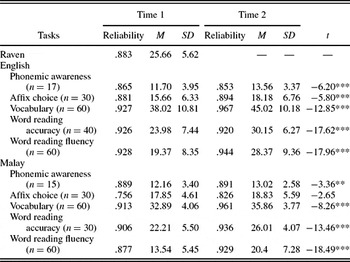
Means and standard deviations of children's performance on all tasks at Time 1 (Grade 3) and Time 2 (Grade 4)

Note: Bonferroni correction for significance testing between Time 1 and Time 2, given multiple t tests.
**p < .01. ***p < .001.
Affix choice
Morphological awareness was measured with an affix choice task that focused on the grammatical function of derivational affixes. The children were instructed to fill the blank in a lexically and grammatically simple sentence (e.g., It is not easy to measure the___of light. / I could feel the___.) with one of three derived forms that shared the same real or pseudo-stem (intensely, intensify, intensity / froody, froodful, froodment). The Malay task had the same format. For example, the sentence Ahmad menangis kerana dia ___ di padang (Ahmad is crying because he ___ on the field.) had three choices that shared the same stem jatuh (fall): kejatuhan (ke- + jatuh + -an; an accident of falling), terjatuh (ter- + jatuh; accidentally fall), and menjatuh (men- + jatuh; dropping). In both languages, there were 30 items, 15 items with real derived words and 15 with derived pseudowords. The tasks were administered in written form; however, to avoid possible influence of decoding on the participants’ performance, the instructions and the items of each task were read aloud to them as they were working on its printed version.
Vocabulary knowledge
English oral, receptive vocabulary knowledge was measured with the Peabody Picture Vocabulary Test—Fourth Edition (PPVT-IV; Dunn & Dunn, Reference Dunn and Dunn2007). Because the focus of this study was on individual variability rather than on determining students’ actual level of vocabulary knowledge, the standardized procedure was not followed to administer the test. To balance the considerations for a need to capture adequate individual differences (for covariance structural modeling) and time constraint in data collection, 60 words were selected from Sets 7 through 11 and group administered. Set 7 (Start Age 8) rather than Set 8 (Start Age 9) was chosen as the beginning set even though the participants were about 9 years old when first tested at the end of Grade 3. This choice was made under the ad hoc consideration that they were bilingual children learning English in a non-English monolingual context. The children were to listen to each target word read aloud to them by a research assistant and select one picture out of four on a booklet to represent the meaning of the word heard.
The Malay vocabulary knowledge test was specifically developed for this study. It also included five sets of 12 words of various frequency levels. These words were selected with reference to the word categories in the PPVT-IV and frequency analysis of Malay words in the Corpus of Dewan Bahasa dan Pustaka (Institute of Language and Literature, a government agency for planning of language and literature in Malaysia; Hajar Abdul Rahim, Reference Rahim2014). For each target word, four black-and-white pictures drawn by an artist were presented in a booklet. Like the PPVT-IV, the children were to select a picture that best represented the meaning of a target word orally presented to them.
Word reading
In both English and Malay, there were two derived word decoding tasks that measured basic accuracy and fluency of word reading, respectively. In the untimed, decoding accuracy task, the children were presented derived words printed on cards and were asked to read aloud each word. The English task included 40 derived words. Most of them were phonologically and orthographically regular (e.g., successful) in that suffixation did not lead to any change to the sound and spelling of the base word. The Malay task included 30 derived words, most of which were regular (e.g., halangan [hindrance] = halang [block] + -an [result or recipient of action]). In the timed decoding task that addressed fluency, the children were asked to read aloud, in both English and Malay, a maximum of 60 derived words in 30 s as accurately and rapidly as possible without skipping any word. As in the untimed or accuracy task, the derived words in the two languages were largely regular with no sound and spelling change to the base words after affixation. In both languages, all test words were randomized on a sheet of paper; the children were given 6 words to practice as many times as they felt they needed before they moved on to the test words.
Data analysis methods
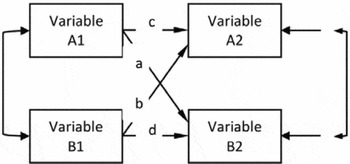
We adopted the structural equation modeling (SEM) method (Kline, Reference Kline2016) to examine the contribution of phonological and morphological awareness to word reading both within English and Malay and between the two languages. To examine cross-linguistic transfer facilitation, we conducted CLP analysis (Biesanz, Reference Biesanz and Hoyle2012; Selig & Little, Reference Selig, Little, Laursen, Little and Card2012). Figure 1 shows a simple CLP model with two observed variables measured at two time points. As a method for longitudinal data analysis, CLP has an advantage in addressing how Variable A at Time 1 predicts Variable B at Time 2 (Path c), and conversely, how Variable B at Time 1 predicts Variable A at Time 2 (Path d; i.e., “cross-lagged” effect or change), controlling for Variable B or A at Time 1 (i.e., lagged or autoregressive effect or stability; Paths a and b). Hence, CLP modeling allows for testing the reciprocity of developmental relationships between two or more variables. In the present study, CLP modeling addressed how Time 1 metalinguistic awareness in one language predicted change in corresponding type of metalinguistic awareness as well as word reading in the other language.
Cross-lagged panel model with two-wave data with two observed variables.

All SEM analyses were conducted with Mplus 7 (Muthén & Muthén, Reference Muthén and Muthén1998–2015) with maximum likelihood estimation. To supplement significance testing of χ2 values, different goodness-of-fit indices have been proposed for evaluating an SEM model. As suggested by Hu and Bentler (Reference Hu and Bentler1999), we reported comparative fit index (CFI), root mean square error of approximation (RMSEA), and standardized root mean square residual (SRMR); and cutoff values of CFI ≥ 0.95, RMSEA ≤ 0.06, or SRMR ≤ 0.08 indicated an SEM model with very good fit.
RESULTS
Descriptive statistics, time comparisons, and bivariate correlations
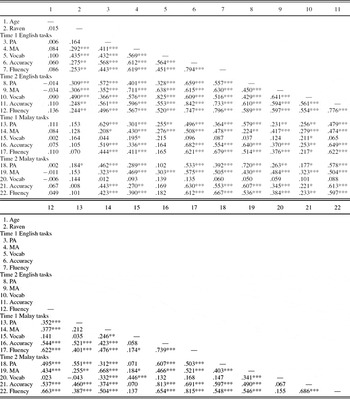
Table 1 shows the means and standard deviations of the children's performance on all the tasks at Time 1 and Time 2. Time 2 performance was significantly better than Time 1 performance for all tasks except Malay Affix Choice, as revealed by a series of t tests with Bonferroni correction. Table 2 shows the concurrent and longitudinal correlations between all tasks within and between languages. Phonological and morphological awareness significantly correlated with both word reading accuracy and fluency at both Time 1 and Time 2 within English as well as Malay. In addition, significant cross-linguistic correlations were observed between the two types of metalinguistic awareness and the two word reading tasks both concurrently and longitudinally.
Bivariate correlations between all tasks at Time 1 (Grade 3) and Time 2 (Grade 4)

Note: Raven, nonverbal intelligence; PA, phoneme deletion; MA, affix choice; Vocab, vocabulary knowledge; Accuracy, word reading accuracy; Fluency, word reading fluency.
*p < .05. **p < .01. ***p < .001.
Within-language SEM analyses predicting word reading
To address the first research question, we conducted SEM analyses both concurrently (at Time 1 and Time 2) and longitudinally within English and Malay. In all concurrent SEM models, the accuracy and fluency tasks were to load on a latent variable of word reading, which was predicted by phonological and morphological awareness and vocabulary knowledge in the same language at the same time. In longitudinal models, Time 2 word reading was predicted by Time 1 word reading (i.e., autoregressor) as well as Time 1 metalinguistic awareness and vocabulary knowledge. In all models, nonverbal intelligence was included as a covariate that predicted all other variables. Because age did not correlate significantly with the literacy variables, it was not included as a covariate.
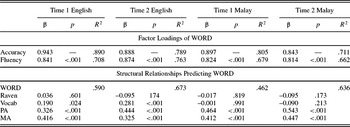
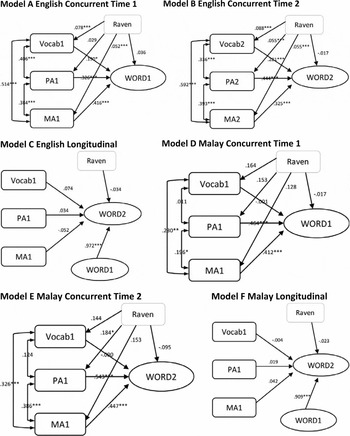
Table 3 shows the standardized estimates of the factor loadings and path coefficients predicting word reading in each concurrent model. Estimated factor loadings were all significant. The concurrent SEM models predicting English word reading (Models A and B in Figure 2) showed very good model fit: χ2 (3) = 8.679, p = .003, CFI = 0.983, RMSEA = 0.120, and SRMR = 0.017 for Time 1; and χ2 (3) = 0.152, p = .985, CFI = 1.000, RMSEA = 0.000, and SRMR = 0.002 for Time 2. At Time 1, both phonological and morphological awareness were a unique predictor of word reading, controlling for the other three predictors (β = 0.326 and 0.416, respectively; both ps < .001). Vocabulary knowledge also had a unique effect on word reading, over and above the two types of metalinguistic awareness and nonverbal intelligence (β = 0.190, p = .024). About 59% of the variance in Time 1 word reading was explained. As at Time 1, both types of metalinguistic awareness were also a significant, unique predictor of Time 2 English word reading (β = 0.444 and 0.325 for phonological and morphological awareness, respectively; both ps < .001). Vocabulary knowledge had a significant, unique effect on word reading (β = 0.281, p < .001). About 67.3% of the variance in English word reading was explained at Time 2.
Standardized parameter estimates of structural equation modeling analyses for English and Malay at Time 1 (Grade 3) and Time 2 (Grade 4)

Note: Only path coefficients predicting word reading are shown. Other structural parameters, such as covariances between metalinguistic awareness and vocabulary knowledge can be found in Figure 2. Accuracy, word reading accuracy; Fluency, word reading fluency; WORD, factor of word reading; Raven, nonverbal intelligence; Vocab, vocabulary knowledge; PA, phoneme deletion/phonological awareness; MA, affix choice/morphological awareness.
Standardized estimates of structural parameters in structural equation models predicting English and Malay word reading. The numbers 1 and 2 after each abbreviation indicate Time 1 (Grade 3) and Time 2 (Grade 4), respectively. Within-time parameter estimates in longitudinal models were similar to those in concurrent models and are thus not shown. Raven, nonverbal intelligence; PA, phonological awareness; MA, morphological awareness; Vocab, vocabulary knowledge; WORD, factor of word reading. *p < .05, **p < .01, ***p < .001.

The model fit of the longitudinal model predicting Time 2 English word reading (Model C in Figure 2) was also very good: χ2 (9) = 29.459, p < .001, CFI = 0.969, RMSEA = 0.132, and SRMR = 0.020. None of the Time 1 predictors, including both types of metalinguistic awareness, however, had any significant, unique contribution to Time 2 English word reading, after accounting for the autoregressive effect (i.e., Time 1 English word reading; β = 0.972, p < .001).
The within-language pattern in Malay was similar with respect to the contribution of metalinguistic awareness; a notable difference from English was the lack of a significant effect of vocabulary knowledge at both times (see Table 3). The Malay concurrent SEM models (Models D and E in Figure 2) also showed very good model fit: χ2 (3) = 8.141, p = .043, CFI = 0.972, RMSEA = 0.114, and SRMR = 0.025 for Time 1; χ2 (3) = 4.747, p = .191, CFI = 0.992, RMSEA = 0.067, and SRMR = 0.021 for Time 2. Phonological (β = 0.464, p < .001) and morphological (β = 0.412, p < .001) awareness were both a significant, unique predictor of Time 1 Malay word reading (about 46.2% of the variance explained). They significantly predicted Time 2 Malay word reading (about 63.6% of the variance explained) as well (β = 0.543 and 0.447 for phonological and morphological awareness, respectively; both ps < .001).
The model fit of the initial longitudinal model predicting Time 2 Malay word reading (Model F in Figure 2) did not appear to be good. Following the suggestion from modification indices, covariance was thus allowed between Time 1 and Time 2 measures for both indicators of Malay word reading (i.e., word reading accuracy and fluency). The modified model showed fairly good model fit: χ2 (7) = 17.367, p = .02, CFI = 0.979, RMSEA = 0.106, and SRMR = 0.029. Very similar to the finding of longitudinal within-language relationships in English, after controlling for Time 1 Malay word reading (β = 0.909, p < .001), none of the Time 1 predictors had any significant, unique contribution to Time 2 Malay word reading.
CLP modeling of cross-linguistic transfer facilitation
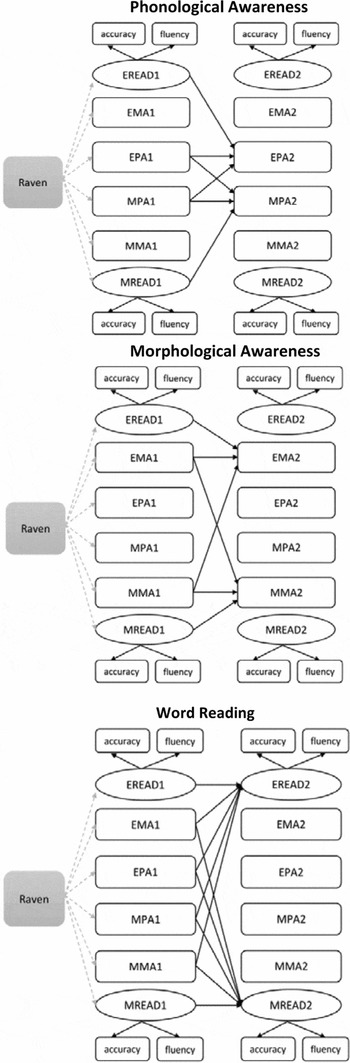
Figure 3 shows the CLP model that tested cross-linguistic transfer facilitation at two levels of development: metalinguistic awareness and word reading. Time 1 English phonological/morphological awareness was hypothesized to predict Time 2 Malay phonological/morphological awareness, controlling for Time 1 Malay phonological/morphological awareness (i.e., autoregressive effect). To account for the influence of earlier intralingual reading experience on later metalinguistic awareness, such as highlighted in the transfer facilitation model (Koda, Reference Koda, Koda and Zehler2008), Time 1 Malay word reading was also included as a predictor of Time 2 Malay phonological/morphological awareness (see Figure 3). Such control for earlier reading ability was also aligned with the findings of some previous longitudinal research that metalinguistic awareness, while supporting reading development, is also shaped by students’ reading ability (e.g., Deacon et al., Reference Deacon, Benere and Pasquarella2013; Kruk & Bergman, 2013). At the levels of both metalinguistic awareness and word reading, such cross-linguistic transfer facilitation was also tested from Malay to English. Nonverbal intelligence was also included as a covariate predicting all Time 1 measures. Included in the CLP model were all residual covariances at both Time 1 and Time 2 as well as those between Time 1 and Time 2 measures for each of the two indicators of word reading (i.e., accuracy and fluency) within each language. Constructed in such a way, the CLP model allowed for concurrent testing of developmentally bidirectional, cross-linguistic relationships between metalinguistic awareness in English and Malay on the one hand and metalinguistic awareness and word reading in the two languages on the other hand.
The configural CLP model, where the factor loading of word reading accuracy was fixed to zero in both languages and at both Time 1 and Time 2, showed good model fit: χ2 (66) = 113.200, p < .001, CFI = 0.972, RMSEA = 0.074, and SRMR = 0.036. To test longitudinal measurement invariance, equivalence constraint was placed on the factor loadings of word reading fluency at Time 1 and Time 2 for both English and Malay. The new model (i.e., metric invariance) also showed good model fit: χ2 (68) = 118.836, p < .001, CFI = 0.970, RMSEA = 0.076, and SRMR = 0.044. A likelihood difference test showed that the metric invariance model was not significantly different from the configural model, ∆χ2 (2) = 5.636, p = .06. Thus, the null hypothesis of longitudinal measurement invariance was retained. All parameter estimates presented in Tables 4 and 5 and Figure 4 are based on the new model.
Cross-lagged panel modeling testing bidirectional transfer facilitation at the construct level (phonological and morphological awareness) and in word reading. For clarity of presentation, separate cross-lagged panel models are presented to show construct and word reading level transfer facilitation, and all residual covariance parameters are not shown. In actual structural equation modeling analysis, all paths shown in the three models were tested simultaneously. The numbers 1 and 2 after each abbreviation indicate Time 1 (Grade 3) and Time 2 (Grade 4), respectively. Raven, nonverbal intelligence; EPA, English phonological awareness; MPA, Malay phonological awareness; EMA, English morphological awareness; MMA, Malay morphological awareness; EWORD, factor of English word reading; MWORD, factor of Malay word reading; accuracy, word reading accuracy; fluency, word reading fluency.

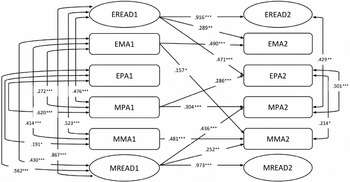
Standardized parameter estimates of cross-lagged panel model testing bidirectional transfer facilitation. For clarity of presentation, only significant path coefficients and cross-linguistic residual covariances are shown. The numbers 1 and 2 after each abbreviation indicate Time 1 (Grade 3) and Time 2 (Grade 4), respectively. EPA, English phonological awareness; MPA, Malay phonological awareness; EMA, English morphological awareness; MMA, Malay morphological awareness; EWORD, factor of English word reading; MWORD, factor of Malay word reading. *p < .05, **p < .01, ***p < .001.

Standardized parameter estimates of cross-lagged panel analyses testing cross-linguistic transfer facilitation at the levels of phonological and morphological awareness

Note: The numbers 1 and 2 after each abbreviation indicate Time 1 (Grade 3) and Time 2 (Grade 4), respectively. EPA, English phonological awareness; MPA, Malay phonological awareness; EMA, English morphological awareness; MMA, Malay morphological awareness; EREAD, factor of English word reading; MREAD, factor of Malay word reading.
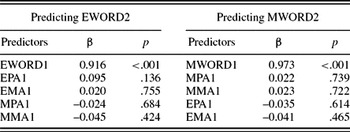
Standardized parameter estimates of cross-lagged panel analyses testing cross-linguistic transfer facilitation on word reading

Note: The numbers 1 and 2 after each abbreviation indicate Time 1 (Grade 3) and Time 2 (Grade 4), respectively. EWORD, factor of English word reading; MWORD, factor of Malay word reading; EPA, English phonological awareness; MPA, Malay phonological awareness; EMA, English morphological awareness; MMA, Malay morphological awareness.
Phonological awareness
Table 4 shows the results of cross-linguistic transfer facilitation at the level of metalinguistic awareness. After controlling for Time 1 English phonological awareness and word reading, Time 1 Malay phonological awareness significantly predicted Time 2 English phonological awareness (β = 0.286, p < .001). This suggests a facilitation effect of Malay phonological awareness transfer on English phonological awareness development. Conversely, however, such a transfer facilitation effect did not surface from English on Malay for phonological awareness. Over and above Time 1 Malay phonological awareness and word reading, Time 1 English phonological awareness did not significantly predict Time 2 Malay phonological awareness (β = 0.025, p = .787).
Morphological awareness
A contrastive pattern of cross-linguistic transfer facilitation was found for morphological awareness. As Table 4 shows, Time 1 Malay morphological awareness did not have a significant effect on Time 2 English morphological awareness (β = 0.074, p = .293), after controlling for Time 1 English morphological awareness and word reading. However, a significant unique effect of Time 1 English morphological awareness on Time 2 Malay morphological awareness surfaced (β = 0.157, p = .020), over and above Time 1 Malay morphological awareness and word reading. Taken together, these results suggest a facilitation effect of English morphological awareness transfer on the development of morphological awareness in Malay but not vice versa.
Word reading
Table 5 shows the result of testing facilitation of metalinguistic awareness transfer in word reading development. Neither phonological nor morphological awareness at Time 1 in one language was a significant, unique predictor of Time 2 word reading in the other language, after controlling for both types of metalinguistic awareness as well as word reading in the target language at Time 1. It appeared that the variance in Time 2 word reading in either language was predominantly explained by the autoregressive effect, which confirmed the findings of the longitudinal within-language analyses reported earlier (see Models C and F in Figure 2). This suggested no significant direct facilitation effect of metalinguistic awareness transfer on word reading development from either direction. Figure 4 shows the CLP model with standardized estimates for all significant autoregressive and cross-lagged cross-linguistic relationships.
DISCUSSION
This longitudinal study examined the contribution of phonological and morphological awareness in bilingual word reading among Malay–English biliteracy learners in Singapore. In particular, using CLP modeling, we examined the developmental mechanism of transfer, or facilitation effect induced by transfer of metalinguistic awareness from one language on change in metalinguistic awareness and word reading in the other language.
Phonology and morphology in word reading in Malay and English
Our first research question addressed whether phonological and morphological awareness would contribute to word reading within both Malay and English. In line with our prediction, the two types of metalinguistic awareness were revealed as significant, unique predictors of word reading in both languages at both times of the study. The significant contribution of phonemic awareness to word reading in Malay is particularly worth noting, because it corroborates the findings of previous research on native Malay-speaking beginning readers (Lee, Reference Lee2008; Lee & Wheldall, Reference Lee and Wheldall2011; Winskle & Widjaja, Reference Winskel and Widjaja2007). It suggests that phonemic awareness is also functional in older, bilingual readers’ Malay reading, despite the lack of instructional emphasis on this small-size unit (i.e., phoneme). Given that the target words of the reading tasks were derivatives, learners understandably also drew upon morphological insights to supplement their phonological decoding of words. It is noted that the reading tasks included one that measured fluency of decoding derived words, in which context it seemed particularly reasonable to expect that learners would actively engage in using large grain-size units like morpheme to support their decoding (e.g., Rickard Liow & Lee, Reference Rickard Liow and Lee2004; Winskle & Widjaja, Reference Winskel and Widjaja2007).
Transfer facilitation at the level of metalinguistic awareness
Our second research question addressed cross-linguistic transfer facilitation at the level of metalinguistic awareness. The CLP modeling intentionally made stringent control for intralingual variables, including Time 1 reading as well as metalinguistic awareness in the target language, when Time 2 metalinguistic awareness in the target language was predicted by Time 1 metalinguistic awareness in the source language. Different from our prediction on reciprocal transfer facilitation between English and Malay at the construct level, there was only unidirectional effect from Malay on English for phonological awareness, and from English on Malay for morphological awareness.
Previous studies on metalinguistic awareness transfer revealed several factors that may have an impact on directionality of transfer, including language dominance or the status of the two languages in learners’ literacy repertoire. Typically, metalinguistic awareness transferred from the stronger language or the language of learners’ primary literacy to support the development of reading and its related abilities in the weaker language or the language of ancillary literacy, such as in the case of young Spanish-speaking ESL learners (Cisero & Royer, Reference Cisero and Royer1995) or Chinese–English biliteracy learners (Wang et al., Reference Wang, Cheng and Chen2006) in North America. Different from many cases reported in the literature, the children in the present study were concurrent biliteracy learners having been taught to become literate concurrently in both English and Malay. Given this study's focus on “shared” facets of metalinguistic awareness and the findings of similar studies such as Deacon et al. (Reference Deacon, Wade-Woolley and Kirby2007), it seemed reasonable for us to hypothesize bidirectional transfer facilitation between English and Malay. Nevertheless, it is noted that English has a preeminent role in the educational system and in the society at large (e.g., communication across ethnic groups or de facto working language) in Singapore (Dixon, Reference Dixon2005). It was thus highly possible that the participants, who had been educated through English-medium instruction for 4 years, had English dominance in their biliteracy repertoire, even though some of them might come from a Malay-speaking home. Given the socioeducational context, children should have a lot more opportunities to be engaged in formal and informal literacy-related activities to refine their metalinguistic awareness (and other reading subskills) in English than in Malay. In view of this proficiency gap (especially a gap in literacy experiences), it seems reasonable to expect that English morphological awareness was transferred to facilitate the development of Malay morphological awareness but not vice versa.
However, if this conjectured proficiency effect on directionality of transfer holds, why then was a converse pattern found for phonological awareness transfer? The unidirectional effect from Malay on English was puzzling also because phonemic awareness is explicitly taught in English but no instructional attention is given to phoneme-level skills in Malay. A logical speculation is that this effect might be attributed to the focus of the task on phonemes and the different levels of letter–phoneme mapping regularity in English and Malay. In other words, the high regularity in Malay might have made it easy for phonemic awareness to transfer from Malay to facilitate the development of a corresponding skill in English (i.e., “overriding” any converse effect attributable to proficiency gap or instruction). Such an explanation seems to align with previous findings on transfer of phonemic awareness from Spanish (transparent letter–phoneme mappings like in Malay) to English among young ESL learners, even though the learners received formal instruction in English with little or no literacy experience in Spanish (e.g., Cisero & Royer, Reference Cisero and Royer1995; Durgunoglu et al., Reference Durgunoglu, Nagy and Hancin1993; Sun-Alperin & Wang, Reference Sun-Alperin and Wang2011). It also appeared to be supported by an earlier finding in Dixon, Chuang, and Quiroz (2011) about ethnic language influence on Singaporean children's English phonological awareness development.
Overall, the contrastive directionality discussed above suggests that transfer facilitation might be conditional upon a complex and dynamic interplay between different factors (e.g., language dominance and regularity of orthography) for different types of metalinguistic awareness that are “shared” between the focal languages. Although in our speculations we tended to emphasize one factor over the other for each type of metalinguistic awareness, the reality could be far more complex. This is definitely an issue that deserves attention in future longitudinal research, which ideally should compare transfer facilitation for different types of metalinguistic awareness with diverse languages in different L2 or biliteracy contexts.
Transfer facilitation effect on word reading
Our third research question on cross-linguistic transfer facilitation addressed whether metalinguistic awareness in one language transferred to facilitate reading development in the other language. The CLP modeling suggested a negative answer. This was against the hypothesis we made based on the evidence of concurrent relationships in the literature that supports cross-linguistic transfer of metalinguistic awareness in word reading. This finding, interpreted together with the significant transfer facilitation effect at the metalinguistic awareness level, seems to suggest that any developmental effect of metalinguistic awareness (in the source language) on reading development (in the target language) might only be achieved indirectly through transfer facilitation at the construct level. In other words, it might not be possible for transferred metalinguistic awareness to directly facilitate reading development in the target language. This lack of a direct facilitation effect on reading is actually supported by our earlier study (Zhang et al., Reference Zhang, Koda and Leong2016) on lexical inferencing in Malay and English among bilingual children in the same context and Luo et al.’s (Reference Luo, Chen and Geva2014) study on Chinese–English biliteracy learners in Canada.
However, there could also be a couple of alternative interpretations. One is that it may take a longer time for a direct transfer facilitation effect on reading development to emerge, or such an effect and its directionality may be a function of learners’ stage of biliteracy learning (refer to the varied patterns of transfer across time periods in Deacon et al., Reference Deacon, Wade-Woolley and Kirby2007). As noted in the literature on CLP design for longitudinal research, whether or not hypothesized cross-lagged effects exist can be sensitive to the developmental stage of students and the choice of time between the observations for a panel model (i.e., the lag chosen; Biesanz, Reference Biesanz and Hoyle2012; Selig & Little, Reference Selig, Little, Laursen, Little and Card2012). This longitudinal study focused on older learners (Grades 3–4) with an interval of only 1 year, whereas most previous studies on transfer of metalinguistic awareness focused on beginning L2 or biliteracy learners. Thus, it leaves to future research how the transfer facilitation effect on reading development might be sensitive to the stage of biliteracy learning and/or the degree of time lag. Another interpretation related to developmental stage may be our inclusion of initial intralingual word reading as a control variable (i.e., autoregressor control). From Grade 3 to Grade 4, or at a stage of transition from learning to read to reading to learn, any causal influence of source-language metalinguistic awareness on target-language word reading development might have already been “fixed” in the readers’ initial (i.e., Grade 3) word reading ability in the target language. Thus, our autoregressor control might have effectively controlled for “the causal effects of the reading-related skills that have already defined the trajectory for future development” (Hulslander, Olson, Willcutt, & Wadsworth, Reference Hulslander, Olson, Willcutt and Wadsworth2010, p. 132). Consequently, Grade 3 metalinguistic awareness in one language failed to show a significant facilitation effect on Grade 4 word reading in the other language.
Limitations and direction for future research
A few limitations of this study are noted. To begin with, we only had one measure for phonological and morphological awareness, which did not capture a wide range of aspects for each type of metalinguistic awareness that have been found to contribute to word reading in the two languages. As a result, when the CLP model was analyzed, perfect measurement invariance was assumed between Time 1 and Time 2 metalinguistic awareness in each language, rather than directly tested and verified as in the case of word reading. Of course, having more indicators for each predictor would mean that the sample size also needs to be larger. In addition, we did not measure students’ actual proficiency and directly compare their proficiency levels in the two languages. Earlier, when we discussed the directionality of transfer facilitation, we speculated on the dominance of English in children's biliteracy repertoire, given their socioeducational experience in the multilingual society in Singapore (Dixon, Reference Dixon2005). However, without measured proficiency, we could not directly test or ascertain any impact of language dominance on directionality of transfer facilitation. Another limitation is related to our simultaneous testing for transfer facilitation at both the construct level and the level of word reading, and stringent control for related variables for identifying the developmental mechanism of transfer. These resulted in a larger number of parameters estimated in the SEM model, and consequently, the participant to parameter ratio was very small, which might have resulted in biased estimates of some results. Finally, a limitation pertains to the use of CLP design to examine cross-linguistic transfer facilitation. CLP, as a method for longitudinal data analysis, has the advantage of testing developmentally reciprocal effects between two or more variables. However, it has a limitation in that it focuses only on individual differences (i.e., interindividual variability). “Although the parameters of the panel model are affected by intraindividual change,” they are not “sensitive to the type of individual-level change” (Selig & Little, Reference Selig, Little, Laursen, Little and Card2012, p. 267). It will be desirable to adopt longitudinal modeling methods, such as latent growth curve modeling, that can account for both inter- and intraindividual variability to provide a deeper understanding of cross-linguistic transfer facilitation effect in future research.
Conclusions
This longitudinal study examined phonological and morphological awareness in bilingual word reading in Malay–English bilingual children in Singapore. Separate SEM analyses found that both types of metalinguistic awareness were significant predictors of word reading concurrent in both languages. More important, CLP modeling showed that Malay phonological awareness was transferred to facilitate English phonological awareness development, whereas English morphological awareness was transferred to facilitate Malay morphological awareness development. Neither phonological nor morphological awareness in one language, however, was transferred to directly facilitate word reading development in the other language.
This study enriches our knowledge about the metalinguistic underpinnings of word reading development in Malay, a transparent orthography that has received little attention in the literature. In particular, it confirmed the importance of both small- and large-size units in Malay reading revealed in previous research on native-speaking children (Lee, Reference Lee2008; Winskel & Widjaja, Reference Winskel and Widjaja2007). It thus supports that reading acquisition in a language, whether among native-speaking or bilingual readers, is subject to the mandates of linguistic and language-to-print mapping properties of the language (Geva & Wang, Reference Geva and Wang2001; Koda, Reference Koda2005). More important, the study deepens our understanding of the developmental mechanism of cross-linguistic transfer. With stringent control of variables that may have an impact on the development of metalinguistic awareness and reading in a target language, especially children's earlier intralingual reading ability/experience, the study provides robust evidence for cross-linguistic transfer facilitation (or lack thereof). In particular, it informs future research on how transfer facilitation may be influenced by a complex interplay between different factors for different types of metalinguistic awareness.
ACKNOWLEDGMENTS
The research reported in this article was supported by Grant OER24/10ZDB from the Office of Education Research at National Institute of Education, Nanyang Technological University. Any views and opinions expressed in this article are ours and do not necessarily represent those of the funding agency.