




No CrossRef data available.
Mora or syllable? Which unit do Japanese use in naming visually presented stimuli?
Published online by Cambridge University Press: 27 April 2004
Abstract
Because the Japanese phonetic script (i.e., kana) represents moraic units, it is often claimed that Japanese people assemble phonology at the moraic unit. Two experiments were conducted to investigate the unit for naming visually presented stimuli, focusing on the special nasals /N/, geminates /Q/, long vowels /R/, and dual vowels /J/. The special sounds create two morae when there is only one syllable. Experiments 1 and 2 compared the production of three-mora, three-syllable and three-mora, two-syllable real, and nonsense words. The findings indicated that native Japanese speakers named the three-mora words containing the special sounds more quickly. Accordingly, it is posited that special sounds are named as syllable units rather than moraic units.
Information
- Type
- Research Article
- Information
- Copyright
- © 2004 Cambridge University Press
Because symbols of the Japanese kana phonetic script (see details of kana in Inagaki, Hatano, & Otake, 2000) basically correspond to morae,1
In kana representations, a single mora (a mora is a smaller unit of a syllable; see Figure 1) corresponds to two kana such as in

/kya/,

/syo/,

/myu/, and

/gya/. Therefore, Japanese kana do not correspond to morae on a one-to-one basis. There are 33 contrasting sounds in Japanese. However, they are regularly matched with two-kana combinations. In this sense, the present study perceives that the Japanese kana script depicts a moraic unit on a regular basis.

Strictly applying the claim of the mora as a processing unit, a Japanese loanword

/kareNdaR/
2The pronunciation in this article is transcribed using Japanese phonemic symbols, which indicate three special sounds in Japanese: /N/ for nasal, /Q/ for geminate, and /R/ for long vowel. In addition to these three sounds, dual vowels (e.g., /ai/, /au/, /oi/) but not continuous vowel are described as /J/.
Cutler and colleagues (e.g., Cutler, Mehler, Norris, & Segui, 1986; Cutler & Norris, 1988; Cutler & Otake, 1994; Otake et al., 1993) conducted experiments to identify how sound sequences are segmented for lexical access using a syllabic monitoring task that required participants to find a consonant–vowel (CV) or CVC sequence in acoustically presented words. Analyzing responses by native French, English, and Japanese speakers, these studies concluded that native French speakers use syllables to segment sound sequences (Cutler et al., 1986; Mehler, Dommergues, Frauenfelder, & Segui, 1981), whereas native English speakers use stress (Cutler & Norris, 1988; Cutler et al., 1986) and native Japanese speakers use morae (Cutler & Otake, 1994; Otake et al., 1993). Based upon the results of these studies, Cutler (1994a, 1994b) proposed “language-specific phonological segmentation.”
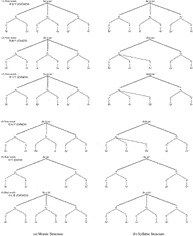
Recent studies in Japanese phonology (e.g., Haraguchi, 1996; Kubozono, 1989, 1995, 1999b; Kubozono & Ota, 1998; Terao, 2002), however, proposed that morae and syllables need not be treated separately; rather, they may coexist in a single hierarchical structure. As shown in Figure 1, phonemes, morae, and CVC and CVV3
As explained in Note 1, there are 33 contrasting sounds in the Japanese sound system that have a CSV structure (S refers to a semivowel). When one considers a combination of C and S as one unit, CSV could be understood as a variation of CV. In fact, CSV sequences are depicted

(/mya/),

(/gyu/), and

(kyo) by a combination of a regular sized kana and a smaller sized kana and are considered a single mora. In the present study, these sounds are not discussed and stimuli used in Experiments 1 and 2 do not include them.
The Japanese special sounds of CVN and CVQ sequences form a CVC structure while CVR has a CVV structure and is referred to as a long vowel syllable. A CVV structure also occurs when two morae, CV and V are combined. These are dual vowel syllables depicted as CVJ. Japanese sounds are usually represented by a CV structure (including the single V structure) that consists of one mora and one syllable. However, the four special sounds, which form a CVC or a CVV phonological structure, show that a single syllable does not always represent a single mora.
Japanese phonetic symbols of kana represent moraic units, so kana acquisition is often assumed to have strong effects on phonological processing units. Concerning this question, Inagaki et al. (2000) investigated the effects of kana acquisition on phonological segmentation in Japanese children. Although the phonetic scripts of hiragana and katakana (generally together called kana) are officially taught in the first grade of school, a majority of children actually master reading kana prior to this. Inagaki et al. (2000) conducted a vocal–motor segmentation task with children aged 4–6 years, which required segmenting spoken words having CVN, CVQ, or CVR syllables. The results compared children with and without kana acquisition (i.e., kana literates vs. kana preliterates) and indicated a shift of units, from a mixture of syllable- and mora-based segmentation for children without kana acquisition to predominantly mora-based segmentation for children with kana acquisition. However, kana acquisition did not create a dramatic, clear-cut shift of choice between a mora and a syllable for segmentation. Ito and Tatsumi (1997) and Ito and Kagawa (2001) indicated that kana preliterate children were also aware of moraic and syllabic units for segmentation, although it was true that kana acquisition increased awareness of moraic units.
Speech errors indicate the use of moraic units by native Japanese speakers. Terao (1996) reported 114 cases of phonological speech errors, indicating that it is often impossible to tell whether a phoneme or mora error occurred. For example, /hakatawaN/, which is a proper noun (Hakata Bay) was mispronounced as /hatakawaN/. Because this word has the same vowel /a/ throughout the string of the word, the error could be interpreted in two ways: as an exchange of the second and third morae (/ta/ and /ka/) or as an exchange of the third and fifth consonants (/t/ and /k/). Terao (1996) counted these as both mora and phoneme errors and provided a figure of 93 moraic errors and 88 phonemic errors (80 consonants, 8 vowels). According to this figure, moraic errors were only slightly greater in frequency than phonemic errors. It is also interesting to note that native Japanese speakers make errors replacing /N/ or /R/ with /i/. Kubozono (1985) reported an error in which /beityuR kaNkei/ meaning “Relationship between China and the United States” was produced as /beityuR kaikei/.
Several studies have been conducted to clarify the role of morae and syllables in Japanese. Otake (1992) conducted phonological segmentation studies investigating /R/ in morae and syllables. In his study, he asked participants to segment auditorily presented words having an initial syllable that included /R/. Participants were then asked to segment each word by drawing a line through its roma-ji (Japanese romanization) spelling. For example, after auditorial presentation of a word kuuki (sounded/kuRki/) meaning air, participants would segment the word as ku|uki or kuu|ki. This study found that syllables with /R/ were segmented into syllabic units 72% of the time and into moraic units 27% of the time (1% others). Based on this finding, Otake (1992) suggested that syllables with /R/ are segmented into syllabic CVR rather than into the morae CV and R.
Otake (1993) further investigated syllables including /N/ and /Q/ using the same method employed in his previous study (Otake, 1992). The syllables with /N/ were segmented into CVN syllables 50.3% of the time and into the morae CV and N 23.1% of the time. Similarly, the CVQ was segmented as a syllabic unit 46.3% of the time and into CV and Q 32.2% of the time. Again, although the difference was much smaller in the case of CVN and CVQ, syllables with /N/ and /Q/ were segmented more frequently as syllables than as morae. Combining the findings of Otake (1992) and this study, the syllable CVR was ranked the highest with respect to frequency of syllable segmentation, followed by CVN and CVQ (i.e., /R/ > /N/ > /Q/). Otake's results (1992, 1993) were thus congruent with the frequency order provided by the corpus study of Matsuzaki (1994).
A different segmentation study was conducted by Machida (1988). In his study, Machida asked participants to clap their hands while pronouncing a word or a phrase. The study used 28 stimulus items constructed of five morae. For example, participants were asked to vocalize /maQtetene/ (please wait), consisting of the five morae /ma/, /Q/, /te/, /te/, and /ne/, and at the same time, clap their hands in a rhythm they thought matched the phrase. Machida (1988) counted how often the participants clapped their hands with the /Q/, /N/, and /R/ sounds. In each of the cases /Q/, /N/, and /R/ appeared in the middle of the phonological string, with the results showing that participants clapped their hands on the single mora unit of /Q/ at the very low rate of 7% (93% on the syllabic unit), whereas they clapped at rates of 26% for /N/ and 27% for /R/. According to Machida's results, all of the special sounds are grouped into syllables of CVQ, CVN, and CVR at a high frequency. The relative frequencies of syllabic clapping was /Q/ > /N/ = /R/. This clapping frequency strongly supports the syllable, not the mora, as a segmentation unit for the special sounds. The order of syllabic segmentation, /Q/ > /N/ = /R/, basically indicated an opposite direction to that of the segmentation study of Otake (1992, 1993) and the corpus frequency study by Matsuzaki (1994) that suggested a segmentation order of /R/ > /N/ > /Q/.
However, there may be a fundamental problem with Machida's (1988) research method. Japanese broadcasters speak at the rate of 9.5 morae (Sugito, 1999), and native English speakers learning Japanese as a second language can read sentences at the rate of 2–3 morae (Tamaoka, 2000). Based on this information, the average speaking rate of native Japanese speakers can be estimated to lie somewhere in between these extremes, such as 5 or 6 morae. Taking this rate into consideration, it would be virtually impossible to clap in rhythm with morae, as this would require a rate of five or six claps per second when speaking at a natural pace. In this sense, it could be argued that Machida's participants either chose or were permitted to clap their hands simply to a larger phonological unit, the syllable, rather than the smaller mora in order to keep up with the speed of word production.
Matsuzaki (1996a) further investigated differences between morae and syllables. Matsuzaki auditorily presented four-morae alphabetic loan words (i.e., Gairaigo) and asked participants to choose one out of eight possible segmentation patterns. The study revealed that /R/ was segmented as a single mora only 12.2% of the time, /Q/ followed next, at a rate of 44.4%, and /N/ was 54.8%. The dual vowel or diphthong /J/ was segmented 63.3% of the time. These figures can be interpreted as showing the tendency of readers to treat these sounds as independent morae. Thus, Matsuzaki (1996a) ranked the tendency of the sounds to serve as parts of syllables to be/R/ > /Q/ > /N/ > /J/. The opposite order is interpreted as the ranking of sounds to serve as independent morae. Matsuzaki (1996b) repeated the same experiment using 92 participants with only Tokyo dialect backgrounds and obtained the same results. Another interesting study related to the frequency of the special sounds was conducted by Kubozono (1999a), who collected 588 CVC and CVV syllables with special sounds from traditional Japanese songs and analyzed the mapping between morae or syllables and musical notes. The strength ranking of syllabic structures in Kubozono's study was /Q/ > /N/ > /R/ > /J/.
According to the previous studies, there are four different patterns of the Japanese special sounds in terms of the degree of syllabic structure strength. First, Otake (1992, 1993) suggested /R/ > /N/ > /Q/, based on phonological segmentation of auditorily presented words. This pattern is congruent with the frequencies of appearance of the special sounds in Kango and Gairaigo words (Matsuzaki, 1994). Second, the hand clapping task used by Machida (1988) indicated a quite different pattern, /Q/ > /N/ = /R/. Third, Matsuzaki (1996a, 1996b) required participants to select one of eight segmentations for auditorily presented words and found the pattern, /R/ > /Q/ > /N/ > /J/. Fourth, Kubozono (1999a) found another pattern, /Q/ > /N/ > /R/ > /J/, in his study of musical notes assigned to CVV and CVC syllables, including the four special sounds in traditional Japanese songs. These four patterns can be further divided into two groups based upon differences in the tasks. The first and third patterns were identified in studies of phonological perception (segmenting auditorily presented words), whereas the second and fourth patterns might be considered phonological production (clapping hands with the production of a word and assigning words to musical notes). Therefore, some distinctive differences could exist between perceiving phonological input and producing phonological output.
Previous studies in Japanese phonological units have focused primarily on perception rather than production. Taking these into consideration, the present study investigated phonological units for naming visually presented stimuli as the means of measuring phonological production, as depicted in Figure 1. The study used phonological strings of nonwords as well as real words for naming so that it would be possible to directly compare naming latencies and error rates for stimuli having different phonological structures, especially with regard to morae and syllables. In the first experiment, all nonword stimuli were presented in the hiragana script to compare three-mora and three-syllable CVCVCV-structured nonwords with three-mora and two-syllable CVNCV-, CVQCV-, and CVJCV-structured nonwords. In the second experiment stimuli were presented in the katakana script because the hiragana script cannot clearly describe a long vowel (i.e., CVRCV). Again, CVCVCV-structured nonwords were used as the basis for comparing nonwords with three-mora and two-syllable CVNCV-, CVQCV-, and CVRCV-structured nonwords. The details of hypotheses related to phonological structure are explained at the beginning of each experiment.
EXPERIMENT 1: NAMING OF NONWORDS VISUALLY PRESENTED IN HIRAGANA
Naming of a nonsense string of hiragana symbols (Goryo, 1987) showed a clear, constant increase in naming latencies with numbers of morae: 467 ms for 1 mora, 527 ms for 2 morae, 607 ms for 3 morae, and 678 ms for 4 morae. This trend was also observed in the naming of real words: 459 ms for 1 mora, 469 ms for 2 morae, 475 ms for 3 morae, and 504 ms for 4 morae. Therefore, it was assumed that the greater the number of morae constructing a nonword, the longer the naming latency would be. If mature, native Japanese readers use the unit of mora for phonological processing of visually presented nonwords, one would expect an equal naming latency and an equal error rate across the three-mora conditions of CVCVCV, CVVCV, CVNCV, and CVQCV. In contrast, if a syllable serves as the phonological processing unit, one would expect that nonwords composed of two-syllable and three-morae conditions (e.g., CVJCV, CVNCV, and CVQCV) would be pronounced more quickly (i.e., have a shorter naming latency) than three-syllable, three-mora items having the CVCVCV structure. Figure 2 illustrates the contrast between moraic and syllabic structures for the stimuli of Experiment 1.

Method
Participants
Twenty-four undergraduate and graduate students (16 females, 8 males; age range = 21 to 31 years) participated in the first experiment. The average age was 23 years and 2 months (23;2).
Stimuli
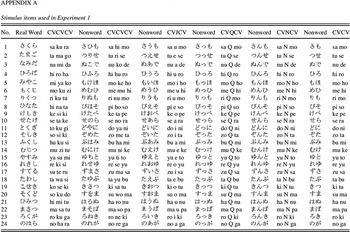
As shown in Figure 2, six stimulus conditions of real words and nonwords were used in the naming task (see the details of stimulus items in Appendix A). Items in Conditions 1–5 were nonwords and those in Condition 6 were real words. Items in the first condition had a CVCVCV structure, which consists of three syllables and three morae, as in /ke ta pe/. Items in the second condition had a CVJCV4
The terms dual vowel and diphthong usually refer to two continuous vowels (e.g., /ai/, /au/, /oi/) that change from an open vowel (i.e., /a/, /o/) to a closed vowel (i.e., /i/, /u/). Two continuous vowels, such as /ia/, /uo/, and /io/, that change from a closed vowel to an open vowel are considered two independent vowels. Experiment 1 used all possible combinations of two continuous vowels in order to create nonwords. In fact, the study by Kubozono (1999a, 1999b) described in the introductory section also used all combinations of two continuous vowels to investigate the mapping of musical notes to the dual vowel /J/. A possible influence of this choice on naming latencies for CVJCV nonwords is mentioned in the General Discussion section of this article.
All of the stimulus items were presented in hiragana. Items in each nonword condition were identical except for the second mora. This stimulus alternation was done to minimize the effect caused by the types of phonemes used for constructing nonwords. In addition to the five conditions of nonwords, there was also a sixth condition. In this case, real words with the same initial onset phonemes as for the nonwords were included to test the well-established principle of the “lexical status effect” (details explained in Taft, 1991), which suggests that real words are pronounced more quickly than nonwords. It is also well documented that the initial phonemes of stimuli cause a difference in naming latencies when determined by a voice key (e.g., Sakuma, Fushimi, & Tatsumi, 1997; Tamaoka & Hatsuzuka, 1997). In the present study, all the stimulus items were paired with all of the conditions (see Appendix A). Thus, differences in initial onsets could not affect naming latencies.
Word-likeness
Word-likeness for nonwords is expected to have facilitation effects in speed, and to some degree accuracy, of naming nonwords; the more the stimulus nonwords are wordlike, the shorter their naming latencies become. The stimulus nature of word-likeness was measured by a 5-point (5 = very much like a Japanese word to 1 = very unlike a Japanese word) scale questionnaire given to 24 university students (20 female, 4 male; average age = 19;3, with SD = 1;8). A one-way analysis of variance (ANOVA) for nonwords revealed a significant main effect in scores of work-likeness across the five nonword conditions, F (4, 115) = 6.69, p < .001. The Student–Newman–Keuls' (SNK) multiple comparison method revealed that only the CVCV two-mora and two-syllable condition were judged by university students to be more wordlike than four other three-mora conditions of CVCVCV, CVJCV, CVQCV, and CVNCV. Because the three-mora conditions did not differ in any comparisons, word-likeness was seen to have no effect on naming latencies or error rates among all the three-mora conditions of nonwords. In any case, scores of word-likeness were used as covariants for post hoc analysis using an analysis of covariance (ANCOVA) with repeated measures.
Bi-mora frequency
An index for how often two moraic units are combined among Japanese words is called bi-mora frequency. In order to investigate its possible effect, the present study calculated the bi-mora frequency of stimulus nonwords. The programming language of MacJPerl 5.15r4J for Macintosh was used to run the calculation procedure. Because all Japanese words can be presented in kana, bi-mora frequencies were calculated on the basis of kana combinations using a lexical corpus of the Asahi Newspaper from 1985 to 1998 (Amano & Kondo, 2000). After calculating all the bi-mora frequencies of possible Japanese mora combinations, a bi-mora frequency for each nonword was found. In the present study, three-mora real words and nonwords were used (except in the CVCV condition), so that two sets of bi-mora frequencies were added to determine a bi-mora frequency for each stimulus. As for the CVCV nonwords, bi-mora frequencies were doubled to equal the other conditions. A one-way ANOVA indicated a significant main effect in bi-mora frequencies across the five nonword conditions, F (4, 115) = 24.89, p < .001. SNK multiple comparisons showed that only the CVNCV three-mora, two-syllable condition was significantly different from other four conditions of CVCVCV, CVJCV, CVQCV, and CVCV. Bi-mora frequency is treated as a covariant for a post hoc analysis by ANCOVA with repeated measures as well as scores of word-likeness.
Procedure
Participants were randomly presented with nonwords and real words in hiragana on the center of a computer screen (Toshiba, J-3100 plasma display) 600 ms after the appearance of a fixation asterisk (*). Participants were required to pronounce the stimulus shown on the screen as quickly and as accurately as they could. A voice-activated key turned off a timer in order to measure naming latency. The accuracy of pronunciation was entered into the computer by the examiner. The next fixation point was presented 600 ms after the examiner pressed the key for entering accuracy. Twenty-four practice trials were given to the participants prior to the commencement of the actual testing.
Results
The mean naming latencies and error rates for the naming task of real words and the five different types of nonwords are presented in Table 1. The statistical tests that follow analyze both participant (F1) and item (F2) variabilities. One-way ANOVAs with repeated measures were conducted for the naming latencies of correct responses and accuracy ratios. Before performing the analysis, naming latencies shorter or longer than ±2.5 SD from the means of individual participants in each nonword and word condition were replaced by latencies that were ±2.5 SD from the means.

Analysis of naming latencies
A one-way ANOVA with repeated measures for naming latencies across all six conditions indicated that there was a significant main effect for the type of real word or nonword in the participant analysis, F1 (5, 115) = 19.27, p < .0001, and item analysis, F2 (5, 115) = 25.03, p < .0001.
Further analysis using an orthogonal polynomial contrast comparison was carried out to isolate the reason for the main effect. As shown in Table 1, real words with a CVCVCV phonological structure were named 122 ms faster than nonwords with the same CVCVCV phonological structure, F1 (1, 23) = 33.34, p < .0001; F2 (1, 23) = 51.64, p < .0001, which supported the well-established “lexical status effect.” Nonwords with a CVJCV structure, which can be divided into three morae or two syllables, were named 55 ms faster than those with a CVCVCV structure, F1 (1, 23) = 9.42, p < .01; F2 (1, 23) = 14.36, p < .001, but no difference was observed in naming latencies between nonwords with CVJCV and CVQCV structures. Nonwords with a CVNCV structure were named more quickly than those with a CVQCV structure, F1 (1, 23) = 31.67, p < .0001; F2 (1, 23) = 11.66, p < .01, and with a CVJCV structure, F1 (1, 23) = 31.85, p < .0001; F2 (1, 23) = 29.80, p < .0001. No significant difference was found between nonwords with CVNCV and CVCV structures. Therefore, the order of naming speed from the fastest to the slowest was CVNCV, followed by CVQCV, with the slowest being CVJCV, in which /Q/ and /J/ did not differ significantly (i.e., /N/ > /Q/ = /J/).
Analysis of error rates
A one-way ANOVA with repeated measures for error rates across the six conditions indicated a significant main effect in participant analysis, F1 (5, 115) = 8.78, p < .0001, and item analysis, F2 (5, 115) = 7.99, p < .0001.
Further analysis using an orthogonal polynomial contrast comparison was carried out to isolate the main effect on error rates over the six types of real and nonwords. Real words with a CVCVCV phonological structure were pronounced 12.5% more accurately than nonwords with the same CVCVCV structure, F1 (1, 23) = 20.36, p < .001; F2 (1, 23) = 19.09, p < .001. As shown in the analysis of naming latencies, the analysis of error rates also supported the lexical status effect. Nonwords with a CVJCV structure, were named 7.3% more accurately than those with a CVCVCV structure, F1 (1, 23) = 4.29, p < .05; F2 (1, 23) = 4.96, p < .05. However, the difference of 5.2% in error rates between nonwords of CVCVCV and CVQCV was not significant. In addition, there was only a slight difference of 1.1% between nonwords with CVVCV and CVQCV structures, which also was not significant.
Nonwords with a CVNCV structure were named more accurately than those with CVCVCV, F1 (1, 23) = 015.38, p < .001; F2 (1, 23) = 20.31, p < .001; CVJCV, F1 (1, 23) = 4.97, p < .05; F2 (1, 23) = 6.68, p < .05; and CVQCV structures, F1 (1, 23) = 9.02, p < .01; F2 (1, 23) = 5.79, p < .05. Nonwords with a CVCV structure, which were named as accurately as those with a CVNCV structure, were named more accurately than nonwords with a CVCVCV, F1 (1, 23) = 17.12, p < .001; F2 (1, 23) = 23.28, p < .0001; CVJCV, F1 (1, 23) = 13.80, p < .005; F2 (1, 23) = 9.86, p < .01; and CVQCV structure, F1 (1, 23) = 10.51, p < .01; F2 (1, 23) = 6.57, p < .05.
Post hoc analysis of word-likeness and bi-mora frequency
Characteristics of word-likeness and bi-mora frequency were calculated for the nonwords in Experiment 1, with both factors showing significant main effects. Thus, a post hoc analysis of ANCOVA with these two factors as covariants was conducted on nonwords' naming latencies. The results revealed the main effects of phonological structure to be significant, F (4, 113) = 13.61, p < .001. Consequently, the phonological structure of nonwords remained an important factor in naming latencies with consideration of word-likeness and bi-mora frequency. Word-likeness also showed a significant main effect, F (1, 113) = 5.94, p < .05, but bi-mora frequency had no main effect. The results of multiple comparison indicated that only the CVCV condition was judged to be more highly wordlike than other conditions. Experiment 1 only considered the four nonword structures of CVCVCV, CVJCV, CVQCV, and CVNCV, so that word-likeness of CVCV did not have any effect on the results. Likewise, the same analysis of ANCOVA was applied to error rates of nonwords. Again, the main effect of nonword phonological structure on error rates remained significant, F (4, 113) = 3.98, p < .01, whereas the main effect of neither word-likeness nor bi-mora frequency was significant. Thus, since neither factors were expected to have effects on error rates, the result of nonword error rates remained as initially found.
Discussion
Naming latencies indicated that nonwords with a CVCVCV structure took longer to name than all other nonwords with CVJCV, CVQCV, and CVNCV structures. Nonwords with CVCVCV structures were the only ones divided into three morae and three syllables; all other nonwords consisted of three morae but only two syllables. Syllabic units had a more salient effect on naming than morae because the latencies of these nonwords were shorter than those with CVCVCV syllabic units. In addition, nonwords with a CVNCV structure were named faster and more accurately than those with CVJCV and CVQCV structures but with the same latency as the CVCV structure. The CVN syllable may be a single phonological unit for the production of nonword naming.
EXPERIMENT 2: NAMING OF NONWORDS VISUALLY PRESENTED IN KATAKANA
The Japanese /R/ is not clearly depicted in hiragana and was therefore not included in Experiment 1. For instance, the Japanese word for “agreement” is written as

, in hiragana. This word is transcribed in hiragana as /doui/, although it is actually pronounced /doRi/. In contrast, another kana script called katakana presents the long vowel as “

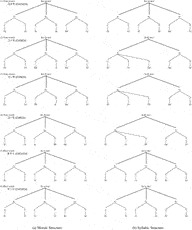
,” so that it is easily recognized. Thus, in order to be able to examine all three Japanese special sounds (/Q/, /N/, and /R/), Experiment 2 used katakana to present the stimulus items. As shown in Figure 3, we hypothesized that if the CVQCV, CVNCV, and CVRCV nonwords with three morae but only two syllables were all named faster than CVCVCV nonwords with three morae and three syllables, the three Japanese special sounds are processed with the preceding CV as a syllabic unit. If the latencies were the same, we would conclude that they are all processed as morae.

Method
Participants
Twenty-four undergraduate and graduate students (20 females, 4 males; age range = 19–38 years) participated in the experiment. The average age was 24;5. None of the participants who participated in Experiment 1 participated in Experiment 2.
Stimuli
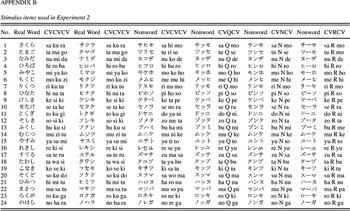
There were two stimulus conditions for real words and four conditions for nonwords. As for nonwords, the CVCVCV structure served as the baseline condition to compare to other nonword conditions having three morae and two syllables. These included the Japanese special sounds of /Q/, /N/, and /R/ and had the phonological structures, CVQCV, CVNCV, and CVRCV. Except for the CVRCV condition, the others included the same items as in Experiment 1 (see the details of stimulus items in Appendix B). To avoid repeating similar stimulus items, the conditions CVQCV, CVNCV, and CVRCV were divided into three sets and assigned to different participants. As in Experiment 1, only the second mora of each item was altered to match items in each nonword condition. All items were presented in katakana. The real words used in Experiment 1 were repeated in Experiment 2, but they were written in both hiragana and katakana scripts in order to test for a “script familiarity effect” that suggests that real words presented in a frequently seen script are processed faster than the same words presented in an unfamiliar script (e.g., Besner & Hildebrandt, 1987; Besner & Smith, 1992; Hatta, Katoh, & Kirsner, 1984; Hayashi, 1999; Kawakami, 1993; Tamaoka, Hatsuzuka, Kess, & Bogdan, 1998; Tamaoka, Leong, & Hatta, 1992; Yokoyama, 1997). Again, real words in hiragana and katakana were equally divided into two sets and assigned to different groups of participants so that readers would not read the same stimulus item twice. All stimulus items began with the same initial phonemes as nonwords so that a difference in initial onsets of nonwords would not affect the measurement of naming latency.
Word-likeness
Word-likeness scores in Experiment 2 were measured in the same way as in Experiment 1. Scores of word-likeness for nonwords in Experiment 2 were generally much lower than those for Experiment 1. This might have been caused by a difference in familiarity between the kana scripts of hiragana and katakana: hiragana is very often seen in Japanese texts, whereas katakana is basically used only to describe alphabetic loanwords. A one-way ANOVA across the four nonword conditions revealed a significant main effect on scores of word-likeness across the 4 three-mora nonword conditions, F (3, 92) = 11.84, p < .001. SNK multiple comparisons revealed that the CVCVCV (M = 2.46, SD = 0.70) and CVNCV (M = 2.62, SD = 0.36) conditions were judged by university students as more wordlike than the CVRCV (M = 2.16, SD = 0.31) and CVQCV (M = 2.01, SD = 0.34) conditions. Because the baseline of the CVCVCV condition did not differ from that of the CVNCV condition, these two could be directly compared. In addition, CVCVCV was much more wordlike than CVQCV and CVRCV. Thus, CVCVCV was expected to gain greater facilitation for naming latencies (i.e., shorter naming latencies) than the other two conditions of CVQCV and CVRCV. Thus, word-likeness was used as a covariant for a post hoc analysis of ANCOVA with the repeated measures.
Bi-mora frequency
Nonwords of bi-mora frequencies were calculated in the same way as in Experiment 1. A one-way ANOVA showed a significant main effect across the four nonword conditions, F (3, 92) = 21.65, p < .001. SNK multiple comparisons further showed that the syllable of CVNCV significantly differed from the three syllables of CVCVCV, CVQCV, and CVRCV. This result indicated that the CVNCV structure was more frequently used in Japanese words than the other three phonological structures. Therefore, bi-mora frequency is treated as a covariant for a post hoc analysis of ANCOVA with the repeated measures as well as scores of word-likeness.
Procedure
The procedure was the same as in Experiment 1.
Results
The mean naming latencies and error rates for the naming task of real words presented in hiragana and katakana and the four different phonological structures of nonwords are presented in Table 2. The statistical tests that follow analyze both participant (F1) and item (F2) variability. Before performing the analysis, naming latencies shorter or longer than ±2.5 SD from the means of individual participants in each nonwords and word condition were replaced by latencies that were ±2.5 SD from the means.

Analysis of naming latencies
A one-way ANOVA for naming latencies for real words was performed to compare the difference between the same words presented in hiragana and katakana. The real words in hiragana were named 36 ms faster than the same words in katakana. This difference was significant in the participant analysis, F1 (1, 23) = 15.67, p < .001, and items analysis, F2 (1, 23) = 7.53, p < .05, which supported the existence of a script familiarity effect. Although these real words are usually printed in kanji, hiragana is sometimes used to write these words, notably in books for elementary school students. Thus, as suggested in previous studies (Hayashi, 1999; Tamaoka et al., 1998), because these real words have orthographic representations depicted in hiragana as well as kanji, participants could pronounce them faster (i.e., shorter naming latency) than the same words presented in katakana.
An additional one-way ANOVA was carried out comparing the three CVCVCV phonological structures including real words in hiragana and katakana and nonwords in katakana. The main effect was significant, F1 (2, 46) = 31.73, p < .0001; F2 (2, 46) = 19.87, p < .0001. Further analysis of the orthogonal polynomial contrast comparison revealed that CVCVCV nonwords were pronounced significantly slower than real words in hiragana, F1 (1, 23) = 48.84, p < .0001; F2 (1, 23) = 13.51, p < .005, and in katakana, F1 (1, 23) = 21.21, p < .0001; F2 (1, 23) = 36.20, p < .0001. These results show effects of both lexical status and script familiarity. The lexical status effect is shown by the difference in naming latencies between CVCVCV real words and nonwords presented in katakana, whereas the script familiarity effect is shown by the difference in naming latencies between CVCVCV real words in katakana and hiragana.
The main purpose of Experiment 2 was to examine the phonological processing unit for production. To reach this goal, differences in naming latencies for the four nonword conditions were examined by a one-way ANOVA with repeated measures. There was a main effect of the four different types of phonological structures in the participant, F1 (3, 69) = 26.07, p < .0001, and item analyses, F2 (3, 69) = 21.97, p < .0001.
Further analysis using an orthogonal polynomial contrast comparison was carried out on pairs of the four nonword conditions. As shown in Table 2, the longest naming latency was observed in the CVCVCV condition. This latency was significantly slower than all other nonword conditions: CVQCV, F1 (1, 23) = 16.29, p < .0005; F2 (1, 23) = 14.14, p < .001; CVNCV, F1 (1, 23) = 74.90, p < .0001; F2 (1, 23) = 28.20, p < .0001; and CVRCV, F1 (1, 23) = 51.02, p < .0001; F2 (1, 23) = 41.97, p < .0001. Among the three Japanese special sounds, CVQCV nonwords had a significantly longer naming latency than CVRCV nonwords, F1 (1, 23) = 6.16, p < .05; F2 (1, 23) = 10.57, p < .005. Unlike the result of the first experiment, there was no difference between the mean naming latencies of CVQCV and CVNCV nonwords. In addition, the mean naming latencies did not significantly differ between CVNCV and CVRCV. Therefore, the order of naming speed from the fastest to the slowest was CVRCV, CVNCV, and CVQCV (i.e., /R/ = /N/ < /Q/), respectively.
Analysis of error rates
A one-way ANOVA on error rates performed on the data for real words in hiragana and katakana revealed no difference. Real words also showed no difference in error rates when compared with nonwords with the same phonological structure. Because naming of stimulus items used in the present experiment was easy for mature native Japanese speakers, the measurement index of error rates was not as sensitive as naming latencies for script familiarity and lexical status effects.
A one-way ANOVA tested for differences in error rates among the four conditions of nonwords. The four different types of nonword structures showed a significant main effect in participant analysis, F1 (3, 69) = 4.31, p < .05, and item analysis, F2 (1, 23) = 3.00, p < .05. An orthogonal polynomial contrast comparison was used to test for differences between the paired conditions. As shown in Table 2, the highest error rate was observed in CVCVCV nonwords; the rate was higher than those in the CVQCV, F1 (1, 23) = 4.60, p < .05; F2 (1, 23) = 4.58, p < .05; and CVNCV, F1 (1, 23) = 8.63, p < .01; F2 (1, 23) = 9.86, p < .005, conditions. However, CVCVCVs did not differ from CVRCVs.
Among the conditions including /Q/, /N/, and /R/, CVRCVs showed the highest error rate (1.91%), which was significantly higher than the lowest error rate (0.69%) found in CVNCV nonwords in the participant analysis, F1 (1, 23) = 6.75, p < .05, but not the item analysis, F2 (1, 23) = 3.13, p < .10. Therefore, the order of error rates from the lowest to the highest was CVNCV, CVQCV, and CVRCV, although these represented rather minor differences.
Post hoc analysis of word-likeness and bi-mora frequency
Word-likeness was measured and bi-mora frequency was calculated for the nonwords of Experiment 2. Both factors examined by one-way ANOVAs showed significant main effects. Thus, a post hoc ANCOVA was conducted for naming latencies with these two factors as covariants. The results showed that the main effect of four phonological structures was significant, F (3, 90) = 10.12, p < .001. Consequently, the phonological structure of nonwords remained a significantly important factor in naming latencies. Word-likeness also showed a significant main effect, F (1, 90) = 6.03, p < .05. Although the one-way ANOVA for bi-mora frequency of nonwords in Experiment 1 showed a significant main effect, bi-mora frequency as a covariant in ANCOVA had no main effect. The effect of word-likeness, however, supported the results in Experiment 2. A base condition of CVCVCV nonwords was more wordlike than CVQCV and CVRCV, which had been expected to show a facilitation effect in speed of naming, but CVCVCV actually proved the slowest among the four nonword conditions. Because the scores of word-likeness between CVCVCV and CVNCV did not differ, the results in naming latencies were as initially indicated. Similarly, an ANCOVA was conducted on error rates of nonwords. No main effects of phonological structure, word-likeness, and bi-mora frequency were significant. Thus, it should be understood that nonword conditions in Experiment 2 did not affect error rates, although the ANOVA in error rates indicated a significant main effect.
Discussion
The second experiment indicated that all the nonword conditions including /N/, /R/, and /Q/ were named faster than the baseline CVCVCV condition. As in Experiment 1, this result indicates that mature native Japanese speakers are likely to name visually presented nonwords with the three Japanese special sounds as a syllabic unit. Because the hiragana script used in Experiment 1 cannot properly depict the long vowel /R/, it was given special attention in Experiment 2. It is interesting that, among the three special sounds, nonwords with /R/ were named faster than nonwords with the other two sounds, /Q/ and /N/. Accordingly, it seems that /R/ in katakana strongly binds with the previous vowel when pronounced.
GENERAL DISCUSSION
Using the differences in the numbers of phonological units between mora and syllable, the present study compared naming latencies and error rates for nonwords of different phonological structures presented in hiragana (Experiment 1) and in katakana (Experiment 2). CVC and CVV structures in Japanese phonology can be divided into hierarchical levels of phoneme, mora, and syllable, as depicted in Figure 1. CVC and CVV nonwords, which are counted as two distinct morae but as a single syllable, are constructed when /N/, /R/, /Q/, and /J/ follow a CV mora. All three-mora, two-syllable nonwords displayed shorter naming latencies than three-mora, three-syllable nonwords. There are two major characteristics of nonwords (word-likeness and bi-mora frequency) that possibly affect the results, which showed significant differences across the conditions of both Experiments 1 and 2. A post hoc ANCOVA treating these two factors as covariants was conducted for each experiment, sustaining the results of prior ANOVAs (excepting error rates in Experiment 2, in which significance disappeared). Taking this as evidence, the present study concluded that the special sounds /N/, /R/, /Q/, and /J/ are combined with a preceding CV mora when native Japanese speakers pronounce visually presented nonwords, regardless of being presented in the hiragana or katakana script. More specifically, syllabic units are basically used for naming tasks requiring phonological production.
Despite the clear trend held among the special sounds comparing the baseline condition of CVCVCV-structured nonwords, there were significant differences in naming latencies within the four special sounds. Experiment 1 indicated the order of /N/ < /Q/ = /J/ whereas Experiment 2 showed the order of /R/ = /N/ < /Q/. Combining the two experiments, the order of naming latencies becomes /R/ = /N/ < /Q/ = /J/. This result implies that the special sounds /R/ and /N/ could be combined CVV/CVC syllables more frequently than /Q/ and /J/. Therefore, the result among the special sounds suggests that the degree of involvement of syllable units for production differs from the higher frequency of /R/ and /N/ to the lower frequency of /Q/ and /J/.
Levelt and Wheeldon (1994) and Levelt, Roelofs, and Meyer (1999) proposed a theory of a “mental syllabary.” In that about 500 different syllables encompass about 80% of English or Dutch utterances, and both of these languages have more than 10,000 different syllables, a few hundred syllables construct a mental syllabary. Because their core syllables are repeatedly used in speech, the syllables in the mental syllabary receive facilitation effects in articulation. However, Japanese utterances consist of approximately 150 different syllables. According to Levelt and Wheeldon (1994) and Levelt et al. (1999), all these syllables must be stored in the mental syllabary. Among these core syllables, some frequently used syllables might have stronger facilitation effects on phonological production. As previously mentioned, heavy syllables of CVV/CVC occur only with the four special sounds that cover about 8–9% of Japanese syllables.
Previous studies (e.g., Inagaki, Hatano, & Otake, 2000; Ito & Kagawa, 2001; Ito & Tatsumi, 1997; Otake & Imai, 2001) suggested that the special sound /Q/ behaves differently from the others. In the present study, although the naming latencies for CVQCV nonwords were 55 ms shorter than for CVCVCV nonwords in Experiment 1, they were 42 ms longer than for CVNCV nonwords. This trend was also observed in Experiment 2. Furthermore, CVNCV nonwords were significantly longer in naming latencies than CVRCV nonwords. Both Experiments 1 and 2 indicated that CVQCV nonwords were processed as CVQ and CV units for naming, although these were not pronounced as quickly as in the cases of CVN and CVR. Therefore, taking the results of both Experiments 1 and 2, it is quite possible that the CVQ could be assembled as both the syllable CVQ and the two morae CV plus Q, depending upon the lexical and phonological conditions required in the tasks.
As explained in the introductory section, Kubozono (1999a, 1999b) found that a CVQ syllable is not usually assigned to a single musical note: thus, the /Q/ is not a single independent sound that is strongly bound into a syllable unit. Kubozono summarized that /Q/ is treated as a syllabic unit much more frequently than /R/, /N/, and /J/. However, the present study found the contradiction that /Q/ was much longer in naming latency than /R/ and /N/. This difference may come from the corresponding nature of orthography and phonology involved with kana description for /Q/. Because /Q/ does not have a specific sound and is simply the waiting duration for the following consonant (Kawakami, 1977; Komatsu, 1981), it must require an extra latency for articulation. Additionally, Imai and Imai (1983) indicated that /Q/ was more difficult to acquire by children because of the nature of ambiguous phoneme description by kana.
CVJCV nonwords resulted in equal naming latencies as CVQCV nonwords, but they were named faster than CVCVCVs. As with /N/, /R/, and /Q/, this result suggests that /J/ is also basically combined with a preceding CV mora to form a CVJ syllable. However, like the case of /Q/, nonwords with /J/ were named much slower than those with /R/ and /N/. Strictly speaking, the term dual vowel refers only to two continuous vowels that are produced by an opened mouth moving to a closed mouth such as /ai/, /au/, and /oi/. Continuous vowels from closed to opened mouth (e.g., /ia/, /ua/, /io/) are not considered dual vowels but rather two independent continuous vowels (Kubozono, 1999b; Kubozono & Ota, 1998). According to this definition, a CVV sound /kua/ is not considered a dual vowel but rather two continuous vowels, and is counted as two syllables (and two morae) in the combination of /ku/ and /a/. Because CVJCV nonwords in the present study used all combinations of two continuous vowels, these might have resulted in a longer average naming latency. Thus, similar to /Q/, /J/ could comprise the syllable CVJ and the morae CV plus J for production. In sum, the present study provided evidence that native Japanese speakers probably pronounce the special sounds as syllable units rather than the moraic units; in more detail, they are likely to select a heavy syllable of CVV/CVC for phonological production, rather than two morae of CV and the special sounds of V/C, although /Q/ and /J/ seem to behave as a mixture of morae/syllables.
APPENDIX A

APPENDIX B

References
Amano N., &
Kondo K.
2000.
Nihongo-no goi tokusei [Lexical properties of Japanese].
Tokyo:
Sanseido.
Besner D., &
Hildebrandt N.
1987.
Orthographic and phonological codes in the oral reading of Japanese kana.
Journal of Experimental Psychology: Learning, Memory, and Cognition, 13,
335
343.Google Scholar
Besner D., &
Smith M. C.
1992.
Basic processes in reading: Is the orthographic depth hypothesis sinking?
In R. Frost &
L. Katz (Eds.),
Orthography, phonology, morphology, and meaning
(pp. 45
66).
Amsterdam:
Elsevier Science.
Cutler A.
1994a.
The perception of rhythm in language.
Cognition, 50,
79
81.
Cutler A.
1994b.
Segmentation problems, rhythmic solutions.
Lingua, 92,
81
104.
Cutler A.,
Mehler J.,
Norris D. G., &
Segui J.
1986.
The syllable's differing role in the segmentation of French and English.
Journal of Memory and Language, 25,
385
400.Google Scholar
Cutler A., &
Norris D. G.
1988.
The role of strong syllables in segmentation for lexical access.
Journal of Experimental Psychology: Human Perception and Performance, 14,
113
121.Google Scholar
Cutler A., &
Otake T.
1994.
Mora or phoneme? Further evidence for language-specific listening.
Journal of Memory and Language,
33
824
844.Google Scholar
Goryo K.
1987.
Yomu to iu koto [Concerning reading].
Tokyo:
Tokyo University Press.
Haraguchi S.
1996.
Syllable, mora and accent.
In T. Otake &
A. Cutler (Eds.),
Phonological structure and language processing: Cross-linguistic studies
(pp. 45
75).
New York:
Mouton de Gruyter.
Hatta T.,
Katoh H., &
Kirsner K.
1984.
Lexical representation of foreign loanwords in Japanese learners among native readers of English.
Psychologia,
27,
237
243.Google Scholar
Hayashi R.
1999.
Nihongo-no tango-ni okeru hyookisa kooka [Script difference effects on Japanese word recognition].
Tokyo:
Kazama Shobo.
Imai Y., &
Imai M.
1983.
Yooji-ni okeru katakana yomi—Sono jittai to gakushuu nan'ido-no kentoo [Katakana reading by preschool children—Investigation for its situation and degree of acquisition difficulties].
Nara Bunka Joshi Tanki Daigaku Kiyoo,
14,
126
134.Google Scholar
Inagaki K.,
Hatano G., &
Otake T.
2000.
The effect of kana literacy acquisition on the speech segmentation unit used by Japanese young children.
Journal of Experimental Child Psychology,
75,
70
91.Google Scholar
Ito T., &
Kagawa A.
2001.
Mojikakutokuzen-no yooji-ni okeru inritsu tan'i no hattatsu—Moora to onsetsu tono kankei [Development of prosodic units in children who have not acquired reading of Japanese kana characters—Relationship between syllables and mora].
Onsei Gengo Igaku,
42,
235
241.Google Scholar
Ito T., &
Tatsumi I.
1997.
Tokushuhaku-ni taisuru meta gengo chishiki [The development of metalinguistic awareness of mora-phonemes in Japanese young children].
Onsei Gengo Igaku,
38,
196
203.Google Scholar
Kawakami M.
1993.
Kanago-no goi kettei kadai-ni okeru hyooki-no shinkinsei to shori tan'i [Script familiarity and processing unit in lexical decision with Japanaese kana words].
Japanese Journal of Psychology,
64,
235
239.Google Scholar
Kawakami S.
1977.
Nihongo onsei gaisetsu [An introduction to Japanese phonetics].
Tokyo:
Bifuusha.
Komatsu H.
1981.
Nihongo-no on'in [Japanese phonology].
Tokyo:
Chuuo Kooronsha.
Kubozono H.
1985.
Speech errors and syllable structure.
Linguistics and Philology,
6,
220
243.Google Scholar
Kubozono H.
1989.
The mora and syllable structure in Japanese: Evidence from speech errors.
Language and Speech,
32,
249
278.Google Scholar
Kubozono H.
1995.
Perceptual evidence for the mora in Japanese.
In B. Connell &
A. Arvaniti (Eds.),
Phonology and phonetic evidence: Papers in laboratory phonology IV
(pp. 141
156).
Cambridge:
Cambridge University Press.
Kubozono H.
1998.
Moora to onsetsu-no huhensei [Universality of mora and syllable].
Onsei Kenkyuu,
2,
5
15.Google Scholar
Kubozono H.
1999a.
Kayoo-ni okeru moora to onsetsu [Mora and syllable in traditional Japanese songs].
In Onsei Bunpoo Kenkyuukai [Spoken language working group] (Eds.),
Bunpoo to Onsei II [Speech and grammar II]
(pp. 243
262).
Tokyo:
Kuroshio Shuppan.
Kubozono H.
1999b.
Nihongo-no onsei [The Japanese sounds.]
Tokyo:
Iwanami Shoten.
Kubozono H., &
Ota S.
1998.
On'in koozoo to akusento [Phonological structure and accents].
Tokyo:
Kenkyuusha Shuppan.
Levelt W. J. M.,
Roelofs A., &
Meyer A. S.
1999.
A theory of lexical access in speech production.
Behavioral and Brain Sciences,
22,
1
75.Google Scholar
Levelt W. J. M., &
Wheeldon L.
1994.
Do speakers have access to a mental syllabary?
Cognition,
50,
239
269.Google Scholar
Machida S.
1988.
Nihongo-no kihonteki-na rizumu-no settei hoohoo to rizumu pataan [On a way of describing Japanese rhythm and the typical rhythmic pattern of Japanese].
Sophia Linguistica,
25,
35
43.Google Scholar
Matsuzaki H.
1994.
Wago, kango, gairaigo-no gokei to tokushu haku no onhairetsu joo no seiyaku [Frequencies of the Japanese special sounds in the lexical categories of Wago, Kango and Gairaigo].
Journal of the Department of Japanese, Tohoku University,
4,
75
86.Google Scholar
Matsuzaki H.
1996a.
Nihonjin-no “onsetsu” to “haku” no chikaku—Gairaigo chooshu jikken-o tooshite [Perception of “mora” and “syllable” by native Japanese speakers—Perception of auditorily presented alphabetic loanwords].
Journal of the Department of Japanese, Tohoku University,
6,
81
92.Google Scholar
Matsuzaki H.
1996b.
Tokushuon-o fukumu “onsetsu”-wa nihonjin-ni donoyoo-ni kikoete iruka [How do native Japanese speakers perceive “syllables” including the special morae?].
In Nihongo Kyooiku Gakkai [Society for Teaching Japanese as a Foreign Language] (Ed.),
Nihongo kyooiku gakkai shuuki taikai yokoo shuu [Proceedings of the Japanese Language Education Conference—Autumn Session]
(pp. 55
60).
Tokyo:
Soeisha.
Mehler J.,
Dommergues J.-Y.,
Frauenfelder U., &
Segui J.
1981.
The syllable's role in speech segmentation.
Journal of Verbal Learning and Verbal Behavior,
20,
298
305.Google Scholar
Otake T.
1992.
Nihongo onsei-no chikaku joo-no bunsetsu no tan'i—Onsetsu to moora [Units of phonological segmentation perceiving Japanese words—Syllables and mora].
In S. Haraguchi (Ed.),
Nihongo-no moora to onsetsu koozoo-ni kansuru soogooteki kenkyuu [A systematic study on phonological structure of mora and syllable] (Vol. 1, pp. 38
47).
Report (03208104) of Group E10, Science Research Project, Ministry of Education, Japan.
Otake T.
1993.
Nihongo onsei-no chikaku-no koozoo—Onsetsu to moora-no kyoozon-no kanoosei [Structural perception of Japanese sounds—Possibility of coexisting of syllable and mora].
In S. Haraguchi (Ed.),
Nihongo-no moora to onsetsu koozoo-ni kansuru soogooteki kenkyuu [A systematic study on phonological structure of mora and syllable]
(Vol. 2, pp. 51
71).
Report (03208104) of Group E10, Science Research Project, Ministry of Education, Japan.
Otake T.,
Davis S., &
Cutler A.
1995.
Listeners' representations of within-word structure: A cross-linguistic and cross-dialectal investigation. Proceedings of EUROSPEECH 95, Madrid
(Vol. 3, pp. 1703
1706).
Otake T.,
Hatano G., &
Yoneyama K.
1996.
Speech segmentation by Japanese listeners.
In T. Otake &
A. Cutler (Eds.),
Phonological structure and language processing: Cross-linguistic studies
(pp. 183
201).
Berlin:
Mouton de Gruyter.
Otake T.,
Hatano G.,
Cutler A., &
Mehler J.
1993.
Mora or syllable? Speech segmentation in Japanese.
Journal of Memory and Language,
32,
358
378.Google Scholar
Otake T., &
Imai Y.
2001.
Nihongo-o bogo to suru yooji-no onsetsu-no kaikoozoo-no nin'siki to sono fuhensei [Awareness of subsyllabic structure by Japanese preschool children and its universality].
On'in Kenkyuu,
4,
81
88.Google Scholar
Otake T., &
Yamamoto K.
1997.
Listeners' representations of within-word structure for bilinguial Japanese speakers of English and monolingual speakers of Japanese and English.
Paper presented at the 134th Meeting of the Acoustical Society of America, San Diego, CA.
Otake T., &
Yoneyama K.
1998.
Phonological units in speech segmentation and phonological awareness.
In R. H. Mannell &
J. Robert–Ribes (Eds.),
Proceedings of the Fifth International Conference on Spoken Language Processing, Sydney, Australia
(Vol. 5, pp. 2179
2182).
Canberra City, Australia:
Australian Speech Science and Technology Association Inc.
Otake T., &
Yoneyama K.
2000.
Shin'nai jisho-no on'in tan'i to sono ninshiki [Phonological units in mental lexicon and their awareness].
On'in Kenkyuu,
3,
21
28.Google Scholar
Sakuma N.,
Fushimi T., &
Tatsumi I.
1997.
Onseiha-no shisatsu niyoru kana-no ondokusenji-no sokutei—Ondokusenji-wa gotoo'on-no choo'onhoo niyori ookiku kotonaru [Measuring naming latencies of kana by sound spectrograph—Naming latencies change depending upon vocalization of the initial onsets].
Shinkei Shinrigaku
13,
126
136.Google Scholar
Sugito M.
1999.
Kotoba-no supiido kan towa nanika [What is the sense of speed in words?].
Gengo,
28
(9),
30
34.Google Scholar
Taft M.
1991.
Reading and the mental lexicon.
London:
Erlbaum.
Tamaoka K.
2000.
Chuugokugokei oyobi eigokei nihongo gakushuusha-no bogo-no hyooki keitai-ga nihongo-no on'in shori-ni oyobosu eikyoo [The effects of mother-tongue scripts on the phonological processing of the Japanese language by native Chinese and English speakers].
Dokusho Kagaku,
44,
83
94.Google Scholar
Tamaoka K., &
Hatsuzuka M.
1997.
Hiragana to katakana-no shori-ni okeru kankaku benbetsu oyobi kankaku shikibetsu kinoo [Sense-discriminative and sense-determinative functions in the processing of Japanese hiragana and katakana].
Dokusho Kagaku,
41,
15
28.
(In Japanese)Google Scholar
Tamaoka K.,
Hatsuzuka M.,
Kess J. F., &
Bogdan D. R.
1998.
Hiragana tai katakana: Goi oyobi gizigo no shori-ni okeru hyooki-no shinkinsei kooka [Hiragana vs. katakana: The script familiarity effect on the processing of Japanese words and pseudo-words].
Dokusho Kagaku,
42,
1
15.Google Scholar
Tamaoka K.,
Leong C. K., &
Hatta T.
1992.
Effects of vocal interference in identifying kanji, hiragana and katakana words by skilled and less skilled Japanese readers in Grades 4–6.
Psychologia,
35,
33
41.Google Scholar
Tanaka S.
1999.
Nihongo-no onsetsu to 4-haku-no tenpureeto—Senryuu to puro yakyuu seien-ni okeru “jiamari”-no bunseki [Syllable and four-mora templates in Japanese—Analyses of “ji-amari” in Senryu poems and baseball cheering].
In Onsei Bunpoo Kenkyuukai [Spoken language working group] (Eds.),
Bunpoo to onsei II [Speech and grammer II]
(pp. 261
290).
Tokyo:
Kuroshio Shuppan.
Terao Y.
1996.
Iiayamari bunseki to on'intan'i [Analysis of speech errors and phonological units].
Gengo,
25
(8),
100
110.Google Scholar
Terao Y.
2002.
Iiayamari wa dooshite okoru? [How do speech errors occur?].
Tokyo:
Iwanami Shoten.
Yokoyama S.
1997.
Hyooki to kioku [Script and memory].
Tokyo:
Japanese Psychological Association.
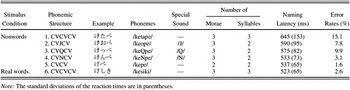
Mean latencies and error rates for naming real words and nonwords as a function of phonological structure
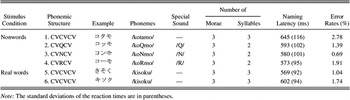
Mean latencies and error rates for naming real words and nonwords with Japanese special sounds of /Q/,/N/, and /R/
Stimulus items used in Experiment 1
Stimulus items used in Experiment 2
 You have
Access
- 12
- Cited by