Understanding reading achievement in university students is important, given the centrality of reading in academic success (Snow & Strucker, Reference Snow, Strucker, Comings, Garner and Smith2000). This study contributes to knowledge of this population through two avenues. First, in studies of English-speaking university students, a group has been identified with undiagnosed, self-reported histories of reading difficulties (e.g., Deacon, Cook, & Parrila, Reference Deacon, Cook and Parrila2012; Parrila, Georgiou, & Corkett, Reference Parrila, Georgiou and Corkett2007). To better understand the functioning of these students, we explore relative strengths and weaknesses across areas of their reading achievement, and examine their performance on measures of morphological awareness. Second, we examine the contributions of morphological awareness to reading achievement for a larger sample of first-year university students.
Morphological awareness is the ability to recognize and manipulate morphemes, the smallest meaningful units in language (e.g., Carlisle, Reference Carlisle1988). Established models of reading development recognize language comprehension as one of two determinants of reading achievement (e.g., Gough & Tunmer, Reference Gough and Tunmer1986; Scarborough, Reference Scarborough, Neuman and Dickinson2001), and morphology is an important component of oral language (e.g., Wiig, Secord, & Semel, Reference Wiig, Secord and Semel2013). Few models, however, have specified a role for morphological awareness (Carlisle, Reference Carlisle2010). Scarborough (Reference Scarborough, Neuman and Dickinson2001) included understanding the structures of language, both the syntactic and the semantic relationships among words, as an important strand of language comprehension. In this model, aspects of language and word reading become more coordinated throughout development, and morphological awareness would be expected to contribute to reading comprehension.
The reading systems framework (Perfetti & Stafura, Reference Perfetti and Stafura2014; Stafura & Perfetti, Reference Stafura, Perfetti, Cain, Compton and Parrila2017), although encompassing many aspects of reading not examined in the current study, explicitly incorporates morphology. Subsystems are delineated in this framework, toward integrating word-level processes within a comprehensive model of reading comprehension. The orthographic system, in which internal orthographic representations are mapped onto phonology and morphology, is instrumental to word reading. Morphology is thus important in word reading as it is proposed to be one organizing principle of the lexicon (see Rabin & Deacon, Reference Rabin and Deacon2008). As one component of a broader linguistic system, morphology is also assigned a role in the integration of word meanings with larger segments of text (for a visual representation see Figure 1, p. 11, in Stafura & Perfetti, Reference Stafura, Perfetti, Cain, Compton and Parrila2017). Within the context of the models discussed, the current study examined specific hypotheses concerning independent contributions of morphological awareness to word reading and to reading comprehension.
Reading achievement in students with a self-reported history of reading difficulties
Research with English-speaking university students has identified a group who report a history of reading difficulties, which have gone largely undiagnosed (e.g., Deacon et al., Reference Deacon, Cook and Parrila2012; Jackson & Doellinger, Reference Jackson and Doellinger2002; Parrila et al., Reference Parrila, Georgiou and Corkett2007). That is, their scores on a self-report questionnaire indicate reading acquisition difficulties in childhood; however, only about 20% have received any type of learning-related diagnosis (Deacon et al., Reference Deacon, Cook and Parrila2012). Academically, students with a self-reported history of reading difficulties had lower first-year grades and completed fewer attempted course credits than their peers without such a history (Bergey, Deacon, & Parrila, Reference Bergey, Deacon and Parrila2017; Chevalier, Parrila, Ritchie, & Deacon, Reference Chevalier, Parrila, Ritchie and Deacon2017). In terms of reading achievement, students with a self-reported history of reading difficulties have been found to show deficits in word reading, reading rate, reading comprehension, and phonological awareness compared to typically achieving peers (Deacon et al., Reference Deacon, Cook and Parrila2012; Deacon, Parrila, & Kirby, Reference Deacon, Parrila and Kirby2006; Kemp, Parrila, & Kirby, Reference Kemp, Parrila and Kirby2009; Parrila et al., Reference Parrila, Georgiou and Corkett2007).
Deacon et al. (Reference Deacon, Cook and Parrila2012) compared the performance of these students with a group of peers with a diagnosed reading disability, and to a comparison group without a history of reading difficulties. Students with a self-reported history of reading difficulties performed the same as students with diagnosed disabilities, and both groups were poorer than the comparison group on measures of timed reading comprehension, word-reading accuracy and efficiency, and phonological awareness (Deacon et al., Reference Deacon, Cook and Parrila2012; see also Parrila et al., Reference Parrila, Georgiou and Corkett2007). The diagnosed group performed better than the self-report group on untimed reading comprehension, but the self-report group read texts faster. These group differences may be attributable to different approaches to reading tasks. The authors concluded that students with a self-reported history of reading difficulties most likely represented the same underlying population as those with a diagnosis; that is, high-functioning individuals with reading difficulties. Students with a self-reported history of reading difficulties may face increased risk of academic difficulties in the university setting, as they do not receive the same academic supports as students with a formal diagnosis.
One remaining gap in our knowledge of reading achievement for students with self-reported histories of reading difficulties concerns the relative magnitudes of their impairments across word- and text-reading domains. These students have been found to have the same phonological and word-reading deficits as students with diagnosed reading disabilities (Deacon et al., Reference Deacon, Cook and Parrila2012). It may follow that the largest achievement gaps for students with a self-reported history of reading difficulties will be in isolated word reading, with lower levels of impairment in reading comprehension. The semantic and syntactic contexts provided by connected text may facilitate comprehension for students with a self-reported history of reading difficulties (see Corkett & Parrila, Reference Corkett and Parrila2008). Alternatively, if processes specific to reading fluency or comprehension are impaired for students with a self-reported history of reading difficulties, text-reading measures may be at least as impaired as isolated word reading. The current study builds on previous research by directly comparing effect sizes for different areas of reading achievement for this group of students.
Reading-related skills in students with a self-reported history of reading difficulties
Another remaining gap in our knowledge concerning students with a self-reported history of reading difficulties is how they read at a level necessary to complete university courses. We turn to another factor that could potentially help to explain reading success in these individuals, morphological awareness. It has been shown that morphology has a role in skilled word reading (e.g., Crepaldi, Rastle, Coltheart, & Nickels, Reference Crepaldi, Rastle, Coltheart and Nickels2010; Taft, Reference Taft1994). Furthermore, both developmental research (Deacon, Tong, & Mimeau, Reference Deacon, Tong, Mimeau, Perfetti and Verhoeven2016) and theoretical models support the notion that individual differences in morphological processing are related to reading achievement (Scarborough, Reference Scarborough, Neuman and Dickinson2001; Stafura & Perfetti, Reference Stafura, Perfetti, Cain, Compton and Parrila2017). Consistent with some research on university students with dyslexia (e.g., Cavalli, Duncan, Elbro, El Ahmadi, & Colé, Reference Cavalli, Duncan, Elbro, El Ahmadi and Colé2017; Law, Wouters, & Ghesquière, Reference Law, Wouters and Ghesquière2015; Martin, Frauenfelder, & Cole, Reference Martin, Frauenfelder and Cole2014), morphological awareness may also be a strength for students with a self-reported history of reading difficulties, acting as a compensation for core deficits in the word reading of these students.
There are, however, inconsistencies in the literature addressing the morphological awareness skills of university students with dyslexia. This state of knowledge is in sharp contrast to the well-established deficits in phonological awareness for university students and adults with reading difficulties, regardless of whether these are diagnosed (Bruck, Reference Bruck1993; Miller-Shaul, Reference Miller-Shaul2005) or not (e.g., Deacon et al., Reference Deacon, Cook and Parrila2012). Research findings from several studies support the view that implicit or explicit morphological processing is an additional deficit for university students with dyslexia (e.g., Leikin & Zur Hagit, Reference Leikin and Zur Hagit2006; Leong, Reference Leong1999; Schiff & Raveh, Reference Schiff and Raveh2007). Some researchers have suggested that compensatory mechanisms in university students with dyslexia be sought in skills other than morphological awareness, such as orthographic, semantic, or meta-analytic processes (Cartwright, Bock, Coppage, Hodgkiss, & Nelson, Reference Cartwright, Bock, Coppage, Hodgkiss and Nelson2017; Leinonen et al., Reference Leinonen, Müller, Leppänen, Aro, Ahonen and Lyytinen2001; Welcome, Chiarello, Halderman, & Leonard, Reference Welcome, Chiarello, Halderman and Leonard2009).
Morphological processing has not been well studied in university students with a self-reported history of reading difficulties. In one of the few such studies, this group of English-speaking students were not sensitive to morphological complexity in priming tasks involving word reading; typically achieving university students matched on untimed reading comprehension did show these effects (Deacon et al., Reference Deacon, Parrila and Kirby2006). These finding are consistent with those of Schiff and Raveh (Reference Schiff and Raveh2007) for Hebrew-speaking university students with dyslexia, and suggest that morphological awareness, which relies on implicit morphological knowledge, may be a deficit rather than a strength for students with self-reported histories of reading difficulties.
When deficits in morphological awareness in university students with dyslexia have been reported, these have been found to extend beyond those explained by phonological deficits (Law et al., Reference Law, Wouters and Ghesquière2015; see also Cantiani, Lorusso, Guasti, Sabisch, & Männel, Reference Cantiani, Lorusso, Guasti, Sabisch and Männel2013); however, these studies have not frequently included orthographic processing. Orthographic processing has been defined as the ability to “form, store, and access orthographic representations” in the mental lexicon (Cunningham, Nathan, & Rather, Reference Cunningham, Nathan, Raher, Kamil, Pearson, Moje and Afflerbach2011, p. 263). These skills are critical to automatic word reading (Ehri, Reference Ehri2005) and have been found to be poorer in adults with diagnosed reading disabilities versus nondisabled peers (e.g., Coleman, Gregg, McLain, & Bellair, Reference Coleman, Gregg, McLain and Bellair2009; Meyler & Breznitz, Reference Meyler and Breznitz2005; Taft, Reference Taft2001). For university students with a self-reported history of reading difficulties, one study found that spelling of simple irregular words was poorer than for a comparison group matched on a standardized spelling test (Kemp et al., Reference Kemp, Parrila and Kirby2009), suggesting a difficulty memorizing orthographic patterns. Given the central roles accorded to phonological awareness and orthographic processing in word-reading acquisition (Ehri, Reference Ehri2005; Cunningham et al., Reference Cunningham, Nathan, Raher, Kamil, Pearson, Moje and Afflerbach2011; Share, Reference Share1995, Reference Share2008), one goal of our study was to investigate morphological awareness skills within the context of these other two skills in university students with a self-reported history of reading difficulties.
Morphological awareness and its relation to reading achievement in university students
Looking beyond students with a self-reported history of reading difficulties, we examined the contribution of morphological awareness to word reading and reading comprehension for first-year university students more generally. Given that the reading achievement of university students is expected to be higher than the population of all young adults, researchers may argue that individual differences in such are not important to academic achievement (Jackson, Reference Jackson2005). We build on prior research by attempting to explain the individual differences in word reading and reading comprehension achievement that are apparent in university students (e.g., Guo, Roehrig, & Williams, Reference Guo, Roehrig and Williams2011; Jackson & Doellinger, Reference Jackson and Doellinger2002). Given the primacy attributed to phonological and orthographic processing in reading acquisition (e.g., Ehri, Reference Ehri2005), these may account for the overwhelming variance in university students’ word reading. Morphological processing, however, is related to word reading in younger samples (Carlisle & Stone, Reference Carlisle and Stone2005), supports skilled word reading (Crepaldi et al., Reference Crepaldi, Rastle, Coltheart and Nickels2010), and is one factor influencing word recognition in the reading systems framework (Stafura & Perfetti, Reference Stafura, Perfetti, Cain, Compton and Parrila2017). Morphological awareness may, therefore, make a unique contribution to individual differences in word reading in university students.
Comprehending text is the ultimate goal of reading and central to successful university studies. There is limited research that simultaneously examines the three reading-related skills included in this study and their relationship to reading comprehension in university students or young adults. Theoretically, morphological awareness is proposed to have a direct influence on reading comprehension (Scarborough, Reference Scarborough, Neuman and Dickinson2001; Stafura & Perfetti, Reference Stafura, Perfetti, Cain, Compton and Parrila2017), and this has been found to be the case for elementary and adolescent students (Carlisle, Reference Carlisle and Feldman1995; Deacon et al., Reference Deacon, Tong, Mimeau, Perfetti and Verhoeven2016; Kirby et al., Reference Kirby, Deacon, Bowers, Izenberg, Wade-Woolley and Parrila2012; Tong, Deacon, Kirby, Cain, & Parrila, Reference Tong, Deacon, Kirby, Cain and Parrila2011). Less is known about the unique contribution of morphological awareness to reading comprehension in university students; however, it has been proposed that over the school years, as words become more structurally complex with increasing text difficulty, the contribution of morphological awareness to reading comprehension should increase (Nagy, Reference Nagy, Wagner, Muse and Tannenbaum2007). Guo et al. (Reference Guo, Roehrig and Williams2011) completed one of very few studies with university students, and did find that morphological awareness contributed to English-language reading comprehension beyond that accounted for by syntactic awareness and vocabulary; however, individual differences in word-reading skills were not accounted for in their analyses. We examined whether morphological awareness contributed to reading comprehension independent of word-reading achievement and other reading-related skills.
The current study
In order to increase current understandings of university students’ reading achievement, we examined three research questions:
1. Which areas of reading achievement are most impaired for students with a self-reported history of reading difficulties?
2. Do students with a self-reported history of reading difficulties show deficits in morphological awareness, and if yes, do these persist after controlling for reading-related skills or word reading?
3. Does morphological awareness make a unique contribution to word reading and to reading comprehension in a large sample of first-year university students?
Our predictions for each question in turn were as follows. We expected that word-reading skills would be more impaired than text-reading processes in students with self-reported histories of reading difficulties, as text reading might allow for contextual facilitation for this group of readers. Outcomes for our second research question were not straightforward to predict. That is, morphological awareness may be an additional and persistent deficit in students with a self-reported history of reading difficulties, as found for younger students with diagnosed disabilities (Deacon et al., Reference Deacon, Tong, Mimeau, Perfetti and Verhoeven2016) and in some studies of university students with dyslexia. Alternatively, morphological awareness may be a strength for students with a history of reading difficulties as reported in other studies with university students with dyslexia, helping them to read university material. Addressing our final research question, we predicted from theoretical models and previous research, largely with younger students, that morphological awareness would make a unique contribution to word reading and to reading comprehension for our larger group of university students.
Method
Participants
Over a 3-year period, each incoming first-year student at a large, research-intensive Canadian university was e-mailed an invitation to participate in an online questionnaire about his or her reading history (Adult Reading History Questionnaire—Revised [ARHQ-R]; Parrila, Corkett, Kirby, & Hein, Reference Parrila, Corkett, Kirby and Hein2003). The current sample is drawn from 750 students who responded to this invitation. These students had no prior postsecondary experience, had English as a first language, and indicated agreement to being contacted for a follow-up study. Two hundred and thirty-two of these students were recruited and attended an individual testing session at a university laboratory and 220 completed the measures for this study. Students whose performance on the ARHQ-R met criteria for a history of reading difficulties were overrecruited.Footnote 1 Of these 220 students (168 females), 58 (26%) had a proportion score on the ARHQ-R that indicated high levels of difficulty learning to read, and 112 had a score that indicated no difficulties in acquiring reading skills (Deacon et al., Reference Deacon, Parrila and Kirby2006, Reference Deacon, Cook and Parrila2012; Lefly & Pennington, Reference Lefly and Pennington2000; Parrila et al., Reference Parrila, Corkett, Kirby and Hein2003).Footnote 2
In order to create a comparison group and control for gender, age, and nonverbal reasoning, a subset of these 112 students without any indication of difficulties learning to read was individually matched, as closely as possible, with the students with a self-reported history of reading difficulties. A match was judged to be acceptable if the individuals were the same gender, within 1 year of age, and within 4 points on the nonverbal reasoning measure. This matching process resulted in a group of 54 students with a self-reported history of reading difficulties (36 females, Mage = 18.92; range 17.08–25.5 years; matrix reasoning = 28.65, SD = 3.32)Footnote 3 and 54 students with no self-reported history of reading difficulties (36 females, Mage = 18.97; range 17.67–26.33 years; matrix reasoning = 28.63, SD = 3.35). Independent-samples t tests showed that the groups did not differ on age, t (106) = –0.23, p = .82, or nonverbal reasoning scores, t (106) = 0.03, p = .98.
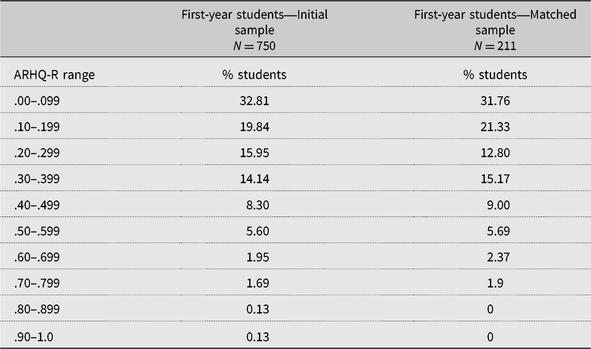
We examined the contribution of morphological awareness to reading achievement in first-year university students more generally. The proportion of students in each decile of the ARHQ-R for the 220 students who completed individual testing was matched with that of the 750 students from whom the sample was drawn. This was done to correct for overrecruiting of students with a history of reading difficulties for individual testing. This resulted in a group of 211 students (161 females) in total, and this group is examined in the regression analyses in this study (see Table 1 for the distribution of ARHQ-R scores for the samples of 750 and 211 students).
Distribution of ARHQ-R scores for initial and matched samples of first-year students

Note: Adult Reading History Questionnaire—Revised (ARHQ-R) scores range from 0 (no history of difficulties acquiring reading skills in elementary school) to 1 (extensive difficulties acquiring reading skills in elementary school).
Measures
Nonverbal reasoning
A computer-adapted version of the matrix reasoning subtest of the Wechsler Abbreviated Scale of Intelligence (Wechsler, Reference Wechsler1999) was administered. Participants chose a computer key to indicate which of five possible responses completed each matrix. The total score was out of 35 items. The split-half reliability for adults is reported in the test manual to be .94 (Wechsler, Reference Wechsler1999).
History of reading difficulties
The participants’ history of reading difficulties was measured on the Elementary-School Scale on the ARHQ-R (Parrila et al., Reference Parrila, Corkett, Kirby and Hein2003). The degree of difficulties acquiring literacy skills in elementary school is assessed with an 8-item scale. Participants respond to each item (e.g., “How much difficulty did you have learning to read in elementary school?”) on a 5-point Likert-like scale. Responses across the 8 items are summed and transformed to result in a score that ranges from 0 (no difficulties) to 1 (extensive difficulties). As in previous research (e.g., Bergey et al., Reference Bergey, Deacon and Parrila2017; Deacon et al., Reference Deacon, Cook and Parrila2012; Parrila et al., Reference Parrila, Georgiou and Corkett2007), students with scores equal to or greater than .37 were identified as having a history of reading difficulties. Students with scores less than .25 were categorized as having no history of reading difficulties. The scale had good reliability in the current sample (N = 211; Cronbach’s α = 0.88). For students with a self-reported history of reading difficulties (N = 54), the mean score on this scale was .50 (SD = .13) and for the comparison group with no history of reading difficulties (N = 54) the mean score was .10 (SD = .07). The groups differed significantly on this scale, t (106) = 20.40, p < .001.
Phonological awareness
Phonological awareness task 1 (PA1) was the spoonerisms subtest of the York Adult Assessment (Hatcher, Snowling, & Griffiths, Reference Hatcher, Snowling and Griffiths2002). This phonological awareness measure has practice items and 12 test items, for which participants heard a first and last name spoken by the examiner, and were required to switch the initial sounds from the two proper names (e.g., the correct response for “John Lennon” is “Lohn Jennon”). Participants were awarded 2 points for correct items and 0 points for an answer with one or more errors. The Spearman–Brown split-half reliability coefficient for the current sample was .74.
Phonological awareness task 2 (PA2) consisted of a phonological choice task (see Parrila et al., Reference Parrila, Georgiou and Corkett2007) that combines elements of phonemic judgement or awareness and phonological decoding. Participants were directed to quickly choose one of two written pseudowords “that sounds like a real English word” (e.g., fite-fipe; saip-saif; and doster-dawter). A participant’s score was the number correct for the 20 items (17 single-syllable pairs and 3 two-syllable pairs). The Spearman–Brown split-half reliability coefficient for the current sample was .82.
Morphological awareness
Across two tasks, participants read a list of 44 words, with each word consisting of one to four morphemes. Participants were instructed to “draw a line between the smallest meaningful parts of words” in the list, and completed practice items with feedback. Examples of items in the lists include malfunctioning, extrasensory, bilingual, farmer, immobile, and corner (correct parsing: mal | funct | ion | ing; extra | sens | ory; bi | lingu | al; farm |er; im | mobile; and corner). These tasks were previously piloted with university student participants. For morphological awareness task 1 (MA1), participants completed the list at their own pace. For morphological awareness task 2 (MA2), participants were given 45 s to complete a list of 44 different words.
There were 9 and 11 distractor items included in MA1 and MA2, respectively. These were items that consist of only one morpheme, but which have orthographic patterns frequently associated with morphemes (e.g., needle; coral; planet; convey, imitate, earnest). Participants received 1 point for not parsing these words, and 0 points if the word was parsed. Participants using an orthographic strategy, rather than attending to the morphological structure of words, would thus receive lower scores due to these distractor items. Participants’ scores were the number of correct parsings, with a maximum score of 56 for each task. The Spearman–Brown coefficient was calculated for odd-even items for the current sample and was .83 for MA1 and .86 for MA2.
Orthographic processing
Orthographic processing was measured using a two-part wordlikeness task similar to previous research (Conrad, Harris, & Williams, Reference Conrad, Harris and Williams2013) and piloted before inclusion in this study. For orthographic processing task 1 (OP1), participants were instructed to indicate which of the nonwords “looks like it could be a real English word” from two pseudowords. The same instructions were given for the orthographic processing task 2 (OP2), but participants chose from three choices (e.g., veighk-vayk-vake; with the correct response vake). Stimuli were presented on the computer screen, and reaction times were measured from stimulus presentation to the participant pressing a response key. The setup and task demands of this measure are similar to that of the PA2 task, but responses call for reliance on orthographic rather than phonological information. As expected from pilot work with this task, participants performed at ceiling on OP1 and OP2 (M = 15.62, SD = 1.38 for 17 items and M = 9.81, SD = 1.19 for 11 items, respectively); reaction times were used in all the analyses. The Spearman–Brown coefficient for reaction time data for the current sample was .92 for OP1 and .94 for OP2.
Word-reading accuracy
The word identification subtest of the Woodcock Reading Mastery Tests—Revised (Woodcock, Reference Woodcock1998) was adapted for computer presentation. Each item was presented one at a time on the screen for the participant to read aloud, and an assistant recorded response accuracy. The test was discontinued after six consecutive errors. Spearman–Brown split-half reliability coefficient is reported in the test manual to be .97 (Woodcock, Reference Woodcock1998).
Word-reading efficiency and phonemic decoding efficiency
The two subtests of the Test of Word Reading Efficiency (TOWRE; Torgesen, Wagner, & Rashotte, Reference Torgesen, Wagner and Rashotte1998) were adapted for computer presentation. Presentation of stimuli was identical to the printed test book, but presented on a computer screen. A participant had 45 s to read as many words (or nonwords) aloud as she or he could. The test–retest reliability is reported in the test manual with r = .91 for the word reading efficiency scale and .90 for the phonemic decoding efficiency scale (Torgesen et al., Reference Torgesen, Wagner and Rashotte1998).
Reading comprehension and text-reading rate
The Nelson Denny Reading Test (Brown, Fishco, & Hanna, Reference Brown, Fishco and Hanna1993) was used to measure text-reading rate and reading comprehension, and was adapted for computer presentation. The reading comprehension test consisted of seven passages that participants read silently, with a total of 38 multiple-choice questions, and participants were given 20 min to complete the test. Reading rate was determined by recording the amount of time taken to silently read the first passage. The reading comprehension score was the number of accurate responses to the multiple-choice questions. Alternate form reliability for the comprehension scale is reported in the test manual to be .81 (Brown et al., Reference Brown, Fishco and Hanna1993).
Data analytic plan
Data analyses addressed each of our three research questions. We first examined normality for raw scores that were used in analyses, and for reaction time data for the two orthographic tasks. All reaction times (RTs) greater than 2 SDs above the participant’s mean were recoded to be at the 2 SD point (Ratcliff, Reference Ratcliff1993). Toward determining areas of strength and weakness for students with self-reported histories of reading difficulties, a multivariate analysis of variance (MANOVA) was first conducted comparing the groups (n = 54) on the reading achievement measures. We next calculated and examined effect sizes and confidence intervals for these group differences. We judged effect sizes with nonoverlapping confidence intervals to be significantly different (Knezevic, Reference Knezevic2008). To address whether morphological awareness skills are a weakness or a strength for students with a self-reported history of reading difficulties, a MANOVA was used to compare the groups on the three reading-related skills. This was followed by two MANCOVAs to determine if morphological awareness differences were explained by the covariates of (a) reading-related skills or (b) word-reading skills. In order to examine our last research question, whether morphological awareness makes a unique contribution to word reading and to reading comprehension in our larger first-year sample, two hierarchical regressions were conducted.
Results
RT distributions for the two orthographic processing tasks, and raw score distributions for all other tasks were examined for normality, and transformations were applied to correct for skewness (Tabachnick & Fidell, Reference Tabachnick and Fidell2007). We corrected mild negative skewness for PA1, PA2, and TOWRE phonemic decoding efficiency, and corrected mild positive skewness for OP1 and Nelson Denny reading rate.
Reading achievement in students with a self-reported history of reading difficulties
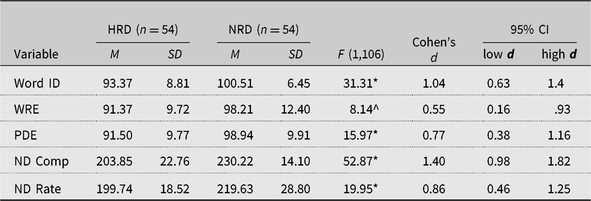
To examine the relative degree of the impairments for students with a self-reported history of reading difficulties across the reading domains, we first conducted a MANOVA on the five reading achievement measures. This yielded a significant group difference, F (5, 102) = 11.45, Wilks’s Λ = .640, p < .001; follow-up, univariate tests were significant for each reading measure. Table 2 displays these F values, as well as effect sizes, 95% confidence intervals, and the group mean standard scoresFootnote 4 and standard deviations for each reading measure. Effect sizes indicated moderate to large gaps in each area of reading achievement for the students with a self-reported history of reading difficulties. The only indication of differences between effect sizes was a more severe deficit for timed reading comprehension compared to that for word-reading efficiency.
Mean standard scores and SD for reading achievement measures by reading group

Note: HRD, group with self-reported history of reading difficulties. NRD, group with no self-reported history of reading difficulties. Word ID, Woodcock word identification. WRE, TOWRE word-reading efficiency. PDE, TOWRE phonemic decoding efficiency. ND Comp, Nelson Denny reading comprehension. ND Rate, Nelson Denny reading rate. *p < .001. ^p < .005.
In order to better understand the observed reading comprehension deficit, we compared the groups on an untimed reading comprehension score (the number of items the participant got correct / the number of items the participant attempted). An independent-samples t test showed a significant difference between the groups on untimed reading comprehension, t (106) = –4.84, p < .001, and d = 0.957. The means were .81 (SD = .13) and .91 (SD = .07), for the group with versus without a self-reported history of reading difficulties, respectively.
Reading-related skills in students with a history of reading difficulties
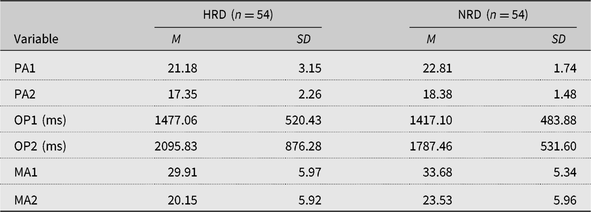
In order to compare the performance of the groups on the reading-related skills, scores on the six tasks were submitted to a one-way MANOVA (mean raw scores or RTs, and standard deviations for the reading-related skills are presented in Table 3). There was a statistically significant difference between the groups, F (6, 101) = 5.57, p < .001; Wilks’s Λ = .751. Follow-up univariate tests showed a significant group effect for all but one measure; PA1, F (1, 106) = 11.66, p < .005, d = 0.658; PA2, F (1, 106) = 7.79, p < .01, d = 0.537; OP2, F (1, 106) = 4.89, p < .05, d = 0.426; MA1, F (1, 106) = 11.96, p < .005, d = 0.663; and MA2, F (1, 106) = 8.72, p < .005, d = 0.567. For each of these measures, the students with a self-reported history of reading difficulties performed worse than the comparison group. The effect of group was not significant for OP1, F (1, 106) = 2.31, p = .13.
Means and SD for reading-related skills by reading group

Note: HRD, group with self-reported history of reading difficulties. NRD, group with no self-reported history of reading difficulties. OP1, orthographic processing task 1. OP2, orthographic processing task 2. MA1, morphological awareness task 1. MA2, morphological awareness task 2. PA1, phonological awareness task 1. PA2, phonological awareness task 2.
To examine whether group differences on morphological awareness remained after controlling for individual differences on the two other reading-related skills, a MANCOVA was conducted on the two morphological awareness scores with PA1 and OP2 as covariates.Footnote 5 There was a statistically significant difference between the groups, F (2, 103) = 5.91, Wilks’s Λ = .897, p < .005. In order to test whether students with a self-reported history of reading difficulties still manifest a deficit in morphological awareness after controlling for variance in word reading, another MANCOVA was conducted with word identification scores as the covariate. A statistically significant difference remained between the groups, F (2, 104) = 3.35; Wilks’s Λ = .940, p < .05.
Reading-related skills and reading achievement in first-year university students
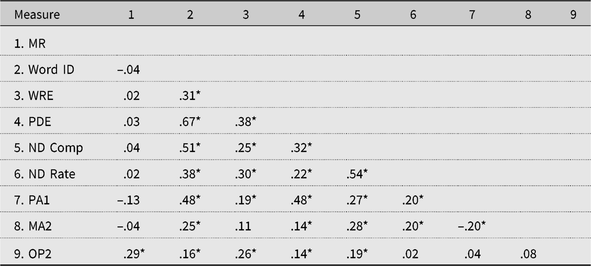
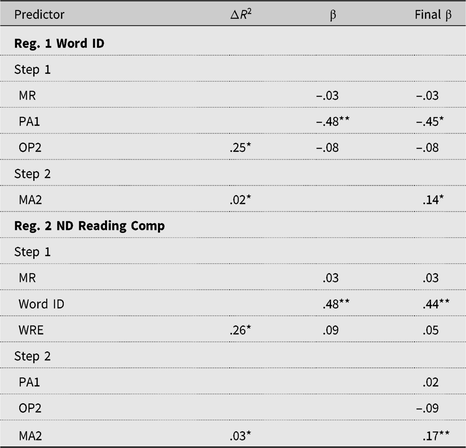
For the sample of 211 first-year university students, zero-order correlations are presented in Table 4.Footnote 6 In each of the following regressions, matrix reasoning was included in the first step to control for general ability. In the first regression, we examined whether morphological awareness contributed to word-reading accuracy beyond that accounted for by matrix reasoning, phonological awareness, and orthographic processing. As can be seen in Table 5, Regression 1, Step 1 accounted for 25.2% of the variance in word-reading accuracy. In Step 2, morphological awareness accounted for an additional and significant 1.8% of the variance in word-reading accuracy.
Correlations of variables in regression analyses for first-year students (N = 211)

Note. MR, matrix reasoning. Word ID, Woodcock word identification. WRE, TOWRE word-reading efficiency. PDE, TOWRE phonemic decoding efficiency. ND Comp, Nelson Denny reading comprehension. ND Rate, Nelson Denny reading rate. PA1, phonological awareness task 1. MA2, morphological awareness task 2. OP2, orthographic processing task 2. *p < .05.
Hierarchical regressions predicting reading achievement (N = 211)

Note: PA1 has a negative β in regression 1 due to the applied transformation to correct for negative skewness. Word ID, Woodcock word identification. MR, matrix reasoning. PA1, phonological awareness task 1. OP2, orthographic processing task 2. MA2, morphological awareness task 2. ND Comp, Nelson Denny reading comprehension. *p < .05. **p ≤ .01.
We next examined the contributions of the reading-related skills to reading comprehension beyond variance accounted for by matrix reasoning, word-reading accuracy, and word-reading efficiency. As can be seen in Regression 2, the first step of the equation predicted 26.3% of the variance in reading comprehension. An additional and significant 3.3% of the variance was accounted for by Step 2, with morphological awareness as the only significant predictor of the three reading-related skills.
Discussion
In the current study, we set out to address three research questions concerning reading achievement and morphological awareness in university students. We first compared the observed effect sizes for group differences across measures of reading achievement, to address which reading skills were relative strengths or weaknesses for students with self-identified histories of reading difficulties. We next compared performance of students with and without a self-reported history of reading difficulties on reading-related skills. These comparisons addressed whether morphological awareness was a relative strength or an additional deficit for students with a self-reported history of reading difficulties. Previous research has examined this question for students with dyslexia, whereas sample selection in this study was based on a self-report measure of reading acquisition difficulties, rather than on norm-referenced tests. Finally, hierarchical regressions were used to examine whether morphological awareness accounted for unique variance in measures of reading achievement for university students more generally. We discuss our findings for each research question in turn.
We found that students with a self-reported history of reading difficulties showed moderate to large deficits on word-reading accuracy, phonemic decoding efficiency, reading comprehension, and text-reading rate. Upon examination of the effect sizes and associated confidence intervals, timed reading comprehension appeared more severely impaired than word-reading efficiency. This outcome was not expected, but may be related to a number of factors. As is evident in this and related studies (e.g., Deacon et al., Reference Deacon, Cook and Parrila2012), university students with self-reported histories of reading difficulties read text more slowly, and may not have time to answer all the questions on a timed test. Furthermore, university students with reading difficulties, diagnosed or self-reported, have been found to take longer to answer multiple-choice questions (Hebert, Reference Hebert2016; Simmons & Singleton, Reference Simmons and Singleton2000), and these differences are not fully accounted for by word-reading efficiency or text-reading rate (Hebert, Reference Hebert2016). This may be due to different approaches to reading the text (Simmons & Singleton, Reference Simmons and Singleton2000); different patterns of metacognitive strategy use have been found between students with a self-reported history of reading difficulties and their peers without such a history (Chevalier et al., Reference Chevalier, Parrila, Ritchie and Deacon2017). University practices of increasing test taking time may accommodate for more than just differences in reading rate, and such accommodations should likely be extended to students with a history of reading difficulties.
Our second research question addressed morphological awareness for students with a self-reported history of reading difficulties within the context of two other reading-related skills. Our participants with a self-reported history of reading difficulties performed more poorly on measures of phonological awareness and orthographic processing, skills central to theories of reading acquisition (e.g., Cunningham et al., Reference Cunningham, Nathan, Raher, Kamil, Pearson, Moje and Afflerbach2011; Ehri, Reference Ehri2005; Share, Reference Share1995). We also found deficits on morphological awareness for students with a self-reported history of reading difficulties, and these persisted after statistically accounting for variance in (a) phonological awareness and orthographic processing, or (b) word reading.
Deacon et al. (Reference Deacon, Cook and Parrila2012) observed marked similarities between the reading performance of students with a self-reported history of reading difficulties and those with previously diagnosed reading disabilities. They suggested these two groups of students with reading difficulties were likely from the same underlying population. A pervasive morphological awareness deficit in students with self-reported histories of reading difficulties is consistent with some findings on university students with dyslexia. From their findings on a morphological priming task, Schiff and Raveh (Reference Schiff and Raveh2007) concluded that implicit morphological knowledge and the use of such in reading is another area of difficulty for Hebrew-speaking readers with dyslexia. In a second study, students with dyslexia were poorer on Hebrew morphological awareness tasks, even after phonological awareness skills were taken into account (Leikin & Zur Hagit, Reference Leikin and Zur Hagit2006). Not constrained to studies conducted in Hebrew, an English-language study found that morphological awareness was poorer for university students with versus without dyslexia, and this deficit remained after controlling for phonological awareness and vocabulary (Law et al., Reference Law, Wouters and Ghesquière2015). In this light of a shared deficit in morphological awareness, our findings would provide additional evidence for the proposal that students with diagnosed or self-reported histories of reading difficulties may represent the same underlying population (Deacon et al., Reference Deacon, Cook and Parrila2012).
These conclusions are in direct contrast to other research that supports the idea that morphological awareness is a strength for university students with dyslexia, and acts as a compensatory mechanism in their word reading. Although Law et al. (Reference Law, Wouters and Ghesquière2015) reported that “group analysis demonstrated an MA deficit in dyslexics” (p. 254), they also found that for 15 of 36 participants with dyslexia, defined as “compensated dyslexics” (average word-reading skills), morphological awareness did not differ from peers without reading difficulties. Furthermore, Law et al. found that morphological awareness accounted for unique variance in word reading for university students with dyslexia but not for typical readers (but see Leikin & Zur Hagit, Reference Leikin and Zur Hagit2006). French-language studies have also found that university students with dyslexia do not differ from their nondyslexic peers on oral-language morphological awareness tasks (Cavalli, Duncan, et al., Reference Cavalli, Duncan, Elbro, El Ahmadi and Colé2017; Martin et al., Reference Martin, Frauenfelder and Cole2014). There have even been reports of a larger morphological priming effect for dyslexic versus nondyslexic university students on orthographic tasks and a greater reliance for this dyslexic group on the semantic versus orthographic features of morphemes (Cavalli, Colé, et al., Reference Cavalli, Colé, Pattamadilok, Badier, Zielinski, Chanoine and Ziegler2017; see Quémart & Casalis, Reference Quémart and Casalis2015, for similar findings with younger students with dyslexia). Given inconsistencies in the literature concerning morphological awareness as a strength versus weakness for university students with dyslexia, it is unclear at this time if they share this deficit with the population we examined, university students with self-reported histories of reading difficulties.
Given that we found morphological awareness to be an additional area of weakness, the question remains of how students with self-reported histories of reading difficulties complete reading requirements for university courses. The answer may be found in higher level strategic processes. More students with a self-reported history of reading difficulties than peers without such a history reported using study and organizational strategies, as well as greater participation in classroom discussions (Corkett, Parrila, & Hein, Reference Corkett, Parrila and Hein2006, but see Bergey et al., Reference Bergey, Deacon and Parrila2017). Furthermore, the extent to which students with self-reported histories of reading difficulties reported using metacognitive reading strategies and study aids predicted their academic success (Chevalier, Parrila, Ritchie, & Deacon, Reference Chevalier, Parrila, Ritchie and Deacon2017). Although this group of university students has pervasive reading deficits, strategy use may be critical to understanding their approach to university reading requirements.
Our third research question addressed the hypothesis that morphological awareness accounts for unique variance in both word reading and in reading comprehension in our larger sample of first-year students. We found that morphological awareness contributed unique variance to word reading in first-year university students, after controlling for phonological awareness and orthographic processing. This relationship has been demonstrated in samples of school-age children (for reviews, see Deacon, Reference Deacon2012; Kuo & Anderson, Reference Kuo and Anderson2006), for whom the causal nature of the association was found to be bidirectional (Deacon, Benere, & Pasquarella, Reference Deacon, Benere and Pasquarella2013; Kruk & Bergman, Reference Kruk and Bergman2013).
We also found that after controlling for word-reading accuracy and efficiency, morphological awareness was the only reading-related skill examined in our study that accounted for variance in reading comprehension. This finding is consistent with, and extends that of Guo et al. (Reference Guo, Roehrig and Williams2011), who found that morphological awareness predicted unique variance in reading comprehension in university students; however, their study did not control for individual differences in word-reading skills. Our findings extend previous research with younger samples that report a unique relationship of morphological awareness to reading comprehension (e.g., Deacon, Kieffer, & Laroche, Reference Deacon, Kieffer and Laroche2014; Kirby et al., Reference Kirby, Deacon, Bowers, Izenberg, Wade-Woolley and Parrila2012). The small amount of unique variance accounted for by morphological awareness in university students’ reading comprehension is comparable to research with children (i.e., accounting for 2%–5% of variance; Deacon & Kirby, Reference Deacon and Kirby2004; Kirby et al., Reference Kirby, Deacon, Bowers, Izenberg, Wade-Woolley and Parrila2012). Considering our findings with university students compared to studies with younger samples, results do not support the suggestion that the strength of the relationship between morphological awareness and reading gets stronger with increasing grade levels (Nagy, Reference Nagy, Wagner, Muse and Tannenbaum2007; see also Kuo & Anderson, Reference Kuo and Anderson2006); however, our findings may be an underestimate of this contribution in adults more generally, as the university student population would be expected to have stronger and less varied reading comprehension than the general adult population. Research is needed to directly compare the contributions of morphological awareness to reading comprehension across age levels.
Our findings lend support to models of reading that propose that morphological awareness exerts a direct influence on each of word reading and reading comprehension (Perfetti & Stafura, Reference Perfetti and Stafura2014). The finding of an independent contribution to reading comprehension is also consistent with models of reading development that emphasize the role of linguistic comprehension to text understanding (Gough & Tunmer, Reference Gough and Tunmer1986; Scarborough, Reference Scarborough, Neuman and Dickinson2001). Although the amount of unique variance accounted for in reading comprehension by morphological awareness was small, this direct relationship was not found for phonological awareness or orthographic processing. Students with stronger morphological awareness may be better able to figure out the meanings and syntactic roles of unfamiliar words, increasing their comprehension of texts (Elbro & Arnbak, Reference Elbro and Arnbak1996). Consistent with our findings and with theoretical models, an intervention training morphological analysis with Hebrew-speaking university students with dyslexia demonstrated small, positive effects on spelling and text-reading (Bar-Kochva, Reference Bar-Kochva2016). Future research is needed to examine if such training can improve the reading achievement of university students with reading difficulties, either diagnosed or self-reported.
The findings of the current study should be viewed within the context of several limitations. First, the models of reading referred to in this paper include many potential sources of individual differences on reading achievement (Scarborough, Reference Scarborough, Neuman and Dickinson2001; Stafura & Perfetti, Reference Stafura, Perfetti, Cain, Compton and Parrila2017), and we examined a limited number of these. Including more language measures, such as vocabulary and syntax, would give a fuller picture of contributors to reading in university students, as well as add to our understanding of language strengths and weaknesses in students with self-reported histories of reading difficulties. Second, we did not have the information to determine the number of participants with self-reported histories of reading difficulties who might have had a diagnosed reading disability. We did have access to this information for other cohorts recruited in a similar manner, and can thus only estimate that this would be about 20% of this group of students. Third, we matched the number of participants in each decile of scores on the ARHQ-R with those from our larger sample of first-year students who completed the questionnaire, had English as a first language with no other postsecondary schooling, and agreed to be contacted for follow-up research (N = 750). Our goal was to have a representative sample of first-year students in terms of reading acquisition history; however, we do not know what selection biases may influence incoming students to respond to the initial invitation.
In summary, the current study provided evidence concerning the extent of difficulties across all areas of reading achievement for university students with a self-reported history of reading difficulties, and placed a particular focus on timed reading comprehension. Alongside the observed reading achievement deficits, these students earn lower grades and fewer credits (e.g., Bergey et al., Reference Bergey, Deacon and Parrila2017; Chevalier et al., Reference Chevalier, Parrila, Ritchie and Deacon2017). It seems likely that these students would benefit from university supports given to those with a formal diagnosis, including accommodations for timed reading comprehension tasks. The current study also demonstrated the pervasiveness of morphological awareness deficits in university students with self-reported histories of reading difficulties. Finally, we provided evidence that morphological awareness contributes unique variance to word reading and to reading comprehension in university students more generally, extending research with younger readers. Morphological awareness appears similar to phonological awareness insofar as it is an area of impairment for young adults with self-identified histories of reading difficulties and is related to reading in a more normally distributed population of university readers. Taken together, research supports the view that morphological awareness is a foundational skill in reading acquisition and achievement, and contributes to individual differences in the reading of university students.
Author ORCIDs
Hélène Deacon 0000-0002-4792-5137