The English language has an alphabetic writing system that represents both phonemes and morphemes. For instance, spelling of the word rocked is based in part on phonology, in that the letters largely follow on the sounds in the word, and in part on morphology, in that the letters –ed are used to represent the past-tense morpheme, even though it has the sound /t/. A wealth of literature has documented the importance of children’s awareness of phonemes in supporting their word-level reading (e.g., Bradley & Bryant, Reference Bradley and Bryant1983; Wagner, Torgesen, & Rashotte, Reference Wagner, Torgesen and Rashotte1994). Far less work has explored the role of morphological awareness in word-level reading (e.g., Carlisle, Reference Carlisle2010; Deacon, Reference Deacon2012). Morphological awareness is the ability to reflect on, analyze, and manipulate the smallest units of meaning in language, or morphemes (Carlisle, Reference Carlisle2010). A key theoretically driven question lies in the consistency of the contribution of morphological awareness to word-level reading across the early to middle elementary school years. We test this question here by examining whether morphological awareness assessed with past-tense verbs is related to skill in reading known and novel words in a cross-sectional study of English-speaking children in the early to middle elementary school years (Grades 1 to 4).
Potential changes across the early to middle elementary school years in the relations between morphological awareness and word-level reading are relevant for models of word reading. In her Phase Theory of Reading Development, Ehri describes word reading as developing through a sequence of four overlapping phases (Ehri, Reference Ehri1995, Reference Ehri2005, Reference Ehri2014; also see Seymour, Reference Seymour, Snowling and Hulme2005). Following on the first prealphabetic phase, children rely increasingly on phonological decoding in the next two phases. Only in the last phase, known as the consolidated alphabetic phase, are children thought to rely on letter patterns, including morphemes such as –ed, that occur frequently in written words. In this phase, children continue to have access to all the linguistic skills used in earlier phases. While phases are not tied directly to grades, in this theory, children are thought to reach the final phase in Grade 3. Likely influenced in part by this theory, much of the empirical literature on the relation between morphology and word-level reading is conducted with children in Grades 3 and up (see Carlisle & Kearns, Reference Carlisle, Kearns, Cain, Compton and Parilla2017, for a review). However, Carlisle and Kearns (Reference Carlisle, Kearns, Cain, Compton and Parilla2017) suggest the relation between morphology and real word reading begins earlier in childhood than what was previously theorized. Moreover, there is some empirical evidence that younger children use morphological information when spelling and when making lexical decisions (Deacon & Bryant, Reference Deacon and Bryant2006; Rabin & Deacon, Reference Rabin and Deacon2008; Treiman, Cassar, & Zukowski, Reference Treiman, Cassar and Zukowski1994).
Theories are less clear about the role of morphology in reading novel words. Ehri’s suggestion that readers in the consolidated alphabetic phase have access to all linguistic skills leads to two possible predictions (Ehri, Reference Ehri1995, Reference Ehri2005, Reference Ehri2014). Children might rely heavily on phonological skills, an earlier developed skill, in the reading of novel words. This prediction is also supported by Ehri’s speculation that letter patterns such as morphemes are useful in securing words in memory; this points to relations specifically for known words with such memory representations and not to novel words. This is likely the assumption to be made by many researchers; a well-known test of pseudoword reading (the TOWRE; Torgesen, Wagner, & Rashotte, Reference Torgesen, Wagner and Rashotte1999) is known as phonemic decoding, suggesting that it tests decoding by phonemes only. Yet, children in the consolidated phase in Ehri’s theory might draw on all available linguistic skills in reading novel words, leading to a role for morphological awareness in reading both known and novel words. Children may segment morphemelike units from pseudowords (or from real words that are new to the child); consider, for instance, the fact that they might activate –ing and –ful in a pseudoword like munsingful. These ideas align with theorizing in the adult literature as to the role of morphemes as functional units of lexical access (e.g., Taft, Reference Taft2004); novel words may not carry meaning on their own, but they contain meaningful semantic units that could influence processing (see Deacon & Kirby, Reference Deacon and Kirby2004). Such processing could occur on the basis of morphemes as “beads on a string” or as convergence of codes (e.g., Seidenberg & Gonnerman, Reference Seidenberg and Gonnerman2000). In addition, items like munsingful occur on commonly given tests of pseudoword reading, including in the word attack that we use in the present study (Woodcock, Reference Woodcock2011). Given these theoretically plausible alternatives, we need empirical research contrasting relations between morphological awareness and the reading of known and novel words across the early to middle elementary school years.
Empirical evidence to date on the relations between morphological awareness, real word, and pseudoword reading
Further impetus to evaluate these relations comes from the relatively limited available research base. As a case in point, the authors of a recent meta-analysis (Ruan, Georgiou, Song, & Shu, Reference Ruan, Georgiou, Song, Li and Shu2018) remarked that the few available studies in English have covered either the lower or the upper elementary school grades. Certainly, there are several longitudinal studies, but by design, these often hold the time point of measurement of morphological awareness constant, while varying the point of measurement of reading outcomes (e.g., Deacon & Kirby, Reference Deacon and Kirby2004); this means that findings of changes in contribution of morphological awareness are confounded with the amount of time passed from its point of measurement. In addition, we would note that studies targeting different age ranges have tended to use different measures of morphological awareness; this makes available literature hard to contrast solely on the basis of grade ranges. Because children with greater reading experience may be more inclined to use morphological information when reading (Ehri, Reference Ehri2014), it would be useful to contrast patterns in cross-sectional studies of children in lower elementary grades, such as Grades 1 and 2, and of older children, in Grades 3 and 4, who have completed the same measures of morphological awareness for all children. In the paragraphs that follow, we review the available studies that report on relations across different levels within the same study that cross this key theoretically important division.
In reviewing this evidence, we are careful to attend to the aspect of morphological awareness assessed because morphological awareness develops across the period during which children are learning to read. Inflections mark grammatical information on words, for instance, denoting plurality or tense and remaining within the same grammatical category. Derivational morphemes tend to change the meaning of a word as well as its grammatical category (e.g., instruct–instructor, thirst–thirsty). Inflectional morphology develops earlier and faster compared to derivational morphology (Berko, Reference Berko1958; Nagy, Diabkidoy, & Anderson, Reference Nagy, Diabkidoy and Anderson1993). There are simply far more derivations than inflections in English about which children can learn. The relatively consistent patterns of inflectional markers in the early elementary grades has been argued to provide a stable base from which to investigate potential changes in the contributions of morphological awareness to reading across grade levels (Deacon & Kirby, Reference Deacon and Kirby2004). This is in part because, clearly, derivational morphology has a far more protracted period of development. Berninger, Abbott, Nagy, and Carlisle (Reference Berninger, Abbott, Nagy and Carlisle2010) identified growth across several measures, tapping primarily derivational morphological awareness, across the entire elementary school period of Grades 1 to 6. Other researchers found continued growth beyond this point (e.g., Derwing & Baker, Reference Derwing, Baker, Fletcher and Garman1979, Reference Derwing, Baker, Fletcher and Garman1986; Tyler & Nagy, Reference Tyler and Nagy1989; Windsor, Reference Windsor1994). These differing developmental trajectories might influence relations to word-level reading.
As such, we keep in mind the aspect of morphology assessed as we review the evidence to date. We also focus our review on results from analyses that implement control variables, rather than zero-order relations, to be isolated effects from other known factors relevant to word-level reading (such as phonological awareness). Further, we review relations separately for reading of real and novel words, given the theoretical rationale for potential differences in children’s treatment of these two types of words. As we will see, studies to date have identified a wide range of developmental patterns in the relation between morphological awareness and word-level reading.
Some studies find an increase in the size of the unique relation between morphological awareness and word-level reading across elementary school; this is the pattern that is widely touted in narrative reviews (e.g., Carlisle, Reference Carlisle2000; Kuo & Anderson, Reference Kuo and Anderson2006). In her empirical study, Carlisle (Reference Carlisle and Feldman1995) found that morphological awareness assessed in Grade 1, but not in kindergarten, contributed unique variance to pseudoword reading in Grade 1 (see also Carlisle & Nomanbhoy, Reference Carlisle and Nomanbhoy1993). In that study, morphological awareness was assessed with both production and judgment tasks including both inflections and derivations. This study provides tentative support for a potential increase in the size of the unique contribution of morphological awareness to word-level reading, at least of pseudowords.
Other studies have found remarkable stability in unique contributions of morphological awareness to word-level reading for younger and older readers (e.g., Deacon, Reference Deacon2012; Deacon & Kirby, Reference Deacon and Kirby2004). As an example, Deacon (Reference Deacon2012) found morphological awareness, assessed with past-tense verbs, was a significant predictor of real word and pseudoword reading in first- and third-grade children once phonological awareness, vocabulary, and orthographic processing were controlled. There were no interactions with grade, suggesting consistency in the size of these relations at Grades 1 and 3 (see Roman, Kirby, Parrila, Wade-Woolley, & Deacon, Reference Roman, Kirby, Parrila, Wade-Woolley and Deacon2009). A somewhat similar pattern emerged in Deacon and Kirby’s (Reference Deacon and Kirby2004) longitudinal study, in which morphological awareness was assessed with an analogy task with past-tense verbs. Morphological awareness at Grade 2 was a reasonably consistent predictor of word reading in Grades 3 to 5, ranging from accounting for 5% to 8% of the variance. Similarly, morphological awareness assessed at Grade 2 predicted 9% to 11% of the unique variance in pseudoword reading across Grades 3 to 5.
Finally, there is some evidence for a decline in size of the unique contribution of morphological awareness to word-level reading and other evidence pointing to null unique contributions. Declining relations emerge in Deacon, Wade-Woolley, and Kirby’s (Reference Deacon, Wade-Woolley and Kirby2007) study with children in French immersion, who completed a sentence analogy task focusing on past-tense. Given that the children all spoke English as a first language, results from the English measures are particularly relevant. In English, Grade 1 morphological awareness was related to real word reading in Grades 1 through 3 (at roughly 10% of unique variance), after controls for phonological awareness, vocabulary, and nonverbal cognitive ability. However, English morphological awareness measured at Grades 2 and 3 was not related to real word reading in either of these grades.1 Of note, by Grade 3, performance on the English past-tense morphological awareness task was almost at ceiling. This may have limited the detection of a significant relation between past-tense morphological awareness and word reading. Nagy, Berringer, Abbott, Vaughan, and Vermeulen (Reference Nagy, Berringer, Abbott, Vaughan and Vermeulen2003) examined relations between morphological awareness and reading skills in at-risk children in Grades 2 and 4. Morphological awareness was measured broadly and included compounds, inflections, and derivations. Morphological awareness was not a significant predictor of word-level reading above and beyond the variance explained by control measures in either grade level. These results suggest that the influence of morphological awareness on word-level reading might decline over the early elementary school years or be difficult to detect when comprehensive controls are included.
This relatively mixed set of findings is highlighted by the findings of a recent meta-analysis. Ruan et al. (Reference Ruan, Georgiou, Song, Li and Shu2018) conducted a meta-analysis of available studies conducted with either English- or Chinese-speaking children. They tested the potential influence of several moderators, including grade-level groupings, in the relation between morphological awareness and word reading. In doing so, they combined studies that measured morphological awareness in different ways (e.g., inflectional and derivational) and word-level reading in different ways (e.g., both real word and pseudoword reading). In addition, as with most meta-analyses, the analyses focused on zero-order correlations. For both English- and Chinese-speaking children, the meta-analysis identified a significant correlation between morphological awareness and each of word reading accuracy and fluency; these relations were moderate in size. Key to our work here, grade level was not a significant moderator in the relation between morphological awareness and word reading accuracy across the preschool to late elementary school period for English-speaking children. For word reading fluency, the relation was significant for advanced readers (Grade 5 and up), but not among younger readers (preschool through Grade 4). We think that further empirical inquiry needs to explore these relations within individual studies; as Ruan et al. pointed out, few studies include key grade levels of 1 through 4, age ranges directly relevant to Ehri’s theory. We think that this is particularly useful in contrasting the nature of word-level reading, given that real word and pseudoword reading scores were combined in the meta-analysis.
The current study
The mixed evidence to date motivates further empirical inquiry into the relations between morphological awareness and word-level reading across the early to middle elementary school years. As mentioned earlier, this is a particularly important time period with respect to advances in reading skills. We examine this time period in a cross-sectional study across Grades 1 to 4, in which we can examine the relations between morphological awareness and word-level reading administered at the same point in development. Specifically, we contrast the relations observed at Grades 1 and 2 with those that emerge at Grade 3 and 4. As we explore these relations, we investigate real word reading and pseudoword reading as separate outcomes.
We measure morphological awareness with a sentence completion task involving the production of past-tense forms (Robertson, Joanisse, Desroches, & Terry, Reference Robertson, Joanisse, Desroches and Terry2013). We chose to focus on past-tense for several reasons. As articulated by others (Brittain, Reference Brittain1970; Deacon & Kirby, Reference Deacon and Kirby2004), we think that awareness of past-tense might provide a relatively stable base from which to capture relations between morphological awareness and word-level reading. This is in contrast to children’s rapidly growing awareness of derivations. Awareness of past-tense has been used in a good deal of prior research in this age range (Deacon, Reference Deacon2012; Deacon & Kirby, Reference Deacon and Kirby2004; Deacon et al., Reference Deacon, Wade-Woolley and Kirby2007), enabling our findings to build on this evidence base. In building on this evidence base, we note that there have been some potential ceiling effects in some prior studies, which might limit the ability to interpret null results (e.g., Deacon et al., Reference Deacon, Wade-Woolley and Kirby2007). For instance, the mean past-tense score for the Grade 3 children in Deacon et al.’s (Reference Deacon, Wade-Woolley and Kirby2007) study was 76%. In addition, 22% of those children had a perfect score. It would be worthwhile to explore whether a test with a greater range of difficulty and items would yield the same pattern of results. This would clarify whether the results from prior studies reflect a developmental pattern rather than ceiling or floor effects. To ensure that our task is adequately challenging, we use both real words and pseudowords in our morphological awareness task focusing on the past tense. Most studies to date have used real verbs to measure past-tense morphological awareness (e.g., Deacon, Reference Deacon2012; Deacon et al., Reference Deacon, Wade-Woolley and Kirby2007). Adding pseudoverbs to the past-tense morphological awareness test may both increase difficulty and reduce confounds from other skills (see also Casalis & Louis-Alexandre, Reference Casalis and Louis-Alexandre2000). As such, we think that including both real words and pseudowords may help to accurately capture individual differences morphological awareness across our time period of investigation.
In investigating the relation between morphological awareness and word-level reading, we control for phonological awareness, given its known relation to word reading, and for nonverbal cognitive ability to remove the effects of general cognitive skills (e.g., Deacon, Reference Deacon2012; Deacon et al., Reference Deacon, Wade-Woolley and Kirby2007). We also control for phonological short-term memory, the temporary storage of verbal material in a phonological code (Gathercole & Baddeley, Reference Gathercole and Baddeley1990). Success on the past-tense morphology task presumes that children can effectively store the verb so they can transform it into its past-tense; as a case in point, phonological short-term memory has been shown to be related to performance on a test of past-tense morphological awareness of real verbs and pseudoverbs in a sample of second- to fifth-grade children (Archibald, Joanisse, & Shepherd, Reference Archibald, Joanisse and Shepherd2008). Strong phonological short-term memory may even be more critical for forming the past tense of pseudoverbs because these are novel forms that are not stored in long-term memory. Like many others before us, we use nonword repetition to measure phonological short-term memory (e.g., Catts, Adlof, Hogan, & Ellis Weismer, Reference Catts, Adlof, Hogan and Ellis Weismer2005; Higgins, Penney, & Robertson, Reference Higgins, Penney and Robertson2017). We do so to control for the demands of short-term memory specifically in the phonological domain as we explore whether past-tense morphological awareness is related to word reading.
In addition to these controls, we add sentence-level language skills as a control. Certainly, vocabulary is a common control in studies of the relation between morphological awareness and word-level reading (e.g., Deacon & Kirby, Reference Deacon and Kirby2004), but we hoped to capture language beyond the single word level. A recent study suggested that the relation between morphological awareness and reading comprehension also remains even after removing the variance shared across morphological awareness, syntactic awareness, and vocabulary (Kieffer, Petscher, Proctor, & Silverman, Reference Kieffer, Petscher, Proctor and Silverman2016). Performance on sentence-level processing tasks has been shown to be related to performance on both inflectional morphological awareness (Archibald et al., Reference Archibald, Joanisse and Shepherd2008) and word reading in typically and atypically developing readers (e.g., Archibald et al., Reference Archibald, Joanisse and Shepherd2008; Fraser & Conti-Ramsden, Reference Fraser and Conti-Ramsden2008; Robertson, Joanisse, Desroches, & Ng, Reference Robertson, Joanisse, Desroches and Ng2009). These patterns suggest sentence-level skills should be controlled if we want to know whether morphological awareness is a unique predictor of word-level reading. We build on the earlier studies by controlling for sentence-level language skills in a way that integrates vocabulary.
We use the formulated sentences subtest from the fourth edition of the Clinical Evaluation of Language Fundamentals as a broad measure of language production at both the word and sentence levels (Semel, Wiig, & Secord, Reference Semel, Wiig and Secord2003). In this test, children are given a key word to use in forming a spoken sentence to go with a displayed picture. As such, this task draws on children’s knowledge of the meaning of the word along with their broader understanding of morphosyntactic constructions to communicate meaning. Controlling for sentence-level language skills in this way might be particularly important when considering the role of awareness of inflectional morphology in word reading. Inflectional morphology involves variations to a word stem to reflect grammatical constraints and is often tested with past-tense verbs in the elementary school years (e.g., Archibald et al., Reference Archibald, Joanisse and Shepherd2008; Deacon & Kirby, Reference Deacon and Kirby2004; Robertson et al., Reference Robertson, Joanisse, Desroches and Terry2013). Because the formulated sentence test requires children to produce sentences with good form and meaning, one could argue awareness of smaller units within sentences (morphemes) may be partially captured by this broader sentence-level processing task. If morphological awareness is still a significant predictor of word-level reading once such a measure of sentence-level language skill is controlled, it would provide stronger evidence that morphological awareness plays a unique role in word-level reading skills.
To summarize the goals of the current study, we examine if past-tense morphological awareness is a significant predictor of word-level reading once phonological awareness, phonological short-term memory, sentence-level language skills, and nonverbal cognitive ability are controlled. Adding the two new controls of phonological short-term memory and sentence-level language skills would provide a particularly stringent test of the relation between past-tense morphological awareness and word-level reading. In particular, we examine if the relation between past-tense morphological awareness and word-level reading changes across reading development in a sample of early and middle elementary school children. We do so in a study examining whether grade-related patterns are similar or different for reading real versus novel words.
Method
Participants
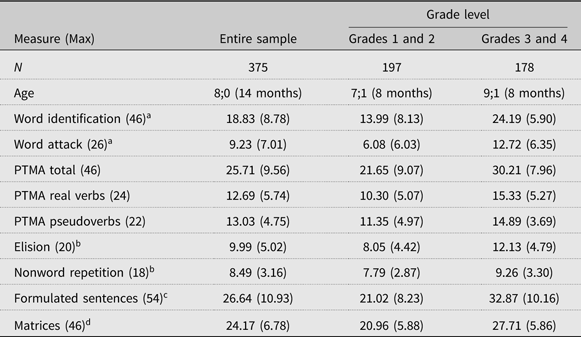
A total of 375 children from Grades 1 to 4 from seven elementary schools in Nova Scotia, Canada, participated (age range of 5 years, 9 months [5;9] to 10;9, M = 8;0, SD = 14 months, 209 females and 166 males). Two grade divisions were used that grouped Grades 1 and 2 for the younger group and Grades 3 and 4 for the older group. Divisions were based on grade rather than chronological age because age would present a confound with the amount of instruction received. For instance, a child could be 1 month older than another in chronological age and receive an extra 12 months of instruction. The younger group had 197 children with an age range of 5;9 to 8;11, and the older group consisted of 178 children with an age range of 7;10 to 10;9. To further break down the participant information by the four grades, there were 96 students in Grade 1 (age range of 5;9 to 7;10, M = 6;6, SD = 5 months), 101 in Grade 2 (age range of 6;6 to 8;11, M = 7;6, SD = 5 months), 105 in Grade 3 (age range of 7;10 to 9;7, M = 8;8, SD = 5 months), and 73 in Grade 4 (age range of 9;1 to 10;9, M = 9;8, SD = 5 months). Analyses were based on grouping Grades 1–2 in the younger group and Grades 3–4 in the older group. The means and standard deviations for the ages of each grade group are reported in Table 1. Curriculum in the province in which we worked follows a balanced approach that includes reading aloud, modeled and shared reading, guided instruction, and independent reading. All targeted instruction was embedded in continuous text. Reading for meaning begins in Grade 1, with an increasing emphasis on meaning extraction in the third-grade level and up. That said, in Grade 1, there is relatively more emphasis on decoding. The curriculum leaves room for teachers’ independence in choosing emphasis based on the needs within their classroom.
Mean raw scores (and standard deviations) of measures

Note: Standard deviations are in parentheses. PTMA, past-tense morphological awareness. Analyses were based on the PTMA total score, and means for real verbs and pseudoverbs are only shown for descriptive purposes. aWoodcock Reading Mastery Tests—Third Edition (Woodcock, Reference Woodcock2011). bComprehensive Test of Phonological Processing (Wagner, Torgesen, & Rashotte, Reference Wagner, Torgesen and Rashotte1999). cClinical Evaluation of Language Fundamentals—Fourth Edition (Semel, Wiig, & Secord, Reference Semel, Wiig and Secord2003). dKaufman Brief Intelligence Test—Second Edition (Kaufman & Kaufman, Reference Kaufman and Kaufman2004).
All participating children spoke English as their first language, based on parental report. The region in which the data was collected was primarily English speaking, with English being the first language spoken in 98.71% of households (Census Canada, 2016). Data from the broader region from which the data was collected from Statistics Canada Census Profile (Census Canada, 2016) indicates that the three largest ethnic origin groups included European (73.09%), North American Aboriginal (9.06%), and North American other (primarily Canadian, 37.65%). Each household could report more than one ethnic origin, and accordingly these numbers do not add to 100% nor do they represent the entire list of groups. With respect to annual income, reports from the Census indicate that largest percentage (29.22%) of households fall within the range of $30,000 to $59,000.2 According to the Census, the highest level of education completed by 24.14% of 25- to 65-year-olds was a college or other nonuniversity certificate or diploma, and another 24.01% had a bachelor’s degree or higher (Census Canada, 2016).
Based on parental report, none of the participants had a neurological impairment, autism, a hearing impairment, or attention-deficit/hyperactivity disorder. Two additional children completed some of the measures but were removed from the sample and all analyses because they did not complete the Clinical Evaluation of Language Fundamentals formulated sentences or the Kaufman Brief Intelligence Test matrices subtests.
Measures
Past-tense morphological awareness
The task developed by Robertson et al. (Reference Robertson, Joanisse, Desroches and Terry2013) was used here with the authors’ permission. A block of 24 real verbs was given first, and this was followed by a block of 22 pseudoverbs. The list of items is reported in the Robertson et al. (Reference Robertson, Joanisse, Desroches and Terry2013) paper. Verbs within each block were presented in a fixed order across participants.
Regular and irregular past-tense real verbs were used in the real verb block. In forming the past-tense of regular real verb items, there are three types of endings that are added to the present tense form depending on the stem’s phonological structure. The ending /t/ is added when the stem’s final phoneme is a voiceless consonant (e.g., talk–talked, ending pronounced as /t/). When the stem’s final phoneme is voiced, /d/ is added (e.g., play–played, ending pronounced as /d/), and when the stem’s final phoneme is an alveolar stop, /Id/ is added (e.g., test–tested, ending pronounced as /Id/). Irregular verbs are less consistent in that there are a number of different changes made to the stem in order to form the past tense (e.g., sleep–slept; swim–swam; stand–stood).
Children were told they would hear a sentence and then they would be asked to help finish a second sentence by using a word from the first sentence. For example, the researcher said, “We play games. Yesterday, we did the same thing; we ______ (played) games.” The child produced the past-tense form played. After completing two practice trials with feedback, the researcher reiterated the rules and children completed the test items without feedback. The test trials were shortened by removing the phrase “we did the same thing yesterday” to avoid redundancy and strains on phonological short-term memory, and to maintain interest. An example of a test trial is “We swim outside. Yesterday we _________ (swam).”
Next, the pseudoverb block was given. Children were told they would play the same game, but with made-up words. For example, “Jill can blick. Yesterday, she did the same thing; she ______ (blicked). The endings that are applied to form the past tense of pseudoverbs were the same as the three types of endings that applied to regular real verbs. Seven of the pseudoverbs employ the /t/ sound in their ending (e.g., pash–pashed, ending pronounced as /t/), 7 employ the /d/ sound in their ending (e.g., murn–murned, ending pronounced as /d/), and 8 employ the /Id/ sound in their ending (e.g., sheed–sheeded, ending pronounced as /Id/). Four practice trials were given with feedback before moving on to the test trials. The carrier sentence was kept short and remained the same across the pseudoword trials to reduce strain on phonological short-term memory. During the practice trials, it was emphasised that children were asked to say what Jill did yesterday by using the made-up word from the first sentence. Cronbach’s α was 0.92, calculated across all items for the total number of items (real verbs and pseudoverbs) on the past-tense morphological task. All standardized tests were administered according to manual instructions.
Real word reading
The word identification subtest of the third edition of the Woodcock Reading Mastery Test, Form A assessed real word reading. Children read aloud isolated words of increasing difficulty and complexity (Woodcock, Reference Woodcock2011). The internal reliability from the test manual is .91.
Pseudoword reading
The word attack subtest of the third edition of the Woodcock Reading Mastery Test, Form A assessed pseudoword reading, which requires phonological skills and structural analysis. Children read aloud isolated pseudowords of increasing difficulty and complexity (Woodcock, Reference Woodcock2011). The internal reliability from the test’s manual is .89.
Phonological awareness
The elision subtest of the Comprehensive Test of Phonological Processing assessed phonological awareness. Children had to repeat a word dictated by the researcher, and then delete a specific phoneme from that word (Wagner, Torgesen, & Rashotte, Reference Wagner, Torgesen and Rashotte1999). The internal reliability from the test’s manual is .89.
Phonological short-term memory
The nonword repetition subtest of the Comprehensive Test of Phonological Processing assessed phonological short-term memory. Children heard a nonword and had to repeat it. Words were presented in order of increasing difficultly, from monosyllabic to multisyllabic words. The nonwords were prerecorded and presented binaurally through headphones. A score of 0 was given when a child did not repeat the word verbatim (Wagner et al., Reference Wagner, Torgesen and Rashotte1999). The internal reliability from the test’s manual is .78
Sentence-level language skills
The formulated sentences subtest of the Clinical Evaluation of Language Fundamentals was given as a broad measure of sentence-level language skills. This task was administered according to the manual protocol. Participants viewed a number of pictures depicting various scenes; they were then given a key word by the researcher and asked to produce a syntactically and semantically intact sentence about each picture (Semel et al., Reference Semel, Wiig and Secord2003). A comparable example of the type of picture viewed and its key word would be a man and a woman walking in the park and the word “walking.” Following on the manual, each sentence is scored as either 0, 1, or 2. A score of 2 was given when the child’s response was logical, syntactically and semantically correct. A logical response with one error in syntax or semantics received a score of 1. Finally, a response with two or more errors, an incomplete or illogical response, or a response that did not include the stimulus word was given a score of 0. The first author conducted several thorough training workshops with two research assistants before they collected the data. Detailed notes were provided to explain what would count as syntactic errors and semantic errors, and several examples were included. The research assistants were given thorough instructions on when to give a score of 0, 1, or 2. Prior to collecting data, they also practiced on each other and on the first author repeatedly, leading to very few inconsistencies across the scores. Research assistants met with the first author each week after collecting data to go over sentences that were difficult to score. Sentences were then scored independently by the second research assistant, and inconsistencies were examined carefully before making a final decision on the score. The internal reliability from the test’s manual is .81.
Nonverbal cognitive ability
The matrices subtest of the second edition of the Kaufman Brief Intelligence Test was administered to assess nonverbal cognitive ability. Children were shown an image depicting a partial pattern as well as a series of single images and had to choose the correct image to complete the pattern (Kaufman & Kaufman, Reference Kaufman and Kaufman2004). The internal reliability from the test’s manual is .88.
Procedure
Procedures were approved by the university research ethics board and local school board prior to data collection. Informed and signed parental consent was obtained, and then children gave oral assent before beginning the tasks. All measures were administered in a fixed order, as is appropriate for analyses focusing on individual differences. All measures were completed over two separate sessions, and each session lasted approximately 30 min. Session 1 included the reading, phonological, and past-tense morphological measures and Session 2 included the sentence-level language skills and nonverbal cognitive ability tests.
Results
Descriptive statistics and zero-order bivariate correlations
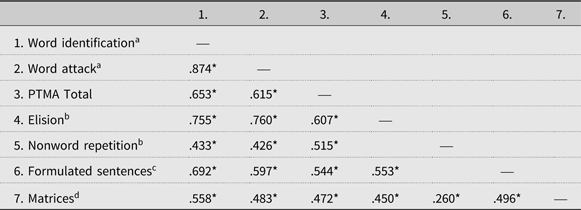
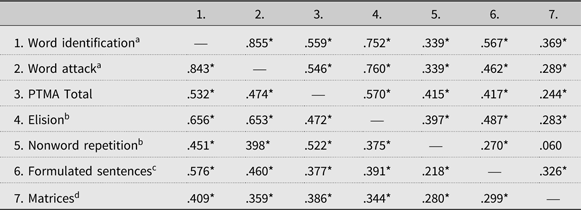
Means and standard deviations for raw scores from all tests are shown in Table 1. A complete bivariate correlation matrix for the entire sample is shown in Table 2. In Table 3, bivariate correlations are broken down by younger (Grades 1 and 2) and older (Grades 3 and 4) samples. For the group as a whole and for each grade separately, all control measures were correlated with the outcome variables at ~.4 to .7. Correlations for past-tense morphological awareness and word-level reading outcomes were in the range of ~.4 to .6.
Pearson bivariate correlations across the entire sample of children (N = 375)

Note: Correlations are based on raw scores, with the exception of PTMA (past-tense morphological awareness), which are based on the square root transformation. Regressions are based on the PTMA total score. aWoodcock Reading Mastery Tests—Third Edition (Woodcock, Reference Woodcock2011). bComprehensive Test of Phonological Processing (Wagner, Torgesen, & Rashotte, Reference Wagner, Torgesen and Rashotte1999). cClinical Evaluation of Language Fundamentals—Fourth Edition (Semel, Wiig, & Secord, Reference Semel, Wiig and Secord2003). dKaufman Brief Intelligence Test—Second Edition (Kaufman & Kaufman, Reference Kaufman and Kaufman2004). *p < .01.
Pearson bivariate correlations across younger (above the diagonal, N = 197) and older (below the diagonal, N = 178) children

Note: PTMA, past-tense morphological awareness. The younger sample is above the diagonal and the older group is below. aWoodcock Reading Mastery Tests—Third Edition Woodcock, (Reference Woodcock2011). bComprehensive Test of Phonological Processing (Wagner, Torgesen, & Rashotte, Reference Wagner, Torgesen and Rashotte1999). cClinical Evaluation of Language Fundamentals—Fourth Edition (Semel, Wiig, & Secord, Reference Semel, Wiig and Secord2003). dKaufman Brief Intelligence Test—Second Edition (Kaufman & Kaufman, Reference Kaufman and Kaufman2004). *p < .01.
Prior to conducting linear regression analyses, we inspected skew and kurtosis values, and we also looked for univariate and bivariate outliers (as per Tabachnick & Fidell, Reference Tabachnick and Fidell2013). We also inspected for issues of multicollinearity. Tolerance and variance inflation factor values for each independent variable, none of which supported the presence of multicollinearity (tolerance > .2; variance inflation factor < 10). Correlations were also all below .8, with the exception of word identification and word attack, which are not included in the same analysis.
The only concern that emerged was in negative skew for the past-tense morphological awareness task. A square root transformation corrected this, and so this transformed score was used in all subsequent analyses. In addition to this, we confirmed the patterns when raw scores were used instead; the same patterns emerged in both. We use raw scores for all other measures, and the raw scores on the past-tense morphological test are reported in Table 1. Regression analyses are based only on the past-tense morphological total square root transformation.
Past-tense morphological awareness predicting real word and pseudoword reading
Hierarchical multiple regression analyses were conducted to examine the relations between past-tense morphological awareness and real word and pseudoword reading. To do so, we conducted two separate regression analyses: one with real word reading scores as the criterion, and the second with pseudoword reading as the criterion. In Step 1, we included phonological awareness, phonological short-term memory, sentence-level language skills, and nonverbal cognitive ability. We then entered our predictor of interest in Step 2: the past-tense morphological awareness total score. In the final step, the interactions between grade group and the past-tense morphological awareness total score was included to evaluate stability in relations across our grade groups.
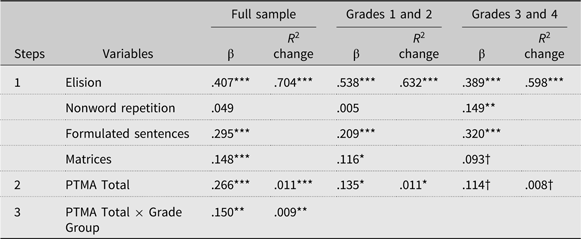
Results for the analyses with real word reading as the outcome are presented in the left column of Table 4. In the full sample, control variables explained 70.4% of the variance in real word reading. Standardized beta weights show that most of the variance in control measures was taken up by phonological awareness, followed by sentence-level language skills. Following on these controls, past-tense morphological awareness explained an additional 1.1% in Step 2, with a standardized beta weight comparable to that of sentence-level language skills. The interaction with grade group was significant in Step 3 (an additional 0.9% of variance). As such, we conducted separate regression analyses with the data for Grades 1 and 2 and for those in Grades 3 and 4. The results of these analyses are reported in the right columns of Table 4.
Hierarchical multiple regression with past-tense morphological awareness predicting real word reading (word identification) across the full sample and by grade group

Note: PTMA, past-tense morphological awareness. Standardized beta weights are for each variable within the full model with all variables entered. R 2 change reflects whether each step as a whole is significant. Unstandardized beta weights and standard errors are available from the authors upon request. *p < .05. **p < .01. ***p < .001. †, p < .10
With the younger group, when entered at Step 2, past-tense morphological awareness explained additional significant variance in real word reading (1.1%) beyond the 63.2% of the variance that was explained by the four controls variables. Standardized beta weights put the unique contribution of past-tense morphological awareness as larger in size than that of nonverbal ability, albeit smaller than that of sentence-level language skills. With the older group, when entered at Step 2, there was a trend toward a unique contribution of past-tense morphological awareness to real word reading (0.8%, p < .10), beyond the substantial contribution of the control variables (59.8%). This reduction in significance might be related to the larger contributions of phonological short-term memory and sentence-level language skills in Grades 3 and 4 than at Grades 1 and 2. Taken together, results suggest a role for past-tense morphological awareness that emerges beyond sentence-level language skills in Grades 1 and 2 but not necessarily at Grades 3 and 4.
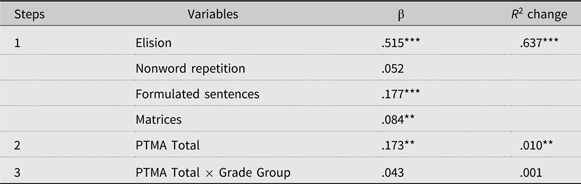
Results for the analyses with pseudoword reading as the outcome are presented in Table 5. The control variables accounted for a significant 63.7% of the variance in pseudoword reading. Critically, when entered at Step 2, past-tense morphological awareness explained additional significant variance (1%) in pseudoword reading. There were no interactions between grade group and past-tense morphological awareness scores in Step 3, suggesting consistency in these relations across the grades investigated here.
Hierarchical multiple regression results for past-tense morphological awareness predicting pseudoword reading (word attack) across the full sample

Note: PTMA, past-tense morphological awareness. Standardized beta weights are for each variable within the full model with all variables entered. R 2 change reflects whether each step as a whole is significant. Unstandardized beta weights and standard errors are available from the authors upon request. **p < .01. ***p < .001.
Discussion
Our research goal was to examine whether there were differences across theoretically relevant elementary school grades in the relations between morphological awareness and word-level reading, investigating if such changes applied to both real word and pseudoword reading. In testing these relations, we controlled for phonological awareness, phonological short-term memory, sentence-level language skills, and nonverbal cognitive ability. Contrasting relations at Grades 1 and 2 with those at Grades 3 and 4 provided a test of these relations across a key predicted transition in theories of word reading development (e.g., Ehri, Reference Ehri2014). To summarize our results, we found that morphological awareness, as assessed with past-tense verbs, made a significant contribution to word reading at Grades 1 and 2—one that did not remain significant in Grades 3 and 4—and a consistent contribution to pseudoword reading across Grades 1–4.
Our findings build on prior studies. As reviewed earlier, there are mixed results on developmental changes underlying the relation between morphological awareness and word-level reading. Some studies suggest the relation between morphological awareness and word reading gets stronger (e.g., Carlisle, Reference Carlisle and Feldman1995; Carlisle & Nomanbhoy, Reference Carlisle and Nomanbhoy1993), declines (e.g., Deacon et al., Reference Deacon, Wade-Woolley and Kirby2007), and or remains stable (e.g., Deacon, Reference Deacon2012; Deacon & Kirby, Reference Deacon and Kirby2004) across the elementary school years. In an effort to address the mixed results, we ensured that our morphological awareness task focusing on past-tense verbs widely used with younger readers was also adequately challenging for older children (see, e.g., Deacon et al., Reference Deacon, Wade-Woolley and Kirby2007, for ceiling effects). We increased the number of items and included pseudoverbs. Performance on the current task suggests it was challenging even for third- and fourth-grade children. Even with increased task difficulty, our results are consistent with those reported in earlier studies: past-tense morphological awareness was a significant predictor of real word reading in Grade 1 and 2 children, but not in Grade 3 and 4 children (see, e.g., Deacon et al., Reference Deacon, Wade-Woolley and Kirby2007). However, morphological awareness was a stable predictor of pseudoword reading across Grades 1 to 4.
We recognize the small size of the contribution of morphological awareness to word-level reading. There was a small amount of variance explained by past-tense morphological awareness, at 1%. This 1% must be considered in light of the fact that there remained only 30% to 40% of the variance, undoubtedly the more difficult part of the variance to explain. In further analyses in which when we removed formulated sentences as a control, past-tense morphological awareness accounted for 2.6% of the variance. This size of contribution is more similar to that in prior studies (e.g., Deacon & Kirby, Reference Deacon and Kirby2004; Mota, Freitas Junior, & Deacon, Reference Mota, Freitas Junior and Deacon2018). It is possible then that some of the contribution in prior studies might have been from broader language skills, particularly when the morphological awareness task included sentences, such as Carlisle’s (Reference Carlisle1988) sentence completion task. Further still, betas in the main analyses across all children quantify the contribution of morphological awareness as similar to that of sentence-level language skills, even though the former has more controls implemented. Taken together, although the significant contribution from past-tense morphological awareness to both real word and pseudoword reading is relatively small, it remains both theoretically and empirically interesting.
These findings run directly counter to predictions from the phase theory of early reading as dominated by phonology (Ehri, Reference Ehri2014). The contribution of past-tense morphological awareness survives controls for awareness, perception, and short-term memory of phonological structures, as assessed by phonological awareness and phonological short-term memory. In our view, these findings point to the importance of a direct empirical contrast across these age ranges. Our findings support Carlisle and Kearns’s (Reference Carlisle, Kearns, Cain, Compton and Parilla2017) idea that readers use morphological awareness when reading in earlier grades than what was previously expected, and is consistent with findings from spelling and priming tasks in young readers (e.g., Deacon & Bryant, Reference Deacon and Bryant2006; Rabin & Deacon, Reference Rabin and Deacon2008; Treiman et al., Reference Treiman, Cassar and Zukowski1994). Our findings are also consistent with predictions from Treiman and Kessler’s (Reference Treiman and Kessler2014) Integration of Multiple Patterns. This theory suggests that morphology may be a source of patterns that help even young children secure spellings in memory (see Gonnerman, Seidenberg, & Anderson, Reference Gonnerman, Seidenberg and Anderson2007). It seems that even less experienced readers take advantage of their awareness of morphology in the oral domain and do not rely solely on phonological awareness as they read words.
Another contribution of our findings to ongoing theory discussions lies in our finding that past-tense morphological awareness predicted pseudoword reading across the entire age range of Grades 1 to 4. One explanation for this finding lies in the flexibility of children. Across Grades 1 to 4, children may use all the linguistic skills at their disposal, including morphological awareness, when the reading task is demanding, as it is with pseudowords. We also need to consider this finding in light of the fact that pseudowords can contain morphemes (e.g., praced and munsingful, respectively). The existence of these pseudowords (including in the pseudoword reading task we used here) forces reconsideration of pseudoword reading as entirely phonological; for instance, the term “phonemic decoding” to refer to a pseudoword reading task (e.g., Torgesen et al., Reference Torgesen, Wagner and Rashotte1999) might be too restrictive. Recent analyses identify a role of awareness of morphology in precisely that task (e.g., Levesque, Kieffer, & Deacon, Reference Levesque, Kieffer and Deacon2018; see also Deacon & Kirby, Reference Deacon and Kirby2004), and distinguish morphological awareness from morphological decoding (see Deacon, Tong, & Francis, Reference Deacon, Tong and Francis2017). Stepping back further, the activation of morphemes in pseudoword tasks has now been identified in both child (e.g., Dawson, Rastle, & Ricketts, Reference Dawson, Rastle and Ricketts2018) and adult research (e.g., Taft, Reference Taft2004), and pseudowords have long been used in morphological awareness tasks (Berko, Reference Berko1958). Overall, these findings need to be integrated into theories of reading development, such that we can identify when morphemes are activated in the reading process. It seems that they operate more than in securing words in memory (as suggested by Ehri, Reference Ehri2005) because morphological effects emerge for pseudowords that do not yet have a store in memory. Building on Taft (Reference Taft2004), it seems likely that morphemes have a role in the input phase of word identification, such that they are useful across new and old words alike. We think that future studies could explore whether such effects of morphemes emerge as independent morpheme units or as a convergence of codes (e.g., Quémart, Gonnerman, Downing, & Deacon, Reference Quémart, Gonnerman, Downing and Deacon2017; Seidenberg & Gonnerman, Reference Seidenberg and Gonnerman2000).
There are at least two ways to understand the grade-level differences in the relation of past-tense morphological awareness to word-level reading. A simple one is that the interaction emerged from changing effects at Step 1; the effect was significant in Grades 1 and 2, and it approached significance at Grades 3 and 4. This reduction to nonsignificance could be associated with the rise in the contribution of sentence-level language skills (as evident in increased beta weight for formulated sentences at Step 1). Grade 3 and 4 children might rely more on comprehension of words and sentences in general and less on morphological awareness in supporting real word reading than do children in Grades 1 and 2. This shift might result in part from a shift from learning to read to reading to learn (Chall, Reference Chall1983) and increased exposure to texts with rich greater morphosyntactic complexity and vocabulary (e.g., Snow, Reference Snow2010). An increase in the influence of sentence-level processing skills is also consistent with the simple view of reading, according to which reading comprehension is the product of oral language comprehension and word reading (Gough & Tunmer, Reference Gough and Tunmer1986). Alternatively, a relation between morphological awareness and real word reading might emerge for older children if the measure assessed derivations (as in, e.g., Mahony, Singson, & Mann, Reference Mahony, Singson and Mann2000). There is growth of derivational morphological awareness during this time period (e.g., Berringer et al., Reference Berninger, Abbott, Nagy and Carlisle2010) and increased exposure to derived forms while reading (Nagy & Anderson, Reference Nagy and Anderson1984; also see Roman et al., Reference Roman, Kirby, Parrila, Wade-Woolley and Deacon2009). Future studies can investigate this possibility by contrasting the roles of inflectional and derivational morphological awareness on real word and pseudoword reading across development. That said, the current study provides empirical evidence of potential differences in patterns of relations of past-tense morphological awareness for real word and pseudoword reading across this key developmental period.
The implications of this work also need to be considered in line with the linguistic context within which they emerged: English. There has long been speculation of greater contributions of morphological awareness in morphosyllabic orthographies and smaller contributions in more phonologically transparent orthographies (e.g., Kuo & Anderson, Reference Kuo and Anderson2006). Yet similar-sized contributions of morphological awareness to word-level reading have appeared across degrees of phonological transparency (e.g., Deacon & Kirby, Reference Deacon and Kirby2004; Mota et al., Reference Mota, Freitas Junior and Deacon2018; Rispens, McBride-Chang, & Reitsma, Reference Rispens, McBride-Chang and Reitsma2008; Rothou & Padeliadu, Reference Rothou and Padeliadu2014). This leads us to consider that the findings here might apply to other orthographies, bearing in mind of course that morphology varies in its representation in different oral languages and in their written forms.
We also need to review limitations. A first lies in the limited demographic data available for the specific sample recruited; data on ethnic origin, income, and education were not collected from individual participants and families in the current study. Prior work has suggested that relations between morphological awareness and reading are similar for children of low and high socioeconomic backgrounds (e.g., Apel, Brimo, Diehm, & Apel, Reference Apel, Brimo, Diehm and Apel2013); that said, we think that potential differences across this factor are worth exploring. Another point worth considering lies in the choice of control measures. Unlike some previous studies, we did not use receptive vocabulary as a control (e.g., Deacon & Kirby, Reference Deacon and Kirby2004; Deacon et al., Reference Deacon, Wade-Woolley and Kirby2007). However, in our view, the sentence-level language skills test we employed, the formulated sentences subtest from the Clinical Evaluation of Language Fundamentals, captures vocabulary knowledge. In this task, children need to show they understand the meaning of the given word in order to apply it to the context of the picture when formulating a sentence. Moreover, this test is a rich measure of linguistic knowledge because it also involves morphosyntactic and semantic processing. As such, it is likely that variance that would be explained by a vocabulary measure was captured by the test of sentence-level language skills. Our measure of sentence-level language skills also incorporated word-level comprehension, and when it was controlled, past-tense morphological awareness still emerged as a significant predictor of word reading. Another limitation of our study is that it is correlational. Our conclusions are specific to changes with grade level, not necessarily with age. Similarly, we captured two rather large grade bands and lacked power to do more fine-grained analysis. A longitudinal study with a larger sample would be better suited to addressing causal relations (e.g., Kruk & Bergman, Reference Kruck and Bergman2013).
Finally, we turn to practical implications. Findings of unique contributions of morphological awareness to word-level reading point to the possible benefits of including teaching of morphology in the classroom. In addition, intervention studies to date often show similar-sized contributions of morphological awareness to other approaches to teaching, such as phonological awareness (e.g., Bowers, Kirby, & Deacon, Reference Bowers, Kirby and Deacon2010). Nevertheless, there are remarkably few studies investigating the effects of morphological awareness on word-level reading outcomes (e.g., Goodwin & Ahn, Reference Goodwin and Ahn2013); there are far more studies on reading comprehension. This leads us to be cautious in drawing practical implications. Further caution comes from the size of contributions; they are small. Similarly, intervention studies need to tease apart the effects of semantics from those of morphology, as has begun in the experimental research (Quémart et al., Reference Quémart, Gonnerman, Downing and Deacon2017). Further still, in addition to uncovering how to teach children, more work needs to be done on how to support the development of teacher knowledge, given evidence of low levels of morphology knowledge in some studies of teachers (Joshi et al., Reference Joshi, Binks, Hougen, Dahlgren, Ocker-Dean and Smith2009; Spear-Swerling & Brucker, Reference Spear-Swerling and Brucker2005). Clearly, further studies of both individual differences and intervention approaches are needed to specify whether and how morphological instruction might benefit word reading in the elementary grade levels.
In summary, we found that morphological awareness, as measured with past-tense verbs, played a unique role in beginning readers’ real word reading and a unique, stable role in pseudoword reading across middle childhood. These contributions emerged beyond phonological awareness, phonological short-term memory, sentence-level language skills, and nonverbal cognitive ability. The size of these contributions was small, potentially as a result of the broad language skills that we controlled for here. We think that these findings remind us that theories of word reading need to include a role for morphological awareness, if they are to be comprehensive in capturing the full range of skills that children bring to the challenging task of reading.
Author ORCIDs
Erin K. Robertson 0000-0001-5462-4132
Acknowledgments
The authors thank Meaghan Higgins, Suzanne Myers, Kelsey Morrison, Kathleen Oliver, Kenzie Kozera, Sarah Penney, and Jennifer Gallant for assistance with data collection, scoring, and entering and students and staff from the Cape Breton-Victoria Regional School Board for participating. Funding for this project was awarded to the first author from the Natural Sciences and Engineering Research Council of Canada. We would also like to thank Kyle Levesque for constructive discussions of the paper before it was submitted.