




No CrossRef data available.
Article contents
Morphological awareness: Just “more phonological”? The roles of morphological and phonological awareness in reading development
Published online by Cambridge University Press: 17 May 2004
Abstract
Given the morphophonemic nature of the English orthography, surprisingly few studies have examined the roles of morphological and phonological awareness in reading. This 4-year longitudinal study (Grades 2–5) compared these two factors in three aspects of reading development: pseudoword reading, reading comprehension, and single word reading. Morphological awareness contributed significantly to pseudoword reading and reading comprehension, after controlling prior measures of reading ability, verbal and nonverbal intelligence, and phonological awareness. This contribution was comparable to that of phonological awareness and remained 3 years after morphological awareness was assessed. In contrast, morphological awareness rarely contributed significantly to single word reading. We argue that these results provide evidence that morphological awareness has a wide-ranging role in reading development, one that extends beyond phonological awareness.
Information
- Type
- Articles
- Information
- Copyright
- © 2004 Cambridge University Press
A wealth of research has demonstrated that children's early phonological awareness is related to progress in learning to read (for reviews, see Adams, 1990; Goswami & Bryant, 1990; National Reading Panel, 2000; Snow, Burns, & Griffin, 1998). This relationship has survived controls of intelligence, vocabulary, and socioeconomic status; and there is evidence that it is causal (Bradley & Bryant, 1983; Wagner, Torgesen & Rashotte, 1994). English orthography is morphophonemic: it preserves semantic relationships among words and effectively predicts pronunciation (Chomsky & Halle, 1968). Therefore, one would expect that sensitivity to both phonemes and morphemes should predict reading development. The goal of the current research is to establish the nature of the link between morphological awareness and children's reading development. Specifically, we aim to determine (a) if morphological awareness contributes to reading development, beyond phonological awareness and intelligence; (b) if this contribution differs according to the type of reading; and (c) if the relative involvement of morphological awareness changes over time.
Morphological awareness refers to children's “conscious awareness of the morphemic structure of words and their ability to reflect on and manipulate that structure” (Carlisle, 1995, p. 194). Morphemes are the smallest units of meaning within words; for example, electricity is made up of two morphemes: the root electric and the suffix-ity. Experimental research by Berko (1958) suggested that children as young as 4 years of age can add certain simple inflections to certain pseudowords. Clark and Cohen (1984) and Jones (1991) showed that kindergarten and first grade children display some competence with simple derivations that do not involve phonological shifts. Older children adeptly tackle more complex derivational relations, such as between electric and electricity, by about the fourth grade (Carlisle, 1988; Tyler & Nagy, 1989). In sum, morphological awareness of inflections and simple derivations might emerge early whereas an understanding of more complex derivational relations may come into place later.
Morphological awareness could be helpful in a range of reading tasks. In single word reading, for example, a child attempting to pronounce the ea in reading and in react would do well to refer to morphemic boundaries. Morphology might also be helpful in uncovering the meaning of single words. For example, the base and affix morphemes within reading and react provide some indication of their meaning. Morphological “problem solving” might also play an important part in constructing the meaning of a text. Further, it is possible, but somewhat less intuitive, that morphological awareness plays a role in pseudoword reading. Although pseudowords have been traditionally used to tap the ability to analyze words into component sounds, these words potentially have morphemic structures. For example, the pseudoword lagician could be interpreted as containing a root lagic and suffix ian. In sum, morphological awareness may play separate roles in individual word decoding, reading comprehension, and pseudoword reading.
Brittain (1970) was the first to examine the role of morphological awareness in reading. Seven- and 8-year-old children performed a task in which they inflected pseudowords (based on Berko, 1958). Even after controlling for intelligence, Brittain found a significant relationship between performance on this task and general reading achievement. Leong (1989) reached a similar conclusion. He gave 9- to 11-year-old children a Production task (based on Carlisle, 1988) in which they generated the appropriate base or derived form of a word for a sentence context. Reaction times discriminated well between readers of differing abilities on the reading subtests of the Canadian Test of Basic Skills. Similarly, Mahony (1994) found a positive relationship between morphological awareness and adolescents' reading comprehension, as assessed by SAT scores. In this experiment, morphological awareness was assessed by the Derivational Suffix test, in which children chose one of four words or pseudowords to complete a sentence. These studies establish that there is a general connection between morphological awareness and reading achievement.
More recent studies have gone further in examining alternative explanations for the relationship between morphological awareness and real and pseudoword reading by including variables such as vocabulary or verbal short-term memory. Singson, Mahony, and Mann (2000, Experiment 1) examined verbal short-term memory in a study with 98 children in Grades 3–6 (ages 8–12). Morphological awareness (measured with the Derivational Suffix Test) accounted for 5% of the variance in reading, after controlling for verbal short-term memory. In another article, Mahony, Singson and Mann (2000, Experiment 1) report on the role of vocabulary in the relationship between morphological awareness and reading. This time morphological awareness was assessed using a Judgment task (based on Carlisle & Nomanbhoy, 1993), in which children had to distinguish morphologically related word pairs (e.g., teach/teacher) from foils (e.g., corn/corner). Morphological awareness correlated with pseudoword reading and word identification (r=.25–.33), after partialing out vocabulary. Neither of these analyses removed age or grade, which may have increased the size of the correlations. Fowler and Liberman (1995) also controlled for vocabulary in their study with younger poor readers (ages 7–9). Performance on a production task successfully predicted single word reading and pseudoword reading, after controlling for vocabulary and age. These three studies point to a relationship between morphological awareness and reading of words and pseudowords.
An additional and important question is whether morphological awareness is related to reading comprehension. Carlisle (2000) addressed this issue in a comprehensive study with 8- and 11-year-old children. Her study included three morphological awareness tasks: Production, morphological problem solving (based on Anglin, 1993), and reading of morphologically complex words (such as movement and easily). Performance on these three tasks accounted for large portions of the variance (41–55%) in reading vocabulary and comprehension. As in Mahony et al.'s (2000) analyses, neither age nor any ability variables were controlled.
These studies point to a reliable connection between morphological awareness and reading and show that this effect remains (at around 5%) after controlling for the individual variables of vocabulary or verbal short-term memory. These controls address the potential confound of verbal intelligence, which is plausibly related to measures of linguistic awareness and to reading. Only one study, that by Brittain (1970), controlled for the combination of verbal and nonverbal intelligence. Controlling for both variables limits the possibility that the link between morphological awareness and reading is due to some form of overall ability, which, in turn, may be a function of a host of other variables. In particular, measures of nonverbal intelligence most often assess the ability to perform novel tasks (which could be relevant to morphological and phonological awareness tasks) and process spatial relationships (which could be relevant for some reading measures). Similarly, given the established role of phonological awareness in reading development, it is critical to establish that morphological awareness is not simply “more phonological”—that is, that the relationship between morphological awareness and reading operates independently of phonological awareness. Thus, studies that control for both phonological awareness and verbal and nonverbal intelligence are needed.
There is support for the independence of the relationship between morphological awareness and single word reading. Carlisle and Nomanbhoy (1993) assessed the morphological awareness (with the Judgment and Production tasks) of a large group of 6-year-old children. The Production task accounted for an additional 4% in single word reading, above and beyond the 37% accounted for by phonological awareness. Shankweiler et al. (1995) found similar results with a group of poor readers who were 7–9 years of age. In this study, the Production task contributed 5% of the variance in single word reading, after phoneme awareness and IQ were controlled. In a study with older children (in Grades 3–6), Mahony et al. (2000, Experiment 2) found that morphological awareness (assessed with the Judgment task) contributed 5%, after phonological awareness and vocabulary, to the variance in pseudoword reading and single word reading. Singson et al. (2000, Experiment 2) reached a similar conclusion with children of the same age. Morphological awareness, assessed with a grammaticality judgment task, contributed 4%, above phonological awareness and vocabulary, to the pseudoword reading and single word reading. Further, between Grades 3 and 6, the contribution of phonological awareness gradually attenuated whereas that of morphological awareness increased. These results suggest that morphological awareness plays a unique role in single word reading and that this role may increase in later development.
This proposal has important educational implications, and it needs to be tested in a longitudinal design. Longitudinal studies allow for the study of developmental and autoregressive effects. Further, with the inclusion of appropriate control measures, they can effectively establish relationships between variables. They do not, however, establish that these relationships are causal.
Carlisle (1995) conducted one of the few longitudinal studies in this field. In kindergarten and in Grade 1, children were given the Production task. In Grade 1, they were also given a phonological awareness test and the Judgment morphological awareness task. Reading measures (pseudoword reading and reading comprehension) were taken in Grade 2. While there was no relationship between kindergarten morphological awareness and reading, Grade 1 measures did contribute significantly to reading. Morphological awareness (assessed with the Production task) was most predictive of reading comprehension, accounting for 10% of the variance after phonological awareness. Phonological awareness was more strongly predictive of pseudoword reading, absorbing 10% of the variance after morphological awareness. Although no other control factors were included in the regression equations, these results are consistent with the hypothesis that morphological awareness plays a role in both reading comprehension and decoding. Further, they suggest that morphological awareness emerges as a better predictor of reading comprehension than of pseudoword reading.
Studies of reading development have included a range of measures of morphological awareness from production of correct inflected and derived forms to the judgment of morphological relationships. The success of the analogy task in spelling research (Nunes, Bryant, & Bindman, 1997a, 1997b) makes it a good candidate for use in reading research. In the Sentence Analogy task, children are given two example sentences, such as “Tom helps Mary” and “Tom helped Mary.” They are asked to carry out the same kind of transformation on another sentence, such as “Tom sees Mary.” This task assesses the productive ability to manipulate morphemes. Research in other domains indicates that preschool children, and even infants, are capable of analogical reasoning (e.g., Chen, Sanchez, & Campbell, 1997; Goswami, 1995), which suggests that analogies are accessible to children. Given the substantial development in knowledge of derivations during elementary school (e.g., Carlisle, 1988; Tyler & Nagy, 1989), measures of inflectional morphology, such as the past tense, may provide a more stable base to use as a predictor variable, as suggested by Brittain (1970). Further, production of the past tense may be particularly informative; it is argued to be an especially sensitive indicator of language difficulties (e.g., Marchman, Wulfeck, & Weismer, 1999; Rice, 1997). Thus, an analogy task with past tense morphemes offers a potentially useful measure of morphological awareness.
From our review of the literature, it seems clear that morphological awareness has a role in reading development. However, the nature of that connection is unclear. There are three specific questions that remain unanswered and these are the foci of the current study. First, does morphological awareness make a significant contribution to reading development, beyond verbal and nonverbal intelligence and phonological awareness? Second, does morphological awareness make a greater contribution to reading comprehension than to single word or pseudoword reading? Third, does the contribution of morphological awareness increase over reading development?
We followed the development of a group of 7-year-old children over the course of 4 years. This longitudinal design allowed the inclusion of stringent control variables, as well as the examination of changes in the contribution of variables over time. We measured morphological and phonological awareness in Grade 2, as well as verbal and nonverbal intelligence. In Grades 2–5, the children completed three reading tasks: single word reading, pseudoword reading, and reading comprehension. Our analyses compared the independent contributions of morphological and phonological awareness to the three measures of reading ability at each grade, after controlling for verbal and nonverbal intelligence and prior measures of reading.
METHOD
Participants
The participants were 143 children in Grade 2 from a broad range of schools in Kingston, Ontario, Canada. Schools were selected to represent a broad range of socioeconomic conditions. All children who returned signed parental consent forms and who were able to understand the instructions were allowed to participate. Attrition reduced the sample in Grades 3, 4, and 5 to 130, 114, and 103, respectively. The most common reason for attrition was that a child had moved out of the area served by the school boards that had given permission for the study to take place. Each year the children remaining in the sample were compared statistically to those who left; none of these differences were statistically significant. Analyses with the data from the 103 participants who remained with the study until Grade 5 are reported here. The results of analyses with all available children at each grade were comparable. In Grade 2, the mean age of the participants was 88.5 months (SD=3.50), and 57 (55.3%) of them were male.
Procedure
Tests were administered individually to the participants in a quiet room in their schools.
Measures
Phonological awareness task
Phonological awareness was measured in Grade 2 with a sound oddity task, adapted from Bradley and Bryant's (1985) rhyme oddity task. In each trial, the child had to choose which of four orally presented words differed from the others by one sound (e.g., bud, bun, bus, rug). There were 30 items, 10 each for the word-initial, word-medial, and word-final positions. Prior to each set of 10 trials, there were 2 practice trials.
Morphological awareness task
Morphological awareness was measured in Grade 2 with the Nunes et al. (1997a, 1997b) Sentence Analogy task. For example, “Peter plays at school. Peter played at school. Peter works at home.

.” Children were first given a practice trial; if they did not provide the correct answer, the example was explained to them. The 8 items in this task all involved regular and irregular past tense verbs.
Verbal and nonverbal intelligence measures
Two tests from the Das–Naglieri Cognitive Assessment System (Naglieri & Das, 1997) were used in Grade 2 to measure verbal and nonverbal intelligence. Figure Memory asks the participants to identify a previously seen simple figure in a more complex figure. In each item, children were shown a two- or three-dimensional geometric figure for 5 s after which the figure was removed and children were presented with a response page containing the original design embedded in a larger and more complex pattern. Children were asked to identify the original design by tracing it with a pencil. For a response to be scored correct, all lines of the original design had to be traced without any omissions or additions. There were 25 items, but the task was discontinued after four consecutive failures and the participant's score was the number of items completed correctly. Visual–Spatial Relations (Naglieri & Das, 1997) consists of 27 items in which children are asked to identify which picture from a set corresponds to an orally presented phrase or sentence (e.g., “The ball under the table”). Each item has six drawings and the question is printed at the bottom of the page. Items involved both objects and shapes arranged in different spatial configurations. The examiner read the question aloud to the child, who was asked to select the drawing that matched the verbal description. Administration ended after four consecutive incorrect responses. The participant's score was the total number of items answered correctly within the 30-s time limit per item. Naglieri and Das (1997) report correlations of .52 and .62 between Figure Memory and Verbal–Spatial Relations with the CAS Full Scale IQ estimate in the standardization sample. The factor represented by these two measures correlated at .43 and .50 with SAT Verbal and Mathematics scores, respectively (see Naglieri & Das, 1997, for details). In our analyses, we entered the raw scores for the Figure Memory and Visual–Spatial Relations tasks as a block, without creating a composite, thus controlling for any aspects of either that are related to reading. The two measures were correlated at .32, and each correlated significantly (p<.001) with each of the outcome variables (see Table 1).

Reading measures
Three subtests from the Woodcock (1987) Reading Mastery Tests—Revised were used to assess reading in Grades 2–5; the Grade 2 scores were used as autoregressors, and the Grade 3, 4, and 5 scores were used as outcome variables. Form G was used in Grades 2 and 4, Form H in Grades 3 and 5. Word Attack measures participants' ability to apply phonic and structural analysis skills in pronouncing pseudowords or low frequency words that are not recognizable by sight (e.g., dee, mancingful, apt). We used it as a measure of pseudoword reading. Word Identification required the participant to read isolated words aloud (e.g., is, you, and). We used it as a measure of single word reading. Passage Comprehension requires the participant to read a short passage (usually two to three lines) and identify a key missing word (e.g., “The fresh snow had been piled into a huge drift along the fence. Larry sank into it up to his waist, but his father was able to work his way through the
and Larry followed his path.”). This cloze task was used to measure reading comprehension.
RESULTS
Means and standard deviations for all predictors (measured in Grade 2) and for all outcome measures (measured in Grades 3–5) are given in Tables 2 and 3, respectively. The mean grade equivalent scores for the reading measures are also shown in these tables. The reliability for the morphological awareness measure was α=.64, and the correlations between the three components of the phonological awareness measure were high (initial–medial r=.70, medial–final r=.65, initial–final r=.76). The skewness values were within the “safe” range for both morphological (.397) and phonological (−.527) awareness. Correlations between morphological and phonological awareness, the reading outcome measures, and the two measures of intelligence are shown in Table 1.


We used hierarchical regression analyses to determine the effects of phonological and morphological awareness upon reading. Prior to conducting these analyses, we looked for univariate and bivariate outliers. There were no univariate outliers. None of the small number of bivariate outliers would increase the relationship between the predictor variables and the outcome measures.
In the first set of analyses, we controlled for verbal and nonverbal intelligence and the autoregressor. In each case, the autoregressor was the Grade 2 score on the same reading measure. By controlling for intelligence and autoregressors, we in effect controlled for general intelligence and for all effects upon reading ability prior to Grade 2. Two hierarchical regression analyses were performed for each of the Grade 3, 4, and 5 measures, the first examining the effect of morphological awareness after controlling for intelligence, the autoregressor, and phonological awareness and the second examining the effect of phonological awareness after controlling for intelligence, the autoregressor, and morphological awareness. We deal with each reading variable in turn.
In the second set of analyses, we controlled for verbal and nonverbal intelligence (but not for the autoregressor). Again, two hierarchical regression analyses were performed for each of the Grade 3, 4, and 5 measures, the first examining the effect of morphological awareness after controlling for intelligence and phonological aw- areness and the second examining the effect of phonological awareness after controlling for intelligence and morphological awareness. The results from the second set of analyses are not reported in detail; instead, they are summarized in the text.
In the analyses that follow, we report changes in the R2 value for each step in each model. Although not shown in the analyses, each of the intelligence measures made a significant (p<.05) unique contribution in each of the analyses.
Pseudoword reading
The analyses with the autoregressor are presented in Table 4. In the analyses with morphological awareness entered last, its contribution increases from less than 1% (p=.052) in Grade 3 to 3.4% (p<.01) in Grade 5. When morphological awareness is entered before phonological awareness, its contribution is greater and still increases from Grade 3 (1.6%) to Grade 5 (over 5%). Phonological awareness entered at step 3 clearly reduces the effect of morphological awareness, but it does not eliminate it. Similarly, morphological awareness entered at step 3 reduces the effect of phonological awareness, and the latter's effect is stronger than that of morphological awareness in Grades 3 and 4 (but not Grade 5).

The results of the second analyses without the autoregressor show that morphological awareness contributes 9, 10, and 11% of the variance at Grades 3, 4, and 5, respectively (each p<.001), after taking intelligence and phonological awareness into account. In comparison, phonological awareness contributes 10, 11, and 7%, respectively (each p<.001), after controlling for intelligence and morphological awareness.
Single word reading
The regression results for single word reading with the autoregressor are presented in Table 5. When morphological awareness is entered at step 4, it contributes less than 1% of the variance, only nearing significance (p<.06) at Grade 4. When it is entered at step 3, only in Grade 4 is it significant, contributing slightly more than 1%. In contrast, phonological awareness makes about the same contribution at Steps 3 and 4, increasing from less than 1% in Grade 3 to 2.5% in Grade 5.

The second analyses, which controlled for intelligence and phonological awareness but not the autoregressor, indicate that morphological awareness contributes 8% (p<.001), 8% (p<.01), and 5% (p<.05) of the variance at Grades 3, 4, and 5, respectively. In comparison, phonological awareness contributes 8, 8, and 9%, respectively (each p<.001), after intelligence and morphological awareness.
Reading comprehension
The regression results with the autoregressor for reading comprehension are presented in Table 6. When entered at step 4, the effect of morphological awareness is nonsignificant at Grade 3 and increases to 2% in Grade 5. It has a slightly greater effect when entered ahead of phonological awareness. Phonological awareness contributes between 1 and 2.5% of the variance entered at step 3; this effect is weaker at step 4, missing the .05 level at Grade 5.

The analyses without the autoregressor indicate that morphological awareness contributes 8, 10, and 7% (each p<.001) of the variance at Grades 3, 4, and 5, respectively, after intelligence and phonological awareness. In comparison, phonological awareness contributes 7% (p<.001), 4% (p<.01), and 4% (p<.01), respectively, after intelligence and morphological awareness.
DISCUSSION
study investigated the relative independent contributions of morphological and phonological awareness to improvement in single word reading, pseudoword reading, and reading comprehension. Earlier research suggested that morphological awareness makes a significant independent contribution to reading development, after controlling for phonological awareness. Further, Carlisle (1995) indicated that this contribution might be greatest to reading comprehension, and Singson et al. (2000) argued that the role of morphological awareness might increase over development. The current study offers a test of these three hypotheses in a longitudinal design that includes controls for verbal and nonverbal intelligence.
Question 1: Does morphological awareness contribute to reading development, beyond verbal and nonverbal intelligence and phonological awareness?
The next natural question is: how much of a contribution does morphological awareness make? In assessing the magnitude of the contribution of morphological awareness, we can compare its contribution to that of phonological awareness. In the majority of analyses without the autoregressor, contributions from morphological awareness are comparable to or greater than those made by phonological awareness. In the more stringent analyses with the autoregressor, morphological and phonological awareness made similar contributions, between 1 and 5%, to Grade 4 and 5 pseudoword reading and reading comprehension. For the other outcomes, phonological awareness made the stronger contribution, in the range of 1–3%. In other words, morphological awareness performs comparably to phonological awareness.
It is important to remember, however, that in the autoregressor models both intelligence and prior achievement have been controlled. Controls for both verbal and nonverbal intelligence were warranted, given the low correlations between the two measures and their significant contributions to the regression equations. Both morphological and phonological awareness had ample opportunity to contribute to prior development of reading skills. In the analyses without autoregressors, both phonological and morphological awareness contributed between 4 and 11% to each outcome. The effects of the autoregressors were quite strong, adding an additional 20–51% of the variance (see Tables 4–6). Thus, by the time the linguistic awareness measures were entered into the regression equations, between 53 and 85% of the variance had been accounted for. Further, there is a substantial correlation between the measures of morphological and phonological awareness (see Table 1). Therefore, the estimates provided in the autoregressor analyses are extremely conservative, measuring only the independent contributions of the two linguistic awareness variables to the change in reading skills since Grade 2. Given the relatively small amount of variance remaining, the two linguistic awareness measures performed reasonably well.
Question 2: Does morphological awareness make a greater contribution to reading comprehension than to single word and pseudoword reading?
The finding of a role of morphological awareness in pseudoword reading may seem surprising. Pseudoword items are not typically viewed as having morphemic structure. These results call into question this assumption. Children may be processing pseudowords, such as gaked and mancingful (both items in Word Attack), with an eye to morphemic units. The current study cannot test this hypothesis; one could do so by presenting pseudowords as mono- and multimorphemic items.
Further, the effect for pseudowords but not for real words is unusual given the results of previous research. Single word reading had the highest autoregressor effects in this study, leaving the least variance for the awareness variables to predict; thus, morphological awareness cannot be ruled out as an earlier contributor. This is consistent with the high correlations between morphological awareness and all aspects of reading, shown in Table 1. Further, in the analyses without autoregressors, it contributed between 5 and 8%. We propose that morphological awareness does not contribute more to reading comprehension than to word reading; instead, its impact can be witnessed in the processing of many types of text.
Question 3: Does the contribution of morphological awareness increase over reading development?
CONCLUSIONS AND FURTHER RESEARCH
Our results provide robust evidence for a role for morphological awareness beyond that of phonological awareness in the achievement of reading expertise. Morphological awareness made a significant contribution to reading development, even 3 years after the original measures were taken, and this relationship survived controls of phonological awareness and verbal and nonverbal intelligence. Furthermore, these results demonstrate that morphological awareness is not restricted in its impact on reading; it influences many areas of reading. These results indicate that morphological awareness is not just more phonological. It makes a contribution above and beyond phonological awareness, as well as several other control variables.
This conclusion is based on standardized tests with a range of single- and multimorphemic words, which offer broad, but not deep, information about reading. It would be valuable to investigate systematically the role of morphological awareness in the reading of one- and two-morpheme words, such as notion and action, as in research on spelling development (Bryant, Deacon, & Nunes, in press; Deacon & Bryant, 2004). Similarly, the use of morphological information in comprehension could be evaluated, as examined in vocabulary development by Anglin (1993). Inquiry into the effects of morphological awareness on other measures of reading, both at younger and older ages, would permit a deeper view into reading development.
While both the phonological and morphological awareness measures had good reliability, a further consideration lies in task choice. Our morphological awareness measure, which was successfully used in spelling research (Nunes et al., 1997a, 1997b), concentrated solely on the past tense. The current research illustrates its usefulness in predicting reading development. A task with a broad range of inflections and derivations might account for even more variance. This is, in part, because the texts that children in upper elementary school encounter are rife with derived forms (Nagy & Anderson, 1984). Further, there is substantial development in children's knowledge of derivational morphology during this time period (Carlisle, 1988; Tyler & Nagy, 1989). Task format also needs to be considered. The morphological task may have, in part, measured analogical reasoning ability, in addition to morphological awareness. Further, there may be overlap between the reading comprehension and analogical tasks because both ask for missing words to be supplied. Similarly, the oddity task may tap memory abilities, in addition to phonology. The impact of spurious variables, such as any similarities between measures, can be limited by adding general abilities control measures, as we did in this study. Another way to address this is to use multiple measures of the same ability (e.g., Carlisle, 2000). Such methodological innovations will allow a more in-depth appreciation of the contributions of morphological and phonological awareness.
In conclusion, these findings add to the body of evidence that morphological awareness is more than just “more phonological.” Morphological awareness has a role, beyond that of phonological awareness, in reading development. These results speak to the importance of teaching that is directed at building both of these skills. This is supported by the results of pilot research by Elbro and Arnbak (1996), which suggest that morphological awareness training can improve reading in dyslexic students. Encouraging the appreciation of both the phonological and morphological connections represented in written language will help to build a broad set of skills that the child can bring to the reading task.
ACKNOWLEDGMENTS
We thank the children and teachers who helped with this research over the course of many years. We also acknowledge grants from The Queen's College and The Rhodes Trust of Oxford to the first author and from the Social Sciences and Humanities Research Council of Canada to the second author, which supported the preparation of this article. Finally, we thank Laurie Fais, Usha Goswami, Rauno Parrila, Noshin Samji, and three anonymous reviewers who gave us helpful suggestions on earlier drafts of this manuscript.
References
Adams M. J.
1990
Beginning to read: Thinking and learning about print.
Cambridge, MA:
MIT Press.
Anglin J. M.
1993
Vocabulary development: A morphological analysis.
Monographs of the Society for Research in Child Development,
58 (Serial No. 238).Google Scholar
Bradley L., &
Bryant P. E.
1983
Categorising sounds and learning to read—A causal connection.
Nature,
301,
419–
420.Google Scholar
Bradley L., &
Bryant P. E.
1985
Rhyme and reason in reading and spelling
(I.A.R.L.D. Monographs No. 1).
Ann Arbor, MI:
University of Michigan Press.
Brittain M.
1970
Inflectional performance and early reading achievement.
Reading Research Quarterly,
6,
34–
48.Google Scholar
Bryant P.,
Deacon S. H., &
Nunes T. (in press).
Morphemes and spelling.
In M. Joshi (Ed.),
Literacy acquisition, assessment, and intervention: The role of phonology, orthography, and morphology.
Mahwah, NJ:
Erlbaum.
Carlisle J. F.
1988
Knowledge of derivational morphology and spelling ability in fourth, sixth and eighth grades.
Applied Psycholinguistics,
9,
247–
266.Google Scholar
Carlisle J. F.
1995
Morphological awareness and early reading achievement.
In L. B. Feldman (Ed.),
Morphological aspects of language processing
(pp. 189–
209).
Hillsdale, NJ:
Erlbaum.
Carlisle J. F.
2000
Awareness of the structure and meaning or morphologically complex words: Impact on reading.
Reading and Writing: An Interdisciplinary Journal,
12,
169–
190.Google Scholar
Carlisle J. F., &
Nomanbhoy D.
1993
Phonological and morphological awareness in first graders.
Applied Psycholinguistics,
14,
177–
195.Google Scholar
Chen Z.,
Sanchez R. P., &
Campbell T.
1997
From beyond to within their grasp: The rudiments of analogical problem solving in 10- and 13-month-olds.
Developmental Psychology,
33,
790–
801.Google Scholar
Chomsky N., &
Halle M.
1968
The sound pattern of English.
New York:
Harper & Row.
Clark E., &
Cohen S.
1984
Productivity and memory for newly formed words.
Journal of Child Language,
11,
611–
625.Google Scholar
Deacon S. H., &
Bryant P.
2004
The strength of children's knowledge of the role of root morphemes in spelling derived words.
Manuscript submitted for publication.
Elbro C., &
Arnbak E.
1996
The role of morpheme recognition and morphological awareness in dyslexia.
Annals of Dyslexia,
46,
209–
240.Google Scholar
Fowler A., &
Liberman I.
1995
The role of phonology and orthography in morphological awareness.
In L. B. Feldman (Ed.),
Morphological aspects of language processing
(pp. 157–
188).
Hillsdale, NJ:
Erlbaum.
Goswami U.
1995
Transitive relational mappings in 3- and 4-year-olds: The analogy of Goldilocks and the Three Bears.
Child Development,
66,
877–
892.Google Scholar
Goswami U., &
Bryant P.
1990
Phonological skills and learning to read.
London:
Erlbaum.
Jones N. K.
1991
Development of morphophonemic segments in children's mental representation of words.
Applied Psycholinguistics,
12,
217–
239.Google Scholar
Leong C. K.
1989
Productive knowledge of derivational rules in poor readers.
Annals of Dyslexia,
39,
94–
115.Google Scholar
Mahony D.
1994
Using sensitivity to word structure to explain variance in high school and college level reading ability.
Reading and Writing: An Interdisciplinary Journal,
6,
19–
44.Google Scholar
Mahony D.,
Singson M., &
Mann V.
2000
Reading ability and sensitivity to morphological relations.
Reading and Writing: An Interdisciplinary Journal,
12,
191–
218.Google Scholar
Marchman V. A.,
Wulfeck B., &
Weismer S. E.
1999
Morphological productivity in children with normal language and SLI: A study of the English past tense.
Journal of Speech, Language & Hearing Research,
42,
206–
219.Google Scholar
Naglieri J. A., &
Das J. P.
1997
Das–Naglieri Cognitive Assessment System interpretive handbook.
Itasca, IL:
Riverside.
Nagy W. E., &
Anderson R.
1984
The number of words in printed school English.
Reading Research Quarterly,
19,
304–
330.Google Scholar
National Reading Panel.
2000
Teaching children to read: An evidence-based assessment of the scientific literature on reading and its implications for reading instruction.
Bethesda, MD:
National Institute of Child Health and Human Development.
Nunes T.,
Bryant P., &
Bindman M.
1997a
Learning to spell regular and irregular verbs.
Reading and Writing: An Interdisciplinary Journal,
9,
427–
449.Google Scholar
Nunes T.,
Bryant P., &
Bindman M.
1997b
Morphological spelling strategies: Developmental stages and processes.
Developmental Psychology,
33,
637–
649.Google Scholar
Rice M. L.
1997
Specific language impairments: In search of diagnostic markers and genetic contributions.
Mental Retardation and Developmental Disabilities Research Reviews,
3,
350–
357.Google Scholar
Shankweiler D.,
Crain S.,
Katz L.,
Fowler A. E.,
Liberman A. E.,
Brady S. A.,
Thornton R.,
Lundquist E.,
Breyer L.,
Fletcher J. M.,
Stuebing K. K.,
Shaywitz S. E., &
Shaywitz B. A.
1995
Cognitive profiles of reading-disabled children: Comparison of language skills in phonology, morphology and syntax.
Psychological Science,
6,
149–
156.Google Scholar
Singson M.,
Mahony D., &
Mann V.
2000
The relation between reading ability and morphological skills: Evidence from derivational suffixes.
Reading and Writing: An Interdisciplinary Journal,
12,
219–
252.Google Scholar
Snow C. E.,
Burns M. S., &
Griffin P. (Eds.).
1998
Preventing reading difficulties in young children.
Washington, DC:
National Academy Press.
Tyler A., &
Nagy W.
1989
The acquisition of English derivational morphology.
Journal of Memory and Language,
28,
649–
667.Google Scholar
Wagner R. K.,
Torgesen J. K., &
Rashotte C. A.
1994
Development of reading related phonological processing abilities: New evidence of bi-directional causality from a latent variable longitudinal study.
Developmental Psychology,
30,
73–
87.Google Scholar
Woodcock R.
1987
Woodcock Reading Mastery Tests—Revised.
Circle Pines, MN:
American Guidance Services.
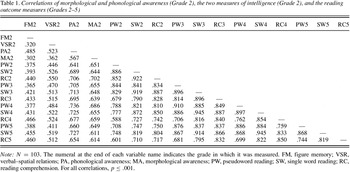
Correlations of morphological and phonological awareness (Grade 2), the two measures of intelligence (Grade 2), and the reading outcome measures (Grades 2–5)
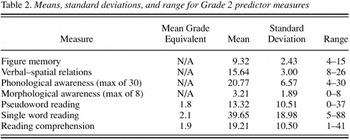
Means, standard deviations, and range for Grade 2 predictor measures
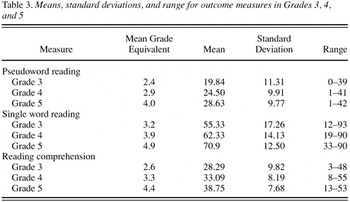
Means, standard deviations, and range for outcome measures in Grades 3, 4, and 5
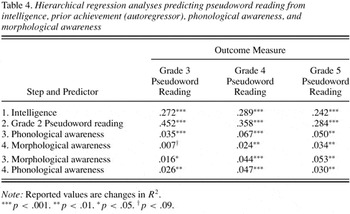
Hierarchical regression analyses predicting pseudoword reading from intelligence, prior achievement (autoregressor), phonological awareness, and morphological awareness
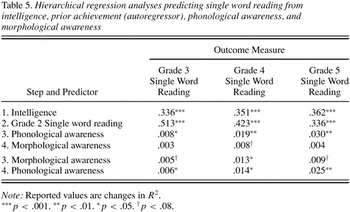
Hierarchical regression analyses predicting single word reading from intelligence, prior achievement (autoregressor), phonological awareness, and morphological awareness
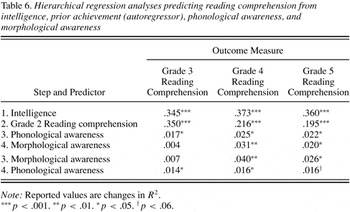
Hierarchical regression analyses predicting reading comprehension from intelligence, prior achievement (autoregressor), phonological awareness, and morphological awareness
 You have
Access
- 501
- Cited by