Morphological awareness is defined as the “conscious awareness of the morphemic structure of words and their ability to reflect on and manipulate that structure” (Carlisle, Reference Carlisle and Feldman1995, p. 194). Morphemes are the smallest units of meaning in language; for example, the word health is made up of the base heal and the affix –th. In English, morphemes tend to maintain their orthographic representation regardless of pronunciation (e.g., heal–health). As such, morphological awareness may help the reader to use known morphemes to understand morphologically complex words, thereby enhancing both word reading and reading comprehension (Kuo & Anderson, Reference Kuo and Anderson2006). The majority of studies showing that morphological awareness is related to reading have been conducted with children learning to read in English (Carlisle, Reference Carlisle and Feldman1995, Reference Carlisle2000; Carlisle & Fleming, Reference Carlisle and Fleming2003; Deacon & Kirby, Reference Deacon and Kirby2004; Kemp, Reference Kemp2006; Nagy, Berninger, & Abbot, Reference Nagy, Berninger and Abbott2006). Certainly these effects might be more apparent in writing systems with greater deviations from letter–sound correspondences, such as English, but we think that similar processes may also occur in the process of learning to read more transparent languages. Consider an example from Portuguese, in which the word código (code) goes through a stress shift and vowel change to become codificar (to codify). Reading and understanding this word could be supported by access to its morphological structure. Thus, although morphological awareness may play a stronger role in reading for languages with opaque orthographies, it could still play a role in reading alphabetic languages that have greater phonological transparency. We expand the small body of research about the role of morphological awareness in reading of phonologically transparent languages to evaluate this possibility (e.g., in Finnish: Müller & Brady, Reference Müller and Brady2001; and in Greek: Pittas & Nunes, Reference Pittas and Nunes2014). Specifically, we evaluate the relation between morphological awareness and reading in a study of children who speak Portuguese, a relatively phonologically transparent writing system.
MODELS OF READING AND THE ROLE OF MORPHOLOGICAL AWARENESS IN READING IN ENGLISH
Several models of word reading identify a role for morphology in word reading. In the last phase of Ehri's (Reference Ehri, Snowling and Hulme2005) model of word reading acquisition, called the consolidated phase, readers become familiar with letter patterns that recur in complex words, specifically orthographic patterns and morphemes. These serve as units to cement words in the mental lexicon, enabling fast and accurate access to these orthographic representations (see Carlisle & Stone, Reference Carlisle and Stone2005; Kieffer & Lesaux, Reference Kieffer and Lesaux2012). Grainger, Lété, Bertan, Dufau, and Ziegler (Reference Grainger, Lété, Bertand, Dufau and Ziegler2012) conceptualize a multiple route model of word recognition. The authors suggest that serial letter identification in word reading shifts to the use of parallel letter identification. Letter patterns, such as affix morphemes, could be identified as units to facilitate accessible meanings.
There is evidence in research with English speakers to support theories that specify that identifying morphemes helps with reading. Carlisle and Stone (Reference Carlisle and Stone2005) showed that elementary school students read morphologically complex words faster than words with one morpheme matched on frequency, length, and orthographic similarity. Moreover, Nunes, Bryant, and Barros (Reference Nunes, Bryant and Barros2012) showed that children's use of morphemes in word recognition at age 8 or 9 makes an independent contribution to their word reading fluency at age 12 or 13. This relation held after controlling for age and verbal IQ.
It is suggested that morphological awareness benefits reading comprehension, perhaps more so than any other reading ability (e.g., Carlisle, Reference Carlisle2003; Kuo & Anderson, Reference Kuo and Anderson2006). One rationale is that morphological awareness might allow children to break words into their component parts, enabling comprehension of individual complex words, and in turn, contributing to comprehension of a whole text. Others have suggested that morphological awareness may be a part of listening comprehension (Kirby & Savage, Reference Kirby and Savage2008; Tong, Deacon, Kirby, Cain, & Parrila, Reference Tong, Deacon, Kirby, Cain and Parrila2011). As predicted by the simple view of reading (Gough & Tunmer, Reference Gough and Tunmer1986; Hoover & Gough, Reference Hoover and Gough1990), morphological awareness would help language comprehension, which in turn would contribute to reading comprehension. Further still, morphological awareness might help the reader “guess” general information about the text by drawing upon syntactic and semantic cues of unknown words on the basis of their morphological structures (Nagy, Reference Nagy, Wagner, Muse and Tannenbaum2007). For instance, readers encountering an unknown word like scarcity may get a better grasp of the word and the text by using the affix –ity to work out that this word refers to an abstract noun. By extracting semantic and syntactic information from morphological complex words, they may understand the main message of the text even if they do not understand the exact meaning of the word.
Several studies have shown morphological awareness to be related to different aspects of word and text reading. For English-speaking children, Kirby et al. (Reference Kirby, Deacon, Bowers, Izenberg, Wade-Woolley and Parrila2012) showed that in third-grade students, the largest effect of morphological awareness was on a reading comprehension measure, accounting for 9% of the variance. Morphological awareness accounted for 3% to 5% of the variance in word reading accuracy and speed. These effects emerged after controlling for cognitive abilities and phonological awareness. It is noteworthy that the largest effects of morphological awareness emerged for reading comprehension.
A further question as to the relation comes from models of reading comprehension, which have long stated that accurate and efficient word reading is essential to successful reading comprehension (Gough & Tunmer, 1989; Perfetti, Landi, & Oakhill, Reference Perfetti, Landi, Oakhill, Snowling and Hulme2005). Fluent reading and accurate and rapid word recognition improve reading comprehension by reducing cognitive demands during text processing, thereby freeing resources for reading comprehension. Morphological awareness may help reading comprehension by enhancing fluent word reading. One possibility though is that it might have a role that extends beyond this in its contributions to successful text comprehension. Kirby et al. (Reference Kirby, Deacon, Bowers, Izenberg, Wade-Woolley and Parrila2012) recently showed that morphological awareness impacts reading comprehension beyond the contribution of word reading for English-speaking children (see Deacon, Kieffer, & Laroche, Reference Deacon, Kieffer and Laroche2014), which supports this possibility. This possibility also fits with suggestions that morphological awareness might index listening comprehension (e.g., Tong et al., Reference Tong, Deacon, Kirby, Cain and Parrila2011), one avenue for such a direct contribution to reading comprehension.
Testing these ideas empirically, two studies of English-speaking children in the early and middle elementary years found that word reading completely mediated the relation between morphological awareness in reading comprehension (Jarmulowicz, Hay, Taran, & Ethington, Reference Jarmulowicz, Hay, Taran and Ethington2008; Proctor, Silverman, Harring, & Montecillo, Reference Proctor, Silverman, Harring and Montecillo2012). In contrast, two other studies of English-speaking children in the middle and late elementary years showed both direct effects of morphological awareness on reading comprehension and indirect effects through word reading (Deacon et al., Reference Deacon, Kieffer and Laroche2014; Kieffer & Box, Reference Kieffer and Box2013; but see Kieffer & Lesaux, Reference Kieffer and Lesaux2012). Given these diverging results, further studies are needed, both in English and in more transparent orthographies.
Taken together, these studies suggest that the effects of morphological awareness occur on many aspects of reading, including speed and accuracy of word reading and reading comprehension. This relationship seems to extend to reading comprehension even beyond its effects on word reading. However, these results are mostly from studies carried out in English. It is possible that the relative contribution of morphological awareness depends on the orthography being studied. English has a particularly complex orthography with many deviations from letter–sound correspondences (Seymour, Aro, & Erskine, Reference Seymour, Aro and Erskine2003), many of which are morphological in nature. Morphological awareness may play a different role for readers of phonologically transparent orthographies. Subsequently, we will explore whether or not this is the case in the literature to date by evaluating the extent to which morphological awareness has effects on word reading and on reading comprehension.
MORPHOLOGICAL AWARENESS AND READING IN TRANSPARENT ALPHABETIC ORTHOGRAPHIES
Seymour et al. (Reference Seymour, Aro and Erskine2003) proposed a classification of alphabetic European languages based on orthographic complexity. European languages range from those that have shallow orthographies with predominantly consistent grapheme–phoneme correspondences (e.g., Finnish) to deep orthographies with many inconsistencies (e.g., French and English). Thus, it can be argued that the extent of morphological awareness required for processing written language may depend on the type of orthography. Reading languages such as English and French, with a great number of deviations based on morphology (e.g., Pacton & Deacon, Reference Pacton and Deacon2008), might draw on morphological awareness to a greater extent (Mann, Reference Mann2000). In addition, it is possible that readers of orthographies that follow alphabetic rules in a transparent way may not require further levels of linguistic analysis (Mann, Reference Mann2000). The following studies will review additional transparent orthographies to evaluate if there is any evidence of the involvement of morphological awareness in reading of transparent orthographies.
Several studies have been conducted in Greek, which has a simple syllabic structure and a phonologically transparent orthography (Seymour et al., Reference Seymour, Aro and Erskine2003). Rothou and Padeliadu (Reference Rothou and Padeliadu2014) explored the contribution of inflectional morphological awareness to word reading and reading comprehension in a cross-sectional study of first-, second-, and third-grade Greek-speaking children. Inflectional morphological awareness significantly contributed to both word and nonword reading in first grade (4% of the variance), but not in the upper grades. Inflectional morphological awareness also contributed to reading comprehension in the third grade (3% of the variance), but not in the lower grades. These results emerged after controlling for vocabulary and phonological awareness. In another study with Greek-speaking children, morphological awareness contributed to 3% of the variance in word reading in first graders and almost 7% in third graders, after controlling for verbal ability and phonological awareness (Pittas & Nunes, Reference Pittas and Nunes2014).
There have also been studies conducted in Norwegian and Finnish, both highly transparent orthographies. In Finnish, Müller and Brady (Reference Müller and Brady2001) also found a connection between morphological awareness and reading. In the first grade, morphological awareness contributed to reading comprehension after accounting for age, intelligence, listening comprehension, and phoneme awareness. There was no such relation to decoding speed after controls were enforced. In addition, in kindergarten children speaking Norwegian as a first language, morphological awareness training has been shown to improve reading (Lyster, Reference Lyster2002), with effects remaining 6 years later (Lyster, Lervåg, & Hulme, Reference Lyster, Lervåg and Hulme2016).
To provide a comprehensive review of orthographies more transparent than English, we review the one available study in Dutch. Dutch is in the middle of the orthographic complexity spectrum, like Portuguese, and so it is of interest. In a study of elementary school aged children who spoke Dutch as a first language, Rispens, McBride-Chang, and Reitsma (Reference Rispens, McBride-Chang and Reitsma2007) found morphological awareness contributed to word reading between 3% and 4% in children in Grade 1 and Grade 6.
In sum, it appears that morphological awareness plays a role in reading in phonologically transparent orthographies. This pattern emerges for children learning to read languages that are in the middle of the spectrum, such as Dutch, and languages that are highly phonologically transparent, such as Greek and Finnish (e.g., Pittas & Nunes, Reference Pittas and Nunes2014; but see Rothou & Padeliadu, Reference Rothou and Padeliadu2014). The relations are clearest for reading comprehension, but they do also emerge for word reading.
MORPHOLOGICAL AWARENESS AND READING IN PORTUGUESE
We turn now to our language of focus. Portuguese is a language with a simple syllabic structure, like Greek, and is in the middle of the spectrum of phonological transparency, like Dutch. In Portuguese, the departures from one-to-one correspondences emerge from contextual and morphological-based regularities (Morais, Reference Morais2009; Nóbrega, Reference Nóbrega2013). Like all languages, Portuguese has many morphologically complex words. For example, a word such as desfaz (undue) has two morphemes des-faz. Given these morphologically based spellings and the abundance of morphologically complex words, we argue that readers of Portuguese can benefit from morphological awareness.
This prediction is also supported by evidence from other orthographies. Given the similarity in nature of the language and writing systems, one would expect similar contributions of morphological awareness to reading in Portuguese, Greek, and Dutch. Therefore, morphological awareness should contribute to both word reading (e.g., Rispens et al., Reference Rispens, McBride-Chang and Reitsma2007) and reading comprehension (e.g., Rothou & Padeliadu, Reference Rothou and Padeliadu2014). Yet, as will emerge in the review that follows, this does not appear to be the case.
Evidence to date conflicts as to whether there is a role for morphological awareness in word reading and reading comprehension in Portuguese-speaking children. Mota, Annibal, and Lima (Reference Mota, Annibal and Lima2008) showed a connection between morphological awareness, measured by a word analogy task, and word reading among second- and third-grade children. Similarly, after controlling for phonological awareness, Mota et al. (Reference Mota, Vieira, Bastos, Dias, Paiva, Mansur-Lisboa and Andrade-Silva2012) showed a connection between a morphological awareness decision task in Grades 2 and 3, in which children chose which of two words was related to a target word, and a cloze task measuring reading comprehension completed 1 year later. The authors did not control for intelligence. In sharp contrast, Justi and Roazzi (Reference Justi and Roazzi2012) found that, after controlling for age, intelligence, and phonological processing, there was no independent contribution of morphological awareness to measures of word reading accuracy and reading fluency in Grade 4 Brazilian Portuguese-speaking children. To further complicate things, Freitas and Mota (Reference Freitas and Mota2015), in a study of 52 children in Grades 4 and 5, showed that morphological awareness measured by a derivational analogy task contributed between 3% to 4% of the variance in word reading accuracy after controlling for phonological awareness and nonverbal ability. There was no unique contribution of morphological awareness to reading comprehension after all controls were enforced. A similar pattern emerged in Guimarães and Mota's (Reference Guimarães and Mota2016) study of 114 second- and fourth-grade Brazilian children; there were contributions of a derivational morphology word analogy task to word reading but not to reading comprehension. Taken together, it is difficult to find a pattern among these studies, although there are more consistent effects of morphological awareness on word reading than on reading comprehension for children learning to read in Portuguese.
There are several possible explanations for this array of results. One lies in reduced power to detect effects on reading comprehension. Several studies combined children across several grades and had small sample sizes (Freitas & Mota, Reference Freitas and Mota2015; Guimarães & Mota, Reference Guimarães and Mota2016) potentially leading to challenges in detecting effects. Another possibility is that morphological awareness might only support word reading, as suggested by Guimarães and Mota (Reference Guimarães and Mota2016). As we explore this possibility, we also investigate the possibility suggested by studies of reading in English: morphological awareness might have a relation to reading comprehension that is independent of word reading (e.g., Deacon et al., Reference Deacon, Kieffer and Laroche2014).
THE PRESENT STUDY
To resolve these conflicting findings, the present study explores the relation between morphological awareness and reading in children learning to read in Portuguese in a method that considers the limitations of previous studies. First, we assess if morphological awareness makes an independent contributions to different aspects of reading. We assessed its effects on word reading accuracy and reading comprehension, as in prior studies (Freitas & Mota, Reference Freitas and Mota2015; Guimarães & Mota, Reference Guimarães and Mota2016). We also assessed its effects on reading with both fluency and accuracy, given the unique features of Portuguese orthography. Portuguese has a simple syllabic structure and quite regular grapheme–phoneme relationships, both more so than English. This combination of simple syllabic structure with semiregular letter–sound correspondences allows children to decode the sounds of words without comprehending the meaning of the words. We examined the role of morphological awareness in successful word reading, beyond simple decoding, by evaluating its effects on children's success in reading words with accurate prosody with the assumption that accessing accurate prosody relies, at least in part, on understanding the meaning of words (Kuhn & Stahl, Reference Kuhn and Stahl2003).
Second, we investigated whether the relationship between morphological awareness and reading comprehension is independent of word reading. Here we tested whether the specific effects uncovered in English (Kirby et al., Reference Kirby, Deacon, Bowers, Izenberg, Wade-Woolley and Parrila2012) emerge in Portuguese. To our knowledge, these effects have not been evaluated in studies of children learning to read an alphabetic orthography other than English.
We investigated these questions in a study of children in the fourth grade. This is a period during which morphological awareness is expected to be important in reading development (e.g., Ehri, Reference Ehri1995). To increase confidence in our results, we included controls for age, nonverbal ability, and phonological awareness; these are well-established predictors of reading that share variance with morphological awareness (e.g., Deacon & Kirby, Reference Deacon and Kirby2004).
In summary, we hypothesize that morphological awareness will significantly contribute to word reading accuracy and fluency, and reading comprehension, after controlling for age, nonverbal ability, and phonological awareness. Furthermore, we hypothesize that morphological awareness will contribute to reading comprehension independently of word reading.
METHOD
Participants
The participants were 132 fourth-grade children (63 male, 69 female) who were enrolled in state-funded schools in Brazil. They all spoke Brazilian Portuguese as their first language and none spoke a second language. Children had a mean age of 10 years, 1 month (SD = 1 year, 7 months). In Brazil, grammar instruction starts to be more systematic in Grade 3, and intensifies by Grades 4 and 5. Thus, we hypothesized that at this grade level, morphological awareness would be expected to be involved in reading development. The children came from two schools in areas with low socioeconomic backgrounds (Brazilian Institute of Geography and Statistics, 2015). The criteria for inclusion in the study were informed parental consent and the absence of reading or cognitive problems, as reported by teachers. Four children whom teachers identified as having cognitive and/or reading problems were excluded.
In keeping with prior studies of Brazilian reading development (Barrera & Maluf, Reference Barrera and Maluf2003; Camilo & Mota, Reference Camilo and Mota2013; Capovilla & Capovilla, Reference Capovilla and Capovilla2000), our research took place in schools with relatively low socioeconomic statuses. The majority of the population in Brazil is of low socioeconomic status, with approximately 75% of the population in the lower half of the socioeconomic bands (Brazilian Association for Business Research, 2015). This index is the most commonly used one by Brazilian researchers, and it accounts for income alongside education level and living conditions. Children from low socioeconomic statuses generally attend state-funded schools because they are free. In the region of the schools in which we recruited our participants, the majority (between 66% and 80%) of school-aged children are enrolled in state schools (Brazilian Institute of Geography and Statistics, 2015). Our recruitment in areas of low socioeconomic background means that our results are more broadly generalizable to the Brazilian population.
Measures
Word reading
Children were given the reading subtest of the Teste de Desempenho Escolar. This test is a standardized assessment of reading accuracy and has good internal consistency indices (α > 0.70; Stein, Reference Stein1994). The test consists of 70 words with increasing difficulty presented to the participant. The participant was asked to read the words aloud, and the examiner recorded the child's responses. Two scores, reflecting two measures of word reading, were obtained from this test. The first was an accuracy score that consisted of the number of correct responses, which was obtained by adding up the number of correct words children read regardless of the time taken to read them correctly. The second was a word fluency reading score that was calculated by tallying the number of words read with correct prosody in 1 min.
Reading comprehension
We used two measures of reading comprehension. The first was a cloze task. In this task, participants silently read two short stories. In both stories, every fifth word was missing. Children were instructed to read the stories once from beginning to end. After this first reading, they read the text again, this time filling in the blanks with one word that best fit the text. The maximum number of correct responses for each story was 15. A composite score was calculated by combining the scores from both stories. This task was validated by Santos and Zago (Reference Santos and Zago2010) for a Brazilian sample, with a reliability of α = 0.83. In our sample, reliability was α = 0.82.
The second task was a question and answer reading comprehension task, devised by Moura (Reference Moura2006). In this task, children read a short text based on a story for children. They were told to read the text and then answer the questions provided. The children were told they could go back to the text as many times as they needed to answer the questions. The test was not timed. Fourteen questions were created to evaluate the students’ basic knowledge of the text. Internal consistency of the test was reported by the author as α = 0.71. Corrections followed the norms set by the author. The questions required short, objective answers, thereby reducing bias in interpreting participant responses.
Nonverbal ability
Block design, a subtest of the Wechsler III Scale of Intelligence (Wechsler, Reference Wechsler1991), was used to measure children's nonverbal abilities. Test procedures followed the test manual adapted to the Brazilian population. The reliability reported for the task was α = 0.82.
Morphological awareness
Morphological awareness was assessed using a word analogy task that included both inflectional and derivational transformations. This task was adapted to Portuguese by Mota, Santos, and Guimarães (Reference Mota, Santos and Guimarães2014), who found validity evidence for this task in a Brazilian sample. The task focused on morphological changes that are characteristic of the Portuguese language rather than lexical characteristics such as length and word frequency. Given that there is no database to check the commonality of these words in Brazilian Portuguese, we ensured that the words in the task are part of everyday language for children of this age (see Appendix A).
In the task, the participant was asked to provide a missing word based on an analogical pattern. The experimenter would say a pair of words, for which the second word included a morphological shift. Then a target word was said out loud. The child was asked to apply the same morphological shift to this word as in the first pair (e.g., in English; pen:pens::doll:dolls for inflection, and paint:painter::art:artist for derivation). The child's score was the total number of correct answers for both inflected and derived words. The reliability for the composite task was α = 0.71. For a list of items, see Appendix A.
Phonological awareness
The phonological awareness task chosen for this study was a phoneme substitution task adapted by Cardoso-Martins, Haase, and Wood (Reference Cardoso-Martins, Haase and Wood1998) for the Portuguese language. The participant was given a word and was asked which sounds would result by changing the first sound of the target word to another sound (e.g., “How do we say the word cup if we remove the first sound and replace it with the sound /l/?”). If requested, the examiner could repeat the instructions. The score was the number of correct responses. There were 3 practice items and 10 test items. Reliability for this task was α = 0.86.
Procedure
Testing occurred in three sessions in children's schools in the second semester of the school year. The sessions lasted between 20 and 30 min. In the first sesssion, the reading comprehension tests were presented to the children in a group session. Then children were seen individually to assess word reading, phonological awareness, and morphological awareness in that order in the second session. The word reading test was recorded for later analysis. In the third and final session, children completed the nonverbal ability measure.
RESULTS
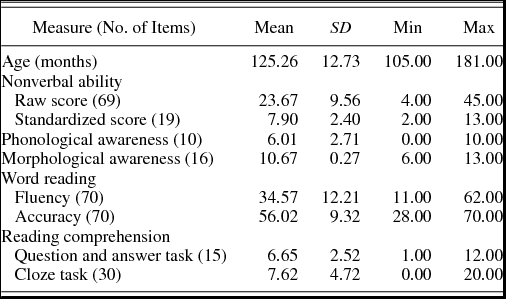
The descriptive statistics for all measures are shown in Table 1. Measures with skew and kurtosis values that fell outside of the acceptable range were transformed per the guidelines in Tabachnick and Fidell (Reference Tabachnick and Fidell2007). Specifically, square root transformations were used to bring skew and kurtosis values within the acceptable range for the word reading accuracy and phoneme substitution variables. We used inversions where appropriate to ensure ease of interpretation. All further analyses were performed with the transformed variables.
Descriptive statistics for all variables

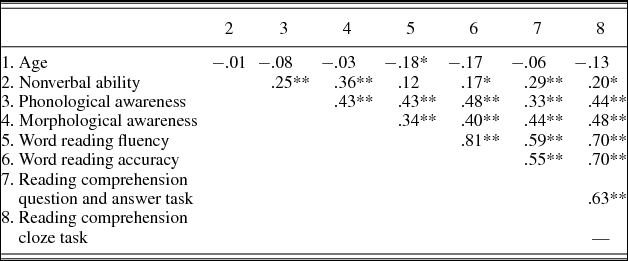
Correlations among measures are reported in Table 2. The correlations were carried out with the raw scores. There was a weak negative correlation between age and fluency. This result suggests that in the sample, the older children were slower readers than the younger children. Morphological awareness scores were significantly positively correlated with each reading measure and with the nonverbal ability measure as well. The correlation coefficients ranged from weak (.34) to moderate (.48). The correlations were slightly stronger numerically with reading comprehension measures. These correlations support our claim that morphological awareness contributes to reading in Portuguese. However, this relationship was further investigated through hierarchical regressions.
Correlations between raw score measures

*p < .05. **p < .01. ***p < .001.
Hierarchical regression analyses were conducted to investigate the role of morphological awareness in word reading and reading comprehension. Separate regression analyses were conducted for each of the four reading variables. In each model, age, nonverbal ability, and phonological awareness were entered in the first, second, and third steps, respectively. In the fourth and final step, we entered the morphological awareness measure composite score.
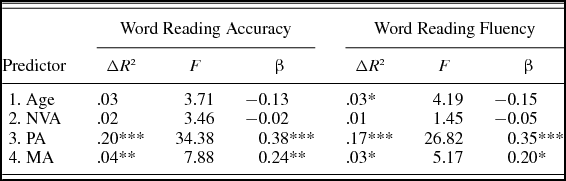
Table 3 reports the results for the analyses with word reading outcomes. The controls accounted for a total of 21% to 25% of the variance. The effects of morphological awareness accounted for an additional 3% to 4 % of the variance in word reading.
Hierarchical multiple regression analyses predicting word reading fluency and accuracy from morphological awareness, with controls of phonological awareness, nonverbal ability, and age

Note: NVA, nonverbal ability; PA, phonological awareness; MA, morphological awareness.
*p < .05. **p < .01. ***p < .001.
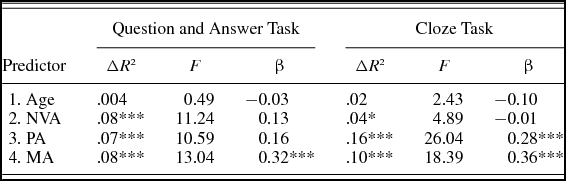
Two further hierarchical regression analyses were performed to examine the influence of morphological awareness on our two measures of reading comprehension. The results are reported in Table 4. Control measures accounted for 15% to 22% of the variance. Morphological awareness contributed an additional 10% of the variance in performance on the cloze task and 8% of the variance in performance on the question and answer reading comprehension task.
Hierarchical multiple regression analyses predicting reading comprehension from morphological awareness, with controls of phonological awareness, nonverbal ability, and age

Note: NVA, nonverbal ability; PA, phonological awareness; MA, morphological awareness.
*p < .05. ***p < .001.
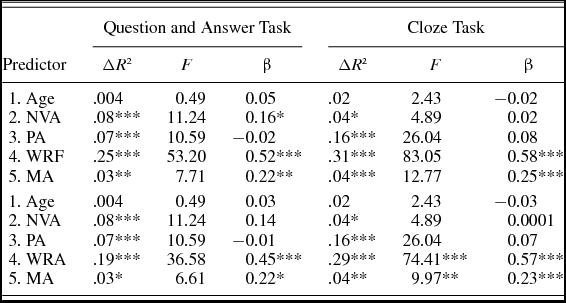
To answer our second question, we examined whether morphological awareness affected reading comprehension independent of word reading. Examining this question required us to conduct four additional hierarchical regression analyses: two for each word reading measure combined with the outcomes for each of our two reading comprehension measures (see Table 5). As in the previous analyses, age, nonverbal ability, and phonological awareness were entered in Steps 1, 2, and 3. We included one of the word reading measures (accuracy and fluency) at Step 4, and the final step was morphological awareness. In each analysis, the word reading measure accounted for a considerable amount of variance (19% to 31%), even after entering nonverbal ability and phonological awareness measures. In each analysis, morphological awareness accounts for a small but significant amount of variance, consistently in the range of 3% to 4%. These results indicate that morphological awareness contributes to reading comprehension above and beyond its effects on word reading.
Hierarchical regression analyses predicting reading comprehension from morphological awareness, with controls for word reading, phonological awareness, nonverbal ability, and age

Note: NVA, nonverbal ability; PA, phonological awareness; WRF, word reading fluency; MA, morphological awareness; WRA, word reading accuracy.
*p < .05. **p < .01. ***p < .001.
DISCUSSION
The purpose of this study was to investigate the relation between morphological awareness and fourth-grade children's reading in Portuguese. The first question in this study was concerned with the role of morphological awareness in aspects of reading in Brazilian Portuguese. We hypothesized that morphological awareness would significantly contribute to word reading accuracy, word reading fluency, and reading comprehension after controlling for age, nonverbal ability, and phonological awareness. Previous research raised questions about the role morphological awareness might play in reading Portuguese, with greater evidence of a relationship to word reading than to reading comprehension (e.g., Freitas & Mota, Reference Freitas and Mota2015; Guimarães & Mota, Reference Guimarães and Mota2016; but see Justi & Roazzi, Reference Justi and Roazzi2012). Such findings were in sharp contrast to the findings in English, Finnish, Norwegian, and Greek studies. We explored the role that morphological awareness might play in reading Portuguese by conducting a study of these relations with a large sample size, with children at a single grade level (Grade 4, as in Justi & Roazzi, Reference Justi and Roazzi2012), and with multiple measures of word reading and reading comprehension. Our second question was to evaluate whether morphological awareness makes a contribution to reading comprehension beyond that of word reading, as was reported in studies in English (e.g., Kirby et al., Reference Kirby, Deacon, Bowers, Izenberg, Wade-Woolley and Parrila2012). We hypothesized that morphological awareness would contribute to reading comprehension independently of word reading.
To answer our first question, the results show that morphological awareness does make an independent contribution to several aspects of word reading and reading comprehension in Portuguese, even beyond substantial controls. The independent effects of morphological awareness on word reading were in the range of 3% to 4%, with larger contributions of 8% to 10% for the two measures that involved reading comprehension. Our findings for word reading confirm results in prior research with Portuguese children (Freitas & Mota, Reference Freitas and Mota2015; Guimarães & Mota, Reference Guimarães and Mota2016). The present study extends the research to demonstrate relations between morphological awareness and reading comprehension in Portuguese. The relation to reading comprehension may have emerged in the present study, and not in previous studies (e.g., Freitas & Mota, Reference Freitas and Mota2015; Guimarães & Mota, Reference Guimarães and Mota2016), because of our focus on a single grade of older children, in keeping with evidence that the amount of variance due to morphological awareness increases with each grade level (Kirby et al., Reference Kirby, Deacon, Bowers, Izenberg, Wade-Woolley and Parrila2012). That the effects were larger for reading comprehension than for word reading are consistent with prior studies in English (e.g., Deacon & Kirby, Reference Deacon and Kirby2004) and in other orthographies (Müller & Brady, Reference Müller and Brady2001). Of note, these effects were above and beyond those of nonverbal ability and phonological awareness. The magnitudes of the effects are modest, but their sizes are remarkably consistent with prior studies in English (e.g., Deacon & Kirby, Reference Deacon and Kirby2004), Dutch (e.g., Rispens et al., Reference Rispens, McBride-Chang and Reitsma2007), and Greek (e.g., Pittas & Nunes, Reference Pittas and Nunes2014). Together, these results suggest a consistent pattern of the contribution of morphological awareness to reading in alphabetic languages.
Furthermore, these results support the argument that morphological awareness may help children's reading accuracy and speed by helping them to decode new and unfamiliar words, as words may be broken into larger chunks of meaning rather than letters and sounds. For example, Nunes et al. (Reference Nunes, Bryant and Barros2012) showed that the use of morphological units enhances reading fluency. Our results suggest that this could apply to Portuguese as well. Morphologically complex words such as infelizmente (unhappiness) may be read more quickly if broken into their morphemes in-feliz-mente. It would be useful for future studies in Portuguese to include measures of such morphemic reading strategies. In the present study, there were unique contributions of morphological awareness to both speed and accuracy of word reading. At the fourth-grade level, it is expected that children may have mastered phonological decoding skills and that morphological awareness plays a greater role in word recognition even in transparent languages (Müller & Brady, Reference Müller and Brady2001).
Our second question was whether the relationship between morphological awareness and reading comprehension is independent of word reading, as seen in a few previous studies in English (e.g., Kirby et al., Reference Kirby, Deacon, Bowers, Izenberg, Wade-Woolley and Parrila2012). Our results support this hypothesis. We demonstrated independent contributions of morphological awareness to measures of reading comprehension even after the effects of the word reading measures were controlled. As there are few studies in languages other than English, our results are novel in demonstrating these relations for a relatively transparent orthography, expanding on prior demonstrations in English. There are several explanations for these relations. One possibility is that morphological awareness is a part of listening comprehension (see Kirby & Savage, Reference Kirby and Savage2008), which in turn contributes to reading comprehension (Gough & Tunmer, Reference Gough and Tunmer1986; Hoover & Gough, Reference Hoover and Gough1990). Another possibility is that morphological awareness helps the child broadly understand the text by drawing upon syntactic and semantic cues from unknown words in the text. In our view, future studies need to disentangle these possibilities.
Our results also support Ehri's (Reference Ehri, Snowling and Hulme2005) model of word reading and suggest that this model may be applied to explain word reading acquisition in Portuguese (see also Cardoso-Martins, Reference Cardoso-Martins, Maluf and Cardoso-Martins2013). Ehri's last stage of word recognition, the consolidated phase, suggests that larger units of letters such as morphemes are processed in word reading. The relation between morphological awareness and word reading reported in the present study supports this claim. These results are also consistent with models of reading comprehension that predict that accurate and rapid recognition of words reduces cognitive demands, thereby enhancing reading comprehension (Perfetti, Reference Perfetti, Landi, Oakhill, Snowling and Hulme2005; Perfetti & Stafura, Reference Perfetti and Stafura2014). There are several aspects of these models that remain to be tested in orthographies other than English. As we consider theoretical implications, we also need to consider the applicability of models developed in English for other alphabetic languages. There have been legitimate concerns voiced regarding the “anglocentricity” of models developed from English reading research (Share, Reference Share2008). These concerns highlight the need to take the nature of languages and orthographies into account when designing and interpreting reading research. Yet while focusing on the uniqueness of each language, we also need to remain open to possible universal factors influencing reading development. Morphological awareness seems to be one such factor, potentially because morphemes are the universal building blocks of oral language. In our review of the literature, research in alphabetic orthographies consistently found contributions of morphological awareness to word reading and reading comprehension in the range of 3% to 4%, and 8% to 10%, respectively (e.g., Deacon & Kirby, Reference Deacon and Kirby2004; Pittas & Nunes, Reference Pittas and Nunes2014; Rispens et al., Reference Rispens, McBride-Chang and Reitsma2007). This contribution is likely to be greater in morphosyllabic writing systems (e.g., McBride-Chang et al., Reference McBride-Chang, Cho, Liu, Wagner, Shu, Zhou and Muse2005) and it bears exploration in abjads (see, e.g., Vaknin-Nusbaum, Sarid, & Shimron, Reference Vaknin-Nusbaum, Sarid and Shimron2016). We believe it is important for future research to identify the unique and universal aspects of reading development across the world's orthographies.
These implications need to be considered alongside this study's limitations. One limitation is the correlational nature of this research, such that we cannot identify the direction of the reported relationships (see, e.g., Deacon et al., Reference Deacon, Kieffer and Laroche2014). Intervention studies are needed to confirm causal connections between morphological awareness and reading in Portuguese (for a review, see, e.g., Bowers & Kirby, Reference Bowers and Kirby2010). Another alternative would be to conduct longitudinal studies designed to look at causal connections between morphological awareness and reading. A second limitation is that only one grade was studied. The contribution of morphological awareness to reading has been shown to be greater in higher grades (Kirby et al., Reference Kirby, Deacon, Bowers, Izenberg, Wade-Woolley and Parrila2012). Further studies should look at this relationship across the developmental span. Third, we did not control for vocabulary or other semantic skills. It is reassuring that in previous studies including these measures, morphological awareness still contributed to word reading after vocabulary and phonological awareness were included in the analysis (Guimarães & Mota, Reference Guimarães and Mota2016; Mota et al., Reference Mota, Vieira, Bastos, Dias, Paiva, Mansur-Lisboa and Andrade-Silva2012). Nevertheless, broader language measures would be useful to include in future studies. It would also be useful to develop standardized measures of morphological awareness; our own task had reasonable reliability, but measures standardized for use across the elementary school years would be integral in answering our questions during all stages of reading development.
Our sample can be considered both a strength and a limitation. We recruited children from two state schools in a region of low socioeconomic status. This sample accurately reflects the reality for most children in Brazil. That said, there is widespread evidence that children who are economically disadvantaged have lower levels of metalinguistic skills (e.g., Schiff & Lotem, Reference Schiff and Lotem2010; Soares & Cardoso-Martins, Reference Soares and Cardoso-Martins1989; Zanella, Reference Zanella2011) and are at risk for language and reading difficulties (e.g., Apel, Brimo, Diehm, & Apel, Reference Apel, Brimo, Diehm and Apel2013). Differences in home language experiences (Reese, Sparks, & Leyva, Reference Reese, Sparks and Leyva2010) and in-classroom instruction (Soares & Cardoso-Martins, Reference Soares and Cardoso-Martins1989) can account for at least some of these differences. In our specific context of Grade 4 children in Brazil, these differences are likely to be greater at first, with evidence that at least spelling skills become similar by Grade 6 (Zanella, Reference Zanella2011). There is little evidence that the underlying processes of learning to read differ on the basis of socioeconomic background. As demonstrated in a Brazilian study, Capovilla and Capovilla (Reference Capovilla and Capovilla2000) showed that a phonological awareness training program successfully used in a private school (Capovilla & Capovilla, Reference Capovilla and Capovilla1998) also showed strong effects in children attending state schools. Similarly, Apel et al. (Reference Apel, Brimo, Diehm and Apel2013) and others have shown relations between morphological awareness and reading in English-speaking children with low socioeconomic backgrounds. As such, we have no reason to suspect that the relations between metalinguistic skills and reading that we uncovered would differ as a result of socioeconomic status. A final feature of working with children in Brazilian schools emerges from the weak negative correlation between age and word reading fluency. The Brazilian educational system groups children by ability, rather than by age; as such, within the same grade, some older children will fall a little behind younger ones on school-related subjects. Taken together, we think that our results would bear replication across a range of socioeconomic backgrounds and grades.
The present study demonstrates clear effects of morphological awareness across a range of reading measures in Portuguese-speaking students in Grade 4. Our results are consistent with previous research on morphological awareness in other orthographies (Pittas & Nunes, Reference Pittas and Nunes2014; Rispens et al., Reference Rispens, McBride-Chang and Reitsma2007). This work resolves prior disputes about the applicability of morphological awareness to reading in the relatively transparent orthography of Portuguese (e.g., Freitas & Mota, Reference Freitas and Mota2015; Justi & Roazzi, Reference Justi and Roazzi2012). We hope that this work contributes to an increasingly robust knowledge of the relationship between morphological awareness and reading across a variety of levels of orthographic complexity.
APPENDIX A WORD ANALOGY TASK
The correct response is in parentheses.
Derivational items
1. pedra:pedreiro::leite: (leiteiro)
2. leitor:leu::escritor: (escreveu)
3. banana-bananada; goiaba: (goiabada)
4. pintor:pintura::livreiro: (livro)
5. livro:livraria::pão: (padaria)
6. goma:engoma::gole: (engole)
7. tênis:tenista::arte: (artista)
8. lixo:lixeira::faca: (faqueiro)
Inflectional items
1. anda:andou::olha: (olhou)
2. cantei:cantamos::dancei: (dançamos)
3. pente:pentes::anel: (anéis)
4. caneta:canetas::boneca:(bonecas)
5. carros:carro::disco: (discos)
6. homem:mulher::ele: (ela)
7. bondosa:bondoso::simpático: (simpática)
ACKNOWLEDGMENTS
The research reported here was supported by the Brazilian government through CNPq-bolsa de produtividade em pesquisa.