Many children grow up with two or more languages, often because one or both of their parents immigrated either as refugees or seeking better economic opportunities than those found in their country of origin. Because immigrant children vary greatly in educational achievement, it is important for educational and social policy planning to identify early sources of this variability. Given that immigrant children’s educational achievement has been shown to be predicted by early majority language and preliteracy development (e.g., August & Shanahan, Reference August and Shanahan2006; Han, Reference Han2012; Kieffer, Reference Kieffer2008, Reference Kieffer2012), the present study examined differences in groups of immigrant children’s majority language and preliteracy acquisition in an understudied but potentially very important age range, namely, 2 to 6 years.
Variability in educational achievement among immigrant children and its predictors
Educational achievement varies greatly among immigrant children. Some immigrant children excel compared to majority children, whereas others underperform. Some of the variation seems to be related to country or region of origin (Conger, Schwartz, & Stiefel, Reference Conger, Schwartz and Stiefel2007; Demie, Reference Demie2001; Han, Reference Han2008; Ryan & Bauman, Reference Ryan and Bauman2016). For example, Han (Reference Han2008) found higher educational achievement for Asian immigrant children in the United States compared to non-Hispanic white majority-language children, but lower educational achievement for Latin American immigrant children. The variability has also been found to be related to socioeconomic (SES) factors (e.g., Dustmann, Frattini, & Lanzara, Reference Dustmann, Frattini and Lanzara2012), although not always. In a study of five immigrant groups in Germany differing greatly in mean educational achievement, SES, indexed by the level of education of foreign-born parents, did not predict their children’s educational achievement (Gang & Zimmermann, Reference Gang and Zimmermann2000). The conclusion that SES has little influence on immigrant children’s educational achievements was, however, qualified by Santos and Wolff (Reference Santos and Wolff2011), showing that parental SES (level of education) was associated with educational achievement in France for some immigrant backgrounds (European and Northern African) but not others (Asian, Middle Eastern, and other African).
The educational achievement of immigrant groups also varies across host countries, which, in turn, may be related to the SES composition of the immigrant population (Dustmann et al., Reference Dustmann, Frattini and Lanzara2012; Schnepf, Reference Schnepf2004). In New York City, for example, the educational achievements of African immigrant children in 8th grade did not differ significantly from those of majority children, whereas immigrant children of West Asian origin (approximately non-African Middle East) had slightly, but significantly, better educational achievement than majority children (Schwartz & Stiefel, Reference Schwartz and Stiefel2006). In contrast, in Denmark, where the research reported below was carried out, corresponding groups of immigrant children underperform substantially compared to majority children when graduating from school in 9th grade (at about age 15) as shown in a study of all graduating students in the country over 3 consecutive years, approximately 65,000 students each year (KREVI, 2011). Students with a Middle East/African (primarily Somalian) background obtained mean grades (4.6) substantially below those of native Danish children (6.4). Yet students with a Western European or Anglosphere background (henceforth collectively referred to as “Western” background) obtained mean grades (6.6) similar to those of native Danish children. Children with an Asian (5.8) or Eastern European background (5.8) obtained mean grades between the just-mentioned groups, but with some national backgrounds (Vietnamese, Sri Lankan, and Polish) obtaining mean grades on a par with those of Danish children. Low educational outcomes are obviously a problem for the individual, but given that first- and second-generation immigrants comprise about 780,000 (13.5%) of Denmark’s population of 5.8 million (Statistics Denmark, 2018), it is of national interest (as in other host countries) to gain more insight in the sources of variability in educational outcomes. Why are outcomes associated with region of origin? Why do immigrants from the same origins have different levels of educational outcomes across host countries, often with only minor contributions of SES variability?
A study of 6th to 10th graders with different immigrant backgrounds in California revealed that East Asian students received higher grades than native peers in mathematics and English, Latino students received lower grades, and Filipino students were on a par with natives (Fuligni, Reference Fuligni1997). Again, SES background accounted for only a small portion of the variance, although the more specific feature of a strong familial emphasis on education was more strongly associated with outcomes. It is noteworthy that the degree of linguistic relatedness between the heritage language and the majority language was not associated with educational achievement, not even English grades. Latino students, speaking linguistically related heritage languages (Spanish or Portuguese), achieved significantly lower outcomes than native peers, while East Asian students, speaking linguistically unrelated heritage languages, achieved significantly higher outcomes than native peers.
The research just discussed suggests, perhaps surprisingly, that the specific heritage language of immigrant children has little relationship to educational achievement. This result seems to mirror a recent finding for early second language (L2) development by Floccia et al. (Reference Floccia, Sambrook, Luche, Kwok, Goslin, White and Plunkett2018). The study reported that three measures of linguistic distance between English and 13 different heritage languages in 2-year-old bilinguals in the United Kingdom did not influence English vocabulary development (although children’s heritage language vocabulary was lower the more distant it was from English). In spite of these findings, it is, likely that learning an L2 that is closely related to a native language (L1) will offer at least some short-term advantages, perhaps only in cases of some degree of mutual L1-L2 intelligibility.
Whereas SES and linguocultural relatedness are thus not documented as strong predictors of educational outcomes of immigrants, research suggests that acquiring proficiency in the L2 or majority language is closely associated with educational outcomes. The association between language and literacy skills before entering school and later achievement is well documented for monolingual children (e.g., Bleses, Makransky, Dale, Højen, & Ari, Reference Bleses, Makransky, Dale, Højen and Ari2016; National Early Literacy Panel, 2008; Rescorla, Reference Rescorla2009). The relation between early language and literacy skills and later achievement also holds for children acquiring the majority language as an L2 (e.g., August & Shanahan, Reference August and Shanahan2006; Han, Reference Han2012; Kieffer, Reference Kieffer2008, Reference Kieffer2012). Early L2 skills, notably vocabulary, may be a stronger predictor of later L2 reading proficiency than are early L1 skills as reported by Kieffer (Reference Kieffer2012) in a longitudinal study of Spanish–English bilinguals in the United States. The importance of early L2 skills holds even though children learning two languages typically have lower levels of skill in each language than monolingual children do, although their combined skills across the two languages are typically at the same level as those of monolinguals (e.g., Hoff, Rumiche, Burridge, Ribot, & Welsh, Reference Hoff, Rumiche, Burridge, Ribot and Welsh2014; Marchman, Fernald, & Hurtado, Reference Marchman, Fernald and Hurtado2010; Thordardottir, Rothenberg, Rivard, & Naves, Reference Thordardottir, Rothenberg, Rivard and Naves2006). However, the language of instruction in school is typically the majority language alone, which means that primarily that language serves as a medium of learning for immigrant children, although they have competences in one or more other languages. Therefore, immigrant children may be at risk for low educational achievement if the majority language is not well developed.
Majority language proficiency in immigrant children continues to be related to their educational achievement through the school ages. For example, Demie (Reference Demie2001) found that immigrant children in primary school in London who were proficient English L2 speakers showed even better educational achievement than majority monolinguals, but less English proficient immigrant children showed lower educational achievement than majority monolinguals. Similar results were reported by Strand & Demie (Reference Strand and Demie2005) with the additional finding that English language proficiency was a significant predictor of educational achievement even when other factors were controlled for, including free school meal entitlement (SES indicator), age, gender, stage of special educational need, and ethnic group.
The research is thus clear that majority language skills are important for language minority children’s educational achievement, as they are for monolingual children. Primary oral language skills, such as vocabulary, are predictive for reading comprehension for language minority students (e.g., Kieffer, Reference Kieffer2012; Proctor, Carlo, August, & Snow, Reference Proctor, Carlo, August and Snow2005).
The challenge for language minority children is that they are trying to hit a “moving target” (Cummins, Reference Cummins2000), because they need to acquire majority language skills at a faster rate than native children in order to close the gap with native children. This achievement requires substantial amounts of time; acquiring basic oral language proficiency in an L2 may take an estimated 3–5 years, while for more advanced or academic language, it may take 4–7 years or even more (Hakuta, Butler, & Witt, Reference Hakuta, Butler and Witt2000; Mancilla-Martinez & Lesaux, Reference Mancilla-Martinez and Lesaux2011). For example, Oller, Pearson, and Cobo-Lewis (Reference Oller, Pearson and Cobo-Lewis2007) found that English vocabulary scores of native Spanish students in Florida schools were below native English peers in the 5th grade as well as in the 2nd grade, although the gap was smaller in 5th grade. In addition to requiring time, L2 acquisition probably also requires a good L1 development prior to the onset of L2 learning. Thus, studies of bilingual 3-year-olds (Scheele, Leseman, & Mayo, Reference Scheele, Leseman and Mayo2010) as well as bilingual 5-year-olds (Verhoeven, Reference Verhoeven2007) have shown a positive association between L1 and L2 development, suggesting a facilitative role of early L1 development for L2 development, at least in the preschool years.
Whereas oral language skills are typically, on average, lower in bilingual than monolingual children, research findings are rather more mixed with respect to bilingual children’s preliteracy skills, such as phonological awareness and letter knowledge, which are essential for the decoding aspect of reading acquisition (for reviews, see Adesope, Lavin, Thompson, & Ungerleider, Reference Adesope, Lavin, Thompson and Ungerleider2010; Hammer et al., Reference Hammer, Hoff, Uchikoshi, Gillanders, Castro and Sandilos2014). For example, Campbell and Sais (Reference Campbell and Sais1995) found significantly higher phonological awareness in a group of Italian–English bilingual children in London than in an SES-matched group of monolingual English children; in contrast, Bialystok, Majumder, and Martin (Reference Bialystok, Majumder and Martin2003) found such advantages only for Spanish–English bilingual children, not for Chinese–English bilingual children. Moreover, the advantage was only found in certain measures. The authors concluded that there was no general bilingual advantage or disadvantage for phonological awareness. With respect to general preliteracy skills, Hammer et al. (Reference Hammer, Hoff, Uchikoshi, Gillanders, Castro and Sandilos2014) concluded in their review that “there is some evidence to suggest that [dual language learners] enter preschool with literacy skills that are lower than those of monolinguals; however, these studies focused on children from low-income homes.” This suggests that there is a need for research on more SES-representative samples of language minority children to determine whether they are disadvantaged with respect to preliteracy skills before entering school, as has been well established for L2 oral language skills.
In general, as noted by Hammer et al. (Reference Hammer, Hoff, Uchikoshi, Gillanders, Castro and Sandilos2014), studies on language minority children with broader ranges of SES backgrounds are needed to disentangle SES effects from effects of bilingualism (i.e., lower L2 skills than monolingual peers being due to having to learn two languages). Recent research suggests that SES and bilingualism do exert independent effects on L2 skills. For example, Chiat and Polišenská (Reference Chiat and Polišenská2016) found that SES and bilingualism were both associated with English vocabulary scores in Spanish–English and Turkish–English bilinguals and monolingual peers living in London, but not with nonword repetition. Likewise, Gathercole, Kennedy, and Thomas (Reference Gathercole, Kennedy and Thomas2016) found independent effects of SES and bilingualism on Welsh–English bilinguals in Wales on several language measures. However, a limitation of the former study was that it was a small-scale study with cells as small as nine children; moreover, SES and heritage language were confounded. The latter study examined the Welsh–English language constellation in depth. However, it is not certain that the centuries-long Welsh–English bilingual context can be generalized to recent immigrant contexts and to other language constellations. On this note, recall that SES influences, for example, later educational achievement differently across different immigrant groups (Santos & Wolff, Reference Santos and Wolff2011). Therefore, additional research is needed to gain further insights into SES effects on L2 development.
The present study
The primary purpose of the present study was to test whether differences exist between disparate immigrant groups in Denmark in the preschool period (ages 2–6) with respect to majority language and preliteracy skills, that is, at the very start of their academic development, given that differences are seen in later academic achievement. A finding that patterns of differences in these academically relevant domains have emerged already before school entry in a way just shifts the question of the sources of differences to an earlier age. However, in order to identify and begin effectively addressing the real sources of differences between immigrant children, it is important to determine the extent to which differences exist already before entering school.
Denmark offers an interesting context for comparison of immigrant groups because most children attend public childcare between ages 3 and 5 (about 97%, Danish Ministry for Social Affairs, 2015), with similar attendance rates for native Danish (90%) and non-Western immigrant children (91%) at any given time between ages 3 and 4 (Danish Ministry of Immigration and Integration, 2016). The high attendance rates are made possible because childcare is publicly subsidized, with progressively scaled fees. Low-income families are entitled to free childcare. There is a national consensus that it is valuable for all families to be able to offer their child daily childcare, whether the parents are working or not. Both social and linguistic development weigh in on this national priority. According to Danish legislation, parents of bilingual preschool children are urged to accept an offer of 15–30 hr of weekly childcare to stimulate the child’s Danish-language development, if the child is shown to have inadequate Danish-language skills according to a national Danish language assessment tool. This means that the children in the present study (2- to 6-year-old preschool children in public childcare) were sampled from a population that makes up the vast majority of preschool children in Denmark.
Given the abovementioned differential academic achievement across immigrant groups and often-found associations of early development with later outcomes, the present study aims to examine Danish-language skills in disparate groups of immigrant children. The immigrant groups were formed based on origin—that is, maternal country or region of birth (or maternal citizenship if the mother was born in Denmark)—following the procedure of Statistics Denmark, the source of the data for the earlier mentioned Danish study of educational achievement (KREVI, 2011), and also the source of the background information about participants in the present study. Note, however, that with classification of children on the basis of maternal immigrant background alone, a small portion of the children in the native Danish group will have a non-Danish father, and conversely, a small number of the children in immigrant groups will have a native Danish father. Receiving native Danish input from the very beginning is obviously beneficial for children’s Danish language development (for Spanish–English bilinguals, see, e.g., Hoff et al., Reference Hoff, Rumiche, Burridge, Ribot and Welsh2014); therefore, having a Danish father will be used as a covariate in the analyses below.
Not only is there little data on disparate groups of immigrant children’s early L2 development in relatively comparable circumstances, such as the Danish childcare context, it is also unknown whether SES impacts immigrant groups differently with respect to early L2 and preliteracy skills, as seen for later educational achievement (Santos & Wolff, Reference Santos and Wolff2011). Finally, it is uncertain from previous research if language minority children are disadvantaged with respect to preliteracy skills such as phonological awareness and letter knowledge. The present study aimed to fill some of these gaps in the research literature. The specific research questions addressed in the following analyses were as follows:
1. To what extent is immigrant background region associated with levels of L2 skills in 2- to 6-year-olds?
2. To what extent is age associated with immigrant children’s L2 skills, and does the age effect differ across immigrant groups?
3. To what extent can SES and having a native Danish father account for immigrant group differences in L2 skills?
4. Is the association between SES and language and preliteracy skills different in immigrant groups compared to the nonimmigrant group?
5. Is the extent to which immigrant children differ from native Danish children similar for Danish oral language skills and for preliteracy skills?
These questions were addressed in a study of L2 skills in native Danish and immigrant children in preschool in a cross-sectional design.
Method
Participants
The analyses for the present paper were based on pretest data from two randomized control trials of language intervention conducted in parallel (Bleses et al., Reference Bleses, Højen, Justice, Dale, Dybdal, Piasta and Haghish2017, Reference Bleses, Højen, Dale, Justice, Dybdal, Piasta and Haghish2018). The combined sample included a total of 13,044 children (“total sample”) in 295 public childcare centers (770 classrooms) from 13 different representative (size and urban/rural) municipalities across Denmark. Not all children had both a language test score and background information, which were required for inclusion in analyses. There were also 15 children with Latin American or Pacific island background, who were excluded because they were too few to make up groups of their own, and were thought to have too little regional/cultural similarities to combine with another group. The resulting sample consisted of 12,470 children.
Reliable educational background information could not be obtained from Statistics Denmark for many of the immigrant parents and was not considered here. Instead, SES was indexed by taxable household income for the year 2013, when the data were collected. The information was obtained from Statistics Denmark. Parental income diverged from national means for men and women (parents and nonparents age 30–49) in opposite directions for mothers and fathers; this was an expected pattern based on previous research on influences of parenthood on earnings for men and women (e.g., Lundberg & Rose, Reference Lundberg and Rose2000). For mothers, mean taxable income was DKK 240,000 compared to the national mean of 244,000 (t = –2.12, p = .034), whereas for fathers, the mean of DKK 362,000 was above the national mean of 318,000 (t = 14.47, p < .001).
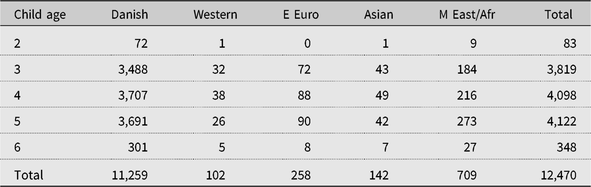
Following standard procedures of Statistics Denmark, country of origin for each child was determined by maternal country of birth (or citizenship for mothers born in Denmark). Note that although most children were born in Denmark, some of the families could have moved to Denmark in the time window between the child’s birth and the time of the child’s participation in the study. Four regional immigrant groups were defined based on patterns of national mean grades when graduating from school (KREVI, 2011, see above), and contrasted with native Danish children. The number of children per group and ages are shown in Table 1. Given the small number of 2-year-olds and 6-year-olds, they were combined with 3- and 5-year-olds, respectively, in all analyses. This was deemed justifiable because all children were assessed using an instrument with monthly age norms (see Measures below). Moreover, the 2-year-olds were close to the 3-year range (M = 34 months old), and the 6-year-olds were close to the 5-year range (M = 72 months old). The age groups in the below analyses are thus age 2–3, age 4, and age 5–6.
Number of children by age (years) and five different maternal immigrant backgrounds

Note. Western, Western European or Anglosphere. E Euro, Eastern European. Asian, South or East Asian. M East/Afr, Middle Eastern or African.
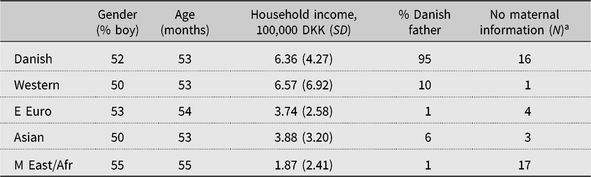
Additional background characteristics are shown in Table 2. Ordinary least square regression analysis followed by pairwise Wald tests showed that the Middle East/African group was slightly but significantly older than the Danish (F = 15.7, p < .001) and Western groups (F = 3.93, p < .048); no other pairwise group comparison of age reached significance (Fs < 3.13, ps > .078). Similar analyses of taxable household income (not including various types of welfare benefits) showed that the Danish (Fs > 45.1, ps < .001) and Western groups (Fs > 21.4, ps < .001) had significantly higher household incomes than the other three groups, and the Middle East/African group had significantly lower income than the other four groups (Fs > 25.1, ps < .001). The Eastern European and Asian groups did not differ significantly (F = 0.1, p = .756), nor did the Danish and the Western groups (F = 0.2, p = .645). Chi-square tests showed that the five groups did not differ significantly in gender composition (χ2 = 2.7, p = .601), but that the four immigrant groups differed in proportion of native Danish fathers in the home (χ2 = 44.0, p < .001); see Table 2.
Background characteristics of each group

Note: aIn these cases, immigration background was determined by paternal background. Western, Western European or Anglosphere. E Euro, Eastern European. Asian, South or East Asian. M East/Afr, Middle Eastern or African.
As noted, all children in the sample were in public childcare, which was assumed to be the primary environment for Danish-language exposure for most of the immigrant children. Therefore, differential childcare entry age could be a source of group differences, but unfortunately, information about age of childcare entry age could only be obtained for about two-thirds of the children in each group (in total 8,761 of the 12,470 children). For the children with childcare entry age information, the entry ages were 12 months (native Danish), 15 months (Middle East/African), 16 months (Western), and to 17 months (Asian and Eastern European groups). Regression analyses followed by Wald tests showed that the native Danish group entered childcare at a significantly younger age than all the immigrant child groups (Fs > 38.7, ps < .001), and the Middle East/African group entered childcare at a significantly younger age than the Eastern European and Asian groups (Fs > 6.59, ps < .010). No other group difference was significant. Because the information was available for only a subset of children, the group results are tentative and will not be used in the analyses below. However, because all immigrant groups in the subsample had a mean childcare entry age between 15 and 17 months, age difference at the time of the study is closely associated with differences in years in Danish childcare.
Measures
Each child was assessed on a validated age- and gender-normed Danish language assessment instrument, administered by the usual childcare teacher (Bleses, Vach, Jørgensen, & Worm, Reference Bleses, Vach, Jørgensen and Worm2010). The battery of language and preliteracy tests were familiar to teachers, as they are used for language assessment in most Danish municipalities; the test scores are used to assign each child a percentile score on which to base recommendations for language intervention. This practice has been in place since 2007 for 3-year-olds, for 3- and 5-year-olds and kindergarteners since 2010, and for ages 3–6 as well as kindergarteners since 2016.
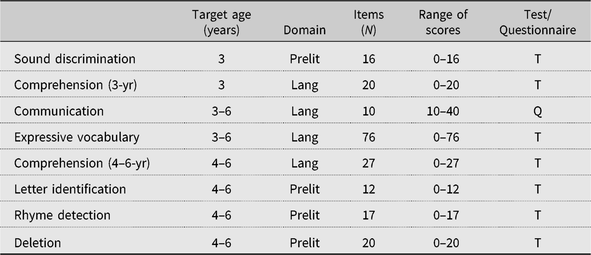
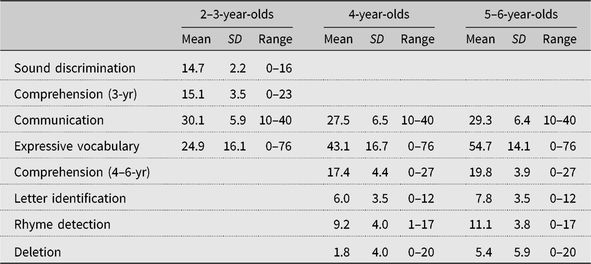
The instrument in its present form contains either four or six language and preliteracy subscales, depending on the child’s age. Three-year-olds were assessed on four subscales, namely, sound discrimination (choosing the correct picture of minimally paired words, such as ball-doll), expressive vocabulary (picture naming), language comprehension (choosing a picture that matches the content of a sentence; e.g., Can you find a man on top of a car), and communication strategies (teacher indicates to which of four degrees each child masters different communicative situations, such as asking questions when reading a storybook with an adult). Four- to 6-year-olds were assessed on six subscales, namely, rhyme detection (out of three depicted words), deletion (three degrees of difficulty: words, syllables, and sounds, such as Say snowman without snow), and letter identification (12 letters) as well as the subscales also used for 3-year-olds: expressive vocabulary, communicative strategies, and comprehension (harder items for the latter subscale). An overview of the subscales is provided in Table 3, while Table 4 provides summary statistics of the raw scores on each subscale.
Subscales of the language and literacy assessment instrument

Raw scores for each subscale used to generate composite scores for the language and literacy assessment instrument

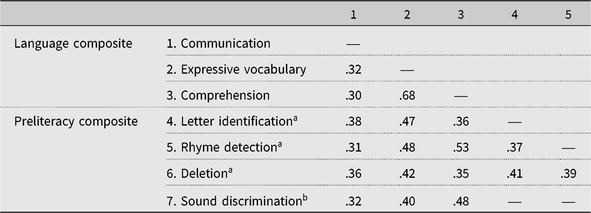
As shown, the assessment instrument targets diverse domains of language and preliteracy development. The subscales were weakly to moderately correlated with each other, indicating that they captured different dimensions of language and literacy development. For 2–3-year-olds, the correlations between subscales ranged from .27 (sound discrimination vs. communication) to .60 (vocabulary vs. comprehension). For 4-year-olds, the correlations ranged from .24 (rhyme vs. communication) to .55 (vocabulary vs. comprehension). For 5–6-year-olds, the correlations ranged from .26 (rhyme vs. communication) to .54 (vocabulary vs. comprehension as well as rhyme vs. comprehension). Correlations between each subscale across all ages are shown in Table 5.
Correlations between subscales of the language assessment instrument

Note: aOnly 4–6-year-olds. bOnly 2–3-year-olds.
The results for each child on each subscale were converted to percentile scores relative to same-age (monthly) and same-gender children of Danish background in the total sample. Subsequently, the percentile scores were converted to z scores by applying the inverse normal distribution function. This procedure typically resulted in the subscale scores being normally distributed, except that sound discrimination exhibited ceiling effects and a disproportionately large number of children scored 0 on the deletion test. This occurred due to the substantial proportion of children who failed to pass the training trials required to begin the test, and therefore received a score of zero.
Three composite scores to be used in the analyses below were derived from the subscales (see Table 3), namely, a total composite score (mean standardized score of all subscales), a language composite score (mean standardized score of the language subscales), and a preliteracy composite (mean standardized score of the preliteracy subscales). Table 3 indicates which subscales were language subscales and which were preliteracy subscales. The language composite and the preliteracy composite were only calculated for 4- and 5–6-year-olds because there was only one preliteracy scale for 3-year-olds, sound discrimination, and it exhibited ceiling effects; therefore, a comparison of scores on the two composites would not be informative for 3-year-olds.
As noted, the language and preliteracy assessment results came from pretests in two language intervention studies, which made it possible to use posttests obtained 6 months later to calculate test–retest reliability (partial correlations controlling for intervention). The analyses showed that for the total composite score, the test–retest correlations for age 2–3, 4, and 5–6 were .73, .76, and .77. For the language composite, age 4 and 5–6, correlations were .75 and .73. For the preliteracy composite, age 4 and 5–6, correlations were .60 and .71. The correlations were thus with one exception in the “acceptable test–retest reliability” range (> .70). Note, however, that these are conservative estimates as children’s different rates of language development during the 6 months between the two tests were likely to account for some of the test–retest variability.
Analysis
The total composite score of the language and preliteracy assessment tool was used to address Research Questions 1–4. The language composite score and the preliteracy composite score were used to address Research Question 5. All scores were analyzed with three-level hierarchical linear models (HLM; Raudenbush & Bryk, Reference Raudenbush and Bryk2002) due to the nested structure of the data (children within classrooms within childcares); child: Level 1, classroom: Level 2, childcare: Level 3. Classroom and childcare were treated as random effects. Given the interest in group differences across immigration background and age, immigration background and age were entered as interacting predictors in the first model. In the second model, native Danish father and SES were entered as additional predictors to determine to what extent these factors were sources of immigrant group differences. To address Research Question 4, an HLM was estimated for the total composite score with immigrant background and SES as interacting predictors, leaving out age but including native Danish father. This model estimated the extent to which SES affected language and preliteracy score differently in the immigrant groups versus the Danish reference group. Subsequently, separate HLMs estimated whether each immigrant group’s scores were affected by SES or not (independently of the SES effect in the Danish group), again controlling for native Danish father. Finally, to address Research Question 5, an HLM was estimated separately for the language composite score and for the preliteracy composite score, with immigrant group as the predictor of interest and SES and native Danish father as additional predictors in both models. As noted above, this question was only addressed for 4- and 5–6-year-olds. The Stata mixed command was used for the analyses; pairwise group differences were determined using Wald tests.
Results
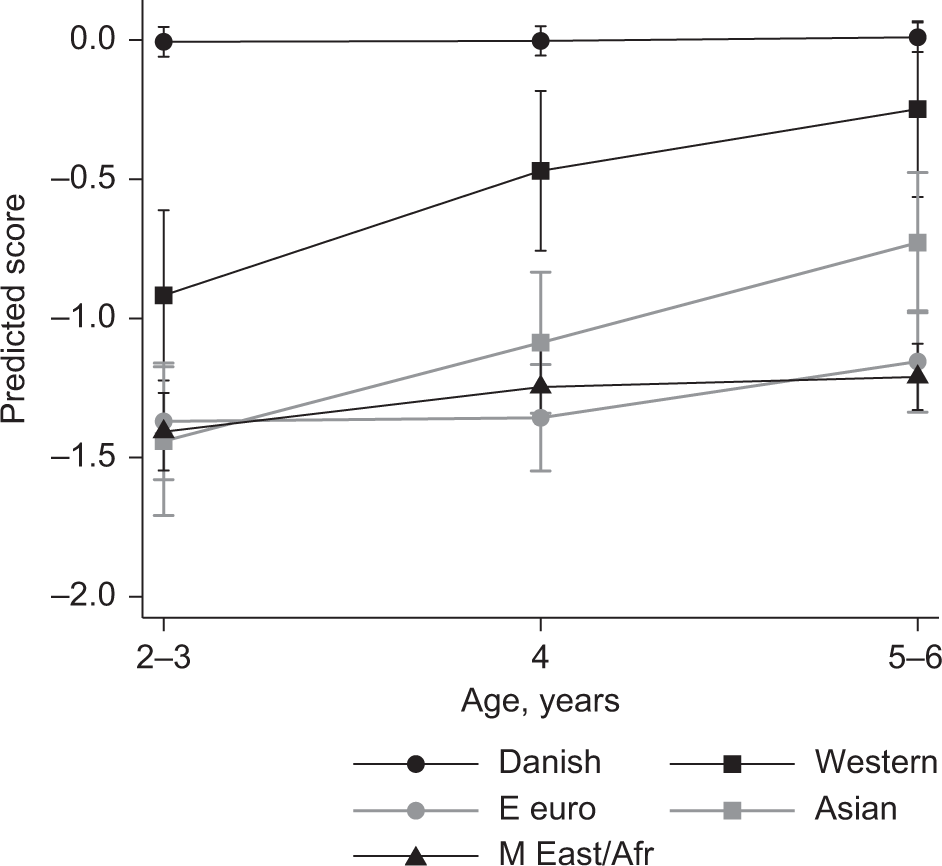
The first research question was whether differences in L2 skills exist between groups of preschoolers in Danish childcare differing according to immigration background, that is, Western, Eastern European, Asian, or Middle East/African origin. The second research question was whether such differences were related to child age and thereby also to their years of Danish-language experience. The third research question concerned the influence of SES and having a native Danish father. Two HLM models addressing these three questions are shown in Table 6; the results of Model 1 are also depicted in Figure 1.
Mean standardized total composite language and preliteracy score across five groups of children differing in maternal immigration background and age (with 95% confidence intervals).

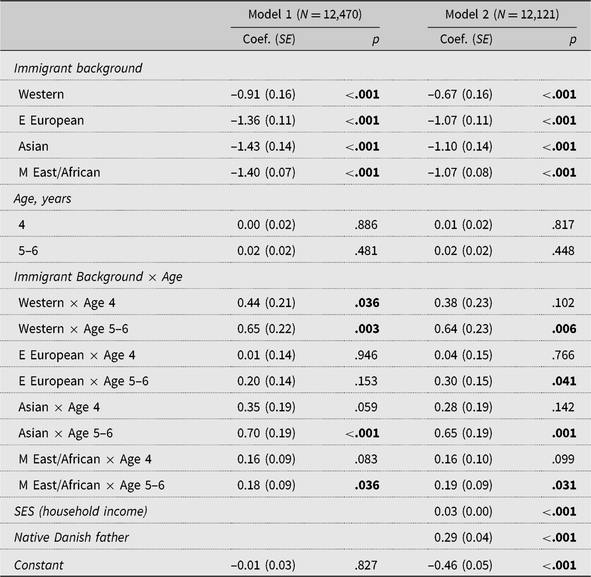
HLM results predicting the total composite language and preliteracy score from child-level characteristics

Note: Western, Western European or Anglosphere. E European, Eastern European. Asian, South or East Asian. M East/African, Middle Eastern or African. SES, socioeconomic status.
As regards Research Question 1, belonging to any of the four immigrant groups was a significant negative predictor of L2 score. Wald tests for differences between the immigrant groups in Model 1 revealed that the Western group differed significantly from the other three groups, χ2 (1) = 5.92–8.53, ps < .015; no other between-group difference approached significance (ps > .676).
As expected, age was not associated with the language and preliteracy scores in the Danish children because the assessment tool was age-normed. However, age was entered in the model in order to test for interactions between age and immigrant background (Research Question 2). Significant interactions with age were found for all immigrant groups except the Eastern European group (see also Figure 1), such that higher age, indicating more years of Danish-language experience, was associated with higher scores.
As shown earlier in Table 2, the groups differed with respect to SES (household income) and proportion of children with a native Danish father. As these factors were highly likely to influence L2 skills, they were entered as predictors in Model 2, addressing Research Question 3.
Entering the additional predictors decreased but did not eliminate the negative group coefficients showing significantly lower scores for immigrant groups than for the native Danish group. Tests for differences between the immigrant groups in Model 2 revealed the same pattern as that seen for Model 1. The Western group differed significantly from the other three groups, χ2 (1) = 4.40–5.48, ps < .040; no other between-group difference approached significance (ps > .883). With SES and native Danish father controlled for, age now interacted with immigrant background for all groups, such that the estimated scores for 5–6-year-olds were significantly higher than for 2–3-year-olds, but with age coefficients 2 to 3 times larger for the Western and Asian groups compared to the Eastern European and Middle East/African groups.
SES and native Danish father were both significant positive predictors, which (in conjunction with the decreased negative coefficients for immigrant background in Model 2) indicated that a high household income and having a native Danish father were partially protective factors for L2 acquisition.
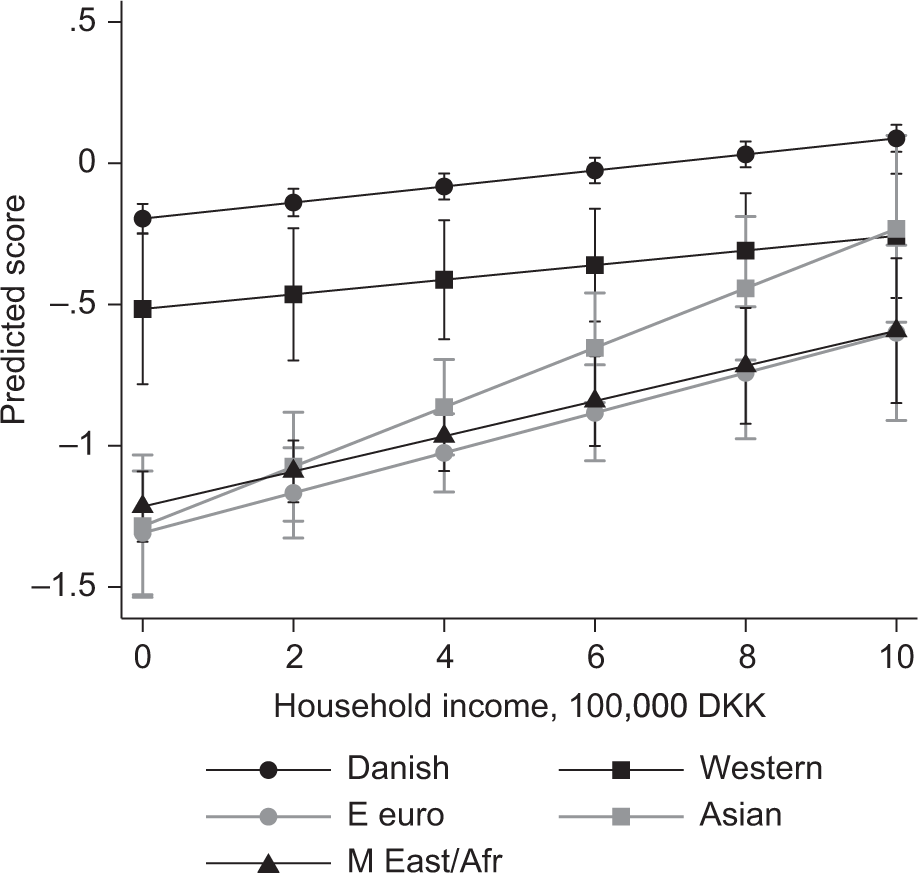
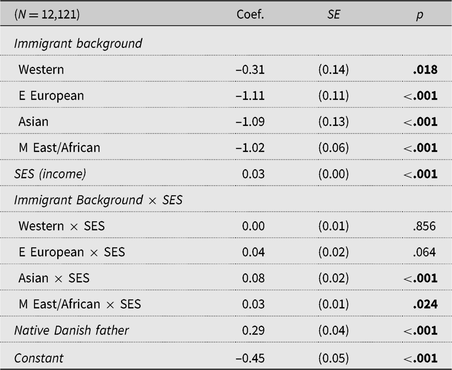
Research Question 4 asked whether the association between SES and language and preliteracy skills differs across immigrant groups, as previous research on educational achievement revealed different SES effects across immigration backgrounds. The HLM interaction model in Table 7 (with native Danish father controlled for) revealed a differentiation of SES effects across immigrant groups. Compared to the native Danish reference group, the association between SES and the total composite score was not significantly different for the Western group or the Eastern European group (though marginally so for the latter group), as indicated by the nonsignificant interaction coefficients. For the Asian and Middle East/African groups, the association between SES and total composite score was significantly stronger than in the Danish reference group, with the Asian group having the largest SES coefficient. The differences are depicted in Figure 2.
Mean standardized total composite language and preliteracy score across five groups of children differing in maternal immigration background and household income (with 95% confidence intervals).

HLM results predicting the total composite language and preliteracy score from child-level characteristics. Interaction between SES (household income) and immigrant background

Note: Western, Western European or Anglosphere. E European, Eastern European. Asian, South or East Asian. M East/African, Middle Eastern or African. SES, socioeconomic status.
The previous analysis tested whether the SES effect in each immigrant group differed from that of the Danish reference group. Another question was whether SES was a significant predictor of language and preliteracy scores in each group considered individually. Separate HLMs for each group revealed a significant positive SES coefficient for the Danish group (0.03, SE = 0.00, p < .001), a positive but nonsignificant SES coefficient for the Western group (0.03, SE = 0.02, p = .098), and significant positive coefficients for the other three groups, Eastern European (0.07, SE = 0.02, p = .002), Asian (0.11, SE = 0.03, p < .001), and Middle East/African (0.06, SE = 0.01, p < .001).
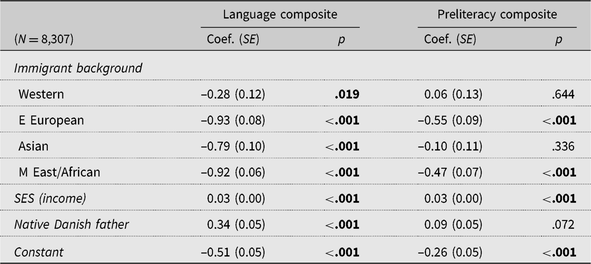
Research Question 5 asked whether immigrant children differed from native Danish children to similar extents for preliteracy skills and oral language skills. This question could be addressed only for 4- and 5–6-year-olds. Two HLM models were estimated: one for the language composite and one for the preliteracy composite (see Table 3). SES and native Danish father were entered as predictors in both models. The results are shown in Table 8.
HLM results predicting scores separately for the language composite and the preliteracy composite. Results only for age 4 and 5–6

Note: Western, Western European or Anglosphere. E European, Eastern European. Asian, South or East Asian. M East/African, Middle Eastern or African. SES, socioeconomic status.
As expected from previous research, belonging to an immigrant group was a significant negative predictor of the language composite score. For the preliteracy composite, the negative coefficients were smaller (one was positive) for all immigrant groups, indicating less of a disadvantage for preliteracy skills than for language skills. Moreover, only two of the four immigrant groups, namely, the Eastern European group and the Middle East/African group, had significantly negative coefficients for preliteracy. Thus, immigrant children seem to be less disadvantaged, or not at all, with respect to preliteracy skills compared to language skills during the 2 years prior to school entry. Finally, it is noteworthy that native Danish father was not a significant predictor of Danish preliteracy skills (although approaching significance).
Discussion
As discussed above, successful educational achievement is in the best interest of both the individual and society, and early language and preliteracy development plays an important role in this regard. Two findings in the research literature constituted the primary motivation for this study. First, early language and preliteracy development (in the L1 as well as the L2) predicts long-term educational achievement. Second, long-term educational achievement differs across groups of immigrant children differing in region of origin. Therefore, the overall question addressed in the present relatively large-scale study was whether differences in L2 skills between immigrant children in Denmark were evident already in the preschool ages 2 to 6. In the following, the findings are discussed with reference to the five specific research questions.
Research Question 1 concerned the extent to which immigrant background region is associated with levels of L2 skills in 2- to 6-year-olds. It was found that a composite measure of Danish language and preliteracy skills does differ markedly between immigrant groups in the preschool period. All groups had lower scores than their native Danish peers, but children with a Western immigration background had higher scores than children with an Eastern European, Asian, or Middle East/African background had, even when effects of SES and having a native Danish father were controlled for.
However, the results of the model in Table 6 showed that the group effects interacted with age, which gave the answer to Research Question 2. Given that the immigrant groups’ mean childcare entry age only ranged between 15 and 17 months, age was highly associated with years in Danish childcare and thus with years of opportunity to get Danish-language input. As expected, there was no main effect of age because the language and preliteracy assessment tool was age normed, and the native Danish children made up 90% of the sample. However, age interacted with immigrant background such that older immigrant children, with more Danish-language experience, had scores closer to the native monolingual age norm than their younger peers had (Table 6). This was also expected because age, as noted, was highly related to Danish-language exposure. However, the age coefficients were 2 to 3 times larger for the Western and Asian groups than for the Eastern European and Middle East/African groups (Table 6 and Figure 1). It is unknown whether these differences across immigration backgrounds reflect different developmental trends, or whether the differences were caused by cohort effects. The latter could be the case if, for the Western and Asian groups, 5–6-year-olds were advantaged over their younger peers in some important variable not accounted for, whereas this were not true for the Eastern European and Middle East/African groups. This unknown variable could, however, not be percent native Danish father or household income, which were controlled for in the models, but could potentially be parental education. Future research using a longitudinal design is needed for a firm conclusion in this regard.
The immigrant group differences are obviously an educational challenge given that early L2 and preliteracy skills are associated with later educational outcomes (e.g., August & Shanahan, Reference August and Shanahan2006; Han, Reference Han2012; Kieffer, Reference Kieffer2008, Reference Kieffer2012). Moreover, the pattern of immigrant group differences found here mirrors the pattern of group differences in graduation grades for older peers about age 15 (KREVI, 2011).
The immigrant group differences in L2 development existed even with SES and native Danish father controlled for. This suggests that a source of the differential outcomes could be cultural differences related to regional background, which, in turn, might influence immigrant children’s degree of assimilation and L2 exposure, even though all children in this study were in Danish-medium childcare. Alternatively or in addition, the differences in L2 development are a consequence of differences in L1 development. As noted above, a positive association has been found between L1 and L2 development (e.g., Scheele et al., Reference Scheele, Leseman and Mayo2010; Verhoeven, Reference Verhoeven2007). If there were systematic differences in L1 development across immigrant groups, such differences would likely be accompanied by differences in L2 development. Unfortunately, measures of L1 skills were not obtained for the present study. However, given the early L2 developmental differences between regional groups of immigrants found in the present study, it will be important in future work to investigate whether L1 developmental differences are one of the causes. If immigrant children’s long-term educational achievement is rooted in L1 development and mediated by L2 development, it is possible that an effective way to reduce differences is to support children’s very early L1 (and L2) development in immigrant families. This suggestion might seem counterintuitive given that Kieffer (Reference Kieffer2012) found that L2 skills were a stronger predictor of educational achievement than were L1 skills. However, it is possible that strengthening very early L1 development would benefit both L1 and later L2 development. For example, Mayberry and Lock (Reference Mayberry and Lock2003) found that early L1 development facilitated later L2 acquisition.
Studies of early language and preliteracy development in immigrant children (and other dual-language learners) have typically focused on low-SES children, making it difficult to disentangle effects of SES and bilingualism on children’s L2 skills, as noted by Hammer et al. (Reference Hammer, Hoff, Uchikoshi, Gillanders, Castro and Sandilos2014). The sample of the present study included children from the entire SES range and several regional backgrounds, allowing for a more detailed examination of SES effects on L2 skills, pertaining to Research Question 3: To what extent can SES and having a native Danish father account for immigrant group differences in L2 skills?
Even with SES and native Danish father controlled for, all immigrant groups had lower estimated L2 skills compared to natives. This suggests that the low L2 skills often found in low-SES immigrant children in previous research were not solely SES effects, but effects of having to learn two languages, consistent with the results of previous L2 research on wider SES ranges (Chiat & Polišenská, Reference Chiat and Polišenská2016; Gathercole et al., Reference Gathercole, Kennedy and Thomas2016).
Research Question 4 asked if the association between SES and L2 skills differed across immigrant groups. This was the case. The Asian and the Middle East/African groups showed significantly stronger SES effects than the native Danish group; the Western group did not (Table 7 and Figure 2). Note, that this was not due to differences in variance within groups; there was no tendency for groups with larger variance to yield higher correlations (Table 2). This suggests that a high SES is a protective factor in dual-language learners’ L2 development, and conversely, that a low SES hinders L2 development, but to different degrees in different groups of bilinguals.
The uneven SES effect for L2 language and preliteracy skills mirrors the uneven SES effect across immigrant groups found for educational achievement (Santos & Wolff, Reference Santos and Wolff2011). This may suggest that, for certain immigrant backgrounds, SES is a less influential factor for child outcomes. One limitation to this conclusion, however, is that mean SES in the present study differed markedly across immigrant groups (see Table 2). In addition, SES was indexed by household income. Educational level, which is another common SES indicator, might have yielded different results (for different effects of income and educational level, see, e.g., Scheeren, Das, & Liefbroer, Reference Scheeren, Das and Liefbroer2017; White, Reference White1982).
The difference in SES measure used could be one reason why this study found different relations between SES and regional background than those found by Santos and Wolff (Reference Santos and Wolff2011); those authors found no SES effect on educational outcomes in Asian, Middle Eastern or non-northern African immigrant groups, but did so for European immigrants. The present study found almost the opposite pattern, which, in addition to the different SES indicator (income vs. educational level), could be due to the different outcome measure (early language and preliteracy vs. later educational achievement) or alternatively host country differences (Denmark vs. France). Because of the multiple differences, more research is needed to tease apart influences of these factors.
Research Question 5 asked whether immigrant children differ from native children to similar extent for L2 language skills versus preliteracy skills. As expected from most previous research (for a review, see, e.g., Hammer et al., Reference Hammer, Hoff, Uchikoshi, Gillanders, Castro and Sandilos2014), all immigrant groups had lower L2 language skills than native children. However, for preliteracy skills, the gap with native children was smaller. Two groups, Western and Asian, did not differ significantly from native children on preliteracy skills. In both analyses, SES and native Danish father were controlled for. This is probably because preliteracy skills such as phonological awareness (used for rhyme detection and deletion) seem to transfer across languages (e.g., Dickinson, McCabe, Clark-Chiarelli, & Wolf, Reference Dickinson, McCabe, Clark-Chiarelli and Wolf2004; López & Greenfield, Reference López and Greenfield2004). This suggests that preliteracy skills may develop partially independently of majority language skills.
The preliteracy results suggest a qualification of the conclusion by Hammer et al. (Reference Hammer, Hoff, Uchikoshi, Gillanders, Castro and Sandilos2014) that dual-language learners are generally disadvantaged with respect to L2 preliteracy skills in preschool, a conclusion based mainly on low-SES samples. The results of the present study (with a broad SES range and SES controlled for) suggest that such a disadvantage may vary across immigration background as well as SES. This variation may also, at least in part, explain some of the conflicting findings regarding an advantage or a disadvantage for preliteracy skills in bilinguals discussed above.
It is also noteworthy that having a native Danish father was not significantly associated with preliteracy skills, as it was for L2 language skills. This result suggests that preliteracy skills in the L2 are not as dependent on native input as language skills are. As noted earlier, children may draw on more general cognitive and linguistic skills during preliteracy tests, although their comprehension needs to be above a certain level to understand instructions delivered in the L2.
Implications
What is the broader implication of the present results? The most important finding is that significant differences in immigrant groups’ majority language and literacy development have already emerged during the preschool period in immigrant children. This is important for understanding when and, more important, why, differences in educational achievement among immigrant groups emerge. These differences were found in immigrant children who all attended publicly supported Danish-medium childcare centers, which suggests that seemingly equal opportunities for majority language input do not result in the same skill levels, even when SES and the opportunity for native input from one parent (in this study, the father) were controlled for. This study provided at least partial answers to the when-question (differences might even begin before the age range examined here), but was not in a position to adequately answer the why-question.
The fact that systematic differences related to region of origin have already emerged in the preschool years implies that intervention to support children at risk for poor majority language development is warranted as early as possible. The great challenge is to identify and implement effective measures to support those in need. As noted above, some research suggests that L2 skills are positively associated with L1 skills in immigrant children. Future research on immigrant group differences in L1 development is needed to establish the extent to which differences in L1 skills, should they exist, may explain the immigrant group differences in L2 development such as those found in the present study. If a causal relation exists, effective intervention might focus on educating immigrant families in the importance of their child’s L1 development, and how they can support it. However, given the multiple barriers to effective implementation of parent intervention (see, e.g., Justice, Logan, & Damschroder, Reference Justice, Logan and Damschroder2015), it is possible that a more effective way to support linguistic aspects of school readiness in immigrant children is to target and support L2 language and preliteracy development in childcare centers using a more comprehensive approach than is in place (at least in Danish childcare centers) today. This program would include implementation of effective language and pre-literacy activities (e.g., Bleses et al., Reference Bleses, Højen, Justice, Dale, Dybdal, Piasta and Haghish2017, Reference Bleses, Højen, Dale, Justice, Dybdal, Piasta and Haghish2018; Justice et al., Reference Justice, McGinty, Cabell, Kilday, Knighton and Huffman2010) as well as regular assessment to examine progress in L2 development (e.g., twice per year). For both family intervention and center-based intervention, the results of the present study suggest that it is important to identify and overcome cultural barriers to children’s language and preliteracy development that may be related to regional immigration background.
Limitations and future directions
Although this research has yielded new insights, it has certain limitations. Only Danish-language skills were assessed, due to the lack of easily administered and valid measures for young children in most of the heritage languages. This limitation has precluded examination of the extent to which slowed L2 development is rooted in a similarly slowed L1 development, a question of considerable theoretical and applied importance. Having L1 as well as L2 measures would also make it possible to address the question of the possible influence of linguistic distance between the L1 and the L2. Inconclusive results on this issue have recently been published, with linguistic distance being associated with early L1 vocabulary scores (receptive or productive depending on distance measure) but not L2 vocabulary (Floccia et al., Reference Floccia, Sambrook, Luche, Kwok, Goslin, White and Plunkett2018).
Each child’s origin was defined by maternal country of birth (or citizenship), following the procedures of Statistics Denmark. As shown in Table 2, this definition had the consequence that some children in the nonimmigrant, Danish group had a father who was an immigrant and some children in the immigrant groups had a native Danish father. A “cleaner” analysis of the effect of regional background might have been obtained by excluding these children, but they were retained for better comparison with groups of similar origin based on the same definition, that is, solely maternal origin (e.g., KREVI, 2011). In addition, as noted earlier, SES was indexed only by household income, leaving out parental educational level. Finally, a study having longitudinal rather than cross-sectional data would make it possible to determine the extent to which differential age effects across groups reflect developmental differences or cohort differences.
Conclusion
The present study has documented systematic variability in immigrant children’s Danish L2 language and preliteracy scores related to regional immigration background. The differences were found in preschool children ages 2–6, and to some extent, they mirror immigrant group differences found in later educational achievement. Given that early L2 language and preliteracy skills have been found to predict later educational achievement, the results suggest that efforts to close the gap in educational achievement between immigrant children should be intensified already before children enter school. In this endeavor, more weight should probably be put on L2 language skill development as the results of the present study suggested that immigrant children are more disadvantaged with respect to L2 language skills than preliteracy skills.
Author ORCIDs
Anders Højen, 0000-0003-2923-5084
Acknowledgments
This research was supported by the Danish Strategic Research Council (Project No. 11-115756) and the Danish National Board of Services. We also wish to thank the participating families as well as the associate editor and the reviewers for helpful comments and advice.