The majority of studies on phonological development have focused on children's acquisition of segmental inventories and the development of phonological and lexical representations. Although work has examined the acquisition of phonotactics (Coady & Evans, Reference Coady and Evans2008) and the acquisition of morphology (Voeikova & Dressler, Reference Voeikova and Dressler2006), a relatively unexplored area in phonological development is the interface between phonotactics and morphology. Specifically, phonotactic restrictions in a language are often linked to phonological processes, which can result in morphophonological alternations (see below for examples). The interface between phonotactics and morphophonology reflects higher cognitive levels of phonological structure, which are developing until at least 6 years of age (Pierre-humbert, Reference Pierrehumbert2003, Reference Pierrehumbert, Goldstein, Whalen and Best2006). Studying the interaction of these two domains provides insight into children's knowledge of how sound structures relate to morphological structures in the lexicon. Despite this, very few studies have looked at how children acquire phonotactics and morphophonology. In this research, we investigate the developmental patterns for Dutch children's acquisition of phonotactics and morphophonological alternations.
Phonotactics refers to the legal sequencing of sounds within a given language. For example, in Dutch, voiceless and voiced obstruents can occur both word-initially and word-medially (1a and b). In word-final position, voiced obstruents are phonotactically illegal (1c). The word pet is produced as [pɛt], and the word bed is produced as [bɛt], with a final /t/ rather than with a final /d/.Footnote 1
(1)

In Dutch, the restriction against voicing in final position is reflected by a phonological process of voicing neutralization or final devoicing. This phonological process leads to morphophonological alternations when words and affixes combine. Thus, voicing neutralization results in an alternation in morphologically related pairs, where one member has a nominal, verbal, or adjectival inflection, whereas the other member does not. Traditionally, a general phonological rule of final devoicing is thought to be responsible for this alternation. Phonologists have proposed that the singular of an alternating word has an abstract underlying form (e.g. /bɛd/ rather than /bɛt/), which is changed into [bɛt] due to final devoicing (e.g., Booij, 1995; Chomsky & Halle, Reference Chomsky and Halle1968). Dutch has two plural suffixes (-en and -s), which are both used productively (e.g., Baayen, Schreuder, de Jong, & Krott, Reference Baayen, Schreuder, Jong, Krott, Nooteboom, Weerman and Wijnen2002). The suffix relevant to morphophonological alternations is the -en suffix. Compare the underlying voiceless /t/ in which voicing does not alternate between the singular and plural in (2a), to the underlying voiced /d/ in which voicing does alternate between the singular and plural in (2b). Because of resyllabification, the /d/ of [bɛdən] is no longer in final position and escapes neutralization. Note that the underlying voicing value is reflected in the spelling of the singular, for example, pet versus bed. Words in (2a) are referred to as nonalternating forms because [t] is produced in both the singular and the plural; words in (2b) are referred to as alternating because [t] is produced in the singular whereas [d] is produced in the plural.
(2)

Both petten and bedden are bimorphemic, because they include the stems pet and bed plus the plural morpheme -en (realized as [ə] or [ən]). Monomorphemic forms are words such as water “water” and poeder “powder” (1b). To determine the underlying voicing of the word-final segment of the nouns in (2), it is necessary to know how voicing is realized in the plural form. Even though the voicing alternation itself is idiosyncratic, depending on the lexical specification of the stem, the process of final devoicing is productive for adults. For example, loanwords such as club are produced as [klʌp]. Kerkhoff (Reference Kerkhoff2007) analyzed the occurrence of voicing alternations in Dutch in a corpus of spoken child-directed speech available through CHILDES (van Kampen, Reference van Kampen1997). Results indicated that nonalternating types exceed the number of alternating types in the input, even though individual alternating words may have high token frequencies. This same pattern was also found in her analysis of nonalternating and alternating types in the Dutch CELEX database. Assuming that this is representative of the input to which children are exposed, Dutch learners predominantly hear nonalternating forms in the ambient language.
To summarize, in Dutch there are two interconnected patterns: the phonotactic restriction on voicing and the morphophonological pattern where voicing alternates on specific lexical items. How does children's knowledge of these patterns develop? In theories of phonological learnability, it has been argued that learners initially acquire phonotactic knowledge before knowledge of morphophonological alternations (Hayes, Reference Hayes, Kager, Pater and Zonneveld2004; Peperkamp & Dupoux, Reference Peperkamp, Dupoux and Lasser2002; Prince & Tesar, Reference Prince, Tesar, Kager, Pater and Zonneveld2004). This is logical because acquiring phonotactics does not require knowledge about specific lexical items or morphological contexts. These theories of learnability assume that (prelexical) learners are able to make the appropriate linguistic generalization on the basis of the input. In the case of Dutch, it is assumed that learners acquire a general pattern of final voicing neutralization. Once learners have acquired their language specific phonotactics, it is hypothesized that this knowledge is then applied in the subsequent acquisition of morphophonological alternations such as those in (2) (Hayes, Reference Hayes, Kager, Pater and Zonneveld2004; Peperkamp & Dupoux, Reference Peperkamp, Dupoux and Lasser2002; Prince & Tesar, Reference Prince, Tesar, Kager, Pater and Zonneveld2004). The child's underlying form may be initially based on the adult's surface form, for example, /bɛt/ (Smith, Reference Smith1973). According to generative theory (e.g., Chomsky & Halle, Reference Chomsky and Halle1968), knowledge of the plural form would lead a child to restructure the original representations based on the neutralized surface form /bɛt/ and arrive at an abstract underlying representation /bɛd/. In other words, alternations should lead the child to posit an underlying form that differs from the surface form. With such an abstract lexical representation, the previously acquired phonological rule or constraint of final devoicing would (still) correctly derive the surface form [bɛt]. In analogical or usage-based models of language (e.g., Bybee, Reference Bybee2001; Tomasello, Reference Tomasello2003), both forms (i.e., [bɛt] and [bɛdən]) are stored as wholes, and word formation is driven by analogy to other words in the lexicon. Under this view, knowledge of the alternation is entirely dependent on knowledge of surface forms (which form a morphological and semantic pair), whereas productivity of the pattern depends on its (type) frequency and transparency.
To correctly produce patterns of morphophonological alternations as in (2b), the child must know how specific lexical items vary in their surface pronunciation. Consider the child who correctly produces alternations in forms such as bed~bedden. There are several ways in which such an outcome could be interpreted. On the one hand, it could reflect knowledge of the word's correct underlying specification of the word-final /d/, in combination with knowledge of final devoicing and the morphological rule of pluralization (i.e. adding -en to the underlying form /bɛd/). On the other hand, it could merely reflect knowledge of the specific lexical items in both the singular and the plural, in which case there is no need for abstract underlying forms.Footnote 2 Even though forms may be morphologically analyzed upon noticing the semantic overlap between the singular and the plural, both forms (i.e., [bɛt] and [bɛdən]) could be stored in the lexicon.
AIMS OF THE CURRENT STUDIES
Despite the central role that phonotactics and morphophonological alternations have played in theories of phonology and learnability, there has been very little experimental work on these alternations in acquisition. To examine Dutch-learning children's acquisition of phonotactics and morphophonological alternations, we have a crucial need to establish (a) whether children are able to produce a medial voicing contrast and (b) whether children have productive knowledge of phonotactics in relation to alternations. We now turn to a discussion of these points, which are the central questions that we aim to address in this study.
There is a large body of research looking at young children's production of voicing contrasts in the first few years of life. Acquisition rates and patterns differ depending on the nature of the voicing contrast in the target language (e.g., Kager, van der Feest, Fikkert, Kerkhoff, & Zamuner, Reference Kager, van der Feest, Fikkert, Kerkhoff, Zamuner, van de Weijer and van der Torre2007; Lasky, Syrdal-Lasky, & Klein, Reference Lasky, Syrdal-Lasky and Klein1975). Previous studies on the acquisition of Dutch have investigated children's acquisition of the medial voicing contrast using elicitation tasks (Kuijpers, Reference Kuijpers1993) and analyses of naturalistic longitudinal data (van der Feest, Reference van der Feest2007). Kuijpers found that children (ages 4 years, 5 months [4;5], 6;4, and 12;2) produced durational differences for the medial voicing contrast that were similar to those of adults, although younger children showed more variability in their responses. Van der Feest (Reference van der Feest2007) found that in medial position, the most common error type is devoicing. She examined 12 children's production of voicing between 1;0 and 2;11, based on analyses of naturalistic longitudinal data from the CLPF database (Fikkert, Reference Fikkert1994; Levelt, Reference Levelt1994). Van der Feest (Reference van der Feest2007) found that 28% of /d/ targets were produced as [t], whereas incorrect voicing of /t/ occurred in only 1.5% of cases. In sum, previous research suggests that the production of medial /t/ by children is accurate by age 2;11 (van der Feest, Reference van der Feest2007), whereas medial /d/ is produced accurately at age 4;5 (Kuijpers, Reference Kuijpers1993). In Experiment 1, we test production of the Dutch medial voicing contrast with children under the age of 4. Based on previous results, we predict that children will accurately produce medial /t/ by 2.5, but that their production of /d/ will not yet be stable at 3.5.
The second goal was to investigate whether children have productive knowledge of Dutch phonotactics and morphophonological alternations. This is an important issue for theories of learnability, because it is possible for the child to correctly produce the morphophonological alternations for their language without any decomposition of the lexical items. For example, consider the child who consistently produces the /d/ in handen [hɑndən] “hands” correctly and neutralizes voicing in the singular hand [hɑnt] “hand.” This child may have stored both the plural [hɑndən] and the singular [hɑnt]. A sounder test of knowledge of morphophonological alternations can be seen in work by Kerkhoff (Reference Kerkhoff, Baauw and van Kampen2004, Reference Kerkhoff2007), who looked at children's productions of morphophonological alternations in nonwords using the “Wug Test” (Berko, Reference Berko1958). In her youngest age group (2;9–4;0), only 8 of the 26 children produced alternations for the plurals of novel singulars (e.g., the singular nonword [slɑt] was pluralized as [slɑdən]). When all children are considered, voicing alternations were produced in only 4% of cases. This shows that the pattern is not very productive, even though most children produced at least one alternation for real words (e.g., [hɑnt]~[hɑndən] “hand~hands”). See van de Vijver and Baer-Henney (Reference van der Vijver and Baer-Henney2010, in press) for similar results from children acquiring German.
Experiment 2 uses a Reverse Wug Test, where children are given novel plurals ([slɑtən] or [slɑdən]) and asked to derive singulars ([slɑt]). Two predictions are made for how children's phonotactic knowledge is applied to morphological alternations. Under a generative theory, knowledge of the plural form should lead the child to posit an underlying form that differs from the surface form. Upon hearing [slɑtən], children would be predicted to posit the correct underlying /slɑt/ and produce [slɑt]. Upon hearing [slɑdən], children would be predicted to posit underlying /slɑd/, which differs from the surface form. However, the previously acquired phonological rule or (phonotactic) constraint of final devoicing would still apply, predicting children to produce [slɑt]. Thus, children's performance on [slɑtən] and [slɑdən] should be the same, provided that they can detect the medial voicing contrast and decompose a complex form into a stem and an affix. In contrast, usage-based theory would predict that the productivity of the pattern depends on its (type) frequency and transparency. Recall that nonalternating types exceed the number of alternating types in the input, which means that Dutch learners predominantly hear nonalternating forms in the ambient language (Kerkhoff, Reference Kerkhoff2007). Thus, children's attention may not be sufficiently drawn to the patterns that would cue voicing neutralization and morphophonological alternations, and their knowledge of the Dutch voicing alternation could be lexically based and limited in its productivity. Under this view, alternating forms (such as /bɛdən/ “beds”) are more likely to be stored as unanalyzed wholes, that are only weakly related to the singular, and hence the alternating pattern is not readily extended to nonwords. In this case, it should be easier for children to produce singulars for nonalternating plurals like [slɑtən] than for alternating plurals like [slɑdən]: novel alternating forms should be harder to analyze as plurals, whereas nonalternating forms do not require any knowledge about the interaction between phonotactics and morphophonology.
The experiments in this study test children's knowledge of voicing neutralization and morphophonological alternations in Dutch. In Experiment 1, we examine how children under 4 years produce voicing in bimorphemic words (which includes both nonalternating and alternating words) versus monomorphemic words, addressing our first aim of investigating whether children produce a medial voicing contrast. Experiment 2 looks at children's productive knowledge of voicing neutralization and morphophonological alternations, addressing our second aim.
EXPERIMENT 1
The first study establishes how young children produce intervocalic /t/ and /d/ in both bimorphemic (nonalternating and alternating) and monomorphemic words. Although there was no theoretically motivated expectation that children would imitate voicing differently in the two morphological contexts, it was important to establish children's performance in the two contexts as a baseline. The issue of morphological status and voicing is returned to in the general discussion. Two age groups (2.5 and 3.5) were tested to determine whether there were developmental differences, and to compare results to Kuijpers’ (Reference Kuijpers1993) production study with older children. This also forms a basis for interpreting children's performance on voicing in Experiment 2.
Participants
Two groups of children participated in the experiment: 18 Dutch-speaking children between the ages of 2;5 and 2;8 (M = 2;7) and 18 Dutch-speaking children between the ages of 3;6 and 3;8 (M = 3;7). Children were recruited through the Baby Research Center of the Max Planck Institute for Psycholinguistics and the Radboud University Nijmegen in The Netherlands.
Materials
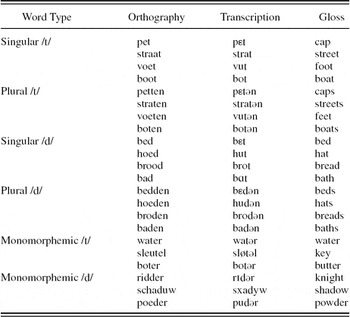
The stimuli consisted of nonalternating (nouns with /t/) and alternating words (nouns with /d/), tested in both the singular and plural. There were four words with /t/ and four words with /d/ (four singular /t/, four plural /t/, four singular /d/, four plural /d/). In addition, a set of monomorphemic nouns was included, which always have /t/ or /d/ in medial position. For example, the “d” in ridder “knight” always surfaces as [d] and the plural is ridders. There were three monomorphemic words with /t/ and three monomorphemic words with /d/.Footnote 3 Items were chosen that were easy to depict and known to children, based on corpus analyses of the CLPF database by Kerkhoff (Reference Kerkhoff2007) and the Dutch version of the MacArthur Communicative Development Inventory (Zink & Lejaegere, Reference Zink and Lejaegere2002). In addition, a pilot study was completed to determine whether children knew the words. The complete stimulus set is given in Table 1. Not all stimuli were equally frequent. Given the difficulty of choosing experimental stimuli that were known to young children, it was impossible to control for this factor in all conditions. We return to a discussion of lexical frequency in the conclusion.
Real word stimuli for Experiment 1

Children were randomly assigned to one of two prerandomized orders. All words were paired with pictures and presented using PowerPoint. The PowerPoint presentation also included auditory tokens of the stimuli, which were prerecorded by a female native speaker of Dutch.
Procedure
Children were individually tested at the KindertaalLab (Child Language Lab) at the Radboud University Nijmegen. Children were seated in front of a computer screen, next to the experimenter.Footnote 4 Children were told that their task was to repeat the words after the computer. Sessions were video recorded, with an external microphone placed in front of the child. Sessions were later digitized and transcribed by the experimenter, who viewed the data in Audacity, a free digital audio editor. A second experimenter, who was blind to the original transcriptions, also transcribed all the data. Transcriptions were compared and agreed upon by both transcribers. Analyses are based on children's first response.
Coding
Children's responses were coded in three categories: voicing correct, voicing incorrect and no response. The coding categories are illustrated using the word hoeden /hudən/ “hats.” For voicing correct, children had to correctly produce the appropriate voicing, for example, [hudən]. Voicing incorrect were responses where children produced /t/ as [d] or the more common response where /d/ was produced as [t], for example, /hudən/ produced as *[hutən]. Responses coded as no response included responses where children did not respond, where the word was incorrectly produced as singular or plural (e.g., /hudən/ produced as [hut]), responses where children produced the incorrect word (e.g., [pɛtən] “caps”), or responses where children produced the word in the diminutive (e.g., [hutjəs]). Less than 4% of the responses were coded as no response. To assess children's production of /t/ and /d/ while taking into account no responses, a proportion of voicing correct was used. This was based on the responses coded as either voicing correct or voicing incorrect (see also Kirk & Demuth, Reference Kirk and Demuth2005).
Results
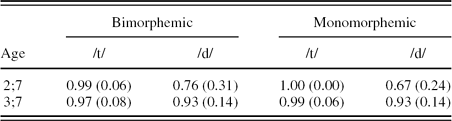
Children's responses for the singulars of bimorphemic plurals (nonalternating and alternating) were first analyzed to determine whether children correctly produced voicing neutralization. Children always produced a final /t/, that is, they never produced errors such as /bɛd/ produced as [bɛd], [bɛp] or [bɛn]. Thus, children did not produce any forms with illegal voicing but always produced final /t/ and /d/ as [t], reflecting Dutch phonotactics. The singulars for the bimorphemic plurals were not included in the remaining analyses. For analyses, a repeated-measures analysis of variance was used with two within-subject factors, Voicing (voiceless or voiced), and morphology (bimorphemic or monomorphemic) and one between-subjects factor, age (2.5 or 3.5). Results are given in Table 2.
Mean (standard deviation) correct responses (out of 1) for /t/ and /d/ in bimorphemic and monomorphemic conditions
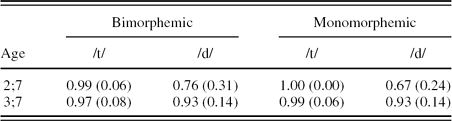
Note: Ages are in years;months. Responses are broken down by age.
There was a main effect of voicing, F (1, 34) = 23.89, p < .001, η2p = 0.41, and an interaction between Voicing × Age, F (1, 34) = 11.83, p < .01, η2p = 0.26. Post hoc tests were performed to assess the effect of voicing in each age group, corrected using Bonferroni adjusted alpha level. Children aged 2.5 were better at imitating /t/ than /d/, t (17) = 4.93, p < .001; however, children aged 3.5 showed no significant difference in how they imitated /t/ and /d/, t (17) = 1.30, p = .21. There was also a main effect of age, F (1, 34) = 10.25, p < .01, η2p = 0.23, showing that older children produced a larger number of correct imitations than the younger children. There were no other significant effects or interactions.
To better evaluate the data in terms of children's acquisition of the voicing contrast,Footnote 5 we performed an analysis on children's responses based on the standards set by Sanders (Reference Sanders1972). Sanders defines segments as ‘customarily produced’ when over 50% of children can produce a segment correctly in two word positions (initial, medial, or final), and “acquired” when over 90% of children can produce a segment correctly in two word positions. Our interpretation of Sanders’ definition was limited to just medial position. At age 2.5, 17 of the 18 children produced /t/ correctly on all words, and at 3.5, 15 of the 18 children produced /t/ correctly on all words. In contrast, at age 2.5, only 3 of the 18 children produced /d/ correctly on all words, and at 3.5, 13 of the 18 children produced /d/ correctly on all words. At 3.5 by Sanders’ definition, /t/ is on the cusp of being acquired, while /d/ is customarily produced.
Discussion
This first experiment is one of the few studies that provides controlled data on how young children produce specific voicing on lexical items, some of which undergo morphophonological alternations and vary in their surface pronunciation. Results revealed a significant interaction between voicing and age. Younger children were less accurate at imitating words with medial /d/ than /t/. We observed a developmental pattern, because this effect only held for the younger participants. In the current study, we have no way of evaluating whether these errors are rooted in perception or production. Based on the standards set by Sanders (Reference Sanders1972), we can say that children have acquired medial /t/ by 2.5, whereas /d/ is customarily produced by 3.5. Our results thus extend the results from Kuijpers’ (Reference Kuijpers1993) study, as the youngest age she tested was 4.5. With singulars, children always correctly produced voicing neutralization, reflecting Dutch phonotactics.
If phonotactic knowledge is generally applied, children should be able to derive singulars from plurals, as singulars should always end in a voiceless stop. Recall that phonotactics reflect the phonological process of voicing neutralization that is responsible for the morphophonological alternation. According to theories of learnability, the learner first acquires the phonotactics of voicing (e.g., Hayes, Reference Hayes, Kager, Pater and Zonneveld2004). That is, children first learn that voiced obstruents do not occur in word-final position. Therefore, we were also interested in testing children's productive knowledge of voicing neutralization and alternations. We chose to use novel plurals to elicit singulars, to test whether children have internalized knowledge of voicing neutralization in relation to alternations. Predictions derived from earlier mentioned generative theories were that children would perform equally well on producing singulars from novel plurals regardless of whether or not this involves morphophonological alternations. Predictions based on usage-based theories were that children should perform better on forms that involve no alternation between the singular and plural because of the limited productivity of the alternating pattern in Dutch. Thus, the associations between singular and plural forms in alternating pairs is weaker than in the frequent and productive nonalternating pairs.
EXPERIMENT 2: REVERSE WUG TEST
Methods
Children completed a Reverse Wug Test, in which they were presented with novel plurals depicted by nonce animals and asked to produce singulars. We could then examine children's ability to posit singulars from plural nonwords with /t/ versus /d/. Plural nonwords with /d/ require children to neutralize voicing in word-final position. If children have knowledge of voicing neutralization or the morphophonological relation between alternating forms, they should be equally good at positing singulars from novel plurals with /t/ and /d/. However, if children have not yet learned how phonotactics apply in morphological contexts, children should have more difficulty positing singulars from plural nonwords with /d/ than /t/. The set of nonword stimuli were taken from Kerkhoff (Reference Kerkhoff2007), who used the “singular” nonwords in a standard Wug Test and the plurals in a Reverse Wug Test.
Participants
Four groups of Dutch-speaking children participated in the experiment: ages 2;4, 2;7, 3;7, and 4;8. The first group of children consisted of eight children between 2;3 and 2;4 (M = 2;4). The 2;7 and 3;7 groups were the same participants from Experiment 1. The last group of 8 children were between the ages 4;3 and 5;1 (M = 4;8), and recruited through local schools.
Materials
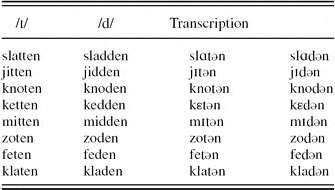
There were eight plural nonwords with either intervocalic /t/ or /d/ (e.g. slatten [slɑtən] or sladden [slɑdən]). In both cases, singulars should end in [t] due to voicing neutralization (i.e., [slɑt]). The stimuli are given in Table 3. There were two practice items and three filler items that took the -s plural morpheme (e.g., kikker~kikkers “frog~frogs”). Nonwords were paired with pictures of nonce animals and prerecorded auditory tokens of the stimuli. Each child was tested on four plurals with /t/ and four plurals with /d/. Each nonword was presented in the plural with either /t/ or /d/, such that different children were tested on either slatten or sladden but not both. Children were randomly assigned to one of two prerandomized orders.
Nonwords with /t/ or /d/ for Experiment 2

Procedure
Testing conditions for the youngest three groups were the same as in Experiment 1. The children aged 4;8 were tested in a quiet room at their school. The task began with two practice items with real words. Children saw two identical birds. The experimenter said “Dit zijn twee ____” (“These are two ____”) and played the prerecorded word vogels “birds.” On the next screen children saw a picture of a single bird. The experimenter then asked the children “Wat is dit?” (“What's this?”), which prompted children to say the word in the singular. The test trials followed the same procedure. Every two nonword trials were separated by a filler trial. Transcriptions were done the same way as in Experiment 1.
Coding
Responses were coded into three categories: correct, incorrect and no response. The coding categories are illustrated using the nonword sladden /slɑdən/. For correct, participants had to correctly produce the nonword in the singular, for example, [slɑt]. Incorrect responses were responses in the plural rather than in the singular ([slɑdən]); in the plural with the incorrect voicing ([slɑtən]), with the incorrect plural affix (slɑts]), and responses other than singulars ([slɑdər]). Last, no response included instances where children failed to give a response or responded with a different word, for example, “Sponge Bob.” Approximately 7% of children's responses were coded as no response.
Results
When given a plural nonword and asked to produce a singular, children did not give many singular responses (2;4: 17% singular responses; 2;7: 11% singular responses; 3;7: 31% singular responses; 4;8: 25% singular responses). The majority of children's errors consisted of a plural response. For example, children often responded by saying een slatten “one slatten” or een sladden “one sladden.” In contrast, children were able to give the singular for known plurals, for example, een kikker “one frog.” On the plural filler items, children's singular response was highly accurate (2;4: 80% singular responses; 2;7: 83% singular responses; 3;7: 100% singular responses; 4;8: 100% singular responses).
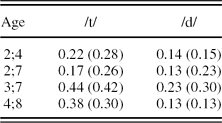
A repeated-measures analysis of variance was used with one within-subject factor, voicing (voiceless or voiced), and one between-subjects factor, age (2;4, 2;7, 3;7, 4;8). Results of the mean scores for nonwords with /t/ and /d/ are given in Table 4. There was a main effect of voicing, F (1, 48) = 12.95, p < .001, η2p = 0.21. Singulars were produced significantly more often for nonword plurals that had a medial /t/ than /d/.Footnote 6 There was no interaction between voicing and age, F (3, 48) = 1.64, p = .19, and no main effect of age, F (3, 48) = 1.78, p = .16. Inspection of the means in Table 4 shows that some of the younger children performed on average better than older children. The differences in performance between the age groups, however, were not significant.
Mean (standard deviation) correct responses of singular from plural non-words with /t/ and /d/ (out of 1)
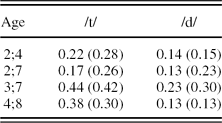
Note: Ages are in years;months. Responses are broken down by age.
Discussion
In Experiment 2, children were tested on their knowledge of voicing neutralization in relation to alternations, using a Reverse Wug Test. Results indicated a significant effect of voicing. Children were more accurate at producing singulars from plural nonwords with /t/ than /d/. At the same time, children obeyed Dutch phonotactics, in that they never produced voiced word-final /d/, which is phonotactically illegal in Dutch. This suggests that the difficulty lies in the linking of phonotactics and alternating forms, rather than the process of voicing neutralization itself. In addition, it must be noted that children had difficulties stripping the affix from the plural form to produce a singular form, which may partly be due to the nonword status of the stimuli.
In the present study, there is a confound between the plural morpheme (-en and -s) and word status (words versus nonwords). All plurals with the -s morpheme were words and all nonwords were given with the -en morpheme. It is not possible to determine on the basis of the present data whether children had difficulty with the -en morpheme, with nonword status, or a combination of both factors. However, in a study with 5-year-olds, Kerkhoff (Reference Kerkhoff2007) directly compared words and nonwords. As in the current study, children had more difficulties producing correct singulars for alternating than nonalternating novel plurals. However, this effect was not observed for real words, as singulars were readily produced for both alternating and nonalternating plurals in -en. Hence, although children have no difficulty relating existing alternating forms, the morphophonological pattern is not easily abstracted. Similar findings are reported for German (van de Vijver & Baer-Henney, Reference van der Vijver and Baer-Henney2010), a language that also has a voicing alternation between singular and plural, as in [tak]~[taɡə] “day~days.” In one component of their study, van de Vijver and Baer-Henney (Reference van der Vijver and Baer-Henney2010) used a Reverse-Wug Task and tested 5-year-old children on alternating and nonalternating words and nonwords. When children were tested on words, they were able to go from plural to singulars. However, when they were tested on nonwords, they found it difficult to go from plural to singulars. As in the present study, German children often gave the plural response back for the singular, suggesting that children have difficulty with nonwords.
GENERAL DISCUSSION
To examine the development of phonotactics and morphophonology, we identified two issues to consider. Although the first deals specifically with the acquisition of Dutch, the second addresses the larger issues of learnability and the types of linguistics generalizations learners can make. First, it is important to know when children acquire the Dutch medial voicing contrast. In Experiment 1, as predicted, we found that both 2.5- and 3.5-year-old children can accurately produce medial /t/ in an imitation task. However, there is an age difference in children's acquisition of medial /d/: 2.5-year-olds have difficulty producing medial /d/, and only by 3.5 is this segment customarily produced by children. We can conclude that by 3.5, Dutch children can correctly produce a medial voicing contrast. This is important because voicing is a central part of morphophonological patterning in Dutch.
The second issue was to establish whether children have productive knowledge of voicing neutralization (phonotactics) in relation to voicing alternations. Experiment 2 tested whether children can apply their knowledge of voicing phonotactics (the knowledge that voiced obstruents cannot occur in word-final position) to produce surface alternations between singulars and plurals. Children never produced singulars with final voiced obstruents, that is, the phonotactic pattern was never violated. However, children were better at producing singulars from plurals when the identity of the medial segment was the same across medial and final position. If the phonotactic voicing pattern had been successfully related to morphophonological alternations, we would not expect children to have more difficulties with novel plurals with medial /d/ than with medial /t/. Thus, the results of Experiment 2 support usage-based models because these predict that the productivity of the pattern would depend on its frequency in a language. Dutch learners predominantly hear nonalternating forms in the ambient language (Kerkhoff, Reference Kerkhoff2007), which is in line with the finding that the Dutch voicing alternation is limited in its productivity. In a study with 5-year-olds, Kerkhoff (Reference Kerkhoff2007) found that these older children also have more difficulties producing correct singulars for alternating than nonalternating novel plurals (35% for nonwords like kedden vs. 56% for nonwords like ketten). However, this effect was not observed for real words, as singulars were readily produced for both alternating and nonalternating plurals (99% for words like bedden “beds” vs. 98% for petten “caps”). This suggests that although children have no difficulty relating existing alternating forms, the morphophonological pattern is not easily abstracted.
A similar result has been found in comprehension (Zamuner, Kerkhoff, & Fikkert, Reference Zamuner, Kerkhoff, Fikkert, Bamman, Magnitskaia and Zaller2006). Children aged 2.5 and 3.5 were significantly better at identifying singular–plural nonword pairs that had no surface alternation, for example, the identification of [slɑt~slɑtən] was better than [slɑt~slɑdən]. Children appear to have difficulties in relating forms in which the final consonant of the singular and the medial consonant in the plural are nonidentical. A partial explanation for this is that a principle such as Paradigm Uniformity (a preference for morphological members of a paradigm to have the same shape; e.g., Hayes, Reference Hayes, Kager, Pater and Zonneveld2004) guides children (Downing, Hall, & Raffelsiefen, Reference Downing, Hall and Raffelsiefen2005; Steriade, Reference Steriade, Broe and Pierrehumbert2000). However, this principle apparently does not lead Dutch children to voice the singular in case of a nonword plural with /d/, showing that the phonotactic rule of final devoicing is not violated in favor of Paradigm Uniformity. Words that exhibit a surface alternation seem to be more difficult to acquire. This may be due to the nontransparent relation between members of the paradigm (see also Ernestus & Baayen, Reference Ernestus and Baayen2007, for a discussion on paradigmatic effects in auditory word recognition of Dutch voicing alternations). In other words, their difficulty may reflect the fact that knowledge of alternating patterns necessarily arises as a result of a generalization over pairs of related words (see also Pierrehumbert, Reference Pierrehumbert, Goldstein, Whalen and Best2006). Thus, it is possible that alternating plurals need to be very frequent (both in absolute terms and in relation to their singular) in order to be learned, and that the general productive pattern will only be acquired when enough types have been encountered (see also Kerkhoff, Reference Kerkhoff2007).
Future research should establish the developmental patterns in Dutch children's acquisition of alternations. Initial work on this is found in Kerkhoff (Reference Kerkhoff2007), who presents a detailed analysis of children's productions of alternating noun plurals, based on data from the CLPF database from CHILDES (Fikkert, Reference Fikkert1994; Levelt, Reference Levelt1994). Results indicated that children attempted few alternating words, and there was variability in how voicing was realized both within words and across words. In an experimental study, Kerkhoff (Reference Kerkhoff2007) elicited the most frequent alternating plurals. She found that 3- to 4-year-olds produced errors such as *[bɛtən] for /bɛdən/ “beds” in around 40% of cases. Even the youngest children produced at least one alternating pair, but performance varied greatly, showing effects of lexical frequency. To fully understand how children acquire knowledge of voicing phonotactics and alternations, we also need to know how children produce monomorphemic forms with intervocalic voicing such as those in (1b), which have no surface variation. If the presence of surface alternations impacts acquisition, children's performance on voicing should vary in these morphological contexts. That is, the production of /d/ should depend on morphological context whereas the production of /t/ will be constant.
The acquisition of phonotactic and morphophonological alternations has been shown to differ across languages. For example, alternations in European Portuguese and Northern Saami, which on the surface appear more complex than the Dutch example, seem to be acquired early. According to Fikkert and Freitas (Reference Fikkert and Freitas2006), who present an analysis of spontaneous speech data from European Portuguese speaking children between 0;10 and 3;7, children show very early command of alternations. Similarly Bals (Reference Bals2004) argues that phonological and morphological relationships in North Saami are acquired as early as 2;5. Note that the European Portuguese and North Saami data are based on studies of spontaneous speech, whereas the current data are from controlled experiments with word and nonword stimuli. Nevertheless, the question arises what might account for cross-linguistic differences in rates of acquisition. First, differences in the type and token frequency of alternating or nonalternating words in languages are predicted to bear on the learnability of these patterns. Second, differences may also stem from the number of different alternation patterns found in a language, as variability has been linked to learnability in other domains. For instance, high variability has been shown to help learners acquire nonadjacent dependencies in studies of artificial language learning (Gómez & Maye, Reference Gómez and Maye2005). Variability seems to guide learners in acquisition, as Dutch children acquire complex clusters much earlier than European Portuguese children (Fikkert & Freitas, Reference Fikkert, Freitas, Cornips and Doetjes2004). Syllable onsets in Dutch allow for a more complex syllable structure than in European Portuguese, and hence, Dutch learners encounter more variability than European Portuguese children. Other work with prelinguistic learners has begun to examine the types of novel phonological alternations learners can acquire based on distributional information (White, Peperkamp, Kirk, & Morgan, Reference White, Peperkamp, Kirk and Morgan2008). Prelexical acquisition of morphophonological alternations may be constrained by the types of dependencies learners can acquire. These learning constraints are not limited to the acquisition of morphophonology, but are also relevant to the acquisition of other grammatical structures, such as those found in syntax (e.g., Christophe, Millotte, Bernal, & Lidz, Reference Christophe, Millotte, Bernal and Lidz2008).
Future research should also continue to examine the relationship between phonotactics and the acquisition of morphophonological alternations in other languages (see van de Vijver & Baer-Henney, Reference van der Vijver and Baer-Henney2010, in press, for a comparison of different types of morphophonological alternations in the acquisition of German). It should also focus on the role of orthography and formal teaching, as children's lexical representations (as well as their knowledge of phonotactics and alternations) may change as they learn to read and write. For example, when children learn to spell, the phonotactic and alternating patterns can be seen more explicitly; the final sound of hond “dog” is spelled with a “d” but produced as a [t]. In a study by Gillis and Ravid (Reference Gillis and Ravid2006), Dutch-learning children between 6;0 and 12;0 were tested on how they spelt pairs of nouns presented in the singular. Both words ended with a surface [t] in speech but are orthographically represented with a “t” or “d,” agent “officer” and arend “eagle,” respectively. Although children could infer the voicing by putting the forms into the plural, agenten and arenden, they were more likely to spell the final consonants based on how the words were produced, rather than based on the plural. This study also compared how Hebrew-learning children spell similar morphophonological patterns in Hebrew, and found that these children rely more on morphology. Gillis and Ravid (Reference Gillis and Ravid2006) argue that this reflects the phonology and morphology of the respective languages. These types of cross-linguistic investigations of the acquisition of phonotactics and alternations are important, to determine to what extent language-specific influences play a role. For instance, one could look at languages such as Catalan, in which the voicing alternation is not reflected in the spelling (Charles-Luce, Reference Charles-Luce1993, cf. Manaster Ramer, Reference Manaster1996), languages such as Northern Saami, in which alternations are more widespread (Bals, Reference Bals2004) or in languages such as Lac Simon, where voicing alternations occur in word-initial position rather than word-final position (Iverson, Reference Iverson1982). Voicing alternations in Lac Simon are potentially easier to learn because they occur in word-initial position, which is more salient than word-final position (Swingley, Reference Swingley2005; Zamuner, Reference Zamuner2006).
CONCLUSION
Voicing phonotactics and morphophonological alternations have played a primary role in phonological theories, yet little work has examined these patterns in development. The research presented here helps us begin to understand the nature of these processes, and the types of language generalizations learners are able to make. Results from Experiment 1 showed that children performed differently on the production of voiced medial obstruents, regardless of morphological context. Results from Experiment 2 showed that children are reluctant to extend phonotactic knowledge to novel forms when they have to relate novel plurals to singulars. In conclusion, we found little evidence that the early acquisition of phonotactics is generalized to the acquisition of morphophonological alternations. In other words, learners are not applying appropriate linguistic generalizations in the proper context. This suggests that children's knowledge is more concrete than has been assumed in traditional generative models, in line with recent usage-based theories of acquisition (e.g., Tomasello, Reference Tomasello2003).
ACKNOWLEDGMENTS
This research was supported by NWO Grants 275-75-001 (to T.Z.), 016-024-009 (to P.F.), and 360-70-100 (to P.F. and R.K.). This research was conducted at the KindertaalLab at the Radboud University Nijmegen. We thankfully acknowledge the assistance and support from Marleen van der Avoird, Elise de Bree, Esther Janse, Erik Jan van der Torre, and Ellen Westrek. We also appreciate the helpful comments and suggestions from two anonymous reviewers.