From the first systematic studies of the grammars of children with specific language impairment (SLI), it has been clear that many of these children have significant grammatical difficulties. One detail of syntax that seems especially difficult for these children is the passive sentence. Studies of English-speaking children with SLI have revealed weaknesses in both the production and comprehension of passives (e.g., Bishop, 1979; van der Lely, 1996). There are at least three factors that can make English passives especially difficult for children with SLI. The most obvious is the noncanonical word order involved in passives. Whereas most sentences involving transitive verbs are subject–verb–object (e.g., The dog chased the cat), in passives, the argument representing the patient is the grammatical subject, and the argument representing the agent can be expressed in a prepositional phrase (PP), referred to here as the by-phrase (e.g., The cat was/got chased by the dog).
A second potential obstacle for children with SLI is the verb morphology required for the English passive. In the active sentence The dog chased the cat, the main verb (chased) carries the tense feature, whereas in the passive equivalent, the auxiliary was or the verb got carries tense (compare The cat got chased and The cat gets chased) and the main verb (chased) is a passive participle.
A third potential obstacle is the means by which the noncanonical word order of English passives might occur, according to current linguistic theory. Consider Example 1, often referred to as a verbal be passive. It is assumed that the noun phrase (NP; the cat) originates as the complement of the verb chased and undergoes movement to the specifier (Spec) position of the tense phrase (TP). This process is referred to as argument- or A-movement. The relationship between the cat and its original position, designated as t (for trace), is shown through co-indexing (i). In the most recent linguistic formulations within the minimalist approach, it is assumed that features rather than constituents undergo movement (Manzini & Roussou, 2000). The agent role is expressed through an adjunct PP, the by phrase. However, in English, the by phrase is not obligatory. It is assumed that the agent thematic role ordinarily assigned to the dog is assigned to the passive morpheme (-ed in this instance; Guasti, 2002). When a by-phrase is used (by the dog), the agent role is transmitted from the passive morpheme to the NP in the by-phrase (the dog). The tense of the verb is located in tense (T) as a result of movement of the auxiliary was (or movement of features in more recent accounts) from the verb (V) position. The passive participle chased remains in the V position.

Another type of passive is the adjectival passive. In an adjectival passive, such as (I noticed that) the door was closed, the form closed is actually an adjective rather than a passive participle. The copula verb (was) moves from V to T, and the subject (the door) moves from the Spec position of VP to the Spec position of TP. This structure is shown in Example 2.

The verbal passive shown in Example 1 involves an auxiliary be form (was). A related passive construction involves a form of get rather than be, and it is given the descriptive name of “get-passive.” An example is The cat got chased by the dog. Passives of this type seem to be acquired by typically developing (TD) children at a young age. Crain, Thornton, and Murasagi (1987; see also Crain & Thornton, 1998) found that they could readily elicit get passive questions such as Which bug got stepped on by the elephant? from 3- and 4-year-olds. One possible reason for the early acquisition of these passives is that they are not identical to verbal be passives. For example, a verb such as expect cannot be employed in a get-passive (compare Clemens was expected to pitch and *Clemens got expected to pitch).
Expanding on arguments first discussed by Haegeman (1985), Fox and Grodzinsky (1998) proposed that get-passives have the structure shown in Example 3.

As can be seen in Example 3, the trace (ti) suggests that the subject (the cat) originated in a position (Spec of adjective phrase) to the right of the original position of got (V). This differs from the position for adjectival passives, where the original position of the subject (Spec of VP) precedes that of the copula (V). It can also be seen that the structure of get-passives differs from that of verbal be passives. However, Fox and Grodzinsky (1998) make the case that get-passives nevertheless involve A-movement. First, they show that get can separate idiom chunks (e.g., Tabs always get kept on foreigners in the USA), suggesting that the subject of the matrix sentence receives its theta role within the embedded clause, a sign that NP-movement has taken place. Second, sentences such as There (finally) got to be a lot of room in this house indicate that the surface subject of get can be an expletive (there), and therefore, cannot be a theta position. Any argument that occupies this position, then, must receive its theta role in the subject position of the embedded clause. According to Fox and Grodzinsky (1998, p. 315), “These sentences thus provide conclusive evidence for Haegeman's claims that get is an unaccusative (raising) verb and that a get-passive involves NP-movement in its derivation and an A-chain in its representation.” They further argue that get-passives “include the same kind of A-chain that exists in a regular passive construction” (p. 316).
Although there are parallels between get-passives and verbal be-passives, there are important differences related to the by-phrase. As noted earlier, in a verbal be passive, the agent thematic role is transmitted from the passive morpheme (-ed) to the NP in the by-phrase. Fox and Grodzinsky (1998) propose that in get-passives, the agent thematic role of the NP is assigned directly by the preposition by. These authors contend that this type of assignment is less problematic for children and represent the major reason why get-passives are used at an earlier age than verbal be passives.
In the present investigation, we employ get-passives in our study on English. These passives involve movement and, because they are commonly used with action verbs, they are less likely to be confused with adjectival passives if they are produced without a by-phrase. Furthermore, as noted above, young children sometimes have difficulty with the by-phrase in verbal be passives but not in get-passives (Fox & Grodzinsky, 1998). Productions of full get-passives, that is, passives with got, the passive participle, and the by-phrase can be elicited from TD children by 3 years of age (Crain et al., 1987; Crain & Thornton, 1998).
There are three different accounts of the grammatical deficits of children with SLI that offer possible reasons for these children's difficulties with English get-passives. These correspond to the three types of obstacles noted at the outset of the paper. First, regardless of the linguistic operations involved in get-passives, their noncanonical word order could constitute a problem. Leonard and his colleagues (see Leonard, 1998, pp. 255–257 for a review) have noted that the sparse grammatical morphology of English may compel children with SLI to become too dependent on the dominant subject–verb–object word order of the language. Because they devote too few resources to grammatical morphology, these children are less likely to register the morphological cues that signal a departure from the more typical word order. Hereafter we refer to this as the “sparse morphology” hypothesis. According to this hypothesis, English-speaking children with SLI will have difficulties because their limited attention to grammatical morphology will make them ill prepared for constructions that differ from the structure of active sentences.
A second potential obstacle is the verb morphology of passives. According to the surface account of Leonard and colleagues (e.g., Leonard, Eyer, Bedore, & Grela, 1997), children with SLI have a speed of processing limitation that is especially evident when grammatical morphemes are brief in duration. Morphemes of this type are consonantal inflections and weak syllables that rarely appear in sentence positions where they can be lengthened. It is assumed that children with SLI are capable of perceiving these challenging phonetic forms. However, when these forms play a morphemic role they require additional operations. Children must not only perceive them but also retain them long enough to hypothesize their specific grammatical functions, and place these morphemes in appropriate paradigms. Because of the children's limited processing speed, these operations are not always completed before the children's focus must turn to other details in the incoming utterance. As a result, the morphemes are sometimes processed incompletely, and therefore the children must have a greater than usual number of encounters with the morpheme before it is adequately learned.
Of the key elements involved in English passives, the most vulnerable according to the surface account is the passive participle inflection -ed. This inflection is usually consonantal ([t] or [d]), and remains brief in duration in all sentence positions. A second morpheme that might be vulnerable according to the surface account is the preposition by. This morpheme is a weak syllable that is rarely lengthened.
Leonard et al. (2003) recently examined the use of the passive participle -ed inflection by children with SLI, and a younger group of TD children matched according to mean length of utterance (MLU). A sentence completion task was employed, in which the examiner provided the child with the first NP of the sentence (e.g., the cat) and the child was required to produce the remainder of the sentence (got chased by the dog). The task did not constitute a full passive task, as the child was not required to produce the sentence-initial NP. The children with SLI were found to produce the participle -ed significantly less frequently than the MLU-matched comparison group. Productions such as got chase by the dog were more likely to be produced by the children with SLI. This finding of passive participle inflection difficulty is in need of replication, because Redmond (2003) found no difference between SLI- and MLU-matched groups in the use of participle -ed inflections.
The surface account does not deal directly with word order. In the case of a verbal be passive such as The cat's chased by the dog, the brief duration of the contracted auxiliary is and preposition by could lead to some confusion, as the sentence might be processed as The cat chase the dog (see Leonard, 1989). However, this seems less likely with the use of get-passives, the type of passive employed in the present investigation. Instead, the surface account predicts that errors will be limited to a failure to include the passive participle -ed and the preposition by.
Finally, children with SLI may have difficulty with get-passives because of the linguistic operations required in these sentences. According to van der Lely's (1994, 1996, 1998) representational deficit for dependent relations (RDDR) account, children with SLI have a deficit in the computational syntactic system that allows movement operations to be optional. It is assumed that the children possess the knowledge of movement; therefore, when movement occurs it is appropriate. However, often movement is not executed. It is important to stress that the optional movement assumed in the RDDR account is not limited to A-movement. Problems are assumed not only with A-movement, but (V to T) movement associated with tense and agreement, T to C movement, as well as A-bar (e.g., wh-) movement (e.g., van der Lely, 1998, p. 178). Accordingly, problems can include the production of bare verb stems in finite contexts, the absence of copula and auxiliary forms, lack of do-support, and misinterpretation of wh-object questions, among others. In the context of get-passives, this optional movement could have one or more of the following outcomes. First, children could show no movement of the tense feature of the verb to T. In the case of get-passives such as those used in the present investigation, this could lead to instances in which the children produce get as a nontense (that is, nonfinite) form in place of the tense-marked got. Second, movement to the surface subject position might not occur. This could result in the children relying primarily on active sentences, or in producing attempts at passives where movement does not occur (e.g., Got the cat chased by the dog in place of The cat got chased by the dog).
In a task involving the comprehension of verbal be passives, van der Lely (1996) found evidence that was consistent with her hypothesis. Reversal errors, such as choosing a picture of a man eating fish in response to the sentence The man is eaten by the fish were significantly more frequent by a group of children with SLI than by younger TD children matched according to their performance on a battery of six language tests. van der Lely also noted that the children with SLI often seemed to interpret the passive sentences as if they were adjectival passives. In the present investigation, we take steps to reduce the likelihood of a strategy of this type by using get-passives, in which the agent thematic role is assigned directly by the preposition by, rendering the sentence more likely to include the agent role and less compatible with an adjectival passive interpretation.
THE CONTRIBUTION OF CANTONESE
It can be seen that English get-passives provide the basis for alternative hypotheses concerning the source of children's difficulty with these constructions. Further study of English passives will no doubt clarify the nature of this difficulty. However, significant insight into this difficulty can also be gained through the study of passive sentence production by children with SLI who are acquiring Cantonese.
Cantonese is a strongly isolating tone language. Six contrastive tones are employed, and these are applied to both lexical forms and grammatical morphemes. The latter are usually single syllables that have the same syllable structure as is found in lexical items. Grammatical morphemes do not undergo phonetic reduction or neutralization, and their duration (usually ranging from 100 to 400 ms) greatly exceeds that of monosyllabic grammatical morphemes in English. There are no grammatical inflections in the language. There is no grammatical agreement or tense, although aspect markers (monosyllabic morphemes that are placed after the verb in the sentence) can be used to express perfective or continuous aspect. To express past time, temporal adverbs are employed. The canonical word order of Cantonese is subject–verb–object, although this order can be altered through topicalization. The subject or the object can be omitted when the context makes the referent clear.
As in English, passive sentences differ from active sentences in word order. Furthermore, the agent of the action in the passive is marked by a form that corresponds to by in English. However, because Cantonese does not employ tense (or agreement), the same verb form is used for both active and passive sentences. Examples of active and passive sentences are provided in Example 4. (Morphemes are presented in romanized form and tones are indicated by numerals, following the system adopted by the Linguistic Society of Hong Kong, 1994.)
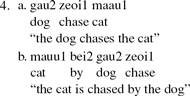
The passive in Cantonese is most likely to be used when the subject (the patient) is affected by the action, often in an adverse manner. According to Matthews and Yip (1994), passives are used less often in Cantonese than in English. They are used only infrequently by adults when speaking to their preschool-aged children (McBride, Tardif, Fletcher, Shu, & Wong, 2004). Based on input frequency, then, Cantonese passives should hold no advantage over passives in English.
In keeping with the sparse morphology hypothesis (Leonard, 1998), the noncanonical word order of passives coupled with the extremely sparse grammatical morphology of Cantonese could lead children with SLI to impose a more typical subject–verb–object order on these utterances. In contrast, given the assumptions of the surface account (Leonard et al., 1997), Cantonese-speaking children with SLI should experience no special difficulties with passives. There are no verb inflections that are needed to distinguish passive sentences from active sentences. In addition, the morpheme bei2 (by) receives a contrasting tone, and its phonological details are not subject to reduction or neutralization. (Unlike English, the grammatical morphemes of Cantonese are usually in the range of 100–400 ms in duration.)
The structure of the Cantonese passive as proposed by Li (1990) is shown in Example 5.

As in English verbal be-passives, the NP (cat) serving as the complement of the verb moves to the Spec position of TP, leaving a co-indexed t. The agent role is expressed through a PP (bei2 dog) that appears within VP. However, unlike English, the PP appears before, rather than after the verb. An important difference between English and Cantonese is that the latter does not have an overt form in T representing tense (or agreement).
The structure for Cantonese passives has implications for the RDDR account. According to this account, Cantonese-speaking children with SLI should be inconsistent in placing the NP complement (cat in our example) in the Spec position of TP. This should result in ill-constructed passives (e.g., productions such as By dog chase cat or even Cat by dog chase cat in place of Cat by dog chase) or an overreliance on active sentences. Other types of problems are not expected. For example, the agent thematic role of the NP is assigned directly by bei2, as in get-passives in English. Because the verb bears no inflection for tense (or agreement), no movement of features is assumed.
In summary, according to the sparse morphology hypothesis, both English get-passives and Cantonese passives could be problematic, as passives in both languages deviate from the dominant subject–verb–object word order and the limited grammatical morphology in each language presumably discourages children with SLI from devoting their limited resources to this area of grammar. This neglect of grammatical morphology will remove important cues that distinguish passive from active sentences in each language. The surface account predicts difficulties with English get-passives, but these will be limited to the participle -ed and the preposition by. Problems with Cantonese passives are not predicted. Finally, in both English get-passives (regardless of the structure assumed) and Cantonese passives, movement is required. Therefore, although the specific types of errors should differ depending on the language, according to the RDDR account, the children with SLI in each language should have greater difficulty than their TD compatriots.
STUDY 1: ENGLISH
Method
Participants
Fifty-four monolingual English-speaking children participated in Study 1. Eighteen of the children met the criteria for SLI and had been enrolled or were on the waiting list to be enrolled in a language intervention program. These children (11 boys, 7 girls) ranged in age from 4 years, 0 months (4;0) to 6;6 (M=5;1, SD=9 months). All children in the SLI group scored more than 1.5 SD below the mean for their age on both the Structured Photographic Expressive Language Test—II (SPELT-II; Werner & Kresheck, 1983a) and the finite verb morphology composite (Leonard, Miller, & Gerber, 1999). The finite verb morphology composite is a composite measure of the children's production of third person singular -s, regular past -ed, and copula and auxiliary be forms in spontaneous speech. The children's scores on the Columbia Mental Maturity Scale (CMMS; Burgemeister, Blum, & Lorge, 1972), a test of nonverbal intelligence, averaged 103.06 (SD=10.06). One child scored only 83, but was exhibiting uncharacteristic behavioral problems during the administration of the test. On the Leiter International Performance Scale—Revised (LIPS-R; Roid & Miller, 1997), he earned a score of 98. The other 17 children's scores on the CMMS ranged from 90 to 122. Each child passed an oral motor screening, a hearing screening, and showed the ability to produce word-final [t] and [d] in monomorphemic contexts. No child had a history of seizures or showed any signs of neurological dysfunction. All of the children produced utterances of sufficient length to permit the use of full passives with by-phrases. The children's MLUs in words averaged 4.13 (SD=0.44), with all children producing a few utterances at least seven words in length.
Thirty-six children were developing language and reaching other milestones at a typical age. Eighteen of the children (12 boys, 6 girls) were similar in age to the children in the SLI group. Each of these children was within 2 months of age of one of the children with SLI. These children ranged in age from 4;1 to 6;8 (M=5;1, SD=9 months). All of the children were within 1 SD of the mean for their age on the above tests, and passed the same screening measures used with the SLI group. It is not surprising that these children's MLUs in words were generally higher than those of the children with SLI (M=5.32, SD=0.75).
The remaining 18 children (9 boys, 9 girls) were considerably younger, ranging in age from 2;8 to 4;1 (M=3;4, SD=5 months). The children closely resembled the children with SLI in MLU. Each child selected for this group was within 0.3 words of the MLU of a child in the SLI group (M=4.13, SD=0.41). All children passed the screening measures used with the children with SLI. Given the children's younger ages, language test scores within 1 SD of the children's age were obtained using the SPELT—Preschool (Werner & Kresheck, 1983b) for children age 3;0 and above, or on the US standardization of the Reynell Developmental Language Scales (RDLS; Reynell & Gruber, 1990) for those under age 3;0. The children's nonverbal intelligence was determined to be within age-appropriate levels based upon the LIPS-R (Roid & Miller, 1997).
Procedure
All children were seen in a quiet room in a speech–language clinic. Our procedure was adapted from an earlier sentence completion task used by Leonard et al. (2003), which in turn, was an adaptation of a past tense task developed by Schütze and Wexler (2000). There were 24 items designed to elicit passive sentences from the children. For 16 of the items, the target verb required the passive participle inflection -ed (e.g., kissed, hugged). These verbs were kiss, dry, lick, color, step on, cover, drop, wash, hug, open, push, pick up, tickle, kick, brush, and chase. For the remaining eight items, the target verb required the passive participle inflection -(e)n (e.g., shaken, thrown). These verbs were shake, ride, tear, hide, break, eat, choose, and throw. One-half of the items permitted reversible passives, where the patient could logically serve as the agent and vice versa (e.g., The cow got chased by the kitty) and one-half were nonreversible (e.g., The corn got licked by the puppy).
The child and two adults participated in the task. One adult manipulated toy characters and props and provided the narration. The second adult manipulated a puppet and served as the puppet's voice. The child was introduced to Freddy, a frog (puppet), who has difficulty paying attention. The child was told that the first adult (E1) and her toy friends (the characters) would play with some other toys and objects and Freddy should pay attention. If Freddy fails to pay attention, the child was to help Freddy by describing what had happened. For each item, two characters were used and the child was asked “choice” questions, as a means of keeping the child engaged in the task. The child's choices dictated the particular toys or props that the characters acted on. Following the enactment of the actions, Freddy admitted to not paying attention and asked what had happened. E1 then described the first action using a passive with a by-phrase and the child was to describe the second action. An example is shown in Example 6.
6. E1: The bird wants to throw something.
Bird: Should I throw the airplane or the baseball?
Child: the baseball
(Bird then throws the baseball)
The bear wants to hug someone.
Bear: Should I hug Ernie or Snow White?
Child: Snow White
(Bear then hugs Snow White)
Freddy: I wasn't paying attention. What just happened?
E1: Let's tell Freddy what happened to the ball and what happened to Snow White. The baseball got thrown by the bird and …
As can be seen from the above example, there were two details in E1's script that could have promoted passive sentence use by the children. First, in the prompt “Let's tell Freddy what happened to …,” it was the patient not the agent that E1 specified. Second, E1's description of the first action was in the form of a get-passive sentence with a by-phrase. For one-half of the items whose target verb required the participle inflection -ed, E1's description of the first action contained a verb with participle -ed. For the remaining half of these items, E1's description of the first action contained a verb with participle -(e)n. Likewise, for one-half of the items whose target verb required the participle -(e)n, one-half were preceded by E1's use of a verb with -ed and the other half were preceded by her use of a verb with -(e)n. For example, in Example 6, the target verb required the participle inflection -ed (hugged), and E1's description of the first action contained a verb with the participle -(e)n (thrown).
Scoring
The children's responses to each of the 24 items were first examined to ensure that they were scorable. Responses determined to be scorable were utterances that had sufficient structure to be deemed full or partial passive sentences or full or partial active sentences. The great majority of utterances (1,240 of 1,296 or 95.68%) were scorable using these standards. The remaining (unscorable) responses were productions that described a reciprocal relationship (e.g., Simba and the bear kissing; They played together) or some variation of “I don't know.” Attempts at passives were defined as sentences containing at least a subject noun, got, and a main verb, that is, N + got + V + (-ed/en) + (by) + (N) or a subject noun, a main verb, and a by-phrase with a noun, thus, N + (got) + V + (-ed/en) + by + N. Example 7 provides examples of all productions regarded as passive attempts that were witnessed in the data. The examples are based on the target sentence The cow got chased by the kitty.
7. a. The cow got chased by the kitty
b. The cow chased by the kitty
c. The cow got chase by the kitty
d. The cow got chased the kitty
e. The cow got chased
f. The cow got chase
g. The cow got chased by the cow
h. The kitty got chased by the cow
i. The kitty got chase by the cow
j. The kitty got chased
It can be seen that Examples 7a–f reflect the appropriate thematic role of patient in subject position; of these, the first four also show an (appropriate) agent in final position. Examples 7g–j reflect problems in the thematic roles. Given our definition of a passive attempt, two other types of utterances would have been regarded as passive attempts, as exemplified in The cow chase by the kitty and The kitty chase by the cow. However, these were not seen in the data. For those utterances meeting the definition of a passive attempt, we recorded whether the utterance included the patient as the subject noun, the verb got, the participle inflection -ed or -(e)n, the preposition by, and the agent in final position.
Attempts at active sentences were defined as productions containing at least a subject noun and a main verb, without got and without a by-phrase, thus N + V + (-ed) + (N). The examples found in the data are shown in Example 8.
8. a. The kitty chased the cow
b. The kitty chase the cow
Given our definition of an active sentence attempt, an utterance such as The kitty chase would have been included. However, active sentences lacking the direct object noun were not seen. Our definition also allowed the more ambiguous sentences The cow chased the kitty and The cow chase the kitty. Such sentences with an active sentence construction but a reversal of thematic roles were absent from the data. (As noted above, some thematic role reversals were present among the passive sentence attempts.)
For one of the measures of interest, the percentage of scorable responses that represented active sentences, we computed the percentage by dividing the number of active sentence attempts for each child by the total number of scorable responses for that child (and then multiplying by 100). For other measures, such as the percentage of full and grammatical passive sentences, the denominator was the total number of attempts at passives. For questions pertaining to specific components of the passive, such as the percentage of use of the participle -ed and the percentage of use of the preposition by, the denominator consisted of the number of passive attempts whose contexts provided obligatory contexts for these components (passive sentences with verbs that require -ed, passive sentences with a postverbal noun, respectively).
Comparisons were performed through an analysis of variance (ANOVA) with participant group (SLI, TD-MLU, TD-A) serving as a between-subjects variable. For each ANOVA, arc sine transformations were performed on the percentage data. Significant main effects for participant group were followed by post hoc least significant difference (LSD) tests at the .05 level, and determination of the effect size d, where a value of 0.80 or greater is assumed to reflect a large effect size, and a value ranging from 0.50 to 0.79 is assumed to represent a medium effect size (Cohen, 1988).
Results
The first analysis dealt with the question of whether the three groups differed in their tendency to avoid passive constructions, producing instead an active sentence. Accordingly, we compared the groups on the percentage of scorable responses that constituted active sentences. A significant difference among the groups was not seen, F(2, 51)=2.66, p=.080. The percentages of active sentence responses by the children with SLI were numerically lower than the percentages for the TD-MLU children, suggesting that the SLI group was not prone to produce active sentences in place of passive sentences. The means for the SLI, TD-MLU, and TD-A groups were 24.72 (SD=18.85), 34.44 (SD=29.28), and 19.17 (SD=12.94), respectively.
The children's active sentence productions were examined to determine whether the semantic reversibility (reversible, nonreversible) of the sentence had any bearing on the children's responses. There was no evidence of this. For the children with SLI, 53 of the 105 active sentences produced (50.48%) were reversible. For the TD-MLU children, of the 64 of the 137 active sentences (46.72%) were reversible. The number of active sentences produced by the TD-A children that were reversible was 40 out of 82 (48.78%). It can be recalled that 50% of the items were reversible; thus, it is clear that the children's tendency to produce an active was not related to reversibility. The same proved true at the level of the individual child. For every child who produced more than two active sentences, the child produced both reversible and nonreversible items with an active sentence construction.
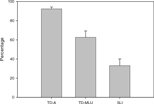
The next comparison was concerned with the children's use of full and grammatical get-passive constructions. These were defined as passives that contained the patient as the subject noun, included both got and the participle inflection, and included the preposition by followed by the noun representing the agent. We restricted this analysis to the 16 items whose verbs required the participle inflection -ed. (As will be seen shortly, children in all three groups produced many nonadultlike participle forms for verbs requiring -(e)n inflections.) A significant difference among groups was observed, F(2, 51)=34.29, p<.001. Post hoc LSD testing at the .05 level indicated that TD-A children (M=92.33, SD=8.00) produced a significantly higher percentage of full and grammatical passives than did the TD-MLU children (M=62.67, SD=27.52, d=1.74). The TD-MLU children, in turn, produced a significantly higher percentage of such passives than did the children with SLI (M=33.06, SD=28.86, d=1.06). These results are illustrated in Figure 1.

The percentage of passive sentence attempts that were full and grammatical by the English-speaking children in Experiment 1.
The above group differences could not be attributed to differences in the children's tendency to omit got. Errors of this type (e.g., Snow White hugged by the bear) were not numerous. Three children with SLI produced 12 such errors, although 9 of these errors were committed by a single child. Five TD-MLU children produced 7 of these errors. Only a single error of this type was found in the TD-A data. These observations suggest that the inclusion of got might have been a major source of difficulty for one of the children in the SLI group, but this detail of the passive construction did not appear difficult for these children as a whole. We also inspected the data for instances in which get was produced in place of got. Three children with SLI produced a single error of this type, as did one TD-MLU child. No error of this type was produced by a TD-A child.
We also examined the data to determine whether the three groups differed in their tendency to produce the -ed participle inflection when a verb requiring this inflection was used. A significant difference among the groups was seen, F(2, 51)=6.81, p=.002. Post hoc testing indicated that both the TD-A children (M=95.11, SD=7.19, d=1.47) and the TD-MLU children (M=86.22, SD=19.60, d=0.66) were significantly more successful in producing the -ed inflection than were the children with SLI (M=71.67, SD=25.01). The two TD groups did not differ. As can be seen from the means, the children with SLI produced utterances such as The girl got push by the kitty in more than 25% of their attempts at passives that required the -ed participle inflection.
Another error type examined was the children's use of a get-passive construction with the agent in subject position. The most salient of these errors were productions such as Steve got dropped by the book. Although most of these errors contained the patient in a by-phrase, we also included in this error type productions such as Steve got dropped. For this analysis, we included all 24 items, thus including items containing verbs with -(e)n participle forms as well those with -ed participle forms. (Accuracy of the participle inflection had no bearing on this analysis.) The TD-A children produced no responses involving a passive construction with the agent in subject position. For this reason, they were excluded from analysis of this error type and the SLI and TD-MLU groups were compared by t test. A significant difference was not seen between these two groups, t(34)=1.93, p=.062. Although not significant, the direction of the difference was opposite to the one expected. The TD-MLU children produced a numerically higher percentage of passive responses involving such errors (M=8.83, SD=14.67) than did the children with SLI (M=1.78, SD=5.12). We inspected the data to determine if the children's tendency to produce a passive construction with agent and patient in the wrong position could be due to whether the passive was reversible (e.g., The bear got kissed by Simba in place of Simba got kissed by the bear) or nonreversible (e.g., The puppy got licked by the corn in place of The corn got licked by the puppy). We found no evidence that reversibility was related to this kind of error. For the children with SLI, 2 of the 5 errors of this type involved nonreversible passives. For the TD-MLU children, 9 of the 16 errors of this type were nonreversible.
Given the structure assumed for get-passives shown in Example 3, we also examined the data for errors such as Got Simba kissed by the bear in place of Simba got kissed by the bear. No such errors were found for any of the children in the three groups.
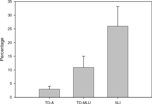
The children were also compared in terms of their tendency to exclude a by-phrase in their attempts at passive constructions. Although pragmatically felicitous in the context created for each item, a by-phrase was not required for the sentence to be well formed; productions such as The cow got chased are not ungrammatical. All 24 items were included in this analysis. The three groups of children clearly differed in their tendency to exclude a by-phrase, F(2, 51)=5.28, p<.001. Post hoc testing revealed that the children with SLI were significantly more likely to exclude a by-phrase (M=26.00, SD=29.63) than both the TD-A children (M=3.00, SD=4.30, d=1.35) and the TD-MLU children (M=10.94, SD=16.92, d=0.72). The TD-A and TD-MLU groups did not differ. Figure 2 illustrates these findings.

The percentage of passive sentence attempts that excluded aby-phrase by the English-speaking children in Experiment 1.
Although get-passives were sometimes produced without a by-phrase, when the agent was properly located in sentence-final position it was nearly always preceded by the preposition by. There was only a single instance in the SLI data and a single instance in the TD-MLU data in which a production such as The cup got washed the kitty was observed.
As noted above, the children in all three groups were not highly successful in producing -(e)n participle forms. When the eight -(e)n items were scored in terms of success in using the adult form of the participle, all groups were accurate with percentages well below 50%. For the children with SLI, the mean percentage of adultlike participle productions for these eight items was only 21.26 (SD=25.66). For the TD-MLU and TD-A groups, the corresponding means were 25.06 (SD=28.51) and 38.76 (SD=26.36), respectively. However, although accuracy by adult standards was rather low for these items, an inflection of some type was used in most of the children's productions. Productions that seemed to constitute overregularization of -ed were especially common (e.g., The rattle got shaked by the horse). When we rescored the children's responses to include both overregularizations and adultlike productions of the participle, the mean percentages were higher for all three groups. Means (SD) for the SLI, TD-MLU, and TD-A groups were 69.58 (25.43), 75.47 (28.57), and 86.88 (28.14), respectively.
Although productions of -ed inflections were quite frequent with verbs requiring -(e)n, there were also instances in which one or more of the 16 items requiring -ed was actually produced by the child with -en. Examples include The girl got pushen by the kitty and The cup got washen by the kitty. Six children with SLI produced a total of 19 responses of this type. Such productions were less frequent in the TD-MLU and TD-A data; three children in each of these groups produced a single form of this type. Because half of the passive items involved the examiner describing the first action with an -(e)n participle form, we examined the data to determine if productions such as pushen might be attributable to a priming effect. If so, the children's use of these forms would be more likely to occur when the preceding model contained an -(e)n participle than when it contained an -ed participle. However, we found no relationship between a child's nonadultlike use of -(e)n and the participle form used in the examiner's preceding model. For the children with SLI, 9 of these productions followed the examiner's use of -(e)n and 10 of these productions followed the examiner's use of the -ed participle form. For the TD-MLU children, the same finding emerged (one production following -(e)n and two productions following -ed). Only the TD-A children showed a pattern suggesting a possible priming effect; all three productions of the type pushen followed the examiner's use of -(e)n. Of course, this group produced very few participles in this unusual way.
Discussion
The children with SLI showed less use of appropriately constructed get-passives with a by-phrase than both the TD-MLU and TD-A children. The group differences were probably due to two factors. First, the children with SLI were less proficient than the other children in producing the participle -ed. Second, these children were less likely than the other children to include a by-phrase in their passive productions. The first of these affects the grammaticality of the sentence; the second is more a matter of pragmatic felicity, although grammatical factors cannot be ruled out. Other potential factors did not appear to play a role. With the exception of one child, the children with SLI had no particular difficulty with the verb got, and no child in the SLI group had problems with using the preposition by when the agent of the action was included in postverbal position. It is important that there was no evidence suggesting that the children with SLI as a group had difficulty with the order in which the patient and agent appeared in the sentence. When a passive construction was attempted, the agent almost never appeared in sentence-initial position. Furthermore, we found no instances such as Got Simba kissed by the bear where the patient (Simba) failed to move to sentence-initial position. Passive constructions were not always attempted; it was not unusual for the children to produce an active sentence even though the examiner had just produced a passive construction as a model. However, the tendency to produce active sentences was no greater for the children with SLI than for the TD-MLU and TD-A children.
STUDY 2: CANTONESE
Method
Participants
Forty-five monolingual Cantonese-speaking children participated in Study 2. These children had also been participants in studies reported by Wong, Leonard, Fletcher, and Stokes (2004) and Fletcher, Leonard, Stokes, and Wong (2005). Fifteen of the children (12 boys, 3 girls) had been previously diagnosed as displaying deficits in language ability by a child assessment center and met the criteria for SLI. The children ranged in age from 4;2 to 6;8 (M=5;1, SD=8 months). All of these children scored more than 1.20 SD below the mean for their age on the comprehension scale of the Cantonese version of the RDLS (C-RDLS; Reynell & Huntley, 1987). The children's MLUs in words were also determined, as this measure serves to reliably distinguish children with SLI from same-age peers who are developing normally (Klee, Stokes, Wong, Fletcher, & Gavin, 2004). The mean MLU for the children with SLI was 3.75 (SD=0.70). As noted below, these values were significantly below those of the age-matched comparison group. The children's scores on the CMMS, a test of nonverbal intelligence averaged 97.47 (SD=11.38) and ranged from 83 to 114. All of the children passed an oral motor and hearing screening. None had a history of seizures or showed signs of neurological or psychosocial dysfunction. Finally, the children were administered the expressive scale of the C-RDLS. Due to its relative insensitivity in identifying children with language disorders in Cantonese, we did not use scores on this scale as a selection criterion.
The remaining 30 children were developing language in a typical manner and had reached other developmental milestones at the expected ages. Fifteen of these children (11 boys, 4 girls) closely resembled the children with SLI in age. These children's ages ranged from 4;1 to 6;9 (M=5;1, SD=8 months). The age of each child in this group (TD-A children) was within 3 months of a child in the SLI group. The TD-A children scored no less than 0.67 SD below the mean for their ages on the comprehension scale of the C-RDLS and no less than 1.00 SD below the mean for their ages on the CMMS. The MLUs in words of the TD-A children (M=4.49, SD=0.77) were significantly higher than the MLUs of the children in the SLI group, t(28)=2.77, p=.010. Each child in this group passed the oral motor and hearing screening.
The final group of 15 TD children (3 boys, 12 girls) were younger than the children in the SLI and TD-A groups. They ranged in age from 2;11 to 3;6 (M=3;2, SD=2 months). These children were significantly younger than the children in the SLI group, t(28)=11.25, p<.001. However, their MLUs in words (M=3.83, SD=0.63) were very similar to those of the children with SLI, t(28)=0.30, p=.763. Although these children were selected on the basis of their younger age, they will be referred to here as TD-MLU children to be consistent with Study 1. The TD-MLU children scored no less than 0.67 SD below the mean for their age on the comprehension scale of the C-RDLS. These children's raw scores on this scale (M=41.53, SD=5.64) were very similar to the raw scores earned by the children with SLI (M=43.60, SD=6.70), t(28)=0.91, p=.368. The TD-MLU children showed age-appropriate scores on the LIPS (Leiter, 1979) or on the CMMS for the children above age 3;0.
Procedure
The children were seen in a quiet room in a speech-language clinic at the University of Hong Kong or in their local community. The children participated in two tasks designed to assess their use of passive sentences. The two tasks were similar. However, in Task 1, the children described each action in response to a question asked about the patient but without having just heard a passive used by the examiner. Task 2 resembled the task employed for English, in which, for each item, the examiner described one action using a passive construction before having the child describe a second action. Task 1 preceded Task 2 for all children.
Task 1
The first task employed 22 items. One adult (E1) introduced the activity to the child and controlled the materials, whereas a second adult (E2) manipulated a dog puppet and acted as the dog's voice. The child was told that they were to watch some actions performed by characters on video and that sometimes the dog might fall asleep and miss the action. The child was asked to describe the actions for the dog in these instances. To promote use of a passive, E1 asked a question about the patient. (The closest translation of this question is “How's the patient?” but it functions much like “What happened to the patient?”) An example appears in Example 9. The abbreviations in capital letters are grammatical morphemes that have no direct English equivalents; PRT represents particle, ASP aspect marker, SFP sentence-final particle, and CL noun classifier.

The 22 verbs employed in the task were tek3 (kick), ngaau5 (bite), teoi1 (push), zong6 (bump), zeoi1 (chase), zit1 (tickle), duk1 (poke), haak3 (scare), zuk1 (catch), to1 (drag), caai2 (step on), mit1 (pinch), pou5 (lift up), daa2 (hit), naau5 (scold), bong2zyu6 (tie up), tau1 (steal), nau2 (twist), waak6 (scribble on), ci1 (put on), mang1 (pull),and gip6 (clip). Unlike the task used for English, all items involved reversible events (e.g., a girl being acted on by a boy).
Task 2
The second task employed 10 items. As in the task used in English, E1 introduced the child to toy characters who would ask “choice” questions of the child before performing actions on other characters. E2 manipulated a bunny puppet and served as its voice. The child was told that the bunny has poor attention and that the bunny might have to be told what had just happened. When responding to the bunny, E1 described the first action using a passive construction and prompted the child to describe the second action by holding up the character serving as the patient. An example appears in Example 10.

The 10 items involved the following verbs: zit1 (tickle), nau2 (twist), ngaau5 (bite), mo2 (touch), zuk1 (catch), bong2zyu6 (tie up), lo2 (take), laam2 (hold), haak3 (scare), and daa2 (hit). All actions were reversible.
Scoring
For each of the two tasks, we first determined which responses were scorable. As in the study on English, responses were regarded as scorable if they had sufficient structure to be interpreted as full or partial passive sentences or full or partial active sentences. However, unlike English, Cantonese allows the omission of subjects if the context permits and, in the case of active sentences, the omission of objects. The possibility of null subjects and null objects led us to regard the following structures as attempts at passives: (a) (N) + bei2 + N + V; (b) N + (bei2) + N + V; (c) bei2 + N + V + N; (d) (N) + bei2 + N + V + personal pronoun; (e) (N) + bei2 + N + V + indefinite pronoun; and (f) Patient + (bei2) + (Agent) + V. This last structure specifies the thematic role of the Ns because an utterance of the form Agent + V does not provide sufficient information to distinguish between an inaccurate attempt at a passive, of the form *(Patient + bei) + Agent + V, or an attempt at an active, of the form Agent + V + (Patient). In Example 11 we provide examples of all productions regarded as passive attempts found in the data. Examples are presented in English for ease of presentation. The examples are based on the target sentence Penguin by lion pinch (“The penguin is/was pinched by the lion”).
11. a. Penguin by lion pinch
b. By lion pinch
c. Penguin lion pinch
d. Penguin by pinch
e. Penguin pinch
f. Penguin by lion pinch him
g. Penguin by lion pinch someone
h. By penguin pinch
Examples 11a–g show no errors in thematic roles. However, Examples 11f and 11g appear to have the patient marked twice, in sentence-initial and sentence-final position. Example 11f is considered an acceptable passive construction, with redundant specification of the patient. (The personal pronoun used, keoi5, literally translated as “him/her/it,” does not carry gender and is applicable to animal characters.) However, given its potential interpretation as a failure of movement according to the RDDR account, we discuss this production pattern in greater detail below. Example 11g is considered an ill-formed passive, and matches rather closely the error that might be expected if movement did not occur. In contrast to the other examples, Example 11h involves the use of the patient (penguin), rather than the agent (lion) following bei2. This example, too, constitutes an error. Given our definition of a passive attempt, other possible utterances would have been treated as (thematically inaccurate) attempts at passives had they been observed in the data. Examples of such nonoccurring utterances are Lion by penguin pinch, Lion by pinch, and Lion penguin pinch. Another plausible passive attempt is illustrated by the example By lion pinch penguin, in which the patient (penguin) occupies its more typical, active sentence position instead of appearing in sentence-initial position. However, no productions of this type occurred in the data.
Attempts at active sentences were defined as utterances with the structure N + V + N, reflecting either the appropriate thematic roles (Agent + V + Patient, Lion pinch penguin) or inappropriate thematic roles (Patient + V + Agent, Penguin pinch lion). As noted above, although the context allowed for the omission of the patient, the production of Agent + V did not provide us with enough structure to distinguish an attempt at an active from an attempt at a passive.
The Cantonese children produced a larger number of unscorable responses than was found in English, owing primarily to the optionality of constituents. Along with Agent + V utterances noted above, there were instances of productions of the verb only. In addition, there were occasional productions of “I don't know” and off-topic comments. Given the occurrence of unscorable responses, we established five scorable responses as the minimum required before including a child's responses in the statistical analyses. For Task 1, this resulted in the inclusion of data from 12 children with SLI, 13 TD-MLU children, and 15 TD-A children. When the measure of interest was based on the number of passive attempts rather than all scorable responses, we retained five as the minimum number of responses permitted for inclusion. This led to a further reduction in the number of children whose data were statistically analyzed; for these analyses, data from 11 children with SLI, 12 TD-MLU children, and 14 TD-A children were used. For the children retained, analyses were based on a mean of 19.65 (SD=3.83) scorable responses and 18.59 (SD=4.55) attempts at passives. For Task 2, there were 10 items, and we established four scorable responses (and four passive attempts for analyses pertaining only to passives) as the minimum. For the analyses employing the total number of scorable responses, analyses were based on data from 14 children with SLI, 11 TD-MLU children, and 15 TD-A children. For analyses employing only passive attempts, analyses were based on data from 13 children with SLI, 11 TD-MLU children, and 15 TD-A children. For the children retained, analyses were based on a mean of 9.23 (SD=1.49) scorable responses and 8.77 (SD=1.86) passive attempts.
To compare the three groups' tendency to use active sentences, we computed the percentages of scorable responses that were attempts at actives. For other comparisons, involving accurately produced or inaccurately produced passives, we based the percentages on the number of passives attempted. The data for each task were examined separately, with participant group (SLI, TD-MLU, TD-A) serving as a between-subjects variable. Arc sine transformations were performed on the percentage data. Significant main effects were followed by post hoc LSD tests at the .05 level and calculation of effect sizes.
Results
Task 1
The first question addressed was whether the three groups would differ in their tendency to use active rather than passive sentences. Only responses that were unambiguously active were counted for this analysis. Although patients are optional if the context makes the referent clear, we did not include agent + verb responses in this count because we could not be certain that such utterances were not attempts at a passive with the omission of both the patient and bei. It is somewhat surprising that we found a total of four responses with an active sentence structure but inappropriate thematic role order (patient + verb + agent). Two of these productions came from a single TD-A children, and one each from a child from the TD-MLU and SLI groups. We excluded these from analysis, thereby focusing only on thematically appropriate active sentences.
An inspection of the Cantonese data indicated no strong tendency to produce thematically appropriate active sentences even though passive sentences were not modeled by the examiner, F(2, 37)=0.05, p=.953. The mean percentage of scorable responses produced as active sentences was only 7.33 (SD=25.40) for the children with SLI. The corresponding means for the TD-MLU and TD-A groups were, respectively, 10.62 (SD=23.14) and 10.73 (SD=24.92). In fact, the use of active sentences was seen in only a minority of children. However, for some of the children who produced active sentences, such sentences were the dominant type of response. Only one child in the SLI group produced an active sentence; however, this child produced 15 such sentences, representing 88% of his response attempts on this task. Four children in the TD-MLU group produced active sentences; for two of these children, such responses constituted somewhat over half of their responses (69 and 55%). Finally, four children in the TD-A group produced active sentences, and for one child, it was the dominant response type, representing 91% of his responses.
The percentages of active sentences used by the Cantonese-speaking children are considerably lower than the percentages seen for the corresponding groups in the English data. For this reason, we considered the possibility that our exclusion of agent + verb responses from the preceding analysis might have distorted the data in some way. That is, if such responses were actually attempts to produce agent + verb (+ patient) active sentences rather than attempts to produce *(patient + bei) + agent + verb passive sentences, the percentages of active sentences attempted by the Cantonese-speaking children might be more similar to the percentages seen for English. However, this did not prove to be true. When we recalculated the data by treating agent + verb responses as attempts at active sentences, the percentages of responses that were active did not increase appreciably and again no differences were found, F(2, 37)=0.10, p=.909. Means (SD) for the SLI, TD-MLU, and TD-A groups were 11.50 (28.50), 16.23 (30.16), and 11.00 (24.87), respectively.
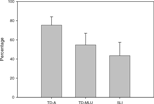
The next analysis compared the three groups of children according to their use of the full passive form, patient + bei + agent + verb. The percentage of attempts at passives of this form served as the dependent measure. A significant difference among the groups was not seen, F(2, 34)=1.80, p=.181. The percentages of use were numerically but not statistically higher for the TD-A group (M=75.36, SD=31.54) than for the TD-MLU group (M=54.75, SD=40.20) or for the SLI group (M=43.55, SD=43.81). All of the children in the TD-A group (14 of 14) produced full passive forms. The same was true for 8 of the 11 children with SLI and 9 of the 12 TD-MLU children. Three of the children with SLI produced all of their passives in the full form; the same was true for only one TD-MLU child. A summary of the children's use of full passive forms appears in Figure 3.

The percentage of passive attempts that were full and grammatical by the Cantonese-speaking children in Task 1 of Experiment 2.
As noted above, productions such as Penguin by lion pinch him were scored as correct, as they are viewed as acceptable utterances although containing redundant expression of the patient. An alternative interpretation of such utterances could be a failure of movement and a filling of the postverbal position with lexical material. An inspection of the data revealed only three productions of this type. One production was produced by each of two TD-A children, and the third was produced by a TD-MLU child. No utterance of this type was used by a child from the SLI group. This last observation suggests that, if utterances of this type were, in fact, failures of movement, our treatment of these productions as correct responses served to exaggerate rather than reduce the differences between the SLI and TD groups.
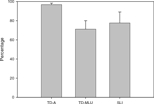
The percentages of full passive forms shown in Figure 3 might underestimate the children's ability to use passive sentences. As noted earlier, patients are optional when the referent is clear from context. The examiner's question, designed to bias the child toward a passive rather than an active sentence attempt, was “How's the patient?” In this context, a response of the form bei + agent + verb is quite appropriate. When responses of this type were combined with full passive responses, the percentages of appropriate passive sentences increased relative to the values reported for full passives alone. A significant difference among the groups was seen, F(2, 34)=5.85, p=.007. Post hoc testing revealed that the TD-A group (M=96.79, SD=5.42) produced appropriate passives to a significantly greater degree than the TD-MLU group (M=71.17, SD=29.27, d=2.14) but not the SLI group (M=77.64, SD=36.15). The TD-MLU and SLI groups did not differ. These results are illustrated in Figure 4. Ten of the 11 children with SLI produced appropriate passives; for 7 of these children, such use was 90% or higher. Eleven of the 12 TD-MLU children (4 with percentages of at least 90%) produced appropriate passives. All children in the TD-A group produced appropriate passives; the lowest percentage seen for this group was 86.

The percentage of passive attempts with or without a subject that were grammatical by the Cantonese-speaking children in Task 1 of Experiment 2.
Cantonese differs from English in that omission of the Cantonese equivalent of the by-phrase (bei + agent) is not regarded as grammatical. Omissions of bei + agent were found in the data for all three groups of children. However, they were not characteristic of any of the groups as a whole, and no group differences were found, F(2, 34)=0.62, p=.543. Whereas the mean for the children with SLI was 8.55 (SD=28.34), only one child in this group omitted bei + agent but did so on 94% of his passive attempts. For the two TD groups, no child showed such a strong tendency toward omission. However, omissions were seen for more than one child in each of these groups. For the TD-MLU group (M=5.75, SD=10.53), four children omitted bei + agent on occasion. For the TD-A group (M=1.64, SD=4.29), two of the children produced omissions of this type.
The data were also examined for instances in which the children omitted bei only (patient + agent + verb). This error did not typify any of the groups. Only one child each in the SLI and TD-MLU groups committed an error of this type. However, whereas the one TD-MLU child omitted bei on a single item, the one child with SLI omitted bei on 10 different items.
One error type that was seen in the data for the SLI and TD-MLU groups only was the production bei + patient + verb. Here, the patient was produced instead of the agent. Five children with SLI produced errors of this type (M=7.18, SD=13.85), as did six TD-MLU children (M=10.00, SD=14.75). This was not the dominant error type for any child, and the SLI and TD-MLU groups did not differ, t(21)=0.47, p=.642.
Finally, we found a single instance of a production of the type shown in Example 11g above, Penguin by lion pinch someone. This response, which might be taken to reflect a failure of movement, was produced by a child with SLI. The same child showed appropriately formed full passives (as in Penguin by lion pinch) for 20 of the 22 items on the task.
Task 2
The first passive task in which the children participated provided a picture of the passive sentence abilities of children with SLI relative to their TD peers. However, to promote comparison of Cantonese data with our data for English, we asked the children to participate in a second passive task, one that matched the procedures used in English. In this second task, the examiner described one event using a passive sentence before asking the child to describe a second event. Of central interest was whether the children's performance would differ greatly from their performance on the first task and, most importantly, whether the similarities and differences across the three groups would remain the same.
The first analysis pertained to the children's use of active sentences. As in the analysis of the data from Task 1, we first selected only those responses that were unambiguously active, having the form agent + verb + patient. The three groups differed significantly, F(2, 37)=3.79, p=.003. Post hoc testing indicated that the TD-A children (M=1.33, SD=3.52) produced significantly fewer active sentences than the TD-MLU children (M=14.55, SD=15.19, d=2.20), but not the children with SLI (M=10.29, SD=15.99). The TD-MLU and SLI groups did not differ. No child in any group was relying principally on active sentences during this task. In contrast, this type of response was not limited to only a few children; 6 of the 14 children with SLI produced at least one active sentence, as did 7 of the 11 TD-MLU children. Only 2 TD-A children produced a response of this type. Virtually identical results emerged when we expanded the criteria for active sentences by including agent + verb responses.
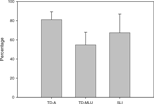
The data were then examined in terms of the children's use of the full passive form, patient + bei + agent + verb. The main effect for participant group was not significant, F(2, 36)=1.59, p=.217. Although the TD-A children produced relatively high percentages of full passives (M=81.13, SD=30.53), these values did not differ significantly from those of the TD-MLU (M=54.82, SD=41.78) and SLI (M=67.46, SD=33.61) groups. These data are illustrated in Figure 5.

The percentage of passive attempts that were full and grammatical by the Cantonese-speaking children in Task 2 of Experiment 2.
Again, we inspected the data to determine whether our treatment of productions such as Penguin by lion pinch him as correct responses might have distorted the findings in some way. Productions of this type were more frequent in the data for Task 2 than for Task 1. However, they were more likely to come from the responses of the TD groups than from those of the SLI group. Four TD-A children produced eight such responses, and four TD-MLU children produced seven responses of this type. For the SLI group, only two children showed three such responses.
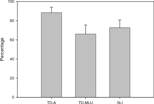
The scoring was then expanded to include responses of the form bei + agent + verb in the passive count, on the rationale that such utterances are pragmatically appropriate (and grammatical) in Cantonese. The main effect for participant group was not significant, F(2, 36)=2.60, p=.082. Means (SD) for the TD-A, TD-MLU, and SLI groups were 88.47 (21.20), 66.09 (29.73), and 72.77 (27.06), respectively. These findings can be seen in Figure 6.

The percentage of passive attempts with or without a subject that were grammatical by the Cantonese-speaking children in Task 2 of Experiment 2.
The omission of bei + agent, resulting in an ungrammatical form in Cantonese, was rare in the data for Task 2. One child with SLI showed a single error type. Another child in this group produced bei but omitted the agent, although only on one item. Two TD-MLU children each produced a single response with bei + agent omitted. This error was not seen at all in the TD-A data. In Task 1, one child each in the SLI and TD-MLU groups omitted bei only. However, this type of error was not observed in any child's responses in Task 2.
The error bei + patient + verb, where the patient was used in place of the agent, was somewhat more frequent in the Task 2 data than for the Task 1 data. However, this error type was no more frequent in the responses of the children with SLI than in the responses of the two TD groups, F(2, 36)=0.50, p=.612. Three of the 13 children in the SLI group committed such errors (M=8.62, SD=18.81). Such errors were produced by 4 of the 11 children in the TD-MLU group (M=17.55, SD=28.29) and by 6 of the 15 children in the TD-A group (M=10.87, SD=21.41). Finally, we found no errors of the type Penguin by lion pinch someone in the data for Task 2.
GENERAL DISCUSSION
The findings from Study 1 and Study 2 suggest that the differences between children with SLI and their TD peers in the use of passive sentences are not the same across languages. In English, the children with SLI were less proficient than both TD-MLU and TD-A children in the use of grammatically accurate passive forms containing a by-phrase. An analysis of the children's response patterns indicated that children with SLI were less successful in producing the participle -ed inflection and less likely to include the by-phrase than were both the TD-MLU and the TD-A groups. Individual children in the SLI group displayed other types of problems, although none of these other error types held true for more than one or two children. The English-speaking children with SLI were no more likely to use active sentences than were their TD peers, and, importantly, when they produced a passive construction, the patient and agent were usually in the proper order. They were certainly as capable as the TD-MLU in this regard.
In Cantonese, a different pattern of findings emerged. Whether passives were regarded as full patient + bei + agent + verb sentences or pragmatically appropriate bei + agent + verb sentences, the children with SLI were as successful as the TD-MLU children, and numerical differences between the SLI and TD-A groups failed to reach statistical significance. The similarity in the performance of the SLI and TD-MLU groups could not be attributed to the number of passive sentences attempted, because the children with SLI were no more likely than the TD-MLU children to produce active sentences during the two tasks. Furthermore, when the children attempted passive sentences, they did not appear to confuse the agent and patient. For example, productions of bei + patient in place of bei + agent constituted an error type that did not distinguish the groups of children. (Although nonsignificant, the numbers of these kinds of errors were actually higher for the TD-MLU group than for the SLI group.) The omission of bei + agent is not permissible in Cantonese, yet one child with SLI showed considerable use of this type of error on Task 1, although not on Task 2. Another child often omitted bei when producing the agent in passive sentences; again, this pattern occurred only on Task 1. Although these errors were quite salient, they were limited to these particular children and were certainly not typical of the SLI group as a whole.
Before discussing the implications of these findings, some qualifications should be made explicit. It is possible that the findings for English were influenced by our procedure. For each item, we chose to have the examiner describe one event with a get-passive sentence before asking the child to describe the second event. Clearly, this constituted a type of modeling. It seems possible that upon hearing the examiner produce a get-passive sentence, the children were more likely to produce a fully accurate get-passive, or to at least produce a passive more accurately than if the examiner provided no such prompt. For this reason, it is possible that our results for English represented an overestimation of the abilities of the SLI group. We also acknowledge that certain types of errors committed by the children might have been influenced by our choice of tasks. The most likely candidate is the English-speaking children's occasional use of a get-passive construction with a reversal of patient and agent. The TD-MLU group produced the greatest number of these kinds of errors. Perhaps the TD-MLU children were “primed” to adopt a passive-sentence mode of responding to the point where they sometimes began to generate the syntactic form before reflecting on the proper thematic roles of the characters. Fortunately, this response pattern did not appear to influence the data to a large degree; fewer than 10% of the TD-MLU children's responses were of this type. Another kind of error that could have been influenced by the task was the children's production of forms such as pushen in place of pushed. These substitutions were more frequent in the responses of the children with SLI than in the responses of the other two groups. Again, priming could have been responsible for these errors.
There are several reasons to believe that these possible priming effects did not distort the data in any significant way. First, consider the construct of priming itself. It is assumed that priming represents facilitating the retrieval of a stored syntactic frame. That is, of the syntactic frames already available to the child, an appropriate syntactic frame that has just been activated thanks to its appearance in a preceding sentence will be more readily retrieved. This assumption holds true not only in the literature on adult sentence production, but in the child language literature as well (e.g., Leonard et al., 2000). Such priming is not simply repetition, of course. Once an already available syntactic frame is retrieved, the child must insert the appropriate lexical items and grammatical morphology into this frame. This was certainly the case in our task in the present study. The children's own production always required retrieval of lexical items that differed from those used in the experimenter's model, as Example 6 illustrates. Furthermore, half of the sentences required the children to inflect the verb with a participle inflection that differed from the one used in the model. We found no evidence that the children's success with, say -ed was greater when -ed was employed in the preceding model. Even unexpected productions such as pushen were as likely to occur immediately after the experimenter's production of a participle with -ed as after the experimenter's production of a participle with -(e)n.
It can also be recalled that children in all three groups produced approximately the same proportion of active sentences on this task. As in formal priming tasks, production of the syntactic structure of interest is only probabilistic, as children will on occasion find alternative ways to express a proposition.
Finally, it is important to recall that the first task used with the Cantonese-speaking children did not include a model produced by the experimenter; priming was clearly not involved. However, the results for Task 1 were very similar to the results for Task 2, in which a model was used. The results for both tasks showed considerable use of passive forms on the part of children in all three groups.
Given that differences between SLI and TD-MLU groups were found for English and not Cantonese, we should consider whether the Cantonese-speaking children with SLI were less severely impaired than their English-speaking counterparts. We do not believe that this is the case. First, the age advantage of the SLI group over the TD-MLU group was similar for the Cantonese-speaking children (22 months on average) and the English-speaking children (21 months on average). Second, the same Cantonese-speaking SLI and TD-MLU groups were participants in studies by Wong et al. (2004) and Fletcher et al. (2005). In these studies, the children with SLI were found to use select grammatical forms with significantly less accuracy than the TD-MLU children. For example, the children with SLI had greater difficulty than TD-MLU children in the use of who-object questions (Wong et al., 2004). (In Cantonese, such questions do not involve movement; the Cantonese equivalent of “Who did Elmo push?” is “Elmo push who?”.) Fletcher et al. (2005) found that the children with SLI were less likely than the TD-MLU children to include grammatical morphemes that express continuous and perfective aspect. These findings indicate that the Cantonese-speaking children with SLI in the present study were less proficient than the TD-MLU children in certain grammatical details. The fact that we found no differences between the same two groups in the use of passives suggests that this area of grammar may not have been as weak as some other areas.
Implications for current accounts of SLI
According to the sparse morphology hypothesis, both English-speaking and Cantonese-speaking children with SLI might be expected to have difficulties with passives. Specifically, these children presumably rely too heavily on the canonical subject–verb–object word order of their respective language and do not devote their limited resources to the morphological cues that might signal that a noncanonical word order is involved. As a result, they should be ill equipped to produce passives with the appropriate word order. We found very little in the data that supported this prediction. The children with SLI in both languages were no more likely to produce active sentences than were the TD groups. In fact, the lowest percentages of scorable responses representing active sentences (M=7%) were seen in Task 1 for the Cantonese-speaking children with SLI. In this task, the children's responses were not preceded by an experimenter's model.
These findings suggest that at least one assumption of the sparse morphology hypothesis is not correct. Specifically, if children with SLI direct their limited resources away from grammatical morphology in languages such as English and Cantonese, they do not then focus exclusively on the canonical word order of the language, but rather to word order cues in general. For example, because got is not an auxiliary verb, English-speaking children with SLI may take note of this form, and conclude that the sentence is not the more customary active sentence. In Cantonese, the passive word order, in which both nouns precede the verb, provides clear evidence that the sentence deviates from the canonical N + V + N form; this difference would be clear even if the children do not attend to the morpheme bei2.
The surface account predicted differences between the SLI and TD-MLU groups for English but not for Cantonese. For English, the children with SLI were expected to have more difficulty than the TD-MLU children in the use of both the participle -ed and the preposition by. There was no basis for expecting problems with word order or with use of the entire by-phrase. Cantonese passives possess only one grammatical morpheme, bei2; however, its phonetic/perceptual properties provide no basis for predicting problems according to the surface account. The findings for Cantonese were consistent with expectations, as no differences were found between the SLI and TD-MLU groups in this language. In English, the finding that the SLI group used the participle -ed in significantly fewer obligatory contexts than did the TD-MLU group was also in line with this account. However, we found no evidence of difficulty with the preposition by. A single omission of by was found in the responses of a single child. This finding indicates the need for a more detailed study of the acoustic properties of by in passive sentences. If, as has been assumed, this morpheme is relatively brief, it would indicate that other factors can offset the perceptual disadvantage of brief morphemes. For example, Watkins and Rice (1991) found that children with SLI were more accurate with in and on when these served as spatial prepositions than when they served as verb particles. It might be the case that the agent-assigning role of by has a similar facilitating effect, the relatively brief duration of this morpheme notwithstanding.
According to the RDDR account, children with SLI have a deficit in the computational syntactic system that permits optional movement, such as movement of constituents or features from V to T for checking, movement from T to C, as well as both A-movement and A-bar movement. In the English data, we found very few instances in which children produced get in place of got; these could have been possible cases of lack of movement from V to T. Three children with SLI produced a single error of this type, as did one TD-MLU child.
Given the structure assumed for get-passives (Fox & Grodzinsky, 1998) shown in Example 3, where the subject originates in Spec of AP, productions such as Got the cat chased by the dog could have been produced if movement failed to occur. However, we found no examples of this error type in the data. It is plausible that the children with SLI employed some type of compensatory strategy, based on real-world knowledge. However, we could find no evidence of this. For example, 12 of the English items were reversible get-passives and we found no evidence that these items were more difficult than the nonreversible items. In addition, as noted earlier in the context of the sparse morphology hypothesis, the children with SLI were no more likely than their TD peers to respond with active sentences.
Cantonese passives have a structure that resembles verbal be passives in English, in that the patient is assumed to move from the object NP to the subject position (Li, 1990). It is plausible that some of the children's adultlike responses did not actually involve movement. In particular, it is possible that the Cantonese-speaking children with SLI produced pragmatically appropriate instances of bei2 + agent + verb (with no patient) without any movement operation. That is, instead of movement of the patient to subject position and then omission of the subject–patient for pragmatic reasons (as is appropriate in Cantonese), the children with SLI might have omitted the object–patient for pragmatic reasons before movement took place. Because null objects, like null subjects, are permitted in Cantonese when the referent is clear, we cannot rule out the possibility that the children dropped the patient–object without any movement operation. One finding that renders this interpretation less credible is the observation that in both Task 1 and Task 2, the SLI group did not differ from the TD groups in the degree to which they used utterances of this type. Furthermore, we found that in both Task 1 and Task 2, the children with SLI were as proficient as the TD-MLU children in using full patient + bei2 + agent + verb passives. The appearance and position of the patient in these responses are consistent with the assumption that movement was involved.
It is also possible that there were occasional problems with movement that took the form of lexical material occupying the object NP position, as in Cat by dog chase someone. Only a single error of this type was seen, produced by a child with SLI during Task 1. The same child was among the most proficient in the use of full passives of the type Cat by dog chase, producing responses of this type on 20 of the 22 items of Task 1 and 9 of the 10 items of Task 2. Another possible error type reflecting lexical material in the object NP phrase is (Cat) by dog chase cat. However, there were no examples of this type of error in the data.
It might be argued that one of the response types we treated as correct, those with a personal pronoun in postverbal position as in Cat by dog chase him, were actually cases in which movement failed to occur. We cannot rule out this possibility. However, on both Task 1 and Task 2, productions of this type were more likely to come from each of the TD groups than from the SLI group. Furthermore, their low total frequency for the SLI group (0 in Task 1 and 3 in Task 2) suggests that, even if they were cases of nonmovement, these cases were the rare exception.
Even if the production of the Cantonese-speaking children with SLI reflected consistent movement of the patient to the subject position, as the data suggest, the evidence would not necessarily constitute refutation of the RDDR account. An important element of the RDDR account is that movement is available to children with SLI; their difficulty rests in the fact that it is optional rather than obligatory in their grammars. It is possible that the contexts created in our tasks were so supportive of movement that the children with SLI were more likely than usual to select the movement option. Although van der Lely (1998) attributes the optionality of movement to a deficit in the computational syntactic system, to our knowledge, she does not rule out the possible effects of processing or other factors that might influence the choice of movement or no movement at the time of the utterance. That is, given the option of employing or not employing movement, there may be factors that influence the choice in any given instance. As noted earlier, the presence of models could have facilitated the children's use of already available passive forms. Although such priming can be operative only if the relevant structure is already available in the child's grammar, it could have led to a higher than usual percentage of instances in which a movement option was selected. However, one finding that limits the degree to which a priming explanation can be applicable is our observation that the Cantonese-speaking children with SLI were similar to the TD children in the use of passives in Task 1. This task was always presented first and did not employ a model.
Although our findings regarding movement might be explained by the RDDR account with the additional specification of supportive contextual factors, we should consider other possibilities. For example, Stokes (2002) has suggested that the limitations of children with SLI might be better described as optional deployment of a host of grammatical details. As a case in point, Fletcher et al. (2005) found that children with SLI were less consistent than TD-MLU children in using aspect markers. Such markers are optional even in adult Cantonese, although mature speakers often include them to provide a clearer indication of the temporal character of the event being described. Although aspect markers were more helpful for communication specificity than for grammaticality, the children with SLI were more likely to treat them as dispensable. In the context of the present investigation, the Stokes suggestion seems especially relevant to our finding that the English-speaking children with SLI were less likely than the TD-MLU children to include the by-phrase in their productions of passive sentences. Because by-phrases do not require movement and are not needed to make a sentence grammatical, their omission seems consistent with an optional deployment proposal.
In summary, we have explored the production of passive sentences by both English-speaking and Cantonese-speaking children with SLI. Only the English-speaking children with SLI differed from younger TD-MLU matched children. The findings necessitate a modification of the assumptions of the sparse morphology hypothesis, and provide only partial support for the surface account. The English get-passives and the Cantonese passives employed in this study differ in their structure but both require some type of movement. However, we found no evidence that movement was at the heart of the children's difficulties. If optional movement is a correct characterization, then we must assume that our tasks increased the likelihood that an available but optional movement operation was selected by the children with SLI. Even this assumption does not handle the findings from one of the tasks used for Cantonese. Finally, the notion of optional deployment seems compatible with important details of the data. However, this notion should be subjected to additional investigative scrutiny before we can be confident of its descriptive adequacy.
ACKNOWLEDGMENTS
This work was supported by research grant R01 DC00458 from the National Institute on Deafness and Other Communication Disorders, National Institutes of Health. The authors thank Robert Kurtz, Laurie Krantz, Amanda Owen, Anna Lee, Eva Chau, Serena Chan, Judy Hon, and Agnes Chan for their expertise in testing the children, and to Elaine Francis for providing us with guidance concerning the alternative structures of passives in Cantonese. We also thank the Hong Kong Christian Service Choi Wan and Yuen Long Early Education and Training Centres, the Speech and Language Clinic at the Division of Speech and Hearing Sciences, University of Hong Kong, the Pamela Youde Child Assessment Centre, the Yan Chai Hospital, and the Purdue Speech and Language Clinic at Purdue University for their support in participant recruitment. Special thanks go to the children and their families.