It is well documented that the characteristics of a word's phonology, including its phonotactic frequency and phonological neighborhood density, influence the perception and production of that word. What is less obvious is that the characteristics of a word's orthography, including its grapheme–phoneme correspondences and orthographic neighborhood density, also influence its perception and production (Alario, Perre, Castel, & Ziegler, Reference Alario, Perre, Castel and Ziegler2007; Ventura, Morais, Pattamadilok, & Kolinsky, Reference Ventura, Morais, Pattamadilok and Kolinsky2004; Ziegler & Ferrand, Reference Ziegler and Ferrand1998; Ziegler, Ferrand, & Montant, Reference Ziegler, Ferrand and Montant2004; Ziegler, Jacobs, & Klueppel, Reference Ziegler, Jacobs and Klueppel2001; Ziegler, Van Orden, & Jacobs, Reference Ziegler, Orden and Jacobs1997). Perceiving a word auditorily will activate its orthographic representation even when the listener is not performing a spelling task (Miller & Swick, Reference Miller and Swick2003). The degree of spelling–sound consistency of novel words may influence speech in tasks such as picture naming and auditory lexical decision making, further suggesting that orthographic factors are involved even when the individual is not actually reading (Rastle, McCormick, Bayliss, & Davis, Reference Rastle, McCormick, Bayliss and Davis2011). This effect is known as orthographic interference; that is, facilitation or disruption may occur as the result of phonological–orthographic correspondence or incongruency (Burgos, Cucchiarini, van Hout, & Strik, Reference Burgos, Cucchiarini, van Hout and Strik2014; Weber-Fox, Spencer, Cuadrado, & Smith, Reference Weber-Fox, Spencer, Cuadrado and Smith2003).
Interactive models of reading capture the relationship between a word's phonology and orthography by positing a bidirectional flow of information: orthographic representations activate phonological representations, but the reverse occurs as well (Jacobs & Grainger, Reference Jacobs and Grainger1994). Morton's classic model (Reference Morton1969) describes three types of information included in the representation of a word in the mental lexicon. Spelling, sound, and meaning are available when a word is recognized, regardless of the modality in which the word was received (Miller & Swick, Reference Miller and Swick2003). Furthermore, interactive models define the relationship among semantic, syntactic, phonological, and orthographic information as “nodes” that are triggered in sequence or simultaneously (Rapp & Goldrick, Reference Rapp and Goldrick2000); these nodes can activate and mutually influence one another (Alario et al., Reference Alario, Perre, Castel and Ziegler2007). Knowledge of orthography changes an individual's perception of the spoken word (Pattamadilok, Perre, Dufau, & Ziegler, Reference Pattamadilok, Perre, Dufau and Ziegler2009; Ventura, Morais, & Kolinsky, Reference Ventura, Morais and Kolinsky2007). Similarly, the association of novel words with consistent or inconsistent representations of spelling and sound may create an immediate effect on participants’ picture naming (Rastle et al., Reference Rastle, McCormick, Bayliss and Davis2011), providing evidence for the interaction between orthography and spoken language processing. These studies lead to the conclusion that experience with reading changes how words are produced. It is the goal of the current study to determine how manipulations of the modality of presentation of nonword stimuli (i.e., auditory or written) influence speech production.
Specific characteristics of a word's orthography can influence its processing. These factors include neighborhood density, consistency, and transparency/opacity effects. Neighborhood density effects involve the number of words that are orthographically or phonologically similar to a given sequence (Coltheart, Davelaar, Jonasson, & Besner, Reference Coltheart, Devalaar, Jonasson, Besner and Dornic1977; Storkel, Reference Storkel2013). Consistency effects involve the degree of grapheme–phoneme correspondence in the word's spelling (Bolger, Hornickel, Cone, Burman, & Booth, Reference Bolger, Hornickel, Cone, Burman and Booth2008). English includes many inconsistent mappings and, consequently, is on the opaque end of the continuum (Frost, Katz, & Bentin, Reference Frost, Katz and Bentin1987; Ziegler & Goswami, Reference Ziegler and Goswami2005). For instance, in English, the sequence /ɚ/ can be spelled in several ways, including birch, lurch, perch, and search (Ventura et al., Reference Ventura, Morais and Kolinsky2007). These three factors (density, consistency, and transparency) interact differently in various languages based on the languages’ orthography. For instance, the psycholinguistic grain size theory (Ziegler & Goswami, Reference Ziegler and Goswami2005) predicts that readers of English need to use both “small unit” and “large unit” recoding strategies (Brown & Deavers, Reference Brown and Deavers1999). This happens because the inconsistency, or opaque characteristics, of smaller units (such as graphemes) is much higher than that of larger units (such as rimes). Languages that contain more transparent characteristics do not have this dual focus. This is important for the current study because our procedures involve the manipulation of these smaller units. The nonword stimuli in this study will be presented with either transparent or opaque spellings; the influence of these manipulations on speech production accuracy and stability will be assessed.
In spoken language, frequency effects such as neighborhood density influence production processes, as indexed by measures such as reaction time and phonetic accuracy (e.g., Rastle et al., Reference Rastle, McCormick, Bayliss and Davis2011; Vitevitch, Reference Vitevitch2002). The influence of orthographic neighborhood factors on production processes has been minimally explored, though there is substantial evidence that orthographic factors influence phonological organization. Frequency and transparency effects likely overlap (e.g., the English homophones peek and pique differ in regard to both of these factors; the former spelling has a greater number of orthographic neighbors and is also more transparent). Neighborhood density influences spoken language processing; however, little is known about how orthographic factors, including orthographic density, may analogously influence language production. Therefore, we have chosen to manipulate orthographic neighborhood density in order to explore one way in which orthography influences processing.
ORTHOGRAPHY INFLUENCES EXPLICIT AND METALINGUISTIC PROCESSING
Influences of orthography on language processing have predominantly been investigated using metalinguistic measures. These methods target an explicit level of processing; that is, participants are asked to attend to the sound structure of the spoken or written stimuli and then to make mindful decisions (Snow, Burns, & Griffin, Reference Snow, Burns and Griffin1998). Examples of such tasks include monitoring lists for rhyming words (Seidenberg & Tannenhaus, Reference Seidenberg and Tanenhaus1979; Zecker, Reference Zecker1991), counting phonemes (Ehri & Wilce, Reference Ehri and Wilce1980) or syllables (Ventura, Kolinsky, Brito-Mendes, & Morais, Reference Ventura, Kolinsky, Brito-Mendes and Morais2001), or training on homonym definition and ambiguous sentence detection in order to improve reading comprehension (Zipke, Ehri, & Smith Cairns, Reference Zipke, Ehri and Smith Cairns2009).
However, metalinguistic judgments represent only some aspects of linguistic processing, and these results come with important caveats. The types of studies mentioned above involve analyzing language at a high (i.e., explicit) level of awareness and consciousness, which is not a requirement for speaking and may not be present in all adult talkers. For example, competent speakers who are not literate in an alphabetic system may experience difficulty in some metalinguistic tasks, such as sound segmentation (Morais, Cary, Algria, & Bertelson, Reference Morais, Cary, Alegria and Bertelson1979; Read, Zhang, Nie, & Ding, Reference Read, Zhang, Nie and Ding1986). Drawing conclusions based exclusively on metalinguistic judgments presents an incomplete picture, because these same individuals would likely be proficient in tasks involving more implicit components of linguistic processing. Orthographic factors may have a deeper effect on speakers and readers: one that is apparent in their implicit linguistic processing and accessible via the methods we will employ in this study.
DOES ORTHOGRAPHY INFLUENCE IMPLICIT LINGUISTIC PROCESSING?
A different aspect of learning involves implicit processing, in which the aspects of language usage are not available for conscious access (Poldrack, Prabhakaran, Seger, & Gabrieli, Reference Poldrack, Prabhakaran, Seger and Gabrieli1999). Implicit learning can be described as unintentional, or outside of the awareness that learning has occurred; it occurs over an extended period; it involves the knowledge of rules or procedures rather than facts (Thomas et al., Reference Thomas, Hunt, Vizueta, Sommer, Durston and Yang2004); it requires no mindful judgments (Hoff, 2011); and it may not be available for introspective report (Berry & Broadbent, Reference Berry and Broadbent1984). Behavioral outcomes also differ based on the type of learning that has occurred. For instance, participants can perform differently on a task depending upon whether or not they are given explicit instructions (Gebauer & Mackintosh, Reference Gebauer and Mackintosh2007); thus, the implicit/explicit difference goes beyond introspective report or description (Xie, Gao, & King, Reference Xie, Gao and King2013).
Researchers have used several different methodologies, ranging from phonetic accuracy measures to reaction time to fine-grained acoustic and kinematic analyses, to quantify implicit processing and provide evidence for interactions among lexical, phonological, and phonetic levels of processing in spoken language (e.g., Pierrehumbert, Reference Pierrehumbert, Gussenhoven and Warner2002). For example, studies of speech production reveal that there are interactions between lower levels of speech output and higher levels of language processing. Slips of the tongue often have a lexical bias; that is, erroneous phoneme substitution is likely to lead to the production of real words. This indicates that slips of the tongue do not simply reflect problems in motor programming, but suggest that the planning of lexical components of speech production is implicated at this level (Goldrick, Baker, Murphy, & Baese-Berk, Reference Goldrick, Baker, Murphy and Baese-Berk2011; McMillan, Corley, & Lickley, Reference McMillan, Corley and Lickley2009). Thus, overt and covert errors that occur at lower levels of speech production may reveal interactivity with higher level aspects of language processing.
Beyond these interactions in spoken language, some studies demonstrate that orthographic factors also influence implicit processing. Furthermore, orthography interacts with both higher level linguistic processes and lower level speech output. This occurs even in tasks that do not directly involve reading, including auditory shadowing tasks (Rastle et al., Reference Rastle, McCormick, Bayliss and Davis2011; Ventura et al., Reference Ventura, Morais and Kolinsky2007), auditory lexical decision tasks (Dich, Reference Dich2011; Zeguers et al., Reference Zeguers, Snellings, Tijms, Weeda, Tamboer and Bexkens2011), and semantic category judgment (Assink, van Bergen, van Teeseling, & Knuijt, Reference Assink, van Bergen, van Teeseling and Knuijt2004; Booth, Bebko, Burman, & Bitan, Reference Booth, Bebko, Burman and Bitan2007). These effects may be modified by the specific orthographic characteristics of the study's stimuli (e.g., consistent vs. inconsistent spellings) and/or participants’ reading skill. For instance, while phonological neighborhood density effects are present in all speakers, orthographic neighborhood effects emerge only in proficient readers (Ziegler, Muneaux, & Grainger, Reference Ziegler, Muneaux and Grainger2003).
The measures described above, such as phonetic accuracy and lexical decision and shadowing, may be used to quantify implicit processing because they do not require participants to make conscious judgments about the stimuli that they hear or read. Unlike what is assessed by metalinguistic tasks, many components of speaking and reading do not require conscious awareness, and thus may be viewed as automatic. This automaticity becomes established throughout the development of children's reading skills, which proceeds from a visual/logographic stage, to more segmental analysis, to the identification of written words by sight (Ehri, Reference Ehri, Barr, Kamil, Mosenthal and Pearson1991; Kamhi & Catts, Reference Kamhi, Catts, Kamhi and Catts2012; Masonheimer, Drum, & Ehri, Reference Masonheimer, Drum and Ehri1984; Ventura et al., Reference Ventura, Morais and Kolinsky2007). Readers at this mature level bypass phonological conversion by applying regularly occurring patterns such as morphemes and shared letter sequences (Kamhi & Catts, Reference Kamhi, Catts, Kamhi and Catts2012). These implicit components of the effects of reading on global language processing are the focus of the present investigation. Specifically, little is known regarding changes in participants’ ability to speak or read aloud that occur as a function of exposure to the written word. Measuring speech production can circumvent the limitations inherent in studies of exclusively metalinguistic tasks, in that it addresses a different level of processing that is present in all speakers, not just those who are literate. Therefore, in the present work, we will evaluate whether exposure to orthographic cues during learning interacts with speech production processes in adult learners. Specifically, we will assess participants’ production accuracy and speech movement stability as they learn nonwords that vary in modality of presentation (auditory or written) or in orthographic transparency (transparent or opaque spelling). We will also explore whether these factors are modulated by individual differences in reading proficiency.
IMPLICIT PROCESSING AS MEASURED BY ARTICULATORY KINEMATICS AND NONWORD REPETITION
A primary methodology that has been used and will be a focus here is phonetic accuracy, or the assessment of errors that talkers include in their productions of novel word forms. An additional promising methodology, which has the potential to quantify implicit learning and which also targets the interaction between speech motor output and language processing, involves speech kinematics (Goffman, Gerken, & Lucchesi, Reference Goffman, Gerken and Lucchesi2007; Heisler, Goffman, & Younger, Reference Heisler, Goffman and Younger2010; McMillan et al., Reference McMillan, Corley and Lickley2009; Smith & Goffman, Reference Smith and Goffman1998). Analyses of speech kinematics necessitate only that the speaker produce target words or sentences, not make metalinguistic decisions. Measuring articulatory stability provides a direct analysis of the influences of lexical, grammatical, and phonological factors on speech production. For example, Saletta et al. (in preparation) discovered that adults’ speech movement stability changes according to the syntactic complexity of a given sentence. In addition, children acquiring a novel word form showed increased speech movement stability when that form was paired with a meaningful referent, but not when it was simply heard and produced as a meaningless nonword (Gladfelter & Goffman, Reference Gladfelter and Goffman2013; Heisler et al., Reference Heisler, Goffman and Younger2010). Articulatory movement analysis has the potential to reveal how readers’ experience with orthography may reorganize their phonological processing.
In these sorts of studies, it is essential that nonwords be used as stimuli. It is evident that speech production is highly sensitive to experience, and only the use of nonwords can control an individual's prior knowledge. Furthermore, a task involving nonwords may be useful in differentiating individuals with varying levels of reading proficiency. Whereas high- and low-proficiency readers have similar word repetition skills, they differ in their nonword repetition skills (Castro-Caldas, Petersson, Reis, Stone-Elander, & Ingvar, Reference Castro-Caldas, Petersson, Reis, Stone-Elander and Ingvar1998). When repeating auditory material, speakers may use any of three strategies or processing pathways. Word repetition predominantly engages semantic or lexical pathways, whereas nonword repetition predominantly engages the phonological pathway (Castro-Caldas et al., Reference Castro-Caldas, Petersson, Reis, Stone-Elander and Ingvar1998). Thus, nonword production tasks enable assessment of the relationship between language skills and speech motor output. More specifically, manipulating the orthographic frequency of the nonword stimuli may provide further insight into the nature of the interaction between orthography and speech production.
OBJECTIVES
To explore the influence of orthography on the production of spoken language, we created nonwords, which were presented with systematic variations in modality (i.e., auditory or visual) and orthographic frequency (i.e., relatively frequent or infrequent spelling). We then measured proficient adult readers’ phonetic accuracy and their articulatory movement stability before and after they either heard and repeated (auditory exposure) or read and repeated (orthographic exposure) the nonwords. The overarching goal was to evaluate whether experience reading as opposed to only hearing these nonword forms would influence speech production.
Specifically, we asked three questions:
1. Does exposure to a written word influence the phonetic accuracy and the articulatory movement stability of an adult talker's production of this new word form?
2. Do specific orthographic characteristics of this nonword, including orthographic transparency and opacity (defined as high and low orthographic neighborhood density) influence phonetic accuracy or articulatory movement stability?
3. Even within a relatively homogeneous group of proficient adult readers, do those individuals who demonstrate better reading skills also produce nonwords with greater articulatory stability?
METHODS
Participants
Participants included 18 adults (10 females) between the ages of 19 years, 3 months (19;3) and 64;3 (M = 28;8; SD = 13). Participants had between 13 and 18 years of education; all were at least college freshmen. All participants were native speakers of English; they reported no history of speech, language, hearing, or reading problems, neurological disease, or learning delay/disability; and they passed a hearing screening. Approval for this study was granted by the Purdue University Institutional Review Board.
Equipment
High-quality audio and video recordings were obtained for the analysis of phonetic accuracy. Simultaneously, three-dimensional kinematic data were collected at 250 samples/second using a three-camera Optotrak 3020 motion capture system or 3D Investigator motion capture system (both Northern Digital, Inc., Waterloo, ON, Canada). Small (11 mm) infrared light emitting diodes (IREDs) were attached with antiallergenic medical adhesive to each participant's upper lip, lower lip, and a lightweight splint under the chin at midline to approximate jaw movement. Five additional IREDs were used to create a three-dimensional head coordinate system in order to subtract head motion artifact (Smith, Johnson, McGillem, & Goffman, Reference Smith, Johnson, McGillem and Goffman2000). A time-locked acoustic signal was collected at 16,000 samples/second to confirm that movement records aligned with target nonword productions.
Procedures and session structure
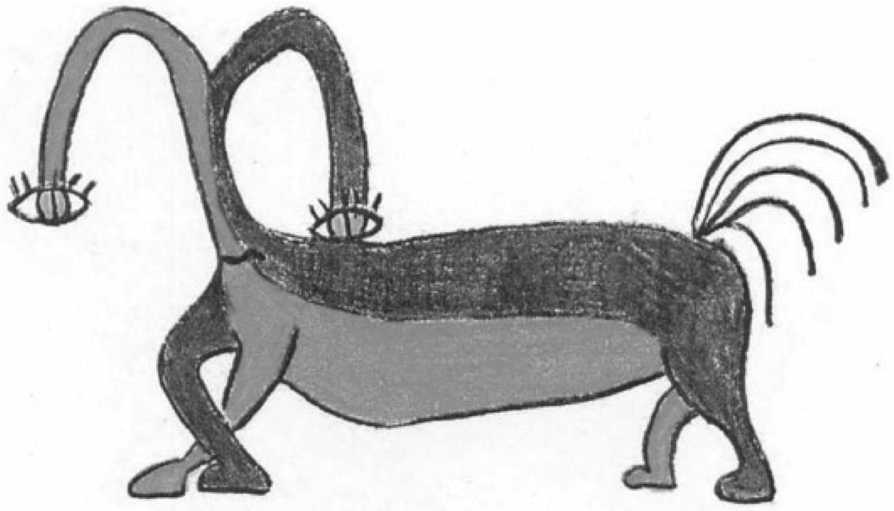
Each individual participated in one session, which was approximately 90 min long and included behavioral testing and the collection of acoustic and kinematic data. In the experimental component of the session, participants heard nonwords, which were described as the names of types of make-believe aliens and were each associated with a specific illustration of a novel character (Ohala, Reference Ohala1996; Figure 1). Participants were instructed to listen to each character's name and then say its name in the sentence “Bob saw a (insert name) before.” This carrier sentence was used to increase complexity and provide linguistic context, and because it contains several labial consonants, to facilitate articulatory kinematic analysis.
An example of an illustration of a novel character (Ohala, Reference Ohala1996). While viewing this picture, participants heard the word /mɅnfik/ and then said, “Bob saw a /mɅnfik/ before.”

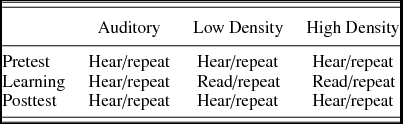
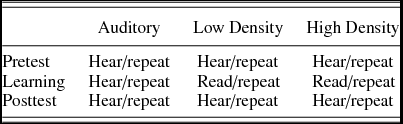
There were a total of three experimental blocks. Each block was associated with a single presentation condition: high orthographic density (corresponding with transparent) orthography, low orthographic density (corresponding with opaque) orthography, and auditory-only presentation. Each experimental block contained 2 target nonwords and 10 fillers (i.e., nonwords that had phonetic characteristics similar to the target words and were included to increase the difficulty of the task. Participants did not know which stimuli were fillers, and fillers were not analyzed). Each condition was further divided into three phases: pretest, learning, and posttest. During the pretest phase, participants heard each nonword presented 10 times and then, after each presentation, repeated it in the carrier sentence. During the learning phase, participants either read each nonword aloud 10 times (in the high-density orthography and low-density orthography conditions) or heard and repeated each nonword 10 times (in the auditory-only condition). The posttest phase was identical to the pretest phase. This arrangement allowed us to determine whether participants’ productions of the nonwords changed as a result of experience with reading aloud or listening to the stimuli, and whether participants’ productions of the nonwords were influenced by the degree of orthographic neighborhood density to which they were exposed.
In the pretest and posttest phases, each target nonword was presented 10 times and each filler was presented 1 time; thus, there were a total of 30 nonwords presented in the pretest and posttest phases. In the learning phase, each target nonword was presented 10 times, but fillers were not presented (because the fillers were not designed to address the experimental questions, but only to increase the complexity of the task); thus, there were a total of 20 nonwords presented in the learning phase. Participants produced this number of repetitions in order to facilitate the capture of changes in articulatory variability across the course of the experiment (Smith et al., Reference Smith, Johnson, McGillem and Goffman2000).
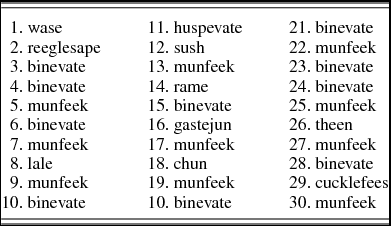
The order of the conditions, as well as which condition contained which nonwords, were fully counterbalanced (i.e., blocked) across participants. Six participants viewed each version of the three counterbalancing schemes, thus controlling for item effects. Within each condition, stimuli were presented in a quasi-random order, with no more than two of the same nonwords occurring consecutively. See Table 1 for a summary of the session structure. See Appendix A for an example of one block of stimuli.
Session structure: three phases (pretest, learning, and posttest) within three conditions (auditory only, low density orthography, and high density orthography).
Stimuli
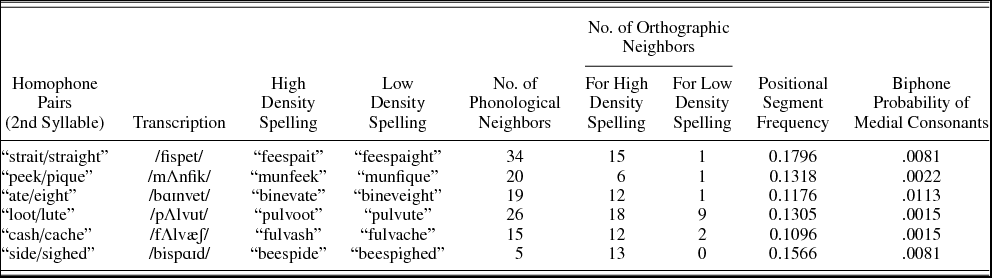
Each target nonword began with a labial consonant to facilitate kinematic analysis. Each word was disyllabic and trochaic, and each syllable followed a consonant–vowel–consonant pattern. We chose to construct disyllabic stimuli because unpublished pilot work suggested that a task consisting of exclusively monosyllabic nonwords would not be sufficiently challenging for adults and may be insensitive to differences in the learning phase of the study. Thus, the first syllable in each nonword was present only in order to increase its complexity, and was drawn from the list of 120 high-probability nonsense syllables presented by Vitevitch, Luce, Charles-Luce, and Kemmerer (Reference Vitevitch, Luce, Charles-Luce and Kemmerer1997). These syllables were defined as having segments with high positional probabilities and frequent biphone probabilities. The second syllable in each nonword was subjected to the relevant manipulations. Each nonword's second syllable was constructed based on a pair of homophones with the initial consonant changed. For example, the homophone /pik/ (“peek/pique”) was changed to /fik/ (“feek/fique”); this syllable made up the second syllable of the nonword stimulus /mɅnfik/. The syllable's more frequent or transparent spelling (e.g., “munfeek”) was used in the high-density condition, and its more infrequent or opaque spelling (e.g., “munfique”) was used in the low-density condition.
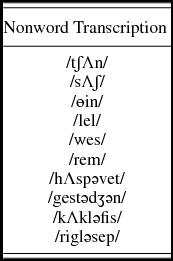
The degree of orthographic frequency was determined based on the number of orthographic neighbors of each spelling (Table 2). The spelling of the nonword /fik/ as “feek” has six orthographic neighbors, while the spelling “fique” has one orthographic neighbor; thus, “feek” has higher type frequency than “fique.” This manipulation was similar to that of Rastle et al. (Reference Rastle, McCormick, Bayliss and Davis2011), who created nonword stimuli that could be spelled in a regular or irregular manner (according to English grapheme–phoneme correspondence) and that were matched according to orthographic neighborhood density. Finally, the second syllables in the nonwords were balanced for phonological neighborhood density and phonotactic frequency (positional segment frequency and biphone probability). These characteristics were calculated using the online Speech and Hearing Lab Neighborhood Database of Washington University in St. Louis (Sommers, Reference Sommers2002). The nonword stimuli used for fillers were either one or three syllables in length, and were created from the list of high-probability syllables in Vitevitch et al. (1997; Appendix B).
Characteristics of target nonwords
Data processing
Data were processed in Matlab (Mathworks, 2009). The sentences were segmented out of each trial and were then sorted by condition and phase in preparation for measurement. Because effects often appear in multimovement contexts for the kinematic analysis, we chose to analyze the whole sentence in which the target word was embedded. Phonetic accuracy was measured only in the target word.
The lip aperture variability (LA) index is a composite measure of spatial and temporal variability that quantifies the movement of three effectors (upper lip, lower lip, and jaw) as they interact during speech to control oral opening and closing (Smith & Zelaznik, Reference Smith and Zelaznik2004; Walsh & Smith, Reference Walsh and Smith2002). The LA index is derived by subtracting upper lip from lower lip movement, resulting in a measure of lip aperture. This measure quantifies articulatory stability.
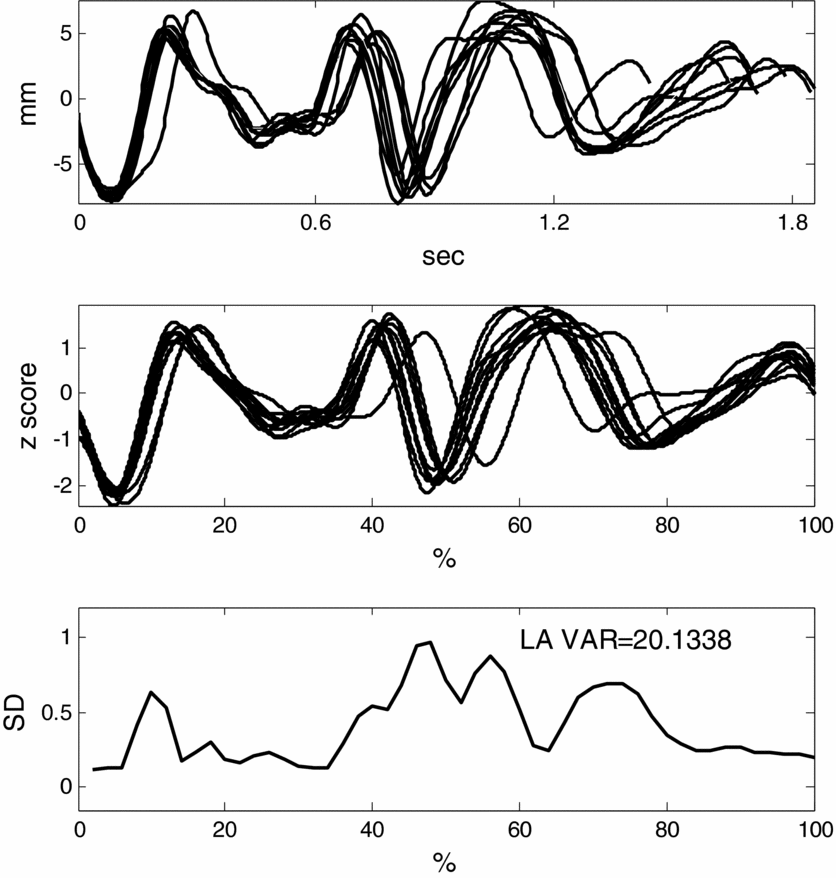
To calculate the LA index, the onsets and offsets of each sentence were selected based on peak velocity of lower lip and jaw movement. Head movement was corrected, and the data were then low-pass filtered (10 Hz cutoff). Movement onsets and offsets were selected by visually inspecting the displacement record for local minima. The minimum value was then confirmed by an algorithm, which determined the point at which velocity crossed zero within a 25-point (100-ms) window of the point selected by the experimenter. The movement trajectories were then linearly amplitude and time normalized. Time normalization was accomplished by setting each record to a common time-base of 1,000 points, using a spline function to interpolate between points. Amplitude normalization was completed by setting the mean to 0 and the standard deviation to 1. After normalizing the data, standard deviations were computed at 2% intervals in relative time across the 10 records and then summed. The sum of the 50 SD is the LA index; a higher value reflects greater movement variability (Figure 2; see Smith, Goffman, Zelaznik, Ying, & McGillem, Reference Smith, Goffman, Zelaznik, Ying and McGillem1995; Smith & Zelaznik, Reference Smith and Zelaznik2004).
Examples of extracted movement sequences from the utterance “Bob saw a /mɅnfik/ before.” The top panel represents the raw records. The middle panel represents the time- and amplitude-normalized records. The bottom panel represents the standard deviations used to calculate the lip aperture variability index values.
Outcome variables
Segmental accuracy
The video recordings were used to transcribe each utterance and determine the percentage consonants correct (PCC). The PCC quantifies speech accuracy by measuring the proportion of consonants in each nonword produced accurately. Reliability of phonetic transcription was established by using an independent coder to transcribe 20% of the sessions. The phonetic transcriptions of the first author and the independent coder were in agreement for 98% of the consonants produced by participants (the coding of the first author was used as the default in cases of disagreement). Along with the raw PCC values, pretest/posttest difference scores were calculated as a more direct index of within-individual change.
Speech movement stability
The LA index values were evaluated separately for each phase within each condition. As with the PCC data, pretest/posttest difference scores were calculated along with the raw LA index values.
Reading and oral language skills
To quantify reading proficiency, we administered the Woodcock Reading Mastery Tests—Revised-Normative Update (WRMT-R/NU; Woodcock, Reference Woodcock2011). The subtests included word identification (participants’ standard score range = 87–133, SD = 10.16), word attack (standard score range = 79–132, SD = 12.61; note that one participant scored more than a standard deviation below the test's mean of 100), word comprehension (antonyms, synonyms, and analogies; standard score range = 87–130; SD = 11.57), and passage comprehension (standard score range = 86–143; SD = 14.04). In addition, we quantified oral language skills by administering two subtests of the Test of Adolescent and Adult Language, Third Edition (Hammill, Brown, Larsen, & Wiederholt, Reference Hammill, Brown, Larsen and Wiederholt2011). Because some participants were outside of the standardization group's age range for this test, we report raw scores rather than standard scores. The subtests included listening grammar (raw score range = 8–33 out of 35) and speaking grammar (raw score range = 14–23 out of 30). Although all of our participants had at least some college education, they showed variation in their reading and language scores.
The critical tests for our analyses of individual differences were the word attack and word comprehension subtests of the WRMT-R/NU. These were chosen based on the fact that they employ two very similar tasks (i.e., reading single items) to measure two very different aspects of reading skills (i.e., decoding vs. comprehension). The other tests and subtests were used to confirm that participants demonstrated typical reading and language skills, but were not subjected to statistical analyses.
Statistical analyses
All variables were analyzed using a within-participant analysis of variance, with condition (auditory only, high-density orthography, and low-density orthography), phase (pretest and posttest), and nonword (first or second nonword) as the within-participant factors. Simple effect analyses were used for pairwise comparisons when main effects were present. We used an arcsine transform to compensate for the fact that the accuracy data are not normally distributed. The α level was set to 0.05. Linear regression was also used to determine whether a relationship exists between two aspects of reading skill (word attack and word comprehension) and overall LA variability. For the correlations, the α level was changed to 0.025 using a Bonferroni adjustment. This adjustment accounts for the potentially inflated Type I error inherent in conducting multiple correlations on related dependent variables (Tabachnick & Fidell, Reference Tabachnick and Fidell2007). We also report effect sizes for all results.
RESULTS
Analytic issues
Approximately 9% of the data were excluded due to disfluencies or other interruptions in the speech signal, such as laughing, coughing, or omitting the article. The productions obtained during the learning phase were not analyzed (these data differed from the pretest and posttest data because, in the high-density and low-density orthography conditions, the nonwords were read aloud instead of repeated). For the kinematic analysis, substitutions of one labial consonant for another, as well as vowel errors, were included; these tokens were considered correct for kinematic analysis. An additional 9% of the data, while amenable to phonetic accuracy analysis, were excluded from the kinematic analysis because the participants did not produce initial, medial, and final labial consonants or because an IRED was missing from the cameras’ view. In these cases, articulatory trajectories could not be extracted from the speech stream. We counterbalanced the nonwords across conditions, and found no significant effects of specific nonwords (i.e., that one nonword was associated with different PCC or LA index values than the other five nonwords). Therefore, all statistical analyses were collapsed across the nonwords.
Segmental accuracy and speech movement stability
Segmental accuracy
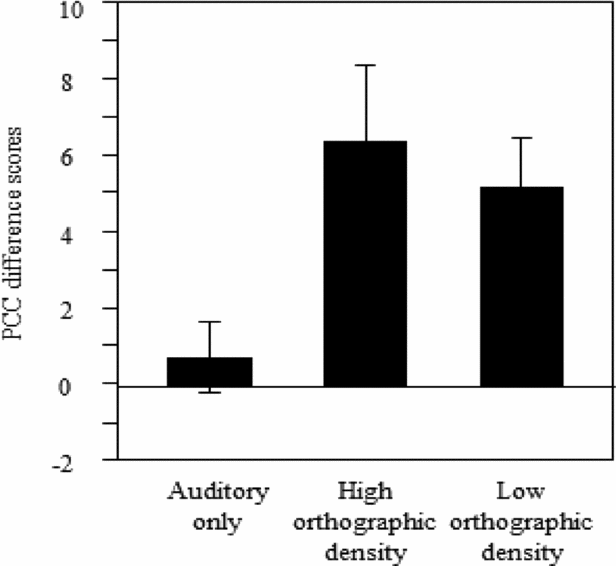
To directly assess participants’ learning, pretest/posttest difference scores for segmental accuracy were calculated. We found a main effect of condition, F (2, 16) = 16.70, p < .001, ηp2 = 0.68 (Figure 3). Simple effect analyses indicated that participants’ PCC scores became more accurate from pretest to posttest in the high-density, t (17) = 3.25, p = .005, and low-density orthography conditions, t (17) = 3.63, p = .002, in comparison to the auditory condition. High- and low-density values did not differ from one another, t (17) = 0.46, p = .65.
Percentage consonants correct pretest–posttest difference scores (positive scores indicate greater accuracy). Participants became significantly more accurate from pretest to posttest in the two written conditions, but not in the auditory condition. Error bars reflect standard errors.
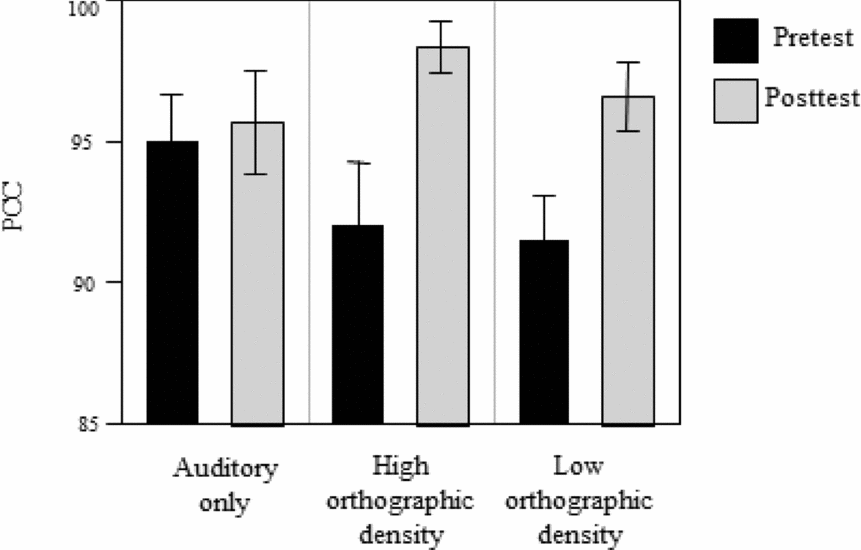
Along with our analysis of difference scores, we examined the raw PCC data. Because by definition, data expressed as proportions are not normally distributed, to stabilize the variance we transformed these data using an arcsine transform (Rucker, Schwarzer, Carpenter, & Olkin, Reference Rucker, Schwarzer, Carpenter and Olkin2009). Analyses of the transformed PCC data indicated that there was a main effect of phase. Participants were less accurate (i.e., lower PCC) in the pretest, M = 0.93, SE = 0.01, than in the posttest phase, M = 0.97, SE = 0.01; F (1, 17) = 34.67, p < .001, ηp2 = 0.67. As shown in Figure 4, condition was not significant, F (2, 16) = 1.12, p = .35, ηp2 = 0.12. There was a significant interaction of phase by condition, F (2, 16) = 10.37, p = .001, ηp2 = 0.56. Simple effect analyses indicated that in all three conditions, participants’ PCC increased from pretest to posttest: in the auditory condition, t (17) = 2.30, p = .03; in the high orthographic density condition, t (17) = 4.22, p = .001; and in the low orthographic density condition, t (17) = 4.17, p = .001.
Percentage consonants correct raw scores in each phase within each condition (higher scores indicate greater accuracy). Participants became significantly more accurate from pretest to posttest in the two written conditions, but not in the auditory condition. Error bars reflect standard errors.
Speech movement stability
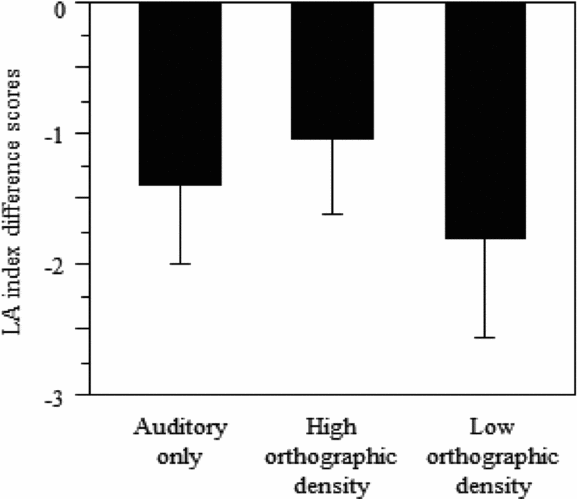
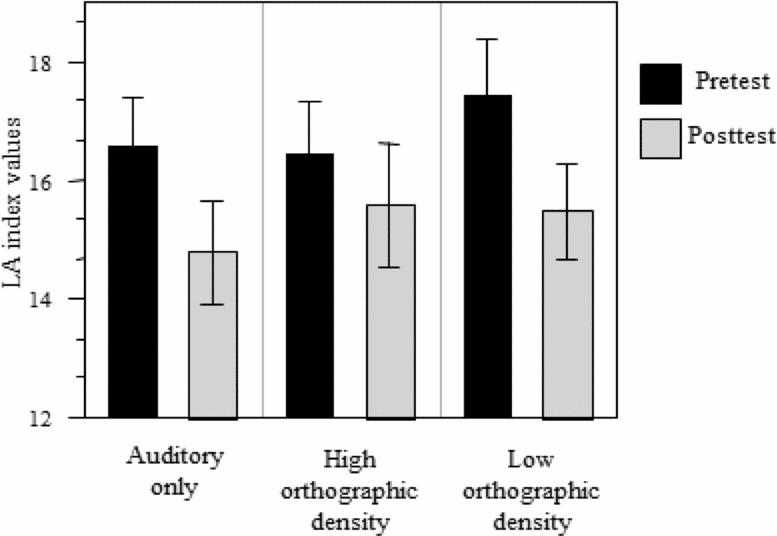
To directly assess participants’ learning, pretest/posttest difference scores for LA index values were calculated. While difference scores were less than zero (reflecting a move toward greater stability; Figure 5), there was no significant condition effect for LA index difference scores, F (2, 16) = 0.26, p = .77, ηp2 = .03. Along with our analysis of difference scores, we examined the raw LA index data. There was a significant main effect of phase. Participants had significantly higher (i.e., more variable) LA index values in the pretest (M = 20.14, SE = 0.62) than in the posttest phase (M = 18.44, SE = 0.62), F (1, 17) = 5.37, p = .03, ηp2 = 0.24. The main effect of condition was not significant, F (2, 16) = 1.07, p = .37, ηp2 = 0.12, and there was no significant interaction, F (2, 16) = 0.25, p = .78, ηp2 = 0.03 (Figure 6).
Lip aperture index value pretest–posttest difference scores (negative scores indicate greater articulatory stability). Participants became significantly more stable from pretest to posttest in all three conditions. Error bars reflect standard errors.
Lip aperture index values (lower scores indicate greater articulatory stability). Participants became significantly more stable from pretest to posttest in all three conditions. Error bars reflect standard errors.
Relationship between reading skills and LA variability
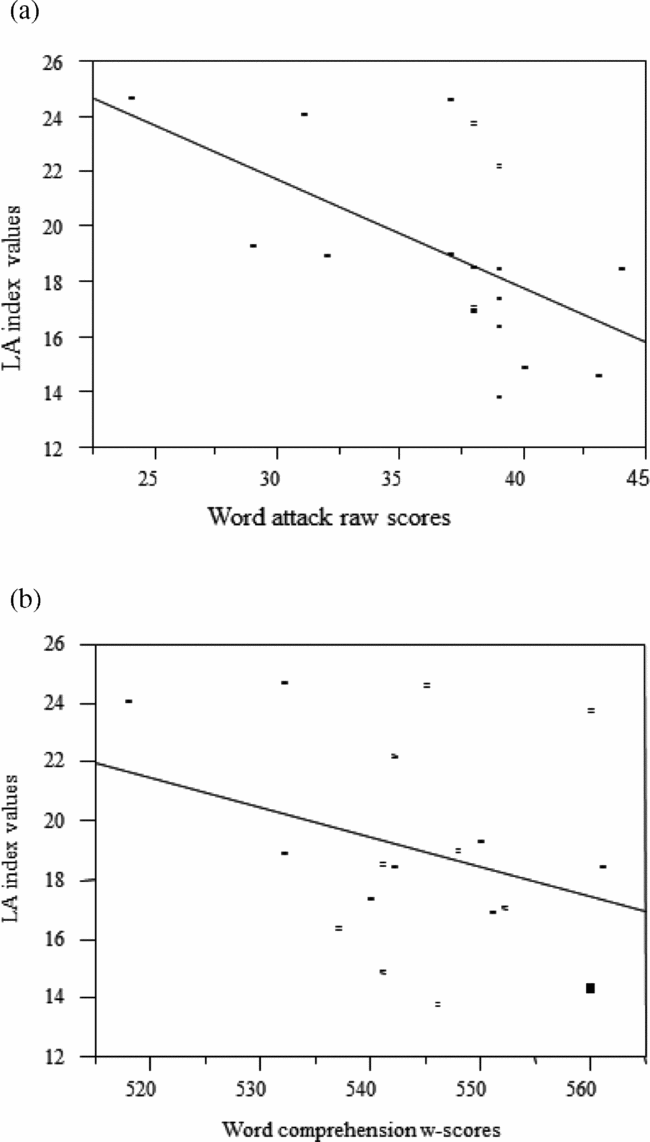
The results of a linear regression indicated that word attack raw scores predicted LA variability, F (1, 17) = 7.34, p = .02, R 2 = .31 (Figure 7a). Given the p value of .025 based on the Bonferroni type adjustment, this result was significant. In contrast, the results of a second linear regression indicated that word comprehension w scores (a measure applied to the WRMT-R/NU, consisting of an equal-interval scale that represents both a person's ability level and the difficulty level of the items; Jaffe, Reference Jaffe2009; Woodcock, Reference Woodcock2011) did not predict LA variability, F (1, 17) = 1.80, p = .20, R 2 = .10 (Figure 7b).
(a) Regression line representing the correlation between Woodcock Reading Mastery Tests—Revised-Normative Update word attack raw scores and overall lip aperture variability. (b) Regression line representing the correlation between Woodcock Reading Mastery Tests—Revised-Normative Update word comprehension w scores and overall lip aperture variability.
DISCUSSION
We inquired whether manipulations of nonword presentation modality and orthography impact how proficient readers produce language. In addition, we asked if individual differences in reading facility, even in these proficient adult readers, influence orthographic effects on word production. To address these questions, we created a nonword production task in which we systematically manipulated the modality of the presentation (auditory or written) and the degree of neighborhood density (transparent or opaque spellings) of the nonword stimuli.
Our data lead to several key findings. We might expect that manipulating modality and orthographic density would influence participants’ phonetic accuracy and articulatory stability. Our findings supported the first component of this prediction, that modality influences production. Participants produced nonwords more accurately (i.e., higher PCC in posttest compared with pretest) after reading them, but not after just hearing them, even with the same degree of exposure. It is crucial that viewing the written cue enabled participants to produce the nonword with greater accuracy in the posttest phase (i.e., even when they were no longer able to read it). These data suggest that participants were able to integrate the nonword's orthography into their lexical representations. That this occurred only when participants were able to read the nonwords, and not when they received the same amount of exposure in the auditory modality alone, indicates that the reading process contributed to this integration. These adult participants demonstrated high segmental accuracy even in the pretest phase (PCC average = 92%–95%). However, these are not simply ceiling effects, because participants showed systemic improvement in production accuracy when exposed to written but not spoken words during the learning phases.
Highly proficient adult readers were not influenced by neighborhood density in their speech production processes. This was somewhat counter to expectations, because it may be predicted that mature talkers would be sensitive to neighborhood effects. While this frequency measure had no influence, speech movement stability did increase with learning or practice (e.g., Heisler et al., Reference Heisler, Goffman and Younger2010; Walsh, Smith, & Weber-Fox, Reference Walsh, Smith and Weber-Fox2006). However, this effect occurred regardless of whether participants heard or read the stimuli. While measures of production accuracy showed sensitivity to exposure to written versus auditory input, measures of articulatory stability revealed only more global practice effects.
These findings are not fully consistent with those from other researchers, who have used different methodologies to assess how orthography influences speech production. For instance, Damian and Bowers (Reference Damian and Bowers2003) found that orthographic congruency influences the facilitative effects of priming; however, Alario et al. (Reference Alario, Perre, Castel and Ziegler2007) did not replicate this result. Miller and Swick (Reference Miller and Swick2003), Ziegler and Muneaux (Reference Ziegler and Muneaux2007), and Rastle et al. (Reference Rastle, McCormick, Bayliss and Davis2011) showed that orthographic factors such as neighborhood density and spelling–sound consistency influence priming effects, spoken word production and recognition, and novel picture naming. As a whole, these studies suggest that orthographic representations exert a powerful influence on speech processing and production.
However, kinematic analyses did reveal that individual differences in reading proficiency interact with articulatory stability. Even among this group of adult, proficient readers, individuals with stronger word attack and word identification skills also presented with greater overall speech movement stability in their nonword repetition. Previous work also supports the use of nonword repetition as an index of reading skill. As noted above, poorer readers often demonstrate weaker nonword repetition skills, due to their poor development of phonological awareness (Castro-Caldas & Reis, Reference Castro-Caldas and Reis2003), lack of focus on sublexical units (Share, Reference Share2004; Ventura et al., Reference Ventura, Morais and Kolinsky2007), and inability to access the phonological pathway strategically (Castro-Caldas et al., Reference Castro-Caldas, Petersson, Reis, Stone-Elander and Ingvar1998). However, it is a new finding that even typical adult readers show differential performance in articulatory stability as a function of their decoding proficiency. This new measure provides an implicit index of the influences of experience and reading skill on speech production.
The above conclusions provide an affirmative answer to our question regarding the relationship between reading skills and articulatory stability. Furthermore, our results indicate that our experimental design using kinematic analysis was an effective tool for assessing the effect of orthography on phonological representations. Aspects of our findings are consistent with those previously obtained using metalinguistic tasks. Specifically, our results follow naturally from the perspective established by earlier works, indicating that reading is an interactive process (Jacobs & Grainger, Reference Jacobs and Grainger1994); that perceiving a word in any modality activates its orthographic representation (Miller & Swick, Reference Miller and Swick2003); that manipulating a word's spelling can impact its processing by listeners and readers (Damian & Bowers, Reference Damian and Bowers2003; Fiez, Balota, Raichle, & Petersen, Reference Fiez, Balota, Raichle and Petersen1999; Rastle et al., Reference Rastle, McCormick, Bayliss and Davis2011); and that orthography is a factor included in a word's representation in the mental lexicon (Morton, Reference Morton1969). However, our experiment goes beyond these preceding studies, in that we measured speech production as an index of implicit processing and found that this type of processing is influenced by access to orthography. Kinematic analyses enable us to obtain fine-grained quantitative measures of implicit processing and learning.
Future studies need to assess individuals with varying levels of reading skill. Perhaps adult proficient readers rely on automatic and rapid processing when accessing new words regardless of whether they are orthographically high or low density. This may not be true of less proficient readers, who may show more sensitivity to these orthographic distinctions. We predict that individuals who demonstrate reduced reading proficiency, and whose reading skills are less automatic, will be influenced to a greater extent by factors such as orthographic density. It seems likely that orthographic characteristics, such as neighborhood density or transparency, will have increased impact during earlier phases of learning to read, when automaticity is still emerging. One expectation based on previous literature is that of Lavidor, Johnston, and Snowling (Reference Lavidor, Johnston and Snowling2006), who predict that individuals with reading impairment may experience difficulty creating fine-grained grapheme–phoneme mappings. Consequently, they may use a relatively global or coarse coding that creates greater reliance on the visual or orthographic properties of words than on their phonological decoding. In contrast, it is possible that individuals with poorer reading skills may benefit less from orthographic cues than more proficient readers, because poorer readers may be relatively insensitive to this type of manipulation. It is therefore important to pursue this investigation in children who are just developing reading skills and in children and adults who demonstrate reading difficulties.
Conclusion
This kinematic study provides an emerging picture of the relationships among modality, orthographic density (which corresponds to transparency), and language production that confirms and extends previous works. Our findings indicate that modality and reading proficiency impact participants’ speech accuracy and efficiency in a nonword production task. Specifically, reading a nonword enables speakers to access its orthography, which facilitates their ability to produce it. Thus, we can conclude that experience with orthography may alter readers’ phonological representations of new word forms. In addition, our data indicate that higher reading proficiency is associated with greater articulatory stability of nonword production. Collectively, these findings help us to understand how, in addition to the way in which orthography influences perceptual/explicit processing and speech perception, orthography also influences implicit processing and speech production. We conclude that quantifying speech accuracy and conducting fine-grained kinematic analyses provide insight into the influence of orthography on language processing.
APPENDIX A
A sample order of a pretest phase
APPENDIX B
Nonword filler stimuli
ACKNOWLEDGMENTS
This research was funded by the Robert L. Ringel Research Endowment Award and by the NIH/NIDCD Grant R01 DC04826. We are grateful to Janna Berlin, Tiffany Hogan, and Daniel Miller for their contributions to this project. The content is solely the responsibility of the authors and does not necessarily represent the official views of the University of Iowa, Purdue University, or the University of Chicago.