Classical computational models of learning to read in English tend to focus on monosyllabic words. For example, the triangle model of Seidenberg and McClelland (Reference Seidenberg and McClelland1989) was trained on 2,897 monosyllabic words. Similarly, the cascaded dual route model (Coltheart et al., Reference Coltheart, Rastle, Perry, Langdon and Ziegler2001) was assessed on the 7,981 monosyllabic words in the CELEX database. This choice is perhaps a surprising one, as the vast majority (approximately 90%) of words in the English language, and most other languages, are multisyllabic (Baayen et al., Reference Baayen, Piepenbrock and Gulikers1995). While these models are taught how to read rare English words such as “ire” or “gall”, they would not be taught multisyllabic words that are common even in a toddler’s vocabulary, such as “hello” or “bottle.”
This omission is important, because there are several factors that play a role in reading and spelling multisyllabic words that are not relevant to monosyllabic words (Heggie & Wade-Woolley, Reference Heggie and Wade-Woolley2017). These include syllabification (the division of words into syllables), prosody (particularly lexical stress), and, to a large extent, derivational morphology (the derivation of a new word using morphemes through the addition of a suffix or affix). It is therefore fair to assume that previous computational models have underestimated the role of these factors in reading and spelling.
Models such as Grain Size Theory (Grainger & Ziegler, Reference Grainger and Ziegler2011; Ziegler & Goswami, Reference Ziegler and Goswami2005) and Lexical Quality (Perfetti, Reference Perfetti2007; Perfetti & Hart, Reference Perfetti and Hart2002) have begun to describe how accurate word reading depends on multiple sources of lexical and sublexical information which are combined simultaneously, extending beyond monosyllabic word reading. The central tenet of the Lexical Quality Hypothesis is that the more that is known about a word, the more rapidly it can be accessed from the lexicon. While Grain Size Theory explicitly acknowledges roles for multiple sublexical units of varying sizes, such as phonemes, graphemes, syllables, and morphemes. Nonetheless, these models remain underspecified with regard to the potential for multiple sources of information to interact and/or conflict during word reading. Further, perhaps because these models focus on lexical access as the end goal of word reading, they are silent to the role of prosody in the accuracy of oral word reading.
There also appear to be gaps within models of literacy, with few models explicit about the relationship between reading and spelling. Those models which do account for spelling do not provide as much information relating to spelling as they do to reading development. Often, spelling is treated as a straightforward reverse of reading but reading an unknown multisyllabic word demands parallel, but not identical skills to those used when spelling (see Breadmore et al., Reference Breadmore, Deacon and Chen2021 for further discussion). Most models that do consider spelling development (e.g., Frith, Reference Frith, Patterson, Marshall and Coltheart1985; Ehri, Reference Ehri, Metsala and Ehri1998) focus on the early phases of learning to spell and, much like models of word reading, are underspecified with regard to how these multiple sources of information are integrated in multisyllabic word spelling.
The central cognitive processes involved in reading and spelling may be the same, but the input and output phases are different, and differences in the processes that are used during those phases might have implications for reliance on different psycholinguistic skills. For example, phonological awareness (PA) might be particularly important for spelling to dictation, where a spoken word is converted into a written one. Relating back to the Lexical Quality Hypothesis, the processes used can vary depending on fluency, depth of vocabulary, age, and experience. However, it is also likely to depend on a range of metalinguistic skills, described in more detail below.
Phonological awareness
The most well-established metalinguistic skill associated with word reading and spelling is PA or awareness of the sounds within words. PA is a predictor of growth in reading and spelling (Bradley & Bryant, Reference Bradley and Bryant1983; Elbro et al., Reference Elbro, Borstrøm and Petersen1998; Wagner et al., Reference Wagner, Torgesen and Rashotte1994). Much of the work focusing on PA has focused on phonemic awareness – awareness of individual phonemes. This is unsurprising because English, in common with most European languages, uses an alphabetic orthography in which letters or graphemes represent phonemes. Further, phonemic awareness has been shown to be the type of PA most closely associated with reading and spelling (Hulme et al., Reference Hulme, Hatcher, Nation, Brown, Adams and Stuart2002; Muter et al., Reference Muter, Hulme, Snowling and Taylor1998). PA is not limited to phonemic awareness. Awareness of other segments, such as onsets, rimes, and syllables, can also play an important role (Ziegler & Goswami Reference Ziegler and Goswami2005). Typically though, PA (with the exception of syllabic awareness; Hatcher et al., Reference Hatcher, Duff and Hulme2014) is taught and tested using monosyllabic words, where stress placement does not influence pronunciation. Similarly, phonics teaching also tends to focus on segmenting and blending monosyllabic words. In order to segment and blend multisyllabic words effectively however, additional linguistic knowledge is likely to be important. This includes suprasegmental PA, or prosodic sensitivity, which is an awareness of sound structure across multiple sound segments, and is discussed in more detail below.
Prosodic sensitivity
Prosodic sensitivity (also known as suprasegmental PA) refers to awareness of the rhythmic elements of spoken language. Suprasegmental phonology itself relates to “rhythmic elements of speech such as stress, tone and duration, which extend over multiple speech segments” (Harrison et al., Reference Harrison, Wood, Holliman and Vousden2017; p. 221). Lexical stress refers to the stress among syllables within a word, and phrasal (or sentential) stress refers to patterns of stress, tone, or duration across a sentence or phrase. For example, in English rising sentential intonation can signal a question rather than a statement: “milk in your tea?” rather than “milk in your tea.” The link between prosodic sensitivity and literacy development has been a particular topic of interest over the last two decades with a growing literature indicating that prosodic sensitivity is a significant predictor of literacy (Harrison et al., Reference Harrison, Wood, Holliman and Vousden2017; Wade-Woolley & Wood, Reference Wade-Woolley and Wood2006).
Wood et al. (Reference Wood, Wade-Woolley and Holliman2009) proposed a theoretical model in which prosodic sensitivity has an indirect effect on reading via its influence on four different skills: rhyme awareness, phoneme awareness, vocabulary, and morphology. Holliman et al. (Reference Holliman, Critten, Lawrence, Harrison, Wood and Hughes2014) tested a modified version of this model empirically in a sample of 75 five- to seven-year-old children. They found that prosodic sensitivity influenced reading and spelling indirectly through its influence on rhyme and vocabulary, which in turn influenced phoneme awareness and morphology, respectively, and thereby reading and spelling. However, in the model proposed for these data, a direct link between prosodic sensitivity and literacy was not assessed. In addition, reading and spelling were measured using standardized measures of reading and spelling, which for these beginning readers would largely be comprised of monosyllabic word lists.
The same group of children were also followed longitudinally for 2 years (Deacon et al., Reference Deacon, Holliman, Dobson and Harrison2018). This time, analyses tested for the direct effect of early prosodic sensitivity on later literacy. As with the cross-sectional findings however, there was no significant direct effect. Other research groups have shown similar findings (e.g., Kim & Petscher, Reference Kim and Petscher2016). In contrast, there were direct effects of both morphological awareness (MA) and PA on word reading accuracy. This in itself is an important finding. However, both studies also used standardized measures for reading ability and did not differentiate between mono- and multisyllabic content. If, as discussed above, lexical prosody is mainly relevant for reading multisyllabic words, standardized reading tests could underestimate the importance of prosodic skills in reading, particularly for beginning readers.
There are, however, some studies showing a direct effect of prosodic sensitivity on reading after accounting for PA and MA. Holliman et al. (Reference Holliman, Gutiérrez Palma, Critten, Wood, Cunnane and Pillinger2017a) found that prosodic sensitivity predicted word reading, but not spelling, in a sample of 6-year-olds. Interestingly, they examined predictive effects on monosyllabic words and multisyllabic words separately. Prosodic sensitivity had a stronger influence on reading multisyllabic words than on reading monosyllabic words. In contrast, PA had an effect on monosyllabic, but not multisyllabic, word reading. In parallel work, Wade-Woolley (Reference Wade-Woolley2016) finds that both prosodic sensitivity and PA predict multisyllabic word reading, but that only PA predicts monosyllabic nonword reading. Wade-Woolley argues that the multiple ways in which prosodic sensitivity could support reading (assigning lexical stress when reading aloud, supporting morphological decomposition, and decoding unstressed vowels) are not relevant to decoding monosyllabic nonwords. Similarly, Clin et al. (Reference Clin, Wade-Woolley and Heggie2009) found that prosodic sensitivity and MA were both independent predictors of literacy after accounting for nonverbal reasoning, language, age, and PA in a sample of 8–13-year-old children.
Following this, Holliman and colleagues examined the roles of PA, MA, and prosodic sensitivity in multisyllabic word reading in more detail (Holliman et al., Reference Holliman, Mundy, Wade-Woolley, Wood and Bird2017b). They found that both prosodic sensitivity and MA had significant independent roles in predicting multisyllabic word reading after controlling for vocabulary, short-term memory, and PA. In contrast, PA was not a significant predictor. In an error analysis, prosodic sensitivity predicted stress placement errors if the sample was limited to children who were above chance on the prosodic sensitivity measure. There were, however, some limitations with this study: the children tested were 7–8 years old and so at the early stages of multisyllabic word reading and the multisyllabic word reading task was purposively difficult to allow detailed error analysis. Overall, throughout the literature, studies of prosodic sensitivity seem to find that prosody is important for reading and literacy development; however, these measurements also have variable task reliabilities, ranging from .70 to .57 to .37 to .82 (Holliman et al., Reference Holliman, Gutiérrez Palma, Critten, Wood, Cunnane and Pillinger2017a; Holliman, Williams, Mundy, Wood, Hart & Waldron, Reference Holliman, Williams, Mundy, Wood, Hart and Waldron2014; Holliman et al., Reference Holliman, Wood and Sheehy2010a, Reference Holliman, Wood and Sheehy2010b, respectively). This demonstrates the difficulties present when measuring prosodic knowledge. Prosodic knowledge is not generally explicitly taught to English-speaking children. It may, therefore, remain at a level of epilinguistic awareness (Gombert, Reference Gombert1992)Footnote 1 . Hence, children often find explicit reflection on the prosodic structure of words very difficult.
Morphological awareness
Most words, particularly longer and multisyllabic words, are made up of several meaningful parts or morphemes. Morphemes have been described as the glue that holds the lexicon together (Bolinger, Reference Bolinger1968) or as “islands of regularity” in reading (Rastle et al., Reference Rastle, Davis, Marslen-Wilson and Tyler2000) due to their multifaceted role in carrying information about form (letters/sounds), meaning, and grammar. While it is true that morphemes are usually spelled the same way in different words even if pronunciation varies (e.g., govern-government, electric-electricity, plural s in dogs, cats and horses), it is also important to note that derivations commonly include slight shifts in spelling, pronunciation, or meaning of individual morphemes. These examples also illustrate that there is not a direct relationship between the number of morphemes and number of syllables in a word – morphemes can be comprised of zero-to-many syllables. Even so, most morphologically complex words are multisyllabic, particularly derivations.
Children use morphemes to guide their spelling from a young age. For example, 6-year-olds are more likely to spell “add” correctly when the letters represent the root morpheme in the related words “adds” and “addition” than in the unrelated word “address” (Deacon, Reference Deacon2008; Deacon & Bryant, Reference Deacon and Bryant2006a, Reference Deacon and Bryant2006b). Children also begin to produce these spellings more quickly (Breadmore & Deacon, Reference Breadmore and Deacon2018).
Knowledge about the morphological structure of words is likely to be particularly important when reading and spelling multisyllabic words, because these words are more likely to contain multiple morphemes. MA is the ability to reflect upon and manipulate morphemes in spoken language. For example, being able to find or define the morphemes in a morphologically complex word (e.g., [un][fair][ness]) or being able to derive a morphologically complex word from a given root (e.g., fair-fairness). Variation in MA affects the ease with which children can use morphemes to support reading and spelling, because MA is applied during reading and spelling through multiple pathways (see Levesque, Breadmore & Deacon, Reference Levesque, Breadmore and Deacon2021).
A good deal of evidence now shows that MA predicts children’s word reading ability, even after accounting for the effects of PA and vocabulary (Carlisle & Stone, Reference Carlisle and Stone2005; Deacon et al., Reference Deacon, Benere and Paquarella2013; Deacon & Kirby, Reference Deacon and Kirby2004; Gilbert et al., Reference Gilbert, Goodwin, Compton and Kearns2014; Kirby et al., Reference Kirby, Deacon, Bowers, Izenberg, Wade-Woolley and Parrila2012; Mahony et al., Reference Mahony, Singson and Mann2000; McCutchen et al., Reference McCutchen, Green and Abbott2008). MA also predicts spelling ability after accounting for PA, orthographic knowledge, vocabulary, and rapid automatized naming (Apel et al., Reference Apel, Wilson-Fowler, Brimo and Perrin2012; Foorman et al., Reference Foorman, Petscher and Bishop2012). However, these studies have not attempted to distinguish between the influence of MA in multisyllabic word reading or spelling. Instead, outcome measures are typically standardized assessments which include stimuli with a range of both syllabic and morphological complexity. Further, these studies have not examined the contribution of PA, prosodic sensitivity, and MA simultaneously. This is important, because information from these different sources can conflict and how children reconcile inconsistencies will also affect reading and spelling accuracy.
Imagine, for example, spelling the word “photography.” Knowing the morphemes “photo” and “graph” is useful in correctly predicting that in this context, the /f/ sound is spelt <ph> on both occasions. The first vowel is a schwa, a particularly ambiguous sound to spell. Knowing the links to derivational relatives would help, but notice that the vowels in “photo,” “photograph,” and “photography” are pronounced differently – this opaque morpho-phonological relationship occurs because pronunciation of the vowel is influenced by stress patterns. These derivational relatives have transparent morpho-orthographic relationship (morphemes are spelled the same) but an opaque morpho-phonological relationship (the sounds differ). Note that our definition of morpho-phonology includes both segmental and suprasegmental phonology (i.e., prosody). Knowledge about how stress patterns change pronunciation might help children to identify the morphological relationship between photo and photography, which in turn could help them to select the appropriate vowel grapheme to use to represent the unstressed first vowel in “photography.”
The relationship between metalinguistic skills
As demonstrated above, the linguistic skills PA, MA, and prosodic sensitivity can be extremely important for the development of literacy in children. However, this relationship is a complicated one: phonology, morphology, and prosody interact with one another, as in the example of “photography” above. Likewise, PA, MA, and prosodic sensitivity all involve similar skills. Tasks measuring these skills are also likely to depend upon similar underlying factors, such as vocabulary and working memory. In order to disentangle influences of these skills, one must assess all three skills at the same time point, and ideally also measure general abilities such as vocabulary, working memory, and IQ. Only a few previous studies have taken this approach, and these studies have tended to focus on beginning readers and on reading rather than spelling.
Despite these difficulties, based on the results of previous literature and ideologies of both the Grain Size Theory and Lexical Quality Hypothesis, we predict that accuracy would increase in multisyllabic word reading and spelling as knowledge of these metalinguistic skills increases, as words with multiple syllables are by nature comprised of these components. For example, a child who is a stronger reader is likely to read the first three syllables in “electricity” (ɪləkˈtrɪsɪtɪ/) and match them to a known morpheme in their lexicon such as “electric” (/ɪˈlεktrɪk/). However, if knowledge of syllabic stress is unknown, this would result in mispronounced phonemes, such as /ɪˈlεktrɪkɪtɪ/. An awareness of how stress alternation proceeds in multisyllabic words would allow alteration to /ɪləkˈtrɪkɪtɪ/, and, finally, contextual phonics knowledge of “c” followed by “ity” being pronounced as /s/ not /k/ might lead to the correct pronunciation of /ɪləkˈtrɪsɪtɪ/. In this case, difficulties in any of the three linguistic areas: phonology, morphology, and prosody could result in a misreading of the word.
In the current study, we examine the role of PA, MA, and prosodic sensitivity in multisyllabic word reading and spelling. The relationship between these sources of knowledge about linguistic structure is likely to be complex, but a lack of empirical evidence limits our ability to integrate these skills into models of reading and a handful of studies currently seek to disentangle the relationship between morphology, phonology, and prosody (Kim & Petscher, Reference Kim and Petscher2016). Of these only two specifically consider a purely multisyllabic set of words (Jarmulowicz et al., Reference Jarmulowicz, Taran and Hay2007; Holliman et al., Reference Holliman, Mundy, Wade-Woolley, Wood and Bird2017b), while only one accounts for both reading and spelling (Holliman et al., Reference Holliman, Critten, Lawrence, Harrison, Wood and Hughes2014). None account for both reading and spelling in relation to multisyllabic word abilities (three or more syllables) specifically. The current study aims to address this lacuna and delve into the predictors of success, by examining when children accurately decode multisyllabic words during both reading and spelling.
The current study
Holliman et al. (Reference Holliman, Mundy, Wade-Woolley, Wood and Bird2017b) previously looked at PA, MA, and prosodic sensitivity as predictors for multisyllabic word reading in 7–8-year-olds using an error analysis. We aimed to extend this work in several key ways. First, we use a wider age range of children (aged 7–10) to encompass a wider range of reading levels. As age 7–8 is a key turning point in literacy development from “learning to read” to “reading to learn” (Chall, Reference Chall1983), it follows that a large proportion of 7–8-year-olds will still be at the stage of “learning to read.” By extending the age range tested from 7 to 10 years old, we can be confident that the large majority of the sample are in the early stages of “reading to learn.” This is the stage at which children will begin to encounter a wide range of more complex words that are not already part of their spoken lexicon, and we predict that the nature of the skills used to learn these words differs from the skills used in younger children.
We include a standardized reading measure as well as a multisyllabic word reading task as this includes a wider range of words to mimic more closely the words the children were likely to encounter, as well as allowing us to verify that the children included were at a typical level of reading competency for their age. Previous studies have used either standardized measures, which do not delineate between mono and multisyllabic words (e.g., Deacon et al., Reference Deacon, Holliman, Dobson and Harrison2018; Holliman et al., Reference Holliman, Critten, Lawrence, Harrison, Wood and Hughes2014), or very low frequency complex words, designed to induce high error rates (e.g., Holliman et al., Reference Holliman, Mundy, Wade-Woolley, Wood and Bird2017b). Instead, we wanted to examine the skills useful in reading complex, multisyllabic words, which may not necessarily be represented in standardized reading tests. Further, including a standardized reading measure allows us to understand the extent to which our multisyllabic word reading measure is equivalent to a standardized test.
We anticipate that PA, MA, and prosodic sensitivity will all be significant independent predictors of word reading. However, given that PA becomes a relatively less important predictor of word reading as children get older and words get more complex (Hogan et al., Reference Hogan, Catts and Little2005; Kirby et al., Reference Kirby, Parrila and Pfeiffer2003), we might anticipate that PA will play a smaller role in multisyllabic word reading than it does in standardized reading measures. Indeed, Holliman et al. (Reference Holliman, Gutiérrez Palma, Critten, Wood, Cunnane and Pillinger2017a) demonstrate that PA is a significant predictor of monosyllabic, but not multisyllabic, reading.
Third, we include a parallel multisyllabic word spelling task to assess whether the same skills were important in spelling as well as reading. Previous studies have tended to focus on reading to the exclusion of spelling, but as described above, there are good reasons to believe that the two skills are different and place different demands on metalinguistic skills. In particular, one might expect prosodic sensitivity to be relatively unimportant in spelling because, in English, spelling does not consistently represent prosody. In contrast, prosody is essential for correct pronunciation during oral word reading.
Even though prosodic sensitivity might be important to multisyllabic oral word reading, these findings may not be directly relevant to spelling. Holliman et al. (Reference Holliman, Critten, Lawrence, Harrison, Wood and Hughes2014, Reference Holliman, Gutiérrez Palma, Critten, Wood, Cunnane and Pillinger2017) did not find a direct effect of prosodic sensitivity on spelling, even though PA and MA did play important roles. Therefore, we too anticipate that PA and MA will be significant predictors of spelling, while prosodic sensitivity will not be.
Finally, we aimed to strengthen the quality of the evidence in two ways: firstly, by controlling for additional background factors: nonverbal cognitive ability, short-term memory, and vocabulary; secondly, by including what we anticipated would be the most appropriate and reliable measures of prosodic sensitivity, PA, and MA, considering the broad age range of the children. To measure PA, Holliman et al. (Reference Holliman, Mundy, Wade-Woolley, Wood and Bird2017b) used spoonerisms, but this task has high working memory demands, which is likely to limit young children’s performance. Hence, performance could be associated with multisyllabic word reading because of the working memory load inherent to both measures. Instead, we measured PA using blending and elision tasks, phonological skills more directly associated with reading and spelling. The measure of MA used by Holliman et al. was appropriate for 5–8-year-old children. However, because of our wider age range of participants we selected a similar measure which included a wider range of morphemes to increase the sensitivity of the task and ceiling effects in older participants (Deacon, Breadmore & Chen, in prep). The prosodic sensitivity measure used by Holliman et al. (the DEEdee task) had shown moderate reliability (α = .66), so we included this measure.Footnote 2
Based on our reading of previous research, we hypothesized that PA, MA, and prosodic sensitivity would predict multisyllabic word reading through a direct significant association after controlling for nonverbal ability, short-term memory, vocabulary, and age. Conversely, we predicted that prosodic sensitivity would only have an indirect association with multisyllabic word spelling, and therefore only PA and MA would be unique predictors of spelling. If appropriate, we can use mediation analysis to assess the indirect influence of prosodic sensitivity via MA and PA on reading and spelling.
Methods
We implemented a correlational study looking at the predictive relationship between MA, PA, and prosodic sensitivity in relation to multisyllabic word spelling and multisyllabic word reading ability in children aged 7–10 years of age. We did this through measuring an extensive battery of control variables while also including measures relevant to the desired metalinguistic skills.
Participants
Seventy children aged 7–10 years were recruited from two state schools in the West Midlands (UK), through opt in parental consent. Both parental consent and verbal assent were gained from all 70 children. The children were from Year 2 (N = 11), Year 3 (N = 31), Year 4 (N = 18), and Year 5 (N = 10). There were 28 males and 42 females with an age range of 7 years 0 months to 10 years 7 months (M = 8.36, SD = 1.10). Both schools’ proportions of pupils eligible for free school meals were above and well-above average, respectively, meaning that the sample was somewhat socio-economically disadvantaged. Both schools were performing well overall, having received UK government inspection reports (Ofsted) rating them as “good.”
Six children in the sample were diagnosed as having special educational needs, including Attention Deficit Hyperactivity Disorder (ADHD), dyspraxia, or otitis media (a.k.a. glue ear). The first language of all of the children was English, although 13 of the children were bilingual. All of these children were included in the sample to ensure it was representative of the full range of ability.
Procedure
Children completed the following tasks individually in the same order (to control for spill-over effects between tasks): reading tasks, prosodic sensitivity, PA, MA, short-term memory, nonverbal cognitive abilities, and vocabulary. Spelling was assessed in small groups. All testing was carried out by the first author. Testing occurred in four to five separate 15-min instalments over 2–3 weeks for all children. The assessments were completed in a quiet area in the school.
Measures
Background measures
Verbal and nonverbal cognitive abilities
Verbal and nonverbal cognitive ability were measured using the Wechsler Abbreviated Scale of Intelligence II (Wechsler, Reference Wechsler2011) in accordance with the standardized instructions. This test consists of four separate tasks, two measuring verbal abilities (vocabulary and similarities) and two measuring nonverbal abilities (matrices and block design). Raw and age standardized scores were given for each task, together with an overall verbal and nonverbal IQ.
Short-term memory
Recall of digits forward subtest from the British Ability Scales II (Elliot et al., Reference Elliot, Smith and McUlloch1996) was used as a measure of short-term memory. The task was administered in line with the manual. Children heard sequences of numbers read aloud by the administrator and needed to repeat these numbers back in the exact same order. Sequence lengths increased from a block of two digits to a block of nine digits until the participant could no longer remember the lists and only got one or less sequences right within a block. Total number of sequences correct was used in analysis.
Single word and nonword reading ability
The Diagnostic Test of Word Reading Processes (Forum for Research in Literacy and Language, 2012) was administered in line with the manual to assess children’s single word reading of regular and irregular words and nonwords. Standardized scores and reading ages are given.
Predictor variables
Phonological awareness
PA was measured using the Blending Nonwords subtest and Elision subtests from the Comprehensive Test of Phonological Processing (Wagner et al., Reference Wagner, Torgesen and Rashotte1999). The Elision subtest measures a child’s ability to remove phonological segments from spoken words to form other words. Meanwhile, the Blending Nonwords subtest measures the ability to synthesize sounds to form nonwords. Both subtests include manipulating various sized units from syllables to single phonemes. Scores on the two tasks were combined. A scaled score of these two subtests is used for analysis.
Morphological awareness
MA was measured using the derivations subtest of The Morphological Awareness Task (Breadmore et al., Reference Breadmore, Deacon and Chen2021). This task requires children to listen to an incomplete sentence and input the last word, using the correct derivation. For example, the children are given a word and told and that they may have to change it a little bit to complete a sentence. For example, “The word is happy . Ava is happy, she is playing…”. The correct answer is “happily.” This list consists of 25 items with no discontinuation rule. Cronbach’s alpha for this subtest in the current study is α = .80. Raw scores are used in analyses.
Prosodic sensitivity
The DEEdee task (Whalley & Hansen, Reference Whalley and Hansen2006) was used as a measurement of prosody. In this task, children listen to a recording of a familiar target phrase (either a title of a children’s film, a fairy-tale, or nursery rhyme), and then hear two sound sequences. After listening to the target phrase, the children hear one DEEdee stress pattern after another. Once a child has heard both, they are asked to indicate whether the first one or the second one sounds more like the target phrase. This means that for this task one DEEdee sequence has the same stress pattern as the target, and the other sequence is a distractor. Distractors occurred as targets in other trials. For example, for the target “Lady and the Tramp” the phrase DEE-dee-dee-dee-DEE (capital DEEs indicate stressed syllables) retains the prosodic structure of the target, while DEE-dee-DEE-DEE-dee (representing “Little Miss Muffet”) does not. The task consists of eighteen items, including two practice items, with no discontinuation rule. Reported Cronbach’s alpha is α = .66 (Holliman et al., Reference Holliman, Mundy, Wade-Woolley, Wood and Bird2017b). The sample specific reliability was α =.46. In order to improve reliability, four items were removed, which raised reliability to α = .59. Base reliability was higher between the schools in separation (.69 and .65), however, due to school effects, was not as high when combined. Raw scores are used in analyses.
Outcome measures
Multisyllabic word reading
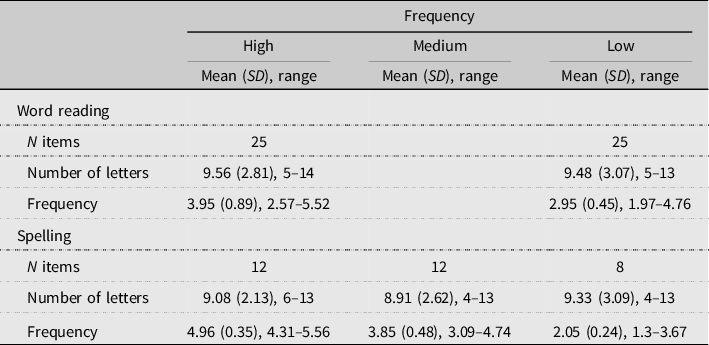
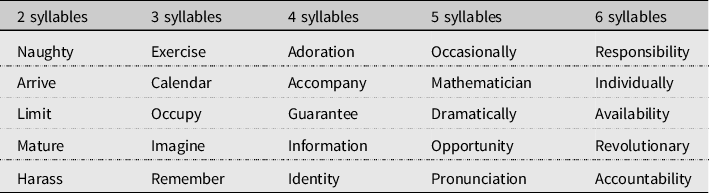
A multisyllabic word reading test was developed from a parallel task created by Heggie et al. (Reference Heggie, Wade-Woolley and Briand2010) but including higher frequency words. This was because Heggie et al. purposefully only used extremely low frequency words in order to conduct an error analysis instead of an accuracy analysis. However, as the current study intended to test accuracy rather than errors, an adaption was necessary. Twenty-five words ranging from 2 to 6 syllables were selected from the UK National Curriculum in England for Spelling (Department for Education, 2014). Across the different syllable lengths, the new 25 words were matched for word frequency using SUBTLEX -UK, based on frequencies for CBBC (a UK children’s TV channel; van Heuven et al., Reference van Heuven, Mandera, Keuleers and Brysbaert2014). The list of items is provided in Appendix 1, with summary statistics in Table 1. Both the 25 low frequency words from Heggie et al. and the 25 higher frequency words were administered, but only scores from the high frequency word list are reported in this paper. Reading results were coded as correct or incorrect based on whether they were pronounced correctly or not. In order to avoid spondee errors (no stress placement due to word sections spoken separately and slowly) all children were asked to read the words as a whole after a spondee attempt before moving on to the next word, ensuring there were no spondee errors. Cronbach’s alpha for this task was α =.91. Raw scores are reported.
Descriptive statistics of stimuli for the multisyllabic word reading and spelling tasks

Multisyllabic spelling
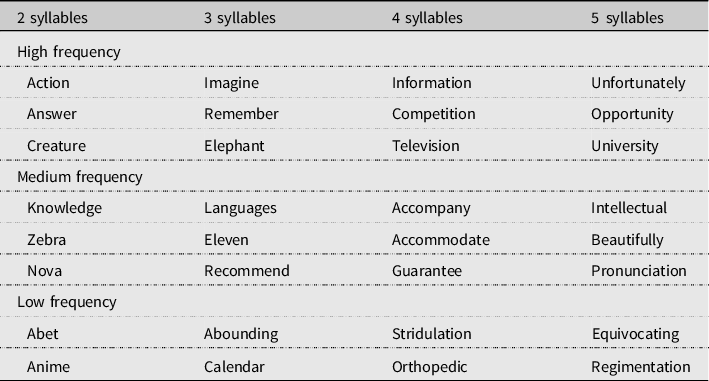
The multisyllabic word spelling task was created as an analogue to the multisyllabic word reading task. This task included 32 multisyllabic words with no discontinuation rule. Words were selected from the Government’s national curriculum in England for spelling (Department for Education, 2014) from the age appropriate curriculum (Years 3–5). Words ranged from 2 to 6 syllables in length. Low frequency, medium frequency, and high frequency words of each length were included in this task and subsequently in the analysis of this paper (SUBTLEX -UK, CBBC; van Heuven et al., Reference van Heuven, Mandera, Keuleers and Brysbaert2014). Across lengths, t tests confirmed that the words were matched for frequency (t values ranged from 0.82 to 0.95). Stimuli are presented in Appendix 2 and summarized in Table 1. This task was administered in small groups of 2–4 children who would hear the target word, then hear an example sentence containing the word, and finally hear the word again. Children would then write their answers down individually on paper. This was the only task administered within a group setting when possible, all other tasks were measured one-to-one. Any children who displayed extremely high levels of difficulty completed the task individually. Spelling results were then coded as correct or incorrect based on accuracy. Raw scores were used for analyses. Sample specific Cronbach’s alpha for this task was α = .87.
Results
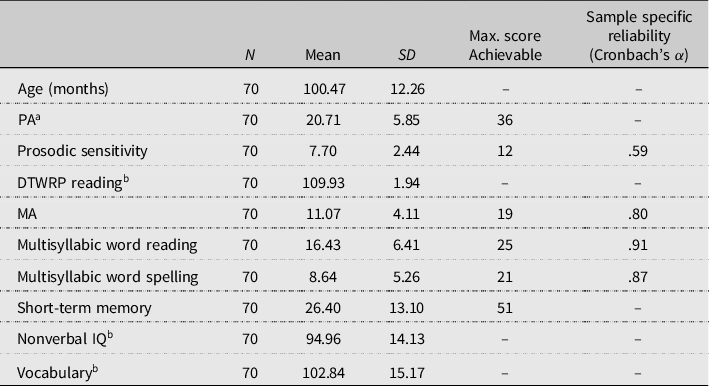
Descriptive statistics for the sample are shown in Table 2. The measure of short-term memory was positively skewed, so it was transformed using a log transformation. Standardized reading ability and multisyllabic reading were negatively skewed and so were transformed using a reverse score transformation to ensure a normal distribution and inverted for ease of interpretation. Verbal and nonverbal IQ were close to general population norms, while standardized word reading was slightly above average.
Descriptive statistics for all variables

a Scaled score in which population mean = 10, SD = 3.
b Standardized score in which population mean = 100, SD = 15.
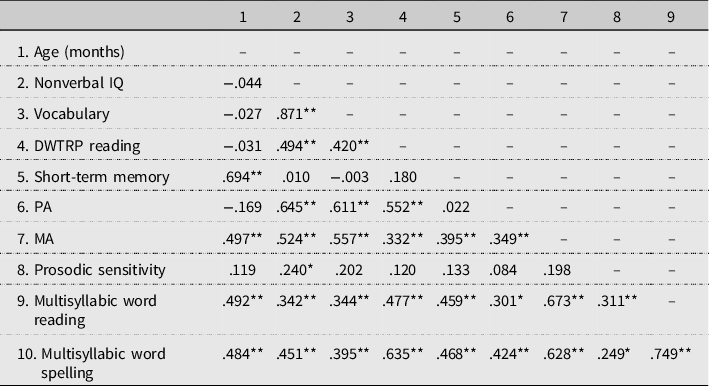
A correlation matrix showing the associations between the different variables is shown in Table 3. Generally, there were moderate intercorrelations between the variables, with the exception of the prosodic sensitivity measure, which was not significantly associated with the other predictor variablesFootnote 3 . All of the background and predictor variables were significantly associated with multisyllabic reading and spelling, which indicates it is appropriate to include them in a multiple regression. Notably, the standardized reading measure showed only a moderate correlation with the multisyllabic reading and multisyllabic spelling measures, providing support for the view that it is useful to examine multisyllabic literacy specifically.
Bivariate correlation matrix between all variables

Note: Both the standardized reading score and multisyllabic word reading score were reflected during transformation due to non-normal distributions; these reflections have been corrected for analysis.
**Correlation is significant at the .01 level (two-tailed).
*Correlation is significant at the .05 level (two-tailed).
We intended to include a mediation analysis assessing whether the effect of prosodic sensitivity on reading and spelling was mediated by other metalinguistic skills, but as there was no significant correlation between prosodic sensitivity and PA and MA, one of the essential preconditions for mediation was not met, and this analysis therefore will not be included.
Two hierarchical multiple regressions were conducted, with multisyllabic reading and multisyllabic spelling as outcome variables, respectively. In each case, we included the background variables age, nonverbal IQ, vocabulary, and short-term memory in the first block. In both cases, these variables accounted for a good proportion of the variance in the outcome. The three metalinguistic variables (PA, MA, and prosodic sensitivity) were then included in the second block.
PA, MA, and prosodic sensitivity as predictors of multisyllabic word reading
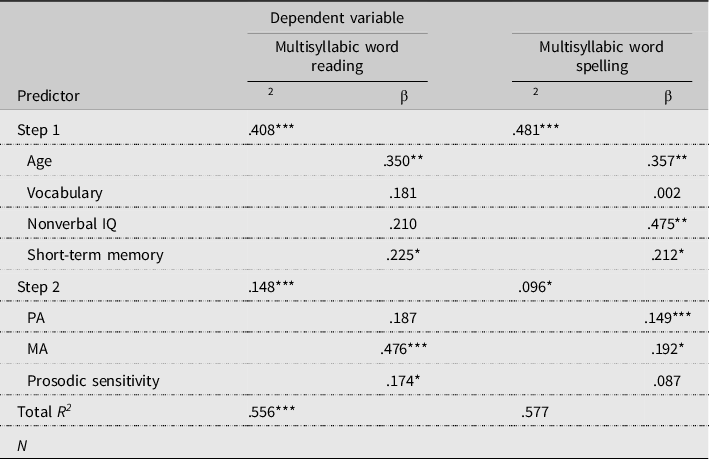
With respect to reading, the background variables accounted for 40.8% of the variance, while MA, PA, and prosodic sensitivity in combination accounted for a further 9.8%. MA (β = .476, p < .001) and prosodic sensitivity (β = .174, p < .05) were significant predictors of multisyllabic word reading when controlling for age, IQ, vocabulary, short-term memory, and other metalinguistic skills. However, PA (β = .187, p = .11) was not a significant predictor (see Table 4).
Hierarchical multiple regression analyses predicting multisyllabic word reading and spelling

*p < .10; **p < .05; ***p < .001.
Significant contributions to multisyllabic word reading
To assess the unique significant contributions of these metalinguistic skills for multisyllabic word reading, separate analyses were conducted consisting of three further hierarchical regressions. Each regression included a third step to isolate MA, PA, or prosodic sensitivity from the other six variables, to analyze their separate unique contributions. In relation to multisyllabic word reading, this indicated that MA (p < .001) displayed a significant unique contribution when controlling for age, vocabulary, nonverbal IQ, short-term memory, PA, and prosodic sensitivity. Prosodic sensitivity displayed a significant unique contribution to multisyllabic word reading when controlling for age, vocabulary, nonverbal IQ, short-term memory, PA, and MA (p = .04). Lastly, PA when controlling for age, vocabulary, nonverbal IQ, short-term memory, MA, and prosodic sensitivity did not display a significant unique contribution (p = .11).
PA, MA, and prosodic sensitivity as predictors of multisyllabic word spelling
With respect to spelling, the background variables accounted for 44.9% of the variance in outcome. The three metalinguistic variables added a further 9% of variance. This analysis demonstrated that MA (β = .256, p = .05) and PA (β = .322, p < .01) were significant independent predictors of multisyllabic spelling after controlling for background and other metalinguistic variables. In contrast, prosodic sensitivity did not account for significant variance in multisyllabic spelling (β = .089, p = .311).
Significant contributions to multisyllabic word spelling
In relation to multisyllabic word spelling, MA (p = .05) displayed a significant unique contribution when controlling for age, vocabulary, nonverbal IQ, short-term memory, PA, and prosodic sensitivity. PA displayed a unique significant contribution (p < .01) when controlling for age, vocabulary, nonverbal IQ, short-term memory, MA, and prosodic sensitivity. However, as expected, prosodic sensitivity did not display a unique significant contribution to spelling accuracy (p = .25)
Discussion
This study examined the predictors of multisyllabic word reading and spelling in a group of 7- to 10-year-old children. To our knowledge, this is the first study to examine the role of all three metalinguistic predictors in multisyllabic reading and spelling tasks. After controlling for age, vocabulary, IQ, and short-term memory, both prosodic sensitivity and MA were significant independent predictors of multisyllabic word reading, while PA was not. In multisyllabic word spelling, both PA and MA were significant independent predictors, but prosodic sensitivity was not.
The current research provides support for the growing body of literature indicating that MA is an important predictor of both reading and spelling, particularly in multisyllabic words (Clin et al., Reference Clin, Wade-Woolley and Heggie2009; Holliman et al., Reference Holliman, Mundy, Wade-Woolley, Wood and Bird2017b; Jarmulowicz et al., Reference Jarmulowicz, Taran and Hay2007). This is logical since multisyllabic words are more likely to be multimorphemic. It is likely that awareness of morphemes within longer words supports memory mechanisms for both spelling and reading, acting as “islands of regularity” in printed words (Rastle et al., Reference Rastle, Davis, Marslen-Wilson and Tyler2000).
PA was a significant predictor of multisyllabic spelling, but not multisyllabic reading. This lack of an association between PA and multisyllabic reading is in line with the findings of Holliman et al. (Reference Holliman, Gutiérrez Palma, Critten, Wood, Cunnane and Pillinger2017a) and is a potential explanation for the regularly reported finding that PA is an important predictor of early literacy, but becomes less important as children grow older (Hogan et al., Reference Hogan, Catts and Little2005; Kirby et al., Reference Kirby, Parrila and Pfeiffer2003). As children get older and their reading becomes more advanced, the words they read are more likely to be multisyllabic and multimorphemic, and therefore difficult to decode using grapheme–phoneme correspondences alone. As a result, PA becomes less important as a predictor, while MA and prosodic sensitivity become relatively more important for reading. In contrast, we found that PA was a significant predictor of multisyllabic spelling, a task which could be expected to place higher demands on phonological skills, as children need to segment a word and hold those segments in memory as they produce the spelling.
Prosodic sensitivity was a significant direct predictor of multisyllabic reading, but not spelling. This is perhaps the most striking finding, given that much of the previous research has often indicated an indirect, rather than a direct, role for prosodic sensitivity in literacy (Deacon et al., Reference Deacon, Holliman, Dobson and Harrison2018; Holliman et al., Reference Holliman, Critten, Lawrence, Harrison, Wood and Hughes2014; Wood et al., Reference Wood, Wade-Woolley and Holliman2009). However, it is in line with findings suggesting that prosodic sensitivity may have an important role to play in multisyllabic word reading, where lexical stress assignment is not always clear from the written form of a word (Holliman et al., Reference Holliman, Gutiérrez Palma, Critten, Wood, Cunnane and Pillinger2017a; Holliman et al., Reference Holliman, Mundy, Wade-Woolley, Wood and Bird2017b; Wade-Woolley, Reference Wade-Woolley2016).
Differences in the nature of the tasks might also be key to understanding why prosodic sensitivity predicts reading but is not a significant predictor of spelling. In spelling-to-dictation, the correct prosodic structure of the word is provided by the experimenter. High-quality lexical representations that include prosodic information may speed auditory word recognition (Perfetti & Hart, Reference Perfetti and Hart2002), but in terms of spelling processes, the speller’s receptive awareness of prosody just needs to be good enough to use this information to support auditory word recognition. They do not necessarily need to rely on prosody during the spelling processes. In the absence of information about prosody, correct spellings could still be produced by relying on knowledge of PA, morphology, and orthography. In contrast, in oral reading, the reader has to accurately construct prosodic structure to produce the correct pronunciation in an oral reading task – here the knowledge has to be both accurate and secure.
Holliman et al. (Reference Holliman, Critten, Lawrence, Harrison, Wood and Hughes2014) argue that prosodic sensitivity has reciprocal associations with vocabulary, and both vocabulary and prosodic sensitivity predict the development of PA and MA. They also showed that all three metalinguistic skills (PA, MA, and prosodic sensitivity) play significant independent roles in a standardized measure of word reading. However, our findings suggest that prosodic sensitivity and MA play independent roles in multisyllabic reading, while PA does not. In contrast, prosodic sensitivity does not seem to have a direct influence on spelling (either monosyllabic or multisyllabic), whereas PA and MA have a direct influence on both. Future research should carry out more detailed comparison of the skills required for reading and spelling monosyllabic and multisyllabic words.
The nature of the skills required for literacy tasks varies depending on the nature of the task at hand and the nature of the words used within the task. Prosodic sensitivity has a direct influence on reading, but no direct influence on spelling. PA is important for spelling and, while it is widely established that it is an important influence on early reading, our data suggest that it becomes relatively less important in multisyllabic word reading. MA is important for both multisyllabic word reading and spelling. Typically, standardized measures of reading and spelling have not recorded how many monosyllabic and multisyllabic words are included at different stages of development. Our findings suggest that it is potentially important to understand the nature of the items used within different literacy tasks, due to the composition of the words used, even when accounting for age. This finding supports and extends previous research in the area (e.g., Holliman et al., Reference Holliman, Mundy, Wade-Woolley, Wood and Bird2017b; Wade-Woolley, Reference Wade-Woolley2016). This could also be a concern within studies assessing the role of prosody in literacy, as these also often do not differentiate monosyllabic and multisyllabic literacy tasks, which this research shows could have an effect.
There are some limitations within our research and some findings which should be interpreted with caution. We had planned to examine mediated (indirect) effects of prosodic sensitivity on reading and spelling via PA and MA. However, prosodic sensitivity did not show significant correlations with PA and MA in this sample, precluding mediation analysis. This lack of association between the metalinguistic skills was surprising and taken in combination with the relatively low reliability of the prosodic sensitivity measure (despite our work to improve reliability), suggests some caution is required in interpretation of the results, particularly null results.
There is an extensive history of difficulties in developing reliable measures of prosodic sensitivity. In part, this may be because prosodic sensitivity is an umbrella term which covers a range of different skills, including lexical and metrical tasks, and focusing on stress, intonation, and timing (Holliman, Williams et al., Reference Holliman, Williams, Mundy, Wood, Hart and Waldron2014). We attempted to improve the reliability of measurement the prosodic sensitivity measure by including two different tasks tapping into different aspects of prosody (e.g., phrasal vs. lexical level). However, the second task, aimed at lexical level prosody, proved very difficult for our participants and was highly unreliable, and therefore we relied on the DEEdee task (phrasal prosody) in the analysis (refer to footnote 2).
As previously stated, comparisons between studies suggest that the DEEdee task has variable reliability. A possible reason for this variability is that prosodic sensitivity is not typically taught or measured in schools. As a result, the tasks and approaches are relatively unfamiliar to school children, and prosodic sensitivity is likely to remain at the epilinguistic level of awareness (Gombert, Reference Gombert1992). In effect, the DEEdee task is a metalinguistic task used to assess an epilinguistic phenomenon. Some support for this explanation comes from finding a positive correlation between prosodic sensitivity and nonverbal IQ, suggesting perhaps that the prosodic sensitivity task involves some aspect of fluid intelligence (c.f. Chan & Wade-Woolley, Reference Chan and Wade-Woolley2018).
Some of the children in our sample showed scores at, or close to, chance performance on the DEEdee task. Further, there was no significant correlation with age, indicating no particular improvement in performance from 7 to 10 years of age. The effects of prosodic sensitivity must therefore be interpreted with some caution. Nonetheless, performance was variable and rarely at floor. Therefore, the fact that prosodic sensitivity predicts multisyllabic word reading is a striking one and is unlikely to have occurred by chance. Further, that variability in prosodic sensitivity at this age influences literacy despite its independence from chronological age raises important implications for development. Further research should explore different and more reliable measures of prosody, to observe whether these effects persist, as well as exploring any difference between word and phrasal level prosodic stress. If this is achieved, it would also be beneficial to include a direct comparison of purely multisyllabic and purely monosyllabic words and their relationships to prosodic sensitivity to observe a direct difference, as implicated by this research.
A second key limitation is the cross-sectional nature of the analysis. Longitudinal studies are needed to clarify the direction of the effects between different measures. In particular, it is well established that there is a reciprocal relationship between PA and literacy (Wagner et al., Reference Wagner, Torgesen and Rashotte1994). It is likely that there is a similar reciprocal relationship between MA and literacy. Future work with longitudinal samples would allow examination of the direction of the association between the variables tested.
Lastly, a final limitation relates to the difference between the varied number of children participating per year group, making year group comparisons difficult. Instead, age is included as a covariate throughout.
Notwithstanding these limitations, the key findings from this study are that PA remains a strong predictor of spelling ability beyond the initial stages of development, and for longer than in reading. Meanwhile, prosody is a stronger predictor of oral reading than spelling in older children. This suggests that both segmental (PA) and suprasegmental (prosody) phonology have important but distinct roles in multisyllabic reading and spelling. As expected, MA was a particularly strong predictor of both reading and spelling of multisyllabic words. Previous work has tended to focus on the skills used in monosyllabic word reading and spelling, and as a result, has tended to overestimate the importance of PA in literacy, and underestimated the roles of two other, closely related metalinguistic skills: MA and prosodic sensitivity.
Appendices
Multisyllabic word reading task stimuli (adapted from Heggie et al., Reference Heggie, Wade-Woolley and Briand2010)

Multisyllabic word spelling stimuli