Adult second language (L2) learners typically speak their L2 with an accent (Flege, Reference Flege, Burmeister, Piske and Rohde2002; Flege, Munro, & MacKay, Reference Flege, Munro and MacKay1995; Munro, Flege, & MacKay, Reference Munro, Flege and MacKay1996). The nature of this accent is connected to the relationship between the learner's native first language (L1) and the L2, both in terms of the perceptual similarities between the phones of the L2 and the L1 (see Bohn & Flege, Reference Bohn and Flege1992), and in terms of the size of the L2 phonemic inventory relative to the L1 phonemic inventory (Iverson & Evans, Reference Iverson and Evans2007). The strength of the L2 accent is also partly determined by the amount of experience that a learner has had with the L2 (Best & Strange, Reference Best and Strange1992; Bohn & Flege, Reference Bohn and Flege1992; Flege, Bohn, & Jang, Reference Flege, Frieda and Nozawa1997; MacKain, Best, & Strange, Reference MacKain, Best and Strange1981), as well as his or her relative L1/L2 usage patterns (Flege, Frieda, & Nozawa, Reference Flege, Bohn and Jang1997; Piske, MacKay, & Flege, Reference Piske, MacKay and Flege2001), and the age at which the learner has acquired the L2 (Flege et al., Reference Flege, Munro and MacKay1995; Flege, Schirru, & MacKay, Reference Flege, Schirru and MacKay2003; Flege, Yeni-Komshian, & Liu, Reference Flege, Yeni-Komshian and Liu1999; MacKay, Meador, & Flege, Reference MacKay, Meador and Flege2001; Munro et al., Reference Munro, Flege and MacKay1996; Oyama, Reference Oyama1976; Piske, Flege, MacKay, & Meador, Reference Piske, Flege, MacKay and Meador2002; Seliger, Krashen, & Ladefoged, Reference Seliger, Krashen and Ladefoged1975; Yamada, Reference Yamada and Strange1995; Yeni-Komshian, Flege, & Liu, Reference Yeni-Komshian, Flege and Liu2000).
Despite this wealth of knowledge about the factors that influence L2 speech accent, theories dealing specifically with L2 production, such as the speech learning model (Flege, Reference Flege and Strange1995), have been slow to put forward testable hypotheses for what drives the clearly observable improvement from naïve to experienced L2 production. Rather, the focus has been on differences in the “learnability” of L2 phones based on their perceived similarity to L1 categories (Aoyama, Flege, Guion, Akahane-Yamada, & Yamada, Reference Aoyama, Flege, Guion, Akahane-Yamada and Yamada2004; Flege, Reference Flege1987), and the detailing of the improved production observed in the relative patterns of intelligibility (i.e., how well native listeners are able to identify accented phones as members of the intended category) at the two most extreme points of L2 acquisition: naïve or inexperienced L2 speakers versus highly experienced L2 speakers (see Flege et al., Reference Flege, Bohn and Jang1997; Flege, Takagi, & Mann, Reference Flege, Munro and MacKay1995; Larson-Hall, Reference Larson-Hall2006).
Theories of speech perception and production generally and sensibly assume that there is a close relationship between changes in L2 production and L2 perception. Although the perceptual training has been found to have an beneficial effect also on production (see, e.g., Bradlow, Pisoni, Akahane-Yamada, & Tohkura, Reference Bradlow, Pisoni, Akahane-Yamada and Tohkura1997), theories more focused on cross-language speech perception, such as the perceptual assimilation model (PAM; Best, Reference Best, Goodman and Nusbaum1994, Reference Best and Strange1995), have likewise avoided the issue of what drives the change from naïve to experienced L2 perception. Instead, the main focus has been on how the native phonological inventory (and the native phonetic realizations of those phones) affects the perception of nonnative phones by naïve listeners. In particular, PAM in its original form focused on the patterns of discrimination of pairs of nonnative phones that map onto native phonological categories in different ways, as a means to infer the organization of the native phonological inventory.
Only recently, through the extension of PAM to L2 acquisition (PAM-L2; Best & Tyler, Reference Best, Tyler, Munro and Bohn2007), has a model been developed that includes predictions regarding which aspects of L2 use and exposure drive L2 phonetic and phonological change in perception and production.
PAM-L2: AN ACCOUNT OF L2 PERCEPTION AND PRODUCTION
PAM-L2 (Best & Tyler, Reference Best, Tyler, Munro and Bohn2007) assumes (as does the speech learning model) that the language learning mechanisms of childhood L1 acquisition remain accessible throughout life. By extension, the mechanisms involved in L1 attunement and phonologization, that is, the tuning in to the higher order phonological structure of the native language, are also employed in the L2 acquisition requirement of reattunement of the perceptual systems and subsequent rephonologization, that is, the establishment of an L2 phonological system, by modification or addition to the L1 phonological system.
According to PAM-L2, L2 phones are first perceptually assimilated into or dissimilated from already existing L1 categories on a phonetic level, that is, on the basis of their language-specific realization. PAM-L2 further proposes that continued L2 vocabulary acquisition may subsequently lead an L2 learner to attune to higher order phonological distinctions in the L2 that may differ systematically from those in the L1. This phonetic and subsequently phonological attunement, however, is thought to happen optimally during the very beginning phase of L2 acquisition before a learner settles on a version of the L2 phonology, as he or she uses the language more and more routinely. The L2 phonology is, however, likely to remain accented and reflect the L1 phonology of the learner. In other words, PAM-L2 suggests that improvement in L2 segmental perception may slow down very early in L2 learning, while the L2 vocabulary is still fairly small. Furthermore, an even modestly larger beginning-phase L2 vocabulary may pressure the learner to settle on a particular L1-influenced version of the L2 phonology in order to build and maintain a large enough L2 vocabulary for adequate communication, curtailing further phonetic and phonological learning.
True to its theoretical foundations in direct realism (Gibson, Reference Gibson1966, Reference Gibson1979) and articulatory phonology (Browman & Goldstein, Reference Browman and Goldstein1989, Reference Browman and Goldstein1990, Reference Browman and Goldstein1992; Goldstein & Fowler, Reference Goldstein, Fowler, Schiller and Meyer2003), PAM/PAM-L2 suggests that the directly perceived gestural information in speech (i.e., the multimodal speech information) available from other speakers is also available, along with proprioception, from the listener herself during her own speech production. As no translation is needed between what is perceived and what is produced by the self, this leads to the general prediction that production will follow perception (unless the speaker receives specific articulatory training), as the speaker will perceive the articulatory gestural basis of his or her own productions and the productions of others, and subsequently fine tune the gestures involved in particular speech acts.
This lag in the development of speech production skills relative to speech perception development has been consistently identified in L1 learning toddlers (Benedict, Reference Benedict1979; Fernald, Pinto, Swingley, Weinberg, & McRoberts, Reference Fernald, Pinto, Swingley, Weinberg and McRoberts1998) and in L2 learning adults (Fan, Reference Fan2000; Laufer, Reference Laufer1998; Laufer & Paribakht, Reference Laufer and Paribakht1998; Webb, Reference Webb2008). In comparing the development of L1 and L2 production, at least two factors must be taken into consideration: first, there are differences between the cognitive abilities and motor control of a child L1 learner and those of an adult L2 learner (Harris & Chasin, Reference Harris and Chasin1999; Reznick & Goldfield, Reference Reznick and Goldfield1992), and second, the adult L2 learner may experience additional interference from the articulatory habits developed to suit their L1. Despite these two factors, however, the transfer of L2 perceptual learning to (more delayed) L2 production has been documented (e.g., Akahane-Yamada, Tohkura, Bradlow, & Pisoni, Reference Akahane-Yamada, Tohkura, Bradlow, Pisoni, Bunnell and Idsardi1996; Bradlow et al., Reference Bradlow, Pisoni, Akahane-Yamada and Tohkura1997), as would be expected.
The expectation of perceptual change (i.e., the achievement of more nativelike L2 perception) occurring before change to L2 production sets PAM apart from the motor theory of speech perception (Liberman, Cooper, Shankweiler, & Studdert-Kennedy, Reference Liberman, Cooper, Shankweiler and Studdert-Kennedy1967; Liberman & Mattingly, Reference Liberman and Mattingly1985) with which PAM is often compared, due to both theories’ focus on speech gestures rather than speech acoustics. Although not pertaining to L2 speech perception/production in particular, motor theory assumes that the fundamentals of speech are neuromotor commands that correspond, in a one to one fashion, to the intended phonemes, and that perception and production (even in an L2) must be conceptualized as flipsides of the same coin: production is perception in reverse, and vice versa. This leads to the prediction that perception and production develop simultaneously, or even with a production lead, contrasting with the PAM/PAM-L2 prediction that perceptual changes lead, and changes in production lag.
L2 VOCABULARY SIZE MATTERS
We extend PAM-L2 by introducing the vocabulary-tuning model of L2 rephonologization, or vocab model for short, which focuses on the facilitating effect of L2 vocabulary expansion in the early phase of L2 perceptual attunement, rephonologization, and L2 production, rather than simply on the curtailing effect of a larger L2 vocabulary. The vocab model suggests that improvements in L2 segmental perception and production during the early stages of L2 immersion may be positively associated with an expanding L2 vocabulary, as the need to decipher and comprehend L2 speech rapidly guides the learner to tune in to the phonological system of that particular language, rather than continue to perceive L2 speech on the basis of its superficial phonetic similarities (and dissimilarities) to the L1 (Cutler & Otake, Reference Cutler and Otake2004; Cutler, Weber, & Otake, Reference Cutler, Weber and Otake2006).
The proposed positive association between a larger L2 vocabulary and both L2 perception and L2 production is commensurate with research detailing the close relationship between initial L1 vocabulary development and both segmental perception and production in infants and toddlers. For instance, a positive association has been demonstrated between a child's ability to discriminate native speech sounds at 6 months and the size of his/her vocabulary (receptive and productive) in the second year of life (Tsao, Liu, & Kuhl, Reference Tsao, Liu and Kuhl2004), suggesting that successful segmental perception is essential to vocabulary development. Likewise, children with smaller productive vocabularies perform more poorly than children with larger vocabularies in terms of accuracy in the production of low-frequency L1 two-phoneme combinations (Edwards, Beckman, & Munson, Reference Edwards, Beckman and Munson2004), indicating that vocabulary size is closely related to successful speech production as well. Similarly, late talkers between 18 and 33 months of age produce phonetically complex utterances in a manner less intelligible than typically developing toddlers (Thal, Oroz, & McGaw, Reference Thal, Oroz and McGaw1995), whereas children with larger vocabularies have been found to outperform children with smaller vocabularies in nonword repetition tasks (Bowey, Reference Bowey2001). Taken together, these studies indicate strong links among successful speech perception, vocabulary size, and speech production. Although the association may be somewhat bidirectional, infant speech perception does seem to develop prior to the corresponding segmental production abilities (see, e.g., Rvachew, Alhaidary, Mattock, & Polka, Reference Rvachew, Alhaidary, Mattock and Polka2008; Whalen, Levitt, & Goldstein, Reference Whalen, Levitt and Goldstein2007; Whalen, Levitt, & Wang, Reference Whalen, Levitt and Wang1991).
Although the hypothesized positive association between L2 vocabulary expansion and improved L2 vowel production has yet to be tested, two studies (Bundgaard-Nielsen, Best, & Tyler, Reference Bundgaard-Nielsen, Best and Tyler2011, in press) have recently tested the related hypothesis that L2 vocabulary size is positively associated with L2 vowel identification and discrimination in adult L2 learners. In these studies, Japanese L2 learners of English with larger English vocabularies (>6,000 words, which has been proposed to be the necessary L2 vocabulary size for participation in normal L2 conversation; see Nation, Reference Nation2006) more consistently identified L2 vowels than learners with smaller L2 vocabularies (<6,000 words). L2 learners with larger vocabularies identified more vowels as consistently belonging to a specific L1 category in more than 50% of presentations, exhibited a higher average assimilation score for those vowels (percentage of vowels identified as that one category), and used a smaller set of L1 categories to label the set of L2 phones. Other studies, although not testing the prediction of the vocab model, have also found L2 vocabulary to be the key factor in the performance of L2 speakers on a range of perception and production tasks (see Cerviño & Mora, Reference Cerviño and Mora2009; Doty, Rogers, & Bryant, Reference Doty, Rogers and Bryant2009; Sperbeck, Reference Sperbeck2009), suggesting that the lexicon, rather than general L2 proficiency and/or syntax, that is centrally related to phonological development.
In the following study, we turn to L2 speech production, testing the predicted positive association between L2 vocabulary size and L2 vowel intelligibility in a group of newly immersed adult Japanese learners of Australian English (AusE). We test the prediction that learners who differ only in the size of their L2 vocabularies (and not in other relevant measures such as amount of L2 experience, years of learning, or duration of immersion), will also differ in their L2 vowel production intelligibility.
We examined Japanese learners of (Australian) English for several reasons. This particular language combination is traditionally considered one that is fairly taxing on the learner, as the very limited set of L1 vowel categories (Japanese has only five phonologically distinct vowels, in long/short pairs: /i, iː, e, eː, a, aː, o, oː, u, uː/) does not seem to provide the learner with very many options for assimilation of the total array of 18 AusE vowels (monophthongs /iː, ɪ, е, еː, ɜː, æ, ɐ, ɐː, oː, ʊ, ʉː, ɔ/ and diphthongs /ɪə, æɪ, ɑе, oɪ, əʉ, æɔ/). For details of the acoustic characteristics of the AusE vowels, see, for instance, Cox (Reference Cox2006) and Bundgaard-Nielsen et al. (Reference Bundgaard-Nielsen, Best and Tyler2011). This requires Japanese L2 learners of English to divide their existing phonetic and phonological space more finely in order to accommodate all the L2 vowels, although the results from recent perceptual studies indicate much greater perceptual flexibility in Japanese learners than previously predicted on the basis of contrastive analyses (Bundgaard-Nielsen et al., Reference Bundgaard-Nielsen, Best and Tyler2011, in press). Studying the vowel productions Japanese learners of AusE also allows us to relate our findings to those examinations of the typical Japanese perception of AusE vowels. This approach involves direct comparison of the phonological elements of the L2 relative to those of the L1 in order to predict which ones will be problematic for a given L2 learner on the basis of his/her native language background. We will thus focus on the seven AusE vowels /iː, ɪ, ɪə, oː, ʉː, əʉ, ɜː/ that combine to form the four PAM contrasts single category assimilation (SC) /iː/-/ɪə/, two-category assimilation (TC) /iː/-/ɪ/, uncategorized–categorized assimilation (UC) /ɜː/-/ʉː/, and uncategorized–uncategorized assimilation (UU) /əʉ/-/oː/ (Bundgaard-Nielsen et al., in press). These four contrast types yield different predictions in terms of what may be expected in L2 production. PAM-L2 (and by extension the vocab model) thus predicts that the SC contrast will fail to improve even with increased L2 vocabulary, whereas the members of the TC contrast will be well separated and likely produced in an intelligible fashion from early on in acquisition and only improve minimally with vocabulary expansion. Finally, the UC and UU contrasts may improve significantly over time, depending on the perceived similarities between the L2 phones, as the learner's L2 vocabulary expansion forces the learner to improve. These vowels also form a suitable test set for a production study, as they vary in duration, spectral qualities, and in the amount of dynamic change during production, in ways that are not found in Japanese.
THE PRODUCTION OF AusE VOWELS BY NATIVE SPEAKERS OF JAPANESE
The present study focuses on the production of the AusE vowels /iː, ɪ, ɪə, oː, ʉː, əʉ, ɜː/ by Japanese learners who differ in L2 vocabulary size, but not in their L2 acquisition history or the amount of immersion experience they have had with their L2.
Method
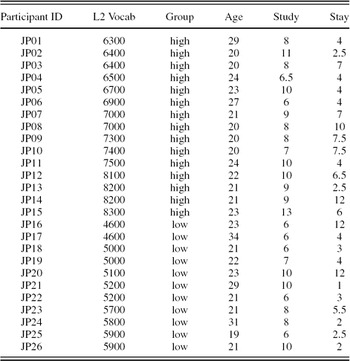
Japanese participants. The participant group consisted of 26 native speakers of Japanese (7 male, 19 female; M age = 23.1 years; for full details see Table 1), who were studying English as an L2 at an English college in Sydney or following a General Studies course at the University of Technology or the University of New South Wales in Sydney. All participants had come to Australia with the explicit purpose of improving their L2 comprehension and production, and all were in full-time (English-only) study programs. Some participants were in home-stay programs in families consisting of native as well as nonnative speakers of English, and often with more than one student, whereas others lived in share accommodation with other international students. One participant lived alone. Although all participants had regular contact with other speakers of Japanese, they reported speaking English most of the time in their homes in Australia (M = 70% of the time, range = 0–100). All had spent fewer than 3 months in Australia (stay in Australia, M = 5.4 weeks, range = 1–12 weeks) but had received English instruction in Japan in middle and high school, typically from native speakers of Japanese (foreign language English instruction, M = 8.3 years; range = 6–13 years), and overwhelmingly through the written medium. All had had occasional input from native speakers of various dialects of English (Australian, American, British, Irish, and New Zealand dialects of English), and they had been exposed to various dialects of English through popular music and films.
L2 vocabulary size, vocabulary group, age, number of years of English study in Japan, and duration of stay in Australia at the time of testing for all participants

Note: L2 Vocab, second language vocabulary; Group, vocabulary group; Study, number of years of English study in Japan; Stay, duration of stay in Australia at the time of testing (weeks).
Japanese productions of L2 English vowel targets. The stimuli used in this study were citation-form disyllabic nonsense words designed to elicit five AusE stressed monophthongs (/iː, ɪ, ɜː, oː, ʉː/) and two diphthongs (/ɪə, əʉ/). These specific vowels were selected on the basis of the perceptual assimilation patters observed in our preceding studies (Bundgaard-Nielsen et al., Reference Bundgaard-Nielsen, Best and Tyler2011, in press). The disyllabic nonsense words were in the form of first-syllable stressed /hVbə/. This context was chosen to minimize any effect of consonant coarticulation on the vowels (Strange et al., Reference Strange, Weber, Levy, Shafiro, Hisagi and Nishi2007). Furthermore, this structure is phonotactically legal in both English and Japanese (although susceptible to a range of systematic phonetic variations), and thus has the benefit of not causing problems for the Japanese speakers or the AusE listeners. The nonsense words were produced in isolation by the native Japanese learners of English as an L2.
All Japanese speakers produced five repetitions of each vowel. They were elicited from the speakers by having them read aloud randomized lists containing the target nonsense words heeba, hibba, horba, whoba, herba, hereba, and hoeba. The speakers were instructed to use an informal speaking style at a normal conversational speaking rate, and they were free to ask for assistance with grapheme–phoneme correspondence at any time during the recording. Tokens number 2, 3, and 4 of the five recorded tokens were selected from each of the 26 speakers when possible for use in the perceptual intelligibility study with native AusE listeners. A small number of tokens were eliminated from the study as they were clearly identifiable as vowel misreadings (i.e., produced in a manner atypical for that individual speaker, or in a manner that did not conform to English phoneme–grapheme correspondences, such as long Japanese /eː/, rather than English /iː/, for the spelling ee). Such misread tokens were replaced with the first or last repetition of the target nonword from the relevant speaker when possible, although some speakers consistently misread certain tokens and thus provided no alternatives. In cases where the speaker did not successfully read any tokens from a given category, the speaker contributed only tokens from vowel categories that were not consistently misread.
Tokens with mispronounced consonants were not considered misread, as L2 consonants were not the focus of this study. Typical consonantal errors were the substitution of /f/ for /h/ before /ʉː/ and /oː/, and bilabial fricative [β] for [b] before the word-final /a/. These particular substitutions reflect phonotactic constraints in Japanese, as the so-called /h/-kana series /ha/, /hi/, /hu/, /he/, /ho/ is realized with a palatal fricative [ʃ] preceding /i/, and a voiceless bilabial fricative (rather similar to a labiodental /f/) preceding back vowels /o/ and /u/. Similarly, Japanese does not have a phonemic /v/ but sometimes realizes Japanese [b] as [β], which is similar to English /v/. The Japanese substitutions also included errors that seem to have no basis in L1 phonotactics, such as /k/ and /b/ for /h/ before /ʉː/ and /oː/.
Audio recording took place in a sound-attenuated room at MARCS Auditory Laboratories at the University of Western Sydney, using a Shure SM10A headset microphone, an LG laptop computer, and an external sound card (Edirol UA-25). The intensity of all words was adjusted in Praat (Boersma & Weenink, Reference Boersma and Weenink2008) so that the average root mean square intensity of the target vowel was equal to 70 dB. The average vowel durations F1, F2, and F3 at 25%, 50%, and 75%, respectively, for each target vowel for the speakers are presented in Appendixes A (male speakers) and B (female speakers).
The participants also completed a multiple-choice L2–English vocabulary size test (Nation & Beglar, Reference Nation and Beglar2007), revealing that they had an average L2 vocabulary of 6392 words (range = 4600–8300 words).
Native AusE listeners. The listeners were eight Australian-born, native speakers of AusE (three male, five female, M age = 25.1 years). They did not speak any other language fluently. One participant reported knowing some Croatian; two participants had limited knowledge of French; one of Japanese; and one participant had limited knowledge of French and German. None had ever lived in a non-English speaking country. All had normal hearing and normal/corrected to normal vision.
Procedure. All AusE listeners were tested in a quiet room at MARCS Auditory Laboratories at University of Western Sydney, Australia. A total of 529 randomized individual tokens were presented over Koss UR20 headphones from a MacBook laptop computer using PsyScope. All listeners had an explanation as to which vowels were the intended targets for the nonwords and were presented with real-word examples. The participants identified each token's stressed (first) vowel in terms of on-screen spellings of the 18 bisyllabic target AusE nonsense words. These target words (heeba, hibba, hebba, hairba, herba, habba, hurba, habba, hobba, hoobba, whoba, horba, hereba, hayba, highba, howba, hoiba, hoeba) were created to allow the listeners to choose from the complete set of 18 AusE monophthongs and diphthongs (monophthongs /iː, ɪ, е, еː, ɜː, æ, ɐ, ɐː, oː, ʊ, ʉː, ɔ/ and diphthongs /ɪə, æɪ, ɑе, oɪ, əʉ, æɔ/: Cox, Reference Cox2006). Prior to the testing session, each participant was familiarized with the target words, and the orthographically nontransparent targets discussed in detail.
General predictions
There were two types of predictions for this study: specific predictions for the role of L2 vocabulary size in the overall intelligibility of L2 vowels and a general expectation that the intelligibility of the L2 vowels will reflect L1 phonetic/phonological interference. On the basis of PAM-L2 and the vocab model, we predicted that L2 vocabulary size would be associated with L2 vowel intelligibility, such that L2 learners with larger L2 vocabularies would produce more intelligible (i.e., correctly identifiable) L2 vowels than learners with smaller L2 vocabularies, even when those subgroups are otherwise comparable in terms of immersion duration and foreign language instruction in the L2. To operationalize L2 intelligibility, we proposed two complimentary measures: (a) consistency in identification as intended, that is, the number of L2 vowels produced in a manner so that they could be consistently identified as intended by native listeners; and (b) overall intelligibility, measured by the average percentage of the L2 vowels that are produced in an intelligible manner.
Results
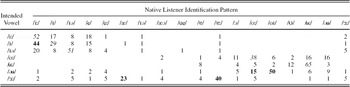
General intelligibility. The overall results from the identification task are presented in Table 2 as an intelligibility matrix. An L2 vowel was defined as intelligible to the native listeners if it was identified as belonging to the intended English category in more than 50% of instances. This 50% criterion follows the approach of previous studies on L2 perception (Best, Faber, & Levitt, Reference Best, Faber and Levitt1996; Bundgaard-Nielsen, Best & Tyler, Reference Bundgaard-Nielsen, Best, Tyler, Fletcher, Loakes, Göcke, Burnham and Wagner2008; Bundgaard-Nielsen et al., Reference Bundgaard-Nielsen, Best and Tyler2011, in press).
Intelligibility matrix showing the overall identification pattern percentage summed across all participants

Note: The intended second language vowels are presented in the leftmost column, and the top row indicates what the native listeners selected/perceived from among all 18 Australian English vowel choices. Italic indicates the percentage of each vowel identified as intended. Bold indicates greater misidentification as a nonintended vowel than as the correct target.
We included the vowels (selected tokens as described above) of all speakers in the intelligibility matrix (Table 2), despite not all speakers producing each of the seven vowels. We consider this approach sound, as vowels were only excluded (resulting in missing data points) on the basis of misreading, that is, when the nonnative speakers did not follow English rules for grapheme to phoneme transformation. Unusual realizations were included if they were not based on problems with English orthography. In addition, the average intelligibility score for each vowel was calculated on the basis of the total number of intended productions of that vowel used in the stimulus presentations, and thus not influenced by variation in the number of tokens produced for each vowel.
The intelligibility matrix reveals that only three (/iː, ɪə, ʉː/) of the seven produced vowels (/iː, ɪ, ɪə, oː, ʉː, əʉ, ɜː/) were produced in a manner that was intelligible to the listeners, according to our (lenient) 50% criterion (note that chance in this task would be one in six or 16.7%), with scores for two vowels (/ɪə/ and /iː/) at 51% and 52%, respectively, and /ʉː/ identified in 65% of instances. The vowels /ɪ, oː, əʉ, ɜː/ were not produced in a manner that was intelligible to the native listeners. The vowel /oː/ was identified as intended in 38% of instances, whereas /ɪ/ was only identified as intended in 29% of instances, and as /iː/ in 44% of instances. Poorest of all was the identification score for /ɜː/ at a mere 5%. It is interesting that the vowel /əʉ/ was perceived as AusE /oɪ/ 50% of the time, reflecting systematic mispronunciation and misidentification of this particular vowel.
Analysis by vocabulary size. To test the hypothesis that L2 vocabulary size is associated with improved L2 intelligibility, we split the 26 Japanese speakers (M vocabulary = 6392) into high L2 vocabulary (HV) and low L2 vocabulary (LV) groups with 6,000 words defined as the cut-off, following Bundgaard-Nielsen, Best, and Tyler (Reference Bundgaard-Nielsen, Best, Tyler, Fletcher, Loakes, Göcke, Burnham and Wagner2008, Reference Bundgaard-Nielsen, Best and Tyler2011, in press).
A series of independent t tests revealed that the HV and LV groups (HV: n = 15, M vocabulary = 7213; LV: n = 11, M vocabulary = 5272) differed in the size of their L2 vocabularies, t (24) = 2.62, p < .001, but did not differ in terms of years of English study in Japan, M HV = 8.8 years, M LV = 7.5 years, t (24) = 1.816, p = .082, nor in their length of residence in Australia on the day of testing, M HV = 5.9 weeks, M LV = 4.6 weeks, t (24) = 0.986, p = .334. The two groups did not differ on the amount of English they spoke in their homes in Australia, t (24) = 1.681, p = .207. There was no systematic difference between the two groups in terms of their enrolment in either a General Studies course at a university or one of the English colleges in Sydney.
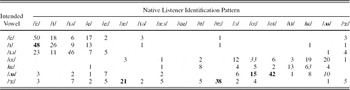
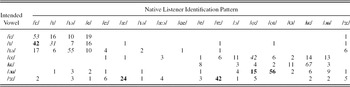
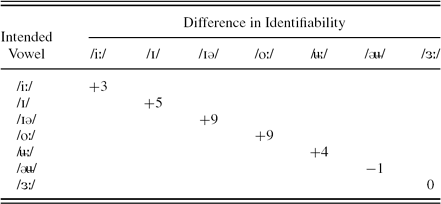
The intelligibility matrices for the LV and HV groups are presented in Table 3 and Table 4. The results show that the intelligibility of the learners was related to their L2 vocabulary size. Although the general pattern of intelligibility was similar for the LV (see Table 3) and HV (see Table 4) groups, the two groups differed on both proposed measures of L2 intelligibility, namely, number of vowels produced in a manner in where they could be consistently identified as intended by the native listeners, and the average intelligibility score (i.e., average of the percentage of each of the seven vowels identified as intended by the native listeners). A tally of the differences between the two groups is presented in Table 5.
Intelligibility matrix showing the overall identification pattern percentages summed across low vocabulary participants

Note: The intended second language vowels are presented in the leftmost column, and the top row indicates what the native listeners selected/perceived from among all 18 Australian English vowel choices. Italic indicates the percentage of each vowel identified as intended. Bold indicates greater misidentification as a nonintended vowel than as the correct target.
Intelligibility matrix showing the overall identification pattern percentages summed across high vocabulary participants

Note: The intended second language vowels are presented in the leftmost column, and the top row indicates what the native listeners selected/perceived from among all 18 Australian English vowel choices. Italic indicates the percentage of each vowel identified as intended. Bold indicates greater misidentification as a nonintended vowel than as the correct target.
Difference in the intelligibility score for the high vocabulary (HV) group versus the low vocabulary (LV) group
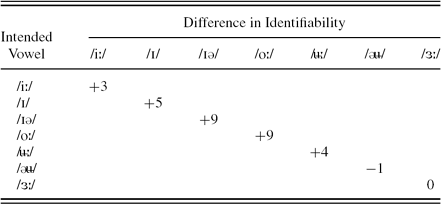
Note: The leftmost column indicates the intended vowels, and the first row contains the response categories. The reported score is calculated as the difference in the mean percentage of a vowel identified as intended between the HV group and the LV group. The score thus reflects the increase in identifiability between the vowels produced by the LV and the HV groups.
In terms of the number of L2 vowels that were identified as intended, the HV group successfully produced the vowels /iː, ɪə, and ʉː/ (at 53%, 55%, and 67%, respectively), whereas the LV group did not reach the 50% intelligibility criterion for the vowel /ɪə/ (only 46% of /ɪə/ tokens identified as intended by the native listeners), and thus only produced /iː/ and /ʉː/ (at 50% and 63%, respectively) as intended. Another difference between the HV and LV group was in the production of AusE target /əʉ/, which was produced by the HV group in a manner that lead the native judges to identify this target as /oɪ/ in 56% of instances, but which did not reach 50% identification as that (incorrect) vowel for the LV group.
For the analysis of overall intelligibility, we chose a different approach to the inclusive approach presented above. We excluded participants who did not produce all seven vowels from our analyses, that is, individuals who did not successfully read at least one token from all seven vowel categories. We chose this approach because the identity of missing vowel tokens varied from speaker to speaker (rather than representing general difficulties in common with a subset of the L2 vowels). Including speakers with a variety of missing vowels would potentially influence individual intelligibility averages drastically so that some speakers might appear to have surprisingly high intelligibility averages due to not having produced vowels that would typically not be intelligible (such as /ɜː/), whereas other participants would appear to be less intelligible than their peers due to not having produced vowels that would typically be relatively intelligible (such as /iː, ɪə, ʉː/). In total, we excluded six HV speakers and four LV speakers from the analysis.
Analysis of the background information for the remaining nine HV speakers (HV9) and seven LV speakers (LV7) followed the pattern for the larger HV and LV groups: HV9 and LV7 differed significantly in terms of their L2 vocabulary size, HV9 = 7288, LV7 = 5157; t (14) = 6.283, p < .001, but not in terms of the duration of their stay in Australia, t (14) = 0.185, p = .856, or the number of years that they had studied English in Japan, t (14) = 1.370, p = .192. Of importance, HV9 and LV7 differed significantly in the overall intelligibility score: HV9 = 55% intelligible, LV7 = 44% intelligible; t (14) = 2.595, p = .021.
Regression analysis. In order to further test our prediction that a larger L2 vocabulary is correlated with greater L2 intelligibility, we conducted a series of regression analyses on the intelligibility scores of those participants who successfully produced at least one token of all seven L2 vowels. By “successful production,” we refer to tokens that were not clearly misread.
We again excluded the 10 participants who had missing scores for one or more vowels from the analyses. As above, our reasons for adopting this approach, rather than one of replacing missing values with either group or individual means or scores of 0% correct are as follows. As participants did not always misread the same vowel, some appeared to have unusually high or low mean intelligibility scores, depending on whether they misread a vowel which was generally “easy” for the learners, or whether they misread a more “difficult” vowel. Replacing missing values with individual means was thus not a sound approach. Second, filling empty cells with a group-based but vowel-specific mean was unacceptable as it would entail that all participants would perform similarly, irrespective of their vocabulary size, duration of immersion, and other factors. Third, giving the participants a score of 0% correct would incorrectly conflate reading errors with failure to produce a given vowel.
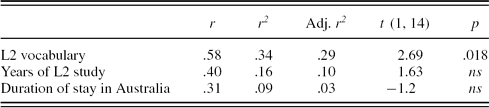
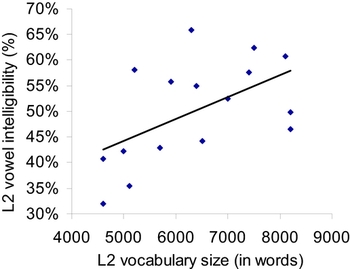
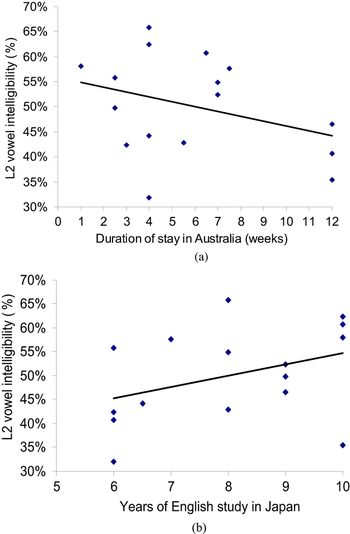
The results from the regression analysis of the remaining 16 participants showed that a large L2 vocabulary was linearly related to better vowel intelligibility (see Table 6). Overall intelligibility and L2 vocabulary size accounted for one-third of the variance in overall L2 vowel intelligibility, despite the effect that other factors might have on the performance of the participants, such as motor-patterning and a possible lag in the improvement of vowel production relative to the perceptual reattunement and rephonologization. The results also showed (see Table 6) that the intelligibility of the participants was not related to the amount of time they had spent in Australia, nor the number of years they had studied English in Japan prior to coming to Australia. The linear relationship between vocabulary size and mean intelligibility is presented in Figure 1, whereas the ns relationship between mean L2 intelligibility and the duration of the participants' stay in Australia and the number of years they studied English in Japan is presented in Figure 2a and b.
Results from the regression analyses
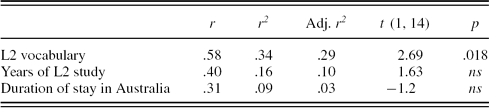
Note: The predictors are second language (L2) vocabulary size, years of L2 study in Japan, and the duration of the participants' stay in Australia. The dependent variable for each analysis is the average intelligibility of the seven L2 vowels produced only by speakers who did not systematically misread one or more targets.
Relationship between second language vocabulary size and overall intelligibility of the seven Australian English vowels.

(a) The relationship between the duration of the participants' stay in Australia and overall intelligibility of the seven Australian English vowels. (b) The relationship between the number of years of second language English study undertaken in Japan and overall intelligibility of the seven Australian English vowels.

DISCUSSION
Although the specific acoustic characteristics of Japanese-accented AusE vowels (or a subset of AusE vowels) have been systematically described previously (i.e., Ingram & Park, Reference Ingram and Park1997; Tsukada, Reference Tsukada1999), this is the first study of the perception of Japanese-accented AusE vowels by native listeners of the L2. It is also the first study testing the vocab model hypothesis that early during L2 immersion, L2 vocabulary expansion is associated with improved L2 segmental production in a group of Japanese learners of AusE.
As expected, the general intelligibility pattern revealed that the L2 vowels produced by the Japanese AusE learners were heavily accented (i.e., not identifiable consistently as they were intended by native listeners). This accent appears to reflect the phonological inventory of the learners, both in terms of the spectral qualities of the phones and their duration. To exemplify, the Japanese learners were unable to produce AusE /ɜː/ and /əʉ/ in a manner in which they could be identified as intended by native listeners, indicating that they struggled with central AusE vowels, which have no Japanese counterparts. Similarly, the learners had problems producing AusE /ɪ/ in a manner that was identifiable, possibly due in part to the durational difference between the (spectrally similar) vowels being different to that between single and bimoraic Japanese vowels, and in part due to the Japanese learners not producing crucial dynamic differences between the vowels (e.g., an onglide for AusE /iː/, see Cox, Reference Cox1999, Reference Cox2006).
In terms of the relevant PAM/PAM-L2 contrast types, some of the nonnative productions differ from native productions in the way they are perceived by native and nonnative listeners. In particular, /ɪə/ and /iː/, which in their native varieties are perceived as an SC contrast by Japanese and AusE listeners alike (see Bundgaard-Nielsen et al., Reference Bundgaard-Nielsen, Best and Tyler2011, in press; Bundgaard-Nielsen, Best, Tyler, & Kroos, Reference Bundgaard-Nielsen, Best, Tyler, Fletcher, Loakes, Göcke, Burnham and Wagner2008) were both successfully identified by the native listeners in their accented forms, perhaps due to (nonnativelike) hyperarticulation of the diphthong /ɪə/, or even the insertion of a rhotic, arising from the English orthography. Likewise, the identification pattern of the accented /ɪ/-/iː/ contrast differs from the clear TC assimilation found for this contrast by Japanese and native AusE listeners in the Bundgaard-Nielsen et al. (Reference Bundgaard-Nielsen, Best and Tyler2011, in press) and Bundgaard-Nielsen, Best, Tyler, and Kroos (Reference Bundgaard-Nielsen, Best, Tyler, Fletcher, Loakes, Göcke, Burnham and Wagner2008) studies. We suspect that /ɪ/ surprisingly failed to reach our lenient assimilation criterion of 50%, and was typically identified as /iː/ by the native listeners, as a reflection of a nonnative duration. Both the SC and TC contrasts thus indicate that the relationship between perception and production is complex, in particular when mediated by a nontransparent L2 orthography. For the UC and UU contrasts, the Japanese productions reflected the learners' problems in systematically identifying /ɜː/, /oː/, and /əʉ/, revealing a production pattern that is symmetrical with the perception pattern identified in previous work (Bundgaard-Nielsen et al., Reference Bundgaard-Nielsen, Best and Tyler2011, in press).
The results from the study support the vocabulary-growth hypothesis as the results are consistent with the prediction that newly immersed L2 learners with larger L2 vocabularies produce more intelligible L2 vowels than newly immersed L2 learners with smaller L2 vocabularies (indicating a close association between L2 vocabulary acquisition and L2 segmental production). As expected, HV and LV Japanese learners differed in their L2 vowel production on both proposed measures, namely, the number of L2 vowels they produced in an intelligible manner, and their overall intelligibility score. The results thus support the vocab model hypothesis that L2 vocabulary development is positively associated with change in L2 production accuracy, even in learners who have spent a very limited time in an L2-speaking environment. The study, however, does not allow the testing of the vocab model prediction that a large vocabulary by the first few weeks of immersion may curtail further improvements in L2 vowel intelligibility during the next few months of immersion. The results from the regression analysis further support the predictions of the vocab model as L2 vocabulary size is correlated with the L2 vowel intelligibility of our participants, whereas the duration of their stay in Australia and the number of years they studied English in Japan prior to arriving in Australia does not. There was a significant linear relationship between L2 vocabulary size and L2 vowel intelligibility.
The present study is thus compatible with PAM-L2 and the vocab model, and in particular with the prediction that early L2 vocabulary expansion facilitates improvements to L2 segmental production, whereas a larger L2 vocabulary may curtail further L2 segmental production, as the larger vocabulary forces the learner to settle on an (accented) L2 phonology. Learners with larger L2 vocabularies thus outperform learners with smaller L2 vocabularies at an early point in L2 immersion.
The results are also compatible with recent studies of L2 vowel perception (e.g., Bundgaard-Nielsen et al., Reference Bundgaard-Nielsen, Best and Tyler2011, in press) in which newly immersed Japanese learners of English who had larger L2 vocabularies also outperformed (in terms of L2 to L1 vowel assimilation, and L2 vowel discrimination) learners with smaller L2 vocabularies. Consistent with the results obtained here, the longitudinal study found that newly immersed learners with larger L2 vocabularies did not improve their L2 perception (assimilation and discrimination) after 6–8 months of additional L2 immersion.
The results are also compatible with the PAM-L2 (Best & Tyler, Reference Best, Tyler, Munro and Bohn2007) and vocab model hypothesis (Bundgaard-Nielsen et al., Reference Bundgaard-Nielsen, Best and Tyler2011, in press) that similar mechanisms underlie L1 and L2 language acquisition, with the caveat that the already acquired L1 of the learners will, of course, interfere with L2 production in a systematic manner, reflecting the similarities and differences between the particular L1–L2 pair. In particular, the results are compatible with observations from child language acquisition that large L1 vocabularies are associated with better segmental production, as well as with better segmental perception in the first year of life. Although recognizing that development in segmental production (and perception) and vocabulary expansion may be bidirectionally or even cyclically linked in the acquisition process, as has been suggested for child language acquisition (Smith, McGregor, & Demille, Reference Smith, McGregor and Demille2006), we also tentatively suggest that changes in perception initially precede those in production. This may also be reflected in the observed lag between developmental change in L2 perception and production.
Future research would thus benefit from continuing to consider both the similar processes (such as L2 vocabulary expansion, perceptual reattunement, and rephonologization) that may govern and connect perception and production intimately in L2 acquisition as well as the origins of the observed lag between improvements in L2 perception and production and which factors (such as motor patterning, and orthographic influences) may affect L2 perception and production differently.
APPENDIX A
Mean acoustic measurements of the productions of the seven male participants

APPENDIX B
Mean acoustic measurements of the productions of the 19 female participants