The literature has shown that children learning null argument languages, that is, languages that allow argument omissions, are particularly sensitive to discourse-pragmatic features. For example, Italian- and Inuktitut-speaking children use overt arguments to indicate new referents but null arguments to indicate given referents (e.g., Allen, Reference Allen2000; Allen & Schroder, Reference Allen, Schroder, Du Bois, Kumpf and Ashby2003; Serratrice, Reference Serratrice2005). Likewise, children learning other null argument languages such as Chinese (So, Demir, & Goldin-Meadow, Reference So, Demir and Goldin-Meadow2010), Korean (Clancy, Reference Clancy and Clark1993), Hindi (Narasimhan, Budwig & Murty, Reference Narasimhan, Budwig and Murty2005), and Romance (Paradis & Navarro, Reference Paradis and Navarro2003) follow discourse principles in their speech. Recent research findings showed that children who are learning a subject-prominent language, like English, appear to be as sensitive to the discourse principles as children learning null argument languages (So et al., Reference So, Demir and Goldin-Meadow2010). However, previous studies on the acquisition of discourse-pragmatic skills focused on monolingual children only. The question of interest is whether bilingual children who are learning a null argument language, Mandarin Chinese, and a nonnull argument language, English, have mastered discourse skills in both languages.
Bilinguals usually do not acquire both languages at the same pace (e.g., Bialystok, Reference Bialystok1988; Cromdal, Reference Cromdal1999; Hakuta & Diaz, Reference Hakuta, Diaz and Nelson1985; Mayberry & Nicoladis, Reference Mayberry and Nicoladis2000; Nicoladis, Mayberry, & Genesee, Reference Nicoladis, Mayberry and Genesee1999). This is mainly because most bilingual children are rarely exposed to the “one-parent–one-language” environment. Rather their parents use different languages with them, with the time spent on each language being uneven. Hence, this results in bilingual children being more dominant in one language than the other (Pearson, Fernández, Lewedeg, & Oller, Reference Pearson, Fernández, Lewedeg and Oller1997).
Little is known of the acquisition of discourse skills in bilinguals. Related to this line of research, Gullberg (Reference Gullberg2006) found that second language (L2) learners are often more explicit when speaking their L2 (weaker language) than they need to be. For example, they used specific referential expressions (i.e., nouns) in L2 for both newly introduced and previously mentioned characters, suggesting that they were not sensitive to the discourse principle of information status in L2. However, they produced nouns more often for newly introduced characters than for previously mentioned characters in their first language (L1, stronger language), suggesting that they have mastered the discourse skills in L1.
In the present study, we ask whether bilingual children have acquired discourse skills in two languages that vary in language proficiency. We focus on two languages, English and Mandarin Chinese. English is a subject-prominent language in which the subject–predicate relationship plays a major role in the grammar. In addition, it has verb morphology and inflection to mark subject agreement of the verb. Thus, it requires each sentence to include a subject (Bloom, Reference Bloom1990; Hyams & Wexler, Reference Hyams and Wexler1993). For example, it is ungrammatical to say “eat” without mentioning the subject “she.”Footnote 1 Besides subjects, English also requires objects to be mentioned. It is ungrammatical to say, “I take” without mentioning the object “the umbrella.” In general, English requires arguments to be overtly mentioned in speech. However, English speakers should use pronouns instead of nouns when referring back to the arguments that have been mentioned in the previous discourse context (Chomksy, Reference Chomksy1981).
Mandarin Chinese, unlike English, is a topic-prominent language. Thus, it allows deletion of arguments (Huang, Reference Huang1984; Tsao, Reference Tsao1990). For example, it is grammatical to say “Chi1 fan4” (eat lunch) without mentioning the subject “ta1” (she). It is also grammatical to say “wo3 na2 le4” (I take) without mentioning the object “zan3 zi3” (umbrella). However, Mandarin speakers do not omit arguments randomly. Rather they omit arguments when discourse conditions are appropriate (Lee & Naigles, Reference Lee and Naigles2005; Tsao, Reference Tsao1990). In a discourse in Mandarin, overt nouns refer to the entities that are not previously mentioned and not retrievable from previous context, whereas omitted arguments refer to the entities that are previously mentioned and are analyzed as coreferential with the overt noun phases in the preceding text (Chiu, Reference Chiu2001; Chu, 1998; Li, Reference Li2004; Li & Thompson, Reference Li, Thompson and Givon1979; Tao, Reference Tao and Fox1996). Hence, listeners can still understand what omitted arguments are referring to based on the information previously mentioned in the discourse.
Thus, English and Mandarin Chinese are grammatically different from each other in terms of representation of arguments in speech. Previous findings showed that English- and Mandarin-speaking children have acquired the grammatical rules in argument representation in their native languages. Zheng and Goldin-Meadow (Reference Zheng and Goldin-Meadow2002) observed English- and Mandarin-speaking children in a natural discourse context and found that English-speaking children obeyed the patterns of English and rarely omitted words for the agents. In contrast, Mandarin-speaking children displayed greater flexibility in their argument representation as Mandarin permits deletion. However, these children showed a bias to delete only the subjects of caused motion, not the subjects of spontaneous motion. Likewise, Wang, Lillo-Martin, Best, and Levitt (Reference Wang, Lillo-Martin, Best and Levitt1992) found that Mandarin-speaking children dropped their subjects and objects at a much higher rate than English-speaking children. They also showed that Mandarin-speaking children display an asymmetry in their deletion patterns, that is, they omitted subjects more frequently than objects.
Previous research has also shown that young English and Mandarin monolingual children have mastered discourse-pragmatic principle that underlies their respective languages (So et al., Reference So, Demir and Goldin-Meadow2010). In their study, English- and Mandarin-speaking caregivers were engaged in spontaneous interactions with their children. Their findings showed that Mandarin-speaking children omitted arguments more often than English-speaking children but that both English- and Mandarin-speaking children followed the discourse-pragmatic principle of information status of referents in their speech. That is, they produced nouns to indicate new referents and pronouns or null arguments to indicate given referents.
The first aim of the present study is to examine whether English–Mandarin bilinguals show sensitivity to the discourse-pragmatic principle of information status of referents in both languages. In order to address this issue, we compare the ways English–Mandarin bilinguals use speech to refer to given and new referents to age-matched English- and Mandarin-speaking monolingual children's. We expect that unbalanced bilingual children might have acquired discourse-pragmatic skills in their stronger language but not in their less dominant one.
Children also gesture when they talk. For example, they point to a bottle to refer to the bottle. It is interesting that their gestures followed the same pattern as speech: they gestured more often when indicating new referents than when indicating given referents (So et al., Reference So, Demir and Goldin-Meadow2010). Overall, children used nouns and gestures to indicate referents that needed to be specified. Thus, sensitivity to the discourse-pragmatic principle in speech appears to go hand-in-hand with that in gestures. The second aim of the present study is to explore whether gestures produced by English–Mandarin bilinguals follow the discourse principle when they are speaking in both languages.
Previous research showed that young children often convey their thoughts not only in their spoken modality but also in their gestures (e.g., Alibali, Reference Alibali1999; Church & Goldin-Meadow, Reference Church and Goldin-Meadow1986; Perry, Church, & Goldin-Meadow, Reference Perry, Church and Goldin-Meadow1988). It is more important that they use gestures to express thoughts that are not ready to be convyed in speech (Garber, Alibali, & Goldin-Meadow, Reference Garber, Alibali and Goldin-Meadow1998; Goldin-Meadow, Alibali, & Church, Reference Goldin-Meadow, Alibali and Church1993). In the study by Garber et al. (Reference Garber, Alibali and Goldin-Meadow1998), fourth-grade children were asked to explain mathematics problems to an experimenter, and it was found that the students conveyed solutions in gestures but not in speech. Church and Goldin-Meadow (Reference Church and Goldin-Meadow1986) reported that children often expressed new solutions to mathematics problems in gestures before they could articulate those solutions in speech.
Thus, emerging thought or knowledge is usually conveyed in gestures followed by speech. Such a phenomenon could be generalized to language acquisition. Previous findings showed that 10- to 14-month-old infants produced pointing gestures to refer to objects before they produced lexical words (Iverson & Goldin-Meadow, Reference Iverson and Goldin-Meadow2005), 12-month-old infants produced action gestures prior to words (Capirci, Contaldo, Caselli, & Volterra, Reference Capirci, Contaldo, Caselli and Volterra2005), and 18-month-old infants combined a gesture and a word before they combined two words (Ozcaliskan & Goldin-Meadow, Reference Özçalışkan and Goldin-Meadow2005). Gesture always seems to precede advances in speech.
Based on those previous findings, the possibility is raised that bilingual children who have not yet mastered discourse skills in their less dominant language might still be able to distinguish new referents from given referents in their gestures. That is, they might gesture new referents more often than given referents.
In the present study, we videotaped spontaneous interactions between children (both monolingual and bilingual) and their caregivers. We specifically looked at how bilingual children used speech and gestures to convey given and new referents and compared their speech and gestures with those produced by Mandarin- and English-speaking monolingual children.
METHOD
Participants
Our monolingual participants were six English-speaking children (three males, three females), and six Mandarin-speaking children (four males, two females). The mean age of the monolingual English-speaking children was 5 years, 1 month (5;1, range = 4;4–5;5), and that of the monolingual Chinese-speaking children was 4;9 (range = 4;3–5;8). English- and Chinese-speaking children were living in Chicago and Nanjing, China, respectively, in middle-class homes. Their caregivers were recruited from postings and were paid for their participation. Half of our monolingual children (three in each language group) participated in So et al.'s 2010 study. The rest of the monolingual children were added for this study.
Our bilingual participants were nine Singaporean Chinese children (five males, four females). The mean age was 5;3 (range = 4;5–5;11). These children were bilingual in English and Mandarin and were recruited from various local kindergartens and childcare centers. Their families were given a token of appreciation for participating in this study.
Bilingualism in Singapore
Singapore is a multicultural and multilingual country. It has four official languages (English, Mandarin–Chinese, Tamil, and Malay). A bilingual policy was adopted in 1966 and is considered to be fundamental to Singapore's well-being (Pakir, Reference Pakir, Gopinathan, Pakir, Kam and Saravanan1998). According to this policy, every child should learn English and one of the mother tongues. English is recognized as a “working language” in education and work, while the rest of the official languages are “mother tongues” of major ethnic groups (Dixon, Reference Dixon, Cohen, McAlister, Rolstad and MacSwan2005; Pakir, 1999).
Since 1987, English has been the sole medium of instruction for all content subjects. In contrast, mother tongues have been taught as mandatory classroom subjects but not used for teaching content subjects in all schools (Shepherd, Reference Shepherd2005). English in the form of British Standard English was considered prestigious compared to the Singapore Colloquial English, which had evolved from the schoolchildren of different language backgrounds in English schools in the early part of the 20th century (Shepherd, Reference Shepherd2005). Presently, the bilingual policy has greatly improved the literacy rates of Singaporeans in English (Pakir, Reference Pakir, Gopinathan, Pakir, Kam and Saravanan1998). However, among the Singaporean Chinese,Footnote 2 there has been a decline in the standard of Mandarin Chinese. This is mainly because many of these children are coming from English-speaking families. Hence, there is a trend that the majority of Singaporean Chinese children are dominant in English over Mandarin.
Procedure
All data collection was conducted in the children's homes. For monolinguals, all English- and Mandarin-speaking children were engaged in the spontaneous conversations with their caregivers. The caregivers were told that we were interested in studying parent–child interactions during play and were asked to interact naturally with their children. The whole session was videotaped, and each lasted for approximately 30 min. Of all English-speaking caregivers, four of them were the children's mothers and two were the children's fathers. Of all Mandarin-speaking caregivers, one of them was a child's grandmother, three were the children's mothers, and two were the children's fathers. All of them were monolingual children's primary caregivers. A bag of gender-neutral toys, books, and puzzles was brought for each session to facilitate the interaction.
For bilinguals, we began home visits by administering the self-reported Language Background Questionnaire (LBQ) that assessed the language dominance of the children (Tan, Reference Tan and Cruz-Ferreira2010). LBQ required caregivers to (a) identify the caregivers who looked after their children most of the time; (b) report which languages mothers, fathers, and other main caregivers, such as maids, childcare teachers, and grandparents, used with their children; (c) state the amount of time (out of 100%) they spent on each language with their children; (d) rank the children's language proficiency in English, Mandarin, and other languages; and (e) evaluate the children's abilities to understand and speak in each language using a 7-point scale.
After completion of the questionnaire, all bilingual children were engaged in spontaneous conversations with their caregivers. If primary caregivers were not available on the date of data collection, other main caregivers who were present were asked to interact with the children. Of all the caregivers of bilingual children who were videotaped, eight of them were children's mothers and one was a child's father. They were provided with the same instructions as the caregivers of monolingual children except they were asked to interact with their children in English for 30 min and in Mandarin for another 30 min. The order of language was counterbalanced across caregivers. A bag of gender-neutral toys, books, and puzzles was brought for each session.
Language dominance assessment in bilingual children
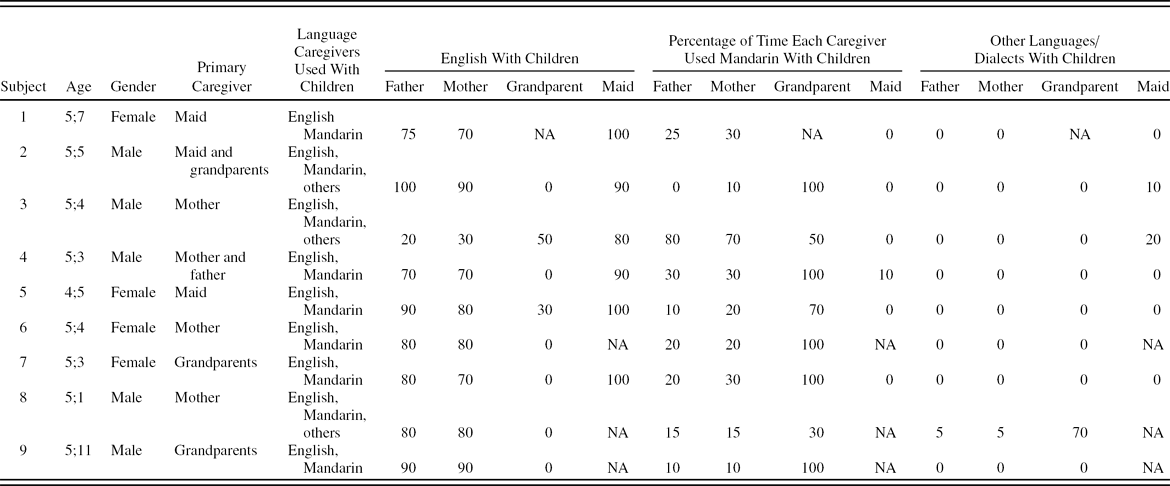
We determine children's language dominance based on the information reported by caregivers in LBQ. Table 1 shows the summary of results. We expected that a child's language dominance or proficiency would often be related to the amount of time he/she was exposed to a particular language (Mayberry & Nicoladis, Reference Mayberry and Nicoladis2000). Thus, we looked at the average amount of the time the parents and other main caregivers spent speaking in English or Mandarin to their children.Footnote 3 The score was calculated as a form of percentage. For example, if a child's father and mother each spoke English 80% of the time, her maid spoke English 90% of time, and her grandparent did not speak English, she was considered as being exposed to English 62.5%.
Summary of language background information of English–Mandarin bilinguals

Note: Ages are in years;months. NA, not available.
As shown in Table 1, the mean percentage of time exposed to English was 62.04% (SD = 11.64%, range = 45%–81.67%Footnote 4), to Mandarin was 34.17% (SD = 11.73%, range = 20%–50%), and to other languages was 3.80% (SD = 8.75%, range = 0%–26.67%). In general, bilingual children were exposed to English more often than Mandarin.
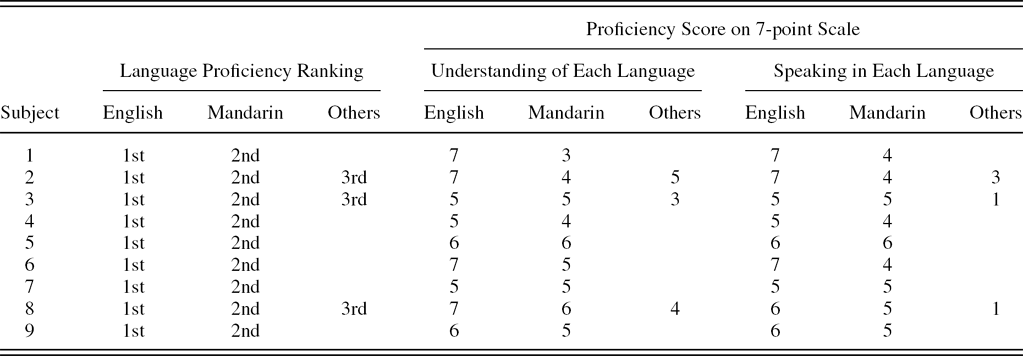
We also looked at how caregivers ranked their children's proficiency in each language. As seen in Table 2, all caregivers ranked their children as most proficient in English, followed by Mandarin. The mean proficiency score in understanding in English was 6.11 (SD = 0.87); the score for understanding in Mandarin was 4.78 (SD = 0.92). The mean proficiency score for speaking in English was 6.00 (SD = 0.82) and that for speaking in Mandarin was 4.67 (SD = 0.67). Thus, the proficiency scores in both understanding and speaking abilities in English were generally higher than those for abilities in Mandarin. Overall, caregivers reported that English was a more dominant language than Mandarin for their children.
Proficiency scores and ranking in English–Mandarin bilinguals
Spoken language transcription and coding
All conversations between children and caregivers were transcribed by research assistants who were native speakers of English and Chinese. Breaths, pauses, and speech dysfluencies such as self-interruptions, self-corrections, and repetitions were indicated in the transcripts. Speech that contained repetitions within one conversational turn, unintelligible sounds, songs, nursery rhymes, or poems were excluded from the analyses.
The remaining speech was segmented into utterances. Each utterance contained a clause. Utterances containing more than one clause connected by a conjunction (e.g., and, but, hai3 you2, bu2 guo4), were separated into two utterances. For the purpose of present study, we only included the utterances containing third-person referentsFootnote 5 (e.g., he, she, it, cat, ta1, mao1). Utterances produced by bilingual children were classified into three different language categories according to the language spoken: (a) English only (e.g., What is this?), (b) Chinese only (e.g., zhe4 ge4 shi4 mao1), and (c) mixed (e.g., zhe4 ge4 shi1 cat). Mixed utterances were excluded from the analyses.
Each referent was assigned to one of the three categories according to its form of referring expressions: (a) noun (e.g., deer, dog, lu4, gou3), (b) pronoun (e.g., he, she, it, ta1, this, that, zhe4 ge4, na4 ge4), and (c) null arguments. Third-person referents were further classified into information status: a third-person referent was considered given if it was mentioned somewhere in the preceding 20 utterances and new if it had not been mentioned in the preceding 20 utterances (Chafe, Reference Chafe and Tomlin1987; Du Bois, Reference Du Bois1987).
Gesture transcription and coding
Hand movements were considered as gestures if they were used to express information to an interlocutor and did not involve any direct manipulation of objects (e.g., piecing a puzzle; scissors, paper, stone; Özçalışkan & Goldin-Meadow, Reference Özçalışkan and Goldin-Meadow2005). Children's gestures were classified into the following types: (a) deictic gestures, (b) iconic gestures, (c) emblems, and (d) speech beats. Deictic gesture involves pointing at an object or person (e.g., index finger pointing at a rabbit, classified as a reference to rabbit) or holding up an object in midair to bring it to the interlocutor's attention (e.g., holding up a toy car, classified as a reference to toy car). Iconic gesture represents an action or a shape of the object (e.g., flapping both hands to indicate bird). Emblem is a conventional gesture whereby its meaning can be recognized by the interlocutor even without accompanying speech (e.g., holding up one finger to signify one). Speech beats are meaningless hand movements that follow the rhythm of speech (e.g., child taps hand once in midair while saying, I'm ready). Our analysis focused on the deictic and iconic gestures as they are always produced along with speech and they can identify referents (McNeill, Reference McNeill1992; So, Kita, & Goldin-Meadow, Reference So, Kita and Goldin-Meadow2009; So et al., Reference So, Demir and Goldin-Meadow2010).
All deictic and iconic gestures were then assigned semantic meaning (i.e., referents being conveyed). The semantic meaning of a gesture was determined by its form in conjunction with the co-occurring speech. For example, two hands flapping at the shoulders produced in conjunction with the utterance, “The bird eats a worm,” was assumed to refer to the bird. If a gesture was not accompanied by an utterance containing a word that expressed its third-person referent, the physical context or the form of gesture was used to determine its meaning. For example, pointing at a puzzle referred to the puzzle; a curved palm moving toward the mouth referred either to a glass or to an action of drinking.
The proportion of third-person referents conveyed in gestures was calculated as the total number of third-person referents conveyed in gestures, divided by the total number of third-person referents that could be expressed.Footnote 6 All proportions were subjected to an arcsine transformation before statistical analysis.
Reliability
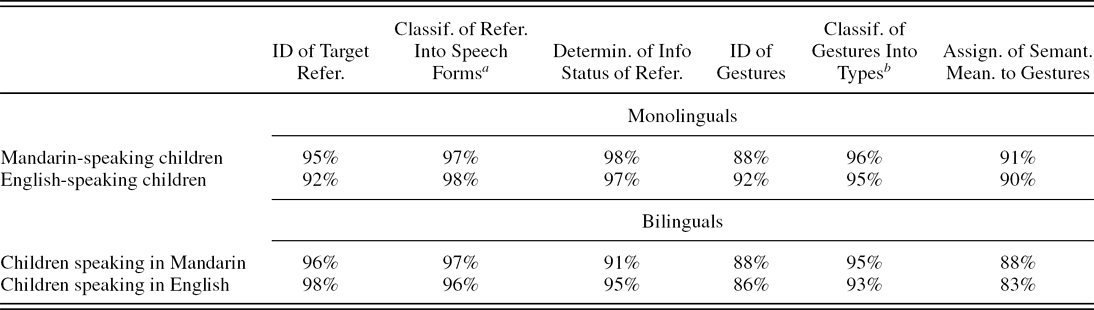
We established reliability by having a second individual transcribe 20% of speech utterances produced by monolingual English- and Chinese-speaking children and English–Mandarin bilingual children, respectively. The second coder was a bilingual speaker in English and Mandarin and was trained to code speech and gesture. Table 3 shows the summary of Cohen kappa values for interrater agreement rates in various aspects of speech and gesture coding.
Interrater agreements in speech and gesture coding (Cohen κ)
aNouns, pronouns, and omissions.
bDeictic gesture, iconic gesture, emblem, and speech beat.
RESULTS
This study aimed to examine whether English–Mandarin bilingual children showed sensitivity to the discourse-pragmatic principle of information status in their speech and gestures. If so, they should produce nouns to indicate new referents and pronouns or null arguments (depending on respective languages) to indicate given third-person referents. They should also gesture new third-person referents more often than given third-person referents. In order to address these issues, we compared the speech and gestures produced by English–Mandarin bilinguals to those produced by English- and Mandarin-speaking monolingual children. We first look at the ways monolingual English- and Mandarin-speaking children produced speech and gestures to indicate given and new third-person referents.
Monolingual English- and Mandarin-speaking children
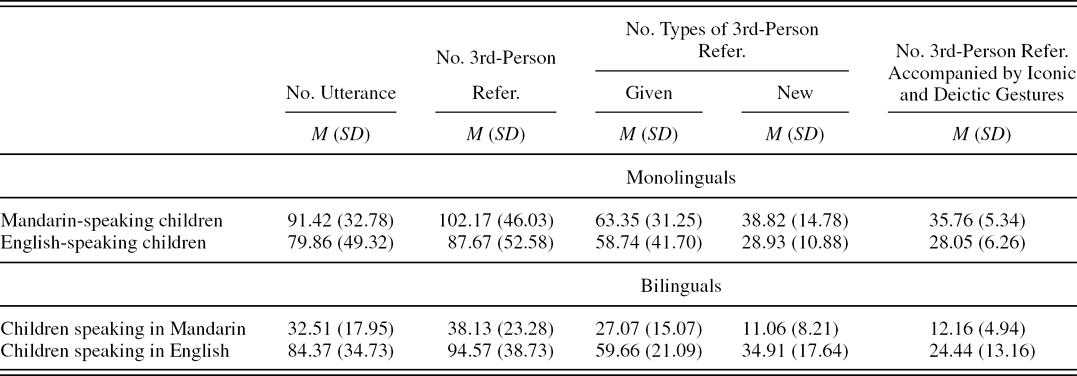
We only included the utterances containing third-person referents. Thus, we excluded 221 utterances produced by monolingual Mandarin-speaking children, and 151 utterances by monolingual English-speaking children. Table 4 (top) shows the mean number of utterances, mean number of third-person referents, mean number of given and new third-person referents, and mean number of third-person referents accompanied by iconic and deictic gestures in both groups of monolingual children.
Summary of mean (standard deviation) number of utterances, third-person referents and their types, and third-person referents accompanied by iconic and deictic gestures produced by monolingual and bilingual children in both languages
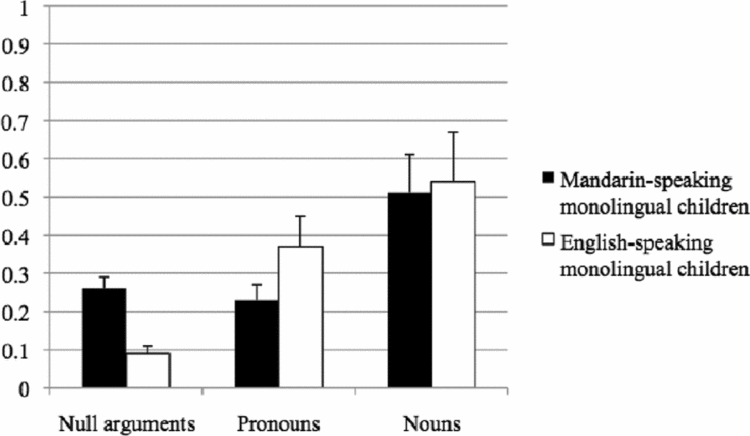
We first examine how monolingual English- and Mandarin-speaking children conveyed third-person referents in speech. Figure 1 shows the distribution of types of referring expressions produced by English- and Mandarin-speaking children. The proportion of each type of the referring expressions for each speaker was calculated as the total number of that form of referring expressions divided by the total number of third-person referents that could be expressed. The majority of referring expressions were nouns in both language groups. We conducted three independent-sampled t tests, one for each type of the referring expression. The proportion of null arguments was higher in Mandarin-speaking children than that of null arguments in English-speaking children, t (10) = 2.75, p < .02. In contrast, the proportion of pronouns in English-speaking children was greater than that of pronouns in Mandarin-speaking children, t (10) = 1.83, p < .05. There was no significant difference in the proportion of nouns between two language groups, t (10) = .92, ns.
The distribution of different forms of referring expressions in speech produced by monolinguals Mandarin-speaking children (black bars) and English-speaking children (white bars).
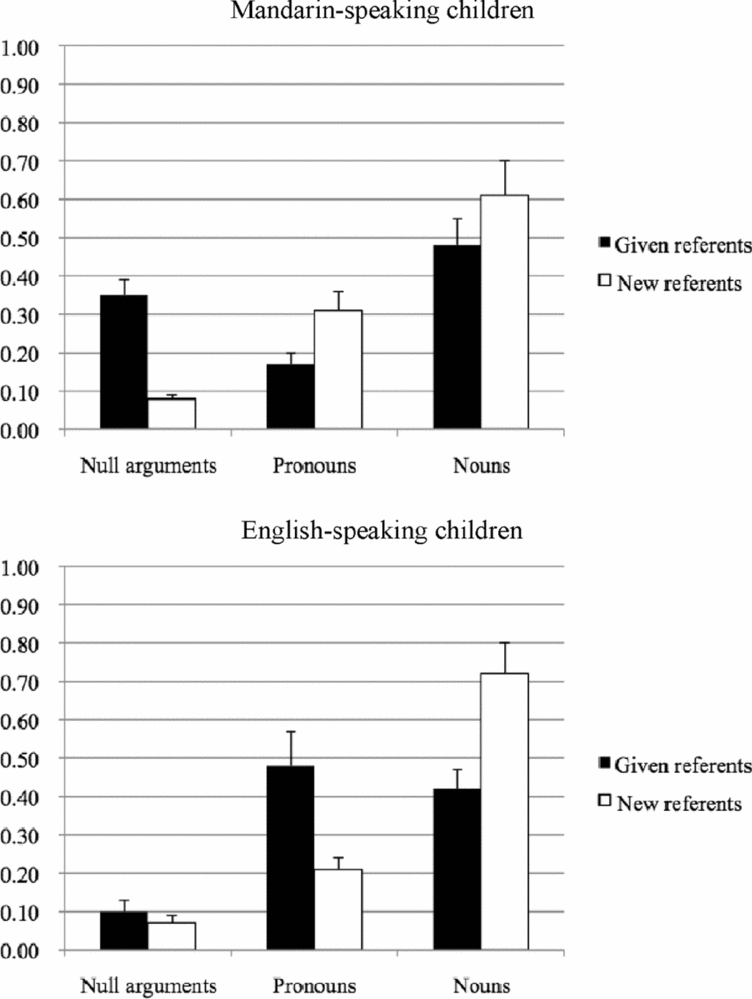
Next, we examined whether their speech followed the discourse principle of information status of third-person referents. Figure 2 shows the distribution of the different types of referring expressions that conveyed given and new third-person referents in both Mandarin- and English-speaking children. We conducted three separate, mixed analyses of variance (ANOVAs), one for each type of the referring expression, with mean proportion of referring expressions as the dependent variable, language group (Mandarin, English) as the between-subject independent variable, and information status (given, new) as the within-subject independent variable.
The distribution of different forms of referring expressions for given and new referents produced by monolinguals speaking in (top) Mandarin and (bottom) English.
For null arguments, there was a significant effect of language, F (1, 10) = 34.61, p < .001, a significant effect of information status, F (1, 10) = 24.38, p < .001, and a significant interaction, F (1, 10) = 15.34, p < .01. In general, Mandarin-speaking children produced null arguments more often than English-speaking children. Paired-sample t test showed that Mandarin-speaking children produced null arguments more often when conveying given third-person referents than when conveying new third-person referents, t (5) = 3.91, p < .01. However, such difference was not found in English-speaking children, t (5) = 0.12, ns.
For pronouns, there was a significant effect of language, F (1, 10) = 6.01, p < .04, no effect of information status, F (1, 10) = 2.34, ns, and a significant interaction, F (1, 10) = 15.39, p < .01. Mandarin-speaking children tended to produce pronouns more often when conveying new third-person referents than when conveying given third-person referents. The difference was marginally significant, t (5) = 1.89, p < .07. However, such pattern was opposite in English-speaking children; that is, English-speaking children produced pronouns more often when conveying given third-person referents than when conveying new referents t (5) = 2.51, p < .03.
For nouns, there was no effect of language, F (1, 10) = 2.56, ns, a significant effect of information status, F (1, 10) = 23.29, p < .001, and no interaction, F (1, 10) = 1.34, ns. Children in both language groups tended to produce nouns more often when conveying new third-person referents than when conveying given third-person referents.
To summarize, our findings showed that monolingual children in both language groups used less-specified referring expressions, that is, null arguments and pronouns, to indicate given third-person referents. Of all given third-person referents, 52% (SD = 11.13%) of them were conveyed in less-specified referring expressions in Mandarin-speaking children. Similarly, 58% (SD = 10.08%) of given third-person referents were conveyed in less-specified referring expressions in English-speaking children. However, the type of less-specified referring expressions differed between two language groups. Monolingual Mandarin-speaking children tended to use null arguments to indicate given third-person referents whereas monolingual English-speaking children tended to use pronouns to indicate given third-person referents. These findings showed that both Mandarin- and English-speaking children have acquired the language-specific rules in their argument representation. In contrast, monolingual children in both language groups used nouns to indicate new third-person referents, suggesting that they have mastered the discourse principle of information status.
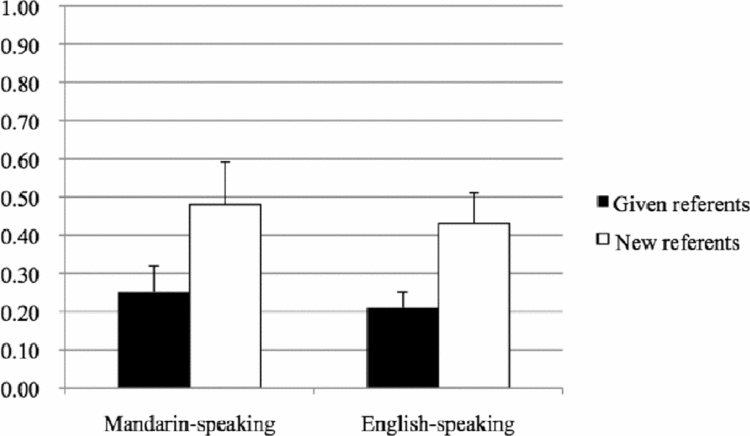
Finally, we examined whether their gestures followed the discourse principle of information status of third-person referents as well. Children in both language groups gestured. Figure 3 shows the proportion of given and new third-person referents accompanied by gestures in Mandarin- and English-speaking children. A mixed ANOVA with the mean proportion of third-person referents accompanied by gestures as the dependent variable, language group (Mandarin, English) as the between-subject independent variable, and information status (given, new) as the within-subject independent variable, was conducted. There was no effect of language, F (1, 10) = 1.19, ns, a significant effect of information status, F (1, 10) = 17.14, p < .01, and no interaction, F (1, 10) = 0.92, ns. Thus, children in both language groups produced gestures more often when conveying new third-person referents than when conveying given third-person referents.
The proportion of given and new referents accompanied by gestures in (left) Mandarin-speaking children and (right) English-speaking children.
To summarize, monolingual Mandarin- and English-speaking children showed sensitivity to the discourse principle of information status both in their speech and in gestures. Then, we look at the speech and gestures produced by English–Mandarin bilinguals, asking whether they followed the discourse principle in both languages.
English–Mandarin bilinguals
We only included utterances containing third-person referents, and thus we excluded 223 utterances spoken in English and 78 utterances spoken in Mandarin. After excluding utterances not containing third-person referents, there were 55 mixed utterances (i.e., utterances containing both English and Mandarin); 821 utterances spoken in English; and 356 utterances spoken in Mandarin. For the purpose of present study, we excluded mixed utterances and included English- and Mandarin-only utterances that contained third-person referents.
Table 4 (bottom) shows the mean number of utterances, mean number of third-person referents, mean number of given and new third-person referents, and mean number of third-person referents accompanied by iconic and deictic gestures produced by bilingual children when they were speaking in both languages. Note that bilingual children produced significantly fewer utterances as well as third-person referents when they were speaking in Mandarin than when they were speaking in English, number of utterance, t (8) = 4.53, p < .01; number of new third-person referents: t (8) = 4.74, p < .01 (also see bottom of Table 4). Because of such differences, the proportions of different types of referring expressions were computed on highly variable sample sizes. In addition, the actual numbers of different types of referring expressions were rather limited in Mandarin due to a small language sample.Footnote 7 Thus, the following analyses on the speech in Mandarin should be interpreted with caution, especially when comparing English and Mandarin utterances produced by bilingual children and when comparing Mandarin utterances of bilingual and monolingual children.
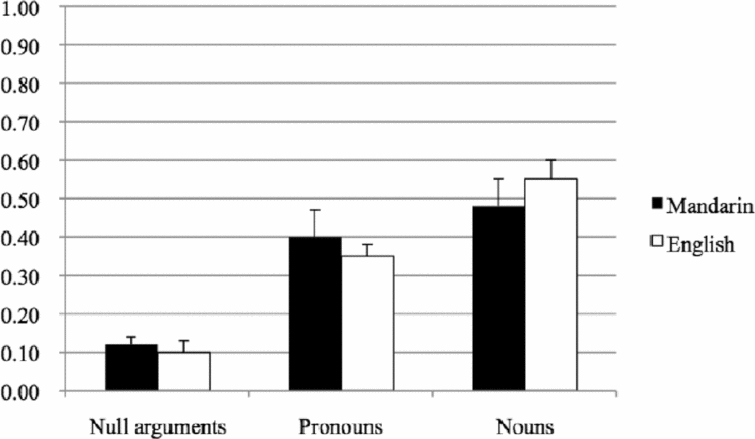
Figure 4 shows the distribution of different types of referring expressions in bilingual children when they were indicating third-person referents in English and Mandarin. Three paired-sample t tests were conducted for each type of referring expressions. The proportion of null arguments was similar in both Mandarin and English, t (8) = 0.23, p < ns. The proportion of pronouns was also similar in both languages, t (8) = 0.91, p < ns. The proportion of nouns was slightly higher in English than in Mandarin, but the difference did not reach significance, t (8) = 1.27, ns. As a result, the distribution of nouns, pronouns, and null arguments in Mandarin was similar to that in English in bilinguals.
The distribution of different forms of referring expressions in speech produced by English–Mandarin bilingual children when they were speaking in (black bars) Mandarin and (white bars) English.
The way English–Mandarin bilingual children represented arguments in Mandarin was different from monolingual Mandarin-speaking children in two aspects. First, the proportion of null arguments was significantly higher in monolingual Mandarin-speaking children (26%) than in English–Mandarin bilingual children (11%), t (14) = 3.43, p < .001. Second, the proportion of pronouns was significantly lower in monolingual Mandarin-speaking children (22%) than in English–Mandarin bilingual children (40%), t (14) = 3.68, p < .001.
In contrast, the way English–Mandarin bilingual children represented arguments in English was similar to that of monolingual English-speaking children. The proportions of null arguments and pronouns in English–Mandarin bilingual children resembled those in monolingual English-speaking children: null arguments: t (14) = 0.34, ns, pronouns: t (14) = 0.56, ns.
Altogether, bilingual children might have acquired language-specific rules in argument representation in English but not in Mandarin. However, some of the findings (especially those on the null arguments) might be difficult to interpret due to small language sample in Mandarin (see Note 7).
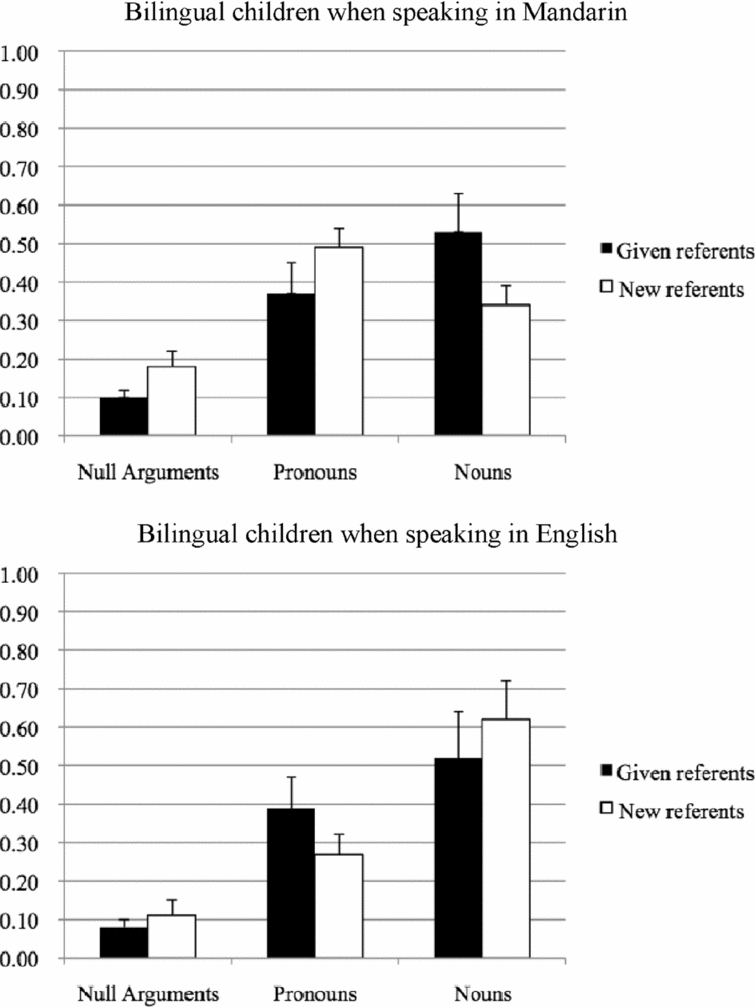
We next ask whether English–Mandarin bilingual children showed sensitivity to the discourse principle of information status in their speech. Figure 5 shows the distribution of different types of referring expressions that conveyed given and new referents in bilingual children when they were speaking in Mandarin and English.
The distribution of different forms of referring expressions for given and new referents produced by English–Mandarin bilingual children when they were speaking in (top) Mandarin and (bottom) English.
We conducted three separate, repeated measures ANOVAs, one for each type of the referring expressions, with mean proportion of referring expressions as the dependent variable, language group (Mandarin, English) as the within-subject independent variable, and information status (given, new) as the within-subject independent variable. For null arguments, there was no effect of language, F (1, 8) = 0.98, ns, no effect of information status, F (1, 8) = 3.27, ns, and no interaction, F (1, 8) = 0.28, ns. The proportion of null arguments referring to new third-person referents appeared to be greater than that of null arguments referring to given third-person referents in Mandarin, but the difference did not reach significance, t (8) = 1.31, ns.
For pronouns, there was no effect of language, F (1, 8) = 1.28, ns, no effect of information status, F (1, 8) = 0.89, ns, and significant interaction, F (1, 8) = 7.54, p < .03. To explore the interaction further, we conducted two paired-sample t tests for Mandarin and English respectively. When speaking in Mandarin, the proportion of pronouns referring to new third-person referents was higher than that of pronouns referring to given third-person referents, t (8) = 1.97, p < .05. Such pattern was opposite in English, that is, the proportion of pronouns referring to new third-person referents was lower than that of pronouns referring to given referents, t (8) = 1.91, p < .05.
For nouns, there was a significant effect of language, F (1, 8) = 7.45, p < .03, no effect of information status, F (1, 8) = 0.63, p = ns, and significant interaction, F (1, 8) = 9.48, p < .02. In general, the proportion of nouns was greater in English than in Mandarin. When speaking in English, the proportion of nouns referring to new third-person referents was greater than that of nouns referring to given third-person referents. The difference was marginally significant, t (8) = 1.60, p < .08. However, such pattern was opposite in Mandarin, that is, the proportion of nouns referring to new third-person referents was smaller than that of nouns referring to given third-person referents, t (8) = 1.91, p < .05.
Based on the small language sample in Mandarin, the proportion of null arguments referring to given third-person referents appeared to be similar to that of null arguments referring to new third-person referents in bilinguals. By contrast, the proportion of null arguments referring to given third-person referents was greater than that of null arguments referring to new third-person referents in monolingual Mandarin-speaking children. In addition, the proportion of nouns referring to given third-person referents seemed to be higher than that of nouns referring to new third-person referents in bilinguals. However, an opposite pattern was observed in monolingual Mandarin-speaking children. In general, the way English–Mandarin bilingual children produced null arguments and nouns to refer to given and new referents might indicate that they have not yet mastered discourse skills in Mandarin.
In contrast, English–Mandarin bilinguals seemed to show sensitivity to the discourse principle when they were speaking in English. The proportion of pronouns referring to given third-person referents was higher than that of pronouns referring to new third-person referents. In addition, the proportion of nouns referring to given third-person referents was lower than that of nouns referring to new third-person referents. These patterns were also observed in monolingual English children.
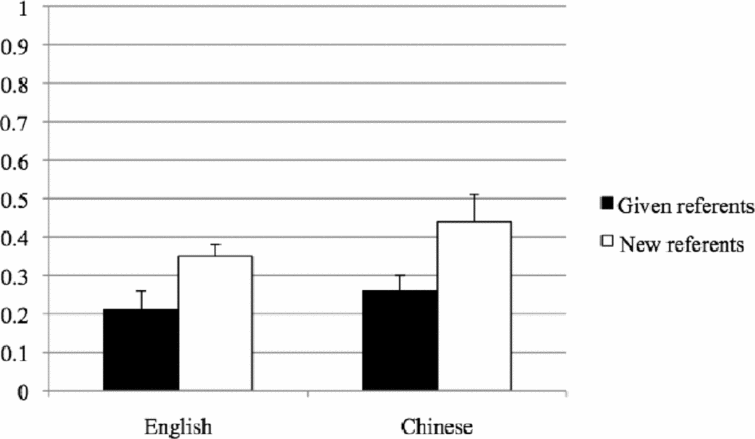
Finally, we ask whether the bilingual children followed the discourse principle of information status when they gestured. Figure 6 displays the proportion of given and new third-person referents accompanied by gestures in bilinguals when they were speaking in Mandarin and English. We conducted a repeated measure ANOVA with the proportion of expressions accompanied by gesture as the dependent variable, and information status (given, new) and language (English, Chinese) as the within-subject independent variables. We found a significant effect of type of the information status, F (1, 8) = 43.75, p < .001, no effect of language, F (1, 8) = 4.20, ns, and no interaction, F (1, 8) = 1.10, ns. Thus, the bilingual children gestured new referents more often than given referents in both languages.
The proportion of given and new referents accompanied by gestures in English–Mandarin bilingual children when they were speaking in (left) Mandarin and (right) English.
DISCUSSION
Our study explored whether bilingual children's speech and gesture followed the discourse principle of information status when they were speaking in their dominant (English) and less dominant (Mandarin) languages. We compared the ways bilinguals used speech and gestures to indicate given and new third-person referents to those of monolingual English- and Mandarin-speaking children. Our findings showed that monolingual children in both language groups showed sensitivity to the discourse principle in both speech and gestures. English–Mandarin bilingual children might also display sensitivity to the information status of third-person referents in speech when speaking in their dominant language but not in their less-dominant language. Yet, they showed such sensitivity in gestures in both languages. However, these findings were based on a relatively small language sample in Mandarin in bilinguals.
Acquisition of language-specific rules in argument representation in English and Mandarin
English is a nonnull argument language that requires arguments to be mentioned in most of the situations (Bloom, Reference Bloom1990; Hyams & Wexler, Reference Hyams and Wexler1993). In contrast, Mandarin Chinese is a null argument language. Speakers can omit arguments, but argument omission is constrained by the discourse factors (Huang, Reference Huang1984; Tsao, Reference Tsao1990). Our findings showed that Mandarin-speaking children omitted more arguments than English-speaking children. Thus, monolingual children have acquired the language-specific rules in argument representation in their native languages in early childhood (see also Wang et al., Reference Wang, Lillo-Martin, Best and Levitt1992; Zheng & Goldin-Meadow, Reference Zheng and Goldin-Meadow2002).
Then did bilingual children in the present study show the language-specific patterns in argument representation when speaking in both English and Mandarin, compared to monolingual children? Our findings showed that, when bilingual children were speaking in English, they omitted at more or less the same rate as did monolingual English-speaking children. In contrast, when speaking in Mandarin, they omitted significantly less frequently than monolingual Mandarin-speaking children. One possibility is bilingual children in the present study were more dominant in English than in Mandarin. According to the language background information provided by their caregivers, these children were exposed to English more frequently than Mandarin, and they were rated as as more proficient in English than in Mandarin. As a result, they might not have acquired language-specific rules in argument representation in their weaker language, Mandarin.
It is interesting that their omission rates in Mandarin and English were comparable. Hence, there might be cross-linguistic influence from English to Mandarin. In other words, English–Mandarin bilinguals seemed to “transfer” language-specific rules in argument representation from English to Mandarin. Previous research also reported cross-linguistic influence from a language that does not generally allow for omissions to one that is more flexible with omissions (Paradis & Navarro, Reference Paradis and Navarro2003; Serratrice & Sorace, Reference Serratrice, Sorace, Beachley, Brown and Conlin2003; Serratrice, Sorace, & Paoli, Reference Serratrice, Sorace and Paoli2004).
The role of information status in speech
Not only have young monolingual English- and Mandarin-speaking children acquired the language-specific patterns of argument representation, but they have also mastered discourse skills in their respective languages. Our findings showed that Mandarin-speaking children produced null arguments to refer to given third-person referents, while English-speaking children produced pronouns to refer to given third-person referents. Both groups of children produced nouns to refer to new third-person referents. These findings replicated So et al.’s (Reference So2010) findings that showed monolingual English- and Mandarin-speaking children produced nonnouns (null arguments and pronouns) to refer to given third-person referents and nouns to new third-person referents. So et al. also reported the same patterns in first and second person referents. Hence, irrespective of the language they are learning, monolingual children display sensitivity to the discourse principle of information status in early childhood.
However, English–Mandarin bilingual children might not show the same level of sensitivity to the information status of referents in both languages. They might follow the discourse principle when they were speaking in their dominant language, English, but not in their less dominant language, Mandarin. Thus, their Mandarin discourse skill might be weaker than their skill in English and that of monolingual Chinese children. However, our findings might be affected by significant differences in the language sample sizes between English and Mandarin, and thus they should be interpreted with caution. Future study should investigate how the difference in language sample sizes might influence the patterns for the third-person referents. In addition, a longitudinal study should be conducted to investigate whether bilingual children share the same path of discourse development with monolingual children.
It is counterintuitive that bilingual children seemed to overspecify given referents (but underspecified new referents) when speaking in Mandarin. One possibility is that overspecification is one of the characteristics of language learners who have not yet mastered discourse skills. Gullberg (Reference Gullberg2006) found that early second-language adult learners tended to overspecify referents when speaking in their weaker language. In addition to that, bilingual children might have limited vocabularies to specify new referents in their less-dominant language. It might be because they have had less exposure to Mandarin from caregivers. Thus, they tended to use less-specified forms when indicating new referents. In order to verify this, we should look at the new third-person referents that were underspecified and track their referring forms of expressions throughout the discourse. By doing that, we could examine whether the bilingual children used less-specified referring expressions consistently to convey those referents. However, due to the small language sample in Mandarin in the present study, there was not a sufficient number of new third-person referents for this analysis.
The role of information status in gestures
Our findings showed that monolingual English- and Mandarin-speaking children gestured according to the discourse principle of information status. In particular, they produced gestures more often when indicating new third-person referents than when indicating given third-person referents. Such findings replicated previous research that suggested monolingual English- and Mandarin-speaking children showed sensitivity to the discourse principle in their gestures (So et al., Reference So, Demir and Goldin-Meadow2010). Previous findings also showed that monolingual English- and Mandarin-speaking caregivers produced gestures more often when asking their children to identify new referents than given referents (So & Lim, in press).
English–Mandarin bilingual children also displayed sensitivity to discourse in their gestures when speaking in both languages. Similar to English- and Mandarin-speaking monolinguals, bilingual children produced gestures for new third-person referents more often than given third-person referents. This finding was striking as it documented consistencies in cross-linguistic gestures even though there were differences in third-person referencing in English and Mandarin speech.
Why did bilinguals’ gestures in both languages follow the discourse principle of information status? One possibility is there was a “transfer” in gestures as from English to Mandarin. In other words, the way bilingual children gestured when they spoke in English influenced the way they gestured when they spoke in Mandarin. So (Reference So2010) recently examined cross-cultural transfer in gesture frequency from English to Mandarin in English–Chinese bilinguals. In that study, monolingual English-speaking adults gestured more often than monolingual Mandarin-speaking adults. English–Chinese bilinguals gestured as frequently as English monolinguals when speaking in English but gestured more often than Chinese monolinguals when speaking in Mandarin. In addition, the gesture frequency in both languages was similar to each other in bilinguals. These findings suggested that gesture frequency seemed to transfer from English to Mandarin.
Another possibility is that gesture precedes speech in acquisition of discourse skills. Previous research has shown that children who conveyed solutions to mathematics problems in their gestures (but not in speech) might have an idea of how to solve these problems in their mental representation but they were not yet ready to articulate it in speech (Goldin-Meadow and Singer (Reference Goldin-Meadow and Singer2003). Likewise, the gestures produced by the English–Mandarin bilinguals in the present study might reflect that they understood the discourse rule of information status of Mandarin but that they were not ready to show such understanding in speech. In fact, previous findings showed that gesture precedes language acquisition in lexical and syntactic aspects (Capirci et al., Reference Capirci, Contaldo, Caselli and Volterra2005; Iverson & Goldin-Meadow, Reference Iverson and Goldin-Meadow2005; Ozcaliskan & Goldin-Meadow, Reference Özçalışkan and Goldin-Meadow2005). Our study builds on this research by extending the phenomenon to acquisition of discourse skills. Longitudinal study should be conducted to examine when these English–Mandarin bilinguals master the discourse principle in Mandarin.
Conclusion
To summarize, we have found that bilingual children follow the discourse principle of information status in their speech when speaking in their dominant language. However, they are not sensitive to the information status in their less-dominant language, although the language sample in Mandarin is relatively small. It is interesting that their gestures show sensitivity to the information status in both languages, suggesting that gesture precedes language development at discourse level in the less-dominant language in unbalanced bilinguals.
ACKNOWLEDGMENTS
This research was supported by Provost Research Funding R-581-000-074-133 (to W.C.S.) and R-581-000-088-112 (to S.H.T.) at National University of Singapore. We thank Tee Can Shou Joseph, Amanda Yeo, Tan Ming Chu, Justine Xue, Alicia Ngerng, Erin Fu, Xin Ying Tan, Angela Ho, and Sally Goh for help in collecting and coding the data. We are grateful to Susan Goldin-Meadow who generously shared the monolingual data. We also thank Susan Goldin-Meadow and Susan Rickard-Liow for their comments on this research.