Researchers widely agree that poor readers exhibit problems with phonological skills (Ramus, Reference Ramus2003; Snowling, Reference Snowling2000; Sprenger-Charolles, Colé, & Serniclaes, Reference Sprenger-Charolles, Colé and Serniclaes2006; Vellutino, Fletcher, Snowling, & Scanlon, Reference Vellutino, Fletcher, Snowling and Scanlon2004), resulting in low performance on phonological tasks. One task that has frequently been used to demonstrate problems with the coding and retrieval of phonological information in verbal short-term memory (VSTM) is the nonword repetition task (NRT). In the NRT, participants must repeat nonwordsFootnote 1 varying in phoneme length and complexity. The NRT reflects a sequence of cognitive processes: recognizing and discriminating the sequence of speech sounds in the acoustic signal; temporarily storing the thus derived phonological representation in VSTM, that is, a sequence of familiar phonemes in a specific, unfamiliar serial order; and finally retrieving the representation from VSTM to make an articulatory response (Munson, Swenson, & Manthei, Reference Munson, Swenson and Manthei2005; Rispens & Parigger, Reference Rispens and Parigger2010). Previous studies with the NRT typically show that individuals with dyslexia or children at risk for dyslexia are less accurate in repeating nonwords; that is, they repeat significantly fewer nonwords correctly than individuals without dyslexia (with children, e.g., Baird, Slonims, Simonoff, & Dworzynski, Reference Baird, Slonims, Simonoff and Dworzynski2011; Robertson & Joanisse, Reference Robertson and Joanisse2010; Schraeyen, Geudens, Ghesquière, Van der Elst, & Sandra, Reference Schraeyen, Geudens, Ghesquière, Van der Elst and Sandra2017; with young adults, e.g., Dietrich & Brady, Reference Dietrich and Brady2001; Ramus et al., Reference Ramus, Rosen, Dakin, Day, Castellote, White and Frith2003). Most studies refer to poor performance on the NRT as a demonstration that impaired readers have problems with the coding and/or temporary storage, and/or retrieval of phonological information in VSTM and, thus, argue that there is an association between these skills on the one hand and reading performance on the other hand. Apart from this observation, it is still unclear why individuals with dyslexia find it more difficult to repeat unfamiliar phoneme strings. What is it about the NRT that makes it more difficult for individuals with dyslexia?
To identify potential factors that underlie the observed differences, we set out from the following characterization of the NRT. To correctly reproduce a nonword or novel sequence of speech sounds, participants must have a correct recall of all phonemes appearing in the nonword and of the position of each phoneme in the serial order of these phonemes. Given this characterization, one might wonder whether the extensively reported differences between individuals with and without dyslexia on NRT performance should be linked to their ability to recall phonemes’ identity, their serial order, or both. This question is at the heart of the present paper. Do persons with dyslexia experience more problems in recalling constituent phonemes’ identity, phonemes’ serial order, or both pieces of information?
A lot of research seems to suggest that the capacity to identify phonemes is involved. Numerous researchers describe the problems on tasks tapping phonological skills, such as the NRT, due to the nature of underlying phonemic representations of words in individuals with dyslexia (Boada & Pennington, Reference Boada and Pennington2006; Carroll & Snowling, Reference Carroll and Snowling2004; Elbro, Reference Elbro1996; Elbro, BorstrØm, & Petersen, Reference Elbro, Borstrøm and Petersen1998; Ramus & Szenkovits, Reference Ramus and Szenkovits2008), which some refer to as poorly specified (Elbro & Jensen, Reference Elbro and Jensen2005), others as indistinct (Elbro, Reference Elbro1998), or still others as less mature (Boada & Pennington, Reference Boada and Pennington2006). These poor-quality representations of words’ phonemic structure in the mental lexicon would have a negative effect on the development of the conscious awareness of their constituent phonemes (Foy & Mann, Reference Foy and Mann2001), which would cause problems with the coding, retrieval, and manipulation of phonemic information in VSTM (McDougall & Hulme, Reference McDougall, Hulme, Hulme and Snowling1994; Torgesen, Reference Torgesen1985). As the development of a conscious awareness of words’ constituent phonemes is also required for learning to read (Castles & Coltheart, Reference Castles and Coltheart2004), the poor quality of words’ phonemic representations would link poor performance on both reading tasks and the NRT task in individuals with dyslexia.
Other researchers have proposed that the basic problem is not the nature of the phonemic representations but the access to these representations. Ramus and Szenkovits (Reference Ramus and Szenkovits2008), for example, argued that the phonemic representations of people with dyslexia are normal, and that the phonological problems they experience are only demonstrable when task requirements increase the processing load on VSTM, that is, when only limited resources are available for access purposes. Boets et al. Reference Boets, Op de Beeck, Vandermosten, Scott, Gillebert, Mantini and Ghesquière(2013) recently combined functional magnetic resonance brain imaging with multivoxel pattern analysis and functional and structural connectivity analysis. They demonstrated that the neural quality of phonetic representations is intact in adults with dyslexia, whereas the functional and structural connectivity patterns between their frontal and temporal language areas is hampered. These results are compatible with the view that persons with dyslexia experience problems with the access to otherwise intact phonemic representations. Even though this is quite a different account of the causal factor behind dyslexia, what matters for our purpose is that it predicts the same behavioral consequence as the idea of poor phonemic representations: problems in tasks where performance relies on the ability to identify phonemes.
Is there any evidence that individuals with dyslexia have problems with the recall of phonemes’ serial order? Even though there is partial support that these individuals have a weaker ability to recall serial order in memory tasks, these findings are mixed (for a recent review, see Cowan et al., Reference Cowan, Hogan, Green, Cabbage, Brinkley and Gray2017; Majerus & Cowan, Reference Majerus and Cowan2016). Research has focused on both serial order in short-term memory (STM) and long-term memory (LTM). In the domain of STM, Gupta and colleagues provided evidence for a sequence mechanism in STM by showing within-nonword primacy effects (better recall of first relative to middle syllable positions) and recency effects (better recall of final relative to middle syllable positions; Gupta, Reference Gupta2003, Reference Gupta, Thorn and Page2009; Gupta, Lipinski, Abbs, & Lin, Reference Gupta, Lipinski, Abbs and Lin2005). In recent work, Martinez Perez, Majerus, and Poncelet (Reference Martinez Perez, Majerus and Poncelet2012) and Martinez Perez, Majerus, Mahot, and Poncelet (Reference Martinez Perez, Majerus, Mahot and Poncelet2012) further explored the relationship between a serial order mechanism in STM and reading acquisition (Martinez Perez, Majerus, & Poncelet, Reference Martinez Perez, Majerus and Poncelet2012) and reading impairment (Martinez Perez, Majerus, Mahot, et al., Reference Martinez Perez, Majerus, Mahot and Poncelet2012). These studies aimed to disentangle the recall of the items in a sequence (item STM capacity) from the recall of their serial order (serial order STM capacity). To this end, they developed two tasks. First, they presented an item STM task, in which children had to recall as many monosyllabic consonant–vowel–consonant (CVC) nonwords after a filled delay as they could, serial order recall being irrelevant. Second, they presented an order STM task, in which children first had to listen to a sequence of animal names with high lexical frequency and low age of acquisition (making item encoding easy), such as “cat” and “dog.” Afterward, the children had to order a sequence of cards with pictures of the auditorily presented animal names. The authors found that order VSTM capacity, but not item VSTM capacity, predicted independent variance in children’s decoding abilities (Martinez Perez, Majerus, & Poncelet, Reference Martinez Perez, Majerus and Poncelet2012). Furthermore, they observed that children with dyslexia obtained inferior performance than both chronological-age and reading-age matched controls on the measure for serial order STM. They also found inferior performance on the item STM task for children with dyslexia compared to chronological-age matched controls, but not to reading-level matched controls (Martinez Perez, Majerus, Mahot, et al., Reference Martinez Perez, Majerus, Mahot and Poncelet2012). Together, these findings suggest that the problem in children with dyslexia is not situated at the level of item recall but at the level of serial order recall.
In the same vein, Hachmann et al. (Reference Hachmann, Bogaerts, Szmalec, Woumans, Duyck and Job2014) compared adults with dyslexia and matched controls on age and IQ. Participants were compared in four conditions. In the verbal item STM task, pictures of familiar objects were presented on a screen. Upon their disappearance, participants heard a word and had to decide whether the word corresponded to one of the pictures that had been presented by pressing a yes/no button. The nonverbal item task was similar to the verbal task, the only difference being that the items were nonsense drawings and participants had to decide whether the target drawing had been an item in the list. In the verbal order task, the participants first saw a list of digits on the screen. Upon their disappearance, they had to decide whether another list of digits was presented in the same order by pressing a yes/no button. The nonverbal order task was similar to the verbal order task. However, instead of digits, nonsense drawings were used. The results showed inferior performance for adults with dyslexia on both verbal and nonverbal order tasks. In contrast to Martinez Perez, Majerus, Mahot, et al. (Reference Martinez Perez, Majerus, Mahot and Poncelet2012), these authors could not find a difference between adults with and without dyslexia on the item tasks. They attributed the different outcome on the (verbal) item task between their study and Martinez Perez et al.’s studies to the nature of the verbal item STM task in the latter studies. According to Hachmann et al. (Reference Hachmann, Bogaerts, Szmalec, Woumans, Duyck and Job2014), CVC monosyllabic nonwords are not suitable to grasp item STM processing independently of order processing, as such items require the recall of the (unfamiliar) serial order of their phonemes. For that reason, they used existing words in their verbal item task.
Even though these studies suggest that individuals with dyslexia experience problems with the recall of serial order information, one study failed to find such an effect. When Staels and Van den Broeck (Reference Staels and Van den Broeck2014) used the same statistical analyses as Martinez Perez, Majerus, Mahot, et al. (Reference Martinez Perez, Majerus, Mahot and Poncelet2012) in their study with reading impaired children, they replicated their results: inferior performance for children with dyslexia on both the item STM and the order STM tasks. However, a different pattern emerged when they conducted analyses that they claimed to be more appropriate. First, they argued that one can only demonstrate a specific order STM problem when individuals with dyslexia and normal readers score similarly on item STM (Staels & Van den Broeck, Reference Staels and Van den Broeck2014). To achieve this goal, they brought the children’s item STM performance under statistical control when analyzing their order STM capacity, such that a group effect could not be codetermined by a difference on item STM performance between individuals with dyslexia and controls. Using state trace analyses and entering performance on the item STM task as a covariate, they were unable to find a specific deficit in serial order STM in children with dyslexia. However, when order STM performance was entered as a covariate, the effect of group remained significant in children’s item STM performance. Second, these authors argued that the item and order tasks that were used by Martinez Perez et al. (Martines Perez, Majerus, Mahot, et al., Reference Martinez Perez, Majerus, Mahot and Poncelet2012; Martinez Perez, Majerus, & Poncelet, Reference Martinez Perez, Majerus and Poncelet2012) do not measure entirely independent processes, that is, that both are related to phonological processing, given that the serial order STM task they used (order of animal names) holds a, although minimized, phonological component. For this reason and also because nonverbal IQ was more involved in order STM than item STM in both their and Martinez Perez, Majerus, and Poncelet’s (Reference Martinez Perez, Majerus and Poncelet2012) study, they suggested that the partial independence of both STM processes (e.g., Majerus, Poncelet, Greffe, & Van der Linden, Reference Majerus, Poncelet, Greffe and Van der Linden2006; Nairne & Kelley, Reference Nairne and Kelley2004) is not attributable to a difference in phonological involvement. Instead, it would be an effect of nonverbal intelligence processes in serial order STM (Staels & Van den Broeck, Reference Staels and Van den Broeck2014).
In the domain of LTM, some recent studies revealed a significant contribution of serial order memory in differentiating typical and impaired readers, using a Hebbian learning paradigm. Hebbian learning refers to a serial order learning effect that reveals how a sequence of individual units (i.e., digits, phonemes, or graphemes) is learned in STM and progressively develops into a more stable LTM representation. Using this paradigm, Szmalec, Loncke, Page, and Duyck (Reference Szmalec, Loncke, Page and Duyck2011) found evidence for impaired serial order learning in adults with dyslexia. Participants were tested under three modalities, using the Hebb learning paradigm: (a) verbal materials were presented visually (i.e., verbal–visual), (b) verbal materials were presented auditorily (i.e., verbal–auditory), and (c) visuospatial materials were presented (i.e., visuospatial). Hebb learning is a paradigm in which participants have to repeat item sequences. Some sequences are presented several times, such that the effect of implicit learning can be measured by comparing performance on repeated and nonrepeated sequences. In the Szmalec et al. study, adults with dyslexia showed a reduced Hebb serial order learning effect compared to matched controls in all three modalities. The observation that the group with dyslexia was also hampered in the visuospatial condition, a condition without any linguistic load, led these researchers to conclude that reading impairment reflects a domain-general deficit in serial order learning (Szmalec et al., Reference Szmalec, Loncke, Page and Duyck2011). These results were confirmed in a recent study on adults with dyslexia, focusing on the verbal–visual modality (see Bogaerts, Szmalec, Hachmann, Page, & Duyck, Reference Bogaerts, Szmalec, Hachmann, Page and Duyck2015).
Taken together, the overall conclusion that can be drawn from all these studies is that recalling item information and serial order information in STM involves, at least partially, distinct processes. Moreover, with the exception of Staels and Van den Broeck (Reference Staels and Van den Broeck2014), several studies suggest that adequate serial order recall in STM is important for successful reading and that problems with this ability are related to dyslexia.
However, it is important to note that, in studies addressing the recall of phonological information, all measures of item or serial order recall adopted so far mainly focused on the level of whole items (like nonwords) or syllables. We are not aware of any study that targeted these two types of recall abilities at the phoneme level, except for one recent study by Schraeyen et al. (Reference Schraeyen, Geudens, Ghesquière, Van der Elst and Sandra2017). These authors reported an experiment that focused on phoneme recall with third graders representing a continuum of literacy skills. The study showed that literacy skills do not predict children’s capacity for recalling phonemes’ identity (after partialing out the covariance with serial order recall). However, literacy skills did predict the capacity for recalling phonemes’ serial order (after partialing out the covariance with identity recall).
This rather limited attention is somewhat surprising, as the first line of research discussed above established the importance of accurate phoneme identification in individuals with and without dyslexia. Hence, studying participants’ recall ability of individual phonemes might still reveal that individuals with dyslexia experience a problem with item VSTM capacity for phoneme-sized units. In addition, or alternatively, they may also have problems with the immediate recall of phonemes’ serial order.
In our research, we wanted to investigate two hypotheses that we derived from our earlier characterization of the NRT: (a) individuals with dyslexia have problems with the recall of phonemes’ identity and (b) individuals with dyslexia have problems with the recall of phonemes’ serial order. Possibly they encounter both problems. Hence, our purpose was to investigate the problem(s) underlying poor phoneme-related skills in individuals with dyslexia. First, we compare the performance of individuals with dyslexia and controls on their recall scores for entire nonwords, that is, the kind of comparison that has been done previously when a NRT is used. We expected our findings to replicate previous findings. Second, the effect of group was investigated on the two phoneme-related factors that underlie overall performance, that is, the recall of individual phonemes’ identity and the recall of phonemes’ serial order. In addition, we explored the relationship between both types of recall ability.
Method
Participants
Two groups of native Dutch-speaking adults took part in this experiment: 45 adults with dyslexia (mean age = 18.0 years, SD = 8 months) and 46 typical adult readers (mean age = 18.03 years, SD = 6 months). The group of individuals with dyslexia had been diagnosed with dyslexia by specialists in recognized centers for reading disabilities, which means that they met all clinical criteria used in Flanders (scoring below percentile 10 on both a standardized word reading test and a nonword reading test, taking both accuracy and speed into account; normal intelligence; resistance to intervention; and exclusion of alternative explanations). The participants in the control group (i.e., controls) were age-matched (group-wise, within a year band) young adults with a similar academic background and no history of reading difficulties or other language problems.
Materials and design
We used the Dutch adaptation (Scheltinga, Reference Scheltinga2003) of the Children’s Test of Nonword Repetition (Gathercole, Willis, Baddeley, & Emslie, Reference Gathercole, Willis, Baddeley and Emslie1994). This Dutch NRT test comprises 48 nonwords, which are constructed along a 4 (syllable length) × 2 (word complexity) × 2 (phonological similarityFootnote 2 ) design. Hence, these nonwords are organized into four syllable categories, varying in length from two to five syllables, 12 items per category. In this study we did not include two-syllable items to guard against ceiling effects. For each nonword length, the test also controls for nonword complexity. To this end, half of the nonwords have different consonants on both sides of the syllable boundary, giving rise to closed syllables (e.g., /lem.ros.pag/). In the other half of the nonwords, the same consonant occurs on both sides of the syllable boundary, giving rise to an open syllable; that is, the consonant is pronounced only once (e.g., /pip.pok.ket/). Within each half of the items for each syllable length, phonological similarity is also controlled for. To this end, half of the nonwords are phonologically similar; that is, each of their syllables contains two consonants sharing phonetic features (e.g., /nim.mun.naf/ or /nom.lun.fam/). In the other half of the items, that is, phonologically dissimilar nonwords, each syllable contains two consonants involving phonetic contrasts (e.g., /gik.kal.lom/ or /pig.dul.mek/). A vowel occurs only once in each nonword. All nonwords observe the Dutch pattern of placing stress on the penultimate syllable (Booij, Reference Booij1995). Appendix 1 provides an overview of the nonwords, ordered along the above dimensions.
Given (a) the differences in pronunciation between Dutch as spoken in the Netherlands and Dutch as spoken in Flanders and (b) our use of the NRT with Flemish participants, the available Flemish recording, made by De Smedt (see, e.g., De Smedt, Reference De Smedt2006; De Smedt, Verschaffel, & Ghesquière, Reference De Smedt, Ghesquière and Verschaffel2004) was used.
Procedure
Participants were tested individually. The nonwords and two test items that preceded the item list, pronounced at a consistent rate by a professional speech language pathologist, were recorded on a CD by using Cool Edit. A short beep of 200 ms centered around 440 Hz preceded each nonword, followed by 1 s of silence. Each word was presented only once. In contrast to Gathercole et al. (Reference Gathercole, Willis, Baddeley and Emslie1994), in this Flemish recording, the nonwords were blocked by syllable length and randomized per participant within each block. This was done to minimize the potential influence of contextual and attentional factors on nonword recall. This recorded list was used and was presented auditorily via headphones. As we did not include two-syllable items in our studies, our recording started with the two test items, followed by the three-syllable items, which were in turn followed by the four-syllable items and five-syllable items. Each successive block contained items with one extra syllable. All responses were recorded (with Audacity software, version 1.2.4) to enable listening again to the audio files when necessary and to exclude that the scoring of responses was influenced by memory factors of the experimenter.
The participants were told that they would hear a nonword and were asked to repeat it back immediately. Each response was phonetically transcribed by the experimenter and by a second judge using SAMPA (Speech Assessment Methods Phonetic Alphabet), which was an adequate transcription system for capturing the phonetic details of participants’ responses. An interrater agreement of 94.6% was found, based on the ratio of the number of identically transcribed phonemes on the total number of transcribed phonemes. As far as the scoring of the responses is concerned (see below), there was also a high agreement between the scores at the two linguistic levels under study, that is, 99.4% at the nonword level and 92.8% at the phoneme level. In case of disagreement, the experimenter and the second judge decided together how the responses were scored.
Scoring
In a first set of global analyses, we wanted to answer the following questions: Is there an effect of group (individuals with vs. without dyslexia) on the recall of a nonword? Is there an effect of group on the recall of phonemes’ identity when repeating a nonword? Is there an effect of group on the recall of phonemes’ serial order when repeating a nonword? To that end, we assigned a binary score to each response, at the three different levels of analysis, that is, the nonword level and the two phoneme levels. Binary scores were used for two reasons. First, in line with previous researchers who scored overall NRT performance (nonword-level performance) with a binary coding system (correct response or not; e.g., Martens & de Jong, Reference Martens and de Jong2006), we decided to use binary scores for the phoneme-related variables as well. This made for a consistent scoring procedure. Second, we wanted the phoneme-level scores to reflect whether participants could repeat the nonword (a) without any phoneme identity errors, irrespective of serial order errors (score of 1), and (b) without any serial order errors among the correctly recalled phonemes, that is, irrespective of phoneme identity errors (score of 1). Hence, the nonword score reflected whether both the identity and the serial order of all phonemes were correctly recalled, the phoneme identity score reflected whether the identity of all phonemes was correctly recalled, and the serial order score reflected whether the serial order of all (correctly recalled) phonemes was correctly recalled. This coding system made it possible to distinguish between the two types of phoneme recall that are unavoidably conflated in the way NRT data are typically analyzed.
Note that we explicitly did not restrict our analyses at the phoneme level to the set of incorrect responses. As our questions regarding the impact of reading skill on participants’ ability to recall phonemes’ identity and serial order involve the scores at a lower phonological level than the nonword scores, it is important to include the scores on phoneme identity and serial order for both correct and incorrect nonword repetitions. Correct nonword repetitions are responses where no problems arise at the phoneme level, neither with respect to phoneme identity performance nor with respect to serial order performance. Hence, these correct nonword repetitions provide equally relevant information as incorrect nonword repetitions, which may reflect a problem at the level of phonemes’ identity, phonemes’ serial order, or both. Leaving out correct nonword responses from the analyses at the phoneme level would be a decision that results in a considerable loss of data at the phoneme-level variables, and hence, in a reduction of the statistical power of our analyses. Thus considered, the phoneme-level analyses in a sense “split up” the nonword analysis into two separate analyses on the same set of responses. A more detailed description of our coding system is given below. The same scoring system was used in a recent study on the relationship between NRT performance and decoding skill in a group of 10-year-old children (Schraeyen et al., Reference Schraeyen, Geudens, Ghesquière, Van der Elst and Sandra2017).
Recall of the nonword (nonword-level score)
A response was counted as correct and given a binary score of 1 if the entire nonword was correctly recalled, that is, no errors were made at the word stress level, the syllable, and the phoneme levels. For example, for the target nonword /lem.rós.pag/, the response /lem.rós.pag/ would be scored as 1. Any other response was given a binary score of 0. Note that this first analysis is the analysis that is typically reported in NRT experiments. Although it generally reflects differences in the overall recall performance of individuals with dyslexia and controls (individuals with dyslexia performing worse), it cannot address the question whether differences in identity recall or in serial order recall are responsible for this difference. As described above, it is our explicit purpose to address this question. This is where the two recall scores at the phoneme level come in.
Recall of phonemes (phoneme-level scores)
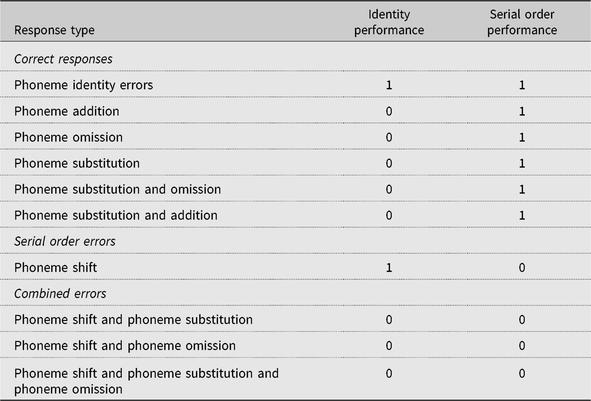
To evaluate participants’ ability to recall the identity and serial order of the phonemes in the nonword item, each response was assigned two binary values at the phoneme level. These values reflected performance on the two phoneme-related variables. All possible combinations of the binary values on these two variables resulted in four types of responses. Response type 1: a correct response received a binary score of 1 on both variables. In such a response, there were no problems with the recall of either identity or serial order. Response type 2: a response with only phoneme identity errors received a binary score of 0 on the dependent variable phoneme identity and a binary score of 1 on the dependent variable serial order. In such a response, there were only problems with the recall of phoneme identity. Response type 3: a response with only serial order errors was given a binary score of 1 on the phoneme identity variable and a binary score of 0 on the serial order variable. In such a response, there were only problems with recall of serial order. Response type 4: a response with both phoneme identity and serial order errors was given a binary error score of 0 on both the phoneme identity and serial order variables. In such a response, there were problems with recall of both identity and serial order. The different response types are described in more detail below.
1. Correct response (no identity or serial order errors): all target phonemes appeared in the same serial order in the response, for example, target: /lem.rós.pag/, response: /lem.rós.pag/.
2. Phoneme identity errors. Phoneme identity errors refer to errors in which a participant (a) added and/or (b) substituted and/or (c) omitted at least one phoneme in the response while respecting the correct serial order of all correctly recalled phonemes (see below). For instance, target: /lem.rós.pag/, response: /lem.rós.pags/ (addition of /s/); target: /lem.rós.pag/, response: /lem.vós.pag/ (substitution of /r/ by /v/); target: /lem.rós.pag/, response: /lem.ró.pag/ (omission of /s/); target: /lem.rós.pag/, response: /lem.kós.pa/ (substitution of /r/ by /k/ and omission of /g/).
3. Serial order errors. Serial order errors refer to errors in which a participant shifted at least one of the correctly recalled phonemes. We did not score a phoneme’s absolute serial order but its position relative to the other correctly recalled phonemes of the target word. Hence, phoneme substitutions, phoneme omissions, and phoneme additions did not necessarily have a negative effect on serial order scores. For example, the substitution error in the response /lem.pós.pag/ for the target /lem.rós.pag/ does not affect the serial position of the correctly recalled phonemes. Note that it is obvious, both from a logical point of view and from an analytical perspective, that the recall of a phoneme’s serial order can only be determined if the phoneme itself has been correctly recalled, that is, if the phoneme does not give rise to an identity error. First, it makes no sense to attribute positional properties to phonemes that are absent in the output (omissions) or did not appear in the input (additions or substitutions). Second, if each phoneme identity error also counted as a serial order error, the former errors would be a subset of the latter, which would be at odds with our intention to separate these two error types.
To determine whether the serial order of phonemes was respected, we used the procedure suggested by McKelvie (Reference McKelvie1987). In a first step, all phoneme strings of two or more phonemes were considered correct if they also appeared in the input nonword, whether or not these were in the correct absolute position when counting from the beginning or the end of the nonword sequence. In a second step, we checked whether any remaining single phoneme was in the correct absolute position when counting either from the beginning or from the end of the string, but not both. For example, for the target word /lem.rós.pag/, the response /rem.lós.pag/ would be checked as follows: all nine phonemes are correctly identified (i.e., no phoneme identity errors). Following the McKelvie method, the phonemes in the strings /em/, /os/, and /pag/ are correctly ordered. However, the single phoneme /l/ as well as the single phoneme /r/ are swapped between positions 1 and 4, violating the rule that single phonemes have to be in the correct absolute position when counting either from the beginning or from the end of the string. For the target word /lem.rós.pag/, the response /ler.só.pa/ would be checked as follows: seven phonemes are correctly identified (i.e., omission of /m/ and /g/). Following the McKelvie method, the phonemes in the strings /le/, /pa/, and /o/ are correctly ordered. However, the single phonemes /r/ and /s/ are shifted, violating the rule that single phonemes have to be in the correct absolute position when counting either from the beginning or from the end of the string.
4. Combined errors. These errors refer to errors in which a response contained both phoneme identity and serial order errors. For example, target /lem.rós.pag/, response: /rem.ló.pag/. The target phonemes /r/ and /l/ are swapped, giving rise to a serial order error, whereas the /s/ is omitted, giving rise to a phoneme identity error.
Table 1 provides an overview of the four response types described above and their specific subtypes. In addition, their associated binary values on the two phoneme-related dependent variables are provided.
Overview of response types and their associated binary values with respect to identity and serial order performance

Note: Combined errors were incorporated in the statistical analyses of both phoneme identity performance and serial order performance (see text). Note that these errors (final three rows) could occur in combination with or without phoneme additions (not specified in the table to reduce the number of rows).
Statistical analyses
To start with, we computed Pearson correlation coefficients to explore the (linear) association between the different dependent variables in this study: nonword-level performance, phoneme identity performance, and serial order performance. We calculated total sum scores (i.e., total number of correct responses on each dependent variable) per participant.
However, the most important analyses were those in which the effect of the independent variables was examined at the level of the individual item responses. To this end, we used general linear mixed-effects models (GLMMs) with a logit link function (because the outcomes are binary; see, e.g., Molenberghs & Verbeke, Reference Molenberghs and Verbeke2005). These models make it possible to simultaneously assess the variance explained by the random effect of participants and the random effect of items. The latter one is crucial to avoid the language-as-a-fixed-effect fallacy (Clark, Reference Clark1973). In our initial models, we included group (coded as dyslexic group = 0, nondyslexic group = 1), syllable length (a factor with levels 3, 4 and 5; this variable was dummy coded with 2 dummies and syllable length = 3 as the reference category), and the Group × Syllable Length interaction as fixed effects. In addition, phoneme identity performance was used as a covariateFootnote 3 in the analysis of serial order performance (and vice versa) to bring the collinearity between both factors under statistical control, that is, to make sure that the effect of group was not due to the shared variance between the two phoneme-related variables but to the unique variance that it explains on the outcome variable. The use of such an approach is quite common (see Verbeke & Molenberghs, Reference Verbeke and Molenberghs2000). Subsequently, it was evaluated whether removing the interaction term led to a significant decrease of model fit. We used the maximum likelihood method to estimate all model parameters. An advantage of this is that likelihood-ratio tests can be carried out to compare the fit of the model with the interaction term and the model without this term. The final model was then refitted using the restricted maximum likelihood estimation, as this yields more accurate estimates of the variance components in smaller samples. All models were fitted using R (packages lme4, Bates, Maechler, & Dai, Reference Bates, Maechler and Dai2008; language R, Baayen, Reference Baayen2008). Throughout the paper, the significance level was set at p ≤ .05.
Results
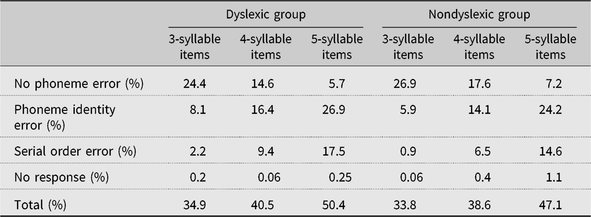
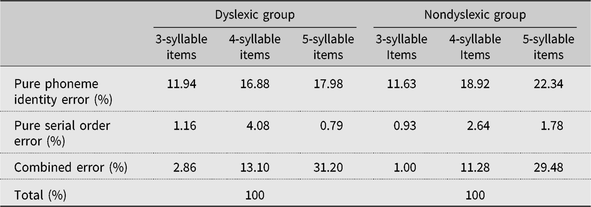
Table 2 shows the mean percentages for all response types as a function of both group and syllable length.
Mean percentages for each response type for each syllable length in the dyslexic and nondyslexic groups

Note: Combined errors are not analyzed as a separate error type. As they count as both identity errors and serial order errors, they have also been included in the error rates for these two error types. As a result, the sum of percentages exceeds 100 in all columns.
Correlation analyses
Table 3 reveals high positive correlations between performance at the levels of whole nonword recall, phoneme identity recall, and serial order recall (i.e., all rs ≥ .76, all ps < .0001). This should not come as a surprise, as three of the four response typesFootnote 4 imply identical binary values on the nonword-level variable and one phoneme-level variable. For the correlation involving performance on phoneme identity, these are correct responses, phoneme identity errors, and combined errors (representing 96.19% and 95.94% of all responses in the dyslexic and nondyslexic groups, respectively). For the correlation involving the performance on phonemes’ serial order, these are correct responses, serial order errors, and combined errors (representing 73.87% and 73.73% of all responses in the dyslexic and nondyslexic groups, respectively). Hence, only the proportion of responses of the fourth response type (phoneme serial order error in the case of phoneme identity variable; phoneme identity error in the case of serial order variable) cause the correlation to be less than 1. The high positive correlation between the two phoneme-related variables is not surprising either, as correct responses and combined errors imply identical scores on these two variables (representing 70.57% and 71.23% of all responses in the dyslexic and nondyslexic groups, respectively). In contrast, the identity and serial order errors weaken the correlation, such that the distribution of these two categories of response types determines the exact value of the correlation.
Pearson’s correlations and levels of significance (two-sided tests) among the main variables of the study

*p < .0001.
Nonword-level performance
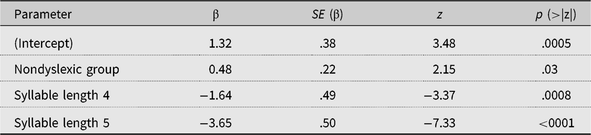
The results of the GLMM that was used to analyze participants’ nonword-level performance are summarized in Table 4. The two-way interaction Group × Syllable Length was not significant. Hence, in the final model, the interaction term was removed.
Estimated fixed effects of the generalized linear mixed model predicting nonword-level performance from group and syllable length

Note: Reference levels for the generalized linear mixed model are syllable length 3 and dyslexic group.
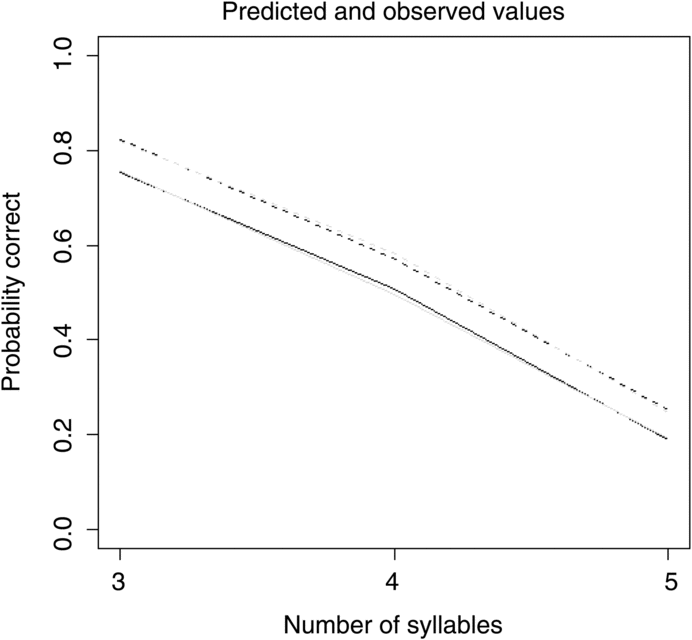
As expected, we observed a main effect of group (p = .03), revealing that the probability of a correct nonword repetition was higher for participants without dyslexia compared to participants with dyslexia. In addition, for both participant groups (i.e., no significant interaction), the probability of a correct response was higher for three-syllable nonwords compared to four-syllable nonwords, p = .0008, and five-syllable nonwords, p < .0001, and higher for four-syllable nonwords compared to five-syllable nonwords, β = −2.10, p < .0001 (the latter β estimate was obtained by fitting the same model as shown in Table 4 but using syllable length 4 as the reference level; data not shown).
Figure 1 visualizes the probability of a correct response as a function of syllable length and group. Probabilities are the values that are predicted by the statistical model, more particularly by back-transforming the β value for each combination of group and syllable length (a value on the logit scale) to the number whose natural logarithm is β. This number expresses the ratio between the probability of success (p) over the probability of failure (1 – p). Solving the equation for p yields the proportion of correct performance for that cell in the design. Across all syllable length conditions, adults with dyslexia repeated about 7% fewer nonwords correct than controls (44.66% vs. 51.71%). The performance of both groups linearly dropped between three-syllable items (77.12%), four-syllable items (48.21%), and five-syllable items (19.22%), each additional syllable resulting in a drop of around 30% correct nonword repetitions (averaged across groups). For the sake of comparison, Figure 1 also visualizes the observed proportions (black lines).
Predicted and observed probabilities of correct nonword repetition as a function of group and syllable length. Predicted values (gray) and observed values (black) for dyslexics (solid line) and nondyslexics (dashed line). Although the lines for the predicted and observed values virtually coincide, this does not mean that the model makes perfect predictions. The predicted probabilities in Figure 1 are averaged across many predicted individual responses, which may or may not differ from the actual responses. The model does a good job in predicting mean response behavior.

Phoneme-level performance
We also used GLMMs to analyze the recall of (a) phonemes’ identity and (b) serial order. As explained, a participant’s response was assigned two binary scores at the phoneme level, expressing whether all phonemes were recalled correctly or not (identity scores of 1 and 0, respectively), and whether all correctly recalled phonemes had been placed in the correct serial order or not (serial order scores of 1 and 0, respectively).
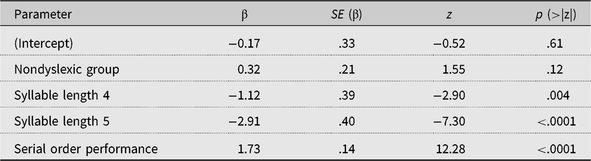
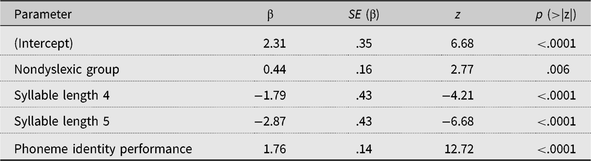
We found no significant Group × Syllable Length interaction effect in the analysis of phoneme identity performance. After removing the interaction term from the model, we obtained the results that are summarized in Table 5. There was a significant effect of serial order performance on phoneme identity performance (p < .0001), which is in line with the relatively strong correlation between these two variables (see Table 3). The final GLMM revealed no main effect of group (p = .12); that is, participants with and without dyslexia did not differ in their recall of phonemes’ identity. In addition, phoneme identity performance was better in three-syllable nonwords compared to four-syllable nonwords (p = .0004) and five-syllable nonwords (p < .0001). Similarly, phoneme identity performance was better in four-syllable nonwords compared to five-syllable nonwords, β = −1.8, p < .0001 (this β estimate was obtained by fitting the same model as shown in Table 5 but using syllable length 4 as the reference level; data not shown). The effect of syllable length was the same for both groups, as there was no Group × Syllable Length interaction.
Estimated fixed effects of the generalized linear mixed model predicting phoneme identity performance from group and syllable length when statistically controlling for serial order performance

Note: Reference levels for the generalized linear mixed model are syllable length 3 and dyslexic group.
Figure 2 visualizes the model-predicted probabilities of correct phoneme identity performance as a function of syllable length and group. On average, performance on phoneme identity recall was about 6.5% worse in the dyslexic group compared to the control group (48.23% vs. 54.81%), a nonsignificant effect. Performance in both groups dropped about 25% between three-syllable items (78.81%) and four-syllable items (53.86%), and about 32% between four-syllable items and five-syllable items (21.89%). For the sake of comparison, Figure 2 also visualizes the observed proportions (black lines).
Predicted and observed probabilities of correct phoneme identity recall as a function of group and syllable length. Predicted values (gray) and observed values (black) for dyslexics (solid line) and nondyslexics (dashed line).

Table 6 summarizes the results of the final model for the analysis of serial order performance. We found no significant Group × Syllable Length interaction effect. After removing this interaction term from the final GLMM, the model revealed a significant effect of phoneme identity (p < .0001). Hence, phoneme identity performance was a predictor of serial order performance at the level of individual responses (see also Table 3), these responses being the input to the GLMM. We found a significant effect of group (p = .006). Adults without dyslexia outperformed adults with dyslexia in the recall of the serial order of correctly recalled phonemes. In addition, we observed a main effect of syllable length across both groups (no Group × Syllable Length interaction), indicating that serial order performance was better in three-syllable nonwords compared to four-syllable nonwords (p < .0001) and five-syllable nonwords (p < .0001). Serial order performance was also higher in four-syllable nonwords compared to five-syllable nonwords, β = −2.7, p < .0001 (this β estimate was obtained by fitting the same model as shown in Table 6 but using syllable length 4 as the reference level; data not shown).
Estimated fixed effects of the generalized linear mixed model predicting serial order performance from group and syllable length when statistically controlling for phoneme identity performance

Note: Reference levels for the generalized mixed model are syllable length 3 and dyslexic group.
Figure 3 visualizes the model-predicted probabilities of repeating the correctly recalled phonemes in their correct serial position, as a function of syllable length and group. Note that the percentages are higher than in Figures 1 and 2 because serial order recall is a conditional probability; that is, it expresses the probability that no serial order errors are made within the set of correctly recalled phonemes. On average, performance on serial order recall was about 7% worse in the group with dyslexia compared to the control group (70.72% vs. 77.43%), a highly systematic effect (p = .006). The drop in performance was on average about 20% between three-syllable items (95.43%) and four-syllable items (75.95%), and about 25% between four-syllable items and five-syllable items (50.84%). For the sake of comparison, Figure 3 also visualizes the observed proportions (black lines).
Predicted and observed probabilities of correct serial order recall as a function of group and syllable length. Predicted values (gray) and observed values (black) for dyslexics (solid line) versus nondyslexics (dashed line).

Pairwise comparisons between response types
In the mixed-model analyses of phoneme identity performance and serial order performance reported above, we included both correct and incorrect responses (pure identity errors, pure serial order errors, and combined errors). In these analyses, we statistically controlled for the correlation between the recall of phonemes’ identity and their serial order. However, the fact that part of the variability on the dependent variable can be explained by both identity and serial order recall (the part that is kept under statistical control) reduces the amount of variability that can be uniquely explained by each independent variable.
In the analysis described below we will look at the effect of group on the distribution of the three error types only: pure identity errors, pure serial order errors, and combined errors. When there is a failure in recall ability, both groups may differ in the association strength between the two recall mechanisms, that is, the probability that, if one error type is made, the other one is also made. More specifically, one group might make more combined errors than the other group, whereas the opposite pattern might occur for pure identity errors. This would indicate that the two recall mechanisms are more strongly associated in one group than in the other. Table 7 gives the distribution of the three error types as a function of both group and syllable length. This table shows that when participants could recall all phonemes of the nonword, they almost invariably recalled their serial order as well; that is, pure serial order errors seldom occurred. In the analyses below, we did not use the data for the pure serial order errors because such errors were very rare, both in the nondyslexic group (5.35% of all errors) and in the dyslexic group (6.03%), as can be seen in Table 7. These small rates of pure serial order errors did not differ between the two groups, as evidenced by a GLMM in which the effect of error type (pure serial error vs. other error) was predicted by group. The GLMM yielded no effect of this fixed factor: β = 0.07 (SE β = .27), p = .80. Consequently, we removed pure serial order errors from further analyses.
Mean percentage errors for each error type as a function of group and syllable length

In sum, in this different type of analysis, we did not keep the collinearity between the two types of recall under statistical control, but compared two error types by keeping one of the two recall measures constant while varying the other. More particularly, we first studied the effect of group on the probability of making a serial order error by focusing on the contrast between pure identity errors and a combination of identity and serial order errors, that is, while keeping the presence of identity errors constant. Second, we studied the effect of group on the probability of making a phoneme identity error by focusing on the contrast between correct responses and pure identity errors, that is, while keeping the absence of serial order errors constant.
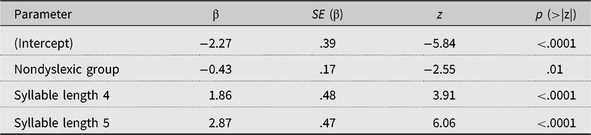
Table 8 summarizes the results of the GLMM predicting the probability of a serial order error when a phoneme identity error has been made (group and syllable length being the only two fixed factors). A pure identity error was coded as 0, whereas a combined error was coded as 1. The model revealed a main effect of group, p = .01. When a phoneme identity error was made, the probability of making a serial order error as well (i.e., a combined order error) was smaller in participants without dyslexia compared to participants with dyslexia. This outcome is in line with the effect of group on serial order recall in the GLMM on all data. In addition, we observed a main effect of syllable length indicating that the probability of a combined error increased with increasing syllable length.
Estimated fixed effects of the generalized linear mixed model predicting phoneme serial order errors (in the set of pure identity errors and combined errors) from group and syllable length

Note: Reference levels for the generalized mixed model are syllable length 3 and dyslexic group.
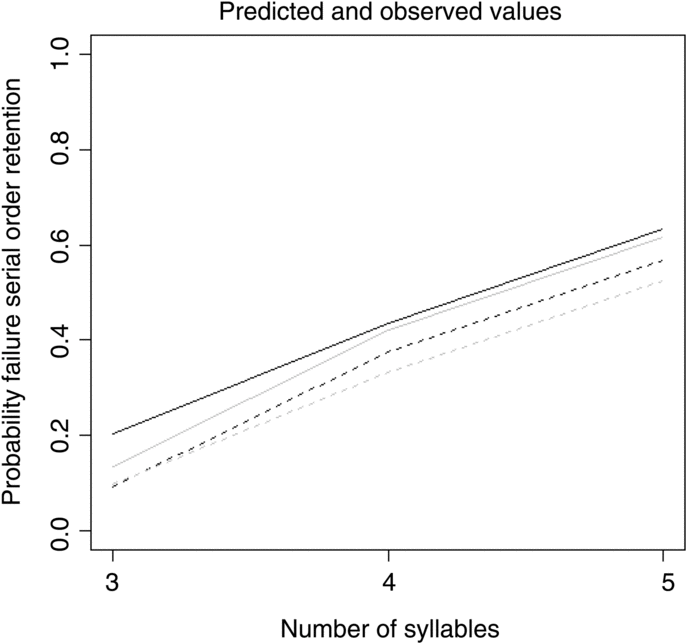
Figure 4 visualizes the model-predicted probabilities of a failure in serial order recall when a phoneme identity error has been made. On average, this failure of serial order recall in the presence of a phoneme identity error was about 7% higher in the dyslexic group compared to the control group (38.98% vs. 31.82%). The increase of errors was on average about 26% between three-syllable items (11.60%) and four-syllable items (37.61%), and about 19% between four-syllable items and five-syllable items (56.99%). For the sake of comparison, Figure 4 also visualizes the observed proportions (black lines).
Probabilities of serial order recall failures when a phoneme identity error has been made, as a function of group and syllable length. Predicted values (gray) and observed values (black) for dyslexics (solid line) and nondyslexics (dashed line).

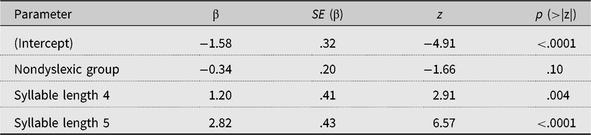
In a second analysis, we studied the effect of group on the recall probability of phonemes’ identity, more particularly, by contrasting the sets of correct responses and pure identity errors. No serial order errors were made in these two response types. A correct response was coded as 0, whereas a pure identity error was coded as 1. As can be seen in Table 9, the GLMM revealed no effect of group, p = .10; that is, when no serial order errors were made, both groups were equally likely to make a phoneme identity error. This outcome is in line with the absence of an effect of group on phoneme identity recall in the GLMM on all data. An identity error was higher for five-syllable nonwords compared to three-syllable nonwords (p < .0001) and four-syllable nonwords (p = .0001), and higher in four-syllable nonwords compared to three-syllable nonwords (p = .004).
Estimated fixed effects of the generalized linear mixed model predicting phoneme identity errors (in the set of pure identity errors and correct responses) from group and syllable length

Note: Reference levels for the generalized mixed model are syllable length 3 and dyslexic group.
Figure 5 visualizes the model-predicted probabilities of a failure in phoneme identity recall in the absence of a serial order error. On average, this failure was about 5.5% worse in the dyslexic group compared to the control group (45.81% vs. 40.22%), a nonsignificant effect. The increase of errors was on average about 21.5% between three-syllable items (19.19%) and four-syllable items (40.65%), and about 29% between four-syllable items and five-syllable items (69.21%). For the sake of comparison, Figure 5 also visualizes the observed proportions (black lines).
Probabilities of phoneme identity recall failures when no serial order error has been made, as a function of group and syllable length. Predicted values (gray) and observed values (black) for dyslexics (solid line) and nondyslexics (dashed line).

Discussion
The central aim of this study was to further our understanding of the well-documented lower performance of individuals with dyslexia versus typical readers on the NRT. We attempted to explain this lower performance on the NRT in individuals with dyslexia by focusing on their recall of phonemes’ identity and their recall of phonemes’ serial order when repeating a nonword.
We conducted three types of analyses. First, we calculated global correlations between the dependent variables of interest, using the participant total scores on the NRT. Second, we performed generalized linear mixed-effects model analyses at the level of individual (item) responses, in which the probabilities of phoneme identity performance and serial order performance were predicted by group (dyslexic vs. nondyslexic), the items’ syllable length, and the correlation between the two dependent measures (identity and serial order recall). The third type of analysis assessed the effect of group on two response types only; that is, the collinearity between identity and serial order recall was removed by keeping one response type constant. All analyses converged on the same conclusions.
We found significant positive correlations between all three dependent variables. This is to be expected, given that some responses are correct or incorrect with respect to two or three of these measures.
More important, when analyzing the data at the level of individual responses, using a GLMM, we found that the probability of a correct response was higher in adults without dyslexia compared to adults with dyslexia. These results corroborate previous findings that reading difficulties in adults are indexed by difficulties in accurate nonword repetition (e.g., Dietrich & Brady, Reference Dietrich and Brady2001).
Our next aim was to detect the cause of this overall problem with the repetition of nonwords. There are only two possible causes: a problem in recalling a nonword’s phonemes or a problem in recalling the serial order of correctly recalled phonemes (or both). In our GLMM analyses, one type of phoneme performance (phoneme identity or serial order) was included as a covariate when using the factor group to predict performance on the other phoneme-related variable. When thus analyzing phoneme identity performance, no effect of group was found: individuals with dyslexia were as successful as individuals without dyslexia in recalling phonemes’ identity when repeating a nonword. In contrast, an effect of group was found when predicting serial order performance: adults without dyslexia outperformed adults with dyslexia with respect to the recall of phonemes’ serial order, irrespective of the number of syllables in the nonword; that is, the interaction between group and syllable length was not significant.
Separate pairwise comparisons between error types, in which the correlation between phoneme identity and phoneme serial order was not brought under statistical control but removed from the data by keeping responses on one measure constant (e.g., all responses contained phoneme identity errors), confirmed these findings. An effect of group was found when the data on pure identity errors and combined errors were compared; that is, the probability of making a serial error was larger too for adults with dyslexia than adults without dyslexia. In contrast, no effect of group was found when the data on correct responses and pure identity errors were compared; that is, the probability of making an identity error did not differ between the two groups. The latter analysis shows that the effect of group on serial order performance in the GLMM on all data was not due to a reduction in the variability of the data after statistical controlling for the correlation between the two phoneme-related outcome variables.
Overall, our results clearly show that (a) a failure of the recall mechanism for serial order (i.e., serial order performance), defined as a failure to reproduce the serial order of all correctly recalled phonemes of the nonword, occurred more often in adults with dyslexia than in adults without dyslexia, and that (b) a failure of the recall mechanism for phoneme identity, defined as a failure to recall all phonemes of the nonword, occurred equally often in both groups. These results are in line with a recent study by Schraeyen et al. (Reference Schraeyen, Geudens, Ghesquière, Van der Elst and Sandra2017) in young readers with different literacy skills.
Our results also confirm the findings reported by several studies that focused on item and serial order processing in STM (with adults: e.g., Bogaerts et al., Reference Bogaerts, Szmalec, Hachmann, Page and Duyck2015; Hachmann et al., Reference Hachmann, Bogaerts, Szmalec, Woumans, Duyck and Job2014; Martinez Perez et al., Reference Martinez Perez, Majerus and Poncelet2013; with children: e.g., Martinez Perez, Majerus, Mahot, et al., Reference Martinez Perez, Majerus, Mahot and Poncelet2012; Martinez Perez, Majerus, & Poncelet, Reference Martinez Perez, Majerus and Poncelet2012; Staels & Van den Broeck, Reference Staels and Van den Broeck2014). Of importance, however, they extend these findings to the level of phonemes, which has not been addressed before. Our results also confirm our hypothesis that serial order recall is a crucial factor for describing the widely reported differences in overall NRT performance between dyslexic and nondyslexic adults.
Even though the statistical analyses suggest that adults with and without dyslexia perform equally well as typical readers on the recall of phonemes’ identity, one should be cautious in interpreting this result. The very high correlation between participants’ nonword repetition performance and their performance on phoneme identity recall makes one expect the same effect of group on both measures. Still, the control group outperformed the dyslexia group on the nonword measure but not on the phoneme identity measure. This failure to obtain an effect of group on phoneme identity recall may be due to a lack of statistical power in the analyses. First, in the analysis of all responses (correct and incorrect ones), the collinearity between the recall of phonemes’ identity and their serial position was brought under statistical control. This statistical procedure comes with a cost: it considerably reduces the amount of variability on the dependent measure that can be uniquely accounted for by the distinction between individuals with dyslexia and controls. Second, when analyzing the effect of group on the difference between pure identity errors and combined errors (i.e., differing on the serial order measure only, the number of responses in the data set is considerably smaller than in the entire data set, that is, the basis for the effect of group on the probability of a correct nonword response. As both analyses have less power than the analysis of the effect of group on nonword recall, our results do not allow us to doubt the possibility that individuals with dyslexia have more problems than controls when having to recall the phonemes in a nonword. We emphasize that this does not undermine our conclusions. Despite this loss of statistical power, we still found a solid effect of group on serial order recall in the two analyses mentioned above. This highlights problems with serial order recall in individuals with dyslexia even more. At the same time, this loss of power and the high correlation mentioned above imply that our null effect of group on the recall of phoneme identity is still compatible with the established idea that individuals with dyslexia have problems at the level of phonemic representations.
Before discussing the possible theoretical implications of our findings, there is one further result that must be briefly discussed: the absence of interaction effects between group and the number of syllables in the nonwords in all three GLMMs. If the probability of making a serial error is the same for each syllable and syllables are encoded, retained, and retrieved independently of one another, one would predict that the difference between the two groups increases as the number of syllables increases. The problem of the dyslexic group would manifest itself for each syllable, such that the effect of group would become more pronounced as the nonword contains more syllables. However, it can easily be demonstrated that there is no statistical independence between syllables in our data. As can be seen in Table 7, the percentages of observed combined errors, the errors that involve both an error at the level of phoneme identity and at the level of serial order (which by far outnumber the percentages of pure serial errors), are the major error type together with the pure identity errors. If we assume statistical independence, we can infer the probability of an error for a single syllable from the data for the three-syllable items. For individuals with dyslexia, the probability of making no error on a three-syllable item is 1 − 0.0286 = 0.9714. Under the assumption of independence, this is the cube of the probability that a single syllable gives rise to an error. Hence, the latter probability is the third root of 0.9714 = 0.9904. The probabilities for making an error in four-syllable items and five-syllable items can be calculated by raising this proportion for one syllable to the power of 4 or 5, respectively, and subtracting the outcome (i.e., the probability of making no error) from 1. This yields the percentages 3.80 and 4.72 for these item types. The same calculations lead to the following percentages for three-syllable, four-syllable, and five-syllable items for the controls: 1.00, 1.33, and 1.67. These percentages would lead to the following effects of group for the three syllable conditions (in ascending order of number of syllables): 1.86, 2.47, and 3.05. This is obviously a pattern that would fit an interaction. This is obvious, as it is the pattern of predicted effects, based on the assumption of statistical independence of syllable recall. Crucially, the observed error percentages do not even come close to the predicted error percentages assuming independence: 13.10% and 31.20% for three-syllable and four-syllable items in the dyslexic group and 11.28% and 29.48% in the control group. Hence, it is clear from the above that the assumption of statistical independence does not hold.
In what follows, we will focus on our finding that individuals with dyslexia and controls strongly differ in their ability to recall phonemes’ serial order when performing a NRT task. We suggest four possible accounts. The first three accounts situate the effect at the level of STM storage. Two of these storage accounts attribute the effect to the nature of a linguistic representation in STM, whereas the third one links it to a nonlinguistic, that is, domain-general, STM ordering mechanism. The fourth account situates the effect at the level of retrieval from STM.
Serial order problems in a phonological representation in STM
A first account explains problems in individuals with dyslexia as the result of their poorer knowledge of phonotactic regularities in the language. Phonotactics pertains to the permissible orderings of phonemes within syllables and words. For instance, in English as well as in Dutch, no word begins with the sequence /tl/, though the same sequence is allowed word-internally, as in atlas (Geudens & Sandra, Reference Geudens and Sandra2003). Phonotactic knowledge also involves the implicit “awareness” of the transitional probability between successive phonemes.
This account can be directly linked to the development and structure of the phonological representations of words, as serial order is obviously an important property of these representations. Even though many researchers do not take this factor into account within the domain of phonology, it does play a crucial role in the development of phonological representations of words, as supported by the largely documented role of phonotactics in language development studies (Jusczyk, Luce, & Charles-Luce, Reference Jusczyk, Luce and Charles-Luce1994; Storkel, Reference Storkel2001). Note that the idea that individuals with dyslexia might have poorer phonotactic knowledge can easily be linked to the concept that they have more problems in representing accurate phoneme representations, the building blocks of phonotactic sequences.
Bonte, Poelmans, and Blomert (Reference Bonte, Poelmans and Blomert2007) used an oddball paradigm to investigate phonotactic sensitivity in children with dyslexia by analyzing event-related potential responses to phonologically legal nonwords with either high (e.g., /not.sel/) or low (e.g., /not.kel/) phonotactic probability. The mismatch negativity, that is, the difference between the event-related potential activity induced by the same nonword when presented as the standard (the frequently repeated item of the pair in a block) and when presented as the deviation (the infrequently repeated item), was larger for the nonword with large phonotactic probability, but only for the control group. The individuals with dyslexia even showed the reversed tendency. The authors attributed this finding to a difference in sensitivity to phonotactic probabilities, suggesting that children with dyslexia are less sensitive to quantitative changes in phonotactic probability. As phonotactics deals with serial order restrictions on phonemes and phonotactic probability with differences in the transitional probabilities between successive phonemes, evidence suggesting inferior phonotactic sensitivity in poorer versus better readers may be related to their different abilities in coding, retaining, or accessing the correct serial order of phonemes. Hence, these results seem to support our finding that individuals with dyslexia performed worse on the recall of phonemes’ serial position than controls in a NRT.
Note, however, that Szenkovits, Darma, Darcy, and Ramus (Reference Szenkovits, Darma, Darcy and Ramus2016) could not replicate a phonotactic sensitivity effect when studying adults with dyslexia. The authors suggested that “it could be perfectly possible that children with dyslexia, owing to their phonological deficit, incur a delay in their tuning to phonotactic probabilities, but that in adulthood they eventually reach normal phonotactic sensitivity, albeit later than controls” (p. 11). Another possibility is that the source of the difference between Bonte et al.’s and Szenkovits et al.’s studies is due to the magnitude of the phonotactic variations that are used in the two studies. Szenkovits et al. suggested that poorer sensitivity may be so subtle in individuals with dyslexia that it is difficult to measure. This would explain why this lower sensitivity surfaced in, for instance, Bonte et al.’s study, where larger phonotactic variations were used, but not in their own.
Obviously, our findings cannot shed light on this discussion. The only case we want to make is that there is evidence to suggest that poorer performance in individuals with dyslexia in recalling phonemes’ serial order may be an intrinsic phonological effect. If so, it is plausible to trace it back to the vital role of phonotactics in phonological development. Findings like the ones in the oddball paradigm suggest that individuals with dyslexia have a poorer phonotactic knowledge, due to their weaker phonemic skills. This makes sense, as a good knowledge of phonemes should make it easier to detect (high-probability) phonotactic sequences. In turn, such sequences are likely to increase the size of phonological encoding units, making it possible to use both phonotactic chunks and individual phonemes for the purposes of encoding and representation in STM. It follows that individuals with dyslexia would have fewer possibilities than controls for encoding, retaining, or accessing a sequence of phonemes in a NRT, which would explain their poorer recall of phonemes’ serial order.
In short, the effect of group on the recall of phoneme order may be explained in terms of higher order phonological units, that is, phonotactic sequences that are retrieved from LTM for encoding and storage in STM. In this account, there is no need for a special STM mechanism for ordering individual phonemes because subsequences of the nonwords match LTM representations with an internal order.
One observation in our study is compatible with (at least a partial) role of phonotactic knowledge: the extremely low proportion of pure serial order errors. This indicates that, when participants can recall all phonemes, they almost invariably also recall their serial order. At first sight, the fact that all phonemes’ serial order is easier to recall when more phonemes can be recalled seems paradoxical. However, it makes perfect sense if the successful recall of these phonemes depends on the ability to encode the nonword in terms of phonotactic units. Such units are familiar phoneme sequences, characterized by high-probability transitional probabilities, such that positional information needs to be encoded, stored, and retrieved for fewer information units, the phonotactic chunks. Note that this account is not discredited by the null effect for the recall of phoneme identity (see power issue above).
Serial order problems in an orthographic representation in STM
A second possibility is that the effect is nonphonological in nature, but originates at the level of orthographic or graphemic knowledge. Previous work shows that performance on the NRT is affected by orthographic factors (Nation & Hulme, Reference Nation and Hulme2011). Acting as a graphic support, the possible use of orthographic representations in the NRT could facilitate participants’ memory for short-lived phonemic segments (Geudens, Reference Geudens2006). Within such a framework, the question remains how orthographic knowledge could explain our observation that the recall of serial order turns out to be a discriminating factor between the two groups. If anything, it suggests that persons with dyslexia have problems keeping a generated sequence of orthographic segments in their correct order. Note that this does not by itself imply that individuals with dyslexia can map phonemes onto graphemes equally fast as individuals without dyslexia. This would be an unlikely consequence in the light of the many demonstrations that individuals with dyslexia have problems with such mappings. Moreover, our measure of serial order recall is a conditional one: it expresses participants’ success in serial order recall, given their set of correctly recalled phonemes; that is, the number of correctly recalled phonemes does not play a role in the metric. Yet the data do suggest an equally fast mapping process of a phonemic representation onto an orthographic representation of the auditory nonwords in both groups. However, as mentioned above, we should be careful with this null effect. Our failure to obtain an effect of group on the recall of phoneme identity may be due to low statistical power. As a matter of fact, this is quite likely in the light of the high correlation between nonword recall and phoneme identity recall (see above). Following the above line of reasoning, our findings are compatible with the idea that individuals with dyslexia are worse than controls in recalling the order of the letters in the orthographic representation of the auditorily presented nonword.
Serial order problems in a domain-general sequencing mechanism in STM
A third account at the level of STM storage proposes the existence of a mechanism that is specifically dedicated to the recall of (any kind of) serial order information in STM. In previous work, such a mechanism has been suggested in the context of storing sublexical phonological representations (more particularly, syllables) in VSTM (Gupta, Reference Gupta2003, Reference Gupta, Thorn and Page2009; Gupta et al., Reference Gupta, Lipinski, Abbs and Lin2005). In these studies, a computational model for VSTM has been proposed in which sequence memory, that is, a language-independent memory component for keeping track of sequential information, is thought to be involved in temporarily maintaining the serial order of (sublexical) units. Participants found it easier to recall initial and final syllables in nonwords, suggesting the importance of serial order in VSTM.
As highlighted above, several recently published studies focusing on the link between serial order processing and literacy skills subscribe to the idea of a domain-general impairment in individuals with dyslexia (e.g., Bogaerts et al., Reference Bogaerts, Szmalec, Hachmann, Page and Duyck2015; Hachmann et al., Reference Hachmann, Bogaerts, Szmalec, Woumans, Duyck and Job2014; Martinez Perez, Majerus, Mahot, et al. Reference Martinez Perez, Majerus, Mahot and Poncelet2012; Martinez Perez, Majerus, & Poncelet, Reference Martinez Perez, Majerus and Poncelet2012; for a review, see Majerus & Cowan, Reference Majerus and Cowan2016). According to these studies, a domain-general mechanism in STM is responsible for recalling the order of units of any kind (hence, also phonemes). Our finding of serial order recall problems in impaired readers, then, could be explained by a basic difference between these readers’ (domain-general) sequence memory mechanism in STM and that of controls. The fact that serial order impairments have also been detected in individuals with dyslexia with tasks in which no support of LTM can play a role (e.g., when using audio-tactile sequences; see Laasonen et al., Reference Laasonen, Virsu, Oinonen, Sandbacka, Salakari and Service2012) could be seen as support for a domain-general deficit in STM. In their study, Laasonen et al. (Reference Laasonen, Virsu, Oinonen, Sandbacka, Salakari and Service2012) examined whether poor STM in a group of adults with dyslexia influenced their processing of sensory stimulus sequences in addition to phonological material. They used binary nonverbal stimuli such as light flashes, tone bursts, finger touches, and cross-modal combinations. They showed an underperformance in order recall in sensory STM compared to controls, indicating a general difficulty in the representation of temporal sequences in STM.
The fact that similar problems were also found in other cognitive areas (e.g., in the domain of dyscalculia, see Attout & Majerus, Reference Attout and Majerus2015) could suggest that learning difficulties in multiple cognitive areas might be due to serial order STM problems (Jaroslawska, Gathercole, Logie, & Holmes, Reference Jaroslawska, Gathercole, Logie and Holmes2016), possibly areas in which the recall of serial order is crucial to performance.
The distinction between item STM and order STM in all aforementioned studies is to some extent analogous to our distinction between the short-term recall of phoneme identity and the short-term recall of position in the NRT. Hence, it is tempting to interpret our results in terms of these explanatory concepts and attribute problems with the recall of phonemes’ serial order in individuals with dyslexia to a more fundamental problem with a basic domain-general ordering mechanism in STM, specifically dedicated to recall the order of (any kind of) information units.
Yet, there is a major difference between our study and previous work. We captured the distinction between identity and order information by using the same (nonword) items and focusing at the intrasyllabic phoneme or segmental level (the crucial level according to the phonological deficit hypothesis), whereas all previous studies used two types of stimulus materials for studying the distinction between the recall of these two types of information. One might argue that the use of a single set of materials targeting the recall of phonemes involves a risk if one wishes to demonstrate the existence of two different STM processes (e.g., Hachmann et al., Reference Hachmann, Bogaerts, Szmalec, Woumans, Duyck and Job2014; Martinez Perez, Majerus, Mahot, et al., Reference Martinez Perez, Majerus, Mahot and Poncelet2012; but see Staels & Van den Broeck, Reference Staels and Van den Broeck2014). It is certainly true that, in our data, the correlation between identity recall and serial order recall indicates that the two mechanisms that are responsible for encoding, storing, and/or retrieving both types of information were not independent from each other. At the same time, it should be stressed that we found worse performance in serial order recall in individuals with dyslexia in two analyses where this correlation could not affect this outcome.
Moreover, this methodological choice might also be perceived as a strength. The fact that particular phonemes may not be recalled correctly whereas their serial information is intact and the fact that phonemes may be recalled correctly whereas they are not recalled in the correct serial order makes it possible that two STM mechanisms, that is, item STM and order STM, can be studied independently with a single set of materials. The fact that we could analyze our data without any contamination by the correlation between item and order recall demonstrates that our study did benefit from the strength offered by a single set of materials. In short, the effect of group on the recall of phonemes’ serial order is at least compatible with the concept of a domain-general, that is, non-language-specific, ordering mechanism for information in STM.
Serial order problems during retrieval from STM
The three accounts above all concern the encoding or storage (representation) of a nonword’s representation. One might propose a fourth account, in which the nature of the representations itself is not the key problem but rather the way in which these representations are accessed or retrieved. Such a view would mean that individuals with dyslexia have difficulties with the order in which they have to retrieve the specific information from the nonword’s representation, not with the temporary storage of the nonword itself. This would imply that responses in the NRT do not reflect the underlying representation of a nonword but the process of reconstructing this representation by serially accessing its phonemes (or graphemic counterparts) or phonotactic units in a temporary STM representation. Hence, they would reveal the operation of a serial order mechanism at the moment of retrieval, rather than during encoding and, hence, at the level of the STM representation itself. In line with this account, Ramus and Szenkovits (Reference Ramus and Szenkovits2008) presented a detailed analysis of performance in adults with dyslexia on a range of phonological tasks, and concluded that their problems were not related to their phonological representations as such but strongly depended on task requirements, such as the processing load on STM, conscious awareness, or time constraints. Hence, they proposed that the basic problem of poor readers is a problem in accessing phoneme-based representations, not a problem involving the quality or intrinsically “poor” nature of these representations (see also Van den Broeck & Geudens, Reference Van den Broeck and Geudens2012). Recent neuroimaging findings support this hypothesis. Boets et al. Reference Boets, Op de Beeck, Vandermosten, Scott, Gillebert, Mantini and Ghesquière(2013) demonstrated that the neural quality of the phonetic representations in adults with dyslexia was intact but that they were hampered by a dysfunctional connection between frontal and temporal language areas. This suggests that problems in the fluent manipulation of speech sounds in individuals with dyslexia stem from their problems in accessing otherwise intact phonemic representations.
Future studies are required to shed further light on this matter and elucidate whether the serial phoneme order problem in individuals with dyslexia reflects a problem with the intrinsic quality of phonemic representations in STM, which do not adequately represent the correct serial order of the phonemic segments, or a problem with the access to the phonemic information in STM in the correct serial order, that is, the composition or reconstruction of the phonological representation at the moment of retrieval. If the former possibility is correct, the problem might be rooted in a language-independent sequence memory problem in STM or be due to those individuals being less competent in the use of phonotactic and/or orthographic knowledge for retaining unfamiliar phoneme strings. If the second possibility is correct, the problem also involves the malfunctioning of a domain-general serial ordering mechanism but one that does not regulate the recall process in STM itself but the retrieval of information from STM. Note that different skills in the use of phonotactics and/or orthography might also play a role if the problem is situated at the level of retrieval.
Even though our data are compatible with different accounts, the major demonstration of our study is that adults with dyslexia have a problem in recalling the serial order of phonemes in a novel phoneme string, that is, a nonword. We could demonstrate this with a single set of nonwords, even though there was a correlation between the two dependent measures: the recall of phonemes’ identity and the recall of their serial order. The problem with serial order recall in individuals with dyslexia is so big that it is stronger than their problem with the recall of phonemes’ identity. The latter problem was not observed, even though the phonological deficit hypothesis made us expect it. However, we emphasize that the above-mentioned correlation and the consequent loss of power in the statistical analyses may be responsible for this, that is, may have caused a Type II error. Hence, the absence of an effect of group on identity recall cannot be construed as counterevidence for the phonological deficit hypothesis. A second contribution of our study is that it is, to our knowledge, the first attempt to link reading success to two current views on the cause of dyslexia: the importance of the quality of phonemic representations in STM and the role of serial order in STM.
Conclusion
Our results show that the distinction between two types of recall errors—phoneme identity recall errors and serial order recall errors—contributes to a more precise understanding of NRT performance and the importance of the two task components in determining reading success. Serial order turns out to be a key factor in explaining the difference in the NRT error patterns of readers with and without dyslexia. Schraeyen et al. (Reference Schraeyen, Geudens, Ghesquière, Van der Elst and Sandra2017), who also used phonemes’ identity and serial position recall scores on a single set of items in a recent NRT study, arrived at the same conclusions for a group of young readers varying in reading success (regression design). We conclude that adult readers with dyslexia are less sensitive to phonemes’ serial order compared to typical readers and that this finding imposes restrictions on any account of dyslexia.
Appendix 1. Target Items for the Nonword Repetition Task (NRT)