





Introduction
For decades, psycholinguistic research has focused, among other topics, on the impact of stimuli’s features on reading, as they allow inferences to be made about the cognitive processes involved in reading skills and their characteristics. Importantly, differential effects have been observed between languages, particularly those that differ in the orthographic transparency and metric systems (Ardila, Reference Ardila1991; Ardila & Cuetos, Reference Ardila and Cuetos2016). Most of the evidence regarding word recognition and reading comes from empirical studies conducted in English. Consequently, numerous influential models of word recognition and reading are built upon findings from English (for a comprehensive overview, refer to Norris, Reference Norris2013). However, several linguistic characteristics unique to English, not found in other languages, could significantly impact word processing. For instance, English features an opaque orthographic system characterized by highly inconsistent grapheme–phoneme correspondences, lacks consistent accentuation rules, and has ambiguous syllabic segmentation. In contrast, other languages possess transparent orthographic systems with greater consistency in grapheme–phoneme mappings, clear accentuation rules, and distinct syllabic boundaries. Spanish, for example, exemplifies such characteristics, making it an appropriate language for comparison with English. Notably, as elaborated further, evidence indicates that the effects of various psycholinguistic variables associated with lexical items (i.e., words) differ across languages. Hence, conclusions concerning the processing of printed words in one language cannot be directly extrapolated to others. Thus, adjustments would be required for English-based reading models when applied to other languages, accounting for the presence and influence levels of the aforementioned psycholinguistic variables.
From a theoretical perspective, the present study is framed within the models of lexical access that differ in the role attributed to semantic information during word recognition. Interactive activation models (e.g., Coltheart et al., Reference Coltheart, Rastle, Perry, Langdon and Ziegler2001) assume bidirectional interactions between orthographic, phonological, and semantic levels, allowing semantic information to influence early stages of processing. In contrast, frequency-based and distributional approaches emphasize the role of exposure-driven lexical representations, often minimizing the necessity of semantic access for tasks such as lexical decision (LD) (e.g., Norris, Reference Norris2006). Additionally, embodied or grounded cognition frameworks propose that word meaning—particularly for action-related words such as verbs—is partly represented in sensorimotor systems (e.g., Pulvermüller, Reference Pulvermüller2005, Reference Pulvermüller2013).
Within this theoretical landscape, a key unresolved question concerns whether semantic access is necessarily engaged during lexical decision, especially in transparent orthographies such as Spanish, where sublexical processing may suffice for accurate performance. The present study directly addresses this issue by examining the extent to which lexical-semantic variables, including word prevalence and motor content, contribute to verb recognition performance.
Methodologically, studies investigating variables that impact processing have evolved from factorial designs with a limited number of stimuli and very specific characteristics, to megastudies, which offer advantages over traditional factorial design experiments in cognitive psychology in general and particularly in psycholinguistics, as noted in numerous previous works (see e.g., Balota et al., Reference Balota, Yap, Hutchison and Cortese2012; Keuleers & Balota, Reference Keuleers and Balota2015; Kuperman, Reference Kuperman2015). Basically, megastudies allow us to explore or confirm the contribution of a large number of factors to behavioral data and ensure sensibly the generalizability of findings to an entire language. Despite these advantages, megastudies also present some limitations, such as reduced experimental control over specific variables, potential heterogeneity in participant samples (especially in large-scale online data collection), and challenges in establishing causal relationships due to their largely correlational nature (Keuleers & Balota, Reference Keuleers and Balota2015; Kuperman, Reference Kuperman2015).
Since the pioneering megastudies by Coltheart (Reference Coltheart1981) and by Seidenberg and Waters (Reference Seidenberg and Waters1989), many others have been conducted in different languages. The iconic English Lexicon Project (Balota et al., Reference Balota, Yap, Hutchison, Cortese, Kessler, Loftis, Neely, Nelson, Simpson and Treiman2007), with chronometric data of word naming and visual lexical decision (i.e., a task in which participants decide whether letter strings presented on a screen are real words or pseudowords) for 40,481 American English words, had their equivalents in the lexical decision task in Dutch (Keuleers et al., Reference Keuleers, Diependaele and Brysbaert2010; with 14,000 words), French (Ferrand et al., Reference Ferrand, New, Brysbaert, Keuleers, Bonin, Méot, Augustinova and Pallier2010; with 38,840 words), British English (Keuleers et al., Reference Keuleers, Lacey, Rastle and Brysbaert2012; with 28,730 words), and Spanish (Aguasvivas et al., Reference Aguasvivas, Carreiras, Brysbaert, Mandera, Keuleers and Duñabeitia2018; SPALEX, with over 45,000 words). These megastudies, along with others, are listed on the Center for Reading Research’s website (Brysbaert, Reference Brysbaert2022). SPALEX (Aguasvivas et al., Reference Aguasvivas, Carreiras, Brysbaert, Mandera, Keuleers and Duñabeitia2018), a relevant reference for our current megastudy, collected data from an online lexical decision task, which was performed by nearly 170,000 Spanish native speakers (who reported Spanish as their first-acquired and dominant language) from Spain and Spanish-speaking countries of America. Participants had to respond to 100 items (70 words and 30 pseudowords) with no time limit imposed on individual responses. This database has been used to examine the influence on vocabulary size (Aguasvivas et al., Reference Aguasvivas, Carreiras, Brysbaert, Mandera, Keuleers and Duñabeitia2020), and to investigate age-related differences in the recognition of valenced words (Kyröläinen et al., Reference Kyröläinen, Keuleers, Mandera and Brysbaert2021). Nevertheless, response time (RT) data from SPALEX have not been thoroughly analyzed to provide a comprehensive examination of the psycholinguistic variables implicated in word recognition in Spanish. Other notable megastudies have also been conducted in Spanish, including word naming (Davies et al., Reference Davies, Barbón and Cuetos2013), lexical decision (González-Nosti et al., Reference González-Nosti, Barbón, Rodríguez-Ferreiro and Cuetos2014), and more recent work focusing on verbs (SpaVerb-WN; San Miguel-Abella et al., Reference San Miguel-Abella, Pérez-Sánchez, Cuetos, Marín and González-Nosti2022).
Against this background, the present work extends this line of research by conducting a megastudy on visual lexical decision in Spanish for the same set of verbs. Word naming (or reading aloud) and visual lexical decision are two commonly used cognitive tasks in reading research. Although some variables consistently show similar effects in both tasks (in direction and size) across languages (e.g., lexical frequency, with lower RT and higher accuracy for high-frequency than for low-frequency words), others yield mixed results depending on the tasks (e.g., neighborhood size) and languages (e.g., syllabic frequency). These similarities and differences are typically interpreted in terms of shared and task-specific processes involved, as well as the orthographic transparency of the language. In addition, some variables, such as the motor content of words, have received comparatively little attention in lexical decision tasks and warrant further investigation.
Psycholinguistic effects in lexical decision
In visual lexical decision tasks, word frequency has consistently shown a significant influence on word recognition. High-frequency words tend to have better accuracy rates and require less time to be recognized than low-frequency words, regardless of the language being studied (for a review, see Ghyselinck et al., Reference Ghyselinck, Lewis and Brysbaert2004), including those with a highly transparent orthography such as Spanish (e.g., González-Nosti et al., Reference González-Nosti, Barbón, Rodríguez-Ferreiro and Cuetos2014) or Dutch (e.g., Brysbaert et al., Reference Brysbaert, Stevens, Mandera and Keuleers2016) and even those with a full transparent orthography, as is the case of Persian (Nemati et al., Reference Nemati, Westbury, Hollis and Haghbin2022).
Word length (number of letters) is another variable that directly affects word recognition. In English, a quadratic effect of word length on word recognition times has been shown when word frequency is controlled (i.e., RTs decrease for two-to-four letter words, stay stable for five-to-eight letter words, and increase for longer words; see New et al., Reference New, Ferrand, Pallier and Brysbaert2006). A similar U-shaped effect of word length has been observed in languages with intermediate-depth orthography as French (e.g., Ferrand et al., Reference Ferrand, New, Brysbaert, Keuleers, Bonin, Méot, Augustinova and Pallier2010) or Portuguese (Soares et al., Reference Soares, Lages, Silva, Comesaña, Sousa, Pinheiro and Perea2019). However, in more transparent languages the effect seems to be linear, as in Dutch (Brysbaert et al., Reference Brysbaert, Stevens, Mandera and Keuleers2016), or is not significant, as in Persian (Nemati et al., Reference Nemati, Westbury, Hollis and Haghbin2022), Italian (Colombo & Burani, Reference Colombo and Burani2002), and Spanish (González-Nosti et al., Reference González-Nosti, Barbón, Rodríguez-Ferreiro and Cuetos2014). This null effect of word length on recognition times in transparent languages aligns with the findings of Acha and Perea (Reference Acha and Perea2008), in Spanish, where the inhibitory effect of word length found in children (i.e., long words were read slower than short words) disappears in adults. These authors thus reported a developmental shift from an inhibitory length effect in RTs to a null effect in skilled adult readers. They further suggested that in a literate adult lexical system, at least in a transparent language, access to known word representation is automatic, whereas accessing unknown words or pseudowords requires a letter-by-letter decoding (see also Barton et al., Reference Barton, Hanif, Eklinder Björnström and Hills2014).
In contrast, while considering accuracy rather than RTs, Aguasvivas et al. (Reference Aguasvivas, Carreiras, Brysbaert, Mandera, Keuleers and Duñabeitia2020) demonstrated that word length was a significant facilitatory predictor of accuracy rate in lexical decision in Spanish, such that longer words were recognized more accurately than shorter ones. Unfortunately, Aguasvivas et al. did not analyze the influence of word length (or any other variable) on RTs, and González-Nosti et al. did not analyze the length effect (nor any other variable) on accuracy.
This contrast across studies highlights a discrepancy between dependent measures. High accuracy rates and low RT both indicate ease of word recognition. However, the direction of the length effect differs depending on the measure; the facilitatory main effect of word length on accuracy, observed by Aguasvivas et al. in Spanish and previously by Yap and Balota (Reference Yap and Balota2009) in English, means that the longer the words are, the easier (more accurate) they are recognized, whereas the robust inhibitory effect on RT found in the languages mentioned above goes in the opposite direction because the greater the length, the more difficult (longer RT) is the correct recognition. At present, there is no satisfactory explanation that reconciles these opposing patterns across measures.
With respect to interactions, Aguasvivas et al. (Reference Aguasvivas, Carreiras, Brysbaert, Mandera, Keuleers and Duñabeitia2020) also identified an interaction effect between word length and frequency in accuracy; a clear and direct impact of length was observed for low-frequency words (i.e., longer words exhibited higher accuracy), an effect that gradually diminished as frequency increases. Similar interactions between these two variables have been reported in many previous studies on word recognition times in English and other languages (see Barton et al., Reference Barton, Hanif, Eklinder Björnström and Hills2014, for review). However, in contrast to these prior findings, this interaction was not found in the megastudy by Gonzalez-Nosti et al. and, as far as we know, it has not been previously reported in Spanish.
The orthographic neighborhood of words has been observed to result in a facilitative impact on word recognition. Words with larger neighborhoods tend to elicit more accurate responses and quicker recognition times. This phenomenon is commonly explained by the hypothesis that words with dense neighborhoods activate numerous lexical representations. As a result, the “word-response” can rely on the total activation in the lexicon rather than solely on the activation of the individual word representation. This effect has been consistently observed across languages, with robust effects for opaque languages as English (e.g., Andrews, Reference Andrews1997; Yap & Balota, Reference Yap and Balota2009), for intermediate-depth orthography languages as French (e.g., Ferrand et al., Reference Ferrand, New, Brysbaert, Keuleers, Bonin, Méot, Augustinova and Pallier2010) or Portuguese (Soares et al., Reference Soares, Lages, Silva, Comesaña, Sousa, Pinheiro and Perea2019), and for transparent languages as Spanish (e.g., Aguasvivas et al., Reference Aguasvivas, Carreiras, Brysbaert, Mandera, Keuleers and Duñabeitia2020; González-Nosti et al., Reference González-Nosti, Barbón, Rodríguez-Ferreiro and Cuetos2014), but see the mixed results found by Nemati et al. (Reference Nemati, Westbury, Hollis and Haghbin2022) in Persian. Orthographic neighborhood effect seems to interact with the effect of other variables. The interaction between neighborhood and word frequency, so that the facilitatory effect of the former is higher for low-frequency words than for high-frequency words, has been widely reported across languages (Andrews, Reference Andrews1997; Brysbaert et al., Reference Brysbaert, Stevens, Mandera and Keuleers2016; Yap & Balota, Reference Yap and Balota2009). In Spanish, Gonzalez-Nosti et al. did not find this interaction as significant while predicting RTs, and Aguasvivas et al. (Reference Aguasvivas, Carreiras, Brysbaert, Mandera, Keuleers and Duñabeitia2020) found the interaction as significant effect on accuracy, but in the opposite way, with a notable inhibitory effect of neighborhood in low-frequency words and a very small effect in high-frequency words. The interaction between orthographic neighborhood and word length has also been reported. The neighborhood effect seems to be only significant for short words (e.g., Brysbaert et al., Reference Brysbaert, Stevens, Mandera and Keuleers2016; González-Nosti et al., Reference González-Nosti, Barbón, Rodríguez-Ferreiro and Cuetos2014). This association between length and neighborhood is predictable, as shorter words tend to have denser neighborhoods, whereas longer words typically have sparser neighborhoods. This interaction may be considered a trivial effect, as it arises from the inherent relationship between word length and neighborhood size. Alternatively, it has been suggested that the advantage of having a dense neighborhood (i.e., of having many similar words that contribute to an overall activation in the lexicon) could take out the effects of frequency or length (Brysbaert et al., Reference Brysbaert, Stevens, Mandera and Keuleers2016).
Age of acquisition (AoA) is a decisive variable in visual lexical decision, with early-acquired words recognized faster than late-acquired ones (see Elsherif et al., Reference Elsherif, Preece and Catling2023; Johnston & Barry, Reference Johnston and Barry2006; Juhasz, Reference Juhasz2005 for reviews). This effect has been observed across different languages when analyzed, mostly in English (e.g., Brysbaert & Cortese, Reference Brysbaert and Cortese2011; Cortese & Khanna, Reference Cortese and Khanna2007; Cortese & Schock, Reference Cortese and Schock2013; Morrison & Ellis, Reference Morrison and Ellis2000), but also in French (Bonin et al., Reference Bonin, Chalard, Méot and Fayol2001), Portuguese (Soares et al., Reference Soares, Lages, Silva, Comesaña, Sousa, Pinheiro and Perea2019) Dutch (Brysbaert et al., Reference Brysbaert, Van Wijnendaele and De Deyne2000; Ghyselinck et al., Reference Ghyselinck, Lewis and Brysbaert2004), Italian (Colombo & Burani, Reference Colombo and Burani2002; Menenti & Burani, Reference Menenti and Burani2007), and Spanish (González-Nosti et al., Reference González-Nosti, Barbón, Rodríguez-Ferreiro and Cuetos2014; Wilson et al., Reference Wilson, Cuetos, Davies and Burani2013). Although it has been an intense debate about how genuine the AoA effect is, as it could be confounded with the effects of other variables such as cumulative frequency and frequency of trajectory, current evidence strongly suggests certain and separate effects of AoA in word recognition (Izura et al., Reference Izura, Pérez, Agallou, Wright, Marín, Stadthagen-González and Ellis2011; Juhasz et al., Reference Juhasz, Yap, Raoul and Kaye2019; see also Brysbaert, Reference Brysbaert2017). Additionally, an interaction between AoA and word frequency has been observed in both opaque (Cortese & Schock, Reference Cortese and Schock2013) and transparent languages (Brysbaert et al., Reference Brysbaert, Stevens, Mandera and Keuleers2016; González-Nosti et al., Reference González-Nosti, Barbón, Rodríguez-Ferreiro and Cuetos2014). This interaction indicates that the effect of AoA is stronger or exclusively present in low-frequency words. Additionally, there is an interaction between AoA and word length where the AoA effect tends to be stronger for long words (Brysbaert et al., Reference Brysbaert, Stevens, Mandera and Keuleers2016; González-Nosti et al., Reference González-Nosti, Barbón, Rodríguez-Ferreiro and Cuetos2014).
Regarding syllable frequency, the seminal work by Carreiras et al. (Reference Carreiras, Alvarez and Devega1993) was the first to demonstrate an effect of the first-syllable frequency in a visual lexical decision in Spanish because words starting with high frequency syllables were recognized slower than those starting with low frequency syllables (see also Carreiras & Perea, Reference Carreiras and Perea2004). This inhibitory effect was ascribed to the influence of syllable frequency on the recognition process. Specifically, words beginning with high-frequency syllables activate a broader range of potential candidates compared with those starting with low-frequency syllables. Then, the larger the number of activated candidates, lexical selection processes take longer. The effect has been replicated in French (e.g., Chetail & Mathey, Reference Chetail and Mathey2009b) and German (e.g., Conrad et al., Reference Conrad, Stenneken and Jacobs2006), but a later study in Spanish failed in observing behavioral effects of syllable frequency on accuracy and RT in a visual lexical decision task (Carreiras et al., Reference Carreiras, Mechelli and Price2006). In other lexical decision experiments, a dissociation between type and token measures of syllable-frequency was found, with the token frequency predicting an inhibitory effect on word recognition times, and with the type frequency predicting a facilitation effect (Conrad et al., Reference Conrad, Carreiras and Jacobs2008). Interestingly, the inhibitory effects mentioned above have not been replicated in English, where the effect of syllable frequency in lexical decision showed as facilitatory instead (i.e., words starting with high-frequency syllables are recognized faster compared to those beginning with low-frequency syllables; Macizo & Van Petten, Reference Macizo and Van Petten2007).
Word prevalence, defined as the percentage of individuals who know a word, is a relatively new variable (it was presented by Keuleers et al., Reference Keuleers, Stevens, Mandera and Brysbaert2015, and it is calculated from accuracy in a lexical decision task, with corrections for response bias due to random word recognition) that has demonstrated to play a prominent role in word processing, surpassing even the effects of word frequency, AoA, and length. Despite those remarkable results, prevalence has been only analyzed in word naming and visual lexical decision tasks with Dutch (Brysbaert et al., Reference Brysbaert, Stevens, Mandera and Keuleers2016) and English words (Brysbaert et al., Reference Brysbaert, Mandera, McCormick and Keuleers2019; see also for an extensive analysis of the different roles of word prevalence). Brysbaert et al. (Reference Brysbaert, Stevens, Mandera and Keuleers2016, Reference Brysbaert, Mandera, McCormick and Keuleers2019) suggested that word prevalence can be considered a variable that works akin to what a subjective frequency does, a measure to compensate for poor estimates of word frequency based on text corpus counts. Therefore, word prevalence effect could be interpreted as the same way as the frequency effect. Importantly, word prevalence interacts with numerous variables, namely, word frequency, AoA, length, and neighborhood size. In a series of two-way interaction analyses, Brysbaert et al. (Reference Brysbaert, Stevens, Mandera and Keuleers2016) showed that the prevalence effect is stronger for mid-frequency, short, late acquired, and “hermit” (i.e., those with sparse orthographic neighborhoods) words. Beyond these results from word recognition in Dutch, these relationships have not been addressed further.
Finally, the role of grammatical category in visual lexical decision has received less attention compared with other variables, but studies have found some influence of grammatical class on performance. Recently, Brysbaert et al. (Reference Brysbaert, Stevens, Mandera and Keuleers2016) observed that closed-class words (functional words and numbers) took longer recognition times than open-class words (nouns, verbs, and adjectives) in Dutch. Within the open-class words, faster recognition latencies for nouns than for verbs have been found (e.g., Brysbaert et al., Reference Brysbaert, New and Keuleers2012; Sereno & Jongman, Reference Sereno and Jongman1997, in English; Cordier et al., Reference Cordier, Croizet and Rigalleau2013, in French). Regarding this noun advantage, the experiments in German by Kauschke and Stenneken (Reference Kauschke and Stenneken2008) demonstrated that the processing differences between nouns and verbs cannot be reduced to variables such as frequency, word form, or morphological complexity. Chiarello et al. (Reference Chiarello, Liu, Shears and Kacinik2002), using English words, showed that the noun advantage disappears when nouns and verbs were explicitly matched for imageability. Therefore, it has been suggested that the noun advantage is more related to semantic dimensions than lexical or morphological aspects. However, Colombo and Burani (Reference Colombo and Burani2002) reported larger effect sizes of AoA (a lexical-semantic variable), and root frequency (a lexical variable), on recognition times for Italian verbs compared to nouns. Although megastudies include words from various grammatical categories, the analysis of the influence of grammatical category in word recognition is still limited (but see Brysbaert et al., Reference Brysbaert, Stevens, Mandera and Keuleers2016). In Spanish, Davies et al. (Reference Davies, Barbón and Cuetos2013) only provided evidence that verbs and nouns were pronounced significantly slower than adjectives in word naming; González-Nosti et al. (Reference González-Nosti, Barbón, Rodríguez-Ferreiro and Cuetos2014) did not include the grammatical category factor in the analysis of lexical decision times and, up to date, there are no studies based on the Spalex Project (Aguasvivas et al., Reference Aguasvivas, Carreiras, Brysbaert, Mandera, Keuleers and Duñabeitia2018) about this factor. Considering the limited and varied evidence currently available, the question arises naturally as to whether the findings obtained with nouns (such as the facilitatory effect of imageability, the noun advantage in recognition latencies, and the influence of semantic dimensions on processing) can be directly applied to words of other grammatical categories, particularly verbs. Nonetheless, some insights can be gleaned from neuropsychological research, which may supplement the mentioned behavioral evidence with neuropsychological dissociations in verb/noun processing (see the next section).
As observed, the impacts of the aforementioned variables on visual word recognition can vary between languages. Specifically, the effects observed in a language with opaque orthography, like English, should not be automatically applied to languages with transparent orthographies, such as Spanish, and vice versa. Thus, previous study findings indicate the necessity for further research with a concentrated emphasis on the orthographic systems of diverse languages. In line with this, we introduce a new megastudy utilizing extensive data from a visual lexical decision task conducted in Spanish, examining the effects of various psycholinguistic variables on the given task.
Neural evidence on action words processing
Although the primary focus of this study is behavioral, evidence from neural studies of action words can help contextualize how motor content influences verb recognition. There is a consensus among researchers regarding the role of the neural circuits of sensory and motor areas in the organization of the semantic system and in the processing of word meaning. Thus, evidence indicates that categorical dissociations between verbs and nouns are likely rooted in semantic distinctions, with verbs more associated with sensory/action-motor features and nouns with visual/abstract features (Arévalo et al., Reference Arévalo, Perani, Cappa, Butler, Bates and Dronkers2007; Gainotti, Reference Gainotti2004; Kiefer & Pulvermüller, Reference Kiefer and Pulvermüller2012). More precisely, there exists a connection between the processing of action words and the motor regions of the brain, which are responsible for planning and executing the corresponding actions (for a review, see Pulvermüller, Reference Pulvermüller2013). This theoretical framework, called “embodiment” or “semantic grounding,” states that the semantics of action words (i.e., essentially verbs) are correspondingly embodied with the sensorimotor neural circuits activated during the performance of those actions (Glenberg, Reference Glenberg2015; Pulvermüller, Reference Pulvermüller2005). Furthermore, this theory also claims that even abstract concepts are based on the experience (i.e., actions, emotions, and perceptions) of concrete situations, and therefore they have a brain trace at the sensory, motor, and emotional structures. Embodiment theory has increasingly been supported by evidence in both neuroimaging and behavioral studies using language comprehension and production tasks. We will focus on some of the most relevant results found in visual lexical decision. Pulvermüller et al. (Reference Pulvermüller, Lutzenberger and Preissl1999) examined whether different cortical areas are activated during the recognition of verbs and nouns. They observed the effects of word class on behavioral measures, on event-related potentials, and on high-frequency electro cortical responses. Physiological activity maps derived from both event-related potentials and high-frequency records revealed strong differences between word class over motor and visual cortices. Although there was not an effect of word class on recognition accuracy or latency, participants rated verbs as more motor-related words (i.e., those referred to activities that participants could perform themselves) than nouns, and nouns as more visual-related (i.e., those referred to visually perceivable objects or scenes). Pulvermüller et al. interpreted these physiological responses as reflecting semantic associations, with verbs eliciting motor associations and nouns eliciting visual associations. Moreover, several neuroimaging studies, focusing on nouns related to actions performed with specific body parts, have further supported the involvement of the sensorimotor system in conceptual and semantic language processing (e.g., Carota et al., Reference Carota, Moseley and Pulvermüller2012) As a matter of fact, words referring to actions activate motor areas corresponding to the part of the body involved in performing that action, suggesting distributed cortical processing of semantics (see Kiefer & Pulvermüller, Reference Kiefer and Pulvermüller2012, for a review). Convergent results have been found with transcranial magnetic stimulation on the motor cortex (Pulvermüller et al., Reference Pulvermüller, Hauk, Nikulin and Ilmoniemi2005) and from behavioral studies. Sidhu et al. (Reference Sidhu, Kwan, Pexman and Siakaluk2014) collected ratings of imageability and “relative embodiment,” defined as the degree to which the meaning of each verb involves the human body, for a set of verbs. Then, 400 of them jointly with the same number of pseudowords were selected as materials for a lexical decision task. These variables were then examined as predictors of verb recognition latencies in a lexical decision task, while controlling for other psycholinguistic factors. A hierarchical regression analysis revealed that, after the introduction of other psycholinguistic variables as controls, only relative embodiment, and not imageability, emerged as a significant predictor of verb recognition latencies, with faster times for high-embodied than for low-embodied verbs. Similar findings were reported in the study by Sidhu et al. (Reference Sidhu, Heard and Pexman2016), in which AoA, valence, arousal, semantic diversity, imageability, and relative embodiment were examined as semantic predictors of verb recognition latencies in a lexical decision task. They found that, after applying controls for word frequency and neighborhood, relative embodiment, AoA, valence, and arousal (but not imageability and semantic diversity) were the significant predictors. Taken together, all this evidence indicates a strong linkage between the neural foundation of verb/action representation and the anterior cortical motor systems.
The results obtained with healthy individuals have also been confirmed by dissociations from patients with motor cortex involvement, either due to lesion, stroke, or neurodegenerative disease. Neininger and Pulvermüller (Reference Neininger and Pulvermüller2003) asked for patients affected in the right frontal lobe or in the right temporo-occipital lobes to perform an accelerated lexical decision task with different word classes: action verbs, nouns with strong visual associations, and nouns with both action and visual associations. They found that patients with frontal lesions showed more problems in the recognition of action verbs compared to the other conditions, whereas patients with temporal lesions performed worse on visually related nouns. Similar dissociations were found in patients with motor neuron disease, where selective impairment of verb comprehension and production, compared with those of nouns, was observed (Bak et al., Reference Bak, O’Donovan, Xuereb, Boniface and Hodges2001). However, former discussion does not apply to all verbs (and to all nouns either). Considering the semantics of the verbs, those with concrete or abstract meanings are processed in partially differentiated brain networks. Patients with lesions in frontal areas (i.e., those related to sensory and motor processing) had problems when named action verbs but not with abstract verbs, although patients with lesions in temporal areas (i.e., those related to semantic processing) had problems naming abstract but not action verbs (Riccardi et al., Reference Riccardi, Yourganov, Rorden, Fridriksson and Desai2019; Rüschemeyer et al., Reference Rüschemeyer, Brass and Friederici2007). Patients with Parkinson’s disease also exhibit difficulties in the processing of action verbs that require more movement (i.e., high motor content) compared with those that require less movement (i.e., low motor content) (Bocanegra et al., Reference Bocanegra, García, Lopera, Pineda, Baena, Ospina, Alzate, Buriticá, Moreno, Ibáñez and Cuetos2017; Fernandino et al., Reference Fernandino, Conant, Binder, Blindauer, Hiner, Spangler and Desai2013; Herrera et al., Reference Herrera, Rodríguez-Ferreiro and Cuetos2012). Studies with patients with aphasia and impaired access to knowledge about manipulable objects, such as tools, showed a selective deficit for both nouns and verbs related to concepts involving action (Arévalo et al., Reference Arévalo, Perani, Cappa, Butler, Bates and Dronkers2007).
The development of new databases and resources that capture the motor and sensorimotor content of words has indeed been valuable in conducting more precise experiments and further investigating the theoretical framework of embodiment. Thus, San Miguel-Abella and González-Nosti (Reference San Miguel Abella and González-Nosti2020) elaborated a database with 4565 Spanish verbs that includes information about their motor content. Lynott et al. (Reference Lynott, Connell, Brysbaert, Brand and Carney2020) have also developed a sensorimotor database for 40,000 English words, from which information is available for six perceptual modalities (touch, hearing, smell, taste, vision, and interoception) and five action effectors (mouth/throat, hand/arm, foot/leg, head excluding mouth/throat, and torso) including words from all major syntactic categories (e.g., nouns, verbs, adjectives, adverbs, prepositions, pronouns, etc.). In addition, they examined the sensorimotor variables together with data from the English Lexicon Project (Balota et al., Reference Balota, Yap, Hutchison, Cortese, Kessler, Loftis, Neely, Nelson, Simpson and Treiman2007) and found that these variables are predictors of both RT and accuracy in lexical decision tasks. In Spanish, the SpaVerb-WN database (San Miguel-Abella et al., Reference San Miguel-Abella, Pérez-Sánchez, Cuetos, Marín and González-Nosti2022) provides RT data for 4,562 Spanish verbs in a word-naming task. The results revealed that RT increases with increasing word length and with decreasing neighborhood size. Additionally, AoA was found to mediate the effect of motor content (i.e., with an inhibitory effect of motor content for early-acquired words and a facilitatory effect for late-acquired words) and word frequency (i.e., the AoA effect diminishes gradually for low-frequency verbs as frequency increases.). Notably, no significant effect of first syllable frequency was observed.
Beyond theoretical inquiries into verb and noun processing, the present study provides an extensive compilation of word recognition latencies, which holds inherent interest. It encompasses norms for lexical-semantic, lexical, and sublexical variables, alongside new data on word prevalence, motor content, accuracy, and chronometric records for a substantial array of verbs and pseudoverbs. These datasets could streamline stimulus selection processes, facilitate the design of new virtual or pilot experiments, or enable exploration of novel research questions for fellow researchers. Moreover, the open accessibility of this data serves as a valuable resource for scientists across fields such as language processing, attention, memory, and even for the development of computer models of word recognition.
At the clinical level, this database could also prove invaluable, particularly in the selection of materials for rehabilitation. RTs can pinpoint words that are recognized more easily, thereby aiding in the gradation of material difficulty for the treatment of language impairments.
Thus, within this context and as a natural extension of SpaVerb-WN, the primary aim of the present megastudy, SpaVerb-LD, is to investigate whether verb processing engages lexical-semantic mechanisms beyond those predicted by frequency-based or sublexical accounts. Additionally, we sought to delve deeper into the role of verb motor content in word recognition, as well as the interactions between this variable and each of the selected psycholinguistic variables. Additionally, we intend to test some significant effects previously reported in the literature. To achieve this purpose, we used data from a lexical decision megabase (Pérez-Sánchez et al., Reference Pérez-Sánchez, Marín, San Miguel-Abella, Herrera and González-Nosti2026) and performed several analyses of logistic and linear mixed-effects regression models to address whether the “classical” variables of word frequency, AoA, length, neighborhood size, and syllable frequency, as well as, for the first time in Spanish, word prevalence, motor content, and a series of interactions between the mentioned variables, affect verb recognition accuracy and latencies.
Method
Participants
A total of 267 participants (aged M = 21.1, SD = 3.8; and 84% were women) performed a lexical decision task. All of them were graduates or undergraduates at the Faculty of Psychology of the University of Murcia or of the University of Oviedo (Spain) and participated in exchange for academic credit or as volunteers. Although participants had received formal instruction in a second language (typically English) from an early age and some had the option to learn a third language at the beginning of secondary education, all were considered native speakers of Spanish based on their current dominance in the language, daily use in communication and academic activities, and literacy in Spanish. Participants not meeting these criteria were excluded. The variable level of proficiency in the second language did not affect their classification as native speakers. A more detailed description of the sample and a simulation-based power analysis can be found in the study of Pérez-Sánchez et al. (Reference Pérez-Sánchez, Marín, San Miguel-Abella, Herrera and González-Nosti2026).
Results from that power analysis confirmed as valid the commons practices in the field of taking over 20–25 responses per item, as a minimum, in megabases with thousands of items. The megabase Spaverb-LD (Pérez-Sánchez et al., Reference Pérez-Sánchez, Marín, San Miguel-Abella, Herrera and González-Nosti2026) collects a total of valid 248,871 observations. In accordance with the guideline provided by Brysbaert and Stevens (Reference Brysbaert and Stevens2018), which suggests a minimum of 1,600 observations per condition in designs involving repeated measures, and estimating a loss of 20% of them after removing errors and RT outliers (resulting in around 199,000 responses), we could construct a prediction model for RT of up to 64 parameters with 1,600 observations per parameter.
Materials
We used the set of verbs included in the SpaVerb-LD megabase by Pérez-Sánchez et al. (Reference Pérez-Sánchez, Marín, San Miguel-Abella, Herrera and González-Nosti2026). This compilation comprises 4,565 Spanish verbs in either infinitive or pronominal forms (i.e., infinitive + the reflexive pronoun “-se”). The entire verb set also had prior norms for AoA (Alonso et al., Reference Alonso, Díez and Fernandez2016) and motor content (San Miguel-Abella & González-Nosti, Reference San Miguel Abella and González-Nosti2020). AoA values correspond to the mean of participants’ ratings of the age at which each verb was learned, on a scale from 1 (<2 years), 2–10 (aged 2–10 years), and 11 (≥11 years). Motor content values correspond to the mean of participants’ ratings of the degree of bodily movement implied by each verb, on a 1–7 scale (1 = low motor content; 7 = high motor content). We gathered data on word length (in number of letters and syllables), frequency (word frequency per million), and neighborhood (through three measures: the number of phonological and orthographic substitution neighbors and the orthographic Levenshtein’s distance) from EsPal database (Duchon et al., Reference Duchon, Perea, Sebastián-Gallés, Martí and Carreiras2013), a comprehensive, web‑accessible repository of Spanish word properties, built from large written and subtitle corpora. First-syllable frequency measures were obtained from San Miguel-Abella et al. (Reference San Miguel-Abella, Pérez-Sánchez, Cuetos, Marín and González-Nosti2022), based on the syllabified Real Academia Española CREA corpus (∼170 million words). Syllabification followed a rule-based algorithm for Spanish (Cuayáhuitl, Reference Cuayáhuitl2004). Frequencies were computed for individual syllables (not structural types), with type frequency defined as the number of distinct words beginning with a given syllable and token frequency as the summed frequency of those words. Word prevalence data were obtained from Pérez-Sánchez et al. (Reference Pérez-Sánchez, Marín, San Miguel-Abella, Herrera and González-Nosti2026) and computed following Keuleers et al. (Reference Keuleers, Stevens, Mandera and Brysbaert2015) using item response theory to correct for response bias (false positives) in a yes/no word recognition task.
Pseudoverbs were constructed using a semiautomatic multistep procedure based on trigram frequencies. Type and token trigram frequencies were computed from the set of 4,565 verbs used in the study. For each source verb, an initial pool of pseudoverb candidates was generated by concatenating mutually compatible trigrams derived from that corpus. Next, for each candidate, we computed its Euclidean distance from the profile of the paired source verb. This distance measured was used to rank candidates by their distributional proximity to the source item and thus to identify a restricted set of plausible verb-like candidates. Importantly, this distance metric was not used as an automatic final decision rule. Rather, the final pseudoverb paired with each verb was selected by the researchers from the candidate set on the basis of its overall suitability for the task, prioritizing items judged to be well formed and sufficiently verb-like. Accordingly, the present study relied on a semiautomatic stimulus-construction procedure rather than on a fully autonomous pseudoword generator. A more extended technical description of the candidate-generation procedure is provided by Pérez-Sánchez et al. (Reference Pérez-Sánchez, Marín, San Miguel-Abella, Herrera and González-Nosti2026).The selected verbs and pseudoverbs were randomly divided into 18 blocks with 506 or 508 items each (50% of verbs and 50% of pseudoverbs), which were randomly distributed among the different participants.
Procedure
A detailed description of the procedure is reported in the work of Pérez-Sánchez et al. (Reference Pérez-Sánchez, Marín, San Miguel-Abella, Herrera and González-Nosti2026). Essentially, they run a lexical decision task in the standard lab conditions. The task was performed at the Faculties of Psychology at the University of Oviedo or University of Murcia. The presentation of items and recording of responses were conducted using the DMDX software (Forster & Forster, Reference Forster and Forster2003). Data collection occurred during individual sessions, where each participant was sequentially presented with the verbs in lowercase letters, using Arial font at 11-point size, with black characters on a white background. Participants were instructed to respond with speed and accuracy and always pressed the “word” key with their dominant hand and the “pseudoword” key with the other. Each experimental trial started with an asterisk as a fixation point at the center of the screen for 500 ms, and after that an item appeared and remained on the screen until the participant pressed a key or until 1,500 ms. Each participant was presented with the target items in a randomized order, with breaks every 50 stimuli. Each subject performed a maximum of one block of items per day. Each block was presented to at least 25 participants.
Results
We first report the data selection and description for analysis. We then report some basic statistics for response accuracy and speed, and for the characteristics of the psycholinguistic variables. We then present the pairwise correlations matrix of variables and the steps taken to avoid the potential problem of multicollinearity. Finally, we report the results from several linear mixed-effects model (LMM) analyses carried out on word recognition accuracy and latencies.
Data selection and description
We used the behavioral data from the lexical decision megabase by Pérez-Sánchez et al. (Reference Pérez-Sánchez, Marín, San Miguel-Abella, Herrera and González-Nosti2026), which is available at https://osf.io/5cpsh/. For accuracy analyses, we used the complete set of records for the verbs (column “ACC” in the file “SpaVerb-LD_raw_database”). This set is composed of a total of 124,134 responses from 267 participants to the 4,565 verbs, grouped in 491 individual records, and with a minimum of 24 different responses per item. Each response was coded as “1” (correct) or “0” (incorrect). For response RT analyses, we used the trimmed dataset (column “RT_filtered” in the file “SpaVerb-LD_RT_filtered”), which is composed of only correct responses and where RT outliers are removed. Outliers were detected and removed by applying commonly cut thresholds used in psycholinguistics. First, on the raw data records, the mean RTs (in ms) of the correct responses were calculated by each individual record. Then, the responses with extreme fast (RT < 200 ms or 2 SD below the record’s mean) or slow (RT > 1500 ms or 2 SD above the record’s mean) latencies were excluded from the dataset, which represented 4.6% of the total correct responses. The resulting dataset contains 97,072 recognition latencies in ms for 4,542 verbs.
Descriptive statistics
Descriptive statistics and histograms of the distribution of the accuracy and RT means and the variables’ scores by items are presented in Table 1 and Figure 1, respectively. Accuracy rate of verbs shows that there are some verbs with no correct responses at all, although others reached the ceiling of performance. The median indicates that most of verbs were recognized correctly by at least 92% of participants. As can be seen in Figure 1, the distribution of accuracy was clearly biased onto correct responses (skewness = −1.534). The distribution of RT values fitted a normal curve but had the typical moderate positive bias of this outcome (skewness = 0.688). Lexical frequency values were transformed into Zipf scores (log10(fpmw)+3; van Heuven et al., Reference van Heuven, Mandera, Keuleers and Brysbaert2014), and this was the metric henceforth used in subsequent analyses. Both orthographic Levenshtein’s distance (henceforth OLD20) and orthographic and phonological substitution neighborhood sizes were highly skewed (skewness of 2.181, 2.334 and 2.550, respectively) as well as both measures of first syllable frequency (skewness of 1.593 for type frequency and 1.523 for token frequency). Motor content and the number of letters and syllables showed moderate-to-low positive skews (skewness of 0.715, 0.402, and 0.415, respectively). By contrast, AoA had a negative low skew (−0.315), and Zipf showed no skewness (0.018). Regarding the mean and range of the predictor variables, motor content showed scores that cover the entirety of the corresponding 1-to-7 scale with a mean (over 2.9 points) under the mid-point of the scale (i.e. 4 points), AoA scores ranged 13 years, with a mean age near 10 years, and word length and neighborhood measures showed representative means and ranges of the whole Spanish lexicon (i.e., Written and Web corpus of SpaLex: letters, M = 9.2, min = 1, max = 23; syllables, M = 3.8, min = 1, max = 10; OLD20, M = 2.3, min = 1.0, max = 11.3; orthographic neighborhood, M = 2.2, min = 0, max = 45; and phonological neighborhood, M = 4.7, min = 0, max = 117; see Duchon et al. Reference Duchon, Perea, Sebastián-Gallés, Martí and Carreiras2013). Mean and median Zipf frequency values (both over 2.8 points) show that our words are mostly low-to-mid-frequency words as classified according to the intuitive scale suggested by van Heuven et al. (Reference van Heuven, Mandera, Keuleers and Brysbaert2014) for this variable (i.e., values of 1–3 represent low-frequency words, and values of 4–7 represent high-frequency words). However, it must be noted that there is also a considerable number of high-frequency words, with a maximum Zipf value of 6.22. Regarding first-syllable frequency, we find extreme values, with some words having very infrequent first syllable and many words beginning with very frequent syllables (for an extended description of the first-syllable frequency data we refer the reader to San Miguel-Abella et al. Reference San Miguel-Abella, Pérez-Sánchez, Cuetos, Marín and González-Nosti2022). Finally, we used the logit transformation of word prevalence because this has a lower skewness than that of the untransformed prevalence (−0.831 and −1.596, respectively; see Pérez-Sánchez et al., Reference Pérez-Sánchez, Marín, San Miguel-Abella, Herrera and González-Nosti2026). Overall, the words in the dataset seem to be known enough, low-motor-content, low-to-mid-frequency, late-acquired, with mid-values for length and neighborhood, and beginning with frequent syllables.
Descriptive statistics of the accuracy rate, RT, and the predictor variables

Table 1. Long description
A table presenting descriptive statistics of accuracy rate, response times, and predictor variables for verbs. The table has 15 rows and 7 columns. The columns are labeled N, Mean, SD, Median, Min, and Max. The rows are labeled with different variables: Accuracy rate (verbs), Response times (verbs) in milliseconds, Motor content (MC), Age-of-acquisition (AoA), Frequency (Zipf), Length—letters (Let), Length—syllables (Syl), Levenshtein’s distance (OLD20), Neighborhood—orthographic (OrN), Neighborhood—phonological (PnN), 1st-syllable frequency—type (FSFtp), 1st-syllable frequency—token (FSFtp), and Logit prevalence (LogPreval). Each row provides the corresponding values for N, Mean, SD, Median, Min, and Max for each variable. For example, the Accuracy rate (verbs) row shows N as 4565, Mean as 0.81, SD as 0.24, Median as 0.92, Min as 0.00, and Max as 1.00. The table provides a comprehensive overview of the statistical measures for each variable, highlighting the distribution and range of values.
Note: Frequency and neighborhood values for 94 verbs were not available in the EsPal database.
Histograms of each of the variables.

Preparation of predictor and dependent variables
Data preparation was targeted to the analyses of words only. First, we transformed both neighborhood and syllable frequency measures to reduce their extreme positive skewness (all > 1.5). After the calculation of the log10(x + 1) of the scores for these measures the skew was 0.465 for OLD, 0.082 for the orthographic neighborhood, −0.370 for the phonological neighborhood, −0.778 for the type syllable frequency, and −0.841 for token syllable frequency. Next, we examined the potential problem of multicollinearity. The problem is that the overlapped information associated with predictors would distort the unique contributions to outcome variance of the given predictors, or it would show unstable effects between different samples (Cohen et al., Reference Cohen, Cohen, West and Aiken2002). High pairwise correlations indicate a potential problem of multicollinearity in a linear model or even in (G)LMM. Therefore, we calculated the pairwise correlations between the psycholinguistic variables, accuracy (in terms of error rate, to facilitate the interpretation), and RT for the word set (see Table 2). We obtained correlations r ≥ .8, which is a commonly used threshold to suspect a collinearity problem (Cohen et al., Reference Cohen, Cohen, West and Aiken2002), for two pairs and a triad of variables: those for word length (number of letters and of syllables), those for syllable frequency (type and token), and those for neighborhood size (OLD20, orthographic substitution, and phonological substitution). The rest of pairwise correlations between the psycholinguistic variables are r ≤ .62.
Correlation matrix (pair-wise selection)

Table 2. Long description
A table showing correlation matrix of psycholinguistic variables. The table has 13 rows and 13 columns, including row labels and column headers. The row labels and column headers are as follows: 1. Error rate, 2. RT, 3. MC, 4. AoA, 5. Zipf, 6. Let, 7. Syl, 8. LogOrN, 9. LogPhN, 10. LogOLD20, 11. LogSFStp, 12. LogSFSfkt, 13. LogPreval. The values in the table represent the correlation coefficients between the variables. Row 1: Error rate, 1.000. Row 2: RT, .620***, 1.000. Row 3: MC, .069***, .039**, 1.000. Row 4: AoA, .549***, .583***, -.066***, 1.000. Row 5: Zipf, -.531***, -.619***, -.100***, -.462***, 1.000. Row 6: Let, -.049***, .378***, -.112***, .235***, -.246***, 1.000. Row 7: Syl, -.025, .366***, -.119***, .221***, -.260***, .858***, 1.000. Row 8: LogOrN, -.156***, -.414***, .040*, -.364***, .375***, -.563***, -.479***, 1.000. Row 9: LogPhN, -.204***, -.481***, .034*, -.372***, .499***, -.616***, -.558***, .858***, 1.000. Row 10: LogOLD20, -.190***, .473***, -.053***, .349***, -.484***, .665***, .598***, -.827***, -.903***, 1.000. Row 11: LogSFStp, -.005, .086***, -.020, .022, -.008, .108***, .299***, -.025, -.030*, .011, 1.000. Row 12: LogSFSfkt, -.029*, .066***, -.040**, .019, .028, .126***, .304***, -.031, -.030*, .012, .988***, 1.000. Row 13: LogPreval, -.969***, -.664***, -.078***, -.581***, .578***, .029*, .007, .177***, .224***, -.211***, .000, .026.
***p < .001, **p < .01, *p < .05. RT, response times; MC, motor content; AoA, age-of-acquisition; Zipf, logarithmic transformation of word lexical frequency, log10(fpmw) + 3; Let, word length in number of letters; Syl, word length in number of syllables; LogOrN, log transformation of word orthographic neighborhood, log10(OrN + 1); LogPhN, log transformation of word phonological neighborhood, log10(PhN + 1); LogOLD20, log transformation of OLD20 (orthographic Levenshtein’s distance), log10(OLD20); LogFSFtp, log transformation of type first-syllable frequency, log10(FSFtp); LogFSFtk, log transformation of token first-syllable frequency, log10(FSFtk); LogPreval, logit transformation of prevalence (predicted difficulty of items).
To avoid the potential problem of multicollinearity we selected only one variable of each highly correlated group (pair or triad) as predictor variable in the LMM analyses. We selected in each group the variable with the highest correlation with the corresponding dependent variable, accuracy or latency. Therefore, and for the analysis on accuracy, we selected the number of letters, the (log transformed) phonological neighborhood size, the (log transformed) token first-syllable frequency, and we dropped the number of syllables, the (log transformed) OLD20 and orthographic neighborhood, and the (log transformed) type first-syllable frequency (see correlations in Table 2). Moreover, prevalence, as a derivate of accuracy, was not considered for the analysis on accuracy.
For the analysis on RTs, we selected the number of letters, the (log transformed) phonological neighborhood size, the (log transformed) type first-syllable frequency, and we dropped the number of syllables, the (log transformed) OLD20 and orthographic neighborhood, and the (log transformed) token first-syllable frequency.
The next step was to z-standardize the selected predictors (centering and scaling by their global SD), which facilitates model convergence and is critical for the estimation of interaction effects. Moreover, transforming the predictors into the same scale allows a straightforward comparison of the effects. Finally, following a common practice, we transformed RT to log10(RT) to reduce its skewness in the distribution of latencies, which resulted in 0.274 after transformation (M = 2.86, SD = 0.06, min = 2.57, max = 3.11). Then, we standardized the log-transformed latencies for a more intuitive interpretation of coefficients (β) and plots, as the predictor variables were also standardized. All trial-level data are available as supplementary materials to this paper for readers who may wish to replicate our analyses or perform new ones.
In addition, to further examine the interpretation of the neighborhood effect, we conducted follow-up analyses on pseudoword trials.Footnote 1 For the pseudoword accuracy analysis, timeout responses were excluded, and responses were coded as false alarms (1) when a pseudoword received an erroneous “word” response and as correct rejections, and (0) when it received the correct “pseudoword” response. These data were analyzed with a mixed-effects logistic regression model including OLD20 and pseudoword length (number of letters) as predictors, with random effects for participants and items. For the pseudoword latency analysis, we used responded pseudoword trials only and modeled log-transformed RT as a function of OLD20, response type (false alarm vs. correct rejection), pseudoword length, and the interaction between OLD20 and response type, again including random effects for participants and items.
Model construction
We strived to follow the best practice guidance from the seminal paper by Meteyard and Davies (Reference Meteyard and Davies2020) concerning the use of LMM in psychology. Most of the decisions we made regarding the rationale of the analysis process and results reporting are based on the advice given in that guideline. We agree that reporting results from LMM analyses in a comprehensive and systematic way, such as the one proposed by Meteyard and Davies, may improve the understanding and transparency of the psycholinguistic findings based on that technique. However, due to its magnitude, the process of constructing the best regression models for word recognition accuracy and times is detailed in an appendix to this article (available at https://osf.io/2f9us/). Descriptions of the final models (those that best fit to data) for accuracy and times are presented in Tables 3 and 4, respectively. The fixed effects in these tables show the relative magnitude of the effect (β),Footnote 2 the standard error, the 95% confidence intervals, the z- or t-statistic, and the significance level for the variables and interactions of interest. The significant effects of psycholinguistic variables for recognition accuracy and times are shown in Figures 2 and 3, respectively.
Final-model description using accuracy as dependent variable

Table 3. Long description
The table presents the fixed and random effects of a model. The fixed effects section includes coefficients, standard errors, 95% confidence intervals, z-values, and p-values for various variables and their interactions. The variables listed are Intercept, AoA_z, Zipf_z, LogPhN_z, Let_z, MC_z, Zipf_z:Let_z, Zipf_z:LogPhN_z, and Zipf_z:AoA_z. The random effects section shows the variance, standard deviation, and intraclass correlation coefficient (ICC) for participants and items. The model fit section includes marginal R-squared, conditional R-squared, adjusted ICC, conditional ICC, and root mean square error (RMSE).
SE, standard errors; CI, confidence intervals; AoA_z, standardized scores of word age-of-acquisition; Zipf_z, standardized scores of logarithmic transformation of word lexical frequency, log10(fpmw)+3; LogPhN_z, standardized scores of log transformation of word phonological neighborhood, log10(PhN + 1); Let_z, standardized scores of word length in number of letters; MC_z, standardized scores of motor content of verbs; Interaction terms include punctuation mark “:” (colon). Confidence intervals and p-values are based on Wald method and asymptotic test, respectively. ICCs are based on the proposals by Nakagawa et al. (Reference Nakagawa, Johnson and Schielzeth2017). Logit model equation, [ACC ∼ AoA_z + Zipf_z + LogPhN_z + Let_z + MC_z + Zipf_z:Let_z + Zipf_z:LogPhN_z + Zipf_z:AoA_z + (1 | Participants) + (1 | Items)], where ACC is accuracy (1 = correct answer, 0 = error).
Final-model description using RT as dependent variable

Table 4. Long description
The table presents the fixed and random effects of a model. The fixed effects section includes coefficients, standard errors, 95% confidence intervals, t-values, and p-values for various variables and interactions. The variables listed are Intercept, LogPreval_z, Zipf_z, AoA_z, LogPhN_z, Let_z, LogFSPType_z, MC_z, and several interactions such as Let_z:MC_z, Let_z:AoA_z, Zipf_z:AoA_z, LogPreval_z:Zipf_z, and LogPreval_z:LogPhN_z. The random effects section shows the variance, standard deviation, and intraclass correlation coefficient (ICC) for Participants (Intercept), Items (Intercept), Blocs (Intercept), and Residual. The model fit section includes Marginal R-squared, Conditional R-squared, Adjusted ICC, Conditional ICC, and RMSE. The table provides detailed statistical information for understanding the model’s performance and the significance of various predictors.
SE, standard errors; CI, confidence intervals; LogPreval_z, standardized scores of logit prevalence; Zipf_z, standardized scores of logarithmic transformation of word lexical frequency, log10(fpmw)+3; AoA_z, standardized scores of word age-of-acquisition; LogPhN_z, standardized scores of log transformation of word phonological neighborhood, log10(PhN + 1); Let_z, standardized scores of word length in number of letters; MC_z, standardized scores of motor content. Interaction terms include punctuation mark “:” (colon). Confidence intervals are based on Wald method, and t-tests and p-values are based on Satterthwaites’s methods for degrees-of-freedom and t-statistics. ICCs are based on the proposals by Nakagawa et al. (Reference Nakagawa, Johnson and Schielzeth2017). Linear model equation, [Log10RT_z ∼ LogPreval_z + Zipf_z + AoA_z + LogPhN_z + Let_z + LogFSPType_z + MC_z + MC_z:Let_z + Let_z:AoA_z + Zipf_z:AoA_z + Preval_z:Zipf_z + Preval_z:LogPhN_z + (1 | Participants) + (1 | Items) + (1 | Blocks)], where Log10RT_z = standardized values of logarithmic transformation of response times, log10(RT).
Regression charts of predicted accuracy values by fixed-effect terms (only significant psycholinguistic variables) of the final model.
Note: In the interaction-effects chart, line styles (in color only for the electronic version of the article) represent three values of AoA: the mean, the value one standard deviation above, and the value one standard deviation below the mean (see legend).

Regression charts of predicted RT (z values) by fixed-effect terms of the final model.
Note: In the interaction-effects charts, line styles (and color for the electronic version of the article) represent three values of the corresponding variable (see legend): the mean, the value one standard deviation above, and the value one standard deviation below the mean. RT (z values), standardized values of logarithmic transformation of response times, log10(RT).

Additional analyses on pseudoword responses
To further characterize the behavior of the pseudoverb materials, false alarms were analyzed with a mixed-effects logistic regression including standardized OLD20 and pseudoword length (number of letters) as fixed effects, random intercepts for participants and items, and an uncorrelated by-participant random slope for OLD20. The model showed a significant negative effect of OLD20, such that pseudoverbs with lower OLD20 values were more likely to elicit false alarms, β = −0.625, SE = 0.032, z = −19.52, p < .001, OR = 0.54, 95% CI [0.50, 0.57]. There was also a significant positive effect of number of characters, β = 0.661, SE = 0.030, z = 21.89, p < .001, OR = 1.94, 95% CI [1.82, 2.05]. The model converged without singularity, showed no evidence of overdispersion (ratio = 0.71), and yielded Akaike Information Criterion AIC = 71300.77, Bayesian Information Criterion BIC = 71358.96, and logLik = −35644.39.
RTs for responded pseudoword trials were analyzed with a linear mixed-effects model fitted to log-transformed RTs. The model included standardized OLD20, false-alarm status, their interaction, and standardized pseudoword length as fixed effects, with random intercepts for participants and items and an uncorrelated by-participant random slope for OLD20. All fixed effects were significant. RTs showed a negative effect of OLD20, β = −0.026, SE = 0.002, t = −12.53, p < .001; a negative effect of false-alarm status, β = −0.066, SE = 0.002, t = −30.50, p < .001; a positive effect of length, β = 0.087, SE = 0.002, t = 53.43, p < .001; and a significant OLD20 × false-alarm interaction, β = 0.0367, SE = 0.002, t = 16.95, p < .001. The model converged without singularity and yielded AIC = −20792.35, BIC = −20705.08, and logLik = 10405.18.
Taken together, these analyses indicate that responses to the pseudoverbs were systematically modulated by standard orthographic variables rather than behaving as arbitrary or anomalous items, which supports the adequacy of the final pseudoverb set for use in the lexical decision task.
The data and materials are available in this repository https://osf.io/5cpsh/, and none of the norms or results were preregistered.
The appendix with the regression model construction is available in this repository: https://osf.io/2f9us/ and none of given analyses were preregistered.
Discussion
The main goal of this megastudy is to explore which and to what extent psycholinguistic variables affect visual verb recognition in Spanish with a particular focus on identifying processing patterns that may be specific to the verb category as opposed to lexical processing more generally. The study also examines how these findings relate to those obtained in the verb-naming task reported in SpaVerb-WN, and they can be interpreted within broader models of lexical access. In particular, the observed effects of lexical-semantic variables support interactive and embodied accounts, in which semantic information contributes to lexical decision performance, even in transparent orthographies. This contrasts with strictly frequency-based or sublexical models that assume minimal semantic involvement in such tasks.
Word frequency and AoA effects
Word frequency and AoA were, in terms of size effect, the two most relevant variables in predicting response accuracy (β = 0.945 and −0.921, respectively). Regarding RTs, they were also significant (β = −0.097 and 0.083, respectively), although in this case behind prevalence and length. Both effects were in the expected direction, i.e., the higher the frequency and lower the AoA of the verb, the faster and more accurate responses. These results are fully consistent with prior evidence, as the effect of these two variables has been consistently observed across different languages (for reviews, see Elsherif et al., Reference Elsherif, Preece and Catling2023; Ghyselinck et al., Reference Ghyselinck, Lewis and Brysbaert2004; Johnston & Barry, Reference Johnston and Barry2006; Juhasz, Reference Juhasz2005). Regarding the locus of action of these two variables, it has been proposed that both affect lexical access, whereas AoA also influences the access to meanings (see Brysbaert & Ghyselinck, Reference Brysbaert and Ghyselinck2006). According to this, the effect of AoA should be more apparent in those tasks that require semantic processing, such as lexical decision, picture naming, or categorization. In reading aloud tasks that do not necessarily require semantic or lexical access, the AoA effect may be more inconsistent and vary across languages. Thus, and in the frame of the dual route theory of reading (e.g., Coltheart et al., Reference Coltheart, Rastle, Perry, Langdon and Ziegler2001), in opaque orthographies such as English, French, or Portuguese, which require lexical-semantic processing for irregular word reading (i.e., thought the lexical route), the AoA effect has been consistently observed (Brysbaert & Cortese, Reference Brysbaert and Cortese2010; Cortese & Khanna, Reference Cortese and Khanna2007; Cortese & Schock, Reference Cortese and Schock2013; Soares et al., Reference Soares, Lages, Silva, Comesaña, Sousa, Pinheiro and Perea2019). By contrast, in transparent orthographies such as Spanish or Italian, where grapheme–phoneme correspondences are highly predictable, semantic or even lexical processing may not be necessary for reading aloud, resulting in the absence of a clear AoA effect (i.e., words can be read through the nonlexical route). Therefore, no evident AoA effect would be observed. However, studies conducted in transparent languages have produced inconsistent findings, with some showing an AoA effect (Bates et al., Reference Bates, Burani, D’amico and Barca2001; Cuetos & Barbón, Reference Cuetos and Barbón2006; Davies et al., Reference Davies, Barbón and Cuetos2013; San Miguel-Abella et al., Reference San Miguel-Abella, Pérez-Sánchez, Cuetos, Marín and González-Nosti2022) and others not (Alonso et al., Reference Alonso, Díez and Fernandez2016; Alonso et al., Reference Alonso, Fernandez and Díez2015; Barca et al., Reference Barca, Burani and Arduino2002; Burani et al., Reference Burani, Arduino and Barca2007; Davies et al., Reference Davies, Barbón and Cuetos2013). A possible explanation for these mixed results is that the word-naming task may truly involve semantic access depending on the characteristics of words, such that concrete or high-imageability words are read through or with the contribution of the lexical-semantic route. Therefore, the AoA effect would emerge when this kind of words are read (see San Miguel-Abella et al., Reference San Miguel-Abella, Pérez-Sánchez, Cuetos, Marín and González-Nosti2022 for an extended discussion).
Regarding the interaction between word frequency and AoA, the results of our study show that, while analyzing word accuracy, the effect (slope of the regression line) of AoA decreases as word frequency increases, whereas the effect of lexical frequency is more pronounced for late-acquired words (β = 0.176). However, when we examine RT, the interaction between word frequency and AoA goes in the opposite direction (β = −0.028). The effect of AoA is more pronounced for high-frequency than for low-frequency words, and the effect of frequency increases as the AoA of words decreases. The effect on accuracy matches with those found in several previous studies in both opaque and transparent languages (Brysbaert et al., Reference Brysbaert, Stevens, Mandera and Keuleers2016; Cortese & Schock, Reference Cortese and Schock2013; González-Nosti et al., Reference González-Nosti, Barbón, Rodríguez-Ferreiro and Cuetos2014; San Miguel-Abella et al., Reference San Miguel-Abella, Pérez-Sánchez, Cuetos, Marín and González-Nosti2022). Although our finding for RT is contrary to those reported in most of the previously mentioned studies, it is consistent with that by Brysbaert et al. (Reference Brysbaert, Stevens, Mandera and Keuleers2016) in a lexical decision task in Dutch, where the AoA effect was stronger for mid-to-high-frequency words (i.e., Zipf scores from 3 to 5) than for low-frequency words (i.e., Zipf score = 1). This suggests a multiplicative effect of word frequency and AoA, where the most frequent words are the most influenced by AoA, and the earliest acquired words are the most influenced by lexical frequency. By contrast, as we noted above, the more consistent interaction found in previous studies between word frequency and AoA seem to be a mutually compensating effect; that is, only the less frequent words are influenced by AoA, and only the latest acquired words are influenced by lexical frequency.
One possible explanation for this divergence is that RT and accuracy capture partially different aspects of lexical processing. Although RT is typically more sensitive to the dynamics of lexical access, accuracy may be more strongly influenced by decision-related factors, response uncertainty, or speed–accuracy trade-offs, which could lead to differences in the observed interaction patterns.
In addition, the characteristics of the present stimulus set may contribute to this effect. The exclusive use of infinitive verb forms results in a relatively high degree of morphological homogeneity, which may reduce variability at the form level and increase the relative contribution of lexical-semantic variables to performance. Under these conditions, the interplay between frequency and AoA may manifest differently across dependent measures.
Finally, it is also possible that the relationship between AoA and semantic dimensions that are particularly relevant for verbs, such as motor content, plays a role in shaping this interaction. If AoA is partially associated with the richness or type of semantic representations in the verb domain, its effects may vary depending on frequency and on the specific processing demands reflected in RT versus accuracy.
Although these accounts remain tentative, they provide a more specific framework for interpreting the observed pattern and suggest that future work should further examine how lexical, morphological, and semantic factors jointly modulate AoA by word frequency interactions across tasks and measures. However, these effects should be interpreted specifically for verbs, given their semantic complexity and strong links to action representations. Consequently, the observed patterns may not generalize to other lexical categories.
Length effect
A clear length effect was found in the analysis of RT, which tended to be larger as the number of letters increased (β = 0.150). This effect has been previously observed, although the influence on RT seems to differ across languages. Thus, New et al. (Reference New, Ferrand, Pallier and Brysbaert2006) describe a U-shaped length effect in English, with higher TRs for words of short and long words than for words of medium length (five to eight letters). Similar results have shown in languages with intermediate-depth orthography as French (e.g., Ferrand et al., Reference Ferrand, New, Brysbaert, Keuleers, Bonin, Méot, Augustinova and Pallier2010) or Portuguese (Soares et al., Reference Soares, Lages, Silva, Comesaña, Sousa, Pinheiro and Perea2019). However, in transparent languages, the observed effect, when significant, tends to be linear (Brysbaert et al., Reference Brysbaert, Stevens, Mandera and Keuleers2016). The most widely accepted explanation is regarding the implication in reading of a serial sublexical pathway in charge of graphemes encoding, so that word length (e.g., number of letters) importantly affects the numbers of decoding processes to be executed and, subsequently, the reading time. The problem is that this explanation fits absolutely to what happens in word reading aloud (i.e., word-naming task), but not in word recognition (i.e., lexical decision task) performed by skilled readers, in which the prominent used route is the lexical-semantic route. Therefore, minimal or no effects of word length are expected to occur in lexical decision task. As a matter of fact, in the megastudy conducted by González-Nosti et al. (Reference González-Nosti, Barbón, Rodríguez-Ferreiro and Cuetos2014) the main effect of length was not statistically significant in the regression analysis, even though the correlation between word length and mean RT was r = .360 (p < .01). However, interactions of word length with neighborhood size and AoA were significant. According to the authors, the effect of length might be masked in high-neighborhood or early-acquired words. Not only that, when stimuli were divided into short (three to six letters) and long (7–10 letters), the length effect appeared only in the long word group, which would be reflecting that short words can be recognized with a glance, although long words cannot. This could be because long words need a more complex visual examination (e.g., more than one eye fixation) or a more elaborated morphological processing. In the case of word naming, the length effect could additionally be due to the substantial role of the sublexical route, whose total decoding time is highly influenced by the number of grapheme-to-phoneme conversions required. Both the megastudy by San Miguel-Abella et al. (SpaVerb-WN) and the present study (SpaVerb-LD) revealed a clear inhibitory main effect of stimuli length on RT. Following the explanations above, the length of stimuli could explain the mixed results found. The words selected for the Gonzalez-Nosti et al. megastudy ranged from 3 to 10 letters, with a mean of 6.6, whereas the stimuli selected for the two SpaVerb megastudies are between 2 and 17 letters, with a mean of 8.5. This two-letter difference could explain why the main effect of length is more apparent in both SpaVerb studies. Beyond length differences, a theoretically important distinction is that González-Nosti et al. included words from multiple lexical categories, whereas SpaVerb focuses exclusively on verbs. This categorical focus may modulate the influence of variables such as word length or AoA, as verbs are known to rely more heavily on semantic and sensorimotor information.
In the present study, the aforementioned interaction between AoA and length was also observed for RT (β = 0.021) and in the same direction described by González-Nosti et al. (Reference González-Nosti, Barbón, Rodríguez-Ferreiro and Cuetos2014), that is, the effect of AoA is more accentuated in long words than in short words and the effect of length is larger in late-acquired words than in early-acquired words. Moreover, a small but statistically significant interaction effect between length and motor content was also found in predicting RT (β = 0.009), with a greater effect of motor content on long words. This study is the first to find such an interaction and complements previous findings (e.g., San Miguel-Abella et al., Reference San Miguel-Abella, Pérez-Sánchez, Cuetos, Marín and González-Nosti2022) about the still novel variable motor content. We propose that both interactions, between AoA and length and between length and motor content, would be specially related to the longer time that long words take to be recognized. Regardless of what is behind the slower processing of long words (see discussion above), the point here is that it may have collateral effects on the variables acting at a semantic level, which in our case are AoA and motor content. As verb processing takes longer, the probability of word meaning involvement in such processing increases, and therefore the effects of semantic variables are also more likely to be large. In sum, the larger effects of AoA and motor content in long verbs arise as an indirect consequence of the greater implication of semantics, which is favored, in turn, by the extra time necessary to process such verbs. These effects are particularly informative for verbs, given their close association with action and sensorimotor representations. The inhibitory effect of motor content, for instance, likely reflects additional processing demands linked to embodied semantic networks that are especially relevant for verbs.
Regarding word accuracy, a main facilitatory effect of the number of letters was also found, with a considerable effect size (β = 0.399); we observed in our data that the longer words were associated with a lower probability of error. This result fits with previous evidence. Both Aguasvivas et al. (Reference Aguasvivas, Carreiras, Brysbaert, Mandera, Keuleers and Duñabeitia2020) and Yap and Balota (Reference Yap and Balota2009) reported similar effects from megastudies in Spanish and English, respectively. However, the reason behind the facilitatory effect of word length on accuracy and its inhibitory effect on RT remains unclear. One possible explanation for this effect of length on accuracy could concern the interaction between word length and frequency (i.e., the word frequency effect decreases as length increases) found in Spanish by Aguasvivas et al. (Reference Aguasvivas, Carreiras, Brysbaert, Mandera, Keuleers and Duñabeitia2020) and in several other studies carried out in different languages (see Barton et al., Reference Barton, Hanif, Eklinder Björnström and Hills2014 for a review). However, we did not find that interaction (β = −0.006, p = .827). One more tentative explanation is related to a potential speed-accuracy automatic trade-off. If longer words require more time to be visually analyzed (i.e., more than one eye fixation), this additional time could contribute collaterally to a sort of consolidation effect of the item’s information that already entered first in the system (i.e., that from the first eye fixation). Consequently, responses based on that more consolidated information could be more accurate as well. Nevertheless, further research is required to explore this matter thoroughly.
Neighborhood effect
Phonological neighborhood had a slight effect on RT; a main effect of this variable was found (β = −0.028), but with a smaller size than prevalence, length, frequency, and AoA. The effect was facilitatory so that verbs with a greater number of neighbors were recognized faster. These results are consistent with those found in most of the of previous studies (Aguasvivas et al., Reference Aguasvivas, Carreiras, Brysbaert, Mandera, Keuleers and Duñabeitia2020; Andrews, Reference Andrews1997; Ferrand et al., Reference Ferrand, New, Brysbaert, Keuleers, Bonin, Méot, Augustinova and Pallier2010; González-Nosti et al., Reference González-Nosti, Barbón, Rodríguez-Ferreiro and Cuetos2014; Yap & Balota, Reference Yap and Balota2009), although mixed results were found by Nemati et al. (Reference Nemati, Westbury, Hollis and Haghbin2022). The facilitation effect of neighborhood has been attributed to the activation of multiple lexical representations by words with dense neighborhoods, allowing the “word-response” to rely on total activation in the lexicon rather than the activation of a specific representation. Interestingly, the interaction found here between verb prevalence and neighborhood size (β = 0.021) could be supporting that hypothesis (see Brysbaert et al., Reference Brysbaert, Stevens, Mandera and Keuleers2016, for a similar effect in Dutch). The interaction indicates that the neighborhood effect decreases as prevalence increases, being null at the highest levels of prevalence. Thus, the recognition time for a verb does not depend on its neighborhood size when that verb is clearly known or, in other words, neighborhood size only matters for unknown verb recognition. This can be interpreted as follows. Unknown or less-known words, in terms of prevalence, are responded to in terms of the total activation in the lexicon. In contrast, clearly known words are identified based on the activation of their corresponding specific lexical-semantic representations (see below the discussion about the complementary roles of word prevalence and frequency in lexical decision).
However, the expected interaction between neighborhood and word length was not found (the effect did not contribute significantly to model fit for either accuracy or RT; see Appendix), contrary to findings showing that the effect of neighborhood is mainly observed in short words (Brysbaert et al., Reference Brysbaert, Stevens, Mandera and Keuleers2016; Gonzalez-Nosti et al., Reference González-Nosti, Barbón, Rodríguez-Ferreiro and Cuetos2014). This discrepancy could be attributed to the very low density of neighborhoods in long words. It is also plausible that the greater length of our stimuli in relation to other studies carried out with nouns (see numbers mentioned above) may be behind both the small effect size of neighborhood and the absence of its interaction with other variables. In SpaVerb-WN (San Miguel-Abella et al., Reference San Miguel-Abella, Pérez-Sánchez, Cuetos, Marín and González-Nosti2022), unlike in previous studies in Spanish using the same task (Davies et al., Reference Davies, Barbón and Cuetos2013), no main effect of neighborhood or interaction with other psycholinguistic variables was found either, which could support this hypothesis.
Neighborhood was also modest, but statistically significant, in predicting word accuracy (β = −0.087). The effect was inhibitory because high-neighborhood verbs were recognized with more errors than the low-neighborhood verbs. This result does not fit the facilitatory effect of neighborhood previously found in lexical decision (e.g., Aguasvivas et al., Reference Aguasvivas, Carreiras, Brysbaert, Mandera, Keuleers and Duñabeitia2020; Ferrand et al., Reference Ferrand, New, Brysbaert, Keuleers, Bonin, Méot, Augustinova and Pallier2010; Yap & Balota, Reference Yap and Balota2009) and does not support the classical explanation given for such effect. By contrast, the present result suggests that high-neighborhood verbs activate a higher number of competitors at the lexical level, and it would hinder the recognition of the target verb and consequently increase the error rate. However, this hypothesis is not endorsed in turn by the facilitatory effect of neighborhood size found on RT here and in previous studies. How can a word be simultaneously facilitated and inhibited in its recognition by the same variable? To address this contradiction, we propose a speculative explanation based on a speed–accuracy trade-off that is compatible with the classical explanation for the facilitatory effect on response speed. If neighborhood size affects such a way that the “word-response” can rely on the total activation in the lexicon rather than on the activation of the individual word representation, this could be viewed as a response bias in the recognition criteria favoring speed over accuracy. In this sense, the “word-response” can be understood as a familiarity-based decision that relies on a global signal of lexical activation, rather than on the full identification of a specific lexical entry, a mechanism akin to the early familiarity check proposed in models such as the EZ Reader framework (Reichle et al., Reference Reichle, Pollatsek, Fisher and Rayner1998; Reichle et al., Reference Reichle, Rayner and Pollatsek2003). Therefore, the “word-responses” to those items that “sound like words” because they activate many alike words (i.e., high-neighborhood words) trend to be fast but not checked at a lexical level, that is, they have lower RT but are emitted with more inaccuracy.
This interpretation is supported by the additional analyses on pseudoword responses. Specifically, pseudowords with denser orthographic neighborhoods were more likely to elicit false alarms, even after controlling for length. Moreover, false alarms were faster than correct rejections overall, and the effect of neighborhood density differed depending on response type: denser pseudowords were associated with faster false alarms but slower correct rejections. This pattern suggests correct rejections. This pattern suggests that neighborhood density increases the wordlikeness of the stimulus and biases participants toward a rapid “word” response when the item is highly similar to existing lexical representations. Therefore, the opposite effects of neighborhood on word RT and word accuracy observed in the main analyses need not be interpreted solely in terms of facilitation versus inhibition at the lexical level, but may also reflect a familiarity-based or criterion-shift component in lexical decision.
Motor content effect
A small but consistent effect of motor content was found, as it appears in both accuracy and RT prediction (β = −0.073 and 0.012, respectively). This is an inhibitory effect, such that the higher the motor content, the higher the RT and the error rate. Motor content is a measure about the semantic quality of a verb in terms of the amount of displacement or movement of the different parts of the body involved in the action referenced by the given verb (San Miguel-Abella & González-Nosti, Reference San Miguel Abella and González-Nosti2020). Although there are limited studies comparing these results, as motor content is a relatively new variable that has mainly been tested in patients with motor disorders rather than healthy adults, one relevant study is SpaVerb-WN (San Miguel-Abella et al., Reference San Miguel-Abella, Pérez-Sánchez, Cuetos, Marín and González-Nosti2022). In that study no main effect of motor content was found, but an interaction with AoA was observed. Given that the tasks used in SpaVerb-WN was word naming and in the present one was lexical decision, it can be suggested that differences in the motor content effect may reflect the distinct processing demands of each task. The lexical decision task involves semantic processing and accessing word meaning, which likely influences and improves the response, making it reasonable to expect a significant effect of a semantic variable such as motor content in this context. In contrast, lexical-semantic access is not crucial for word naming, at least in transparent languages where reading can be done through non-lexical routes. Therefore, weak effects of lexical-semantic variables like motor content are expected in word-naming tasks.
It is plausible that motor simulation processes are less engaged in lexical decision than in word naming, where articulation is required. This difference in task demands may partly explain why motor content appears as a main effect in SpaVerb-LD but mainly as an interaction in SpaVerb-WN. Furthermore, the activation of a broader network involving multiple brain areas (i.e., both sensorimotor and perisylvian regions) for high motor-content verbs could increase processing complexity, resulting in longer recognition times and higher error rates.
However, the inhibitory effect of motor content found here does not fit the facilitatory effect shown by an analog variable, the relative embodiment (Sidhu et al., Reference Sidhu, Kwan, Pexman and Siakaluk2014, Reference Sidhu, Heard and Pexman2016). Relative embodiment refers to the degree to which the meaning of a verb involves the human body. Although content and relative embodiment are not equally defined, their ratings should be positively correlated. Sidhu et al. (Reference Sidhu, Kwan, Pexman and Siakaluk2014) concluded that participants activated sensorimotor information from body experience during word reading and that information contributes to the verb-recognizing process, although the authors did not explain exactly how. As mentioned, our motor content effect is inhibitory on recognition latencies, and we think that it could be understood from the so-called minimal-embodiment perspective (e.g., Bedny & Caramazza, Reference Bedny and Caramazza2011; Mahon & Caramazza, Reference Mahon and Caramazza2008). This view does not deny the participation of different brain networks in semantic representation, but it argues that networks activate and interact dynamically and differently for action, perception, and language. Word comprehension (spoken or written) may occur primarily in left-hemisphere perisylvian networks, engaging areas associated with modality-independent, conceptual-abstract processing, although activation can also spread to other sensorimotor neural circuits. These areas enrich the semantic grounding of words by retrieving specific sensory and motor information, what Mahon and Caramazza (Reference Mahon and Caramazza2008) called the “grounding by interaction” framework. Thus, when word reading or recognition is required, the conceptual-abstract network, as part of the linguistic system, could be primarily (required and fast) consulted, although the sensorimotor networks could be done in a subsidiary (supplementary and slow) way.
If high content-motor verbs somehow depict words with scarce or poor conceptual-abstract features in comparison with those of low content-motor verbs (i.e., with extensive and rich conceptual-abstract features), a processing advantage in lexical tasks would emerge for the last, that is, an inhibitory effect of motor content of verbs. Evidence from patients with motor cortex involvement supports this view; these patients show greater difficulty processing action words compared with non-action words, and impaired access to sensorimotor networks may disproportionately affect high motor-content words. Another argument supporting the inhibitory effect of motor content is that the activation of a broader network involving several brain areas (i.e., both the sensorimotor and perisylvian areas) in the case of high motor-content verbs could imply greater processing complexity and thus higher recognition times and errors. This explanation was also proposed by San Miguel-Abella et al. (Reference San Miguel-Abella, Pérez-Sánchez, Cuetos, Marín and González-Nosti2022) when discussed the interaction between motor content and AoA that they found in a verb-naming task (i.e., there were an inhibitory effect of motor content in early-acquired words). In the present study, that interaction was not observed and a possible reason is related to the more lexical-semantic nature of the lexical decision task in comparison with word naming. Thus, the motor content effect makes more apparent as a main effect in lexical decision, although it was observed more subtly as a two-way interaction in word naming.
Syllable frequency effect
The present study failed to find effects of syllable frequency on word accuracy (the effect did not contribute significantly to model fit; see Appendix), but an inhibitory effect on RTs was found (β = 0.023). This result is consistent with those previously reported in Spanish (Carreiras et al., Reference Carreiras, Alvarez and Devega1993; Carreiras & Perea, Reference Carreiras and Perea2004; but see Carreiras et al., Reference Carreiras, Mechelli and Price2006) and in other languages such as French and German (e.g., Chetail & Mathey, Reference Chetail and Mathey2009a; Conrad et al., Reference Conrad, Stenneken and Jacobs2006). From the seminal study by Carreiras et al. (Reference Carreiras, Alvarez and Devega1993) the effect of syllable frequency on word recognition has been observed and replicated in several languages (e.g., Carreiras & Perea, Reference Carreiras and Perea2004; Chetail & Mathey, Reference Chetail and Mathey2009; Conrad et al., Reference Conrad, Stenneken and Jacobs2006) and using different tasks. Nevertheless, the effect appears in general as facilitatory in word naming (i.e., words with higher syllable frequency are named faster) and as inhibitory in visual lexical decision (i.e., words with higher syllable frequency are identified slower; but see Conrad et al., Reference Conrad, Carreiras and Jacobs2008, and Macizo & Van Petten, Reference Macizo and Van Petten2007). Thus, it is considered that the facilitating effects in word naming occur because in the phonological encoding stage high-frequency syllables are more available and easier to process. In lexical decision, on the contrary, the inhibitory effects of syllable frequency are explained by competition between candidates beginning with the same syllable.
The syllable frequency effect observed in the present study contrasts with the absence of such an effect—whether facilitatory or inhibitory—in the megastudy of verb naming by San Miguel-Abella et al. (Reference San Miguel-Abella, Pérez-Sánchez, Cuetos, Marín and González-Nosti2022), SpaVerb-WN. The authors explained the null effect by pointing out the stress homogeneity of Spanish verbs in the forms employed, which always have the stress on the last syllable in infinitive form (e.g., “abanicar,” to fan) or on the penultimate one in the pronominal form (e.g., “abanicarse,” to fan yourself). As a result, almost all the verbs used in the study had their initial syllables unstressed (only 6 out 4,562 verbs had the stressed syllable in the first position). If the syllable frequency affects only or mainly words with the first stressed syllable, it is logical that the syllable frequency does not affect verb processing. However, we found here that the syllable frequency does affect recognition times of the same set of verbs. Therefore, the explanation provided by San Miguel-Abella et al. for the null effect of syllable frequency cannot be generalized to lexical decision tasks. This, in turn, implies that further research is necessary to clarify whether the association between the syllable effect and the stressed syllable is genuine and, if so, to what extent it is dependent on the task or the stimuli employed.
Word prevalence
Our results on verb prevalence demonstrate that this variable is the most important predictor of recognition times (β = −0.287), with decreasing times as word prevalence increases. In other words, the knowledge level of verbs predicts the processing speed better than other variables. It is important to underline that other variables, such as word frequency, AoA, and neighborhood size, which are strongly or moderately correlated with word prevalence, also entered in the regression model as significant predictors even when word prevalence was already included. Moreover, word prevalence remained as a significant predictor even after accounting for the other variables examined. This means that word prevalence, on the one hand, cannot be explained by a combination of other well-known psycholinguistic variables, as those mentioned above, and cannot be considered an alternative measure of the lexical frequency.
As far as we know, this is the first study in Spanish that analyses the impact of word prevalence on recognition times (see Brysbaert et al., Reference Brysbaert, Mandera, McCormick and Keuleers2019 for a wide analysis of prevalence as independent and dependent variable). Aguasvivas et al. (Reference Aguasvivas, Carreiras, Brysbaert, Mandera, Keuleers and Duñabeitia2020) addressed word prevalence, which was calculated from SPALEX data (Aguasvivas et al., Reference Aguasvivas, Carreiras, Brysbaert, Mandera, Keuleers and Duñabeitia2018), as an estimate of vocabulary size, and it was analyzed as a dependent variable in several regression analyses. However, the influence of word prevalence in word-processing times collected in SPALEX has not yet been investigated.
Brysbaert et al. (Reference Brysbaert, Stevens, Mandera and Keuleers2016) proposed that word prevalence would be correcting the gaps of lexical corpora based on word occurrence count measures, with those words known by people but that for some reason are rarely talked or written (e.g., words referring to daily life objects, loanwords, and morphologically composed or derived words). The current results fit previous findings regarding the preponderance of word prevalence in predicting word reading and recognition times in Dutch (Brysbaert et al., Reference Brysbaert, Stevens, Mandera and Keuleers2016) and English (Brysbaert et al., Reference Brysbaert, Mandera, McCormick and Keuleers2019). They also support and, to some extent, extend the aforementioned explanation given by Brysbaert et al. about the role of word prevalence in the grammatical category of verbs.
The interactions between word prevalence and other psycholinguistic variables can provide further insights into its role in word processing (see the discussion above regarding the interaction between prevalence and neighborhood). We observed an interaction between word prevalence and word frequency (β = −0.024), with a practically null frequency effect for low-prevalence words and with a prevalence effect being less pronounced for low-frequency words. Brysbaert et al. (Reference Brysbaert, Stevens, Mandera and Keuleers2016, Figure 3) also informed of a similar interaction between these variables (i.e., no frequency effect in low prevalence words and a diminished prevalence effect for the lowest-frequency words), although it was not specifically discussed. We propose that the first side of the interaction (i.e., the almost null frequency effect for low-prevalence words) should be considered as a natural consequence above all other considerations because word frequency cannot affect those unknown words. However, the other side of the interaction (i.e., a less pronounced effect of prevalence in low-frequency words, but considerable in absolute terms) is more complex to explain. We suggest that one explanation of why the prevalence effect persists in low-frequency words can be taken from a suggestion given by Brysbaert et al. (Reference Brysbaert, Stevens, Mandera and Keuleers2016; also see Brysbaert et al., Reference Brysbaert, Mandera, McCormick and Keuleers2019) that “not all words require many encounters to be acquired and to be processed rapidly” (p. 452) because there are some words that are acquired easily (better) than others when all of them appear just once (see Borovsky et al., Reference Borovsky, Elman and Fernald2012). Brysbaert et al. also discussed that some infrequent words can have a high prevalence because of the semantic depth and richness in which they are incorporated into the semantic system (see also Brysbaert et al., Reference Brysbaert, Mandera, McCormick and Keuleers2019 for an analysis and discussion about whether “word knowledge” implies necessarily semantic information). Therefore, word prevalence effect is related but not absolutely dependent on frequency effect, that is, there can be known words represented in the system, both at lexical and semantic levels, although they were measured with very low or zero frequency scores. By contrast, frequency effect is dependent on prevalence effect, as the former cannot affect unknown (low prevalence) words. If we assume that prevalence effect operates at semantic level and frequency effect does at lexical level, it is reasonable to expect that both effects appear and interact, as observed in our study. However, it should be noted that this distinction is not unequivocal, as word prevalence may also reflect lexical-level familiarity rather than the depth of semantic representations, a possibility already acknowledged in previous work (Brysbaert et al., Reference Brysbaert, Stevens, Mandera and Keuleers2016, Reference Brysbaert, Mandera, McCormick and Keuleers2019). Therefore, the present pattern of results is more appropriately interpreted as converging evidence rather than as a definitive indication of a semantic locus for the prevalence effect.
Finally, we did not find more significant interactions between prevalence and other variables, showing that the main effects of AoA, word length, motor content, and syllable frequency are relatively constant across more or less known words. These results do not replicate the interactions found by Brysbaert et al. (Reference Brysbaert, Stevens, Mandera and Keuleers2016) in Dutch, where the prevalence effect was particularly high for late-acquired words, short words, and words with few other alike words. It is also important to note that Brysbaert et al. used mixed lexical categories, whereas our findings come from verbs only. This difference reinforces that lexical category itself can shape how variables like prevalence interact with other psycholinguistic factors. These mixed results reinforce the need for further research on word prevalence and its contribution to word recognition times.
Grammatical class
One objective of the current megastudy was to sum evidence about whether the results obtained with nouns in the lexical decision task are replicated with words of other grammatical categories, particularly with verbs. Previous results in word naming (Davies et al., Reference Davies, Barbón and Cuetos2013; San Miguel-Abella et al., Reference San Miguel-Abella, Pérez-Sánchez, Cuetos, Marín and González-Nosti2022) and in picture/action naming (Rodríguez-Ferreiro et al., Reference Rodríguez-Ferreiro, Menéndez, Ribacoba and Cuetos2009) provide evidence that such replication may indeed occur. On the other hand, neuropsychological evidence (as mentioned in the introduction) indicates that other variables might be particularly implicated in action/verb processing, such as motor content. Taken together, the present findings highlight that verb processing is not merely a special case of general lexical processing, but instead reflects category-specific dynamics that should be explicitly considered in models of lexical access. These results fit the notion that the processing differences between nouns and verbs (i.e., a processing advantage for nouns) cannot be reduced only to lexical- morphological aspects, but they are related rather to semantic dimensions (e.g., Kauschke & Stenneken, Reference Kauschke and Stenneken2008). In this respect, the motor content effects found here on verb recognition latencies can contribute to the knowledge of semantic networks of actions terms (i.e., mainly verbs) in comparison with those of non-action terms (i.e., mainly nouns; see the discussion about motor content above).
Limitations of the present work
Although Spanish serves as the native and official language for millions of speakers worldwide, there exist linguistic and cultural variances among Spanish-speaking populations and communities. In particular, lexical frequency and familiarity may vary across dialects (e.g., certain verbs may be more commonly used in some varieties than in others), which could influence behavioral measures such as RTs. This could potentially impact on the direct extrapolation of the current findings to other populations. However, we believe there’s no compelling reason to anticipate divergent results from an equivalent study involving a different Spanish-speaking population, although this assumption depends on the use of dialect-appropriate psycholinguistic norms. In the present study, frequency norms were derived from Peninsular Spanish corpora, and participants were speakers of this same variety, which reduces the likelihood that our results are driven by dialect-specific familiarity. Moreover, all variations of Spanish keep the core characteristic of transparency (i.e., spelling-to-sound correspondences, syllable limits, and accent rules). Other limitation is that behavioral data (accuracy rates and RT) were obtained from a sample of, mostly women, Spanish university students. The presence of educational level and gender biases in our sample is a common occurrence in many psychological studies, and these biases may restrict the generalizability of the results to the broader population. Concerning gender, there is no inherent reason to anticipate significantly different results in a more balanced sample. However, regarding educational level, it is not advisable to directly generalize the present results to populations with differing educational backgrounds, as reading skills and word knowledge are influenced by education.
Conclusions
Under the premise that effects observed in word recognition within one language may not readily apply to others, particularly when they vary in the transparency of their orthographic systems, we undertook a megastudy on lexical decision in Spanish. We explored the role of known and relatively novel sublexical, lexical, and lexical-semantic variables in visual word recognition, taking the data from the megabase by Pérez-Sánchez et al. (Reference Pérez-Sánchez, Marín, San Miguel-Abella, Herrera and González-Nosti2026). Our study utilized the same set of verbs as the word-naming study conducted by San Miguel-Abella et al. (Reference San Miguel-Abella, Pérez-Sánchez, Cuetos, Marín and González-Nosti2022), both as a complement and for comparative purposes. Overall, our results fit with those previously obtained with nouns in Spanish in lexical decision. The regression model obtained by LMM on recognition times revealed significant facilitative effects of word frequency and neighborhood size, as well as inhibitory effects of word length, AoA, and syllable frequency. Our study introduced, for the first time in Spanish, the broad impact of word prevalence. This suggests that word prevalence may compensate for certain limitations of word frequency measures and could more likely operate at the semantic, but also at a lexical level. In addition, the inhibitory effects of the motor content of actions provide insights for theories of embodied cognition and may help refine hypotheses regarding difficulties in processing action verbs observed in patients with motor deficits.
Several interaction effects previously reported in the literature were also observed here. The interaction between word prevalence and word frequency suggests that lexical frequency effects depend on whether a word is represented in the mental lexicon, whereas word prevalence captures a broader dimension of word knowledge that can operate even for low-frequency items. The interaction between word prevalence and neighborhood size points to neighborhood effects reflecting a familiarity-based mechanism that operates mainly for low-prevalence words but becomes irrelevant once words are firmly represented in the lexicon. The relationship observed between AoA and length indicates that longer words, due to their increased processing demands, allow greater involvement of semantic information, thereby amplifying the effects of variables such as AoA. Finally, the interaction between AoA and word frequency was paradoxical in relation to most previous findings (i.e., a decreasing frequency effect as AoA increases), suggesting that lexical and semantic factors jointly and dynamically constrain processing, particularly in verbs, although more research is needed to consolidate these findings.
Overall, these findings indicate that, beyond sublexical and lexical processes, semantic access operates during lexical decision tasks in transparent languages. They also emphasize the need for verbs to be investigated in large-scale studies and suggest that future research should incorporate word prevalence and motor content of verbs while designing psycholinguistic experiments or clinical assessments, thereby advancing in their abstract and embodied representational status within lexical-semantic processing.
Supplementary material
The supplementary material for this article can be found at https://doi.org/10.1017/S0142716426100903.
Replication package
All research materials, data, and analysis code are available at:
-
• Raw data: Pérez-Sánchez et al. (Reference Pérez-Sánchez, Marín, San Miguel-Abella, Herrera and González-Nosti2026) Scientific Data, https://doi.org/10.1038/s41597-025-06339-0
-
• Data and materials: https://osf.io/5cpsh/
-
• Appendix with regression model construction: https://osf.io/2f9us/
None of the norms or results were preregistered.
The appendix detailing the regression model construction and the full analysis code used to produce the results reported in the article are both included in this repository.
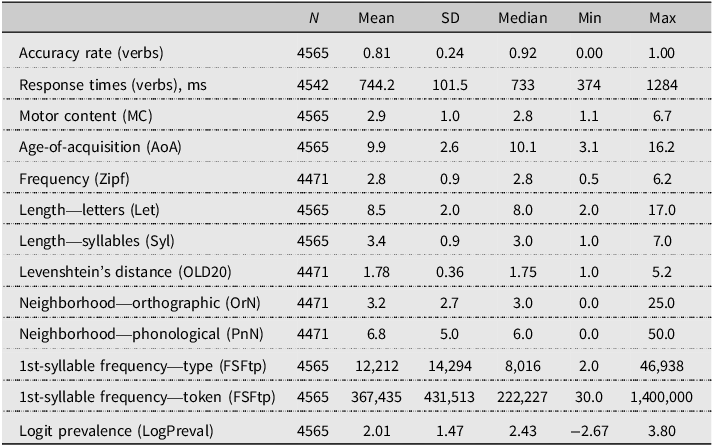
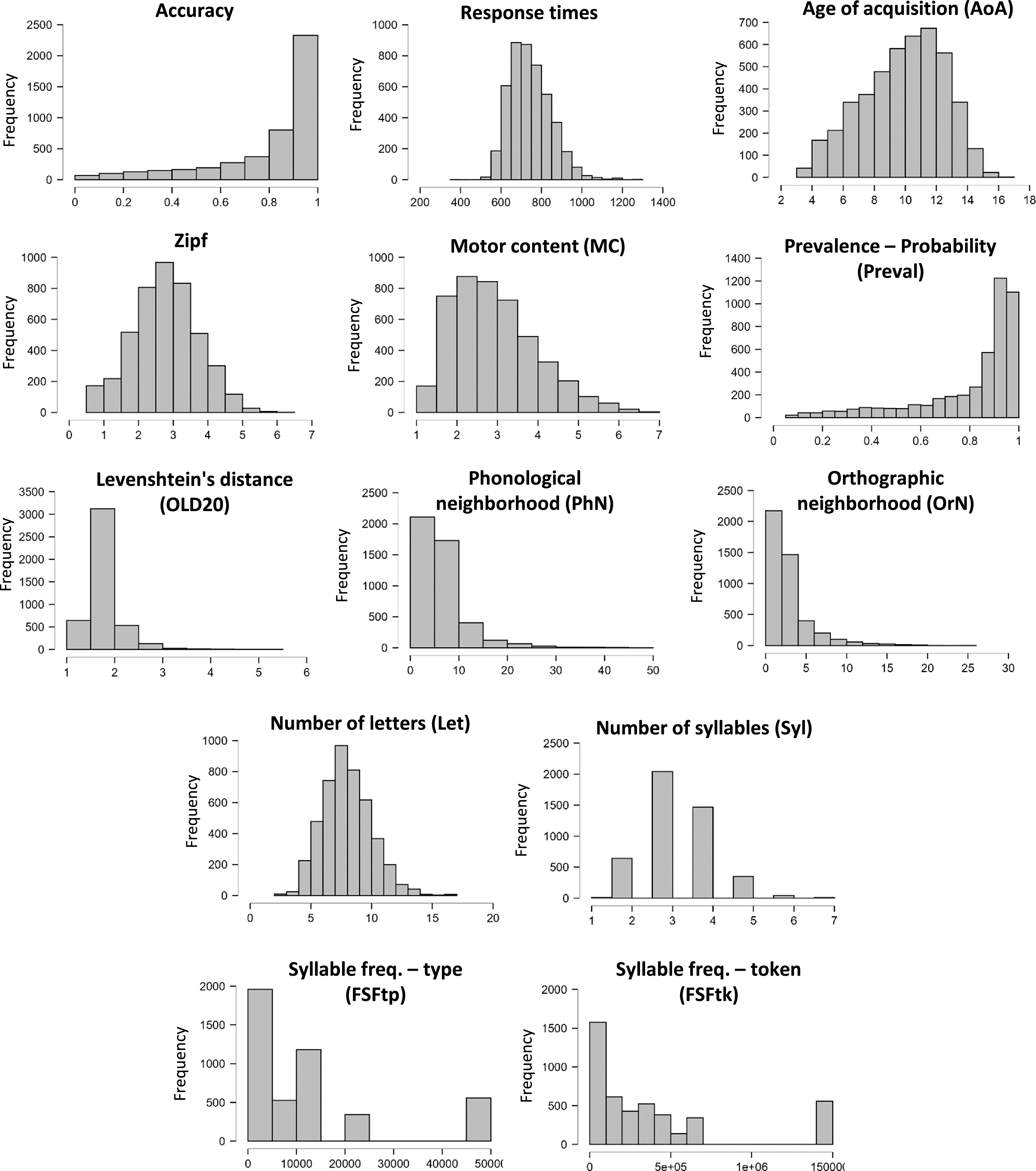
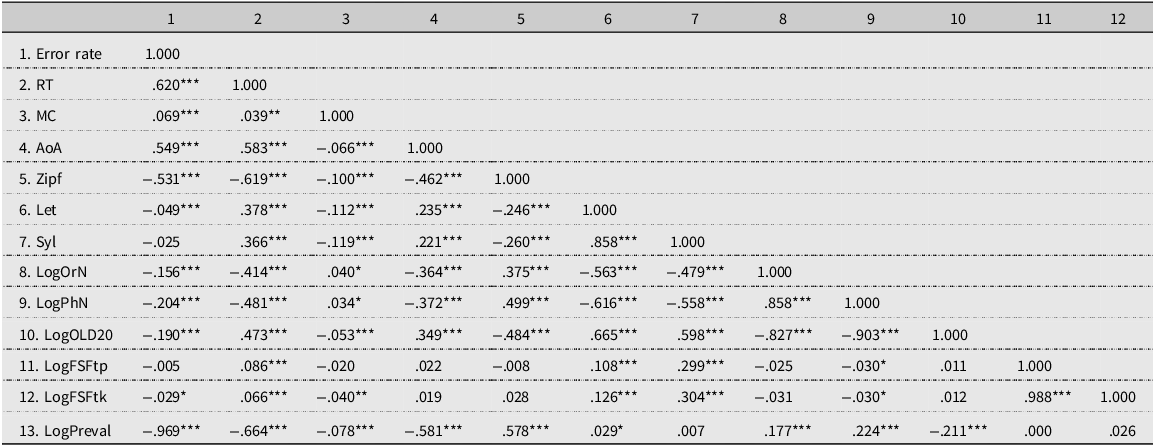
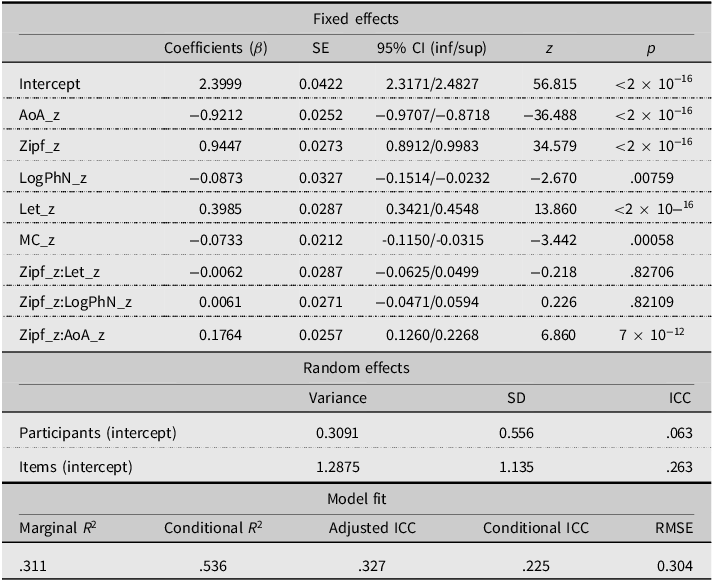
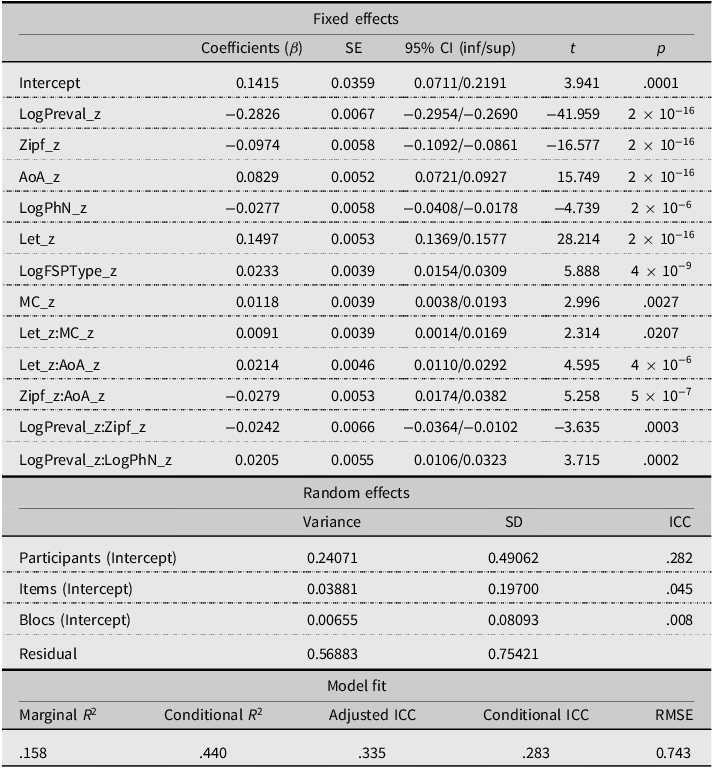
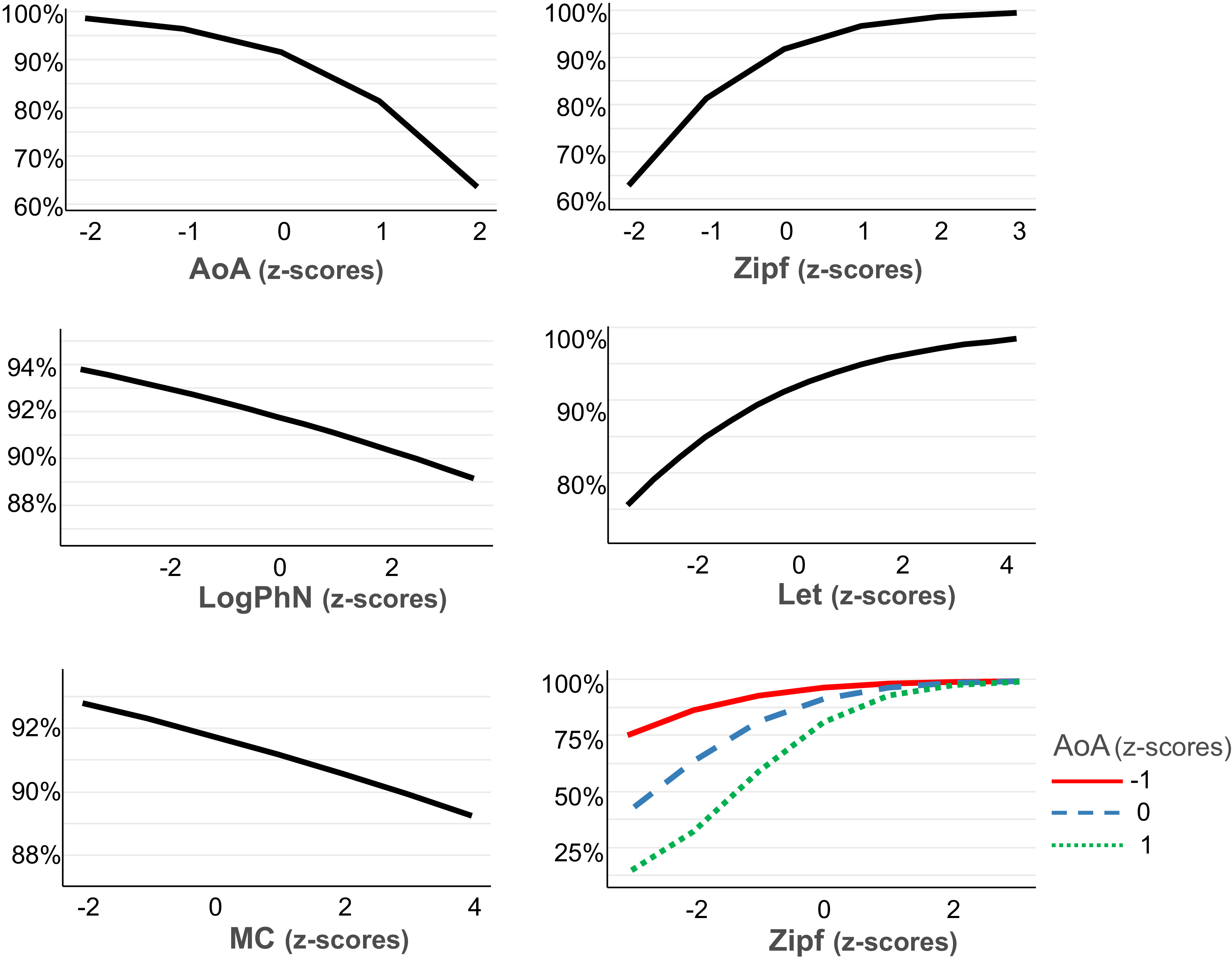
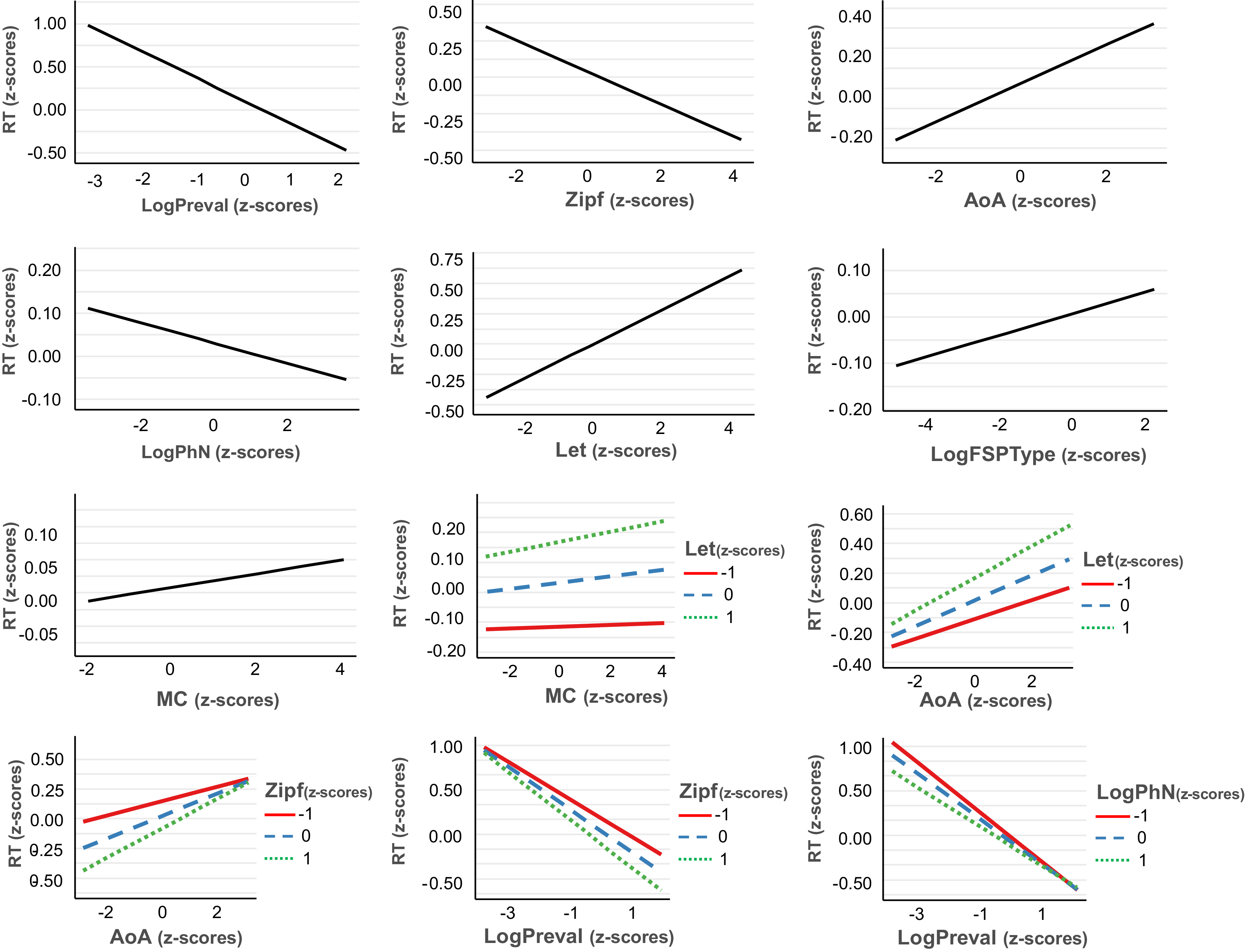


 Open access

