Like nouns, verbs represent basic units of grammar that are essential components in language use. Generally, nouns are defined as words referring to entities and verbs as referring to processes (Laudanna & Voghera, Reference Laudanna and Voghera2002). Much of what is known about word recognition and production is based on the study of nouns. However, recent research on verb recognition and production has burgeoned in studies of language development (Labelle, Godard, & Longtin, Reference Labelle, Godard and Longtin2002; Negro, Chanquoy, Fayol, & Louis-Sidney, Reference Negro, Chanquoy, Fayol and Louis-Sidney2005), aging (Bird, Franklin, & Howard, Reference Bird, Franklin and Howard2001; Mackay, Connor, Albert, & Obler, Reference Mackay, Connor, Albert and Obler2002; Marini, Boewe, Caltagirone, & Carlomagno, Reference Marini, Boewe, Caltagirone and Carlomagno2005; Morrison, Hirsch, & Duggan, Reference Morrison, Hirsh and Duggan2003; Persson et al., Reference Persson, Sylvester, Nelson, Welsh, Jonides and Reuter-Lorenz2004), aphasia (Barde, Schwarz, & Boronat, Reference Barde, Schwartz and Boronat2006; Berndt, Mitchum, & Price, Reference Berndt, Mitchum and Price1991; Caramazza & Hillis, Reference Caramazza and Hillis1991; Hillis, Tuffash, & Carmazza, Reference Hillis, Tuffiash and Caramazza2002; Plunkett & Bandelow, Reference Plunkett and Bandelow2006), bilingualism (Dopke, Reference Dopke1998; Pillai, et al., Reference Pillai, Araque, Allison, Sethuraman, Loring and Thiruvaiyaru2003), and speech errors (Arnaud, Reference Arnaud1999; Poulisse, Reference Poulisse1999). Still, less is known about the extent to which the grammatical, morphological, and phonological characteristics of verbs contribute to differences in word recognition and production.
Depending on the language, a verb may vary in form according to factors such as tense, gender, person, and number (singular or plural). Unlike English verbs, which undergo little inflection, many Romance languages such as Spanish and Italian have a rich inflectional morphology. Psycholinguistic studies show that adults and children who speak Italian rely heavily on morphological cues for the recognition and sentence interpretation of nouns as well as verbs (e.g., Bates, Devescovi, & D'Amico, Reference Bates, Devescovi and D'Amico1999; Bates, Devescovi, Pizzamiglio, D'Amico, & Hernandez, Reference Bates, Devescovi, Pizzamiglio, D'Amico and Hernandez1995; Devescovi, D'Amico, Smith, Mimica, & Bates, Reference Devescovi, D'Amico, Smith, Mimica, Bates and Hillert1998; MacWhinney, Bates, & Kiegl, Reference MacWhinney, Bates and Kliegl1984). The present report takes advantage of the inflectional morphology of Spanish verbs to determine which linguistic and psycholinguistic factors influence verb shadowing and pronoun production.
To assist in the study of Spanish inflection we implement a data set that incorporates grammatical, morphological, and phonological dimensions of Spanish verbs, which we refer to as the Spanish Verb Inventory (SVI). Only a handful of online databases have been developed to obtain indices specific to Spanish words. These include LEXESPFootnote 1 (Sebastían-Gallés, Marti, Carreiras, & Cuetos, Reference Sebastián-Gallés, Martí, Carreiras and Cuetos2000), Corpus del Español (Davies, Reference Davies2001), BuscaPalabras (Davis & Perea, Reference Davis and Perea2005), EuroWordNet (Vossen, Reference Vossen1998), the International Picture-Naming Project (Szekely et al., Reference Szekely, Jacobsen, D'Amico, Devescovi, Andonova and Herron2004), and C-ORAL-ROM (Crestie & Moneglia, 2000). There is currently, however, no online lexical data set free of charge for computing linguistic/psycholinguistic dimensions specific to Spanish inflected verbs. Such a data set would facilitate the study of lexical processing in a morphologically rich language. The first part of this report describes a lexical Excel spreadsheet designed specifically for calculating summary statistics across several psycholinguistic features characteristic of Spanish verbs.Footnote 2 Using these data, we then characterize the factors contributing to spoken word recognition and production across two levels of processing. These analyses shed light on psycholinguistic factors shared by other languages but also call attention to verb features unique to the Spanish language, such as verb tense and inflected verb forms that are compatible with multiple subject pronouns.
SPANISH LANGUAGE DATABASES
Currently, there are few databases that provide psycholinguistic measures of Spanish inflected verbs. Two excellent data sets, LEXESP (Sebastián-Gallés et al., Reference Sebastián-Gallés, Martí, Carreiras and Cuetos2000) and BuscaPalabras (B-Pal; http://www.uv.es/mperea/; Davis & Perea, Reference Davis and Perea2005) include many psycholinguistic and linguistic variables. The LEXESP query system is an extensive lexical database for Spanish words. It contains a total of 5,020,930 word tokens (including some inflected verbs) and incorporates measures of word frequency (for 166,494 words), number of syllables, stress location, and word pronunciations. As noted by Davis and Perea (Reference Davis and Perea2005), many of these words are proper nouns, words containing nonalphabetic characters, pseudowords, or non-Spanish words. Norms for imageability, concreteness, and familiarity are also included for 6,500 of the most frequent words. Of these, however, imageability and concreteness values are available for only 21 (2.3%) of the 920 inflected verbs in the present study. In addition, LEXESP does not contain other variables such as age of acquisition, orthographic or phonological neighborhood measures, or syllable frequencies (Davies & Perea, Reference Davis and Perea2005).
In 2005, Davis and Perea created BuscaPalabras (B-Pal; http://www.uv.es/mperea/), a lexical program based on 31,491 Spanish word types found in LEXESP. B-Pal includes several indices not found in LEXESP such as age of acquisition, syllable-based measures (such as token and type syllable frequency), orthographic neighborhood measures, phonological statistics such as the word's pronunciation, initial and number of phonemes, stress pattern, syllable count, and occurrences of homophones, valence, and arousal. The program also includes information about orthographic similarity, such as transposed letter neighbors and embedded-word similarity, and enables researchers to integrate up to three user-defined indices not previously included in the original database. However, B-Pal is limited in that it includes few inflected verb forms. Although 49 of the 50 infinitive verb forms are included, B-Pal contains only 51 (5.5%) of the 920 inflected verb forms found in the present study. In addition, indices such as tense, class, stress type, regularity, and the object pronoun associated with each verb are not part of B-Pal. Furthermore, B-Pal does not include phonemic variables such as vocal location of articulation (e.g., lateral or voiced palatal), manner and place of articulation, root and stem spoken durations, and audio sound recordings for each verb. Note that although B-Pal and LEXESP include frequency measures, the most comprehensive and updated frequency database for written Spanish words is the Davies corpus (2001), which is freely available online (http://www.corpusdelespanol.org/).
SVI
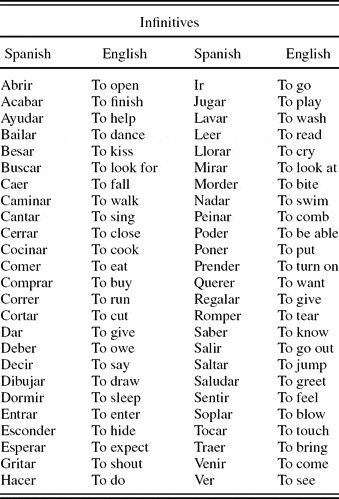
When it comes to the study of inflected verbs, the availability of online psycholinguistic databases is limited. To address this shortcoming, we present the SVI, a data set constructed to include psycholinguistic measures particular to Spanish inflected verbs. The verb inventory consists of 50 of the earliest acquired common Spanish verbs (Table 1), conjugated across person, number, and four verb tenses, for a total of 920 unique inflected verb forms (see Method section for details). For each word, queries can be made across grammar, morphology, and phonology (see Appendix A for a complete list of variables). Like LEXESP and B-Pal, SVI includes measures of word length, word and syllable frequency, and subjective ratings of concreteness (infinitive verb forms only). Similar to B-Pal, SVI includes phonological indices such as initial phoneme, stress pattern, number of syllables, vowel–consonant (VC) structure of the lexeme (e.g., hacemos [we do] has a CVCVCVC structure), and phonemic variables, such as root and stem. However, we provide these variables for words that are not within the B-Pal database.
List of experimental verbs

In presenting this data set, we also acknowledge its shortcomings. Some factors such as phonological and orthographic neighborhood, which have proved important for lexical access, are not available for verbs and were not included herein. However, another feature of SVI is that it is amenable to the addition of indices as they become available in future studies.
In brief, SVI is the first data set that provides indices that are relevant for psycholinguistic studies of inflected Spanish verbs that are unavailable from other databases. SVI is unique in that it is specific for the study of Spanish verbs and includes variables that have never been included in other lexical databases. These variables include the following: (a) alternative pronouns across verb forms, (b) the duration of each word and word part (stem, root, word ending) in milliseconds, (c) mean response times (RTs) for two production tasks, and (d) audio sounds files for the 920 Spanish inflected verbs. The data set is presented as a Microsoft Excel spreadsheet, along with a codebook describing each of the variables. These tools can be accessed free of charge from the Center for Research in Language website at http://crl.ucsd.edu/experiments/svi/.
FACTORS RELATED TO SPOKEN WORD RECOGNITION, LEXICAL ACCESS, AND VERB PRODUCTION
In developing this online data set, we also aimed to provide researchers interested in verb processing with analyses characterizing how different linguistic and psycholinguistic factors relate to word recognition and production. In particular, evidence suggests that factors such as word frequency, measures of word length (Cuetos, Ellis, & Alvarez, Reference Cuetos, Ellis and Alvarez1999; Prado & Ullman, Reference Prado and Ullman2099; Spieler & Balota, Reference Spieler and Balota1997), phonetic characteristics (Treiman, Mullennix, Bijeljac-Babic, & Richmond-Wllty, Reference Treiman, Mullennix, Bijeljac-Babic and Richmond-Welty1995) and verb regularity/irregularity (Marslen-Wilson & Tyler, Reference Marslen-Wilson and Tyler1997; Sonnenstuhl, Eisenbeiss, & Clahsen, Reference Sonnenstuhl, Eisenbeiss and Clahsen1999; Stanners, Neiser, Hernon, & Hall, Reference Stanners, Neiser, Hernon and Hall1979) affect lexical access. Moreover, prior studies suggest that performance can change when participants are asked to focus explicitly on grammatical dimensions (Bates et al., Reference Bates, Devescovi, Pizzamiglio, D'Amico and Hernandez1995; Bates, Devescovi, Hernandez, & Pizzamiglio, Reference Bates, Devescovi, Hernandez and Pizzamiglio1996). Verb tense has also been found to influence verb processing in inflected verb forms (Carreiras, Perea, & Grainger, Reference Carreiras, Perea and Grainger1997; Kostic & Havelka, Reference Kostic and Haveka2002). Not only are these important factors for word recognition and production, these are factors that can potentially act as confounds in studies of language processing more generally.
In the present study, we tested the effect of many of these psycholinguistic dimensions on RT using two tasks: a word repetition task and a pronoun production task. In both tasks, native speakers of Spanish listened to spoken verbs. In the first task (called single word shadowing; see Bates & Liu, Reference Bates and Liu1996), participants were asked to repeat each target word as quickly as possible without making a mistake. This task does not necessarily require specific attention to verb conjugation or conscious decision about morphological markers, although these factors have been shown to influence even simple word repetition (Bates et al., Reference Bates, Devescovi, Pizzamiglio, D'Amico and Hernandez1995). Such attention and reflection were more important in the second task, in which participants were asked to generate a subject pronoun that agreed with each verb. To perform the latter task, participants had to monitor the person and number inflection on the target verb and to make a deliberate decision about a suitable subject pronoun (e.g., given the second person singular imperfect form corrías [you were running], participants would have to generate the second person singular pronoun tu). This is a metalinguistic task, and it could be argued that it is artificial in Spanish for two reasons: (a) Spanish is a pro-drop language in which subject pronouns are frequently omitted and (b) subject pronouns, when they do occur, are more likely in preverbal position; yet in this task, speakers generated the pronoun after the verb. In contrast, subject pronouns are still a high-frequency phenomenon, and because overt subject pronouns tend to be used for emphasis, they are more common in postverbal position than many other subject types (e.g., the sentence Corría yo, literally “Was running I,” can be translated more fully as “I was the one who was running”). The main advantage of the pronoun generation task, as a complement to word repetition, is that it permits us to investigate the factors that influence performance when speakers are forced to attend to and reflect upon grammatical information. Although it is obvious that the latter task will be more taxing and thus lead to longer RTs than the repetition task, we have made available the mean differences in RT between two tasks, as these are informative for knowing how long on average it takes listeners to process and produce each stimulus dependent on the task demands.
METHOD
Participants
Data were obtained from 60 native speakers of Spanish (39 females, 21 males), ages 17 through 25 years (M = 20.9), who were students of the college of Humanities at the Universidad Autónoma de Baja California and living in Tijuana, Mexico.Footnote 3 Prior to testing, each participant completed a language history questionnaire to assess biographical information regarding all contact with their native and any other languages, and to identify them as native Spanish speakers (i.e., contact since birth and dominant language used at time of testing). Information concerning handedness and past auditory or linguistic disability was also collected. All participants were right-handed, with no prior history of disabilities that could hinder their performance on the experimental tasks. Participants were compensated for their participation.
Materials
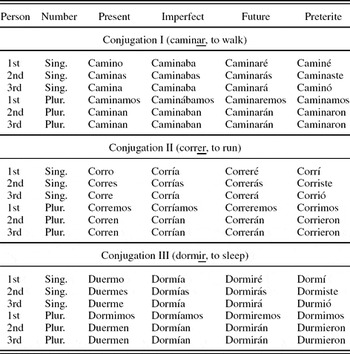
The verbs used in this data set are 50 of the first 100 verbs acquired by Spanish-speaking children, obtained from the Spanish version of the MacArthur–Bates Communicative Development Inventory (Fenson et al., Reference Fenson, Dale, Reznick, Thal, Bates and Hartung1993; Jackson et al., Reference Jackson-Maldonado, Thal, Marchman, Newton, Fenson and Conboy2003; Table 1). The same 50 verbs were used in a study of Italian inflected verbs (Devescovi et al., Reference Devescovi, D'Amico, Bentrovato and Bates2009). These 50 verbs were chosen because they were among the first 100 verbs learned in both languages. Each of the 50 verbs (i.e., lexemes) appeared as isolated inflected verbs (i.e., morphosyntactic word form) in four indicative tenses (imperfect, preterite, future, and present), three persons (first, second, and third person) and number (singular and plural) combinations. Although four tenses, three persons, and two numbers should lead to 24 inflected morphosyntactic forms per verb, there are several repeated lexical forms across verb conjugations in Spanish, resulting in only 18 or 19 unique word forms depending on the verb (Table 2). First, the second- and third-person plural forms across all tenses are always identical in Spanish (e.g., ellos/ellas van, ustedes van, “they [masc/fem] go,” “you [plural] go”). Second, the first- and third-person singular forms of the imperfect tense for all verbs are identical (e.g., yo abría, él/ella abría, “I was opening,” “he/she was opening”). Finally, the first-person plural forms in the present and preterite tenses for 30 of the verbs used are identical (e.g., nosotros abrimos/abrimos, “we open/opened,” but not nosotros vemos/vimos, “we see/saw”). Each of the 920 inflected verbs were recorded by a female native speaker of Spanish in a sound-attenuating booth and converted from digital audiotape to individual digital sound files. The sound files were normalized and cleaned, with the blank space before word onset and after word offset removed. The average duration of the sound files was 624.8 ms, with a range between 274.0 and 965.0 ms. These sound files are Windows PCM files, and can be played online using any Windows media software at http://crl.ucsd.edu/experiments/svi/.
Simple tense of the indicative mode in Spanish verbs

Note: Second person plural can express 3rd person forms; 3rd person singular forms can express 2nd person forms; 1st, 2nd, and 3rd person singular forms and 1st person plural forms of dormir denote irregular verbs across all verb tenses; 1st person imperfect is expressed by 3rd person imperfect; 1st person plural present tense is expressed by 1st person plural preterite tense.
Procedure
Participants were randomly assigned to one of two tasks: verb repetition (single word shadowing) (N = 30) or pronoun production (N = 30). Note that our sample size is comparable to several other norming studies but is still comparable to several other norming studies (e.g., those listed at http://crl.ucsd.edu/~aszekely/ipnp/ under “Studies”). In both tasks participants listened to prerecorded verbs in random order and were asked to either repeat the word as soon as they knew what it was (single word shadowing) or to produce the first pronoun that came to mind upon listening to the verb.Footnote 4 In each case, participants were instructed to respond as quickly as possible upon hearing the stimulus, without making errors. They were asked to avoid making any sounds that could interfere with the answer (given that the voice key recorded the first perceived sound as the onset of a response) and to avoid correcting themselves after a response was given.
A brief practice session consisting of 20 verbs that were not used in the experimental session was given to each individual prior to the actual session. Participants were asked to fixate their attention on a cross (+) in the middle of a blank computer screen, and were informed that a series of inflected verbs were going to be presented through the headphones. In the pronoun production task, participants were not prompted on which pronoun to say. Thus, for some verbs, more than one correct pronoun could potentially be produced. For instance, the verb corría (was running) could elicit either of the following correct pronoun response: él (he), ella (she), yo (I), or usted (you formal). The actual response was noted, with any of these responses considered correct.
Individuals were tested one at a time in a quiet cubicle with an experimenter present. Each participant sat in front of a computer monitor and wore headphones with a sensitive built-in microphone with adjustable volume. The headphones were connected to the Voice-Operated Relay (VOR) of a Carnegie Mellon University Button Box, a voice-activated key that gives results in millisecondsFootnote 5 (Cohen, MacWhinney, Flatt, & Provost, Reference Cohen, MacWhinney, Flatt and Provost1993). A tie microphone connected to a magnetic tape recorder was used to record the actual voice responses for offline verification. Before testing, participants read a list of words into the microphone to adjust the sensitivity of the VOR for each participant individually. The experimenter also wore headphones (connected to the computer via a two-prong connector), and hand recorded each correct response and all naming errors on a score sheet during testing.
The stimuli were presented directly from a Macintosh computer using PsyScope software. The experiment began when the participant pressed a button on the keyboard. Three lists of all 920 verbs were created, each with a different random order. Participants were randomly assigned to one list. The verbs were presented in a continuous sequence with a 1500-ms interstimulus interval between each word. Participants were given 3000 ms to respond from the onset of each stimulus, but as soon as a voice response was detected the interstimulus interval began. A black dot appeared at the bottom of the computer screen when a response was received. An “NR” for “no response” was automatically marked in the data file if the 3000-ms period ended prior to the participant's response. There were eight rest breaks throughout the experiment (~102 verbs presented/block). Participants were allowed to continue when ready, by pressing any button on the keyboard. The entire experimental session lasted approximately 45 min.
Transitivity and concreteness norming. Depending on their contextual use, verbs can belong to either transitive (requiring a direct object) or intransitive categories. Concreteness is usually employed when referring to nouns (the word “tough” is less concrete than “dog”), but verbs may also be described by varying degrees of concreteness (e.g., action verbs like “kick” versus verbs of being like “am”). Currently, there are no resources available to obtain normed ratings of concreteness or transitivity for all of the Spanish inflected verbs used herein. Normed values of transitivity (and concreteness) for Spanish-inflected verbs would entail undertaking a more extensive study. This is not the primary goal of this study, but is a worthy endeavor for a future study. We did, however, want to provide an estimate of concreteness and transitivity for the 50 infinitive verb forms used in the present study to examine whether these variables were associated with RT. Ratings were therefore collected using a short questionnaire from a separate group of 30 native speakers of Spanish living in San Antonio, Texas. Subjects rated each verb lexeme on a 5-point Likert scale that ranged from high to low concreteness and transitivity. The mean values for all ratings across subjects were calculated, and whereas they are not normative, are made available to readers as an estimate of concreteness and transitivity for the 50 infinitive verb forms used in the study. They can be accessed online along with the SVI data set at http://crl.ucsd.edu/experiments/svi/.
MAIN ANALYSES AND RESULTS
The mean RT (ms) was the primary dependent variable across all analyses. Two operationally defined measures of RT were examined: (a) RT measured from word onset, from the onset of the stimulus to the onset of the verbal response; and (b) RT measured from word offset (stimulus onset − stimulus duration [ms]). The duration of each stimulus sound file was determined by audio review and visual inspection of the speech waveforms. Onset RT provides a standard RT measure, whereas offset RT eliminates the duration of the word as a factor in response delay. Accuracy was also measured as the percentage of responses that were correctly repeated in the single word-shadowing task, or for which a pronoun was correctly generated in the pronoun production task. Given the high accuracy (only 3.9% errors for pronoun production, 1.9% for repetition), errors were not analyzed further. Only onset RT was used as a dependent measure in multiple regression analysis, whereas the other measures were used for descriptive statistics of the means only.
Data were examined by item (N = 920 items by 30 participants for each task). Only correct responses were used for the analyses. Mechanical error (e.g., no voice detected when response was given or voice detected early) and participant error (e.g., incorrect pronoun or misheard word) were coded offline in each participant's data file, and removed from the data set prior to averaging. Trials removed because of error amounted to 2,275 or 8.2% of the total data in the pronoun production task and 1,357 or 4.9% of the total data in the repetition task. Mean RTs were measured from stimulus offset and onset after removing univariate outliers exceeding three standard deviations from the mean (an additional 988 trials or 3.6% of the total data for repetition and 1,743 trials or 6.3% of the total data for pronoun production). The remaining 23,582 pronoun trials (85.4% of the data) and 25,255 repetition trials (91.5% of the data) were used for further analyses.
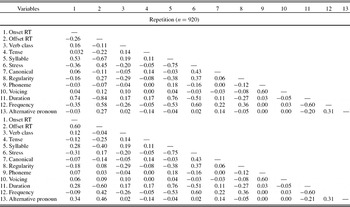
Verb frequency counts were logarithmically transformed to improve pairwise linearity and to reduce skewness. A variable called “alternative pronoun” consisting of four groups was created to categorize verbs that take more than one alternative pronoun (e.g., the pronoun for the imperfect form of correr [to run], corría can be either yo [I], ella [she], él [he], or usted [you formal]). Categorical variables were also created for verb class, syllable stress, and first phoneme sound articulation. Finally, multivariate outliers were assessed across the 10 independent variables (Table 3) through Mahalanobis distance,Footnote 6 indicating that at least one variable was skewed (i.e., the independent variable, “number of tenses”). This variable contributed to multivariate outliers with a Mahalanobis distance greater than χ2 = 29.59 (p < .001). Removal of this factor reduced the number of outliers to one factor. This factor was not extreme, and therefore, was retained. Residual plots showed no large departures from a linear association.
Bivariate correlations between dependent and independent variables (N = 1,840)

Note: RT, response time.
Mean RT differences across tasks
A two-sample t test was used to compare mean onset RTs for the repetition and pronoun production tasks. Producing a pronoun corresponding to a spoken verb took on average 350 ms longer (M = 1242.1, SD = 119.5) than repeating the verb (M = 885.5, SD = 67.3), t (1468.5) = 65.3, p < .001; equal variance not assumed.Footnote 7
Mean RT difference across independent variables
Analysis of variance with Dunnett T3 correction was used to examine mean differences in RT across the following categorical factors: verb class (e.g., -er, -ir, -ar), number of syllables, tense,Footnote 8 alternative pronoun,Footnote 9 syllable stress position, canonical stress, verb regularity, voiced/voiceless pronunciation, and first phoneme sound pattern (e.g., fricative, stop, nasal). The partial eta squaredFootnote 10 was used to determine effect size. All remaining means analyses were conducted on each task separately.
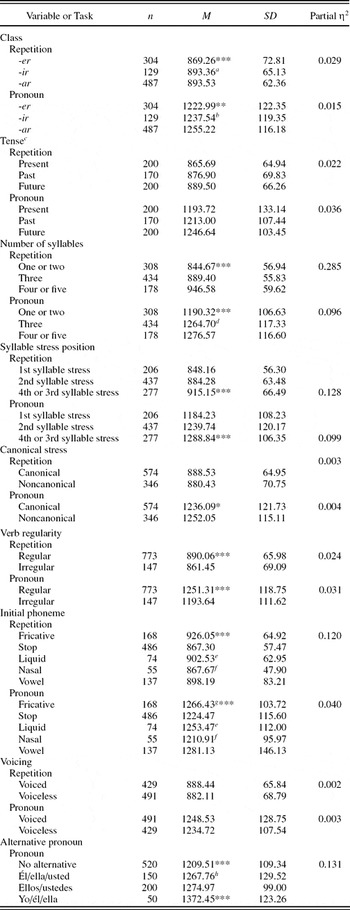
Means comparisons from onset. Univariate analysis showed significant mean differences across verb class, number of syllables, tense, stress position, verb regularity, and first phoneme articulation in both tasks, as well as alternative pronoun (relevant to the pronoun task only) and canonical stress in the pronoun production task (Table 4). In particular, -er verbs, verbs containing one to two syllables, stress occurring on the first syllable, irregular verbs, verbs beginning with a stop sound, and canonical stress were associated with faster RTs than comparable conditions. In the pronoun production task, RTs were slower for verbs with multiple alternative pronouns compared to verbs with fewer or no alternative pronouns.
Mean differences in onset response time across grammatical, phonological, and morphological characteristics (N = 1,840)

aVerbs that end with -ir are not significantly different from -ar verbs.
bVerbs that end with -ir are not significantly different from -er and -ar verbs.
cBecause of repeating lexical forms in the singular imperative tense and across all plural forms, these values are limited to the singular present, past, and future tense forms.
dThree syllable verbs are not significantly different from the four or five syllable group.
eLiquids are not significantly different from vowels.
fNasals are not significantly different from stops.
gFricatives are not significantly different from liquids or vowels.
hÉl/ella/usted are not significantly different from ustedes/ellos.
*p < .05. ***p < .001.
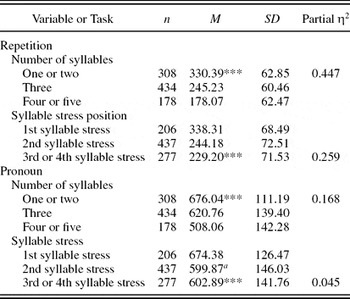
Means comparisons from offset. There were significant mean differences measured from stimulus offset (with duration of the stimulus removed) and a reversal in pattern compared to stimulus onset, for number of syllables and stress position in both tasks (Table 5). In particular, words containing four or five syllables elicited faster offset RTs than one-, two-, or three-syllable verbs. Furthermore, stress occurring on later syllables was associated with faster RTs compared to earlier stressed syllables.
Mean differences in response time measured from stimulus offset for number of syllables and stress position (N = 1,840)

aThe 2nd syllable stress position is not significantly different from the 3rd or 4th stress position.
***p < .001.
Predictors of RT at onset
Correlation coefficients (Pearson's correlation) were used to investigate linearity between the dependent (RT) and the 10 independent variables (Table 3) and to examine multicollinearity between each independent variable. Independent variables with a correlation of 0.8 or greater were considered multicollinear (Katz, Reference Katz2006). Pearson's correlations were classified as weak for r = .20, moderate for r = .50, and strong for r = .80 (Cohen, Reference Cohen1988). Given that a significant p value does not always mean the presence of a strong relationship with large sample sizes (Odberg, Jakobsen, Hultgren, & Halseide, Reference Odberg, Jakobsen, Hultgren and Halseide2001), a predictor variable that had a correlation of .20 or greater with RT (the dependent variable) was considered for inclusion in a standard linear regression analyses. Using this method, all of the independent variables enter the regression equation at one time. Each independent variable is evaluated in terms of what it adds to the prediction that is different from the predictability afforded by all of the other variables (Tabachnick & Fidell, Reference Tabachnick and Fidell2001). Separate item analyses were performed for the repetition and pronoun production tasks. The percent of unique and shared variation explained by each predictor variable was estimated in each model. A value of p < .05 was used to denote statistical significance.
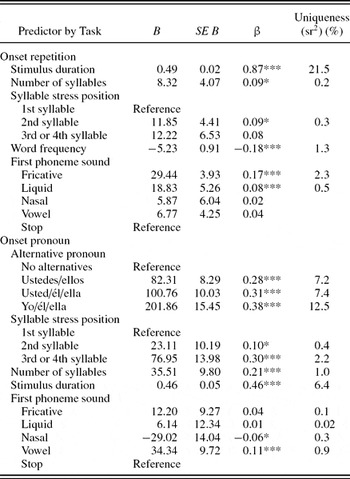
In univariate analyses, five factors were associated with the time required to repeat a verb measured from stimulus onset: stimulus duration, number of syllables, word frequency, and certain levels of stress position and first phoneme sound articulation. Of these, stimulus duration, word frequency, second syllable stress, and the fricative and vowel phonemic sounds contributed to predicting RT for repeating a verb in multivariate regression analyses (Table 6). Together, these variables accounted for 62% of the variance in RT (p < .001). Stimulus duration contributed the largest to the effect size, accounting for 21.5% of the variance in the model.
Summary of standard regression analyses for onset response time across repetition and pronoun tasks (N = 920)

Note: Repetition: R 2 = 62.1% (unique = 24.5%, shared = 37.6%); pronoun: R 2 = 32.5% (unique = 38.0%, shared = 0.0%).
*p < .05. ***p < .001.
Verb characteristics bivariately associated with pronoun production measured from stimulus onset included alternative pronoun, stress position, number of syllables, stimulus duration, and specific levels of first phoneme sound articulation. In multivariate regression analyses, verbs with a greater number of alternative pronouns, stress occurring at a later position in the verb, stimulus duration, and verbs beginning with a nasal or vowel phonemic sounds significantly contributed to predicting pronoun production (Table 6). Together, these variables accounted for 32.5% of the variation in onset RT (p < .001), with the largest effect size attributed to verbs having multiple pronouns.
Concreteness and transitivity
Although we did not have RTs for each of the 50 verb lexemes, we took the averaged RTs of the root (the portion of each verb that is common across all verb conjugations) and used this value as a dependent measure for correlation with ratings of transitivity and concreteness. No linear association was found between the mean root RT when compared to mean values for concreteness (Pearson r = .01) and transitivity (Pearson r = .03). Although, it is worth noting that the trend was such that mean root RTs were faster for verbs judged to be more concrete and transitive than those judged to be less concrete and intransitive.
Summary
In summary, factors such as number of syllables, stress position, stimulus duration, and certain levels of a verb's initial phoneme facilitate both verb shadowing as well as pronoun production from verb onset. Of particular relevance to Spanish verbs was the finding that verbs with more than one possible pronoun lead to slower RTs compared to verbs having only one possible subject pronoun. This finding suggests that at least some grammatical aspects unique to the Spanish language influence RT. These findings also suggest that a listener can prepare a response prior to the end of auditory stimulus presentation. This is evident from the reversal of RT effects when comparing onset to offset RTs. When measured from stimulus onset, listeners were able to respond faster to verbs with fewer syllables and verbs with stress on the first syllable than to verbs with stress appearing later. However, when the stimulus duration was subtracted from the RT (e.g., RT measured from stimulus offset), the direct inverse relationship was observed.
DISCUSSION
As research into the processing and production of Spanish language continues to grow, so too will be the greater utility for quick, user-friendly online lexical resources that provide psycholinguistic frequency and summary statistics suitable for use with standard spreadsheets. Only recently have lexical databases such as LEXESP and BuscaPalabras incorporated psycholinguistic measures of Spanish words. We present the first data set available free of charge dedicated to psycholinguistic measures specific to Spanish-inflected verbs including measures of grammar, morphology, word length, word frequency, phonology, and RT. This is also the first study of inflected Spanish verbs to include concreteness ratings. The SVI is a lexical data set developed to facilitate the study of Spanish verbs, as described in the SVI Section.
In the second section of this report, we examined several characteristics found in the SVI to determine which ones best predicted RT to repeat a verb and produce its pronoun. Our results highlight four main factors that contribute to RT: word length, stress position, phonetic patterns, and word frequency. Although each of these topics merits an extensive review, herein we briefly discuss these factors as per our findings and highlight their relation to each body of literature independently.
Word length
The relationship between word length and the time it takes to respond could have three potential outcomes. First, if the time it takes to produce a verbal response was independent of word length then, by removing the duration of the stimulus from the RT, there would be no change in effect between short and long words. Second, if RT strictly depended on the length of the word, when removing the duration of the stimulus from RT longer words should lead to longer RTs than shorter words. The third option is that preparation time begins at some point after stimulus onset and not from stimulus offset. In this case, removing the stimulus duration from the RT could elicit shorter RTs for longer compared to shorter words. If this relationship were such that it takes a fixed amount of acoustic information before one can begin to prepare a response, then there would be no difference in RTs from the onset of shorter or longer words. Our comparison of the number of syllables and stress position measured from stimulus onset suggest that words containing more syllables elicit longer RTs. However, when the effect of stimulus length was removed by looking at the offset latencies, an inverse result was observed: verbs containing more syllables resulted in shorter offset RTs in both tasks. This indicates that listeners begin to prepare a response at some point from stimulus onset, but that this time is not a fixed preparation time. This notion was supported in post hoc analyses by the fact that when the stimulus duration was removed, many RTs yielded negative values, indicating that individuals were able to respond before the end of the word (these were negative responses for words that had positive responses measured from stimulus onset). Of 26,070 responses in the pronoun production task, 1,135 (4.4%) produced negative offset times. Similarly, of 26,444 individuals responses in the repetition task, 1,745 (6.6%) produced negative offset times. Only responses that had positive onset RT values were used for these analyses; hence, these negative offset values were necessarily a result of voice onset times occurring between the onset and offset of the stimulus. In the repetition task, onset RT increased with increasing stimulus duration (r = .74). Conversely, a strong significant negative correlation was observed for offset RT and stimulus duration (−.84), with faster RTs resulting with increasing stimulus duration. A similar but weaker relationship was observed in the pronoun task.
This is supported by previous research that suggests that when it comes to two-word pairs, the point of articulation depends on both the time required to prepare a word and the length of a preceding word (Griffin, Reference Griffin2003). Griffin proposed that articulation of shorter words reduced the amount of “last second preparation” time available for preparing the next word, such that speakers delayed pronouncing the first word while preparing the second. Speakers had more time during speech to prepare longer words, so pronunciation of the first word was initiated earlier (see also Meyer, Roclofs, & Levelt, Reference Meyer, Roelofs and Levelt2003; Schriefers & Teruel, Reference Schriefers and Teruel1999).
Studies suggest that this early recognition process may be facilitated by early acoustic information (e.g., O'Rourke & Holcomb, Reference O'Rourke and Holcomb2002; Wheeldon & Levelt, Reference Wheeldon and Levelt1995). O'Rourke and Holcomb tested the impact of acoustic input on word recognition using event related potentials for words ranging in duration from 600 to 900 ms. The authors found that N400 peak latency and RT measured from word onset were faster for stimuli when the acoustic uniqueness point occurred earlier in the word than points occurring later. To quantify the time course of processing, the authors evaluated the onset and offset of the N400 using consecutive t tests at each electrode site contrasting words with early and late uniqueness points. Significant positive t tests (i.e., early uniqueness point had a more negative peak than late uniqueness point) were found early in the time course (at ~400 ms). Significant negative t tests (i.e., later uniqueness point had a more negative peak than earlier uniqueness points) were found later in the time course (at about 550 ms), with the earliest difference between early and late uniqueness points occurring almost 200 ms before the offset of the shortest stimuli. Based on these studies, it is evident that early acoustic input of units smaller than the complete word facilitates word recognition.
Although determining the true uniqueness point of each of our 920 verbs was beyond the scope of this study, we approximated the uniqueness point by subtracting the duration of the root from the stimulus duration. The root represents the portion of each verb that is common across all verb conjugations, especially in nonstem changing regular verbs. Hence, the following syllable often carries the unique conjugation information for each word. Our data showed a weak positive correlation between postroot verb duration and onset RT (r = .40) in the repetition task but not in the pronoun production task (r = .063). Although the uniqueness point did not contribute to producing the pronoun of the verb in the present study, our findings support those of previous research suggesting that articulation can begin at some point prior to hearing the completion of a word.
Stress position
Another feature of words that may determine the ability to recognize them prior to hearing them to completion is lexical stress. A word's metric shape includes information about both the number of syllables in the word and the position of stress (i.e., the syllable that is stressed). According to the WEAVER++ model (Levelt, Roelofs, & Meyer, Reference Levelt, Roelofs and Meyer1999), accessing word forms entails activation of the word's morphological makeup, its metric shape, and its segmental makeup. In Spanish, the syllable is considered to be a basic sublexical processing unit (Alvarez, Carreiras, & Taft, Reference Alvarez, Carreiras and Taft2001; Barber, Vergara, & Carreiras, Reference Barber, Vergara and Carreiras2004; Carreiras, Alvarez, & de Vega, Reference Carreiras, Alvarez and de Vega1993; Perea & Carreiras, Reference Perea and Carreiras1998). The position of stress varies systematically across verb conjugations in Spanish, with stress most commonly occurring on the second to the last syllable (canonical stress for Spanish words). Several studies have shown an effect of stress position on word recognition and production. For instance, Jansma and Schiller (Reference Jansma and Schiller2004) instructed participants to press a button if the stress of a bisyllabic Dutch noun represented by a picture occurred on the first syllable, and avoid pressing the button if the stress occurred on the second syllable. The authors found that mean decision latencies were significantly faster for words whose stress occurred on the first syllable compared to the second syllable. In another study, Schiller, Jansma, Peters, and Levelt (Reference Schiller, Jansma, Peters and Levelt2006) used a picture-naming and self-monitoring task to investigate the effects of stress on onset latency time. Participants were asked to name a picture consisting of a bisyllabic or trisyllabic word (having initial, prefinal, or final stress) or to suppress overt naming of the pictures, and instead press a button to determine if a picture had initial or final stress. There was a significant subject advantage in onset latency for picture names with final stress compared to picture names with initial stress in bisyllabic words, which disappeared in trisyllabic words. Mean RT in the self-monitoring task showed a significant advantage of the initial stress condition over the final stress in bisyllabic words (i.e., the canonical stress position), and initial stress facilitated responses to trisyllabic words. The authors concluded that encoding of stress follows a rightward incremental pattern. These findings suggest that stress position is an important factor in recognizing and processing verbs.
Phonetic patterns
Evidence suggests that initial phonemic sounds affect the articulatory motor components of naming performance (Spieler & Balota, Reference Spieler and Balota1997). In this study initial phoneme as a factor did not strongly correlate with RT in either task. However, when examining the individual levels of initial phoneme our results showed some significant relationships between certain initial phonemes and RT. A comparison of mean differences (Table 4) suggested that verbs containing a stop or nasal phoneme were repeated faster than other initial sounds. When the variance of other factors was considered, fricative and liquid phonemes were significant predictors of RT when repeating a verb, with faster RT compared to other initial phonemes (Table 6). These findings are partially consistent with previously reported findings. For example, in Treiman et al. (Reference Treiman, Mullennix, Bijeljac-Babic and Richmond-Welty1995) participants were instructed to read a word as soon as it appeared on a screen. In a standard regression analysis that controlled for consistency, neighborhood size, word length, word frequency, and familiarity, the authors found that faster onset RTs were produced for words having liquids/semivowels or nasal initial sounds than fricatives and affricates.
One could argue that this effect is simply because of mechanical error, given the evidence that voice keys are sensitive to the acoustic properties of the initial phoneme (see Kessler, Treiman, & Mullemix, Reference Kessler, Treiman and Mullennix2002; Pechmann, Reetz, & Zerbst, Reference Pechmann, Reetz and Zerbst1989; Rastle & Davis, Reference Rastle and Davis2002; Tyler, Tyler, & Burnham, Reference Tyler, Tyler and Burnham2005). In particular, voiceless initial phonemes can fail to trigger the device, eliciting delayed RTs compared to voiced-initial phonemes (Trieman et al., Reference Treiman, Mullennix, Bijeljac-Babic and Richmond-Welty1995). However, a means analysis (Table 4) shows the opposite pattern: verbs with voiceless onset were repeated faster than voiced-initial phonemes, indicating that these differences are not solely because of a bias in the trigger device. Moreover, similar effects were found for pronoun production, where the words triggering the voice key were all voiced (vowel onset) and unrelated physically to the verb heard. In particular, producing an appropriate pronoun for verbs starting with a stop or nasal phoneme was faster than for other initial sounds, and nasal phonemes significantly predicted faster RTs, whereas vowel sounds predicted slower RTs. It is not clear from these data what the effect of initial phoneme on pronoun production means, but it is likely because of salience differences of the initial sound during perception of the word. Nevertheless, these data indicate that initial phoneme can be a significant contributing factor to performance in recognizing and processing verbs.
Word frequency
The effect of word frequency on recognition and production has been examined extensively across a variety of psycholinguistic dimensions. Lexical frequency effects have been observed across a number of behavioral tasks including auditory word recognition (Connie, Mullennix, Shernoff, & Yelen, Reference Connine, Mullennix, Shernoff and Yelen1990), visual word recognition (Alegre & Gordon, Reference Alegre and Gordon1999; Spieler & Balota, Reference Spieler and Balota2000; Treiman et al., Reference Treiman, Mullennix, Bijeljac-Babic and Richmond-Welty1995), picture-naming tasks (Alario, Costa, & Caramazza, Reference Alario, Costa and Caramazza2002; Bachoud-Levi, Dupoux, Cohen, & Mehler, Reference Bachoud-Levi, Dupoux, Cohen and Mehler1998; Bates et al., Reference Bates, D'Amico, Jacobsen, Szekely, Andonova and Devescovi2003; Cuetos, Alvarez, Gonzalez-Nosti, Meot, & Bonin, Reference Cuetos, Alvarez, Gonzalez-Nosti, Meot and Bonin2006; Cuetos, Bonin, Ramón Alameda, Chalard, & Caramazza, Reference Cuetos, Bonin, Ramón Alameda, Chalard and Caramazza2009; Cuetos et al., Reference Cuetos, Ellis and Alvarez1999; Navarrete, Basagni, Alario, & Costa, Reference Navarrete, Basagni, Alario and Costa2006), and eye movement tasks (Pynte & Kennedy, Reference Pynte and Kennedy2006). These studies find that higher frequency words facilitate lexical access and production compared to low-frequency words. In the present study, we found that word frequency contributed to predicting RT for verb repetition when other covariates were controlled for, but was not a significant factor in producing a pronoun.
Word frequency has also been examined in relation to word length. For instance, Trieman et al. (Reference Treiman, Mullennix, Bijeljac-Babic and Richmond-Welty1995) found an interaction between word frequency and word length such that increases in word length produced lower RTs for low-frequency words compared to high-frequency words. Similarly, Spieler and Balota (Reference Spieler and Balota1997) found that frequency, as a sole predictor, accounted for 7.3% of the variance in naming latency for 2,870 monosyllabic words. When word length and neighborhood frequency were entered into the model all three variables accounted for 21.7% of the variance.
Magnetoencephalography (e.g., Assodollahi & Pulvermüller, Reference Assadollahi and Pulvermuller2003) and event related potential (e.g., Hauk & Pulvermüller, Reference Hauk and Pulvermuller2004) studies with visually presented word stimuli have also investigated the relationship between word frequency and word length. In particular, low-frequency words led to stronger amplitude responses primarily in the left occipitotemporal cortex compared to high-frequency words (Assodollahi & Pulvermüller, Reference Assadollahi and Pulvermuller2003). This occurred at early time intervals for short words (between 120 and 170 ms poststimulus onset), whereas longer words showed a frequency effect later in the brain response (225–250 ms poststimulus onset). Of interest, syllable frequency has the opposite effect on RT compared to whole-word frequency (Alvarez et al., Reference Alvarez, Carreiras and Taft2001; Barber et al., Reference Barber, Vergara and Carreiras2004; Carreiras et al., Reference Carreiras, Alvarez and de Vega1993; Conrad & Jacobs, Reference Conrad and Jacobs2004). The assumption is that words with high-frequency syllables trigger a larger number of lexical candidates because they are shared by more words (Alvarez et al., Reference Alvarez, Carreiras and Taft2001; Barber et al., Reference Barber, Vergara and Carreiras2004), and thus lead to longer RTs until the uncertainty is resolved. For instance, Carreiras et al. (Reference Carreiras, Alvarez and de Vega1993) used a lexical decision task and a naming task to examine the effect of lexical (or word) frequency and the positional frequency of each syllable in 144 bi- and trisyllabic words. Results showed that RT was significantly faster for high-frequency words than for low-frequency words. However, syllable frequency produced an inhibitory effect: low-frequency syllables produced faster RTs compared to high-frequency syllables. Similar results were found for bi- and trisyllabic words across both tasks, and have been observed in several recent behavioral (Alvarez et al., Reference Alvarez, Carreiras and Taft2001, Experiments 1 and 2; Conrad & Jacobs, Reference Conrad and Jacobs2004, Experiment 1; Perea & Carreiras, Reference Perea and Carreiras1998) and electrophysiology studies (e.g., Barber et al., Reference Barber, Vergara and Carreiras2004).
In the present study, we attempted to measure first- and second-syllable frequency by using B-Pal, the Spanish standard database used in previous studies. The online database only includes first syllable frequencies for 244 verbs (26.5% of total). Of these, second-syllable frequencies were available for 91 verbs (9.9%). Of the 224 verbs with first-syllable frequencies, we did find a weak correlation between first-syllable frequency measured from stimulus onset (r = −.131) and offset (r = .123) in the repetition task, but not in the pronoun production task. Although this correlation is weak, it provides support for the inhibitory effect discussed above, in that words that share their first syllable with many words (i.e., more frequent first syllable) take longer to repeat than less frequent first-syllable words. In brief, our results show that word frequency, and syllable frequency, can also significantly contribute to verb recognition and processing.
CONCLUSION
This report describes a lexical data set that incorporates grammatical, morphological, phonological, and phonemic psycholinguistic dimensions including concreteness ratings particular to Spanish verbs. Using this data set, we demonstrated significant differences in auditory verb recognition and processing across two psycholinguistic measures that are supported by past research, while accounting for other factors that could potentially affect lexical access. In particular, our findings suggest that measures of word length, word stress, word frequency, phonetic composition, and verbs with alternative pronouns contribute to differences in RTs for both repeating a verb and producing an appropriate pronoun. Clearly, these data do not account for the total range of potentially explanatory or confounding factors that may contribute to predicting RT (e.g., measures of phonological neighborhoods, word familiarity, imageability, concreteness, and transitivity). Furthermore, although grammatical factors unique to Spanish (such as multiple pronouns) were associated with RT, analysis of other factors such as verb tense was limited because of the fact that several of the lexical forms repeat across verb conjugation. However, these results provide psycholinguists with an overview of some of the important factors currently available to study Spanish inflected verbs. The online data set presented in this manuscript offers researchers a tool for addressing future questions related to verb processing in Spanish.
APPENDIX A
The percentages in parentheses are out of the total of 920 verbs.
1. Grammatical dimensions.
• Verb tense: imperfect (21.7%), preterite (23.9%), future (27.2%), and present indicative (27.2%)
• Person: first (40.2%), second (21.7%), and third person (38.1%)
• Alternative pronoun (43.5%): verbs that can take more than one pronoun (e.g., caía can represent more than one person: yo caía [I was falling], él caía [he was falling]) (see also Note 9)
• Number: singular (59.8%) and plural (40.2%)
• Verb class: -ar (52.9%), -er (33.0%), -ir (14.0%)
2. Morphological characteristics (word form):
• Regularity: regular (84.0%) and irregular verbs (16.0%).
• Stem changing (4.7%): changes in vowel stem of the word when inflected. For instance, the vowel o changes to ue or u, and the vowel e in the stem changes to ie or i (e.g., the o in dormir [to sleep] changes to ue in yo duermo [I sleep]).
• Root, stem and suffix.
3. Measures of word length:
• Number of characters: range = 2–11 (M = 6.73)
• Number of syllables: range = 1–5 (M = 2.86)
• Stimulus duration: 624.8-ms mean duration, range = 274–965 ms
• Length of the root: The root was defined as the simplest form of the lexical morpheme, after all affixes (all bound and free forms of the morpheme) are removed; the root was measured from word onset to the offset of the root in milliseconds (e.g., the root corr- in the verb corremos [we run]).
• Length of the suffix after the root: measured from the offset of the root to the end of the word in ms (e.g., the suffix -emos in the verb corremos [we run])
• Length of the stem: As with root length, stem length was measured from the onset of the word to the offset of the stem (in ms). The stem was defined as the root plus the thematic vowel immediately following the root of the infinitive form of a regular verb (e.g., the stem corre- in the verb corremos [we run]; Linares, Rodriguez-Fornelles, & Clahsen, Reference Linares, Rodriguez-Fornells and Clahsen2006). In the case of an inflected irregular verb not containing the thematic vowel of the infinitive verb form, the stem is equal to the root of the word. In the verb corrimos [we ran], for instance, both the root and stem are denoted as corr- because the thematic vowel e is replaced with i. Similarly, the root d in the verb doy [I give] is the same as its stem, because the infinitive of the verb dar [to give] contains the thematic vowel a instead of o. The same rule was applied to stem changing verbs (e.g., in the verb dormir [to sleep], the root and stem for the inflected verb duermo is denoted as duerm-).
• Length of the suffix after the stem: measured from the offset of the stem to the end of the word (ms)
• Structure: consonant and vowel structure of the word
4. Measures of frequency:
• Lemma frequency: frequency counts were obtained from Davies’ (2001) Corpus del Español, the largest online word frequency database for written Spanish words. Only counts that occurred during the 1900s (20 million words) were included, and consisted of words obtained from written literature, oral texts, newspapers, and encyclopedias. All 50 verb–lemmas (100%) were retrieved from the corpus. Additional frequency corpora, such as Juilland and Chang-Rodriguez (Reference Juilland and Chang-Rodríguez1964) and Alameda and Cuetos (Reference Alameda and Cuetos1995) are included in the data set, but were not used for analysis in part II given that not all verb forms were available.
• Lexeme frequency: Lexeme frequency counts were also obtained from Davies’ (Reference Davies2001) Corpus del Español for the 1900s data. A total of 54 out of a total of 920 verbs (5.8%) were either not found in the corpus or contained a frequency of zero during that century.
• First-syllable frequency: First-syllable frequency counts for a total of 244 inflected verbs out of 920 (26.5%) were available from the BuscaPalabras program (Davis & Perea, Reference Davis and Perea2005).
5. Phonetic dimensions:
• Syllable stress: the syllable position carrying the stress of the word on the first (22.4%), second (47.5%), third (25.2%), and fourth (4.9%) syllable
• Canonical Stress: stress that falls on the penultimate syllable. This is the most common and default stress position for Spanish words, unless marked by a stress accent (e.g., camino [I walk] vs. caminó [he/she/it/you walked]). A verb is defined as canonical (62.4%) or noncanonical (37.6%).
• Stress type: In traditional Spanish grammar, stress is defined based on four categories. Although stress patterns in Spanish are assigned from right to left, they are presented from left to right as follows: oxytone [aguda] (stress on the final syllable); paroxytone [llana or grave] (penultimate stress), proparoxytone [esdrújula] (antepenultimate stress or stress on the third to last syllable), sobresdrújula [sobresdrújula] (preantepenultimate stress on the fourth to last syllable). All proparoxtyones and sobresdrújulas have written accent marks. The frequency of stress in our verb list includes: 62.4% llana, 32.2% aguda, and 5.4% esdrújula.
• First phoneme sound articulation: provides subclassification of obstruent and sonorant constants for the first phoneme of each inflected verb. Verbs are categorized as beginning with a fricative [f, s, v, z] (18.3%), stop [t, k, b, d, g, p] (52.8%), liquid [l, r] (8.0%), vowel [a, e, i, o, u] (14.9%), or nasal [m, n] (6.0%) sound.
• Voiced/nonvoiced articulation: characterizes sounds that are produced with vibration of the vocal cords (in English [b] and [d] are voiced as opposed to [p] and [t], which are voiceless). Of the verb list, 53.5% are voiced, whereas 46.5% are voiceless.
• Consonant phonetics: classifies each word according to whether it is bilabial (22.7%), labiodental (0.5%), dental (14.1%), alveolar (23.8%), palatal (1.8%), velar (22.1%), or central or middle (7.4%)
6. Additional linguistic dimensions:
• Transitivity (see Methods Section): whether a verb can take a direct object (based on a subjective rating on a 5-point scale, Likert-type questionnaire, mean of N = 30): mean transitivity rating = 2.94, range = 1.97 to 4.0
• Concreteness (see Methods Section): how concrete a verb is (based on a subjective rating on a 5-point scale, Likert-type questionnaire, mean of N = 30): mean concreteness rating = 3.92, range = 1.73 to 4.77
7. RT data:
• Verb shadowing (repetition): mean voice onset times (ms) from the onset of the stimulus (mean = 885.48, range = 392.04) and offset of the stimulus (mean = 260.74, range = 554.02) for each verb entry from 30 participants on an auditory shadowing task (see Methods Section)
• Pronoun production: mean voice onset times (ms) from the onset of the stimulus (mean = 1242.09, range = 939.08) and offset of the stimulus (mean = 617.46, range = 1044.88) for each verb entry from 30 participants on a pronoun production task (see Methods Section)
ACKNOWLEDGMENTS
This project was started in 1995 by Elizabeth Bates, in collaboration with Antonella Devescovi and Nicole Wicha, as a starting point for creating a foundation for verb processing in languages with rich inflectional morphology, in particular, Italian and Spanish. The work has been supported over the years by a grant to Elizabeth Bates (NIH/NIDCD R01 DC00216) and faculty startup funds from the University of Texas at San Antonio to Nicole Wicha. We thank the many individuals who have provided valuable support and advice, in particular, Iliana Reyes (the voice for the verbs) and Robert A. Buffington for technical assistance; Mark Davies and Manuel Carreiras for assistance with their databases and edification in linguistic terminology; Marta Ortega-Llebaria, Mary Ellen Garcia, and Fred F. Jehle for providing assistance with linguistic rules of Spanish verbs; and Fred Dick, Vic Ferreira, and two anonymous reviewers who provided valuable criticism and comments on previous versions of this manuscript. We are totally responsible for any remaining errors in this manuscript. We also acknowledge our collaboration with the College of Humanities at the Autonomous University of Baja California in Tijuana as our valued participant population, and in particular, Lourdes Gavaldón de Barreto for her invaluable assistance on this and many other projects.