




No CrossRef data available.
Article contents
- Abstract
- AUDITORY WORD PRIMING
- PROPERTIES OF AUDITORY WORD PRIMING
- AUDITORY WORD PRIMING AS A LEARNING MECHANISM
- EXPERIMENT 1: AUDITORY WORD PRIMING IN L1 AND L2
- EXPERIMENT 2: PROCESSING ORIENTATION AND AUDITORY WORD PRIMING
- GENERAL DISCUSSION
- CONCLUDING REMARKS
- APPENDIX A
- ACKNOWLEDGMENTS
- References
Spoken-word processing in native and second languages: An investigation of auditory word priming
Published online by Cambridge University Press: 01 November 2005
Article contents
- Abstract
- AUDITORY WORD PRIMING
- PROPERTIES OF AUDITORY WORD PRIMING
- AUDITORY WORD PRIMING AS A LEARNING MECHANISM
- EXPERIMENT 1: AUDITORY WORD PRIMING IN L1 AND L2
- EXPERIMENT 2: PROCESSING ORIENTATION AND AUDITORY WORD PRIMING
- GENERAL DISCUSSION
- CONCLUDING REMARKS
- APPENDIX A
- ACKNOWLEDGMENTS
- References
Abstract
The present study investigated whether and to what extent auditory word priming, which is one mechanism of spoken-word processing and learning, is involved in a second language (L2). The objectives of the study were to determine whether L2 learners use auditory word priming as monolinguals do when they are acquiring an L2, how attentional processing orientation influences the extent to which they do so, and what L2 learners actually “learn” as they use auditory word priming. Results revealed that L2 learners use auditory word priming, that the extent to which they do so depends little on attention to the form of spoken input, and that L2 learners overrely on detailed context-specific information available in spoken input as they use auditory word priming.
Information
- Type
- Articles
- Information
- Copyright
- © 2005 Cambridge University Press
Of all aspects of language, phonological ability (defined here as a language user's ability to perceive and produce the auditory dimension of spoken language like native speakers of that language) poses difficulty for adult learners of a second language (L2). For example, L2 learners' production is frequently marked by an accent (Flege, Munro, & MacKay, 1995; Flege, Yeni–Komshian, & Liu, 1999) residing in, but not limited to, nonnative articulation of sounds (Flege, MacKay, & Meador, 1999; Guion, Flege, Liu, & Yeni–Komshian, 2000). Learners' comprehension is similarly characterized by perceptual confusions arising when contrasting L2 sounds are subsumed perceptually within similar native (first)-language (L1) sounds (Guion, Flege, Akahane–Yamada, & Pruitt, 2000), revealing an L1 bias in L2 processing (Fox, Flege, & Munro, 1995). In addition, learners' difficulty in L2 perception and production is also revealed in training studies, which yield fairly minor improvements and little generalization beyond training materials, despite often massive instruction (Bradlow, Pisoni, Akahane–Yamada, & Tohkura, 1997; Lively, Pisoni, Yamada, Tohkura, & Yamada, 1994).
However, these difficulties inherent in learning L2 phonology stand in stark contrast to many L2 learners' nearly native attainment in learning an L2 lexicon (e.g., Horst & Meara, 1999; Weber–Fox & Neville, 1996), illustrating a striking discrepancy between their ability to acquire the meaning of an unfamiliar word and their capacity to accurately perceive and produce it. This discrepancy is, in fact, even more perplexing given that, in L1 development, learning the lexicon largely entails a nearly simultaneous and successful acquisition of both the phonological and referential properties of words (Werker & Tees, 1999). The present study adopted an information-processing perspective to investigate possible reasons for this discrepancy and thus sought an explanation for L2 learners' difficulty in acquiring L2 phonology at the level of language-processing mechanisms.
One issue central to an investigation of language processing lies in identifying a potential mechanism that operates at the level of spoken-word processing and underlies word learning. Another related issue resides in developing an adequate description of this mechanism, a description that may be applied to both L1 and L2 development. The present study was conducted to examine these issues in detail. It had three objectives. The first objective was to determine whether and to what extent auditory word priming, one mechanism of spoken-word processing, is involved in the processing of spoken L2 words. The intention here was to establish whether L2 learners use auditory word priming. The second objective was to describe situations in which the involvement of auditory word priming in L2 spoken-word processing appears to be most likely. In the present study, such situations were defined in terms of L2 learners' attention to either semantic (conceptual, meaning-related) or auditory (perceptual, form-related) properties of spoken words. The intention here was to examine how L2 learners' attention to semantic or auditory properties of spoken words influences the degree to which auditory word priming is involved in L2 spoken-word processing. The final objective was to characterize the benefits that auditory word priming evinces in L2 spoken-word processing. In other words, the intention was to investigate what it is that L2 learners actually “learn” in spoken-word processing as they use auditory word priming.
AUDITORY WORD PRIMING
The present study was situated within a theoretical framework, which postulates that knowledge of phonological regularities of language (e.g., knowledge of phonotactic constraints) is an emergent property of lexical learning. That is, such knowledge emerges as a “by-product” of a learner's experience with language, in particular with the lexicon (Beckman & Edwards, 2000). In essence, phonological generalizations, typical of a native speaker's knowledge of language, are viewed as an emergent property of lexical development (Pierrehumbert, 2003). Inherent in this position is the claim that lexical learning involves the learning not only of distinct word forms but also of the phonological regularities in them. In the course of such learning, learners apply their knowledge of such regularities, derived from already familiar words, to the acquisition of novel words (see Broe & Pierrehumbert, 2000, for review).
An important step in developing a comprehensive account of language learning as part of learning the lexicon undoubtedly includes a systematic investigation of a viable mechanism enabling the learner to both build robust lexical representations and acquire important phonological regularities inherent in the lexicon. In L1 development, one such candidate mechanism capable of building and updating auditory representations of words in response to recent experience is exemplified by auditory word priming (Church & Fisher, 1998; Church & Schacter, 1994; Schacter & Church, 1992).
Auditory word priming illustrates the phenomenon of unconscious and unintentional facilitation in auditory processing of words. Defined as a time and/or accuracy benefit for repeated (“familiar”) versus nonrepeated (“novel”) words and word combinations, auditory word priming is a ubiquitous outcome of processing spoken language in a variety of memory tasks. For example, listeners are more likely to identify (Franks, Plybon, & Auble, 1982; Jackson & Morton, 1984; Kempley & Morton, 1982), repeat (Onishi, Chambers, & Fisher, 2002), and recall from memory (Bassili, Smith, & MacLeod, 1989; Pilotti, Bergman, Gallo, Sommers, & Roediger, 2000) the words they have heard in recent experience than the words they have not. This processing advantage (defined as more rapid and/or accurate responses) that such repeated words have over unrepeated words is here referred to as an “auditory word-priming effect.” Following the practice of Church and Fisher (1998), the term “auditory word priming” here refers to the mechanism that underlies priming effects in spoken-word processing.
PROPERTIES OF AUDITORY WORD PRIMING
Auditory word priming displays a number of important characteristics, one of which is its stimulus-specific nature. Stimulus specificity of auditory word priming ensues from the observation that the amount of processing facilitation is further enhanced for those words that are also matched for a number of contextual details. For example, repeated words spoken in a familiar voice promote more rapid and accurate responses in a word-recognition task than the same words spoken in an unfamiliar voice (Craik & Kirsner, 1974; Goldinger, 1996; Sheffert, 1998). Other investigations have revealed similar added processing benefits due to listeners' familiarity with such details of spoken words as speaker's gender (Schacter & Church, 1992), the intonation in which a spoken word is uttered (Church & Schacter, 1994), its pitch (the perceptual equivalent of fundamental frequency; Church & Schacter, 1994), and phonetic context (Fisher, Hunt, Chambers, & Church, 2001). Word-priming effects are thus largest when two renditions of a spoken word also share one (or more) context-specific details.
In contrast to the facilitative effects of a repeated phonological context (Goldinger, Luce, & Pisoni, 1989) or of a semantically related word (Neely, 1991), which rarely last more than a second, auditory word-priming effects are long lasting. For example, reliable processing benefits for repeated spoken words are maintained over delays of 8 s (Cole, Coltheart, & Allard, 1974), minutes (Church & Schacter, 1994), days, and even weeks (Goldinger, 1996). These findings suggest that auditory word-priming effects have a long-term memory component.
Another attribute of auditory word priming lies in its relative insensitivity to the type of processing in which listeners engage during their exposure to words. This is most clearly evident in experimental manipulations of listeners' attentional processing orientation. Thus, the magnitude of processing facilitation is relatively uniform regardless of whether listeners are oriented, at the time of initial exposure to words, to the auditory or semantic properties of words (sound or meaning of words, respectively; Church & Schacter, 1994). Auditory word-priming effects thus likely arise as an automatic consequence of word processing (Church & Fisher, 1998).
Finally, auditory word priming displays a constancy in development. Church and Fisher (1998) examined whether auditory word-priming effects would be manifest in monolingual children. Indeed, children as young as 2 years showed robust processing facilitation in their identification of previously studied words, whether or not their attention had been directed to the semantic properties of words during study. These results underscore the involvement of auditory word priming in speech processing by children and adults and reveal its perceptual nature.
AUDITORY WORD PRIMING AS A LEARNING MECHANISM
As these findings suggest, auditory word priming emerges as a context-specific, long-lasting, nonsemantic, and apparently developmentally constant phenomenon, a characterization that perhaps accentuates its important role in speech processing by children and adults. In fact, Church and Fisher (1998) recently identified auditory word priming as a likely mechanism supporting spoken-word processing and learning. In particular, they argued that auditory word priming may provide the support for building and using auditory representations of words in language development. First, because auditory word priming does not require access to word meaning, it may reflect the process whereby listeners build and use presemantic auditory representations. Second, because the magnitude of auditory word priming depends on the perceptual match between words, word priming most likely arises as a consequence of creating and using context-specific auditory word representations (Goldinger, 1996). Third, the long-lasting and developmentally constant nature of auditory word priming renders it an automatic mechanism for the encoding and retrieval of auditory word representations. Thus, according to Church and Fisher (1998), auditory word priming may provide the necessary support for building word representations that do not require prior knowledge of word meaning, and that generalize across linguistic and nonlinguistic variability in speech.
It is therefore possible that auditory word priming may also support spoken-word processing in an L2; hence, the overall objective of the present study was to determine whether and to what extent this mechanism is available to L2 learners. Conversely, however, auditory word priming may not play such a role or it may be involved differently in L1 versus L2 spoken-word processing. For example, auditory word priming may be mediated or even eliminated in situations when listeners' attention is directed away from the auditory (perceptual) details of spoken words. In fact, such situations may not be unusual in those learning contexts where the formal (auditory) properties of a language are not emphasized to the same extent as are its meaningful (semantic) properties (Doughty & Williams, 1998). Whatever their underlying source, such differences (if demonstrated) may provide at least one reason why learning L2 phonology seems to pose a considerable problem for adult L2 learners.
Overall, research on auditory word priming in L1 speakers provides the necessary theoretical foundation for extending its investigation to include L2 learners. Experiment 1 of this study investigated whether and to what extent auditory word priming, as a mechanism of spoken-word processing, is available to L2 learners. Experiment 2 examined the effect of attentional processing orientation on auditory word priming, one factor that may cause differences in the involvement of auditory word priming in L1 versus L2 processing. Finally, in both experiments, the processing outcomes of auditory word priming were examined to determine what L2 learners “learn” as they use auditory word priming.
EXPERIMENT 1: AUDITORY WORD PRIMING IN L1 AND L2
Because, as numerous visual word-priming studies have demonstrated (e.g., Durgunoglu & Roediger, 1987), visual word processing evinces priming benefits in both of L2 learners' languages, it is likely that comparable benefits arise in auditory word processing as well. However, only three studies have, to date, examined auditory word priming in L2 learners and bilinguals, and only one has done so in detail. For example, Woutersen, Cox, Weltens, and de Bot (1994; de Bot, Cox, Ralston, Schaufeli, & Weltens, 1995; Woutersen, de Bot, & Weltens, 1995) measured auditory word priming in a lexical-decision task to examine interdialectal influences on lexical processing in speakers of different dialects of Dutch. (The testing was restricted to the auditory modality because the Maastricht dialect of Dutch does not have an orthography that is distinct from standard Dutch.) Woutersen et al. (1994) reported auditory processing benefits in both of the speakers' dialects. More recently, Ju and Church (2001) extended these results in a study with native English speakers learning Spanish by providing evidence of auditory word priming in Spanish, the learners' L2. Although these findings provide support for the existence of auditory word-priming effects in an L2, they do not suggest that such effects are identical in L2 learners' two languages. That is, the involvement of word priming in an L2 does not necessarily suggest that a specific speech-processing capacity is transferred in its entirety from an L1 to an L2, or that L2 learners use this capacity equally in both L1 and L2. Two sources of potential L1–L2 differences will be discussed below.
One possibility may be that the magnitude of priming effects is dependent on L2 learners' amount of experience, proficiency, or degree of dominance in a language. For example, Kirsner, Smith, Lockhart, King, and Jain (1984) demonstrated that L2 learners of French who were native speakers of English and claimed at least 10 years of experience with French showed larger visual word-priming effects in English than in French, implying greater processing benefits in their more dominant language. In a similar visual lexical-decision experiment, Scarborough, Gerard, and Cortese (1984; see also Ju & Church, 2001) found that English monolinguals, who effectively had no familiarity with Spanish, displayed a smaller amount of processing facilitation in Spanish than did L2 learners of Spanish. Similarly, Smith (1991) reported that native English learners of French, high-school students participating in a French immersion program, showed larger visual word-priming effects in English (L1) than in French (L2). Taken together, these findings suggest that, at least in the visual modality, word-priming effects may be reduced in an L2, especially when learners are less proficient in it than in their L1.
The first objective of this experiment was thus to determine whether and to what extent auditory word-priming effects depend on learners' language proficiency. The prediction here was that auditory word priming would be involved in both L1 and L2 processing but this involvement would be greater in learners' L1 than in their L2. To test this prediction, native English learners of Spanish were tested in tests of auditory word priming in English and Spanish. If learners benefit from previous experience with spoken words in their two languages, they should process repeated words more rapidly than unrepeated words and such processing benefits should be comparable in both English and Spanish. Conversely, if learners demonstrate substantially reduced levels of sensitivity to previously encountered words in their less dominant language, processing benefits should be larger in English (L1) than in Spanish (L2).
Another possibility may be that a speech-processing capacity, although shared between L1 and L2, evinces qualitatively different benefits in L1 and L2 processing. One way to determine the nature of word-priming benefits in auditory processing is to examine priming effects for words that differ in degree of perceptual specificity. Previous research has shown that listeners are sensitive to both relatively abstract and relatively specific perceptual information available in spoken words. That is, listeners not only demonstrate a processing benefit from “abstract” word-identity matches across episodes of experience but also gain an additional processing benefit when “specific” details of spoken words (e.g., a speaker's voice, or intonation and pitch of an utterance) match across episodes of experience (Church & Schacter, 1994; Schacter & Church, 1992). For example, listeners identify more accurately and/or process more rapidly a word they have heard than a word they have not heard in recent experience; they appear to do so even more accurately and/or rapidly when such a word is spoken in a familiar as opposed to an unfamiliar voice. In other words, both repeated words and repeated voices prime (facilitate) the processing of spoken words (Craik & Kirsner, 1974; Geiselman & Bellezza, 1976). This same-voice advantage has since been replicated in a number of perceptual processing tasks in a speaker's L1 (Goldinger, 1996; Sheffert, 1998), suggesting that, in completing perceptual tasks, listeners access detailed context-specific long-term representations for spoken words.
Although listeners may indeed be sensitive to both abstract and specific information available in spoken words as they use auditory word priming in their L1, they may be less likely to do so in their L2. For example, L2 learners may be less sensitive in their L2 than in their L1 to context-specific characteristics of spoken words (cf. Bradlow & Pisoni, 1999), failing to encode detailed perceptual information available in L2 words. Learners may also be less sensitive in their L2 than in their L1 to abstract word-identity matches (Bradlow et al., 1997; Lively et al., 1994), failing to generalize across multiple, context-specific instances of the same word. Taken together, such L1–L2 differences may help explain why adult L2 learners often fail to create robust perceptual representations for L2 sounds (Flege et al., 1999), and therefore, may indicate why learning L2 phonology often poses a considerable task for L2 learners.
The second objective of this experiment was thus to determine whether L2 learners are sensitive to abstract and specific information available in L1 and L2 spoken words, which would suggest that they encode and use qualitatively similar types of perceptual information in both languages. This objective was accomplished in tests of auditory word priming for L1 and L2 words that either shared or did not share the specific perceptual details of a speaker's voice. If L2 learners are sensitive to both abstract and specific information in their auditory processing of L1 and L2 words, then auditory word-priming effects should be obtained in L1 and L2 for repeated words that are spoken in the same and in different voices, with larger priming effects for same- than for different-voice repetitions. The prediction here was that auditory word-priming effects would differ in the learners' two languages, L1 and L2. That is, it is possible that auditory word-priming effects would be reduced in an L2 (compared to word-priming effects in an L1) for repeated words spoken in the same voices if L2 learners are not sensitive to context-specific details of spoken words. It is also possible that auditory word-priming effects would be reduced in an L2 but not in an L1 for repeated words spoken in different voices if learners fail to make abstract word-identity matches across multiple instances of the same word. To test these predictions, auditory word-priming effects obtained for native English learners of Spanish were analyzed separately for repeated words spoken in the same voice (primed words and primed voices) and for repeated words spoken in different voices (primed words only).
Method
Participants
The participants in this experiment were 20 learners of Spanish (13 females, 7 males). All were adult college-age (M=19.6, SD=1.0 years) native speakers of English enrolled in a third-semester course of Spanish. Although two participants had not been exposed to English since birth (one started learning English at the age of 2.5 and the other at the age of 5), their exposure to English occurred sufficiently early to consider them native speakers of English, at least with respect to their ability to perceive L1 speech accurately (Mack, 2003). With no exceptions, all participants had received primary and secondary education in English in the United States.
Prior to testing, the participants had completed on average 1 semester of Spanish instruction in middle school, 5 semesters in high school, and 1 semester in university, for an average of 6.4 semesters altogether. The participants started learning Spanish as adolescents (M=14.1, SD=1.3 years). For those who indicated using Spanish outside the classroom, the use of Spanish was minimal and primarily involved the use of individual Spanish words or phrases in conversations with predominantly nonnative speakers of Spanish. Individuals of Latino descent, those who had had extensive experience speaking Spanish, as well as those who had been exposed to Spanish outside regular Spanish instruction were excluded from the participant pool.
The participants were asked to rate their language proficiency on a scale between 1 (I do not know any English/Spanish) and 10 (I am a native speaker of English/Spanish) to verify that they were all native speakers of English and had a comparable level of proficiency in Spanish. The analysis of these ratings yielded a mean proficiency score of 9.8 (SD=0.4) in English and 4.6 (SD=1.2) in Spanish, suggesting that the participants were at a native-speaker level of proficiency in English and at a low-intermediate level of proficiency in Spanish. Although revealing, these self-ratings may not have provided an accurate measure of language proficiency, especially in the participants' L2. Therefore, a production task was administered to obtain another measure of the participants' Spanish proficiency. The task, which was included to assess the degree of foreign accent in Spanish, involved speaking extemporaneously in Spanish in response to questions posed orally by the experimenter.
Each participant's responses were tape-recorded and rated for the degree of foreign accent by 10 judges, native speakers of Spanish (7 females, 3 males) who were born and raised in Spain (6), Colombia (2), Mexico (1), and Argentina (1), and were all exposed to Spanish from birth. One speech sample (a response to one question) per participant (mean duration=15 s) was chosen from the recordings to be included in the accent-judgment test. The speech samples were randomly presented one at a time binaurally over Sony stereo headphones (MDR-CD60), and the judges were asked to rate the degree of foreign accent in each speech sample on a 9-point scale (1=heavy foreign accent, 9=no foreign accent). An accent score was computed for each participant by averaging the accent ratings given by the judges. These scores ranged from 1.7 to 6.7, with a mean of 3.7 (SD=1.4). No participant obtained an accent score of 7 or higher. This result thus supported the belief that all participants were at an approximately low-intermediate level of proficiency in Spanish.
Materials
The materials consisted of two sets of 72 words, one set in English and the other in Spanish (see Appendix A). No translation equivalents or cognates were used. The English set consisted of common English words familiar to university-age native speakers of English. For the construction of the Spanish set, 108 Spanish words had been drawn from the pool of the core vocabulary taught in an introductory course in Spanish (VanPatten, Lee, & Ballman, 1996), a course immediately preceding the one from which the participants were drawn. (No words contained the letters and letter sequences z, ce, or ci that are pronounced as a voiceless dental fricative /θ/ in peninsular Spanish and as a voiceless alveolar fricative /s/ in Latin American varieties of Spanish. The inclusion of such words would have biased the word set toward those learners who had been exposed in their classes to the peninsular variety of Spanish.)
The selected words were pretested with 286 learners of Spanish from this course to further ensure that the participants were familiar with the words included in the final Spanish set. (Each Spanish word was rated by at least 69 learners.) The learners translated each Spanish word into English, rated their familiarity with each word on a 7-point scale (1=unfamiliar word, 7=familiar word), and rated each word for its cognate status, indicating how similar the Spanish word looked and sounded to an English word on a 7-point scale (1=word does not look and sound similar to any English word, 7=word looks and sounds similar to an English word). Included in the Spanish word set were only the words that were translated by at least 80% of the raters, whose mean familiarity score was 5 or higher, and whose mean cognate status was 4 or lower.
The selected English words were recorded by six adult native speakers of American English (three males, three females). The selected Spanish words were recorded by six adult native speakers of Spanish (three males, three females). All English speakers were raised in Illinois, and considered themselves to be native speakers of the Midwestern dialect of English. All Spanish speakers were born and raised in Spain, and all judged themselves to be native speakers of standard peninsular Spanish. Although all native Spanish speakers had resided in the United States (M=2.4, range=0.3–6.0 years) and were proficient speakers of English, they rated themselves 10 on a 10-point scale of Spanish proficiency. The recordings took place in a sound-attenuated booth. Two repetitions of 112 words (72 target words, 40 fillers) were visually presented on a computer screen in four randomized lists one at a time with a 2-s interstimulus interval (ISI). The speakers were asked to read the words aloud as naturally as possible. Their production was recorded using a Tascam DAT tape recorder (DA-P1) and a Shure unidimensional head-mounted microphone (SM10A). The recorded words were digitized at 16 kHz, ramped off during the first and last 15 ms to eliminate audible clicks, and normalized for peak intensity and perceived loudness. The words were not edited in any other way, and were thus representative of the acoustic–phonetic variability found in speech. The better token of each word (of the two recorded) was selected for inclusion in the word sets.
The words in the English and Spanish word sets did not differ in syllable length, word frequency, or spoken-word duration. The words in both sets were, on average, 2.3 syllables long and included an equal number of high-, medium-, and low-frequency words. The English word set contained words with a mean frequency of 169.6 (21–1, 171) occurrences per million (Kucera & Francis, 1967). The Spanish word set contained words with a mean frequency of 127.9 (2–831) occurrences per million (Juilland & Chang–Rodríguez, 1964). The English and Spanish word sets contained words of a mean duration of 495 and 457 ms, respectively.
The 72 English and 72 Spanish words were further divided into two sets of 36 words for which 6 words were randomly chosen from each speaker's productions, with each speaker therefore contributing 6 words to each set. In each language, the two sets of 36 words were used to construct four study–test list pairs. Each pair contained a 36-word study list and a 72-word test list. The test list included the entire list of study words (36 repeated words) and a list of test words (36 unrepeated words). Of the 36 study words included in a test list, half were spoken by the same speaker (i.e., in the same voice) and half were spoken by a different speaker (i.e., in a different voice), where each word that was spoken by a male speaker in a study list was spoken by a female speaker in a test list, and vice versa. Across the four study–test list pairs, each word was spoken equally often in a male and a female voice. Likewise, each word appeared equally often in study and test lists.
Procedure
The testing, which lasted approximately 60 min, was conducted individually in a quiet location using a personal computer and speech-presentation software (Smith, 1997). The participants were seated at a desk with a set of loudspeakers (Harman Kardon) positioned in front of them. The instructions were given in English, the participants' L1. In the first phase of the experiment, the study phase, the participants were asked to listen to 46 words (36 study words, 5 primacy and 5 recency fillers) auditorily presented with a 5-s ISI. Following the study phase of the experiment, the participants engaged in a simple 3–4 min distractor task in which they performed a series of simple arithmetic problems printed on a sheet of paper. The purpose of this task was to clear the participants' short-term memory and to allow some time to pass between the study and the test phases of the experiment. Immediately following this task came the test phase of the experiment, conducted in the same language. An immediate-repetition task (Onishi et al., 2002) was used in the test phase of the experiment to estimate auditory word priming. In this task, the participants were instructed to listen to 80 words (72 test words, 4 primacy and 4 recency fillers) auditorily presented with a 5-s ISI over loudspeakers and to repeat each word as rapidly and as accurately as possible. The participants' responses were audiotaped using a Tascam DAT recorder (DA-P1) and a Shure head-mounted microphone (SM10A). Considering the total duration of the study phase, the distractor task, and the test phase, the time that elapsed between the first presentation of a word in the study phase and its subsequent presentation in the test phase varied between 4 and 28 min.
In the remainder of the experimental session, the study and test phases of the experiment were conducted in the other language. The participants were tested in both languages on both repeated (primed) and unrepeated (unprimed) words. The order of testing (English vs. Spanish) was counterbalanced across the participants. The participants were equally frequently assigned to the four study–test list pairs.
Data analysis
Included in the final data analyses were only words familiar to the participants. Because the objective of this study was to assess auditory word priming for known, as opposed to novel, L2 lexical items, it was important that the participants know or at least be fairly familiar with the Spanish words. (See Stark & McClelland, 2000, for a comparison of word priming for words and nonwords in English.) Word familiarity was established in a Spanish word-knowledge test administered at the end of the testing session. (No such test was administered in English because all participants spoke English natively.) In this test, the participants were asked to translate each Spanish word into English and then rate on a 7-point scale (1=I don't know the word at all, 7=I know the word very well) how familiar they were with the word. The data based on responses to unknown and unfamiliar Spanish words (i.e., those words the participants were unable to translate) were excluded from the analyses (M=3.4 words or 4.7% per participant). The final dataset thus only included the participants' responses to the Spanish words that were well known and familiar to them.
The dependent variable used in this experiment was response latency, defined as the length of time (in milliseconds) between the offset of the stimulus word and the onset of the participant's response (repeating the word). Assuming response latency provides an accurate measure of processing time (Sternberg, 1966), then a comparison of response latencies for repeated versus unrepeated words will help determine the extent to which repeated words are processed faster than unrepeated words. Response latency was calculated using correct repetitions only (excluded tokens: 1.9% in English and 4.0% in Spanish). Measurements of response latency were made from audiotaped recordings of the test phase of the experiment in English and Spanish. The recordings were transferred onto a computer for further analyses using digital speech-analysis software (CoolEdit 2000). Measurements were taken directly from the waveform display: response latency was measured between two cursors placed to demarcate the end of phonation in a stimulus word and the beginning of phonation in a participant's repetition of it. To remove outlier response latencies within a participant's data set, the data were winsorized by replacing the slowest and fastest 10% of the individual's response latencies by the next slowest or fastest response latency, separately for each of the eight conditions formed by crossing the language (English, Spanish) and test list factors.
The obtained data were tabulated separately in each language (English, Spanish) for the 18 repeated words spoken in the same voice (i.e., by the same speaker) between the study and the test phases of the experiment for the 18 repeated words spoken in a different voice (i.e., by a different speaker of the opposite gender) between the study and the test phases of the experiment, as well as for the 36 unrepeated words (i.e., words appearing only in the test phase of the experiment). Both subject (F1 or t1)- and item (F2 or t2)-based response–latency scores were computed and were subsequently submitted to separate analyses of variance (ANOVAs). In the case of item-based analyses, only significant findings are reported below. For all statistical tests reported below, the alpha level for significance was set at .05. Significant main effects and interactions were explored using Bonferroni tests.
Results
The response–latency data were submitted to a three-way ANOVA with language (English, Spanish), repetition (repeated, unrepeated words), and voice (same, different) as within-subjects factors. This analysis yielded a significant main effect of language, F1 (1, 19)=9.35, p<.01, F2 (1, 35)=43.00, p<.001, and repetition, F1 (1, 19)=47.19, p<.001, F2 (1, 35)=12.68, p<.001. The Language×Voice, F1 (1, 19)=3.46, p=.08, and Language×Voice×Repetition, F1 (1, 19)=3.45, p=.08, interactions approached but did not reach statistical significance. Bonferroni tests revealed that response latencies were shorter in English than in Spanish for both unrepeated, t1 (19)=2.81, p<.025, t2 (35)=4.34, p<.01, and repeated, t1 (19)>2.89, p<.025, t2 (35)>6.52, p<.01, words. For same-voice repetitions, Bonferroni tests revealed an auditory word-priming effect in English t1 (19)=4.22, p<.01; t2 (35)=3.20, p<.01, and Spanish, t1 (19)=5.04, p<.01. For different-voice repetitions, Bonferroni tests revealed an auditory word-priming effect in English, t1 (19)=4.85, p<.01, but not in Spanish, t1 (19)=2.10, p=.10. Mean response latencies in English and Spanish are presented in Table 1.

Discussion
The first objective of this experiment was to determine whether and to what extent auditory word priming is involved in the processing of L1 and L2 spoken words. The prediction was that auditory word priming would be involved in both L1 and L2 processing, but that this involvement would be greater in learners' L1 than in their L2. Taken together, results of this experiment revealed that, in both English and Spanish, the participants were faster at initiating word production in response to a repeated than an unrepeated word. That is, an auditory word-priming effect (a temporal benefit in the processing of repeated vs. unrepeated words) was obtained in both languages, although the participants overall responded less rapidly in their L2 than in their L1. If response latency provides an accurate measure of processing time (Sternberg, 1966), then this finding suggested that listeners benefit from prior experience with spoken words not only in their L1 (Schacter & Church, 1992) but also in their L2. These results complemented the findings of one other study that examined auditory word priming in English–Spanish bilinguals in a perceptual–recognition task (Ju & Church, 2001), and indicated that auditory word priming is involved in speech processing in both L1 and L2.
Results of this experiment also revealed that the involvement of auditory word priming was overall comparable in magnitude in both L1 and L2, that is, no significant Language×Repetition interaction was obtained. The participants were, on average, as fast in Spanish as they were in English at initiating word production in response to a repeated word. These findings were consistent with the results of other investigations that found comparable word-priming effects in bilinguals and L2 learners who are proficient in their two languages, both in the visual (Kirsner et al., 1984) and in the auditory (Ju & Church, 2001) modalities, and suggested that word-priming effects may be reduced in an L2 only when speakers are unfamiliar with it, in the earliest stages of L2 learning (Ju & Church, 2001; Scarborough et al., 1984).
The second objective of this experiment was to determine whether L2 learners are sensitive to abstract and specific information available in spoken L1 and L2 words. The prediction was that auditory word-priming effects would be reduced in an L2 (compared to L1 word-priming effects) for repeated words spoken in the same and/or different voices. This is because L2 learners may not be sensitive to context-specific details of spoken words and/or may fail to make abstract word-identity matches across multiple instances of the same word. Results demonstrated that L2 learners' sensitivity to information available in speech indeed tended to depend on the language in which they performed the task and on the perceptual specificity of spoken words.
In English, the learners were faster at initiating word production in response to a repeated than to an unrepeated word, whether or not the repeated word was spoken in the same or in a different voice. This finding suggested that the learners were sensitive to abstract information in spoken L1 words, being able to generalize across two instances of spoken L1 words that differed in perceptual detail. It was not clear from this finding if the learners were also sensitive to specific information in spoken L1 words. Evidence of listeners' sensitivity to context-specific information in speech involves significant priming effects for both same- and different-voice repetitions (which were obtained in this experiment), with a significantly larger priming effect for same- than for different-voice repetitions (which was not obtained in this experiment). However, the absence of a significant advantage of same- over different-voice repetitions in L1 spoken-word processing (which might be due to a low power of the statistical analyses based on the limited number of items in the same- and different-voice conditions) does not invalidate the conclusions of this study regarding the learners' sensitivity to abstract and specific information available in spoken L2 words (see below).
In Spanish, however, the learners appeared faster at initiating word production in response to a repeated than an unrepeated word only when the repeated word was spoken in the same voice. This finding suggested that the learners were sensitive to specific information in spoken L2 words, being able to encode specific perceptual information about spoken L2 words and to bring this information to aid in subsequent spoken-word processing (Bradlow & Pisoni, 1999; see also Mack, 1988, 1992). This finding also suggested that the learners were not sensitive to abstract information in spoken L2 words. Although the learners tended to process repeated L2 words spoken in a different voice faster than unrepeated ones, a word-priming effect for these words did not reach statistical significance (after a Bonferroni adjustment). Apparently, when specific characteristics of spoken words (i.e., a speaker's voice) were not preserved, listeners treated such repeated words as being “new,” and were less likely to encode information about word identity, suggesting that the ability to disregard variability in a speaker's voice (and perhaps in other context-specific details in speech) may not easily transfer from listeners' L1 to their L2, at least in relatively early stages of L2 learning. The finding of the present study that auditory word-priming effects in an L2 arise only for words that preserve, across episodes of experience, their full phonological contextual details invites the conclusion that learners may overrely in their L2 processing on context-specific characteristics of spoken words. In turn, this implies that learners may not easily generalize across multiple context-specific instances of L2 words to create “speaker-free” nativelike word representations (Goldinger, 1996, 1998).
EXPERIMENT 2: PROCESSING ORIENTATION AND AUDITORY WORD PRIMING
Results of Experiment 1 revealed that auditory word priming is involved in both L1 and L2 speech processing, but suggested that listeners may differ in the degree to which they are sensitive to the information available in spoken L1 and L2 words. This experiment explored another possible L1–L2 difference, that is, that auditory word priming in an L2, but not in an L1, may be contingent on attentional processing orientation, a factor that reflects information-processing demands imposed on a language user by a task.
The distinction drawn in this study is that between perceptual and conceptual processing orientation (Blaxton, 1989; Tulving & Schacter, 1990). Under a perceptual processing orientation, a language user largely relies on form-related, perceptual characteristics of verbal or nonverbal stimuli to perform a task. Examples of such tasks include tests of word identification (especially under degraded listening conditions) or word-fragment completion (e.g., e_e_h__t to be completed as elephant). The processing involved in these tasks is termed auditory processing in the present study. Under a conceptual processing orientation, a language user establishes or activates semantic or meaning-related relations between the studied event and the already known information. Exemplifying conceptual tasks are those requiring a language user to generate an instance of a specific semantic category or to translate a word. The processing involved in these tasks will be termed semantic processing in the present study. Although any given task in actuality does not involve pure perceptual or conceptual processing (Craik, Moscovitch, & McDowd, 1994; Jacoby, Toth, & Yonelinas, 1993) but instead exemplifies an interaction between the two (Challis, Velichkovsky, & Craik, 1996), the perceptual–conceptual processing distinction has nonetheless proven useful in describing priming phenomena.
Whereas auditory word priming in an L1 is relatively insensitive to the nature of a processing task, that is, regardless of whether listeners' attention is directed to the meaning or form of spoken words (Church & Fisher, 1998; Church & Schacter, 1994), some evidence exists that auditory word priming in an L2 is susceptible to variations in processing orientation. Thus, word-priming effects may be effectively abolished, even under the most favorable of conditions, whenever semantic properties of an L2 are accentuated during processing. In other words, an explicit emphasis on meaning-based properties of L2 input may eliminate word-priming effects: processing benefits arising as a consequence of repeated word forms (Kirsner & Dunn, 1985). For example, Heredia and McLaughlin (1992; Basden, Bonilla–Meeks, & Basden, 1994) demonstrated that visual word-priming effects in English, the participants' L2, were markedly attenuated when Spanish–English bilinguals were instructed to recall and translate the words they had previously studied. In essence, a translation task encouraged conceptual processing of words and eliminated any perceptual processing benefits. In an investigation of visual word priming with native English speakers learning French, Smith (1991) reported visual word-priming effects that were due to conceptual processing alone, that is, due to repeated meaning, not form of words. In that study, a conceptual processing of words was achieved by embedding words in phrases which, as Smith argued, encouraged their conceptual processing and removed any perceptual, form-based contribution to a subsequent reprocessing of the same words. Taken together, these findings suggested that priming effects in an L2 may be effectively removed when a language task does not require the use of perceptual information. More importantly, these findings underscored one possible L1–L2 difference in speech processing: whereas a semantic processing orientation may not affect auditory word-priming effects in an L1, it may substantially reduce or altogether eliminate those in an L2.
The objective of this experiment was thus to determine the effect of processing orientation on auditory word priming in L2 learners' two languages. In particular, the intention here was to examine whether and how processing orientation would affect learners' sensitivity to both abstract and specific information available in L1 and L2 spoken words. If, as the results of Experiment 1 suggested, L2 learners overrely on context-specific information available in L2 words and do not easily generalize across their multiple instances, then the prediction was that a semantic processing orientation would moderate the involvement of auditory word priming in an L2 by reducing learners' sensitivity to context-specific information, and perhaps further impairing their sensitivity to abstract information, available in L2 words. This is because, under instructions to attend to semantic properties of L2 words, learners would be less likely to encode and subsequently to generalize across context-specific details available in spoken words. Because the effect of an auditory processing orientation on learners' L2 speech processing was not known from prior research, there were no specific predictions for its effect beyond the possibility that it could enhance auditory word-priming effects in an L2. To test these predictions, native English learners of Spanish were tested in tests of auditory word priming in English and Spanish under two processing-orientation conditions: auditory and semantic. Overall, these tests sought to establish whether word-priming effects would be more susceptible to a manipulation of processing orientation in an L2 than in an L1. If so, this finding may provide at least one reason why learning L2 phonology often poses a considerable problem for adult L2 learners, and may indicate that they could benefit from explicit instruction to attend to perceptual properties of spoken words.
Method
Participants
The participants in this experiment were 40 native English learners of Spanish (24 females, 16 males) drawn from the same participant pool as in Experiment 1. As in the previous experiment, the participants rated their proficiency in English and Spanish and performed a production task in Spanish. The participants were randomly assigned to one of two processing orientation conditions (auditory or semantic), with 20 in each group. One-way ANOVAs were carried out to determine if the participants in these two groups and those who participated in Experiment 1 differed on a number of variables. Results revealed no statistically significant differences among the three groups for any of the seven variables examined: age, self-rating of proficiency in English, self-rating of proficiency in Spanish, age at the onset of Spanish learning, number of semesters of Spanish taken, number of errors in the reading passage, and accent score. A summary of the participants' characteristics in the three groups is presented in Table 2. (The condition used in Experiment 1, the condition that contained no explicit processing orientation, is referred to as the “baseline [none]” condition.)

Materials
This experiment used the same materials as Experiment 1.
Procedure
The testing procedure in this experiment was the same as in Experiment 1, with one exception. As the participants were listening to a list of words in the study phase of the experiment, they performed a task whose purpose was to orient their attention during processing to either the semantic or auditory properties of the spoken words. In the semantic condition, the participants rated word pleasantness (pleasantness of the word meaning) on a 7-point scale (1=meaning is unpleasant, 7=meaning is pleasant). In the auditory condition, the participants rated subjective word clarity on a 7-point scale (1=word is not clearly enunciated, 7=word is clearly enunciated). The instructions for each task were given prior to the study phase of the experiment in each condition. In both conditions, upon hearing each word presented with a 5-s ISI, the participants circled the appropriate rating on an answer sheet. Although all words presented for rating were enunciated clearly (e.g., no words were presented in noise), the words differed in perceived intelligibility, with some speakers, as results of pilot testing indicated, being perceived as more intelligible than others in both English and Spanish. Overall, both tasks seemed comparable in difficulty; in fact, the pleasantness-rating task, perhaps due to its relative “familiarity” to language users who automatically access word meanings in spoken discourse (Swinney & Love, 2002), elicited slightly shorter response latencies than did the clarity-rating task (see below). Within each of the processing–orientation conditions, the participants were tested in both languages. The order of testing and testing materials were counterbalanced across the participants at each level of the between-participant variable.
Data analysis
As in Experiment 1, excluded from the final data analyses were the data based on incorrect repetitions (1.2% in English and 3.8% in Spanish in the auditory condition; 1.6% in English and 5.2% in Spanish in the semantic condition). Also excluded were words that were unfamiliar to the participants: a mean of 3.9 words per participant (5.4%) in the auditory condition and a mean of 4.3 words per participant (6.0%) in the semantic condition. To remove outlier response latencies within a participant's data set, as in Experiment 1, the data were winsorized by replacing the slowest and fastest 10% of the individual's reaction latencies by the next slowest or fastest reaction latency, separately for each of the 16 conditions formed by crossing the language (English, Spanish), orientation (auditory, semantic), and test list factors. The same dependent variables, data measurement and tabulation procedures, and statistical analyses were used in this experiment as well.
Results
The response–latency data in English were submitted to a three-way ANOVA with processing orientation (auditory, semantic) as the between-subjects factor and voice (same, different) and repetition (repeated, unrepeated words) as the within-subjects factors. This analysis yielded a significant main effect of repetition, F1 (1, 38)=31.92, p<.001, F2 (1, 70)=21.39, p<.001, and a main effect of orientation that approached significance, F1 (1, 38)=3.70, p=.06, F2 (1, 70)=55.83, p<.001. Bonferroni tests revealed significant auditory word-priming effects in both conditions for repeated words spoken in the same voices: auditory, t1 (19)=3.95, p<.01, t2 (35)=3.30, p<.01, semantic, t1 (19)=2.91, p<.025, t2 (35)=2.86, p<.025; and for repeated words spoken in different voices: auditory, t1 (19)=3.21, p<.01, semantic, t1 (19)=3.73, p<.01.
The response–latency data in Spanish were submitted to a three-way ANOVA with processing orientation (auditory, semantic) as the between-subjects factor, and voice (same, different) and repetition (repeated, unrepeated words) as the within-subjects factors. This analysis yielded a significant main effect of repetition, F1 (1, 38)=17.77, p<.001, F2 (1, 70)=16.11, p<.001, and voice, F1 (1, 38)=11.06, p<.005, and a significant Repetition×Voice interaction, F1 (1, 38)=11.06, p<.005. Bonferroni tests revealed significant auditory word-priming effects in both conditions for repeated words spoken in the same voices: auditory, t1 (19)=4.27, p<.01, t2 (35)=3.33, p<.01, semantic, t1 (19)=4.25, p<.01, t2 (35)=2.69, p<.025, but no priming effect in either condition for repeated words spoken in different voices: auditory, t1 (19)=2.17, p=.09, t2 (35)=1.38, p=.18, semantic, t1 (19)=.28, ns, t2 (35)=.48, ns. Mean response latencies in the auditory and semantic conditions are presented in Table 3.

However, before drawing conclusions based on these findings, it was important to ensure that the comparisons of auditory word-priming effects carried out in the present study were valid. In particular, previous research demonstrated that drawing inferences about the strength of priming effects among several treatment conditions may depend, at least in part, on having comparable baseline-performance rates (Chapman, Chapman, Curran, & Miller, 1994), where a baseline-performance rate refers to performance speed and/or accuracy on unprimed (unrepeated) materials. In other words, comparisons of auditory word-priming effects may not be accurate when baseline (unprimed) performance differs substantially among the treatment conditions. This was the case in the present study. The analyses of response–latency data for unrepeated (unprimed) words revealed a significant main effect of language, with response latencies being shorter in English than in Spanish at least in the semantic condition, t1 (19)=3.54, p<.005, t2 (35)=11.72, p<.001.
One approach that may ensure valid comparisons of priming effects with unequal baseline performance is logarithmic (log) transformation of reaction–time data (Chapman et al., 1994). This approach was implemented here. The obtained response–latency data were log transformed and reanalyzed. The reanalysis of log-transformed data yielded the same pattern of statistically significant main effects and interactions as the analyses of raw data. Overall, these findings suggested that the analyses of raw reaction–time data allowed for reasonably accurate comparisons of auditory word-priming effects between both treatment conditions.
Discussion
The objective of this experiment was to determine the effect of processing orientation on auditory word priming in L1 and L2, testing the prediction that a semantic processing orientation would moderate the involvement of auditory word priming in an L2 by reducing learners' sensitivity to context-specific and abstract information available in L2 words. Results revealed that processing orientation overall appeared to have little effect on the involvement of auditory word priming in either L1 or L2. That is, in both English and Spanish, the participants appeared statistically significantly faster at initiating word production in response to a repeated than an unrepeated word in both conditions. These findings were in agreement with results of those investigations of auditory word priming that found comparable word-priming effects in situations where listeners were oriented, at the time of initial exposure to words, to the auditory or semantic properties of words (e.g., Church & Schacter, 1994). These overall findings underscored perceptual rather than conceptual bases of priming effects in both L1 and L2 (Church & Fisher, 1998; Church & Schacter, 1994; Kirsner & Dunn, 1985), suggesting that word-priming effects in the L2 may be less sensitive to manipulations of processing orientation in the auditory than in the visual modality (Heredia & McLaughlin, 1992; Smith, 1991) and that they likely arise as an automatic consequence of word processing (Church & Fisher, 1998). Overall, it appears that the original suggestion that attention to semantic properties of speech during L2 speech processing may help explain L2 learners' difficulties with phonology is not supported, at least in the context of this experiment.
However, results revealed that the involvement of auditory word priming in an L2, but not in an L1, depended on perceptual specificity of spoken words, with participants benefiting from a prior experience with a spoken L2 word in both the auditory and the semantic conditions only if that word was spoken in the same voice. That is, an auditory word-priming effect for words repeated in a different voice was reduced (and failed to reach statistical significance after a Bonferroni adjustment) in the auditory condition and was completely obliterated in the semantic condition. These findings replicated the results of Experiment 1, indicating again that L2 learners may overrely in their processing of spoken L2 words on their surface-level perceptual characteristics. This may be the case in early stages of L2 learning when language input is complex and learners' processing capacity is limited (Chincotta & Underwood, 1998). This may also be the case in situations when task demands upon processing are elevated, for example, when listeners are required to identify or recall words spoken by many speakers (Bradlow & Pisoni, 1999; Goldinger, Pisoni, & Logan, 1991). In any case, the findings of this experiment suggested that, even under relatively favorable listening conditions, L2 learners (at least in early stages of learning) appear to be “speaker-specific” perceivers of L2 speech relying on surface-level characteristics of spoken words. Such characteristics likely provide a degree of consistency in the otherwise variable spoken input.
GENERAL DISCUSSION
Auditory word priming as a speech-processing mechanism
The results of the present study revealed auditory word-priming effects in both of L2 learners' languages, suggesting that, in their L1 and L2 alike, learners benefit from their (repeated) experience with spoken words. Assuming that auditory word priming exemplifies a likely mechanism supporting the processing and learning of an L1 (Church & Fisher, 1998), the results of the present study suggested that this mechanism also supports the processing and learning of an L2. In other words, auditory word priming appears to be a mechanism that supports the development of auditory representations of L2 words and the use of such representations in processing.
Although the precise psychological and neural underpinnings of auditory word priming are yet to be determined in future research, the results of the present study were suggestive. They indicated that the processing benefits exemplified by auditory word priming likely represent outcomes of implicit perceptual learning driven by input (Church & Fisher, 1998; see Johnstone & Shanks, 2001, and Nosofsky & Johansen, 2000, for theoretical motivations). Whether or not such perceptual learning is specific to language learning or is representative of a general cognitive learning capacity (Poldrack, Selco, Field, & Cohen, 1999), these findings are important to research in bilingualism and L2 processing and learning. They not only highlight similarities in L1 and L2 processing and learning but, more important, also provide a research framework for examining sources of differences between L1 and L2 processing and learning.
Processing benefits of auditory word priming
Results of the present study suggested that L2 learners are sensitive to context-specific detailed information in spoken L2 words. In addition to emphasizing similarities in speech processing in L1 and L2 (Goldinger, 1996; Sheffert, 1998), these results indicated that listeners, in their L1 and L2 alike, may create and use perceptual spoken-word representations that include (at a minimum) a sufficient amount of perceptual detail. Other findings, however, suggested that, at least for adult learners in beginning to intermediate stages of L2 learning, context-specific information available in spoken words may both help and hinder L2 spoken-word processing. That is, learners' sensitivity to context-specific information may benefit them in encoding speaker-specific instances of spoken words but may also prevent them from being able to generalize across these instances to create “speaker-free” nativelike word representations.
The present study provided evidence that the nature of auditory input plays a crucial role in determining the processes and outcomes of L1 and L2 auditory processing. In other words, what L2 learners “learn” from auditory processing is crucially determined by the nature (i.e., quality) of the spoken input to which they are exposed. With respect to models of L2 processing and learning, this finding thus necessitates that such models specify the quality of input in L2 learning (Bialystok, 1999; Skehan, 1998; Towell & Hawkins, 1994; VanPatten, 1996). Indeed, as Gass (1997) noted in her input and interaction model of L2 learning, information-processing approaches to L2 learning view input as “more an issue of quantity…than of quality” (p. 93).
One way in which the quality of input may be conceptualized is by reference to type frequency, as opposed to token frequency. Type frequency refers to the number of distinct lexical items that conform to a specific pattern in the input, whereas token frequency refers to the number of total occurrences of lexical items in the input. For example, in a situation when listeners are exposed to a number of words spoken by several speakers, token frequency refers to the total number of spoken words in the input, whereas type frequency refers to the total number of individual speakers (i.e., voices) who produce individual words. The important role of type frequency in language learning has been demonstrated in a number of studies. For example, it has been shown that the productivity of phonological, morphological, and syntactic patterns in a language importantly depends on the distributions of type but not token frequencies in the input (Bybee, 1995; see Bybee & Hopper, 2001, for review).
High type frequency in the input, for example, a high number of spoken words produced by different speakers, would allow the learners not only to encode information that is specific to each token but also to generalize across multiple types, creating “type-based” and “token-free” nativelike representations of spoken words (Bybee, 1995; Fisher et al., 2001; Homa, Cross, Cornell, Goldman, & Schwartz, 1973). These representations of spoken words would be a likely outcome of such input-driven learning for several reasons. First, high type frequency in the input encourages the learner to abstract away token-specific information and to form a general category. Second, high type frequency in the input allows such a general category to be applied to the processing of other tokens. Third, high type frequency ensures that a general category is used frequently, thus increasing its repeated availability and accessibility in language use (Bybee & Thompson, 2000; Ellis, 2002).
An example of learning practices that invoke the notion of type frequency can be found in a series of training studies conducted by Pisoni and his colleagues, who suggested that learning the phonological properties of an L2 was contingent on a sufficient amount of variability in the spoken input. In support of this hypothesis, for example, Lively et al. (1994; Bradlow et al., 1997) reported improvements in identification accuracy, decreased response latencies, and transfer of learning from the training set to novel stimuli in the training of Japanese learners of English to discriminate English /r/ and /l/ (as in rock–lock) using numerous naturally produced words spoken by multiple speakers. In these studies, it was the training based on the input spoken by a number of different speakers (i.e., input with high type frequency) that resulted in significant learning gains and triggered the process of creating perceptual representations (categories) for L2 sounds. By contrast, one-talker training (i.e., input with low type frequency) promoted talker-specific and stimulus-specific learning and did not result in robust perceptual-training gains. Taken together, these findings both validate, and in fact, encourage exposing L2 learners in training to a variety of speakers (Schweinberger, Herholz, & Stief, 1997; Sheffert, Pisoni, Fellowes, & Remez, 2002). Exposing L2 learners to highly variable input may thus help learners avoid the type of learning revealed in the present study: learning that is specific to an individual speaker and an individual learning situation.
CONCLUDING REMARKS
Whether this conceptualization of the quality of input as type frequency is valid, the results of the present study suggested that input needs to be viewed as a powerful force that drives learning (Ellis, 2002), as a means of focusing the learner on what needs to be learned. Carefully designed input may highlight those aspects of language that do not conform to the learner's existing knowledge and may thus promote learning (Long, 1991). As the results of the present study indicated, input itself may indeed be a priming (and hence learning) mechanism.
APPENDIX A

ACKNOWLEDGMENTS
This research was supported by a University of Illinois at Urbana–Champaign Graduate College grant. The author extends his gratitude to Molly Mack, Gary Cziko, Gary Dell, Numa Markee, and Wendy Baker for their invaluable advice on all aspects of this study, and to Elizabeth Gatbonton, Randall Halter, Patsy Lightbown, Norman Segalowitz, and two anonymous reviewers for their helpful suggestions on earlier drafts of this paper. The author also thanks colleagues who provided valuable service in recruiting participants and testing stimuli, as well as the helpful and willing participants.
References
Basden B. H.,
Bonilla–Meeks J. L., &
Basden D. R.
1994.
Cross-language priming in word-fragment completion.
Journal of Memory and Language,
33,
69–
82.Google Scholar
Bassili J. N.,
Smith M. C., &
MacLeod C. M.
1989.
Auditory and visual word-stem completion: Separating data-driven and conceptually driven processes.
The Quarterly Journal of Experimental Psychology,
41A,
439–
453.Google Scholar
Beckman M. E., &
Edwards J.
2000.
The ontogeny of phonological categories and the primacy of lexical learning in linguistic development.
Child Development,
71,
240–
249.Google Scholar
Bialystok E.
1999.
Cognitive complexity and attentional control in the bilingual mind.
Child Development,
70,
636–
644.Google Scholar
Blaxton T. A.
1989.
Investigating dissociations among memory measures: Support for a transfer-appropriate processing framework.
Journal of Experimental Psychology: Learning, Memory and Cognition,
15,
657–
668.Google Scholar
Bradlow A. R., &
Pisoni D. B.
1999.
Recognition of spoken words by native and non-native listeners: Talker-, listener-, and item-related factors.
Journal of the Acoustical Society of America,
106,
2074–
2085.Google Scholar
Bradlow A. R.,
Pisoni D. B.,
Akahane–Yamada R., &
Tohkura Y.
1997.
Training Japanese listeners to identify English /r/ and /l/: IV. Some effects of perceptual learning on speech production.
Journal of the Acoustical Society of America,
101,
2299–
2310.Google Scholar
Broe M. B., &
Pierrehumbert J. (Eds.).
2000.
Papers in laboratory phonology V: Acquisition and the lexicon.
Cambridge:
Cambridge University Press.
Bybee J.
1995.
Regular morphology and the lexicon.
Language and Cognitive Processes,
10,
425–
455.Google Scholar
Bybee J., &
Hopper P. (Eds.).
2001.
Frequency and the emergence of linguistic structure.
Amsterdam:
John Benjamins.
Bybee J., &
Thompson S.
2000.
Three frequency effects in syntax.
Berkeley Linguistic Society,
23,
65–
85.Google Scholar
Challis B. H.,
Velichkovsky B. M., &
Craik F. I. M.
1996.
Levels-of-processing effects on a variety of memory tasks: New findings and theoretical implications.
Consciousness and Cognition,
5,
142–
164.Google Scholar
Chapman L. J.,
Chapman J. P.,
Curran T. E., &
Miller M. B.
1994.
Do children and the elderly show heightened semantic priming? How to answer the question.
Developmental Review,
14,
159–
185.Google Scholar
Chincotta D., &
Underwood G.
1998.
Non-temporal determinants of bilingual memory capacity: The role of long-term representations and fluency.
Bilingualism: Language and Cognition,
1,
117–
130.Google Scholar
Church B., &
Fisher C.
1998.
Long-term auditory word priming in preschoolers: Implicit memory support for language acquisition.
Journal of Memory and Language,
39,
523–
542.Google Scholar
Church B. A., &
Schacter D. L.
1994.
Perceptual specificity of auditory priming: Implicit memory for voice information and fundamental frequency.
Journal of Experimental Psychology: Learning, Memory, and Cognition,
20,
521–
533.Google Scholar
Cole R. A.,
Coltheart M., &
Allard F.
1974.
Memory of a speaker's voice: Reaction time to same- or different-voiced letters.
Quarterly Journal of Experimental Psychology,
26,
1–
7.Google Scholar
Craik F. I. M., &
Kirsner K.
1974.
The effect of speaker's voice on word recognition.
The Quarterly Journal of Experimental Psychology,
26,
274–
284.Google Scholar
Craik F. I. M.,
Moscovitch M., &
McDowd J. M.
1994.
Contributions of surface and conceptual information to performance on implicit and explicit memory tasks.
Journal of Experimental Psychology: Learning, Memory and Cognition,
20,
864–
875.Google Scholar
de Bot K.,
Cox A.,
Ralston S.
Schaufeli A., &
Weltens B.
1995.
Lexical processing in bilinguals.
Second Language Research,
11,
1–
19.Google Scholar
Doughty C., &
Williams J. (Eds.)
1998.
Focus on form in classroom second language acquisition.
Cambridge:
Cambridge University Press.
Durgunoglu A. Y., &
Roediger H. L. III,
1987.
Test differences in assessing bilingual memory.
Journal of Memory and Language,
26,
377–
391.Google Scholar
Ellis N. C.
2002.
Frequency effects in language processing: A review with implications for theories of implicit and explicit language acquisition.
Studies in Second Language Acquisition,
24,
143–
188.Google Scholar
Fisher C.,
Hunt C.,
Chambers K., &
Church B.
2001.
Abstraction and specificity in preschoolers' representations of novel spoken words.
Journal of Memory and Language,
45,
665–
687.Google Scholar
Flege J. E.,
MacKay I. R. A., &
Meador D.
1999.
Native Italian speakers' perception and production of English vowels.
Journal of the Acoustical Society of America,
106,
2973–
2987.Google Scholar
Flege J. E.,
Munro M. J., &
MacKay I. R. A.
1995.
Factors affecting strength of perceived foreign accent in a second language.
Journal of the Acoustical Society of America,
97,
3125–
3134.Google Scholar
Flege J. E.,
Yeni–Komshian G. H., &
Liu S.
1999.
Age constraints on second-language acquisition.
Journal of Memory and Language,
41,
78–
104.Google Scholar
Fox R. A.,
Flege J. E., &
Munro M. J.
1995.
The perception of English and Spanish vowels by native English and Spanish listeners: A multidimensional scaling analysis.
Journal of the Acoustical Society of America,
97,
2540–
2551.Google Scholar
Franks J. J.,
Plybon C. J., &
Auble C. J.
1982.
Units of episodic memory in perceptual recognition.
Memory and Cognition,
10,
62–
68.Google Scholar
Gass S. M.
1997.
Input, interaction, and the second language learner.
Mahwah, NJ:
Erlbaum.
Geiselman R. E., &
Bellezza F. S.
1976.
Long-term memory for speaker's voice and source location.
Memory and Cognition,
4,
483–
489.Google Scholar
Goldinger S. D.
1996.
Words and voices: Episodic traces in spoken word identification and recognition memory.
Journal of Experimental Psychology: Learning, Memory, and Cognition,
22,
1166–
1183.Google Scholar
Goldinger S. D.
1998.
Echoes of echoes? An episodic theory of lexical access.
Psychological Review,
105,
251–
279.Google Scholar
Goldinger S. D.,
Luce P. A., &
Pisoni D. B.
1989.
Priming lexical neighbors of spoken words: Effects of competition and inhibition.
Journal of Memory and Language,
28,
501–
518.Google Scholar
Goldinger S. D.,
Pisoni D. B., &
Logan J. S.
1991.
On the nature of talker variability effects on recall of spoken word lists.
Journal of Experimental Psychology: Learning, Memory, and Cognition,
17,
152–
162.Google Scholar
Guion S.,
Flege J. E.,
Akahane–Yamada R., &
Pruitt J. C.
2000.
An investigation of current models of second language speech perception: The case of Japanese adults' perception of English consonants.
Journal of the Acoustical Society of America,
107,
2711–
2724.Google Scholar
Guion S. G.,
Flege J. E.,
Liu S., &
Yeni–Komshian G. H.
2000.
Age of learning effects on the duration of sentences produced in a second language.
Applied Psycholinguistics,
21,
205–
228.Google Scholar
Heredia R., &
McLaughlin B.
1992.
Bilingual memory revisited.
In R. J. Harris (Ed.),
Cognitive processing in bilinguals
(pp. 91–
103).
Amsterdam:
Elsevier.
Homa D.,
Cross J.,
Cornell D.,
Goldman D., &
Schwartz S.
1973.
Prototype abstraction and classification of new instances as a function of number of instances defining the prototype.
Journal of Experimental Psychology,
101,
116–
122.Google Scholar
Horst M., &
Meara P.
1999.
Test of a model for predicting second language lexical growth through reading.
The Canadian Modern Language Review,
56,
308–
330.Google Scholar
Jackson A., &
Morton J.
1984.
Facilitation of auditory word recognition.
Memory and Cognition,
12,
568–
574.Google Scholar
Jacoby L. L.,
Toth J. P., &
Yonelinas A. P.
1993.
Separating conscious and unconscious influences of memory: Measuring recollection.
Journal of Experimental Psychology: General,
122,
139–
154.Google Scholar
Johnstone T., &
Shanks D. R.
2001.
Abstractionist and processing accounts of implicit learning.
Cognitive Psychology,
42,
61–
112.Google Scholar
Ju M., &
Church B. A.
2001, November.
Voice specificity effects in second-language acquisition: Episodic vs. dualist.
Paper presented at the 42nd Annual Meeting of the Psychonomic Society, Orlando, FL.
Juilland A., &
Chang–Rodríguez E.
1964.
Frequency dictionary of Spanish words.
The Hague:
Mouton & Co.
Kempley S. T., &
Morton J.
1982.
The effects of priming with regularly and irregularly related words in auditory word recognition.
British Journal of Psychology,
73,
441–
454.Google Scholar
Kirsner K., &
Dunn J.
1985.
The perceptual record: A common factor in repetition priming and attribute retention?
In M. Posner &
O. Marin (Eds.),
Attention and performance XI
(pp. 547–
565).
Hillsdale, NJ:
Erlbaum.
Kirsner K.,
Smith M. C.,
Lockhart R. S.,
King M. L., &
Jain M.
1984.
The bilingual lexicon: Language-specific units in an integrated network.
Journal of Verbal Learning and Verbal Behavior,
23,
519–
539.Google Scholar
Kucera H., &
Francis W. N.
1967.
Computational analysis of present-day American English.
Providence, RI:
Brown University Press.
Lively S. E.,
Pisoni D. B.,
Yamada R. A.,
Tohkura Y., &
Yamada T.
1994.
Training Japanese listeners to identify English /r/ and /l/. III. Long-term retention of new phonetic categories.
Journal of the Acoustical Society of America,
96,
2076–
2087.Google Scholar
Long M. H.
1991.
Focus on form: A design feature in language teaching methodology.
In K. de Bot,
R. Ginsberg, &
C. Kramsch (Eds.),
Foreign language research in cross-cultural perspective
(pp. 39–
52).
Amsterdam:
John Benjamins.
Mack M.
1988.
Sentence processing by non-native speakers of English: Evidence from the perception of natural and computer-generated anomalous L2 sentences.
Journal of Neurolinguistics,
2,
293–
316.Google Scholar
Mack M.
1992.
How well is computer-processed speech understood?: A cross-linguistic and cross-dialectal analysis.
World Englishes,
11,
285–
301.Google Scholar
Mack M.
2003.
The phonetic systems of bilinguals.
In M. T. Banich &
M. Mack (Eds.),
Mind, brain, and language: Multidisciplinary perspectives
(pp. 309–
349).
Mahwah, NJ:
Erlbaum.
Neely J. H.
1991.
Semantic priming effects in visual word recognition: A selective review of current findings and theories.
In D. Besner &
G. W. Humphreys (Eds.),
Basic processes in reading: Visual word recognition
(pp. 264–
336).
Hillsdale, NJ:
Erlbaum.
Nosofsky R. M., &
Johansen M. K.
2000.
Exemplar-based accounts of “multiple-system” phenomena in perceptual categorization.
Psychonomic Bulletin and Review,
7,
375–
402.Google Scholar
Onishi K. H.,
Chambers K. E., &
Fisher C.
2002.
Learning phonotactic constraints from brief auditory experience.
Cognition,
83,
B13–
B23.Google Scholar
Pierrehumbert J.
2003.
Probabilistic theories of phonology.
In R. Bod,
J. B. Hay, &
S. Jannedy (Eds.),
Probability theory in linguistics
(pp. 177–
228).
Cambridge, MA:
MIT Press.
Pilotti M.,
Bergman E. T.,
Gallo D. A.,
Sommers M., &
Roediger H. L. III,
2000.
Direct comparison of auditory implicit memory tests.
Psychonomic Bulletin and Review,
7,
347–
353.Google Scholar
Poldrack R. A.,
Selco S. L.,
Field J. E., &
Cohen N. J.
1999.
The relationship between skill learning and repetition priming: Experimental and computational analyses.
Journal of Experimental Psychology: Learning, Memory, and Cognition,
25,
208–
235.Google Scholar
Scarborough D. L.,
Gerard L., &
Cortese C.
1984.
Independence of lexical access in bilingual word recognition.
Journal of Verbal Learning and Verbal Behavior,
23,
84–
99.Google Scholar
Schacter D. L., &
Church B. A.
1992.
Auditory priming: Implicit and explicit memory for words and voices.
Journal of Experimental Psychology: Learning, Memory, and Cognition,
18,
915–
930.Google Scholar
Schweinberger S. R.,
Herholz A., &
Stief V.
1997.
Auditory long-term memory: Repetition priming of voice recognition.
Quarterly Journal of Experimental Psychology: Human Experimental Psychology,
50A,
498–
517.Google Scholar
Sheffert S. M.
1998.
Voice-specificity effects on auditory word priming.
Memory and Cognition,
26,
591–
598.Google Scholar
Sheffert S. M.,
Pisoni D. B.,
Fellowes J. M., &
Remez R. E.
2002.
Learning to recognize talkers from natural, sinewave, and reversed speech samples.
Journal of Experimental Psychology: Human Perception and Performance,
28,
1447–
1469.Google Scholar
Skehan P.
1998.
A cognitive approach to language learning.
New York:
Oxford University Press.
Smith M. C.
1991.
On the recruitment of semantic information for word fragment completion: Evidence from bilingual priming.
Journal of Experimental Psychology: Learning, Memory, and Cognition,
17,
234–
244.Google Scholar
Smith S. C.
1997.
UAB software [computer software].
Birmingham, AL:
University of Alabama, Birmingham, Department of Rehabilitation Sciences.
Stark C. E. L., &
McClelland J. L.
2000.
Repetition priming of words, pseudowords, and nonwords.
Journal of Experimental Psychology: Learning, Memory, and Cognition,
26,
945–
972.Google Scholar
Swinney D., &
Love T.
2002.
Context effects on lexical processing during auditory sentence comprehension: On the time-course and neurological bases of a basic comprehension process.
In E. Witruk &
A. D. Frederici (Eds.),
Basic functions of language, reading and reading disability. Neuropsychology and cognition
(Vol. 20, pp. 25–
40).
Dordrecht:
Kluwer Academic.
Towell R., &
Hawkins R.
1994.
Approaches to second language acquisition.
Philadephia, PA:
Multilingual Matters Ltd.
Tulving E., &
Schacter D. L.
1990.
Priming and human memory systems.
Science,
247,
301–
306.Google Scholar
VanPatten B.
1996.
Input processing and grammar instruction: Theory and research.
Norwood, NJ:
Ablex.
VanPatten B.,
Lee J. F., &
Ballman T. L.
1996.
¿Sabías que…?: Beginning Spanish.
New York:
McGraw–Hill.
Weber–Fox C. M., &
Neville H. J.
1996.
Maturational constraints on functional specializations for language processing: ERP and behavioral evidence in bilingual speakers.
Journal of Cognitive Neuroscience,
8,
231–
256.Google Scholar
Werker J. F., &
Tees R. C.
1999.
Influences on infant speech processing: Toward a new synthesis.
Annual Review of Psychology,
50,
509–
535.Google Scholar
Woutersen M.,
Cox A.,
Weltens B., &
de Bot K.
1994.
Lexical aspects of standard dialect bilingualism.
Applied Psycholinguistics,
15,
447–
473.Google Scholar
Woutersen M.,
de Bot K., &
Weltens B.
1995.
The bilingual lexicon: Modality effects in processing.
Journal of Psycholinguistic Research,
24,
289–
298.Google Scholar
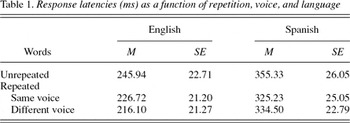
Response latencies (ms) as a function of repetition, voice, and language
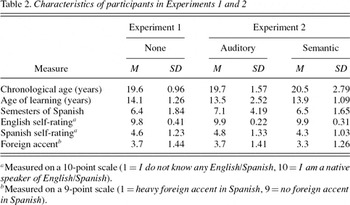
Characteristics of participants in Experiments 1 and 2
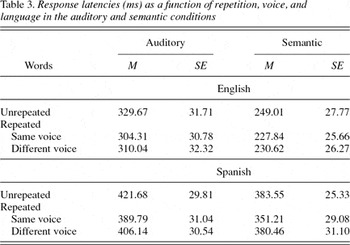
Response latencies (ms) as a function of repetition, voice, and language in the auditory and semantic conditions

Spanish words
 You have
Access
- 16
- Cited by