Research on learning to read has mainly focused on when and how phonological mediation is acquired by beginning readers, mainly because this stage is crucial to becoming a skilled reader (for a review, see Sprenger-Charolles, Colé, & Serniclaes, Reference Sprenger-Charolles, Colé and Serniclaes2006). Recently, however, there has been a growing interest in another type of reading mechanism likely to develop in beginning readers: processing and identifying morphemes in written words in order to rapidly recognize the words they form. The morpheme is traditionally defined as the smallest unit of meaning in a language. In French, for example, the suffixed word chaton (kitten) would be recognized by means of its morphemes chat (cat) and -on (little).
Until recently (but see Carlisle, Reference Carlisle2003; Carlisle & Stone, Reference Carlisle and Stone2005), most researchers interested in reading acquisition have considered morphological processing to come into play only after several years of reading. For Seymour (Reference Seymour, Rieben, Fayol and Perfetti1997), following Frith (Reference Frith, Patterson, Marshall and Coltheart1985, Reference Frith1986), the morphological structure of words is only used in reading after the child has mastered graphophonemic decoding. Morphology is brought to bear essentially to compensate for the irregularity of certain words (which cannot be correctly read by simple conversion of graphemes to phonemes). For these researchers, the use of morphological units in written word identification is a sign of skilled reading. Many studies have shown that skilled adult readers perform an automatic morphological analysis of complex words as they read (Barber, Dominguez, & De Vega, Reference Barber, Dominguez and De Vega2002; Bertram & Hyönä, Reference Bertram and Hyönä2003; Colé, Segui, & Taft, Reference Colé, Segui and Taft1997; Longtin, Segui, & Hallé, Reference Longtin, Segui and Hallé2003), so most research into the role of morphology in reading acquisition has focused on more advanced reading levels (after 3 or 5 years of instruction). Apart from a few studies on French (Casalis & Louis-Alexandre, Reference Casalis and Louis-Alexandre2000; Colé, Royer, Leuwers & Casalis, Reference Colé, Royer, Leuwers and Casalis2004; Marec-Breton, Gombert, & Colé, Reference Marec-Breton, Gombert and Colé2005), Italian (Burani, Marcolini, & Stella, Reference Burani, Marcolini and Stella2002), German (Verhoeven, Schreuder, & Baayen, Reference Verhoeven, Schreuder and Baayen2003; Verhoeven, Schreuder, & Haarman, Reference Verhoeven, Schreuder and Haarman2006), and Hebrew (Abu-Rabia, Reference Abu-Rabia2007), the research has mainly concerned English-speaking readers, seemingly without cross-linguistic comparisons. Yet the morphological systems of these languages (and more particularly, their derivational systems) are very different from the English one. The French morphological system, for example, is more productive than the English system, and Duncan, Casalis, and Colé (Reference Duncan, Casalis and Colé2009) found that metamorphological development is accelerated in French children between 5 and 8 years of age relative to English children of the same age. The main goal of the present study was to gain insight into learning to read in French, where the data is scarce (second grade) or totally lacking (third grade). More specifically, we looked into whether these beginning readers use morphological units to decode two kinds of items: pseudowords that have never be heard or read before (Experiment 1) and infrequent words (Experiment 2).
Although there are not many studies on the role of morphological processing in the early stages of learning to read, two main research orientations can nevertheless be identified. The first focuses on the role of morphological awareness in word identification. Morphological awareness has been defined as the capacity to reflect upon and explicitly manipulate the morphological structure of words orally (Carlisle, Reference Carlisle and Feldman1995); this definition is based on the conventional definition of phonological awareness, which has proven to be one of the best predictors of reading success (for a review, see Sprenger-Charolles et al., Reference Sprenger-Charolles, Colé and Serniclaes2006). The second orientation focuses directly on the processes involved in reading complex words. There are two types of morphologically complex words, inflected and derived. Inflected forms are composed of a stem, and one or two inflectional affixes that mark properties such as gender, number, tense, and person. Derived words (also called suffixed words here) are composed of a stem (or base) and affixes, such as the suffix -er in the word dancer. Various linguistic criteria make it possible to distinguish inflectional affixes from derivational affixes, the main difference being that while derivational suffixes create a new lexeme, inflectional ones modify the lexeme to which they are attached (Beard, Reference Beard, Spencer and Zwicky2007; Stump, Reference Stump, Spencer and Zwicky2007). In the present study, we focused on derived word processing at the beginning of reading acquisition in French, for two main reasons. First, knowledge of derivational affixes appears to be a better predictor of reading success than knowledge of inflectional affixes (Deacon & Kirby; Reference Deacon and Kirby2004; Muter, Hulme, Snowling, & Stevenson, Reference Muter, Hulme, Snowling and Stevenson2004). Second, derivational forms constitute a large proportion of the new words that children learn during the elementary school years (Nagy & Anderson Reference Nagy and Anderson1984), and some studies have shown that starting in a certain school grade, vocabulary size, and reading ability are linked (Carlisle, Reference Carlisle2000).
ROLE OF MORPHOLOGICAL KNOWLEDGE IN LEARNING TO READ
Studies of the first type use regression analysis to quantify the amount of variance in reading performance explained by morphological knowledge. Fowler and Liberman (Reference Fowler, Liberman and Feldman1995), for example, observed significant correlations between second-, third-, and fourth-grade children's performance on morphological tasks and word and pseudoword reading tasks, even after controlling for effects related to age and vocabulary size. A hierarchical regression analysis revealed that morphological task performance explained 42% and 34% of the variance in word and pseudoword reading, respectively. Studies by Shankweiler et al. (Reference Shankweiler, Crain, Katz, Fowler, Liberman and Brady1995) and Mahony, Singson, and Mann (Reference Mahony, Singson and Mann2000) showed that the contribution of metamorphological knowledge to word reading increased between the third and sixth grades, whereas that of metaphonological knowledge decreased in relative importance over the same period (but remained significant because it still explained between 10% and 15% of the variance). Similar trends were observed by Singson, Mahonny, and Mann (Reference Singson, Mahony and Mann2000) for phonological awareness and by Carlisle (Reference Carlisle2000, Reference Carlisle2003) for morphological awareness. The Singson et al. (Reference Singson, Mahony and Mann2000) study indicated that phonological awareness contributed less and less to reading variance over the school years, dropping to 36% in third grade, 4% in fourth grade, 3.2% in fifth grade, and to only 1% in sixth grade. Carlisle (Reference Carlisle2000, Reference Carlisle2003) showed that morphological knowledge contributed significantly to reading comprehension variance in third grade (43%) and fifth grade (where it rose to 55%; for inflection use, see also Deacon & Kirby, Reference Deacon and Kirby2004). Unlike phonological awareness, then, morphological knowledge seems to play an increasingly important role in written word recognition (see also Nagy, Berninger, & Abbott, Reference Nagy, Berninger and Abbott2006).
Although there are a few studies showing that morphological awareness can emerge in preliterate children (see, e.g., Bertram, Laine, & Virkkala, Reference Bertram, Laine and Virkkala2000, for Finnish and Dutch; Casalis & Louis-Alexandre, Reference Casalis and Louis-Alexandre2000, for French), which suggests that some kind of morphological knowledge is available to children when they start learning to read, studies with first and second graders are scarce, for the theoretical reasons mentioned above, and the data reported are contradictory. The English studies have revealed a significant contribution of derivational knowledge to reading performance in first graders (Carlisle & Nomanbhoy, Reference Carlisle and Nomanbhoy1993; Carlisle & Fleming, Reference Carlisle and Fleming2003). For example, Carlisle and Nomanbhoy (Reference Carlisle and Nomanbhoy1993) showed that metamorphological knowledge (of both inflections and derivations, the authors did not distinguish between the two) was involved in word reading as early as the first grade. Two metamorphological tasks were used. In their word-relationship judgment task, the child had to decide whether or not two words presented orally were connected (e.g., teach and teacher, doll and dollar). In the production task, the child had to complete an oral sentence by supplying the inflected or derived form of the stem word given (e.g., drive/ This man is a . . ./ driver.). The authors found that performance on these two tasks explained the children's ability to read words to a small but significant degree (4%). Phonological tasks contributed more heavily (explaining 22.09% of the variance).
By contrast, in the study with French-speaking children (Casalis & Louis-Alexandre, Reference Casalis and Louis-Alexandre2000), which separated derivational data from inflectional data, production-task performance did not explain any variance until second grade, where it accounted for 16% on a standardized reading test (Lefavrais's Alouette, Reference Lefavrais1967) and 24.2% on a written sentence comprehension test (Lecocq's E.CO.S.SE, 1996). Carlisle (Reference Carlisle and Feldman1995) and Fowler and Liberman (Reference Fowler, Liberman and Feldman1995) obtained similar results, suggesting that metamorphological knowledge is utilized relatively early in reading (by second grade), especially in reading comprehension.Footnote 1 The finding that morphological awareness made little or no contribution during the initial learning stages could be because the tasks used tapped explicit knowledge. In a longitudinal study of children in the first and second years of elementary school, Colé et al. (Reference Colé, Royer, Leuwers and Casalis2004) found that performance on a task designed to measure implicit word relationship judgments (involving no conscious manipulation of morphological knowledge by the child) was related to reading level as early as the first elementary school grade (the word relationship judgment task used was Carlisle and Nomanbhoy's, Reference Carlisle and Nomanbhoy1993). By contrast, performance on explicit tasks did not determine reading level until second grade, suggesting that morphological knowledge may be brought to bear in reading even when children cannot explicitly analyze the morphological structure of words.
MORPHOLOGICAL PROCESSING AND WRITTEN WORD RECOGNITION IN LEARNING TO READ
A smaller number of studies have attempted to directly examine how the reading of complex words is affected by their morphological structure. They showed that for English, readers carry out a morphological analysis of derived words as early as the third grade. Mann and Singson (Reference Mann, Singson, Assink and Sandra2003) asked children to read aloud suffixed words whose stem was frequent or infrequent but whose “surface” form (the complete derived word) was of comparable frequency to the other words on the list. The stems of the “high-stem” words (e.g., movement, stem = move) occurred 70 or more times per million and the stems of the “low-stem” words (e.g., equipment, stem = equip) occurred less than once per million. The results showed that already by the third grade, children were sensitive to the frequency of a derived word's stem and decoded low-stem words less successfully than comparable words with high-frequency stems. As early as third grade, then, suffixed words appear to be parsed during reading as stem + suffix.
Carlisle and Stone (Reference Carlisle, Stone, Assink and Sandra2003) reported similar data. They showed that English second and third graders (as well as fourth to sixth graders) were able to use the morphological structure of suffixed words. They read suffixed words like windy faster and with greater accuracy than pseudosuffixed forms like candy (see also Carlisle & Stone, Reference Carlisle and Stone2005). Laxon, Rickard, and Coltheart (Reference Laxon, Rickard and Coltheart1992) demonstrated that English readers ages 7 to 10 processed inflected forms and derivations as they read (detailed analyses according to word type were not given). These authors found that when word pairs were read out loud, suffixed forms (dancer/locked) generated significantly fewer errors than pseudosuffixed words whose final letter strings have the form of a suffix but do not perform this function (dinner/wicked). These results were also obtained with suffixed pseudowords (such as fooder) and pseudosuffixed pseudowords (such as rinter).
For Italian, morphological knowledge also seems to play an important role in visual word recognition. Burani et al. (Reference Bertram, Laine and Virkkala2002) confirmed this hypothesis by showing that Italian third graders relied on morphological processing to read. These authors compared reaction times for lexical decision and naming tasks involving pseudowords made up of a stem and illegally combined derivational suffixes (e.g., donn-ista), as well as nonmorphological pseudowords (e.g., denn-osto). They obtained identical results for the two tasks in all groups studied (third to fifth graders): “morphological” pseudowords were pronounced more rapidly than “nonmorphological” ones. As Burani et al. (Reference Bertram, Laine and Virkkala2002) suggested, it may be the availability of preassembled morphological units (stems and suffixes) that results in more efficient naming compared to the more laborious grapheme–phoneme decoding, the only process available for new words with no morphological structure. This morphological processing is called morpholexical by Burani et al. (Reference Bertram, Laine and Virkkala2002).
However, some studies have also found that suffixed word reading is dependent on phonological factors. Mann and Singson (Reference Mann, Singson, Assink and Sandra2003; for similar results, see also Laxon et al., Reference Laxon, Rickard and Coltheart1992) showed that suffixed word reading is dependent on phonological constraints up to the fifth grade, echoing findings obtained for inflected forms (Feldman, Rueckl, DiLiberto, Pastizzo, & Vellutino, Reference Feldman, Rueckl, DiLiberto, Pastizzo and Vellutino2002; Laxon et al., Reference Laxon, Rickard and Coltheart1992). English third- through sixth-grade readers were asked to read aloud suffixed words that were either phonologically transparent (quickly) or phonologically opaque (easily). The results indicated that transparent suffixed words were read more accurately than opaque ones, but the phonological-transparency effect was only found for third and fourth graders. The authors accounted for the large improvement in the reading of opaque suffixed forms by fifth graders in terms of Anglin's (Reference Anglin1993) observation that fifth-grade reading material contains more morphologically complex words.
In summary, the studies reviewed above indicate that English-speaking children use morphological chunks to read words and decode new words and Italian children do so to decode new words only. The processing of morphological units seems to be acquired gradually between the end of the second (or third) grade and the end of elementary school (but see Rapin & Deacon, Reference Rabin and Deacon2008). However, until a relatively advanced grade, the processing of such units continues to be influenced by phonological factors.
In French, the only study available on this topic is Marec-Breton et al.'s (Reference Marec-Breton, Gombert and Colé2005). With first and second graders reading aloud, they compared suffixed words such as danseur (dancer) to pseudosuffixed words such as douleur (pain), and suffixed pseudowords (pseudowords with illegally combined morphemes) such as mordage (bite-age) to pseudosuffixed pseudowords such as soumage. They found that suffixed pseudowords were read better by second graders (but not by first graders) than pseudosuffixed pseudowords, but there was no difference for words (danseur vs. douleur). In addition, morphological structure had no effect on reading time. Yet the French data obtained by Casalis and Louis-Alexandre (Reference Casalis and Louis-Alexandre2000) and Colé et al. (Reference Colé, Royer, Leuwers and Casalis2004) suggest that, for this language, morphological processing starts in second grade for both word and pseudoword reading. Because of the virtual lack of French data, additional studies are needed for this language. In particular, because Marec-Breton et al. (Reference Marec-Breton, Gombert and Colé2005) did not include a “monomorphemic” control condition, there is no way of knowing whether the pseudosuffixed words or pseudowords were processed as one-morpheme units, or whether the suffix caused them to be processed differently. Finally, given that these authors did not find a morphological structure effect for words, our first experiment pertained to pseudoword reading.
EXPERIMENT 1: READING MORPHOLOGICALLY COMPLEX PSEUDOWORDS
The aim of this experiment was to determine whether and when French children are able to make use of the morphological structure (stems and derivational suffixes) of letter strings they have to read aloud. To this end and given that Marec-Breton et al. (Reference Marec-Breton, Gombert and Colé2005) did not find any morphological structure effects for first grade children, we asked second- and third-grade children to perform a reading task on pseudowords whose morphological structure was manipulated. As in the experiments by Marec-Breton et al. (Reference Marec-Breton, Gombert and Colé2005) and Laxon et al. (Reference Laxon, Rickard and Coltheart1992), the stimuli were suffixed pseudowords composed of a stem and a suffix in an illegal combination (e.g., chature) and matched pseudosuffixed pseudowords composed of a pseudostem and a suffix (e.g., choture). We added a “monomorphemic” control condition (as in Burani et al., Reference Bertram, Laine and Virkkala2002) containing pseudowords composed of a pseudostem (a letter string that does not exist as a stem) and a pseudosuffix (a letter string that is never a suffix, as in chotore). This last comparison is important because, as mentioned above, this condition should allow us to determine which of two types of processing is applied to pseudosuffixed pseudowords (whole string processing or suffix identification). It should also inform us about the type of morphological processing applied to suffixed pseudowords. More specifically, it should help us determine the nature of the effect observed in favor of suffixed pseudowords, and in particular, to find out whether it is the breakdown into stem + derived suffix that is responsible for the better performance or whether it is solely the identification of the stem. If beginning French readers decode derived pseudowords via morphological processing that involves identifying both the stem and the suffix, not only should these pseudowords be read more quickly and more accurately than the other two types, but also pseudosuffixed pseudowords should be read better than monomorphemic pseudowords. This last result would suggest that suffixes of pseudosuffixed pseudowords are read as a whole rather than decoded like the pseudostem that composes them. In contrast, if no difference is observed between pseudosuffixed pseudowords and monomorphemic pseudowords, we can conclude that the suffixed pseudowords underwent morphological processing that was reduced to the sole recognition of the stem.
Method
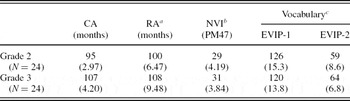
Participants. Two groups of children (24 second graders, 24 third graders) from two schools in Chambéry, France, participated in the experiment in April and May. Table 1 describes the groups in terms of chronological age, reading age (Alouette Reading Test; Lefavrais, Reference Lefavrais1967), nonverbal intelligence (Raven's Progressive Matrices [PM47]; Raven, Reference Raven1998), and receptive vocabulary (Echelle de Vocabulaire en Images Peabody [EVIP]; Dunn, Thiérault-Whalen, & Dunn, Reference Dunn, Thiérault-Whalen and Dunn1993).
Experiment 1 participant means (standard deviations) for chronological age (CA), reading age (RA), nonverbal intelligence (NVI), and vocabulary scores for second and third graders

a According to Lefavrais’ Alouette (1967).
b Number of correct responses according to Raven's Progressive Matrices (PM47; 1998).
c Standard score on Echelle de Vocabulaire en Images Peabody (EVIP)-1 or percentage of correct responses on EVIP-2 (1993).
Analyses conducted on the participants’ chronological and reading ages indicated that these ages were equivalent in third grade, t (23) < 1, ns, but not in second grade, t (23) = 3.37, p < .01. The observed difference of means in second grade was about 5 months, so the second graders’ reading age was slightly above their chronological age. The reading and chronological ages of the third graders were nevertheless about 1 year above those of the second graders, and there was a significant difference between the chronological ages, t (46) = 13.47, p < .001, and between the reading ages, t (46) = 3.27, p < .01, of the two groups.
The children's PM47 and EVIP scores were also analyzed. The EVIP score is the normalized score determined from a standardization done on French-speaking Canadian children.Footnote 2 To save time (EVIP testing time is long), we decided to use only a small number of items (items 50 to 150, i.e., 101 items). We also decided to work with a raw score, namely, the percentage of correct responses. With this measure, the statistical analysis yielded an effect of school grade on vocabulary size: normalized score, t (46) = 1.32, p < .20; number of errors on 101 items, t (46) = 2.08, p < .01.
The PM47 scores fell between the 25th and 100th percentiles in both the second and third grades and corresponded to the expected median scores for these grades.
Materials. Fifty-one morphologically complex pseudowords were presented for reading in three conditions. The suffixed pseudoword condition included 17 pseudowords made up of a real stem illegally combined with a real suffix (e.g., sauture); the pseudosuffixed pseudoword condition included 17 pseudowords composed of a pseudostem and a real suffix (e.g., seuteur); the monomorphemic pseudoword condition included 17 pseudowords made up of a pseudostem and a pseudosuffix (e.g., seutore).
A matched pseudostem was generated from a real monosyllabic stem by changing either the vowel (e.g., saut-seut) or the final consonant (tard-tarv). A matched pseudosuffix was generated from a real suffix by changing either the vowel (ure-ore) or the final consonant (ine-ime). The real stems used can be considered “frequent” given their mean standard frequency index of 62.17 (range = 52.42 to 70.99, according to MANULEX: Lété, Sprenger-Charolles, & Colé, Reference Colé, Royer, Leuwers and Casalis2004). For monomorphemic pseudowords, the pseudosuffix was not in the list of French suffixes, and the final string of letters (two to five letters) was not a suffix either.
Seventeen triplets were generated. Each one contained the three types of pseudowords, all of which began with the same phoneme to improve time-measurement accuracy. The three types of pseudowords were matched on number of letters, phonemes, and syllables (7.6 letters, 5.7 phonemes, 2 syllables; all ps > .20) and on bigram frequency (all ps > .20). The list of experimental items is presented in Appendix A.
Procedure. The children were tested individually in four sessions held in a quiet room in their school. During the first, second, and third sessions, they took the Alouette pretest, Raven's Matrices pretest, and the EVIP pretest, respectively. They performed the pseudoword reading task during the fourth session.
The children were told they would have to read “Martian” words, as accurately and quickly as possible, and that they should pronounce them “once they had read them silently to themselves.” Practice items (four plurimorphemic pseudowords) were proposed first to familiarize the children with the material and to make sure they understood the instructions and the reading procedure. Then for each child, the 51 items were presented in random order. The “words” were displayed in the middle of the screen, in lowercase black letters (40-point Courier New font) against a white background.
The experiment was run by a portable computerFootnote 3 (Dell, Inspiron 2600) using e-prime software. The pseudowords were displayed one at a time and remained on the screen until the child responded. Reading time (milliseconds) was recorded. Reading time was defined as the time between when the word appeared on the screen and when the child responded by pressing the space bar to indicate that he/she had read the word. Pressing the space bar stopped the clock. After pressing the space bar, the child had to pronounce the item just read. The experimenter then clicked on one of the two mouse buttons to record the child's response (correct or incorrect). A response was marked as wrong when the child did not produce the correct phonological form of the pseudoword.
Results
The data were analyzed in mixed analyses of variance (ANOVAs) with school grade (second and third) as a between-subject factor and morphological condition (suffixed pseudowords, pseudosuffixed pseudowords, and monomorphemic pseudowords) as a within-subject factor. ANOVAs were conducted on the correct response percentage and on reading time for correct responses. ANOVAs were performed using participants (F1) and items (F2) as random variables (with school grade as a within-subject factor and morphological condition as a between-subject factor for the F2 ANOVA).
The reading times collected for each subject were processed first via a smoothing procedure performed on times for correct responses, consisting of eliminating items more than 1.75 interquartile ranges (IQRs; which is the difference between the first and third quartiles) below the first quartile or more than 1.75 IQRs above the third quartile. The first quartile, third quartile, and IQR were calculated for each subject. This eliminated less than 5% of the scores (2.24% and 1.49% for second and third grade, respectively).Footnote 4
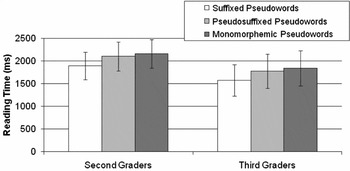
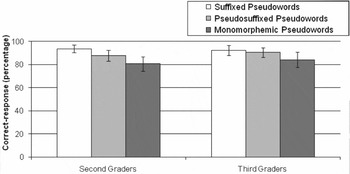
The ANOVAs on the children's pseudoword reading performance (Figure 1 for reading time, Figure 2 for response accuracy) yielded a significant effect of morphological condition on reading time, F1 (2, 88) = 28.3, p < .0001, effect size: η2 = 0.39; F2 (2, 48) = 6.77, p < .01, but a nonsignificant effect of school grade, F1 (1, 44) = 2.65, p < .15; F2 (1, 48) = 58.94, p < .0001. The interaction between these two factors was nonsignificant, F1 (2, 88) < 1, ns; F2 (2, 48) < 1, ns. For the morphological condition effect, pairwise comparisons indicated that reading time was lower in the suffixed pseudoword condition than in the pseudosuffixed pseudoword and monomorphemic pseudoword conditions, t1 (46) = 7.74, p < .0001; t2 (48) = 3.41, p < .001. In addition, reading time was marginally lower in the pseudosuffixed pseudoword condition than in the monomorphemic pseudoword condition, t1 (46) = 1.54, p < .07; t2 (48) = 1.38, p < .09.
Mean reading time (ms) and standard deviation of second and third graders as a function of the pseudowords’ morphological structure (suffixed pseudowords, pseudosuffixed pseudowords, monomorphemic pseudowords).

Mean correct-response percentage and standard deviation of second and third graders as a function of the pseudowords’ morphological structure (suffixed pseudowords, pseudosuffixed pseudowords, monomorphemic pseudowords).

For the correct response percentages, the ANOVA yielded a significant effect of morphological condition, F1 (2, 92) = 21.63, p < .0001, effect size: η2 = 0.32; F2 (2, 48) = 7.84, p < .01, but a nonsignificant effect of school grade, F1 (1, 46) < 1, ns; F2 (1, 48) = 2.03, p > .15. The interaction between these two factors was not significant, F1 (2, 92) = 1.34, p > .20; F2 (2, 48) = 1.84, p > .15. For the morphological condition effect, pairwise comparisons indicated that the correct response percentage was higher in the suffixed pseudoword condition than in the pseudosuffixed pseudoword and monomorphemic pseudoword conditions, t1 (46) = 5.67, p < .0001; t2 (48) = 3.09, p < .01. In addition, the correct response percentage was higher in the pseudosuffixed pseudoword condition than in the monomorphemic pseudoword condition, t1 (46) = 3.79, p < .001; t2 (48) = 2.47, p < .01.
Discussion
In this experiment, the main effect of morphology on both the mean reading time and the mean correct response percentage, and the lack of an interaction between school grade and morphology, indicate that regardless of their reading age, these French children used morphological units to read new words more quickly and more accurately. More specifically, we showed that by the second grade, pseudowords composed of two illegally combined morphemes were read faster and more accurately than pseudosuffixed pseudowords composed of a pseudostem and a derived suffix, and than monomorphemic pseudowords with no morphological units. Finally, pseudosuffixed words were read more accurately and faster (although only marginally) than monomorphemic pseudowords. These results replicate Marec-Breton et al.'s (Reference Marec-Breton, Gombert and Colé2005) for French second graders, Laxon et al.'s study (Reference Laxon, Rickard and Coltheart1992) for English second graders and above, and Burani et al.'s (Reference Burani, Marcolini and Stella2002) study with third-grade Italian readers. It could be argued that, in our experiment, children may have processed the task syllabically rather than morphologically. However, syllabic parsing is incompatible with morphological parsing for all the items used in our experiment. For example, “chantine” parses syllabically as “chan-tine” and morphologically as “chant-ine.” Our results thus can be interpreted as being influenced by analysis of the pseudowords’ morphological structure.
They suggest that by the second grade French readers are able to identify and use morphemes to decode complex “words” they have never seen before. It also suggests an early morphological organization of the mental lexicon into stems and suffixes among unskilled second-grade readers in a period when phonological mediation for recognizing written words is often used (see Sprenger-Charolles, Siegel, Bechennec, & Serniclaes, Reference Sprenger-Charolles, Siegel, Béchennec and Serniclaes2003). Burani et al. (Reference Bertram, Laine and Virkkala2002) suggest that morphological processing could be morpholexical in nature (in other words, it may result from the activation of preassembled morphological units, stems, and suffixes). Last, morphological processing appears to be applied quite early, at least in French and Italian, which differ in orthographic transparency (Seymour, Aro, & Erskine, Reference Seymour, Aro and Erskine2003).
These results go against the interpretation that the morphological processing observed in this experiment consists simply of identifying a familiar word (namely, the stem) inside another word (the derived word), as Taft and Forster (Reference Taft and Forster1975) have proposed. Rather, they support the hypothesis that morphological processing is applied to all morphemes in the derived word, as proposed for example by Caramazza, Laudanna, and Romani (Reference Caramazza, Laudanna and Romani1988). Taking this view, Marec-Breton et al. (Reference Marec-Breton, Gombert and Colé2005) compared reading performance on three types of morphological pseudowords: suffixed pseudowords composed of two illegally combined morphemes (bougeur), pseudowords composed of a pseudostem and a suffix (sanneur), and pseudowords containing a potential stem and a pseudosuffix (bougire). The pseudowords with two morphemes were read faster and more accurately than the other two types, which did not differ from each other. Thus, pseudowords with two identifiable morphological units were read better than ones composed of a single identifiable morpheme (stem or affix). Combined with ours, these findings suggest that morphological processing is not used solely to detect the presence of frequent or familiar orthographic configurations but also serves to identify meaningful morphological units such as stems and suffixes.
However, following Burani et al. (Reference Bertram, Laine and Virkkala2002) and even though the latter authors did not test the hypothesized morphological processing of words, Marec-Breton et al. (Reference Marec-Breton, Gombert and Colé2005) nevertheless concluded that morphological processing, although very helpful for decoding new words, is not necessarily useful for reading known words. This would account for why Marec-Breton et al. (Reference Marec-Breton, Gombert and Colé2005) did not observe a morphological structure effect on familiar words. The results obtained by Casalis and Louis-Alexandre (Reference Casalis and Louis-Alexandre2000) and Colé et al. (Reference Colé, Royer, Leuwers and Casalis2004) suggest nonetheless that this type of processing may be applied at least to lower frequency words. The purpose of our second experiment was to test these two alternative hypotheses.
EXPERIMENT 2: READING COMPLEX WORDS
One possible account of why Marec-Breton et al. (Reference Marec-Breton, Gombert and Colé2005) did not find a morphological structure effect on suffixed word reading is related to the frequency of the suffixed and pseudosuffixed words they used. When that experiment was conducted, MANULEX, which is a French database of the written lexicon found in elementary school reading books (Lété et al., Reference Lété, Sprenger-Charolles and Colé2004), was not yet available, so the authors could only test for familiarity in a very general way. It turns out that the frequencies of their words (in occurrences per million, according to MANULEX) were 17.33 for the suffixed words and 54.57 for the pseudosuffixed words, t (18) = 2.527, p < .05. Their pseudosuffixed words were therefore much more frequent, and this could explain the lack of a facilitatory morphological structure effect on suffixed words, which were less frequent overall.
For the sake of comparability with Marec-Breton et al.'s (Reference Marec-Breton, Gombert and Colé2005) experimental conditions, we selected suffixed words within the same frequency range (second grade: 17.33 in Marec-Breton et al., Reference Marec-Breton, Gombert and Colé2005, 19.41 in our experiment). However, we chose a different paradigm: the one Taft (Reference Taft1979, Reference Taft2001) used with skilled readers. All words were presented to subjects in two segments separated by a space, in a predefined format that corresponded, for example, to their syllabic structure (e.g., den tiste) or their morphological structure (e.g., dent iste). The logic underlying this paradigm is that if the format presented corresponds to the units activated during written word identification, then recognition time will be shorter (for adult studies on this topic, see Lima & Pollatsek, Reference Lima and Pollatsek1983; Prinzmetal & Millis-Wright, Reference Prinzmetal and Millis-Wright1984; Spoehr & Smith, Reference Spoehr and Smith1973). To our knowledge, this paradigm has never been used on beginning readers; it has the advantage of directly testing the availability of the units activated for word identification.
In our experiment, second and third graders were shown suffixed words in syllabic format (e.g., ma lade), morphological format (mal ade), unsegmented format (malade), or another format we called morphological + 1 (mala de) in which the first segment was the stem plus the next grapheme in the word. This condition was used to ensure that the type of linguistic unit presented was responsible for any facilitatory effects observed, not the amount of information supplied by the segmentation format (see Lima & Pollatsek, Reference Lima and Pollatsek1983). For instance, in our example the syllable “ma” has one less letter than the morpheme “mal,” so a potential morphological structure effect could be ascribed to the greater amount of information in “mal” and thus the greater facilitation of reading as compared to the syllabic condition. The morphological + 1 condition thus served as a good control for the unsegmented condition.
According to Colé, Magnan, and Grainger (Reference Grainger, Colé and Segui1999) and Sprenger-Charolles et al. (Reference Sprenger-Charolles, Siegel, Béchennec and Serniclaes2003), beginning French readers start relying on syllable-based phonological mediation to read monomorphemic words by the end of first grade. Moreover, Sprenger-Charolles et al. (Reference Sprenger-Charolles, Siegel, Béchennec and Serniclaes2003) noted that phonological processing was used massively in the first and second grades. Based on Marec-Breton et al.'s (Reference Marec-Breton, Gombert and Colé2005) hypothesis, one can therefore assume, for complex word reading, that the syllable format will give rise to shorter reading times among second graders, and that morphological units will not be used to read suffixed words until third grade. In contrast, based on the findings obtained by Casalis and Louis-Alexandre (Reference Casalis and Louis-Alexandre2000) and Colé et al. (Reference Colé, Royer, Leuwers and Casalis2004), one can assume that morphological units will already be used in second grade.
Method
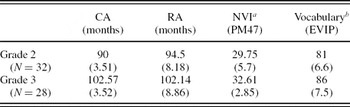
Participants. The participants were 32 second graders and 28 third graders from three schools in Chambéry, France. They were different from the children who had participated in the first experiment. They participated in the experiment in April and May. Table 2 describes the groups for each school grade in terms of chronological age, reading age (Alouette Reading Test; Lefavrais, Reference Lefavrais1967), nonverbal intelligence (Raven's Progressive Matrices [PM47]; Raven, Reference Raven1998), and receptive vocabulary (Echelle de Vocabulaire en Images Peabody [EVIP]; Dunn et al., Reference Dunn, Thiérault-Whalen and Dunn1993).
Experiment 2 participant means (standard deviations) for chronological age (CA), reading age (RA), nonverbal intelligence (NVI), and vocabulary scores for second and third graders

a Number of correct responses according to Raven's Progressive Matrices (PM47; 1998).
b Percentage of correct responses according to Echelle de Vocabulaire en Images Peabody (EVIP; 1993).
Analyses on chronological age and reading age yielded the expected effect of school grade on chronological age, t (58) = 13.81, p < .001, and reading age, t (58) = 3.49, p < .001. Chronological age and reading age were equivalent in third grade, t (27) = 1, p > .20, but not in second grade, t (31) = 2.81, p < .01. The observed difference of means in second grade was 5 months, so the second graders’ reading age was slightly above their chronological age. The reading and chronological ages of the third graders were nevertheless about 1 year above those of the second graders, and there was a significant difference between the chronological ages, t (58) = 13.82, p < .001, and between the reading ages, t (58) = 3.47, p < .001, of the two groups.
The children's PM47 and EVIP scores were also analyzed.Footnote 5 The statistical analysis yielded an effect of school grade on vocabulary size, t (58) = 9.29, p < .001. The PM47 scores fell between the 25th and 100th percentiles in both grades. Thus, the nonverbal intelligence scores in each school grade corresponded to the expected median scores for these grades.
Materials. Sixteen words were presented for reading in the following formats: morphological (e.g., mal ade), syllabic (e.g., ma lade), morphological + 1 (e.g., mala de), where an extra letter was added to the stem, and a control condition without segmentation (e.g., malade).
The experimental words were selected from MANULEX (Lété et al., Reference Lété, Sprenger-Charolles and Colé2004). Their mean length was 7.31 letters, 4.95 phonemes, and 2 syllables. Their mean frequency was 19.41 for second grade and 16.98 for third grade, t (30) = .37, p = .71, which means that the words were infrequent but not rare. The 16 words were chaton (kitten), ourson (bear cub), peureux (fearful), chanteur (singer), honteux (shameful), pleureur (weeping), longueur (length), dentiste (dentist), soirée (evening), rizière (rice patty), mortel (deadly), malade (ill), mangeoire (trough), peinture (paint), canetons (ducklings), and fleuriste (florist).
Four lists of 24 items were generated. Each list contained all 16 experimental items, 4 per experimental condition (morphological, syllabic, morphological + 1, and control). Each 4-item group appeared in a different segmentation format on each list, in such a way that the same word occurred only once on a given list but was segmented differently on the four lists. Eight segmented or whole word monomorphemic fillers were included on each list. The mean number of letters in the fillers was 6.19 and their mean frequency was 61.5. Different fillers were used on each list.
Procedure. Because reaction times vary across children in these school grades, every child was tested in all four experimental conditions of each word. Thus, each participant saw the four lists displayed in a different order generated by a randomization procedure. The four sessions took place one after the other on the same day. The words on each list also occurred in random order.
The children had to read the words as accurately and quickly as possible, pronouncing each one “once they had read it silently to themselves.” Practice items were given first. In the three segmented conditions, the segments were separated by a space. All words were displayed in the middle of the screen, in lowercase black letters (40-point Courier New font) against a white background.
The experiment was run by a portable computer (Dell, Inspiron 2600) using e-prime software. The words were displayed one at a time, and reading time was recorded in the same way as in Experiment 1. Reading time was defined as the time between when the word appeared on the screen and the child responded by pressing the space bar to indicate that he/she had read the word. After pressing the space bar, the child had to pronounce the word just read. The experimenter then clicked on one of the two mouse buttons to record the child's response.
Results
The results (reading times and correct response percentages) were analyzed in mixed ANOVAs with school grade (second and third) as a between-subject factor and segmentation format (syllabic, morphological, morphological + 1, and unsegmented) as a within-subject factor. Reading times were processed using the same smoothing procedure as in Experiment 1. Less than 5% of the scores were discarded (4.35% and 4.79% for the second and third grades, respectively). ANOVAs were conducted on correct response percentages and on reading times for correct responses. ANOVAs were performed using participants (F1) and items (F2) as random variables (with school grade as a within-subject factor and segmentation format as a between-subject factor for the F2 ANOVA).
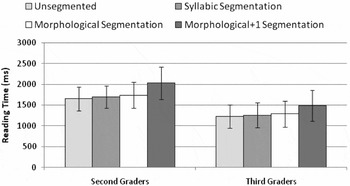
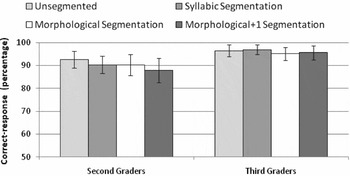
The ANOVAs on the children's reading data (Figure 3 and Figure 4) indicated significant effects of segmentation format, F1 (3, 174) = 23.06, p < .001; effect size: η2 = 0.28; F2 (3, 60) = 73.99, p < .05, and school grade, F1 (1, 58) = 8.85, p < .01; effect size: η2 = 0.13; F2 (1, 60) = 50.40, p < .001, on mean reading time. Post hoc pairwise comparisons (Newman–Keuls) showed that the morphological, syllabic, and unsegmented conditions did not differ (p > .20), whereas the morphological + 1 condition differed from the others (morphological, syllabic, unsegmented, p < .05). Last, the Grade × Segmentation interaction was nonsignificant, F1 (3, 174) < 1, ns; F2 (3, 60) < 1, ns.
Mean reading time (ms) and standard deviation of second and third graders as a function of word-segmentation format (unsegmented, syllabic, morphological, morphological + 1).

Mean correct-response percentage and standard deviation of second and third graders as a function of word-segmentation format (unsegmented, syllabic, morphological, morphological + 1).

For the correct response percentages, the ANOVAs again yielded a significant grade effect, F1 (1, 58) = 14.71, p < .001; effect size: η2 = 0.05; F2 (1, 60) = 15.08, p < .001, a significant format effect but only in the subject analysis, F1 (3, 174) = 3.08, p < .05; effect size: η2 = 0.20; F2 (3, 60) < 1, ns, but no Grade × Format interaction, F1 (3, 174) = 1.58, p > .15; F2 (3, 60) < 1, ns). Post hoc pairwise comparisons (Newman–Keuls) indicated a significant difference between the morphological + 1 and unsegmented conditions in the subject analysis (p < .05), but no other differences between the four formats (all ps > .57).
Discussion
French second and third graders read suffixed words faster when they saw the words either whole or segmented into syllables or morphemes, than when they saw them in the morphological + 1 condition. This finding indicates that starting in second grade, beginning French readers have units of differing sizes at their disposal, namely, syllables and morphemes, for reading plurimorphemic low-frequency words. At first glance, one could argue that the morphological + 1 condition gave rise to the longest reading time (and to the highest percentage of errors) because the first segment displayed was a pseudoword (e.g., ourso n). If this were true, the same argument would apply to the syllabic format (i.e., our son). Our data do not support this interpretation because, in this condition, there was no increase in reading time like the one found in the morphological + 1 condition.
One can also argue that the performance observed in the morphological and syllabic conditions did not differ because the phonological codes activated by the first segment would be the same (e.g., cha-ton vs. chat-on, because the letter “t” is silent). If this were the case, the phonological code of the whole word form that could be activated in the morphological condition would not correspond to a word (e.g., the presentation of chat-on would activate the phonological form of chaon instead of chaton), which should cause longer reading times and more errors. But this is not what happened, which means that the participants took the final letter into account (and thus the orthography) in their responses.Footnote 6
Linguistic units, whether syllabic or morphological, therefore seem to be relevant for identifying derived words, because it was not segment length (i.e., the amount of perceptual information supplied) that accounted for the results but that the units were linguistic in nature. The condition with the longest and most information-bearing first segment (morphological + 1), but that did not break the words down into linguistic units, gave rise to the longest reading times and to more errors. Furthermore, the unsegmented format had the same effects as the syllabic and morphological formats. This result can be interpreted in terms of the idea that syllables, morphemes, and whole word forms contribute to a similar extent to word reading for low-frequency words.
An alternative hypothesis is that the specific features of the words utilized; that is, their frequency (low) and the sequential organization of their morphological constituents (stem + suffix) promoted morphological analysis rather than global identification, as suggested in research with adults. For French in particular, a morphological segmentation process has been found in studies using low- or intermediate-frequency words (Colé, Beauvillain, & Segui, Reference Colé, Beauvillain and Segui1989). Taft's (Reference Taft1991) model suggests that the morphological analysis of complex words is systematic. However, as in dual-route models of morphological processing like Caramazza et al.'s (Reference Caramazza, Laudanna and Romani1988), one can also assume that when a stimulus word is presented for reading, both the whole word form and its morphological units are activated. An important assumption in this view is that, for known words, the whole word form is activated more rapidly than its morphemes. However, both whole word and morpheme access mechanisms are thought to use morphologically decomposed units in the orthographic lexicon, in such a way that these units are always activated regardless of the access mechanism employed. Our data fit well with this model.
Finally, we found that morphemes were just as good as syllables for achieving fast and accurate suffixed word reading as early as the second grade. Contrary to what Marec-Breton et al. (Reference Marec-Breton, Gombert and Colé2005) concluded, the second-grade readers in our experiment took advantage of these units. Thus, morphological units do not appear to be used solely to decode words never seen before (pseudowords); they are also utilized to identify low-frequency derived words. For the third graders, by contrast, we did not obtain the predicted superiority of morphological segmentation over syllabic segmentation. This result may be related to the frequency of the words being used here did not change in this grade, so that the opportunity to read and process them did not differ.
GENERAL DISCUSSION
This study was designed to explore the development of morphological processing by French children during the early elementary years. The results of the two experiments reported here suggest that, starting in second grade, beginning French readers are sensitive to morphological units in suffixed words that they have never read before (pseudowords in Experiment 1) or that are infrequent (Experiment 2).
In line with Carlisle and Stone (Reference Carlisle and Stone2005), morphological processing can be seen as an alternative to phonological mediation for decoding new suffixed words or low-frequency words containing frequent letter sequences that learners can detect and identify. This type of processing would result from the use of morphological knowledge acquired implicitly through contact with the written word. For French, such implicit knowledge may be related to the very nature of the written transcription of morphology in this language, which according to Jaffré and Fayol (Reference Jaffré and Fayol1997), is a highly special case. Although English is clearly an outlier for grapheme–phoneme correspondences (Sprenger-Charolles et al., Reference Sprenger-Charolles, Colé and Serniclaes2006), French is the language that stands apart when it comes to morpheme transcription because, unlike Italian and English, written French has a large number of morphological markers that are not pronounced, including derivational markers. For example, the letter “d” at the end of the French word lourd (heavy), from which the word lourdeur (heaviness) is derived, is silent, whereas the “d” in the English word kind, from which kindness is derived, is pronounced.
Morphological knowledge may also develop through repeated exposure to morphologically complex words. Very early in the learning process, beginning readers encounter large numbers of plurimorphemic words, and some computational studies have shown that school textbooks propose four times more morphologically complex words than morphologically simple ones (Nagy & Anderson, Reference Nagy and Anderson1984). In other words, morphemes (both stems and affixes) appear relatively frequently in many morphologically complex words. In French, for instance, the stem lait (milk) occurs in numerous words, including laitage (dairy product), laitier (milkman), laiteux (milky), allaiter (to breast feed), allaitement (breast feeding), and so forth. It is reasonable to assume that beginning readers are sensitive to the mapping of meanings to frequent letter combinations (like those that make up morphemes) and that these learners might rely on morphological units and their relationships to meanings to decode new words whenever possible.
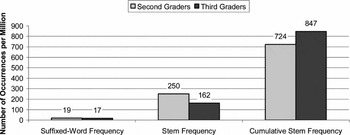
In support of this hypothesis, Carlisle and Stone (Reference Carlisle and Stone2005) showed that starting in second grade, two-morpheme words such as shady were read faster than one-morpheme words such as lady whenever the suffixed word contained a highly frequent stem (shade). High stem frequency may make a word salient and attract the reader's attention to its morphological makeup; stem identification would then trigger word recognition. The second- and third-grade readers in our experiment also proved to be sensitive to morphological units in low-frequency suffixed words. We calculated the frequency of the words’ stems (the frequency of the stem dent, for example, in the word dentiste) for each school grade. Then for each word, we calculated the cumulative stem frequency by counting the occurrences of the stem and all affixed words with that stem (e.g., the frequency of dent + dentiste + dentier + dentifrice, etc.). Cumulative frequency gives an indication of the overall frequency of the stem, that is, how often children can encounter this orthographic sequence in schoolbooks. As we can see in Figure 5, the stems of the suffixed words used in both school grades tested here had a high frequency. A frequency-related mechanism may therefore have built orthographic representations of the stems. In line with this, Sprenger-Charolles et al. (Reference Sprenger-Charolles, Siegel, Béchennec and Serniclaes2003) showed for French that an orthographic lexicon already exists by the end of first grade.
Suffixed-word frequency, stem frequency, and cumulative stem frequency for the suffixed words used on second and third graders in Experiment 2.

Such an interpretation is in line with Reichle and Perfetti's (Reference Reichle and Perfetti2003) developmental model of complex word reading, in which the familiarity of words and their constituents (morphemes) is granted a key role. In this model, becoming skilled in identifying written words consists primarily of developing high-quality lexical representations of words, where “quality” corresponds to both the accuracy with which the orthographic, phonological, and semantic characteristics of words are represented in memory, and the strength of the connections between them. The development of high-quality lexical representations is thought to be partly determined by exposure to words in print, and thus to their familiarity, which in turn leads to faster and faster written identification. According to these authors, this process is more complex for derived words than for monomorphemic ones, because each morpheme in a word has features that can help or hinder word identification. The quality of the representation of each morpheme in a word (e.g., help and ful), along with that of the whole word (helpful), would affect the speed and accuracy at which the derived word is identified, with representational quality being contingent upon the word's familiarity and also the familiarity of the morphemes it contains. More specifically, representational quality depends on the reader's experience not only with the derived words themselves but also with the stems in them, the size of the morphological family to which they belong, and the mean frequency of the members of that family. Carlisle and Katz (Reference Carlisle and Katz2006) tested this hypothesis on fourth and sixth graders and showed that these features (familiarity of derived words and their morphemic constituents, and family frequency) come from two different factors. The first includes stem frequency and mean (morphological) family frequency, the second, derived word frequency and family size. According to the authors, the first factor reflects the reader's awareness of the word's morphological composition, especially recognition of the stem word; the second reflects general experience with a variety of words in the family. In the Carlisle and Stone (Reference Carlisle and Katz2006) study, these two factors accounted for a significant portion of the variance in suffixed word reading (40% for fourth grade, 41% for sixth grade). This result suggests that ease of suffixed word reading is affected the most by exposure to words in print, but is also influenced by awareness of morphological composition. The results of our study (at least in part) indicate that French second graders are sensitive to the morphological structure of derived words and identify the stems of words they have to read.
In line with Carlisle and collaborators (Carlisle & Katz, Reference Carlisle and Katz2006; Carlisle & Stone, Reference Carlisle and Stone2005), our findings suggest that starting in second grade, beginning French readers are able to use morphemes (the stem) in new or rare words during decoding, as an alternative to phonological mediation. As Carlisle and Stone (Reference Carlisle and Stone2005) and Reichle and Perfetti (Reference Reichle and Perfetti2003) argued, reading-acquisition models generally ignore this aspect of learning to read (Coltheart, Rastle, Perry, Langdon, & Ziegler, Reference Coltheart, Rastle, Perry, Langdon and Ziegler2001; Ehri, Reference Ehri, Ehir and Metsala1998; Harm & Seidenberg, Reference Harm and Seidenberg1999; and more recently, Ziegler & Goswami, Reference Ziegler and Goswami2005).
Encouragement for research in this area is provided by a few studies conducted in this domain on dyslexic children, where it is suggested that achieving perfect mastery of word decoding is not a prerequisite for being able to use morphological units to read. Morphological processing thus appears to improve beginning or impaired identification of written words (see Elbro & Arnbak, Reference Elbro and Arnbak1996).
This study contributes to the evidence that morphology plays a role in the reading acquisition of French. It provides further evidence for a mental lexicon organized according to morphological principles as of the second grade, as shown in English by Rabin and Deacon (Reference Rabin and Deacon2008) and in French by Casalis, Dusautoir, Colé, and Ducrot (Reference Casalis, Dusautoir, Colé and Ducrot2009). However, further studies are needed to determine exactly when in the reading-acquisition process these units are put to use and how they are processed. The characteristics of French orthography described above suggest that morphemes are particularly important for learning to read in this language. This hypothesis should be tested in future cross-linguistic studies.
Finally, a certain number of studies have shown an influence of suffix productivity on morphological decomposition in expert readers (Laudanna & Burani, Reference Laudanna, Burani and Feldman1995; Järvikivi, Bertram, & Niemi, Reference Järvikivi, Bertram and Niemi2006). In the domain of reading acquisition, a very small number of studies have highlighted the role of suffixes in the identification of complex written words, notably through suffix/pseudosuffix comparisons (e.g., Carlisle & Stone, Reference Carlisle, Stone, Assink and Sandra2003, Reference Carlisle and Stone2005), but they do not directly address the question through manipulation of suffix productivity. This is another important question for future research in reading acquisition.
APPENDIX A
Items used in Experiment 1

ACKNOWLEDGMENTS
This research was supported by grants from the Agence Nationale de la Recherche (A.N.R.) for a project called “Les traitements morphologiques dans l'apprentissage de la lecture et ses troubles” (ANR-06-APPR-006). The authors thank three anonymous reviewers for their very helpful comments on the manuscript.