Lying is a deliberate attempt to transmit messages that mislead others. It has been variously described as threatening the moral fabric of our society (Bok, Reference Bok1978), and as an important developmental milestone (deVilliers & deVilliers, Reference deVilliers and deVilliers1978) that may be lacking in some disorders (e.g., autism; Sodian & Frith, Reference Sodian and Frith1992). Deceiving another is likely to involve a variety of mental processes that may include theory of mind (anticipating the thoughts of the person receiving the lie) and effortful cognition (e.g., construction of new information while withholding factual information). Neuroscientific evidence suggests that deception engages executive, prefrontal systems (Spence et al., Reference Spence, Hunter, Farrow, Green, Leung and Hughes2004) with different types of deception (e.g., practiced vs. unpracticed lies) activating distinct neural networks (Ganis, Kosslyn, Stose, Thompson, & Yurgelun-Todd, Reference Ganis, Kosslyn, Stose, Thompson and Yurgelun-Todd2003). It is interesting that, although some individuals engage in lying more frequently than the average person (e.g., psychopaths; Rogers & Cruise, Reference Rogers, Cruise and Gacono2000), lying appears to be a part of everyday social interactions with some studies suggesting that people generally lie once or twice a day (DePaulo, Kashy, Kirkendol, Wyer, & Epstein, Reference DePaulo, Kashy, Kirkendol, Wyer and Epstein1996).
A comprehensive understanding of deception has significant applications in disciplines such as psychology and law. An important step toward this understanding rests on the ability to detect when somebody is lying or telling the truth. In view of the poor performance of human lie detectors, and other currently available methods (such as the polygraph, which is perhaps a guilt detector rather than a lie detector; Yocom, Reference Yocom2007), there is a need for improved methods of detection using more objective procedures. To this end, the analysis of language behaviors holds great promise because language draws on the kinds of cognitive and interpersonal processes thought to be associated with deception. The current study provides analysis of a particular aspect of language usage—the prevalence and acoustic nature of “um” and “like,” so-called filler words—in laboratory elicited lying versus truth-telling.
Despite the frequency with which we are exposed to lies, people's ability to discriminate lies from truth is equal to that of chance (Bond & DePaulo, Reference Bond and DePaulo2006). The inaccuracy of human lie detectors appears to stem from a number of factors, including undue reliance on nonverbal cues such as body movements (Mann, Vrij, & Bull Reference Mann, Vrij and Bull2004; Sporer & Schwandt, Reference Sporer and Schwandt2007). A recent study showed that even trained schoolteachers, social workers, and police are poor deception detectors, and that they perform poorly regardless of whether the liars are 5–6 years of age, adolescents, or adults (Vrij, Akehurst, Brown, & Mann, Reference Vrij, Akehurst, Brown and Mann2006). To date, specifically tailored training programs in deception detection have failed to improve overall accuracy and, in some instances, have actually worsened detection rates (Kassin & Fong, Reference Kassin and Fong1999; Meissner & Kassin, Reference Meissner and Kassin2002). Some studies have reported on rare “truth wizards,” who appear to demonstrate above-average deception detection abilities (Ekman, O'Sullivan, & Frank, Reference Ekman, O'Sullivan and Frank1999; O'Sullivan & Ekman, Reference O'Sullivan, Ekman, Granhag and Stromwell2004); however, the notion of truth wizards is currently being debated in the deception literature (Bond & Uysal, Reference Bond and Uysal2007; O'Sullivan, Reference O'Sullivan2008). In general, detection of deception is fraught with difficulty as the relevant cues may be “subtle, dynamic and transitory [and therefore] often elude humans' conscious awareness” (Meservy, Jensen, Kruse, Burgoon, & Nunamaker, Reference Meservy, Jensen, Kruse, Burgoon, Nunamaker and Kantor2005, p. 198).
Although it is unlikely that scientists will ever identify the one cue that always occurs during any kind of deception (and not at any other time), it is fruitful to examine the probability of certain behaviors during lying versus truth-telling (Zuckerman, DePaulo, & Rosenthal, Reference Zuckerman, DePaulo and Rosenthal1981). Language behaviors, in particular, draw on processes such as working memory, attention, arousal, motivation, and self-presentation that have been associated with deception (e.g., Buller & Burgoon, Reference Buller and Burgoon1996; Burgoon & Floyd, Reference Burgoon and Floyd2000; DePaulo, Reference DePaulo1992; Walczyk, Roper, Seeman & Humphrey, Reference Walczyk, Roper, Seeman and Humphrey2003; Zuckerman et al., Reference Zuckerman, DePaulo and Rosenthal1981). Researchers interested in the link between language and deception have examined a number of linguistic variables. For example, measures of quantity have included assessment of the number of words/clauses/sentences produced, speech rate, length of individual words produced, and number of words from particular grammatical categories such as noun or verb (e.g., Burgoon & Qin, Reference Burgoon and Qin2006; Sporer & Schwandt, Reference Sporer and Schwandt2006). Other language behaviors that have been investigated include expressivity (e.g., Rassin & Van Der Heijden, Reference Rassin and Van Der Heijden2005); affect (e.g., Bond & Lee, Reference Bond and Lee2005; Newman, Pennebaker, Berry, & Richards, Reference Newman, Pennebaker, Berry and Richards2003); and causation (e.g., Hancock, Curry, Goorha, & Woodworth, Reference Hancock, Curry, Goorha and Woodworth2008); as well as diversity, redundancy, informality, and specificity (e.g., Zhou, Burgoon, Nunamaker, & Twitchell, Reference Zhou, Burgoon, Nunamaker and Twitchell2004).
The results of studies that have examined multiple linguistic cues are impressive with some studies demonstrating deception detection rates of 67%, which is significantly better than the average levels of around 52% obtained by human lie detectors (e.g., Newman et al., Reference Newman, Pennebaker, Berry and Richards2003). A meta analysis of 120 deception studies conducted by DePaulo et al. (Reference DePaulo, Lindsay, Malone, Muhlenbruck, Charlton and Cooper2003) found that liars generally provide fewer details; make more negative statements; sound more uncertain, impersonal, evasive, and unclear; and produce more words that distance themselves from their statements and the person or people to whom they are lying when compared with truth-tellers.
As we see it, an important challenge now facing researchers who work in the area of linguistic markers of deception is to refine the conceptualization of particular linguistic cues. Take, for instance, the case of emotion words. Newman et al. (Reference Newman, Pennebaker, Berry and Richards2003) argued that increased use of negative emotion words might reflect deceptive behaviors as a result of guilt-related feelings. In contrast, Zhou et al. (Reference Zhou, Burgoon, Nunamaker and Twitchell2004) claimed that deceivers may exhibit a decreased use of negative emotion words as a result of decreased connectedness between the deceiver and the deceived and/or to cover any accidental betrayal of true feelings of guilt. A variety of important questions are yet to be addressed; for example, precisely what constitutes a negative emotion word, can all examples of these words be accurately identified by automated software, and what are the theoretical underpinnings that link negative emotion words and deceptive behavior?
The current study focuses on a particular language behavior, the use of so-called “fillers.” Here, we examined two such utterances, “um” and “like,” in laboratory-elicited lying versus truth-telling. Traditional thought is that these kinds of utterances constitute filled pauses/hesitations (e.g., Maclay & Osgood, Reference Maclay and Osgood1959) or errors that render speech disfluent in a similar way to repetitions, repairs, and false starts (Chomsky, Reference Chomsky1965; Goldman-Eisler, Reference Goldman-Eisler1968). Recent research provides an alternative view. It has been suggested that these utterances might not reflect problems in the planning and/or execution of speech. Rather, they might serve specific purposes and have a lexical status similar to other English words.
Clark and Fox Tree (Reference Clark and Fox Tree2002) argued that utterances such as “um” have lexical status (perhaps similar to the open class of words termed interjections, which includes items such as “alrighty” and “woops”), and that they have “conventional phonological shapes and meanings and are governed by the rules of syntax and prosody” (p. 3). Unrelated to research on deception, Clark and Fox Tree's analysis of 170,000 words from 50 face-to-face conversations demonstrated that speakers exhibit use of “um” when marking important delays in speaking (e.g., such delays may be associated with an attempt to keep the floor or cede the floor) and that they plan for, formulate, and produce such utterances just as they would any other English word.
Fox Tree's (Reference Fox Tree2006) examination indicated that “um” and “like” tend to be used in different places in a narrative. “Um” tends to occur at the beginning of the narrative, for example, to preface the beginning of a list of elements or when stating specific names and times; “like” tends to occur just before information that might be considered a loose memory of the facts. Fox Tree (Reference Fox Tree2007) explored differences in people's understandings of their own usage of words such as “um” and “like.” Results backed up the earlier (Fox Tree, Reference Fox Tree2006) findings of differences between “um” and “like” in showing that there was a much wider range of intuitions regarding the meaning of “like” compared to “um.” Certainly, the use of “like” as an interjection appears to be more recent than that of “um.” In addition, the use of the word “like” as an interjection has been suggested by some to be a feature increasingly exhibited by young females and possibly related to sociolinguistic characteristics of certain peer groups (e.g., Drager, Reference Drager, Warren and Watson2006), whereas “um” may be used more frequently by males (Benus, Enos, Hirschberg, & Shriberg, Reference Benus, Enos, Hirschberg and Shriberg2006).
A study of speech recognition in Spanish confirmed the frequency and acoustic predictability of fillers, and demonstrated that incorporation of such utterances as lexical items (rather than noise) in models of automatic speech recognition improves the recognizer's performance (Rodriguez & Torres, Reference Rodriguez and Torres2006).
The conceptualization of utterances such as “um” as speech errors/hesitations or as utterances with lexical status has important implications for the way deception research is conducted and for the interpretation of results. Many deception studies have assumed that utterances such as “um” reflect disfluent speech, and it has been theorized that disfluent speech is associated with deception. It has often been argued that the link between disfluency and deception operates via increased cognitive load (related to effortful monitoring of responses) and/or increased arousal (related to heightened feelings of guilt, fear, or excitement) that often occurs during lying (e.g., Hosman & Wright, Reference Hosman and Wright1987; Vrij & Winkel, Reference Vrij and Winkel1991). Vrij, Edward, Roberts, and Bull (Reference Vrij, Edward, Roberts and Bull2000, p. 242) stated “we expected liars to show . . . more ‘ah’ and ‘non-ah’ speech disturbances . . . as these behaviors are associated with thinking hard.” In another illustration of this pervasive view, language analysis software (such as the Linguistic Inquiry and Word Count software developed by Pennebaker, Francis, & Booth, Reference Pennebaker, Francis and Booth2001), which is increasingly being used in the study of deception detection, automatically tags utterances such as “um” as nonfluencies.
However, a close look at previous studies in this area reveals mixed findings concerning the relationship between utterances such as “um” and deception. Some studies have found an increase in these utterances during lying (e.g., Vrij et al., Reference Vrij, Edward, Roberts and Bull2000). Other studies have found an increase in the number of these utterances during particular kinds of lies, for example, lies that involve reporting on discussions between people rather than on the physical appearance of individuals (Vrij & Heaven, Reference Vrij and Heaven1999) and lies told in reverse order (Vrij et al., Reference Vrij, Mann, Fisher, Leal, Milne and Bull2008). Recent metadata has revealed that effect sizes linking increased use of these utterances with deception “are no longer as strong as once believed” (Sporer & Schwandt, Reference Sporer and Schwandt2006, p. 437). Other research indicates that the presence of utterances such as “um” might be a marker of truthful rather than deceptive speech (e.g., Benus et al., Reference Benus, Enos, Hirschberg and Shriberg2006). Although these studies used a variety of research designs and elicitation methods, all were laboratory-based studies of truth-telling versus lying in healthy volunteers. None of these studies provided a complete list of all of the utterances that were classified as disfluencies. None mentioned the role of “like” and only one included acoustic analysis.
Our study was designed to elucidate the discriminative ability of these kinds of utterances during truth-telling versus lying. We examined laboratory elicited lies in healthy volunteers using the false opinion paradigm. We chose to include in-depth analyses of the prevalence and acoustic nature of two particular utterances: “um” and “like.” Although there appears to be growing consensus that both utterances operate similarly to interjections in English, it has also been suggested that there may be differences in the prevalence, use, and meaning of these two items (Fox Tree, Reference Fox Tree2006). We conducted our investigation using a within-participants design because the tendency to use “um” and “like” may vary considerably among individuals. Thus, it is individuals’ relative use of these items during lying versus truth-telling that was of interest here. It was also necessary to elicit language in the context of an interactive interview setting (rather than a monologue) for two reasons. First, we wanted to ensure a listener was present because, as mentioned, items such as “um” may be used (consciously or otherwise) for the listener's benefit (as opposed to being reflective of the speaker's speech-planning processes). Second, the presence of a conversant may assist in encouraging speakers to lie convincingly, when they need to respond to repeated questioning. Note also that the presence of a suspicious interviewer and very little time to prepare to lie in advance ensures that lying is not necessarily easy.
In summary, we expected “um” and “like” exemplars to demonstrate some discriminative ability between deceptive and truthful speech; however, considering the contradictory findings reported in previous published studies, it was an open empirical question as to whether the number of “um” and “like” exemplars would increase or decrease during lying compared to during truth-telling in the present study. Similarly, we were unsure whether we would find significant differences related to other acoustic characteristics of these utterances such as loudness and duration (during lies vs. truth). Finally, we thought it possible that “um” might be a more reliable marker of lying versus truth-telling than “like” because of the relatively recent use of “like” as an interjection in English and the greater variability concerning the folk understanding of its precise meaning. Although gender-related effects were not a key focus of the study, we thought it possible that we might find differences in usage of “like” versus “um” (with females exhibiting increased use of “like” as in Drager, Reference Drager, Warren and Watson2006, and males exhibiting increased use of “um” as in Benus et al., Reference Benus, Enos, Hirschberg and Shriberg2006); we were unsure whether gender effects would interact with our deception conditions.
METHOD
Participants
A total of 32 participants (22 females, 10 males) with an average age of 20.2 years (SD = 4.8) volunteered to take part in the study. They received course credit in exchange for their participation.
Procedure
We employed a false opinion paradigm based on the procedure described by Frank and Ekman (Reference Frank and Ekman2004). The recruitment notices that were posted on the research participation noticeboard described the study as an investigation of communication skills relating to social issues; “deception” was not mentioned during recruitment. Participants took part in individual testing sessions lasting 30 min. At the beginning of the session each participant was given a social issues questionnaire (see below for the topics addressed in this questionnaire). They then handed this questionnaire to an experimenter for processing and filled out some other test instruments (unrelated to the current study) for 5–10 min. The experimenter then told the participant that they would be asked to lie or tell the truth about their opinion on some of the social issues that had been presented to them in the social issues questionnaire during a videotaped interview (with an interviewer whom they would meet shortly).
Participants were given explicit instructions about how to respond during the interview. For the issue about which participants would give a truthful account, the experimenter instructed them to simply give an honest account of their genuinely held opinion. For the issue about which participants would give an untruthful account, the experimenter instructed participants that they should attempt to make the interviewer believe that they held the opposite opinion to their genuine beliefs. In other words, participants who agreed with the question about an issue were instructed to lie so that the interviewer would believe that they actually disagreed, and vice versa.
Participants were given additional instructions that were intended to motivate them to attempt to be convincing during their lying (i.e., to raise the stakes associated with lying), and to appear genuine when giving a truthful account. The experimenter told participants that the interviewer was aware that some participants would attempt to lie about some issues, but would not know who those participants were. Participants were told that if the interviewer suspected that the participant was lying, the interview would be terminated immediately, and that it was important to be extremely convincing during the interview.
The experimenter then introduced participants to the interviewer, who commenced videotaping and began the interview. The order of the two interview topics was counterbalanced so that truthful accounts preceded untruthful accounts for half of the participants, and vice versa. The interviewer raised one of the two issues with participants and asked a series of questions about the issue: (a) What is your opinion about this issue? (b) Can you tell me why you hold that opinion? (c) Is this really your true opinion? (d) Are you lying to me now? (e) You have told me your opinion, but others might hold the opposite view. Can you tell me what you think might lead them to hold an opposite opinion to yours? After asking participants about both issues, the interviewer returned participants to the original experimenter, who carried out a debriefing and thanked participants for their participation.
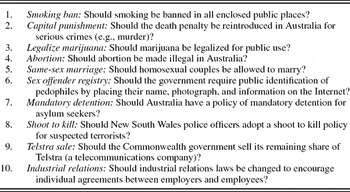
The social issues questionnaire contained a list of 10 debated topics in Australian current affairs at the time that the research was conducted. The topics are listed in Table 1.
Topics addressed on the social issues questionnaire

We asked each participant to first provide their opinion on each topic (1 = strongly disagree, 7 = strongly agree) and to then rate how strongly they personally felt about each issue (1 = no feelings, 7 = very strong feelings). Based on these responses we selected two topics for each participant for which participants held both a strong opinion (of either agreement or disagreement) and had strong feelings. Wherever possible, we chose issues for which the participant had reported an opinion rating of either 1 or 7 and had also provided a value of 7 for personal feelings about the issue. For one topic participants were asked to give a truthful account of their views, and for the other topic participants were asked to provide an untruthful account of their views (i.e., to lie). For each participant, the two selected topics were randomly assigned to be either the target of the truthful or the untruthful account. Across the 32 participants, the mean absolute difference of opinion ratings from the midpoint of 4 (i.e., mean absolute strength of agreement or disagreement) was 2.44 (SD = 0.72) for issues assigned to be the truthful account and 2.63 (SD = 0.49) for untruthful accounts. The mean ratings of feelings were 5.94 (SD = 0.95) for truthful accounts and 6.16 (SD = 0.92) for the untruthful accounts. We conducted paired samples t tests and found no significant differences between issues selected for truthful and untruthful accounts in terms of participants’ opinions, t (31) = −1.359, p = .861, or feelings, t (31) = 1.487, p = .184.
Data preparation and analysis
An excerpt from an interview where the participant was being interviewed about the topic of same-sex marriage is provided in Appendix A as an example of the language we elicited. In the tagging of “um” instances, examples of “uh” (or “ah”) were not tagged as “um” unless they were characterized by vowel nasalization (anticipatory nasalization occurs when speakers intend to close with a nasal consonant such as /m/). The tagging of “like” instances only included usage as interjections, and did not include instances of other grammatical categories (e.g., verb use as in “I like smoking”). All duration and amplitude measures were made by an experienced sound engineer using Sony Sound Forge 9. The sound engineer was blind to the deception conditions (lying vs. truth-telling) of the speech samples. Frequency of use is reported as a percentage of the total number of words the participant produced in each condition. For duration (ms) the beginning and ending of each utterance was determined by their slight presence above the ambient noise floor. Amplitude (dB) was measured at the peak (loudest). It should be noted that where a participant did not produce “um” or “like,” there are obviously no data for duration or amplitude.
Prior to conducting each analysis we examined the truth and deception conditions for outliers and removed participant data (i.e., individuals not trials) that were ±2.5 SD from the overall mean (the number of outliers removed is indicated in brackets for each analysis). In separate analyses of the utterances “um” and “like” we conducted a series of analyses of variance (ANOVAs) to examine each of three dependent variables: frequency of use, average duration, and average amplitude. For each ANOVA there were two independent variables: deception was a within-participants factor (lying vs. truth-telling) and gender was a between-participants factor (female vs. male).
RESULTS
Participants produced an average of 162 words in the truth condition and an average of 182 words in the lying condition. A 2 (Condition: lying vs. truth-telling) × 2 (Gender: female vs. male) ANOVA revealed no significant main effects in terms of total number of words produced during lying versus truth-telling or for females versus males (Fs < 1) and no significant interaction between these variables, F (1, 30) = 1.15, p = .292.
Analysis of “um”
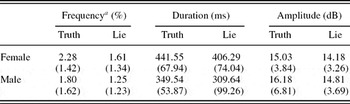
We excluded data from four participants whose responses constituted outliers. Descriptive statistics with these outliers excluded are provided in Table 2.
Mean (standard deviation) use of “um”

aPercentage of total words.
We conducted ANOVAs to examine the average frequency, average duration, and average amplitude (loudness) of “um.” The analysis of frequency of use (one outlier removed) revealed a significant main effect of deception, F (1, 29) = 7.04, p = .013, with significantly more instances in the truth-telling condition. In contrast, there was no main effect of gender and no interaction between gender and deception (both Fs < 1). The analysis of duration of utterances (two outliers removed) revealed a significant main effect of deception, F (1, 20) = 5.15, p = .034, with significantly longer utterances in the truth-telling condition. There was also a significant main effect of gender, F (1, 20) = 9.28, p = .006, with females exhibiting longer utterances than males; however, there was no interaction between gender and deception (both F < 1). In the analysis of amplitude (one outlier removed) there were no significant effects.
Analysis of “like”
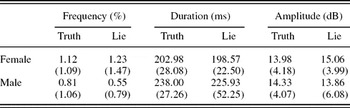
We excluded data from three participants whose responses constituted outliers. Descriptive statistics for the three dependent measures (with outliers excluded) are provided in Table 3.
Mean (standard deviation) use of “like”

As in our analysis of “like,” we conducted ANOVAs to examine the frequency, average duration, and average amplitude (loudness) of “like.” The analysis of frequency (one outlier removed) revealed no main effect of deception (F < 1), no main effect of gender, F (1, 29) = 1.44, p = .240, and no interaction between these variables (F < 1). The analysis of duration (one outlier removed) revealed a main effect of gender, F (1, 12) = 4.89, p = .047, with males producing longer instances of “like” than females, but there was no main effect of deception (F < 1), and no interaction between these variables (F < 1). In the analysis of amplitude, too, there were no significant main effects and no significant interaction (all Fs < 1).
DISCUSSION
The current study was designed to investigate the use of “um” and “like” as linguistic markers of truth versus deception. To our knowledge, there have been limited previous investigations of this topic. Of the previous investigations that have examined items such as “um,” researchers have not always been explicit in their methods of defining and identifying these utterances (e.g., possible differences between “um” vs. “uh”), in explaining the role of these items in communication (i.e., as disfluencies or as lexical items), or in discussing the reasons why their use might correlate with deception. It would appear that no previous investigation has examined the prevalence and acoustic nature of both “um” and “like” along with possible effects of gender in truth-telling versus lies.
The results confirmed our hypothesis that these kinds of utterances successfully discriminate between deceptive and truthful utterances. In particular, our results showed that instances of “um” were significantly more frequent and of longer acoustic duration during truth-telling than during lying. These effects are subtle, as is often the case with cues to deception (Meservy et al., Reference Meservy, Jensen, Kruse, Burgoon, Nunamaker and Kantor2005). On average, the difference in frequency of use between lies and truth (within participants) amounts to around one extra use of “um.” This suggests that the discriminatory power of these utterances might be more effectively harnessed via computer-assisted detection methods rather than trying to train humans to detect these kinds of subtle effects.
We propose two possible explanations regarding the discriminatory power of “um.” It may be that such utterances are more accurately conceptualized as conventional English words rather than filled pauses/hesitations or speech disfluencies/errors (see Clark & Fox Tree, Reference Clark and Fox Tree2002; Fox Tree, Reference Fox Tree2006). Research unrelated to deception behaviors provides converging evidence for the special status of utterances such as “um” that have been found to have different distribution patterns to other types of disfluencies such as repetitions and false starts. Bortfeld, Leon, Bloom, Schober, and Brennan (Reference Bortfeld, Leon, Bloom, Schober and Brennan2001) found that these utterances “may be a resource for or a consequence of interpersonal coordination” (p. 123). As such, these utterances might be an important part of authentic, effortless speech (i.e., presumably, somewhat lacking during lying). Accordingly, although the use of utterances such as “um” may not be under strategic control, we would expect usage to be lessened during lying (compared to truth-telling). The second possibility is that the use of utterances such as “um” is under direct control, and that participants reduce their usage of these utterances during lying in an effort to mask deception. In line with this view, speakers remove what they see as markers of uncertainty (utterances such as “um”) when they lie (e.g., Akehurst, Kohnken, Vrij, & Bull, Reference Akehurst, Kohnken, Vrij and Bull1996; Vrij & Semin, Reference Vrij and Semin1996).
The outcome of each of these scenarios is the same: fewer utterances such as “um” during lying. Of importance, although frequency of use of “um” could conceivably be under strategic control, it seems unlikely that particular acoustic characteristics of these utterances, such as duration (which we found to differ significantly across our two deception conditions), could be as easily controlled by participants. However, perhaps while strategically reducing the frequency of “um” in deceptive speech, speakers also try to rush through any that do manage to break through into their speech. This remains an open empirical question to be investigated in future studies. Our results challenge traditional conceptualizations of “um” as a filled pause/hesitation or speech disfluency/error that is more likely to occur in situations of increased cognitive load and/or increased arousal, such as during lying (e.g., Hosman & Wright, Reference Hosman and Wright1987; Vrij & Winkel, Reference Vrij and Winkel1991).
The most compelling explanation for the discrepancy between the present findings and previous studies of deceptive speech relates to inconsistencies in the way utterances such as “um” have been defined and measured. For instance, Sporer and Schwandt (Reference Sporer and Schwandt2006), in their meta-analysis of 41 studies of linguistic cues to deception grouped “um,” “uh,” “er,” and so on together under the heading of “filled pauses”; the individual contributions made by each measure are unclear. To our knowledge, of the previously published studies that did specifically measure “um” in its own right, the findings were consistent with ours; that is, the presence of “um” was observed more frequently during truthful than deceptive speech. As mentioned, it has been argued in the psycholinguistic literature that “um” is not a nonlexical sound, but instead deserves the status of a legitimate word (Clark & Fox Tree, Reference Clark and Fox Tree2002; Fox Tree, Reference Fox Tree2001, Reference Fox Tree2002). The inconsistencies reported in the research on fillers in deception, and the findings of the present study, support the measurement of “um” as a variable in its own right.
Another explanation for the discrepancy between the findings reported for the discriminative ability of “um” in deceptive speech relates to the differences in research design. Many different paradigms are utilized in deception research; as such, there are a number of moderator variables that may impact upon findings including the content and difficulty of the lie, preparation time, rehearsal time, motivation to lie, the amount of interaction with the experimenter, between-participants versus within-participants design, monologic versus dialogic format, and so on. For instance, Vrij and Heaven (Reference Vrij and Heaven1999) reported a positive relationship between what they labeled “speech disturbances” (the frequency of saying “uh,” “um,” “mm,” or pausing between words) and deception when the lie was difficult and a negative relationship between speech disturbances and deception when the lie was easy. It is possible that through the false opinion paradigm our participants may have been able to construct a lie somewhat more easily because of a familiarity with the arguments for both sides of the social issues that were presented.Footnote 1 However, we think this may have been offset by other factors in our study that contributed to making the lies more effortful: participants were given no preparation time, they were face to face with a suspicious interviewer, and they were told the interview would be terminated as soon as the interviewer decided they were lying.
We found no significant differences in the prevalence or acoustic nature of “like” utterances in truth-telling versus deceptive speech. Perhaps we failed to find significant effects in our analysis of “like” because of the small number of data points and, thus, these particular results should be interpreted with caution. However, use of “like” may appear less often than “um” in any speech sample because the use of “like” as an interjection is a relatively recent phenomenon. It is interesting that it has been suggested that “like” might have a different meaning/purpose from “um” in popular usage (as in Fox Tree, Reference Fox Tree2006). As mentioned earlier, it is possible that participants see “um” as a marker of deception and try to control their use of it when trying to convince someone with a lie. By contrast, participants might view “like” quite differently (compared with “um”) and consequently might not attempt to control their use of “like” because they do not view it as a marker of deception. We suggest that (at least in this point in contemporary language use) “um” is a clearer marker of truth versus deception compared with “like.”
Finally, our results suggest some interesting differences in the use of both “um” and “like” by females and males. On average, females produced longer instances of “um” and males produced longer instances of “like.” Previous research has suggested gender differences in usage of “um” (Benus et al., Reference Benus, Enos, Hirschberg and Shriberg2006) and “like” (Drager, Reference Drager, Warren and Watson2006) but, to our knowledge, ours is the first study to examine both “um” and “like” and to show that differences are related to acoustic duration. These differences were unrelated to the deception conditions.
It would be valuable for future studies to examine a wider range of interjection-like utterances and to examine the prevalence and nature of utterances such as “um” during real-life, high-stakes lies (e.g., media interviews and court cases associated with homicide). The paradigm we have used here is a well-accepted method of eliciting lies in the laboratory, but it is important to verify that findings from the laboratory can be generalized to truth versus lies in the real world. Future studies might also look at teasing apart the influence of different kinds of research design, and more directly manipulating cognitive load, arousal, and opportunities for strategic control during truth-telling versus lies, to see if this changes the pattern of use for utterances such as “um.”
CONCLUSION
In summary, utterances such as “um” have traditionally been considered to be filled pauses/hesitations or speech disfluencies/errors that increase when an individual is experiencing the kind of increased cognitive load and increased arousal that often accompanies lying. As such, researchers in the area of deception have tended to theorize that we might see increased use of these utterances during lying. In contrast, our results showed decreased use of “um” and shorter instances of “um” during lying compared to truth-telling. These results have important implications for research in the area of deception but also in terms of a reconceptualization of the role of these utterances in general communication.
APPENDIX A
“. . . Um, well I think they're just like any other person so um they should just have the same chance as any other Australian to get married um and it's sort of up to them whether or not they should want to, like, it's their choice . . .”