Introduction
The Government of Canada has welcomed and resettled almost 58,000 Syrian refugees across Canada since November 2015 with the majority of these refugees being families with young children (Immigration, Refugees, and Citizenship Canada, 2018). As a result, approximately half of these refugees are under the age of 18. Due to the nature of the war in Syria, many refugees may have lived in resettlement or refugee camps for years before arriving in Canada. These experiences can negatively affect refugee children in terms of educational or psychological impacts. For example, refugee children may have experienced limited access to education or disrupted schooling, due to the war or due to living in the refugee camps (Hadfield et al., Reference Hadfield, Ostrowski and Ungar2017). According to Sirin and Rogers-Sirin (Reference Sirin and Rogers-Sirin2015), more than half of all Syrian children did not attend school during the 2014–15 school year because of the conflict in Syria. Furthermore, refugee children continue to be at a disadvantage after arriving in Canada due to challenges related to language proficiency, literacy, and social integration (Geva & Wiener, Reference Geva and Wiener2014). Therefore, research is needed to assess the specific educational challenges of Syrian refugee children.
Literacy skills are crucial to educational success. The key components of literacy include skills in phonemic awareness, decoding, sight word reading, fluency, vocabulary, and finally a deep understanding of text (i.e., reading comprehension) (National Reading Panel, 2000). To understand the meaning of a text, the reader must first use lower level skills such as word recognition skills to access the meaning of words. Therefore, this study investigates word reading and related skills among refugee children, ages 6 to 13 years, who recently immigrated to Canada. The children arrived in Canada with nonexistent to limited skills in English, their second language (L2), and varying levels of education in their first language (L1), Arabic. Their L1 educational experiences were often not commensurate with their ages. Although reading comprehension is the ultimate goal of reading acquisition, word reading is a key building block to literacy development. Therefore, this study examined relations among skills within languages, specifically whether vocabulary, morphological knowledge, and phonological awareness were related to word reading in Arabic and English among Syrian refugee children. The study also examined cross-linguistic relations in terms of Arabic linguistic and metalinguistic skills as predictors of English word reading. Because the children had relatively little experience with English, only L1 to L2 relations were examined.
Bilingual context
Because word recognition is considered a starting point for the complex skill of reading comprehension (Gough & Tunmer, Reference Gough and Tunmer1986), researchers have examined relations among language and literacy skills within and across languages for L2 learners. The linguistic interdependence hypothesis formulated by Cummins (Reference Cummins1979) and the script-dependent hypothesis proposed by Geva and Siegel (Reference Geva and Siegel2000) provide theoretical frameworks for understanding relations across language and literacy skills in bilingual children. According to the linguistic interdependence hypothesis, skills in one language are related to learning another language, which suggests that L1 proficiency is related to L2 proficiency either across general underlying skills (Cummins, Reference Cummins1979) or across specific linguistic skills such as phonological awareness (Durgunoglu, Reference Durgunoğlu2002). Therefore, the difficulties or delays in language and literacy acquisition in the L1 are related to children’s abilities to acquire the L2. Additionally, performance on linguistic constructs across languages would be related.
Alternatively, the script-dependent hypothesis proposed that the relations between skills and across languages are due in part to the characteristics of different scripts (Geva & Siegel, Reference Geva and Siegel2000). For example, English does not have a one-to-one relation between graphemes and phonemes whereas Arabic, when written in its voweled form, has much more predictable grapheme–phoneme correspondences than English (Abu-Rabia & Siegel, Reference Abu-Rabia and Siegel2002). Additionally, Arabic and English differ in terms of their scripts and linguistic typologies, which could influence relations across languages (see a detailed discussion of Arabic in the following text). In their psycholinguistic gran size theory, Ziegler and Goswami (Reference Ziegler and Goswami2005) suggest that word reading acquisition processes are highly influenced by the nature of the sound-symbol mappings. Therefore, the challenges that children encounter when learning to read in the L1 are not necessarily the same as those that affect their ability to read in the L2, if the languages are different enough (Gottardo et al., Reference Gottardo, Pasquarella, Chen and Ramirez2016). In terms of relationships between skills across languages, linguistic constructs should be highly related if languages have similar scripts or linguistic typologies, but might not be highly related if languages differ in script or linguistic typology. However, the psycholinguistic gran size theory focuses on phonological units and does not explicitly acknowledge the role of other linguistic structures such as morphology in its examination of factors related to word reading.
Koda’s Transfer Facilitation Model examines the connections between L1 and L2 language and literacy skills with a focus on metalinguistic awareness of phonology and morphology (Koda, Reference Koda2008). The Transfer Facilitation Model suggests that the key task of learning to read involves the learner mapping oral language to written language with the learner paying attention to the important graphic elements in a given language. The learner uses salient oral and written linguistic patterns in their L1 to “understand” how print maps onto oral language and to develop metalinguistic awareness through exposure to the oral and written forms of their language (Koda, Reference Koda2008). The reciprocal relationship between language and literacy skills and metalinguistic awareness within and across languages drives the development of reading (Koda, Reference Koda2008).
Overview of the Arabic language
Arabic ( al-arabiyyah) is a Semitic language (Saiegh-Haddad, Reference Saiegh-Haddad2013). It is the fifth most common language in the world in terms of the number of native speakers, with 300 million speakers, mostly in the Middle East and North Africa (Elbeheri & Everatt, Reference Elbeheri and Everatt2007). In addition to this large number of native speakers, Arabic is learned by millions of Muslims around the world because it is the language of the Quran, the holy book of Islam, and is consequently considered the second most widely used additional language in the world after English (Mahfoudhi et al., Reference Mahfoudhi, Everatt and Elbeheri2011).
Arabic is characterized as a diglossia, a phenomenon where two varieties of a language are used by one group (Ferguson, Reference Ferguson1959). Children learn an oral form of Arabic (spoken Arabic) at home and in the community, which differs from the form that is written or used orally in school or in formal settings (Modern Standard Arabic: MSA). People from Syria speak Levantine Arabic. This form differs from MSA in vocabulary, morphology, phonology, and even syntax (Kwaik et al., Reference Kwaik, Saad, Chatzikyriakidis and Dobnik2018; Saiegh-Haddad & Schiff, Reference Saiegh-Haddad and Schiff2016). Upon entering school these children often have experiences learning MSA that are similar to learning an additional language. Therefore, for refugee children, interrupted schooling or lack of schooling has an effect on children’s familiarity with MSA.
Arabic morphology
Arabic is a morphologically complex language that combines both linear and nonlinear morphological processes (Boudelaa, Reference Boudelaa, Saiegh-Haddad and Joshi2014). As a nonconcatenative language, the nonlinear morphological processes in Arabic are characterized as a root and pattern system in which both components are bound morphemes. Arabic roots are bound morphemes consisting of three to four consonants, which provide the core meaning of the word (e.g., r.s.m) (Saiegh-Haddad, Reference Saiegh-Haddad2013; Shamsan & Attayib, Reference Shamsan and Attayib2015). Using nonlinear, derivational, and sometimes inflectional morphology, patterns that are added to roots, using long and short vowels as well as other infixes, provide morpho-syntactic and phonological forms to build words (Saiegh-Haddad, Reference Saiegh-Haddad2013; Saiegh-Haddad & Henkin-Roitfarb, Reference Saiegh-Haddad, Henkin-Roitfarb, Saiegh-Haddad and Joshi2014). Hence, the combination of the root with the word pattern results in words with different but related meanings and different grammatical parts of speech. The combination of roots and patterns in words also changes the internal structure of words. For example, from the root “r.s.m,” several words can be derived by inserting vowels into the root pattern, creating words with different but related meanings, such as rasama “to draw,” /rassa:m/“painter,” /rasma/“picture,” and /rusi:ma/“was drawn.”
In Arabic, linear morphology is used primarily for inflectional markers, with morphemes added sequentially as prefixes or suffixes, which are used to mark grammatical distinctions such as tense, number, person, gender, mood, and voice (Abu-Rabia & Taha, Reference Abu-Rabia and Taha2006; Schiff & Saiegh-Haddad, Reference Schiff and Saiegh-Haddad2018) (e.g., from the root “r.s.m,” T is added at the beginning of word as a prefix, meaning  “she draws” and Na is added as a suffix, meaning
 “we draw”). In contrast, English is considered a concatenative language that uses linear morphological processes, including derivational prefixes and suffixes (e.g., un-happi-ness) and simple inflectional morphology (e.g., jump, jumps, jumped). Therefore, Arabic morphology has both unique and overlapping morphological patterns compared to English, which can influence relations across languages.
Arabic phonology
Arabic shares several phonemes with English, 17 in total (e.g., /b/, /s/, /ʃ/, /t/) (Smart & Altorfer, Reference Smart and Altorfer2005). Arabic also includes phonemes that do not exist in English but are found in other European languages, such as the /r/ sound, which is like the trilled “r” of Scottish, and the “kh” sound, which is similar to the German sound for “ch.” Finally, some phonemes are specific to Arabic and other Semitic languages.
Arabic orthography
Arabic is represented by an abjad writing system when written in its consonantal form (Saiegh-Haddad, Reference Saiegh-Haddad2013). It includes 28 consonant letters and three letters that represent long vowels (a, u, i) (Abu Rabia & Taha, Reference Abu-Rabia and Taha2006). Arabic has specific features that distinguish it from other languages including English. Arabic is written from the right to left, while English is written from left to right. Unlike English, there are no capital letters in Arabic. In addition, most Arabic letters have more than one written form (four shapes) depending on the letter’s position, whether it is in the initial, middle or final position in a word, or isolated (Letter “baa”: “initial  ”, “middle
 ”, “ final ”
 , “isolated
 ”). Arabic has the dot system, which is used within its letters. Out of 28 letters, 15 letters are written with dots ranging from one to three dots (Abu Rabia & Taha, Reference Abu-Rabia and Taha2006). Thus, the number of dots and their positions, below or above the letters, are used to distinguish letters in Arabic.
Arabic also has two types of vowels, long and short vowels, which are represented differently. The long vowels are represented by three letters ا/a:/, و/u:/, and ي /i:/. Short vowels are represented by three diacritical markers)fatḥah: َ  , ḍammah:, ُ
 kasrah: ِ
 ), which play an essential role in reading Arabic and contribute to the phonology of the Arabic alphabet (Abu-Rabia, Reference Abu-Rabia2012). Therefore, when Arabic words and texts are vowelized (using diacritics), such as in children’s books, religious texts, and textbooks for beginning readers and foreign learners, Arabic is considered a shallow orthography with one-to-one grapheme–phoneme correspondences (GPC). Abu-Rabia (Reference Abu-Rabia2001) indicated that vowel diacritics facilitate word recognition and reading comprehension regardless of the level of reading skill or the age of the reader. In contrast, when it appears without the diacritics (unvowelized), as in newspapers and texts for proficient readers, such as older children and adults, Arabic script is considered a deep orthography with less transparent GPCs. When diacritics are removed, a specific word can have multiple pronunciations due to the homographic nature of Arabic orthography, which leads readers to depend more on context to support the processing of words (Abu-Rabia, Reference Abu-Rabia2001; Abu-Rabia & Taha, Reference Abu-Rabia and Taha2006).
Predictors of word reading
Research on word reading has focused on the linguistic foundations of word decoding in an alphabetic orthography. Understanding the language-specific linguistic and cognitive skills related to reading are important to understand reading development in a particular language. In fact, word recognition is related to several linguistic skills including phonological awareness and morphological awareness (Carlisle, Reference Carlisle2000; Deacon & Kirby, Reference Deacon and Kirby2004; Kirby et al., Reference Kirby, Deacon, Bowers, Izenberg, Wade-Woolley and Parrila2012; LaFrance & Gottardo, Reference LaFrance and Gottardo2005; Nagy et al., Reference Nagy, Berninger, Abbott, Vaughan and Vermeulen2003; Nagy et al., Reference Nagy, Berninger and Abbott2006). However, recently this research has been criticized as Anglocentric/Eurocentric, as it focuses on reading across European languages (Share, Reference Share2008).
Phonological awareness
Phonological awareness is a metalinguistic skill that involves awareness of the phonological or sound structure of spoken words independent of meaning (Geva & Wiener, Reference Geva and Wiener2014; Hatcher et al., Reference Hatcher, Hulme and Ellis1994; Stahl & Murray, Reference Stahl and Murray1994). Based on the results of various studies, phonological awareness skill is strongly associated with reading development (Deacon & Kirby, Reference Deacon and Kirby2004; Gottardo et al., Reference Gottardo, Yan, Siegel and Wade-Woolley2001; Lonigan et al., Reference Lonigan, Burgess and Anthony2000) as well as being considered as a reliable skill differentiating between good and poor readers (Shankweiler & Fowler, Reference Shankweiler and Fowler2004). Poor phonological awareness delays the acquisition of the alphabetic principle and of word reading (Deacon & Kirby, Reference Deacon and Kirby2004).
Ample research evidence points to the relationship between phonological awareness and word reading in many languages including English, French, Dutch, Spanish, Hebrew, Arabic, and Chinese (Anthony et al., Reference Anthony, Solari, Williams, Schoger, Zhang, Branum-Martin and Francis2009; Ho & Bryant, Reference Ho and Bryant1997; LaFrance & Gottardo, Reference LaFrance and Gottardo2005; Laurent & Martinot, Reference Laurent and Martinot2010; Saiegh-Haddad & Geva, Reference Saiegh-Haddad and Geva2008; Taibah & Haynes, Reference Taibah and Haynes2011; Verhagen et al., Reference Verhagen, Aarnoutse and Van Leeuwe2008). Various research studies also have suggested that phonological awareness skills play an important role in developing reading skills in Arabic (Abu-Rabia et al., Reference Abu-Rabia, Share and Mansour2003; Taibah & Haynes, Reference Taibah and Haynes2011; Tibi, Reference Tibi2010; Tibi & Kirby, Reference Tibi and Kirby2018). For example, a study conducted by Al- Mannai and Everatt (Reference Al Mannai and Everatt2005) with monolingual Arabic-speaking Bahraini children showed that decoding and phonological awareness were the best predictors of word reading when controlling for memory, speed of processing, and nonverbal reasoning, especially in the early grades. Taibah and Haynes (Reference Taibah and Haynes2011) reported similar conclusions in their study of the contribution of phonological awareness to basic literacy skills in 237 children from kindergarten through Grade 3, whose native language was Arabic. The results showed that the best predictor of basic Arabic skills for Arabic-speaking children was phonological awareness. In terms of bilingual Arabic-speaking children, Farran et al. (Reference Farran, Bingham and Matthews2012) found that for Arabic–English bilingual children in Grades 3, 4, and 5, word reading (both vowelized and nonvowelized Arabic words) was predicted by phonological awareness. Similarly, Saiegh-Haddad and Geva (Reference Saiegh-Haddad and Geva2008) found that Arabic phonological awareness significantly predicted Arabic word reading among English–Arabic bilingual children in elementary grades.
In addition, there is evidence of cross-language transfer of phonological awareness between Arabic and other languages. For example, phonological awareness in Arabic was correlated to phonological awareness in English (Farran et al., Reference Farran, Bingham and Matthews2012). Similarly, a study conducted by Alshaboul et al. (Reference Alshaboul, Asassfeh, Alshboul and Alodwan2014) found evidence of transfer of phonological awareness from Arabic to English in first-grade Jordanian bilingual children aged 6 to 10. These findings confirm that phonological skills are an important factor in the development of basic literacy skills within and across languages, as phonology is primary to reading in most languages (Share, Reference Share1995) or is accessed as early as permitted by the writing system (Perfetti et al., Reference Perfetti, Liu and Tan2005). Although relationships across languages are well documented, the examination of unique and overlapping variances in languages with very different linguistic typologies is less common.
Morphological awareness
Morphological awareness, which is ability to reflect on and analyze the morphological structure of a given language, is another component of general metalinguistic ability (Carlisle, Reference Carlisle and Feldman1995; Koda, Reference Koda2008). Research conducted with native speakers of English has shown that morphological awareness is significantly associated with various aspects of literacy skills including word reading (Carlisle, Reference Carlisle2000; Deacon et al., Reference Deacon, Benere and Pasquarella2013; Kirby et al., Reference Kirby, Deacon, Bowers, Izenberg, Wade-Woolley and Parrila2012; Nagy et al., Reference Nagy, Berninger, Abbott, Vaughan and Vermeulen2003; Nagy et al., Reference Nagy, Berninger and Abbott2006). Studies reported that children in the elementary grades differ significantly in their ability to manipulate morphologically complex words, and these variances reflect children’s differences in word reading (Nagy et al., Reference Nagy, Berninger and Abbott2006; Singson et al., Reference Singson, Mahony and Mann2000). These results showed that morphological knowledge plays an important role in reading complex words. A longitudinal study by Carlisle (Reference Carlisle and Feldman1995) showed that morphological awareness was positively correlated with subsequent reading achievement and reading proficiency from kindergarten to the second grade.
Furthermore, morphological awareness is an important factor in predicting literacy among bilingual children. Ramirez et al. (Reference Ramirez, Chen, Geva and Luo2011) investigated English morphological awareness skills among Chinese and Spanish L2 learners, who were in Grade 4 and Grade 7. The outcomes showed that morphological awareness made a unique contribution to word reading in all groups. Also, performance on an oral morphological production task accounted for unique variance in reading and spelling after controlling for phonological awareness among Chinese/English bilinguals (Wolter et al., Reference Wolter, Wood and D’ztako2009). English morphological awareness in first grade was related to French reading at the same time as well as three years later in native English speakers in French immersion (Deacon et al., Reference Deacon, Wade-Woolley and Kirby2007).
The awareness of the morphological structures of a language was found to play an essential role in reading processes in Semitic languages (Abu-Rabia, Reference Abu-Rabia2007; Saiegh-Haddad, Reference Saiegh-Haddad2013; Saiegh-Haddad & Geva, Reference Saiegh-Haddad and Geva2008; Tibi & Kirby, Reference Tibi and Kirby2017) (see discussion about Arabic morphology in the preceding text). In terms of monolingual children, a study conducted by Abu-Rabia (Reference Abu-Rabia2007) with Arabic typical readers and readers with dyslexia in Grades 3, 6, 9, and 12 found that morphological skills and spelling were the strongest predictors of reading accuracy and comprehension. Saiegh-Haddad has noted that due to the structure of Arabic (see previously mentioned text), morphological roots are salient across words and might facilitate the development of morphological processing (Saiegh-Haddad, Reference Saiegh-Haddad2013; Saiegh-Haddad & Henkin-Roitfarb, Reference Saiegh-Haddad, Henkin-Roitfarb, Saiegh-Haddad and Joshi2014, also see Tibi & Kirby, Reference Tibi and Kirby2017).
A study examining cross-language transfer of morphological awareness between Arabic and English revealed that Arabic morphological awareness predicted word reading in English (Saiegh-Haddad & Geva, Reference Saiegh-Haddad and Geva2008). However, this research was conducted with English–Arabic speakers attending private schools. There is no known research that examines the role of Arabic and English morphological awareness in Arabic-speaking refugee children in an English-speaking context. Given the differences in linguistic typologies across Arabic and English, the degree of unique and shared variance in morphological skills will inform our understanding of the role of morphological awareness in bilingual Arabic–English speakers.
The present study
The goals of the present study are twofold and include practical and theoretical implications. The present study investigates variables related to word reading in Arabic (L1) and English (L2) for Syrian refugee children who are newcomers to Canada. These findings can have practical implications for creating screening tools and interventions that capitalize on strengths and address learning weaknesses. The second goal is to examine the overlapping and unique contributions of phonological awareness and morphological processing within and across languages in relation to word reading ability. This component of the study has theoretical and practical implications in terms of the nature of cross-linguistic relations for constructs in languages with different writing systems and different linguistic typologies. The literature has shown that phonological awareness is important for learning to read and is usually related across languages. However, morphological awareness is related to reading in English in older participants and is less likely to be related across languages.
Method
Participants
Data were collected on 96 participants who were identified as Syrian refugees by their schools or who were recruited through community centers who assisted refugees with resettlement in Ontario, Canada. Families with children within the appropriate age range, 6 to 13 years old, were approached to take part in the study. In most cases, two children from each family were selected, resulting in children from 50 families being tested. Children who differed by two or three years were selected in families with multiple children within the desired age range. The mean age of the participants was 113.78 mos (SD = 23.6 mos). Participants included 49 girls (mean age 117.43 mos, SD = 24.4 mos) and 47 boys (mean age 109.98 mos, SD = 22.5 mos). The mean age of arrival in Canada was 91.4 mos (SD = 24.6 mos) and parents reported that the children had 17.82 mos of experience with English (SD = 6.7 mos). The parents were asked to report if the children had been in school prior to arriving in Canada. Sixty-six children had attended school prior to arriving in Canada while 30 of the children had not attended school prior to arriving in Canada. Of the 30 children in the study who did not attend schooling prior to arriving in Canada, 16 children were deemed unlikely to be eligible for schooling prior to immigrating with a mean age of 57.18 mos upon arrival in Canada. However, 14 children were deemed eligible for schooling with a mean age of 90.07 mos upon arrival in Canada. Even the children who had attended school prior to their arrival, likely had interruptions in their schooling due to fleeing their homes, moving frequently, and settling in temporary accommodations (e.g., refugee camps).
Measures
Parallel language measures were administered in Arabic and English. Nonverbal reasoning performance was measured to control for general ability.
Word Reading
In English
English word reading accuracy was measured using the Letter-Word Identification subtest of the Woodcock–Johnson III battery (WJIII; Woodcock et al., Reference Woodcock, McGrew and Mather2002). This test is a standardized measure with 76 items presented in increasing order of difficulty. The initial 16 test items required the children to identify letter names or point to letters that match the letter name presented orally by the examiner. For the remaining items, children were asked to read aloud sets of English words that gradually became more challenging (e.g., is, had, together, astronomer). Testing was discontinued when the child incorrectly read six consecutive words. The Cronbach’s alpha from the manual was .95.
In Arabic
Word reading accuracy in Arabic was measured using an Arabic vowelized word reading test created by Tibi and Kirby (Reference Tibi and Kirby2017). This test included 100 vowelized words (10 practice items, 90 test items). Given that the task involved written Arabic, pronunciations represented MSA versions of the words. Feedback was given on all practice items. The words represented different parts of speech (nouns, verbs, or adjectives). The items increased in difficulty in terms of the number of syllables, phonological structure, and morphological complexity. The test was discontinued after 10 consecutive errors. The Cronbach’s alpha for this measure was .97.
Phonological awareness
In English
Phonological awareness was measured with the Elision subtest of the Comprehensive Test of Phonological Processing (CTOPP-2; Wagner et al., Reference Wagner, Torgesen, Rashotte and Pearson1999). This subtest consisted of 34 test items. Children were asked to repeat a word, delete a specific syllable (9 items) or phoneme (25 items) and then state the remaining word (e.g., “say toothbrush without saying tooth” or “say meet without saying /t/”). Testing was discontinued after three consecutive errors. The Cronbach’s alpha for this measure was .89.
In Arabic
The Arabic phonological awareness task was modified for the current study (Tibi & Kirby, Reference Tibi and Kirby2017). The task was parallel in design to the English phonological awareness (elision) subtest. This task included 6 training items and 20 test items. Children were asked to listen to Arabic words presented orally, repeat the words and then delete a syllable (3 items) or phoneme either in the initial, middle, or final position from the word (17 items) (e.g., “Say /samaa/ ‘sky’ without /sa/.” Response: /maa/ “water” “Say /fiil/ ‘elephant’ without saying /l/” Response: /fee/ “in”). Feedback was given on all training items. Variability in the pronunciation of the responses was allowed and was based on the child’s initial pronunciation of the whole word. The test was discontinued after three consecutive errors. The Cronbach’s alpha for this measure was .80.
Morphological awareness
In English
The morphological awareness task was a derivational awareness task (adapted from Carlisle, Reference Carlisle2000). Items were presented orally and were selected to be suitable for younger children and beginner L2 learners. Children were required to produce a derived word to complete a sentence (e.g., Swim. She was a strong ______. [swimmer]. This test included 16 items. The Cronbach’s alpha for this measure was .75.
In Arabic
The Morphological Production subtest of the Tests and Manual-Logat Elkaraa (TMLE; Asadi et al., Reference Asadi, Shany, Ben-Semon and Ibrahim2014) was administered to examine children’s morphological awareness. This task consists of seven morphological roots derived from three letters (two as practice items and five as testing items). The test was administered orally. Each root was presented separately to children who were asked to produce at least two new words. The words that were produced could be verbs or nouns (e.g., kitaab/“book,” /kutub/“books,” /maktab/“desk,” /kaatib/“writer,” /taktub/“she writes,” /yaktub/“he writes,” and /katabu/“they wrote”), but they had to be derived from the three-letter root that was presented. Roots were selected to permit multiple responses that generated high-frequency words. For each root, one minute was provided to produce as many words as possible. The children’s responses were audio-recorded. This subtest was administered in Levantine Arabic, the variety spoken in Syria. The Cronbach’s alpha for this measure was .97.
Morphological awareness was also measured in Arabic, using a root awareness task adapted from Tibi (Reference Tibi2016). Children were asked to determine which words were morphologically related to a given stimulus root, with some of the words being related, while other words were phonologically similar to the root but not morphologically related. The children were asked to circle the correct responses from a choice of four vowelized words, some of which were morphologically related to the stimulus root. The task included five practice items and 15 test items with a total score of 30. Older children with good decoding skills were asked to work independently after the practice items, but younger children with low decoding skills were given the task aurally. “There are four words in brackets that belong to the family of this word (referring to the root word) in sharing both meaning and alphabets, whereas other words do not belong to the same family as they only share either meaning or alphabets.” Each child was given one point for each correct choice circled and one point for each unrelated word that was not selected. Forms were compatible with Levantine Arabic, the variety spoken by the participants.
Vocabulary
In English
The Peabody Picture Vocabulary Test, Fourth Edition, Form A (PPVT-IV; Dunn & Dunn, Reference Dunn and Dunn2007) was administered to assess children’s receptive vocabulary in English. The PPVT-IV test consists of 228 items equally distributed across 20 item-sets. The children were asked to point to the picture from an array of four that represents the word that was provided orally by the examiner (e.g., Point to the picture that shows sleeping). The test was discontinued when the child made at least eight errors in a block of 12 items. The Cronbach’s alpha from the manual was .97.
In Arabic
To assess children’s receptive vocabulary in Arabic, the Picture Vocabulary subtest of the Tests and Manual-Logat Elkaraa was used (Asadi et al., Reference Asadi, Shany, Ben-Semon and Ibrahim2014). The test consisted of 73 items. The children were asked to point to the picture from an array of four that best illustrated the word provided orally by the examiner. The test was discontinued after eight consecutive errors. Vocabulary items were compatible with Levantine Arabic. The Cronbach’s alpha for this measure was .86.
Nonverbal Reasoning
Two subtests of the Matrix Analogies Test, specifically Reasoning by Analogy and Spatial Visualization, were used to measure nonverbal reasoning (Naglieri, Reference Naglieri1985). Each subtest consisted of 16 items of increasing difficulty. The children were asked to choose one of six pieces that best completed the given matrix pattern. Testing for each subtest was discontinued after four consecutive errors. The Cronbach’s α was .87 for this test.
Procedures
Tests were administered across two sessions on different days, one for each language. Testing sessions were usually separated by a week. Children were tested individually in their homes, schools, or community centers or in a room at the university. Testing was conducted by fluent or native speakers of each language.
Results
Descriptives
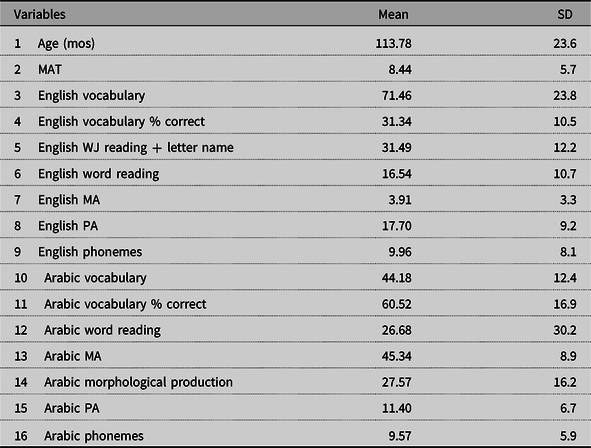
Mean raw scores and standard deviations were calculated for the measures. Standardized scores were not used given that the participants’ experiences in Arabic and English do not reflect the norming samples. Additionally, percent correct scores were calculated for the measures of Arabic and English vocabulary to allow for a better comparison of the mean scores. Percent correct was calculated by dividing the participants’ scores with the total number of items. English reading scores are reported for the letter-word identification subtest of the Woodcock–Johnson as well as raw scores for the words read correctly on the subtest to allow for a better comparison of word reading across languages. For the phonological awareness measures, both the total raw scores and the scores for the phoneme-based items were reported. Many of the measures showed appropriate variability. However, English morphological awareness and Arabic word reading showed high variability with many children having very low scores on these measures (see Table 1). The phoneme component of the English phonological measure also showed high variability with some children having very low scores. Within-group comparisons showed that the children had lower mean raw scores on English word reading, t (95) = 4.18, p < .001, and lower percent correct scores on English vocabulary, t (95) = 16.46, p < .001, than on the parallel Arabic measures. Phoneme elision scores did not differ across languages, t (95) = 0.74.
Mean raw scores and standard deviations

Note: MA: morphological awareness, PA: phonological awareness.
Relationships among variables
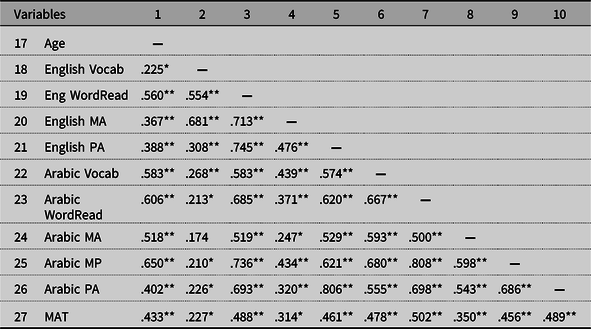
Bivariate correlations were calculated using raw scores for the English and Arabic reading and language variables. All variables were correlated within and across languages. Large correlations were found for English phonological awareness and reading variables within and across languages, rs = .620 to .685, as well as with phonological awareness in Arabic, r = .806 (See Table 2). English morphological awareness was moderately to highly correlated with most variables. Both Arabic morphological production and Arabic morphological awareness were highly correlated with most of the oral language and reading variables within and across languages (see Table 2).
Correlation matrix for raw scores within and between English and Arabic measures

* p < .05. ** p < .001.
Notes: Age = Chronological age in months; English Vocab = English Vocabulary (PPVT); Eng WordRead = English Word Reading; English MA= English Morphological Awareness; English PA = English Phonological Awareness; Arabic Vocab = Arabic Vocabulary (PPVT); Arabic WordRead = Arabic Vowelized Words Reading; Arabic MA = Arabic Morphological Root Awareness; Arabic MP = Arabic Morphological Production; Arabic PA = Arabic Phonological Awareness; MAT = Matrix Analogies Test (nonverbal reasoning).
Within-language variables related to English and Arabic word reading
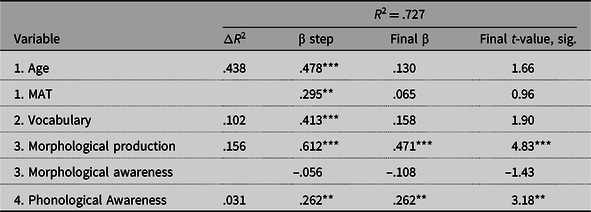
Given the large number of significant correlations, a series of hierarchical regression analyses were conducted to determine which within-language variables were related to Arabic and English word reading. For the regression analysis that examined word reading in Arabic, age, and nonverbal reasoning (MAT) were entered as control variables. Vocabulary, morphological production, morphological awareness, and phonological awareness were entered as steps to determine if they were unique predictors of Arabic word reading. The total variance explained was R2 = .727, F (5, 89) = 39.46, p < .001. Two of the four cognitive-linguistic variables explained unique variance in Arabic word reading (see Table 3). Specifically, the final β weights and significance values for morphological production, β = .471, t (5, 89) = 4.83, p < .001, and phonological awareness, β = .262, t (5, 89) = 3.18, p < .01, were significant.
Arabic variables related to Arabic word reading (N = 96)

* p < 05. ** p < .01.
Note: Raw scores used in this analysis.
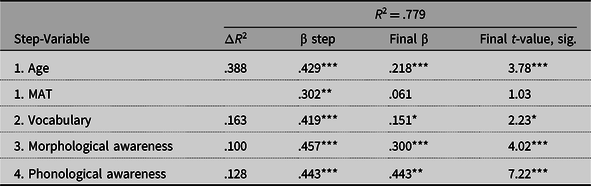
The analyses also examined within-language variables related to English word reading. This analysis included age, MAT, English vocabulary, English morphological (derivational) awareness, and English phonological awareness as predictors of English word reading with the variables entered in the preceding order, explaining a total of R2 = .779, F (5, 95) = 63.56, p < .001 of the variance (see Table 4). All the variables but MAT were significant unique predictors of word reading with values for the final β weight and significance for each variable listed: age, β = .215, t (90) = 3.78, p < .001, vocabulary, β = .151, t (90) = 2.23, p < .05, morphological awareness, β = .300, t (90) = 4.02, p < .001, and phonological awareness β = .443, t (90) = 7.22, p < .001.
English variables related to English word reading (N = 96)

* p < .05. ** p < .01.
Note: Raw scores used in this analysis.
Cross-language variables related to English word reading
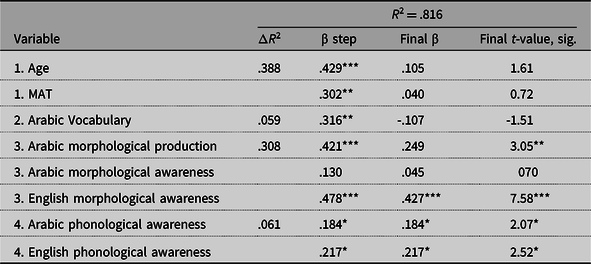
A hierarchical regression analysis was conducted to determine, which Arabic language variables were related to English word reading. Because of the participants’ newcomer status, it is unlikely that their L2 would influence their L1, therefore L2 to L1 analyses were not conducted. Also, lower English scores than Arabic scores on parallel measures support this decision (see Table 1). For this regression analysis examining variables related to English word reading, age, and MAT were entered as control variables. The following Arabic measures were entered: vocabulary, morphological production, morphological awareness, and phonological awareness. English morphological awareness and phonological awareness were entered in the third and fourth steps with the respective Arabic variables. The total variance explained was R2 = .816, F (8, 87) = 48.34, p < .001 (see Table 5). As with the previous analyses, English morphological awareness and phonological awareness were related to English word reading in this analysis, β = .427, t (89) = 7.58, p < .001, and β = .217, t (87) = 2.52, p < .05%, respectively. Two of the four Arabic cognitive-linguistic variables explained unique variance in English word reading. Specifically, the final β weights and significance values for Arabic morphological production, β = .249, t (89) = 3.05, p < .01, and Arabic phonological awareness, β = .184, t (87) = 2.07, p < .05, were significant even when parallel measures in English were included.
Arabic and English variables related to English word reading

* p < .05. ** p < .01.
Note: Raw scores used in this analysis.
The effects of L1 and L2 phonological awareness on English word reading
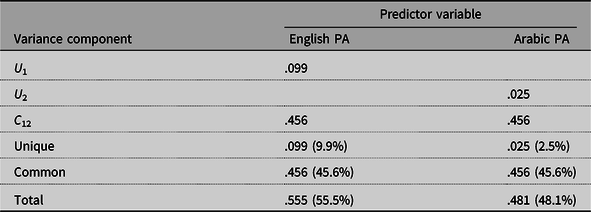
Commonality analyses were used to calculate commonality coefficients to examine the unique and common contributions of Arabic and English phonological awareness to English word reading (Capraro & Capraro, Reference Capraro and Capraro2001; Ray-Mukherjee et al., Reference Ray-Mukherjee, Nimon, Mukherjee, Morris, Slotow and Hamer2014). The commonality coefficients for the unique variance explained by phonological awareness in each language as well as the shared variance for phonological awareness across languages is calculated (see Table 6). Percentages of the total variance in English word reading are also reported in Table 6. The majority of the regression effect was explained by variance that was common to phonological awareness in Arabic and English, 45.6%. The unique effects of English phonological awareness to English reading are potentially important, explaining 9.9% of the variance. Although Arabic phonological awareness is significantly related to English word reading, it only explains 2.5% unique variance, with most of the variance being common with English phonological awareness.
Commonality coefficients for English word reading with English phonological awareness (PA) and Arabic PA (N = 96), Full model R 2 = .580

Notes: Criterion variable = English word reading; C 12 = common component of predictor variable 1 and 2, etc. Raw scores used in this analysis.
The effects of L1 and L2 morphological processing on English word reading
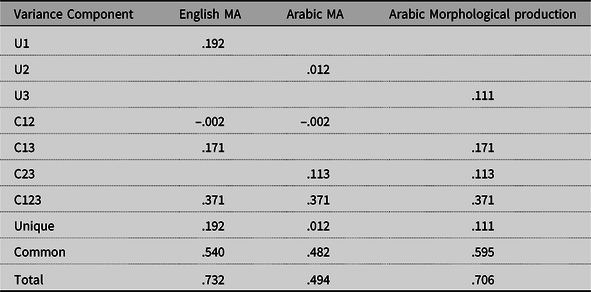
Commonality analyses were used to examine the common variance for the morphological processing measures across the two languages in relation to English word reading. The commonality coefficients were calculated for the morphological predictor variables, specifically for English morphological awareness using the derivational morphology task, Arabic morphological awareness, and Arabic morphological production. The percentages of the total variance explained in English word reading in relation to morphological tasks were also calculated (see Table 7). The majority of the regression effect was explained by shared variance across all three measures of morphological processing, 37.1%. English morphological awareness and Arabic morphological production both contributed unique variance to English word reading, 19.2% and 11.1%, respectively. Although Arabic morphological awareness did not contribute unique variance to English word reading, it accounted for common variance through common effects with English morphological awareness and Arabic morphological production (see Table 7). Together, the three predictors accounted for a total of 74.4% of the variance in English word reading.
Commonality coefficients for English word reading with English derivational morphology and Arabic morphological awareness and morphological production (N = 96), Full model R 2 = .744

Notes: Criterion variable = English word reading; C 12 = common component of predictor variable 1 and 2, etc. Raw scores used in this analysis.
Discussion
The results of the current study address the factors related to word reading in Syrian refugee children in elementary school who are recent immigrants to Canada. The present study had two main goals: (a) to investigate variables related to word reading in the L1, Arabic, and the L2, English, in newcomer refugee children and (b) to examine the overlapping and unique contributions of phonological awareness and morphological processing within and across languages in relation to English word reading ability. The study is unique in that it examines reading skills in refugee children who might differ from other L2 learners in terms of their L1 and L2 educational experiences. Additionally, the patterns of within and cross-linguistic relations found for the variables led to the examination of overlapping and unique variance in word reading for phonological awareness and morphological processing.
Variables related to word reading
Within-language relations
In terms of word reading skills, the current study showed that phonological awareness and morphological processing were uniquely related to word reading in Arabic and English with vocabulary being related to word reading in English. For both Arabic and English, the variables included in the analyses explained a large amount of the variance in word reading, suggesting that the variables selected for this study were highly relevant to word reading performance in this sample. The Arabic word reading task involved reading vowelized script, which provides a regular and consistent letter-sound mapping, associated with phonological decoding. Arabic reading is complicated by the fact that Arabic is a diglossic language, where children learn to read a version of the language that is different from their oral language. Although an effort was made to account for differences in spoken Arabic by creating measures in the children’s dialect, written language measures were constrained to be in MSA. Therefore, written forms were likely less familiar to children as evidenced by their lower scores. Phonological awareness is related to decoding ability and can facilitate partial phonological recoding, when word forms or specific lexical items are unfamiliar (Gottardo, Reference Gottardo2002; Share, Reference Share1995), a process akin to pseudoword decoding.
Additionally, the unique experience of being refugees might explain the strong relationship between phonological awareness and reading in this sample. Despite the age range, few of the participants had strong decoding skills in either language. These weak decoding skills are likely due to their impoverished educational experiences in the L1 and L2, as refugees and as recent immigrants. Several of the participants did not attend school for periods due to war while in their homeland, or while living in refugee camps or in temporary accommodations in other countries in transit. Therefore, their Arabic educational level and their experiences with MSA (see preceding text) are not commensurate with the age at which they arrived in Canada. Additionally, the participants were beginner learners of English due to the fact that they immigrated within 2 years of testing and had not received English instruction prior to immigrating. Although many children were placed in age appropriate grades in their schools in Canada, they were functioning well below grade level. This finding is consistent with previous research showing that phonological awareness is associated with word reading at all levels but shows stronger associations with word reading in beginners (Scarborough et al., Reference Scarborough, Ehri, Olson and Fowler1998).
Additionally, morphological awareness is associated with reading in native English speakers (Carlisle, Reference Carlisle2000; Nagy et al., Reference Nagy, Berninger and Abbott2006). For ESL students, English morphological awareness is related to English word reading in learners with a wide range of L1s including Spanish and Chinese (Ramirez et al., Reference Ramirez, Chen, Geva and Luo2011). Morphological processing is also highly related to word reading in Arabic (Saiegh-Haddad, Reference Saiegh-Haddad2013). This relationship is due to Arabic’s highly complex derivational morphology with its root and pattern system of infixes and affixes, which result in changes in meaning and the creation of different but related words (Saiegh-Haddad, Reference Saiegh-Haddad2013). Additionally, Arabic inflectional morphology is used to mark tense, number, person, gender, mood, and voice. Given the importance of morphological processing and morphological awareness for written and oral Arabic, it is not surprising that in the present study with this sample of native Arabic speaking refugee children, morphological processing is highly related to reading in Arabic (Saiegh-Haddad & Geva, Reference Saiegh-Haddad and Geva2008).
Finally, vocabulary knowledge in English was related to English word reading. This relationship has been found in adolescents who were newcomers to Canada (Pasquarella et al. Reference Pasquarella, Gottardo and Grant2012). Similarly, in this study, vocabulary knowledge might act as a proxy for general language proficiency in beginning learners who are not very proficient in English.
Between-language relations
Cross-linguistic relations were examined for L1 skills in relation to L2 reading. Because the children were recent immigrants with limited English experience both specifically at school and generally in Canada, L2 to L1 relationships were not explored. Their lower scores on L2 measures compared to L1 measures support this decision. Performance on Arabic phonological awareness was related to English word reading. This relationship is not surprising given previous studies that find that phonological awareness in the L1 is related to reading in the L2 regardless of how similar or different the scripts are to each other (Durgunoglu, Reference Durgunoğlu2002; Gottardo et al., Reference Gottardo, Yan, Siegel and Wade-Woolley2001; Saiegh-Haddad & Geva, Reference Saiegh-Haddad and Geva2008). More interesting is the finding that both English morphological awareness and Arabic morphological processing are related to English word reading. Research has shown that morphological awareness is related across languages such as Spanish and English, which share some common linguistic roots (Ramirez et al., Reference Ramirez, Chen, Geva and Luo2011). Additionally, both the Spanish and English tasks were morphological awareness tasks that measured metalinguistic awareness and therefore shared method variance (Ramirez et al., Reference Ramirez, Chen, Geva and Luo2011). In the current study, although morphological awareness was measured, one of the key Arabic tasks measured the ability to produce a variety of morphologically related items based on the root. The importance of morphological processing for reading Arabic could result in children, who are potentially good at language learning in their L1, being highly sensitive to morphology in their L1 and therefore having higher metalinguistic skills. These linguistic and metalinguistic skills are related to being better learners in their L2.
Cross-linguistic relations within constructs
The results of the commonality analyses suggest that although skills within constructs (phonological awareness and morphological awareness) were uniquely related to reading, the majority of the variance was explained by overlapping variance. For example, shared variance between phonological awareness in English and phonological awareness in Arabic explained almost half of the variance in word reading in English, suggesting that phonological awareness skills across languages in these readers is an underlying skill common to both languages. This relationship between phonological awareness skills has been found across a variety of languages (Durgunoglu, Reference Durgunoğlu2002; Geva & Wang, 2001; Melby-Lervåg & Lervåg, Reference Melby-Lervåg and Lervåg2011).
Similar results were found for morphological skills. Although morphological skills were related across Arabic tasks in these children, morphological production in Arabic was also related to morphological awareness in English. The relatively higher scores on measures of morphological awareness and morphological processing skills in Arabic were likely developed in these children through exposure to oral language. Given the unique role of morphology in Arabic language and literacy development, speakers and readers of Arabic also might use linguistic and meta-linguistic skills acquired in Arabic to complete language and literacy tasks in other languages.
The strong relationships within constructs and across languages were expected for phonological awareness. However, previous findings of cross-linguistic relations for morphological processing are inconsistent (Durgunoglu, Reference Durgunoğlu2002; Kuo & Anderson, Reference Kuo and Anderson2006). The children in this study were beginner learners and readers of English. Although the linguistic interdependence hypothesis proposes that skills are related to underlying linguistic competencies, it assumes a threshold level of skill in the L2 (Cummins, Reference Cummins1979). However, in the case of these children, their L2 morphological skills were limited based on their beginner status and their lack of exposure to their L2, suggesting that competencies would not be related across languages. Additionally, the script dependent hypothesis suggests that languages with similar scripts and possibly similar linguistic typologies would be highly related, while languages with different scripts and typologies would not be related (Geva & Siegel, Reference Geva and Siegel2000). However, the findings of the current study are not consistent with the preceding theories.
Therefore, it is necessary to consider other theories to assist in explaining the data for these beginning learners. Research has shown that skills are related across languages as they occur in the same “mind” (Kroll et al., Reference Kroll, Dussias, Bogulski and Kroff2012). For example, for vocabulary development, it is possible that L1 and L2 skills are linked in beginning learners through a “parasitic” mechanism (Hernandez et al., Reference Hernandez, Li and MacWhinney2005). Koda’s Transfer Facilitation Model suggests that the mechanism of “transfer” is the learner’s metalinguistic awareness in terms of phonological and morphological awareness developed initially through L1 language and literacy skills (Koda, Reference Koda2008). This model suggests that learning to read in the L2 involves using skills acquired in the L1 to map oral language to written language with a focus on the important graphic elements of a given language. These skills would then be influenced by the similarity of the languages in terms of typologies and scripts (Koda, Reference Koda2008; Ziegler & Goswami, Reference Ziegler and Goswami2005). The reciprocal relationship between language and literacy skills and metalinguistic awareness within and across languages drives the development of reading (Koda, Reference Koda2008).
The findings from the current study suggest that the learners’ L1 linguistic and metalinguistic skills, which are the linguistic skills most accessible to beginner L2 learners, might be the most salient route through which to “solve the problems” or challenges posed when acquiring L2 language and literacy skills (Ziegler & Goswami, Reference Ziegler and Goswami2005). In this case, morphological processing and awareness in the L1 is highly related to morphological skills in the L2 in these beginning L2 speakers. These mechanisms appear to be present for languages with very different linguistic typologies in beginning learners and favor skills important for the L1, which in the case of Arabic is morphological processing.
Implications and limitations
The results inform our understanding of English language and literacy acquisition in beginner learners with Arabic as an L1 in general and the acquisition of these skills in refugees specifically. The results suggest that instructors of L2 learners pay close attention to salient features of the learner’s L1 both in predicting L2 skill and in providing students with strategies to use their L1 metalinguistic skills to learn their L2. For example, Arabic L1 speakers can be taught how to use morphology to read morphologically complex words in English, and might acquire this skill relatively easily. Targeting metalinguistic skills might be even more important for our sample of Syrian refugees who have low literacy skills in their L1 and for whom L1 literacy might not be as effective in facilitating L2 literacy.
The study is not without limitations. One challenge of conducting cross-linguistic research is the creation of equivalent measures. Although an attempt was made to equate measures, the measures differed based on constraints of the language (e.g., Arabic morphological production) and the number of items administered. Additionally, the design of the study included the use of sibling pairs. Although this design has the advantage of controlling for family environment and experiences, the design results in the participant data not being fully independent observations.
Conclusions
The findings of this study are congruent with the vast body of knowledge regarding the role of phonological awareness in reading acquisition (Lonigan et al., Reference Lonigan, Burgess and Anthony2000; Scarborough, Reference Scarborough, Fletcher-Campbell, Soler and Reid2009; Stahl & Murray, Reference Stahl and Murray1994). The findings also support the strong underlying relations between phonological awareness skills across languages (Durgunoglu, Reference Durgunoğlu2002; Geva & Wang, 2001; Melby-Lervåg & Lervåg, Reference Melby-Lervåg and Lervåg2011). In this case the underlying relations occur in beginner learners of the L2. Additionally, and somewhat surprisingly, L1 and L2 morphological awareness and production were related to English word reading. This finding suggests that beginner readers of an L2 use skills that are related to and salient for reading their L1 to begin to “solve the problems” presented by reading in their L2 (Ziegler & Goswami, Reference Ziegler and Goswami2005). Although the “solutions” to these challenges might be more typical (e.g., phonological processing, orthographic knowledge), in some cases the solution (e.g., morphological knowledge) might be based on its salience in the L1 and therefore be used to learn to read the L2. Therefore, researchers and practitioners should examine the performance of L2 learners on multiple variables, including variables not usually highly related to reading in beginning readers who are native speakers of the given language. These somewhat different patterns of relations might be found in learners with low L2 proficiency, who have no other strategies available to them at that time.
Acknowledgments
First, we would like to thank the families who participated in this research. We also acknowledge the important contribution of the student assistants who assisted in the data collection. This research was funded by the Social Sciences and Humanities Research Council of Canada through a Partnership Grant (PI: Michael Ungar) and an Insight Developmental Grant awarded to the fourth author.