I want to thank the commentators for their thoughtful and diverse responses. I was originally worried that my intentionally provocative sally was going to either scratch a bundle of raw nerves or go over like a wet firecracker. Instead, the replies were all over a very interesting global map (with perhaps a few reactions at either extreme). To quote Mark Pluciennik, one could say of the total array of responses that ‘where archaeologies might fit among such a constellation of uses and abuses is of course highly contextual and dependent on one's position in time, and space, and sociocultural and political situation’ (p. 153). I will not be so bold as to try to contextualize each author according to their national original, institutional setting or academic training and research interests, since I think the intelligent reader can see these glinting through the responses. Instead, I will take this opportunity to contextualize myself. Despite my calls for honesty in the paper, I have not been entirely honest about the genealogy and context of my opinions. In the course of my confessional, I will also enunciate those places where I am humbled by the knowledge and activities of the responders and, of course, where I think I have been misunderstood.
My critique of ‘public archaeology’ is most decidedly coming out of a North American context of historical archaeology, towards which I aimed my sharpest barbs and thus not unexpectedly received some of the sharpest defences from fellow historical archaeologist Carol McDavid. European archaeologists, on the other hand (to judge from the commentators) may find that my critiques are simply not as applicable. My position has been shaped by 14 years of experience in New Orleans within cultural resource management, as the director of a public archaeology programme through the University of New Orleans (with public outreach, preservation and research responsibilities), and more recently as an academic research archaeologist who has worked extensively (if not always happily) with diverse local constituents and the media. These experiences included some very ‘public’ archaeology projects, such as an early, well-intentioned effort to do community archaeology through a summer camp programme for disadvantaged youth on a site that was home to an integrated private school run by a Creole of colour during the height of Jim Crow. That idealistic young archaeologist is still within me, but now more humbled – and more militant.
Unlike Holtorf, in my time in New Orleans I never found that archaeological projects ‘can relieve racial, social, gender and other community tensions’ (p. 184). Rather, if anything, public archaeology usually exacerbates them. And that is not such a bad thing. I would agree with Chris Matthews (Reference Matthews2009), in his recent review of activist and community archaeology, that lively debate may be the most realistic and even desired outcome. So long as the conversation is not limited to ‘whose heritage is it anyway?’ This is a point of common ground between myself and Funari and de Carvalho, who say, ‘It is much better to heed a variety of voices, and much less dangerous and authoritarian’ (p. 181). I would agree with this entirely, but I have by and large not found that ‘heritage archaeology’ as practised in the US is tolerant of multiple interpretations or multiple voices. There is always a sifting and sorting of ‘whose heritage is it really?’, as we saw in the Kennewick Man and African Burial Ground controversies. And I would agree with Funari and de Carvalho that it is the dialectic between the planes of the present–past–future that makes archaeology interesting. Benjamin, in fact, was a revolutionary who used an archaeological method to imagine an alternative, non-teleological future. He was charmed by, but did not accept, the mythos of capitalism. Although he embraced surrealism, I do not think he would have embraced the diversity of all the views of his contemporaries. Otherwise, his critique of fascism would have been empty. To fine-tune my own criticism in response to some confusion, my objections are not raised against ‘diversity’ in archaeological interpretation, but rather against the pervasive ‘self-congratulatory’ tone (Matthews Reference Matthews2009) one finds in the community and activist archaeology literature (I am afraid McDavid has not yet convinced me that the field has matured out of this stage). But my stronger concern is about the crypto-fascist implications of heritage archaeology (which, contra Sommer, is not an old-hat argument in the Americas), particular within the structure of state-sponsored archaeology. In the US, I worry that a reification of racial and ethnic difference is being accomplished through projects such as ‘heritage archaeology’ precisely because it serves the interests of a state based on census-gerrymandered voting districts and the myth that everyone is middle class. I am not clear about the institutional arrangements of the community archaeology projects defended by commentators such as Funari and de Carvalho or Holtorf, but I think any politically astute approach to ‘useful’ archaeology must reveal the structures of its own possibility. Some of the commentators seem to live or work in a world where the archaeologist is a free agent with no strings attached, able to live out their dreams of being a professional intellectual and community activist without any politically compromising structural constraints. That is not the world I know.
As Ulrike Sommer intuited towards the end of her comment, the tenor of my keynote was coloured by Hurricane Katrina and my experience attempting to work as a consultant between the local community, the state archaeology office and the Federal Emergency Management Agency during three intensive months immediately following the levee breaks. This was a transformative experience, and one, I will admit, that put me in a rather doomsday mood about the ‘use’ of archaeology.
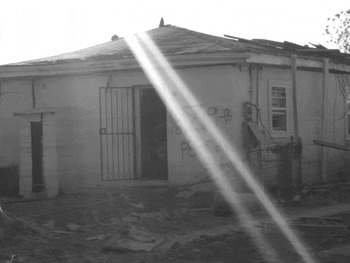
For those of my colleagues who work in war-torn areas, I need not describe the phenomenological shock of a devastated landscape, particularly if it was a place they once called home (figure 1). The scars of the landscape were, of course, matched by those of friends and acquaintances dealing with unimaginable losses. Driving the mudcaked streets of New Orleans attempting to fill out historic preservation and archaeological site condition reports felt worse than useless when faced with the pleadings of shell-shocked residents on the street asking for much more immediately meaningful aid. On several occasions, there was outright anger at the arrogance of those who deigned to prioritize history over the present in the rebuilding process. I would venture to say that if you were to truly listen to the community of New Orleans, the majority would vote that no provisions be made for archaeology whatsoever. Can community archaeology be no archaeology? In the four long years since the storm, this debate is not dead and the utility of archaeology in the face of poverty, racism and homelessness now exacerbated by the disaster and the decline of the tourism industry has not made its ethical defence any easier. Not, at least, the type of archaeology that raises the dead over the living.
Katrina ruin in Lower Ninth Ward, New Orleans, October 2005. Photo by S. Dawdy.

Katrina has awakened me politically. But perhaps not to the same waking state of others who consider themselves radicals and do-gooders. The negative side of my new beliefs might be summed up by the sentiment of Ulrike Sommer's student: ‘if you want to change society, you need a gun, not a fucking trowel’ (p. 178). This is essentially what I have written elsewhere (Dawdy Reference Dawdy2008), though perhaps committing Sommer's error of being too polite about it. Of course, in New Orleans we have enough guns. The city now leads the nation in murders (McCarthy Reference McCarthy2009). This, too, is in part a consequence of the storm and the social and political failures that combined to make this a large-scale catastrophe (on the impossibility of separating natural and political disasters, see Dawdy Reference Dawdy2006). The senseless daily deaths of young people in New Orleans, the vast majority of them African American, also helps put archaeology in perspective. In a city where the history of slavery and Jim Crow haunts almost every resident in their daily activities in the form of ‘slave quarter’ architecture, if not in the visible continuities of inequality in education, housing, medical care and job opportunities, do we really need heritage archaeology to also remind us of this past? Not only is this redundant, but I fear that for many what is missing is not the past – it is all around – but an imagined future. In this moment, what seems like a truly revolutionary possibility in New Orleans is to break with heritage, not to fetishize it any more.
I am reminded by an early experience I had in Louisiana in my earnest efforts to engage in community archaeology. I was working for a cultural resource management firm that did an annual excavation and open dig at the industrial campus of a rather notorious chemical company (curious sleuthers may check Salinger's Encyclopedia of white-collar and corporate crime (Reference Salinger2004, 29–31)). As part of Louisiana's public ‘Archaeology Week’, we guided hundreds of local schoolchildren on a tour of our open dig on a plantation site. While giving my spiel about the sunup-to-sundown extremities of the sugar labour regime, a young African American high-school student burst into tears and walked away. When I asked her teacher later what was wrong, she said that the girl simply did not want to know that history. Ever since, I have asked myself, and now louder than ever, ‘who I am to give that girl history?’ It's okay if she doesn't want it.
Those like Carol McDavid who have worked assiduously on community archaeology in dialogic modes might answer that the young Shannon committed the error of monologue, not asking the community what stories they wanted out of the archaeology, or what projects they wanted to see undertaken. But the reality is, as the structural setting of that dig made abundantly clear, that the terms of excavation opportunity are often set by forces much larger and more powerful than either the archaeologist or descendant community members. Nor, as the present condition of New Orleans makes painfully clear, is archaeology all that useful in addressing the most entrenched social problems, even those with clear historical roots. McDavid and Holtorf have listed some very laudable and interesting efforts to unite archaeology with environmental justice issues, but it seems to me that many of these are using archaeology or heritage as legal leverage with the ultimate goals being something other than recovering memory. Instead, they are geared towards something very pragmatic and presentist, such as halting or mitigating destructive development projects. In cases such as these, I would agree with Pluciennik that it is not the archaeology per se that is useful, but its collateral benefits, such as winning a recognition case, protecting homelands or developing the local economy. Joe Watkins, for example, makes an eloquent and convincing case that Native Americans have found archaeology very useful for specific legal battles as they have become increasingly sophisticated in using the US court system, while at the same time archaeology provides new source material for their own narratives of the past. I would love to see archaeology's usefulness in this way expand, eventually erasing the dividing line between archaeologists and the indigenous through training and empowerment, as has been happening among the wealthier tribes. However, my own experience is that the unique legal position of Native American groups as sovereign nations and as descendant communities with special rights under NAGPRA and other protections may not be generalizable to other contemporarily disadvantaged groups.
Another Katrina-related source of my cynicism and critique of ‘public’ archaeology comes from my attempt to persuade FEMA to apply a principle developed to protect Native American sacred sites called the Traditional Cultural Properties criterion. McDavid is right to point out that so much gets lumped under ‘public archaeology’ that the term is almost useless. One of my own points is that corporate and US nationalist archaeology hides under this innocuous title. So let me be clear here that this next critique is launched at the practice I will call ‘government archaeology’, which in the US covers all that work sponsored by federal agencies either directly or through contract firms.
One of the main tasks I was given in my post-Katrina role was to help come up with an ‘action plan’ for FEMA to deal with the devastated Lower Ninth Ward under historic preservation and environmental justice mandates. It was clear that this was important not because the Lower 9 (as locals call it) was particularly historic, but because it was particularly political.
In my report for FEMA, I made several recommendations. The first was that the structures in the area be considered part of a new historic district nominated for its contribution to events in history related to the civil rights movement (Ruby Bridges's entry into the Franz Elementary School during desegregation, famously painted by Norman Rockwell, took place here). Secondly, I recommended that FEMA invoke the Traditional Cultural Properties criterion defined by a site's ‘association with cultural practices or beliefs of a living community that (a) are rooted in that community's history, and (b) are important in maintaining the continuing cultural identity of the community’ (Parker and King Reference Parker and King1998). Applying this criterion demands learning from local expertise and consulting with the community. I urged community consultation on the history of the unique local Social Aid and Pleasure Clubs, jazz clubs, and spiritualist churches which, most ethnographers would have agreed, were significant cultural practices in the neighbourhood.
Thirdly, I recommended that FEMA consider not isolating the Lower 9 in what they call their ‘treatment measures’, or ways of mitigating federal actions by spending dollars and doing feel-good projects like preserving isolated monuments or landmarks, or developing museum displays and memorials. It was the very isolation of the Lower 9 from other neighbourhoods in the city that so riled local activists. Further, despite the media depiction of the tragedy of the Lower 9 as epitomizing the racial disparities of our country, if you listened to local voices there was a desire to focus on issues of class over those of race.
FEMA declined to take up any of my recommendations and now most of the damaged structures in the Lower 9 have been razed with no mitigation in the form of archaeology or historic-register status. Among the many reasons I suspect are: (1) to define the neighbourhood as a historic district important for its role in the civil rights movement would dig up the fact of the federal government's role in undermining school desegregation in New Orleans; (2) taking a Traditional Cultural Properties approach would require consulting with the local community, which FEMA is loath to do because, as one colleague told me, they are likely to find a diversity of opinions and angry, ‘irrational’ suggestions within the community that they could not act upon; and (3) taking a historical view that stresses the complex racial history of the Lower 9 did not jive with the simplified ‘black ghetto’ image circulating in the media. I was told by another FEMA employee that although my report was very interesting, they ‘didn't really need an academic history in order to do historic preservation’. Colleagues in the FEMA office were particularly dismissive of activist insistence that the lost heritage of the neighbourhood was as a multiracial working-class community (though my historical research showed this to indeed be true prior to the 1960s). In essence, a community-based archaeology of the Lower 9 did not serve the public relations needs of the federal government, so it did not get done. So, to clarify, I am far from opposed to community-consulting in archaeology, but I am totally discouraged as to (a) its strong use-value in remedying contemporary social problems or (b) the ability of nationally backed archaeological projects to do anything except serve the interests of the state, even in the guise of embracing diversity. In the US context, racial division is useful, while any suggestion of class conflict is taboo.
As I hope this fuller explanation of my own context makes clear, commentators such as Wright, Funari and de Carvalho, and Sommer, who may have interpreted my admittedly broad-stroke paper as a retreat from politics, have missed my sharpest critique: that US nationalist archaeology marches on, virtually unopposed. This US context, of course, differs significantly from that of Europe, where, as Holtorf and Sommer make clear, the field is highly attuned to, if not tired of, the debate. It may surprise them to learn that American archaeologists are relatively ignorant of Kossinna, so my effort indeed has been to try to get American and European archaeologists engaged in a dialogue about the differential politics that affect their practices. I have elsewhere stated, as Pluciennik does, that all archaeological politics are local and that context is everything (Dawdy Reference Dawdy2005). Thus my retreat from heritage archaeology is not redirected towards the safe space of objectivism or academic autonomy. Rather, it marks a misgiving about how heritage gets used in the US context, where, at the very least, it risks becoming an apologist distraction from living injustices.
The move I want to make is a realignment of archaeology towards future utopian possibilities which I find more revolutionary than state-sponsored nostalgia. The quite political (though anti-nationalist) thrust of my recommendations should also be clear from my agreement with Jeremy Sabloff that archaeologists need to be involved in policy-making. I will hold my ground on the point that policies regarding global warming and sustainability are more urgent and useful than policies about heritage. However, I would not think to contradict Rita Wright's point about the high international stakes involved in the looting and illegal trafficking of antiquities. There is a fine line to walk between claiming sites and artefacts as ‘world heritage’, which has a way of overriding local communities, and attempting to intervene when civil wars and international conflicts lead to a form of archaeological disaster. While the ethnic diversity within the hotspots she points to (Iraq and Afghanistan) brings up the problem of ‘whose heritage is it?’, this does not mean that we abandon efforts to help prevent looting and destruction. In fact, stewardship may be a useful idea to rescue, in the sense that one can be a steward of a land and its resources whether your ancestors arrived 40 or 4,000 years ago.
I have another confession to make, which is that I responded to this forum with some reluctance. This was not because the question was not interesting, but because I felt poorly qualified to answer it. I am not one of the many respected scholars who have published extensively on activist or public archaeology, nor do I have the expertise I would like to have to make a stronger case for futurist problem-solving archaeology. I am therefore extremely grateful to commentators Jeremy Sabloff and Margaret Nelson for filling me in on what so many scholars are already doing to apply their work to pressing supra-national problems such as global warming. Nelson's Resilience Community study seems to me an inspirational model for work that is simultaneously practical, utopian and intellectually fruitful. This is precisely the sort of thing I had naively hoped to spur. We need a ‘wet’ version of this type of study on the Gulf Coast to study the patterns of hurricane and flooding adaptation over the long term. At this time, there appears to be an issue of generational memory in both prehistoric and historic communities when there is a lull of more than 75 years in the hurricane cycle and settlements creep into more vulnerable areas. In this case ‘tradition’ may be adaptive! But so far, these are anecdotal observations that would benefit from the rigorous modelling undertaken in the Resilience study.
Thus I would like to end on an ‘up’ note that the outcome of this dialogue for me has been finding new sources for optimism in the training of indigenous and descendant archaeologists unafraid to exploit the collateral benefits of archaeology and in the discovery of a larger community of futurist archaeologists I might call my own.