




Crossref Citations

This article has been cited by the following publications. This list is generated based on data provided by Crossref.
Habermacher, Florian
2015.
Evolutionary Biology: Biodiversification from Genotype to Phenotype.
p.
225.
Bachkirova, Tatiana
2016.
A new perspective on self-deception for applied purposes.
New Ideas in Psychology,
Vol. 43,
Issue. ,
p.
1.
邬, 雨洲
2019.
An Experimental Study on the Effect of Emotional Activation on Self-Deception.
Advances in Psychology,
Vol. 09,
Issue. 04,
p.
708.
Mei, Dongmei
Ke, Zijun
Li, Zhihao
Zhang, Wenjian
Gao, Dingguo
and
Yin, Lijun
2023.
Self‐deception: Distorted metacognitive process in ambiguous contexts.
Human Brain Mapping,
Vol. 44,
Issue. 3,
p.
948.
Raza, Mohammad Adnan
Khatoon, Nousheen
Parveen, Rahnuma
Nirisha, V.
Thakur, Yamini
Thakur, Yogita
Lata, Kumari
Shifana, A.S.
Disouza, John
Saoji, Suprit D.
and
Ajazuddin
2025.
Natural macromolecules polysaccharide-based drug delivery systems targeting tumor necrosis factor alpha receptor for the treatment of cancer: A review.
International Journal of Biological Macromolecules,
Vol. 318,
Issue. ,
p.
145145.
This brilliant paper goes a long way to resolve a long-standing conflict between ancient Delphic wisdom that urges “know thyself” and the somewhat more recent evidence, most prominently offered by Taylor and colleagues (Taylor & Brown Reference Taylor and Brown1988; Reference Taylor and Brown1994), that self-deception, in a self-enhancing direction, may incur some advantages. Misleading yourself can help you to mislead others, and a little bit of extra confidence in one's own attractiveness or abilities can enhance one's perceived attractiveness and competence. I was once a peripheral participant in the debate over the adaptiveness of self-enhancement (Colvin et al. Reference Colvin, Block and Funder1995). Speaking only for myself, I can say that von Hippel & Trivers' (VH&T's) argument has convinced me that a modicum of self-enhancement can indeed, in some circumstances – and especially when accompanied by self-deception – be adaptive.
However, as ambitious as it is, the target article's exposition of the mechanisms and implications of self-deception still neglects three key points. First, self-enhancement is not is not the only direction in which self-presentation can be biased. People often present themselves as better than they are, but they also sometimes present themselves as worse than they are. In one study, while about 35% of the participants showed a self-enhancement bias, 15% showed the opposite, self-diminishment bias, and the remaining 50% were fairly accurate (John & Robins Reference John and Robins1994). I look forward to VH&T's evolutionary explanation of what those 15% were up to.
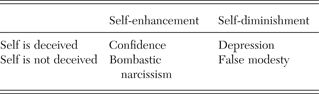
Second, the observation that biased self-presentation can occur in either direction highlights the separateness of self-deception and self-enhancement, which the target article tends to conflate. Consider the following 2×2 table. The cell entries are simplified.
Implications of self-enhancement versus self-diminishment
The target article is mostly about the upper left cell. The two right-hand cells are not acknowledged at all. The lower left cell is acknowledged, implicitly, when VH&T imply that that the maladaptiveness and mental unhealthiness of self-enhancement is limited to those cases in which people “are… unconvinced by their own self-enhancing claims.”
Third, and despite the target article's implication, it is easy to imagine many cases in which the confidence engendered by sincerely believed self-enhancements could be harmful. Misleading oneself about one's own abilities can lead to years of wasted effort as a failed artist, writer, or premed student. Misleading oneself about one's attractiveness can lead to the pursuit of unattainable mates at the expense of perfectly suitable mates one could otherwise achieve. Misleading oneself about one's own physical strength can be dangerous or even fatal if it leads to a fight with someone who really is stronger. In other words, exaggeration of your positive attributes can lead to unfortunate consequences even if you believe it. These obvious points are perhaps implicit in VH&T's characterization of the “proper dosage” for self-deception and their brief acknowledgment of the costs of losing “information integrity,” but are surprisingly underemphasized and underdeveloped in an otherwise carefully nuanced argument.
But these are matters of emphasis. The present point is simply that in the enthusiasm to develop a fascinating and creative argument for the otherwise paradoxical advantages of self-enhancing self-deception, we should not neglect how self-presentational biases can run in two directions and that in some important ways the oracle at Delphi was correct. To know yourself, accurately, can definitely be useful.