Cohen Kadosh & Walsh (CK&W) brilliantly discuss methodological and theoretical limitations of neurophysiological evidence supporting the claim that numerical representation is abstract. However, this reasoning can also be applied to their own arguments:
1. Finding no difference in BOLD signal intensity in functional magnetic resonance imaging (fMRI) studies between different modalities (“null result”) may be due to a lack of statistical power. However, even by increasing the statistical power (i.e., increasing the number of subjects, or the intensity of the paradigm, respectively), thus potentially resulting in a significant difference in BOLD signal between different forms of input, would not necessarily imply a relevant notation-dependent cortical output (Logothetis Reference Logothetis2008).
2. Single-cell neurophysiology does not solve the problem of reduced spatial resolution of fMRI experiments, because only a small portion of neurons in a specific brain region can be explored using this technique.
3. Although single-cell physiology is used in clinical settings (e.g., Engel et al. Reference Engel, Moll, Fried and Ojemann2005), single-cell experiments are not yet applicable to humans. Thus, this method cannot yield direct evidence of a non-abstract numerical representation in the human brain.
4 The fact that CK&W address single neurons as abstract or non-abstract neurons is questionable. First, any understanding of abstract representations as neuronal populations that are insensitive to the form of input does not imply the existence of abstract neurons. Second, how do the authors classify a mental representation localized in a specific brain region, including abstract and non-abstract neurons that are highly co-located?
Despite these methodological concerns, we share the authors' doubts that an abstract number representation exists in the human brain. According to recent developmental approaches, preverbal infants, as well as monkeys, have two different systems for representing quantitative information: one system for small numbers of objects that can be tracked over space and time, and one system that represents large, approximate numerosities (Spelke Reference Spelke2000). Both systems are independent of verbal information processing and apply to different sensory modalities, stimuli, and task contexts. In that sense, one could say that they are abstract. But this is not the type of abstract representation that CK&W talk about. The authors focus on an adult number concept.
In order to communicate about number representations in an adult-like way, young children must learn to (a) abstract the general meaning of number words as representations for quantities, (b) say number words in the correct sequence, (c) identify number symbols, and (d) associate words as well as digits with exact quantities. To form some sense of a number scale, they also need experience in bringing exact quantities in a linear order. Children who have already acquired basic counting skills cannot yet solve mathematical equations, but are able to solve the same problems using less abstract representational formats. This can be illustrated by data from our own laboratory (Pauen, in preparation).
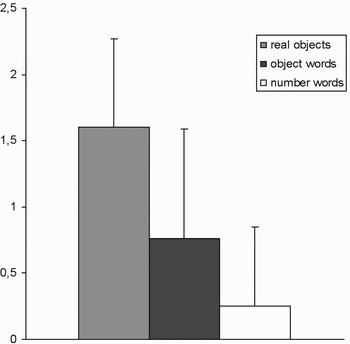
A study with 138 4–5-year-olds tested performance on simple addition problems involving small numbers (x<10). Four different task formats were presented: (1) Real objects: Children were shown two groups of objects and were asked, “How many marbles are there together?” (2) Object words: No object was presented, but children were asked the same kind of question as before, combining object and number words, for example, “How many are one banana and five bananas together?” (3) Number words only: For example, “How many are three and three together?” As revealed by our Figure 1, performance systematically varied with task format. Performance was highest when real objects were presented, lower for questions combining object and number words, and very low when only number words were involved.
Mean number of correct answers for two simple addition problems presented in three different task formats (real objects, object words, number words).

These findings illustrate that number operations strongly depend upon how numerosities are presented at preschool age. With the beginning of elementary school training, task format gradually loses importance and children learn to flexibly shift from one format to another.
Based on developmental research, one can conclude that there is no such thing as an innate abstract representation for exact numbers in terms of their representation format (words, digits, quantities). The cognitive subsystems involved in processing different types of numerical information seem to be distinct at the beginning. They become gradually associated as a result of repeated exposure to simultaneous presentation of different representation formats (e.g., number words combined with specific object quantities and/or digits).
In summary, we argue that two distinct innate systems representing small numbers of objects and large quantities may exist, and that they are not tied to any verbal or visual symbols of numbers (Spelke Reference Spelke2000). Hence, they are abstract in a different sense than that defined by CK&W. A more elaborate representation of exact numbers evolves by forming associations between exact quantities and symbolic systems identifying digits and numbers during preschool years.
Based on this conclusion, we think that the work of CK&W could be extended by taking into account a developmental (ontogenetic) perspective. Could it be useful to combine the authors' theoretical approach with the knowledge about the emergence of representation in infancy? This might mean that a representation of quantities is more basic than a representation of exact numbers. Fonagy and Target (Reference Fonagy and Target2003) claim that we need “something more” than knowledge about cognitive-behavioral pathways for understanding representations/mentalization in general. This could be a key to understanding why neuroimaging alone does not reveal how numbers/quantities are represented in the human mind. May the results from paradigms of preferential looking in the newborn and early infancy period (infants love “A” more than “B”; e.g., Meltzoff Reference Meltzoff1990) represent the pre-existence of abstract quantities? Could this be reminiscent of the philosophical dispute on universal entities in scholasticism (“universalia sunt ante res”)? This question is associated with Plato's theory on the existence of ideal numbers. The Renaissance of this in Neo-Platonism contributes to the current scientific debate. It could be enriched by further trans-disciplinary research between neuroscientists, developmental psychologists, clinical practitioners, and philosophers.