Sometimes, science looks like a court of law. There is a scientific hypothesis – the defendant – and there are its advocates and opponents – the defense and prosecution. Here, the defendant is conscious experience. It stands accused of not existing in its own right. Conscious experience is what we say we see or hear, what we cognitively access and manipulate – so claim the prosecutors. Ned Block is leading the defense team, arguing that we should not equate conscious experience with cognitive access. Many psychological experiments show mental representations that have higher capacity than what is reported by the subject. These mental representations have phenomenal qualities and might just as well be conscious representations. There is sufficient evidence to cast reasonable doubt on the accusation. Should the defendant be satisfied with such a defense, or litigate for malpractice? I think the latter. Block has made only half a plea (his “mesh argument” lacks a key consideration), and left out all the forensic evidence (arguments intrinsic to neuroscience).
Neurophysiological studies in primates (Supèr et al. Reference Supèr, Spekreijse and Lamme2001b), as well as electroencephalography (EEG) (Sergent et al. Reference Sergent, Baillet and Dehaene2005), functional magnetic resonance imaging (fMRI) (Haynes et al. Reference Haynes, Driver and Rees2005), and transcranial magnetic stimulation (TMS) (Silvanto et al. Reference Silvanto, Lavie and Walsh2005b) studies in human subjects, show that recurrent or re-entrant processing between different regions of the brain is necessary for conscious experience. In the Global Workspace theory (GWT) (Baars 2005; Dehaene et al. Reference Dehaene, Changeux, Naccache, Sackur and Sergant2006), the content of information processed in, say, visual areas, is broadcast and made available for global access by means of recurrent amplification. “Workspace neurons,” in prefrontal cortex, are vital to this amplification, because they provide long-range connections between sensory and motor cortices. With global recurrent amplification, conscious experience becomes accessible and reportable (Sergent et al. Reference Sergent, Baillet and Dehaene2005). However, more localized recurrent interactions, restricted to visual areas and not involving specialized workspace neurons, are also possible and have been reported (Scholte et al. Reference Scholte, Witteveen, Spekreijse and Lamme2006). Advocates of GWT argue that in that case there is no conscious experience, only proto-consciousness, precisely because of the absence of global workspace (prefrontal cortex) activation.
Block, however, argues that such localized recurrent states correspond to phenomenality without access. He converges upon that view through the “mesh argument”: If we assume that the neural basis of phenomenality (recurrent processing in visual cortex) does not include the neural basis of access (frontal cortex), we can understand why phenomenality overflows access, as is shown in the Sperling, Landman et al., and Sligte et al. experiments. Although I agree with the conclusion – localized recurrent processing is conscious processing – this is an argument that I suspect will convince only part of the jury.
The metaphysical correlationist can sketch a competing mesh argument, interpreting the iconic memory experiments as non-phenomenal, proto-consciousness overflowing “real” consciousness. And he would argue that this corresponds to the difference between processing with or without workspace neuron activation. No need for acquittal of the defendant. The epistemic correlationist would still find both options not scientifically distinguishable. Call for a mistrial.
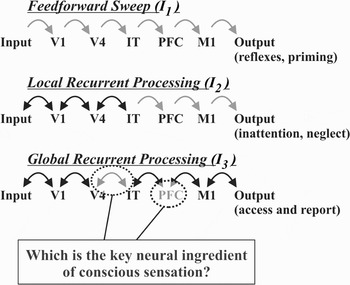
What we need are independent arguments for attributing phenomenality to localized recurrent processing. The mesh argument should not only take the division between local and global recurrent processing (I2 and I3 in Dehaene et al.'s [2006] terms, Fig. 1) into account. The issue becomes much clearer when fully unconscious or inaccessible neural processing (I1) is also considered. Since there is little disagreement about the absence of conscious experience in I1, or about its presence in I3, the question becomes whether I2 is more like I1 (i.e., unconscious) or like I3 (conscious). This is an empirical issue. The question could be asked, whether properties we usually associate with conscious percepts (I3) are also present in iconic memory (I2), or in other alleged cases of inaccessible experience (attentional blink, neglect, split brain – probably all I2). For example, unconscious processing (I1 in the neural sense) is typically about feature extraction, whereas in conscious perception (I3) features are combined into objects, backgrounds, and so on (Lamme Reference Lamme2004). Is there perceptual binding in iconic memory (Landman et al. Reference Landman, Spekreijse and Lamme2003)? Do indirect effects (such as learning) of I2 states operate along the dimensions of isolated features or of coherent percepts?
Three stages of visual processing: First, visual information is processed along the sensorimotor hierarchy (V1 to M1) by means of feedforward connections. This constitutes the feedforward sweep (I1). Depending on attention, subsequent recurrent processing either remains localized to visual areas (V1, V4, IT; I2) or extends towards areas involved in the planning and execution of movement (PFC, M1; I3). Phenomenal sensation develops from I1 (unconscious), via I2 (P-conscious), to I3 (A-conscious). See Lamme (Reference Lamme2003).

Similarly, it could be asked what the critical neural differences are between I1, I2, and I3 states. The first 100 msecs of visual processing is dominated by feedforward activation of the brain. Information sweeps from visual to frontal areas, not accompanied by conscious experience – that is, fully inaccessibly (I1) (Lamme & Roelfsema Reference Lamme and Roelfsema2000). Subsequently, recurrent processing is instantiated by horizontal and feedback connections. With time, localized (I2) recurrent cores may grow into more global ones (I3), depending on bottom-up and top-down selection mechanisms (Lamme Reference Lamme2003). Where does the critical neural dichotomy lie? Between feedforward and recurrent processing – that is, between I1 and I2/I3, as Block and I would argue (Block Reference Block2005; Lamme Reference Lamme2003) – or between I1/I2 and I3, as GWT advocates try to let you believe (Dehaene et al. Reference Dehaene, Changeux, Naccache, Sackur and Sergant2006)? Before you choose, please consider that also in fully unconscious feedforward activation (I1), there is activation of workspace neurons, as is shown by masked stimuli activating prefrontal cortex (Lau & Passingham Reference Lau and Passingham2007; Thompson & Schall Reference Thompson and Schall1999). In addition, there are important differences in the properties of feedforward versus feedback synapses. It is likely that feedforward activation is not mediating synaptic plasticity and learning, while recurrent processing (of whatever extent) does do so (Singer Reference Singer1995). Third, recurrent processing between visual areas has been shown to mediate perceptual organization, binding, and figure-ground organization, in cases of inattention and the absence of report, as well, whereas feedforward processing is typically about feature extraction and categorization (Lamme Reference Lamme2004). Finally, recurrent processing is suppressed by anesthesia, whereas feedforward is not (Lamme et al. Reference Lamme, Zipser and Spekreijse1998).
To the neuroscientist, it therefore seems pretty straightforward to draw a line between feedforward processing (I1) on the one hand, and recurrent processing (I2/I3) on the other. Of course, the extent of these recurrent interactions matters: when frontal or motor areas are involved, a report is possible, otherwise not. But that also applies to feedforward processing. Unconscious behavioral effects (like priming) are possible only when the feedforward sweep penetrates deeply into the sensorimotor cascade. The key feature “causing” phenomenality in I3 states therefore seems to be the recurrency, not the activation of workspace (frontal) neurons. Occam's razor thus obliges us to group I2 with I3, not with I1, and to attribute phenomenality to both I3 and I2. The neuroscience angle brings that out immediately, and much more convincingly (Lamme Reference Lamme2004). The jury can now go out and deliberate.