


Introduction
Cyclothymia is classified by the DSM-IV (American Psychiatric Association, 1994) as a mood disorder that involves numerous brief episodes of hypomania and minor depression, with episodes lasting several days or longer. The disorder creates significant associated functional impairment and heightened emotional distress in those it affects, and up to half of those affected may develop bipolar disorders (Shen et al., Reference Shen, Sylvia, Alloy, Barrett, Kohner, Iacoviello and Mills2008). The present research examined a cognitive behavioural therapy (CBT) directed at regulating extremes in the daily mood of a patient with cyclothymia. In particular, it investigated whether changes to the daily pattern of mood variability following CBT were due to changes in cognitive regulatory control.
Research devoted specifically to cyclothymia has been scant (Brieger and Marneros, Reference Brieger and Marneros1998; Jacobsen, Reference Jacobsen1993) so its understanding is largely based on models developed for bipolar disorders (BD). The “internal trigger” hypothesis (Grandin, Alloy and Abramson, 2006) proposes that mood disturbance occurs for individuals who have a chronobiologic vulnerability in which disruptions to circadian rhythms trigger affective episodes (Goodman, Reference Goodman1996), whereas the “external trigger” hypothesis (Ehlers, Frank and Kupfer, Reference Ehlers, Frank and Kupfer1988) proposes that mood disturbance occurs when social cues that entrain circadian rhythms become derailed by negative life events (Grandin et al., Reference Grandin, Alloy and Abramson2006). Extending these accounts, Jones (Reference Jones2001) argued that bipolar mood episodes occur when individuals incorrectly interpret and respond to the mood states that arise from disruption of circadian rhythms.
Problems in interpreting and regulating mood do appear to have a major role in producing and sustaining the mood extremes found in BD (e.g. Mansell, Reference Mansell2007). Mansell, Morrison, Reid, Lowens and Tai's (2007) cognitive account of mood variability explains that attempts at mood regulation fail when patients make extreme and conflicting personal appraisals of changes in internal states, because such appraisals create the need to control moods in an exaggerated and counterproductive manner. Control attempts aimed at enhancing internal activation are termed ascent behaviours, whereas those aimed at decreasing internal activation are termed descent behaviours (Mansell and Padley, Reference Mansell and Padley2007). CBT-treatment based on this model involves helping clients engage in cognitive control to challenge their extreme appraisals of mood and implement less counterproductive behaviours. It also cultivates mindful acceptance of a broader range of mood changes, as well as engagement in personal goals that is less dependent on current mood.
A recent study of cyclothymia proposed that extreme mood variability occurs when a circadian disturbance of internal state is triggered, sustained and amplified by events, behaviours and regulatory processes (Totterdell and Kellett, Reference Totterdell and Kellett2008). The regulatory processes concerned involve the cognitive interpretation and control of mood states, and as such can be seen as consistent with the Mansell et al. (Reference Mansell, Morrison, Reid, Lowens and Tai2007) model. Although Totterdell and Kellett (Reference Totterdell and Kellett2008) showed that diurnal changes in activation (energy) owing to CBT were consistent with the circadian model, the influence of regulatory control mechanisms was assumed rather than measured. The present study therefore repeats and extends that study by examining the influence of regulatory control mechanisms during treatment of cyclothymia.
Treatment involved CBT directed at assisting a cyclothymic patient recognize and manage mood variability, and to prevent escalation or descent into debilitating mood extremes. First, in line with Totterdell and Kellett (Reference Totterdell and Kellett2008), it was expected that CBT would enhance the patient's mental health at the cost of reduced activation. Second, it was expected that the therapy would lead to reduced variability in mood and regulatory control during and between days. Third, it was expected that the therapy would decouple a dysfunctional positive association between activation and positive mood (in which the patient believes that high energy states are necessary for success and well-being) by enhancing the patient's cognitive control. In other words, therapy would moderate the relationship between activation and mood, and the effect would be mediated by cognitive regulatory control. The specific hypotheses were:
1 H1: Mood levels will change (less energetic, happier, less anxious) during and after CBT compared to before it and the patient's mental health will improve.
2 H2: Diurnal variation and daily variability in mood and regulatory control will be reduced during and after CBT, compared to before it.
3 H3: The association between activated (energetic) mood and both happy mood and anxious mood will be moderated by CBT and this moderated effect will be mediated by cognitive regulatory control, in the form of self-reported control of thoughts and engagement in a mindful mode.
Therapeutic effectiveness was assessed using a prospective A/B single case experimental design (SCED; Hersen and Barlow, Reference Hersen and Barlow1976), with extended follow-up (Kellett, Reference Kellett2007). An intensive time-sampling method (Stone, Kessler and Haythornthwaite, Reference Stone, Kessler and Haythornthwaite1991) was used to obtain mood and regulatory control ratings from the patient every 4 hours during wake-time for almost a year. This enabled a detailed examination of mood and cognitive change, thereby addressing a recognized limitation of previous cyclothymia studies (Shen et al., Reference Shen, Sylvia, Alloy, Barrett, Kohner, Iacoviello and Mills2008).
Method
Participant
The patient was a 35-year-old male with a prolonged history of mood problems, and who had been in receipt of mental health services for 15 years. He was married with two children, but had not worked for 12 years due to chronic mood instability. The patient reported no close friends, observing that his mood instability had created havoc in close relationships. The patient had been taking a mood stabilizer (Olanzapine) and an anti-depressant (Fluoxetine) for 18 months prior to the study, and had previously taken part in a psychoeducational group-CBT programme, with little evidence of any change to clinical symptoms. The presenting clinical diagnosis of cyclothymia was verified using the Structured Clinical Interview for DSM-IV (SCID; First, Spitzer, Gibbon and Williams, Reference First, Spitzer, Gibbon and Williams1996).
The patient described alternating between two dominant mood profiles, with marked ascent and descent cycles. The ascent cycle was characterized by a steady escalation of mood into a temporary manic state, in which the patient would have high self-esteem, be mentally over-active/over-excited and experience psychomotor agitation/poor sleep. During such elevated moods, the patient reported disorganized, disinhibited and erratic behaviour, including compulsive spending, over-sexualized behaviour and craving for external stimulation. The patient stated that he would ignore the early stages of the ascent cycle and simply submit at the height of the mood cycle. The descent cycle was marked by a lowering of mood and self-esteem, associated behavioural/social withdrawal and increasing suicidal ideation. At the depths of the descent cycle, the patient reported total behavioural inactivity, feeling completely helpless/hopeless and becoming actively suicidal. The patient stated that he could alternate between mood extremes across the course of a single day, and stated a preference for the manic state because this was an escape/relief from the descent cycle and a state in which he felt goal-directive and full of energy.
Procedure
Treatment. The patient was treated (by the second author) using 19 sessions of CBT, after establishing a baseline across 5 assessment sessions. Basco and Rush's (Reference Basco and Rush2005) treatment protocol was adapted to enable management of rapid mood alteration. The patient was provided with a diagrammatic formulation (Moore, Reference Moore2007) at session 5, which summarized the key schematic, cognitive and behavioural procedures of both the ascending/manic and descending/depressed mood cycles. The patient used the formulation as a reflective tool throughout therapy and follow-up periods to increase self-awareness of mood state.
Self-assessment. The self-assessment period lasted 51 weeks and included three distinct periods: 5-week assessment prior to starting CBT (baseline), 35-weeks during CBT (therapy), and 11-weeks following CBT (follow-up). The patient completed a battery of psychometric measures for global functioning prior to baseline and at the completion of therapy and follow-up. He also completed a structured daily diary throughout the 51 weeks. The diaries were presented in weekly paper booklets and were returned at treatment sessions. Each day the patient recorded the times at which he went to sleep and woke-up, and rated his mood and regulatory control at 9 a.m., 1 p.m., 5 p.m. and 9 p.m. These four times were chosen to cover the patient's usual period of wakefulness. This high frequency of measurement meant that full survey scales were infeasible, so item measures for mood and control were selected from validated scales. The meaningfulness and saliency of the items was checked with the patient.
Measures
Global measures of functioning. The patient completed the following outcome measures at the three measurement periods: Hypomanic Attitudes and Positive Predictions Inventory (HAPPI; Mansell, Reference Mansell2006; Mansell, Rigby, Tai and Lowe, 2008) to measure generalized mood variability; Beck Depression Inventory-II (BDI-II; Beck, Steer and Brown Reference Beck, Steer and Brown1995) to measure depressed mood; Inventory of Interpersonal Problems-32 (IIP-32; Barkham, Hardy and Startup, Reference Barkham, Hardy and Startup1996) to measure interpersonal functioning; and Brief Symptom Inventory (BSI; Derogatis, Reference Derogatis1993) to measure psychiatric symptomatology. BSI scores were used to calculate the Global Severity Index (BSI-GSI; Derogatis, Reference Derogatis1993).
Mood. On each diary measurement occasion, the patient rated the intensity with which he was currently experiencing three specific moods using a response scale from 1 (not at all) to 9 (a great extent). The three mood items “energetic”, “happy” and “anxious” were selected from the three sub-scales of the UWIST mood adjective checklist (Matthews, Jones and Chamberlain, Reference Matthews, Jones and Chamberlain1990) to measure energetic arousal (energetic), hedonic tone (happy), and tense arousal (anxious).
Cognitive regulatory control. On the same occasions, the patient rated the degree to which he was currently experiencing two aspects of cognitive regulatory control using a response scale from 1 (not at all) to 9 (a great extent). The first control item, “I have no control over my thoughts” (reverse-scored), was selected from the HAPPI sub-scale for loss of control when activated (Mansell et al., Reference Mansell, Rigby, Tai and Lowe2008). HAPPI measures cognitions that may influence the development of mania or hypomania. Aggregated responses to the item in the three periods correlated .85 with the corresponding item in the global HAPPI measure, and between .63 and .93 with the other items in the sub-scale. The second control item, “I can just let my thoughts come and go”, was taken from the Five Facet Mindfulness Questionnaire (Baer, Smith, Hopkins, Krietemeyer and Toney, Reference Baer, Smith, Hopkins, Krietemeyer and Toney2006). Mindfulness incorporates both present-centered control of cognitive processes and acceptance of thoughts (Bishop et al., Reference Bishop, Lau, Shapiro, Carlson, Anderson and Carmody2004).
Data
The patient returned data for 47 of the 51 weeks, missing weeks 6, 19, 31 and 32. The patient reported within-day mood on 135 baseline occasions, 825 therapy occasions, and 299 follow-up occasions, which represented compliance rates of 96%, 84% and 97% respectively. As well as using the within-day ratings, the ratings were also aggregated to calculate the daily average (mean) and daily variability (standard deviation) for each variable. The patient provided ratings for at least 3 of the 4 measurement occasions on all days that he responded.
Results
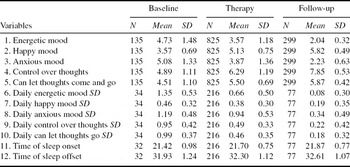
Table 1 shows the means and standard deviations of the within-day and daily variables before, during and after CBT. The sleep data show that the patient's sleep period shifted later by about 30 minutes following CBT.
Descriptive statistics for SCED variables during baseline, therapy, and follow-up

Note: Times are decimalized.
Effects of therapy on global functioning
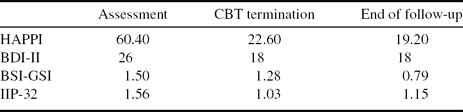
The global functioning measures were analyzed using Jacobson and Traux's (Reference Jacobson and Traux1991) formula for assessing reliable change indices (RCI) for a single patient. Reliable change occurs when change on a measure is sufficiently large that it is unlikely to have been due to measurement unreliability. Scores at the three time points are shown in Table 2. Between assessment and CBT termination, the HAPPI (RCI = 2.17, p < .05) and BDI-II scores (RCI = 2.31, p < .05) demonstrated a reliable reduction. None of the RCIs between CBT termination and end of follow-up were significant, indicating stasis in outcome measures over the follow-up period.
Patient's scores on global outcome measures at initial assessment, at the end of CBT, and at the end of the follow-up

Note. HAPPI = Hypomanic Attitudes and Positive Predictions Inventory; BDI-II = Beck Depression Inventory-II; BSI-GSI = Brief Symptom Inventory - Global Severity Index; IIP-32 = Inventory of Interpersonal Problems-32.
Effects of therapy on mood and regulatory control
To test the effects of therapy on levels of mood and regulatory control (H1) and on diurnal variation in daily mood and regulatory control (H2), a two-factor analysis of covariance was conducted on each mood and regulatory control variable, with stage-of-treatment (baseline, therapy, follow-up) and time-of-day (9 a.m., 1 p.m., 5 p.m. and 9 p.m.) as the two factors. The first-order lag (autocorrelation) of the dependent mood or regulatory control variable was used as a covariate to remove serial dependency in the time-series (West and Hepworth, Reference West and Hepworth1991). Stage-of-treatment was significant for energetic mood (partial η2 = .12, F(2, 1195) = 80.83, p < .01), happy mood (partial η2 = .10, F(2, 1195) = 65.96, p < .01), anxious mood (partial η2 = .12, F(2, 1195) = 81.51, p < .01), control over thoughts (partial η2 = .08, F(2, 1195) = 49.12, p < .01) and letting thoughts come and go (partial η2 = .12, F(2, 1195) = 84.02, p < .01). Simple contrasts showed that the patient was less energetic, happier, less anxious, had more control over thoughts, and could let thoughts come and go more, during both CBT and follow-up periods compared with baseline (all p < .01). These results, together with the findings for the global measures, support the first hypothesis.
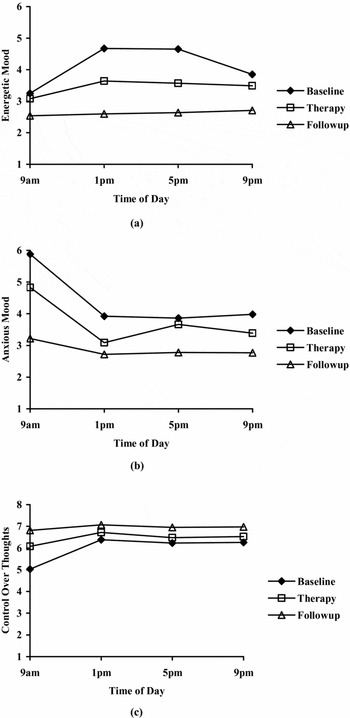
In support of H2, there was a significant interaction between time-of-day and stage-of-treatment for energetic mood (partial η2 = .03, F(6, 1195) = 5.60, p < .01), happy mood (partial η2 = .03, F(6, 1195) = 5.05, p < .01), anxious mood (partial η2 = .05, F(6, 1195) = 10.10, p < .01), control over thoughts (partial η2 = .03, F(6, 1195) = 5.44, p < .01), and letting thoughts come and go (partial η2 = .04, F(6, 1195) = 7.98, p < .01). All variables showed less change across the day following CBT, with a noticeably smaller deviation in the middle of the day for energetic mood (Figure 1a) and at the start of the day for the other variables (see Figure 1b and 1c).
Diurnal variations during baseline, therapy and follow-up in (a) energetic mood, (b) anxious mood, and (c) control over thoughts

To test the other part of H2, that daily variability in mood and control would be reduced by CBT, a one-factor analysis of covariance was conducted on the within-day standard deviation of each variable, with stage-of-treatment as the factor and the first-order lag of the dependent variable as the covariate. Stage-of-treatment was significant for variability in energetic mood (partial η2 = .19, F(2, 318) = 37.28, p < .01), happy mood (partial η2 = .05, F(2, 318) = 7.86, p < .01), anxious mood (partial η2 = .13, F(2, 318) = 23.79, p < .01), control over thoughts (partial η2 = .12, F(2, 318) = 20.57, p < .01), and letting thoughts come and go (partial η2 = .14, F(2, 318) = 25.71, p < .01). Simple contrasts revealed less daily variability during therapy in all variables except happy mood (p < .05), and less daily variability during follow-up in all variables (p < .01).
Effects of therapy on relationships between activation, regulatory control, and mood
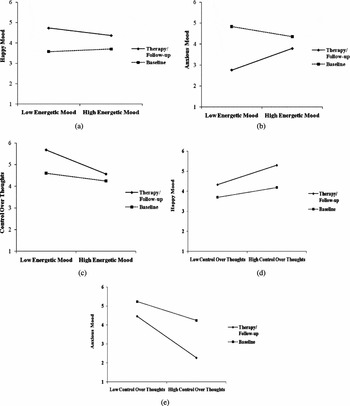
To test H3, the three recommended regression analyses for testing mediated moderation (Muller, Judd and Yzerbyt, Reference Muller, Judd and Yzerbyt2005) were used, with the first-order lag of the dependent variable entered at the first step to remove serial dependency. First, to test for a moderated effect, a regression analysis was conducted with happy or anxious mood as the dependent variable. The predictor variables were energetic mood, a binary variable for stage (0 = therapy/follow-up, 1 = baseline) and the interaction term formed from their product. The interaction was significant for happy mood (β = .31, t(1203) = 4.95, p < .01) and anxious mood (β = −.59, t(1203) = −7.49, p < .01), indicating moderated effects. Less energetic mood was associated with greater happy mood (Figure 2a) and less anxious mood (Figure 2b) after baseline, but not before.
Therapy as a moderator of relationships between mood and regulatory control variables

Second, to test whether the moderated effect was associated with the regulatory control mediators, a regression analysis was conducted with control over thoughts or letting thoughts come and go as the dependent variable, using the same predictor variables. The main effect of energetic mood (β = −.41, t(1203) = −16.95, p < .01) and its interaction with stage (β = .32, t(1203) = 5.75, p < .01) were significant for control over thoughts, but only the main effect of energetic mood was significant for letting thoughts come and go (β = −.28, t(1203) = −9.59, p < .01). This suggests that only control over thoughts could have passed on the moderated effects. Figure 2c shows that less energetic mood was associated with greater control over thoughts after baseline.
Third, to test whether the regulatory control mediator variables passed on or were a source of the moderated effects, the first regression analysis was repeated but a regulatory control variable and its interaction with stage were entered as an additional step. For happy mood, control over thoughts (β = .52, t(1201) = 18.38, p < .01) and its interaction with stage (β = −.30, t(1201) = −3.88, p < .01) were significant predictors. Having greater control over thoughts was more strongly associated with happier mood after baseline (Figure 2d). The direct moderated effect of energy was no longer significant and a Sobel test showed that the indirect path via control over thoughts was significant (Z = 5.48, p < .01), indicating that the moderated relationship was mediated by control over thoughts. Testing the relationship between energetic mood and happy mood at each level of the moderator showed a non-significant positive relationship at baseline (β = 1.38, t(129) = 1.38, n.s.) and a negative relationship after (β = −.21, t(1073) = −8.07, p < .01), but when control over thoughts was entered the relationship was similar during baseline (β = .18, t(128) = 2.28, p < .05) and after (β = .14, t(1072) = 4.77, p < .01). In other words, control over thoughts accounted for the relationship.
Control over thoughts (β = −.73, t(1201) = −22.05, p < .01) and its interaction with stage (β = .47, t(1201) = 5.11, p < .01) were also significant predictors of anxious mood. Having greater control over thoughts was more strongly associated with less anxious mood after baseline (Figure 2e). The direct moderated effect of energy was no longer significant and a Sobel test showed that the indirect path was significant (Z = 5.55, p < .01), indicating mediation of this moderated relationship too. Testing the relationship at each level of the moderator showed a negative relationship at baseline (β = −2.46, t(129) = −2.46, p < .05) and a positive relationship after (β = .32, t(1073) = 10.85, p < .01), but when control over thoughts was entered the relationship was similar during baseline (β = −.28, t(128) = −3.34, p < .01) and after (β = −.12, t(1072) = −3.82, p < .01). In other words, control over thoughts accounted for the relationship.
The interaction between letting thoughts come and go and stage was a significant predictor of happy mood (β = -.28, t(1201) = -3.75, p < .01) and anxious mood (β = .42, t(1201) = 4.48, p < .01). Specifically, the relationships were stronger following therapy. However, in both cases, the moderated effect of energy remained significant so the relationships were not mediated by letting thoughts come and go.
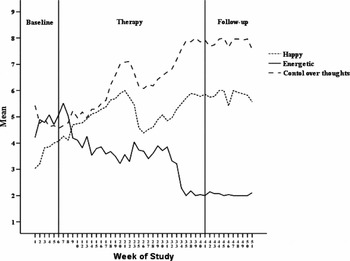
In summary, the results from the regression analyses supported H3 in that the relationships between activated (energetic) mood and happy/anxious mood were moderated by therapy, but the effect was only mediated by control over thoughts. Therapy appeared to influence the effect of energetic mood on control over thoughts, and the effect of control over thoughts on happy and anxious mood. Figure 3 shows how these variables changed throughout the study.
Weekly changes in energetic mood, happy mood and control over thoughts

Discussion
A CBT intervention was successful in treating the mood problems of a patient presenting with a long-standing diagnosis of cyclothymia. The results from 11 months of daily data collected before, during and after therapy were supportive of the proposed role played by cognitive regulatory control processes in determining mood variation in cyclothymia. Prior to therapy, the patient's moods were characterized by states of unhappy mood and high anxiety, which were mildly relieved when energetic mood was higher, whereas following therapy the associations of happy and anxious mood with energetic mood were reversed in direction and strengthened, so that the patient was able to achieve greater happiness and less anxiety, but seemingly at the expense of energetic mood. This cost of “reduced activation” has been recognized as contributing to patients’ resistance to treatment for BD (Mansell, Reference Mansell2007).
As predicted, daily variability of energetic, happy, and anxious mood were all significantly reduced during and after therapy. Cyclothymia has previously been identified as having a circadian component (Akiskal, Reference Akiskal2001), which is consistent with our finding that diurnal variation in mood was reduced (and the sleep period shifted later) following CBT. Unlike social rhythm therapy, which attempts to reduce mood variability by restructuring the pattern of daily activities (Frank, Swartz and Kupfer, Reference Frank, Swartz and Kupfer2000), the therapy in the present study was aimed at reducing mood variability by enhancing cognitive awareness and change of mood states. That this was the mechanism through which the therapeutic benefits occurred was supported by the evidence that the association between activated (energetic) mood and affective well-being (happy mood, anxious mood) was changed by therapy. Furthermore, this change was mediated by the patient's ability to control his thoughts. The change was validated by the clinically significant change in the HAPPI measure, indicating that by the end of treatment the patient had a cognitive style that was less likely to create and maintain extreme mood variability.
Cognitive regulatory control may therefore be a good target to include in the therapeutic treatment of cyclothymia, especially as a recent intervention study indicated that increasing patients’ lifestyle regularity may be insufficient to reduce cyclothymic symptoms (Shen et al., Reference Shen, Sylvia, Alloy, Barrett, Kohner, Iacoviello and Mills2008). Helping patients develop better awareness of their contrasting mood states and ways of managing their mood variability would appear to be elements worth incorporating in CBT for cyclothymia and are achievable through effective case formulation (Moore, Reference Moore2007). A specific goal of therapy should be to challenge the belief that high energy states are necessary for personal success and affective well-being.
Our analysis showed that the patient's ability to let thoughts come and go – a component of mindfulness – was not responsible for changing the association between feeling activated and feeling positive. However, the patient was more able to let thoughts come and go during and following CBT and this ability then had a stronger relationship with happy and less anxious moods. Mindfulness training may therefore be a useful complementary adjunct to include in the treatment of cyclothymia.
More globally, the patient displayed a reliable reduction in depression scores following therapy, although he remained in the range for clinical dysfunction. The patient also reported a general positive effect of the intervention on his life and routines. In relation to mood management, the patient described being more able to recognize and label his moods and choose from a “menu” of coping responses according to severity of mood and context. There was a substantial deterioration in his mood about 20 weeks into therapy (see Figure 3). Clinical notes showed that the patient reported active suicidal ideation at this time, without an external cause. The patient noted that he had become over-confident in his abilities to manage mood variability and had not engaged in mood management strategies. Recovering from this brief depressive phase, the patient experienced increasing self-efficacy in relation to his mood management. However, it is notable that the patient continued to experience mild depression at the end of therapy, which may be due to believing that experiencing a high energy state will lead to a loss of control. CBT may therefore also need to involve “broadening the bandwidth” of internal states that are acceptable (Mansell et al., Reference Mansell, Morrison, Reid, Lowens and Tai2007), such that clients feel less vulnerable in the face of a surge in energy level.
The repeated administration of measures during a time-sampling study can heighten participants’ awareness of a phenomenon and consequently cause them to change their behaviour. For some research this can be a limitation but in the current study it was an active aspect of the therapeutic process (Kellett and Beail, Reference Kellett and Beail1997). Previous research has shown that keeping diaries can have a therapeutic effect on mood (e.g. Burt, Reference Burt1994) and, in a recent study, self-monitoring was thought to have reduced depressive symptoms in a control group with cyclothymic symptoms (Shen et al., Reference Shen, Sylvia, Alloy, Barrett, Kohner, Iacoviello and Mills2008). We would therefore encourage therapists to incorporate mood, cognition and behaviour time-sampling diaries into their treatment practices, both for research and therapeutic purposes. The use of hand-held computers for administering and collecting the data may increase accuracy of monitoring and offer opportunities for dynamic interventions in future (Bolger, Davis and Rafaeli, Reference Bolger, Davis and Rafaeli2003).
In conclusion, the principal finding of this SCED study was that CBT focused on changing cognitive regulatory control proved effective for treating cyclothymia. The time-sampling diary approach produced over 1250 response occasions across an 11-month period, which enabled detailed study of the mood dynamics of cyclothymia over different timescales (within-day, daily, weekly) throughout CBT treatment. However, the obvious and main limitation of the study is that its results may not generalize to other cases and therefore randomized control studies are now required.
Acknowledgements
This research was partly supported by ESRC large grant RES-060–25-0044: “Emotion regulation of others and self (EROS)”.



Comments
No Comments have been published for this article.