


Introduction
Hoarding disorder (HD) is a severe psychological disorder characterized by an excessive need to acquire and save possessions, persistent difficulties in making decisions about belongings, and emotional distress when discarding items regardless of their actual value. The accumulation of objects in the home results in cluttered and unusable rooms (American Psychiatric Association, 2022). It has an estimated prevalence of 2.5% and affects both men and women equally (Postlethwaite et al., Reference Postlethwaite, Kellett and Mataix-Cols2019). Although people with HD typically present for treatment in late adulthood, many report a childhood onset of hoarding symptoms that persist and become more severe over time (Akıncı et al., Reference Akıncı, Turan, Esin and Dursun2022; Grisham et al., Reference Grisham, Frost, Steketee, Kim and Hood2006; Tolin et al., Reference Tolin, Meunier, Frost and Steketee2010).
People with HD have high levels of overall functional impairment across multiple domains (Ong et al., Reference Ong, Pang, Sagayadevan, Chong and Subramaniam2015). In particular, several recent studies have focused on loneliness in hoarding and have shown that people with HD have high levels of loneliness and that hoarding severity is positively associated with loneliness (Edwards et al., Reference Edwards, Salkovskis and Bream2023; Yap et al., Reference Yap, Timpano, Isemann, Svehla and Grisham2023). Given that loneliness is a modifiable treatment target (Hickin et al., Reference Hickin, Käll, Shafran, Sutcliffe, Manzotti and Langan2021; Morrish et al., Reference Morrish, Choudhury and Medina-Lara2023), Yap et al. (Reference Yap, Timpano, Isemann, Svehla and Grisham2023) suggested that addressing loneliness for people with hoarding problems may lead to improvements in both hoarding and other co-morbid conditions. However, there has been no review of loneliness research in hoarding disorder and the evidence on potential treatment targets for loneliness is unclear.
The negative impact of loneliness
Loneliness is ‘the distressing feeling that accompanies the perception that one’s social needs are not being met by the quantity or especially the quality of one’s social relationships’ (Hawkley and Cacioppo, Reference Hawkley and Cacioppo2010; p. 218). It is a common emotional response to social isolation, but, as it is a subjective experience, individuals can experience loneliness even when they are not alone or conversely, may not feel lonely when in solitude (Ost-Mor et al., Reference Ost-Mor, Palgi and Segel-Karpas2021). Loneliness is experienced when there is a perception that social needs are not met. For most people, loneliness motivates engagement in meaningful social connections. However, individuals who experience chronic and severe loneliness can perceive the social environment as more threatening and thus avoid connecting with others (Cacioppo and Hawkley, Reference Cacioppo and Hawkley2009), or they may develop social anhedonia ‒ a lack of interest and pleasure in social connections, which may lead to chronic loneliness (Barkus and Badcock, Reference Barkus and Badcock2019). Chronic loneliness is associated with physical and mental health problems, and leads to higher mortality rates (Zhou et al., Reference Zhou, Yang and Gao2023).
Hoarding and loneliness
Hoarding may lead to greater social isolation and loneliness because it is associated with high levels of stigma and shame (Chasson et al., Reference Chasson, Guy, Bates and Corrigan2018; Chou et al., Reference Chou, Tsoh, Vigil, Bain, Uhm, Howell, Chan, Eckfield, Plumadore, Chan, Komaiko, Smith, Franklin, Vega, Delucchi and Mathews2018; Prosser et al., Reference Prosser, Dennis and Salkovskis2024). People with HD often avoid inviting others to their homes because they fear being judged and the secrecy surrounding their hoarding intensifies feelings of loneliness. Hoarding also results in strained relationships with family, friends, and neighbours (Subramaniam et al., Reference Subramaniam, Jeyagurunathan, Devi, Chang, Samari, Verma, Ng, Tan, Chong, Ye, Lim, Babjee, Vaingankar and Chong2020). Furthermore, cluttered homes lead to increased health and safety risks, which may prevent friends and family from visiting (Dong et al., Reference Dong, Simon, Mosqueda and Evans2012).
In addition to being a consequence of hoarding, loneliness may also cause more severe hoarding behaviours. According to attachment theory, people have an innate need to connect with others and form close relationships (Bowlby, Reference Bowlby1978). This need is present from infancy, when children seek out and form close emotional bonds with their caregivers, and it extends across the lifespan as individuals seek proximity to others and rely on intimate relationships and friendships for support. Due to a combination of temperament and negative early childhood experiences, some individuals develop insecure attachment styles that have an ongoing negative impact on interpersonal relationships and wellbeing (Mikulincer et al., Reference Mikulincer, Shaver and Pereg2003). Mathes et al. (Reference Mathes, Timpano, Raines and Schmidt2020) argued that some individuals with insecure interpersonal attachment styles turn to inanimate objects as substitutes for interpersonal relationships. They imbue objects with human-like qualities, rely on them for comfort and support, and use objects to compensate for unmet relatedness needs (Timpano and Shaw, Reference Timpano and Shaw2013; Yap and Grisham, Reference Yap and Grisham2019). This compensatory process does not fully satisfy relatedness needs because objects do not reciprocate connection in the same way as people do. Furthermore, object attachment in hoarding is characterised by anxiety and insecurity and therefore may paradoxically intensify hoarding behaviours and lead to greater loneliness (Yap and Grisham, Reference Yap and Grisham2021).
Consistent with this compensatory process, research has shown that hoarding is positively associated with insecure interpersonal attachment (Chia et al., Reference Chia, Pasalich, Fassnacht, Ali, Kyrios, Maclean and Grisham2021) and that people with HD are more likely to report a history of interpersonal trauma and emotional deprivation (Sanchez et al., Reference Sanchez, Linkovski, van Roessel, Steinberg, McCarthy, Muñoz Rodríguez, Avanesyan, Mukunda, Frost and Rodriguez2023). Cross-sectional studies have also demonstrated a positive association between loneliness and hoarding (Yap et al., Reference Yap, Eppingstall, Brennan, Le and Grisham2020). However, to have confidence that loneliness is a cause, in addition to being a consequence, of hoarding, longitudinal and experimental research are required, which unfortunately has been limited.
Aims and objectives
In this review, we aimed to examine the link between loneliness and hoarding, and to answer three specific questions that further our understanding of this relationship. Firstly, how lonely are people with HD compared with clinical and healthy controls? Secondly, what is the strength of the association between loneliness and hoarding symptoms? Thirdly, what is the evidence that loneliness causes hoarding? We will also identify the limitations of the literature to date and propose a program of research to address these gaps.
Method
Eligibility criteria
Included studies were (1) quantitative studies, including cross-sectional, longitudinal, experimental research, and intervention studies, (2) that had either assessed participants using a validated measure of hoarding symptoms or comprised participants with hoarding disorder, (3) included a validated measure of loneliness, and (4) were published in a peer-reviewed journal. For experimental studies, we also included studies (5) with experimental conditions that increased social rejection, social exclusion, or intervened to improve loneliness and had assessed the impact of change in loneliness on hoarding symptoms. These studies needed to have assessed loneliness to confirm that the manipulation had the intended effect.
Excluded studies were (1) qualitative studies, case studies, and reviews, (2) had participants with hoarding problems due to another condition other than hoarding disorder, such as dementia, psychosis, or obsessive-compulsive disorder, and (3) examined squalor or Diogenes syndrome without an assessment of hoarding severity. Although hoarding may be present in people living with squalor or who have Diogenes syndrome, we decided to exclude such studies because the cause of hoarding in these cases is often due to co-morbid conditions such as dementia or psychosis.
Data sources and search strategy
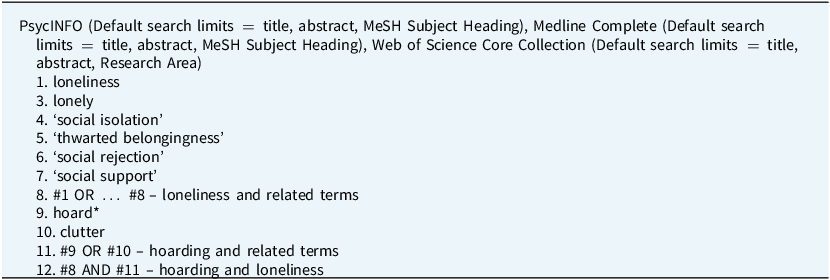
The literature searches were conducted in three databases: PsycINFO, Medline, and Web of Science, using the terms related to loneliness and hoarding in the title, abstract, and subject headings. Please see Table 1 for the line-by-line search strategy. No restrictions were placed on the year of dissemination or language of the papers. The initial search was conducted on 3 June 2024 and updated twice on 16 January 2025 and 16 May 2025.
Search strategy

Table 1. Long description
A table with 12 rows and 1 column detailing a search strategy for databases. The table includes search terms and combinations used in PsycINFO, Medline, and Web of Science. Row 1: PsycINFO (Default search limits = title, abstract, MeSH Subject Heading), Medline Complete (Default search limits = title, abstract, MeSH Subject Heading), Web of Science Core Collection (Default search limits = title, abstract, Research Area). Row 2: loneliness. Row 3: lonely. Row 4: ‘social isolation’. Row 5: ‘thwarted belongingness’. Row 6: ‘social rejection’. Row 7: ‘social support’. Row 8: #1 OR . . . #8 – loneliness and related terms. Row 9: hoard*. Row 10: clutter. Row 11: #9 OR #10 – hoarding and related terms. Row 12: #8 AND #11 – hoarding and loneliness.
Selection process
Two reviewers (K.Y. and I.S.) independently conducted the title/abstract screen for all retrieved papers and the subsequent full-text screen (K.Y. and W.C.). Disagreements were resolved by a third reviewer (J.G. or D.C.). Authors for papers in another language would be contacted for the required information.
Data collection process and data items
Two reviewers (K.Y. and D.C.) independently extracted data from all included papers. Data extracted included the primary aim of study, sample size and characteristics (age, gender, type of participants, i.e. non-clinical, or clinical, diagnoses), type of assessments of loneliness and hoarding used, means and standard deviations of loneliness and hoarding, zero-order correlations between loneliness and hoarding, and effect sizes for differences between groups. If more than two measures of hoarding severity or loneliness were used, we extracted data from the more frequently used and well-validated measures used in the literature.
Risk of bias assessments
We used the Quality Assessment with Diverse Studies (QuADS) tool to evaluate study quality (Harrison et al., Reference Harrison, Jones, Gardner and Lawton2021). The tool outlines 13 criteria for rating studies. Each item is scored from 0 (lowest quality – no information available) to 3 (highest quality). Scores for the QuADS range from 0 to 39, where higher scores represent higher study quality. As per the recommended guidelines, two authors (I.S. and W.C.) independently applied the QuADS criteria to three studies and then met to consolidate a shared understanding of how to best apply the criteria, before independently rating the remaining studies. The final concordance rate between the authors indicated substantial agreement (κ = .76; see Appendix A in the Supplementary material).
Data analysis
To examine the association between loneliness and hoarding across studies, we conducted a meta-analysis using a random-effects model in R (version 4.4.2) with the metafor package (Viechtbauer, Reference Viechtbauer2010). We transformed correlation coefficients to Fisher’s z scores and computed corresponding variances based on sample sizes. We used the restricted maximum likelihood (REML) estimator to estimate the pooled effect size and assessed heterogeneity using Cochran’s Q, I2, and tau2 statistics. We then generated a forest plot to visualise the individual and pooled effects with a 95% prediction interval. Outliers and influential studies were identified by examining the studentised residuals and Cook’s distances. Finally, we assessed publication bias using funnel plot asymmetry, the rank correlation test, and Egger’s regression test. All significance tests were two-tailed at alpha of .05.
Results
Figure 1 presents the PRISMA flow diagram showing the selection and inclusion of studies. We identified 124 studies from the three databases in the initial search, 134 in the first update and 146 in the final update, resulting in a total of 404 studies. Two duplicates were identified manually and 310 automatically by Covidence, leaving 92 studies for title and abstract screening (K.Y. and I.S.). The inter-rater reliability analysis for the title and abstract screening showed a proportionate agreement of 0.94 and a Cohen’s kappa of 0.84, indicating strong agreement between reviewers. Discrepancies occurred in six cases and were resolved by a third reviewer (J.G. or D.C.). The title and abstract screen resulted in 21 full-text studies, which were then assessed for eligibility by two reviewers (K.Y. and W.C.). The inter-rater reliability showed a proportionate agreement of 0.85 and Cohen’s kappa of 0.70, indicating strong agreement. Discrepancies occurred in three cases and were resolved by a third reviewer (D.C.). Eleven studies in total met inclusion criteria and were included in the current review. There were a total of 2715 participants. Details of the studies are presented in Tables 2 and 3. All studies were conducted in English speaking countries (US, Canada, UK, or Australia).
PRISMA flow diagram.

Summary of findings ‒ study design and sample characteristics

Table 2. Long description
The table presents a summary of findings from various studies, detailing the study design, recruitment method, sample size, and demographic characteristics. It includes data from 11 studies conducted in English-speaking countries (US, Canada, UK, or Australia). The table has 11 rows and 5 columns. The columns are labeled Author (year), Country, Study design, Recruitment method, Sample size, and Demographic characteristics. Each row provides specific details for each study, including the author and year, country of origin, study design, recruitment method, sample size, and demographic characteristics of the participants. The studies vary in design, including cross-sectional, correlational, quasi-experimental, pre-test-post-test, and experimental designs. Recruitment methods include social media, community advertisements, undergraduate students, and advocacy organizations. Sample sizes range from 12 to 298 participants. Demographic characteristics include age, gender, and ethnicity of the participants.
HD, hoarding disorder; OCD, obsessive-compulsive disorder; HC, healthy controls.
Summary of findings ‒ measures, loneliness severity, and correlations

Table 3. Long description
The table presents data on loneliness measures, hoarding severity, and correlations between hoarding and loneliness across various studies. It includes columns for author and year, loneliness measure and severity, hoarding measure, hoarding severity, and findings. The table has 10 rows and 5 columns. Each row corresponds to a different study, detailing the mean and standard deviation of loneliness and hoarding measures, and the correlations found. Notable studies include those by Barton et al. (2021), Bedi and Woody (2025), and others, each providing specific data points and correlations.
CES-D, Centre for Epidemiological Studies Depression Scale; DJGLS, DeJong Gierveld Loneliness Scale; UCLA-LS, UCLA loneliness scale; INQ-TB, Interpersonal Needs Questionnaire-Thwarted Belongingness Subscale; SI-R, Savings-Inventory Revised; CIR, Clutter Image Rating Scale.
Risk of bias in studies
The QuADS analysis indicated that the studies included were generally of a high quality. Most studies had strong theoretical and conceptual underpinnings, clearly stated their research aims, utilised appropriate data collection tools, employed suitable analytic methods, and provided a balanced discussion of the relative strengths and weaknesses of their research. However, studies were more heterogenous in quality when it came to the appropriateness of their sampling methods and research designs. Many studies relied on analogue samples of undergraduates or participants from crowdsourcing platforms, who were either unselected or had elevated scores on a hoarding symptom measure, rather than clinical HD participants. Many studies also only provided a cross-sectional analysis of the hoarding‒loneliness link at one time point and failed to justify why these designs were used over longitudinal or experimental research methods. Several studies were also missing key pieces of information about their data collection and recruitment processes (i.e. how many participants were approached, how many declined to participate). There was a critical lack of stakeholder/consumer co-design across the included literature, with only two studies providing evidence of this. See Fig. 2 for a weighted bar plot summary of the distribution of risk-of-bias judgements within each bias domain, as per the QUADS assessment.
Weighted bar plot of the distribution of risk-of-bias judgements within each bias domain from the QuADS assessment.

How lonely are people with HD compared with healthy and clinical controls?
Four studies compared people with HD with a control group on loneliness levels (Barton et al., Reference Barton, Salkovskis and Walters2021; Bedi and Woody, Reference Bedi and Woody2025; Edwards et al., Reference Edwards, Salkovskis and Bream2023; Yap et al., Reference Yap, Timpano, Isemann, Svehla and Grisham2023). Three used the UCLA Loneliness Scale and one used a single item in the Center for Epidemiological Studies-Depression (CES-D) 20-item measure to assess loneliness (Bedi and Woody, Reference Bedi and Woody2025). All studies showed significantly higher loneliness among hoarding participants compared with healthy controls with moderate to large effect sizes. The studies using the UCLA Loneliness Scale found that the average levels of loneliness in people with HD ranged from moderate to severe levels (based on recommended cut-offs in Cacioppo and Patrick, Reference Cacioppo and Patrick2008). Furthermore, in a post-hoc analysis, Yap et al. (Reference Yap, Timpano, Isemann, Svehla and Grisham2023) showed that individuals with high levels of hoarding (n = 262, M UCLA-LS = 52.3, SD = 12.8) were significantly lonelier than a low hoarding group who were matched on depression severity (n = 262, M UCLA-LS = 49.8, SD = 15.4), Welch’s t (d.f. = 505.7) = 2.00, p = .046, Cohen’s d = 0.18.
Barton et al. (Reference Barton, Salkovskis and Walters2021) and Edwards et al. (Reference Edwards, Salkovskis and Bream2023) also compared the HD group with an OCD group. While both studies showed that HD and OCD participants were significantly lonelier than healthy controls with large effect sizes, Barton et al. reported no significant difference between HD and OCD. By contrast, Edwards et al. found significantly higher loneliness in the HD group compared with the OCD group with a medium effect size.
One additional study compared a HD analogue sample with a compulsive buying analogue sample on levels of loneliness (Norberg et al., Reference Norberg, Kwok, Crone, David, Kakar and Grisham2020). They found that both groups had loneliness scores in the moderate range but there was no significant difference between the two groups. Nevertheless, the HD group reported higher levels of anxious attachment and more interpersonal problems than the compulsive buying group.
Association between loneliness and hoarding
There were six papers with cross-sectional study designs that reported eight zero-order correlations from distinct samples. There were another five papers that reported measuring loneliness and hoarding severity but did not report zero-order correlations. We contacted the corresponding authors and received correlations from two authors resulting in a total of 10 effect sizes from independent samples reported in eight papers and a total sample size of 2287 participants. The loneliness measure most frequently used was the UCLA-Loneliness Scale (UCLA-LS; Russell et al., Reference Russell1996) and the hoarding measure most frequently used was the SI-R total score. If there were two or more measures of loneliness and hoarding in correlations, we used the correlation between UCLA-LS and SI-R total. If correlations were reported for more than one time point (e.g. Weiss et al., Reference Weiss, Landers, Todman and Roane2020), we used the first time point. Broos et al. (Reference Broos, Kushner, Stamatis and Timpano2024) used the difficulties discarding and acquisition subscales of the SI-R to measure hoarding symptoms. Given that the SI-R difficulties discarding subscale has a higher sensitivity to detect HD than the acquisition subscale (Kellman-McFarlane et al., Reference Kellman-McFarlane, Stewart, Woody, Ayers, Dozier, Frost, Grisham, Isemann, Steketee, Tolin and Welsted2019), we used the correlation between the SI-R difficulties discarding subscale and the INQ-Thwarted Belongingness subscale from their study.
Meta-analysis
As the correlations between loneliness and hoarding across studies ranged from r = .12, p = .72 (Chen et al., Reference Chen, McDonald, Wearne, Sabel, Long and Grisham2023) to r = .62, p < .001 (Yap et al., Reference Yap, Timpano, Isemann, Svehla and Grisham2023), we conducted a meta-analysis using a random-effects model (REML estimator) to provide a clearer picture of the association. The results showed a moderately strong positive pooled effect size across the 10 studies, r = .38 [95% CI .33, .44] (Fig. 3) with moderate heterogeneity (τ2 = 0.0039, I2 = 41.4%). The Q-test for heterogeneity was not significant (Q = 16.15, p = .06) and the 95% prediction interval ranged from 0.266 to 0.543, indicating that future studies would also show positive associations of similar magnitude. Analysis of studentised residuals showed one potential outlier (Yap et al., Reference Yap, Timpano, Schmidt and Grisham2024). Exclusion of the study resulted in a slightly larger pooled effect size, r = .41 [95% .38, .45]. We therefore decided to take a conservative approach and retain the study.
Forest plot of studies examining the association between loneliness and hoarding.

The Begg’s rank correlation test and Egger’s regression test were not significant (p = .48 and p = .66, respectively). Examination of the funnel plot indicated a low risk of publication bias with most points falling within the funnel and evenly distributed around the pooled estimate (Fig. 4).
Funnel plot assessing publication bias in studies on the association between loneliness and hoarding.

Does loneliness cause hoarding?
Most studies had a cross-sectional correlational study design and did not provide any evidence regarding causality. Chen et al. (Reference Chen, McDonald, Wearne, Sabel, Long and Grisham2023) and Weiss et al. (Reference Weiss, Landers, Todman and Roane2020) were longitudinal pre- and post-treatment studies, but neither study included control groups and the interventions did not target loneliness. Only one study had an experimental study design (Yap et al., Reference Yap, Timpano, Schmidt and Grisham2024). The study aimed to evaluate whether improving loneliness reduced object attachment. Although they reported significant improvements in object attachment for a new item in the loneliness intervention group relative to the active control group, there were no significant improvements for other object attachment measures and hoarding. The authors noted that the loneliness intervention was only a brief online intervention and may have had an insufficiently strong effect on reducing loneliness.
Discussion
In this review, we aimed to clarify the association between hoarding and loneliness as previous literature suggested that they share important empirical and theoretical links, with loneliness proposed as both a cause and a consequence of hoarding. We asked three research questions: (1) how lonely are people with HD compared with clinical and healthy controls, (2) what is the strength of the association between loneliness and hoarding symptoms, and (3) what is the evidence that loneliness causes hoarding?
Results showed that people with HD were significantly more lonely than healthy controls. There was, however, mixed evidence about whether loneliness is heightened in HD compared with other clinical groups with one study showing significantly higher loneliness in the HD group and another showing no significant difference. Furthermore, the clinical group in these studies were people with OCD. It is unclear how loneliness in HD compares with disorders that are typically associated with loneliness and social isolation (e.g. depression and social anxiety). Considering previous research showing interpersonal conflict, high social isolation, and poor quality of life in people with HD (Nutley et al., Reference Nutley, Read, Martinez, Eichenbaum, Nosheny, Weiner, Mackin and Mathews2022; Tolin et al., Reference Tolin, Frost, Steketee, Gray and Fitch2008), future research may find similar or even higher levels of loneliness when comparing HD with these disorders.
Although previous research indicated mixed findings regarding the association between loneliness and hoarding, our meta-analysis results showed a significant and moderately strong positive correlation. There were two studies with non-significant correlations (Chen et al., Reference Chen, McDonald, Wearne, Sabel, Long and Grisham2023; Weiss et al., Reference Weiss, Landers, Todman and Roane2020). Both studies showed small correlations that were not significant due to small sample sizes. Given that there were eight studies reporting positive associations, relatively low heterogeneity, and a low risk of publication bias, we are confident in the validity of this finding.
Our findings are consistent with observations that people with HD experience high levels of stigma and shame (Prosser et al., Reference Prosser, Dennis and Salkovskis2024) and are more likely to be socially isolated due to difficulties in interpersonal functioning (Chen et al., Reference Chen, Denson, Timpano, Kocol and Grisham2024; Grisham et al., Reference Grisham, Martyn, Kerin, Baldwin and Norberg2018). However, despite these promising initial findings, there is insufficient evidence to conclude that loneliness is a cause of hoarding, as is suggested by attachment theory (Mathes et al., Reference Mathes, Timpano, Raines and Schmidt2020; Yap and Grisham, Reference Yap and Grisham2021). There was only one study (Yap et al., Reference Yap, Timpano, Schmidt and Grisham2024) that examined a causal link and its findings were mixed. Further experimental and longitudinal research studies are needed to confirm whether loneliness causes more severe hoarding.
Limitations of included studies
While the quality of the research included in this review was generally high, with most studies having strong theoretical foundations, clear aims, and utilising appropriate research methods, we observed some limitations across the literature. Firstly, there was a critical lack of experimental or longitudinal research, with most studies conducting a cross-sectional analysis of hoarding and loneliness at one time point. Although we are confident that hoarding and loneliness share a moderate, positive association, this lacuna limits our ability to draw causal conclusions as we are unable to properly ascertain whether loneliness causes hoarding, hoarding causes loneliness, or whether they influence one another bi-directionally.
Secondly, we observed an over-reliance on analogue samples. While four studies recruited individuals who had been formally diagnosed with hoarding disorder, the majority of research included in this review relied upon undergraduate or crowdsourcing samples, with participants who were either unselected or had elevated scores on a hoarding symptom measure. Although findings using analogue samples have been found to generalise to clinically severe populations in other OCD-spectrum disorders (Abramowitz et al., Reference Abramowitz, Fabricant, Taylor, Deacon, McKay and Storch2014), and hoarding traits are dimensional in the population (Timpano et al., Reference Timpano, Broman-Fulks, Glaesmer, Exner, Rief, Olatunji, Keough, Riccardi, Brähler, Wilhelm and Schmidt2013), it is possible that the over-reliance on non-clinical samples in this review resulted in an under-estimation of the true association between hoarding and loneliness, as we might expect loneliness to be more elevated in clinically severe populations who have been given a formal HD diagnosis. Hoarding behaviours can also ensue from conditions other than hoarding disorder, such as eating disorders (Novara et al., Reference Novara, Bottesi, Dorz and Sanavio2016), dementia (Hwang et al., Reference Hwang, Tsai, Yang, Liu and Lirng1998), and psychosis (Machado et al., Reference Machado, Fragoeiro and Passos2019), so without ratifying a formal diagnosis through a structured clinical interview, these studies are unable to rule out that the presence of other psychopathology is not muddying the hoarding‒loneliness link.
Thirdly, we observed that several studies did not provide sufficient information about their recruitment processes (e.g. where they recruited from, how many were originally approached, and how many declined to participate). This is an important oversight to address, as there is evidence to suggest individuals who hoard are ‘hard to reach’ and those who choose to participate in hoarding research and treatment opportunities may differ in important ways from cases that come to community attention (i.e. more insight, more likely to be female, less clutter volume in the home; Woody et al., Reference Woody, Lenkic, Bratiotis, Kysow, Luu, Edsell-Vetter, Frost, Lauster, Steketee and Tolin2020). Finally, there was a general lack of consumer/stakeholder co-design across the literature, with only one study showing sufficient evidence of this. Future research may seek to liaise with personnel who have lived experience of hoarding disorder to inform the appropriateness of their research methods (e.g. to determine which loneliness measure best reflects the HD experience; the UCLA-LS, INQ-TB, or DJGLS).
Limitations of the current review
Our systematic literature review included only peer-reviewed studies which may have led to a publication bias and an over-estimation of effects. Furthermore, while we did not exclude studies published in a non-English language, no non-English papers were included in this review. All included studies were therefore conducted in English-speaking countries with western, educated, industrialised, rich, and democratic (WEIRD) populations, which limits the cross-cultural validity of our findings. Finally, although we asked three research questions, we only conducted one meta-analysis that examined correlations between hoarding and loneliness. Due to the lack of studies, we did not conduct meta-analyses for the other research questions.
Implications and further research
Notwithstanding the limitations of the included studies and of our review, our results confirm that people with HD are likely to have high levels of chronic loneliness, and that those with more severe hoarding symptoms are lonelier. We suggest that clinicians working with HD assess loneliness and social isolation during their initial assessments and evaluate the impact of loneliness on hoarding and wellbeing over time. This may provide further insight into whether loneliness triggers hoarding behaviours for the individual. Given that loneliness has wide-ranging negative effects on psychological wellbeing and physical health, reducing loneliness should be a priority. As there are well-established evidence-based interventions for loneliness (Hickin et al., Reference Hickin, Käll, Shafran, Sutcliffe, Manzotti and Langan2021), we recommend integrating these interventions into the treatment of hoarding for HD clients who are lonely.
Gaining a better understanding of loneliness in HD is important with respect to informing theoretical models of hoarding and providing avenues to enhance treatment of this challenging disorder. While our review demonstrated a clear link between hoarding and loneliness, the causal direction is unclear. As hoarding is associated with interpersonal conflict and shame, it is probably a cause of greater loneliness. Whether loneliness in turn increases object attachment and hoarding as suggested by attachment theory is yet to be established.
Future longitudinal research should therefore investigate the positive feedback cycle in which loneliness/social isolation, insecure attachment and interpersonal difficulties drive a compensatory attachment to possessions that results in excessive clutter, which may then lead to further social isolation due to shame and impaired functioning. Cross-lagged panel studies where these variables are measured over several time points will allow for complex modelling of feedback loops and reciprocal causal relationships.
In addition, intensive longitudinal studies involving ecological momentary assessment (EMA) where data is collected several times a day over a shorter time frame (e.g. 2 weeks) will allow us to examine within-person variability, and to evaluate whether fluctuations in loneliness throughout the day have effects on object attachment, and whether social and interpersonal contexts play a role. Using idionomic methods, EMA can also provide an opportunity to examine whether the link between loneliness and hoarding applies to all people with hoarding symptoms or whether there are meaningful subgroups where loneliness affects hoarding to a greater or lesser extent (Ciarrochi et al., Reference Ciarrochi, Sahdra, Hayes, Hofmann, Sanford, Stanton, Yap, Fraser, Gates and Gloster2024).
Experimental studies to examine the impact of loneliness on object attachment and hoarding symptoms in people with HD compared with active controls are also required. There are several experimental studies on the effects of social exclusion on object attachment and hoarding behaviours, but these studies were excluded from this review because of the lack of loneliness or hoarding measures (Chen et al., Reference Chen, Wan and Levy2017; Keefer et al., Reference Keefer, Landau, Rothschild and Sullivan2012; Kwok et al., Reference Kwok, Grisham and Norberg2018; Mathes and Schmidt, Reference Mathes and Schmidt2020; Norberg et al., Reference Norberg, Kwok, Crone, David, Kakar and Grisham2020). The findings of these studies were mixed and may not be relevant to hoarding because the experimental manipulations induced mild feelings of social exclusion with strangers and did not target chronic social exclusion from significant others. Furthermore, a ceiling effect is likely for people with HD who already have extremely high levels of chronic loneliness, thus limiting the applicability of this research paradigm. Therefore, instead of manipulating social exclusion, experimental studies to reduce chronic loneliness may be more relevant. Yap et al. (Reference Yap, Timpano, Schmidt and Grisham2024) provided some preliminary evidence of a causal link using such a design, but there were many study limitations including the use of an analogue sample, the lack of clinical assessments for the diagnosis of HD, and the use of a brief online loneliness intervention which had only small effects on loneliness. A randomised controlled trial of more intensive loneliness interventions that treat chronic loneliness in hoarding disorder patients is therefore needed.
Previous research has shown that loneliness has large effects on all health outcomes, with the largest effects on mental health and wellbeing, and is associated with all-cause mortality in older adults (Zhou et al., Reference Zhou, Yang and Gao2023). We therefore recommend greater attention on addressing loneliness in the treatment of HD regardless of a causal link. One avenue for further research is to examine whether modifications to hoarding treatments can improve loneliness and wellbeing in addition to hoarding symptoms. Furthermore, including treatment components that address loneliness in hoarding treatment may indirectly lead to improved hoarding treatment outcomes by improving interpersonal relationships, mood, and emotion regulation. Initial pilot studies using transdiagnostic approaches that affect interpersonal factors have shown some promise and warrant larger scale randomised controlled trials (Chen et al., Reference Chen, McDonald, Wearne, Sabel, Long and Grisham2023; Chou et al., Reference Chou, Tsoh, Shumway, Smith, Chan, Delucchi, Tirch, Gilbert and Mathews2020).
Modifications to group interventions for hoarding to address loneliness also warrant further investigation. Currently, most group interventions for hoarding involve psychoeducation and cognitive behavioural strategies that specifically target hoarding behaviours. However, qualitative feedback from patients in group CBT for hoarding shows that social interaction is highly valued and beneficial (Chandler et al., Reference Chandler, Fogg and Smith2019; Schmalisch et al., Reference Schmalisch, Bratiotis and Muroff2010). The group format provides opportunities for increased social contact in a safe and supportive environment, and re-designing group interventions to enhance social interactions, target loneliness, and reduce shame associated with hoarding may improve the effectiveness of hoarding treatments. The re-designing of interventions would benefit from qualitative research and co-design to ensure that it aligns with the lived experience of people with hoarding disorder who have high levels of loneliness. The re-design of group interventions is not limited to face-to-face interventions; online group interventions for hoarding using video teleconferencing have shown some promise, and research examining ways of directly targeting loneliness in these new formats is also warranted (Yap et al., Reference Yap, Chen, Wong, Isemann, Svehla and Grisham2022).
Finally, research involving non-WEIRD populations is needed. Hoarding disorder has been identified in non-western countries and shows similar symptoms and core features (Jaisoorya et al., Reference Jaisoorya, Thamby, Manoj, Kumar, Gokul, Narayanaswamy, Arumugham, Thennarassu and Reddy2020; Nordsletten et al., Reference Nordsletten, Fernández de la Cruz, Aluco, Alonso, López-Solà, Menchón, Nakao, Kuwano, Yamada, Fontenelle, Campos-Lima and Mataix-Cols2018; Subramaniam et al., Reference Subramaniam, Jeyagurunathan, Devi, Chang, Samari, Verma, Ng, Tan, Chong, Ye, Lim, Babjee, Vaingankar and Chong2020). Whether loneliness is associated with hoarding across cultures is unknown. It may be that shame and social isolation due to hoarding in collectivistic cultures are more intense, which may then lead to higher levels of loneliness. Alternatively, greater social support in these societies could attenuate the impact of hoarding on loneliness.
Conclusion
There is a growing recognition of the importance of examining interpersonal factors associated with hoarding. This study is the first review of research into loneliness in hoarding disorder. We found that people with hoarding disorder experience significantly higher levels of loneliness compared with healthy controls but probably at similar levels as other severe psychological disorders. We also found a significant moderate correlation between hoarding and loneliness. These findings indicate that assessing and addressing loneliness in hoarding disorder patients is a priority. There was, however, insufficient evidence that loneliness causes more severe hoarding. Further research to examine the causal link is warranted.
Supplementary material
To view supplementary material for this article, please visit https://doi.org/10.1017/S1352465826101398
Data availability statement
The data supporting the findings of this study are derived from previously published studies cited in the article. Extracted data and analysis outputs are included in the article and its Supplementary material.
Acknowledgements
None.
Author contributions
Keong Yap: Conceptualization-Lead, Data curation-Lead, Formal analysis-Lead, Investigation-Lead, Methodology-Lead, Validation-Lead, Visualization-Lead, Writing - original draft-Lead, Writing - review & editing-Equal; Isaac Sabel: Conceptualization-Supporting, Formal analysis-Supporting, Investigation-Supporting, Methodology-Supporting, Visualization-Supporting, Writing - review & editing-Equal; David Cooper: Conceptualization-Supporting, Formal analysis-Supporting, Writing - review & editing-Equal; Wenting Chen: Conceptualization-Supporting, Formal analysis-Equal, Visualization-Supporting, Writing - review & editing-Equal; Jessica Grisham: Conceptualization-Supporting, Supervision-Lead, Writing - review & editing-Equal.
Financial support
This research received no specific grant from any funding agency, commercial or not-for-profit sectors.
Competing interests
The authors declare none.
Use of AI
The first author used ChatGPT-4o on 13 May 2025 for spelling and grammar checking, to improve the readability and language of some sections of the manuscript. After using this tool, he reviewed and edited the content as needed and takes full responsibility for the content of the published article.


 Open access


Comments
No Comments have been published for this article.