Rationale
Bilingual children show heterogeneity in acquiring language, even greater than monolinguals. The main reasons for this seem to be linked to the complex mechanisms involved in acquiring two languages, as well as the amount of exposure to each of the languages the child is exposed to (Carroll, Reference Carroll2017; Gatt & O'Toole, Reference Gatt and O'Toole2016). Bilingual children are exposed to (at least) one native language spoken in the family by one or both parents and a major language of a geographical area, which is the official language spoken outside the child's home (Farabolini, Caselli, Rinaldi, & Cristia, Reference Farabolini, Rinaldi, Caselli and Cristia2021). Language exposure is the prior exposure to each of the languages a child is exposed to, and it has an impact on language acquisition in children with both typical and atypical language development (Carroll, Reference Carroll2017).
Nonword repetition tasks
Given the heterogeneity in bilingual language acquisition, there is a growing body of research on how to disentangle variation in acquisition patterns from atypical language development pathways. To address this question, different authors have worked on clinical markers, where evidence has shown significantly lower performance in monolingual children with atypical language development if compared to children with typical language development (Bortolini, Arfé, Caselli, Degasperi, Deevy, & Leonard, Reference Bortolini, Arfé, Caselli, Degasperi, Deevy and Leonard2006; Conti-Ramsden, Botting, & Faragher, 2001). One of the most used clinical markers is nonword repetition (NWR), a neuropsychological task where children listen to a nonsense word that sounds like a real word but has no meaning, and then they have to repeat it. Recent meta-analyses have shown this task identifies monolingual (Graf Estes, Evans, & Else-Quest, Reference Estes K, Evans and Else-Quest2007) and bilingual (Ortiz, Reference Ortiz2021; Schwob, Eddé, Jacquin, Leboulanger, Picard, Ramos Oliveira, & Skoruppa, Reference Schwob, Eddé, Jacquin, Leboulanger, Picard, Oliveira and Skoruppa2021) children with atypical language development.
Different research designs have been employed to develop nonwords. Language-like nonwords are those developed following the phonological constraints of a specific language; they are often created by changing some phonemes of real words (Engel de Abreu, Reference de Abreu PMJ2011). Non language-like stimuli are developed respecting the phonological rules of one or two existing languages, but they are often less strictly word-like by modulating nonwords’ sub-lexical cues, which are properties related to the phonological constraints of a target language (e.g., length, phonotactic probability and prosody; Armon-Lotem, de Jong, & Meir, Reference Armon-Lotem, de Jong and Meir2015; Thordardottir, Reference Thordardottir2017). Non language-like items are often developed with the aim of reducing the word-likeness of the stimuli and at the same time respecting the phonological constraints of a target language (e.g., non Icelandic-like stimuli for bilingual Icelandic-speaking children should be developed reducing the degree of Icelandic word-likeness and respecting Icelandic phonological constraints; Thordardottir, Reference Thordardottir2008). Finally, cross-linguistic nonwords follow and expand the principles of non language-like nonwords. They are developed according to the shared phonological constraints of a set of languages. Following this design, stimuli should be minimally sensitive to a bilingual child's language exposure and proficiency in a target language (Chiat, & Polišenská, Reference Chiat and Polišenská2016). Even though nonwords are often classified into two different categories (namely, language-like and non language-like), the manipulation of sub-lexical cues allows to develop nonwords as more language-like or less language-like (Szewczyk, Marecka, Chiat, & Wodniecka, Reference Szewczyk, Marecka, Chiat and Wodniecka2018), suggesting the difference between these categories is not dichotomic but rather a continuum. To give some examples of the different types of nonwords, /ˈnɑskət/ is an English-like nonword (Chiat, & Polišenská, Reference Chiat2016), /vopekɛt/ is a Dutch-like nonword (Boerma, Chiat, Leseman, Timmermeister, Wijnen, & Blom, Reference Boerma, Chiat, Leseman, Timmermeister, Wijnen and Blom2015), and /kata'sepo/ is an Italian-like nonword (Dispaldro, Leonard, & Deevy, Reference Dispaldro, Leonard and Deevy2013). Looking at non language-like items, /jolla/ and /vopgem/ are non Icelandic-like nonwords (Thordardottir, Reference Thordardottir2008), and /ˈsiˈpulɑ/ (Chiat, & Polišenská, Reference Chiat and Polišenská2016) and /lυmikɑ/ (Boerma et al., Reference Boerma, Chiat, Leseman, Timmermeister, Wijnen and Blom2015) are cross-linguistic stimuli.
Additionally, the NWR presentation by examiners might influence children's NWR performance. In detail, language-specific prosodic and articulatory features can influence the degree of language-likeness of nonwords to a target language. As a consequence, theoretical frameworks bearing on the development of stimuli which are minimally language-specific should administer stimuli with the aim of maximally reducing language-specific suprasegmental features (Thordardottir, Reference Thordardottir2008). In the literature, stimuli have been audio-recorded prior to NWR administration and presented through digital devices (de Almeida, Ferré, Morin, Prévost, dos Santos, Tuller, Zebib, & Barthez, Reference de Almeida, Ferré, Morin, Prévost, dos Santos, Tuller, Zebib and Barthez2017; Summers, Bohman, Gillam, Peña, & Bedore, Reference Summers, Bohman, Gillam, Peña and Bedore2010), or presented orally (Kehoe, Poulin-Dubois, & Friend, Reference Kehoe, Poulin-Dubois and Friend2021; Vaahtoranta, Suggate, Lenhart, & Lenhard, Reference Vaahtoranta, Suggate, Lenhart and Lenhard2021).
Two notation systems have often been used in the literature to calculate NWR performance. Whole-word scoring measures the accuracy of each item as a whole – that is, each nonword repeated is scored as correct or incorrect and the number of nonwords correctly repeated is obtained. Phoneme scoring is based on the number of phonemes correctly repeated throughout the task, irrespective of accuracy in whole-word repetition. Different authors have tested the validity of the two scoring systems and similar results have been found overall in identifying monolingual children with atypical language development (Dispaldro et al., Reference Dispaldro, Leonard and Deevy2013; Graf Estes et al., Reference Estes K, Evans and Else-Quest2007). Looking at bilingual children, while mixed evidence has been found favoring whole-word (Boerma et al., Reference Boerma, Chiat, Leseman, Timmermeister, Wijnen and Blom2015) or phoneme (Guiberson, & Rodríguez, Reference Guiberson and Rodríguez2015) scoring as the better system for the identification of atypical language development, a recent meta-analysis underlined the absence of differences across the two scoring methods in diagnostic accuracy (Ortiz, Reference Ortiz2021). Finally, similar results have been found across the two scoring methods in terms of correlations between NWR and other language measures (Brandeker, & Thordardottir, Reference Brandeker and Thordardottir2015).
Nonword repetition in bilingual children
NWR tasks have been found to identify language-learning difficulties in bilingual populations (Ortiz, Reference Ortiz2021) and distinguish such difficulties from those due to different amount and degree of language-specific exposure and experience (Chiat, & Polišenská, Reference Chiat and Polišenská2016).
Different NWR types have been used with bilingual populations. Beyond the common use of language-like or non language-like stimuli, a recent research network attempted to develop language assessment tools which are minimally influenced by prior language-specific exposure (which is the time of exposure received by children in each of the languages they are exposed to before the assessment time) and proficiency, in order to maximally assess language-learning processes in bilingual children (Armon-Lotem et al., Reference Armon-Lotem, de Jong and Meir2015). Following this theoretical framework, that same research network developed cross-linguistic (also called quasi-universal; Chiat, Reference Chiat2015) nonwords. In detail, cross-linguistic stimuli are developed respecting phonological constraints of a set of languages, e.g., 2- to 5-syllables long, with the CV syllabic structure, including consonants and vowels which are common among the set of languages, with prosody tuned with the target languages spoken by the child (Chiat, & Polišenská, Reference Chiat and Polišenská2016).
Different authors raised debates on the impact of prior language exposure and experience on NWR performance. Different scholars argued that prior language exposure to the languages spoken by the child might be related to NWR accuracy (Gibson, Summers, Peña, Bedore, Gillam, & Bohman, Reference Gibson, Summers, Peña, Bedore, Gillam and Bohman2015; Schraeyen, Elst, Geudens, Ghesquière, & Sandra, Reference Schraeyen, Elst, Geudens, Ghesquière and Sandra2018). Mixed evidence has been found on the association between language exposure to a specific target language and NWR performance (Bonifacci, Barbieri, Tomassini, & Roch, Reference Bonifacci, Barbieri, Tomassini and Roch2018; Core, Chaturvedy, & Martinez-Nadramia, Reference Core, Chaturvedy and Martinez-Nadramia2017).
Nonword repetition performance and language exposure
Evidence supports the claim that prior exposure to a specific language partially explains heterogeneity in NWR performance (Antonijevic, Lyons, Malley, Meir, Haman, Banasik, Carroll, McMenamin, Rodden, & Fitzmaurice, Reference Antonijevic, Lyons, Malley, Meir, Haman, Banasik, Carroll, McMenamin, Rodden and Fitzmaurice2019; Thordardottir, Reference Thordardottir2017), but mixed evidence has been found on the relationship between NWR and language exposure (Antonijevic et al., Reference Antonijevic, Lyons, Malley, Meir, Haman, Banasik, Carroll, McMenamin, Rodden and Fitzmaurice2019; Barbosa et al., Reference Barbosa and Jiang2017; Engel de Abreu, Baldassi, Puglisi, & Befi-Lopes, Reference de Abreu PMJ, Baldassi, Puglisi and Befi-Lopes2013; Tuller, Hamann, Chilla, Ferré, Morin, Prevost, Santos, Ibrahim, & Zebib, Reference Tuller, Hamann, Chilla, Ferré, Morin and Prevost2018). Different hypotheses support either the independence or the relationship between NWR and language exposure.
On the one hand, since in NWR tasks children have to repeat items they have never heard before, it seems that prior language exposure should not, or at most minimally, affect NWR performance. Following this perspective and given that language exposure is related to language development, NWR might be used to analyze language development as a means of optimally reducing the influence of language exposure on task performance. As a consequence, low NWR scores might be mainly related to language processing abilities rather than to prior language exposure. For this reason, different authors argue that this task might be helpful in identifying atypical language development in bilingual children and in disentangling low language assessment scores due to lower exposure to the language of assessment from those due to language difficulties (Chiat, & Polišenská, Reference Chiat and Polišenská2016).
On the other hand, NWR is often considered as a neuropsychological task that mainly assesses phonological short-term memory (Baddeley, Reference Baddeley1986; Chiat, Reference Chiat2015). Indeed, the task requires storing, retrieving and reproducing a meaningless sequence of phonemes. Even though NWR is not a linguistic task that mainly assesses a language domain, it does involve phonological abilities, which is why prior language exposure should have at least a low impact on NWR. The impact of prior language exposure on NWR might be mediated by the nonwords’ sub-lexical cues, which if designed accordingly can make nonwords more language-like and, therefore, enhance NWR performance. Mixed evidence has been found on the relationship between non language-like NWR performance and language exposure (Öberg, Reference Öberg2020; Vaahtoranta et al., Reference Vaahtoranta, Suggate, Lenhart and Lenhard2021).
Different language exposure measures are frequently used to study its association with NWR – namely, age of first exposure, current exposure, and cumulative exposure. Age of first exposure is the chronological age at which the child has first been exposed to a specific language. Current exposure is the amount of exposure to a language calculated over a short period just before the assessment. Cumulative exposure is measured in diverse ways across studies. One definition is based on the amount of exposure to a language calculated in daily waking hours (e.g., Parra, Hoff, & Core, Reference Parra, Hoff and Core2011); another definition relies on an index considering settings, speakers, and speakers' speech features (Thordardottir, & Brandeker, Reference Thordardottir and Brandeker2013), as well as the length of exposure to the major language at educational institutions (Duncan, & Paradis, Reference Duncan and Paradis2016; Thordardottir, & Juliusdottir, Reference Thordardottir and Juliusdottir2013), across the child's lifetime.
When studying the association between NWR performance and language exposure, the latter is often calculated for the language according to which the nonwords have been developed – that is, the language from which the phonological constraints to develop the nonwords have been taken (e.g., if the stimuli are developed following English phonological constraints, language exposure is calculated for English; (Buac, Gross, & Kaushanskaya, Reference Buac, Gross and Kaushanskaya2016; Talli, & Stavrakaki, Reference Talli and Stavrakaki2020); however, this is not always the case (Gathercole, & Masoura, Reference Gathercole and Masoura2005; Pérez-Navarro, Molinaro, & Lallier, Reference Pérez-Navarro, Molinaro and Lallier2020; Summers et al., Reference Summers, Bohman, Gillam, Peña and Bedore2010).
Potential moderators can affect the relationship between NWR and language exposure (Armon-Lotem, & Meir, Reference Armon-Lotem and Meir2016; Gutiérrez-Clellen, & Simon-Cereijido, Reference Gutiérrez-Clellen and Simon-Cereijido2010). Looking at nonwords’ features, the nature of NWR stimuli (e.g., cross-linguistic vs language-specific) might have an influence on NWR performance in bilinguals (Chiat, & Polišenská, Reference Chiat and Polišenská2016). Similarly, the number of stimuli included in NWR lists varies across studies (Archibald, & Gathercole, Reference Archibald and Gathercole2006) and might also be related to NWR performance. Indeed, results from tasks with a lower number of nonwords might be less reliable because they provide less data on different features of nonwords (e.g., presence or absence of clusters, phonotactic probability, length variability). At the same time, lists with a higher number of stimuli might be affected by fatigue or attention decrease, which might impact negatively on NWR performance.
In addition, language exposure might be differently related to NWR performance in children with and without atypical language development. It might be the case that NWR performance in children with typical language development can be enhanced by language exposure, whereas children with difficulties in processing nonwords might be more influenced by language difficulties than prior language exposure (Boerma et al., Reference Boerma, Chiat, Leseman, Timmermeister, Wijnen and Blom2015). At the same time, beyond language difficulties affecting NWR, prior language exposure might affect NWR performance in both children with and without atypical language development (de Almeida et al., Reference de Almeida, Ferré, Morin, Prévost, dos Santos, Tuller, Zebib and Barthez2017).
Finally, chronological age might also have a mediating effect on the interplay between children's NWR performance and their individual language exposure. In monolingual development, for instance, it has been proposed that, especially during the early stages of language development – up to the age of five years – mechanisms related to phonological short-term memory support language acquisition; while after this age the relation is inverted, with language knowledge supporting phonological memory (Coady, & Evans, Reference Coady and Evans2008). In more detail, word learning and NWR tasks involve similar phonological short-term memory processes (e.g., to retain, store, retrieve, and eventually reproduce a meaningless or meaningful sequence of phonemes), all of which play a central role in carrying out both tasks successfully. It has further been suggested that after the first years of life children have mastered their language to a great extent. Not only have they acquired a relatively large lexicon but they have also developed a more comprehensive and reliable language knowledge across the various linguistic levels. Such broad language mastery could play a core role in children's NWR performance and might even outweigh the contribution of phonological short-term memory processes.
Following this perspective, we hypothesize that this same pattern might occur in bilingual language development too. Indeed, phonological short-term memory is involved in language acquisition whether a child is exposed to and learning one or more languages. In bilingual children, phonological short-term memory might be influenced by the relative amount of exposure a bilingual child receives in each of their languages. Since word learning and NWR tasks involve similar phonological short-term memory processes, such processes would play a core role in NWR accuracy during the first years of bilingual children's exposure to multiple languages, when they have just started acquiring their lexicon. Later on during language development, once bilingual children have received reliable exposure to each of their languages, their NWR performance will rely more on their knowledge of the languages than on language exposure. In particular, mastery of language-specific phonological constraints would enable language-specific NWR performance to be facilitated by sub-lexical cues. Given that, in general, older children have accumulated greater language exposure and, thus, greater language knowledge than younger children, who have had less language exposure and, thus, less language knowledge, it might be the case that language exposure and NWR are more strongly related in younger children than in older ones.
To the extent that NWR tasks are one of the most used assessment tools to identify language impairment (Schwob et al., Reference Schwob, Eddé, Jacquin, Leboulanger, Picard, Oliveira and Skoruppa2021) in monolingual (Graf Estes et al., Reference Estes K, Evans and Else-Quest2007) and bilingual (Ortiz, Reference Ortiz2021) children, we wish to contribute to the better understanding of the impact of language exposure on NWR performance, as well as the contribution of child internal and external factors.
The current study
We carried out a systematic review and meta-analysis addressing the following research questions:
1) Is prior language exposure associated with NWR performance in bilingual children?
2) Which are the variables related to bilingual language development that affect the association between NWR and language exposure?
Is the association between NWR and language exposure moderated by:
a) the measure of language exposure (cumulative exposure, current exposure, or age of first exposure)?
b) the type of stimuli in the NWR task (non language-like vs language-specific)?
c) the NWR scoring system (whole-word vs phoneme scoring)?
d) language development (typical or atypical)?
e) participants’ chronological age (in toddlers, preschoolers and schoolers)?
Methods
Our research design follows PRISMA guidelines for systematic reviews and meta-analyses (Liberati, Altman, Tetzlaff, Mulrow, Gøtzsche, Ioannidis, Clarke, Devereaux, Kleijnen, & Moher, Reference Liberati, Altman, Tetzlaff, Mulrow, Gøtzsche, Ioannidis, Clarke, Devereaux, Kleijnen and Moher2009). The current study was registered in the “International Prospective Register of Systematic Reviews” (PROSPERO; CRD42020173573). The first research question of the current systematic review studies the association between two variables, while the second one analyzes whether the meta-analysis main effect is influenced by the selected moderators.
Systematic review
Search protocol
We used the open-access databases Google Scholar and ERIC for database searching. Independent search was carried out by the first and the second authors. For the Google Scholar database we employed the following search keywords: (“nonword repetition” AND “language exposure” AND “bilingual”), while for ERIC we used [(non-word repetition OR nonword repetition OR pseudowords OR nwr) AND (language exposure OR input) AND (bilingual OR bilingualism OR multilingual OR multilingualism)]. We used two different sets of search keywords to adjust to the search settings of each database. Additionally, we collected research works through mailing lists and personal contacts. Searches on Google Scholar ended on 29/11/2021 and on ERIC on 31/11/2021. Study selection was carried out following these steps: abstract retrieval, abstract screening, full text retrieval and full text screening (see Table S1 in Supplementary Material for the literature screening). Literature screening at abstract level was performed on both databases by the first author, and by the second author on ERIC and a portion of the search results from Google Scholar. All search results judged as relevant by one or both reviewers were screened by both at full text level. Once the literature search and screening were finished, the first and second authors compared their inclusion decisions and, when needed, reached an agreement through a consensus process; when consensus could not be reached, the last author's advice was sought to make a decision. We finally calculated inter-rater reliability on literature screening before comparing extracted data across coders (Orwin, Reference Orwin1994). Inter-rater reliability was carried out on a portion of the screened literature.
Inclusion and exclusion criteria
To be included in the current systematic review, experimental data had to be related to bilingual children – that is, children below the age of 18 years who are exposed to at least two languages during their lifespan. We included studies that employed NWR tasks (but not word learning or sentence imitation assessment tools) and reported statistical results for the association between NWR and language exposure measures. We excluded effect sizes on the association between performance in NWR tasks developed following the phonological constraints of one language (e.g., Spanish) and language exposure measured for a different language (e.g., English) (Gathercole, & Masoura, Reference Gathercole and Masoura2005; Parra et al., Reference Parra, Hoff and Core2011; Pérez-Navarro et al., Reference Pérez-Navarro, Molinaro and Lallier2020; Summers et al., Reference Summers, Bohman, Gillam, Peña and Bedore2010). Multiple comparison results not reporting the single effect of language exposure on NWR scores were excluded as well. When we found included studies from the same laboratories, we asked for further information about studies’ samples to avoid duplicate data (from these procedures, we excluded Santos, & Ferré, Reference Santos and Ferré2016).
Data extraction
After consensus was reached regarding included studies, the first two authors carried out blind data extraction, which they then compared and discussed. For included articles, we extracted data about participants, NWR research design, language exposure measures, and statistical analyses. Regarding participants, we reported the sample size, the chronological age, and whether children had typical or atypical language development or if both were included. Regarding the NWR tasks, we extracted the type of nonwords used (language-like, non language-like or mixed), the amount of nonwords in the NWR lists and their syllabic range (i.e., their different lengths, in number of syllables), and the scoring system employed (phoneme and/or whole-word scoring). For language exposure we extracted the measure used (e.g., cumulative exposure, current exposure, age of first exposure). We reported the statistical analysis, statistical results, and the related significance (see Table S2 in Supplementary Material for the data extraction). Finally, we analyzed the agreement on data extraction across coders using percentage.
Risk of bias
We developed a list of study risk-of-bias variables after consulting the literature and considering methodological issues which can affect the quality of the information derived from a study, regarding the research question of the current work. The following study characteristics were assessed: (a) representativeness of the exposed cohort; (b) published vs gray literature; (c) bilingual status across participants (if they share only the major language or also the native one); (d) parents’ bilingual status (both or only one of the parents shares with the child a native language different from the major language of a geographical area); (e) data bearing on participants’ native and/or major language (language exposure and nonwords based on and developed following the native and/or major language); (f) amount of nonwords administered (between 16 and 24 stimuli; between 8 and 16; between 24 and 40 or more than 40 stimuli); (g) the nonwords’ syllabic range (three groups classified for range and maximum length: the first group included lists with a syllabic range as [1-5], [1-4] or [2-5]; the second group included lists with nonwords of two or three different lengths excluding 6-syllable stimuli and above; the third group included lists having either all nonwords of the same length or nonwords of more than four different lengths as well as lists including 6-syllable items and above; the latter were grouped together in the same subgroup because they included more extreme syllabic ranges which could potentially lead to more extreme scores). We did not exclude studies based on the risk of bias. Rather, we took an inclusive approach to study selection, to maximize the literature of our systematic review and meta-analysis, and we collected data related to the risk of bias. A checklist of desirable study characteristics is given in Table S3 in Supplementary Material. For each study we assessed whether each of the desirable study characteristics was present, relatively present, or absent.
Data processing
We coded both correlation and comparison results and then converted them into Fisher's z scores. While correlation coefficients were directly converted into z scores, we followed Lakens (Reference Lakens2013) to calculate Fisher's z score from analysis of variance. We decided not to reproduce those statistical analyses already reported in the publications, nor additional ones, on the raw descriptive statistics of the included studies.
Meta-analysis
We conducted a random-effects model meta-analysis for each individual predictor using Review Manager 5.4 (RevMan; The Cochrane Collaboration, 2020). We acknowledged significance at p < .05.
Main effect
We reported for each study standard errors (SE) and Fisher's z scores as effect sizes. The meta-analysis main effect is calculated and reported with odd ratios by RevMan. The subgroup analysis results are calculated following the same statistical procedure.
Heterogeneity
We estimated the magnitude of heterogeneity using the I2 value (Borenstein, Hedges, Higgins, & Rothstein, Reference Borenstein, Hedges, Higgins and Rothstein2009). The interpretation of I2 was insignificant heterogeneity for 0%–25%, low heterogeneity for 26%–50%, moderate heterogeneity for 51%–75%, and high heterogeneity for > 75% (Higgins, Thompson, Deeks, & Altman, Reference Higgins, Thompson, Deeks and Altman2003).
Moderation analysis
We tested potential moderators of the relationship between predictors and outcomes using subgroup analyses. Recommendations indicate that moderation analyses are appropriate when there is at least low heterogeneity (I2 > .25) on the main effect and a minimum of eight studies for each subgroup (Borenstein et al., Reference Borenstein, Hedges, Higgins and Rothstein2009).
In all subgroup analyses, we tested the moderators that we hypothesized were relevant to one specific predictor. Concerning language exposure, we analyzed whether the main effect differed according to the language exposure measure (cumulative exposure, current exposure, or age of first exposure), the NWR stimuli type (language-like vs non language-like; we expected the main effect to be stable when using language-like stimuli but maybe weaker when using non language-like stimuli, because the latter are developed with the aim to be minimally affected by language exposure), the NWR scoring system (phoneme vs whole-word scoring), the language development (typical or atypical), and the participants' chronological age (in toddlers [0–3 years], preschoolers [3–6 years], and scholars [older than 6]).
Eight subgroups did not conform to the recommendations on moderation analysis because they included less than eight studies: NWR and language exposure using non language-like nonwords, in children with atypical language development, in toddlers, in children younger than six, in children sharing their native language with at least one parent, with data bearing on native language, for NWR lists containing 8–16 or 24–40 stimuli and for NWR lists with a single length, with more than four different lengths, or including 6-syllable items and above. Subgroup analysis was not carried out for these subgroups; however, we do report the single effect sizes of each study in the Results section in order to open qualitative interpretations to such analyses.
Publication bias and sensitivity analysis
We carried out publication bias and sensitivity analyses to evaluate the validity and robustness of the meta-analysis findings. We assessed publication bias by examining funnel plots for asymmetry, as well as conducting subgroup analyses (see Table S3 in Supplementary Materials for further information). We assessed sensitivity by exploring the effects of removing each individual study on our meta-analysis main effect and on each subgroup analysis (Fisher, Reference Fisher2017). We only report sensitivity results that change the main effect. Sensitivity analyses were conducted on subgroups with more than eight studies.
Results
Systematic review
See Appendix S1 in Supplementary Material for the PRISMA flow diagram detailing search results and records excluded for various reasons. Among 882 screened research articles, a total of 24 met our selection criteria and were included (see Table S1). We also analyzed inter-rater reliability on literature screening and agreement on data extraction of included studies. We found almost perfect agreement (McHugh, Reference McHugh2012) on literature screening (Cohen's κ=.967; see Appendix S2 for reproducible data) and an agreement of 94.55% in data extraction (see Appendix S3 for reproducible data). Out of the 24 included articles (see Table 1 for the main characteristics of the included studies), 16 have been published in peer-reviewed journals as experimental studies. Among the remaining eight works, there was a study under submission (Pérez-Navarro et al., Reference Pérez-Navarro, Molinaro and Lallier2020), a study published in conference proceedings (Core et al., Reference Core, Chaturvedy and Martinez-Nadramia2017), three PhD dissertations (Huls, Reference Huls2017; Kołak, Reference Kołak2020; Öberg, Reference Öberg2020), and three master theses (Li'el, Reference Li'el2017; Limacher, Reference Limacher2019; Reid, Reference Reid2019).
Participant and methodological characteristics of included records and unpublished reports.

1 When mean and standard deviation were not available, age range is included in square brackets.
2 NL = native language. NLs indicates bilingual participants in the sample had different native languages.
3 L2 = dominant language in a specific geographical area.
Sample sizes were heterogeneous across studies, ranging from 16 to 151 children (M = 58.3, Mdn = 55.5) and with a total of 1399 children. We found 12 studies including more than 50 participants. Participants were recruited from toddlerhood to high school, with mean age ranging from 22 to 134 months (M = 69.9, Mdn = 69.75). Eighteen studies included only children with typical language development, one study reported data only on children with atypical language development (Vaahtoranta et al., Reference Vaahtoranta, Suggate, Lenhart and Lenhard2021) and five reported data on both children with typical and atypical development. Among these five works, two reported separate effect sizes from subgroups of children with typical and atypical language development.
Looking at participants’ linguistic backgrounds, 14 studies reported data on samples composed of bilingual children exposed to the same set of languages. Thirteen studies reported English as a major language and Spanish, Chinese or other South Asian languages, French, Polish, or Welsh as the participants’ native language, while one study reported data on bilingual children learning English at school with Greek as their native language. Others included children having French, English, Hebrew, Italian, Icelandic or Australian English as their major language and a range of different native languages. One study included Basque-Spanish bilingual children. One study enrolled bilingual children in Luxembourg, a trilingual country where French and German are learned at school; these children had either Portuguese or Brazilian Portuguese as their native language, and Luxembourgish as their major language (see Table 1 for further details).
Different language exposure measures have been used by researchers. The most common were cumulative exposure (N = 9), current exposure (N = 9), and age of first exposure (N = 9). The latter measure included age of arrival at the geographical area where the target language is spoken and age of first contact with the target language.
Included studies reported effect sizes using only language-like (N = 18) or both language-like and non language-like nonwords (N = 6). Four studies administered two different lists of language-like nonwords specific to each of the languages spoken by the children (e.g., both Spanish-like and English-like nonwords for Spanish-English bilinguals). Among the six studies using both non language-like and language-like stimuli, three reported effect sizes for each NWR type separately. Among the 18 studies including language-like stimuli, two of them reported associations between exposure to the participants’ native language and NWR with nonwords developed according to the phonological constraints of the participants’ native language. Thirteen other effect sizes corresponded to associations between exposure to the major language and NWR with nonwords developed according to the phonological constraints of the major language. Two studies used stimuli developed following the phonological constraints of both the native and the major language of the participants. Additionally, one study used language-like stimuli constructed according to the phonological constraints of the standard variety of a language with children exposed to a geographical variety of that language (North American English-like nonwords used for bilingual children having Australian English as their major language).
Eight studies used an amount of nonwords ranging between 16 and 24, and five studies used either less than 16 or between 24 and 40; 10 studies used more than 40 stimuli, and one study did not report this information. Looking at the syllabic range of the NWR lists used by each study, eight studies had a syllabic range of 1–5 (i.e., the shortest nonwords were monosyllabic and the longest ones had five syllables), 1–4, or 2–5. These three syllabic ranges can be considered as the most optimally reliable since they include a wide range of word length that is common across languages. Thirteen studies used stimuli with two or three different lengths that varied from one study to another but in all cases excluded 6-syllable nonwords and above. The remaining three works used NWR lists with more than four different lengths, or including nonwords with six or more syllables. Looking at NWR presentation procedures, 12 studies presented audio-recorded stimuli through digital devices, six administered stimuli orally and six did not report this information. Finally, 13 research works used whole-word scoring, nine used phoneme scoring, while two works calculated NWR accuracy using both whole-word and phoneme scoring and reported separate results from each notation system.
Meta-analysis
Quantitative integration
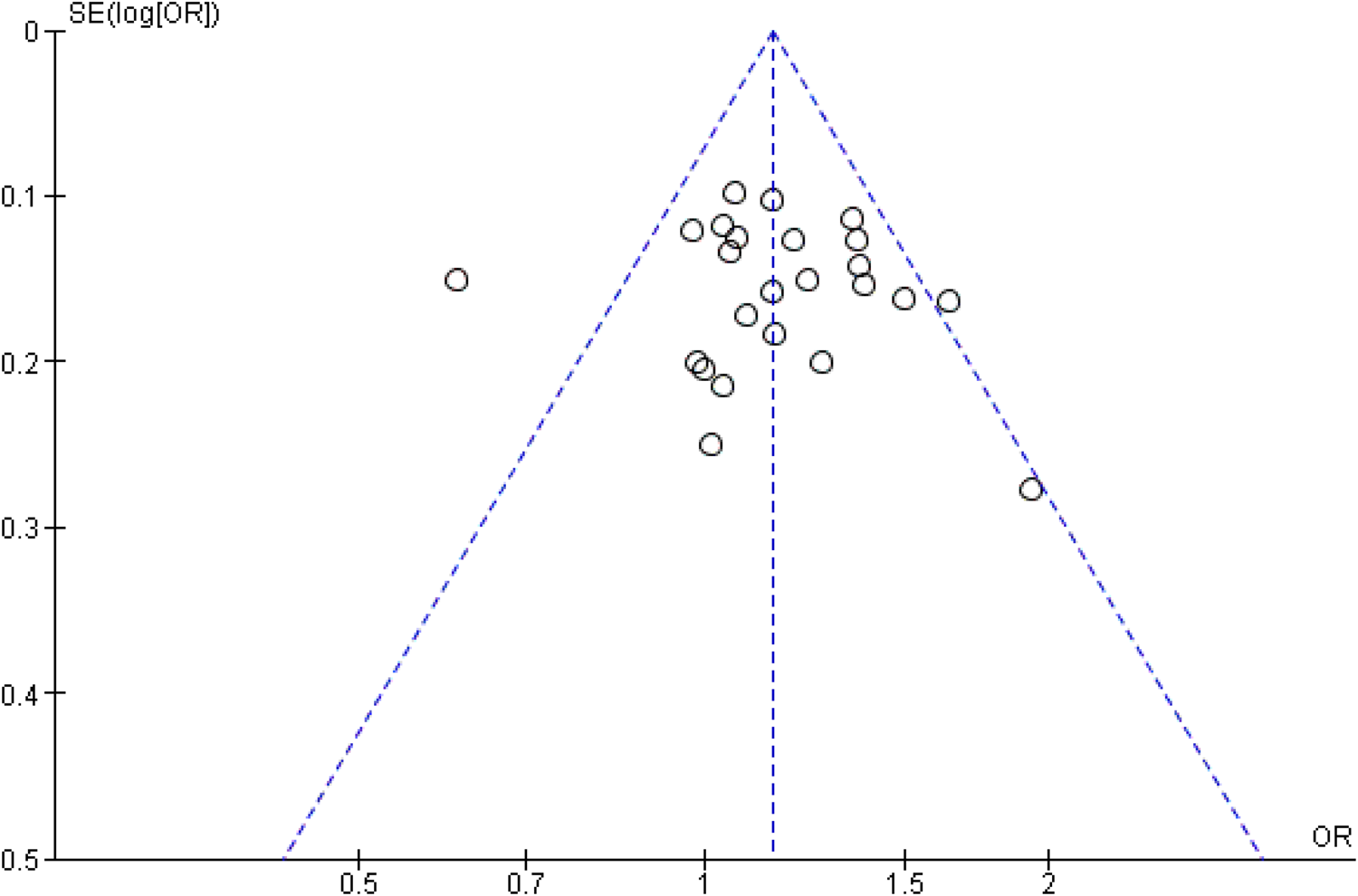
We carried out a random-effects meta-analysis on the selected studies (see Appendix S4 in Supplementary Material for reproducible data). Across the 24 studies, the main effect revealed a positive and significant association between prior language exposure and NWR performance (OR: 1.15 [1.06, 1.25], p < .0005). Figure 1 displays the forest plot for the 24 included studies. The funnel plot in Figure 2 shows low heterogeneity across studies (I2 = 44%). Sensitivity analysis on the included studies revealed the main effect does not change when removing each included study separately.
Forest plot of the association between nonword repetition and language exposure.

Funnel plot of the association between nonword repetition and language exposure.

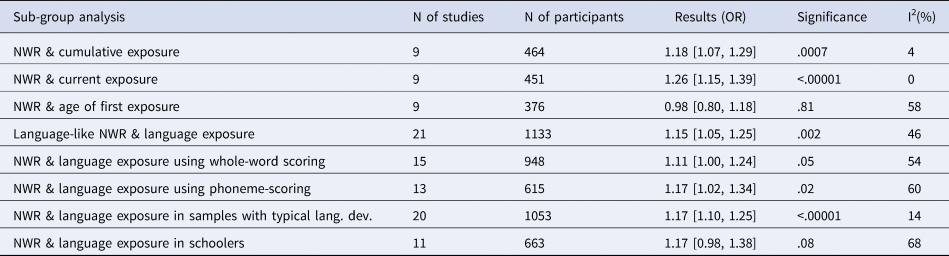
We then carried out subgroup analyses to study the effect of different variables that can affect the main effect (see Table 2 for summary findings and Appendix S5 for forest and funnel plots of each subgroup analysis).
Summary of evidence from sub-group analysis.

Regarding the impact of the language exposure measure, while better performance on NWR measures was exhibited by children with higher levels of cumulative (OR: 1.18 [1.07, 1.29], p = .00007, I2 = 4%) or current (OR: 1.26 [1.15, 1.39], p < .00001, I2 = 0%) exposure, the same was not true for age of first exposure, which did not seem to be related with NWR performance (OR: 0.98 [0.80, 1.18], p = .81, I2 = 58%).
Concerning NWR research designs, the main effect did not change when using language-like items (OR: 1.15 [1.05, 1.25], p = .002, I2 = 46%).
Looking at the NWR scoring method, the association between NWR and language exposure remained significant when using phoneme scoring (OR: 1.17 [1.02, 1.34], p = .02; I2 = 60%), although the sensitivity analysis revealed that the main effect changed in one case (OR: 1.15 [1.00, 1.32], p = .06; I2 = 60% when removing Parra et al., Reference Parra, Hoff and Core2011). When using whole-word scoring, the main effect approached but did not reach significance (OR: 1.11 [1.00, 1.24], p = .05; I2 = 54%); sensitivity analysis revealed that the main effect was still significant in three cases (OR: 1.11 [1.00, 1.24], p < .00001; I2 = 0% when removing Antonijevic et al., Reference Antonijevic, Lyons, Malley, Meir, Haman, Banasik, Carroll, McMenamin, Rodden and Fitzmaurice2019; OR: 1.12 [1.00, 1.25], p = .04; I2 = 56% when removing Kołak, Reference Kołak2020; OR: 1.12 [1.01, 1.26], p = .04; I2 = 57% when removing Tuller et al., Reference Tuller, Hamann, Chilla, Ferré, Morin and Prevost2018). Then, the main effect did not change when considering effect size only from children with typical language development (OR: 1.17 [1.10, 1.25], p = .00001, I2 = 14%).
Considering chronological age, when looking at effect sizes collected in schoolers and beyond, the association between NWR and language exposure did not reach significance (OR: 1.17 [0.98, 1.38], p = .08, I2 = 68%); sensitivity analysis revealed that the main effect was still significant in one case (OR: 1.24 [1.11, 1.39]; p = .0001; I2 = 18% when removing Antonijevic et al., Reference Antonijevic, Lyons, Malley, Meir, Haman, Banasik, Carroll, McMenamin, Rodden and Fitzmaurice2019).
Finally, we looked at the effect of selection bias on the meta-analysis (see Appendix S6 for further information). Concerning the representativeness of the cohort, the main effect of the meta-analysis did not change considering studies with a sample size larger than 50 participants (OR: 1.14 [1.06, 1.22], p = .0003, I2 = 0%). When considering studies with a sample size smaller than 50, the main effect approached and did not reach significance (OR: 1.18 [0.99, 1.41]; p = .06; I2 = 65%), but sensitivity analysis revealed the main effect did not change in one case (OR: 1.27 [1.14, 1.42]; p < .0001; I2 = 1% when removing Antonijevic et al., Reference Antonijevic, Lyons, Malley, Meir, Haman, Banasik, Carroll, McMenamin, Rodden and Fitzmaurice2019).
Then, considering the publication status of the work, while the main effect did not change when considering only evidence from published articles (OR: 1.17 [1.05, 1.31], p = .004, I2 = 59%), it approached but did not reach significance when considering only gray literature (OR: 1.11 [1.00, 1.22], p = .05, I2 = 0%).
Looking at bilingual status between participants, the main effect was still significant for participants sharing both major and native languages (OR: 1.21 [1.13, 1.31], p < .00001, I2 = 6%). For participants sharing only the major language, the association was not significant (OR: 1.11 [0.89, 1.38], p = .36, I2 = 71%), but sensitivity analysis revealed the main effect did not change in one case (OR: 1.20 [1.02, 1.41], p = .03, I2 = 35% when removing Antonijevic et al., Reference Antonijevic, Lyons, Malley, Meir, Haman, Banasik, Carroll, McMenamin, Rodden and Fitzmaurice2019). Concerning research designs using language-like NWR, the main effect was still significant across data bearing on major languages (OR: 1.18 [1.09, 1.28], p < .0001, I2 = 22%).
Finally, regarding the length of NWR lists, while the main effect was still significant for lists with more than 40 nonwords (OR: 1.25 [1.12, 1.41], p = .0001, I2 = 30), it was no longer significant for 16–24 nonword lists (OR: 1.01 [0.86, 1.19], p = .091, I2 = 57%).
Last, across syllabic range, the main effect did not change for the 1–4, 1–5, or 2–5 syllabic range group (OR: 1.27 [1.13, 1.42], p <.00001, I2 = 31%). Similar results have been found for nonwords of two or three different lengths, excluding 6-syllable nonwords and above (OR: 1.11 [1.01, 1.22], p = .03, I2 = 24%), but sensitivity analysis revealed the main effect changed in four cases (OR: 1.09 [0.99, 1.19], p =.09, I2 = 17% when removing Gibson et al., Reference Gibson, Summers, Peña, Bedore, Gillam and Bohman2015; OR: 1.10 [1.00, 1.22], p =.06, I2 = 27% when removing Kehoe et al., Reference Kehoe, Poulin-Dubois and Friend2021; OR: 1.08 [0.99, 1.18], p =.08, I2 = 8% when removing Parra et al., Reference Parra, Hoff and Core2011; OR: 1.09 [0.99, 1.20], p =.08, I2 = 18% when removing Sharp, & Gathercole, Reference Sharp and Gathercole2013).
Qualitative analysis
Even though subgroup analyses were not conducted for subgroups with fewer than eight studies, here we report the individual results of those studies with the aim of sharing evidence for qualitative analysis.
Three included studies reported data using non language-like stimuli. In detail, they all used cross-linguistic items. Among these three studies, two reported a non-significant association between NWR performance and language exposure (Huls, Reference Huls2017; Vaahtoranta et al., Reference Vaahtoranta, Suggate, Lenhart and Lenhard2021), while one article reported mixed evidence (Öberg, Reference Öberg2020). Two other included studies used cross-linguistic nonwords but they report overall NWR performance including both language-like and cross-linguistic nonwords (de Almeida et al., Reference de Almeida, Ferré, Morin, Prévost, dos Santos, Tuller, Zebib and Barthez2017; Tuller et al., Reference Tuller, Hamann, Chilla, Ferré, Morin and Prevost2018).
Taking into account studies on children with atypical language development only, three of them found a non-significant association between NWR and language exposure (de Almeida et al., Reference de Almeida, Ferré, Morin, Prévost, dos Santos, Tuller, Zebib and Barthez2017; Li'el, Reference Li'el2017; Vaahtoranta et al., Reference Vaahtoranta, Suggate, Lenhart and Lenhard2021).
Looking at the moderator effect of subgroups with children younger than six years, mixed evidence has been found. In detail, results collected from studies on toddlerhood revealed significant and positive associations (Core et al., Reference Core, Chaturvedy and Martinez-Nadramia2017; Parra et al., Reference Parra, Hoff and Core2011), significant and negative associations (Core et al., Reference Core, Chaturvedy and Martinez-Nadramia2017), and non-significant associations (Kehoe et al., Reference Kehoe, Poulin-Dubois and Friend2021), while one study found both significant and nonsignificant associations (Kołak, Reference Kołak2020). Data collected on preschoolers revealed non-significant associations between NWR and language exposure (Farabolini et al., Reference Farabolini, Rinaldi, Caselli and Cristia2021; Kehoe et al., Reference Kehoe, Poulin-Dubois and Friend2021; Limacher, Reference Limacher2019; Pérez-Navarro et al., Reference Pérez-Navarro, Molinaro and Lallier2020; Sharp, & Gathercole, Reference Sharp and Gathercole2013), except for one study that found both significant and nonsignificant associations (Vaahtoranta et al., Reference Vaahtoranta, Suggate, Lenhart and Lenhard2021).
Among the five studies with data bearing on native language, non-significant (Core et al., Reference Core, Chaturvedy and Martinez-Nadramia2017; Pérez-Navarro et al., Reference Pérez-Navarro, Molinaro and Lallier2020; Vaahtoranta et al., Reference Vaahtoranta, Suggate, Lenhart and Lenhard2021), significant (Engel de Abreu et al., Reference de Abreu PMJ, Baldassi, Puglisi and Befi-Lopes2013), and mixed results (Sharp, & Gathercole, Reference Sharp and Gathercole2013) have been found. Considering parents’ bilingual status, no study included children sharing their native language (which is not the major language of the geographical area) with both parents, while on samples with at least one parent speaking the native language, significant (Duncan, & Paradis, Reference Duncan and Paradis2016; Engel de Abreu et al., Reference de Abreu PMJ, Baldassi, Puglisi and Befi-Lopes2013; Parra et al., Reference Parra, Hoff and Core2011), non-significant (Farabolini et al., Reference Farabolini, Rinaldi, Caselli and Cristia2021; Li'el, Reference Li'el2017; Limacher, Reference Limacher2019) and mixed (Kołak, Reference Kołak2020) evidence has been found.
Similarly, for NWR lists containing 8–16 or 24–40 stimuli, significant (Parra et al., Reference Parra, Hoff and Core2011) and non-significant (Brandeker, & Thordardottir, 2015; Kehoe et al., Reference Kehoe, Poulin-Dubois and Friend2021; Öberg, Reference Öberg2020; Vaahtoranta et al., Reference Vaahtoranta, Suggate, Lenhart and Lenhard2021) associations between NWR and language exposure were found. Finally, looking at the nonwords’ syllabic length, three studies used NWR lists with a single length, with more than four different lengths, or including 6-syllable items and above, and they all found non-significant associations between NWR and language exposure (Li'el, Reference Li'el2017; Limacher, Reference Limacher2019; Reid, Reference Reid2019).
Discussion
Our meta-analysis investigated the association between prior language exposure and NWR performance in bilingual children, and we found a significant and positive correlation. We then carried out subgroup analyses to further examine which variables might affect the association. These revealed that the main effect remained significant when considering only studies that used cumulative exposure, current exposure, language-like stimuli, phoneme scoring, or data from children with typical language development. On the contrary, the association between NWR and language exposure was not significant when using age of first exposure or data from children older than 6, and it was weak when using whole-word scoring. The main effect was biased by the representativeness of the exposed cohort (i.e., the main effect changed when considering only studies with a sample size lower than 50), by participants’ bilingual status (the main effect was no longer significant on samples composed by participants sharing only one language), and by publication status (it approached significance when considering only gray literature). Finally, the main effect was biased by the number of stimuli included in the NWR list (studies with 16-24 nonword lists changed the main effect).
We found that both current and cumulative exposure were associated with NWR performance, while, interestingly, age of first exposure to a language was not. A possible interpretation of this finding is that the former measures might be more representative of and more closely associated with language development in bilingual children than the latter. Another possible interpretation is that both current and cumulative exposure are measures focused on the amount of exposure received, while age of first exposure is related to when it is received, more particularly to its onset, and thus to considerations related to the sensitive period for language acquisition and development. Another possibility is that age of first exposure might play a core role in early language development (e.g., in the first three years of life), while the participants of the included studies are older (with a mean age of 68.4 months).
Nearly all the studies included in this meta-analysis employed quantitative language exposure measures. Quality of input features (e.g., exposure to native as opposed to non-native speakers, intra- and inter-language variability among speakers, speakers’ lexicon, syntactic complexity, and variability in the use of concrete as opposed to abstract conversations) should be taken into account to analyze the moderator effect on the association between the role of language exposure and linguistic experience on language development (Anderson, Graham, Prime, Jenkins, & Madigan, Reference Anderson, Graham, Prime, Jenkins and Madigan2021; Hoff, Reference Hoff2020). Unfortunately, few works measure and analyze the quality of input. Similarly, parental beliefs and expectations about language proficiency and the importance of each of the languages the child is exposed to might play a role in the weight with which language exposure can affect language development (Ronderos, Castilla-Earls, & Marissa Ramos, Reference Ronderos, Castilla-Earls and Marissa Ramos2021).
Looking at the type of NWR stimuli, positive and significant associations were found for studies using language-like nonwords. These results support the assumption that language-like stimuli are related to language exposure in the target language. So, when using language-like stimuli on bilingual populations, the language-specific exposure received by a bilingual child on the target language is related to NWR performance. Moderation analysis on non language-like stimuli was not run since only three studies reported effect sizes using non language-like stimuli. These three studies all report non-significant associations between NWR and language exposure, which are in line with the idea that non language-like stimuli should maximally reduce the impact of exposure to a target language on NWR (Chiat, & Polišenská, Reference Chiat and Polišenská2016). However, this evidence should be taken with caution since it came from single effect sizes of three studies, not from moderation analysis of the current meta-analysis.
Looking at the effect of the NWR scoring system, we found the main effect does not change when using phoneme scoring while, surprisingly, it approaches but does not reach significance when using whole-word scoring (but sensitivity analysis revealed the main effect is still significant in three cases). This finding of a weak significance is not in line with previous results which suggested that both NWR scoring systems can be employed similarly to study the impact of language exposure on NWR performance (Brandeker, & Thordardottir, Reference Brandeker and Thordardottir2015; Farabolini et al., Reference Farabolini, Rinaldi, Caselli and Cristia2021). A possible interpretation is that while phoneme scoring analyzes the phonological processes involved in phonological short-term memory, which is associated with language exposure, it might be the case that whole-word scoring relies mainly on item-level processing, which might involve mechanisms closer to lexical processing and more independent from language exposure.
We found that the association between NWR and language exposure was not moderated by data from children with typical language development, while subgroup analysis on children with atypical language development could not be run due to the low number of studies in this subgroup. We encourage further research into this because it is possible that the variability introduced by the language difficulties of children with atypical language development is such that it overshadows other factors like language exposure. Indeed, not only is atypical language development an umbrella term covering various types of language difficulties for which different identification criteria are used in the literature, but these difficulties also present somewhat differently from one child to another. Hence, the impact of language exposure on NWR performance might be secondary, in the presence of atypical acquisition patterns, to underlying mechanisms related to language difficulties.
Finally, regarding chronological age, the main effect changed when considering evidence from schoolers older than six years. Following the hypothesis that NWR and word learning involve similar phonological short-term memory processes, at earlier stages of language acquisition, language exposure might enhance these mechanisms, which might in turn result in the association between language exposure and performance in NWR. Later on, since language exposure to a target language enhances phonological and lexical development in that language, older bilingual children might have reached both phonological and lexical abilities which are less dependent on language exposure: at this stage, NWR might be more related to such phonological and lexical abilities than to language exposure. Further studies should disentangle the contribution of language exposure and phonological short-term memory processes involved in tasks requiring retaining, storing, retrieving, and reproducing a linguistic sequence across age.
Regarding the risk of bias assessment, the main effect changed when considering studies with fewer than 50 children and studies published as gray literature. The lack of significance in studies with sample sizes lower than 50 might be due to a lack of statistical power. In turn, studies with low sample size cannot be considered representative of a target population. The weak significance of the association between NWR and language exposure for non peer-reviewed works might suggest there is a bias against the publication of negative results.
Many studies did not report the parents’ bilingual status, so there was a lack of information regarding the subgroups we defined related to this information (both or at least one parent speak their native language to the child which is different from the major one). Thus, no interpretations can be elaborated on the moderation of the target variable. We hope further research can address this to explore the potential role of having one or both parents speaking one or more languages on children's NWR performance and, in general, on language development.
Then, the main effect changed when considering studies with bilingual children sharing the major language but having been exposed to different languages. This might be explained by the fact that bilingual populations with different native languages have acquired language through language-specific constraints. Additionally, recent research suggested that also cultural, sociolinguistic and pragmatic rules influence language development (Cristia, Farabolini, Scaff, Havron, & Stieglitz, Reference Cristia, Farabolini, Scaff, Havron and Stieglitz2020; Loukatou, Scaff, Demuth, Cristia, & Havron, Reference Loukatou, Scaff, Demuth, Cristia and Havron2021). From this perspective, we advance the hypothesis that such constraints and rules might also be related to NWR performance.
We underline the heterogeneity in both the number of nonwords used to calculate NWR performance (ranging from 12 in Parra et al., Reference Parra, Hoff and Core2011 to 108 in Sharp, & Gathercole, Reference Sharp and Gathercole2013; mean = 36.72) and nonwords’ syllabic range (ranging from syllabic ranges of 1–2 in Sharp, & Gathercole, Reference Sharp and Gathercole2013 to 1–7 in Duncan, & Paradis, Reference Duncan and Paradis2016). The number of nonwords was a moderator of the association studied: the main effect changed for an amount of stimuli between 16 and 24 but did not when considering studies using more than 40 stimuli. This evidence does not support the hypothesis that a high amount of nonwords affects NWR due to, for example, decrease of attention or fatigue. At the same time, this result underlines that language exposure is associated with NWR lists including more than 40 stimuli; when using NWR lists with a high amount of stimuli, scholars and practitioners should bear in mind that NWR performance seems to be associated with language exposure.
Concerning syllabic range subgroup analyses, the association between language exposure and NWR lists with nonwords of two or three different lengths excluding 6-syllable nonwords and above is still significant, but sensitivity analysis revealed that the association is weak. The studies from these subgroups included syllabic ranges as 1-2, 1-3 or 2-4. One possible interpretation is that the lists containing stimuli with a narrow syllabic range might not be related to language exposure. An alternative hypothesis is that such syllabic ranges mainly involve phonological processes which are more related to mechanisms underlying phonological short-term memory than language exposure. In detail, it might be possible that these stimuli with relatively short length are mainly related to phonological processing of nonwords rather than to previous language exposure, but further research is needed. We highlight that we did not control for nonword length, and we suggest further studies should shed light on the impact of sub-lexical cues on the association between NWR and language exposure.
Finally, we also underline that different procedures have been found regarding NWR presentation, which are often administered orally or digitally through audio-recorded stimuli. The NWR presentation mode was not directly related with year of publication (e.g., Summers et al., Reference Summers, Bohman, Gillam, Peña and Bedore2010 used digital presentation; Kehoe et al., Reference Kehoe, Poulin-Dubois and Friend2021 used oral presentation) nor with NWR type; further research should consider experimenters’ prosodic and articulatory features which could influence NWR administration and, as a consequence, NWR performance. Audio-recorded administration might be the optimal methodological choice (Sahlen, Reuterskiold-Wagner, Nettelbladt, & Radeborget, Reference Sahlen, Reuterskiold-Wagner, Nettelbladt and Radeborg1999) to maximally reduce language-specific suprasegmental features for stimuli, as well as possibly ensuring homogeneity of administration to all participants.
Concerning clinical implications, we suggest, in line with previous literature, that NWR should be used together with other assessment tools, such as receptive and expressive lexical tasks (Haman, Wodniecka, Marecka, Szewczyk, Białecka-Pikul, Otwinowska, Mieszkowska, Łuniewska, Kołak, Miękisz, Kacprzak, Banasik,, & Foryś-Nogala, Reference Haman, Wodniecka, Marecka, Szewczyk, Białecka-Pikul, Otwinowska, Mieszkowska, Łuniewska, Kołak, Miękisz, Kacprzak, Banasik and Foryś-Nogala2017), narrative tests (Gagarina, Klop, Kunnari, Tantele, Välimaa, Balčiūnienė, Bohnacker, & Walters, Reference Gagarina, Klop, Kunnari, Tantele, Välimaa, Balčiūnienė, Bohnacker and Walters2012), or sentence repetition lists (Meir, Walters, & Armon-Lotem, Reference Meir, Walters and Armon-Lotem2015), in order to have information from different language domains.
Limitations
Several limitations have to be reported regarding included articles in the current review. First, we excluded reports written in languages other than English, Spanish, French or Italian.
Second, there are differences across studies that might cause heterogeneity in our work. Sources of heterogeneity might be related to NWR features (e.g., type, scoring, administration, amount and length of stimuli) and bilingual background (e.g., exposure received, language exposure measure, parents’ native languages, same or different languages spoken by the children, participants having the same or different native languages).
Third, there are research articles reporting quantitative results only for significant effect sizes (e.g., Kołak, Reference Kołak2020). Therefore, non-significant effect sizes from those studies could not be included in the meta-analysis. Such results, had they been included, possibly could have modified our results.
Fourth, risk of bias assessment is considered mandatory in meta-analysis considering randomized-trial designs (Boutron, Page, Higgins, Altman, Lundh, Hróbjartsson, & Group, Reference Boutron, Page, Higgins, Altman, Lundh and Hróbjartsson2019), which is not the case of our study. However, we decided to carry it out to obtain more information on the effect of potential bias on our main effect. It should be noted that the categorization of some of the selected biases (e.g., amount of nonwords and syllabic range) was chosen in an arbitrary fashion. Additionally, the impact of other sub-lexical cues (e.g., length, wordlikeness, phonotactic probability) on NWR was not analyzed in the current study and thus we cannot rule out the possible impact of these features on NWR accuracy. Mixed evidence has been reported in the literature on the effect of nonword length on NWR performance. While some authors found that NWR performance decreases as nonword syllabic length increases (Chiat, & Polišenská, Reference Chiat and Polišenská2016; Gibson et al., Reference Gibson, Summers, Peña, Bedore, Gillam and Bohman2015), others reported the absence of a significant effect (Farabolini et al., Reference Farabolini, Rinaldi, Caselli and Cristia2021). Moreover, length seems to differently impact NWR across languages (e.g., 2- to 5-syllable Spanish-like stimuli showed similar complexity as 1- to 4-syllable English-like stimuli in Spanish-English bilinguals; Irizarry-Pérez, Peña, & Bedore, Reference Irizarry-Pérez, Peña and Bedore2021). Hopefully, future research will help clarify this issue.
Then, our results include data of NWR tasks built on different language-specific phonological constraints. Therefore, stimuli with similar characteristics might still differ greatly across languages. Differences such as articulatory complexity or the number of phonemes required to reproduce stimuli might affect NWR performance and its association with language exposure.
In addition, similarity between the languages the child is exposed to might influence said association. For example, bilinguals exposed to languages that are similar (e.g., French and Spanish) might benefit from the prior exposure received in the native language and “use it” to acquire the major language (i.e., language transfer) more than children exposed to languages with lower similarity (e.g., Mandarin and English).
We also point out that the studies included in our work include in their samples children attending the last year of kindergarten and the first years of primary schools. These children are exposed to different degrees to literacy education programs and they have reached different levels of literacy proficiency. Literacy can have an impact on the ability to repeat a sequence of phonemes and, thus, on NWR performance. Mixed evidence has been found on the association between NWR and both literacy and language exposure (Cristia et al., Reference Cristia, Farabolini, Scaff, Havron and Stieglitz2020). The effect of literacy on NWR performance should be considered.
A further limitation concerns the statistical nature of subgroup analysis and is the fact that it is a bivariate analysis. Subgroup analysis investigates the effect of a target variable on the studied association without controlling for other variables (e.g., test of interactions among variables to explain variance in NWR performance; Summers et al., Reference Summers, Bohman, Gillam, Peña and Bedore2010). Thus we cannot ensure that results from our subgroup analysis were not influenced by other variables.
Finally, we underline that all included studies were conducted in Western, educated, industrialized, rich, and democratic (WEIRD) countries. It would be interesting to collect data in non-WEIRD countries to analyze the weight of social and cultural differences in developmental pathways (Muthukrishna, Bell, Henrich, Curtin, Gedranovich, McInerney, & Thue, Reference Muthukrishna, Bell, Henrich, Curtin, Gedranovich, McInerney and Thue2020). A recent work revealed that, in a community of Amazonian villages where infants are rarely spoken to, monolingual kids showed lower NWR scores if compared to data from monolingual children from WEIRD contexts (Cristia et al., Reference Cristia, Farabolini, Scaff, Havron and Stieglitz2020).
Conclusions
As conveyed throughout this work, heterogeneity is the keyword to describe differences both between and within bilingual populations, considering each individual's linguistic background, the languages spoken, and the geographical areas. Nonetheless, research and clinical communities are working to improve multilingual language assessment for children exposed to more than one language. This review and meta-analysis, which included studies on bilingual children with a wide range of languages spoken, geographical areas and chronological ages, shows that NWR performance is significantly associated with the prior language exposure received, especially as measured by cumulative and current exposure. Further studies should focus on this association in bilingual children with atypical language development, as well as on NWR lists developed with non language-like or cross-linguistic stimuli. Our findings encourage the use of NWR tasks on bilingual children, but researchers and clinicians should be aware that language exposure plays a core role in the NWR performance of this population. Given this task's potential for bilingual language assessment, we hope this work will contribute to a better and deeper understanding of the cognitive and linguistic mechanisms involved in it.
Acknowledgements
The first author contributed to building the research design: he has carried out the literature review, data collection, data extraction and coding, as well as the quantitative meta-analysis; he has also contributed to data interpretation and the writing of the manuscript. The second author has carried out the literature review, data collection and data extraction, and she has contributed to the writing. The third author contributed to the writing of the manuscript and to the evaluation of its coherence and consistency, with an additional role of senior researcher. The last author contributed to the methodological research design, quantitative meta-analysis and data interpretation with an additional role of senior researcher.
Competing interests
Competing interests: The author(s) declare none.
Data availability statement
We present reproducible data [Table S2] and reproducible data code [Appendix S4].
Supplementary Material
For supplementary material accompanying this paper, visit http://dx.doi.org/10.1017/S1366728922000906
Appendix S1. Prisma flow-diagram.
Appendix S2. Inter-rater reliability on literature screening.
Appendix S3. Inter-rater data extraction.
Appendix S4. Reproducible data for meta-analysis.
Appendix S5. Forrest and funnel plots from subgroup analyses.
Appendix S6. Forrest and funnel plots from sub-group analysis for risk of bias assessment.
Table S1. Literature screening.
Table S2. Data extraction.
Table S3. Indication for risk of bias.