Introduction
Due to the increasing number of bilingual people all over the world, bilingualism has received growing attention over the years. One important difference between monolingual and bilingual children is that the latter group receives less input of each of their languages compared to children whose input consists of one language. An ensuing question is whether language acquisition of bilingual children is the same in time and in developmental pattern as that of monolingual children. This issue is often placed in the context of a discussion of the roles of quality and quantity of language input in the process of language acquisition (e.g. De Houwer, Reference De Houwer2007; Duursma, Romero-Contreras, Szuber, Proctor & Snow, Reference Duursma, Romero-Contreras, Szuber, Proctor, Snow, August, Calderón and Carlo2007; Leseman & van den Boom, Reference Leseman and Van den Boom1999; Pearson, Fernandez, Lewedeg & Oller, Reference Pearson, Fernández, Lewedeg and Oller1997; and Unsworth, Reference Unsworth2013 for a recent overview). The current study reports on production data of the Dutch past tense in a group of Dutch–Hebrew bilingual children to evaluate the effects of type frequency of the past tense morphemes and token (lexical) frequency in children who have had less exposure to Dutch compared to monolingual children as a consequence of their bilingualism.
Comparisons between monolingual and bilingual children's rate and patterns of language acquisition have yielded mixed findings. For instance, some studies suggest that bilingual children show a faster rate of development than their monolingual peers (e.g. Kupisch, Reference Kupisch2007) but others do not find evidence of differences (e.g. Gutierrez-Clellen, Simon-Cereijido & Wagner, Reference Gutierrez-Clellen, Simon-Cereijido and Wagner2008; Mattock, Polka, Rvachew & Krehm Reference Mattock, Polka, Rvachew and Krehm2010; Paradis & Genesee, Reference Paradis and Genesee1996). Another type of findings are those that have demonstrated differences in rates of acquisition in some, but not all, language domains or in only one of the two languages relative to monolingual children (e.g. Fennell, Byers-Heinlein & Werker, Reference Fennell, Byers‐Heinlein and Werker2007; Gathercole, Reference Gathercole2007; Leseman, Reference Leseman2000; Nicoladis, Palmer & Marentette, Reference Nicoladis, Palmer and Marentette2007; Pérez-Leroux, Pirvulescu & Roberge, Reference Pérez-Leroux, Pirvulescu and Roberge2009; Thordardottir, Rothenberg, Rivard & Naves, Reference Thordardottir, Rothenberg, Rivard and Naves2006; Uccelli & Paez, Reference Uccelli and Páez2007; Unsworth, Reference Unsworth2013). For instance, both Thordardottir et al. (Reference Thordardottir, Rothenberg, Rivard and Naves2006) and Nicoladis et al. (Reference Nicoladis, Palmer and Marentette2007) found that bilingual children were less accurate in verbal morphology (past tense in Nicoladis et al., Reference Nicoladis, Palmer and Marentette2007) than monolingual children in one language, but that this delay was less prominent in the other language of the bilingual children.
One source of variation that explains these mixed findings is the type of bilingualism of the children who participated in these studies. Some children have been exposed to two languages from birth onwards (simultaneous bilingualism), whereas other children are first exposed to a second language at some point in their childhood (sequential bilingualism). However, even within a group of simultaneous bilingual children, the proficiency of either language can vary compared to monolingual children (see Thordardottir et al., Reference Thordardottir, Rothenberg, Rivard and Naves2006 for findings on vocabulary and expressive syntax). Thordardottir (Reference Thordadottir2011) studied the differences in exposure to one of the two languages in a group of simultaneous bilingual children (English–French) and demonstrated that the amount of exposure determined the vocabulary score in either French or English (see also Pearson et al., Reference Pearson, Fernández, Lewedeg and Oller1997; Unsworth, Reference Unsworth2013). Thus, the amount of input is an important factor in the acquisition pattern of bilingual children.
Another variable, in addition to the amount of exposure, that plays a role in the rate and pattern of bilingual children is transfer of characteristics of one language to the other (see Foursha-Stevenson & Nicoladis, Reference Foursha-Stevenson and Nicoladis2011; Hulk & Müller, Reference Hulk and Müller2000; Yip & Matthews, Reference Yip and Matthews2007, for recent overviews). Linguistic transfer presumably interacts with the type of bilingualism. Transfer may be more prominent in sequential bilingualism where the morphosyntactic properties of the first language influence the morphosyntactic acquisition pattern of the second language. Recent studies have shown that the morphosyntactic specifics of one language can play a role in acquisition of verb inflection in the second language (Blom & Paradis, Reference Blom and Paradis2013; Blom, Paradis & Sorensen Duncan, Reference Blom, Paradis and Sorenson Duncan2012). Blom et al. (Reference Blom, Paradis and Sorenson Duncan2012) assessed the production of English subject–verb agreement allomorphs (third person singular; /s/, /z/, and /ɪz/) in children with English as their second language. Two groups of children participated: children with inflecting languages and children with isolating languages (no overt verb agreement inflection) as their first language. Spontaneous speech was analyzed five times during two years. Results showed that children with inflecting languages as their first language were more accurate in English verb inflection than those with isolating languages. This points to an effect of transfer of morphosyntactic properties from the first language. In addition, production of the /z/ allomorph was correct more often than /s/ in children with an isolating language as their first language. This is explained by both a higher type (allomorph) frequency of /z/ compared to /s/ and a higher token frequency of the verbs demanding a /z/ allomorph. Both /z/ and /s/ allomorphs were produced correctly more frequently than /ɪz/, again agreeing with the frequency of input, as /ɪz/ is the least frequent allomorph. Thus, input frequency was found to guide development of agreement allomorph production especially in sequential bilingual children with an isolating first language.
Cross-linguistic differences and the way these differences may explain variations in rate of morphosyntactic acquisition between the two languages have also been reported in groups of French–English bilingual children (Nicoladis et al., Reference Nicoladis, Palmer and Marentette2007; Nicoladis & Paradis, Reference Nicoladis and Paradis2012; Paradis, Nicoladis, Crago & Genesee, Reference Paradis, Nicoladis, Crago and Genesee2010). In both French and English, the bilingual children were better at inflecting regular verbs for the past tense than the irregular past tense. The differences in accuracy outcomes between regulars and irregulars depended on the language in which this was measured. For French the differential accuracy rates between regulars and irregulars were smaller than for English. Paradis et al. (Reference Paradis, Nicoladis, Crago and Genesee2010) suggest that this pattern is related to the token/type frequency of the English irregular, which is different from that in French. Type frequency is a particularly relevant distributional cue as high type frequency has been suggested to facilitate acquisition (Bybee, Reference Bybee2007, Reference Bybee, Robinson and Ellis2008). In English, the type frequency (the number of verbs that are inflected in the same way) of irregular forms is low, but the token frequency of irregular verbs is high, whereas this is the opposite in French. As bilingual children usually have reduced exposure to language, irregular verb forms with low type frequency (as is the case in English) are more susceptible to delay than in languages in which the type frequency is high (French). Thus, frequency of occurrence (both type and token) plays a role in the acquisition pattern of the past tense. Cross-linguistic differences in such frequency distributions can explain cross-linguistic acquisition patterns within bilingual children.
In the current study we were particularly interested in examining the effect of bilingualism on input factors that have been found to influence past tense production in Dutch-speaking monolingual children. In Dutch, the regular past tense is formed by adding one of two allomorphs (te or de) to the verb stem, depending on its phonological characteristics. All stems ending in an underlyingly voiceless obstruent receive a te allomorph (e.g. past tense of bakken–bakte “bake–baked”) and all other verbs the de allomorph (e.g. kammen–kamde “comb–combed”). The distributions of the phonotactic pattern of the two allomorphs (the type frequency of the allomorph) are different. The combination of the verb stem + te is more frequent than verb stem + de in the Dutch language (following phonotactic frequency counts within a database of Dutch spoken language; Rispens & de Bree, Reference Rispens and de Bree2014). A previous study found effects of allomorph type on past tense productivity in Dutch in monolingual five- and seven-year-old children (Rispens & de Bree, Reference Rispens and de Bree2014). The five-year-olds showed an effect of type frequency, with te regular and novel verbs being inflected more accurately for the past tense than de verbs. The seven-year-olds demonstrated an advantage for inflecting the past tense with a te allomorph in novel verbs only. The past tense production of lexical regular verbs was in this group influenced by token (lexical) frequency, with verbs high in frequency being inflected more accurately.
In the present study, we compared bilingual and monolingual children on their production accuracy of the two past tense allomorphs (differing in type frequency) and on the influence of token frequency on the Dutch regular and irregular past tense of lexical and novel verbs. We assessed past tense inflection of lexical as well as novel verbs to address the sensitivity to the morphophonology involved in the regular past tense. Novel verb inflection cannot take place solely on the basis of lexical retrieval, which could be the case in lexical verbs (rote-learned). In order to inflect novel verbs correctly for the past tense, an accurate phonological analysis of the verb stem is needed to establish the underlying voice value of the final consonant (±voice) so that the correct allomorph can be selected. Thus, by adding novel verbs to our experimental task we aimed to address the morphophonological component of the past tense as directly as possible.
In addition to the regular past tense we also investigated irregular past tense production. In Dutch the majority of the past tenses of irregular verbs is formed by a vowel change in the stem without suffixation to the stem (e.g. hij slaat–hij sloeg “hit–hit”). The Dutch irregular past tense inflection resembles the frequency pattern of English irregulars (Paradis et al., Reference Paradis, Nicoladis, Crago and Genesee2010) in the sense that the token frequency of the irregulars is relatively high (Tabak, Schreuder & Baayen, Reference Tabak, Schreuder, Baayen, Kepser and Reis2005) and the type frequency is relatively low. In order to assess whether the assumption – that irregular verbs with low type frequency are more difficult to acquire – proposed by Paradis et al. (Reference Paradis, Nicoladis, Crago and Genesee2010) to account for their cross-linguistic findings also holds for Dutch, past tense productions of regular and irregular verbs were investigated in the current study.
In the present investigation, bilingual children were not only compared to monolingual children of the same chronological age (CA), but also to younger monolingual children with the same receptive vocabulary scores. This allowed us to investigate whether a potential difference with CA-matched monolingual children reflects a rate of development comparable to monolingual children matched on vocabulary age. This design also allowed us to investigate in particular whether inflections with low type frequency (irregular verb inflection relative to regular verbs and past tense inflection of regular verbs with the less frequent allomorph type de relative to te) are susceptible to delay in bilingual children relative to the age-matched monolingual group. Type frequency facilitates acquisition (Bybee, Reference Bybee2007, Reference Bybee, Robinson and Ellis2008) and as bilingual children will have had less exposure to input they will be most disadvantaged with elements that occur relatively infrequently and that are necessary for constructing the past tense.
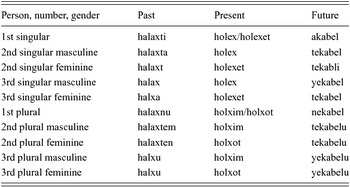
Dutch–Hebrew bilingual children participated in the current study. Hebrew has a rich morphological system for the past tense, as person, number and gender are visible in the inflection (Schwarzwald, Reference Schwarzwald2001), but there are no allomorphs involved in the past tense morphology. Table 1 (from Armon-Lotem, Reference Armon-Lotem2014) shows an example of the inflectional paradigm of Hebrew.
Verb inflections in Hebrew past and present tense of the verb holex “walk” and the future tense of the verb mekabel “get” (table from Armon-Lotem, Reference Armon-Lotem2014, Table 1, p. 10).

As can be seen, tense is marked by vowels in the stem, by suffixation or by prefixation in Hebrew. Table 1 lists (non-exhaustive) examples of the past, present and future markings. Hebrew thus has a richer morphological system than Dutch which contains two allomorphs depending on the phonology of the regular verb stem for the three singular forms. In Dutch, all regular plural forms are formed by the appropriate past tense allomorph (te or de) + n.
Research questions
The present study was undertaken to address the following questions. First, are Dutch–Hebrew bilingual children as accurate in their production of the Dutch past tense as monolingual Dutch children? As discussed above, two variables are likely to influence accuracy of past tense morphology: amount of exposure to language and the morphosyntactic properties of the other language. Related to this latter issue of transfer, we hypothesize that the rich morphological structure of Hebrew would not disadvantage the bilingual children in their sensitivity to producing the Dutch past tense. Regarding the issue of amount of exposure, the expectations are less clear-cut. On the basis of earlier studies with simultaneous bilingual children who showed lower accuracy in past tense morphology, we tentatively hypothesize that the accuracy of the past tense will be lower in our bilingual group (Nicoladis et al., Reference Nicoladis, Palmer and Marentette2007; Thordadottir et al. Reference Thordardottir, Rothenberg, Rivard and Naves2006). It should be pointed out here that the present study only looked at past tense productions in one language (Dutch). We thus cannot answer the question of whether one language is stronger relative to the other.
Our second question was whether Dutch–Hebrew bilingual children displayed the same type and token frequency effects in past tense production as monolingual Dutch children. We assume that the bilingual children have had less exposure to the Dutch language relative to their CA-matched monolingual peers and therefore have had less opportunity to analyze and process the distributions of phonotactic patterns (type frequency) and lexical items (token frequency) in the input. We hypothesize that the bilingual children would therefore be more disadvantaged by the less frequently occurring lexical elements (verbs with low token frequency) and phonotactic patterns (past tense inflections with lower type frequency: these are irregular verb past tenses and past tenses of regular lexical and novel verbs expressed by a de allomorph). We further hypothesize that in novel verb inflection the disadvantage for low type frequency would be more pronounced than in lexical verbs for the bilingual children. In the latter condition the sensitivity to the morphophonological component of the Dutch past tense (reflected by the choice of the allomorph and thus the type frequency) is tested more directly as there is no direct potential facilitation of storage of inflected verbs in the mental lexicon.
Finally, we addressed the question whether the bilingual children would behave similarly to a younger monolingual group who had the same Dutch receptive vocabulary size as the bilingual children. We hypothesize that, if a potential difference between the CA-matched monolingual and the bilingual children reflects a delay, then the latter group would be similar to monolingual children matched on receptive vocabulary. To further examine the past tense production patterns between the groups of children, qualitative analyses of their errors were made. Previously found differences between monolinguals and bilinguals have generally been reported in a quantitative way (in terms of being less or equally accurate), but some studies have demonstrated qualitative differences in the morphosyntactic domain (e.g. Yip & Matthews, Reference Yip and Matthews2007). Qualitative error comparisons in the current study between monolingual and bilingual children will not only provide more insight into cues used in the morphophonology of past tense generation, but it is also a welcome addition in the field of bilingual studies in general.
Method
Participants
Three groups of children participated: one group of Dutch–Hebrew bilingual children (BIL: n=11, mean age seven years, eight months (7;8)); one group of monolingual children matched on CA of the BIL group (CA MONO: n=30, mean age 7;9) and a group of monolingual children (VOCAB MONO: n=21, mean age 5;10) matched on receptive vocabulary score of the BIL group.
The CA MONO children were selected from four primary schools that were located in the North, Central and South-West regions of the Netherlands. All children attended second grade and only children who made normal progress in school and did not have any cognitive or emotional disturbances, such as attention deficit hyperactivity disorder, developmental dyslexia or autism, were selected for this study. All children had normal hearing and normal, or corrected-to-normal, vision. Only children who were raised with Dutch being the language spoken at home from birth onwards participated.
The younger VOCAB MONO children all attended kindergarten and came from three different primary schools located in the North and Central part of the Netherlands. The same exclusion criteria as the CA MONO children were used for selection of the younger monolingual group.
The BIL group all attended second grade (same class) at a Jewish school in the North-West of the Netherlands. The school has a bilingual policy in the sense that education is provided in both Dutch and Hebrew. For example, the children learn to read and write in both orthographies and receive language classes in both Dutch and Hebrew. Our group of children attended this school from four years of age and onwards and thus were comparable in their Dutch–Hebrew bilingual language environment during school hours. As the bilingual children were all at the end of second grade when they participated, they had all experienced almost two years of bilingual formal instruction in the Dutch and Hebrew languages and two years of bilingual education in kindergarten. Reports about language use at home revealed that all children grew up in a bilingual setting in which they all spoke both Hebrew and Dutch at home.
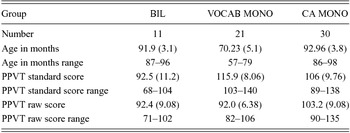
The Dutch version of the Peabody Picture Vocabulary Test-III-NL (PPVT, Schlichting, Reference Schlichting2005) was administered to all children to assess receptive vocabulary. Importantly, all individual children from both monolingual groups scored within normal limits (see Table 2 for the raw and standard scores). Two children of the BIL group scored below the normative mean (standard scores below 85; one of 68 and one of 83), but the mean of the group was within normal limits (see Table 2). We investigated whether the low scores of these two children were related to an unequal bilingual home environment with Dutch being spoken less. For one girl (standard score 68) this may indeed be the case, as she reported that she always spoke Dutch with her father at home, but that on average she spoke more Hebrew at home than Dutch. For the second child (PPVT standard score 83) there was no disadvantage for the amount of Dutch spoken at home. Importantly, the teacher reported that these two children displayed normal development and progress at school. A one-way ANOVA was carried out to compare the raw vocabulary scores between the groups and this analysis showed a significant difference between the groups, F(2,61)=22.05, p< .001). Post-hoc tests (Bonferonni correction) showed that the BIL children performed significantly lower than the CA MONO children (p=.001) but similar to the VOCAB MONO children (p = .99). The difference between CA MONO and the BIL children was also found when the two children of the BIL group with standard scores lower than 85 were removed (p=.008). The two children with the lower scores thus did not cause the overall difference for vocabulary scores between the two age-matched groups and we decided to include these children in the database to add power to this already relatively small-scale study.
Participant characteristics. Means, standard deviations (in parentheses) and ranges of age in months and PPVT scores (standard and raw).

Materials
Two tasks were administered to investigate past tense production: a task in which the past tense form of existing verbs was elicited and a task in which novel non-existing verbs were presented (see also Rispens & de Bree, Reference Rispens and de Bree2014, in which both tasks are discussed).
Task 1: Past tense production of existing verbs
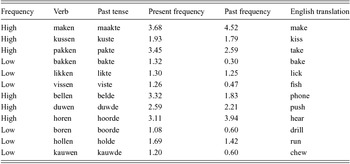
The past tense elicitation task of real words contained twelve regular and eight irregular verbs. Half of the verbs in both categories were high in token frequency on the basis of the logged values of the CELEX database (Baayen, Piepenbrock & van Rijn, Reference Baayen, Piepenbrock and Van Rijn1993) and half were low. The high token frequency regular verbs had a mean present tense frequency (1st, 2nd and 3rd person singular and plural verb forms) of 4.1 and a mean past tense frequency (1st, 2nd and 3rd person singular and plural verb forms) of 2.8 whereas the low frequency regular verbs had a mean present tense frequency of 1.3 and a mean past tense frequency of 0.8 (see Appendix 1 for a list of the verbs and the frequencies). There was no overlap between frequencies in the high/low condition and there was a significant difference between the high- and low-frequency verbs, regardless of the tense (mean present tense frequency t(10)=6.1, p=.001; mean past tense frequency t(10)=4.0, p = .006).
The regular verbs were also classified according to the type of past tense allomorph with which the verbs were inflected. Half of the verb stems ended in an underlying voiceless obstruent (four times /k/ and twice /s/, e.g. maken–maakte “make–made”), the other half in a voiced consonant (twice /l/, twice /r/ and twice /w/, e.g. horen–hoorde “hear–heard”; see Appendix 1). These stems were chosen as they are unambiguous with respect to devoicing and rendered unambiguous te or de expectations. All verbs had a consonant–vowel (CV) structure of the form CVCVC (e.g. maken “make”) in the infinitival form.
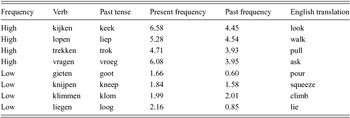
Eight irregular verbs were selected on the basis of high/low token frequency following the same method as for the regular verbs, e.g. knijpen–kneep “pinch–pinched”, lopen–liep “walk–walked”. The mean frequency of high token frequency verbs in the present tense was 5.7 and 4.2 of the past tense forms, whereas the low-frequency items had a mean token frequency of 1.9 and a past tense form frequency of 1.3. There was no overlap between frequencies in the high/low conditions and the difference in frequency between the high and low verbs was statistically significant (present tense frequency t(6)=8.75, p=.002; past tense frequency t(6)=8.19, p < .001). Comparing the frequencies of the regular and irregular verbs (see Appendices 1 and 2) it can be seen that irregular verbs have higher token frequencies than regular verbs (see also Tabak et al., Reference Tabak, Schreuder, Baayen, Kepser and Reis2005). All verbs in the infinitival form had a CVCVC structure (e.g. lopen). See Appendix 2 for a list of the items.
Task 2: Past tense production of novel verbs
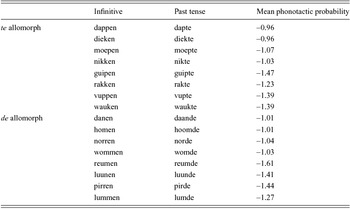
Sixteen novel verbs were created; half of the stimuli were voiced with respect to the final consonant of the verb stem (e.g. norren) and half were voiceless (e.g. rakken). Similar to the existing verbs, only verb stems ending in consonants that unambiguously demand the te or de were chosen. All final verb stems had a CVC structure (e.g. nor-) so that all target answers (stem + allomorph) resulted in a CVCCV structure. As processing of pseudo-words can be influenced by the phonotactic probability of the pseudo-word (Rispens & Baker, Reference Rispens and Baker2012), we ensured that the phonotactic probability of the verbs taking a te allomorph was similar to the de condition. The Dutch phonotactic frequency database (Adriaans, Reference Adriaans2006) was used, which is derived from the corpus of spoken Dutch (Oostdijk, Reference Oostdijk, Gravilidou, Carayannis, Markantonatou, Piperidis and Stainhaouer2000). The phonotactic probabilities of all biphone combinations per novel word were calculated and the average phonotactic probability of each item is listed in Appendix 3. A t-test revealed that the mean phonotactic probability of the two conditions (novel verbs taking te or de) does not differ, t(14)=.34, p=.74.
Procedure
All children were tested individually in a quiet place in their schools. The two past tense tasks and the receptive vocabulary task were all administered in one session. Past tenses were elicited through wug-type tasks presented on a computer. On the computer screen pictures were presented to the children, one at a time, and were accompanied by a little story during which the picture remained on the screen. This was a three line story which first described what was going on in the picture. After saying that the characters performed this action often or every day, the children were asked to finish the final sentence in which they were prompted to give a past tense form. An example of the prompting procedure for the existing verbs is the following: a child is presented with a photograph of an elderly woman baking a pancake and the audio file of the infinitive form “bake” is played simultaneously. The experimenter would tell the child: Dit is een lieve oma. Zij bakt vaak pannekoeken. Gisteren ook. Wat deed zij gisteren? Gisteren ___ “This is a kind grandmother. She often bakes pancakes. Yesterday also. What did she do yesterday? Yesterday ___”. The experimenter would then wait for the child to finish the sentence. The children heard the present tense form of the verb within a sentence (once) and the verb in its infinitive form through an auditory file (once). In Dutch the subject comes after the verb in the sentences used in the tasks. A child would thus have to produce the verbs immediately after “yesterday”. Example answer: Gisteren bakte zij ook pannekoeken (literally: “Yesterday baked she also pancakes”).
The task with the novel verbs was introduced by explaining to the children that they would be presented with funny figures that do not exist and that these figures are doing something strange. The children were told that the experimenter would tell them a little story in which the name of the action would be told and that the children had to finish the story. For example: A child was presented with a drawing in which a monster is depicted waving its arms (this action is labelled “vuppen” in the story that was told to the children). The sound file vuppen was played to the children. The experimenter would tell the child: Dit monster vindt het leuk om te vuppen. Elke dag vupt hij. Gisteren ook. Wat deed het monster gisteren? Gisteren ___ “This monster likes to vup. Every day it vups. Yesterday also. What did the monster do yesterday? Yesterday ___”. The experimenter would wait for the child to finish the sentence. Two of the lead-in stories out of the sixteen items contained plural subjects, the others were all singular. The children heard the present tense verb form once, the verbs in their infinitival form twice (once before the story presented by the audio file and once within the lead-in story); and of course never heard the verb inflected for the past tense.
Data analysis
The responses of the children were recorded and transcribed online and scored afterwards. A second coder checked around half of the responses of the children to ensure inter-rater reliability (agreement between raters was very high). Only the verb was marked as correct or incorrect, the remainder of the sentence that a child uttered was ignored. An item would be scored as correct if the past tense form was correct. Violations of agreement between the verb and the subject were not taken into account. An example of a correct past tense form with an agreement error would be Gisteren bakten (plural) hij (singular) ook pannekoeken instead of Gisteren bakte (singular) hij ook pannekoeken “Yesterday he also baked pancakes”.
Some children would start the sentences that they had to finish with “also” followed by the infinitive. For example: experimenter: “Yesterday ___?” The answer of the child: “also fish”. The child was then prompted to start their response with the target verb as the experimenter would give the verb's first sound (e.g. experimenter: “Yesterday f ___?”).
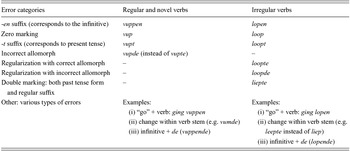
Each correct response was awarded a point. The erroneous responses were assigned to a category on the basis of the most frequently produced error types. For the regular existing verbs and the novel verbs, five error categories were created and seven for the irregular verbs. Table 3 provides examples of the errors using the novel verb vuppen of which the target past tense form is vupte, and the irregular verb lopen “walk” which has liep as the past tense. The error categories also included “other”. All responses that could not be classified as the other error types were assigned to this category. This means that all responses were assigned to a category, as it never occurred that a participant responded with silence. The errors were calculated in two different ways. First we analyzed and counted what type of errors were made. Secondly, the percentage of occurrence of a particular error type relative to all errors was calculated. For instance, a group of children may on average produce an infinitive instead of a past tense in 10% of all responses (with correct and error scores adding up to 100%). In addition, we calculated the percentage of a particular error depending on the distribution of errors (with errors adding up to 100%). The production of these infinitives could, for example, encompass 60% of all errors produced.
Error categories for regular, novel and irregular verbs. Target productions are vupte and liep. Error categories show (potential) errors.

Results
Past tense production of regular verbs
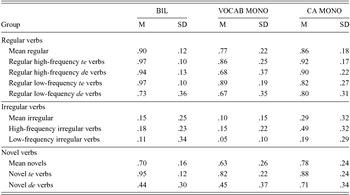
The mean percentage of accurately inflected verbs is displayed in Table 4. Inspection of the data revealed that the data were not normally distributed (Shapiro-Wilk, p = .025). Non-parametric statistical tests were used to analyze the results. The Kruskal-Wallis test revealed no effect of group, χ2(2)=3.63, p=.16. For each group separately the effect of allomorph and the effect of token frequency on past tense production was investigated using Wilcoxon tests. The BIL group showed a main effect of token frequency, Z=2.07, p = .038, with higher-frequency items rendering higher accuracy, but no main effect of allomorph, Z=1.48, p = .14. As can be seen in Table 4, the means of the high- and low-frequency verbs demanding the te are quite similar, in contrast to the low-frequency verbs taking the de allomorph. An analysis of the differences between the frequency and allomorph condition indeed shows a significant disadvantage for inflecting de verbs compared to te verbs only for low-frequency verbs (Z=2.07, p=.038; all other conditions p > .07). The VOCAB MONO group did not show a main effect of token frequency, Z=.07, p=.94, but did show a significant effect of allomorph, Z=2.89, p=.004 with higher accuracy for te than de verbs. The CA MONO group demonstrated a significant main effect of token frequency, Z=2.43, p=.015 (high > low), but no effect of allomorph, Z=.71, p=.48. Unlike the BIL group, there were no significant results for the frequency × allomorph conditions (all paired tests p > .61). In sum, the younger VOCAB MONO children showed an advantage for inflecting verbs for the past tense that demand a te allomorph. For the BIL children the advantage of te verbs was only visible in verbs of low token frequency, and for the CA MONO group only token frequency influenced past tense accuracy.
Proportions correct and standard deviations of past tense inflections of the different verb types per group.

Qualitative error analysis: Regular verbs
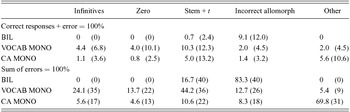
Results of the error analyses are presented in Table 5. The top of the table shows the percentages of errors based on all responses (i.e. including the correct answers as well as the errors). The bottom of the table shows the analysis in which only the errors are included to examine their distribution more closely. The substantial occurrence of incorrect allomorph for the BIL group stands out immediately.
Proportions and standard deviations (in parentheses) of errors for regular verbs per group.

The error analysis of the BIL group shows that only two types of errors were made. The majority of errors consisted of a past tense with a wrong allomorph (83.3% of all errors, e.g. hoorde as *hoorte “heard”). Importantly, these errors consisted of producing a te allomorph in case of a de verb. The other errors were present tenses instead of a past tense (16.7%, e.g. hoorde as hoort, “hears” instead of “heard”). This error pattern is different from that of the children of the VOCAB MONO group, who made errors in all five categories. Furthermore, whereas the BIL group predominantly produced the wrong allomorph, this error only occurred 12.7% in the VOCAB MONO data. The most frequent error type of the VOCAB MONO group was a present tense instead of a past tense. The CA MONO children made few errors and most belonged to the category “other”. Again the difference in the error pattern between the CA MONO children and the BIL group stands out, as the latter group most dominantly produced wrong allomorphs, but this error pattern was rare in their monolingual peers.
Irregular verbs
The results on past tense inflection of the irregular verbs are presented in Table 4. As the data were not normally distributed (Shapiro Wilk: p=.025), nonparametric tests were used to analyze the data. To investigate group differences a Kruskal-Wallis was carried out demonstrating a significant group difference, χ2(2)=14.04, p=.001. Follow-up tests examining this difference (Mann-Whitney U with the p level set to .025 to adjust for multiple testing) showed that the BIL children did not differ from the VOCAB MONO (U=113, p=.99). The BIL group performed significantly more poorly than the CA MONO children (U=90, p=.025), as did the VOCAB MONO group (U=132.5, p=.001).
For each group separately the effect of token frequency on irregular past tense production was examined using Wilcoxon tests. The BIL group did not show a significant effect of frequency, Z=1.34, p=.18, whereas the CA MONO and VOCAB MONO children did (CA MONO: Z=4.3, p < .001; VOCAB MONO: Z=2.18, p=.03).
Qualitative error analysis: Irregular verbs
Seven error categories were distinguished. For two items (liegen “to lie” and vragen “to ask”) the categories “overregularization with correct allomorph” and “overregularization with wrong allomorph” were excluded. This was done because Dutch verbs ending with the velar fricative /x/ (represented by the letter g) are ambiguous in their selection of the te or de allomorphs and the voicing distinction is not realized by all speakers of Dutch (see Gussenhoven & Bremmer, Reference Gussenhoven and Bremmer1983, for an overview of Dutch fricatives).
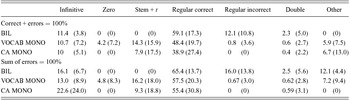
Table 6 shows the mean percentages of all error types for the irregular verbs. One of the CA MONO children inflected all irregular verbs correctly; none of the VOCAB MONO and BIL children did.
Proportions and standard deviations (in parentheses) of errors for irregular verbs per group.

All three groups show the same error pattern with correct allomorph overregularizations (e.g. target liep as loopte) being by far the most frequent error type. The BIL children also produced overregularizations with an incorrect allomorph – 16% of the overregularizations occur with the wrong allomorph, e.g. target klom as klimte “climbed”, which is more frequent than in the VOCAB MONO group (0.7%) and the CA MONO group (0%). The monolingual groups also produced present tenses and “other responses”; these did not occur in the BIL group.
Past tense of novel verbs
The accuracy scores on the novel verbs are presented in Table 4. Inspection of the data revealed that the data were not normally distributed (Shapiro-Wilk p=.044) and non-parametric tests were subsequently used to analyze the data. A Kruskal-Wallis test showed that there was an effect of group, χ2(2)=9.10, p=.011. Follow-up tests (Mann-Whitney U with the p level set to .025 to correct for multiple testing) showed that the bilingual children did not differ from the VOCAB MONO children (p=.23) and the CA MONO children (p=.11), but that the CA MONO children outperformed the VOCAB MONO group, U=154, p=.004.
The data were analyzed on the effect of allomorph for each group separately. Wilcoxon tests showed that in each group verbs demanding a te allomorph were inflected more accurately for the past tense than de verbs (BIL, Z=2.81, p=.005; VOCAB MONO, Z=3.19, p < .001; CA MONO, Z=2.01, p=.044). Even though all three groups show a significant effect of allomorph type, the effect of allomorph for both the BIL and the VOCAB MONO group is more prominent relative to the CA MONO group.
Qualitative error analysis: Novel verbs
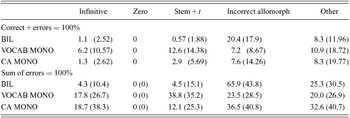
Table 7 shows the mean occurrence of all errors divided over the five categories. The most dominant error for the BIL group is “incorrect allomorph” (65% of all errors in the BIL group). All errors involving an incorrect allomorph were made with verbs that demand a de being realized as te (e.g. *norte); the production of past tenses of te verbs never included a wrong allomorph (for instance rakde). The VOCAB MONO and the CA MONO children showed a different error pattern from the BIL group as their errors were distributed more equally over the four categories “stem + t”; “other”; “incorrect allomorph” and “infinitives”.
Proportions of error types and standard deviations (in parentheses) for novel verbs per group.

Discussion
The present study was undertaken to investigate Dutch past tense productions in Dutch–Hebrew bilingual children, looking at regular, irregular and novel past tense morphology. Research questions were whether Dutch–Hebrew bilingual children were as accurate in the production of the Dutch past tense as monolingual Dutch children and whether the bilingual children showed effects of type and token frequency in their past tense productions similar to their monolingual peers.
Starting with the first question, our results showed that the bilingual children were not different from their monolingual peers on their accuracy scores of past tense inflections involving the two allomorphs (i.e. past tense of regular lexical and novel verbs), but that they were less accurate than the age-matched monolinguals on irregular verbs. The findings on the past tenses of the regular and novel verbs run counter to our expectations. These were based on the findings of previous studies that showed a delay in past tense acquisition for bilingual participants (Nicoladis et al., Reference Nicoladis, Palmer and Marentette2007; Thordardottir et al., Reference Thordardottir, Rothenberg, Rivard and Naves2006). The better performance of the Dutch-Hebrew bilingual children could be due to their greater age compared to the aforementioned studies, in which ages ranged between two and six years.
There was a specific weakness in past tense inflection for the bilingual group as they made significantly more errors in inflecting irregular verbs compared to the CA MONO group. Both the BIL and the VOCAB MONO group performed quite poorly on the irregular verbs, producing 14.5% (BIL) and 10% correct inflections (VOCAB MONO). Interestingly, the token frequency of the irregular verbs did not influence the past tense production for the BIL group, in contrast to the monolingual children. However, the floor performance of the BIL group could have masked a potential effect. All three groups displayed a substantial difference between regular and irregular past tense production. This difference was most pronounced for the BIL group (90% regular past tense accuracy versus 14.5% irregular), confirming previous findings in English (Nicoladis & Paradis, Reference Nicoladis and Paradis2012; Paradis et al., Reference Paradis, Nicoladis, Crago and Genesee2010). The observation that our bilingual children performed worse than the CA MONO children on the irregular past tense, but not on the regular past tense also fits the suggestion of Paradis et al. (Reference Paradis, Nicoladis, Crago and Genesee2010). They proposed that in bilingual acquisition the reduced exposure to either language is less noticeable in regulars compared to irregulars as the former verbs have a higher type frequency that facilitates the regular morphology acquisition. The results thus do not indicate a general past tense delay for the BIL group, as they performed similarly on the lexical and novel verbs relative to the CA MONO children. However, the performance of the bilingual children on both the novel and the irregular verbs was equal to that of the two years younger VOCAB MONO children, in contrast to the CA MONO group, who outperformed the younger monolingual children. The past tense behavior of the bilingual group thus matches the past tense profile of the two years younger monolingual children, just like their receptive vocabulary profile.
Our second research question concerned the effects of type (allomorph) and token frequency on past tense productions in the bilingual group. We hypothesized that the bilingual children would show more pronounced effects of low type and low token frequency on past tense production as they have had less exposure to the Dutch language and have had less opportunity to generalize from the distributional past tense patterns. We will first turn to the results on the regular lexical verbs. Unlike both monolingual groups, the bilingual children inflected verbs with low lexical frequency that demand the de allomorph significantly less accurately than the other verbs. Low token frequency itself was not the cause of the difficulty with past tense inflection, as low frequent te verbs were inflected as accurately as high frequency verbs. Furthermore, past tense inflection in verbs with high token frequency was the same for the two allomorphs, indicating that the bilingual children did not have difficulty with one particular allomorph. In contrast, the VOCAB MONO group, which consisted of five-year-olds, showed an advantage for te allomorph productions, regardless of token frequency. The BIL group also differed from the CA MONO group, who showed an effect of token frequency regardless of allomorph type. The type of errors that were produced also differed between the BIL group and the monolingual groups: the dominant error for the BIL group was production of the incorrect allomorph, which was most often a te instead of a de allomorph. This error type was infrequent in the two monolingual groups. These results thus confirmed our expectation: the bilingual group was most disadvantaged on the condition in which both type and token frequency was low. This was not a matter of delay compared to the CA MONO group, as the younger monolingual children matched on receptive vocabulary showed a disadvantage for de allomorphs independently of token frequency, and their error pattern was different.
The novel verbs revealed a different pattern from that of the regular verbs, as all three groups showed the same effect of type frequency: novel verbs demanding a te allomorph were inflected more accurately for the past tense than de verbs. We can conclude that in the absence of direct lexical influences, type frequency plays a role in past tense production. The difference between the two past tense allomorphs was striking for the bilingual group. There was a sharp contrast between te and de accuracy in novel verb past tense performance of the BIL group: 95% correct for te and only half of that of the de verbs (44%). This effect was less visible in the VOCAB MONO (37% difference between scores), and the CA MONO groups (17% difference). These findings thus confirm our expectation that bilingual children have more difficulty with producing past tenses with low type frequency, especially in a test condition in which sensitivity to the morphophonology is more demanded in the absence of direct lexical facilitation. Furthermore, the bilingual group showed a different error pattern from those of the monolingual groups. The monolingual groups most often replaced the past tense by a present tense (VOCAB MONO), or produced “other” forms (CA MONO) and their errors were distributed quite evenly over the categories. In contrast, the bilingual children most dominantly made errors of the type “incorrect allomorph”, replacing a de target with a te allomorph.
The finding that verbs demanding a te allomorph have higher inflection scores than de verbs is in line with previous work of Rispens and de Bree (Reference Rispens and de Bree2014). In that study we reported that children with specific language impairment (SLI) were more accurate in inflecting te verbs despite their overall low accuracy scores. A difference between the performance patterns of the bilingual children compared to the monolingual children as well as to the children with SLI is that the Dutch–Hebrew children often produced the incorrect allomorph when they made an error (replacing most often the de with a te): an error type that the monolingual children and the children with SLI produced to a much lesser extent.
The different pattern for the bilingual children can be explained in two ways. It may be the case that children learning two languages, one without and one with past tense allomorphs, focus more on the properties of these allomorphs in the input as they cannot build on the schema of the other language (see also Blom et al., Reference Blom, Paradis and Sorenson Duncan2012, for this line of reasoning). This could lead to the expectation that absence of allomorphs in one language (Hebrew) would yield higher sensitivity to allomorphs in the other language (Dutch), and thus to the morphophonological environments that they occur in. Because the combination of final consonant +/tə/ is more frequent than final consonant +/də/ in the Dutch language, the bilingual children acquire the +/tə/ past tense more accurately. The more frequent phonotactics of +/tə/ may further lead to using this allomorph selection as a default in case of the regular lexical verbs with low token frequency and in case of the novel verbs.
A second explanation of the frequent allomorph error might be that phonological transfer from Hebrew to Dutch has affected the production of the past tense allomorphs. The past tense in Hebrew does not consist of allomorphs, but it is a rich morphological system containing several past tense suffixes that have the /t/ consonant followed by a vowel (see Table 1). No past tense suffixes with /d/ + a vowel exist. It could well be that the morphophonological characteristics of Hebrew past tense morphology influenced the bilingual children in their selection of the Dutch allomorphs (see also Goad, White & Steele, Reference Goad, White and Steele2003; Nicoladis, Song & Marentette, Reference Nicoladis, Song and Marentette2012, for prosodic transfer effects and Tessier, Sorenson Duncan and Paradis, Reference Tessier, Sorenson Duncan and Paradis2013, on phonological transfer). Our current results showed that the disadvantage for de allomorphs was most prominent in the verbs with low token frequency, and in the novel verbs. These are both verbs conditions in which no (novel verbs) or limited (low frequency regular verbs) facilitation from the mental lexicon is possible. In those instances in which no lexical representation is available, it may be possible that the familiarity with a /t/ in Hebrew morphophonology not only triggered the production of Dutch te allomorphs (as observed in the accuracy difference between te and de), but also triggered overuse of this allomorph. The bilingual children may thus be guided by the phonology of their other language for past tense marking in instances where the lexical representation is not available or not activated consistently due to low token frequency. The bilingual children thus seemed to be less sensitive in a way to the phonological constraints of past tense morphophonology than the monolingual children as this latter group did not produce the wrong allomorph, but made other errors.
Our final research question addressed the comparison between the bilingual children and Dutch monolingual children matched on receptive vocabulary. The error pattern of these monolingual children indicated that the bilingual children did not merely show a delay relative to the CA-matched monolingual group, but that the production pattern of the bilingual group was different.
In order to strengthen our observations, this study should be replicated with a larger sample, include past tense inflection in both Dutch and Hebrew, a comparison between past tense production and comprehension (Rispens & Woensdregt, Reference Rispens and Woensdregt2013), as well as a more elaborate assessment of amount of exposure of Dutch (e.g. Blom, Reference Blom2010; Paradis et al., Reference Paradis, Nicoladis, Crago and Genesee2010; Thordadottir, Reference Thordadottir2011). Despite the fact that this study is limited by the small sample size and limited participant background information, the findings are important for (bilingual) language acquisition, as regularity, frequency and allomorphy were all found to influence past tense realization and showed different patterns for different groups of language learners.
Regular Dutch lexical verbs elicited in the study

Irregular Dutch verbs elicited in the study

Novel verbs elicited in the study