Studies on sentence processing have examined the role that different types of cues, such as word order, argument structure, lexico-semantic information, and sense-semantic information may play in determining a final sentence parse when readers approach a written text, be it in their first language (L1) or their second language (L2) (e.g., Bates & MacWhinney, Reference Bates, MacWhinney, Wanner and Gleitman1982; Clahsen & Felser, Reference Clahsen and Felser2006; Frenck-Mestre & Pynte, Reference Frenck-Mestre and Pynte1997; Garnsey, Tanenhaus & Chapman, Reference Garnsey, Tanenhaus and Chapman1989; Gass, Reference Gass1987; Harrington, Reference Harrington1987; Papadopoulou & Clahsen, Reference Papadopoulou and Clahsen2003; Stowe, Tanenhaus & Carlson, Reference Stowe, Tanenhaus and Carlson1991; Tanenhaus, Boland, Garnsey & Carlson, Reference Tanenhaus, Boland, Garnsey and Carlson1989; Traxler & Pickering, Reference Traxler and Pickering1996; Williams, Möbius & Kim, Reference Williams, Möbius and Kim2001). Identifying how readers weigh and integrate different types of cues is key in understanding their ultimate reading performance. Although there has been debate regarding the stage at which different types of information are utilized during parsing, it is generally agreed that sentence processing in one's native language is primarily led by general syntactic parsing principles, with lexico-semantic, sense-semantic, and contextual cues modulating the outcome (e.g., Altmann & Steedman, Reference Altmann and Steedman1988; Ferreira & Clifton, Reference Ferreira and Clifton1986; Traxler & Pickering, Reference Traxler and Pickering1996). The reader's individual variables, such as working memory (e.g., MacDonald, Just & Carpenter, Reference MacDonald, Just and Carpenter1992; Traxler, Williams, Blozis & Morris, Reference Traxler, Williams, Blozis and Morris2005) or reading speed (Traxler, Long, Johns, Tooley, Zirnstein & Jonathan, Reference Traxler, Long, Johns, Tooley, Zirnstein and Jonathan2012) are also known to interact with available lexical, syntactic, and semantic information in arriving at a final parse.
In the L2 literature, there remains considerable debate regarding the types of cues that learners are able to tune into. A well-known view on second language processing (that of Clahsen & Felser, Reference Clahsen and Felser2006), for instance, holds that second language learners are primarily led by lexico-semantic cues and only attain shallow processing of the available syntactic cues. Other studies argue that the extent to which L2 learners’ processing strategies differ from those in the L1 is largely determined by individual variables such as working memory (Dussias & Piñar, Reference Dussias and Piñar2010), proficiency in the L2 (Frenck-Mestre, Reference Frenck-Mestre, Heredia and Altarriba2002; Hopp, Reference Hopp2006; Hoshino, Dussias & Kroll, Reference Hoshino, Dussias and Kroll2010; Kilborn, Reference Kilborn1992), and other experience-based factors (Dussias, Reference Dussias2003; Dussias & Sagarra, Reference Dussias and Sagarra2007; McDonald, Reference McDonald2006).
In light of current discussions regarding the type of information that different readers attend to and the individual variables that may affect parsing, we examine here how deaf readers of English who are bilingual in American Sign Language (ASL) and English use syntactic and semantic cues when they process sentences in print and whether individual variables, specifically the readers’ experience in English and in ASL, might affect their sentence parsing strategies. In spite of the considerable attention that has been devoted over the years to a reported reading achievement gap between hearing and deaf readers (cf. Allen, Reference Allen, Schildroth and Karchmer1986; Holt, Reference Holt1994; Gallaudet Research Institute, 2005; Karchmer & Mitchell, Reference Karchmer, Mitchell, Marschark and Spencer2003; Traxler, Reference Traxler2000; Wauters, Van Bon & Tellings, Reference Wauters, van Bon and Tellings2006), the on-line sentence processing strategies of deaf readers are still poorly understood. Deaf readers’ path to literacy in a spoken language is markedly different from what is typical among hearing readers. One key difference is that deaf readers generally gain proficiency in the grammar of the spoken language through print, with the written language effectively functioning as a primary linguistic source (Kuntze, Reference Kuntze2004; Supalla, Wix & McKee, Reference Supalla, Wix, McKee, Nicol and Langendoen2001). This process is quite different from what is common among hearing individuals, who, most typically, learn to read after having acquired the spoken language first. Differences between deaf and hearing readers in their experience with print might lead to differences in reading strategies. Additionally, many deaf adults are bilingual in a signed and in a written language, with the written language typically becoming their L2, which might also affect their processing resources and reading strategies, when compared to hearing readers reading in their L1. Early language experience in deaf readers is also known to be a key factor affecting their literacy skills. Importantly, while a minority of deaf children – most commonly those who are born to signing families – are exposed to a sign language early, deaf children's full exposure to language is, in most cases, delayed. Delays in full language exposure will, in turn, affect deaf individuals’ subsequent language development both in the signed and in the written language (e.g., Mayberry, Reference Mayberry1993, Reference Mayberry2007; Mayberry & Eichen, Reference Mayberry and Eichen1991; Mayberry & Lock, Reference Mayberry and Lock2003). In contrast, several studies have found a correlation between early sign language exposure and better written literacy skills later in life (e.g., Chamberlain & Mayberry, Reference Chamberlain and Mayberry2008; Hoffmeister, Reference Hoffmeister, Chamberlain, Morford and Mayberry2000; Kampfe & Turecheck, Reference Kampfe and Turecheck1987; Kuntze, Reference Kuntze2004; Mayberry, Reference Mayberry1989; Padden & Ramsey, Reference Padden, Ramsey, Chamberlain, Morford and Mayberry2000; and Strong & Prinz, Reference Strong, Prinz, Chamberlain, Morford and Mayberry2000). As mentioned, however, little is known about the real time strategies that deaf readers use when they process sentences in print, about whether their parsing strategies are qualitatively different from those of hearing readers, or about how exactly their level of proficiency in the written and in the signed language modulates their syntactic processing abilities during reading comprehension (but see recent work by Bélanger & Rayner, Reference Bélanger and Rayner2013; Bélanger, Slattery, Mayberry & Rayner, Reference Bélanger, Slattery, Mayberry and Rayner2012, and Traxler, Corina, Morford, Hafer & Hoversten, Reference Traxler, Corina, Morford, Hafer and Hoversten2014).
Earlier claims about the reading strategies of deaf individuals include the idea that they rely more on context and background information than syntactic information (e.g., Gormley & Franzen, Reference Gormley and Franzen1978), that they derive meaning through pragmatic inferences and modality-independent linguistic knowledge (Dalby & Letourneau, Reference Dalby and Letourneau1991), and that they rely more than hearing readers on vocabulary to interpret written text when encountering unfamiliar syntactic structures (De Villiers & Pomerantz, Reference De Villiers and Pomerantz1992; Dominguez & Alegria, Reference Dominguez and Alegria2010). However, these studies did not rely on real time measures of reading comprehension and did not take into consideration the participants’ L1 and L2 proficiency. In this study we focus particularly on adult deaf readers’ real time parsing strategies. Specifically, we use eye-tracking to re-examine earlier claims that deaf readers differ from hearing readers regarding their ability to use syntactic and lexico-semantic cues for reading comprehension. Additionally we explore whether ASL and English experience may qualitatively affect their sentence comprehension strategies.
In an off-line study, Miller (Reference Miller2005) found some evidence suggesting that sign language experience among deaf children might qualitatively affect the parsing strategies that they use when they read. Specifically, Miller compared reading comprehension in semantically plausible and implausible sentences in deaf, hearing, and hard of hearing Israeli children and found lower comprehension levels among the deaf and hard of hearing participants in the implausible condition, but not in the plausible condition, which might have been an indication of a general strategy to rely on semantic, rather than syntactic cues (see also Miller, Reference Miller2000). Closer scrutiny, however, revealed that the participants who were able to tune into syntactic cues shared as a common variable that their parents were also deaf or hard of hearing. These participants were more likely to have been exposed to sign language from birth, thus suggesting a possible link between knowledge of sign language and better ability to attend to syntactic cues in a reading task. Further, in a recent eyetracking study involving ASL–English bilingual deaf adults, Bélanger and Rayner (Reference Bélanger and Rayner2013) investigated the effect of sentence context on target word fixation times. They found that only those readers with lower English proficiency benefited from highly predictable sentence environments to reduce fixation time and regressions. The more proficient readers were less dependent on sentence context. Thus, language proficiency affects reading strategies in deaf adults. Interestingly, Bélanger and Rayner noted that participants with higher English skills also acquired ASL earlier. Like the effect in Miller (Reference Miller2005), the pattern reported by Bélanger and Rayner also points to a connection between sign language experience and written language processing abilities.
In this paper, we further explore the sentence processing strategies of bilingual deaf readers. Particularly, we examine the extent to which they attend to syntactic and animacy cues when they process sentences in print of varying syntactic difficulty. Our target structures are English subject and object relative clauses (henceforth SRCs and ORCs, respectively), which have been shown to present different levels of structural complexity for the reader and thus provide a fruitful testing ground for the interplay of syntactic and semantic information (e.g., Traxler et al., Reference Traxler, Williams, Blozis and Morris2005).
In a recent study, Traxler et al. (Reference Traxler, Corina, Morford, Hafer and Hoversten2014) used self-paced reading to test sentence processing in deaf readers, and they found virtually no differences in the processing of English relative clauses between their deaf bilingual subjects and their hearing bilingual and hearing monolingual controls. In contrast, in another recent self-paced reading study, Coulter and Goodluck (Reference Coulter and Goodluck2015) concluded that deaf readers do not use the same syntactic strategies as hearing readers to solve Wh-dependencies. Specifically, they argued that deaf readers do not display the typical garden path effect that signals a strategy to solve Wh-dependencies as soon as possible, like hearing readers do, and that they do not associate incoming material with the most recently processed phrase. As a reviewer points out, it is possible that whether deaf readers’ processing patterns are similar or not to those of hearing readers might depend on the particular structure that is being processed. It is also likely, however, that differences in the linguistic experience of participants across different studies might yield different effects. For instance, Coulter and Goodluck based their conclusions on a total of sixteen subjects and they did not provide detailed information about the participants’ individual variables, other than the fact that they were all from hearing families, learned English as their first language, and were educated in an oral environment. They gave no measures of language proficiency or information about the level of bilingualism of the participants. In contrast, the participants in Traxler et al.’s study, as those in the present study, were all bilingual, immersed in a signing environment, and relatively early learners of ASL. Given the wide range of individual variation among deaf readers, it is important to attend to their language history when drawing general conclusions about the effect of deafness on reading. Here, we examine the performance of a population of adult, bilingual deaf readers of similar characteristics to the deaf participants in Traxler et al., and we use eyetracking, which allows for more natural reading than a word by word self-paced task and consequently lets us evaluate not only the timing but also the fixation patterns of bilingual deaf readers in the real time processing of English relative clauses. We also use linear mixed-effects modeling to explore whether their ASL and English experience might affect their sentence parsing. We begin by summarizing some background on the processing of English relative clauses and by discussing why they offer a good testing ground for our research purposes.
Relative Clause processing
A reliable finding in the literature on sentence processing is that ORCs in English are typically harder to process than equivalent SRCs. Thus, ORC sentences such as (1) below, where the relativized NP, the hiker, is the object of the verb inside the relative clause, present more processing difficulty than their SRC counterparts, as in (2), where the hiker is the subject of the relative clause (from Traxler et al., Reference Traxler, Williams, Blozis and Morris2005):
-
(1) The hiker that the avalanche buried appeared in the six o'clock news.
-
(2) The hiker that fled the avalanche appeared in the six o'clock news.
This effect has been replicated in a variety of studies using different experimental materials and methodologies (e.g., Gordon, Hendrick & Johnson, Reference Gordon, Hendrick and Johnson2001; King & Just, Reference King and Just1991; Traxler, Morris & Seely, Reference Traxler, Morris and Seely2002; Traxler et al., Reference Traxler, Williams, Blozis and Morris2005). Different explanations have been proposed, such as a higher memory load demand in ORCs due to longer distance between the antecedent and the Wh-variable in object structures (e.g., Gibson, Reference Gibson1998; Grodner & Gibson, Reference Grodner and Gibson2005; Grodner, Watson & Gibson, Reference Grodner, Watson and Gibson2000), differences in canonical word order between SRCs and ORCs (e.g., MacDonald & Christiansen, Reference MacDonald and Christiansen2002), and unfulfilled structural expectations following a relative complementizer in ORCs (Gennari & MacDonald, Reference Gennari and MacDonald2009; Roland, Dick & Elman, Reference Roland, Dick and Elman2007). A further explanation for the reported contrast might be related to the assignment of more than one case and thematic role to the same NP in ORCs such as (1) above, where the relativized NP, The hiker, is the subject of the matrix verb and the object of the relative clause verb, which might lead to an initial misparse or to temporary competition between NPs and argument slots (Traxler et al., Reference Traxler, Morris and Seely2002; Traxler et al., Reference Traxler, Williams, Blozis and Morris2005). Further, studies have found that available semantic cues, such as the animacy of the NPs, modulate the subject/object relative contrast effect (e.g., Mak, Vonk & Schriefers, Reference Mak, Vonk and Schriefers2002; Traxler et al., Reference Traxler, Morris and Seely2002; Traxler et al., Reference Traxler, Williams, Blozis and Morris2005; Weckerly & Kutas, Reference Weckerly and Kutas1999). Thus, when the relativized NP is inanimate, and therefore a more likely object, the processing difficulty in ORCs disappears, as in The avalanche that the hiker fled appeared on the six o'clock news, as compared to The hiker that the avalanche buried appeared on the six o'clock news. Interestingly, Traxler et al. (Reference Traxler, Williams, Blozis and Morris2005) also found that the extent to which expected animacy cues ameliorated the so-called object-penalty effect was modulated by the working memory capacity of the participants, with higher span participants showing more ability to integrate both syntactic and semantic cues and thus benefitting more from helpful animacy cues. In a subsequent study, Traxler et al. (Reference Traxler, Long, Johns, Tooley, Zirnstein and Jonathan2012) found that reading speed, while correlated with working memory, actually accounts for even more variability in participants’ ability to successfully integrate syntactic and semantic cues. Thus, a variety of linguistic variables and participant characteristics may be involved in determining a final parse in these structures.
It is not the purpose of this paper to adjudicate among the different accounts summarized above. In fact, in a recent eye-tracking study, Staub (Reference Staub2010) argues that different behavioral patterns at different points in the processing of ORCs suggest that more than one of the proposed factors discussed in the literature might be at play in explaining their processing difficulty. What is important for our purposes is that, as proposed in the studies cited above, factors such as distance across constituent binding, word order configuration, and multiple case and theta role assignments to the same NP contribute to making English ORCs generally more complex than equivalent SRCs and that lexico-semantic cues, such as animacy, as well as the readers’ characteristics, modulate their processing difficulty. The fact that English L1 readers show a processing contrast between subject and object relative clauses and that this contrast is modulated by animacy cues indicates that, as long as sufficient resources are available, English L1 readers are able to weigh and effectively integrate both syntactic and semantic cues in the processing of these structures.
The question we address is what can the processing of subject and object relative clauses tell us about the types of cues that bilingual deaf readers exploit during written sentence comprehension. If deaf readers are more attentive to semantic than to structural cues when processing sentences in print, as has been proposed by some accounts in the literature, we might not expect to find a robust subject/object relative clause contrast such as the one reported for English-L1 readers. Rather, deaf readers might rely more on animacy cues to determine the roles and function of the NPs. In such case, we might find that animate subject relative clauses and inanimate object relative clauses are easier to process than the other conditions because the animacy of the NP would match the animacy expectations for subjects and objects. On the other hand, if deaf readers are guided by syntactic cues, subject relative clauses should be generally easier than object relative clauses, regardless of the animacy cues. If deaf readers integrate both syntactic and semantic cues in real time, then animacy cues would be expected to neutralize the so-called ‘relative object penalty’ in the inanimate relative object condition. That is, we should find no significant differences between animate and inanimate subject relative clauses or between subject relative clauses and inanimate object relative clauses. Finally, the parsing strategies of deaf readers might also be modulated by individual variables, such as their relative experience in English and in ASL; in which case their reliance on syntactic and semantic cues might vary with the reader's experience.
Method
Participants
Thirty-nine deaf college students participated in this experiment. Participants’ ages ranged from 18 to 33. All of the participants were bilingual in ASL and English, although, as is common in a deaf participant population, they were not all native ASL users and they varied regarding their proficiency in written English. Twenty-one out of the thirty-nine participants had at least one deaf parent, seventeen of the participants had hearing parents, and one had hard of hearing parents. Thirty-one participants reported learning sign language (29 ASL, 2 signed English) before age 5, three reported learning ASL at age 12 or 13, and five participants (two with deaf parents) did not report their age of first exposure to ASL (all five reported English as their stronger language). Thirteen of the participants who did not come from deaf families still declared ASL to be their dominant language, but their exposure to ASL ranged from being exposed at age 1 to age 13. All participants were immersed daily in a signing environment. The participants’ English reading skill level, measured with the passage reading comprehension subtest of the Woodcock-Johnson III, ranged from third grade level to college level and beyond, a range that is consistent with numerous reports on deaf adults (e.g., Gallaudet Research Institute, 2005). Additionally, self-assessment scores were collected for ASL comprehension and production skills (range: 1–10 for each), and these two ratings were summed for analysis.
Materials
Our critical experimental materials were forty-four relative clause sentence quartets exemplifying four conditions. Conditions A and B contained subject and object relative clauses, respectively, where the relativized NP was animate. Conditions C and D contained subject and object relative clauses, respectively, where the relativized NPs were inanimate. A sample of each condition is given in (a–d) below (see appendix to see the whole set):
-
(a) The hikers that fled the avalanche appeared on the six o'clock news.
-
(b) The hikers that the avalanche buried appeared on the six o'clock news.
-
(c) The avalanche that buried the hikers appeared on the six o'clock news.
-
(d) The avalanche that the hikers fled appeared on the six o'clock news.
The materials were almost entirely taken from Traxler et al.’s (Reference Traxler, Williams, Blozis and Morris2005) study. Some infrequent vocabulary items were replaced with more frequent ones, since English is, effectively, a second language for the majority of the participants. The nouns inside the two critical NPs appeared in all the conditions in different orders and were, therefore, exactly matched. Additionally, there were no significant differences in length and frequency between animate and inanimate nouns, based on the CELEX database. There were also no differences among the relative clause verbs. Additionally, the experimental conditions were counterbalanced so that only one version of each item was assigned to one of four lists.
Procedure
The data was collected using an Eyelink 1000 (SR Research, Toronto, Ontario, Canada) at a sampling rate of 1000 Hz. A chin rest was used to prevent participants from moving their head. Participants were asked to read sentences that appeared on a single line on a computer screen. Sentences were presented one by one. A nine-point calibration procedure was performed after participants received instructions to read the sentences normally for comprehension. The experiment was divided into two halves, with a programmed break when the participant reached the midpoint of the experiment. Participants were calibrated at the onset of the first and second halves of the task and were also recalibrated if track loss occurred at any point during the experiment.
Each participant saw each condition in the context of a different item and read a total of forty-four relative clause experimental sentences, as well as seventy-eight filler sentences. The order of presentation was randomized. A simple yes/no comprehension question followed each sentence, to which participants answered by clicking either a YES or a NO button. Half of the sentences required a NO answer. Response accuracy was automatically recorded. Average accuracy was 81% (sd = 8.3, range = {64, 93}). Trials on which the comprehension question was answered incorrectly were left in the analysis, but refitting the model reported below with these trials omitted yielded an identical pattern of results.
Our dependent measures were 1) first-pass reading time, defined as the sum of all fixation durations beginning with the first fixation in a region until the reader's gaze leaves the region, left or right; 2) total time, defined as the sum of all fixations in a region at any time, including any regressions back to that region; 3) first pass regressions, defined as the number of eye movements that crossed a region's left-hand boundary immediately following a first-pass fixation, and 4) regression path time, defined as all fixation durations beginning with the first fixation in a region until the reader's gaze crosses the right-hand boundary of the region. The critical region for analysis was the relative clause region following the complementizer that (e.g., fled the avalanche in “The hikers that fled the avalanche appeared on the six o'clock news.”)
As stated above, if deaf readers are primarily guided by syntactic information in the processing of relative clauses, much like hearing native English speakers are, we predict longer reading times and more regressions in the ORC condition, although attention to animacy cues might eliminate the processing difficulty of ORC sentences in the inanimate condition. However, if, as some studies have suggested, deaf readers rely more on semantic than syntactic cues, we might expect to find more difficulty in both conditions in which animacy expectations for an argument are not met; that is, in the object animate as well as in the subject inanimate relative clause conditions. The readers’ language background variables might also be predicted to affect their parsing strategies. Readers with higher English proficiency might arguably have more available resources to benefit from both syntactic and available semantic cues, as do hearing native English speakers. On the other hand, based on previous reports indicating a relationship between sign language experience and written sentence processing (i.e., Miller, Reference Miller2005), ASL experience itself might also predict readers’ ability to exploit both syntactic and semantic cues during English parsing.
Data analysis
Two of the 44 experimental items had to be removed, due to an error in the text of the sentences. Additionally, prior to analysis, 48 trials on which no fixations occurred in the relative clause region were eliminated, leaving 1590 trials for the 39 participants. The data were analyzed with mixed effects regression fitted with the lme4 (version 1.1-10) package in R (R Core Team, 2015; Bates, Mächler, Bolker & Walker, Reference Bates, Mächler, Bolker and Walker2015). We fitted separate models for four dependent variables: first-pass and total reading times for the relative clause, the likelihood of a regression from the relative clause to the left of the relative clause, and the regression path (RP) reading time (for those trials on which regressions occurred). The reading times were log-transformed to bring their distributions closer to normality. The likelihood of a regression was modeled via mixed-effects logistic regression with the logit link function.
All four models included fixed effects for relative clause type (RCtype; subject or object), animacy of the first noun (animate or inanimate), and their interaction, to test our primary hypotheses about deaf readers’ use of syntactic structure and animacy in processing relative clauses. These binary predictors were sum-coded with contrasts set to −0.5, 0.5. At the participant level, English reading proficiency (Woodcock-Johnson III grade equivalent scores; henceforth WJ) and self-reported ASL proficiency were included and allowed to enter into two- and three-way interactions with RCtype and animacy, to determine whether English comprehension scores or self-ratings in ASL modulated the effects of RCtype, animacy, or their interaction. WJ scores and ASL self-rating scores were not allowed to interact with each other.
WJ scores ranged from elementary reading proficiency through college degree (M = 9.8, sd = 5.0, range = {2.9,18}). ASL scores were coded as the sum of each participant's self-ratings (on scales of 1–10) of ASL comprehension and production (M = 18.1, sd = 2.2, range = {10,20}). Both of these measures were standardized. WJ scores and ASL self-ratings were not correlated (r = −.08, p > .6). We also fitted models substituting family background for ASL self-ratings. Participants with at least one deaf parent reported slightly higher ASL proficiency (M = 19.0, sd = 1.3) compared to participants with no deaf parents (M = 17.4, sd = 2.7; t(25.7) = 2.3, p < .05, corrected for unequal variance). However, family background did not contribute to explaining any results and was dropped from the analysis. Similarly, we also fitted models substituting age of ASL acquisition for ASL ratings. Somewhat surprisingly, but also in accord with the recent results in Traxler et al. (Reference Traxler, Corina, Morford, Hafer and Hoversten2014) for a similar subject population, self-reported age of acquisition did not predict any effects, but this may simply be due to the fact that nearly all of the participants had learned a sign language before age 5.
Crossed random effects were included for participant and sentence, with the maximal (uncorrelated) random effects structure justified by the design (Barr, Levy, Scheepers & Tily, Reference Barr, Levy, Scheepers and Tily2013). Since the sentences across experimental conditions were organized in quadruplets with largely the same lexical content, reorganized to manipulate animacy and the syntactic position of the relativized NP (see above), the sentence-level random effect referred to these quadruplets rather than to the individual sentences read on a given trial. Thus, for example, the four sentences referring to avalanches and hikers (The avalanche that buried the hikers appeared on the 6 o'clock news; The avalanche that the hikers fled. . .; the hikers that fled the avalanche. . .; the hikers that the avalanche buried. . .) were considered as one level of the sentence random factor, since the differences between them are captured by the fixed effects for RCtype and animacy. Significance was assessed via likelihood ratio tests comparing nested models.
Results
Mean logged first-pass reading times were slightly longer for object relative clauses than for subject relative clauses with no effects whatsoever of animacy (Mobj-animate = 6.16, SD = 0.05; Mobj-inanimate = 6.16, SD = 0.05; Msubj-animate = 6.11, SD = 0.05; Msubj-inanimate = 6.11, SD = 0.05) Neither this difference, nor any interactions, reached significance. Note, however, that fixation patterns in many instances revealed a high degree of word skipping, which may have introduced a great deal of variability to this measure. In the majority of these cases (about 41% of the data), participants failed to fixate one of the constituents involved in the interpretation of relative clauses: namely, the antecedent NP, the NP inside the relative clause, the relative clause verb, and the main clause verb. One consequence of this is that the first-pass reading times on these trials are shorter than for the other trials (t(1384.41) = −10.6132, p < .001). This is not surprising in that the noun or the verb in the relative clause (our critical region) might not have been fixated. Less trivially, total reading times for these trials were also significantly shorter (t(1298.29) = −10.98, p < .001), suggesting that a less careful reading strategy may have been used on some trials.
In an additional 6% of trials, participants fixated all nouns and verbs in the antecedent, relative clause, and main verb regions, but not in a left-to right predictable order. For example, readers might skip the antecedent NP and start by fixating either the noun or the verb inside the relative clause region in a first pass to then return to fixate the antecedent NP before fixating all words in the relative clause. Or they might skip the main verb and fixate later material, and then return to the main verb. The distribution of first-pass reading times within the relative clause for these trials was distinctly bimodal, with one mode overlapping completely with the first-pass times from trials on which all material in the antecedent, relative clause, and main verb regions was fixated in a predictable order, and the other, larger mode being faster. For total reading times, the distribution for these trials was unimodal and did not differ from the trials in which participants fixated all words in a predictable order, p > .15.
To ensure that this variability in the reading strategies did not systematically impact comprehension of the materials, we fitted a logistic regression using accuracy on the comprehension questions (collected on every trial) as the outcome, and skipping as the fixed predictor. Skipping was identified as those trials on which the participant either did not fixate all nouns and verbs in the antecedent, relative clause, and main verb regions, or did not fixate all of these elements in left-to-right order. Full random effects by participant and by item were used. No effect of skipping on accuracy was found (χ2(1) = 1.80, p = .18).
The fact that 47% of the data show word skipping patterns suggests that a mixture of different reading strategies may have been in use. Items where skipping was identified were found to be uniformly distributed across subjects. There were no significant correlations between the proportion of predictable reading strategies per participant and their WJ scores or ASL self-rating scores (both >.25). Furthermore, excluding the items that involved skipping from the analysis does not affect the results. We, therefore, report an analysis that includes both fixation patterns. As we elaborate in the discussion, the fixation patterns that we report are consistent with recent findings (i.e., Bélanger et al., Reference Bélanger, Slattery, Mayberry and Rayner2012) that deaf readers may exhibit a text scanning profile that is, in some ways, different from that of hearing readers. This feature of our data thus strongly encourages further exploration of the range of reading strategies that deaf readers employ. We focus now on the results for (log) total reading times, and then for regressions.
Total reading times
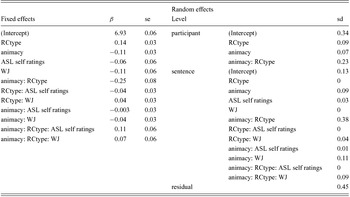
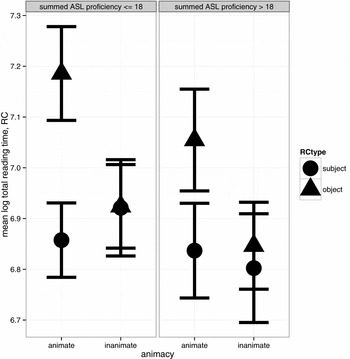
The results showed interacting effects of RCtype and animacy on log total reading times (β = −0.25, SE = 0.08, χ2(1) = 8.82, p < .01). We unpacked this interaction by fitting models to subsets of the data, and report Bonferroni-corrected p-values, and we also report empirical 95% CIs on the mean differences between conditions, across participants. Animate ORCs were read significantly slower than both animate SRCs (95%CI [0.18, 0.37], β = 0.27, SE = 0.06, χ2(1) = 19.09, p < .001) and inanimate SRCs (95% CI [−.32, −.18], B = −.25, SE = .04, X2(1) = 38.93, p < .001). Additionally, animate ORCs were read slower than inanimate ORCs (95%CI [−0.32, −0.15], β = −0.23, SE = 0.05, χ2(1) = 16.94, p < .001). No significant differences were found between inanimate ORC and subject RCs, or between animate and inanimate SRCs. The model estimates (fixed and random effects), with log total reading times for the relative clause as the dependent variable, are shown in Table 1. Note that the coefficients represent the effect of predictors on log total reading time at mean WJ and ASL proficiency, averaging across the experimental conditions.
Fixed and random effects for total reading times

There was a marginal three-way interaction between RCtype, animacy, and ASL self-rating scores (β = 0.11, SE = 0.06, χ2(1) = 3.23, p < .08), suggesting that the difficulty associated with animate ORCs may be smaller for individuals with greater ASL self-ratings. While this effect was marginal, we mention it here because it suggests that follow-up research using more sensitive measures of ASL proficiency than the ones that were available to us might reveal interesting differences in syntactic parsing abilities.Footnote 1 Figure 1 shows the empirical means, by condition, separating participants with above- and below-median ASL self-ratings.
Mean log total reading times for the relative clause, by condition. Participants are split at median ASL self-rating scores. Error bars show ±1 SE

There was also a marginal effect of WJ (β = 0.11, SE = 0.06, χ2(1) = 3.67, p < .06), reflecting shorter total reading times as WJ scores increased, but it did not enter into any interactions.
We also ran an analysis substituting accuracy on the comprehension questions for reading times in order to examine whether there were any differences by sentence type. The results yield an interaction of animacy by position (β = 1.13, SE = 0.46, χ2(1) = 5.81, p < .05), revealing higher accuracy (β = 1.14, SE = 0.32, χ2(1) = 12.06, p < .001) for questions to inanimate object RCs (M = .88, 95%CI [.83, .92])Footnote 2 than for questions to animate object RCs (M = .74, 95% CI [.69, .78]). This is consistent with the reading time results in that inanimate object RCs seem to pose less difficulty than animate object RCs despite faster reading times. Responses in the inanimate object RC condition were also more accurate than in the subject RC conditions. The inanimate object condition simply stands out as producing more accurate responses, but accuracy on the comprehension questions reveals no other differences.
Regressions and regression path
Overall, regressive saccades back to the left of the relative clause occurred on 406 of the 1592 valid trials (26%). Of the 39 participants, 37 made an average of 11 regressions (Mode = 1, range = {1,26}). To determine whether accuracy, RCtype, or English or ASL self-ratings could explain some of the variance in the likelihood of regressive eye movements, we first fitted a logistic regression, with the same model structure as above. This model revealed only a marginal effect of animacy (in logit units, β = −0.27, SE = 0.15, 95%CI [−0.57, 0.03], χ2(1) = 2.86, p < .1), whereby regressions were less likely to inanimate first NPs than to animate NPs. This did not interact with RCtype or either language proficiency measure (all p > .2). Additional information is provided by the RP reading times in those trials in which a regression occurred.
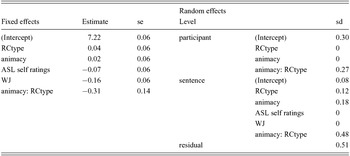
The 406 valid trials are not enough to support a model with the complexity of the above models (the common rule of thumb of 20 trials per model parameter would require 580 trials). Since there was no sign of any interactions involving WJ or ASL self-ratings, we fitted a reduced model containing fixed effects for animacy, RCtype, and their interaction, plus main effects only for WJ and ASL self-ratings. The maximal uncorrelated random effects structure given this design was also included. The complete model is reported in table 2.
Fixed and random effects for regression path reading times

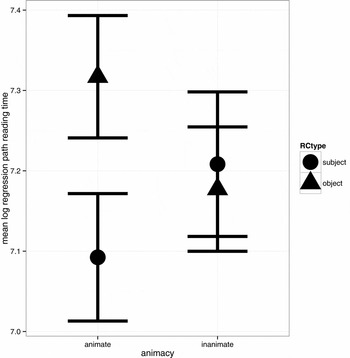
These results reveal a comparable interaction between animacy and RCtype to that seen for total reading times (β = −0.32, SE = 0.14, 95% CI [−0.59, −0.04], χ2(1) = 4.64, p < .05), which is shown in Figure 2. Readers with higher WJ scores also showed faster RP reading times (β = −0.16, SE = 0.06, 95% CI [−0.28, −0.04],χ2(1) = 6.77, p < .01).
Mean log regression path reading times, by condition. Error bars show ±1 SE

A model fitted to data with animate first NPs only showed that RP reading times were significantly slower for animate ORCs than for animate SRCs (β = 0.22, SE = 0.08, 95%CI [0.07, 0.37], χ2(1) = 7.30, corrected p < .05). However, models fitted to only subject relative clauses or only object relative clauses did not reveal significant effects of animacy.
In sum, total and RP reading times showed that, overall, deaf participants are faster to read subject than object relative clauses. Total reading times reveal that when the initial NP is inanimate, participants show no processing cost in the object condition as compared to reading SRCs. In fact, response accuracy on the comprehension questions seems to give an indication that attention to helpful animacy cues might render the inanimate object condition less difficult than the other structures. Our reading time results replicate and extend the findings of Traxler et al. (Reference Traxler, Corina, Morford, Hafer and Hoversten2014) regarding the processing of relative clauses in deaf ASL–English bilinguals. Deaf bilinguals readers are sensitive to both structural and semantic factors when processing these sentence structures in real time. Interestingly, WJ scores did not predict any reading time effect differences among participants, other than reading faster across conditions. This is consistent with previous findings in the literature. For instance, Lillo-Martin, Hanson and Smith (1992), in an off-line task, and Kelly (Reference Kelly2003) and Traxler et al. (Reference Traxler, Corina, Morford, Hafer and Hoversten2014) in self-paced reading tasks, also failed to find differences in relative clause processing among deaf readers based on independent measures of English language comprehension. Additionally, Traxler et al. (Reference Traxler, Corina, Morford, Hafer and Hoversten2014) found that age of exposure to ASL was related to self-paced reading speed, but there were no effects of ASL background on the clause type by animacy interaction. In contrast to this, we found a marginal three-way interaction between ASL self-assessment scores and RCtype and animacy, but no effects of age of ASL exposure on speed. This finding suggests the need to incorporate more finely-tuned, objective measures of ASL proficiency when examining the English processing strategies of deaf readers, as our data show a tendency for those subjects with higher ASL self-ratings to have shorter reading times in the animate ORC condition, which, in turn, suggests the interesting possibility that higher ASL skills may make these bilingual deaf readers better prepared to handle structural complexity in English.
Discussion
Consistent with what has been found in previous studies involving hearing native English speakers, our main finding is that the eye-tracking fixation patterns of deaf readers reveal the interplay of syntactic and semantic cues in the on-line processing of relative clauses. Overall, participants are faster to read subject than object relative clauses, indicating effects of syntactic complexity on fixation times. Total reading times also indicate that deaf readers capitalize on useful animacy cues in the condition that poses the most structural difficulty, namely, in ORCs. Importantly, our findings replicate and extend the results of a recent study by Traxler and colleagues (Traxler et al., Reference Traxler, Corina, Morford, Hafer and Hoversten2014) evaluating the feasibility of using self-paced reading methods with deaf ASL–English bilinguals to assess on-line sentence processing outcomes. Traxler et al. also presented deaf readers with subject and object relative clauses and found evidence for an object relative penalty effect modulated by semantic cues. Given the dearth of on-line reading studies with deaf readers and the contradictory claims about their reading processing abilities, our study provides valuable support for the main effects reported by Traxler et al., using a different on-line methodology with higher ecological validity. Taken together, these results have theoretical implications for the field of second language processing, as they provide evidence of reliance on syntactic processing in an L2.
Other evidence that deaf bilinguals are sensitive to syntactic cues in the L2 comes from a recent study investigating verb bias effects (Anible, Twitchell, Waters, Dussias, Piñar & Morford, Reference Anible, Twitchell, Waters, Dussias, Piñar and Morford2015). As in the current study, Anible et al. found parallels between the cues that influence online sentence processing for hearing readers in their first language and deaf readers in their second language. Using eye fixation measures, they compared reading times for temporarily ambiguous sentences with verbs that had a higher likelihood of preceding direct objects or sentential complement continuations. The participants in this study showed shorter gaze duration on the postverbal NP when verbs that are more frequently followed by sentential clause continuations were, in fact, followed by the expected structure, thus revealing that they used syntactic cues to anticipate structure. A general preference for sentential clause continuations, as opposed to a simpler NP object continuation, however, also revealed some differences with English L1 readers that might reflect the impact of first language experience on which L2 cues become most influential for online processing. Specifically, Anible et al. speculate that the general preference for sentential complement continuations might be due to the syntactic packaging preference in ASL to place focused information sentence finally (Wilbur, Reference Wilbur, Lee, Sweetser and Verspoor1997, p. 89), as is generally the case in English sentential complement structures as compared to simpler direct object structures.
In the present study, there is a suggestion that ASL proficiency (operationalized in terms of ASL production and comprehension self-ratings) may have an effect on English syntactic processing. The fact that participants with at least one deaf parent rated themselves higher, as reported in the results section, suggests that the self-rating scores were, in fact, tapping into the ASL experience of the participants. More finely-grained objective ASL measures might have provided a more definite result. Nevertheless, the trend that is revealed here is reminiscent of the above-mentioned effects reported by Miller (Reference Miller2005) for young Israeli deaf readers, in that Miller found that family background, which was likely linked to knowledge of sign language, also modulated the readers’ ability to handle unexpected semantic cues by relying on syntactic cues.
It is somewhat surprising that, given the established link in the literature between ASL proficiency and English literacy, we did not find a correlation between the participants’ WJ scores and their ASL ratings or ASL history. ASL measures that make finer distinctions in proficiency among highly fluent signers might be necessary to uncover this relationship in adult bilinguals. Further, while family language background and early language exposure are critical for literacy development, other variables that were not collected for this study, such as educational method and socioeconomic status, are also known to be important factors ultimately affecting literacy skills. Twitchell, Morford and Hauser (Reference Twitchell, Morford and Hauser2015), for example, have shown that socioeconomic status and ASL proficiency independently contribute to reading proficiency as assessed by the Peabody Individual Achievement Test-Revised (PIAT-R, Markwardt, Reference Markwardt1989) in deaf ASL–English bilinguals. A larger sample with a more comprehensive multilevel analysis considering a larger array of individual measures is needed to attain a more finely grained understanding of the factors affecting the online sentence processing skills of deaf readers. Nevertheless, this study calls for the need to incorporate objective measures of the sign language skills of adult deaf participants – beyond self-report information about their family background and age of acquisition – when assessing their syntactic processing patterns in a written language.
The suggestion that there might be a connection between ASL skills and syntactic processing in English may seem surprising at first, particularly since ASL and English are very different languages that are expressed in two distinct modalities. However, this idea ceases to be surprising when seen within the context of bilingual literacy theories. Supporters of bilingual education have long sustained the view that a strong foundation in one language facilitates the path to literacy in the other language (e.g., Cummins, Reference Cummins1978, Reference Cummins2000). Reported evidence showing a link between ASL and English literacy skills in deaf readers indicates that connections between the languages of a bilingual are not limited by differences in modality across the two languages (Chamberlain & Mayberry, Reference Chamberlain and Mayberry2008). Further, studies involving bilingual deaf adults and children have revealed that these bilinguals activate aspects of the phonology of the sign translations of words presented in print (Kubuş, Villwock, Morford & Rathmann, Reference Kubuş, Villwock, Morford and Rathmann2014; Morford, Wilkinson, Villwock, Piñar & Kroll, Reference Morford, Wilkinson, Villwock, Piñar and Kroll2011; and Ormel, Hermans, Knoor & Verhoeven, Reference Ormel, Hermans, Knoors and Verhoeven2012) thus showing that crosslanguage lexical connections can occur across language modalities. Importantly, the fact that crosslanguage activation of signs in print recognition tasks has been identified in young deaf readers who are still in the process of acquiring written literacy skills might shed light on the long-debated issue of how prelingually deaf children, who have no access to the phonology of the spoken language, learn to read while bypassing the process of learning the sound-print correspondences that connect the spoken language to its written form. Specifically, it has been proposed that bilingual deaf children initially map words in print directly onto signs before they develop direct links from orthography to semantics (Hermans, Knoors, Ormel & Verhoeven, Reference Hermans, Knoors, Ormel and Verhoeven2008) and that knowledge of the sublexical structure of a signed language may subserve the development of lexical decoding skills in the written language in the absence of sound-based phonological awareness (McQuarrie & Parrila, Reference McQuarrie and Parrila2009). In this context, the suggestion that a better grasp of the linguistic resources of ASL may qualitatively affect deaf readers’ parsing of sentences in print, particularly as it concerns enhanced attention to syntax, is concordant with new evidence pointing to the role of sign language in the development of written literacy skills.
Although ASL and English relative clauses do not have parallel structures, and little is known about the processing of ASL relative clauses other than the fact that they are acquired later than less complex structures (i.e., Boudreault & Mayberry, Reference Boudreault and Mayberry2006), greater ASL proficiency may lead to a general advantage for learning to process English syntactic structures. Alternatively, experience with the cognitively complex task of aligning embedded and main clause arguments in ASL could be beneficial to processing RCs in English. This state of affairs points toward the strong need for syntactic parsing studies of ASL itself. It also points toward the need for studies of English reading experience as a potential influence on the parsing of ASL.
Finally, an important question that lies beyond the scope of this paper, but that was revealed by our data, concerns the text scanning patterns of our participants. As mentioned, a portion of our data indicates a considerable word skipping rate and an unpredicted text scanning sequence, suggesting the presence of multiple reading strategies. The almost complete lack of on-line studies examining the reading patterns of deaf readers has left this aspect of their reading profile largely unexplored to date. Nevertheless, Bélanger et al. (Reference Bélanger, Slattery, Mayberry and Rayner2012), in one of the first studies probing eye-fixation patterns in skilled deaf readers, found that deaf bilinguals’ text scanning patterns are somewhat different from those that are typical in hearing readers. In their study, deaf readers appeared to have a wider perceptual span and shorter fixations, particularly at higher levels of written language proficiency, than hearing participants of comparable reading levels. The word skipping and text scanning sequence patterns that we found in some of our data could well be related to a wider perceptual span or to an alternative strategy to scan the sentence for contextual information prior to engaging in syntactic parsing.
In sum, our analysis provides strong ecologically valid evidence that adult deaf readers rapidly detect and incorporate both syntactic and semantic cues during the online processing of relative clauses in English. While more syntactic structures need to be examined, these results are of theoretical relevance in light of the fact that the participants were bilingual in a signed and written language, and were, in most cases, operating in their L2. This study also revealed some suggestive effects that call for a deeper exploration of the extent to which objective measures of the current signing skills of adult deaf readers may play a modulating role in their ability to exploit syntactic cues. As one of few eye-tracking studies addressing written sentence processing in deaf readers, we hope that this paper will call attention to the need to gather more on-line reading measures investigating their text scanning patterns and the extent to which individual variables, such as bilingual status and language proficiency, may modulate the reading comprehension processes of a population with such diverse and often complex linguistic profiles.
Appendix
Relative clause experimental stimuli
1 a. ‘The hikers that fled the avalanche appeared on the six o'clock news.’
‘Did the hikers appear on TV?’
2 a. ‘The farmer that washed the tractor was standing next to the barn.’
‘Was the farmer next to a barn?’
3 a. ‘The cowboy that hid the pistol was known to be unreliable.’
‘Was the cowboy unreliable?’
4 a. ‘The woman that started the accident caused a number of serious injuries.’
‘Did the woman cause injuries?’
5 a. ‘The plumber that held the hammer was found near the back door.’
Was the plumber near the back door?’
6 a. ‘The burglar that found the revolver was in the bedroom.’
‘Was there a thief in the bedroom?’
7 a. ‘The fireman that fought the fire caused only a small amount of damage.’
‘Did the fireman damage something?’
8 a. ‘The fish that nibbled the food impressed the fisherman quite a lot.’
‘Was the fish impressive?’
9 a. ‘The elephant that drank the water was located in the heart of Africa.’
‘Was the elephant in Africa?’
10 a. ‘The boys that vandalized the church looked very shabby.’
‘Were the boys messy?’
11 a. ‘The girls that climbed the trees were in the back yard.’
‘Were the girls behind the house?’
12 a. ‘The chef that measured the flour won a prize at the state fair.’
‘Did the chef win a prize?’
13 a. ‘The kids that ate the pizza stayed in the basement all night.’
‘Did the pizza stay in the kitchen?’
14 a. ‘The farmer that planted the corn died after the early frost.’
Did the farmer die after a snowstorm?’
15 a. ‘The girls that collected the feathers were from South Africa.’
‘Were the girls from South Africa?’
16 a. ‘The gangster that concealed the acid came up during the trial.’
‘Did the gangster hide money?’
17 a. ‘The senator that reviewed the article was forgotten after the election.’
‘Was the senator remembered?’
18 a. ‘The student that attended the school was visited by the governor.’
‘Did the governor visit the student?’
19 a. ‘The patients that chewed the pills were mentioned in the medical journal.’
‘Were the patients mentioned in a TV program?’
20 a. ‘The people that rode the train arrived at the station early.’
‘Did the people arrive at the station early?’
21 a. ‘The drug dealer that damaged the street lamp stood on the corner of Oak and Jefferson.’
‘Did a drug dealer stand on the corner of Oak and Jefferson?’
The cattle that destroyed the grass disappeared after the first big snowstorm.’
22 a. ‘Did the grass disappear after a big tornado?’
23 a. ‘The pilot that flew the helicopter crashed near the grocery store.’
‘Did the pilot end up near a hardware store?’
24 a. ‘The engineer that designed the rocket flew over the wildlife preserve.’
‘Did the engineer fly over a park?’
25 a. ‘The worker that fixed the machine cost the company time and money.’
‘Did the worker save the company time and money?’
26 a. ‘The woman that prepared the water stayed in the bath tub for hours.’
‘Did the woman take a quick shower?’
27 a. ‘The actress that purchased the jewelry got a lot of attention at the party.’
‘Was the actress overlooked?’
28 a. ‘The tiger that escaped the cage was in the center of the zoo.’
‘Was there a lion in the center of the zoo?’
29 a. ‘The soldiers that built the camp covered a large part of the forest.’
‘Did the soldiers cover the majority of the park?’
30 a. ‘The child that swallowed the medicine stayed in the operating room.’
‘Did the child have a routine check-up?’
31 a. ‘The secretary that drove the car cost the insurance company a fortune.’
‘Did the insurance company have to pay a small amount of money?’
32 a. ‘The expert that operated the machinery detected a flaw in the metal.’
‘Was the metal perfect?’
33 a. ‘The cowboy that threw the rope was strong and tough.’
‘Did the cowboy lack strength?’
34 a. ‘The actor that bought the razor appeared in the horror movie.’
‘Did the actor appear in a scary movie?’
35 a. ‘The inspector that found the metal didn't harm the animals.’
‘Was the metal harmless?’
36 a. ‘The scientist that discovered the chemical came from Australia.’
‘Was the scientist from Australia?’
37 a. ‘The soldiers that occupied the fort saved the city from the enemy.’
‘Did the soldiers protect the fort?’
38 a. ‘The campers that built the fire burned down the cabin.’
‘Did the campers build down the cabin?’
39 a. ‘The tourist that brought the electric fan was a nuisance for the maid.’
‘Was the fan used for cooling?’
40 a. ‘The mechanic that changed the oil left a stain on the front seat.’
‘Did the front seat have a stain?’
41 a. ‘The technician that replaced fluid filled the can next to the truck.’
‘Was the can next to the truck?’
42 a. ‘The donkey that carried the bricks fell over the cliff.’
‘Did a horse fall over the cliff?’
43 a. ‘The wrestlers that displayed the tattoos were as ugly as they could be.’
‘Were the tattoos pretty?’
44 a. ‘The executive that borrowed the airplane vanished into thin air.’
‘Did the airplane disappear?’
1 b. ‘The hikers that the avalanche buried appeared on the six o'clock news.’
‘Did the hikers appear on TV?’
2 b. ‘The farmer that the tractor hit was standing next to the barn.’
‘Was the farmer next to a barn?’
3 b. ‘The cowboy that the pistol injured was known to be unreliable.’
‘Was the cowboy unreliable?’
4 b. ‘The woman that the accident hurt caused a number of serious injuries.’
‘Did the woman cause injuries?’
5 b. ‘The plumber that the hammer bruised was found near the back door.’
‘Was the plumber at the back door?’
6 b. ‘The burglar that the revolver shot was in the bedroom.’
‘Was there a thief in the bedroom?’
7 b. ‘The fireman that the fire burned caused only a small amount of damage.’
‘Did the fireman damage something?’
8 b. ‘The fish that the food caught impressed the fisherman quite a lot.’
‘Was the fish impressive?’
9 b. ‘The elephant that the water cooled was located in the heart of Africa.’
‘Was the elephant in Africa?’
10 b. ‘The boys that the church housed looked very shabby.’
Were the boys messy?
11 b. ‘The girls that the trees protected were in the back yard.’
Were the girls behind the house?
12 b. ‘The chef that the flour covered won a prize at the state fair.’
‘Did the chef win a prize?’
13 b. ‘The kids that the pizza fed stayed in the basement all night.’
‘Did the pizza stay in the basement?’
14 b. ‘The farmer that the corn fed died after the early frost.’
‘Did the farmer die after the early frost?’
15 b. ‘The girls that the feathers tickled were from South Africa.’
‘Were the girls from South Africa?’
‘16 b. ‘The gangster that the acid burned came up during the trial.’
‘Did the acid burn a judge?’
17 b. ‘The senator that the article accused was forgotten after the election.’
‘Was the senator forgotten?’
18 b. ‘The student that the school educated was visited by the governor.’
‘Did the governor visit the student?’
19 b. ‘The patients that the pills cured were mentioned in the medical journal.’
‘Were the patients mentioned in a TV program?’
20 b. ‘The people that the train carried arrived at the station early.’
‘Did the people arrive at the station early?’
21 b. ‘The drug dealer that the street lamp lit stood on the corner of Oak and Jefferson.’
‘Did a doctor stand on the corner of Oak and Jefferson?’
22 b. ‘The cattle that the grass nourished disappeared after the first big snowstorm.’
Did the grass disappear after a big tornado?
23b. ‘The pilot that the helicopter carried crashed near the grocery store.’
‘Did the pilot end up near a hardware store?’
24b. ‘The engineer that the rocket lifted flew over the wildlife preserve.’
‘Did the engineer fly over a stadium?’
25b. ‘The worker that the machine injured cost the company time and money.’
‘Did the worker save the company time and money?’
26b. ‘The woman that the water burned stayed in the bath tub for hours.’
‘Did the woman take a quick shower?’
27b. ‘The actress that the jewelry decorated got a lot of attention at the party.’
‘Was the actress overlooked?’
28b. ‘The tiger that the cage held was in the center of the zoo.’
‘Was there a lion in the center of the zoo?’
29b. ‘The soldiers that the camp housed covered a large part of the forest.’
‘Were the soldiers in a park?’
30b. ‘The child that the medicine treated stayed in the operating room.’
‘Was the child in the recovery room?’
31b. ‘The secretary that the car crushed cost the insurance company a fortune.’
‘Did the insurance company have to pay a small amount of money?’
32b. ‘The expert that the machinery assisted detected a flaw in the metal.’
‘Was the metal perfect?’
33b. ‘The cowboy that the rope hung was strong and tough.’
‘Did the cowboy lack strength?’
34 b. ‘The actor that the razor shaved appeared in the horror movie.’
‘Did the actor appear in a scary movie?’
35 b. ‘The inspector that the metal poisoned didnt harm the animals.’
‘Was the metal harmless?’
36 b. ‘The scientist that the chemical sickened came from Australia.’
‘Was the scientist from Australia?’
37 b. ‘The soldiers that the fort protected saved the city from the enemy.’
‘Did the soldiers protect the fort?’
38 b. ‘The campers that the fire warmed burned down the cabin.’
‘Did the campers burn down the cabin?’
39 b. ‘The tourist that the electric fan cooled was a nuisance for the maid.’
‘Was the fan used for cooling?’
40 b. ‘The mechanic that the oil splashed left a stain on the front seat.’
‘Did the front seat have a stain?’
41 b. ‘The technician that the fluid soaked filled the can next to the truck.’
‘Was the can next to the truck?’
42 b. ‘The donkey that the bricks exhausted fell over the cliff.’
‘Did a horse fall over the cliff?’
43 b. ‘The wrestlers that the tattoos covered were as ugly as they could be.’
‘Were the tattoos pretty?’
44 b. ‘The executive that the airplane carried vanished into thin air.’
‘Did the airplane disappear?’
1 c. ‘The avalanche that buried the hikers appeared on the six o'clock news.’
‘Did the avalanche appear on TV?’
2 c. ‘The tractor that hit the farmer was standing next to the barn.’
‘Was the tractor next to a barn?’
3 c. ‘The pistol that injured the cowboy was known to be unreliable.’
‘Was the pistol unreliable?’
4 c. ‘The accident that hurt the woman caused a number of serious injuries.’
‘Did the accident cause serious injuries?’
5 c. ‘The hammer that bruised the plumber was found near the back door.’
‘Was there a tool near the back door?’
6 c. ‘The revolver that shot the burglar was in the bedroom.’
‘Was there a gun in the bedroom?’
7 c. ‘The fire that burned the fireman caused only a small amount of damage.’
‘Did the fire damage something?’
8 c. ‘The food that caught the fish impressed the fisherman quite a lot.’
‘Was the food impressive?’
9 c. ‘The water that cooled the elephant was located in the heart of Africa.’
‘Was the water in Africa?’
10 c. ‘The church that housed the boys looked very shabby.’
‘Was the church messy?’
11 c. ‘The trees that protected the girls were in the back yard.’
‘Were the trees behind the house?’
12 c. ‘The flour that covered the chef won a prize at the state fair.’
‘Was the flour good?’
13 c. ‘The pizza that fed the kids stayed in the basement all night.’
‘Did the pizza stay in the kitchen?’
14 c. ‘The corn that fed the farmer died after the early frost.’
‘Did the corn die?’
15 c. ‘The feathers that tickled the girls were from South Africa.’
‘Were the feathers from South Africa?’
16 c. ‘The acid that burned the gangster came up during the trial.’
‘Did the gangster conceal alcohol?’
17 c. ‘The article that accused the senator was forgotten after the election.’
‘Was the article forgotten?’
18 c. ‘The school that educated the student was visited by the governor.’
‘Did the governor visit the school?’
19 c. ‘The pills that cured the patients were mentioned in the medical journal.’
‘Were the pills mentioned in the medical journal?’
20 c. ‘The train that carried the people arrived at the station early.’
‘Did the train arrive at the station early?’
21 c. ‘The street lamp that lit the drug dealer stood on the corner of Oak and Jefferson.’
‘Did a thief damage the street lamp?’
22 c. ‘The grass that nourished the cattle disappeared after the first big snowstorm.’
‘Did the grass die?’
23 c. ‘The helicopter that carried the pilot crashed near the grocery store.’
‘Did the helicopter end up near a hardware store?’
24 c. ‘The rocket that lifted the engineer flew over the wildlife preserve.’
‘Did a plane fly over a wildlife preserve?’
25 c. ‘The machine that injured the worker cost the company money.’
‘Did the machine save the company money?’
26 c. ‘The water that burned the woman stayed in the bath tub for hours.’
‘Did the water drain from the shower quickly?’
27c. ‘The jewelry that decorated the actress got a lot of attention at the party.’
‘Was the jewelry overlooked?’
28 c. ‘The cage that held the tiger was in the center of the zoo.’
‘Was the cage outside the zoo?’
29 c. ‘The camp that housed the soldiers covered a large part of the forest.’
‘Did the camp cover the majority of a park?’
30 c. ‘The medicine that treated the child stayed in the operating room.’
‘Did the medicine remain in the nurse's station?’
31 c. ‘The car that crushed the secretary cost the insurance company a fortune.’
‘Did the insurance company have to pay a small amount of money?’
32 c. ‘The machinery that assisted the expert detected a flaw in the metal.’
‘Was the metal perfect?’
33 c. ‘The rope that hung the cowboy was strong and tough.’
‘Did the cowboy lack strength?’
34 c. ‘The razor that shaved the actor appeared in the horror movie.’
‘Did an actress buy the razor?’
35 c. ‘The metal that poisoned the inspector didn't harm the animals.’
‘Was the metal harmless to animals?’
36 c. ‘The chemical that sickened the scientist came from Australia.’
‘Was the scientist from Australia?’
37 c. ‘The fort that protected the soldiers saved the city from the enemy.’
‘Did the fort help the soldiers?’
38 c. ‘The fire that warmed the campers burned down the cabin.’
‘Did the fire burn down a hotel?’
39 c. ‘The electric fan that cooled the tourist was a nuisance for the maid.’
‘Was the fan used to cool the maid?’
40 c. ‘The oil that splashed the mechanic left a stain on the front seat.’
‘Did the front seat have a stain?’
41 c. ‘The fluid that soaked the technician filled the can next to the truck.’
‘Was the can behind the truck?’
42 c. ‘The bricks that exhausted the donkey fell over the cliff.’
‘Did the bricks fall?’
43 c. ‘The tattoos that covered the wrestlers were as ugly as they could be.’
‘Were the tattoos ugly?’
44 c. ‘The airplane that carried the executive vanished into thin air.’
1 d. ‘The avalanche that the hikers fled appeared on the six o'clock news.’
‘Did the avalanche appear on TV?’
2 d. ‘The tractor that the farmer washed was standing next to the barn.’
‘Was the tractor next to a barn?’
3 d. ‘The pistol that the cowboy hid was known to be unreliable.’
‘Was the pistol unreliable?’
4 d. ‘The accident that the woman started caused a number of serious injuries.’
‘Did the accident cause serious injuries?’
5 d. ‘The hammer that the plumber held was found near the back door.’
‘Was there a tool near the back door?’
6 d. ‘The revolver that the burglar found was in the bedroom.’
‘Was there a gun in the bedroom?’
7 d. ‘The fire that the fireman fought caused only a small amount of damage.’
‘Did the fire damage something?’
8 d. ‘The food that the fish nibbled impressed the fisherman quite a lot.’
‘Was the food impressive?’
9 d. ‘The water that the elephant drank was located in the heart of Africa.’
‘Was the water in Africa?’
10 d. ‘The church that the boys vandalized looked very shabby.’
‘Was the church messy?’
11 d. ‘The trees that the girls climbed were in the back yard.’
‘Were the trees behind the house?’
12 d. ‘The flour that the chef measured won a prize at the state fair.’
‘Was the flour good?’
13 d. ‘The pizza that the kids ate stayed in the basement all night.’
‘Did the pizza stay in the kitchen?’
14 d. ‘The corn that the farmer planted died after the early frost.’
‘Did the corn die?’
15 d. ‘The feathers that the girls collected were from South Africa.’
‘Were the feathers from South Africa?’
16 d. ‘The acid that the gangster concealed came up during the trial.’
‘Did the gangster conceal alcohol?’
17 d. ‘The article that the senator reviewed was forgotten after the election.’
‘Was the article forgotten?’
18 d. ‘The school that the student attended was visited by the governor.’
‘Did the governor visit the school?’
19 d. ‘The pills that the patients chewed were mentioned in the medical journal.’
‘Were the pills mentioned in the medical journal?’
20 d. ‘The train that the people rode arrived at the station early.’
‘Did the train arrive at the station early?’
21 d. ‘The street lamp that the drug dealer damaged stood on the corner of Oak and Jefferson.’
‘Did a thief damage the street lamp?’
22 d. ‘The grass that the cattle destroyed disappeared after the first big snowstorm.’
‘Did the grass die?’
23 d. ‘The helicopter that the pilot flew crashed near the grocery store.’
‘Did the helicopter end up near a hardware store?’
24 d. ‘The rocket that the engineer designed flew over the wildlife preserve.’
‘Did the plane fly over a wildlife preserve?’
25 d. ‘The machine that the worker fixed cost the company time and money.’
‘Did the machine save the company time and money?’
26 d. ‘The water that the woman prepared stayed in the bath tub for hours.’
‘Did the water drain from the shower quickly?’
27 d. ‘The jewelry that the actress purchased got a lot of attention at the movie premiere.’
‘Was the jewelry overlooked?’
28 d. ‘The cage that the tiger escaped was in the center of the zoo.’
‘Was the cage outside the zoo?’
29 d. ‘The camp that the soldiers built covered a large part of the forest.’
‘Did the camp cover the majority of the park?’
30 d. ‘The medicine that the child swallowed stayed in the operating room.’
‘Did the medicine remain in the nurse's station?’
31 d. ‘The car that the secretary drove cost the insurance company a fortune.’
‘Did the secretary win a lot of money?’
32 d. ‘The machinery that the expert operated detected a flaw in the metal.’
‘Was the metal perfect?’
33 d. ‘The rope that the cowboy threw was strong and tough.’
‘Was the rope weak?’
34 d. ‘The razor that the actor bought appeared in the horror movie.’
‘Did an actress buy the razor?’
35 d. ‘The metal that the inspector found didn't harm the animals.’
‘Was the metal harmless?’
36 d. ‘The chemical that the scientist discovered came from Australia.’
‘Was the chemical from Australia?’
37 d. ‘The fort that the soldiers occupied saved the city from the enemy.’
‘Was the fort in a small town?’
38 d. ‘The fire that the campers built burned down the cabin.’
‘Did the fire burn down the cabin?’
39 d. ‘The electric fan that the tourist brought was a nuisance for the maid.’
‘Was the fan bothering the maid?’
40 d. ‘The oil that the mechanic changed left a stain on the front seat.’
‘Did the front seat have a stain?’
41 d. ‘The fluid that the technician replaced filled the can next to the truck.’
‘Was the can next to the truck?’
42 d. ‘The bricks that the donkey carried fell over the cliff.’
‘Did the bricks fall?’
43 d. ‘The tattoos that the wrestlers displayed were as ugly as they could be.’
‘Were the tattoos pretty?’
44 d. ‘The airplane that the executive borrowed vanished into thin air.’
‘Did the airplane land safely?