Introduction
Categorization is an essential aspect of cognition, with recent research suggesting that categories are acquired through interaction of human cognition with the surrounding environment and culture – a linguistically mediated process that results in different encoding across languages. The relationship between language and cognition is placed into focus when examining cross-linguistic differences, and category acquisition poses a challenge to learners of two languages or a second language who have to manage two different, potentially conflicting semantic stores, while maintaining a single conceptual system.
The present study focuses on the influence of the semantic-conceptual mapping and linguistic labelling on category boundaries. To address this question, we examine the performance in a category membership judgment task of speakers of distinct languages (Study 1) and of bilingual versus monolingual speakers (Study 2).
The classical view of categorization
Categorization forms the basis for our thought, perception, action and speech (Barsalou, Reference Barsalou2008). It takes place in all our sensory and perceptual domains (visual, olfactory, haptic experience) and also in thinking and talking about kinds of things, performing kinds of actions, experiencing kinds of feelings, and creating kinds of objects (Rosch, Reference Rosch and Moore1973). Categories have long been assumed to be abstract symbols that receive their meaning by referring to things in the real world (Russell, Reference Russell1905), where category membership is unproblematic and can be determined by necessary and sufficient features (e.g., CAT = [+animal], [+carnivorous], [+soft fur], [+short snout], [+retractile claws]).
Despite its apparent simplicity, this classical view of categories has been shown to be flawed (Lakoff, Reference Lakoff1987). For instance, most categories cannot be defined only by necessary and sufficient features: e.g., the category GAMES variously encompasses items that are characterized by competitiveness or sport (racing), strategy (chess), skill (pool) or amusement (solitaire), but there is no one set of features that links all of these – i.e., there is no set of necessary and sufficient features for inclusion in the category. Moreover, category boundaries can be influenced by context (is a TOMATO a vegetable or a fruit?), and can be extended or reduced at will (does NUMBERS include negative or irrational numbers?) (see Wittgenstein, Reference Wittgenstein and Anscombe1953). Additionally, categories have been shown to have an internal structure where some members are better representatives than others (sparrows vs. penguins in BIRDS) (see Rosch, Reference Rosch and Moore1973; Rosch & Mervis, Reference Rosch and Mervis1975).
Modern approaches to categorization
Modern theories on conceptual representation break with the objectivist tradition, by suggesting that categories are a product of human cognition. In particular, categories are viewed as stemming from the interaction of human cognition, physical experience (and its human constraints) and the wider culture and language (Bowerman, Reference Bowerman, Gumperz and Levinson1996; Gärdenfors, Reference Gärdenfors and Clark1996; Levinson, Reference Levinson, Bowerman and Levinson2001; Barsalou, Reference Barsalou2003). Along these lines, Lakoff (Reference Lakoff1987) argues that concepts are both embodied – constructed and modified through perception and interaction of our human bodies with the physical world – and embedded in a more general knowledge structure unique to each linguistic community or culture (e.g., bachelors can only exist in cultures where men that reach a certain age are expected to marry or to stay single and does not apply in a polygamous society, or in a religious context where men do not marry).
Word meaning and concepts
Language mediates much of our interaction with the wider community: semantics (word meaning) provides a means for the individual to encode concepts on a symbolic level and to interact with the linguistic community, and this encoding is conventionalised in language-specific ways (Lakoff, Reference Lakoff1987, Levinson, Reference Levinson, Nuyts and Pederson1997). Words in one language might have more than one translation equivalent in another language (Jarvis & Pavlenko, Reference Jarvis and Pavlenko2008), or one language might have a lexicalized concept that another language does not encode (e.g., English seafood has no exact Spanish equivalent, Swedish att torka corresponds to both English to dry and to wipe).
Many take the position that conceptual knowledge and semantics can be seen as separate systems, where semantics is the ‘lens’ through which concepts are viewed (Slobin, Reference Slobin, Gumperz and Levinson1996; Levinson, Reference Levinson, Nuyts and Pederson1997), so that language-encoded notions are attended to, while those that are not encoded may tend to be ignored (Gathercole & Moawad, Reference Gathercole and Moawad2010). This contrasts with the position that concepts and semantics are one and the same (for discussion, see Jarvis & Pavlenko, Reference Jarvis and Pavlenko2008; Paradis, Reference Paradis, De Groot and Kroll1997).
Language learning
Developmental research highlights the importance of language for the conceptual system. Children might acquire a concept before they have a name for it (Merriman, Schuster & Hager Reference Merriman, Schuster and Hager1991), but often they acquire concepts after learning the word for them (e.g., usually learning the word sidekick before knowing what it means). In the process of learning new words, children are guided by the conventions in their language (Choi, Reference Choi2006), and already-learned semantic structures influence the expectations and interpretations of new words (Slobin, Reference Slobin, Gumperz and Levinson1996; Choi, Reference Choi and Gathercole2009). This process is not trivial, and there is evidence that children make errors of over-extending and under-extending category boundaries in their language (Bowerman, Reference Bowerman, Gumperz and Levinson1996; Dromi, Reference Dromi and Gathercole2009; Gathercole & Moawad, Reference Gathercole and Moawad2010).
In relation to fluent speakers who have undergone this process, one pervasive question found in the literature has been the extent to which cross-linguistic differences can affect speakers' processing of categories, and whether any such effects are restricted to language-related tasks or can also be observed in non-language-related tasks. Study 1 below examines this question in relation to the types of categories discussed here.
Second language acquisition, bilingualism and lexico-semantic control
Category learning may be more effortful in bilingual and second language learners, partly because the two languages are competing or the L2 is competing for resources with an already established L1, and also because the speaker might favour understanding a word in one language by accessing its translation in the other language, rather than paying attention to contextual cues to extract semantic information (Jiang, Reference Jiang2000).
Second language acquisition is assumed to rely extensively on the first language. Scholars suggest that L2 word meaning is accessed, at least at first, through links to the L1 forms, which in turn are associated with the corresponding conceptual representations. As fluency increases, links between the L2 forms and conceptual representations develop (Kroll & Stewart, Reference Kroll and Stewart1994; Jiang, Reference Jiang2000). Evidence of this phenomenon can be found in studies where processing of the L2 results in activation of the L1 forms (Perfetti, Bell & Delaney, Reference Perfetti, Bell and Delaney1988; Thierry & Wu, Reference Thierry and Wu2007), and in translation priming asymmetries where the L1 primes the L2 translation but not vice-versa (Jiang, Reference Jiang1999).
Studies on L1 and L2 or bilingual categories have revealed evidence of semantic convergence in bilinguals (e.g., Ameel, Malt, Storms & Assche, Reference Ameel, Malt, Storms and Assche2009), and have also suggested that cross-linguistic influence is mediated by the kind of category and the timing of L2 learning. For instance, Gathercole and Moawad (Reference Gathercole and Moawad2010) addressed L1-L2 semantic interaction in early and late bilinguals, by examining performance in relation to distinct types of categories that differed in the nature of the semantic-conceptual mapping. In particular, the researchers distinguished three types of categories: a) classical categories (the group can be defined by necessary and sufficient conditions, and word meaning maps onto a coherent conceptual space), e.g., reloj in Spanish, covering all timepieces (WATCHes and CLOCKs); b) radial categories, which have a core meaning or application (e.g., leg for human LEGs) that is also extended, by analogy or metaphorical extension, to applications beyond items that share common properties (e.g., leg for a table LEG); and c) homonyms, wherein two unrelated meanings are designated by the same word form (e.g., bat for a baseball BAT and for the flying mammal BAT); with homonyms, semantic-conceptual links are virtually absent. The study showed interference in classical categories in early bilinguals, which could be taken as evidence that cross-linguistic influence in category boundaries is modulated by the links between conceptual and semantic information. The researchers suggest that in the process of restructuring category boundaries in L2 learning, the type of category seems to matter. If the L2 makes a more fine-grained distinction than the L1, and the language learner has to differentiate aspects of a category that were not distinguished in the L1, this will be easier if the words involve conceptually distant members. If, on the other hand, the L2 collapses a distinction that is made in the L1, this may be easier in relation to words that involve items that are close in the conceptual space (see Gathercole, Stadthagen-González, Pérez-Tattam & Yavaș, in press, for discussion). Other researchers have also suggested that late bilinguals may have special difficulties in mastering the semantic conventions of the L2 words if they become fossilized at an immature stage at which the L2 meanings are still mediated via the L1 translations (Jiang, Reference Jiang2000).
Thus, the semantic systems of bilingual speakers might have an effect on the organization of the semantic-cognitive system. It has also been suggested that just the very fact of being bilingual may have an effect on the cognitive systems of bilinguals. Given that being a bilingual generally involves frequent switching between languages and inhibiting the irrelevant language in given linguistic contexts, bilingualism has been associated with enhanced domain-general cognitive control. Such advantage has been reported in tasks that require executive functioning (Costa, Hernández & Sebastián-Gallés, Reference Costa, Hernández and Sebastián-Gallés2008) – specifically, inhibitory control, goal maintenance or task-set switching, such as in the Simon task (Bialystok, Poarch, Luo & Craik, Reference Bialystok, Poarch, Luo and Craik2014), Stroop test (Hernández, Costa, Fuentes, Vivas & Sebastián-Gallés, Reference Hernández, Costa, Fuentes, Vivas and Sebastián-Gallés2010) or Flanker task (Luk, De Sa & Bialystok, Reference Luk, De Sa and Bialystok2011). Reports differ, however, on the evidence of the extent of this advantage and on whether it is restricted to control or applies in a more domain-general fashion (Duñabeitia, Hernández, Antón, Macizo, Estévez, Fuentes & Carreiras, Reference Duñabeitia, Hernández, Antón, Macizo, Estévez, Fuentes and Carreiras2014; Gathercole, Thomas, Jones, Viñas-Guasch, Young & Hughes, Reference Gathercole, Thomas, Jones, Viñas-Guasch, Young and Hughes2010; Gathercole, Thomas, Kennedy, Prys, Young, Viñas- Guasch, Roberts, Hughes & Jones, Reference Gathercole, Thomas, Kennedy, Prys, Young, Viñas Guasch, Roberts, Hughes and Jones2014; Hilchey & Klein, Reference Hilchey and Klein2011; Paap & Greenberg, Reference Paap and Greenberg2013; Valian, Reference Valian2015; Paap, Johnson & Sawi, Reference Paap, Johnson and Sawi2015). Study 2 was designed to explore the question of whether the mere fact of being bilingual could affect performance on semantic categorization tasks of the type discussed here.
The present research
The studies presented here address three questions. The first question was whether category membership and treatment of category boundaries are influenced by the nature of their language-specific semantic-conceptual links, and the second whether online presentation of a linguistic cue (a label) for a category facilitates or alters category membership judgments. To answer the first question, the studies used distinct types of categories that, in two contrasting languages, involved four types of categories involving distinct semantic-conceptual mapping patterns. We divide categories into four types: classical categories, homonyms, radial taxonomic categories and radial categories with thematic links (see section on linguistic stimuli below).
Regarding the second question (on the influence of the presence of a label on categorization), we examined performance in two groups: one group of participants was presented with labelled category exemplars, and another group viewed unlabelled category exemplars. In the first study, English and Catalan speakers viewed labels in their respective languages; in the second study, Spanish monolinguals and bilingual Catalan–Spanish speakers viewed labels in Spanish.
The third question asked whether the simple fact of being bilingual affects the performance of bilingual speakers, in comparison with monolingual speakers, in a task in which the category boundaries did not differ – i.e., one in which the bilinguals and monolinguals are tested on the same language. This is addressed in Study 2.
Study 1
The first study examined category membership judgments across categories that differ in their semantic-conceptual mapping (classical, radial, homonyms) in Catalan and English. Half of the participants viewed labels for the categories, while the other half did not.
Design
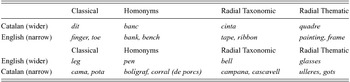
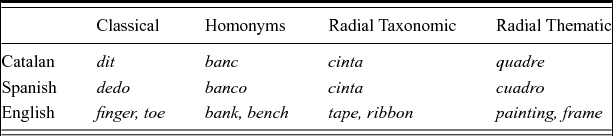
The study used 24 categories. In half of them, the English name for the category (e.g., nail) translated into two Catalan words (ungla – finger nail, clau – metallic pin), so that the English category had a wider scope than either of the Catalan categories. In the other half, the Catalan category (e.g., banc) had two English translations (bank, bench), so that it was the Catalan category that had a wider scope. Following Gathercole and Moawad (Reference Gathercole and Moawad2010), we divided the 24 categories into four types: classical, homonyms, radial taxonomic and radial thematic (see Table 1).
Examples for category types used in the present studies. The category types used are posited to differ in the way concepts are mapped onto words.

Classical categories
These are categories that can be defined in terms of necessary and sufficient sets of defining features. For example, Catalan dit = both fingers and toes: [+part of body, +appendix at the end of a limb, +articulated]. This type generally refers to a limited conceptual space, and, for that reason may be the least dependent on language of all three types, and more dependent on shared perceptual or functional features instead.
Radial categories
These are categories for which it is not possible to define membership via necessary and sufficient conditions. These typically consist of a central, primary use that has been conventionally extended in a language to include other applications. In one sub-set of radial categories (radial taxonomic categories), the extensions are based on shared perceptual or functional similarities. For example, the Catalan category pota ‘paw’-‘table leg’ has a central meaning of leg of an animal (a paw), and due to the similarity between the function of an animal leg (sustaining the body of some animals) and a table leg (supporting the flat top where one can place things), pota has been conventionally extended so that it also designates table legs. In another sub-type of radial categories (radial thematic categories), the central application of the word has been extended to items associated with that central referent by sharing in an event or setting with the central referent. For instance, the word pesca denotes both the act of fishing and the product of fishing, a catch. In this case, the central meaning of the activity has been extended (by thematic association) to the outcome of the activity.
Homonyms
A homonym is a special type of stimuli: strictly speaking not a category, but rather, when two words with different meanings happen to be designated by the same surface form. An example of a homonym in Catalan is banc (meaning both ‘bank’ and ‘bench’). While the meanings in classical and radial categories share a single word form and conceptually related meanings, homonyms only share form and no conceptual underpinning linking the meanings. They, thus, allow us to compare items along a range of semantic-conceptual relations, from classical on one end, to radial, to homonymic, in order to examine the interplay between conceptual and semantic mechanisms. The full set of linguistic stimuli is shown in Appendix A.
Non-Linguistic stimuli
In each of 24 trials, participants first viewed a picture depicting the category (‘the referent'), followed by six pictures of potential category members. The task consisted of deciding which of the six pictures belonged to the category. Half of the participants viewed the name of the category written underneath the referent picture.
Trial stimuli
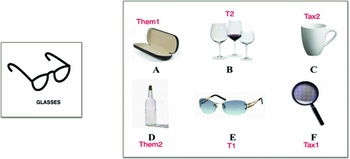
The stimuli depicting potential category members consisted of six images arranged in 3 columns and 2 rows on the screen. The items in the upper row were marked with the letters ‘A’ ‘B’ ‘C’, and those in the lower row were marked with the letters ‘D’ ‘E’ ‘F’. In half of the trials, the images were drawings, whereas in the other half they were photographs, but pictures and photographs were never combined in any trial. The trial choices consisted of 6 variants. One picture showed the same type of object as the referent (a different image of an object of the same kind – e.g., if the referent was a door key, this variant was a different door key). This picture was coded as T1 (target one), corresponding to the same application of the word within the category as the initial target stimulus. The second picture (‘T2’) was another object that can be named by the label in the wider language but not in the narrower language (e.g., for ‘key’, a computer key is an appropriate referent in English, but not in Catalan). In the third and fourth images, items that were taxonomically related (‘being of the same kind’) to T1 and T2 were presented (these were coded as Tax1 and Tax2). And in the fifth and sixth pictures, items that were thematically related to T1 and T2 were presented. These are referred to below as Them1 and Them2, respectively. A typical arrangement of the pictures is shown in Figure 1. The location of the six trial choices in the A to F positions was balanced across stimuli.
Sample of the stimuli used. The category glasses has a ‘wide’ scope in English, so while ‘E’ (target 1) is the obvious answer, in English, ‘B’ (target 2) could be labelled as glasses as well. However, in Catalan or Spanish, the only correct response would be ‘E’ Also note the taxonomically and thematically related distractors.

Participants
Thirty Catalan speakers (mean age 20.7 years, SD = 0.82), and thirty English speakers (mean age = 20.1 years, SD = 0.45) took part in the first study. All of the Catalan speakers were Catalan–Spanish bilinguals, a fact not relevant to this first study, but relevant to the second study. All participants were undergraduate psychology and education students, recruited at the University of the Balearic Islands (Mallorca, Spain) and Bangor University, Wales, UK. All participants had passed university entry exams that require high proficiency in oral and written aspects of their languages, so proficiency across language groups was deemed equivalent (see Costa, Miozzo & Caramazza, Reference Costa, Miozzo and Caramazza1999; Colomé, Reference Colomé2000, for studies using a similar rationale). Participation was voluntary. Information about language use and proficiency was obtained via a language background questionnaire (see appendix C in Supplementary Materials). All participants in the Catalan–Speaking group reported being native speakers of Catalan, and using Catalan at least 50% of the time relative to Spanish. English participants reported using English 100% of the time. Half of the participants in each language group were randomly assigned to the ‘no label’ condition and half were assigned to the ‘label’ condition.
Procedure
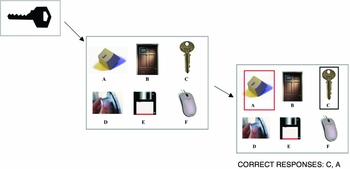
In each of the 24 trials, participants saw an image depicting a category exemplar for 2000 ms. (with or without a label, depending on the group), followed by a blank screen (500 ms.) and then six more images depicting category members and distractors. Participants were asked to look carefully at the pictures and select those items that were ‘like’ the category exemplar (see figure 2). Responses were made by pressing the DFGHJK keys on a computer keyboard (which had been relabelled with stickers on the keyboard as ABCDEF, to match the items on screen). Participants were encouraged to make their choices as quickly as possible, since time for their responses was limited to 6 seconds in each trial. Before starting the task, participants completed three practice trials, to ensure that participants understood that the task consisted in choosing items ‘like’ the category exemplar.
Sample of a trial, ‘KEY’. The correct response is C, although A could also be labelled as ‘KEY’. Here, ‘KEY’ is ‘wide in English, narrow in Catalan’.

Predictions
We hypothesised the following possible outcomes. First, in relation to the question of access to the linguistic labels for categories: if when making their ‘similarity’ judgments, participants are basing their judgments entirely on accessing the word form for the category, whether or not they are presented with a label naming the category, we would expect speakers to choose both referents of a category (T1 and T2) when their language had wider scope, and only the T1 referent when their language had narrower scope. Furthermore, if speakers' judgments are based entirely on access to lexical labels, no differences are expected across category types.
Alternatively, if participants are not basing their similarity judgments on the word for the category, we expected responses to be less in conformity with the categories of the language spoken. This would mean that responses would be based entirely on conceptual factors, and might result in primarily choosing T1 referents and lower numbers of T2 referents, even in the wide categories.
Second, in relation to the presence of labels: if the presence of a label influences performance, speakers may make choices that are more in conformity with their language when a label is present than when it is not.
Third, in relation to the type of category: if the nature of the mapping between the linguistic category and the conceptual space matters for performance, then those category types that involve items that are closer in the conceptual space should elicit distinct patterns of response from those that involve items that are far apart in the conceptual space. The specific prediction would be the greater choice of both T1 and T2 in relation to classical categories than in radial categories, and greater choice of both items in relation to the radial categories than in homonymic categories.
Fourth, if there is an interaction of these factors, there should be evidence of the influence of a combination of factors, with no one single factor accounting for 100% of the patterns of response.
And, finally, we did not anticipate differences in accuracy between the language groups. Both language groups were tested in their native language, so the effects of language-specific width and of the presence of labels should be similar in the two groups.
Results
Participants’ responses were examined in two different sets of analyses. The first set analysed the pattern of target choices (choosing items that were deemed ‘like’ the category exemplar, T1 and/or T2). The second set analysed the choice of items other than targets (Tax1, Tax2, Them1 and Them2), henceforth ‘overextensions’. The latter set of analyses revealed minimal overextensions (from 0.06 to 0.81 per cell), and the choices were likely influenced by the patterns of choices in relation to T1 and T2 (e.g., if they chose both targets, they may have been less likely to choose distractor items than if they chose only one of the targets), so we will not discuss these here. The results are shown in Appendix B, however, for the reader's information.
Analysis of scores in relation to target referents
In ‘wide’ category trials, we considered a response correct if the participant chose both T1 and T2. In ‘narrow’ category trials, the response was correct if participants chose T1 only. Note that when a category was ‘wide’ in one language, it was ‘narrow’ in the other language. A data set was obtained from the behavioural responses of the participants and a repeated measures ANOVA was performed with 4 factors: language group and label group (between-subjects) and width and category type (within-subjects).
The analysis revealed main effects of category type, F(3,171) = 7.338, p<.001, width, F(1, 57) = 303.2, p < .001, and label, F(1,57) = 7.7, p = .007. The effect of category type revealed that performance on classical (1.62) and radial taxonomic (1.62) categories was higher than that on homonymic (1.40) and radial thematic categories (1.36), .001 < ps < .027, pairwise comparisons with Bonferroni correction. The effect of width revealed higher scores in the narrow categories (2.24) than in the wide categories (0.76). And scores in the label condition were higher (1.62) than those in the no label condition (1.38).
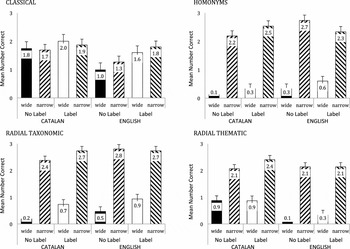
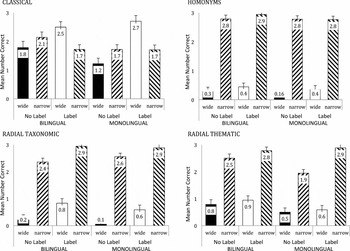
In addition, the analysis also revealed significant interaction effects of Category Type x Width, F(3,171) = 60.04, p<.001, and of Category Type x Language Group, F(3,171) = 11.55, p<.001, and a near-significant effect of Category Type x Language Group x Label, F(3,171) = 2.21, p = .088. In order to explore these interactions, separate analyses were conducted for each category type separately, with language group and label group entered as between-subjects variables and width as a within-subjects variable. Performance by Category type, Width, Language Group, and Label Group is shown in Figure 3.
Performance by Category Type, Language, Label Condition, and Width, Study 1

Classical categories
There was a significant effect of label group, F(1,57) = 7.77, p = .007, with higher scores in the label group (1.82) than in the non-label group (1.43). In addition, there was a significant effect of language group, F(1,57) = 8.54, p = .005, with higher scores in the Catalan group (1.83) than in the English group (1.42).
Homonyms
In homonyms, there were no effects of label or language, but there was a significant effect of width, F(1,57) = 306.9, p < .001. There were higher scores in narrow (2.45) than in wide (0.35) categories.
Radial taxonomic categories
In radial taxonomic categories, there were significant effects of width, F(1,57) = 249.9, p < .001, of label, F (1,57) = 9.25, p = .004, and of language group, F(1,57) = 4.45, p = .039. Performance was better in narrow (2.66) than in wide (0.58) categories, better with a label (1.78) than without a label (1.46), and better in the English group (1.73) than in the Catalan group (1.51).
Radial thematic categories
Finally, in radial thematic categories, there were effects of width, F(1,57) = 198.4, p < .001, and of language group, F(1,57) = 9.87, p = .003. Scores were higher in the narrow (2.18) than in the wide (0.54) cases, and higher in the Catalan group (1.55) than in the English group (1.17). There was also, however, an interaction of Width X Language Group, F (1,57) = 6.00, p = .017. While the two language groups performed at a comparable level in the narrow cases (2.23 Catalan, 2.13 English), the Catalan group had higher scores in the wide context than the English group (0.87 Catalan, 0.20 English).
Summary, target referent scores
These results can be summarized as follows. First, the general results showed that performance overall was better on the classical and radial taxonomic categories than on the homonym and radial thematic categories, that performance was generally better on narrow categories (in which only one target is an appropriate referent) than on the wide categories (in which two targets were appropriate referents), and that labels in general aided performance.
However, the interactions and the examination of the performance on the individual category types revealed some important qualifications of these general patterns. First, better performance on the narrow than on the wide categories held for every category type except for classical categories. That is, for all category types except the classical categories, the narrow categories were easier than the wide categories. In the classical categories, in contrast, there was no significant difference in performance by width. Second, the presence of labels mattered for all category types except homonyms. This means that language influenced decisions on choices in most cases – i.e., the labels generally served to provide some ‘nudge’ towards choosing in conformity to the linguistic categories – but not with homonyms. In fact, the only factor that affected performance on the homonyms was width.
The analyses also revealed that there were some differences between the two language groups. The English speakers had higher scores than the Catalan speakers in relation to radial taxonomic categories, but the Catalan speakers had higher scores than the English speakers in relation to the classical categories and the radial thematic categories. Visual inspection of the data suggests that the advantage of the English speakers in the radial taxonomic categories held across the conditions (except the narrow, label condition). In contrast, the analyses showed that the advantage of the Catalan speakers in the radial thematic contexts held particularly in the wide conditions; and visual inspection of the classical data suggests a similar advantage for the Catalan speakers in wide contexts there and also in the no label condition.
We had hypothesised that a strict linking of the items with the linguistic categories of the language would have led to uniform performance across categories. This was not what was found. We had also hypothesized that strict adherence to perceptual or conceptual similarity would have led to poorer performance across the board in the wide categories. While performance in the wide categories was, in general, certainly inferior to that in narrow categories, this was not true in the case of the classical categories. We had also hypothesized that if labels aided performance, they would do so across the board. Again, this was not the case; labels made no difference in the homonym cases.
The results here favour a mixed account. The fact that wide categories were generally hard indicates that the choice of referents was based on adherence to similarity of attributes and favoured those that were most similar to the initial referent – i.e., T1 responses. The exception was in the case of classical items, where speakers chose T2 quite often in the wide cases, so much so that performance in the wide cases was not significantly different from that in the narrow cases. This was especially true of the Catalan speakers, who also chose some T2 referents in the radial thematic cases.
In addition, the mere presence of a label influenced choices, in the direction of responses more in conformity with the linguistic categories. This was true for all category types except the homonyms. This indicates that the label alone was not sufficient to elicit judgments of ‘similarity’.
We had also hypothesized that the two language groups would perform similarly. This was not wholly true. Whereas their general performance was similar, English speakers had higher scores in the radial taxonomic cases than the Catalan speakers, and Catalan speakers had higher scores in the classical and radial thematic cases – as noted, especially in relation to the wide conditions.
One possible explanation for the differences may have to do with the particular items studied. Recall that what for Catalan speakers was wide was for the English speakers narrow, and vice-versa. It could simply be that there could have been some difference in the difficulty of the items across the languages. Thus, for example, in the classical cases, what was wide in Catalan might have somehow been ‘easier’ than what was wide in English in the corresponding cases. Alternatively, it might be that there are aspects of the structure of each language, or of the cultures in which they are embedded, that make each group of speakers attend differently to the types of categories tested, leading the Catalan speakers to be more attentive to the categories tested in the classical and radial thematic cases, and the English speakers to be more attentive to the categories tested in the radial taxonomic cases. For example, it might simply be that the wide classical and radial thematic items in Catalan are more frequent than the corresponding words in English, and perhaps the English items in the radial taxonomic cases are more frequent than the corresponding words in Catalan. Or, for example, gendered endings in Catalan may highlight the recurrence of the same word across the relevant wide instances, whereas such a grammatical feature is not available in English to emphasize such multiple usage. The notion that linguistic factors can affect other cognitive domains is not new: much work within the framework of the linguistic relativity hypothesis (Lucy, Reference Lucy1992) has explored the interaction between linguistic representations and perception, such as the effects of terminology on the perception of color (Berlin & Kay, Reference Berlin and Kay1969; Athanasopoulos, Reference Athanasopoulos2009), or of shape (Boutonnet, Dering, Viñas-Guasch & Thierry, Reference Boutonnet, Dering, Viñas-Guasch and Thierry2013). Additionally, there is empirical evidence that patterns of lexicalization (e.g., spatial and event conceptualization) affect the way speakers recall and describe events (tight vs. loose containment relations, absolute vs. relative coordinate systems, manner vs. end point of motion (see Choi, Reference Choi2006; Majid, Bowerman, Kita, Haun & Levinson, Reference Majid, Bowerman, Kita, Haun and Levinson2004). Likewise, studies have shown that the presence of a language-inherent classifier system affects speakers’ judgments of similarity – for instance, by categorizing objects in terms of substance and not shape in cases where the classifier places emphasis on substance (Zhang & Schmitt, Reference Zhang and Schmitt1998).
A third plausible explanation for the differences in performance might have to do with the fact that the Catalan speakers were all bilingual. It might be that the fact of being bilingual somehow raised awareness of or attention to the categories here, especially the wide categories. In bilinguals, successful acquisition of both languages requires increased awareness of the category boundaries, and research in developmental psychology suggests that acquiring category boundaries is not a trivial task. As Gathercole & Moawad (Reference Gathercole and Moawad2010) point out, even monolingual children make errors of over- and under-extension when learning the category system of their language (Bowerman, Reference Bowerman, Gumperz and Levinson1996) and L2 speakers never attain the same accuracy determining category boundaries as native speakers (Ameel, Malt & Storms, Reference Ameel, Malt and Storms2009). Continuous exposure to conflicting conceptual-semantic systems from an early age would therefore entail enhanced attentional or cognitive control, respective to monolinguals who are exposed to a single unambiguous semantic-conceptual mapping. In the present studies, this advantage would be more prominent in wide categories, where lexical-semantic conventions contradict conceptual information, and enhanced attention to category boundaries is required. Along these lines, previous research on bilinguals suggests an advantage of bilinguals over monolinguals in some linguistic tasks (Gathercole et al., Reference Gathercole, Thomas, Jones, Viñas-Guasch, Young and Hughes2010; Bialystok, Reference Bialystok2001), superior metalinguistic abilities in bilinguals over monolinguals (Bialystok, Reference Bialystok, Pratt and Garton1993), and possible superior performance in tasks involving executive functioning and executive control (Zelazo & Müller, Reference Zelazo, Müller and Goswami2002). Higher metalinguistic abilities could lead to heightened attention in relation to a language task like that performed here; high cognitive control could lead to active controlling of the language systems. It is possible, that is, that the Catalan speakers performed better, especially where they did – in relation to wider categories – simply due to enhanced attentional or cognitive control conferred by the fact of being bilingual (see general discussion).
The design of the first study did not allow us to determine whether any difference in performance between the English- and Catalan-speaking groups could be related to the fact that the two groups were processing two different languages, English vs. Catalan, or whether differences could be due to the fact that one group was bilingual and the other monolingual. This question was addressed in the second study.
Study 2
Study 2 examined performance of bilingual and monolingual groups who shared a single cultural background. The question was whether, when the two groups responded to the same language, and when that language had the same semantic structure in relation to the relevant categories as that of the bilinguals' other language, would the bilinguals still perform differently from monolinguals. Here we tested monolingual speakers of Spanish in comparison with bilingual speakers of Spanish (and Catalan). The Spanish category organization for the categories used in this study is the same as in Catalan.
The two groups of speakers had similar SES backgrounds (students of psychology and education in public universities in Spain), both to each other and to the participants of the first (Catalan and English) study. The second study used the same task and stimuli as the first study (except the labels were in Spanish), in order to examine the question of the best explanation for differences in the scores of the Catalan speakers and English speakers in the first study.
Predictions
In line with the previous study, we expected performance to be higher in classical and radial taxonomic categories, and lower in radial thematic categories and especially homonyms. We also expected, in line with study one, an effect of width in all cases except for the classical cases, and an effect of label in all cases except for the homonym cases. In relation to the aim of comparing two participant samples where bilingualism is the main difference in order to explore the potential contribution of bilingualism to category membership judgments, we predicted that if the language of the stimuli was responsible for the Catalan/English differences in the first study, we should find no difference in performance in study two, since both groups were tested on Spanish. If, on the other hand, in study one the bilingual nature of the Catalan group was responsible for their differential performance relative to the English group, then in the second study, the bilinguals (Catalan–Spanish) should show distinct performance from the monolingual Spanish group. In particular, the question is whether the bilinguals show better performance on the wide categories, or in the no label contexts, than the monolinguals, especially in relation to the classical categories, as was the case for the Catalans relative to the English speakers in study one.
Participants
Thirty-two Catalan–Spanish bilinguals (mean age = 20.76 years, SD = 0.82) and thirty-five Spanish monolinguals (mean age = 20.11 years, SD = 0.45) took part in the study. All participants were undergraduate psychology and education students, recruited, respectively, at the University of the Balearic Islands and the Autonomous University of Madrid, Spain. Information about language use and proficiency was obtained via a language background questionnaire. The Catalan participants were similar in all respects relative to those of the first study. Participants in the monolingual Spanish group reported using only Spanish 100% of their time. All participants had passed university entry exams that require high proficiency in oral and written aspects of their languages (Spanish in the case of monolinguals, and both Catalan and Spanish in the case of bilinguals), so proficiency across language groups was deemed equivalent (see Costa et al., Reference Costa, Miozzo and Caramazza1999; Colomé, Reference Colomé2000, for studies comparing similar samples).
Procedure
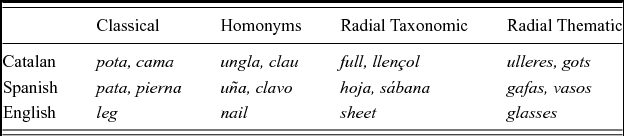
The testing procedure and scoring of participants’ responses were identical to those in study 1. However, in this case, the ‘wide’ and ‘narrow’ categories from Catalan were used and re-named in Spanish. These words in Spanish have similar semantic structure, in relation to the English words of study 1, as the Catalan words from study 1 (see tables 2 and 3).
Example of ‘wide in Catalan and Spanish’ categories used in study 2

Example of ‘narrow in Catalan and Spanish’ categories used in study 2

Results
As for Study 1, participants’ responses were examined in two different sets of analyses. The first set analysed the pattern of target choices (choosing items that were ‘like’ the category exemplar, T1 and/or T2). The second set analysed the choice of items other than targets (Tax1, Tax2, Them1 and Them2), which we call ‘overextensions’. The latter set of analyses revealed minimal overextensions (from 0.262 to 0.905 per cell), and the choices were likely influenced by the patterns of choices in relation to T1 and T2 (e.g., if they chose both targets, they may have been less likely to choose distractor items then if they chose only one of the targets), so we will not discuss these here. The results are shown in Appendix B, however, for the reader's information.
Analysis of scores in relation to target referents
As for Study 1, in ‘wide’ category trials, we considered a response correct if the participant chose both T1 and T2. In ‘narrow’ category trials, the response was correct if participants chose T1 only. A data set was obtained from the behavioural responses of the participants and a repeated measures ANOVA was performed with 4 factors: language group and label group (between-subjects) and width and category type (within-subjects).
The analysis revealed, first, main effects of category type, F(3,189) = 16.450, p<.001, of width, F(1,63) = 447.95, p<.001, of language group, F(1,63) = 5.381, p = .024, and of label, F (1,63) = 25.72, p < .001. Scores were significantly higher for classical categories (1.938) than for all other category types: homonyms (1.544), radial taxonomic categories (1.554), radial thematic categories (1.615), all ps<.001 (pairwise comparisons with Bonferroni correction); performance was better in the narrow categories (2.463) than in wide categories (0.863), and higher with labels (1.849) than without labels (1.477). And scores were higher in the bilingual group (1.748) than in the monolingual group (1.578).
There were also interaction effects of Category Type x Label Group, F(3,189) = 2.715, p = .046; of Category Type x Width, F (3,189) = 162.848, p < .001; of Category Type x Language Group x Label Group, F(3,189) = 3.281, p = .022; and of Category Type x Width x Label Group, F(3,189) = 14.583, p<.001. In order to explore these interactions, follow-up analyses examined each category type separately in relation to width, language group, and label group. Performance by Category Type, Width, Language Group, and Label Group is shown in Figure 4.
Performance by Category Type, Language, Label Condition, and Width, Study 2

Classical categories
There was a significant main effect of only one factor, of Label group, F (1,63) = 13.247, p = .001, with higher scores in the label group (2.158) than in the non-label group (1.718). However, performance by Label group interacted with both width and language group: Width x Label Group, F (1,63) = 21.88, p < .001, Language Group x Label Group, F (1,63) = 5.884, p = .018. Without labels, participants had higher scores for narrow categories (1.93) than for wide categories (1.50), whereas with labels, scores were higher for the wide categories (2.6) than for narrow (1.7). Without labels, the bilinguals had higher scores (1.96) than the monolinguals (1.47), whereas with labels, the two performed at a comparable level (2.2, 2.1, respectively).
Homonyms
Performance on the homonymic category items is shown by Width, Language Group, and Label Group in Figure 4. For homonyms, there were no effects of label group or language group, but there was a significant main effect of width, F (1, 63) = 815.58, p < .001. Performance was high in relation to narrow categories (2.82), and low with wide categories (0.27).
Radial taxonomic categories
Performance on the radial taxonomic category items is shown by Width, Language Group, and Label Group in Figure 4. For radial taxonomic categories, there were main effects of width, F(1,63) = 399.3, p<.001, and of label, F(1,63) = 23.7, p < .001. Performance was high in relation to narrow categories (2.69) and low in relation to wide categories (0.42), and it was higher with labels (1.81) than without labels (1.30).
Radial thematic categories
Performance on the radial thematic category items is shown by Width, Language Group, and Label Group in Figure 4. With radial thematic categories, there were main effects of width, F (1,63) = 292.8, p < .001, of label, F (1,63) = 10.92, p = .002, and of language group, F(1,63) = 6.10, p = .016. Performance was higher on narrow categories (2.53) than wide categories (0.71), with labels (1.80) than without (1.43), and by bilinguals (1.75) than monolinguals (1.48). There was also an interaction of Width x Label Group, F(1,63) = 5.18, p = .026. The presence of a label improved performance in the case of narrow categories, from 2.22 to 2.83 correct responses (wide: from 0.64 to 0.77).
Summary, target referent scores
These results can be summarized as follows. First, the general results showed that performance overall was better on the classical categories than on any other type, that performance was generally better on narrow categories (in which only one target is an appropriate referent) than on the wide categories (in which two targets were appropriate referents), that labels in general aided performance, and that bilinguals scored better than monolinguals.
However, the interactions and the examination of the performance on the individual category types revealed some important nuances to these general patterns. First, for all category types except the homonyms, the label assisted performance. This means that language influenced decisions on choices in most cases – i.e., the labels generally served to provide some ‘nudge’ towards choosing in conformity to the linguistic categories – but not with homonyms. In addition, for all category types except the classical categories, the narrow categories were easier than the wide categories. In contrast, the wide classical categories were not significantly harder than the narrow classical categories. However, labels mattered. For the classical categories, when the categories were wide, the labels boosted performance; labels also boosted performance for narrow radial taxonomic and radial thematic categories.
These analyses also revealed that there were primarily two places where the bilinguals outperformed the monolinguals: first, in relation to radial thematic categories, they had higher scores, in every condition, than the monolinguals; and, second, they had higher scores than the monolinguals in relation to the classical categories in the no label condition (see Fig. 4).
These results of the second study are, in general, in line with the findings of Study 1. In relation to conformity of choices in relation to the target referents, performance was, first, consistently highest in classical categories, and lowest in radial thematic categories, with homonyms and radial taxonomic categories in an intermediate position. Second, there was an effect of width only in relation to homonyms, with more accurate performance in the narrow than in the wide conditions for homonyms. Both studies also showed some effect of the label on performance, with better performance in the label condition than in the non-label condition for all categories except the homonyms. With regard to the performance of the participant groups, the two studies show differences and some striking similarities. First, there was an overall advantage of the English speakers over the Catalan speakers in relation to radial taxonomic items in the first study, but no such advantage of the monolingual Spanish speakers over the bilingual speakers in the second study. This suggests that the effect for English in study one may have been related to the particular items tested for English versus Catalan. In contrast, the two studies share the result showing an advantage of the Catalan (bilingual) speakers in study one and the bilingual (Catalan–Spanish) speakers in study two. In both cases, these speakers outperformed the other group (English monolinguals, Spanish monolinguals) in particular in the classical contexts and the radial thematic contexts, and especially in the wide and no label contexts. This similarity in performance argues against the first two possible explanations above for the performance in study one – i.e., against the possibilities that the particular items being tested or that language- and culture-specific factors were responsible for the differences in performance. Instead, the similarity in performance of the Catalan speakers in the two studies argues in favour of the third explanation – i.e., that the very fact of being bilingual raised awareness of or attention to the categories tested, leading to their responses being more in conformity with the categories of the language being tested.
Discussion
Taken together, the present studies highlight important implications for the study of semantic processing in bilinguals and for performance of bilingual participants in studies such as this one. Specifically, our results suggest that several factors influence category membership judgments in bilinguals: on the one hand, the specific semantic-conceptual mapping of the category type, the presence of a linguistic context (labels), and the width of the category all affect performance; at the same time, the very fact of being bilingual affects processing by promoting heightened linguistic awareness or cognitive control.
We argued that category membership is clearer in categories in which a word maps onto referents that are close in the conceptual space. Consistent with this, accuracy scores were highest in classical categories, and, importantly, they were as high in the wide contexts as in the narrow contexts for classical categories. In contrast, performance in the homonym cases was poor in all wide contexts, even in the presence of a label. That is, labels never were enough to lead respondents to consider the T2 referents ‘similar’ to the initial referents. The radial taxonomic and radial thematic cases lay between these two: performance on the wide cases was much lower than that on the narrow cases, but that performance was boosted with the presence of a label. That is, the labels served to bring respondents to judge the T2 as ‘similar’ to the initial referent in these category types, as they did in the classical category type.
The results of the two studies indicate that the judgments here were affected by an interaction of a variety of factors: semantic-conceptual mapping, linguistic context, and bilingual/monolingual status. The difference between the bilinguals and the monolinguals cannot be explained by effects of language or culture: in the second study, the specific categories, and the category scope for each were the same for the monolinguals and bilinguals tested (and also the same in the bilinguals' two languages, Spanish and Catalan). The increased accuracy of the bilingual group is consistent with previous reports of a bilingual advantage in metalinguistic and in cognitive tasks.
Note that previous literature has focused on the special pattern of categorization in bilinguals as a result of convergence of their two semantic systems. Our design avoided any confounds due to semantic convergence in the languages tested, and suggests that the pattern of choices in bilinguals can also be influenced simply by increased metalinguistic awareness or attentional control, consistent with work on bilinguals in other realms (Costa et al., Reference Costa, Hernández and Sebastián-Gallés2008; Luk et al., Reference Luk, De Sa and Bialystok2011; Tao, Marzecová, Taft, Asanowicz & Wodniecka, Reference Tao, Marzecová, Taft, Asanowicz and Wodniecka2011; Luk et al., Reference Luk, De Sa and Bialystok2011, Kapa & Colombo, Reference Kapa and Colombo2013). Such awareness or control appears to have led the bilinguals to respond in greater conformity with the category structure of their language.
Conclusion
Summarizing, our results show that bilingualism, type of semantic-conceptual mapping, and linguistic context influence the treatment of category boundaries. In particular, our research highlights two main issues: first, that the effect of linguistic context on category membership is modulated by the mapping of conceptual knowledge onto word meaning. Category boundaries are not equally vulnerable to the influence of linguistic context, and as a consequence, the study of the relationship between language and the conceptual store requires careful distinctions between conceptual and semantic levels. Second, the results indicate that differences in categorization between monolinguals and early bilinguals are not only a product of convergence of the bilinguals’ two lexico-semantic stores, but also stem from a heightened awareness or control of the linkages of category boundaries with the language-specific relevant boundaries. It should be remembered that the task here entailed similarity judgments, not category membership judgments. The fact that these results were obtained even in a simple similarity judgment task suggests the strength of these effects.
These results suggest that in future work, the adoption of careful choice and classification of stimuli based on semantic-conceptual mapping is necessary in order to distinguish the separate contributions of conceptual factors and linguistic factors. Second, the comparison of monolinguals, early and late bilinguals, and second language learners can help us to understand whether the type of bilingual advantage observed here arises from developmental differences or is a result of continuous practice in the use of different languages. Third, it would be beneficial to compare bilinguals whose languages are typologically close with bilinguals whose languages are typologically distant. Languages of the same family tend to have higher lexical similarity, a prevalence of cognates and presumably shared or overlapping conceptual or lexico/semantic representations (see Van Hell & De Groot, Reference Van Hell and De Groot1998), so the question arises whether inhibition of L2 lexical forms that are similar to one's L1 involves greater or lesser attentional costs than keeping lexical forms separate in languages that are typologically distant and where lexico/semantic overlap is less likely. While our studies did not directly compare groups of bilingual speakers whose languages differed in typological distance, it seems plausible to speculate that maintaining two separate systems of category boundaries might be more difficult in cases where category boundaries can be either totally different, or partially or totally, than it would be in cases where category boundaries differ completely. One factor that we predict would modulate performance in either case regardless of typological distance is the degree of proficiency of the speakers in the two languages, so this would be crucial to control in any examination of this question.
Supplementary Material
For supplementary material accompanying this paper, visit http://dx.doi.org/10.1017/S1366728916000754