





1. Introduction
Multilinguals frequently draw on more than one language in daily communication and often seamlessly switch between them. This ability reflects a dynamic coordination of two active linguistic systems. During speech planning, both languages are activated in parallel, meaning that selecting the intended language requires recruiting cognitive mechanisms that manage interference from the non-target system. These mechanisms, collectively referred to as bilingual language control, involve processes such as monitoring potential conflict and inhibiting unwanted linguistic competitors (Abutalebi, Reference Abutalebi2008; Green & Abutalebi, Reference Green and Abutalebi2013).
A central question in research on bilingualism is whether bilingual language control and domain-general control rely on overlapping cognitive resources (Jiao, Meng, et al., Reference Jiao, Meng, Wang, Schwieter and Liu2022; Magezi et al., Reference Magezi, Khateb, Mouthon, Spierer and Annoni2012). Some studies report positive links between the two systems, finding that individuals who manage linguistic interference also tend to show stronger performance on non-linguistic tasks measuring inhibition or conflict monitoring (Declerck et al., Reference Declerck, Koch and Philipp2015; Jiao et al., Reference Jiao, Liu, Liang, Plummer, Perfetti and Chen2019). Neuroimaging studies similarly suggest partial overlap between neural systems that support language control and those that support executive functioning (Abutalebi, Reference Abutalebi2008; Christoffels et al., Reference Christoffels, Firk and Schiller2007). However, other studies have failed to detect any reliable behavioral correspondence between bilingualism and performance on cognitive control tasks (Calabria et al., Reference Calabria, Grunden, Serra, García-Sánchez and Costa2019; Paap et al., Reference Paap, Johnson and Sawi2014), leaving the nature of this relationship unresolved. The other side of the coin is that managing multiple languages may confer cognitive benefits across a range of domains, including attention and learning (Antoniou et al., Reference Antoniou, Liang, Ettlinger and Wong2015; Marian & Shook, Reference Marian and Shook2012). As these advantages are not consistently observed, their extent may depend on the nature of bilingual experience and the specific cognitive processes being measured (Schwieter & Festman, Reference Schwieter and Festman2024).
Training studies offer a powerful way to address this question because they allow researchers to test whether exercising bilingual language control produces measurable changes in executive functions. If switching between languages relies, at least partially, on the same inhibitory processes needed in non-linguistic conflict tasks, then practicing rapid alternation between languages should improve performance in non-linguistic paradigms. Some evidence supports this prediction: Liu et al. (Reference Liu, Yang, Jiao, Schwieter, Sun and Wang2019) found that language switching training improved monitoring and inhibition in Chinese-English bilinguals. Subsequently, Jiao et al. (Reference Jiao, Liu, Schwieter and Chen2021) demonstrated similar training benefits when Chinese speakers switched between newly learned languages. However, studies such as Prior and Gollan (Reference Prior and Gollan2013) report no such training effects, suggesting that transfer may depend on linguistic background, task demands, or the specific executive processes recruited during switching. In addition to behavioral training effects, some studies suggest that engaging in language switching can influence non-linguistic cognitive processes, although findings remain mixed (see Timmer et al., Reference Timmer, Calabria and Costa2019).
Inhibitory control is crucial to both bilingual language regulation and conflict resolution more generally. Inhibitory control refers to suppressing an automatic or dominant response in favor of a more appropriate or accurate one (Bunge et al., Reference Bunge, Dudukovic, Thomason, Vaidya and Gabrieli2002; Clark, Reference Clark2012) and can be measured through various behavioral tests such as the flanker task. The task measures the ability to manage conflict between spatially or perceptually competing stimuli (Markiewicz et al., Reference Markiewicz, Mazaheri and Krott2023; Paap et al., Reference Paap, Johnson and Sawi2014). The adaptive control hypothesis proposes that various types of bilingual contexts shape the control processes used to manage interference (Green & Abutalebi, Reference Green and Abutalebi2013). From this perspective, engaging repeatedly in language switching (even over a short period) may temporarily strengthen aspects of executive control recruited by the switching process (Lai & O’Brien, Reference Lai and O’Brien2020). However, previous switching-training research has focused primarily on Chinese first-language (L1) speakers who were trained to switch between L2 English (Liu et al., Reference Liu, Yang, Jiao, Schwieter, Sun and Wang2019) or between two newly learned languages (German and Japanese in Jiao et al., Reference Jiao, Liu, Schwieter and Chen2021) with which they had no prior experience. Whether similar effects emerge among other bilinguals with various language backgrounds remains unknown. The present study addresses this gap.
We administered a flanker task before participants engaged in a 50-minute training session in language switching to gather a baseline index of their inhibitory control. Immediately following the language-switching task, we again employed the flanker task to analyze whether there were any differences in participants’ flanker effects arising from the training. If switching experience draws on the same inhibitory mechanisms engaged in these tasks, then interference effects should be smaller after training in language switching. We hypothesize that this will be the case, namely that participants will show reduced flanker effects post-training.
2. Method
2.1. Participants
We conducted an a priori power analysis using G*Power 3.1 (Faul et al., Reference Faul, Erdfelder, Lang and Buchner2007) to determine the required sample size. The analysis was based on an α level of .05, desired statistical power of .80 and the effect size (Cohen’s d) was set to .41, representing a medium effect size. The analysis found that a minimum of 47 participants was needed for meaningful analyses. Accordingly, we recruited 55 undergraduate students between 17 and 25 years old. To be eligible to participate in the study, individuals needed to have a functional knowledge of at least one additional language other than English. All participants completed the same three phases of the study: a pre-training flanker task, the training in language-switching task and a post-training flanker task. All data were collected anonymously, and participants were assigned a numeric identification code to conceal their identity. This study was approved by the Wilfrid Laurier University Research Ethics Board (#9411), and all participants provided informed consent prior to participation.
A language questionnaire was used to gather information about participants’ language backgrounds and self-ratings of proficiency. Participants reported a wide range of L2s, with French being the most common (49.1%, n = 27). Other L2s included Arabic (7.3%, n = 4), German (n = 3), Hebrew (n = 3), Hindi (n = 3), Spanish (n = 3) and Russian (n = 2), as well as one participant speaking each of the following languages: Armenian, Dari, Greek, Japanese, Mandarin, Polish, Portuguese, Tagalog, Yoruba (n = 10).
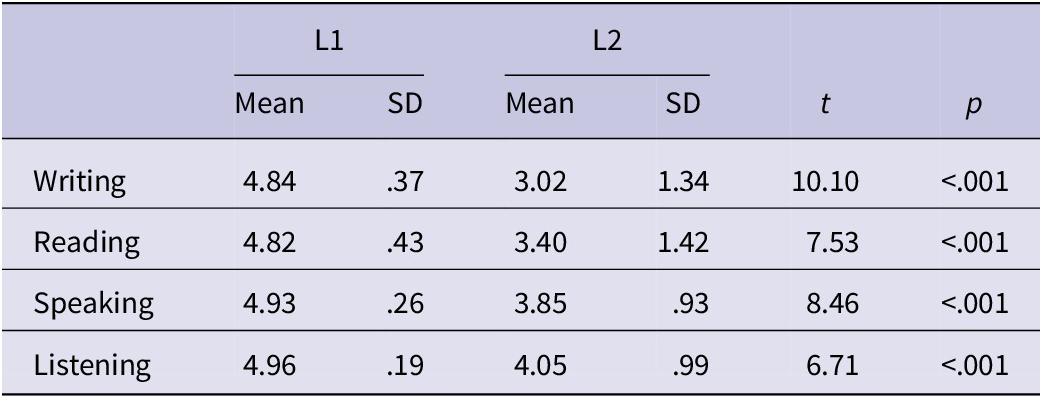
The questionnaire also elicited information about participants’ L2 age of acquisition, languages spoken at home and at school and self-perceived proficiency ratings in each language. Proficiency ratings were provided on 5-point Likert scales assessing speaking, comprehension, reading and writing abilities. Paired t-tests that were conducted on participants’ L1 and L2 ratings demonstrated that the individuals were significantly more proficient in their L1 than L2 (see Table 1).
Means and standard deviations (SD) of second language (L2) self-report proficiency and use among participants

Table 1. Long description
The table contains seven columns: Skill, L 1 Mean, L 1 S D, L 2 Mean, L 2 S D, t-value, and p-value.
* Writing: L 1 Mean 4.84 (S D .37), L 2 Mean 3.02 (S D 1.34), t 10.10, p less than .001.
* Reading: L 1 Mean 4.82 (S D .43), L 2 Mean 3.40 (S D 1.42), t 7.53, p less than .001.
* Speaking: L 1 Mean 4.93 (S D .26), L 2 Mean 3.85 (S D .93), t 8.46, p less than .001.
* Listening: L 1 Mean 4.96 (S D .19), L 2 Mean 4.05 (S D .99), t 6.71, p less than .001.
Across all categories, L 1 scores are consistently higher than L 2 scores with statistically significant differences.
2.2. Design and procedure
The three phases of the study were completed in a single testing session, with the entire experimental session lasting approximately 75 minutes. In the pre-training phase, participants were administered a flanker task. To minimize expectancy effects, participants were not informed that they will later repeat the same task. Following the flanker task, participants proceeded to the training in language-switching task. On each trial, participants were shown a single-digit numeral (1–9) and were required to name it in either their L1 or L2 depending on the background screen color presented. The structure of this task creates frequent opportunities for language switching or nonswitching. Switch trials and nonswitch trials occurred in a fixed proportion, ensuring consistent switching demands across the training period. The entire training session lasted approximately 50 minutes. Finally, immediately after the training in language switching, participants completed the same flanker task as in the pre-training phase. The timing between pre- and post-test was kept consistent for all participants to ensure that any differences in performance reflected the immediate effects of the switching task rather than those arising from other variables. Below we describe the tasks’ design and procedure in more detail.
2.2.1. Training in language switching: A numeral switching task
The numeral switching task (Meuter & Allport, Reference Meuter and Allport1999; see also Schwieter & Sunderman, Reference Schwieter and Sunderman2008 for a similar design using pictures) was run using E-Prime 3.0. In the task, participants were asked to name lists of individually presented numerals (1–9) in either their L1 or L2 as determined by the color of the background screen (blue = to be named in L1; yellow = to be named in L2). Participants’ verbal responses were recorded into a high-quality microphone connected through a Chronos response box. The entire task included four practice lists, including 41 trials followed by 48 lists totaling 480 trials. Of the experimental trials, 65% (312) were nonswitch trials (those in which the immediately preceding trial was named in the same language) and 35% (168) were switch trials (those in which the immediately preceding trial was named in a different language). Our variables of interest are trial type (switch vs. nonswitch) and response language (L1 vs. L2).
The practice and experimental trials proceeded as follows: a black fixation cross (+) was presented at the center of a white background screen for 750 ms. The fixation point then disappeared, and a numeral appeared on either a blue or yellow background until the participant responded. If no response was given, the numeral disappeared after 5000 ms. A blank screen appeared for 750 ms before a new trial began with a fixation point. The entire training session lasted approximately 50 minutes.
2.2.2. Flanker task
Before and after the training in language switching, participants were administered a flanker task using E-Prime 3.0. In the task, a series of five arrows (e.g., <<<<<) was presented on a computer screen. Using the keyboard, participants were asked to respond to the direction of the middle arrow (“f” key for left-going arrows and the “j” key for right-going arrows) while ignoring the flanking arrows on both sides. The task included a practice set of 8 trials followed by two blocks of 75 trials. Half of the experimental trials represented congruent conditions (e.g., <<<<< or >>>>>) and the other half were incongruent (<<><< or >><>>). Our variable of interest is congruency (incongruent trials vs. congruent trials).
The practice and experimental trials proceeded as follows: a fixation point (●) was presented at the center of a black background screen for 500 ms. The fixation point then disappeared, and five white arrows appeared for 1500 ms, during which time the participant responded by keypress. A blank screen appeared for a random amount of time between 850 and 1000 ms before a new trial began with a fixation point. The entire task lasted approximately 5 minutes.
2.3. Data analyses
Analyses on reaction times (RTs) and accuracy rates from the language switching and flanker tasks were conducted in SPSS 27.0 using linear mixed-effects models with participants as a random intercept fitted to trial-level data. Prior to the analyses, the data were screened for completeness and accuracy. For RT analyses, only trials with correct responses were included, and all variables were examined for potential outliers and data entry errors. Responses faster than 250 ms or slower than 2500 ms were treated as outliers and excluded from the analyses. For accuracy rates, both incorrect and correct responses were included.
3. Results
3.1. Training in language switching
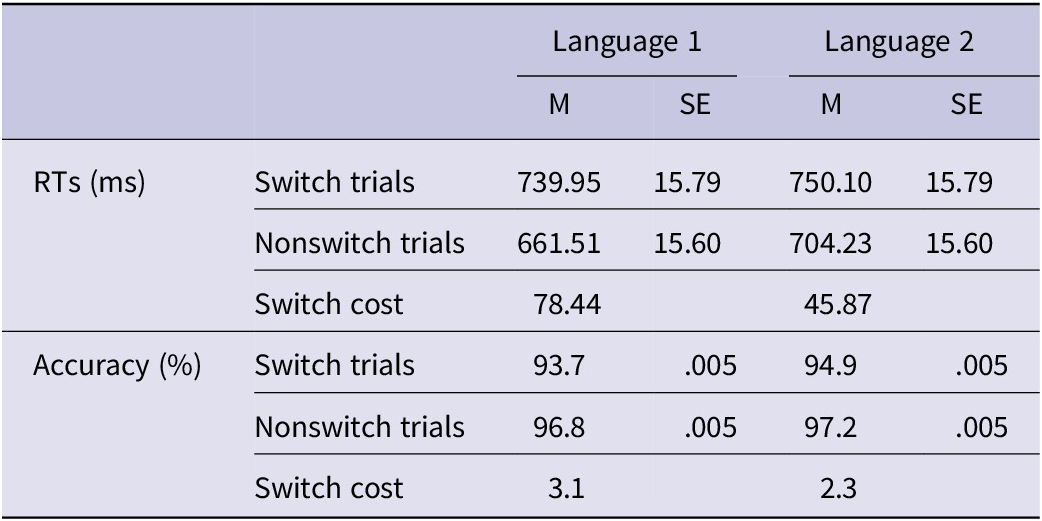
Mean RTs and accuracy rates from the language-switching task are shown in Table 2.
Reaction times (ms) and accuracy rates (%) for trial type and language

Table 2. Long description
The table is divided into two main sections: R T s (m s) and Accuracy (percent). Each section compares Language 1 and Language 2 across three trial categories: Switch trials, Nonswitch trials, and Switch cost.
For R T s (m s):
* Switch trials: Language 1 M = 739.95, S E = 15.79; Language 2 M = 750.10, S E = 15.79.
* Nonswitch trials: Language 1 M = 661.51, S E = 15.60; Language 2 M = 704.23, S E = 15.60.
* Switch cost: Language 1 = 78.44; Language 2 = 45.87.
For Accuracy (percent):
* Switch trials: Language 1 M = 93.7, S E = .005; Language 2 M = 94.9, S E = .005.
* Nonswitch trials: Language 1 M = 96.8, S E = .005; Language 2 M = 97.2, S E = .005.
* Switch cost: Language 1 = 3.1; Language 2 = 2.3.
Note: Language 1 refers to English. M represents the mean and S E represents the standard error.
Note: Language 1 refers to English; Language 2 varied among the participants (see Section 2.1).
3.1.1. Reaction times
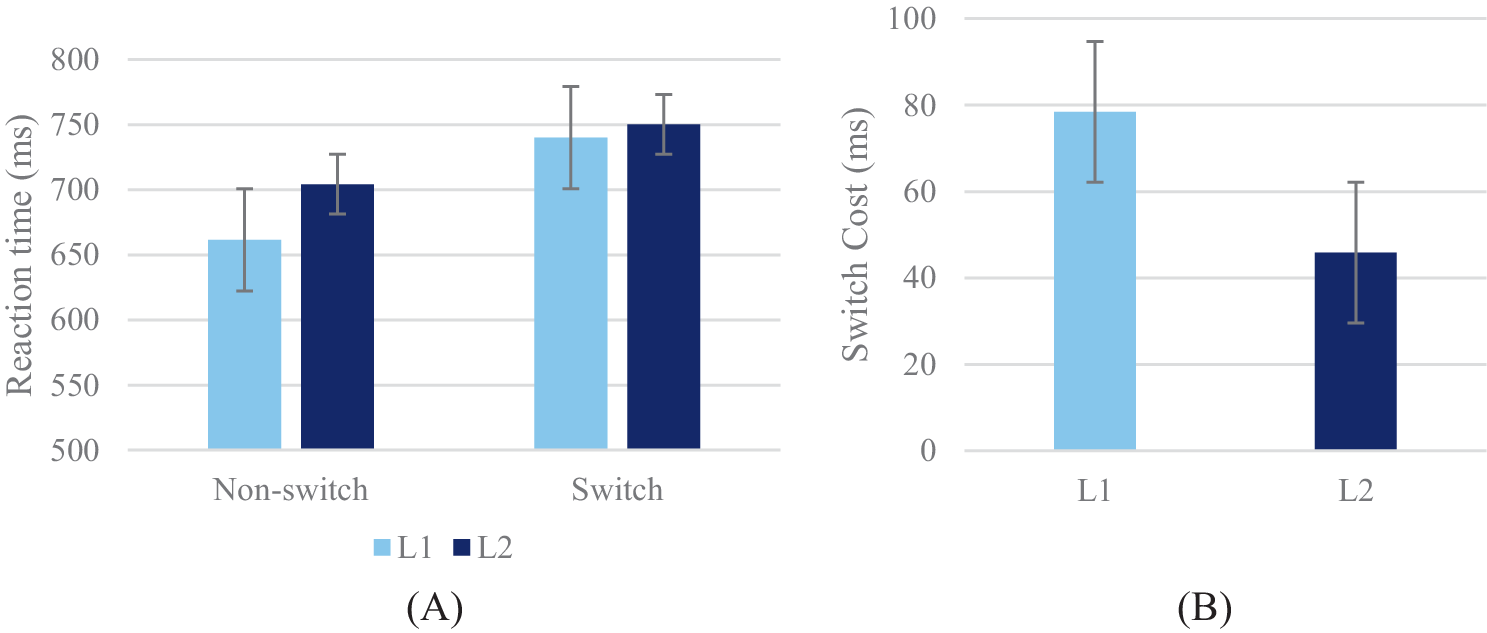
RTs of correct responses from the language-switching task were first analyzed separately using linear mixed-effects models with participants as a random intercept fitted to trial-level RT data. The dependent variable was RT, and the fixed effects were trial type (switch vs. nonswitch) and language (L1 vs. L2). There was a significant main effect of trial type, F(1, 25033.24) = 347.97, p < .001, indicating slower responses on switch trials (M = 745.03 ms, SE = 15.57) than nonswitch trials (M = 682.87 ms, SE = 15.47). There was also a significant main effect of language, F(1, 25033.24) = 62.92, p < .001, with slower responses in the L2 (M = 727 ms, SE = 15.52) than L1 (M = 700.73 ms, SE = 15.52). Importantly, the interaction between trial type × language was significant, F(1, 25033.24) = 23.89, p < .001. Further pairwise analyses showed that the cost of switching into the L1 (M = 78.44 ms) was greater than into the L2 (M = 45.87 ms). See Figure 1 for an illustration of these findings.
Mean reaction times (ms) for trial type and language (A) and switch costs for L1 and L2 (B).

Figure 1. Long description
A two-panel figure labeled A and B.
Panel A is a clustered bar graph. The y-axis is labeled Reaction time m s and ranges from 500 to 800. The x-axis has two categories: Non-switch and Switch. A legend indicates light blue bars for L 1 and dark blue bars for L 2.
* For Non-switch trials, L 1 reaction time is approximately 660 m s and L 2 is approximately 705 m s.
* For Switch trials, L 1 reaction time is approximately 740 m s and L 2 is approximately 750 m s.
* All bars include vertical error bars.
Panel B is a bar graph showing switch costs. The y-axis is labeled Switch Cost m s and ranges from 0 to 100. The x-axis lists L 1 and L 2.
* The light blue bar for L 1 shows a switch cost of approximately 78 m s.
* The dark blue bar for L 2 shows a switch cost of approximately 46 m s.
* Both bars include vertical error bars.
3.1.2. Accuracy rates
As in the RT analyses, we conducted separate linear mixed-effects models on accuracy rates. Participants were added as a random intercept, accuracy rates as a dependent variable, and trial type (switch vs. nonswitch) and language (L1 vs. L2) as fixed effects. There was a significant main effect of trial type, F(1, 26341) = 111.50, p < .001, indicating higher accuracy on nonswitch trials (M = 97.0%, SE = .005) compared to switch trials (M = 94.3%, SE = .005). The main effect of language was also significant, F(1, 26341) = 8.91, p = .003, such that responses were more accurate in the L2 (M = 96.0%, SE = .005) compared to the L1 (M = 95.3%, SE = .005). The interaction between the two variables was only marginally significant, F(1, 26341) = 2.81, p = .094.
3.2. Flanker task
3.2.1. Reaction times
RTs of correct responses from the pre- and post-training flanker tasks were first analyzed separately using linear mixed-effects models with participants as a random intercept fitted to trial-level RT data. The dependent variable was RT, and the fixed effect was congruency (incongruent vs. congruent). In the pre-training flanker task, there was a significant main effect of congruency, F(1, 6918.22) = 1147.31, p < .001. Estimated marginal means indicated that participants responded faster on congruent trials (M = 464.64 ms, SE = 9.62) than on incongruent trials (M = 561.51 ms, SE = 9.64). In the post-training flanker task, the main effect of congruency was also significant, F(1, 6968.16) = 1193.23, p < .001, showing that participants responded faster on congruent trials (M = 430.28 ms, SE = 6.93) than on incongruent trials (M = 509.57 ms, SE = 6.94). These patterns from both pre-and post- training flanker tasks reflect the typical flanker effect.
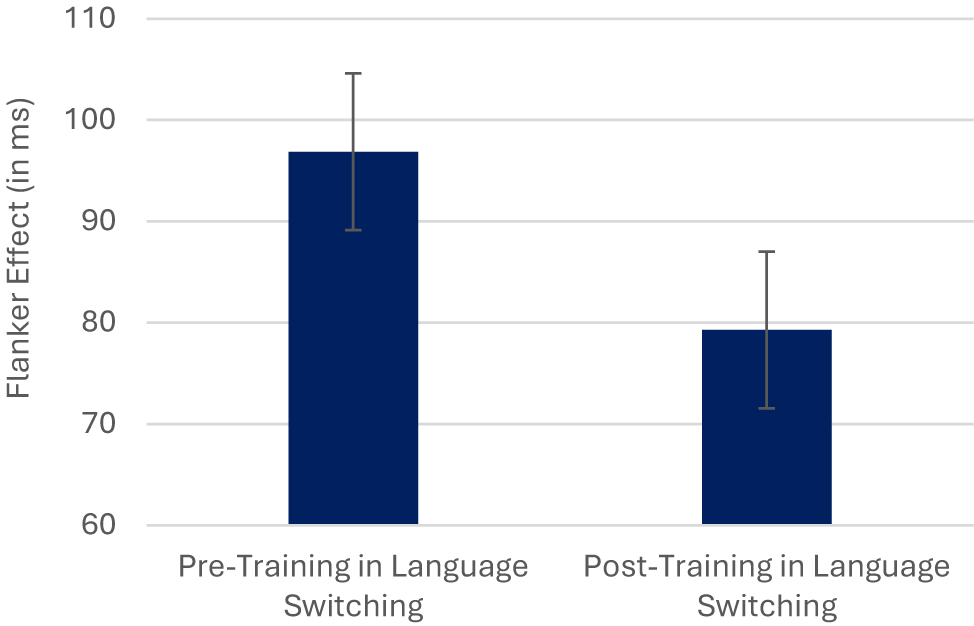
We then conducted another mixed-effects model to compare differences between pre- and post-training flanker performance. Participants were added as a random intercept, RTs as the dependent variable and congruency (incongruent vs. congruent) and session (pre-training vs. post-training) as fixed effects. The main effect of congruency was significant, F(1, 13935.12) = 2227.73, p < .001, indicating that congruent trials (M = 447.48 ms, SE = 7.63) were faster than incongruent trials (M = 535.50 ms, SE = 7.64). The main effect of session was also significant, F(1, 13935.12) = 534.59, p < .001, showing that overall RTs in the pre-training flanker task (M = 513.05, SE = 7.63) were slower than in the post-training task (M = 469.93, SE = 7.63). Importantly, the congruency × session interaction was significant, F(1, 13935.12) = 22.20, p < .001. Further pairwise analyses showed that the flanker effect was significantly smaller in the post-training session (79.29 ms) compared to pre-training (96.87 ms) (see Figure 2).
Mean flanker effect (in ms) before and after training in language switching.

3.2.2. Accuracy rates
As in the RT analyses, we conducted separate linear mixed-effects models on accuracy rates for pre- and post-training flanker tasks. Participants were added as a random intercept, accuracy rates as a dependent variable and congruency (incongruent vs. congruent) as a fixed effect. In the pre-training flanker task, the main effect of congruency was significant, F(1, 7151) = 116.25, p < .001, showing that participants were more accurate on congruent (98.9%) versus incongruent (94.5%) trials. Similarly, in the post-training flanker task, the main effect of congruency was significant, F(1, 7151) = 119.77, p < .001, such that participants were more accurate on congruent (99.4%) versus incongruent (95.4%) trials.
We then ran an additional mixed-effects model to compare differences in accuracy rates between pre- and post-training flanker tasks. Participants were added as a random intercept, accuracy rates as the dependent variable and congruency (incongruent vs. congruent) and session (pre-training vs. post-training) as fixed effects. The congruency × session interaction was not significant (p = .49), suggesting that flanker effect accuracy did not significantly change from pre- to post-training, likely reflecting a ceiling effect throughout the experimental session.
4. Discussion
The present study examined whether training in language switching had an immediate effect on inhibitory control among English-dominant bilinguals with various L2 backgrounds. This question was grounded in the ongoing debate regarding the relationship between bilingual language control and domain-general executive control, particularly whether language switching produces measurable improvements in non-linguistic cognitive tasks. Overall, as we elaborate below, the findings provide support for this relationship.
4.1. Language switching involves control processes
The language-switching task showed robust results that were consistent with prior studies and established models of bilingual language control. RTs were significantly slower on switch trials compared to nonswitch trials. Responses were also significantly slower in the L2 compared to the L1. Additionally, the overall switch cost was significantly larger in the L1 than in the L2, demonstrating the effects of reactivating a more dominant language system from suppression. This pattern aligns with inhibitory control accounts proposing that a dominant language must be more strongly suppressed when switching into a weaker language, resulting in more time needed to switch back into the dominant language (Abutalebi, Reference Abutalebi2008; Green & Abutalebi, Reference Green and Abutalebi2013). The presence of this asymmetry provides evidence that the numeral naming task successfully engaged bilingual language control.
Accuracy results further support the presence of switching-related cognitive demands. Accuracy rates were significantly higher on nonswitch trials compared to switch trials, indicating that switching imposes an expected performance cost. However, the asymmetry between L1 and L2 switch costs in accuracy rates was only marginally significant. This pattern may reflect a tendency for participants to maintain accuracy across conditions, even when switching increases cognitive load. Alternatively, it may indicate that the mechanisms underlying accuracy are less sensitive to language dominance than those affecting RTs.
4.2. Training in language switching improves inhibitory control
The central question in our study was whether training in language switching would affect participants’ inhibitory control. From the analyses on RTs, we indeed found that participants had improved inhibitory control following training in language switching, as demonstrated by reduced flanker effects. Although one may have expected that an intense, demanding task such as language switching would “cognitively drain” participants, thus hampering their performance on the post-training flanker task, the opposite was the case. The analyses on accuracy rates, however, did not show significant differences between pre- and post-training flanker tasks, suggesting that the improvement in speed was not accompanied by a decline in accuracy. This pattern indicates increased efficiency in resolving conflict, rather than a speed-accuracy trade-off. From the perspective of the adaptive control hypothesis, repeated engagement in switching contexts may temporarily enhance cognitive control processes involved in managing interference (Green & Abutalebi, Reference Green and Abutalebi2013; Lai & O’Brien, Reference Lai and O’Brien2020). However, the absence of a corresponding improvement in accuracy suggests that this effect may be limited in scope. Rather than reflecting a fundamental strengthening of inhibitory control, the improvement in RTs may reflect short-term adaptation or task-specific efficiency.
Taken together, these findings provide additional evidence that language switching engages cognitive control processes and, importantly, that the unique bilingual practice can be beneficial to inhibitory control. The reduction of the flanker effect provides some evidence for overlap between bilingual language control and inhibitory control, but the absence of accuracy effects and the relatively modest magnitude of improvement indicate that this relationship is not robust. This interpretation is consistent with prior research suggesting that transfer between language control and executive control is often weak or context-dependent (Paap et al., Reference Paap, Johnson and Sawi2014; Prior & Gollan, Reference Prior and Gollan2013). This variability also aligns with broader critiques of the bilingual advantage literature, which emphasize that cognitive benefits are not universal and may depend on factors such as proficiency, frequency of use and the specific cognitive demands of the task (Pfenninger & Singleton, Reference Pfenninger and Singleton2019).
5. Limitations
Several limitations should be considered when interpreting these findings. Given that we did not conduct a delayed post-test, it is unknown as to whether a single 50-minute language-switching task can produce lasting changes in inhibitory control. Training studies demonstrating more robust transfer effects typically involve repeated or longer-term interventions (Jiao et al., Reference Jiao, Liu, Schwieter and Chen2021; Liu et al., Reference Liu, Yang, Jiao, Schwieter, Sun and Wang2019). Although our intention was to include participants with a diverse set of language backgrounds and proficiency levels, these individual differences may influence both switching performance and the likelihood that it will transfer to another cognitive domain. Future research could examine whether factors such as proficiency, age of acquisition or habitual codeswitching moderate the effects of training in language switching on inhibitory control.
Future studies could also extend this work by examining different types of switching contexts, such as voluntary versus cued switching, which may engage distinct control mechanisms (Jiao, Gao, et al., Reference Jiao, Gao, Schwieter, Li, Zhu and Liu2022). Additionally, incorporating neurophysiological measures could help clarify whether overlapping neural systems are recruited during language switching and non-linguistic control tasks (Abutalebi, Reference Abutalebi2008). Such approaches would provide a more detailed understanding of the extent to which bilingual language control and executive control rely on shared cognitive resources.
6. Conclusion
The present study examined whether a brief training session in language switching influenced inhibitory control among English-dominant bilinguals. During the language-switching task, participants displayed typical asymmetric switching costs reported in prior work, supporting the notion that language switching is underpinned by control processes. When measuring participants’ inhibitory control before and after training in language switching, we found reduced flanker effects (i.e., improved inhibitory control) following the switching task, while accuracy remained stable. Overall, this study contributes to ongoing discussions in bilingualism research by demonstrating that while language switching places measurable demands on cognition, it can also have immediate benefits for inhibitory control.
Data availability statement
Data is available by contacting the corresponding author.
Competing interests
We have no known conflict of interest to disclose.

 Open access

