1. Introduction
This paper presents an analysis of the sociolinguistic functions of code-switching (CS) in terms of the interaction and optimal satisfaction of five socio-cognitive principles that generalize over 130 functions assigned to CS in the 120 studies we have reviewed. Previous scholarship has provided insightful understanding of the specific functions of CS in different socio-political contexts and how speakers deploy CS to construct and negotiate bilingual identities and accomplish the social, interactional, and sequential organization of conversation. Yet, there is very little that integrates all these insights into a coherent framework that provides an understanding of the general principles of bilingual behavior underlying the specific instantiations of CS. There are two major, apparently theoretically incommensurable, traditions in the field of sociolinguistics of CS: the micro-discursive tradition, as in the conversation-analytic approaches of Auer (Reference Auer1998) and Li (Reference Li2002), and the macro-discursive tradition, as in the works of Myers-Scotton (Reference Myers-Scotton1993) and Heller (Reference Heller, Milroy and Muysken1995), among others. Viewing these approaches as complementary rather than incompatible (see Gardner-Chloros, Reference Gardner-Chloros2009), we draw insights from both traditions and embed them in a framework inspired by Optimality Theory to account for inter-community variation in CS.
Our proposal is theoretically motivated by two fundamental questions raised in studies of bilingual behavior: Why do bilinguals code-switch? And what accounts for inter-community variation in observed patterns of CS? Our answers to these questions are predicated on the assumption that there is a system – a sociolinguistic grammar – underlying all bilingual use. A sociolinguistic grammar, in our view, is a set of principles that mobilize the most effective means of communication of meaning in any interactional (bilingual) context. The specific model of sociolinguistic grammar we propose uses five general principles of CS instantiated in different community grammars in terms of different order of computational hierarchy. The five principles – informally labeled as faith, power, solidarity, face, and perspective – span over basic aspects of meaning such as conceptual, relational-interpersonal, and discourse-presentational meanings that are always available, if not always present, in bilingual communication. In this respect, our framework for CS interfaces with Halliday's (Reference Halliday1994) functional approach to language as a system, where language use is conceptualized in terms of three fundamental functions: “ideational”, “interpersonal”, and “textual”. Thus, we start from the premise that it is both possible and expedient to situate the study of the functional dimensions of CS within an integrative framework that permits a level of abstraction in terms of a few general principles. We also take a “multi-functional” view of CS, with the five principles ordered in relation to one another. Our specific aim is to test the different optimization possibilities of ordered preferences of these principles that instantiate different, community-specific, grammars. Thus, we exclusively focus on and attempt to model inter-community variation of CS. Our broader goal is to show how “local” functions of CS turn out to be specific instantiations of the interactions of these “global” principles, or (products of) their interaction. This paper thus attempts to outline a unified framework for creating a typology of CS of various multilingual communities, which in turn, can shed light on links between the macro/global and the micro/local dimensions of multilingualism.
Nevertheless, we hasten to emphasize that our proposed principles do not necessarily exhaust the repertoire of universal principles/constraints that underlie both the orderliness and variability of CS, but are presented here in a bid to motivate a theoretical framework for exploring the nature of multi-linguistic competence. Also, while our focus here is inter-community variation of CS, we do not assume that intra-community and intra-speaker variation of CS does not occur. However, a systematic account of such internal diversity of CS is beyond the scope of this paper. What we are able to offer here is only a first, modest attempt to impose a theoretical order on a complex field and reach for generalizations.
2. Theoretical and methodological assumptions
Our analysis builds on previous theoretical approaches that have attempted to account for the various functions/meanings implicated in CS. Specifically, it is indebted to the social-functional models (Gumperz, Reference Gumperz1982; Heller, Reference Heller and Eastman1992; Myers-Scotton, Reference Myers-Scotton1993) and to the conversation-/ discourse-analytic models of CS (Auer, Reference Auer1998; Li, Reference Li1994). We hope that the ways in which our model integrates the insights of these works into a coherent framework of assumptions will become obvious. The social-functional models take an indexical approach to CS and explain it in terms of speaker motivation or macro-social factors such as group membership, identity affiliations, and the politics of bilingual language contact. The analytic focus of these studies is generally on explicating patterns of symbolic meaning of switches (e.g. authority, solidarity, dominance). The conversation-/discourse-analytic model, on the other hand, treats CS as a contextualization cue, i.e. how people signal their orientation to one another in situated bilingual interactions and use CS as an orderly conversational resource in constructing interactional meaning.
Although these two approaches have developed their own separate methodological and empirical paradigms, we believe that they can indeed be unified, if only partially, to yield a more comprehensive understanding of bilingual behavior. In our view, meaning-making activity in CS at the micro-discursive level (e.g. perspective taking) as well as at the macro-discursive level (e.g. power/solidarity) can be reconciled within a framework such as ours that allows these two aspects of meaning-making to interact in systematic ways to yield a restrictive range of interpretive functions of CS in spoken conversations or written texts.
The methodological assumptions that guide the empirical scope of this paper are as follows:
(i) We focus on CS, in either oral or written texts, that contributes to “meaning-making”, i.e. when CS, a functional choice, is conceivably involved in indexing and/or creating particular socio-pragmatic effects.Footnote 1
(ii) We exclude “crutch-like” switches that result from apparent psycholinguistic difficulties rather than a socio-pragmatically meaningful choice.Footnote 2
(iii) We exclude established or cultural borrowings “of convenience” that fill in a lexical gap in the recipient language by default, i.e. loans motivated by the lack of a competing choice, or conceivable functional alternative, in the bilingual lexicon. To be excluded, borrowings had to meet the following criteria: (a) showing phonological and morpho-syntactic integration; (b) having monolingual status (entry in monolingual dictionary/corpus); (c) filling predictably a lexical/cultural gap (vs. expressing bilingual creativity for socio-pragmatic effects).
(iv) We also assume that social actors producing bilingual texts, oral or written, are “reflexive” and rational (Myers-Scotton & Bolonyai, Reference Myers-Scotton and Bolonyai2001); i.e. agents involved in purposeful meaning-making through bilingual productions, given their socio-political positioning vis-à-vis the various contexts of their interactional habits.
(v) Following (ii)–(iv) above, the database we consider for analysis is taken from bilingual and multilingual contexts where CS is a communal sociolinguistic practice – we exclude data of highly unstable bilingualism such as contexts of severe language loss;
(vi) We identify instances of CS where there is evidence of meaningful mobilization of bilingual linguistic resources in any given context of language use, both within and beyond clause boundary. We therefore exclude from analysis code-switches that do not appear to accomplish any socio-pragmatic work.
The notion of a sociolinguistic grammar follows from Eckert and McConnell-Ginet's (Reference Eckert and McConnell-Ginet2003) work on community grammars that are assumed to be shared by the interactional participants.Footnote 3 Accordingly, we assume that members of a discourse community of practice that use CS as a social practice have common knowledge of ways of relating to each other, ways of using their languages, and ways of mixing them. And while shared knowledge of the social regularities of ways of talking does not determine linguistic choices per se, it is a requisite one that needs “to build on in conveying one's communicative intentions” (Gal, Reference Gal1983, p. 69).
The core of our socio-cognitive model is premised on the theoretical assumption of optimization – an operation (of individual and community grammars) that selects from a set of plausible linguistic expressions one that is contextually most appropriate: the optimal output. The socio-cognitive grammar of CS of a community results from the particular ranking of the proposed five principles. While the five meta-principles, and the wide range of socio-pragmatic functions they underlie, are universally available for actors to draw on, the ranking of principles is community-specific, and it is through participation – socialization and interaction with others – in the same community of practice that individuals come to develop an awareness and a shared grammar of locally meaningful use of two or more normatively organized codes. Given variation in CS practice between communities, we hypothesize that the grammars of specific CS communities will vary in terms of how the constraints are ranked as a function of differences in socio-cultural norms and values, history of bilingual contact, structural position of bilingual group within the larger social-historical context, and collective agency in how communities organize their bilingual resources and (re)negotiate meanings of code choice and CS in particular socio-political economies. Admittedly, at this point we do not have a dynamic, multi-level socio-cultural theory available that (a) connects social structures, cultural models to interactional practices and (b) is robust enough to predict community-specific constraint hierarchies of CS a priori. We can at best afford a weak, and partial, predictability, along the lines of cultural variability in value orientations and norms (Hofstede, Reference Hofstede1991; Scollon & Scollon, Reference Scollon and Scollon1995), “cultural scripts” (Wierzbicka, Reference Wierzbicka1991), and political economies of linguistic choices, including CS (Gal, Reference Gal and Heller1988). For example, one could hypothesize that the high value placed by a cultural group (such as Polish, Hungarian) on what Wierzbicka (Reference Wierzbicka1991) defines as interpersonal “closeness”, “warmth”, and “intimacy” will be reflected in a pattern of CS that emphasizes linguistic solidarity between members of that group. Or, a cultural ethos (such as Indian culture) that promotes “consideration” more than it does “intimacy” will prefer ways of speaking, including CS, that prioritizes people's face concerns over the expression of solidarity.
3. Principles of code-switching and their empirical bases
In this section we discuss five principles of bilingual language use that seem to underlie the diverse contexts of CS operations. We state our principles as generalizations over only those instances of CS where the alternative monolingual form–meaning pair is perceived as less than optimal in terms of (a) speaker's/writer's individual goals and socio-structural opportunities, (b) economy of expression of socially contextualized ideational meanings (faith), (c) framing relational-interpersonal (power, solidarity, face) communication, and (d) discourse-interactional orientations (perspective). The five meta-principles reflect our view that CS is multi-functional and builds, simultaneously or separately, different types of meaning. Thus, a single code-switch has the potential to create ideational, relational-interpersonal, and discourse-interactional aspects of meaning. In some cases, a code-switch may be more closely and unequivocally associated with one type of meaning and one particular principle; in other instances, a code-switch might appear to “do multiple things” within the functional scope of two or more principles. Complemented by an approach inspired by Optimality Theory, such a multi-functional perspective of CS can also help to show systematic links and ordered relations among the range of potentially available functions and principles at work in bilingual discourse. We show how these principles explain our data and could generalize over other CS data discussed in previous research.
In determining what principles to use as the basis for what can be viewed a socio-pragmatic “constraint inventory”, we worked bottom–up and used sociolinguistically significant generalizations found in the literature as a point of departure. These generalizations were collated, abstracted, and then theoretically encoded into the five meta-principles. In categorizing the 130 functions we extracted from 120 studies, identification, descriptions, and explanations of functions provided by the studies themselves served as our primary guide. If a study, for example, discussed CS as a resource for power-wielding, we included it under the meta-principle of power, even though at the level of interaction such a move may potentially involve a change in footing, and thus falling under the principle of perspective. Conversely, if CS was thought to create a humorous effect, we listed it under perspective, although such a switch may simultaneously build solidarity or power. In cases where a term itself could reference more than one category (e.g. “closeness” or “alignment” may highlight a discursive act of positioning (perspective) or the nature of an interpersonal relation being produced (solidarity)), we again followed what we understood as the author's intended focus and categorized the function accordingly. (In the close analysis of examples, when our goal was to assign, rather than catalogue, meaning to specific switches, we took note of such multi-functionality in CS.) At the same time, since many studies use similar, transparent, “basic-level” descriptions (e.g. “control”, “power”, “domination”), coalescing functions into a particular meta-principle (Power) was a relatively straightforward process. Perhaps the most important exception involves functional descriptions and generalizations with a wider scope (e.g. “metaphorical” switching or “brought-along” meaning), since these categories in and of themselves cannot be linked to any specific sub-function or meta-principle.
Any attempt to assess CS – or comparable monolingual practice – in terms of its function and meaning involves recovering communicative intentions and create interpretations of social actions in given contexts. Inevitably, making judgment of meaning in CS is shaped by the interpretive assumptions and practices analysts bring to bear upon the task. As linguistic meaning is fundamentally ambiguous, incomplete, and implicit, our bias is toward using interpretive resources in a maximally inclusive way. Thus, when assigning individual code-switches in empirical data to the five principles, we considered a number of local micro-interactional and broader macro-level factors, including evidence from and/or our knowledge of (a) immediate sequential and larger interactional context; (b) norms of interaction and symbolic values associated with codes at a given individual/interactional level, at the community level, and at the socio-cultural level; (c) individual speakers’ language competence and preference; and (d) ethnographic, sociolinguistic, sociopolitical, and historic-cultural background resources. We were also able to draw on our first-hand observations through our membership in the community, and participating in and recording the conversations under study.
Before we move to the discussion of the socio-pragmatic meta-principles of CS, a brief description of our own empirical data is in order. The Hungarian–English CS data come from a corpus of 70 hours of semi-structured interviews collected as part of a larger ethnographic, sociolinguistic, and discourse-analytical study of long-term Hungarian immigrants living in North Carolina, in the so-called “Research Triangle” area (Raleigh, Durham, Chapel Hill and smaller nearby towns). Fifty immigrants including 37 first-generation and 13 second-generation immigrants, ages 15–88 years, participated in the study that was conducted over 20 months, in 2007–2009. The overwhelming majority of the participants were highly educated, with a college or graduate degree. The informal, semi-structured interviews, which were organized as small-group dinner table conversations, were audio-recorded and manually transcribed. The length of interviews varied from 50 minutes to 400 minutes; typically, they lasted for about 90 minutes. The interview questions focused on a range of issues related to the immigrant experience such as people's decision to migrate, ties to the native land and the host community, reflections on bilingual language experiences, language attitudes and ideologies, future plans for resettlement, practices of language transmission, etc. For data analysis, a random sample of 5,000 switches was selected from the transcripts (c. 3,000 pages) of the 70 hours of audio-recorded conversations and a smaller set of (c. 80) e-mail exchanges among members of the immigrant community.
The Hindi–English–Kashmiri CS data were collected from two sources, the written (English newspapers) source and the oral (interview) source. The written data were collected from two Indian English newspapers during one-month-long visits to India in 2001–2004 and 2006. A total of 1,627 tokens of code-switching were collected. These switches involved single-word switches, phrases, and sentences. Care was taken to assure that none of the data coded as a switch was a borrowed item. The oral data, collected in 2006 from members of the Kashmiri community in New Delhi, India, uses 11 (of a total of 29) hours of structured and unstructured interviews in mainly three different contexts: recordings of (i) casual conversations in family settings, (ii) one-on-one interviews eliciting a range of questions about socio-cultural and linguistic practices of the community, and (iii) focus-group interviews that involved a total of five different groups of four or five individuals discussing social and political issues concerning the Kashmiri community. The data were manually transcribed (c. 500 pages), and then coded for different functions of CS. A total of 6,439 tokens of switches – words, phrases, and sentences – were identified. Out of these tokens, we excluded those that seemed to us to be “unmarked” in the sense that no specific semantic-pragmatic import of meaning of those switches could be determined. The remainder of the 4,896 tokens of switches was used as a basis for data analysis.
Switches from both data sets were then re-codified for the five socio-pragmatic principles using (a) the definitional criteria of each of the principles, and (b) the linguistic and sociolinguistic/ethnographic information of the context of the switch. As a methodological practice, we tagged a token of code switch twice that could be interpreted in two different meanings, with the meaning/function that appeared to us as dominant coded first and the less dominant reading (function) then added in parenthesis, to show the relative interpretive status of the two socio-pragmatic functions.Footnote 4 While we did not have access to consistent help throughout the coding process, it is advisable in future research, as pointed out by a reviewer, to have at least two people coding the data, so that inter-rater reliability could be checked.
3.1 Principle of Interpretive Faithfulness
Principle of Interpretive Faithfulness (faith). Social actors switch to another language if it enables them to maximize informativity with respect to specificity of meaning and economy of expression. Actors code-switch to the language that more faithfully and economically captures the intended conceptual, semantic-pragmatic, often socio-culturally or ideologically grounded, meaning.
This principle aims to ensure full, faithful, and parsimonious interpretation of communicative intentions and meanings. It is a socio-cognitive principle in the spirit of Gricean and neo-Gricean theories of meaning and intentionality (Gibbs, Reference Gibbs1999; Grice, Reference Grice, Cole and Morgan1975; Levinson, Reference Levinson and Goody1995). Intentions are of both cognitive and social character: while they exist as subjective mental entities in the minds of individuals, their functions are social and become meaningful only as “part of the intersubjective quality of human experience” (Gibbs, Reference Gibbs1999, p. 38). In our view, CS as a communicative practice constitutes an intentional action which entails optimization in the creation/interpretation of meaning in situated bilingual discourse. Orientation to faithfulness in meaning-making forms the basis on which code choices are made: actors code-switch if it enables them to maximize the conditions for meaning to be created and understood with greater specificity and economy of expression than it would be attainable through monolingual code. Thus, CS takes place when actors perceive the monolingual alternative as insufficient or inefficient to faithfully capture the intended meaning – whether in terms of its lexico-conceptual content, semantic-pragmatic entailments, or social, cultural, historical, political or ideological inflections and/or indexicalities. In effect, faith promotes particularization and maintenance of distinction through CS; it makes distinctiveness of meaning salient through formal difference.
A number of researchers have drawn attention to functions of CS that can be subsumed under the meta-principle of faith. To name but a few examples, CS that serves to convey “highly specific” cultural connotations (Backus, Reference Backus and Jacobson2001), capture the pragmatic force of an utterance through le mot juste (Gardner-Chloros, Charles & Cheshire, Reference Gardner-Chloros, Charles and Cheshire2000; Myers-Scotton & Jake, Reference Myers-Scotton and Jake1995), or express the “cultural logic” of an act (Lin, Reference Lin1996), can be understood as instantiations of faith. So can switches for words that are culturally bound or belong to “a semantic domain that has strong associations with the embedded language” (Backus, Reference Backus and Jacobson2001, p. 48), which create aesthetic effects or “stylistic embroidery” (Callahan, Reference Callahan2004; Valdés-Fallis, Reference Valdés-Fallis1976), or which encode ideological meanings (Pfaff, Reference Pfaff2001), “political and philosophical associations” (Davies, Reference Davies2008) or religious invocations (Callahan, Reference Callahan2004). Perhaps not surprising, given cross-linguistic and cross-cultural differences in connotational meanings, that CS motivated by what we call interpretive faithfulness is fairly frequent in bilingual practice (Backus, Reference Backus and Jacobson2001; Bhatt, Reference Bhatt2008).
Example (1) illustrates how CS is employed to recall and rebuild cultural memory in the here-and-now of text production, an action that, within our approach, follows from faith. The extract is taken from an English daily newspaper in India. (In (1) and subsequent examples, normal font and italics mark the languages involved in the CS, with italics indicating the language switched to.)
(1) There have been several analyses of this phenomenon. First, there is the “religious angle” which is to do with Indian society. In India a man feels guilty when fantasising about another man's wife, unlike in the west. The saat pheras (“seven circumnavigations”) around the agni (“fire”) serves as a lakshman rekha (“line one doesn't cross”).Footnote 5
The bilingual mode of this news-feature presentation, leaving the Hindi idiom untranslated, is germane to the authentic expression of indigenous socio-cultural meanings in the globalized, postmodern life of Indian English society. Indeed, there is nothing in the context to suggest to a monolingual reader the general sense of the Hindi expressions. The Hindi items in (1) are rooted in the most important historical narratives (Vedas) and the great Hindu epic (the Ramayana) of India, and a full appreciation of the text therefore demands knowledge of the Sanskrit Vedic traditions and cultural-historical literacy of the indigenous people. The switch to Hindi realizes a significant meaning-making function: these words serve as vehicles of cultural memory, in so far as their significations are concerned – recalling within the global, the local-cultural practices of the past. It is the orientation to socio-cultural faithfulness that precipitates the switch to Hindi and renders it as the optimal linguistic choice that, unlike English, can produce an immediate, authentic, and particularized interpretation of meaning among the Hindi–English bilingual readership of the newspaper. The alternative choice, monolingual English, would bleach the cultural context in which the textual meaning is situated, leading to an altered reading that does not have any intertextual meaning that switching here entails.
Example (2) comes from a different context, that of a Hungarian immigrant community in North Carolina, whose members engage in CS as part of their everyday communicative practice (Bolonyai, Reference Bolonyai2007). In this example, a code-switch is used to evoke specific socio-cultural and political meanings uniquely tied to American social reality. The speaker, a first-generation immigrant, uses mostly Hungarian as he talks about public order and safety issues in New York, but, after some word-searching, switches to English for the highly specific expression homeland security.
(2) Most itt azóta van rend, amióta előjött ez az . . . izé, a homeland security probléma, most mindenhol civil ruhás, meg egyenruhás rendőrök vannak, és ezek . . . az ilyen bűnözések egy kicsit lecsökkentek, mert mindent figyelnek.
“Now, here it's been oder since this . . . this thingumajig, the homeland security problem has come up, now there are policemen in plainclothes and uniform everywhere, and these . . . like the crimes have decreased a little, because they are watching everything.”
Within the terms of our model, the switch from Hungarian to English is implemented by faith and constructs socio-pragmatic meaning that is maximally specific, authentic, economic, and overall consistent with actors’ shared socio-cultural experience. Following the 9/11 terrorist attacks in New York, the federal government created the Department of Homeland Security and introduced new laws, policies, and strategies in order to protect the territory and people of the United States. Since then, the notion of “homeland security” has been intimately tied to both the tragic events of 9/11 and the ensuing public discourse on the war against terrorism. It is by virtue of the switch to English that the speaker is able to evoke his “semantic and expressive intention” (Bakhtin, Reference Bakhtin and Holquist1981, p. 239) and the range of cultural and political connotations associated with the expression homeland security. While translation equivalents such as nemzetbiztonság “national security” and honföld biztonság “homeland security” can be found in Hungarian, they do not carry the same degree of cultural specificity, conceptual accuracy, and immediacy of meaning as the English term does. The momentary word-search (ez az izé “this this thingumajig”) preceding the switch to English further indicates a perceived lack of a maximally faithful equivalent in Hungarian. The speaker's choice of English constitutes an optimal choice that satisfies the principle of faith.
Example (3), illustrating faith at work, is taken from a conversation between five Spanish–German bilinguals in Hamburg (Auer, Reference Auer1998). The exchange takes place in J's apartment, where C is a guest. C is not sure whether he should go outside and smoke a cigarette in the corridor, following German rules of conduct, or stay in the living room and smoke there, as he would in his homeland, in South America.
(3) J por qué por qué quieres ir al flur?
“why why do you want to go out in the corridor?”
C para fumar
“in order to smoke”
[. . .]
J [aquí no hay aquí no hay nichtraucher =
“here we don't have no-smoking”
(Peter Giese, unpublished data, 1992/93, cited in Auer, Reference Auer1998, p. 6)
In Auer's analysis, the insertion of German nichtraucher “no smoking” in a basically Spanish conversation constitutes discourse-related CS which leads “participants to search for an account for ‘why that language now?’” (Auer, Reference Auer1998, p. 8). Following Grice (Reference Grice, Cole and Morgan1975), a discourse-related code-switch can be seen as carrying an implicature that is inherently strategic and intentional. The switch in (3) is interpreted to accentuate difference between norms of the home place and those of “the other place”: “it is a certain segment of German culture which is contrasted with these South American participants’ way of living in terms of how it deals with smokers” (Auer, Reference Auer1998, p. 7).
In our framework, the code-switch can be attributed to faith. When J wishes to call up the propositional and socio-cultural connotations of a social practice that has no counterpart in his native South-American culture, he has two options: to continue in Spanish with a superficial translation equivalent or to switch to German nichtraucher. faith favors the use of the German term as the optimal means for constructing the desired meaning and interpretation. The choice of nichtraucher fills a culturally-conditioned conceptual gap and cogently invokes the specificity and localness of a practice for which Spanish may have the form (no fumar) but no comparable meaning/practice onto which it could be mapped. Therefore, a non-switch could only afford sub-optimal conditions for conceptually salient, authentic meaning-making.
3.2 Principles of Relational Frames: Power and solidarity
In this section we discuss an important cross-linguistic generalization that has appeared in various guises throughout the CS literature, the observation that many instances of CS index two important acts of identity: power and solidarity (Gal, Reference Gal1987; Heller, Reference Heller, Milroy and Muysken1995; Woolard, Reference Woolard and Heller1988). Power and solidarity can be understood as socio-cognitive structures, or relational frames that allow individuals to organize, represent, and construct their knowledge about social relations, self and other categorizations, and social order (Brown & Gilman, Reference Brown, Gilman and Sebeok1960). In our framework, insights into the construction and dynamic practices of social relations of dominance and affiliation are formally encoded in two principles: Principle of Symbolic Domination (power) and Principle of Social Concurrence (solidarity). These two principles operate in contexts where structuring of socio-psychological reality along dimensions of power and solidarity – and related positions of hierarchy and equality, dominance and affiliation, status and connection, similarity and difference, exclusion and inclusion, convergence and divergence, integration and fragmentation, closeness and distance, and so forth – is relevant.
The idea that CS is an important symbolic resource in constructing relations of dominance and affiliation is far from being new. Over several decades, researchers have identified, often with disparate labels, numerous CS functions that can be subsumed under the meta-principles of power and solidarity. Gumperz (Reference Gumperz1982) pioneered the notions of we code and they code to explain a pattern of CS observed in relatively stable bilingual situations where the minority language and the majority language convey oppositional values with respect to relations of solidarity and power. The we code, the language variety that symbolizes in-group identity, corresponds to solidarity in our framework, whereas the they code, or the majority language that is inflected with out-group associations, is linked to power. Some of the functions of CS noted in the literature most frequently that would fall under solidarity in our framework include switching to express ethnic affiliation and identity (de Fina, Reference De Fina2007; Gal, Reference Gal1979; Heller, Reference Heller, Milroy and Muysken1995; Myers-Scotton, Reference Myers-Scotton1993; Poplack, Reference Poplack and Heller1988; Woolard, Reference Woolard and Heller1988), invoke “the vehicle of ‘nationhood’” (Gafaranga, Reference Gafaranga2001), create “in-group cohesion” (de Fina, Reference De Fina2007), or construct “co-membership” in a speech community (Rampton, Reference Rampton1995) or “symbolic alignment” with a cultural community of practice (Doran, Reference Doran, Pavlenko and Blackledge2004). The meta-principle solidarity also underlies instances of CS used for “accommodation” (Callahan, Reference Callahan2007; Giles & Coupland, Reference Giles and Coupland1991), “convergence” (Burt, Reference Burt1992), “boundary leveling” (Heller, Reference Heller and Eastman1992; Woolard, Reference Woolard and Heller1988), and “reducing the social distance” (Canagarajah, Reference Canagarajah1995; Myers-Scotton, Reference Myers-Scotton1993). Further, as a means of creating affective identity affiliations and conveying “warmth”, “closeness”, or “intimacy” (Camilleri, Reference Camilleri, Heller and Martin-Jones2001; Pavlenko, Reference Pavlenko2004), CS again instantiates solidarity.
The functions of CS that can be motivated by the meta-principle of power have been equally well-documented in the literature. These include switching to increase social distance (Eastman, Reference Eastman1992; Rindler-Schjerve, Reference Rindler-Schjerve and Jacobson1998), assert “control” (Gal, Reference Gal1979; Heller, Reference Heller and Heller1988a; Woolard, Reference Woolard and Heller1988; Zentella, Reference Zentella1997), negotiate “interactional power” and “statusful power” (Myers-Scotton, Reference Myers-Scotton1988), produce or resist “symbolic domination” (Bolonyai, Reference Bolonyai2005; Gal, Reference Gal and Heller1988; Heller, Reference Heller, Milroy and Muysken1995), and engage in the act of “power-wielding” (Jørgensen, Reference Jørgensen and Auer1998; Li, Reference Li and Auer1998). The construction of dominance and inequality through CS is also apparent when CS is a means of “exclusion” (Callahan, Reference Callahan2004; Grosjean, Reference Grosjean1982), “divergence” (Burt, Reference Burt1992), “boundary maintenance” (Blommaert, Reference Blommaert1992; Woolard, Reference Woolard and Heller1988) and “elite closure” (Canagarajah, Reference Canagarajah1995; Myers-Scotton, Reference Myers-Scotton and Weinstein1990). Other documented examples of hierarchical switching include CS for the assertion of “superiority” (Myers-Scotton, Reference Myers-Scotton1988), “authority” (Gal, Reference Gal and Heller1988; Myers-Scotton, Reference Myers-Scotton1993; Stroud Reference Stroud2004), and “expertise” (Bolonyai, Reference Bolonyai2005; Gal, Reference Gal1979). In the next two subsections, we turn to the empirical motivation of these two principles.
3.2.1 Principle of Symbolic Domination
Principle of Symbolic Domination (power). Social actors switch to another language if it enables them to maximize symbolic dominance and/or social distance in relational practice. Actors switch to the language that is best positioned to index or construct power, status, authority, social distance, and or/difference between self and other(s).
We take the view that power and solidarity are differentially salient, and often at variance with a particular construction of social relations and identities being selected at any given time. When people are concerned with creating unequal relations of power and domination, the linguistic practices they use to achieve this social effect are expected to be mobilized by power. The principle of power predicts that CS is drawn upon as a resource if it helps to maximize symbolic dominance, status difference, and/or social distance in relational practice. The direction of the CS itself is not determined a priori and no language is assumed to confer power automatically. Rather, the formulation of the principle foregrounds that social agents switch strategically to the language that is best positioned to construct or index dominance, status, authority, social distance, and or/difference between self and other(s).
Let us turn to some examples. Examples (4) and (5) are excerpts from a casual conversation that took place in New Delhi, India, among Kashmiri (mother-tongue) Pandit family members. The languages involved are Hindi and English. The unmarked code in both of these interactional episodes is Hindi, which for most members of this community is the lingua franca. English in these family interactions is the code of power and prestige, whereas Kashmiri is used, albeit rarely, for most intimate (solidarity) functions; in other words, the indexicality of the codes involved is stable and transparent. The switch in (4) by speaker A from Hindi to English (line (4c)) demonstrates a clear instance of how the exercise of assertiveness and authority is rendered in English. Speaker B in line (4d) also switches from Hindi, used in his previous turn (line (4b)), to English, expressing distance in his response to speaker A's suggestion.
- (4)
a. A: zamiin par aapka bhii hak hai
“You also have the (ancestral) right to that land”
b. B: are hameN kyaa karnaa hai zaraa si us zamiin ka (1.0) tumhe cahiye kyaa
“What am I going to do with that little piece of land? Do you want it?”
c. A: mujhe nahiN cahiye but you should demand what is yours
“I don't want (the land) . . .”
d B: I am not interested, if you are, you do it
In (5), the data of interest to us is the code-switch from Hindi to English in line (5d): the switch within an utterance from Hindi to English by speaker C.
- (5)
a. A: . . . jeb mein paisa honaa chahiye
“You need to have money in your pocket.”
[. . .]
b. C: are, aisaa kuch nahiiN hai
“Oh, it's nothing like that.”
c. B: kyuN, aap bina paisoN ke apnaa kaam caleto ho
“Why, are you getting through life without money?”
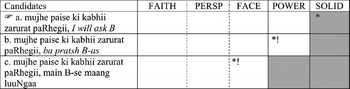
d. C: mujhe paise kii kabhii zarurat paRhegii, I will ask B
“When/If I ever need money, I will ask B.”
In this excerpt, speaker C in line (5d) has two linguistic choices available to him for the switch: either switch to Kashmiri or to English, but he chooses English. We will show in Section 4 below how the grammar of bilingual language use presents English as a better, optimal option; it should suffice here to say that in choosing English, speaker C in line (5d) is able to “distance” himself, qua power, from the future request for money, a face-threatening act.
Similarly, data from the Hungarian–American community illustrates how CS enables social actors to maximize the functional weight of power when creating authority and social distance in bilingual discourse. In extract (6), the speaker, a real-estate agent in his early thirties gives voice to his frustration with what he perceives as typical American mentality. To illustrate his point, he recounts his experience with an American home inspector and another real-estate agent who insisted on calling an electrician to change a burned-out light bulb in a house he was selling for a client rather than replacing it themselves.
(6) Azaz, nem hülyéskedek. Nekem volt a ház, amikor adtam el, és ki volt égve a körte, és azt mondja, azt mondta, azt mondta az inspector, hogy “call electricians”, a “licensed electrician”, a “certified electrician”. Há’ mondom, hogy, “put a fucking lightbulb in it”. És azt mondja, azt mondja nekem a másik agent, hogy “az nem, mert nem azt írták neked föl”. . . . És ez nekik teljesen normális.
“That's right, I'm not kidding. I had a house, when I was selling, and a light bulb was burned out, and he says, he said, the inspector said, ‘call electricians’, the ‘licensed electrician’, ‘certified electrician’. Well, I say, ‘put a fucking light bulb in it’. And he says, the other agent says to me,‘no, [you can't do it] because that's not what was written down for you [on the paper]’. . . . And this is completely normal to them.”
While most of the story is narrated in Hungarian, a purposeful switch to English (bold face, italicized) occurs when the narrator constructs a commanding identity for himself. At the level of relational organization, he positions himself as an authority figure in control and sets himself off from and above the two American real-estate workers whose behavior he finds incompetent and unreasonable. Switching to English for the aggravated, expletive-ridden imperative provides the speaker with a strategic means of creating an asymmetrical, oppositional relation of dominance and subordination. The maximal effect distance and hierarchy in this context can be best achieved through CS to English due to both the “brought-along” symbolic power English carries at a global macro-social level and the “brought-about” (Auer, Reference Auer1998; Li, Reference Li and Auer1998) power of contrasting code choice at the local interactional level.
We should also note that the switch in (6) simultaneously performs work of pragmatic importance on the discourse-textual level. Deployed in a direct quote, it marks a shift in voice and footing as the speaker moves from being the narrator of the story to a character in the story. This means that the meta-principle perspective, to be discussed in Section 3.4 below, plays an additional role in giving rise to this switch and maximizing the potential of bilingual meaning-making.
As a further illustration of the workings of power, consider the excerpt in (7), from Canagarajah's (1995) study in Jaffna, Sri Lanka. In Jaffna three main codes are in use: Tamil, English, and “Englishized Tamil”. In the speech economy of Jaffna, each code contributes differently to stratifying the social order. Monolingual Tamil, at the top of the social hierarchy, derives its value as the ethnic language of a newly-risen politico-military elite and of state nationalism. English maintains its status as a class marker of a parallel elite: the educated, urban, wealthy, and professional bilinguals. Englishized Tamil is a resource accessible to dominant and subordinated groups, monolinguals and bilinguals, and is becoming the unmarked everyday code that relaxes “the tension between the two languages, and the values and ideologies embodied by each” (Canagarajah Reference Canagarajah1995, p. 208).
The exchange in (7) takes place at a university faculty meeting. The dean and the lecturers (Dr. SS and Dr. BB) are elite bilinguals, while the instructors (not represented in this transcript) are largely Tamil monolinguals.
- (7)
a. Dean: aTuttataaka Fine Arts-ilai oru degree vaLankiratai paRRi oru proposal
samaRpikkappaTTirukku, virumpiyavarkaL karuttu tervikkalaam.
“Next, a proposal has been submitted about offering a degree in fine arts. Those who wish can express their views.”
b. Dr. SS: This has to be approached carefully. Now, will the degree replace the present
diploma? Will the present diploma holders be allowed to do the degree, or the
diplomas converted into a degree? [. . .] So this will lead to a lot of confusion and
complication=
c. Dr. BB: = That's right. Now, is the proposed syllabus here the same as the syllabus for
the diploma? [. . .] How can you have the same syllabus [for both]?
d. Dr. SS: [Does] such a degree exist in any other Sri Lankan University? [. . .]
naankaL maRRavayayum ceetu kataippam. IppiTi veeRai enkayaavatu
degree irukkaa?
“We will include the others also in the discussion. Is there a similar
degree anywhere else?”
Canagarajah (Reference Canagarajah1995, p. 203) explains that the bilingual lecturers’ switch to English (lines (7b–c)) is a strategic move through which the bilinguals “appropriate for themselves the power to deliberate and make decisions on the issue” and “decide when and how the monolinguals can be included in the discussion”, indicated by the eventual switch back to Tamil (line (7d)). By using English, the lecturers draw an “elite closure” (Myers-Scotton, Reference Myers-Scotton and Weinstein1990), the boundary that separates those who have control over valuable symbolic and material resources, and those who do not. Given the lecturers’ attempt to affirm hierarchical order and divisive lines of power through code choice, the switch represents an instantiation of power. As a constraint that prefers the maximization of power differential, power in this context mobilizes CS to English – the code that has the most limited distribution and is the least accessible for non-members of the bilingual elite.
3.2.2 Principle of Social Concurrence
Principle of Social Concurrence (solidarity). Social actors switch to another language if it enables them to maximize social affiliation and solidarity in relational practice. Actors switch to the language that is best positioned to index or create solidarity, affiliation, connection, intimacy and/or similarity between self and other(s).
We argued above that when people engage in processes of social categorization that bring into existence relations of equity and affiliation, we expect the meta-principle solidarity to gain prominence in governing speakers’ choice of one linguistic variety rather than another. According to solidarity, social actors select CS from the linguistic resources at their disposal if it enables them to maximize relational meanings of connection, inclusion, similarity, and intimacy. Once again, the direction of the switch is dynamic: people are predicted to switch to a language that they see as being best positioned to bring about the desired effects of solidarity.
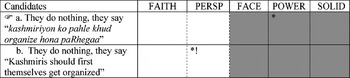
Code-switching to effect identity affiliation – in-group solidarity – is best expressed in the interaction noted in (8), where three multilingual Kashmiri speakers are discussing the plight of migrant Kashmiris (Hindi is shown in italics and Kashmiri is in boldface). First, the switch by speaker F to Hindi in line (8b) animates the local politicians’ response to the Kashmiri migrant problem, indicated in the quoted material. The same speaker later switches to Kashmiri (line (8e)) – the in-group language – to present the community's perspective on the historical problem in getting organized: the knowledge, and attitude, shared by all Kashmiris of their inability to organize and speak up as a group. This function of recalling shared knowledge and presenting a perspective of the community on the issue is served by switching to the language of solidarity, Kashmiri, for effecting maximization of affect and identity affiliation.
- (8)
a. Si: What are the politicians doing about the migrant problem I would like to know
b. F: They do nothing, they say “kashmiriyon ko pahle khud organize hona paRhegaa”
“They do nothing, they say ‘Kashmiris themselves have to first get organized’.”
c. Si: Well, then
d. K: organize hona pRhegaa, yahii to hamaarii problem hai
“will get organized, that is our problem”
e. F: asyi kaasharan aas dohay yahay problem . . .
“We Kashmiris have always had this problem”
The next two examples of solidarity involve Hungarian–English CS in e-mail exchanges. In both excerpts in (9), actors use Hungarian, the language of “belonging”, to express connection, affect, and intimacy.
- (9)
a. I've tried to call you several times, but your voicemail picks up immediately. Minden rendben? (“Is everything all right?”) Call or e-mail back.
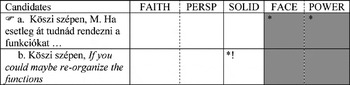
b. Köszi szépen, M. Ha esetleg át tudnád rendezni a funkciókat in alphabetic order, az nagy segítség lenne.
“Thanks very much, M. If you could maybe re-organize the functions in alphabetic order that would be a big help.”
The e-mail in (9a) was written by a mother to her son who lives in another city. The opening line of the e-mail is in English; yet, the mother switches to Hungarian as she is expressing emotional concern for her son. The switch to Hungarian maximizes closeness, and enables her to signal a heightened sense of care or “true” concern for her son.
It turns out that maintenance of closeness and solidarity is preferred even at the expense of losing power (discussed above) and face (next section). In the e-mail fragment in (9b), a professor requests help from a graduate student that goes beyond her “official” duty. The perceived weight of imposition appears to be counterbalanced by the lack of code-switching (in bold) to English. That is, the speaker continues to use Hungarian at a point where conceivably a switch to English could have been made to accomplish particular ends – albeit different ones than Hungarian.Footnote 6 Hungarian carries the message of closeness, similarity, and a measure of equality between the two interlocutors. By contrast, while using English for the request would protect the professor's face, it would also mediate power asymmetry and position her as pretentious, high-handed, and distancing. The preference clearly seems to be maintaining solidarity even if it means relinquishing dominance and forfeiting face.
Our last example, in (10), illustrating the use of CS as a resource for maximizing the relational impact of solidarity, comes from English–Swahili–Luo CS in Nairobi, Kenya (Myers-Scotton, Reference Myers-Scotton1993, p. 40). In multi-ethnic Nairobi, both Swahili and English function as lingua francas, but Swahili is preferred in service encounters. The conversation in (10) takes place between a clerk and a customer who is trying to withdraw money from his account at a post office.
(10) Setting: The main post office in Nairobi. Swahili is used except for a switch to Luo, which is italicized.
a. Clerk: Ee . . . sema.
“OK . . . what do you want?” (literally: “speak”)
b. Customer: Nipe fomu ya kuchuka pesa.
“Give me the form for withdrawing money.”
[. . .]
c. Clerk: Bwana, huwezi kutoa pesa leo kwa sababu hujamaliza siku saba.
“Mister, you can't take out money today because you haven't yet finished seven days [since last withdrawal].”
d. Customer (switching to Luo): Konya an marach.
“Help, I'm in trouble.”
e. Clerk (also speaking Luo now): Anyalo kony, kik inuo kendo.
“I can help you, but don't repeat it.”
(Myers-Scotton, Reference Myers-Scotton1993, p. 40)
Since the norm is to maintain ethnic neutrality in conventionalized public exchanges, even speakers from the same ethnic group use Swahili, “unless very private or special conditions prevail” (Myers-Scotton Reference Myers-Scotton1993, p. 40). Indeed, the customer and the clerk, both members of the Luo ethnic group, initially speak Swahili; the customer switches to Luo only when he realizes he needs help from the clerk. The customer's switch to Luo represents a bid for solidarity – more specifically, for favoritism – a bid that is occasioned by, and depends for its success upon, the common ground of shared ethnicity and mother tongue. In terms of our framework, Luo is the best, or optimal index to evoke a frame of equivalence and maximize the value of ethnic connection. Not only does the clerk accommodate the customer in his request, but, by reciprocating in Luo, he assumes a stance of consensus and co-constructs a relation of solidarity and alliance at the discourse level as well.
3.3 Principle of Face Management
Principle of Face Management (face). Social actors switch to another language if it enables them to maximize effective maintenance of “face” or public image of self in relation to others. Actors switch to a language that is best positioned to manage their interpersonal relations consistent with face needs of self and/or others (e.g. appreciation, tact, deference, respect, positive or negative politeness).Footnote 7
This principle captures the generalization that social actors take linguistic action, i.e. deploy CS, to enact, approve, or challenge the public image, or face they orient to, claim for themselves or attribute to others in situated social interactions. Following Goffman (Reference Goffman1967), we understand face as the social value and standing a person claims, “an image of self delineated in terms of approved social attributes – albeit an image that others may share” (Goffman, Reference Goffman1967, p. 5). Here we take face-work, both self-oriented and other-oriented, to reflect a dialogic face relationship between self and others.
Face management can be achieved through various practices, including the most basic – politeness. Politeness, according to Brown and Levinson (Reference Brown and Levinson1987), refers to actions people take to minimize face threats in social interaction. Positive politeness is using language to manage positive face needs: signal appreciation, approval, liking, and connection. Negative politeness is using language to manage negative face needs: maintain distance, restraint, autonomy, and freedom from imposition. For others (Watts, Reference Watts1999), politeness is not simply about face threat avoidance. It may involve other forms of face-work such as showing respect, honor, and dignity (Penman, Reference Penman1990), considerateness (Goffman, Reference Goffman1967), tact (Janney & Arndt, Reference Janney, Arndt, Watts, Ide and Ehlich1992), and deference or discernment (Ide, Reference Ide1989); or displaying social appropriateness and “legitimate” or “correct” language use (Watts, Reference Watts1999). In order to account for inter-community variation in face-work, we adopt a more encompassing notion of politeness. We argue that in bilingual interaction also, face management can be optimally accomplished through CS.
The literature on CS reports that bilinguals use CS as a “deference strategy” (Heller, Reference Heller and Heller1988a), to avoid “risking loss of face” (Gumperz, Reference Gumperz1982), “preserve the face of the addressee” (Li, Reference Li1994), mitigate or defuse a face threat (Gross, Reference Gross2000; Heller, Reference Heller and Heller1988a; Myers-Scotton & Bolonyai, Reference Myers-Scotton and Bolonyai2001), “dampen directness” (Gardner-Chloros & Finnis, 2003), mitigate requests (Lipski, Reference Lipski1985; Zentella, Reference Zentella1997), mark “dispreference” in face-threatening situations (Li & Milroy, Reference Li and Milroy1995), signal “shifting authorship” for less direct attacks (Stroud, Reference Stroud and Auer1998), and “attack a powerful addressee's face” (Gross, Reference Gross2000).
Example (11) shows how CS is used as a discursive device to minimize face-threats in social interaction. The conversation takes place in C's home in New Delhi, India; those present are C, C's children (B and D) who are visiting home, and the housemaid (A), who has worked for C for many years. Speaker A speaks Hindi (normal font) but does not know Kashmiri (italicized), whereas B and D speak predominantly Hindi and English and C uses predominantly Kashmiri and Hindi. (Switched items in Hindi are bold-faced.)
- (11)
a. A: kyaa baj rahaa hai
“What time is it (getting to be)?”
b. B: bas cay pinee ka waqt ho rahaa hai
“Just getting to be the time to have tea.”
c. C: vuch aayas caay tyaTh
“[referring to B] Look, he's getting the urge to drink tea.”
d. D: mujhe bhii piinii hai, main bana detii huN
“I also want to drink (tea), I will make it.”
e. C: D vanyi chak vatshmatsayi, zaraa A ke liyee bhii paanii rakh degii
“D, now that you are up, can you put some water (for tea) also for A?”
f. D: haaN
“Yes (Okay).”
The switch that is of interest to us takes place in the second turn of C. In this turn, C continues in Kashmiri, but code-switches to Hindi when she needs to make an explicit request (for D to also make tea for A) – a face-threatening act. Under the constraints of face, Speaker C, must code-switch, and she does, to maximize the maintenance of face. The strategy C chooses to minimize the face-threat is the creative use of positive politeness: the switch to Hindi enables her to manage positive face needs, showing considerateness and anticipating appreciation from Speaker A, while simultaneously displaying to her children (Speakers B and D) the strong social bond (solidarity) between herself and the maid. Speaker C is thus able to manage multiple face goals in one creative move – CS to Hindi.
Our next example, from Hungarian–English CS, further illustrates the skillful use of CS as a “dialogic” tool in the management of multiple face needs. The exchange in (12) between an eight-and-a-half-years-old boy (K) and his mother (M) is taken from a conversation recorded in a Hungarian–American family living in the U.S. (Myers-Scotton & Bolonyai, Reference Myers-Scotton and Bolonyai2001, p. 15).
The family members are bilingual, the preferred language in home interactions is Hungarian (normal font in (12)). The family is at the dinner table, when despite his mother's stated preference, K stands up to make lemonade for himself and spills the water.
- (12)
a. K (lifting a bottle of water): Oh, my God. Let me just do it by myself.
b. K (spilling the water on the kitchen cabinet counter): Ah! Sorry, sorry!
c. K: Nagyon nehéz volt ez. Bocsánat.
“It was very heavy. I'm sorry.”
As the bottle of water turns out to be too heavy and K spills the water – a damage to his social image – he quickly apologizes in English (line (12b)). In line (12c), however, he switches to Hungarian to offer an explanation and a second apology for the accident. In our interpretation, the switch, governed by face, constitutes an optimal choice for managing multiple face concerns and restoring “social equilibrium” and harmony (Goffman, Reference Goffman1967). Although an apology by definition is a remedial act intended to “give face” and alleviate interpersonal imbalance, its efficacy and internal consistency depend in part on its linguistic form. While K's expression of regret in English Sorry, sorry!) shows an attempt to restore his own social image, it conveys social distance and does little to amend the disrupted “expressive order”, i.e. his good relationship with his mother. Switching to Hungarian, the language of belonging, allows him to maximize the socio-pragmatic force of the apology. Bocsánat “forgiveness” simultaneously conveys interpersonal closeness, genuineness, a concern for his own and his mother's face needs, and a more emphatic attempt at restoring a harmonious relation between the two of them.
3.4 Principle of Perspective Taking
Principle of Perspective Taking (perspective). Social actors switch to another language if it enables them to maximize perspectivity in interaction. Actors switch to a language that is best positioned to signal what is assumed to be currently salient point of view and socio-cognitive orientation in discourse.
This principle rests on the central idea that the expression of perspectivity is an omnipresent feature of effective communication whereby people foreground some aspect of the world from a particular vantage point and signal its salience discursively (Linell, Reference Linell1998; MacWhinney, Reference MacWhinney, Pecher and Zwaan2005; Slobin, Reference Slobin, Gumperz and Levinson1996). Making our current perspective and cognitive orientation prominent means “giving clear cues to our listeners about which perspectives they should assume and how they should move from one perspective to the next [so that] we maximize the extent to which they can share our perception and ideas” (MacWhinney, Reference MacWhinney, Pecher and Zwaan2005, p. 1). We find the notion of perspective a useful conceptual tool that refers to a set of inter-related discursive constructs such as footing (Goffman, Reference Goffman1979), frame (Goffman, Reference Goffman1974), voice (Bakhtin, Reference Bakhtin and Holquist1981), stance (Ochs, Reference Ochs, Duranti and Goodwin1992), and positioning (Davies & Harré, Reference Davies and Harré1990), as well as conversational resources and functions that might mark perspective taking and shifting (pronouns, quotations, intertextuality, repetition, emphasis, discourse markers) (cf. Schiffrin, Reference Schiffrin2006).
Conceptualized as a socio-pragmatic constraint on CS, the specific intuition of perspective is that participants’ perspectives that are relevant to the conversational/discourse implicature must be profiled so that they achieve a certain degree of salience – brought into prominence, as interpretive focal points – within the discourse context. CS, we believe, is a mechanism of discourse profiling intended to discriminate between perspectives that are highly relevant, and need to be foregrounded, and those that are not. We suggest three main functions of marking perspectivity through CS. When CS takes place, (a) some aspect of reality is focalized relative to another (contrasting function), (b) various visions of reality are constructed simultaneously (multiplicity function), and/or (c) alternate visions of reality are brought into a common focus (leveling/neutralizing function).
Some of the discourse and conversational uses of CS our framework accommodates under perspective include “quotation” (Auer, Reference Auer, Milroy and Muysken1995; Koven, Reference Koven2001; McClure & McClure, Reference McClure, McClure and Heller1988); “message qualification”, “reformulation”, “elaboration”, and “clarification” (Callahan, Reference Callahan2004; Gumperz, Reference Gumperz1982; Lin, Reference Lin1996); “parenthetical remarks” and “off-stage” talk (Halmari & Smith, Reference Halmari and Smith1994); “reiteration”, “repetition”, and “emphasis” (Callahan, Reference Callahan2004; Gumperz, Reference Gumperz1982; Rindler-Schjerve, Reference Rindler-Schjerve and Jacobson1998); shift of “key” and “tone” (Auer, Reference Auer, Milroy and Muysken1995); “sarcasm”, “irony”, and “parody” (Stroud, Reference Stroud2004; Woolard, Reference Woolard and Heller1988); “role-shift” (Auer, Reference Auer, Milroy and Muysken1995; Zentella, Reference Zentella1997); “double voicing”, “bivalency”, “heteroglossia”, and “hybridity” (Bhatt, Reference Bhatt2008; Rampton, Reference Rampton1995; Woolard, Reference Woolard1999); “footing” (Auer, Reference Auer1998; Zentella, Reference Zentella1997); and CS as a “contextualization cue” (Auer, Reference Auer, Milroy and Muysken1995; Gumperz, Reference Gumperz1982; Li, Reference Li1994).
The CS data in (13) illustrates how the switching from one language to another within the narrative of one speaker presents a switch in perspective, opening up different, and contested, ideological spaces through which members of the Kashmiri community navigate their daily personal routines: articulating cultural attitudes, presenting community norms of linguistic practices, and negotiating social-personal and class identities. The data is significant in that the switches are used to articulate these ideological spaces within which the different perspectives that the narrator takes are visibly profiled – brought into prominence – so that these perspectives (and related participant roles) are obligatorily accessed.
The narrator in (13) is an upper-middle class Kashmiri woman, a member of the Kashmiri community living in New Delhi. In the excerpt, she is responding to the question, justifying why she did not speak Kashmiri to her three children when they were young. (English is in bold face, Kashmiri is italicized, and Hindi is in normal font.)
- (13)
a. mai jab chotii Thii
“when I was little”
b. jab meri shaadi hui
“when I got married”
c. mujhe bhii yahii lagtaa Thaa
“I also used to think/feel”
d. ki myaanyan shuryan gos na kashmiri accent gasun
“that my kids should not get the ‘Kashmiri accent’”
e. so, I spoke to them in English mainly
f. [pause] bas yahii hai
“well, that is it.”
We notice that the speaker opens her turn in Hindi and then switches to Kashmiri (line (13d)), then to English (line (13e)), and then back to Hindi (line (13f)). Additionally, in line (13d), there is a switch to the English noun phrase, “Kashmiri accent”. In recalling her past as a young married woman, she uses Hindi (lines (13a–c)), and then aligns herself with her community's attitudinal stance by switching to Kashmiri (line (13d)). Here, she presents herself as a member of the Kashmiri diaspora community that is aware of its linguistic habits: that Kashmiris speaking another language (Hindi and English) betray their ethnic identity in speech at the prosodic level; hence, the “Kashmiri accent”. The switch to English noun phrase here references others’ (non-Kashmiri speakers’) perception of self and is used here more or less as a direct quote – the voice of the other. This layered CS displayed in line (13d) manifests the operation of perspective: one of the important functions of CS is to enable an articulation of different ideological spaces within which different perspectives are brought into prominence. The switch from Hindi to Kashmiri enables the speaker to switch from the perspective of a narrator to another perspective – the “role” of a mother – that allows her to articulate the linguistic mythologies that are shared by members of her Kashmiri diaspora community. It is in this new perspective only that she can situate, and justify, her linguistic actions of the past, embracing and incorporating another perspective almost simultaneously, made salient with a switch to English (“Kashmiri accent”), the voice of the others. The switches thus make salient, visible, the perspectives that must be readily accessed for the interpretation of discourse implicatures.
In line (13e), there is a switch in perspective that involves a declaration of the speaker's linguistic intentions/actions with a concomitant switch to English, a code that is a highly valued commodity in the Kashmiri diaspora community, and outside. The use of English in India generally indexes class ideologies; in line (13e), the switch to English indexes the speaker's membership of the English-knowing bilingual (upper-)middle class while at the same time it ratifies her intentions using the medium (English) as the message (access to power/knowledge through the acquisition and use of English). In line (13f), she switches back to Hindi, assuming again the perspective of the narrator, but having finished with her response, coda.
Our next illustration of perspective, in (14), comes from Hungarian–English CS. The conversation takes place between two Hungarian–American men who exchange stories about their first experiences in the U.S. In the extract, the speaker expresses his indignation at the American banking system and the way he was treated when he inadvertently overdrew his checking account by four cents, for which he ended up being fined $100.
(14) És bementem személyesen és megkérdeztem, hogy mi van, és fölhívtam, és és
egyszerűen egy dolgot fogtak föl, az ő szempontjukból egy dolog volt fontos, hogy én
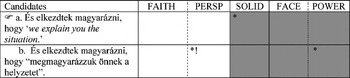
nem értem a helyzetet. És elkezdtek magyarázni, hogy “we explain you the situation”.
“And I went [to the bank] in person, and asked them what was going on, and I called them, and and they understood one thing only, from their perspective there was only one thing that was important – that I don't understand the situation. And they began to explain that, ‘we explain you the situation’.”
The speaker opens his turn in Hungarian but switches to English to set off a direct quote (we explain you the situation) from the reporting clause that precedes it. Under the constraint of perspective, CS occurs in order to ensure an optimal way of the discursive articulation of perspectivity. In (14), the switch serves multiple functions: it conspicuously contrasts different voices, foregrounds different viewpoints, and highlights the intertextual trajectory and dimension of communicative events within discourse. Specifically, the switch marks a change in footing as the speaker moves from being the narrator of the story to the character of the story. It also points to a shift in the speaker's perspective of events as he takes up the stance of the American clerk and positions himself as the “other”. Finally, the use of English for the direct quotation allows him to appropriate and animate the bank clerk's authoritative voice and provide commentary on it. Not only does the switch foreground a different vision of reality (what the problem is, whose problem it is, and how it should be handled) but it also enables the speaker to contest this American vision through what can be read as exaggeration and parody.
Our last example, in (15), sheds light on how CS functions as an instantiation of perspective through repetition. The example comes from a study on CS within a Sikh Punjabi community in West London by Gardner-Chloros et al. (Reference Gardner-Chloros, Charles and Cheshire2000). The speaker in the excerpt describes “a fairly amusing scene (someone falling around at the airport because they were so sleepy)”.
(15) Context: From a conversation about waiting with a friend during an overnight delay at an airport.
a. RENU . . . and she was sleeping all over the place, so I had to stay awake
b. digdthi-firdthi si everywhere, so I had to stay awake
[falling-around she was] everywhere, so I had to stay awake
“she was falling around everywhere, so I had to stay awake”
(Gardner-Chloros et al., Reference Gardner-Chloros, Charles and Cheshire2000, p. 1319)
The CS from English to Punjabi (italicized) involving the first instance of repetition occurs in line (15b). By reiterating the English verb (“was sleeping”) in Punjabi, the speaker is able to foreground and lend emphasis to the point of the story in a way that it goes beyond the original statement. The authors argue that the switch to Punjabi enables the speaker to produce language that is “more expressive”. This second, verbatim repetition of the English clause (“so I had to stay awake”) immediately follows, and “acts as a counterpoint” to, the code-mixed clause before it. In our approach, these switches are motivated by perspective: repetition through the introduction of a different code maximizes the intended discourse-presentational effect. Code-switching makes prominent a new perspective on, or altered meaning of, an “old” message that needs to be re-interpreted in light of the new, contrastive code that carries the repetition.
3.5 Summary
The principles we have introduced and discussed above encode the linguistically significant generalization that CS is constrained, systematic, and predictable. Within our view, these principles, stated as constraints on contextually appropriate bilingual utterances, can be understood as operations of a sociolinguistic grammar of a multilingual community.
That said, it is obvious that some of the principles may actually conflict with each other; for example, the Principle of Symbolic Domination – switches must be made to gain power – could present an empirical conflict with another principle of the grammar, the Principle of Social Concurrence – switches must be made to establish solidarity. Since both these principles are part of a community grammar, by hypothesis, it is a logical possibility that a switch from one language to another for expressing power or for establishing solidarity may violate one or another of these principles of the bilingual grammar. The question that begs an explanation is how the grammar resolves such inevitable conflicts to yield desirable results. In the next section, we sketch out the design of such a bilingual grammar, borrowing some of the insights, terminology, and methodological procedures from Optimality Theory (OT) (Prince & Smolensky, Reference Prince and Smolensky2004), and extending it to the socio-pragmatic domain of CS.Footnote 8
4. Code-switching and optimal grammars
Central to our conceptualization of a sociolinguistic grammar is that the principles we have proposed can be viewed as universal sociolinguistic constraints over contextually appropriate code-switches. Following the logic of OT in generative grammar (Prince & Smolensky, Reference Prince and Smolensky2004), we presume that these general meta-principles of CS, stated as “violable” sociolinguistic constraints, exhibit a theoretical tension: they are in potential conflict in generating the grammar of bilingual language use. Given the assumptions that the constraints are (a) violable and (b) in potential conflict with each other, we hypothesize that a “particular” bilingual grammar is a set of hierarchically ranked conflicting universal constraints.Footnote 9 Community patterns of CS may differ from each other in terms of how respective grammars rank the set of violable constraints. The constraint-rankings of individual community grammars are organized in the following manner: As an initial methodological hypothesis, all constraints are presumed to be unranked with respect to each other. However, when data such as (4) discussed above presents itself, where a switch involves two potentially conflicting constraints – power (switch to English) and solidarity (switch to Kashmiri) – the switch to English (assertiveness) violating solidarity provides us with the initial evidence to test our next methodological hypothesis that in this grammar power outranks solidarity. Similarly, the data in (1) gives us evidence of rankings of two constraints, faith and power. The switch to Hindi violates power, but assures interpretive faithfulness, faith, suggesting the third hypothesis that faith outranks power that outranks solidarity. That is, we recursively build the hierarchy of constraints for a particular bilingual grammar, until we reach a point in the data set where no counter-evidence to the grammar appears.Footnote 10
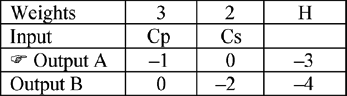
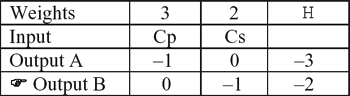
Thus, different configurations of constraint ranking yield, in principle, different grammars. The important standard theoretical assumption we make here is that the constraint rankings for a particular community are stable, not changeable across different contexts of situations. Depending on their intentions, speakers can alternately switch to express power or solidarity, but the grammar makes it possible not because the rankings between the two constraints are changeable, but due to the interaction of some other, higher-ranked, constraint with them (see the discussion related to Tableau 4 for how a switch from English (power) to Hindi (solidarity) is licensed in a grammar where power outranks solidarity). Finally, we argue that the patterns of CS that we have observed in this paper emerge from the interaction and optimal satisfaction of these universal constraints.
In extending the OT framework to express accounts of bilingual behavior, we have made certain adjustments, naturally, but without altering the fundamental design of the theory. In a bilingual framework, the “input” is drawn from two lexicons, i.e. linguistic items (translation equivalents) from the lexicons (Lex) of each of the two languages (L1, L2) – Lex(L1) and Lex(L2) – serve as the input to the function GEN (Generator). The function GEN, in a bilingual framework, mixes the linguistic items from the two lexicons in all possible permutations generating a candidate set of potential outputs (surface structures) that is subject to the function EVAL (Evaluator). The function CON, a set of universal constraints on CS, feeds into the function EVAL – a set of language-pair specific ranked constraints used to evaluate – that selects the optimal (contextually most appropriate) output from the competing candidate outputs of GEN. We believe, much in the spirit of Heck, Müller, Vogel, Fischer, Vikner & Schmid (Reference Heck, Müller, Vogel, Fischer, Vikner and Schmid2002), that (unlike phonology) the socio-cognitive constraints of CS apply to outputs of GEN. This is schematized in Figure 1.
An Optimality-Theoretic model of bilingual grammar.

Before we proceed to discuss specific outcomes, we first illustrate how our version of OT of bilingual CS accounts for well-formed outputs. Consider two grammars, Grammar A (hypothetically, Hindi–English CS) and Grammar B (hypothetically Hungarian–English CS) both of which have three universal constraints {x, y, z}. Assume further, that in Grammar A these constraints are ranked in such a way that {x} dominates {y}, which in turn dominates {z} [= x ≫ y, y ≫ z, x ≫ z]. In other words, Grammar A imposes a total order on the constraints: x ≫ y ≫ z. Now, assume that for a certain input we get two competing output candidates: cand1 and cand2. Tableau 1 shows the competition between the two candidates. Evaluation of candidates proceeds algorithmically from left to right in the tableau, evaluating candidates first for the most dominant constraint to the least dominant. Cand1 violates the highest-ranking constraint {x}, which is lethal (makes that particular candidate output “contextually least preferred”), indicated by “*!” (Shaded cells indicate that the outputs of those constraints do not alter the choice of the optimal candidate.) Grammar A, therefore, chooses cand2 straightforwardly as the optimal, contextually appropriate, option, indicated by the symbol ☞. Cand1 in this grammatical framework is understood as “sub-optimal”, less preferred.
Output = cand2

Now consider the other grammar, Grammar B. Assume that it, too, has the same three (universal) constraints {x, y, z}. This grammar imposes a slightly different ordering, for example, the constraint {y} dominates {x}, which in turn dominates {z}. For the same input as in Grammar A, we get the same two competing candidate outputs: cand1 and cand2. The optimal output, as shown in Tableau 2, is cand1, because in this grammar cand2 violates a higher-ranked constraint {y}, leading to its rejection as optimal.
Output = cand1

In sum, our theory of bilingual CS works as follows: All possible code-switched output representations for a given bilingual input are examined by a set of (violable) ranked constraints which evaluate their contextual appropriateness. The optimal, harmonic, code-switched output representation is the one that has the least serious constraint violations, i.e. violations of constraints ranked lower in the hierarchy. Thus, with the introduction of the idea that a sociolinguistic grammar of bilingual language use is a set of ranked constraints, it becomes possible to capture sociolinguistically significant generalizations of CS within one theoretical framework.
4.1 Optimal bilingual grammar: Kashmiri–Hindi–English CS
We hypothesize that the grammar of Hindi–Kashmiri–English CS is instantiated by the following ranking of the proposed principles/constraints:
(16) Hindi–Kashmiri–English constraint ranking
{faith, perspective, face} ≫ power ≫ solidarity
It follows from our hypothesis in (16) that faith, perspective, and face are not ranked vis-à-vis each other (indicated in the tableaux as a dotted vertical line between them): constraints in the optimal grammar are “potentially” in conflict with other constraints; faith, perspective, and face, we argue, are not in conflict here. The ranking in (16) predicts that faith (also perspective and face), where there is a conflict, outrank(s) power and solidarity. Furthermore, power outranks solidarity. We show next that our English–Hindi CS data is an optimal product of the interaction and satisfaction of our proposed universal constraints.
First we demonstrate the interaction of two constraints, power and solidarity. The data in (4), repeated below in part (line (4c)), follows from the optimality logic of constraint interaction and satisfaction.
- (4)
c. A: mujhe nahiiN chaiye, but you should demand what is yours
“I don't want (the land) . . .”
As we argued, the switch from Hindi to English expresses assertiveness and authority. However, this switch violates solidarity. None of the other constraints in this interaction is involved; that is, faith, perspective, and face are unable to discriminate between the competing candidates: the switch to English, candidate (a) in Tableau 3, and the corresponding code-switch to Kashmiri, candidate (b). Thus, the computation proceeds to the next constraint for evaluation, power. Here, candidate (b) incurs a violation as the switch is not made to a language of power: Kashmiri indexes solidarity. Next, the computation proceeds for evaluation to solidarity, where now candidate (a) incurs a violation because the switch is not made to a language expressing solidarity: English indexes power. The optimal choice is guaranteed by the logic of the interaction and optimal satisfaction between power and solidarity: in the final evaluation of the two candidates, candidate (a) turns out to be the optimal, as well as the attested, option, by virtue of candidate (b)'s violation of the higher-ranked constraint, power (see Tableau 3).
Interaction of POWER and SOLID (POWER ≫ SOLID)

Consider next the English–Hindi CS in (1) above, repeated here in part:
(1) The saat pheras around the agni serves as a lakshman rekha.
“The seven circumnavigations around the fire serves as a line one doesn't cross.”
Recall that the switch from English to Hindi satisfies faith. However, it also violates power: a switch is made but not to the language of power. Since the grammar of English–Hindi CS ranks faith over power, the bilingual option – switch to Hindi – is a better choice than the alternative monolingual option (see Tableau 4).
Interaction of FAITH and POWER (FAITH ≫ POWER)

The bilingual grammar first evaluates the two options for the higher-ranked constraint faith. Candidate (b) incurs a violation there, but not candidate (a). Since perspective and face are not involved in the computation of evaluation, the grammar moves to the next ranked constraint lower in the hierarchy, power, to evaluate each candidate. Under power, candidate (a) incurs a violation but not candidate (b). Although both bilingual (code-switching) and monolingual (no switching) options violate one constraint each, it is the monolingual option that violates the higher-ranked constraint, faith, rendering the bilingual option (1) the optimal choice.Footnote 11
We now consider the interaction of perspective and power as demonstrated by example (8b) above, repeated below, where the speaker switches from English to Hindi. Recall that the switch to Hindi, animates politicians’ response to the Kashmiri migrant problem and flags the shift from the narrator to the character voice, qua perspective. However, CS to Hindi violates power.
- (8)
b. F: They do nothing, they say “kashmiriyon ko pehle khud organize hona paRhegaa”
“They do nothing, they say ‘Kashmiris should first themselves get organized’.”
Again, the interaction of perspective and power yields the right results for the data in (8b). In Tableau 5, we note that faith and face are unable to discriminate between the competing candidates, but perspective is able to do so: only the monolingual candidate, (b), violates this constraint. As the computation proceeds to power for evaluation, the bilingual candidate (a) incurs a violation under this constraint. Since perspective outranks power, the violation by candidate (b) of perspective is a more serious violation compared to the violation of the bilingual candidate (a), and thus this candidate, the attested form, is the winner.
Interaction of PERSP and POWER (PERSP ≫ POWER)

The interaction of face with power and solidarity is illustrated in (5) above, partially repeated in (5d) below, where Speaker C switches from Hindi to English. The switch is necessitated under face, as the possibility of a future request – a face-threatening act – is indicated.Footnote 12 Note, however, that the switch is made to English, the language of power, not to Kashmiri, the language of solidarity, even though both languages are available for the speaker-hearers. The switch to English violates solidarity and a switch to Kashmiri would violate power. There is another candidate, the monolingual Hindi option that also competes with the two other candidates, as the speaker could have continued in Hindi.
- (5)
d. C: mujhe paise kii kabhii zarurat paRhegii, I will ask B
“When/If I need money, I will ask B.”
Tableau 6 shows that when the candidates are evaluated for face, only the monolingual option (c) incurs a violation as face mandates a switch in a face-threatening act. As the evaluation proceeds to power, candidate (b), switching to Kashmiri, incurs a violation because the switch is not made to the language of power. Next, under solidarity candidate (a) incurs a violation since switching to English does not establish solidarity between speaker-hearers. Given the logic of optimality, candidate (a) turns out to be the winner – with the least serious violation – over candidates (b) and (c), and this is in fact the optimal, as well as the attested, choice. The best output of the optimality computation in Tableau 6 is precisely the empirical data seen in (5d).
Interaction of FACE, POWER and SOLID (FACE ≫ POWER ≫ SOLID)

4.2 Optimal bilingual grammar: Hungarian–English CS
The optimal bilingual grammar of Hungarian–English differs from Kashmiri–Hindi–English in terms of its ranking solidarity vis-à-vis power and face. Whereas in Kashmiri–Hindi–English grammar face outranks power which outranks solidarity, Hungarian–English organizes its grammar ranking solidarity over power and face. The hypothesized ranking of Hungarian–English is in (17):
(17) Hungarian–English constraint ranking
{faith, perspective} ≫ solidarity ≫ {face, power}
This ranking guarantees that the best output of the optimality computation is precisely the empirical data we observe for Hungarian–English CS. Consider first the interaction of solidarity and power. The data in (9a), repeated here in part, shows that the introductory statement of the e-mail is in English; however, the speaker switches to Hungarian as she expresses concern for her son. The switch to Hungarian, the in-group code, creates closeness and a heightened sense of affect and intimacy (solidarity), but in so doing the switch violates power.
- (9)
a. I've tried to call you several times, but your voicemail picks up immediately. Minden rendben? (“Is everything all right?”)
Tableau 7 shows how the switch to Hungarian turns out to be the optimal output of the grammar. The two competing candidates are first evaluated by faith and perspective. As the two constraints are unable to discriminate between the candidates (shown by the shaded cells), the computation proceeds for evaluation to the next-ranked constraint, solidarity. Under this constraint evaluation, candidate (b) incurs a violation. The computation then proceeds to face and power, unranked with respect to each other. Since face is not involved, it is unable to evaluate the two candidates. Under power, however, candidate (a) incurs a violation since the switch is made to a language indexing solidarity. The ranking of solidarity over power eliminates the monolingual option, candidate (b), which incurs a violation of solidarity, rendering it sub-optimal, i.e. less preferred, compared to candidate (a), which incurs a violation of power, a lower-ranked constraint leading thus to a less serious violation.
Interaction of SOLID and POWER (SOLID ≫ POWER)

Next we show how the interaction of solidarity and face gives the right empirical results observed in (9b), repeated here in part.
- (9)
b. Köszi szépen, M. Ha esetleg át tudnád rendezni a funkciókat . . .
“Thanks very much, M. If you could maybe re-organize the functions . . .”
In (9b), a professor requests extra help from a student. The face-threatening act of request (highlighted in bold) requires a switch to another language due to the constraint face, yet the request is made with no CS, in Hungarian, violating face. Tableau 8 shows how the ranking of solidarity over face yields the right empirical results. Since faith and perspective are not involved in the evaluation of the two competing candidates, monolingual (a) and bilingual (b), the computation proceeds to the next constraint on the hierarchy, solidarity. solidarity is violated by candidate (b) as a switch is made to the language of power. As the computation moves to the next lower constraints, face and power, candidate (a) incurs a violation for each of those constraints. Even though candidate (a) violates two constraints and candidate (b) violates only one, the logic of optimality computation determines the winner as the candidate with the least serious violations, which is option (a): the sub-optimal candidate (b) violates a constraint, solidarity, ranked higher than both power and face.
Interaction of SOLID and FACE (SOLID ≫ FACE)

Having established that solidarity outranks both face and power, we now show how both perspective and faith outrank solidarity. Recall from our discussion of example (2) above that the speaker code-switches from Hungarian to English to evoke specific socio-cultural and political meanings associated with American social reality through the notion of “homeland security”. The switch is mandated by faith, to reference a particular meaning, but it violates solidarity, as the switch is to a language of power.
Tableau 9 shows how the optimality computation yields the optimal output to be the attested bilingual option. The two competing candidates are first evaluated by faith, under which candidate (b) incurs a violation since the Hungarian translation does not adequately capture the nuanced meaning of homeland security. Since perspective is unable to discriminate between the competing candidates, the computation moves to the next constraint lower in the hierarchy, solidarity. Under solidarity, candidate (a) incurs a violation. Finally, when the computation reaches the last constraint, power, for evaluation (face is unable to decide), candidate (b) incurs a violation. Since candidate (b) incurs a more serious violation, of faith, candidate (a) turns out to be the optimal choice.
Interaction of FAITH and SOLID (FAITH ≫ SOLID)

Finally, the interaction of perspective and solidarity yields the correct results for Hungarian–English as shown in Tableau 10. We saw earlier in example (14), repeated below in part, that the code-switch to English marks a shift in footing, stance, and voice. This switch due to perspective, represented by candidate (a) in Tableau 10, however, violates solidarity. The non-switch option, candidate (b), violates perspective, a more serious violation, which makes candidate (a) the optimal choice.
(14) És elkezdtek magyarázni, hogy “we explain you the situation”.
“And they began to explain that, ‘we explain you the situation’.”
Interaction of PERSP and SOLID (PERSP ≫ SOLID)

4.3 Summary
In this section we have demonstrated how an optimal bilingual grammar, using a set of potentially conflicting ranked constraints, is able to yield the empirical generalizations of Hindi–Kashmiri–English and Hungarian–English CS. We therefore claim that a particular bilingual grammar is a set of ranked constraints: different bilingual grammars will exhibit different rankings, to the extent that they differ from each other, among the proposed universal constraints. Thus, the difference between Hindi–Kashmiri–English and Hungarian–English CS patterns turns out to be the different ranking of solidarity vis-à-vis face and power. More precisely, in Hindi–Kashmiri–English grammar, face outranks power, which outranks solidarity, whereas in the Hungarian–English grammar, solidarity outranks face and power, which are unranked in terms of each other. These differences, then, account for the variation in CS patterns we observe between these two language contact situations (see Appendix for discussion of varying CS patterns).
5. Conclusions, consequences, and implications
In this paper we have put forth a tentative proposal that the vast array of empirical facts of CS may be constrained by the operation of five universal meta-principles of bilingual grammars. These principles motivate, as well as restrict, options of CS. We presented empirical evidence of inter-community CS, published as well as our own, to demonstrate how these principles underlie bilingual language use.
Following the logic of an OT-based grammar, we presented preliminary evidence from two bilingual communities to support our hypothesis that community bilingual grammars may differ from each other in terms of how they prioritize the socio-cognitive constraints on CS. As the ranking of these constraints is community-specific, it is through participation in a discourse community that individuals come to develop a shared grammar of CS. Our attempt to model inter-community variation in the socio-pragmatic use of CS offers modest support for the hypothesis that the proposed constraints, their interaction and optimal satisfaction, can capture significant empirical generalizations of CS. Although more empirical work should test our claims about the theoretical move towards applying OT-inspired grammars of bilingual use, some preliminary work in other contact situations provides tentative support for our approach. We briefly discuss below results of two such studies.Footnote 13
One of the studies, Lee (Reference Lee2009), analyzes Korean–English bilinguals in the U.S. The results of her analysis yield a bilingual CS grammar which differs minimally from Hungarian–English, namely the constraint solidarity in Korean–English is ranked above power, as in Hungarian–English, but face is also ranked above power, unlike Hungarian–English. Lee offers the following hypothesized grammar of Korean–English CS that accounts for the empirical generalizations she discovered:
(18) Korean–English constraint ranking
{faith, perspective} ≫ {face, solidarity} ≫ power
In the other study, Cramer (Reference Cramer2009) reanalyzes the data presented in Margaret Mishoe's dissertation (Mishoe, Reference Mishoe1995), investigating CS practices between regional standard southern American English and local dialect. According to Cramer, Mishoe's study, using Myers-Scotton's (1993) Markedness Model, when reanalyzed under Optimality assumptions, yields the grammar given in (19) to account for the CS practices of that community. Notice that with respect to the constraint interactions of face, power, and solidarity, dialect – Standard English grammar appears to be a mirror image of Hungarian–English grammar (compare (17) above).
(19) Dialect – Standard English constraint ranking
{faith, perspective} ≫ {face, power} ≫ solidarity
The variability in the four language contact situations has to do with the relative rankings of three constraints: face, power and solidarity. The natural questions the rankings of all these grammars raise are the following: Is there independently available evidence to account for variation in ranking of the three relational-interpersonal constraints? Why are faith and perspective undominated in all these grammars? Although more research is needed to answer these questions, we offer a brief speculation here. With respect to the first question, one might turn to proposed differences in cultural values that have been associated with different ways of speaking and meaning (Ochs, Reference Ochs1976; Schiffrin, Reference Schiffrin1984). Thus, for example, the ranking of solidarity above face and power in Hungarian–English CS could be related to the higher value Hungarian culture places on expressing “interpersonal closeness” than on preserving “personal autonomy” (Wierzbicka, Reference Wierzbicka1991). As for the second question, we suggest that both faith and perspective represent what is cognitively and interactionally fundamental to language use: speaker's intention and the identification of situated, inter-subjective vantage points and pragmatic meanings. In our proposal, CS due to faith manifests the indexical effects of speaker's intentionality – being perspicuous – whereas CS due to perspective allows interlocutors to reach some on-the-spot mutual understanding of discourse-pragmatic meaning. Since both of these constraints are critical in interpreting an utterance, across all socio-cultural situations, we believe that they will be ranked higher than the other three constraints, which depend on the social-relational context for their salience/importance. We leave it as a hypothesis, needing further empirical proof, that primarily cognitive constraints will always trump the constraints that rely on the social-relational context for their appropriate implementation.
Finally, we conclude this paper by briefly discussing one last implication of our proposal: that optimization of sociolinguistic options is key to the design of the bilingual grammar. Under this view, code-switching – as a strategy to creatively mobilize linguistic resources to exploit the functional-indexical potential – will turn out to be a more optimal option in most bilingual interactions, with the exception of those rare cases where a higher-ranked constraint militates against the switch forcing the continuation of the monolingual mode.
Appendix. Inter-speaker and intra-speaker variation of code-switching
A reviewer asked how we would account for inter- and intra-speaker variation in CS. We can offer three ways in which internal variation may be accounted for.
Inter-speaker variation
Variation, as when one ethnic group uses “inversion” in English matrix question and other does not – the difference between British and Indian English – can be captured by difference in ordering of the same constraints (Bhatt, Reference Bhatt2000). Similarly, systematic differences in use of CS between regional, gender, and age groups, when salient in a community, can be addressed by assuming a minimally different ordering of the same constraints, each minimally different ordering (= grammar) indexing a salience of a particular variable.
Intra-speaker variation
Possibility 1: Tied constraints. In the event that variation appears to be “free”, i.e. not socially meaningful, we argue that it arises when two constraints are tied, in the sense of Pesetsky (Reference Pesetsky, Archangeli and Langendoen1997). When that is the case, the output of the tie, e.g. between power and solidarity (solid), is the union of the outputs of power ≫ solid, and solid ≫ power. With this in mind, consider the Hindi–Kashmiri–English data (4) discussed in the main text of the present paper. Given the tied-constraint scenario, both code-switching (= variable) possibilities are now allowed in Tableau A1: switching from Hindi to English (power ≫ solid, option (a)) and Hindi to Kashmiri (solid ≫ power, option (b)) – (cf. Tableau 6 above).
Interaction of FACE, POWER and SOLID (FACE ≫{POWER, SOLID})

Possibility 2: Harmonic Grammar (HG). In contrast with standard OT, where every constraint has complete priority over all lower-ranked constraints (combined), HG is a model of linguistic constraint interaction in which well-formedness is calculated as the sum of (numerically) weighted constraint violations rather than ranked constraints (see Legendre, Miyata & Smolensky, Reference Legendre, Miyata, Smolensky, Smolensky and Legendre2006). In the HG system, the cumulative constraint interaction yields an optimal candidate that has the highest harmony score (H), i.e. the candidate that has the negative score closest to zero. By adjusting our framework to accommodate the insight of HG, it becomes possible to formally account for intra-speaker variation as sociolinguistic instances of repeated violations of a lower-weighted constraint, the cumulative effect of which is an optimal output that has in fact violated a higher-ranked constraint. We illustrate this scenario in Tableau A2.
A weighted constraint tableau

Notes: The higher-ranked constraint Cp has a numerical weight of 3, is violated once [–1] for Output A, resulting in a harmony score for Output A H = –3 (winner). The lower-ranked constraint Cs has a numerical weight of 2, is violated twice [–2] for Output B, resulting in a harmony score for Output B H = –4 (loser).
Compare the scenario in Tableau A2 with that in Tableau A3, where the lower-ranked constraint is only violated once, and hence, in this sociolinguistic instance, Output B is optimal with the harmonic score closest to zero.
A weighted constraint tableau

In sum, and simplifying somewhat, we argue that in a given sociolinguistic context the cumulative “weight” of the lower-ranked constraints may outweigh the weight of the higher-ranked constraint, resulting in an output where a sub-optimal form in general appears as optimal, and hence the variability.
Possibility 3: Conscious choice and linguistic variability. Following mainly the work of Cutillas Espinosa (Reference Cutillas Espinosa2004), we assume that socially meaningful variability can be captured by using a combination of a continuous-ranking approach to constraints (Boersma & Hayes Reference Boersma and Hayes2001) and a three grammars model. The main idea here is that a speakers’ grammar G1 is extremely dynamic, drawing freely from a range of values – from standard grammatical forms (G2) to local-vernacular forms (G3) – reflecting different identity-positioning, meaning-making, and personal goals and desires of the speaker in a given interactional context. Although intuitively appealing, it is not clear to us how this model can extend to issues of CS. For now, we leave a discussion of its extension and implications for future research.