Introduction
There has been a growth in multilingual populations in the United States over the last several decades (Ryan, Reference Ryan2013) and it is estimated that the majority of the world's population speaks more than one language (Grosjean, Reference Grosjean2010). Therefore, it is important to characterize bilingual language development to refine extant models of acquisition and inform educational policy and clinical practice (e.g., Greene, Peña & Bedore, Reference Greene, Peña and Bedore2013). Code-switching is a commonly-occurring pattern of bilingual language expression that begins early in acquisition (e.g., Ribot & Hoff, Reference Ribot and Hoff2014). In general, it can be defined as an alternation between two languages during production. Although code-switching is common among bilinguals, there is a dearth of longitudinal research on its development in the preschool period.
As in adults, code-switching in preschool and school-aged children is governed by grammatical constraints (Allen, Genesee, Fish & Crago, Reference Allen, Genesee, Fish and Crago2002; Genesee & Nicoladis, Reference Genesee, Nicoladis, Hoff and Shatz2006; Gutiérrez-Clellen, Simon-Cereijido & Erickson Leone, Reference Gutiérrez-Clellen, Simon-Cereijido and Erickson Leone2009; Lanza, Reference Lanza1997; Paradis, Nicoladis & Genesee, Reference Paradis, Nicoladis and Genesee2000, cf. Meisel, Reference Meisel1994; Vihman, Reference Vihman1998), can occur within or between utterances (Genesee, Nicoladis & Paradis, Reference Genesee, Nicoladis and Paradis1995; Meisel, Reference Meisel1994), and can vary across contexts (e.g., narrative versus spontaneous language sample; Gutiérrez-Clellen et al., Reference Gutiérrez-Clellen, Simon-Cereijido and Erickson Leone2009; Pan, Reference Pan1995). Further, research has identified several potential correlates of children's code-switching: language status, exposure, proficiency, and code-switching in language input (Genesee et al., Reference Genesee, Nicoladis and Paradis1995; Greene et al., Reference Greene, Peña and Bedore2013; Gutiérrez-Clellen et al., Reference Gutiérrez-Clellen, Simon-Cereijido and Erickson Leone2009; Lanza, Reference Lanza1992; Lindholm & Padilla, Reference Lindholm and Padilla1978; McClure, Reference McClure1977; Pan, Reference Pan1995; Petersen, Reference Petersen1988; Ribot & Hoff, Reference Ribot and Hoff2014; Swain & Wesche, Reference Swain and Wesche1975; Vihman, Reference Vihman1985). This research paints a fairly rich picture of the factors underlying children's code-switching. However, much of it relies on case studies or very small samples (i.e., N ~ 5 or 6). Research at the group level, particularly in the preschool period, remains limited. Indeed there is only a single prior longitudinal investigation of code-switching and its correlates during this period (Kuzyk, Friend, Sverdija, Zesiger & Poulin-Dubois, Reference Kuzyk, Friend, Sverdija, Zesiger and Poulin-Dubois2019). The present study is the first to contrast groups of bilingual toddlers across language contexts: Spanish–English children in San Diego and French–English children in Montréal. This comparison allows us to ask whether patterns of language use vary with sociocultural context. English is the official and the majority language in San Diego whereas although French is the official language in Montréal, the majority of individuals speak both French and English. The aims of the present study are to 1) analyze quantitative developmental changes in spontaneous code-switching from 31 to 39 months of age, examining the factors that underlie early code-switching and 2) describe qualitative patterns of code-switching in these distinct samples. We discuss each aim and its motivation below.
Quantitative and qualitative changes in code-switching
Prior studies have shown that code-switching is ubiquitous in young children and highly variable in quantity (Nicoladis & Genesee, Reference Nicoladis and Genesee1997). For example, code-switching may occur more in one language than the other (Greene et al., Reference Greene, Peña and Bedore2013; Gutiérrez-Clellen et al., Reference Gutiérrez-Clellen, Simon-Cereijido and Erickson Leone2009; Lanza, Reference Lanza1992; McClure, Reference McClure1977; Pan, Reference Pan1995; Petersen, Reference Petersen1988; Swain & Wesche, Reference Swain and Wesche1975; Ribot & Hoff, Reference Ribot and Hoff2014; Vihman, Reference Vihman1985). Several studies have shown more code-switching in minority relative to majority languages (Greene et al., Reference Greene, Peña and Bedore2013; Guttiérrez-Clellen et al., Reference Gutiérrez-Clellen, Simon-Cereijido and Erickson Leone2009; Lindholm & Padilla, Reference Lindholm and Padilla1978; McClure, Reference McClure1977; Pan, Reference Pan1995; Ribot & Hoff, Reference Ribot and Hoff2014), such that children borrow more majority language words in a non-majority language context than the reverse. This suggests that patterns of code-switching vary with sociocultural context. The present study evaluates how code-switching develops in sociolinguistic contexts in which more than one language is spoken relative to contexts in which there is a clear majority language.
Two potential sources of variability in children's code-switching are investigated: language exposure and proficiency. One candidate explanation for the finding that children code-switch more in one language relative to the other (Greene et al., Reference Greene, Peña and Bedore2013; Gutiérrez-Clellen et al., Reference Gutiérrez-Clellen, Simon-Cereijido and Erickson Leone2009; Lanza, Reference Lanza1992; McClure, Reference McClure1977; Pan, Reference Pan1995; Petersen, Reference Petersen1988; Swain & Wesche, Reference Swain and Wesche1975; Ribot & Hoff, Reference Ribot and Hoff2014; Vihman, Reference Vihman1985) is that code-switching is driven by language proficiency (Genesee et al., Reference Genesee, Nicoladis and Paradis1995; Greene et al., Reference Greene, Peña and Bedore2013; Gutiérrez-Clellen et al., Reference Gutiérrez-Clellen, Simon-Cereijido and Erickson Leone2009; Lindholm & Padilla, Reference Lindholm and Padilla1978; McClure Reference McClure1977; Petersen, Reference Petersen1988; Swain & Wesche, Reference Swain and Wesche1975). Indeed, children code-switch when they do not have a translation equivalent (synonym across languages) or the appropriate grammatical structure in the language they are speaking, using the stronger language to fill lexical and syntactic gaps (e.g., Bernardini & Schlyter, Reference Bernardini and Schlyter2004; Greene et al., Reference Greene, Peña and Bedore2013; Lindholm & Padilla, Reference Lindholm and Padilla1978, but cf. Gutiérrez-Clellen et al., Reference Gutiérrez-Clellen, Simon-Cereijido and Erickson Leone2009).
Relatedly, code-switching patterns may be influenced by language exposure such that children are more likely to borrow morphemes from the language they are exposed to more often (Lanza, Reference Lanza1997). Although exposure and proficiency are positively correlated (Bedore, Peña, Summers, Boerger, Resendiz, Greene, Bohman & Gillam, Reference Bedore, Peña, Summers, Boerger, Resendiz, Greene, Bohman and Gillam2012; DeAnda, Bosch, Poulin-Dubois, Zesiger & Friend, Reference DeAnda, Bosch, Poulin-Dubois, Zesiger and Friend2016b; Lanza, Reference Lanza1997; Pearson, Fernández, Lewedeg & Oller, Reference Pearson, Fernandez, Lewedeg and Oller1997; Poulin-Dubois, Bialystok, Blaye, Polonia & Yott, Reference Poulin-Dubois, Bialystok, Blaye, Polonia and Yott2013), there is not a one-to-one correspondence (Bedore et al., Reference Bedore, Peña, Summers, Boerger, Resendiz, Greene, Bohman and Gillam2012). Language exposure reflects the relative and absolute amount of language input to a child whereas proficiency reflects the level of the child's acquisition and usage in each language. Thus a primary goal is to evaluate the extent to which exposure and proficiency can be disentangled to clarify their independent contributions.
In addition to exposure and proficiency, the linguistic features of each language may influence children's code-switching behavior. For example, English has relatively less inflectional morphology than Spanish and French. In the case of content words like nouns, English requires marking count, whereas Spanish and French require marking gender as well. This difference may facilitate switching from Spanish and French to English more so than from English to either Spanish or French.
As noted by Cantone and colleagues (Reference Cantone, Kupisch, Müller and Schmitz2008), it is important to consider multiple factors of language development in relation to code-switching (Cantone, Kupisch, Müller & Schmitz, Reference Cantone, Kupisch, Müller and Schmitz2008). That is, the authors argue that language proficiency and language dominance can and should be defined by multiple factors with acknowledgement of linguistic differences that could influence their relative development. In the present paper we consider linguistic aspects of the target languages, exposure to each language, and proficiency (i.e., comprehension and production at the word and sentence levels) as we evaluate code-switching across geographical, linguistic, and majority language contexts. In addition, we examine socio-economic status (SES) as a potential influence on code-switching rates given the relation of SES to language development more generally (Hart & Risley, Reference Hart and Risley1992). Indeed, increased acculturation (which can include language use as well as attitudes and beliefs) to the majority culture is positively related to SES (Rudmin, Reference Rudmin2009). This may lead to relatively more code-switching from the minority to the majority language among higher, but not lower, SES families.
Previous studies also point to individual differences in the quality of code-switching. For example, code-switching can occur within or between utterances (i.e., intra- or inter-sententially) and young children typically engage in more inter- relative to intra-sentential code-switching (Genesee, Boivin & Nicoladis, Reference Genesee, Boivin and Nicoladis1996; Genesee et al., Reference Genesee, Nicoladis and Paradis1995). Further, Vihman (Reference Vihman1980; Reference Vihman1985) described a pattern of code-switching in which function words (i.e., determiners, adverbs, and prepositions) were more likely than nouns to be mixed prior to age 3 whereas others report findings in the opposite direction (e.g., Gutiérrez-Clellen et al., Reference Gutiérrez-Clellen, Simon-Cereijido and Erickson Leone2009; Lindholm & Padilla, Reference Lindholm and Padilla1978; McClure, Reference McClure1977). A second goal of the present study is to replicate and clarify previous findings by examining variation in code-switching type (intra- vs. inter-sentential) and word class (content vs. function) longitudinally in two distinct groups of preschool-aged children.
Study aims
The first aim is to analyze quantitative developmental changes in spontaneous code-switching from 31 to 39 months of age. These time points approximate the period during which grammatical abilities are rapidly developing and children consistently combine words into 2- or 3-word utterances (e.g., Brown, Reference Brown1973; Miller & Chapman, Reference Miller and Chapman1981; Thordardottir, Reference Thordardottir2005). At these time points we can examine how children navigate speaking two languages in their early multiword utterances. Children participated in two single language visits, one for each language, approximately one week apart. During each visit, the experimenter spoke only in the target language and parents were encouraged to speak this language as well. No such instructions were given to children, allowing us to observe the child's spontaneous use of the non-target language. This design permits us to obtain optimal measures of language proficiency in each language independently by reducing switch-costs (Sandoval, Gollan, Ferreira & Salmon, Reference Sandoval, Gollan, Ferreira and Salmon2010) and to instantiate an “intermediate mode” (e.g., Grosjean, Reference Grosjean, Nicol and Wei2001, p. 4) with regard to the free play context. That is, in the present study, the target language is defined by the single language context but the presence of a bilingual parent invites code-switching in spontaneous conversation.
We study two groups of bilingual children: Spanish–English children in San Diego in Study 1 and French–English children in Montréal in Study 2. In the United States, English is the majority language and the language of higher prestige (Eilers, Pearson & Cobo-Lewis, Reference Eilers, Pearson and Cobo-Lewis2006). Despite this, in San Diego, California, 25% of children five years and older speak or hear Spanish in the home (United States Census Bureau, 2015). In contrast, in Montréal, Québec, where French is the official language, 59% of children five years or older speak both French and English (Statisanada, 2016a). This enables us to evaluate patterns of code-switching in young children from distinct learning environments. Bilingual children in San Diego hear primarily the majority language in public and the minority language in more restricted settings. We hypothesize that these children will engage in more code-switching from Spanish to English than vice-versa consistent with previous studies (Greene et al., Reference Greene, Peña and Bedore2013; Gutiérrez-Clellen et al., Reference Gutiérrez-Clellen, Simon-Cereijido and Erickson Leone2009; Lindholm & Padilla, Reference Lindholm and Padilla1978; McClure, Reference McClure1977; Ribot & Hoff, Reference Ribot and Hoff2014). Conversely, French–English children in Montréal hear both languages in a variety of settings. We hypothesize that these children will exhibit relatively comparable code-switching from French to English and from English to French. This aim builds on previous research by examining code-switching patterns longitudinally at the group level across sociocultural contexts.
In service of the first objective, we also seek to examine language exposure and proficiency as factors driving code-switching. Based on previous research (Genesee et al., Reference Genesee, Nicoladis and Paradis1995; Greene et al., Reference Greene, Peña and Bedore2013; Gutiérrez-Clellen et al., Reference Gutiérrez-Clellen, Simon-Cereijido and Erickson Leone2009; Lanza, Reference Lanza1997; Lindholm & Padilla, Reference Lindholm and Padilla1978; McClure Reference McClure1977; Petersen, Reference Petersen1988; Swain & Wesche, Reference Swain and Wesche1975), we expect both language exposure and proficiency to be significantly correlated with code-switching. Nevertheless, we expect differences across sociocultural contexts in these relations. Consistent with Petersen's (Reference Petersen1988) language dominance hypothesis, we expect proficiency in the target language to be negatively related to code-switching in both French–English and Spanish–English bilingual children. However, we expect this effect to be weaker than the effect of language exposure in our US Spanish–English sample. Whereas these children tend to be less proficient in Spanish relative to English (i.e., Hoff, Reference Hoff2017), both English and Spanish support processing in the other language regardless of proficiency (Goodrich & Lonigan, Reference Goodrich and Lonigan2018). One possibility is that there is a preference for speaking the majority language even when it is the weaker language (Gutiérrez-Clellen et al., Reference Gutiérrez-Clellen, Simon-Cereijido and Erickson Leone2009) especially when exposure to the minority language is low. Accordingly, we expect language exposure to be a more important factor in code-switching than proficiency in this sample. That is, we expect low levels of exposure to Spanish (the minority language) to be associated with increased switching to English (the majority language). This aim extends the existing literature by assessing the relative explanatory power of exposure and proficiency.
Finally, the second aim is to describe qualitative changes in code-switching over time. Toward this end, we explore changes in the quality or kind of code-switched utterances by examining the use of inter- and intra-sentential code-switching and function relative to content words over time.
Study 1: Spanish–English bilinguals in the United States
Method
Participants
Thirty bilingual parent-child dyads participated in San Diego. Children were observed longitudinally at 31 (N = 29; 12 females; M age = 31;26 months; range = 28 –35) and 39 months of age (N = 24; 10 females; M = 39;8 months, range = 35;6–42;24). There was 17% attrition (N = 5 participants did not return) from time one to time two. The mean interval between the first and second visits was 7;18 months (range = 6;12 to 10;12). All children were typically developing with normal hearing and vision. Participants were recruited from birth records, flyers, and child-oriented events. Children were exposed to both English and Spanish from birth by one or more caregivers and received a maximum of 77% exposure to their dominant language (either English or Spanish) and a minimum of 23% exposure to their non-dominant language at the time of first testing. At the group level, participants were relatively balanced in their exposure to Spanish and English (English: M = 47%, SD = 14%; Spanish: M = 52%, SD = 14%). Individually, there were 18 relatively balanced (<=65% to the dominant language: 11 English and 7 Spanish dominant) and 12 relatively unbalanced (>=66% exposure to the dominant language, 4 English and 8 Spanish dominant) bilinguals. SES was computed by averaging sample-specific z-scores for three variables important to determining SES: maternal education, paternal education, and income. In the event participants did not disclose income information (N = 4), an average z-score was created by combining maternal and paternal education. For the present study, children were categorized into high or low SES groups based upon whether their SES composite score was at or above z = 0 to create SES groups of equal size for analyses. Note that this particular high-low grouping is sample-specific and may not generalize to other groups of Spanish–English bilingual children. See Table 1 for additional demographic information.
Distribution of demographic characteristics of participants from Study 1 and Study 2

Note. Dominance is defined as a function of relative exposure. In Study 1, 15 children were more exposed to English and 15 were more exposed to Spanish. In Study 2, 13 children were more exposed to English and 14 were more exposed to French. In Study 1, income is expressed as USD. In Study 2, income is expressed as CAD.
Materials
The Language Exposure Assessment Tool (LEAT)
The LEAT (DeAnda et al., Reference DeAnda, Bosch, Poulin-Dubois, Zesiger and Friend2016b) was administered over the phone prior to the child's visit at 31 and 39 months to determine their relative exposure to English and Spanish. The LEAT is an excel-based systematic interview assessment in which parents report quantitative and qualitative language exposure information for each language. The LEAT obtains the following information for interlocutors who interact regularly with the child: the languages they speak, whether they are a native speaker, and the number of hours talking to or being overheard by the child in each language. The program yields quantitative estimates of the relative exposure to each language in hours per day, hours per week, and percent exposure. We used percent exposure to each language as our estimate of relative exposure. The LEAT has high reliability, is a good predictor of vocabulary size, and accounts for unique variance in lexical knowledge above a simple global parent estimate of exposure. In addition, the LEAT's calculations of minimal levels of language exposure (between 0–20%) have been shown to predict vocabulary size as early at 16 and 22 months of age (DeAnda, Arias-Trejo, Zesiger, Poulin-Dubois & Friend, Reference DeAnda, Arias-Trejo, Poulin-Dubois, Zesiger and Friend2016a). Preliminary work also shows that parent reports of exposure on the LEAT reflect naturalistic observations (Orena, Byers-Heinlein & Polka, Reference Orena, Byers-Heinlein and Polka2018). The interviewers who administered the LEAT were fluent in both English and Spanish. The LEAT manual is available in the supplemental materials of the original publication at https://pubs.asha.org/doi/suppl/10.1044/2016_JSLHR-L-15-0234.
MacArthur-Bates Communicative Development Inventory and Inventarios del Desarrollo de Habilidades Comunicativas
The English MacArthur-Bates Communicative Development Inventory, Words and Sentences Form (MCDI; Fenson et al., Reference Fenson, Bates, Dale, Marchman, Reznick and Thal2007), as well as its Mexican-Spanish adaptation, the MacArthur-Bates Inventarios del Desarrollo de Habilidades Comunicativas Palabras y Enunciados (IDHC; Jackson-Maldonado, Thal, Fenson, Marchman, Newton & Conboy, Reference Jackson-Maldonado, Thal, Fenson, Marchman, Newton and Conboy2003) were administered at 31 months of age. Each form was administered separately about one week apart. The MCDI contains a widely used parent report checklist of 680 words on which caregivers indicate the words their children say. The MCDI evinces high internal consistency (Cronbach's α = .96), strong test-retest reliability (with correlation coefficients in the .90s), and moderate to strong six-month stability (correlations from .50 to .80). Further, it has moderate to high concurrent validity with other laboratory measures of vocabulary (Fenson et al., Reference Fenson, Bates, Dale, Marchman, Reznick and Thal2007). Similarly, the IDHC contains a checklist of 680 words and evinces moderate test-retest reliability (Jackson-Maldonado, Thal, Marchman, Bates & Gutiérrez-Clellen, Reference Jackson-Maldonado, Thal, Marchman, Bates and Gutiérrez-Clellen1993) and moderate concurrent validity with vocabulary and grammar (Thal, Jackson-Maldonado & Acosta, Reference Thal, Jackson-Maldonado and Acosta2000).
Several variables were extracted from the MCDI/IDHC. Expressive vocabulary in each language was estimated as the number of words parents reported that children produced. We calculated the number of translation equivalents (TEs) across languages by counting the words children knew in both English and Spanish excluding cognates and semi-cognates (see Legacy, Zesiger, Friend & Poulin-Dubois, Reference Legacy, Zesiger, Friend and Poulin-Dubois2016) and we computed total conceptual vocabulary by taking the sum of English and Spanish vocabulary and subtracting TEs (Pearson, Fernandez & Oller, Reference Pearson, Fernández and Oller1993). These measures constitute estimates of expressive vocabulary proficiency at 31 months.
The Peabody Picture Vocabulary Test-III (PPVT) and the Test de Vocabulario en Imagenes Peabody (TVIP)
The English Peabody Picture Vocabulary Test-III (PPVT; Dunn & Dunn, Reference Dunn and Dunn1997) and its Spanish adaptation, the Test de Vocabulario en Imagenes Peabody (TVIP; Dunn, Lugo & Dunn, Reference Dunn and Dunn1997) were administered at 39 months of age given that the MCDI: Words and Sentences is not appropriate at this age. This standardized assessment measures receptive vocabulary (Dunn & Dunn, Reference Dunn and Dunn1997). The PPVT and TVIP require children to point to the target image from a field of four. Internal consistency and test-retest reliability of the PPVT are strong, with reliability coefficients in the .90s. The PPVT also has moderate to strong construct validity with other vocabulary assessments (Dunn, Lugo & Dunn, Reference Dunn, Lugo and Dunn1997). Reliability and construct validity are similar for the TVIP (Dunn, Padilla, Lugo & Dunn, Reference Dunn, Padilla, Lugo and Dunn1986). Raw scores were used as the measure of receptive vocabulary at 39 months of age. We calculated the number of TEs by counting how many words they knew in both English and Spanish excluding cognates and semi-cognates (see Legacy et al., Reference Legacy, Zesiger, Friend and Poulin-Dubois2016). Finally, we computed total conceptual vocabulary by summing English and Spanish vocabulary and subtracting the number of TEs (Pearson et al., Reference Pearson, Fernández and Oller1993). These variables constitute estimates of receptive vocabulary proficiency at 39 months.
Sentence repetition task (SR)
An SR task based on Devescovi and Caselli (Reference Devescovi and Caselli2007) was administered at 39 months (Ribot & Hoff, Reference Ribot and Hoff2014). Performance on SR positively correlates with other measures of expressive language and is considered a measure of general language ability (Klem et al., Reference Klem, Melby-Lervåg, Hagtvet, Lyster, Gustafsson and Hulme2015). The test included 27 sentences of varying complexity and length. English sentences were adapted to Spanish (see Appendix 1 for the sentence list in English and Appendix 2 for the sentence list in Spanish). Each sentence was accompanied by an image depicting sentence meaning. With the image covered, the experimenter modeled the sentence and then revealed the image to let the child repeat after her. The sentence was repeated up to three times until the child responded. Only the child's first attempt at repetition was scored. Two research assistants coded all SR data for the number of words repeated correctly. Approximately 20% (N = 5) of the data were reliability-coded and word-by-word agreement was .89 for the English task and .92 for the Spanish task.
Free-play spontaneous language sample
Two free-play sessions were conducted yielding parent-child language samples in English and in Spanish. At 31 months, the free-play session was 20 minutes long, and at 39 months the session was 15 minutes long. Parents were told to play as they would at home and to speak to their child in either English or Spanish depending on the visit to obtain optimal measures of language proficiency and usage in each language independently. During the collection of the language sample, dyads played with a complex toy (either a farm or a house). Children played with a different toy at each visit to control for repetition effects. The toy set used for each language was counterbalanced across participants. The Little People farm set included vehicles, animals, farmers, a stable, and fruits and vegetables. The house set included a car, different family members (e.g., mom, dad, sister, and baby), animals, and furniture.
Coding and analysis
Transcribing and coding was accomplished in two stages. All transcribers and coders were fluent in English and Spanish. Language samples were transcribed using the Systematic Analysis of Language Transcripts software (SALT; Miller & Iglesias, Reference Miller and Iglesias2012). At 31 months of age eight transcribers completed three to eight transcriptions each. At 39 months, six transcribers completed two to nine transcriptions each. Transcribers completed online training provided by SALT Software, LLC. Next, they completed practice transcriptions and were required to meet a minimum inter-rater agreement of .8 with an additional trained transcriber.
Code-switching was operationalized as producing words/phrases in the non-target language (e.g., speaking Spanish during the English free-play context). Six coders were assigned to both age groups and coded both English and Spanish transcripts. Each coder was trained on a coding protocol for the variables of interest: inter- and intra-sentential code-switches, number of content and function code-switched words, and total code-switched words and utterances. We adapted the Matrix-Language Frame model (Myers-Scotton, Reference Myers-Scotton1997; Myers-Scotton & Jake, Reference Myers-Scotton and Jake2000a; Myers-Scotton & Jake, Reference Myers-Scotton and Jake2000b; Paradis et al., Reference Paradis, Nicoladis and Genesee2000), to code both inter- and intra-sentential code-switching by classifying code-switching as elements of the embedded language occurring within the single language matrix frame. For the purposes of the current research, the language of the visit was considered the “matrix” or “target” language, such that alternations to the non-target language were defined as code-switching. That is, utterances containing Spanish would be considered code-switched if they were produced during the English language visit.
Intra-sentential code-switching was defined as the number of utterances that included language alternation within an utterance (e.g., insertion, Muysken, Reference Muysken1997). For example, in a sentence like “Look at the casa over here!” produced in an English target context, the word “casa” would be classified as an intra-sentential code-switch. Inter-sentential code-switching was defined as the number of utterances that included language alternation between utterances (e.g., alternation, Muysken, Reference Muysken1997). For example, in an English target context, the insertion of a Spanish utterance (e.g., “A ti cual te gusta?”) was classified as an inter-sentential code-switch, without regard to the prior speaker (i.e., child or parent) or the language of the prior utterance. In addition, every code-switched word was classified as either a function (pronoun, conjunction, quantifier, deictic, grammaticized verb, preposition or article) or a content (noun, verb, adjective, or adverb) word. This is similar to the distinction between content and system morphemes described in the 4M model (Myers-Scotton & Jake, Reference Myers-Scotton and Jake2000a) applied to free morphemes only. See Appendix 4 for a sample transcript page from the English language context.
Approximately 20% (N = 7) of the transcripts were transcribed/coded by a reliability transcriber. Inter-rater agreement was calculated by dividing the number of agreements by the number of agreements plus the number of disagreements. At 31 months, word-level agreement was .94 for the English transcripts and .89 for the Spanish transcripts. At 39 months, word-level agreement was .95 for the English transcripts and .89 for the Spanish transcripts.
Procedure
The LEAT was administered prior to the lab visit at 31 months of age and again at 39 months to document changes in exposure over time. There were four testing occasions: at each age, two visits (one in English and one in Spanish) were conducted approximately one week apart. Language of testing was counterbalanced across participants. The experimenter spent approximately 10 minutes playing with the child in the language of the visit to establish rapport and allow the child to become comfortable with the experimenter and lab environment. Parents provided informed consent followed by the free-play session. At 31 months of age parents completed the MCDI/IDHC and at 39 months of age children completed the PPVT/TVIP and the SR task, with task order counterbalanced across participants.
Analytic approach
The first aim of the present study was to describe quantitative changes in code-switching in the same children over time and to investigate the sources of variability (exposure and proficiency) that lead to these quantitative patterns. Toward this end, we first examine changes in the absolute amount of code-switching between 31 and 39 months of age using a repeated measures approach. Because proficiency and exposure are positively correlated, we conduct partial correlations and relative importance analyses to disentangle the independent contributions of proficiency and exposure as factors driving code-switching. The second aim was to describe qualitative aspects of code-switching over time. Toward this end, we explore whether inter-sentential, intra-sentential, function word, and content word switches are observed equally across the two time points studied or change with age.
Results
Parent language characteristics
The same parent was present for both Spanish and English visits at 31 and 39 months for 25 out of 30 children. The same parent was present for both English visits for all but 3 children whereas the same parent participated in both Spanish visits for all but 2 children. This reflects variability across participants in parent proficiency in the two languages. All caregivers who participated in the free play sessions spoke both English and Spanish. However, some parents self-reported on the LEAT that they were not native speakers of both English and Spanish (N = 17, 58.63% during English free play and N = 16, 55.17% during Spanish free play at 31 months; N = 16, 66.67% during English free play and N = 16, 66.67% during Spanish free play at 39 months). The rest were native speakers of both languages. Approximately 70–80% of caregivers self-reported code-switching in their input (N = 23, 79.31% during English free play and N = 21, 72.41% during Spanish free play at 31 months; N = 19, 79.17% during English free play and N = 83, 75.00% during Spanish free play at 39 months). Further, all but 3 participants in the Spanish–English sample lived in a home in which at least one primary caregiver reported code-switching. All participants regardless of parent-reported use of code-switching were included in the analyses.
Language proficiency
At 31 months, English MCDI expressive vocabulary ranged from 30 to 569 (M = 248.32, SD = 157.04) and Spanish IDHC expressive vocabulary ranged from 9 to 546 (M = 191.88, SD = 155.50). Only monolingual percentiles are available for the vocabulary instruments. We report these percentiles here to provide a better comparison across instruments and language versions than is possible from raw scores. Both English and Spanish scores correspond roughly to the 1st through the 70th percentiles. At 39 months, English PPVT receptive vocabulary ranged from 4 to 81 (M = 32.86, SD = 19.99) and Spanish TVIP receptive vocabulary ranged from 2 to 22 (M = 8.32, SD = 6.29). Children's English scores represented the full range of percentiles whereas their Spanish scores corresponded to the 9th through the 75th percentile. The number of words children repeated correctly on the English version of the sentence repetition task ranged from 0 to 122 (M = 57.30, SD = 38.25) and the number of words children repeated correctly on the Spanish version ranged from 0 to 120 (M = 37.33, SD = 32.37).
Parent code-switching
Parents were largely successful in using only one language throughout the sample, code-switching in roughly 5% of their utterances (M = .06, SD = .11 in English at 31 months, M = .05, SD = .05 in Spanish at 31 months, M = .03, SD = .05 in English at 39 months, M = .06, SD = .07 in Spanish at 39 months). Further, parental code-switching was not correlated with children's code-switching in either language at either age (all ps > .27). Due to the limited range and lack of relation to children's usage, we did not further consider parental code-switching.
Quantitative aspects of child code-switching
Of interest is the tendency of children to code-switch in a single language context and the factors that predict its rate. Toward this end, we include the full sample in these analyses (those who code-switched and those who did not) in order to more comprehensively characterize patterns of usage across this sample. At 31 months children produced an average of 146.55 utterances in English and 122.66 utterances in Spanish. At 39 months children produced an average of 127.54 utterances in English and 116.63 utterances in Spanish (reflecting a shorter free play sample at 39 relative to 31 months). Additionally, for children who code-switched in both languages at both time points, at 31 months, children code-switched from English to Spanish, on average, in 13.04% of their utterances and from Spanish to English in 30.96% of utterances. At 39 months, children code-switched from English to Spanish in 7.52% of utterances and from Spanish to English in 38.22% of utterances. Age was not correlated with code-switching rates at either time point in either language (all ps > .43).
English-to-Spanish examples (code-switches in italics, see also Appendix 4):
“Him. Es un niño mama.”
“Mira, hold this.”
Spanish-to-English examples:
“Casa. Big house.”
“Goodnight vacas.”
The dependent variable of interest was the proportion of utterances containing a code-switch and thus ranged from 0 to 1. We ran a mixed effects logistic model in R (R Core Team, 2017) using the glmer function of the lme4 package (Bates, Maechler, Boker & Walker, Reference Bates, Maechler, Bolker and Walker2015). SES, Language (English or Spanish), and Age (31 or 39 months) were included as factors. Additionally, we included a by-subjects random intercept and a by-subjects random slope for both language and time. SES was included as a control variable owing to its established relation to parent-child language patterns more generally (Hart & Risley, Reference Hart and Risley1992).
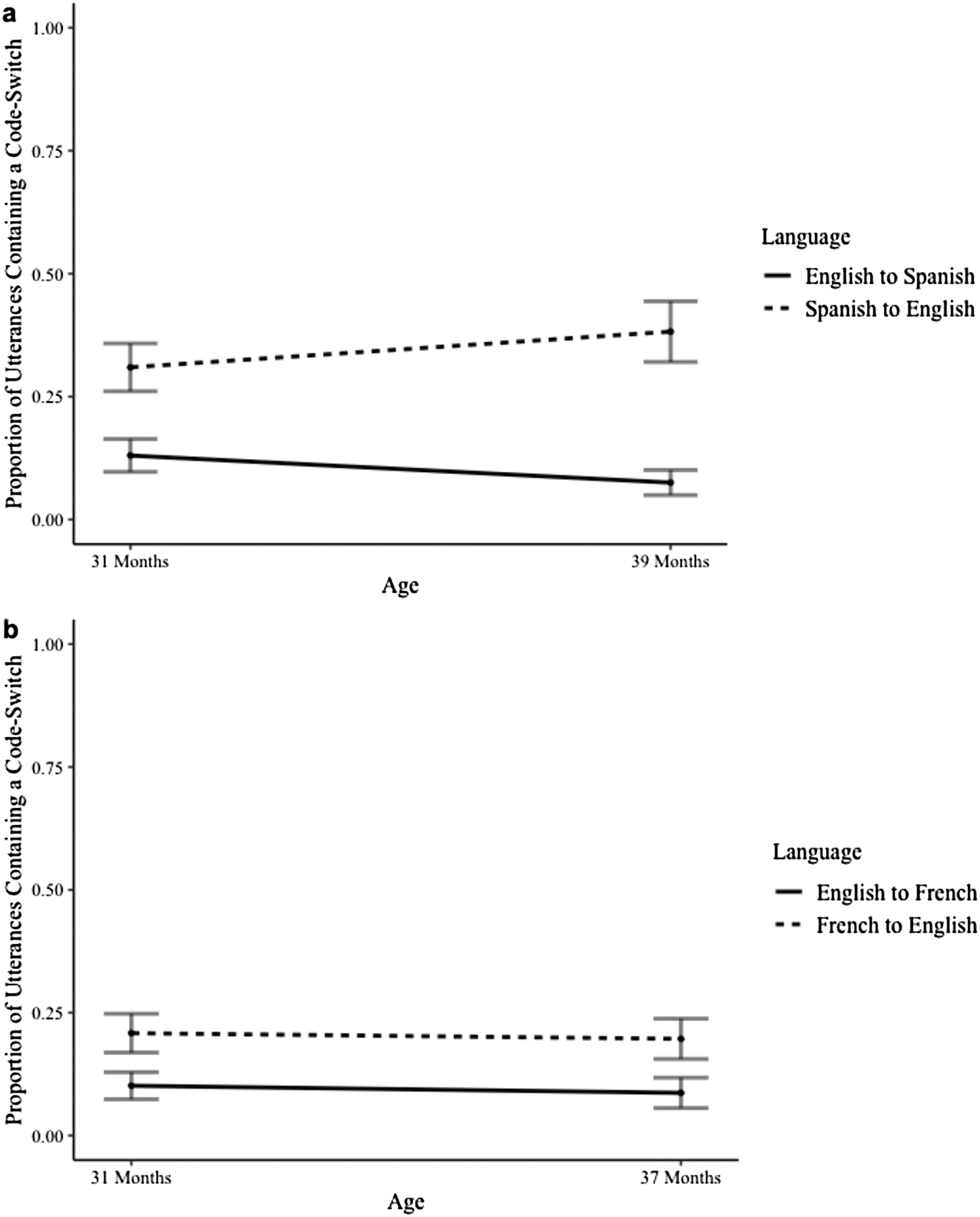
Likelihood ratio tests were performed on nested models in order to test the significance of added parameters. The analysis revealed a significant main effect of Language (χ2 (1, N = 23) = 16.71, p < .001) indicating, consistent with our prediction, that children code-switched more from Spanish to English than from English to Spanish (see Figure 1). Additionally, there was a significant Age X Language interaction (χ2 (1, N = 23) = 80.13, p < .001). Post-hoc simple effects analyses were conducted using the lsmeans package (Lenth, Reference Lenth2016) with a Tukey p-value adjustment for all possible comparisons. These analyses revealed that children code-switched significantly more from Spanish to English than from English to Spanish at both 31 and 39 months of age (z = 3.48, p = .002 and z = 5.69, p < .001, respectively). Additionally, code-switching from English to Spanish decreased significantly over time but code-switching from Spanish to English did not (z = 3.24, p = .007 and z = −2.28, p = .10, respectively). See Figure 1 for an illustration of this interaction.
Change in code-switching with age as a function of language a. Spanish-English participants b. French-English participants Note. Error bars represent 1 standard error.

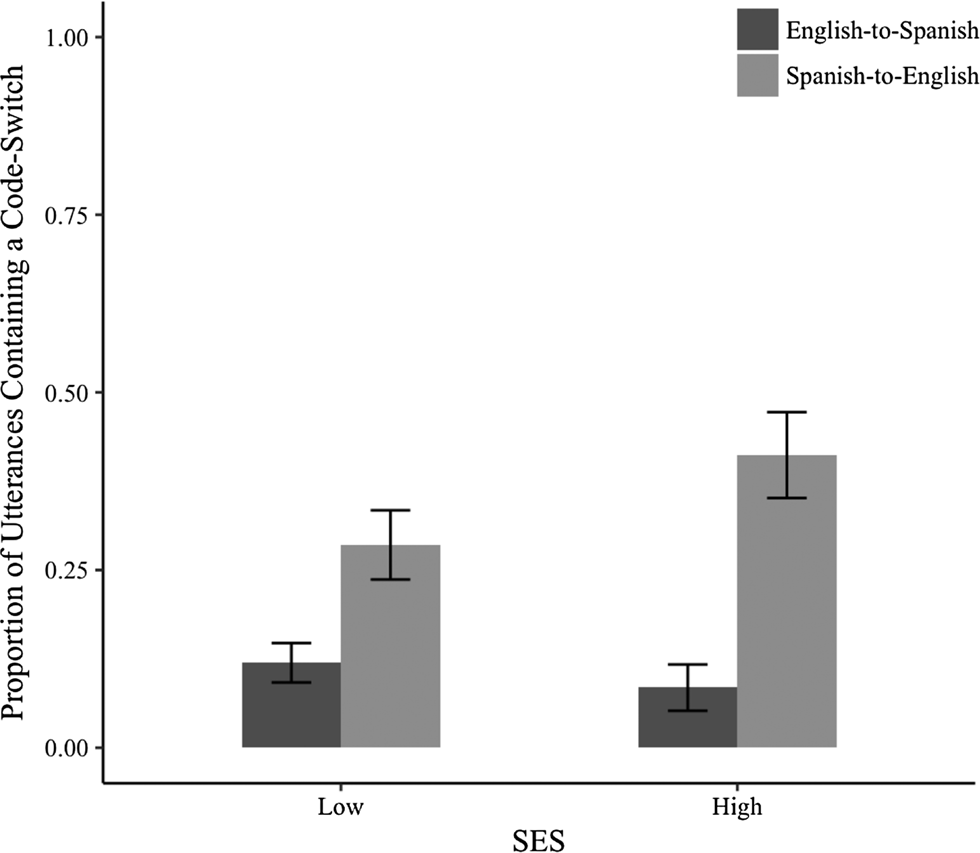
Finally, the analysis revealed a significant SES X Language interaction (χ2 (1, N = 23) = 4.62, p = .03). Post-hoc simple effects analyses using a Tukey p-value adjustment for all possible comparisons revealed that higher-SES children code-switched significantly more from Spanish to English than from English to Spanish (χ2 (1, N = 23) = −4.53, p < .001) whereas lower-SES children did not code-switch more in one language over the other (χ2 (1, N = 23) = −1.86, p = .24). See Figure 2 for an illustration of this interaction.
English-to-Spanish and Spanish-to-English code-switching as a function of SES. Note. Error bars represent 1 standard error.

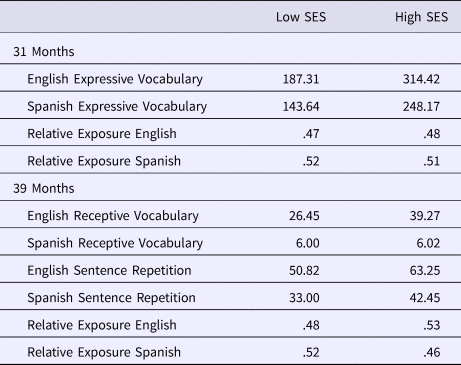
Important to this interaction is the language proficiency and exposure characteristics of the two groups (see Table 2). Higher-SES children had overall higher proficiency levels in both languages. In addition, these children appeared to have a larger English-to-Spanish proficiency ratio than their lower-SES peers in expressive vocabulary at Time 1 and receptive vocabulary at Time 2. Further, their exposure to English was greater than that of lower-SES children at Time 1. However, these differences were not significant when subjected to t-tests with a family-wise error rate correction (ps >.04).
Language proficiency and exposure for children in low- and high-SES groups, Study 1

Note. 1Expressive Vocabulary measured on the MCDI. 2Receptive Vocabulary measured on the PPVT.
Sources of variability
To investigate correlates of code-switching, we again utilized the full sample. We conducted bivariate correlations between code-switching, language proficiency, and exposure in English and in Spanish and followed these with partial correlations and a relative importance analysis to assess the independent contributions of exposure and proficiency. Due to attrition and missing data on proficiency measures for some children, degrees of freedom in the correlational analyses may vary. In the interest of retaining as large a sample size as possible, participants were not excluded list-wise in analyses conducted at a single time point.
English-to-Spanish
Here we evaluate how English exposure and proficiency influence code-switching from English to Spanish. Code-switching at 31 months was negatively correlated with exposure (r(28) = -.49, p = .008) and with expressive vocabulary (r(24) = -.60, p = .002), but not with total conceptual vocabulary, or TEs (all ps > .14). Similarly, code-switching at 39 months was negatively correlated with exposure (r(23) = -.56, p = .005), receptive vocabulary (r(21) = -.61, p = .003), and total conceptual vocabulary (r(21) = -.50, p = .02), but not with sentence repetition or TEs (all ps > .32). Exposure was correlated with expressive vocabulary (r(24) = .57, p = .003) at 31 months and with receptive vocabulary at 39 months (r(21) = .62, p = .002) but not with sentence repetition at 39 months (p = .19).
We next conducted partial correlations to investigate the relative influence of exposure and proficiency. At 31 months, exposure was not correlated with code-switching when controlling for expressive vocabulary (r(22) = -.06, p = .77). However, expressive vocabulary was significantly negatively correlated with code-switching when controlling for exposure (r(22) = -.50, p = .01): the larger a child's vocabulary in English, the less likely the child was to code-switch from English to Spanish. At 39 months exposure was not correlated with code-switching when controlling for receptive vocabulary (r(19) = -.33, p = .14) but was negatively correlated with code-switching when controlling for sentence repetition (r(20) = -.55, p = .008). Neither receptive vocabulary nor sentence repetition were correlated with code-switching when controlling for exposure (r(19) = -.38, p = .09 and r(20) = -.07, p = .76, respectively). Therefore, at 31 months, proficiency more strongly predicted English code-switching rates than exposure but this pattern appeared to reverse by 39 months such that exposure proves a more important predictor when sentence repetition is used as the measure of proficiency.
Relative importance analysis
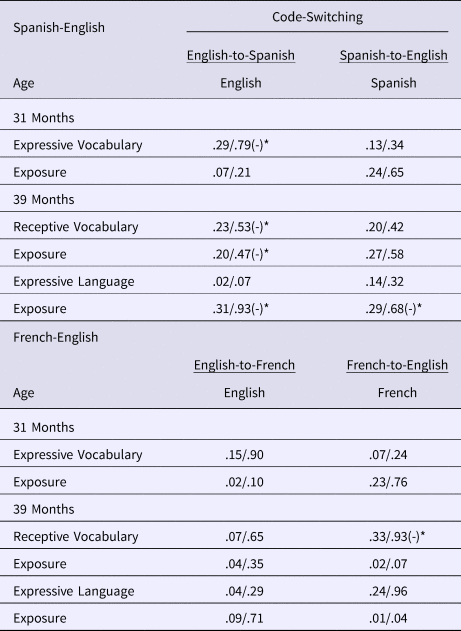
To assess the independent contributions of exposure and proficiency, we conducted three relative importance analyses (Johnson, Reference Johnson2000), one for each proficiency measure. Each analysis evaluates exposure and proficiency as predictors of code-switching from English to Spanish. Analyses were conducted in R (R Core Team, 2017) using the script by Tonidandel and LeBreton (Reference Tonidandel and LeBreton2011). First, we created new orthogonal exposure and proficiency variables permitting us to estimate the variance each predictor explains independently (Johnson, Reference Johnson2000). The analysis yields raw correlations (i.e., raw weights) and 95% confidence intervals (CI) for each predictor. The raw weights represent independent variance in the outcome accounted for by each predictor. The analysis further yields rescaled weights representing proportion of shared variance accounted for by each predictor. These weights sum to 1 and yield an estimate of relative importance. Each weight was statistically tested using a bootstrap procedure of 10,000 iterations with replacement (Tonidandel, LeBreton & Johnson, Reference Tonidandel, LeBreton and Johnson2009): if the 95% CI does not include zero, we can conclude the predictor is statistically significant. Using the same procedure, we tested whether the weights for exposure and proficiency differed significantly. This procedure is conservative with regard to Type I errors (Tonidandel et al., Reference Tonidandel, LeBreton and Johnson2009) so nominal alpha was set at .05. See Table 3 for results from the relative importance analyses.
Relative importance results for Study 1 and Study 2, showing variance accounted for by each predictor.

Notes. * Significant using 95% confidence intervals. Relative importance weights presented as (raw weights)/(rescaled weights); for significant effects, (+) or (-) indicates direction.
At 31 months, 36.50% of the total variance in English to Spanish code-switching was accounted for by exposure and expressive vocabulary combined, and vocabulary accounted for greater variance than did exposure. The weight for vocabulary was significant but the weight for exposure was not. These results reveal that proficiency predicted relatively more variance in code-switching at 31 months than did exposure.
At 39 months, using receptive vocabulary as a measure of proficiency, the total variance in code-switching accounted for by exposure and proficiency combined was 43.29%. Receptive vocabulary and exposure accounted for similar amounts of variance and both weights were significant. Thus, vocabulary and exposure's contribution was roughly equivalent to that of English code-switching at 39 months of age. Using sentence repetition as a measure of proficiency, the total variance accounted for by exposure and proficiency combined was 33.35% and exposure accounted for greater variance than did proficiency. Further, the weight for exposure was significant whereas the weight for proficiency was not. Across analyses, proficiency explained more variance in code-switching at 31 months of age whereas exposure explained equal or relatively more variance by 39 months of age. However, overlapping confidence intervals preclude us from concluding whether this difference is significant.
Spanish-to-English
Here we evaluate how Spanish exposure and proficiency influence code-switching to English. Code-switching at 31 months was negatively correlated with expressive vocabulary (r(25) = -.47, p = .02) and exposure (r(28) = -.49, p = .007) but was not related to TEs or total conceptual vocabulary (ps > .58). By 39 months, code-switching was negatively correlated with exposure (r(23) = -.55, p = .006) and receptive vocabulary (r(21) = -.45, p = .04), but not with sentence repetition, translation equivalents, or total conceptual vocabulary (ps > .05).
Next, we conducted partial correlations to investigate the relative contributions of exposure and proficiency. At 31 months, exposure was significantly negatively correlated with code-switching when controlling for vocabulary (r(23) = -.46, p = .02) but expressive vocabulary was not correlated with code-switching when controlling for exposure (r(23) = -.27, p = .19). At 39 months, exposure was negatively correlated with code-switching when controlling for receptive vocabulary (r(19) = -.58, p = .006) and for sentence repetition (r(21) = -.56, p = .007). Receptive vocabulary (but not sentence repetition) was significantly correlated with code-switching when controlling for exposure (r(19) = -.52, p = .02 and r(20) = -.40, p = .07, respectively). Together, these results suggest that exposure exerts relatively more influence on rates of code-switching from Spanish to English.
Relative importance analysis
Paralleling our analyses of code-switching from English to Spanish, we evaluated the independent contributions of exposure and proficiency to code-switching from Spanish to English (See Table 3). At 31 months, the combined variance accounted for by expressive vocabulary and exposure was 37.25% and exposure accounted for relatively more variance than did proficiency. However, neither weight was statistically significant. Consistent with the partial correlation analysis, exposure appears to exert relatively more influence on Spanish code-switching at 31 months although this finding was not significant.
At 39 months, the total variance accounted for by receptive vocabulary and exposure was 46.74% and exposure accounted for more variance than did proficiency. However, neither weight was significant; which, in combination with the partial correlation results, suggests that both exposure and vocabulary predict similar variance in Spanish code-switching at 39 months. Using sentence repetition as the measure of proficiency, the total variance accounted for by exposure and proficiency was 43.01% with exposure accounting for relatively more variance. Only the weight for exposure suggested, consistent with the partial correlations, that exposure explains more variance at 39 months than does proficiency.
Taken together, these results indicate that although exposure and proficiency are both important in the code-switching of Spanish–English bilingual children within single language contexts, their relative importance varies with language and age. At 31 months, code-switching from English to Spanish was influenced more by proficiency than by exposure whereas code-switching from Spanish to English was influenced more by exposure. By 39 months, language exposure was equally or more important to code-switching than proficiency, such that children borrowed more English words when speaking Spanish if they had relatively low levels of Spanish exposure and vice versa. Receptive vocabulary, but not sentence repetition, was a significant factor when controlling for exposure. This underscores the tight coupling of exposure and proficiency (Bedore et al., Reference Bedore, Peña, Summers, Boerger, Resendiz, Greene, Bohman and Gillam2012; DeAnda et al., Reference DeAnda, Bosch, Poulin-Dubois, Zesiger and Friend2016b; Lanza, Reference Lanza1997; Pearson et al., Reference Pearson, Fernandez, Lewedeg and Oller1997; Poulin-Dubois et al., Reference Poulin-Dubois, Bialystok, Blaye, Polonia and Yott2013) but suggests that exposure may predominate as the factor driving code-switching in the present sample especially when children code-switch from Spanish to English.
Qualitative aspects of child code-switching
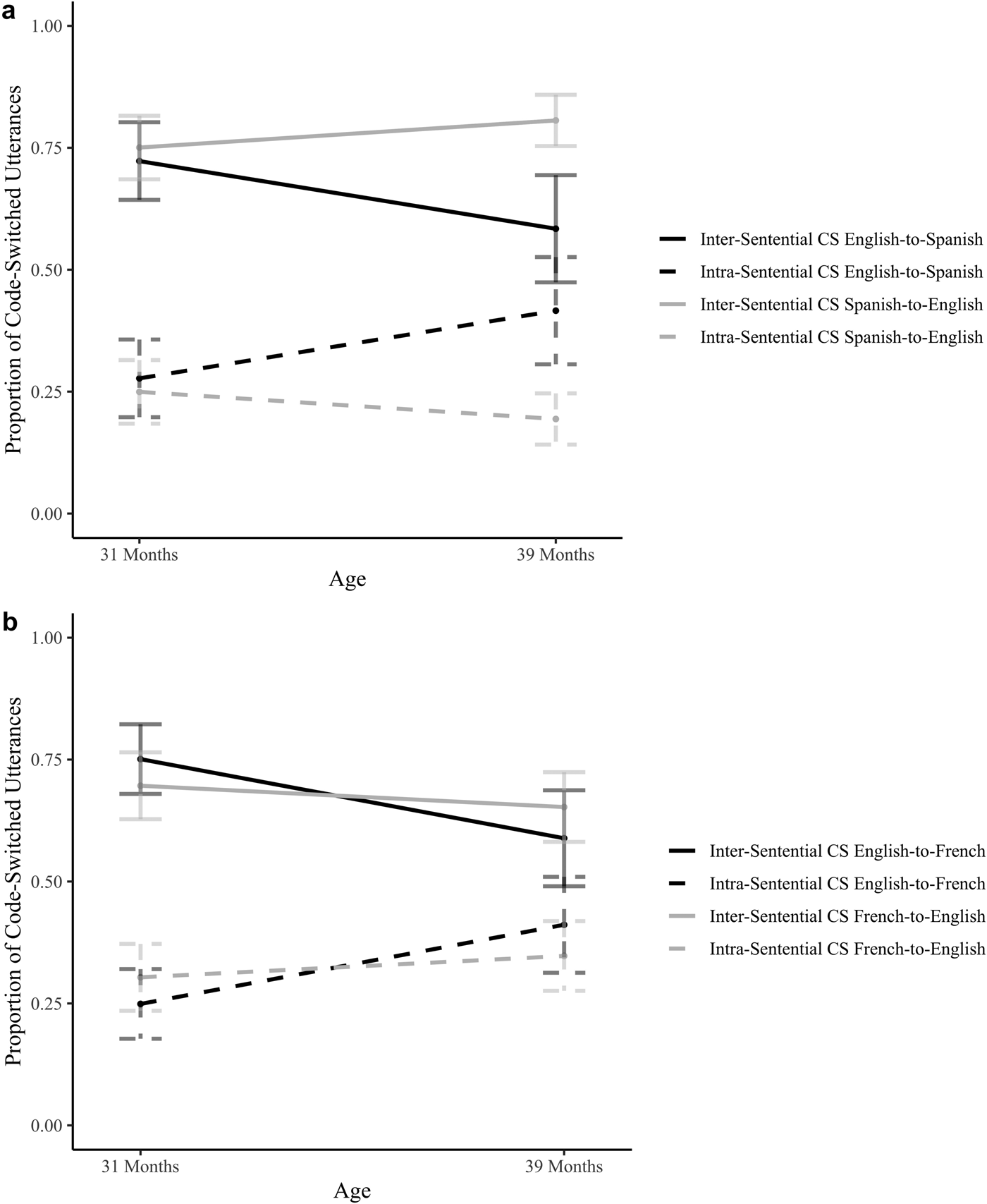
We next examine qualitative aspects of code-switching separately by language including only those children who code-switched at 31 and 39 months. Twelve children (40%) code-switched from English to Spanish (M = 18% of utterances code-switched, range = 3 to 53% at 31 months and M = 14%, range = 1 to 40% at 39 months, respectively). Twenty-three children (77%) code-switched from Spanish to English (M = 31% of utterances code-switched, range = 1 to 74% and M = 38%, range = 1 to 90% at 31 and 39 months, respectively). Because these samples are small, we characterize qualitative aspects of code-switching descriptively. When switching from English to Spanish, children used more inter- than intra-sentential switches on average at 31 and 39 months of age. However, inter-sentential code-switching decreased with age (from 72% to 58%) and intra-sentential code-switching increased with age (from 28% to 42%). When switching from Spanish to English, children also used more inter- than intra-sentential switches and this rate was fairly constant over time (Inter: 75% and 81% at 31 and 39 months; Intra: 25% and 19% at 31 and 39 months). This means that children were more likely to code-switch whole utterances than to embed code-switched words within an utterance (see Figure 3).
Change in type of utterance code-switching as a function of age and language. a. Spanish-English participants b. French-English participants Note. Error bars represent 1 standard error.

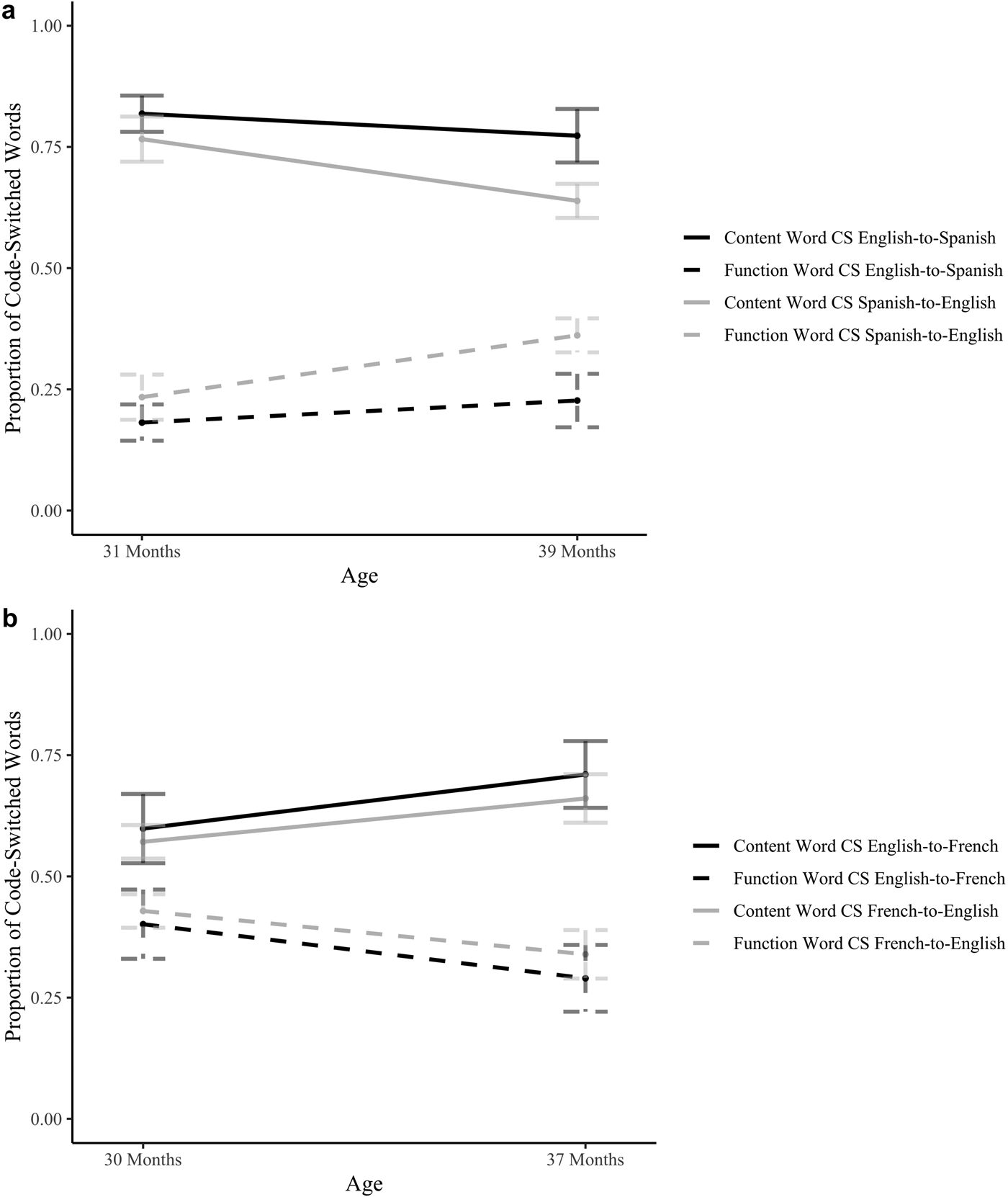
With regard to the use of content and function words, when code-switching from English to Spanish, children switched relatively more content than function words and this did not change with age (Content: 82% and 77% of all code-switched words at 31 and 39 months, respectively; Function: 18% and 23% at 31 and 39 months, respectively). When code-switching from Spanish to English, children also used more content than function words on average at 31 and 39 months of age. However, use of content words decreased (from 77% to 64%) and use of function words increased with age (from 23% to 36%). See Figure 4.
Change in Spanish-English code-switched word type as a function of age and language. a. Spanish-English participants b. French-English participants Note. Error bars represent 1 standard error.

Interim discussion
Study 1 investigated code-switching in Spanish–English bilingual children in an English majority context between 31 and 39 months of age. We first examined children's code-switching quantitatively and found that children code-switched more from Spanish to English than from English to Spanish across time points. Further, code-switching from English to Spanish decreased significantly with age. One explanation consistent with this finding is that children's code-switching is influenced by sociocultural context. The fact that English is the majority language, is spoken in a wider range of contexts than is Spanish, and is the language of higher prestige (Eilers et al., Reference Eilers, Pearson and Cobo-Lewis2006) may contribute to children's relatively high rate of code-switching from Spanish to English and to the decreasing use of Spanish during the English context. There are differences in proficiency across majority and minority languages with age; previous researchers have suggested that language status may play a role in code-switching (Greene et al., Reference Greene, Peña and Bedore2013; Gutiérrez-Clellen et al., Reference Gutiérrez-Clellen, Simon-Cereijido and Erickson Leone2009; McClure, Reference McClure1977; Lanza, Reference Lanza1992; Pan, Reference Pan1995; Ribot & Hoff, Reference Ribot and Hoff2014). Finally, in the current study there was an interaction between SES and language: higher- but not lower-SES children code-switched significantly more from Spanish to English than from English to Spanish across time points. This effect may reflect higher levels of acculturation in higher- relative to lower-SES families and higher impact of corresponding majority language prestige. There were no significant differences in relative language proficiency and exposure between low- and high-SES groups.
Also of interest was the relative influence of language exposure and proficiency. Exposure was more influential to code-switching from Spanish to English than was proficiency at both ages, suggesting that language alternation to English was more influenced by environmental factors than by word knowledge (e.g., lexical gap filling). In contrast however, the relative importance of exposure and proficiency varied with age for English to Spanish code-switching. At 31 months, the influence of proficiency was greater than exposure; whereas at 39 months, the influence of exposure was equal to or greater than proficiency. This could be a result of a shift in the importance of these factors with age or, alternatively, the change in our measures of proficiency from 31 to 39 months of age. That is, expressive vocabulary was an important predictor of code-switching rates at 31 months consistent with lexical gap filling. It is possible expressive vocabulary would have remained an important predictor of children's rates of code-switching from English to Spanish at 39 months as well had the measure of proficiency been constant. These results extend Ribot and Hoff's (Reference Ribot and Hoff2014) findings that exposure and proficiency are important predictors of code-switching in Spanish–English bilingual children by tentatively identifying predictors that account for the most variance at each age: proficiency at 31 months and exposure at 39 months.
Qualitatively, across languages, children were more likely to code-switch whole utterances than to embed code-switched words within an utterance. This trend may reflect the fact that children at this age produce relatively short utterances, decreasing the opportunity for intra-utterance embedding. This was relatively consistent across time points in Spanish-to-English code-switching. However, when children code-switched from English to Spanish there was a decrease in the use of inter-sentential switching and an increase in the use of intra-sentential switching with age. This may reflect improved Mean Length of Utterance (MLU) in English and increasing maturity of code-switching behavior. We return to this explanation in the general discussion. Children also tended to switch more content than function words, consistent with previous research (Gutiérrez-Clellen et al., Reference Gutiérrez-Clellen, Simon-Cereijido and Erickson Leone2009; Lindholm & Padilla, Reference Lindholm and Padilla1978; McClure, Reference McClure1977). However, when code-switching from Spanish to English use of function words increased with age (but remained lower than use of content words). This is somewhat unexpected, since code-switching of function words should decrease as the non-dominant language becomes more stable with age (Bernardini & Schlyter, Reference Bernardini and Schlyter2004). Instead, these findings may reflect an asymmetric increase in English relative to Spanish proficiency and a corresponding reliance on English grammar.
To assess generalization, we conducted an identical study in Montréal where French is the official language but the majority of individuals (59%) speak both French and English (Statisanada, 2016a). We expected these French–English bilingual children to demonstrate relatively balanced rates of code-switching across languages. Consistent with prior literature, we expect both exposure and proficiency to be important factors.
Study 2: French–English bilinguals in Canada
Method
Participants
Children were observed longitudinally at 31 (N = 27; 9 females; M age = 31;1 months, range = 29;18–33;15) and 37 months of age (N = 26; 8 females; M age = 36;27 months, range = 35;12–39;15), exposed to English and French from birth, and accompanied by their primary caregiver. The mean interval between the first and second visits was 5;24 months (range = 4;24 to 7;9). There was 3% attrition (N = 1 participant did not return) from time one to time two. All children received a maximum of 75% exposure to the dominant language (English or French) and a minimum of 25% exposure to the non-dominant language. The majority of participants were relatively balanced in exposure to French and English (English: M = 50%, SD = 14%; French: M = 50%, SD = 14%). Individually, there were 17 relatively balanced (<=65% to the dominant language: 7 English and 10 French dominant) and 10 relatively unbalanced (>=66% exposure to the dominant language, 6 English and 4 French dominant) bilinguals. All children were typically developing with normal hearing and vision. Participants were recruited from birth records and flyer postings. SES was calculated as in Study 1, with a sample-specific high-low grouping. See Table 1 for detailed demographic information.
Materials
The Language Exposure Assessment Tool (LEAT)
Identical to Study 1.
MacArthur-Bates Communicative Development Inventory and L'Inventaire MacArthur de Développement de la Communication
The English MCDI (Fenson et al., Reference Fenson, Bates, Dale, Marchman, Reznick and Thal2007) and its French Canadian adaptation, L'Inventaire MacArthur de Développement de la Communication (IMDC; Trudeau, Frank & Poulin-Dubois, Reference Trudeau, Frank and Poulin-Dubois1999), were used at 31 months of age. The IMDC was normed on children acquiring Québécois French, evinces strong test-retest reliability and is correlated with sentence complexity and grammar (Boudreault, Cabirol, Poulin-Dubois, Sutton & Trudeau, Reference Boudreault, Cabirol, Poulin-Dubois, Sutton and Trudeau2007). As in Study 1, expressive vocabulary in each language, TEs, and conceptual vocabulary were measures of language proficiency at 31 months.
The Peabody Picture Vocabulary Test-III (PPVT) and the Échelle de Vocabulaire en Images Peabody (EVIP)
The English PPVT (Dunn & Dunn, Reference Dunn and Dunn1997), identical to Study 1, and its French adaptation, the Échelle de Vocabulaire en Images Peabody (EVIP; Dunn, Dunn & Thériault-Whalen, Reference Dunn, Dunn and Theriault-Whalen1993) were administered at 37 months of age. The EVIP has high internal consistency and test-retest reliability and is correlated with other vocabulary and IQ measures. As in Study 1, raw receptive vocabulary scores in each language, TEs, and conceptual vocabulary were measures of language proficiency at 37 months.
Sentence repetition task (SR)
Identical to Study 1 except that English sentences were adapted to French (see Appendix 3). Two research assistants coded these data and approximately 15% (N = 5) were reliability-coded by an additional assistant. Word-level agreement was .96 and .95 for English and French, respectively.
Free-play spontaneous language sample
Identical to Study 1.
Coding and analysis
Identical to Study 1. Transcribers were fluent in English and French. An additional research assistant transcribed/coded approximately 15% (N = 5) of the transcriptions. Inter-rater agreement was calculated as in Study 1. At 31 months, word-level agreement was .90 for the English transcripts and .89 for the French transcripts. At 37 months, word-level agreement was .94 for the English transcripts and .93 for the French transcripts.
Procedure
Identical to Study 1.
Results
Parent language characteristics
All caregivers who participated in the free play sessions spoke both French and English. The same parent was present for both French and English visits for 16 out of 27 children. The same parent was present for both English visits for all children whereas the same parent participated in both French visits for all but 2 children. A majority of the parents present during the free-play session self-reported that they were native speakers of both English and French on the LEAT (N = 23, 85.19% of caregivers during the English free play session and N = 20, 74.07% during French free play at 31 months; N = 22, 84.62% during English free play and N = 18, 69.23% during French free play at 37 months). The rest of caregivers were not native speakers of one of the languages. Approximately 50–70% of caregivers present during the free play session self-reported using code-switching (N = 20, 74.07% during English free play and N = 18, 66.67% during French free play at 31 months; N = 13, 50.00% during English free play and N = 13, 50.00% during French free play at 37 months). All but 6 participants lived in a home in which at least one primary caregiver reported using code-switching. All children were included for analyses regardless of parental report of code-switching.
Language proficiency
At 31 months, English MCDI expressive vocabulary ranged from 5 to 680 (M = 343.00, SD = 187.18) corresponding to the 1st through the 99th percentile and French IMDC expressive vocabulary ranged from 57 to 590 (M = 307.08, SD = 163.53), corresponding to the 1st through the 73rd percentile. At 37 months, English PPVT receptive vocabulary ranged from 9 to 71 (M = 37.96, SD = 16.28, percentile range = 1 to 97) and French EVIP receptive vocabulary ranged from 7 to 42 (M = 21.00, SD = 11.03, percentile range = 1 to 91). The number of words children repeated correctly on the English version of the sentence repetition task ranged from 21 to 133 (M = 95.33, SD = 25.71) and the number of words children repeated correctly on the French version ranged from 38 to 118 (M = 80.14, SD = 25.42).
Parent code-switching
Parents were largely successful in using only one language throughout the sample, as reflected in low rates of code-switching (M = .01, SD = .01 in English at 31 months, M = .02, SD = .04 in French at 31 months, M = .01, SD = .02 in English at 37 months, M = .01, SD = .01 in French at 37 months). Further, parental code-switching was only marginally correlated with children's code-switching in French at 37 months (r(22) = .43, p = .04; all other ps > .40). Family-wise alpha correction yields no significant effects. As in Study 1, parental code-switching was not considered further.
Quantitative aspects of code-switching
As in Study 1, the quantitative analyses are conducted over the full sample. At 31 months children produced an average of 151.59 utterances in English and 136.97 utterances in French. At 37 months children produced an average of 138.82 utterances in English and 138.12 utterances in French. Additionally, at 31 months, children code-switched from English to French, on average, in 9.81% of their utterances and from French to English in 19.47% of utterances. At 37 months, children code-switched from English to French in 5.62% of utterances and from French to English in 20.33% of utterances. Age was not correlated with code-switching rates at either time point in either language when controlling for family-wise error rate (fw α = .0125; all ps > .02).
English-to-French examples (code-switches in italics):
“Yeah. C'est gros.”
“The front ici.”
French-to-English examples:
“I put it under there. Sur la table.”
“I know where there toutou.”
A mixed effects logistic regression model was run using R and the glmer function of the lme4 package. SES, Language (English or French), and Age (31 or 37 months) were included as factors. Additionally, a by-subjects random intercept and a by-subjects random slope were included for both language and time. Likelihood ratio tests were performed on nested models in order to test the significance of added parameters. The analysis revealed no main effects. However, there was a significant Age X Language interaction (χ 2 (1, N = 20) = 26.73, p < .001). Post-hoc simple effects analyses using a Tukey adjustment revealed that children code-switched significantly more from French to English than from English to French at 37, but not 31, months of age (z = −2.96, p = .02). Further, the rate of code-switching from English to French decreased significantly with age (z = 4.25, p < .001). See Figure 1 for an illustration of this interaction.
Sources of variability
Paralleling Study 1, we conducted bivariate correlations between code-switching, language proficiency, and exposure in English and in French and followed these with partial correlations and a relative importance analysis to assess the independent contributions of exposure and proficiency.
English-to-French
Here we evaluate how English exposure and proficiency influence code-switching to French. Code-switching at 31 months was negatively correlated with expressive vocabulary (r(24) = -.40, p < .05) but not with exposure, total conceptual vocabulary, or TEs (all ps > .20). Exposure and expressive vocabulary were positively correlated (r(25) = .51, p = .008). Code-switching at 37 months was not correlated with any exposure or proficiency measure (ps > .06). Exposure was related to receptive vocabulary (r(25) = .51, p = .007) but not sentence repetition (p = .37).
Partial correlations revealed that, at 31 months, exposure was not correlated with code-switching when controlling for expressive vocabulary (r(22) = -.07, p = .75) and expressive vocabulary was not correlated with code-switching when controlling for exposure (r(22) = -.32, p = .13). Findings were identical at 37 months (all ps > .06).
Relative importance analysis
At 31 months, the total variance in code-switching accounted for by expressive vocabulary and exposure was 16.15% and vocabulary accounted for relatively more variance than did exposure. Neither weight was statistically significant. The weight results suggest that proficiency accounted for more variance in code-switching than exposure at 31 months. However, non-significance and overlapping confidence intervals preclude the conclusion that this difference was significant.
At 37 months of age the total variance accounted for by receptive vocabulary and exposure was 10.43% and proficiency accounted for relatively more variance than did exposure. However, no weight was statistically significant and the confidence intervals overlapped. The total variance accounted for by sentence repetition and exposure was 12.66% and exposure accounted for relatively more variance than did proficiency. However, neither weight was statistically significant and the confidence intervals overlapped. Numerically, exposure explained more variance than did sentence repetition at 37 months although we cannot conclude that the weights were significantly different. Together, these findings suggest that neither proficiency (vocabulary) nor exposure were relatively more important by 37 months of age. However, vocabulary explained more variance than exposure with exposure explaining more variance relative to sentence-level proficiency.
French-to-English
Here we evaluate how French exposure and proficiency influence code-switching to English. At 31 months, code-switching was negatively correlated with exposure (r(24) = -.58, p = .002) but not with expressive vocabulary, total conceptual vocabulary or TEs (ps > .10). At 37 months, code-switching was significantly negatively correlated with receptive vocabulary (r(21) = -.59, p = .004) and sentence repetition (r(20) = -.51, p = .02) and TEs (r(21) = .46, p = .03) but not with exposure or total conceptual vocabulary (ps > .33).
Next, we conducted the partial correlation analyses. At 31 months, exposure was significantly correlated with code-switching when controlling for expressive vocabulary (r(21) = -.52, p = .01). However, vocabulary was not correlated with code-switching when controlling for exposure (r(21) = -.13, p = .57). At 37 months, this pattern reverses: exposure was not correlated with code-switching when controlling for receptive vocabulary (r(19) = .04, p = .88) or sentence repetition (r(18) = .07, p = .77). However, receptive vocabulary (r(19) = -.57, p = .008) and sentence repetition (r(18) = -.50, p = .03) were correlated with code-switching when controlling for exposure. In sum, exposure was a stronger predictor than proficiency at 31 months whereas proficiency was a stronger predictor than exposure at 37 months.
Relative importance analysis
At 31 months, the combined variance accounted for was 31.00% and exposure accounted for relatively more variance than vocabulary. However, neither weight was significant. In contrast, at 37 months the total combined variance accounted for by receptive vocabulary and exposure was 34.93% and vocabulary accounted for more variance than did exposure. The weight for vocabulary was significant (95% CI = .03 to .64) whereas the weight for exposure was not (95% CI = -.30 to .21). The combined variance accounted for by sentence repetition and proportion exposure to English was 25.57% and sentence repetition accounted for more variance than did exposure. However, neither weight was statistically significant. For both analyses, confidence intervals overlapped, precluding the conclusion of significant differences in weights. Numerically, these results suggest that exposure is a relatively stronger influence than proficiency in code-switching from French to English at 31 months but this pattern reverses by 37 months.
Qualitative aspects of code-switching
We next conducted analyses of the qualitative aspects of code-switching separately by language including only children who code-switched as in Study 1. Sixteen children (59%) code-switched from English to French (M = 15% of utterances, range = 1 to 59% at 31 months and M = 9%, range = 1 to 59% at 37 months, respectively). Sixteen children (59%) code-switched from French to English (M = 25% of utterances, range = 1 to 74% at 31 months and M = 23%, range = 2 to 62% at 37 months, respectively). As in Study 1, we characterize qualitative aspects of code-switching descriptively. When switching from English to French, children used more inter- than intra-sentential switches on average. However, inter-sentential code-switching decreased with age (from 75% to 59%) and intra-sentential code-switching increased with age (from 25% to 41%). When switching from French to English children also used more inter- than intra-sentential switches and this was relatively constant with age (Inter: 70% and 65% at 31 and 37 months; Intra: 30% and 35% at 31 and 37 months). Children were more likely to code-switch by producing single-language utterances than by embedding words (see Figure 3).
Next, we examined whether children were more likely to switch function or content words. When code-switching from English to French children used more content than function words on average at 31 and 37 months of age. However, use of content words increased with age (from 60% to 71%) and use of function words decreased with age (from 40% to 29%). Similarly, when code-switching from French to English children used more content than function words on average at 31 and 37 months of age. However, use of content words increased with age (from 57% to 66%) and use of function words decreased with age (from 43% to 34%). See Figure 4.
Interim discussion
Consistent with our hypothesis, children were equally likely to code-switch from French to English as from English to French at 31 months of age. However, they were more likely to code-switch from French to English than the reverse at 37 months of age and the rate of code-switching from English to French decreased over time. This may reflect changing language demographics in Montréal, a point we return to in the general discussion. There was no effect of SES on the quantity of code-switching.
Both exposure and proficiency were found to predict code-switching and the relative importance of these factors varied with language and age. The effect of language exposure varied as a function of the measure of proficiency. Code-switching from English to French was best predicted by vocabulary relative to exposure at both 31 and 37 months of age. At 37 months, exposure was a better predictor than sentence repetition. It is important to note that, across time points, exposure and proficiency did not reach significance in partial correlation or relative importance analyses and the proportion of variance explained at each time point was relatively low. One possibility is that exposure and proficiency influence code-switching from English to French jointly such that neither emerges as a more important predictor. However, it is also the case that the proportion of variance accounted for by exposure and proficiency in code-switching from English to French was smaller than in code-switching from French to English. It is noteworthy that children were less likely to switch from English to French than from French to English; this pattern was more pronounced over time and could not be explained by SES. The combination of a small sample of children who code-switched from English to French combined with a low rate of code-switching may have resulted in limited variability, precluding our ability to identify significant predictors. Code-switching from French to English, on the other hand, was best predicted by exposure at 31 months and by vocabulary and sentence repetition at 37 months. As in Study 1, this change in relative importance could be due to a change in proficiency measures.
Similar to the results from Study 1, children code-switched more inter-sententially than intra-sententially across age and languages. However, for English to French code-switching, use of inter-sentential switches decreased with age and use of intra-sentential switches increased. Children also tended to switch more content than function words. In both languages, use of content words increased and use of function words decreased over time. These findings may reflect maturation of code-switching patterns, a point we return to in the general discussion.
General discussion
The first aim of the present study was to examine predictors of code-switching, specifically the effects of exposure and proficiency in early toddlerhood. To evaluate code-switching across sociocultural contexts, we examined two groups of bilingual toddlers (Spanish–English in San Diego and French–English in Montréal) longitudinally over a 6 month period. This work builds on previous research by describing typical patterns of code-switching longitudinally in the preschool period and examining factors that account for individual variation.
Quantitative findings across groups
The results from the Spanish–English sample provide support for the language status account, in which code-switching is influenced by majority and minority language status (Gutiérrez-Clellen et al., Reference Gutiérrez-Clellen, Simon-Cereijido and Erickson Leone2009, Lanza, Reference Lanza1992; McClure, Reference McClure1977; Pan, Reference Pan1995): these children were more likely to code-switch from Spanish to English than the reverse. Additionally, English-to-Spanish code-switching significantly decreased with age. French–English children evinced a similar pattern. They were equally likely to code-switch from English to French as from French to English at 31 months of age. However, they were more likely to code-switch from French to English than from English to French at 37 months of age. In San Diego, this finding may reflect the prestige of English relative to Spanish. In Montréal, in contrast, this finding may be at least partly explained by shifting language patterns. Specifically, there has been a recent trend for more families to speak English and fewer to speak French in the home (Statisanada, 2016b), particularly on the island of Montréal from which we drew our sample. This shift potentially prompted the tendency to code-switch more in French than in English with age. That is, this regional pattern in the relative balance of language use may lead to more switches from French to English corresponding to increased exposure to English both in and outside the home.
As we noted in the introduction, it is also important to consider the role of the linguistic features of the three languages. Both French and Spanish are morphologically more complex than English and it is possible that this difference in complexity may help to drive code-switching in the direction of the morphologically simpler language. However, differential effects of SES, proficiency, and exposure across our samples argue for a more nuanced account.
We found that SES influenced code-switching patterns in the Spanish–English sample. High SES children code-switched significantly more from Spanish to English than from English to Spanish but low SES children code-switched equally in each language, an effect not observed among French–English children. There were no significant differences in English proficiency across high-and low-SES groups in this sample that would explain this finding. Rather, this finding supports the interpretation of an effect of language prestige on code-switching.
Proficiency and exposure effects
In the Spanish–English bilingual sample, in general, language exposure was a more important predictor of code-switching. That is, children were more likely to code-switch when exposure to the target language was relatively low. This was especially true of Spanish to English code-switching, suggesting that low levels of exposure to the minority language (Spanish) drives children's alternation to English. In English-to-Spanish code-switching however, proficiency was more important than exposure at 31, but not 39, months of age. This change in the role of exposure aligns with a symmetrical increase in exposure to English. Overall, concomitant increases in English exposure, proficiency, and sociolinguistic awareness with age may contribute to a shift toward the majority language. In contrast, in the French–English sample, exposure played a limited role in code-switching important only in French-to-English code-switching at 31 months of age. In this sample, especially in the case of code-switching from French to English, proficiency was the more important predictor such that children were more likely to code-switch when proficiency in the target language was low. However, neither exposure nor proficiency reached significance in partial correlations or relative importance analyses explaining code-switching rates from English to French.
Differences in the relative importance of proficiency versus exposure across samples may reflect sociocultural differences. Our Spanish–English bilingual children live in an English majority context in which the majority language is ubiquitous in the surrounding community and the minority language is spoken in more restricted contexts. For these children, exposure appears to drive code-switching. This is consistent with a language status account in which there is preferential switching to the higher status, or majority, language regardless of proficiency (Hebblethwaite, Reference Hebblethwaite2010). That young toddlers as early as 31 months make use of such sociolinguistic information to guide their code-switching practices is remarkable. Our French–English bilingual children, in contrast, live in a context in which both French and English are spoken regularly in a wide array of settings. Here, proficiency played a larger role in code-switching. This is consistent with extant research suggesting that differences in code-switching may arise due to differences in proficiency (Genesee et al., Reference Genesee, Nicoladis and Paradis1995; McClure Reference McClure1977; Petersen, Reference Petersen1988; Swain & Wesche, Reference Swain and Wesche1975). In both samples, word-level rather than sentence-level proficiency explained variance in code-switching. Indeed, sentence-level proficiency only uniquely predicted code-switching from French to English. This suggests that it is not expressive language fluency but rather word knowledge that most influences whether children are likely to borrow words and phrases from the more proficient language.
Qualitative findings
The second aim was to examine qualitative differences in code-switching as a function of age and language group. Unlike the adult data but consistent with smaller-scale studies of bilingual children (Genesee et al., Reference Genesee, Boivin and Nicoladis1996; Genesee et al., Reference Genesee, Nicoladis and Paradis1995), children were descriptively more likely to code-switch inter- than intra-sententially. This pattern likely reflects the limited utterance length used by children at these ages (Brown, Reference Brown1973). In the present research MLU in words ranged between 1.68 and 2.42. However, when switching from Spanish to English and from French to English children decreased in their use of inter-sentential switches with age and increased their use of intra-sentential switches. This may reflect maturation of code-switching behaviors, coming in line with adult data.
Across samples and ages, children were descriptively more likely to code-switch content than function words. However, in the French–English sample, use of content words increased with age and use of function words decreased, consistent with Bernardini and Schlyter's (Reference Bernardini and Schlyter2004) hypothesis that languages become more stable and less reliant on the grammar of the other language with age. In contrast to these expectations however, when code-switching from Spanish to English, children used more function words and fewer content words with age. This could reflect a lack of maturation in children's Spanish morphosyntactic skills across the six-month period from time one to time two or an increase in English proficiency relative to Spanish proficiency by 39 months of age. The present findings lend tentative support to this latter interpretation. This pattern replicates previous studies of bilingual children (Lindholm & Padilla, Reference Lindholm and Padilla1978; McClure, Reference McClure1977 but cf. Vihman, Reference Vihman1980; Reference Vihman1985) and adults (Poplack, Reference Poplack1980). The current research extends this literature in larger and linguistically distinct samples of children longitudinally. The tendencies to code-switch inter- rather than intra-sententially and to substitute content rather than function words appear relatively ubiquitous during this period.
Limitations and directions for future research
In evaluating the generalizability of the current findings, we note that code-switching was evaluated during a single-language context: parents were told to use only the language of the visit and did follow these instructions by-and-large. We expected this to instantiate an intermediate mode of activation between the two languages (e.g., Grosjean, Reference Grosjean, Nicol and Wei2001). Although this methodological approach is not without limitations, we wish to emphasize that our results are consistent with prior empirical and theoretical accounts. Further, bilinguals are often exposed to monolingual contexts as Grosjean (Reference Grosjean1997) and Hebblethwaite (Reference Hebblethwaite2010) describe. The extent to which an intermediate mode was instantiated in the present research may have been influenced by experience with code-switching at home. However, it is also important to consider that cognitive control (i.e., the ability to maintain a conversation in the target language) arguably plays a role in observed code-switching rates. This interpretation is consistent with predictions of the Inhibitory Control model (Green, Reference Green1998) and with work on language switching in adults (e.g., Meuter & Allport, Reference Meuter and Allport1999). Indeed, in a previous study designed to test this idea, we found that code-switching rates in a single language context were negatively related to cognitive control in children three and five years of age (Kuzyk et al., Reference Kuzyk, Friend, Sverdija, Zesiger and Poulin-Dubois2019). That is, children with higher scores on a cognitive control task were less likely to code-switch reflecting greater inhibition of the non-target language. Although in another recent study employing a bilingual context, code-switching was unrelated to executive function in children eight years of age (Kang & Lust, Reference Kang and Lust2018). Future research is needed to clarify the mechanisms that support code-switching across the types of contexts encountered by bilingual speakers.
A second limitation is the change in proficiency measures across 31 and 39 months of age. This change is measurement could have contributed to age-related changes in the relative importance of exposure vs. proficiency. Third, following the effects reported here, future research should further examine the role of sociocultural context and its interactions with SES, exposure, and proficiency on bilingualism in general and on code-switching in particular. Finally, future research should explore code-switching behaviors across a wider age range. For example, code-switching function words may be more prevalent at younger ages when at least one language is less proficient (Bernardini & Schlyter, Reference Bernardini and Schlyter2004) and more intra-sentential code-switching may be found as MLU increases with age.
Conclusion
In summary, this research presents one of the first looks into the factors underlying qualitative and quantitative changes in young children's code-switching with age. We present evidence across two socioculturally distinct samples. Together, these findings begin to reveal the development of language alternation early in production.
Acknowledgements
This research was supported by NIH awards 5R01HD068458 and HD068458-02S1 to the senior author, 2T32DC736111 to the first author and F31HD081933 to the second author, and does not necessarily represent the views of the National Institutes of Health. Diane Poulin-Dubois was funded by a Discovery grant from the Natural Sciences and Engineering Research Council of Canada (#2003–2013). We thank Giuditta Marinotti, Camille Labrèche, Rosalie Dauth, Ivana Di Criscio and Olivia Kuzyk, Alyssa Rodriquez, Anele Villanueva, Karla Jimenez, and Stephanie Soto for their help in coding and gratefully acknowledge all of the parents and infants who have devoted their time to participate in this research.
Appendix 1
English version of the sentence repetition task
Simple sentences with copula
1. The cat is cute.
2. The car is red.
3. The mouse is small.
Simple sentences with one argument: Singular
4. The dog eats.
5. The girl dances.
6. The lion runs.
Simple sentences with one argument: Plural
7. The babies sleep.
8. The children read.
9. The horses drink.
Sentences with one argument, one modifier
10. The rabbit jumps far.
11. The flower grows fast.
12. The boys sing again.
Simple sentences with two arguments
13. The monkey takes the banana.
14. The cow looks at the train.
15. The woman opens the window.
Simple sentences, two arguments, simple preposition
16. The pig goes to the beach.
17. The doll falls under the table.
18. The fish swims in the water.
Sentences with two arguments and one modifier
19. The bird carries the big butterfly.
20. The bear drives the blue motorcycle.
21. The goat takes the beautiful carrot.
Simple sentences, 3 arguments, simple preposition
22. Lola gives a hand to Hugo.
23. Marta puts the cheese on the table.
24. Noah washes the truck in the garage.
Simple sentences, 3 arguments, compound preposition
25. Carla brings the bread to the duck.
26. Louis closes the door of the living room.
27. Teddy reads the book to the children.
Appendix 2
Spanish version of the sentence repetition task
Simple sentences with copula
1. El gato es lindo.
2. El carro es rojo.
3. El ratón es chico.
Simple sentences with one argument: Singular
4. El perro come.
5. La niña baila.
6. El león corre.
Simple sentences with one argument: Plural
7. Los bebes duermen.
8. Los niños leen.
9. Los caballos toman.
Sentences with one argument, one modifier
10. El conejo salta lejos.
11. La flor crece rápido.
12. Los niños cantan de nuevo.
Simple sentences with two arguments
13. El mono toma el plátano.
14. La vaca mira el tren.
15. La mujer abre la ventana.
Simple sentences, two arguments, simple preposition
16. El cochino va a la playa.
17. La muñeca se cae debajo de la mesa.
18. El pez nada en el agua.
Sentences with two arguments and one modifier
19. El pájaro lleva la mariposa grande.
20. El oso maneja la motocicleta azúl.
21. La cabra toma la zanahoria bonita.
Simple sentences, 3 arguments, simple preposition
22. Lola le da una mano a Hugo.
23. Marta pone el queso en la mesa.
24. Noah lava la camioneta en la cochera.
Simple sentences, 3 arguments, compound preposition
25. Carla trae el pan al pato.
26. Louis cierra la puerta de la sala.
27. Teddy lee el libro a los niños.
Appendix 3
French version of the sentence repetition task
Simple sentences with copula
1. Le chat est joli.
2. La voiture est rouge.
3. La souris est petite.
Simple sentences with one argument: Singular
4. Le chien mange.
5. La fille danse.
6. Le lion court.
Simple sentences with one argument: Plural
7. Les bébés dorment.
8. Les enfants lisent.
9. Les chevaux boivent.
Sentences with one argument, one modifier
10. Le lapin saute loin.
11. La fleur pousse vite.
12. Les garçons chantent encore.
Simple sentences with two arguments
13. Le singe prend la banane.
14. La vache regarde le train.
15. La dame ouvre la fenêtre.
Simple sentences, two arguments, simple preposition
16. Le cochon va à la plage.
17. La poupée tombe sous la table.
18. Le poisson nage dans l'eau.
Sentences with two arguments and one modifier
19. L'oiseau porte le grand papillon.
20. L'ours conduit la moto bleue.
21. La chèvre prend la belle carotte.
Simple sentences, 3 arguments, simple preposition
22. Lola donne la main à Hugo.
23. Manon met le fromage sur la table.
24. Noah lave le camion dans le garage.
Simple sentences, 3 arguments, compound preposition
25. Chloé apporte le pain au canard.
26. Louis ferme la porte du salon.
27. Théo lit le livre aux enfants.
Appendix 4
Sample coding of code-switching from English free-play sample
Legend
[UCS] : Utterance contains a code-switch
[Inter_CS]: Utterance is an inter-sentential code-switch
[Intra_CS]: Utterance contains an intra-sentential code-switch
[CS]: Code-switched word
[C_CS]: Code-switched word is a content word
[F_CS]: Code-switched word is a function word
C That/'s a horse.
C A XX.
P That/'s another horse?
C Ay[CS][C_CS] ya[CS][C_CS] ya[CS][C_CS][Inter_CS][UCS].
C No|not[EW:not] that.
P No, why not?
P You could put it there.
C No|not[EW:not] that.
C Him.
P Her.
P <She/'s a lady>.
P Look she/'s a girl.
C Lady?
C No, no, t*!
C Him.
C Es[CS][F_CS] un[CS][F_CS] niño[CS][C_CS] mamá[Inter_CS][UCS].
P Mhm.
C Mommy a[EW] pig/s.
P Do you want to take the pig/s?
C Look inside?
P Hmm?
C Inside?
P In
<side>?
C <Yes>.
C Yes.
C Ahi_ahi[CS][C_CS][Inter_CS][UCS].
C No.
C Ahi[CS][C_CS] no mamá[Inter_CS][UCS].
P What happen/ed?
P What can we do next?
C Mommy.
C Mira[CS][C_CS], hold this[Intra_CS][UCS].
P A flower?
C No hold this.