Introduction
While the effects of bilingualism on linguistic processing (e.g., Jared & Kroll, Reference Jared and Kroll2001; Kaushanskaya & Marian, Reference Kaushanskaya and Marian2007; Marian & Spivey, Reference Marian and Spivey2003; Weber & Cutler, Reference Weber and Cutler2004) and cognitive control (e.g., Bialystok, Reference Bialystok1999; Bialystok, Craik, Klein & Viswanathan, 2004; Colzato, Bajo, van den Wildenberg, Paolieri, Nieuwenhuis, La Heij & Hommel, 2008; Costa, Hernández & Sebastián-Gallés, Reference Costa, Hernández and Sebastián-Gallés2008) have been topics of intense investigation over the past few decades, the impact of bilingualism on learning has received relatively little attention. Yet, learning and processing of linguistic information are inherently tied to each other (e.g., Edwards, Beckman & Munson, Reference Edwards, Beckman and Munson2004; Nash & Donaldson, Reference Nash and Donaldson2005; Snowling, Chiat & Hulme, Reference Snowling, Chiat and Hulme1991), with linguistic knowledge constraining novel word learning (e.g., Booth & Waxman, Reference Booth and Waxman2002) and newly-acquired lexical items influencing the co-activation dynamics in the established lexical system (e.g., Bowers, Davis & Hanley, Reference Bowers, Davis and Hanley2005). Moreover, it is the acquisition of two languages, and the subsequent need to control access to the two languages, that is hypothesized to underlie the effects of bilingualism on cognitive control (e.g., Bialystok & DePape, Reference Bialystok and DePape2009; Blumenfeld & Marian, Reference Blumenfeld and Marian2011; Costa, Hernández, Costa-Faidella & Sebastián-Gallés, Reference Costa, Hernández and Sebastián-Gallés2009; Festman, Rodriguez-Fornells & Münte, Reference Festman, Rodriguez-Fornells and Münte2010). Therefore, examining whether bilingualism can influence learning of new information (rather than processing of and control of attention to known information) can lead to better understanding of the cognitive mechanisms that underlie the effects of linguistic experience on cognition. The focus of the present study is the effect of bilingualism on the learning of novel words. While previous studies have generally yielded convergent findings regarding the positive effects of bilingualism on novel word learning, the mechanisms that underlie these advantages remain largely unknown. Here, we examine two factors that may contribute to and/or underlie the bilingual advantages for novel word learning: The phonological familiarity of the novel words (which may modulate the strength of the bilingual advantage effects), and the phonological short-term memory system (which may be the locus of the bilingual advantage effects).
Effects of bilingualism on novel word learning
Immersion in two languages appears to facilitate acquisition of the third language in a school setting (e.g., Cenoz & Valencia, Reference Cenoz and Valencia1994; Sanz, Reference Sanz2000). Previous studies that attempted to compare bilingual and monolingual performance on experimental word-learning tasks also have yielded largely reliable findings of superior learning in participants who speak multiple languages over monolingual participants. For example, in the first experimental study to test the impact of language-learning experience on vocabulary acquisition in adults, Papagno and Vallar (Reference Papagno and Vallar1995) compared polyglots (speakers of three or more languages) to non-polyglots on two paired-associates learning tasks: one where foreign words were paired with native-language translations and one where two native-language words were paired with each other. The findings showed robust learning advantages in polyglots, but only on the task where foreign words were paired with native-language words. Van Hell and Candia Mahn (Reference Van Hell and Candia Mahn1997) replicated the Papagno and Vallar (Reference Papagno and Vallar1995) findings, and demonstrated that experienced language-learners (defined as students with experience of learning three or more languages) outperformed inexperienced language-learners on a word-learning task where words from a foreign language were paired with words from the native language. In our previous work (Kaushanskaya & Marian, Reference Kaushanskaya and Marian2009a, Reference Kaushanskaya and Marianb), we extended the Papagno & Vallar (1995) and Van Hell and Candia Mahn (Reference Van Hell and Candia Mahn1997) findings, and examined novel word learning in bilinguals who acquired both of their languages through immersion-based exposure (and not multilinguals who have had extensive classroom-based exposure to their multiple languages, as in the Papagno & Vallar, Reference Papagno and Vallar1995 and Van Hell & Candia Mahn, 1997 studies). We showed that bilinguals outperformed monolinguals on paired-associates word-learning tasks (Kaushanskaya & Marian, Reference Kaushanskaya and Marian2009b) and that bilinguals with different language-acquisition histories – those who spoke English and Spanish and those who spoke English and Mandarin – outperformed monolingual speakers of English on the word-learning task (Kaushanskaya & Marian, Reference Kaushanskaya and Marian2009a). In both studies, we used a paired-associates word-learning task where artificially constructed phonologically-unfamiliar novel words were paired with native-language English translations.
Given this previous work, it is apparent that bilingual advantages for novel word learning can be reliably observed when the novel words are phonologically unfamiliar to the participants. However, with the exception of Papagno & Vallar (1995), no study has contrasted learning of phonologically-familiar and phonologically-unfamiliar novel words by bilinguals and monolinguals. In the Papagno and Vallar (Reference Papagno and Vallar1995) study, polyglots only outperformed monolinguals on the word-learning task when a foreign word was paired with the native-language word, but not when two native-language words were paired with each other. Because Papagno and Vallar used Baddeley's working memory model (e.g., Baddeley, Reference Baddeley1986) as the theoretical framework for their study, this finding was taken as evidence that the effects of language-learning experience on word learning must be situated within the phonological memory system.
Phonological memory and word learning
Baddeley's working memory model postulates that the acquisition of novel verbal information is accomplished by the dedicated, domain-specific cognitive system called the phonological (or articulatory) loop. The phonological loop consists of two sub-components – the phonological storage, which maintains novel phonological forms for a brief period of time, and the rehearsal mechanism, which refreshes information contained in the phonological store, preventing its decay over time. Thus, the phonological loop is responsible for storage of novel phonological forms in short-term memory, and transportation of short-term memory traces into a long-term memory store through rehearsal. Additionally, according to Baddeley's working memory model, a domain-general attention-control system (the “central executive”) controls the deployment of attentional resources to the phonological loop during learning.
The phonological loop has been termed the “language learning device” (Baddeley, Gathercole & Papagno, Reference Baddeley, Gathercole and Papagno1998) and it is seen as a dedicated memory system responsible for learning of verbal information. A large body of literature links phonological memory capacity to vocabulary acquisition and word learning in both children (e.g., Gathercole, Reference Gathercole1995; Gathercole & Baddeley, Reference Gathercole and Baddeley1990; Gathercole, Service, Hitch, Adams & Martin, Reference Gathercole, Service, Hitch, Adams and Martin1999; Gathercole, Willis & Baddeley, Reference Gathercole, Willis and Baddeley1992; Service, Reference Service1992; Service & Kohonen, Reference Service and Kohonen1995) and adults (e.g., Atkins & Baddeley, Reference Atkins and Baddeley1998; Baddeley, Papagno & Vallar, 1988; Papagno & Vallar, Reference Papagno and Vallar1992). For example, adults’ nonword repetition performance (a well-accepted phonological memory measure) predicted their ability to learn unfamiliar novel words (e.g., Baddeley et al., Reference Baddeley, Papagno and Vallar1988; Cheung, Reference Cheung1996; Dufva & Voeten, Reference Dufva and Voeten1999; Ellis & Beaton, Reference Ellis and Beaton1993; Speciale, Ellis & Bywater, 2004).
While the working memory system is seen as distinct from long-term memory, working memory function can be influenced by knowledge stored as part of long-term memory. In the context of word learning, the role of long-term knowledge in phonological memory function has most frequently been explored through manipulating the phonological familiarity of the novel words (e.g., De Jong, Seveke & van Veen, Reference De Jong, Seveke and van Veen2000; Gathercole & Baddeley, Reference Gathercole and Baddeley1990; Masoura & Gathercole, Reference Masoura and Gathercole1999; Papagno, Valentine & Baddeley, 1991). A number of studies has shown that participants find it easier to acquire vocabulary items in a foreign language when phonology of the foreign language is similar to that of the native language (e.g., Rogers, Reference Rodgers1969; Gathercole, Willis, Emslie & Baddeley, 1991; Service; 1992; Service & Craik, Reference Service and Craik1993; Papagno & Vallar, Reference Papagno and Vallar1992). For instance, Ellis and Beaton (Reference Ellis and Beaton1993) demonstrated that the degree to which the novel word conformed to the phonotactic patterns of the native language correlated highly with its learnability. Similarly, Gathercole et al. (Reference Gathercole, Willis, Emslie and Baddeley1991) found that nonwords that were structured in accordance with native-language phonotactic rules were more accurately repeated than nonwords that were not consistent with the native phonotactic system. These phonological familiarity effects are due to the fact that when the phonology of the novel word is similar to the phonological inventory of the native language, a learner can rely on the established phonemic categories associated with the native language to process and integrate the information associated with the novel word (e.g., Gathercole et al., Reference Gathercole, Willis, Emslie and Baddeley1991; Papagno et al., Reference Papagno, Valentine and Baddeley1991). As a result, the relationships between short-term memory measures and word-learning performance are stronger for less familiar novel words than for more familiar novel words (e.g., Gathercole, Reference Gathercole1995; Gathercole, Hitch, Service & Martin, 1997). In other words, learning of phonologically-familiar information can bypass the capacity limitations of the phonological loop, and thus, the relationship between phonological memory capacity and word learning is weaker for phonologically-familiar novel words than for phonologically-unfamiliar novel words.
Given the association between phonological memory and word learning, the phonological short-term memory is a logical possible locus of the mechanisms that underlie the differences between bilingual and monolingual word learning. This hypothesis gains further support from the Papagno and Vallar (Reference Papagno and Vallar1995) findings, with superior polyglot performance on the task where foreign words were paired with native-language words, but not on the task where two native-language words were paired with each other. Given that phonological memory capacity is more essential to learning of phonologically-unfamiliar novel words (since learning of phonologically-familiar novel words can be supported by the long-term memory), Papagno and Vallar (Reference Papagno and Vallar1995) interpreted their findings as evidence for the superior phonological memory being at the root of the polyglots’ superior performance on the word-learning task. This conclusion was further confirmed by the fact that in the Papagno and Vallar (Reference Papagno and Vallar1995) study, polyglots’ word-learning advantages on the phonologically-unfamiliar novel words were accompanied by advantages on two phonological short-term memory tasks: the digit-span and the nonword repetition tasks. As a result, Papagno and Vallar (Reference Papagno and Vallar1995) suggested that superior phonological memory facilitates foreign vocabulary acquisition, thereby enabling participants to become polyglots in the first place. Thus, they localized the superior word-learning performance by polyglots not to multilingualism itself, but to the superior phonological memory skills. However, there are reasons to re-examine the localization of the bilingual advantages on the word-learning tasks to the phonological memory system, with regard to both the phonological familiarity effects and the tasks that index phonological memory directly.
With regard to the phonological familiarity effects, the task in the Papagno & Vallar (1995) study involved remembering eight pairs of native-language words, and thus may have been uniformly easy for all participants – polyglot or monolingual. In fact, reported learning rates are suggestive of ceiling effects in the data, with participants remembering seven out of eight pairs after only four learning trials. Since the involvement of the phonological memory in word learning is a matter of degrees rather than absolutes, it seems logical that if the paired-associates task is difficult enough, differences between bilinguals and monolinguals should be obtained on the task that involves phonologically-familiar stimuli as well as on the task that involves phonologically-unfamiliar stimuli.
With regard to the effects of bilingualism on the phonological memory, there are conflicting findings in the literature concerning bilingual/monolingual differences on phonological memory tasks as well as the relationship between phonological memory performance and word-learning performance. First, while reports of bilingual advantages on phonological memory tasks have appeared (e.g., Chicotta & Underwood, Reference Chicotta and Underwood1998; Kroll, Michael, Tokowicz & Dufour, 2002), a number of studies have failed to demonstrate differences between bilingual and monolingual phonological memory performance (e.g., Fernandes, et al., Reference Fernandes, Craik, Bialystok and Kreuger2007; Kaushanskaya, Blumenfeld & Marian, 2011; Kaushanskaya & Marian, Reference Kaushanskaya and Marian2009a). Therefore, the effect of bilingualism on phonological memory function is by no means unequivocal. Second, while polyglots in the Papagno and Vallar (Reference Papagno and Vallar1995) study outperformed non-polyglots on both the word-learning and the phonological short-term memory tasks, in our studies (Kaushanskaya & Marian, Reference Kaushanskaya and Marian2009a, Reference Kaushanskaya and Marianb), we have demonstrated bilingual advantages on the word-learning task when bilinguals and monolinguals did not in fact differ in their performance on a phonological memory task.
Together, inconsistencies across studies suggest the need to (i) examine bilingual learning of phonologically-familiar novel words on a task that is difficult enough to eliminate ceiling effects, and (ii) specifically manipulate the phonological memory span across the bilingual and the monolingual groups and to examine whether high phonological memory span trumps bilingualism in predicting the word-learning performance. If increased phonological memory capacity lies at the root of the bilingual advantage for word learning, then bilinguals and monolinguals matched on the phonological memory performance should perform similarly on the word-learning task.
The present study
The present study addressed two goals. The first goal was to compare bilingual and monolingual performance on word-learning tasks where the novel words represented phonologically-familiar information (i.e., shared phonemes with English; Experiment 1) and where the novel words represented phonologically-unfamiliar information (e.g., incorporated phonemes that are not part of the English phonemic inventory; Experiment 2). The second goal was to examine the role of phonological memory in the word-learning performance of monolinguals and bilinguals. In both Experiment 1 and Experiment 2, the digit-span task was administered to participants to obtain a measure of their phonological short-term memory. This measure was chosen because the only study to examine the link between the bilingual advantage for word learning and phonological memory found significant differences between experienced and inexperienced learners on this task (Papagno & Vallar, Reference Papagno and Vallar1995), and because numerous studies have linked performance on digit-span-like tasks with lexical learning (e.g., Gupta, Reference Gupta2003; Majerus, Poncelat, Elsen & Van der Linden, Reference Majerus, Poncelet, Elsen and Van der Linden2006; Majerus, Poncelat, Greffe & Van der Linden, Reference Majerus, Poncelet, Greffe and Van der Linden2006) and vocabulary skills (e.g., Gathercole et al., Reference Gathercole, Hitch, Service and Martin1997; Gathercole, Service, Hitch, Adams & Martin, Reference Gathercole, Service, Hitch, Adams and Martin1999; Gathercole, Willis, Emslie & Baddeley, Reference Gathercole, Willis and Baddeley1992; Kaushanskaya et al., Reference Kaushanskaya, Blumenfeld and Marian2011).
The decision to use the digit-span task as the index of phonological memory capacity was also logical in light of working memory models that draw a distinction between memory for serial order and memory for items (e.g., Burgess & Hitch, Reference Burgess and Hitch1999; Gupta, Reference Gupta2003; Page & Norris, Reference Page and Norris1998). Studies conducted under this theoretical umbrella have shown that memory for sequential order is especially predictive of word-learning performance (Gupta, Reference Gupta2003; Majerus, Poncelat, Elsen & Van der Linden, Reference Majerus, Poncelet, Elsen and Van der Linden2006; Majerus, Poncelat, Greffe & Van der Linden, Reference Majerus, Poncelet, Greffe and Van der Linden2006). For example, Majerus, Poncelat, Van der Linden and Weekes (2008) showed that performance on a serial order reconstruction task (which is similar to a digit-span task) predicted bilingual learners’ performance on a paired-associates word–nonword learning task. Moreover, this predictive relationship held when learners’ knowledge of the target language (French) was factored out. Therefore, the choice of the digit-span measure to index phonological memory in the present study enabled us to probe the effects of bilingualism on sequence memory and the relationship between sequence memory and word learning in bilingual vs. monolingual participants.
Three groups of participants were tested in each experiment: a group of bilingual participants, a group of monolingual participants who were matched to bilingual participants on their phonological memory performance (a high-span group as indexed by the digit span) and a group of monolingual participants who performed less successfully on the digit-span task than bilinguals and high-span monolinguals (a low-span group). Ideally, the design would have included a low-span bilingual group that matched the low-span monolingual group in phonological memory performance. However, after testing 18 bilingual participants for Experiment 1, it became apparent that bilingual participants outperformed monolingual participants on the phonological memory measures to an extent that precluded the ability to collect a large enough sample of low-span bilinguals. Specifically, the digit-span percentile scores for the bilingual participants in Experiment 1 ranged from 63% to 98%, with a mean of 84.94%. At the same time, monolingual participants’ digit-span scores in Experiment 1 ranged from 5% to 95%, with a mean of 69.46%. As a result, bilingual participants in Experiment 1 outperformed monolingual participants on the digit-span task (t(53) = 2.66, p = .011). Moreover, bilinguals also outperformed monolinguals on the nonword repetition task – a secondary phonological memory task we included into the procedure (t(53) = 2.12, p = .03). A similar pattern of results was observed in Experiment 2, with bilinguals outperforming monolinguals on the digit-span measure (t(53) = 2.80, p < .01) when monolinguals were considered as a whole (i.e., when bilinguals were compared to all 36 monolinguals, before separation of monolinguals into a high-span and a low-span sub-group). The nonword repetition scores trended in the same direction (t(53) = 1.53), although the difference between the two groups was not statistically significant, p = .14. Therefore, there was a bilingual advantage on the two phonological memory measures in the present study, rendering the median-split procedure non-viable for the bilingual group. However, the wider range of phonological memory scores available in the monolingual group enabled us to split them into high-span and low-span sub-groups based on their digit-span performance.
Experiment 1: Learning phonologically-familiar novel words
In Experiment 1, participants learned artificially constructed novel words that followed the phonological structure of English. Our predictions for Experiment 1 were as follows: First, if bilingual advantage effects are only obtained in cases where the novel words are phonologically unfamiliar, then there would be no significant differences between bilingual and monolingual participants’ word-learning performance in Experiment 1; second, if enhanced phonological memory leads to superior word-learning performance, then participants with higher phonological memory span should outperform participants with lower phonological memory span, independent of the bilingual status.
Method
Participants
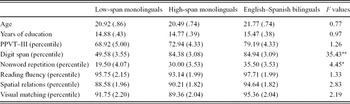
Eighteen bilingual speakers of English and Spanish (eight males), and 36 monolingual speakers of English (15 males) participated in Experiment 1. All participants were recruited from the undergraduate and graduate student community at the University of Wisconsin–Madison. Monolingual speakers were divided into two groups according to the median-split procedure based on their performance on the digit-span task. High-span monolinguals (n = 18, 7 males) were comparable to bilinguals with regard to digit-span performance, and both groups outperformed low-span monolinguals (n = 18, 8 males) on the digit-span task (see Table 1). The ranges of performance for the digit span were as follows: bilinguals (63–98); high-span monolinguals (75–95); low-span monolinguals (5–63). Therefore, the high-span monolinguals occupied a more restricted range of values on the digit-span task than the bilinguals. This provides an even more stringent test of bilingual effects on word learning, since the bilingual group includes participants with lower levels of digit-span performance than the high-span monolingual group.
Experiment 1: Monolingual and bilingual participant characteristics (Means and SE values).

Note: F values are based on Univariate Analyses of Variance with group (bilingual, high-span monolingual, and low-span monolingual) as the between-subjects independent variable. Significance at p < .05 level is marked by an asterisk (*) next to the F value, while significance at p < .01 level is marked by two asterisks (**) next to the F value. Significant differences in all comparisons reflect the difference between bilinguals and high-span monolinguals on the one hand, and low-span monolinguals on the other hand.
Bilingual participants were native speakers of English who acquired Spanish, their second language, on average at 8.42 years of age (SD = 1.44). At the time of the study, bilinguals reported their proficiency in Spanish (on the scale from 0 = no knowledge to 10 = perfect knowledge) to be on average: 6.92 (SD = .67) for speaking, 7.33 (SD = .59) for understanding, and 6.42 (SD = .77) for reading. They were on average exposed to their L2 Spanish 6.08% of time on the daily basis (SD = 1.24). These L2 acquisition data were obtained by having the participants fill out the Language Experience and Proficiency Questionnaire (LEAP-Q; Marian, Blumenfeld & Kaushanskaya, 2007).
Materials
The phonological inventory used in the present study was developed by Kaushanskaya and Marian (Reference Kaushanskaya and Marian2008) to examine the effects of phonological familiarity on word learning. The phonologically-familiar version included eight sounds (four vowels and four consonants) that were part of the English phonological inventory and were thus familiar to speakers of English. It included vowels /ɑ/, /ɛ/, /i/, and /u/, and consonants /f/, /n/, /t/, and /g/. These eight phonemes were used to construct 48 monosyllabic and disyllabic phonologically-familiar novel words. Novel words were recorded by a male native English speaker and paired with their English “translations”. The phonologically-familiar novel words followed English syllabic structure (CVC, CVCV, and CVCVC) and were phonotactically probable in English (sum of phoneme frequencies = 1.14, SE = .06; sum of biphone frequencies = 1.00, SE = .003, according to Vitevitch & Luce, Reference Vitevitch and Luce2004). The English words that served as translation equivalents were selected based on the frequency of use (calculated using Francis & Kučera, Reference Francis and Kučera1982), with the majority of translations falling within high frequency ranges. All 48 English translations referred to concrete, imageable objects with frequent English names. None of the novel words were phonologically similar to their English translations. See Appendix for the list of all the stimuli.
Procedure
Vocabulary learning
Participants heard the novel word pronounced twice over headphones, and saw its written English translation on the computer screen. Each pair was presented twice during the learning phase in a random order. Participants were instructed to repeat the novel word and its English translation out loud three times.
Vocabulary testing
Participants’ memory was tested using recall and recognition tasks immediately after learning and after a one-week delay. The learning task was quite difficult (with 48 novel words to be learned), and piloting of the experiment revealed uniformly floor levels of performance when production of novel words was probed at testing. Therefore, a decision was made to test retention of novel words through retrieval of their English translations. The added benefit to testing retention by asking participants to retrieve the English translations was that it enabled us to de-confound retention and articulation effects in retrieval. This was especially important to do since in Experiment 2, participants were exposed to novel words that diverged from the English phonological structure; articulation of novel words in Experiment 2 would therefore be significantly more difficult than in Experiment 1. By testing retention of English words in both experiments, we equalized the articulation demands across the two experiments.
During recall testing, participants heard the novel word and pronounced its English translation into a microphone. During recognition testing, participants heard the novel word and chose the correct English translations from five alternatives listed on the computer screen. The recall and recognition task were always presented in the same order to all participants, with the recognition task following the recall task. This was done to ensure that the recall performance would not be contaminated by the presentation of the correct English translation in the recognition task. The order of items on the recall and the recognition task was randomized for each participant.
Standardized testing
Each participant was administered an array of standardized language and memory measures in a randomized order. The following measures were administered:
1. The Peabody Picture Vocabulary Test III (PPVT–III), a standardized test measuring receptive word knowledge in English (Dunn & Dunn, Reference Dunn and Dunn1997), which indexes a participant's ability to map an auditory target word to one of four pictures.
2. The Digit Span and the Nonword Repetition sub-tests of the Comprehensive Test of Phonological Processing (CTOPP; Wagner, Torgesen & Rashotte, Reference Wagner, Torgesen and Rashotte1999), which index participants’ phonological short-term memory (STM). The digit-span sub-test of the CTOPP is a forward digit-span task. The stimuli consist of increasing sequences of digits. The task begins with two-digit sequences and each successive sequence is increased by one digit until the testee makes three errors in a row. There are three items per digit-sequence. On the Nonword Repetition sub-test of the CTOPP, the stimuli consist of pseudowords that follow English phonological and phonotactic patterns, increasing in length from one to nine syllables.
3. The Reading Fluency sub-test of the Woodcock–Johnson Tests of Achievement III (Woodcock, McGrew & Mather, 2001), which measures the speed and accuracy of reading in English.
4. The Spatial Relations and the Visual Matching sub-tests of the Woodcock–Johnson Tests of Cognitive Abilities III (Woodcock et al., Reference Woodcock, McGrew and Mather2001), which measure non-linguistic cognition. On the Spatial Relations sub-test, participants re-constitute larger spatially complex figures out of rotated sub-parts; on the Visual Matching sub-test, participants circle identical digits presented in a row with other visually similar digits.
Analyses
Recall and recognition accuracy data were analyzed via 3 × 2 ANOVAs with group (bilingual, high-STM-span monolingual, and low-STM-span monolingual) as the between-subjects variable, and session (immediate vs. delayed) as a within-subjects independent variables. Univariate Analyses of Variance with group as the independent between-subjects variable were conducted across the three groups to examine differences for each of the performance measures. These follow-up ANOVAs were adjusted for multiple comparisons using the Bonferroni method.
Results and discussion
Demographic comparisons
Demographic information and standardized testing data for the three groups of participants are presented in Table 1. The three groups of participants differed on the nonword repetition performance, with the high-span monolinguals and the bilinguals outperforming the low-span monolinguals. The three groups did not differ in age, years of education, performance on the English receptive vocabulary measure (PPVT–III), or the measure of English reading fluency (Reading Fluency sub-test of the Woodcock–Johnson Tests of Achievement III). The groups were also comparable with regard to their cognitive performance, as indexed by the Spatial Relations and the Visual Matching sub-tests of the Woodcock–Johnson Tests of Cognitive Abilities III, although there was a non-significant trend for the bilingual group to perform better on these cognitive measures than the two monolingual groups. Since the three groups of participants had similar educational levels, and since performance on PPVT–III indexes verbal intelligence (e.g., Dunn & Dunn, Reference Dunn and Dunn1997) and performance on the Spatial Relations and Visual Matching sub-tests indexes nonverbal intelligence (e.g., Woodcock et al., Reference Woodcock, McGrew and Mather2001), the three groups of participants are likely comparable in their general intelligence.
Recall analyses
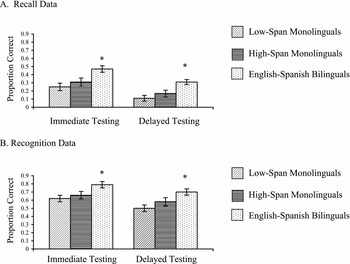
A 3 × 2 ANOVA with group (bilingual, high STM monolingual, and low STM monolingual) and session (immediate vs. delayed) yielded a main effect of testing session, F(1, 51) = 69.15, p < .001, η2p = .62, and a main effect of group, F(2, 51) = 7.76, p < .01, η2p = .27. The interaction between group and session, however, was not significant, F(2, 51) = 0.50, p = .61. The main effect of session was driven by the fact that participants recalled more novel words at immediate (M = 0.34, SE = .03) than at delayed testing (M = 0.20, SE = .02). In order to pinpoint the locus of the group effect, Univariate ANOVAs across the three groups were conducted for both the immediate and the delayed recall data. For immediate recall, the ANOVA with group as the independent variable revealed an overall effect of group, F(2, 51) = 5.90, p < .01, η2p = .22, with the bilinguals (M = 0.47, SE = .04) outperforming both the high-span monolinguals (M = 0.31, SE = .05), p < .05, and the low-span monolinguals (M = 0.25, SE = .05), p < .01. The difference between the high-span monolinguals and the low-span monolinguals, however, was not statistically significant, p = .37. A similar pattern was observed for delayed recall, where the ANOVA with group as the independent variable yielded an overall effect of group, F(2, 51) = 7.56, p < .01, η2p = 0.27. The bilinguals (M = 0.31, SE = .03) outperformed both the high-span monolinguals (M = 0.17, SE = .04), p < .01, and the low-span monolinguals (M = 0.11, SE = .03), p < .01, but the difference between the high-span monolinguals and the low-span monolinguals was not statistically significant, p = .30. The recall data are shown in Figure 1, Panel A.
Experiment 1 recall (Panel A) and recognition (Panel B) data. Bilinguals outperformed both high-span and low-span monolinguals on all retention measures (as indicated by the asterisk above the bilingual bar).

Recognition analyses
The recognition data revealed a similar pattern of results. A 3 × 2 ANOVA with group (bilingual, high STM monolingual, and low STM monolingual) and session (immediate vs. delayed) yielded a main effect of testing session, F(1, 51) = 23.97, p < .001, η2p = .37, and a main effect of group F(2, 51) = 5.81, p < .01, η2p = .22, but no significant interaction between the two, F(2, 51) = 0.11, p = .90. Participants recognized more novel words at immediate (M = 0.69, SE = .03) than at delayed testing (M = 0.59, SE = .02). Follow-up Univariate Analyses of Variance revealed that for immediate recognition performance, an overall effect of group was significant, F(2, 51) = 4.67, p < .05, η2p = .18, with the bilinguals (M = 0.79, SE = .04) outperforming both the high-span monolinguals (M = 0.66, SE = .04), p < .05, and the low-span monolinguals (M = 0.62, SE = .05), p < .01, who did not differ from each other, p = .58. For delayed recognition performance, the ANOVA with group as the independent variable yielded an overall effect of group, F(2, 51) = 5.23, p < .01, η2p = .20. The bilinguals (M = 0.70, SE = .04) outperformed both the high-span monolinguals (M = 0.58, SE = .04), p < .05, and the low-span monolinguals (M = 0.50, SE = .05), p < .01, but the difference between the high-span monolinguals and the low-span monolinguals was not statistically significant, p = .27. The recognition data are shown in Figure 1, Panel B.
Because there was a trend for higher cognitive performance in bilinguals compared to monolinguals on the spatial relations and visual matching sub-tests of the Woodcock–Johnson Tests of Cognitive Abilities III, we re-ran the overall recall and recognition analyses with both cognitive measures factored out as covariates. The findings stayed the same, with the significant differences remaining significant, and the non-significant effects remaining non-significant.
Together, Experiment 1 findings suggest that (i) the bilingual advantage for novel word learning is not rooted in phonological memory capacity differences between bilinguals and monolinguals, at least as measured here, and (ii) that higher phonological memory capacity does not necessarily lead to superior word-learning performance in monolinguals. Our first conclusion regarding the roots of the bilingual advantages for word learning is based on the finding that when bilinguals and monolinguals were matched on phonological short-term memory performance, the bilingual advantage for word learning was maintained. Our second conclusion regarding the relationship between phonological memory and word learning is based on the finding that high-span and low-span monolinguals did not, in fact, differ significantly from each other on word-learning performance. It is possible, however, that these findings are specific to word-learning situations where novel words follow the phonological structure of learners’ native language.
Previous work on the relationship between phonological memory and novel word learning suggests that phonological memory capacity is especially predictive of word-learning performance when the novel words are phonologically unfamiliar. For example, Gathercole et al. (Reference Gathercole, Hitch, Service and Martin1997) showed that phonological memory was more predictive of children's novel word learning when the novel words were characterized by low-frequency phonotactic patterns than when the novel words followed high-frequency phonotactic patterns. Similarly, Papagno and Vallar (Reference Papagno and Vallar1995) showed that phonological memory skills correlated with adults’ learning of foreign words paired with native-language translations, but not with adults’ learning of two native-language words paired together. The differences between the phonologically-familiar and phonologically-unfamiliar novel words are rooted in the involvement of the long-term memory system in the acquisition process. Knowledge of native-language phonological patterns (stored as part of long-term memory) can support learning of phonologically-familiar novel words (e.g., novel words with high phonotactic probability or two native-language words paired together), and thus, the phonological memory is not the sole mechanism responsible for encoding and retention of phonologically-familiar information. Therefore, our finding that high-span and low-span monolinguals did not in fact differ on their performance on the word-learning task is not surprising, and is in line with prior work showing that the role of phonological memory in word-learning performance is reduced when the novel words follow the phonological patterns of the native language.
The finding that phonological memory, at least as measured here, does not underlie the bilingual word-learning advantages in Experiment 1 can also be ascribed to the phonological familiarity of the novel words. Previous work on bilingual advantage effects in novel word learning has focused largely on phonologically-unfamiliar novel words (e.g., Kaushanskaya & Marian, Reference Kaushanskaya and Marian2009a; Reference Kaushanskaya and Marianb; Papagno & Vallar, Reference Papagno and Vallar1995). It may be that because phonological memory is involved in word learning to a larger extent when novel words are phonologically unfamiliar, the bilingual advantage for novel word learning would be tied to phonological memory capacity only when the novel words were phonologically unfamiliar. Therefore, in Experiment 2, we followed the same procedure as in Experiment 1, but taught participants novel words that were phonologically unfamiliar (i.e., that diverged from the native-language phonological system).
Experiment 2: Learning phonologically-unfamiliar novel words
The goal of Experiment 2 was to examine the role of phonological memory capacity in bilingual and monolingual novel word learning for novel words that contained unfamiliar phonology. Our predictions for Experiment 2 were similar to those for Experiment 1: First, if the bilingual advantage for novel word learning can be observed for phonologically-unfamiliar novel words, then bilinguals should outperform monolinguals on the word-learning task in Experiment 2; second, if enhanced phonological memory leads to superior word-learning performance, then participants with higher phonological memory span should outperform participants with lower phonological memory span, independent of the bilingual status.
Method
Participants
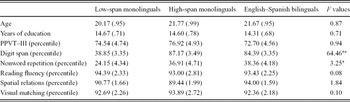
Eighteen bilingual speakers of English and Spanish (10 males) and 36 monolingual speakers of English participated in Experiment 2 (14 males). None of these participants participated in Experiment 1. As in Experiment 1, monolingual speakers were divided into two groups according to the median-split procedure based on their performance on the digit-span task. High-span monolinguals (n = 18, 7 males) were comparable to bilinguals with regard to digit-span performance, and both groups outperformed low-span monolinguals (n = 18, 7 males) on the digit-span task (see Table 2). The ranges of performance for the digit span were as follows: 50–95 for the bilinguals, 63–95 for the high-span monolinguals, and 2–50 for the low-span monolinguals. Therefore, as in Experiment 1, the bilingual group included participants with lower levels of digit-span performance than those that characterized the high-span monolingual group.
Experiment 2: Monolingual and bilingual participant characteristics (Means and SE values).

Note: F values are based on Univariate Analyses of Variance with group (bilingual, high-span monolingual, and low-span monolingual) as the between-subjects independent variable. Significance at p < .05 level is marked by an asterisk (*) next to the F value, while significance at p < .01 level is marked by two asterisks (**) next to the F value. Significant differences in all comparisons reflect the difference between bilinguals and high-span monolinguals on the one hand, and low-span monolinguals on the other hand.
Based on self-reports collected using the LEAP-Q (Marian et al., Reference Marian, Blumenfeld and Kaushanskaya2007), bilingual participants were all native speakers of English who acquired Spanish on average at 8.00 years of age (SD = 1.34). At the time of the study, bilinguals reported their proficiency in Spanish (on the scale from 0 = no knowledge to 10 = perfect knowledge) to be on average: 5.24 (SD = .62) for speaking, 6.14 (SD = .54) for understanding, and 6.21 (SD = .71) for reading. They were on average exposed to their L2 Spanish 5.71% of time on the daily basis (SD = 1.15).
Materials
The phonologically-familiar eight-sound inventory used in Experiment 1 was modified to include non-English phonemes for Experiment 2. Vowels /i/ and /u/ were replaced with non-English vowels /ɨ/ and /y/ and consonants /t/ and /g/ were replaced with non-English consonants /ʈ/ and /χ/). We replaced only half of the sounds with non-English phonemes because piloting of a completely unfamiliar phonological inventory yielded floor learning effects. The 48 novel words in Experiment 2 were therefore identical to the novel words in Experiment 1, with the exception that the novel words in Experiment 2 contained phonemes that do not exist in English (see Appendix). Crucially, these phonemes also do not exist in Spanish, therefore ensuring that bilingual participants would not be advantaged over the monolingual speakers with regard to their experience with these particular sounds. The same male native speaker of English who recorded phonologically-familiar stimuli in Experiment 1 also recorded phonologically-unfamiliar stimuli after extensive training on their pronunciation. Our prior work with these stimuli (Kaushanskaya & Marian, Reference Kaushanskaya and Marian2008, Reference Kaushanskaya and Marian2009a, Reference Kaushanskaya and Marianb) indicated that monolingual speakers of English find these words more difficult to pronounce than phonologically-familiar novel words. Further, extensive piloting of these stimuli revealed that when asked to rate the stimuli on the Likert scale representing the degree to which these novel words resembled English words, English–Spanish bilinguals similar to the population targeted in the present study rated these stimuli similarly to monolingual speakers of English, and lower than the phonologically-familiar novel words in Experiment 1 (Kaushanskaya & Marian, Reference Kaushanskaya and Marian2009b).
Procedure and analyses
The vocabulary learning and testing procedure used in Experiment 1 was also used in Experiment 2. Recall and recognition data were each analyzed using a 3 × 2 ANOVA with group (bilingual, high-span monolingual, and low-span monolingual) as a between-subjects independent variable and session (immediate vs. delayed) as the within-subjects independent variable. Univariate Analyses of Variance with group as the independent between-subjects variable (adjusted for multiple comparisons using the Bonferroni adjustment method) were conducted to examine differences for each of the performance measures across the three groups.
Results and discussion
Demographic comparisons
Demographic information and standardized testing data for the three groups of participants in Experiment 2 are presented in Table 2. The three groups of participants differed on nonword repetition performance, with the high-span monolinguals and the bilinguals outperforming the low-span monolinguals. The three groups did not differ in age, years of education, performance on the English receptive vocabulary measure (PPVT–III), or the measure of English reading fluency (Reading Fluency sub-test of the Woodcock–Johnson Tests of Achievement III, henceforth WJ–III). The three groups also did not differ in their performance on the Spatial Relations and the Visual Matching sub-tests of the WJ–III.
Recall analyses
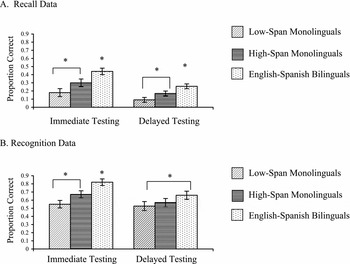
A 3 × 2 mixed ANOVA with group (bilingual, high STM monolingual, and low STM monolingual) and session (immediate vs. delayed) yielded a main effect of testing session, F(1, 51) = 49.97, p < .001, η2p = .81, a main effect of group, F(2, 51) = 10.35, p < .01, η2p = .38, and a non-significant trend towards an interaction between the two factors, F(2, 51) = 2.70, p = .08, η2p = .14. Participants recalled more novel words at immediate (M = 0.32, SE = .03) than at delayed testing (M = 0.17, SE = .02). For immediate recall, the univariate ANOVA with group as the independent variable revealed an overall effect of group, F(2, 51) = 8.11, p < .001, η2p = .31, with the bilinguals (M = 0.44, SE = .04) outperforming both the high-span monolinguals (M = 0.30, SE = .05), p < .05, and the low-span monolinguals (M = 0.18, SE = .05), p < .05. The difference between the high-span monolinguals and the low-span monolinguals was also statistically significant, p < .05. A similar pattern was observed for delayed recall, where the ANOVA with group as the independent variable yielded an overall effect of group, F(2, 51) = 7.49, p < .01, η2p = .31. The bilinguals (M = 0.26, SE = .03) outperformed both the high-span monolinguals (M = 0.17, SE = .04), p < .01, and the low-span monolinguals (M = 0.09, SE = .03), p < .01, and the high-span monolinguals outperformed the low-span monolinguals, p < .05. The recall data are shown in Figure 2, Panel A.
Experiment 2 recall (Panel A) and recognition (Panel B) data. Bilinguals outperformed both high-span and low-span monolinguals on immediate recall measures and the immediate recognition measure (as indicated by the asterisk above the bilingual bar). At delayed recognition testing, bilinguals outperformed low-span monolinguals, but not high-span monolinguals, as indicated by the comparison-specific bracket. Moreover, high-span monolinguals outperformed low-span monolinguals on both recall measures and the immediate recognition measure, as indicated by the comparison-specific bracket.

Recognition analyses
The recognition data revealed a very similar pattern of results. A 3 × 2 mixed ANOVA with group (bilingual, high-span monolingual, and low-span monolingual) and session (immediate vs. delayed) yielded a main effect of testing session, F(1, 51) = 32.38, p < .001, η2p = .49, a main effect of group F(2, 51) = 5.54, p < .01, η2p = .25, and a significant interaction between session and group, F(2, 51) = 5.61, p < .01, η2p = .25. Participants recognized more novel words at immediate (M = 0.69, SE = .03) than at delayed testing (M = 0.59, SE = .02). Follow-up Univariate Analyses of Variance revealed that for immediate recognition performance, an overall effect of group was significant (F(2, 51) = 9.95, p < .0001, η2p = .35, with bilinguals (M = 0.82, SE = .04) outperforming both the high-span monolinguals (M = 0.67, SE = .04), p < .05, and the low-span monolinguals (M = 0.55, SE = .05), p < .01, and the high-span monolinguals outperforming the low-span monolinguals, p < .05. For delayed recognition performance, the ANOVA with group as the independent variable did not yield an overall effect of group, F(2, 51) = 1.90, p = .17, and follow-up comparisons showed that the bilinguals (M = 0.66, SE = .04) outperformed only the low-span monolinguals (M = 0.53, SE = .05), p < .01, but did not differ from the high-span monolinguals (M = 0.57, SE = .05), p = .55. Moreover, the high-span and the low-span monolinguals did not differ from each other, p = .23. The recognition data are shown in Figure 2, Panel B.
Together, the findings for Experiment 2 reveal a similar picture to those for Experiment 1 with regard to the bilingual advantage effects for novel word learning. The bilingual participants outperformed the low-span monolingual participants, replicating the Papagno & Vallar (1995) data. Crucially, in the present study, the bilingual participants also outperformed the high-span monolingual participants on three out of four retention measures despite the fact that the two groups were precisely matched on the phonological memory span. The only measure on which the two groups did not differ significantly was the recognition measure administered at delayed testing – a finding that can be accounted for by the relative ease of the task (recognition vs. recall) and its timing relative to learning (delayed vs. immediate testing). The vast majority of research on how manipulations at encoding affect retention suggests that with time, the impact of encoding differences on retention diminishes (e.g., Kaushanskaya & Yoo, Reference Kaushanskaya and Yoo2011; McDaniel, Pressley & Dunay, Reference McDaniel, Pressley and Dunay1987). Since bilingual–monolingual differences were robust for both recognition and recall at immediate testing, and for recall at delayed testing, we feel confident in concluding that learning of phonologically-unfamiliar novel words was in fact facilitated by bilingualism in this experiment.
While the differences between the high-span and the low-span monolinguals were not significant in Experiment 1, they were significant in Experiment 2 (with the exception of the delayed recognition measure). This finding supports our interpretation of the Experiment 1 data: Since knowledge of native-language phonological patterns plays a more limited role in supporting the acquisition of phonologically-unfamiliar novel words, the learning process in Experiment 2 was likely largely reliant on the phonological memory capacity. It is therefore logical that participants with higher phonological memory capacity outperformed participants with low phonological memory capacity on the word-learning task in Experiment 2. However, it appears that bilingualism compounds the high phonological memory advantages when it comes to word learning.
General discussion
Previous work has consistently yielded bilingual advantage effects on word-learning tasks, with experienced learners (variously defined) outperforming inexperienced learners on paired-associates learning tasks (e.g., Kaushanskaya & Marian, Reference Kaushanskaya and Marian2009a, Reference Kaushanskaya and Marianb; Papagno & Vallar, Reference Papagno and Vallar1995; Van Hell & Candia Mahn, 1997). The question asked in the present study was whether the bilingual advantage effects on word-learning tasks can be localized to the phonological memory system. We approached this question in two ways: First, we examined learning of phonologically-familiar novel words (Experiment 1) and learning of phonologically-unfamiliar novel words (Experiment 2). Since phonological memory capacity is more predictive of learning when the information is phonologically unfamiliar, if the bilingual advantages on the word-learning tasks are tied to the phonological memory capacity, there should be more robust differences between bilingual and monolingual learning when the novel words are phonologically unfamiliar (Experiment 2) than when the novel words are phonologically familiar (Experiment 1). Second, we contrasted word learning in bilinguals to word learning in monolinguals who were matched to bilinguals in their performance on the phonological memory measures. If increased phonological memory capacity is the underlying mechanism of bilinguals’ word-learning advantages, then matching bilinguals and monolinguals on phonological memory performance should eliminate word-learning differences between the two groups. Our findings largely challenge both of these conjectures.
In considering the findings of Experiment 1 together with findings of Experiment 2, it is apparent that the bilingual advantage effects were robust both for the phonologically-familiar novel words and for the phonologically-unfamiliar novel words. The findings of the bilingual advantage on a word-learning task where novel words were phonologically familiar appear to conflict with the findings of Papagno and Vallar (Reference Papagno and Vallar1995), who showed that bilinguals and monolinguals performed similarly on the paired-associates learning task when the stimuli were two native-language words paired together. There are three possible explanations for the apparent discrepancy between our findings here and those of Papagno and Vallar (Reference Papagno and Vallar1995). First, unlike in the Papagno and Vallar (Reference Papagno and Vallar1995) study, where participants had to learn eight pairs of words, in the current study, participants had to learn 48 pairs of words. With the increased difficulty of the task, the ceiling effects that may have characterized the data in the Papagno and Vallar (Reference Papagno and Vallar1995) study were eliminated, thus allowing the bilingual learning advantages to emerge. Second, unlike in the Papagno and Vallar (Reference Papagno and Vallar1995) study, where participants learned pairs of native-language words, in the present study, participants learned novel words that were paired with native-language words. Thus, the phonologically-familiar stimuli in the present study were familiar to the participants only in terms of sub-lexical phonology, while in the Papagno and Vallar (Reference Papagno and Vallar1995) study, the phonologically-familiar stimuli were familiar to the participants in terms of lexical and sub-lexical phonology as well as in terms of semantics. It is possible that semantic familiarity, rather than phonological familiarity, mitigated the bilingual advantage effects in the Papagno and Vallar (Reference Papagno and Vallar1995) study. Future work, where the paired-associates learning task would involve pairs of native-language words, but where the number of pairs to be learned is increased to make the task more demanding, is necessary for this supposition to be tested. Third, it is possible that our manipulation of phonological familiarity was not successful in creating a sharp divide between phonologically-familiar and phonologically-unfamiliar novel words.
Although the present study was not designed to assess the susceptibility of participants to phonological familiarity effects, it was interesting to observe that the mean levels of performance in Experiment 1 and Experiment 2 were in fact quite similar across groups. To confirm this observation, cross-experimental comparisons were performed that contrasted participants’ performance on retention measures in Experiment 1 vs. Experiment 2. For bilinguals, there were no statistically significant differences between Experiment 1 and Experiment 2 retention measures, with p values ranging from .31 (for delayed recall measure) to .79 (for immediate recognition measure). Similarly, for high-span monolinguals, there were no significant differences between Experiment 1 and Experiment 2 retention measures (with p values ranging from .56 to .90). For low-span monolinguals, there was a trend for more accurate retention of novel words in Experiment 1 than in Experiment 2, especially for the immediate recall measure (t(35) = 1.33, p = .12) and the immediate recognition measure (t(35) = 1.09, p = .25).
It is difficult to interpret these comparisons due to the between-subjects manipulation of phonological familiarity (i.e., different groups of participants participated in the two experiments). When we compared the three groups of participants across the two experiments on demographic variables and on language and cognitive measures, we observed largely comparable results. Specifically, high-span monolinguals and bilinguals who participated in Experiment 1 did not differ from high-span monolinguals and bilinguals who participated in Experiment 2 in any of the demographic or language and cognitive performance measures. Moreover, the two groups of bilinguals reported similar amounts of L2 exposure and levels of L2 proficiency. The low-span monolinguals in Experiment 1 were also quite comparable to low-span monolinguals in Experiment 2 on all demographic and language and cognitive measures, with the exception of the digit-span task. Specifically, there was a tendency for Experiment 1 low-span monolinguals to outperform Experiment 2 low-span monolinguals on the digit-span measure (p = .08). When word-learning performance was compared across Experiments 1 and 2 for the low-span monolinguals with the digit-span scores co-varied out, the differences between phonologically-familiar and phonologically-unfamiliar novel words became significant for the immediate recall and recognition measures.
Why did we observe relatively weak effects of phonological familiarity, and then only in the low-span monolingual participants? It may be that variables we have not accounted for, but that applied differently to participants in the two experiments, acted to obscure the phonological familiarity effects in the current study. It is also possible that participants with large phonological memory capacity (bilinguals and high-span monolinguals in the present study) show reduced phonological familiarity effects due to the high efficiency with which novel information is encoded in phonological memory (independent of its familiarity). Finally, it is likely that our retention measure (which indexed the retention of novel words indirectly, through their English translations) reduced the phonological familiarity effects in the data.
The decision to test the retention of novel words via their English translations was made for methodological rather than conceptual reasons. That is, in previous studies of bilingual effects on word learning, both directions of testing yielded bilingual advantage effects. For example, Papagno and Vallar (Reference Papagno and Vallar1995) cued participants to retrieve the nonwords in response to the native-language words, and obtained superior learning in polyglots. On the other hand, Van Hell and Candia Manh (1997) cued participants with novel words, and asked them to produce the native-language translations, and also obtained superior learning in experienced learners. In the present study, the difficulty of the learning task (likely driven by the large number of items participants were directed to learn) made it impossible to obtain analyzable production data for the novel words. This was true for both experiments. That is, despite the easier nature of Experiment 1, piloting revealed floor effects in both experiments when production of novel words was tested directly, especially during delayed testing. Further consideration was given to the fact that articulation of novel words would be significantly more difficult in Experiment 2 than in Experiment 1, while retrieval of English words at testing would serve to equalize articulation demands across the two experiments. However, the decision to test retrieval of English translations resulted in the paradigm that may have diminished the differences between phonologically-familiar and phonologically-unfamiliar novel words. It is quite probable that the effects of phonological familiarity would have been significantly stronger had we tested the retrieval of the wordforms directly. It is also possible that the effects of bilingualism would interact with phonological familiarity during novel word learning differently for paradigms that assess retention of phonological wordforms rather than of native-language translations. Therefore, given the design of the present study, the findings can only be interpreted to suggest that bilingualism facilitates the learning of both phonologically-familiar and phonologically-unfamiliar novel words when retention is tested via the native-language translations. Further, the effects of bilingualism on word learning, as measured here, appear to be independent of the facilitation effects associated with bilingualism for phonological memory skills.
Effects of bilingualism on phonological memory
The findings of the present study indicate that bilingualism may facilitate phonological memory skills. When monolingual participants’ data were collapsed across the high-span and the low-span sub-groups, the average performance of the monolingual group was significantly below that of the bilingual group on the digit-span task in both experiments, and on the nonword repetition task in Experiment 1 (and it trended in the same direction in Experiment 2). In addition, the very fact that we could not recruit a sufficient number of low-span bilingual participants to be able to divide bilinguals into high-span and low-span sub-groups based on phonological memory performance indicates that bilinguals may have higher phonological memory capacity than monolinguals in the population. This finding is in line with the Papagno and Vallar (Reference Papagno and Vallar1995) data, where polyglots outperformed non-polyglots on both the digit-span and the nonword repetition tasks. However, it is important to note that there is in fact very little previous work on the effects of bilingualism on the phonological memory system itself, and the data that do exist are far from conclusive.
Studies of simultaneous interpreters converge in demonstrating enhanced phonological working memory skills (e.g., Chicotta & Underwood, Reference Chicotta and Underwood1998; Christoffels, de Groot & Kroll, Reference Christoffels, de Groot and Kroll2006; Padilla, Bajo & Macizo, Reference Padilla, Bajo and Macizo2005); however, these studies cannot speak unequivocally to the effects of bilingualism on phonological memory because simultaneous interpreters may enter the profession precisely because they possess superior phonological memory. Evidence for higher phonological memory skills in non-interpreter bilinguals does exist, although it is scattered. Moreover, the evidence is not at all consistent, with regard to the tasks used to index phonological memory and with regard to the findings. For instance, while Papagno and Vallar (Reference Papagno and Vallar1995) did find that their experienced learners outperformed inexperienced learners on the phonological memory tasks, in our prior work, we tested groups of bilingual and monolingual participants who performed similarly on phonological memory tasks (e.g., Kaushanskaya & Marian, Reference Kaushanskaya and Marian2009a). Further, Fernandes, Craik, Bialystok and Kreuger (Reference Fernandes, Craik, Bialystok and Kreuger2007) found that bilingualism did not influence the digit-span performance; moreover, they demonstrated decreased word-recall performance in bilinguals compared to monolinguals. In contrast, Kroll et al. (Reference Kroll, Michael, Tokowicz and Dufour2002) found that bilinguals outperformed monolinguals on a reading-span task – a verbal working memory measure.
Therefore, the effects of bilingualism on phonological memory are not clear-cut, and the roots of the bilingual advantage effects on the phonological memory tasks (when obtained) are not obvious. Moreover, to date there has not yet been a study that would examine the effects of bilingualism on phonological memory within the theoretical frameworks that separate the memory for serial order from the memory for items (e.g., Burgess & Hitch, Reference Burgess and Hitch1999; Gupta, Reference Gupta2003; Page & Norris, Reference Page and Norris1998). Recent investigations of lexical learning and its relationship to phonological memory have shown that memory for sequential order (but not necessarily memory for items) is predictive of word-learning performance (Gupta, Reference Gupta2003; Majerus, Poncelat, Elsen & Van der Linden, Reference Majerus, Poncelet, Elsen and Van der Linden2006; Majerus, Poncelat, Greffe & Van der Linden, Reference Majerus, Poncelet, Greffe and Van der Linden2006). Given the conceptualization of the working memory system as involving both memory for serial order and memory for item information, the findings of the current study may be interpreted to suggest that bilingualism facilitates memory for serial order. The digit-span task used in the present study clearly indexes memory for sequences rather than items, since the digits are known in advance, and come from a limited pool of items (numbers 1–9). The nonword repetition task in the present study also appears to index memory for sequences, although it is likely that item memory contributed to participants’ performance, especially for the shorter items (e.g., Majerus et al., Reference Majerus, Poncelet, Van der Linden and Weekes2008). However, since the nonwords on the CTOPP Nonword Repetition sub-test increase in length, beginning with a one-syllable CVC nonword (e.g., jup) and ending with a multisyllabic nonword (e.g., shaburiehuvoimush), it is probable that memory for sequential order played a central role in participants’ nonword repetition performance (e.g., Gupta, Reference Gupta2003).
Therefore, if one construes the digit-span and the nonword repetition tasks used in the present study as indexing serial-order memory, the finding that bilinguals outperformed monolinguals on the two tasks may be interpreted to suggest that bilingualism is especially facilitative to serial recall. However, this conclusion must be very tentative, since the current study was not in fact designed to examine the effects of bilingualism on serial vs. item memory. Future work, where such a distinction between memory systems is made a priori, and where the selected tasks index predominantly one or the other memory system, is necessary before any firm hypotheses can be entertained with regard to bilingual effects on phonological memory. Moreover, in future studies, an effort must be made to compare simultaneous bilinguals (who were exposed to both languages at birth in a family setting, and thus could not possibly have elected to become bilingual) to monolinguals in order to examine whether it is bilingual experience per se that facilitates phonological memory function. It is feasible to hypothesize that early exposure to two distinct phonological system as a result of simultaneous bilingualism may place high demands on the phonological memory (especially the memory for sequential order), thus increasing its efficiency and expanding its capacity for subsequent learning. For now, all that can be said is that in the current study, bilingual participants tended to outperform monolingual participants on two particular phonological memory tasks – digit-span and nonword repetition. Further, bilinguals outperformed monolinguals on the word-learning task across the two experiments.
Effects of bilingualism on word learning
Papagno and Vallar (Reference Papagno and Vallar1995) attributed the differences they observed between the polyglots’ and the non-polyglots’ phonological memory and word-learning performance in their study to self-selection bias. That is, they suggested that individuals with high phonological memory capacity are more likely to become polyglots. While this is certainly a reasonable hypothesis, it seems less likely to explain the findings in the present study, where the bilingual participants spoke only two languages, and acquired their second language fairly early in life, thus minimizing the possibility that they sought out the experiences that would enable them to learn Spanish. Of course, this does not eliminate the possibility that a priori differences exist between individuals who become bilingual and those who do not. What is important for interpreting the patterns of data in the current study is that when the bilinguals were compared to the monolinguals who were matched to them in terms of phonological memory performance, word-learning differences between the bilinguals and the monolinguals persisted. This was true for both Experiment 1 (where participants learned phonologically-familiar novel words) and Experiment 2 (where participants learned phonologically-unfamiliar novel words). Together, the findings of Experiment 1 and 2 point to an interesting dissociation between monolingual and bilingual word learning. In monolinguals, the link between phonological memory capacity and word learning is stronger for phonologically-unfamiliar than for phonologically-familiar novel words. In bilinguals, however, the phonological familiarity of the novel word does not appear to matter, with bilingual advantages (as compared to high-span monolinguals) persisting for both phonologically-familiar and phonologically-unfamiliar novel words.
Division of monolinguals into high-span and low-span sub-groups served two purposes. First, it enabled us to compare high-span and low-span monolinguals to each other in the two experiments, thus allowing us to test the relationship between phonological memory skills on the one hand, and acquisition of phonologically-familiar vs. phonologically-unfamiliar novel words on the other hand. Second, it enabled us to precisely match monolinguals and bilinguals on phonological memory performance through focusing on the high-span monolingual sub-group. With regard to high-span vs. low-span monolinguals’ word-learning performance, differences across the two experiments emerged. In Experiment 1, high-span and low-span monolinguals did not differ in their word-learning performance. Conversely, in Experiment 2, high-span monolinguals outperformed low-span monolinguals on the word-learning task. These contrasting patterns are in fact in line with previous work demonstrating that phonological memory capacity is more predictive of word learning when the novel words are less familiar (Experiment 2) than when the novel words are more familiar (Experiment 1). Since acquisition of phonologically-familiar novel words can be scaffolded by native-language phonological knowledge (e.g., Ellis & Beaton, Reference Ellis and Beaton1993), the discrepancies in phonological memory capacity between high-span and low-span monolinguals in Experiment 1 were not sufficient to yield lower word-learning performance in the low-span monolinguals (presumably because reliance on long-term phonological knowledge mitigated the low phonological memory capacity in the low-span group). Conversely, since acquisition of phonologically-unfamiliar novel words is less likely to recruit native-language phonological knowledge, the ability to rely on the phonological memory capacity during learning of phonologically-unfamiliar novel words is imperative. Thus, in Experiment 2, high-span monolinguals outperformed low-span monolinguals on the word-learning task.
With regard to contrasting bilingual word-learning performance and high-span monolingual word-learning performance, bilingual advantages across the two experiments maintained despite the fact that the two groups were matched on phonological memory measures. These findings indicate that bilingualism overrides phonological memory span in facilitating word learning (at least as phonological memory and word learning are measured here), and suggest that superior word-learning abilities observed for bilinguals in the present study are likely a result of mechanisms other than (or additional to) phonological short-term memory. That is, were the bilingual advantages on the word-learning task an outcome of bilinguals’ increased short-term memory capacity, bilinguals should not have outperformed monolinguals who were matched to them on their short-term memory performance. The finding that the bilingual advantage maintained when bilinguals were compared to high-span monolinguals can be explained in at least two ways: It is possible that the specific relationships between phonological short-term memory and word learning are instantiated differently for bilinguals and monolinguals (for analyses that pertain to this hypothesis, see Supplementary Materials accompanying the online version of the present paper at http://journals.cambridge.org/bil). Conversely, it is possible that differences between bilinguals and monolinguals (other than and/or additional to those in phonological short-term memory capacity) are at the root of the bilingual advantages on word-learning tasks.
This second possibility is especially interesting given that a number of mechanisms other than phonological memory enhancements could feasibly explain the bilingual advantages for novel word learning. Word learning is a complex process, and even a relatively simple paired-associates learning task used in the present study involves multiple sub-components, including acquisition of novel wordforms, referents, and the mappings between them. For example, one reasonable hypothesis would be that bilingualism facilitates word learning not through an effect on the phonological memory system, but through an effect on long-term phonological representations associated with L1 and L2 lexical-phonological knowledge. Within Baddeley's (1986) working memory model, the phonological memory capacity (indexed by both the digit-span and the nonword repetition tasks) is causally linked to novel word learning because it constrains the strength with which a memory trace associated with the novel word can be encoded (e.g., Atkins & Baddeley, Reference Atkins and Baddeley1998; Baddeley et al., Reference Baddeley, Papagno and Vallar1988; Cheung, Reference Cheung1996; Dufva & Voeten, Reference Dufva and Voeten1999; Ellis & Beaton, Reference Ellis and Beaton1993; Service, Maury & Luotoniemi, Reference Service, Maury and Luotoniemi2007; Speciale et al., Reference Speciale, Ellis and Bywater2004). However, an alternative interpretation of the relationship between word-learning and phonological memory measures is that performance on both tasks relies on phonological long-term knowledge (e.g., Gathercole, Frankish, Pickering & Peaker, Reference Gathercole, Frankish, Pickering and Peaker1999). Therefore, it is possible that bilingualism facilitated both word-learning and phonological memory performance because of its effects on phonological long-term knowledge. An inclusion of a phonological knowledge measure in the future studies would be helpful in explicitly testing the role of phonological knowledge in word-learning performance by bilinguals and monolinguals who share a native language.
An alternative hypothesis of how bilingualism may affect word-learning performance would focus on the impact of bilingualism on one's ability to form a link between a novel word and a known word in one's native language. Specifically, it is possible that the bilingual advantages observed in this study are rooted, at least in part, in bilinguals’ practice with learning scenarios where novel words are paired to their native-language translations. This is precisely the kind of experience that acquisition of a second language often requires. Thus, it is possible that the bilingual advantages on paired-associates learning tasks are an outcome of practicing just such a task when acquiring a second language. In the same vein, it is possible that the bilingual advantage for word learning observed here is an outcome of bilinguals’ better ability to encode multiple labels for the same concept. In acquiring the correspondences between labels and concepts, children are biased towards some mappings as opposed to others (e.g., Landau, Smith & Jones, Reference Landau, Smith and Jones1988). One of these biases is known as the mutual-exclusivity (or disambiguation) principle: Children (and adults) are more likely to map a new word to an object for which they do not yet have a name (e.g., Au & Glusman, Reference Au and Glusman1990; Markman & Wachtel, Reference Markman and Wachtel1988). Through exposure to two labels for a single object, bilingual children may relinquish the reliance on the mutual-exclusivity principle earlier than monolingual children (e.g., Davidson, Jergovic, Imami & Theodos, Reference Davidson, Jergovic, Imami and Theodos1997). In fact, recent work suggests that the mutual-exclusivity bias is significantly reduced in bilingual compared to monolingual infants, and is non-existent in trilingual infants (e.g., Byers-Heinlein & Werker, Reference Byers-Heinlein and Werker2009). Therefore, in the present study, bilingualism may have enhanced word learning through bilinguals’ more extensive experience with mapping novel labels to known concepts.
Lastly, localizing the word-learning work within the theoretical framework of Baddeley's working memory model, as proposed by Papagno and Vallar (Reference Papagno and Vallar1995), offers yet another locus of the bilingual effects on word learning – the central executive of the working memory. In Baddeley's model of the working memory system, encoding of new verbal information depends on the capacity of the phonological memory system (i.e., the functionality of the phonological loop). However, the working memory model also explicitly posits the existence of the central executive – a domain-general, attention-control system which allocates “resources” to the phonological loop when the task at hand exceeds the latent phonological memory capacity (e.g., Baddeley, Reference Baddeley1996; Engle, Tuholski, Laughlin & Conway, Reference Engle, Tuholski, Laughlin and Conway1999; Janahshahi, Saleem, Ho, Dirnberger & Fuller, Reference Jahanshahi, Saleem, Ho, Dirnberger and Fuller2006; Miyake, Emerson & Friedman, Reference Miyake, Emerson and Friedman2000; Miyake, Friedman, Rettinger, Shah & Hegarty, Reference Miyake, Friedman, Rettinger, Shah and Hegarty2001; Shah & Miyake, Reference Shah and Miyake1996). The central executive performs a number of functions, including setting the action schema for an impending task (e.g., Baddeley, Reference Baddeley1986), inhibiting irrelevant responses and strategies (e.g., Baddeley, Chincotta & Adlam, 2001; Busch, Booth, McBride, Vanderploeg, Curtiss & Duchnick, Reference Busch, Booth, McBride, Vanderploeg, Curtiss and Duchnick2005; Conway & Engle, Reference Conway and Engle1994; Hester & Garavan, Reference Hester and Garavan2005; Oberauer, Lange & Engle, Reference Oberauer, Lange and Engle2004; Rosen & Engle, Reference Rosen and Engle1998), switching retrieval strategies when necessary (e.g., Baddeley et al., Reference Baddeley, Chincotta and Adlam2001), and coordinating different tasks (e.g., Baddeley, Reference Baddeley1996). Given this conceptualization of the central executive, the construct appears to be highly similar to notions of “cognitive control” that have received so much attention in the recent bilingualism literature (e.g., Bialystok, Craik & Ryan, Reference Bialystok, Craik and Ryan2006; Colzato et al., Reference Colzato, Bajo, van den Wildenberg, Paolieri, Nieuwenhuis, La Heij and Hommel2008; Costa et al., Reference Costa, Hernández, Costa-Faidella and Sebastián-Gallés2008).
Bilingualism can facilitate various aspects of cognitive function, with most-frequently and reliably documented bilingual advantages appearing for tasks that involve the need to resolve competition in the input (e.g., Bialystok, Reference Bialystok2010; Bialystok & Viswanathan, Reference Bialystok and Viswanathan2009; Carlson & Meltzoff, Reference Carlson and Meltzoff2008; Costa et al., Reference Costa, Hernández, Costa-Faidella and Sebastián-Gallés2008). Thus, bilinguals outperform monolinguals on tasks that require inhibitory control and selective attention to the environmental stimulus (e.g., Bialystok, Reference Bialystok1999; Bialystok et al., Reference Bialystok, Craik, Klein and Viswanathan2004; Bialystok & Feng, Reference Bialystok and Feng2009). If we hypothesize that the central executive component of the working memory system is functionally comparable to the cognitive control mechanisms known to be facilitated by bilingualism, then it seems logical to also hypothesize that bilingual advantages on word-learning tasks may be rooted in bilinguals’ enhanced central executive function. A test of this hypothesis would require administration of both short-term and working memory measures to the same group of bilingual participants. Working memory tasks like the backward digit-span task and the reading/listening span tasks require both the storage of verbal information and its manipulation (e.g., Daneman & Carpenter, Reference Daneman and Carpenter1980). Unlike short-term memory tasks, that generally measure the storage capacity of the phonological memory system, working memory tasks also rely on the central executive (Conway & Engle, Reference Conway and Engle1994; Cowan & Morie, Reference Cowan and Morie2007; Postle, D'Esposito & Corkin, Reference Postle, D'Esposito and Corkin2005). If bilingualism facilitates word learning through improved central executive, then bilinguals should outperform monolinguals on the working memory tasks, and there should be a more robust relationship between working memory and word-learning performance than between short-term memory measures and word-learning performance in bilinguals.
In conclusion, the present study has documented bilingual advantages for word learning that are not constrained by the phonological familiarity of the novel words. Bilingual adults appear to outperform monolingual adults on novel word learning tasks independent of whether the phonological structure of the novel words corresponds to that of the learners’ native language (Experiment 1) or of whether the novel words incorporate phonology that does not exist in the learners’ native or second language (Experiment 2). Further, the current work suggests general bilingual advantages for phonological memory, with bilinguals outperforming monolinguals on both the digit-span task and the nonword repetition task. At the same time, the bilingual advantages for novel word learning do not appear to be tied to bilinguals’ increased phonological memory capacity, since matching bilinguals and monolinguals on phonological memory performance did not eliminate the bilingual advantages for novel word learning. In a sense, these findings yield more questions than they answer, with the most important question being whether the mechanisms that underlie the bilingual advantages on the phonological memory tasks and the word-learning tasks are in fact different mechanisms. However, this work also offers a feasible theoretical bridge between studies examining the effects of bilingualism on non-linguistic cognition and those examining the language function in bilinguals, in that it suggests a possibility that the same mechanisms that underlie the bilingual advantages on non-linguistic cognitive control tasks may also contribute to the bilingual advantages observed on linguistic learning tasks.
Appendix. Nonword and English word pairings in Experiment 1 and Experiment 2