1. Introduction
Fluent reading involves the constant activation and selection of lexical candidates, while other words are maintained in memory and integrated into the syntactic and semantic structure of the sentence. For a bilingual, this can be especially demanding as candidates from not one but two languages compete for recognition. While there is ample evidence of competition mechanisms at work in isolated word recognition, research on normal sentence reading is scarce, especially for bilinguals reading in their second language (L2). In this paper, we report the results of an eye-tracking experiment conducted with proficient Norwegian–English bilinguals, investigating the effect of different components of language proficiency on competition between orthographic neighbours in the reading of L2 English sentences.
1.1 Background Literature
Effect of form-related priming on monolingual word recognition
There is ample evidence that the availability of form-related neighbours influences the recognition of written words. Word neighbours are most commonly defined as words differing from a target word in only one letter, while letter position and length are preserved (Coltheart, Davelaar, Jonasson & Besner, Reference Coltheart, Davelaar, Jonasson, Besner and Dornick1977), although it has been argued that neighbours obtained from other configurations, such as letter transpositions (as in calm and clam) or letter deletion (last and blast), should also be included in a word's neighbourhood (Davis & Taft, Reference Davis and Taft2005). Orthographic neighbours have been found to directly influence the subsequent recognition of target words. Much of this evidence comes from studies on single-word reading using masked priming paradigms. In those studies, participants have to make a lexical decision on a target word (or nonword) that was preceded by a forward mask and a brief (form-related or not) prime. These experiments have found that readers are slower to recognize words that are primed by an orthographic neighbour (such as bark priming barn) (e.g., Coltheart et al., Reference Coltheart, Davelaar, Jonasson, Besner and Dornick1977; Davis & Lupker, Reference Davis and Lupker2006; Segui & Grainger, Reference Segui and Grainger1990), but faster to read words primed by a nonword which is also an orthographic neighbour (e.g., barl). Other types of orthographic neighbours, such as highly frequent embedded words (car – scar), have also been found to slow down target word recognition (Bowers, Davis & Hanley, Reference Bowers, Davis and Hanley2005). In these experiments, the inhibitory effect of the prime is larger if that prime is more frequent than the target (Davis & Lupker, Reference Davis and Lupker2006; Grainger, Reference Grainger1990; Segui & Grainger, Reference Segui and Grainger1990), while only less frequent primes slow down target recognition when there is no mask (Segui & Grainger, Reference Segui and Grainger1990).
These priming effects have been interpreted as reflecting competition between lexical candidates and facilitation from sublexical overlap (Davis & Lupker, Reference Davis and Lupker2006; Perry, Lupker & Davis, Reference Perry, Lupker and Davis2008). Competitive network models such as the Dual Route Cascaded Model (Coltheart, Rastle, Perry, Langdon & Ziegler, Reference Coltheart, Rastle, Perry, Langdon and Ziegler2001), the Spatial Coding Model (Davis, Reference Davis2010), or the Interactive Activation model (IAM) (McClelland & Rumelhart, Reference McClelland and Rumelhart1981), agree that lexical retrieval is based on form-based lexical competition. The IAM postulates that each letter string activates orthographically or phonologically similar words in the mental lexicon until recognition is achieved, with facilitatory links between the letter and word levels, and inhibitory links at the word level reflecting competition between candidates.
While there is thus clear evidence that the recognition of isolated words is affected by the existence of, or the recent encounter of, form-related neighbours, only a few studies have looked at the natural continuation of this work, i.e., what happens during normal sentence reading. Paterson, Liversedge and Davis (Reference Paterson, Liversedge and Davis2009) conducted an eye-tracking study where participants read sentences such as There was a blur as the blue lights of the police car whizzed down the street, where blur primes the target-word blue. Gaze durations on blue were longer when blue was preceded by an orthographic neighbour (blur) compared to preceded by a non-related control prime (gasp) – thus replicating the inhibitory neighbour effect found with isolated words. However, and unlike what was found with isolated words (e.g., Segui & Grainger, Reference Segui and Grainger1990), the inhibitory priming was unaffected by the relative frequency of the prime and target. Frisson, Koole, Hughes, Olson and Wheeldon (Reference Frisson, Koole, Hughes, Olson and Wheeldon2014b) showed that this inhibitory priming effect is strongest when the neighbour prime and the target word overlap both orthographically and phonologically (wings – kings as opposed to bear – gear or smile – aisle). Pagán, Paterson, Blythe and Liversedge (Reference Pagán, Paterson, Blythe and Liversedge2016) found that transposed-letter neighbour primes (such as scared for sacred) also led to increased reading times of the target word, compared to a control word. Wang, Tian, Han, Liversedge and Paterson (Reference Wang, Tian, Han, Liversedge and Paterson2014) observed an equivalent effect in Chinese, where priming by a similar-looking character can inhibit target character processing. Current evidence thus suggests that inhibitory neighbour priming effects occur naturally during sentence reading.
Another important and often overlooked factor that modulates priming effects is the degree of phonological overlap between the prime and the target. A large number of studies has demonstrated that readers access the phonological code of words automatically and rapidly (see Rayner, Pollatsek, Ashby & Clifton, Reference Rayner, Pollatsek, Ashby and Clifton2012, for a review). For example, isolated words are easier to recognize when primed by a phonologically overlapping word (Lukatela & Turvey, Reference Lukatela and Turvey1994; Perfetti & Bell, Reference Perfetti and Bell1991) or when they have larger phonological neighbourhoods (Yates & Slattery, Reference Yates and Slattery2019). On the contrary, as reviewed above, Frisson et al. (Reference Frisson, Koole, Hughes, Olson and Wheeldon2014b) demonstrated that the neighbour inhibitory effect in sentence reading was maximal when the prime and the target word overlapped phonologically as well as orthographically. Whether the phonological overlap happens at the beginning or the end of the prime and target also seems to matter. Bridwell (Reference Bridwell2017) observed early inhibition effects when reading alliterations (i.e., words whose beginning sounds overlap) but late inhibition effects when reading rhyming words, contrary to what has been observed previously for end-overlapping words in auditory word recognition (see Dufour, Reference Dufour2008, for an overview). The availability and type of phonologically related words thus also seem to affect visual word recognition in normal reading.
The size and persistence of these effects, however, is not the same for all readers. Indeed, success on fluent reading depends on the level of reading skill. Better spellers have previously shown inhibitory priming when primed by higher frequency orthographic neighbours (e.g., note – node), while poor spellers have shown facilitation in the same condition (Andrews & Hersch, Reference Andrews and Hersch2010). Elsherif, Wheeldon, and Frisson (Reference Elsherif, Wheeldon and Frisson2022) similarly observed individual differences in orthographic priming, but these were driven by a phonological precision component. Andrews and Lo (Reference Andrews and Lo2012) additionally found that better spelling, reading and vocabulary skills were associated with stronger inhibition from transposed-letter word primes and stronger facilitation from neighbour non-word primes. Those results have been interpreted as reflecting the fact that the higher quality lexical representations of good spellers can inhibit competitors faster. Frisson et al. (Reference Frisson, Koole, Hughes, Olson and Wheeldon2014b) investigated the effect of reading skill on the persistence of the inhibitory neighbour priming effect in sentence reading. They compared sentences where prime and target were separated by a short (3 words on average, e.g., The students had a late start [class] and showed a stark contrast in talent.) or a long distance (8.8 words on average, e.g., The students had a late start [class] at the community school and showed a stark contrast in talent.). While both good and poor comprehenders exhibited early inhibitory priming effects in short sentences, the inhibition effect was only observed for good comprehenders in long-distance sentences, suggesting that good readers were affected by the form similarity of the prime and target for longer. Possible interpretations for this finding were that good comprehenders hold onto superficial information for longer than poorer readers, that they keep the prime activated for longer as they rely more on phonological codes than less skilled readers, or that they have superior memory, leading to a stronger memory trace of the previously encountered words.
A number of current models of eye movements in reading assume parallel processing (SWIFT: Engbert, Nuthmann, Richter & Kliegl, Reference Engbert, Nuthmann, Richter and Kliegl2005; Glenmore model: Reilly & Radach, Reference Reilly and Radach2006) and relative position coding (OB1-reader: Snell, van Leipsig, Grainger & Meeter, Reference Snell, van Leipsig, Grainger and Meeter2018) within the words. The location of the next saccade is determined by the relative salience of the neighbouring words in the visual field, which is the product of an interaction between low-level visual cues and cognitive processing. Importantly, in the Glenmore model, salience depends on the ease of activation of a word and the speed at which it reaches an activation threshold. If the word n+1 is short and highly frequent, then its salience is low and it is unlikely to be the target of the next saccade. If, on the contrary, word n is harder to process (for example, because of inhibition effects due to priming) then it is likely to be the target of the next fixation, leading to increased reading times for the target word. If the processing of word n is not completed when a saccade to n + 1 is engaged, then processing continues during the next fixation, leading to spillover effects. Although these saccade location mechanisms are designed to account for word length and word frequency effect, they can also account for inhibitory or facilitatory effects of form priming, as they are based on activation of word competitors.
Effect of form-related priming on bilingual word recognition
Bilinguals encounter an additional difficulty when reading, as lexical candidates can come from two instead of only one language. There is indeed clear evidence in favour of non-selective activation, as demonstrated by the cognate facilitation effect: cognates (words that have similar form and meaning in a bilingual's two languages) are recognized and produced faster by bilinguals than non-cognates (e.g., Costa, Caramazza & Sebastian-Galles, Reference Costa, Caramazza and Sebastian-Galles2000; Van Hell & Dijkstra, Reference Van Hell and Dijkstra2002). Interestingly, neighbour cognates (such as English house and Norwegian hus) are also recognized more rapidly than non-cognates, but not as fast as perfectly identical cognates (e.g., English and Norwegian finger) (Dijkstra, Miwa, Brummelhuis, Sappelli & Baayen, Reference Dijkstra, Miwa, Brummelhuis, Sappelli and Baayen2010). The cognate facilitation effect has also been found in sentence reading (Duyck, Van Assche, Drieghe & Hartsuiker, Reference Duyck, Van Assche, Drieghe and Hartsuiker2007), but seems to be affected by the level of sentential constraint (Libben & Titone, Reference Libben and Titone2009): while a cognate advantage is found when the cognate (divorce) appears in a low-constrained sentence such as Because they owned a lot of property around the world, the expensive divorce was a disaster, it quickly disappeared in high-constrained sentences such as Because of the bitter custody battle over the kids, the expensive divorce was a disaster. Additional evidence that candidates from both languages compete for recognition comes from studies investigating the effect of interlingual neighbourhood density. Van Heuven, Dijkstra and Grainger (Reference Van Heuven, Dijkstra and Grainger1998) showed that, in a lexical decision task, Dutch–English bilinguals took longer to accept an English L2 word with many Dutch L1 neighbours than an English word with few Dutch neighbours. Together, these results show that word recognition in bilinguals is affected by their native language, even during normal sentence reading. The degree of cross-language activation is, however, dependent on L2 proficiency, and decreases when proficiency increases, as more proficient bilinguals exhibit smaller cognate facilitation effects (Pivneva, Mercier & Titone, Reference Pivneva, Mercier and Titone2014).
Additionally, bilinguals, and especially late bilinguals, have been found to be less proficient than monolinguals on lexical access tasks: they are slower in lexical decision tasks (Duyck, Vanderelst, Desmet & Hartsuiker, Reference Duyck, Vanderelst, Desmet and Hartsuiker2008; Gollan, Slattery, Goldenberg, Van Assche, Duyck & Rayner, Reference Gollan, Slattery, Goldenberg, Van Assche, Duyck and Rayner2011) and picture naming tasks (Gollan, Montoya, Fennema-Notestine & Morris, Reference Gollan, Montoya, Fennema-Notestine and Morris2005), spend longer reading target words during sentence reading (Gollan et al., Reference Gollan, Slattery, Goldenberg, Van Assche, Duyck and Rayner2011), and have poorer word identification skills in noise (Rogers, Lister, Febo, Besing & Abrams, Reference Rogers, Lister, Febo, Besing and Abrams2006). Frequency effects have also been found to be larger in L2 than L1 readers (Brysbaert, Lagrou & Stevens, Reference Brysbaert, Lagrou and Stevens2017; Cop, Keuleers, Drieghe & Duyck, Reference Cop, Keuleers, Drieghe and Duyck2015; Lemhöfer, Dijkstra, Schriefers, Baayen, Grainger & Zwitserlood, Reference Lemhöfer, Dijkstra, Schriefers, Baayen, Grainger and Zwitserlood2008). These effects have been attributed to lexical entrenchment: as bilinguals have less exposure to each language, weaker links are established between the different levels of representations, which in turn leads to greater processing costs. It is interesting to note, however, that Schröter and Schroeder (Reference Schröter and Schroeder2018) found no quantitative differences between the reading patterns of monolingual and bilingual children, even though frequency effects remained stronger for bilinguals.
Models of bilingual reading such as the Bilingual Interactive Activation model (BIA) (Dijkstra & van Heuven, Reference Dijkstra, van Heuven, Grainger and Jacobs1998) and its more recent implementation the BIA+ (Dijkstra & van Heuven, Reference Dijkstra and van Heuven2002) account for these effects by assuming that the lexicon is integrated across languages, and that lexical access is parallel and nonselective. These models share the basic architecture of the monolingual IAM, adding a representational level containing language nodes, connected to all the words in both lexicons. They postulate interactive activation between the levels of features, letters, words, and language, with top-down inhibition from language to words. Visual word recognition is thus influenced by competition between candidates from both languages. The BIA+ model additionally assumes a reduced base level of activation for words in L1 and L2, due to more limited exposure, which leads to slower lexical access.
Most research on bilingual word recognition has thus focused on the question of selective activation and on whether bilinguals have a common or separate lexicon for each language, while the effects of form-related priming have not been given much attention. Some studies have looked at form-related and repetition masked priming within or across a bilinguals’ two languages (e.g., Bijeljac-Babic, Biardeau & Grainger, Reference Bijeljac-Babic, Biardeau and Grainger1997; Dijkstra & Van Heuven, Reference Dijkstra and Van Heuven2010), but to our knowledge no study has looked at form-related priming in normal sentence reading in a bilingual's L2.
It is not clear whether form-related inhibitory effects would be found in second language readers. Earlier studies (Frisson et al., Reference Frisson, Koole, Hughes, Olson and Wheeldon2014b) found that only good readers demonstrated inhibitory effects when the distance between prime and neighbours was slightly increased, and it is possible that late bilinguals may be at the end of the reading skills distribution in their L2. In that case, we might observe facilitatory rather than inhibitory effects of form-related primes. Conversely, there may be more confusion with neighbouring words among non-native speakers, in which case late bilinguals may show a higher degree of inhibition. It is therefore not clear that inhibitory lexical access will function the same in late bilinguals as in monolingual speakers, and whether it will be related to second language proficiency – and if so, which type of proficiency impacts it the most.
1.2 The present study
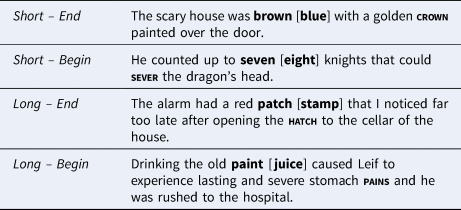
In the present experiment, we aimed to see whether inhibitory effects observed among monolinguals would be replicated in bilinguals, and how they might be affected by individual differences. We therefore examined the effect of form-related neighbour primes on the reading times of target words during sentence reading in proficient Norwegian–English bilinguals reading in their L2, English. Eye movements were recorded while participants read sentences containing a target word preceded by a form-related prime or a control neighbour (e.g., The scary house was brown [blue] with a golden crown painted over the door.). The neighbouring prime always overlapped with the target both orthographically and phonologically. As neighbours overlapping at the beginning of the word (e.g., market and marker) have sometimes been found to interfere with target word processing differently from neighbours rhyming with the target (e.g., fork – pork), we also manipulated the locus of the overlap.
As reading skills have been found to affect the size of inhibitory neighbour priming effects in monolinguals (see above), we expected similar effects for bilinguals, especially as general L2 proficiency also seems to affect priming effects within the L2. Stronger repetition priming effects in the L2 have indeed been found for higher proficiency learners compared to less proficient ones (Veivo & Järvikivi, Reference Veivo and Järvikivi2013). As the phonological component of form-relatedness appears to be crucial to inhibition effects, we expected phonological decoding skills to affect results as well. We thus included a series of tests designed to measure (1) L2 proficiency, (2) L2 reading skills and (3) L2 phonological decoding skills. Note that Frisson et al. (Reference Frisson, Koole, Hughes, Olson and Wheeldon2014b) only measured L1 reading comprehension skill.
Like Frisson et al. (Reference Frisson, Koole, Hughes, Olson and Wheeldon2014b), we also manipulated the distance between the prime and the target word, to investigate how long the potential inhibition effect would last by comparing sentences where the prime and target were close together (short-distance condition, 2.95 intervening words on average) to sentences where the two were further away (long-distance condition, 8.77 words on average). We expected that participants with poorer reading skills would only exhibit an inhibition effect in the short distance condition, if any, while participants with better reading skills would still be affected by competition from the prime in the long-distance condition. As L2 processing is cognitively more demanding, we could also expect the inhibition effect not to be present at all in the long-distance condition, even for good readers, or to be replaced by a facilitatory effect.
Our experiment addressed the following research questions:
(1) Do neighbour primes affect proficient bilinguals during normal sentence reading in the L2, similar to what has been observed for native speakers?
(2) How do individual differences in reading skills and phonological decoding skills affect these inhibitory effects?
(3) Does the distance between the prime and target word (short vs long) and the type of overlap (begin and end) affect form-related priming effects?
2. Methods
2.1 Participants
Fifty-six native speakers of Norwegian with English as a second language participated in the experiment. They were University students between 17 and 35 (M = 24, SD = 4.8) and declared no language impairment or learning disorder. All were late bilinguals except for one participant who was raised in England in a Norwegian-speaking family. They were all highly proficient. Three of them reported that English was their dominant language. Two participants wore thick glasses and could not complete the eye-tracking part of the experiment. Data from 6 participants had to be rejected due to technical malfunctions (lost connection with the eye-tracking device). Data from 48 participants (15 male) remained for analysis. 38 of them reported knowing one or more other languages but with limited proficiency (mostly Spanish: n = 15, French: n = 12, German: n = 12). Note that 29 participants indicated they preferred to read in English. See Appendix A1 for additional details. Participants were recruited from the University of Agder and received a 200 NOK voucher (circa 20€) for their participation. They all gave written informed consent.
2.2 Material
A total of 128 pairs of sentences were constructed, corresponding to 4 conditions (see Table 1 and see Appendix A2 for a full list of stimuli). The conditions combined the different levels of the factors Overlap (begin- vs end-overlap) and Distance (short vs long). Each sentence pair consisted of a Related version, in which the prime was an orthographic neighbour of the target word, and an Unrelated version, containing a non-form-related control word. When related, the prime and target words overlapped in both orthography and phonology and did not differ by more than one letter. None of the words were cognates, as we were interested in lexical representations in the L2 without L1 influence.
Example of stimuli.

Note: The prime [control] word is in bold and the target word is in small capital letters. There were two Distance conditions (Short vs. Long) and two Overlap conditions (End-overlap vs. Begin-overlap).
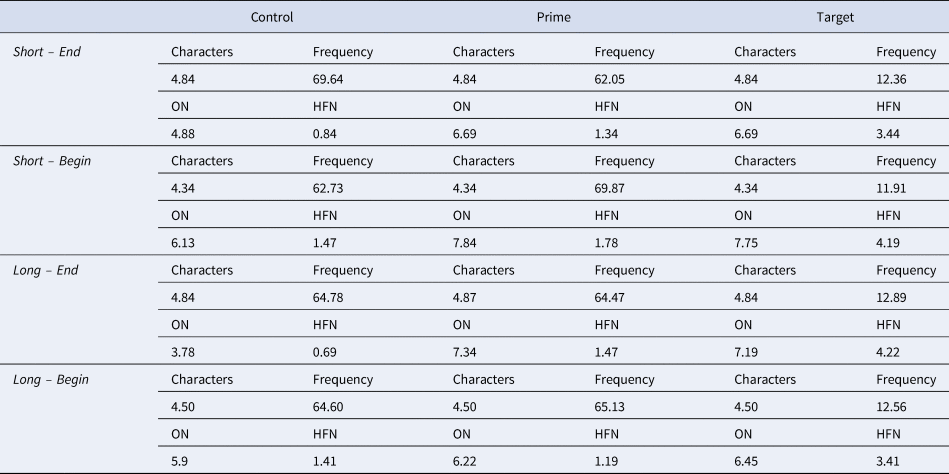
Prime, target and control words were matched for mean frequency, number of letters and phonemes across conditionsFootnote 1 (see Table 2). The mean number of orthographic neighbours and higher-frequency neighbours differed for related and control primes (neighbours: related 7.02 vs control 5.17, higher-frequency neighbours: related 1.43 vs control 1.10, see Table 2). The influence of these variables is evaluated in the results section. The target word was always less frequent than the prime (β = −1.54Footnote 2, SE = 0.12, t(255) = −13.29, p < .001) or the control word (β = −1.54, SE = 0.12, t(255) = −13.36, p < .001), but there was no difference in frequency between the control and prime words (β = −0.007, SE = 0.12, t(255) = −0.06, p > .99). In the begin-overlap condition, the differing letter between prime and target word was at the end of the word (e.g., seven – sever) while end-overlap items rhymed (e.g., fork – pork). Prime and target word were separated by 2 to 4 words (M = 2.95 words, 12.48 characters) in the short-distance condition, and 8 to 9 words (M = 8.77, 44.05 characters) in the long-distance condition. The resulting 256 stimuli were distributed across two lists so participants would only see one version of each item. Each list contained 4 blocks separated by a short break and started with 5 practice sentences. Sentences were pseudo-randomized so that participants never saw more than 2 related sentences in a row. Block order was rotated across participants.
Mean frequencies and characters in control, prime and target words per condition

Note: Frequency is taken from the CELEX database (Baayen, Piepenbrock & Gulikers, Reference Baayen, Piepenbrock and Gulikers1996) with N-watch (Davis, Reference Davis2005) and expressed per million words. ON: number of orthographic neighbours. HFN: number of higher frequency neighbours
2.3 Procedure
Participants first completed an adapted version of the LEAP-Q questionnaire (Marian, Blumenfeld & Kaushanskaya, Reference Marian, Blumenfeld and Kaushanskaya2007) to collect their language history data. Eye movements were recorded with an SR Research Eyelink 1000 Plus with a sampling rate of 500 Hz. Viewing was binocular but only data from the right eye was recorded. A head and chin rest as well as a target sticker were used to limit movements and improve the accuracy of data recording. Sentences were presented left-aligned in 13-pt Courier New font in the middle of the screen. Prime/control and target words always appeared on the same line. A comprehension question followed 25% of the stimuli. The experiment took between 25 and 45 min.
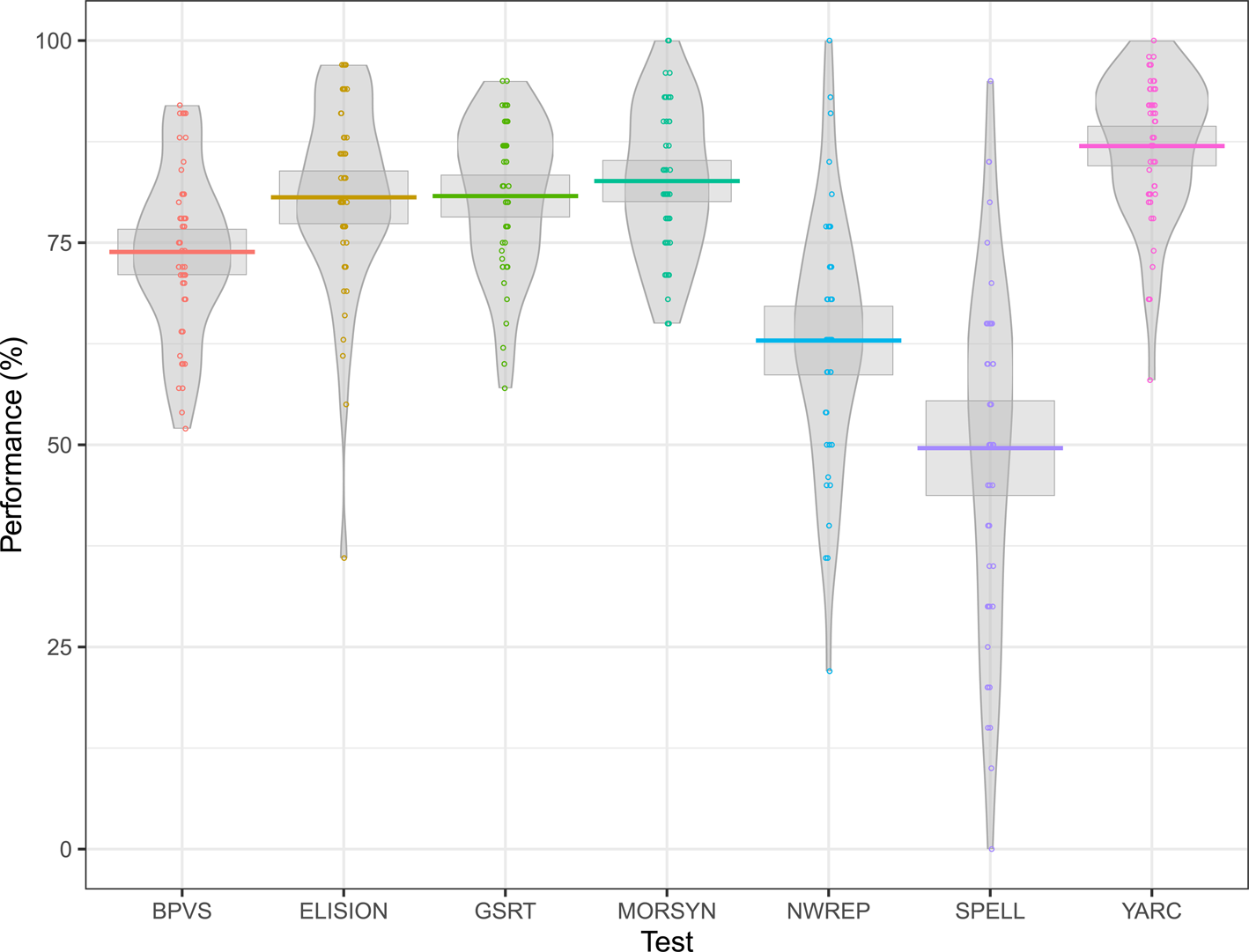
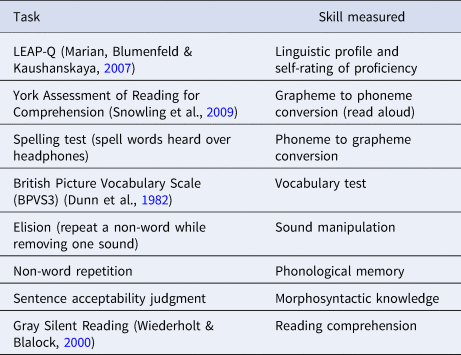
To collect measures of proficiency, participants completed a range of additional tasks, summarized in Table 3. Lists of words and sentences used are available in Supplementary Materials A (Supplementary Materials). For the Single Word Reading Test from the York Assessment of Reading for Comprehension test (YARC, Snowling, Stothard, Clarke, Bowyer-Crane, Harrington, Truelove, Nation & Hulme, Reference Snowling, Stothard, Clarke, Bowyer-Crane, Harrington, Truelove, Nation and Hulme2009), participants had to read aloud 7 lists of 10 words, each list increasing in difficulty. For the Spelling test (SPELL), participants were asked to listen to a word (n = 20) and then spell it. For the British Picture Vocabulary Scale 3 (BPVS, Dunn, Dunn & Whetton, Reference Dunn, Dunn and Whetton1982), participants had to match the word heard (n = 70) to the correct picture among 4 suggestions. For the Elision (ELISION) test, participants were asked to listen to a non-word (n = 18) and repeat it, and then repeat it again without one of its sounds (ex: say “BLART”, and then say “BLART” without the “L”, so “BART”). For the non-word repetition (NWREP), participants had to repeat a non-word (n = 22) of increasing difficulty. For the Sentence acceptability judgment test (MORSYN): participants were asked to read a sentence (n = 32), and decide as fast as possible if it was grammatically acceptable in English. Finally, in the Gray Silent reading test (GSRT, Wiederholt & Blalock, Reference Wiederholt and Blalock2000), participants read 8 stories and replied to 5 multiple choice questions with 4 suggestions for each story. Twenty-five minutes were allocated for this task, whether participants finished all the stories or not. The mean results and the distribution of the data for these proficiency tasks can be seen Figure 1. Full lists of the words used are available in Supplementary Materials A (Supplementary Materials).
Distribution of performance on L2 proficiency tasks
Note: The horizontal bold line shows the mean, the box represents the 95% confidence interval, and the grey area shows the distribution of the data for each task. BVPS: British Picture Vocabulary Scale 3, ELISION: elision test, GSRT: Gray Silent Reading Test, MORSYN: sentence acceptability judgment task, NWREP: nonword repetition task, SPELL: spelling test, YARC: York Assessment of Reading for Comprehension

Additiconal tasks.

2.4 Pre-processing and analyses
Proficiency measures
Errors were coded by the experimenters for all tasks and converted into a percentage of correct answers.
Eye-tracking data
An automatic cleaning procedure combined short fixations (< 80 ms) with another fixation if they were within one character space from each other; while fixations < 40 ms and not within 3-character spaces from another fixation were deleted. Trials with a blink on the target word were deleted from analyses. Fixations < 100 ms were removed. Measures that were more than 3 SDs above or below the participant's mean for that measure and that area of interest were removed from analyses.
Three regions of interest are reported: the prime/control word region, the target region and a spillover region, defined as the next word if it was at least four characters long; otherwise the next two words. The following measures are reported: first-pass dwell time (sum of fixations on a word before exiting the region for the first time), first-pass regressions (percentage of backward saccades out of a region during first-pass reading), regression path duration (sum of all fixation durations on a region from first entering it until going past it, which can include fixations on previously processed text), total dwell time (sum of all fixation durations on a region), and skipping rate (when the word was not fixated during first-pass reading).
2.5 PCA
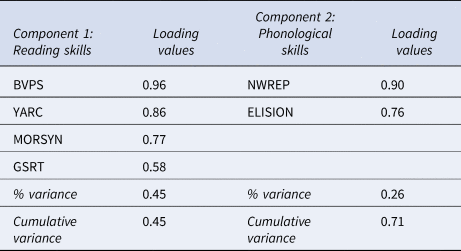
To determine which aspects of proficiency could be grouped together and integrated into the analysis of the eye-tracking data, we conducted a Principal Components Analysis. The PCA was ran with R version 3.6.1 (R Core Team, 2020), with the principal() function from the package psych version 1.9.12 (Revelle, Reference Revelle2019). The 7 measures from the proficiency tasks were considered for the PCA. The correlation matrix showed that SPELL had a correlation of over 0.8 with at least one other variable (YARC), so it was removed from further considerations. The Bartlett correlation test for the 6 remaining variables was significant (χ2(15) = 11.75, p < .001), confirming that the dataset was suitable for a PCA. The Kaiser-Meyer-Olin value was 0.83, which qualifies as a “meritorious” degree of common variance. The PCA revealed only one factor with an eigenvalue > .1 (3.42), the second factor having an eigenvalue of 0.85. However, the root means squared residual (RMSR) for a PCA with 1 factor was 0.11 and thus superior to the threshold value of 0.08. The proportion of absolute residuals over 0.05 was also above the threshold of 0.5 (0.73). For that reason, we decided to extract two factors, in accordance with Jolliffe (Reference Jolliffe2002) who recommends including factors with eigenvalues > 0.7. This led to a proportion of absolute residuals superior to 0.05 of 0.47, and a RMSR of 0.095. The first component explained 45% of the variance and the second one 26%, so together they accounted for 71% of the variance. As the components had a correlation of 0.48, we performed an oblique rotation (Tabachnick & Fidell, Reference Tabachnick and Fidell2007, p. 646). The loading of the variables on each component made theoretical sense. The first component, which we call Reading skills, included BVPS, YARC, MORSYN and GSRT performances. The second component was composed of NWREP and ELISION performances and was therefore deemed to reflect Phonological decoding skills (short: Phonological skills). The pattern matrix is reported in Table 4 and full results including the Structure Matrix are available in Appendix A3.
Results of PCA for the additional tasks

Note: Only variables with a loading value of over 0.30 are reported. Results from the pattern matrix are reported here. See Appendix A3 for full results including the structure matrix.
2.6 Statistical analyses
All analyses were carried out using R v. 3.6.1 (R Core Team, 2020) and the packages lme4 v. 1.1.21 (Bates, Maechler, Bolker, Walker, Christensen, Singmann, Dai, Grothendieck & Green, Reference Bates, Maechler, Bolker, Walker, Christensen, Singmann, Dai, Grothendieck and Green2015) and lmerTest v. 3.1.0 (Kuznetsova, Brockhoff & Christensen, Reference Kuznetsova, Brockhoff and Christensen2015). The first-pass dwell time, regression path duration and total dwell time were log10 transformed to improve normality and analysed with linear mixed-effect models, while the first-pass regressions and the skip rate data, which are binomial (a regression or skip either happened or not), were analysed with a generalized linear mixed effect model (glmer()), with a binomial family and a logit link. Because our short- and long-distance items were different sentences, and the effect of distance consistently interacted with relatedness, we ran separate analyses for the short- and long-distance conditions. This additionally enables better comparability with Frisson et al.'s (Reference Frisson, Koole, Hughes, Olson and Wheeldon2014b) results obtained with monolinguals in similar conditions (full omnibus results are available in Supplementary Materials B). For each dependent variable and each region of interest, a model was first constructed with the following contrast-coded factors and their interactions as fixed effects: relatedness (unrelated: -0.5 vs. form-related: 0.5) and overlap type (begin-overlap: -0.5 vs end-overlap: 0.5). Individual differences were assessed by adding the two factors extracted from the PCA to the different models. The full initial model thus included two three-way interactions between the two fixed-effect factors and each of the proficiency factors (Reading skills and Phonological skills). The random effects structure always included an intercept by participants and an intercept by item. The maximal random-effects structure was tried first (Barr, Levy, Scheepers & Tily, Reference Barr, Levy, Scheepers and Tily2013) but, as it yielded singular models, it was progressively reduced by first removing the higher order interaction and then individual terms until the model was no longer singular and converged. If several models with a single slope by participant converged, they were compared with the anova() function to identify which model was the best fit to the data. To solve convergence issues, the Bobyqa optimizer was used and the maximal number of iterations was increased to 20,000 (Powell, Reference Powell2009). The models were subsequently reduced with the drop1() function which performs model comparisons with a chi square test. As drop1() does not work with binomial data, those models were progressively reduced in a similar fashion using model comparisons with the anova() function. Note however that the manipulated factors were always kept as single terms in the reduced models even if their effects were not significant, to reflect the experimental manipulations. Only the interactions with the two proficiency factors as well as those factors as single terms were therefore removed in turn if not significant. We used an alpha level of < .05 for determining significance. The significance of main effects and interactions were assessed by model comparisons with the drop1() or anova() function. Estimates are reported from a summary of the model. 95% confidence intervals were calculated using the Wald method with the confint.merMod() function of lme4. The R2marginal and R2conditional, which summarize respectively the explanatory power of the fixed-effects structure and the combined explanatory power of the fixed and random effects structure, were calculated using the r.squaredGLMM() function of the MuMIn package (Barton, Reference Barton2020). For binomial models, the theoretical R2 are reported. Follow-up tests were run in two different ways. When the interaction involved two factors (e.g., overlap and relatedness), a nested model was run to test for the significance of the relatedness effect over each level of the overlap factor. For three-way interactions involving relatedness, overlap and one of the continuous factors, separate models were run for each level of overlap, to determine where the interaction between the continuous factor and relatedness was significant. A detailed report of the full models, the reduction procedure and residual plots is available in Supplementary Materials B (Supplementary Materials).
As we had 48 participants and 32 stimuli per condition (combining the levels of Relatedness, Distance and Overlap), we had a total of 1536 observations per condition. Power is notoriously difficult to estimate for analyses using linear and generalized linear mixed-effect models (Brysbaert & Stevens, Reference Brysbaert and Stevens2018; Kumle, Võ & Draschkow, Reference Kumle, Võ and Draschkow2021; Westfall, Kenny & Judd, Reference Westfall, Kenny and Judd2014). Brysbaert and Stevens (Reference Brysbaert and Stevens2018) recommend 1600 observations per condition for repeated measure designs analysed with linear mixed models to observe effects of around 15 ms. Our study is therefore very close to the most recent power recommendations, although it might be slightly underpowered to interpret a three-way interaction between Distance, Relatedness and Overlap.
3. Results
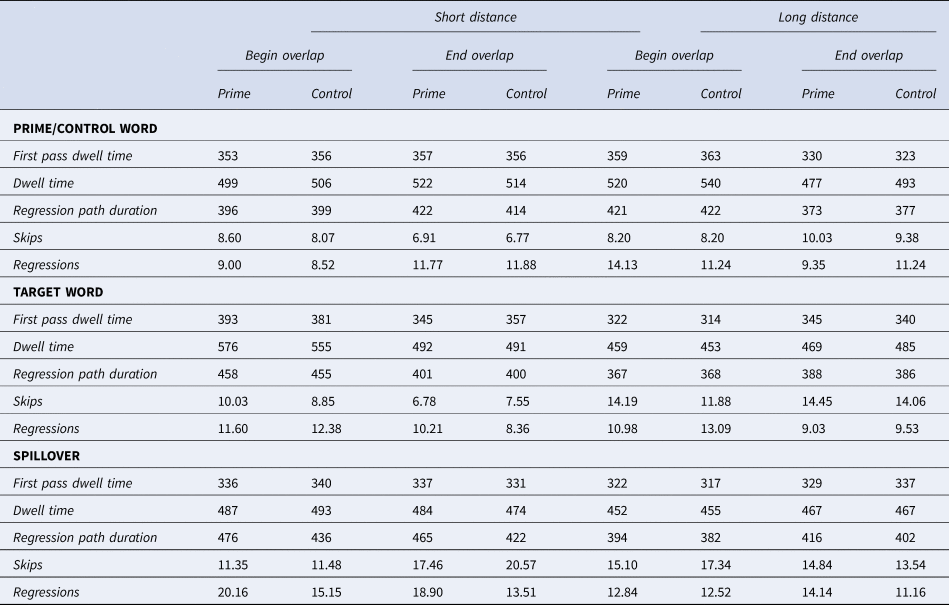
Average reading times are shown in Table 5. Full analyses are available in Supplementary Materials B (Supplementary Materials).
Eye movement data

Note: Reading times are in milliseconds, skips and regressions are in percentages.
As there was a difference in the number of orthographic neighboursFootnote 3 between the related prime and the unrelated control word (t(254) = -3.47, p < .001; MControl = 5.17; MPrime = 7.02), but only marginally in the number of higher frequency orthographic neighbours (t(256) = -1.68, p = .094; MControl = 1.10; MPrime = 1.43), we checked whether the reading time of the prime/control word was affected by the number of orthographic neighbours. As this was not the case (all ps > .18), we did not include the number of neighbours as a factor in the main analyses. Pollatsek, Perea and Binder (Reference Pollatsek, Perea and Binder1999) and Frisson et al. (Reference Frisson, Koole, Hughes, Olson and Wheeldon2014b) also failed to find early effects of neighbourhood size during reading.
3.1 Short distance
Prime/control word region
No significant effect of relatedness was found in this area.
Target word region
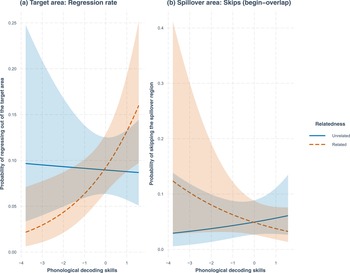
There was no effect of relatedness on dwell time, regression path duration, or skipping rate. The interaction between Relatedness and Overlap was significant for first pass dwell time (β = -0.028, 95% CI [-0.054; -0.0014], t(2597) = -2.06, p = .039, R2Marginal = 0.062, R2Conditional = 0.30), but follow-up tests revealed no effect of relatedness in the begin- nor end-overlap condition (all ps > .13). The interaction between relatedness and phonological skills on the probability of regressing out of the target area was significant (β = 0.42, 95% CI [0.14; 0.70], z = 2.90, χ2 (1) = 8.22, p = .004, R2Marginal = 0.024, R2Conditional = 0.23). Follow-up separate models for unrelated and related primes showed that the effect of phonological skills was only significant for related primes (χ2 (1) = 7.63, p = .006 vs χ2 (1) = 0.005, p = .94)Footnote 4: better phonological decoders were more likely to regress out of the target area after related primes. Thus, only good phonological decoders exhibited an inhibition effect as they were more likely to regress after reading the target word when it followed a related rather than an unrelated prime (see Figure 2a).
Plots for significant interactions between relatedness and individual difference predictors in the short-distance condition

Spillover region
There was no effect of relatedness on first pass or total dwell time. There was a main effect of relatedness on the regression path duration (β = 0.03, 95% CI [0.018; 0.059], t(47) = 371, F(46) = 13.77, p < .001, R2Marginal = 0.033, R2Conditional = 0.30), with longer durations when the prime was related than when the prime was unrelated (related: M = 471 ms, SD = 365 ms; unrelated: M = 430 ms, SD = 346 ms). The effect of relatedness on the regression rate was also significant (β = 0.52, 95% CI [0.26; 0.78], z = 3.93, χ2 (1) = 14.06, p < .001, R2Marginal = 0.024, R2Conditional = 0.23): participants were more likely to regress out of the spillover area when the prime was related to the target than when it was not (regression rate: 19.65% vs 14.12%).
There was a significant three-way interaction on skipping rate between Relatedness, Overlap and Phonological skills (β = 0.62, 95% CI [0.19; 1.05], z = 2.80, χ2 (1) = 7.52, p = .006, R2Marginal = 0.059, R2Conditional = 0.51). The interaction between Phonological skills and Relatedness was only significant for begin-overlap items (β = -0.41, 95% CI [-0.75; -0.076], z = -2.41, χ2 (1) = 5.52, p = .019, R2Marginal = 0.039, R2Conditional = 0.47)Footnote 5: participants with poorer phonological skills were more likely to skip the spillover area after a related begin-overlap prime than participants with better phonological skills (see Figure 2b).
3.2 Long distance
Prime/control word region
There was no significant effect of relatedness in this region.
Target word region
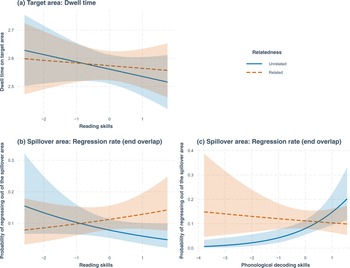
There was no effect of relatedness on the first pass dwell time, the regression path duration, the regression rate or the skipping rate. There was a significant interaction between relatedness and reading skills on dwell time (β = 0.02, 95% CI [0.001; 0.031], t(2435) = 2.13, F(2432) = 4.55, p = .033, R2Marginal = 0.032, R2Conditional = 0.44): better readers read the target area faster, but less so after related primes. Better readers were thus more likely than poorer readers to spend more time on the target area after a related than an unrelated prime (see Figure 3a). A similar but non-significant interaction was found for the first-pass dwell time (p = .056).
Plots for significant interactions between relatedness and individual difference predictors in the long-distance condition

Spillover region
There was no effect of relatedness on first pass dwell time, dwell time, regression path duration or skipping rate. The regression rate showed significant relatedness × overlap × reading skills (β = 0.56, 95% CI [0.029; 1.10], z = 2.05, χ2 (1) = 4.11, p = .043, R2Marginal = 0.027, R2Conditional = 0.22) and relatedness × overlap × phonological skills interactions (β = -0.80, 95% CI [-1.40; -0.21], z = -2.62, χ2 (1) = 6.70, p = .009, R2Marginal = 0.032, R2Conditional = 0.22).
The interaction between relatedness and reading skills was only significant for end-overlap items (β = 0.44, 95% CI [0.065; 0.82], z = 2.30, χ2 (1) = 5.10, p = .024, R2Marginal = 0.052, R2Conditional = 0.23). Better readers were more likely to regress out of the spillover region after a related than an unrelated prime (see Figure 3b).
The interaction between relatedness and phonological skills was only significant for end-overlap items (β = -0.76, 95% CI [-1.19; A-0.33], z = -3.44, χ2 (1) = 7.92, p = .004, R2Marginal = 0.052, R2Conditional = 0.23)Footnote 6: unexpectedly, participants with worse phonological skills were more likely to show inhibitory effects in the form of more regressions (see Figure 3c) than participants with better phonological skills.
4. Discussion
In this experiment, we investigated the effect of form-related priming on word recognition in sentence reading among proficient Norwegian–English bilinguals. The results are consistent with what has been found previously in sentence reading with monolingual speakers of English, but show important effects of individual differences related to L2 proficiency.
Our first research question was whether form-related primes affect proficient bilinguals during normal sentence reading in the L2 in a similar manner to what has been observed for native speakers. Our results show that bilinguals are indeed affected by word neighbours during reading like monolinguals, although the interference might be slightly delayed among them, possibly reflecting slower processing. In the short-distance condition, inhibition effects were found on the target area for good phonological decoders, and on the spillover area regardless of reading and phonological decoding skills. This is in line with prior results of inhibitory neighbour word priming in sentence reading, although our effects appeared later, i.e., on the spillover region and on later measures only (regressions and regression path duration). Bilinguals have been found to have slower lexical access than monolinguals (e.g., Duyck et al., Reference Duyck, Vanderelst, Desmet and Hartsuiker2008; Gollan et al., Reference Gollan, Montoya, Fennema-Notestine and Morris2005, 2011). This does not, however, result in facilitation. For bilinguals as well as monolinguals, the processing of a word is slowed down by a prior encounter with a neighbour of that word in the same sentence. Interactive competition models explain this in terms of competition between word candidates. Letters activate word candidates, which compete for recognition. The interactive BIA and the BIA+ (Dijkstra & van Heuven, Reference Dijkstra, van Heuven, Grainger and Jacobs1998, 2002) bilingual models include top-down activation and inhibition from the language nodes to the word level and from the word to the letter level, as well as inhibition at the word level. Once a word candidate has reached a certain activation threshold, it is identified as the best-matching solution. According to the Inhibitory Control Model (Green, Reference Green1998), all corresponding lemmas are activated, and are then reactively inhibited. The more a candidate word is activated, the more it is inhibited afterwards. Additionally, this model assumes that more proficient bilinguals will exhibit higher levels of inhibition of the suppressed candidates, which is in line with our results for good readers. We will return to this later. This is compatible with how current eye-movement models of reading such as the Glenmore model (Reilly & Radach, Reference Reilly and Radach2006) and the OB1-reader model (Snell et al., Reference Snell, van Leipsig, Grainger and Meeter2018) account for spillover effects. If the target word is inhibited by the form-related prime, then it reaches its activation threshold more slowly, leading to slower processing. If a saccade is initiated to the next word before processing of the fixated word is complete, processing of the target word “spills over” onto the next word or words.
Our second research question was how individual differences relate to inhibitory effects in bilinguals. The effects we found are indeed modulated by individual differences, and, interestingly, the key factor is phonological. Our results show earlier effects for good phonological decoders in the short distance condition: more regressions on the target and fewer skips of the spillover region after related primes. It is not surprising to find that phonological decoding skills affect sentence reading: previous research shows that the phonological codes of words are activated during reading, and that readers rely on them during normal sentence reading (see Rayner et al., Reference Rayner, Pollatsek, Ashby and Clifton2012). Frisson et al. (Reference Frisson, Koole, Hughes, Olson and Wheeldon2014b) also found neighbour priming interference only when the prime and target overlapped both phonologically and orthographically (see also Frisson, Bélanger & Rayner, Reference Frisson, Bélanger and Rayner2014a, for evidence of fast priming effects for orthographically and/or phonologically overlapping words). They concluded that the interference between form-related words in a competition account is not only due to similarity between orthographical codes, but also between phonological ones. This is in line with our results showing that better phonological decoders are more affected by the locus of the overlap than poor phonological decoders, and that they are affected by form similarity earlier during reading (in the target area and on the early measures in the spillover area). Interestingly, our measure of phonological decoding skills targeted phonological processing abilities and phonological short-term memory independently of L2 vocabulary knowledge, as those tasks were completed with nonwords only. This suggests that the inhibition effect at short distance is related to the activation and maintenance of L2 phonological codes rather than L2 reading proficiency.
Our final research question addressed the effect of (a) the distance between the prime and target word (short or long) and (b) the type of overlap between prime and target word (beginning or end). In the long-distance condition, only good readers exhibited inhibition effects in the target area, which was also the case for the monolingual participants in Frisson et al. (Reference Frisson, Koole, Hughes, Olson and Wheeldon2014b). For good readers, the influence of the prime is still present when encountering the target word after eight or nine intervening words. However, the assumption of competition models is that activation decays over time. This would therefore imply that the activation of the prime word has not decayed or been inhibited by the eight or nine other words read meanwhile before encountering the target. This leads to an apparent relative disadvantage for good readers (who read every segment faster overall), which, in a competition model, could be explained in two different ways.
A first possibility is that good readers keep the prime activated longer. There is evidence that skilled readers rely more on phonological codes during reading (Chace, Rayner & Well, Reference Chace, Rayner and Well2005; Elsherif et al., Reference Elsherif, Wheeldon and Frisson2022; Frisson et al., Reference Frisson, Koole, Hughes, Olson and Wheeldon2014b; Unsworth & Pexman, Reference Unsworth and Pexman2003). It is possible then that only good readers still have both the orthographic and phonological sources active when they reach the target, which would lead to those long-lasting inhibitory effects. However, our data show inhibition for participants with good reading skills, but not good phonological decoding abilities. Although those two constructs are related to some extent, they emerged from the PCA as two different components, and they show different patterns of results. The longer-lasting inhibition among the good readers is therefore unlikely to be caused only by longer availability of the phonological codes; otherwise we would expect to see similar trends among good phonological decoders. Additionally, we observed effects going in opposite directions for those two groups in the spillover area of long-distance sentences. Nevertheless, it could be that good phonological decoders do not keep the orthographical codes active for as long as the phonological ones, and therefore show no interference effect because both sources are not active.
A second possibility would be that good readers inhibit the prime's neighbours more, which makes those neighbours harder to recover when they are encountered later in the sentence. There is evidence that inhibition abilities contribute to reading speed in adults (Johann, Könen & Karbach, Reference Johann, Könen and Karbach2020), and that children who are poor comprehenders perform poorly on working memory and inhibitory tasks assessing resistance to interference (Borella, Carretti & Pelegrina, Reference Borella, Carretti and Pelegrina2010). This is also consistent with the Inhibitory Control Model (Green, Reference Green1998), which assumes higher levels of inhibition for more proficient bilinguals. In order to test this possibility, future experiments will need to include direct measures of participants’ inhibition skills.
An alternative explanation for the long-lasting inhibitory effects observed in sentence reading was suggested by Paterson et al. (Reference Paterson, Liversedge and Davis2009). The episodic memory account postulates that whenever a word is read, an episodic trace is created in memory. When the target word is encountered, it reactivates the episodic memory trace encoded during the processing of the prime, and as those two words are neighbours, this trace interferes with target word identification. This account was designed to explain the long-term effects of repetition priming (Tenpenny, Reference Tenpenny1995). This would mean that better readers have stronger working memory capacities, and that the episodic traces created are stronger in the memory of these participants. It is a well-established fact that reading skills are linked to working memory capacities (e.g., Daneman & Merikle, Reference Daneman and Merikle1996), and the two have also been associated in L2 learning (e.g., Harrington & Sawyer, Reference Harrington and Sawyer1992). It should be noted that the relationship between working memory, reading skill and L2 learning is likely symbiotic: being able to hold onto information for longer will facilitate comprehension, which will also improve language learning (see e.g., Archibald, Reference Archibald2016). Another supporting element for this account in our data is that in the long-distance condition, good readers were more likely to regress from the spillover area, but only for end-overlap neighbours. End-overlap items, i.e., rhyming words (fork – pork) might be more likely to be affected by memory processes than begin-overlap items. It is possible that the rhyme helps reactivating the episodic trace at the end of the target word and triggers the need to check the prime again, reflected by a higher regression rate after processing the target, and therefore visible in the spillover area. However, the effect of sentence structure found by Frisson et al. (Reference Frisson, Koole, Hughes, Olson and Wheeldon2014b), where the long-distance inhibition of good readers disappeared if prime and target word were in two different sentences, suggests that something more than passive memory processes are at play (e.g., it is possible that at the end of a sentence, a low-level information “dump” is carried out). This will need to be examined in further details in future studies.
Our data do not allow us to distinguish between these possible accounts of inhibition effects in sentence reading. It generally fits, however, with the Lexical Quality hypothesis (Perfetti, Reference Perfetti2007), with more precise lexical representations leading to greater inhibitory effects (Andrews & Hersch, Reference Andrews and Hersch2010). Our reading skill measure likely includes spelling abilities (recall that the results of the spelling test were removed from the PCA because they correlated too strongly with other measures included in the reading skills composite, in particular the YARC and BVPS scores), and so our better readers are also better spellers. Note, however, that they are also better grammarians: the syntax score was found by the PCA to load onto the reading skill composite. This syntax score provides a measure of general L2 proficiency, which means that our good readers are probably also more proficient in their L2 in general. Higher L2 proficiency has been associated with better cognitive abilities in the L2, and in particular better cognitive control (Luque & Morgan-Short, Reference Luque and Morgan-Short2021). Our better readers are therefore also better at a number of other things that could contribute to the specific pattern of results observed for this group. In comparison, our measure of phonological decoding skills is independent from L2 proficiency.
A final effect remains to be explained: the unexpected effect of the locus of the overlap. For monolinguals, Frisson et al. (Reference Frisson, Koole, Hughes, Olson and Wheeldon2014b) found immediate inhibition effects for rhyming words (end-overlap items) on the target word. Conversely, we only observed delayed inhibitory effects for those items only on the spillover area and only in the long-distance condition. Those effects were also limited to good readers, and, more surprisingly, to poor phonological decoders. Frisson et al. (Reference Frisson, Koole, Hughes, Olson and Wheeldon2014b) additionally found delayed inhibition effects for begin-overlap items on the spillover area only. Our results show facilitation on the spillover area for these items – but only in the short condition and only for poor decoders, who were more likely to skip the spillover area when the target had the same beginning as a previously seen word (e.g., seven – sever). Poor phonological decoders seem to behave in an opposite pattern from monolinguals. There is no obvious reason why this would be the case, and we can only offer some tentative explanations. Begin-overlap items are more likely to affect early lexical access. This suggests that poor phonological decoders are subject to sublexical facilitation rather than lexical inhibition, at least in the short condition. Conversely, rhyming words are likely to trigger memory mechanisms. If good readers also have better memory capacities and more precise lexical representations, the end-overlap items may reactivate the memory of the prime, causing interference with the target. Somehow, poor decoders are also affected by these memory processes in the long-distance condition, as opposed to the sublexical facilitation they experience in the short condition. Interestingly, for monolinguals, Bridwell (Reference Bridwell2017) found strong, long-lasting inhibitory effects for rhyming words – such as the ones observed in the long distance condition for good readers, while alliterations (i.e., begin-overlap items) affected lexical access, as evidenced by effects on earlier measures and not re-reading. It is possible that sublexical and memory processes function differently in the L2 from the L1, as the L2 is generally more difficult to process; but more research is needed to understand this effect of overlap.
5. Conclusion
In sum, our results show that words in a sentence influence each other even in a second language, but that interference is affected by the reading skills and phonological decoding abilities of the reader. Our key findings replicate in an L2 what has previously been found in monolinguals, which shows that form-related priming in sentence reading is a robust and important effect in language reading. Measures targeting working memory capacity and inhibition skills are needed in future research to explain the long-distance inhibitory effects found for good readers, and to distinguish between the different possible accounts of these effects.
Supplementary material
Supplementary Materials (pdf file, 2.84 MB) contain (A) the full list of stimuli used for the additional tasks (words for YARC test, spelling test, PVS 3, elision test, and non-word repetition test; sentences for morphosyntactic test); and (B) the full details of the statistical models (random-effect structure reduction, fixed-effects reduction, plot of model residuals, model summary).
Supplementary materials can be found online at https://doi.org/10.1017/S1366728922000529
Acknowledgements
This study was funded by the Institute for Foreign Languages and Translation at the University of Agder. We thank three anonymous reviewers for their helpful suggestions.
Competing interests
The authors declare none.
Data availability
The data and materials used for this study are available in the IRIS repository.
Appendix
Appendix 1: Additional details from the LEAP-Qs
1.1 Percentage of exposure to Norwegian (L1) and English (L2)

1.2 Preferences for reading and speaking

1.3 Other languages known

1.4 Proficiency, context of learning and context of current exposure to Norwegian and English

Appendix 2: Full list of stimuli
2.1 Short distance, end overlap
1. William used a big fork [knife] to eat the pork they had bought.
2. The scary house was brown [blue] with a golden crown painted over the door.
3. They would finally settle [decide] to test their mettle against each other.
4. Sarah brought a terribly hot kettle [soup] with some nettle and other herbs in it.
5. We found the yellow wall [desk] at the local mall and started painting.
6. It was a long jump [wait] after the big hump in the road.
7. There was about a mile [month] left before the file would be delivered safely.
8. The clothes were left in a pile [heap] while the vile person was taking a shower.
9. As she left her shift the nurse [nanny] began to curse the difficult children.
10. James played the game [song] and gained fame all over the world.
11. They were too late for their flight [scene] after taking a slight left instead of going straight ahead.
12. They sat by the porch [grave] with the unlit torch and started to cry.
13. Panthers tend to growl [whine] a bit as they prowl around the forest.
14. Chad made a point [show] by smoking the joint in a public place.
15. Susan wanted to switch [stop] as her eyes would twitch when she looked at digital screens.
16. They came back from the cruise [trip] without a bruise even though the sea was rough.
17. The bride walked to the town [tailor] with her new gown in a shopping bag.
18. They went ahead and sold [sent] tickets to a bold man they met outside.
19. I got an extensive bill [note] for just one pill from the doctor.
20. It was for her sake [aunt] they tried to fake a message of love and affection.
21. We went to the bridge [boat] and threw my fridge over the side.
22. I was totally about to faint [crash] when I saw a saint walking on the water.
23. Harry bought the expensive block [shirt] and the old clock he saw yesterday.
24. When I know someone hears me flush [sneeze] I tend to blush a little bit.
25. Jenny took her pillow [stick] to the old willow and laid down to sleep.
26. Paul wanted to join [drink] but needed a coin to pay for it in the end.
27. It seemed like the date [rain] was determined by fate when they first met.
28. Leonard was so tired [angry] that he fired his worst employee.
29. There are many responsibilities to carry [accept] if you choose to marry at a young age.
30. They ran through the haze [smoke] and found a maze in the middle of the forest.
31. She quickly turned the handle [carriage] after the lit candle fell to the floor.
32. He went to the beach [shore] and ate a peach and a home-made pie.
2.2 Short distance, begin overlap
1. He counted up to seven [eight] knights that could sever the dragon's head.
2. The people watched the sheep [goats] to see the sheer weight of the wool they had on them.
3. They could see a bright beam [glow] coming from the beak of a parrot statue in the hall.
4. Clara raised the rose [lily] closer to her nose to smell it properly.
5. There is always a lot of noise at the barn [shed] when the dogs bark at the sounds outside.
6. John had ruined his coat [glove] because of the coal he picked up in the mine.
7. Chris brought a really sharp [heavy] knife to kill the shark that was circling the boat.
8. Whenever she sat down to spin [blend] wool she spit her tobacco into a bowl.
9. Jonathan ate from a bowl [dish] with two large bows hanging over his shoulder.
10. The assistant wore a green [nice] jacket to greet everyone on his first day.
11. David attached a hook [frame] to hang up the hood which he wore every day.
12. It was hard to get a seat [chair] to watch the seal that could jump nine hoops in a row.
13. Ian wanted to sleep [dance] but then his sleek haircut might be ruined.
14. Michael received an impressive mark [gift] for explaining the mars expedition to the audience.
15. While the scientist measured the bulk [area] of the shape a bulb went out above them.
16. When it was his turn to speak [shoot] a metal spear was thrown at him.
17. The long ongoing turf [gang] wars began with a turd being tossed towards someone at the Zoo.
18. If you drive down the main [tiny] street you see mail all over the road after the accident.
19. Alice suspected that they would trap [beat] her in the tram station when she got there.
20. They went down the stream [road] after a winning streak at the rowing club
21. Katie found a strange bean [cube] next to the bead she had lost earlier today.
22. The strange bird would shake one wing [foot] and sort of wink at him from the high branch.
23. Keep the air in your bedroom warm [cool] in order to ward off sleepless nights.
24. Carl leaned on the rail [tree] and watched the raid that was taking place in the village.
25. When we gathered the corn [peas] we found a cord buried in the ground.
26. Jackie went down to the brook [lake] with a broom to try and sweep up the glass.
27. The new discovery was a huge step [gain] in the field of stem cell research.
28. They looked at the moon [cloud] and their mood changed a lot.
29. They had to find the right train [field] to follow the trail all the way home.
30. There was a big boom [roar] as his boot hit the concrete floor.
31. Everything was lying all over the floor [path] after the flood hit the area we live in.
32. The musician would rather be dead [shot] than become deaf before finishing his composition.
2.3 Long distance, end overlap
1. Unfortunately a big wave [tide] forced them back out from the secret and unexplored cave on the beach.
2. This equipment seems to lack [miss] everything that I told them was important for my rack of fishing nets.
3. His anxiety festered [swelled] as he thought back on how he was pestered in high school.
4. The group felt that they had to share [claim] supplies even though the others would probably stare at them in surprise.
5. Due to the heavy snow the gang had to crawl [slide] back to their place after unexpectedly losing the brawl they had just been in.
6. It looked like a slug [toad] had crawled around for hours on top of the plug in the kitchen sink.
7. There was a horrible smell [aroma] which might have been a side effect of the spell he had just cast.
8. Bees tend to sting [hurry] to defend the hive with all their strength as they fling themselves to their own deaths.
9. There was a crazy freak [dude] following me around until I heard the soft creak of the shop doors closing behind me.
10. The alarm had a red patch [stamp] that I noticed far too late after opening the hatch to the cellar of the house.
11. There was an overwhelming sound [noise] coming from the post office where a scary hound had been tied up to a pole.
12. The police told us that they could catch [judge] whoever was the criminal who had left behind a match that they had found at the scene.
13. Cutting a lot of timber [forest] throughout his long career had made Fred unusually limber compared to others at his age.
14. Upon noticing the button [odour] Sally decided to select the box containing the mutton instead of the alternative.
15. They would race [move] the longest distance they had ever attempted and knew that pace was the key to finishing.
16. Faith can give you a lot of power [resolve] so you never ever have to be scared and cower in fear from anything.
17. Alison could feel the rage [fury] building up as she knew that her hourly wage was far below what she deserved.
18. At the landing site [spot] there is a young boy who will always fly his kite whenever there is a little breeze.
19. The fox became scared of the duck [goat] after losing the fight and finally decided to tuck its tail between its legs and escape.
20. Without a second thought John threw his fist [club] and managed to hit his opponent on the nose despite the mist that surrounded them.
21. When they looked closer at the page [plan] in the old book there was a description of an unpleasant cage from medieval times.
22. Ian wanted to be brief [quick] because he noticed that some people had expressed grief due to a lack of direction.
23. Everyone thought he was a fool [jerk] for letting himself be used as a tool by the crooked administrator.
24. Most of the villagers accept the notion [theory] that there is no such thing as a magic potion to remedy bad luck.
25. The group might face some danger [threat] even though they are in the company of a ranger from the area.
26. These questionable people are running [driving] a large pyramid scheme that was set up by a cunning banker who got fired.
27. They needed a place to stay [rest] and a calm environment where they could sit and pray without being disturbed.
28. They noticed a peak [rise] in petty crime and tried to prohibit anyone to leak it to the local media.
29. The chicken that Jack wanted to pluck [raise] was in a bad mood and started to cluck when he advanced on it.
30. They both felt as if their sight [value] had decreased significantly after the very long and tight match that they had played.
31. Louise decided to call [phone] the guy she met yesterday because he was tall and quite good-looking.
32. Connor was always considered a hero [king] for keeping the number of casualties down at zero throughout the disaster.
2.4 Long distance, begin overlap
1. Drinking the old paint [juice] caused Leif to experience lasting and severe stomach pains and he was rushed to the hospital.
2. The old but valuable purse [crate] contained a special crystal that people believed could purge any impurities from one's body.
3. When Lee proposed he stroked Sue's cheek [wrist] as he slid the ring on and a huge cheer arose from their families.
4. Sarah searched the market [shop] just up the street from me for a new marker to use for her notes.
5. The knight received a slap [blow] from the rest of his friends for his attempt to slam into those two friendly dragons.
6. Elsa said it was sweet [crazy] to see the girl who works in the clothes shop sweep the floor on weekends.
7. Rick searched a chest [shelf] in his old countryside manor for a book about chess which he needed to study.
8. He wanted to join the clan [guys] but he could only do that if he was clad in the proper clothing.
9. Charles had a tight grip [hold] of the handle of the shopping cart and a huge grin on his face when they entered the mall.
10. Adam was feeling a lot of guilt [anger] about the theft that was committed today at the guild because of the unlocked door.
11. Ed knew the item was a cheap [royal] copy but he could not afford it and had to cheat to make sure he won the bid.
12. A good supply of grain [fruit] for the harsh winter season was the holy grail for the farmer following the poor harvest.
13. He walked back to the tower [guard] of the castle during his day out to get his towel as he had forgotten it again.
14. The university sees [gets] the monumental importance of encouraging students to seek further information on their own.
15. Sue made scans of the brain [teeth] in her well-equipped laboratory while twisting the braid in her long hair.
16. Due to the steam [fence] the thief and his slow and incompetent accomplice could steal the car without being noticed.
17. The morning's thin sheet [cover] of snow was quite dangerous but left a beautiful sheen on the new pavement that brightened the day.
18. Behind the camel he was about to mount [steer] in order to cross the desert was a mound of big and smelly droppings he needed to avoid.
19. He wanted to get paid [busy] but talking to the manager was a real pain every single time.
20. The earthquake shook the roof [cars] because it was so forceful and tossed the root of a tree through the window.
21. Lee didn't laugh at the queen [owner] who had just arrived by car wearing a queer hat for the event.
22. They had looked at the sign [book] and decided together that they would never ever sigh at old people again.
23. Martin was happy that his twin [mate] had gone into the woods and brought back a twig that was dry enough.
24. Clarence noticed a leaf [flag] on the ground when he was about to leap over the edge of the cliff.
25. The young basketball team [star] did charity work where they held back a tear of sadness for the poverty they saw.
26. The wounded man suffered in the heat [cold] of the room while the poor woman tried to heal him as well as she could with few resources.
27. The crystal she found was so hard [thin] that it could quite easily cause some serious harm to anyone who handled it carelessly.
28. Brett couldn't read a specific word [piece] in the old book he found in the attic because a worm had nibbled at some pages.
29. If you are going to lead [hire] the crew you'd better make sure they know not to lean on the loose shelf behind the stage.
30. Several people got hurt [sore] yesterday when an angry monkey suddenly decided to hurl rocks at the audience.
31. She was sitting on the curb [edge] when someone came running by and cut off a curl of her hair all of a sudden.
32. Daniel had become allergic to meat [flour] and had to be very careful about every meal he ate from now on.
Appendix 3: Full results of PCA on additional tasks