





Early bilingualism changes how a child acquires language and literacy. Bilingual children’s skills in one language build upon their experiences with both languages (Chung et al., Reference Chung, Chen and Deacon2018, Reference Chung, Chen and Geva2019; Ellis, Reference Ellis2002; Pérez-Navarro & Lallier, Reference Pérez-Navarro and Lallier2025). Specifically, within each language, a greater proportion of exposure to the language leads to stronger proficiency in that language, while cross-linguistic exposure enables the transfer of skills between languages, supporting overall language and literacy development. How do within- and cross-language influences jointly shape bilinguals’ language development? The present study examined these joint influences by testing the possibility that Chinese-English bilingualism creates two distinctive pathways for acquiring English affix and compound awareness: first, affix awareness is likely driven by within-language influence; second, and in contrast, compound awareness may be shaped by cross-language influence from Chinese. These pathways may, in turn, influence the associations between two types of morphological awareness and English vocabulary. The present study aims to offer a novel test of the theoretical hypotheses of how bilingual exposure to specific morphological structures impacts children’s language development.
Morphological awareness and vocabulary are central to our inquiry as they are among the most important early language skills for a child’s long-term literacy and school success (Deacon & Kirby, Reference Deacon and Kirby2004; Duff et al., Reference Duff, Reen, Plunkett and Nation2015; Duncan et al., Reference Duncan, Dowsett, Claessens, Magnuson, Huston, Klebanov, Pagani, Feinstein, Engel, Brooks-Gunn, Sexton, Duckworth and Japel2007; Muter et al., Reference Muter, Hulme, Snowling and Stevenson2004; Song et al., Reference Song, Su, Kang, Liu, Zhang, McBride-Chang, Tardif, Li, Liang, Zhang and Shu2015; Verhoeven et al., Reference Verhoeven, van Leeuwe and Vermeer2011). Morphological awareness, or the ability to manipulate meaning units of words, or morphemes, taps into both one’s structural awareness of morphological regularities and knowledge of specific lexical items. Morphological awareness emerges in preschool years and serves as a foundational metalinguistic skill to enrich children’s vocabulary (Anglin et al., Reference Anglin, Miller and Wakefield1993; Carlisle, Reference Carlisle and Feldman1995; Kuo & Anderson, Reference Kuo and Anderson2006; Nagy et al., Reference Nagy, Berninger and Abbott2006). Prior research has found reliable associations between morphological awareness and gains in vocabulary over time in child learners of a wide range of languages (e.g., Korean and Chinese languages, including Mandarin and Cantonese, see McBride-Chang et al., Reference McBride-Chang, Wagner, Muse, Chow and Shu2005; English, see Ramirez et al., Reference Ramirez, Walton and Roberts2014; Sparks & Deacon, Reference Sparks and Deacon2015). Interventions in morphological awareness have also been consistently shown to improve vocabulary in typically developing learners and those with learning difficulties (see Brady & Mason, Reference Brady and Mason2024, for a review; Silverman et al., Reference Silverman, Johnson, Keane and Khanna2020, for a meta-analysis).
Due to the differences in morphological structures between Chinese and English, bilingualism in these two languages is of particular interest in the current study. Languages like English, French and Dutch are characterized by a greater number of inflections (e.g., affixes including the plural marker “s”, and tense markers “-ing” and “ed”) and derivations (e.g., affixes “un” in “undo” and “-ly” in “lovely”). In contrast, languages like Chinese and Korean are characterized by their abundance of compound words (i.e., building words by combining two or more roots, e.g., catfish, lipstick, McBride-Chang et al., Reference McBride-Chang, Wagner, Muse, Chow and Shu2005). Indeed, Mandarin and Cantonese share a morphological system and primarily use compounds rather than affixes (Packard, Reference Packard2010). These cross-linguistic variations lead to unique ways in which morphological awareness supports vocabulary in different languages. Specifically, in monolingual child speakers of Chinese, compound awareness has been found to have longitudinal and bidirectional associations with vocabulary size (e.g., Chen et al., Reference Chen, Hao, Geva, Zhu and Shu2009; Ku & Anderson, Reference Ku and Anderson2003; McBride-Chang et al., Reference McBride-Chang, Wagner, Muse, Chow and Shu2005, Reference McBride-Chang, Tardif, Cho, Shu, Fletcher, Stokes, Lam and Leung2008), with studies of English monolinguals showing relations between derivational and inflectional awareness (or affix awareness) with vocabulary levels (e.g., Duncan et al., Reference Duncan, Casalis and Colé2009; Sparks & Deacon, Reference Sparks and Deacon2015). These differences in dominant patterns of word morphology mean that English-speaking children with and without Chinese exposure have quite different experiences with compound and affix structures. And, given that Chinese and English do not have shared lexical items (i.e., no cognates), comparing these two populations of learners creates a natural experiment for examining how the varied experiences with morphological structures afforded by bilingualism influence language development.
We first posit that bilinguals’ English affix awareness will be primarily facilitated by their direct exposure to English, and English affix awareness is further associated with English vocabulary size. This prediction is primarily based on the Usage-based Account of Language Development, which hypothesizes that children develop their language competency in a piecemeal fashion from experience with examples of specific language structures (Ellis, Reference Ellis2002; Pérez-Navarro & Lallier, Reference Pérez-Navarro and Lallier2025; Tomasello, Reference Tomasello2000, Reference Tomasello2005). Indeed, an important premise flowing from this theory lies in the need for sufficient exposure to specific morphological structures for the development of morphological awareness in any child. For bilingual Chinese-English children, experience with English can be the primary – if not only – source of learning for affix structures, as the Chinese language lacks affix structures and thus has limited opportunity to transfer.
Secondly, and in contrast, we posit that bilinguals’ English compound awareness is facilitated by their experience with both English and Chinese via direct exposure and cross-linguistic transfer, respectively. The cross-linguistic effect is guided by the Interactive Transfer Framework (Chung et al., Reference Chung, Chen and Deacon2018, Reference Chung, Chen and Geva2019; see also the classic ideas of bilingual transfer, Cummins, Reference Cummins1979), which suggests that bilinguals’ skills gained in one language can be transferred and applied to those of the other, often due to shared elements across languages. As Chinese is a compound-heavy language, children could transfer their skills in operating root structures from their Chinese experience. Such a transfer would boost children’s English compound awareness by elevating their awareness of applying morphological regularities to create multi-root compound words (Luo et al., Reference Luo, Chen and Geva2014; Pasquarella et al., Reference Pasquarella, Chen, Lam, Luo and Ramirez2011; Sun et al., Reference Sun, Zhang, Marks, Nickerson, Eggleston, Yu, Chou, Tardif and Kovelman2022; Wang et al., Reference Wang, Cheng and Chen2006). As such, a greater proportion of exposure to Chinese will be positively associated with bilinguals’ English compound awareness, and the proportion of English exposure likely does not fully explain English compound awareness proficiency. The transfer effect may further lead to a null-to-small association between English compound awareness and vocabulary size. This is because transfer only applies at the structural level and does not necessarily add to children’s knowledge of specific lexical items, which is essential to vocabulary. Therefore, while direct experience with English compounds may improve bilinguals’ English compound awareness (i.e., the usage-based perspective), due to cross-linguistic transfer, bilinguals’ English compound awareness proficiency is mostly reflective of children’s ability to apply compounding rules, not their knowledge of the lexical units. Consequently, English compound awareness may not further predict English vocabulary sizes.
Several findings to date support the idea of two distinct pathways by which Chinese bilingualism shapes English morphological and vocabulary development. As the Chinese language has rich compounds and lacks derivational (affix) structures, Chinese-speaking monolingual children’s derivational (affix) awareness may develop more slowly than their compound awareness (Ku & Anderson, Reference Ku and Anderson2003). On top of that, Chinese-speaking children who learned English as a second language have been found to be slower at learning English verb morphology (e.g., inflectional tense markers like “-ing” and “-ed’” compared to other bilingual children with a primary language with tense markers (Blom & Paradis, Reference Blom and Paradis2013, Reference Blom and Paradis2015). In contrast, Chinese-English bilinguals have compound awareness in English similar to that of English monolinguals and outperform Spanish-speaking bilinguals in compound awareness (Ramirez et al., Reference Ramirez, Chen, Geva and Luo2011). Further in line with these theoretical expectations, one study found English derivational (affix) but not compound awareness to be significantly associated with reading skills in Chinese-English bilingual children, while both types of morphological awareness were significantly associated with reading in English monolinguals (Marks et al., Reference Marks, Labotka, Sun, Nickerson, Zhang, Eggleston, Yu, Uchikoshi, Hoeft and Kovelman2023). Although it is not clear if the effects in the Marks et al. (Reference Marks, Labotka, Sun, Nickerson, Zhang, Eggleston, Yu, Uchikoshi, Hoeft and Kovelman2023) study of school-aged children were due to exposure to morphological features in written or oral language, this study provided evidence on the possibility that Chinese bilingualism might influence how language outcomes, specifically vocabulary, may be more reliant on certain types of morphological awareness.
To test the above pathways in how bilingual experience shapes the two types of morphological awareness and their relations with vocabulary, we conducted two sets of analyses. We first focused on the Chinese-English bilingual group and examined how individual differences in bilingual experience might explain individual differences in the two types of morphological awareness and their associations with vocabulary. In the second analysis, we further tested whether the different morphology-vocabulary associations found in the first analysis can be explained by bilingualism by a direct comparison between English-Chinese bilingual and English monolingual children. We specifically tested whether children with and without Chinese exposure followed different paths in how the two types of morphological awareness were associated with English vocabulary.
1. The present study
In the present study, we investigate how early Chinese-English bilingual experience influences the role of morphological awareness in vocabulary in 3- to 5-year-old preschool children with no formal reading instruction. The preschool age range is ideal for several reasons. First, prior to school entry, oral language input serves as the primary source of vocabulary and morphological awareness development; thus, a preschool sample maximally rules out the impacts of literacy, allowing for a clear examination of the influence of spoken language experience on these relations. Second, with children showing awareness of morphemes from as young as 3 years old (Kuo & Anderson, Reference Kuo and Anderson2006), children in this age range let us examine the developmental roots of cross-linguistic interactions in this relation. Third, this is a useful age range to examine whether compound and affix awareness both contribute to English vocabulary. Compound structures are primarily gained during the preschool years (Berko, Reference Berko1958; Kuo & Anderson, Reference Kuo and Anderson2006), and thus, it is likely that compound awareness, although often neglected in school-age literature, contributes significantly to vocabulary at the preschool stage. Indeed, existing research on English-speaking children has focused on school-age children’s derivational awareness because it is mostly gained at school age and plays a strong role in literacy (Marks et al., Reference Marks, Labotka, Sun, Nickerson, Zhang, Eggleston, Yu, Uchikoshi, Hoeft and Kovelman2023).
Our focus in this study specifically examines the role of Chinese-English bilingualism in the association between awareness of different morphological structures and English vocabulary. And, as noted above, Chinese and English are chosen as a pair of interest because these languages feature compound and affix morphology, respectively. Our participants are heritage bilingual children and English monolingual children, all of whom were raised in Canada. We focus on heritage bilinguals for several reasons. First, heritage bilinguals are exposed to both languages from an early age, allowing us to understand how early bilingual experience shapes English morphological development. Second, heritage bilinguals are matched with monolinguals in their schooling and societal environment, thereby creating a cleaner comparison.
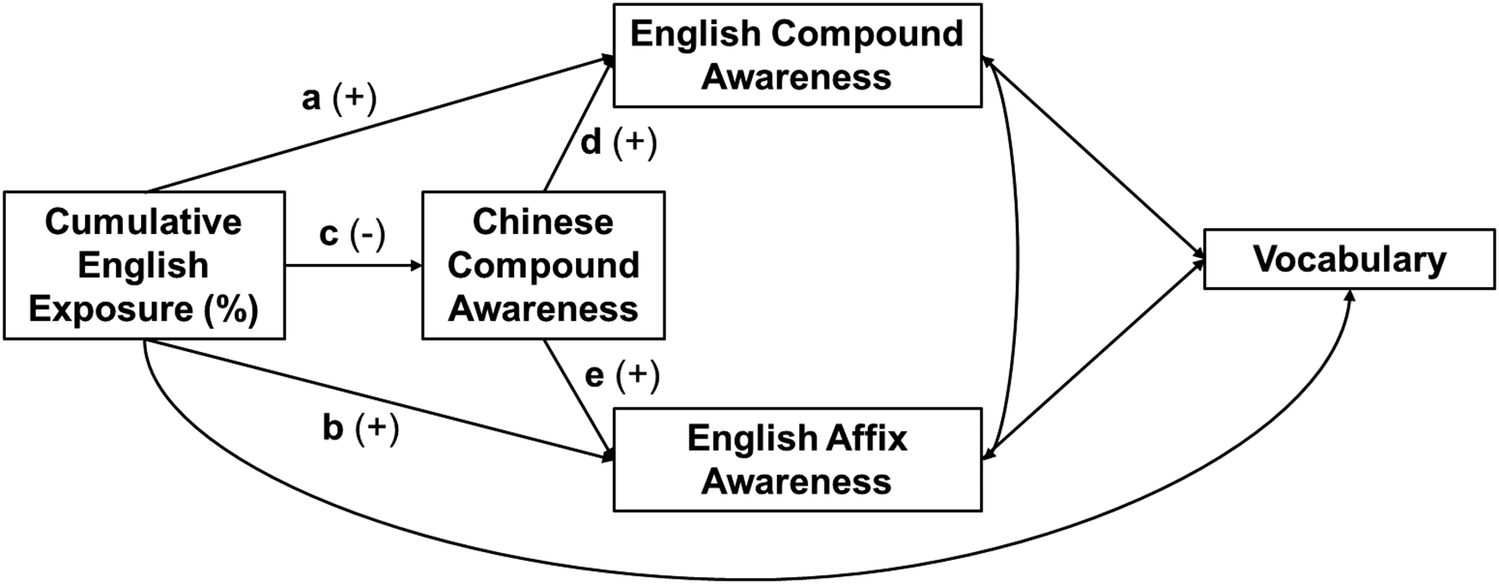
We first tested a model with Chinese-English bilingual children and examined how cumulative bilingual exposure and Chinese compound awareness contribute to the associations between the two types of morphological awareness and vocabulary. Figure 1 shows the hypothesized model of cumulative English exposure and Chinese compound awareness to two types of morphological awareness and vocabulary.
Proposed path model between English exposure, morphological awareness and vocabulary.
Note: Signs in the parentheses indicate the hypothesized directionality of the paths.

Figure 1. Long description
The flowchart consists of five rectangular boxes connected by directional arrows.
1. On the far left is a box labeled Cumulative English Exposure %.
2. In the center, there are three boxes arranged vertically. The top box is English Compound Awareness. The middle box is Chinese Compound Awareness. The bottom box is English Affix Awareness.
3. On the far right is a box labeled Vocabulary.
Pathways from Cumulative English Exposure %:
- Arrow a + points to English Compound Awareness.
- Arrow b + points to English Affix Awareness.
- Arrow c - points to Chinese Compound Awareness.
- A long curved arrow at the bottom points directly to Vocabulary.
Pathways from Chinese Compound Awareness:
- Arrow d + points to English Compound Awareness.
- Arrow e + points to English Affix Awareness.
Pathways to Vocabulary:
- Arrows point to Vocabulary from both English Compound Awareness and English Affix Awareness.
- A double-headed curved arrow connects English Compound Awareness and English Affix Awareness.
Before specifying the model hypotheses, we first clarify the nature of our exposure metric. We used cumulative English exposure (see detailed assessment approach in the Section 2) as an indicator of cumulative bilingual exposure. Along with cumulative Chinese exposure, it sums up to 100%. This creates a zero-sum dynamic that a lower percentage of English exposure denotes a higher percentage of Chinese exposure.
We predicted that, overall, more cumulative English exposure would not translate to higher English compound awareness, and this can be explained by the fact that English compound awareness receives stronger transfer effects from experience with compound-heavy Chinese; in contrast, cumulative English exposure will correspond to higher English affix awareness, as learners gain affix awareness primarily from English experience.
We tested several specific hypotheses (see Figure 1 for the specific paths). First, we hypothesized that the overall effect of cumulative English exposure on English affix awareness would be positive and significant. This overall effect is calculated by summing the direct effect between English exposure and English affix awareness, and the indirect effect via Chinese compound awareness (i.e., paths b + c*e).
Second, we hypothesized that the direct positive effect “b” would be stronger than the indirect negative effect “c*e”, which corresponds to the overall positive total effect in the hypothesis above. With proportionately more exposure to English indicating less exposure to Chinese (i.e., they sum to 100%), path “c” and in turn path “c*e” is expected to be negative, thus negatively correlated with Chinese compound awareness. We note that this negativity does not indicate a “negative transfer effect”; rather, it is an artifact of the relative metric of language exposure. In other words, if Chinese exposure was used as the exposure indicator, this path will become positive. Testing whether “b + c*e” is statistically different from zero therefore creates a test of whether the usage-based, direct effect English exposure (“b”) or transfer effect from Chinese (“c*e”) is stronger in facilitating English affix awareness.
Third, we hypothesized that the overall effect of cumulative English exposure on English compound awareness would not be significant. This overall effect is calculated by summing the direct effect between English exposure and English compound awareness, and the indirect effect via Chinese compound awareness (i.e., total effect of paths a, c, and d, “a + c*d”).
Fourth, we hypothesized that the direct positive effect “a” would not be statistically greater than the indirect negative effect “c*d”, which corresponds to the overall null total effect in the hypothesis above. Again, path “c*d” is expected to be negative because path “c” is hypothesized to be negative (see the second hypothesis above).
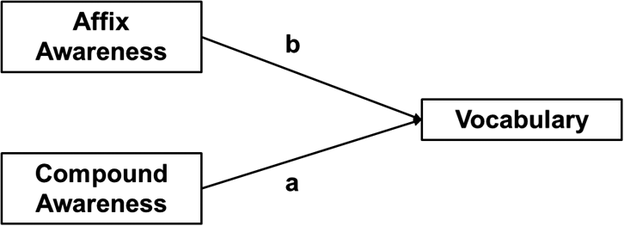
The second model examined how bilinguals’ dual-language experience shapes the associations between vocabulary and awareness of compounds and affixes through a direct comparison of these relations for Chinese-English bilinguals and English monolinguals. Chinese-English bilinguals receive rich exposure to compound structures from both languages, yet relatively less exposure to affix structures compared to English monolinguals. Thus, affix awareness best reflects one’s experience with English and is likely more important in statistically predicting vocabulary size in Chinese-English bilinguals (the usage-based framework, Tomasello, Reference Tomasello2000, Reference Tomasello2005). We therefore predict that affix awareness will be more strongly associated with vocabulary in Chinese-English bilinguals than in English monolinguals (Figure 2, Path a). Moreover, compound awareness will be more strongly associated with vocabulary in English monolinguals than in Chinese-English bilinguals (Figure 2, Path b).
Proposed model of English vocabulary in relation to English morphological awareness.

To address the above questions, 3- to 5-year-old preschool children who are either English monolingual or Chinese-English bilingual completed a set of language and literacy assessments in English. The assessments included the key variables of interest, morphological awareness (i.e., compound and affix awareness) and vocabulary. The morphological awareness measure was an experimenter-developed assessment adapted from previous research, shown to be age-appropriate in preschoolers (Lam & Sheng, Reference Lam and Sheng2016). Of note, for the affix awareness, we focused on two specific affixes (-er, -ing) because they are developmentally appropriate for the current age group (e.g., Berko, Reference Berko1958; Fejzo et al., Reference Fejzo, Desrochers and Deacon2018; Lam & Sheng, Reference Lam and Sheng2016). We acknowledge that they represent only a subset of English morphology, yet they are appropriate affixes to assess in this age group. As such, our findings are most directly applicable to early-emerging derivational and inflectional markers. Moreover, we included phonological awareness, letter-word identification, age and gender as control variables, in keeping with prior literature (e.g., McBride-Chang et al., Reference McBride-Chang, Wagner, Muse, Chow and Shu2005). Finally, a structured interview was conducted in which parents were asked to specify children’s cumulative exposure to each of their languages from birth to test our second set of questions.
2. Method
2.1. Participants
Participants were recruited as a part of a larger project examining the neural foundations for morphological word processing among 3- to 5-year-old English monolingual and Chinese-English bilingual children. We report here on the behavioral part of the data. Participants were recruited from [blinded for review] Canada. For the current study, the sample included N = 202 children (112 girls) aged 3 years 9 months to 5 years 11 months, M(SD)Age = 4.93(0.63). Before participating in the study, parents were first screened with a question to estimate their child’s overall language exposure: “What percent of the time does your child hear English?.” Their responses were used to estimate each child’s overall exposure to the English language. On the basis of these responses, participants were also categorized as monolingual if parents reported them to be exposed to English 90% or more of the time. There were n = 92 English monolingual children, M(SD)Age = 4.97(0.62), 49 girls. Chinese-English bilingual participants were born to and raised by at least one parent who speaks Chinese as their native and most proficient language and reported having exposure to Chinese at least 15% of the time. There were n = 110 Chinese-English bilinguals (M(SD)Age = 4.90(0.64), 63 girls). Chinese-English bilingual children were either exposed to Mandarin (n = 66) or Cantonese (n = 44). Monolinguals and bilinguals were matched on age (t (200) = .87, p = .39). The study was approved by the university Ethics Review Committee ([blinded for review]).
2.2. Measures
2.2.1. Language background interview
Participants’ cumulative language exposure was assessed using the Multilingual Approach to Parent Language Estimates (MAPLE, Byers-Heinlein et al., Reference Byers-Heinlein, Schott, Gonzalez-Barrero, Brouillard, Dubé, Jardak and Tamayo2020). The MAPLE measure is attached in the Supplementary Material. The questionnaire is comprised of a structured interview with the parents to document an hour-by-hour exposure to the languages children hear as they grow up. The interview first separates the child’s life experience into several time periods based on whether there were major changes in their language exposure. Then, the interview delves into each period and asks for the specific number of hours the child hears each of their languages on typical weekdays and weekends. Questions about several aspects of the child’s life are asked to determine the time period separation: (1) age of attending child care and language(s) spoken at child care, (2) home language exposure with parents, grandparents, and/or other members of the family; (3) trips or foreign living experiences that may affect their child’s language exposure; and (4) the child’s sleep schedule (i.e., how many hours of a day their child sleeps and stays awake) and major changes in sleep schedule. Parents were further asked to estimate the number of hours children hear each of their languages for each day of the week (e.g., “You indicate on the questionnaire that during the beginning three months of their life, your child was awake for 6 hours a day. Out of these 6 hours, how many hours did he typically hear English and Chinese?”). Parents were instructed that their exposure estimates should be based on languages spoken directly to the child, excluding radio/TV. The interview takes around 20–30 minutes for a bilingual family and 5–20 minutes for a monolingual family. After the interview, the experimenter calculated the cumulative hours of exposure for each language by adding up all hours of each language for all periods. Cumulative English exposure was expressed as a percentage, calculated by dividing the hours of English exposure by the total hours of language exposure. Note that cumulative English exposure and cumulative Chinese exposure sum up to 100%. The cumulative English exposure in English monolingual participants was M(SD) = 96% (0.08). The cumulative English and Chinese exposure in Chinese bilingual participants were M(SD) = 44% (0.22) and M(SD) = 54% (0.23), respectively. The language group classifications based on the initial screening question were all verified, aligned and made more precise with the MAPLE measure.
2.2.2. English morphological awareness
We assessed children’s awareness of compound words and affix-based words. Both types of morphological awareness were assessed using a subset of the morphological production tasks described by Lam and Sheng (Reference Lam and Sheng2016). The original measure was designed for children aged 4 to 8 years. For each item, a child was first shown a picture and asked to name the picture with either compounding or affix regularities. The words selected in the task were controlled for word frequency (Lam & Sheng, Reference Lam and Sheng2016). Two practice items were conducted to introduce the task to the child before the experimental items described below.
The Compound Awareness task has a total of 20 items, with 10 real-compound items (e.g., “snow-man,” “cheeseburger”), and 10 novel-compound items (e.g., “flower-man,” “cereal-burger”). An example practice item was a picture of a bear painted brown. The experimenter would point to the picture and say, “This is a bear with brown fur. What do we call a bear with brown fur? We call it a ___. (brown-bear).” Following two practice trials, the test phase began, where the child had to answer the “what do you call…” question. For the current sample, the internal consistency of the task is α = .90.
The Affix Awareness task also has a total of 20 items, with 10 items tapping into the affix “-ing” (e.g., “teach-ing,” “climb-ing”) and 10 tapping into the affix “-er” (e.g., “read-er,” “garden-er”). An example practice item was a picture of a surfer. The experimenter would point to the picture and say, “He likes to surf. What do we call a person who likes to surf? He is a ___. (surfer). What is he doing now? He is ___. (surfing).” Again, there were two practice trials. The internal consistency of the task is α = .94.
2.2.3. English receptive vocabulary
Receptive vocabulary was assessed with the Peabody Picture Vocabulary Test 5 (PPVT-5, Dunn, Reference Dunn2019). In the PPVT, children start from their age-appropriate sets of words and stop when they make six consecutive mistakes. For each item, children were shown four pictures and asked to pick the one that best described a word. PPVT-5 has high overall reliability (.97) and test–retest reliability (.88), according to Dunn (Reference Dunn2019). For the current sample, the internal consistency is α = .96.
2.2.4. English phonological awareness
Phonological awareness was measured by a standardized measure from the blending subtest of the Comprehensive Test of Phonological Processing (CTOPP; Wagner et al., Reference Wagner, Torgesen, Rashotte and Pearson1999). For each item, children heard parts of a word and were asked to say the word by blending the parts together. The task starts with full syllable parts, for example, “cow, girl” (blend to “cowgirl”), and becomes more difficult by requiring blending multiple single phonemes, for example, /s/ /t/ /æ/ /m/ /p/ (blend to “stamp”). Children all begin with the first item and end when they make three consecutive errors. CTOPP has high internal consistency with an α > .80 reported in the manual (Wagner et al., Reference Wagner, Torgesen, Rashotte and Pearson1999). For the current sample, the internal consistency is α = .94.
2.2.5. English letter-word identification
Children’s knowledge of letter and word decoding was assessed by the Letter-Word Identification subtest from the standardized Woodcock-Johnson IV (Schrank et al., Reference Schrank, McGrew and Mather2014). Children were first asked to identify visually presented letters and then, if successful, moved to single-word reading. The items were presented with increasing difficulty, and children began with the first item and ended when they made six consecutive errors. There was a total of 78 items. Items 1 to 10 tested letter knowledge, items 11 to 13 tested word recognition (i.e., selecting a written word from four candidate words upon hearing a word) and the remaining items required children to read words themselves. This measure has high test–retest reliability (>.90, Canivez, Reference Canivez, Carlson, Geisinger and Jonson2017). For the current sample, the internal consistency is α = .97.
2.2.6. Chinese compound awareness
Chinese-English bilingual children completed a Chinese compound awareness task, which is a morphological production test adapted from Sun et al. (Reference Sun, Zhang, Marks, Nickerson, Eggleston, Yu, Chou, Tardif and Kovelman2022) with an internal consistency of α = .93. The items were selected based on our pilot data in order to match the word knowledge of this age group. Children are taught the meaning of a compound word and asked to create a new word with the morphemes in the given word. Pictures are provided to help children understand each item. For example, “如果有张纸是白色的, 我们就会叫它白纸, 如果有张纸它是红色的, 我们叫它?(红纸)” (If this piece of paper that is white is called white paper, then if there is a piece of paper that is red, then we call it …? Red paper). The task has a Mandarin and a Cantonese version.
2.3. Data analysis
Path analysis models for both research questions were modeled in Figures 1 and 2. Analyses were conducted using the Lavaan package in R. In both models, as our primary focus is on the associations between language experience, morphological awareness and vocabulary, we included phonological awareness, letter-word identification, age and gender as control variables. All paths indicated in Figures 1 and 2 were modeled freely, without constraining any coefficients to 0 or other values. R codes of the path models are available on OSF: https://osf.io/cbhzj/overview?view_only=d4d55d7c3530419a86f49137f79b09a2
3. Results
3.1. Descriptive statistics and correlations of tasks and English exposure
Table 1 displays the means and standard deviations of all tasks by language group. Monolinguals and bilinguals did not differ in age (p = .495). Monolinguals were exposed to English for significantly more time than bilinguals (p < .001). For task performance differences, a MANOVA was conducted to find out if bilinguals and monolinguals differ in any of the task raw scores. MANOVA yielded significance, F (5, 196) = 8.50, p < .001. Individual t-tests results were next conducted for each task to compare scores between monolinguals and bilinguals (see Table 1). Bilinguals scored similarly to monolinguals on tasks assessing English phonological awareness (p = .603) and English letter-word decoding (p = .258); as expected, bilinguals scored lower on tasks assessing English vocabulary (p < .001) and English morphological awareness (p = .006 for English compound awareness and p < .001 for English affix awareness). In terms of standard scores, the two groups did not differ in English phonological awareness (p = .946), monolinguals scored higher in English vocabulary (p < .001), and bilinguals scored higher in English letter-word identification (p = .026, see Table 1). Table 2 shows bivariate and age- and gender-controlled partial correlations across all tasks and between tasks and English exposure by language group.
Age, English exposure and language task scores by language group

Table 1. Long description
The table presents data for two groups: Chinese-English bilingual (N = 110) and English monolingual (N = 92). For each metric, the Mean (M) and Standard Deviation (SD) are provided, followed by t-values and p-values.
Demographics and Exposure:
* Age (Month): Bilinguals 58.77 (7.67), Monolinguals 59.70 (7.41), t = .68, p = .495.
* Cumulative English exposure: Bilinguals 44% (.22), Monolinguals 96% (.08), t = 22.3, p < .001.
Raw Scores (Max Score):
* Phonological awareness (30): Bilinguals 9.25 (5.89), Monolinguals 9.71 (6.35), t = .52, p = .603.
* Letter-word decoding (78): Bilinguals 16.55 (12.68), Monolinguals 14.58 (11.92), t = 1.14, p = .258.
* Compound awareness (20): Bilinguals 12.24 (4.70), Monolinguals 13.99 (4.21), t = 2.79, p = .006.
* Affix awareness (20): Bilinguals 12.84 (5.64), Monolinguals 15.36 (5.05), t = 3.35, p < .001.
* Vocabulary (240): Bilinguals 98.81 (27.89), Monolinguals 119.32 (29.22), t = 5.07, p < .001.
* Chinese compound awareness (15): Bilinguals 6.19 (4.25), Monolinguals not applicable.
Standard Scores (Mean):
* Phonological awareness (10): Bilinguals 9.30 (2.42), Monolinguals 9.33 (2.59), t = .07, p = .946.
* Letter-word decoding (100): Bilinguals 103.71 (14.92), Monolinguals 98.63 (16.80), t = 2.25, p = .026.
* Vocabulary (100): Bilinguals 101.51 (18.38), Monolinguals 115.72 (21.37), t = 5.01, p < .001.
Note: All tests are in English except for the Chinese Compound awareness.
Bivariate and age- and gender-controlled partial correlations by language group

Table 2. Long description
The table is split into two primary sections.
Section 1: English monolingual group. Measures include 1. Phonological awareness, 2. Letter-word decoding, 3. Compound awareness, 4. Affix awareness, and 5. Vocabulary.
* Bivariate correlations (above diagonal): Range from .37 to .72. The strongest correlation is between Compound awareness and Affix awareness (.72).
* Partial correlations (below diagonal): Range from .21 to .65. The strongest is between Compound awareness and Affix awareness (.65).
Section 2: Chinese-English bilingual group. Measures include the five from Section 1 plus 6. Cumulative English exposure and 7. Chinese compound awareness.
* Bivariate correlations (above diagonal): Range from -.37 to .66. Notable correlations include Affix awareness and Vocabulary (.66), and a negative correlation between Cumulative English exposure and Chinese compound awareness (-.37).
* Partial correlations (below diagonal): Range from -.42 to .56. Notable values include the correlation between Affix awareness and Vocabulary (.56) and a negative correlation between Chinese compound awareness and Cumulative English exposure (-.42).
Significance levels are indicated by asterisks: * p < .05, ** p < .01, *** p < .001, and ns for non-significant.
Note: Coefficients above the diagonals are bivariate correlations, and coefficients below the diagonals are partial correlations controlled for age and gender. ns p > .05, * p < .05, ** p < .01 and *** p < .001.
3.2. Model 1: The contribution of the cumulative English exposure and Chinese compound awareness to English morphological awareness and English vocabulary in Chinese-English bilingual children
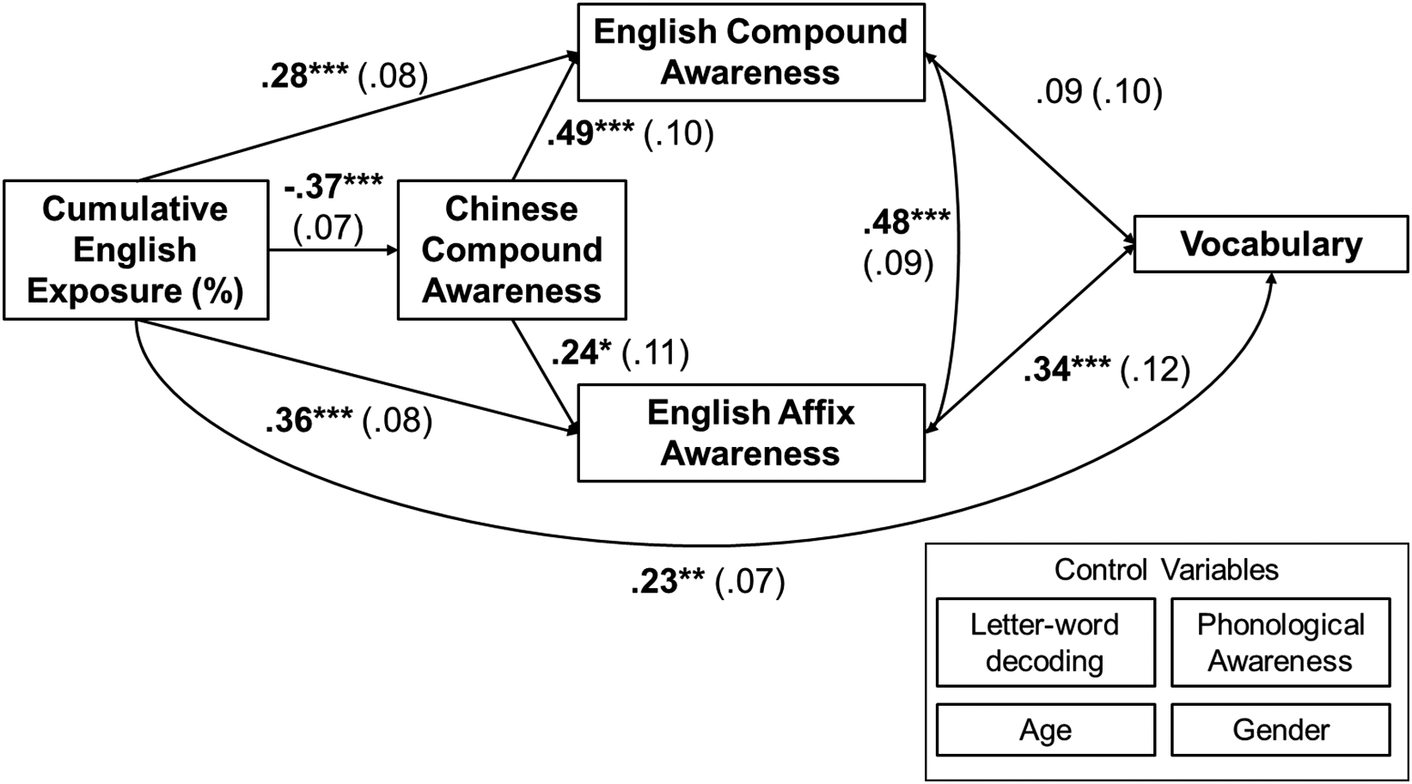
Model 1 examined the role of cumulative English exposure and Chinese compound awareness in English compound and affix awareness and English vocabulary in bilingual Chinese-English children with a path model (Figure 1). Because this specified model was near-saturated (df = 1), the initial estimation yielded mathematically perfect, yet uninformative, global fit indices: χ2(1) = .01, p = .935; comparative fit index (CFI) = 1.000; Tucker–Lewis index (TLI) = 1.116; root mean square error of approximation (RMSEA) = .000 (.000, .076) and standardized root mean square residual (SRMR) = .001. These fit indices are not mathematically stable and hard to interpret as the model had an extremely small degree of freedom (Kenny et al., Reference Kenny, Kaniskan and McCoach2015). Furthermore, the goal of the current model was not to evaluate holistic model fit, but rather to test whether the specific path coefficients support our conceptual hypotheses. Therefore, we took an alternative approach to ensure the robustness of the model by using bias-corrected bootstrapping with 5,000 resamples to generate robust 95% Confidence Intervals (CIs). We report the core standardized estimates, their SEs, 95% CIs and the p values below. Core standardized coefficients are also shown in Figure 3. All other estimates are reported in Supplementary Table S1.
Path model of the role of English exposure to morphological awareness and vocabulary in Chinese-English Bilinguals.
Note: All coefficients are standardized with SE in parentheses. Control variables were included in the model, but their coefficients are not displayed here for brevity and can be found in Supplementary Table S1.

Figure 3. Long description
The path model flows from left to right.
1. Predictor Variable: On the far left is Cumulative English Exposure percent.
2. Mediating Variables: In the center are three boxes.
- Chinese Compound Awareness is positioned in the middle.
- English Compound Awareness is positioned above it.
- English Affix Awareness is positioned below it.
3. Outcome Variable: On the far right is Vocabulary.
Path Coefficients from Cumulative English Exposure percent:
- To English Compound Awareness: .28*** .08.
- To Chinese Compound Awareness: -.37*** .07.
- To English Affix Awareness: .36*** .08.
- To Vocabulary: .23** .07.
Path Coefficients from Chinese Compound Awareness:
- To English Compound Awareness: .49*** .10.
- To English Affix Awareness: .24* .11.
Path Coefficients to Vocabulary:
- From English Compound Awareness: .09 .10.
- From English Affix Awareness: .34*** .12.
There is a bidirectional curved arrow between English Compound Awareness and English Affix Awareness with a coefficient of .48*** .09.
A separate box at the bottom right lists Control Variables: Letter-word decoding, Phonological Awareness, Age, and Gender.
Hypotheses 1 and 2 predicted that the total effect of cumulative English exposure on English compound awareness is not significant (i.e., corresponds to the “a + c*d” paths in Figure 1), and this is due to an equivalent or stronger indirect negative effect via Chinese compound awareness (i.e., corresponds to the “c*d” path in Figure 1). As expected, this total effect was not significant, βpaths a + c*d (SE) = .10 (.09), 95% CI = (−.07, .27), p = .242. To break it down, cumulative English exposure was directly associated with English compound awareness, βpath a (SE) = .28 (.08), 95% CI = (.13, .43), p < .001. However, as more English exposure was associated with lower Chinese skills, it led to a negative indirect effect via Chinese compound awareness, βpath c*d (SE) = −.18 (.05), 95% CI = (−.28, −.08), p < .001. Hypotheses 1 and 2 were thus satisfied.
Hypotheses 3 and 4 predicted that the total effect of cumulative English exposure on English affix awareness is significant (i.e., corresponds to the “b + c*e” paths in Figure 1), and this is due to a stronger direct effect between the two (i.e., corresponds to the “b” path in Figure 1) than the indirect effect via Chinese compound awareness (i.e., corresponds to the “c*e” path in Figure 1). As expected, this total effect was significant, βpaths b + c*e (SE) = .27 (.08), 95% CI = (.11, .42), p < .001. To break it down, cumulative English exposure was directly associated with English affix awareness, βpath b (SE) = .36 (.08), 95% CI = (.19, .52), p < .001. As more English exposure was associated with lower Chinese skills, this led to a negative indirect effect via Chinese compound awareness, and this effect was marginally non-significant, βpath c*e (SE) = −.09 (.05), 95% CI = (−.18, .00), p = .055. Hypotheses 3 and 4 were thus satisfied.
3.3. Model 2: English vocabulary in relation to English compound and affix awareness in Bilingual and monolingual children
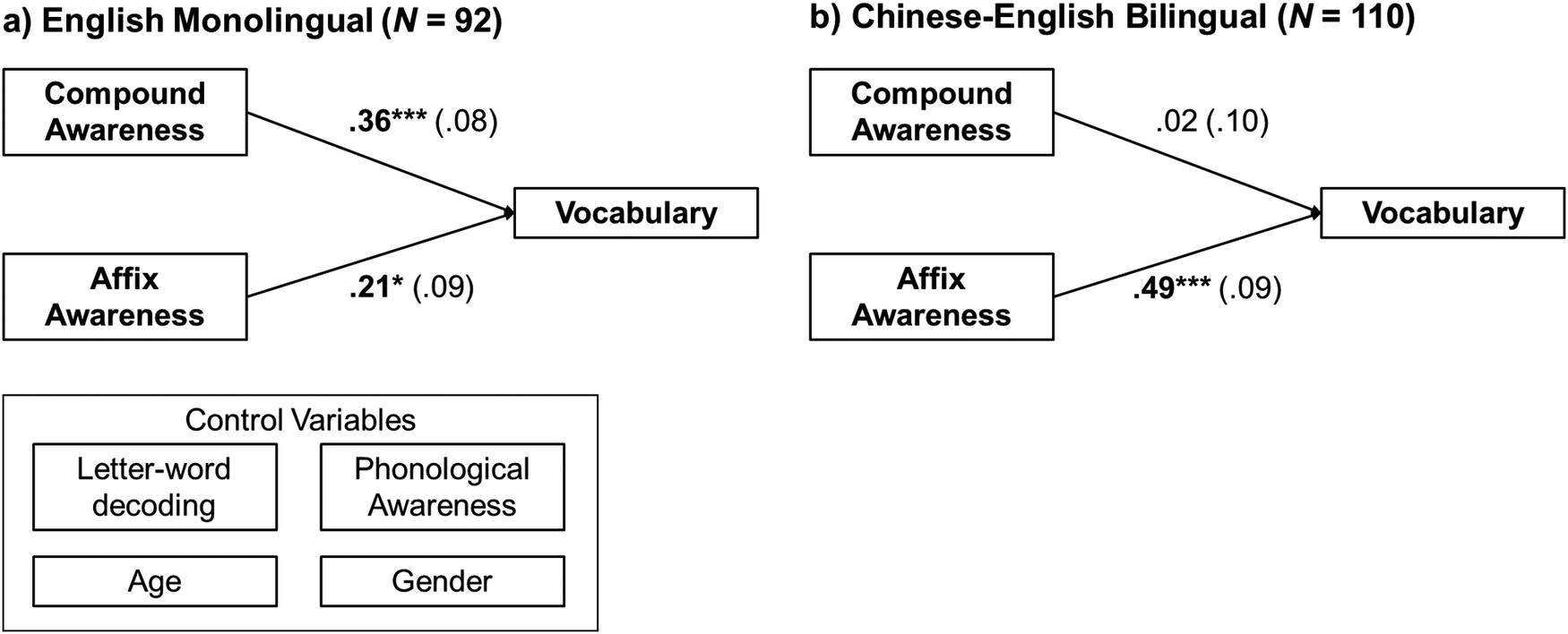
Model 2 tested how English compound and affix awareness may be differentially related to English vocabulary in Chinese Bilingual and English monolingual children. We fitted a multi-group path model mapping scores for each of the compound and affix awareness to vocabulary. Age, gender, English phonological awareness and English letter-word identification were entered into the model as control variables. Measurement invariance was tested with a configural model first by imposing the same path structures across all groups. Next, a strong invariance model imposing equal intercepts across groups was estimated. Finally, a strict invariance model was fitted by imposing equal error variances and covariances across groups. Chi-square tests among the three models indicated strict invariance (according to Kline, Reference Kline2005). Again, the strict invariance model showed very good fit, yet these indices are not mathematically stable, χ2(2) = .20, p = .91; comparative fit index (CFI) = 1.000; Tucker–Lewis index (TLI) = 1.074; root mean square error of approximation (RMSEA) = .000; standardized root mean square residual (SRMR) = .004. We again applied the bootstrapping method to estimate the path coefficients of this model, and we report the core standardized estimates, their SEs, 95% CIs and the p values. Core standardized coefficients are also shown in Figure 4. The remaining estimates are reported in Supplementary Table S2. In English monolinguals, controlling for age, gender and English phonological and English letter-word identification skills, both English compound (βmonolingual b (SE) = .36 (.08), 95% CI = (.19, .52), p < .001) and affix awareness (βmonolingual a (SE) = .21 (.09), 95% CI = (.03, .39), p = .021) were significantly associated with English vocabulary. In Chinese bilinguals, controlling for the same set of variables, only English affix awareness (βbilingual b (SE) = .49 (.09) and 95% CI = (.31, .67), p < .001), and not English compound awareness (βbilingual a (SE) = .02 (.10), 95% CI = (−.18, .22), p = .838), were significantly associated with English vocabulary. In the next section, we tested cross-group differences by statistically comparing the two language groups and comparing the association strengths of each type of English morphological awareness and English vocabulary.
Multi-group path model results of associations between English morphological awareness and English vocabulary for (A) English monolingual and (B) Chinese-English bilingual participants.
Note: All coefficients are standardized with SE in parentheses. Control variables were included in the model, but their coefficients are not displayed here for brevity and can be found in Supplementary Table S2.

Figure 4. Long description
A two-panel path model diagram.
Panel a, English Monolingual (N = 92):
Two predictor boxes on the left point to a single outcome box, Vocabulary, on the right.
- Compound Awareness to Vocabulary has a path coefficient of .36*** with an S E of .08.
- Affix Awareness to Vocabulary has a path coefficient of .21* with an S E of .09.
Panel b, Chinese-English Bilingual (N = 110):
Two predictor boxes on the left point to the Vocabulary outcome box on the right.
- Compound Awareness to Vocabulary has a non-significant path coefficient of .02 with an S E of .10.
- Affix Awareness to Vocabulary has a path coefficient of .49*** with an S E of .09.
Below the panels is a box labeled Control Variables containing four sub-boxes: Letter-word decoding, Phonological Awareness, Age, and Gender.
3.3.1. English compound awareness to English vocabulary
To test whether English compound awareness is more strongly associated with English vocabulary in English monolingual (βmonolingual b (SE) = .36 (.08), 95% CI = (.19, .52), p < .001) than in Chinese bilingual (βbilingual a (SE) = .02 (.10), 95% CI = (−.18, .22), p = .838) children, we fit a separate model constraining the compound awareness to vocabulary path to have equal values in the two groups. The fit indices were compared with the freely estimated model shown in Figure 4. The Chi-square test showed that the freely estimated model fit significantly better than the constrained model. χ2 (1) = 6.96, p = .008. This result suggests that, consistent with our hypothesis, compound awareness is more strongly associated with vocabulary in English monolingual children than in Chinese bilinguals.
3.3.2. English affix awareness to English vocabulary
To test whether English affix awareness is more strongly associated with English vocabulary in Chinese bilingual (βbilingual b (SE) = .49 (.09), 95% CI = (.31, .67), p < .001) than in English monolingual children (βmonolingual a (SE) = .21 (.09), 95% CI = (.03, .39), p = .021), we again fit a different model constraining the affix awareness to vocabulary path to have equal values between the two groups. The fit indices were compared with the freely estimated model, as shown in Figure 4. The Chi-square test showed that the freely estimated model does not provide a statistically better fit than the constrained model with a marginal non-significant difference, χ2 (1) = 2.84, p = .092. Thus, affix awareness is numerically but not statistically more strongly associated with vocabulary in Chinese bilingual children than in English monolingual children.
4. Discussion
Morphological awareness is essential for gaining new vocabulary, making it important in early language and literacy development. Yet, since languages differ in their morphological structures, bilingualism provides children with varied experiences with each structure, leading to unique profiles for bilingual language development. In particular, Chinese is characterized by its abundant compounds, whereas affixes are more featured in English. These structural differences may create varying strengths of within- and cross-language influences on the two types of morphological awareness, and in turn, change the way morphological awareness contributes to vocabulary. Moreover, developmentally, as children acquire compound awareness during preschool years, it may be as important as affix awareness, if not more so, to language and emergent literacy development prior to formal literacy instruction.
The current research tested the possibility of two distinct pathways through which Chinese-English bilingual preschoolers acquire English compound and affix awareness, and their associations with English vocabulary. We hypothesized that, for bilinguals, English affix awareness is primarily associated with the proportion of exposure to English, with greater affix awareness corresponding to larger English vocabulary sizes. In contrast, we predicted that English compound awareness will not be associated with exposure to English, as it is more influenced by cross-language transfer from Chinese. Furthermore, we anticipated that stronger English compound awareness will not necessarily translate into larger vocabulary sizes in bilinguals, as the transfer is limited to the ability to operate on word roots rather than knowledge of specific lexical items.
Results from our first path model with the bilingual sample are consistent with the hypotheses on the two distinct ways of English morphological awareness development. First, there was an overall significant association between cumulative English exposure and English affix awareness, indicating that affix awareness is primarily facilitated by the cumulative English experience in bilinguals (Model 1, Hypotheses 1 and 2). Second, and in contrast, the overall association between cumulative English exposure and English compound awareness was not significant, and this was explained by the stronger transfer effects from Chinese compound awareness (Model 1, Hypotheses 3 and 4). In other words, while there were within- and cross-language impacts for both English affix and compound awareness, indicated by significant direct effects from both English exposure and Chinese transfer, the within-language effect was stronger in facilitating English affix awareness, while Chinese transfer effects explained more of the variance in English compound awareness.
Model 2 tested a direct comparison between Chinese-English bilinguals and English monolinguals. Results show bilinguals’ and monolinguals’ distinct patterns of associations between English morphological awareness and English vocabulary. In the Chinese bilingual sample, English affix but not compound awareness was a significant statistical predictor of English vocabulary. In comparison, in the English monolingual sample, both types of English morphological awareness were significantly associated with English vocabulary. These results aligned with the notion that Chinese-English bilingual children gain knowledge of compound and affix structures via two different pathways: affixing was gained primarily, if not only, from English and not Chinese, while compounding received stronger cross-language transfer facilitation from Chinese. In terms of findings about the impacts of affix awareness, these results are consistent with a prior study showing that derivational but not compound awareness is a significant predictor of English reading outcomes in Chinese-English bilingual kindergarten to third-grade children (Marks et al., Reference Marks, Labotka, Sun, Nickerson, Zhang, Eggleston, Yu, Uchikoshi, Hoeft and Kovelman2023). Turning to effects of compound awareness, the results suggest that Chinese experience boosts bilinguals’ English compound awareness by facilitating their skill in manipulating root morphemes in English, and of affixes or knowledge of specific lexical items, and thus, a stronger English compound awareness does not appear to correspond to a larger English vocabulary.
Our research tapped into morphological awareness, one of the essential aspects of language development, and offered evidence for a dual-pathway acquisition of English morphological awareness in Chinese-English bilinguals. In particular, exposure to Chinese familiarizes children with awareness of compounds but not affixes, making the cumulative English exposure essential for understanding affix structures and growing children’s vocabulary. The significant paths between vocabulary and affix awareness are consistent with the prior research showing overall positive associations between cumulative English language exposure and lexico-semantic skills in bilingual children (Cristia, Reference Cristia2020; Lauro et al., Reference Lauro, Core and Hoff2020; Thordardottir, Reference Thordardottir2015; Weisleder & Fernald, Reference Weisleder and Fernald2013). Extending this, the contrasting effects of affix versus compound awareness bring novel evidence to language-specific impacts on bilingual development, including at an earlier developmental stage. Together, our results add to the understanding of how children’s experience with specific language structures results in unique patterns in bilingual learning.
Our research yields theoretical implications for bilingual language development. Indeed, our research informs the bilingual transfer and usage-based accounts of language acquisition (Chung et al., Reference Chung, Chen and Deacon2018, Reference Chung, Chen and Geva2019; Tomasello, Reference Tomasello2000, Reference Tomasello2005) by mapping out the specific impacts of bilingual exposure on the associations between vocabulary and morphological awareness. In particular, bilingual interaction is a complex and integrated concert which relies on both the piecemeal experience with specific linguistic elements, and influences from exposure to other language inputs. In particular, experience with Chinese facilitates compound awareness in English, thereby advancing English language development. At the same time, as Chinese lacks affix structures, Chinese-English bilingual children may not receive sufficient exposure to English affixes, and thus it could be useful to expose Chinese-English bilingual children to English affix structures.
From a practical lens, the current study informs language instruction for bilingual learners, especially those whose primary language features different language structures. For example, English morphological instruction may focus on teaching affixes to Chinese-English bilingual children to increase their awareness of inflectional and derivational markers and hence enrich English vocabulary acquisition. This may be especially effective given the evidence that morphological interventions significantly boost children’s vocabulary (see a review with English-speaking children, Brady & Mason, Reference Brady and Mason2024). Other practical implications include setting up norms for bilingual children that consider their experiences with other languages. Researchers have suggested that educators and SLPs should take into account children’s specific language experience to avoid erroneously assessing them as language delayed or impaired (D’Souza et al., Reference D’Souza, Kay-Raining Bird and Deacon2012; Paradis, Reference Paradis2005; Paradis & Jia, Reference Paradis and Jia2017). The current study echoes and adds specific evidence to these recommendations by revealing the specific ways Chinese-English bilingual children approach language development in English.
The current study offers novel evidence by zooming in on preschoolers, a previously understudied group in morphological awareness and language development. In particular, our findings with monolinguals, together with other studies with older children, point to a potential developmental shift in the role of morphological awareness in language acquisition. Specifically, in our study with preschool aged monolingual children, both compound and affix awareness are significantly associated with vocabulary, and compound awareness even yielded a numerically stronger association than affix awareness. In contrast, another study with school-age English monolingual children showed an opposite pattern, that derivational (affix) but not compound awareness was a significant predictor of literacy (Marks et al., Reference Marks, Labotka, Sun, Nickerson, Zhang, Eggleston, Yu, Uchikoshi, Hoeft and Kovelman2023). These findings suggest that children’s understanding of root and affix morphemes likely shifts across developmental stages. As emergent users of morphemes, preschoolers are likely to develop morphological awareness primarily through exposure to various root morphemes, with only a limited number of affixes (Kuo & Anderson, Reference Kuo and Anderson2006). Thus, in this preschool-aged (3–5 years) group, compound awareness is more predictive of language proficiency. In contrast, for school-age children, reading instruction and broader literacy experiences enrich children’s knowledge of a range of affixes, making awareness of them increasingly essential to language and literacy (Anglin et al., Reference Anglin, Miller and Wakefield1993; Korochkina et al., Reference Korochkina, Cooper, Brysbaert and Rastle2025). Together, these findings from different age groups of monolingual learners begin to fill out a developmental picture and highlight the importance of supporting compound knowledge as a foundation for language and later literacy development.
Our research also contributes to the measurement of English morphological awareness in English-learning children. Despite the fact that English word morphology features both compound and affix structures, studies on the relation of English morphological awareness to language and literacy skills in school-age children have often focused on measuring affix (i.e., inflectional and derivational) awareness (e.g., Sparks & Deacon, Reference Sparks and Deacon2015; Spencer et al., Reference Spencer, Muse, Wagner, Foorman, Petscher, Schatschneider and Bishop2015). While we acknowledge that the awareness of affixes is key to children’s language and literacy in English (Anglin et al., Reference Anglin, Miller and Wakefield1993), the exclusion of compound awareness may reflect a cultural bias that limits scientific advances, especially when studying younger and linguistically diverse populations. As such, the current work adds to the literature by including and contrasting the effects of English affix and compound awareness, and focusing on beginning users of morphemes who show equivalent proficiency with the two structures. The findings suggest that awareness of both word roots (as in compound words like snow-man) and bound morphemes (as in inflectional and derivational words, -er, -ing) is essential to supporting vocabulary at early stages of language development, before formal schooling.
Several limitations and future directions should be considered. First, in terms of measurement, we focused on two age-appropriate affix measures; therefore, our findings are most directly applicable to early-emerging affix markers. Relatedly, the language exposure indicator was a well-validated parent-report interview measure that records detailed hour-by-hour language exposure estimates (Byers-Heinlein et al., Reference Byers-Heinlein, Schott, Gonzalez-Barrero, Brouillard, Dubé, Jardak and Tamayo2020); while this measure is a parent-report instrument and thus susceptible to reporting bias, its high correlation with recorded input data (Orena et al., Reference Orena, Byers-Heinlein and Polka2019) increases our confidence in its reliability. Second, our study design is based on correlational data, which limits inferences concerning directionality between constructs. Future longitudinal designs may specify the directionality of vocabulary and morphological development, particularly given the mixed patterns in developmental studies to date (Grande et al., Reference Grande, Diamanti, Protopapas, Melby-Lervåg and Lervåg2024; Sparks & Deacon, Reference Sparks and Deacon2015; Zhao et al., Reference Zhao, Cheng, Wu and Nguyen2016), as well as whether and how bilingual exposure may play a role. In keeping with the need for developmental data, tests of instruction in affix awareness on language and reading outcomes would be important extensions. Finally, as with all studies, our results apply most directly to the age and language groups under investigation – specifically, the preschool English-monolingual and Chinese-English heritage bilingual children in Canada; important extensions include testing these effects with other language pairings and with children with varied bilingual experience in other settings. For example, the current cross-linguistic transfer effects may be stronger in Chinese-English bilingual children in Chinese contexts such as in Hong Kong, given that they are typically Chinese-dominant speakers.
A child’s language development is highly influenced by their linguistic experience. For children growing up in bilingual environments, specific aspects of each language may change how they learn to become successful language users. The current study examines how early linguistic experience is associated with children’s language development. Our findings showed that Chinese-English bilingual children’s dual-language experience is associated with specific morpho-semantic skills in English, showing cross-linguistic interactions at particular aspects of language acquisition. Moreover, English monolingual and Chinese-English bilingual preschoolers built different associations between their vocabulary and morphological awareness. Together, these findings add to the literature on how young children from diverse linguistic backgrounds approach language and yield theoretical and practical implications for bilingual research and instruction.
Supplementary material
The supplementary material for this article can be found at http://doi.org/10.1017/S1366728926101801.
Data availability statement
The code is currently available in OSF https://osf.io/cbhzj/overview?view_only=d4d55d7c3530419a86f49137f79b09a2. The data that support the findings will be available in OSF from the date of publication.
Funding statement
This work was supported by a Banting Postdoctoral Fellowship awarded to Xin Sun, and a Social Sciences and Humanities Research Council Partnership Grant awarded to Janet F. Werker and S. Hélène Deacon.
Competing interests
The authors have no competing interests to declare.
Disclosure of use of AI tools
In the preparation of this thesis, the following AI tool was used: ChatGPT. This tool was used primarily to conduct grammar checks. The authors completed the primary version of the manuscript and acknowledge full responsibility for the intellectual content. The authors have ensured all AI-assisted sections have been reviewed for accuracy.




 Open access

