With close to 7000 oral languages in use around the world today (Skutnabb-Kangas, Reference Skutnabb-Kangas2000), and approximately 200 independent countries (Independent States in the World, 2012), humans are more likely than not to be able to speak multiple languages. It has been estimated that at least half of the world's population is multilingual (Grosjean & Miller, Reference Grosjean and Miller1994), and the acquisition of more than one language has been associated with cognitive benefits throughout the lifespan (Bialystok, Craik & Ryan, Reference Bialystok, Craik and Ryan2006; Carlson & Meltzoff, Reference Carlson and Meltzoff2008; Costa, Hernández & Sebastián-Gallés, Reference Costa, Hernández and Sebastián-Gallés2008). Cognitive advantages of bilingualism have even been found during the first year of life (Brito & Barr, Reference Brito and Barr2014; Kovács & Mehler, Reference Kovács and Mehler2009a), and it has been hypothesized that the origin of this bilingual advantage may come from the need to discriminate input and detect patterns within speech (Kovács & Mehler, Reference Kovács and Mehler2009b; Sebastián-Gallés, Albareda-Castellot, Weikum & Werker, Reference Sebastián-Gallés, Albareda-Castellot, Weikum and Werker2012).
Although infants appear to seamlessly acquire language, they are in fact presented with a very complex task of identifying patterns within a string of speech sounds (Kuhl, Reference Kuhl2004; Saffran, Aslin & Newport, Reference Saffran, Aslin and Newport1996). During early bilingual language acquisition, this presents an even bigger challenge as language input is more complex and bilingual infants must discriminate between their own languages and extract the correct patterns for each individual language (Bosch & Sebastián-Gallés, Reference Bosch and Sebastián-Gallés2001). To help facilitate simultaneous language acquisition, cognitive resources may be enhanced or available earlier in development. Past studies have found that compared to monolingual infants, bilingual infants are better able to learn complex structural regularities (Kovács & Mehler, Reference Kovács and Mehler2009b) and are more likely to flexibly apply past memory experiences to novel situations (Brito & Barr, Reference Brito and Barr2012; Reference Brito and Barr2014).
During infancy, the ability to flexibly retrieve past memories is poor and even slight changes in the stimuli or context at the time of memory retrieval can disrupt memory performance, but infants are able to tolerate more differences between learning and test as they develop (Barr & Brito, Reference Barr, Brito, Bauer and Fivush2013; Borovsky & Rovee-Collier, Reference Borovsky and Rovee-Collier1990; Hayne, Reference Hayne, Munakata and Johnson2006; Herbert & Hayne, Reference Herbert and Hayne2000; Learmonth, Lamberth & Rovee-Collier, Reference Learmonth, Lamberth and Rovee-Collier2004). The ability to retrieve memories despite changes in cues and context, allowing learning to be generalized to novel situations (Eichenbaum, Reference Eichenbaum1997), is termed memory flexibility. Although memory retrieval by adults is highly flexible, memory retrieval by infants is not. But a number of studies have demonstrated that infant experience with both cues and contexts can facilitate the flexibility of subsequent memory retrieval (Hayne, Barr & Herbert, Reference Hayne, Barr and Herbert2003; Herbert, Gross & Hayne, Reference Herbert, Gross and Hayne2007; Herbert & Hayne, Reference Herbert and Hayne2000). Hayne (Reference Hayne, Munakata and Johnson2006) argues that neural developmental changes associated with memory are accompanied by gradual experiential developmental change. As infants are presented with more opportunities to encode information in a variety of contexts, they begin to take advantage of a wider range of retrieval cues and are able to flexibly retrieve memories.
Memory flexibility has been tested using the deferred imitation memory generalization task. In this task, the experimenter models a series of actions and the infant is given the opportunity to interact with the objects after a delay. Generally infants are able to recall the target actions when the stimuli match from demonstration to test (Barr, Dowden & Hayne, Reference Barr, Dowden and Hayne1996; Barr & Hayne, Reference Barr and Hayne1999; Hayne, MacDonald & Barr, Reference Hayne, McDonald and Barr1997), but fail to do so when there are inconsistencies in shape, color, or object (Hayne et al., Reference Hayne, McDonald and Barr1997). For example, previous research demonstrated that monolingual infants were unable to generalize across two distinct puppets (a yellow duck and a black/white cow) at 18-months, but could do so 3 months later at 21-months (Hayne et al., Reference Hayne, McDonald and Barr1997). Brito and Barr (Reference Brito and Barr2012) replicated this same task with 18-month-old infants and found that 9 out of 15 bilinguals, compared to 1 out of 15 monolinguals, were able to generalize after a 30-minute delay. This was the first study to demonstrate a relationship between memory flexibility and bilingualism and was consistent with previous studies demonstrating that memory flexibility can be enhanced in young infants by exposing them to different stimuli or to different contexts during the original encoding phase (Amabile & Rovee-Collier, Reference Amabile and Rovee-Collier1991; Barr, Marrott & Rovee-Collier, Reference Barr, Marrott and Rovee-Collier2003; Greco, Hayne & Rovee-Collier, Reference Greco, Hayne and Rovee-Collier1990; Herbert et al., Reference Herbert, Gross and Hayne2007; Rovee-Collier & DuFault, Reference Rovee-Collier and DuFault1991). Considering the daily bilingual language environment, bilingual infants are exposed to more varied speech patterns than monolingual infants and demonstrate early knowledge of translation equivalents or cross-language synonyms (Bosch & Ramon-Casas, Reference Bosch and Ramon-Casas2014; Byers-Heinlein & Werker, Reference Byers-Heinlein and Werker2013; De Houwer, Bornstein & De Coster, Reference De Houwer, Bornstein and De Coster2006). This challenging daily task of associating two words to one referent may provide bilingual children with more opportunities to encode information in a variety of language contexts and may contribute to this enhancement of memory flexibility, as bilingual infants have more practice making more associations between words and objects and taking advantage of a wider range of retrieval cues.
In the current study, we examine two specific factors that may influence memory flexibility in bilingual infants. In Brito and Barr (Reference Brito and Barr2012), although as a whole the bilingual group outperformed the monolingual group in the memory generalization task, there was variability within the bilingual group, as all of the infants did not generalize and recall the target actions. The infants in the bilingual group were exposed to a variety of different languages and not controlling for language pair (i.e., having all the bilingual infants be exposed to the same two languages) could have increased the bilingual group variability in performance. In the first experiment, we control for language similarity by comparing groups of bilingual infants who were exposed to two pairs of languages differing, among other things, in their phonological rhythm and in their similarity at the lexical level (Spanish–Catalan and English–Spanish). Previous research has shown that infants are sensitive to these two linguistic dimensions and they may originate bilingual-specific adaptations in language learning. The two groups of bilingual infants were tested on a memory generalization task and compared to monolingual 18-month-olds (English and Spanish/Catalan monolingual groups). In the second experiment, we test the hypothesis that more opportunities to encode information in a variety of language contexts enhances memory flexibility; trilingual 18-month-olds exposed to a variety of languages were tested on the same tasks and their performance was compared to the monolingual and bilingual infants’ performance from the first experiment.
Experiment 1
Past studies have demonstrated that rhythmic similarity mediates an infant's ability to discriminate languages; it takes 4 to 5 months for infants to be able to notice that Dutch and English (or Spanish and Catalan) sound different, while language pairs such as Spanish and English can be differentiated from birth (Bosch & Sebastian-Galles, Reference Bosch and Sebastián-Gallés1997; Christophe & Morton, Reference Christophe and Morton1998; Mehler, Jusczyk, Lambertz, Halsted, Bertoncini & Amiel-Tison, Reference Mehler, Jusczyk, Lambertz, Halsted, Bertoncini and Amiel-Tison1988; Nazzi, Bertoncini & Mehler, Reference Nazzi, Bertoncini and Mehler1998; Nazzi, Jusczyk & Johnson, Reference Nazzi, Jusczky and Johnson2000; Ramus, Nespor & Mehler, Reference Ramus, Nespor and Mehler1999). As such, infants simultaneously exposed to Spanish and Catalan, but not those exposed to English and Spanish, are for a relatively extended period of time unable to differentiate their two languages. Sundara and Scutellaro (Reference Sundara and Scutellaro2011) concluded that rhythmic distance between languages shaped the development of speech perception in bilingual infants. At the lexical level, language pairs differ in the percentage of cognate words they share. Language pairs formed by Romance languages, such as Spanish and Catalan, have a higher percentage of cognates (e.g., puerta – Spanish, porta – Catalan) than language pairs formed by Romance and Germanic languages, such as Spanish and English (Schepens, Dijkstra, Grootien & van Heuven, Reference Schepens, Dijkstra, Grootjen and van Heuven2013). Processing such similar words may be more taxing for early language learning than processing words in more distant languages (Ramon-Casas, Swingley, Sebastián-Gallés & Bosch, Reference Ramon-Casas, Swingley, Sebastián-Gallés and Bosch2009; Sebastián-Gallés & Bosch, Reference Sebastián‐Gallés and Bosch2009; Albareda-Castellot, Pons & Sebastián-Gallés, Reference Albareda-Castellot, Pons and Sebastián‐Gallés2011). Therefore, exposure to two languages that are more similar could potentially enhance cognitive processes like memory flexibility. This research would predict that both bilingual groups would exceed the memory performance of the monolingual groups, but the Spanish–Catalan bilingual group would recall more target actions than the English–Spanish bilingual group. An alternative hypothesis is that since Spanish and Catalan share more linguistic properties than English and Spanish, the Spanish–Catalan bilingual infants may be exposed to a smaller distribution of speech patterns and therefore experience less flexibility in applying rules to novel contexts. Consistent with this hypothesis, Bosch and Ramon-Casas (Reference Bosch and Ramon-Casas2014) have reported that Spanish–Catalan 18-month-olds have fewer form-similar (e.g., puerta – Spanish, porta – Catalan) and form-dissimilar (e.g., cama – Spanish, llit – Catalan) translation equivalents than bilinguals acquiring two languages that are more distant (Deuchar & Quay, Reference Deuchar and Quay2000; Holowka, Brosseau‐Lapré & Petitto, Reference Holowka, Brosseau‐Lapré and Petitto2002; Nicoladis & Secco, Reference Nicoladis and Secco2000). This research would predict that the Spanish–English infants would outperform the Spanish–Catalan infants.
In addition to linguistic differences, testing infants from different countries may tap into differences due to exposure to multiple cultures. A previous study found cultural effects on various tests of executive function, with monolingual Chinese preschoolers outperforming monolingual American preschoolers (Sabbagh, Xu, Carlson, Moses & Lee, Reference Sabbagh, Xu, Carlson, Moses and Lee2006); therefore comparing monolingual infants in Spain to monolingual infants in the United States was important to try to control for confounds in cross-cultural variation in relation to memory flexibility performance. In our sample, the Spanish–English bilingual infants were more likely to be from immigrant or multicultural families than our Spanish–Catalan bilingual group. Of the Spanish–English bilingual families, 75% had at least one parent who immigrated, compared to just 7% of Spanish–Catalan bilingual families. More variation in cultural or parenting practices may also influence the effects of bilingualism on memory flexibility; therefore a bilingual comparison group outside of the U.S. was important.
Method
Participants
Our final sample included 15 Spanish or Catalan monolingual (9 Spanish, 6 Catalan) and 15 Spanish–Catalan bilingual infants recruited and tested in Barcelona, Spain, and 15 English monolingual and 15 Spanish–English bilingual infants recruited and tested in Washington, DC (28 male, 32 female; M = 18.33 months, SD = 0.53). An additional 12 monolingual infants (5 male, 7 female; M age = 18.47 months, SD = .39) were recruited in Washington, DC and served as the baseline control group. A previous study showed no difference between monolingual and bilingual infants in this same baseline control condition (Brito & Barr, Reference Brito and Barr2012), therefore only monolinguals were recruited for the baseline control group. Eight additional infants were excluded from the analyses because of experimental error (n = 3), infant fussiness (n = 5), or parental interference (n = 2).
Parents in both locations were contacted from a participant database and were invited to participate in the study for a small gift. In Barcelona, parents’ mean educational attainment was 15.83 years (SD = 1.31 with 80% reporting) with a 4-year college degree being the highest level of education for the majority of parents (57%), and the mean rank of socioeconomic index (SEI) was 67.54 (SD = 17.03, with 80% reporting). SEI ranks 503 occupations listed in the US census on a scale from 1 to 100, with higher status occupations (e.g., physicians) assigned higher ranks. Although only parental occupation is recorded, rankings of occupational prestige take into account three major components of socioeconomic status: educational attainment, occupational status, and annual income (Nakao & Treas, Reference Nakao and Treas1992). In Washington, DC, parents’ mean educational attainment was 17.93 years (SD = 0.37, with 100% reporting) with an advanced degree being the highest level of education for the majority of parents (97%), and the mean SEI was 77.44 (SD = 9.34, with 77% reporting). A 2 (language status: monolingual or bilingual) x 2 (location: DC or BCN) ANOVA indicated no main effect of language status (p = .34) or interaction between location and language status (p = .93) on SEI. There was a main effect of location F(1,43) = 5.97, p = .019, where Washington DC families had higher rank SEI scores than Barcelona families. Similarly, a separate analysis examining the same variables for parental educational attainment resulted in no main effect of language status (p = .84) or interaction between location and language status (p = .75), but did reveal a main effect of location on parental educational attainment, F(1,50) = 68.09, p < .001. The parents in Washington DC also reported higher educational attainment levels than the families in Barcelona; therefore both family SEI and parental educational attainment were controlled for in the subsequent analyses. See Table 1 for a description of participant demographics.
Participant Demographics

Bilingual infants were defined as those who had been exposed to two languages on a daily basis from birth. An infant's language exposure was measured by an adapted version of the Language Exposure Questionnaire (Bosch & Sebastián-Gallés, Reference Bosch and Sebastián-Gallés2001) to obtain specific estimates of the infant's exposure to each language from all possible language partners (e.g., parents, grandparents). To ensure that the infants in the English–Spanish bilingual group were exposed to both languages consistently on a daily basis, only infants whose parents had different native languages (i.e., one parent's first language was Spanish and the other parent's first language was English) were included in the bilingual group. In Washington, DC, the average first language (L1) exposure for the English monolingual group was 95% (some infants were minimally exposed to a second language via a secondary caregiver). Average L1 exposure for the English–Spanish bilingual group was 68%; range of second language (L2) exposure for the bilingual group was between 20% and 50%. In Barcelona, average L1 exposure for monolingual infants exposed to Spanish or Catalan was 90%. Being raised in a bilingual city, most monolingual infants were somewhat exposed to a second language. To ensure that the infants in the Spanish–Catalan bilingual group were exposed to both languages consistently on a daily basis, only infants whose parents had different native languages (i.e., one parent's first language was Spanish and the other parent's first language was Catalan) were included in the bilingual group. Average L1 exposure for the Spanish–Catalan bilingual group was 68%; range of second language (L2) exposure for the bilingual group was between 25% and 45%.
Apparatus
For the generalization task, two hand puppets (a black-and-white cow and a yellow duck with an orange bill) 30 cm in height and made out of soft acrylic fur were used. A removable felt mitten (8 cm x 9 cm) was placed over the right hand of each puppet and it matched the color of the puppet. A large jingle bell was secured to the inside of the mitten and the bell was removed during the test session to avoid prompting memory retrieval (See Figure 1).
Duck and cow puppets used in DI task.

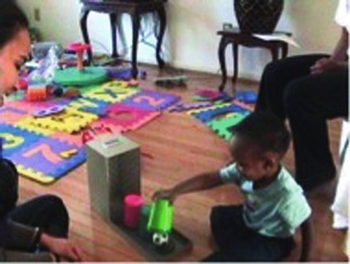
In addition to the memory generalization task, working memory was also assessed. Working memory (WM) refers to the ability to hold information in mind and update this information while executing a task (Morris & Jones, Reference Morris and Jones1990; Smith & Jonides, Reference Smith and Jonides1997) and this measure was included to rule out basic differences between groups in the capacity to hold and manipulate information. For the working memory task, the Hide the Pots (Bernier, Whipple & Carlson, Reference Bernier, Whipple and Carlson2010) task was used. Three distinctly colored opaque cups (red, blue, and green), a small black and white ball, and a box were used for this task. All three cups fit inside the box in a straight line with equal spacing between them and a hinge attached a lid to the box in order to easily open and close the box (see Figure 2).
Eighteen-month-old completing a trial on the Hide the Pots WM task.

The caregiver was asked to complete a general information questionnaire (assessing SEI, parental education, and language) as well as the MacArthur Communicative Development Inventory: Words and Sentences Short Form (MCDI) to measure children's productive vocabulary. The MCDI Words and Sentences Short Form is appropriate for infants 16- to 30-months of age and contains a 100-word checklist. Of the 100 words, 52% of the items were nouns, 18% were verbs, 15% were adjectives and adverbs, and 15% were pronouns, prepositions, and other parts of speech (Fenson, Pethick, Renda, Cox, Dale & Reznick, Reference Fenson, Pethick, Renda, Cox, Dale and Reznick2000). A short-form of the MCDI was not available for infants growing up in Spain (the available Spanish form is used for Spanish-speaking countries outside of Spain), therefore modifications were made in order to collect the most accurate vocabulary totals. For the bilingual infants in Washington DC, the caregiver was asked to fill out the same form for both languages, marking the words the infant could produce and in which language (English, Spanish, or both). For the infants in Barcelona, a native Spanish/Catalan bilingual who was also fluent in English translated the MCDI. Again, parents were asked to mark the words the infant could produce in which language (Spanish, Catalan, or both).
Procedure
During the demonstration, the infants sat on their caregiver's lap and the parent held the infant firmly by his/her waist. The experimenter sat directly in front of the infant and held the puppet at the infant's eye level, approximately 80 cm away, out of the infant's reach. The experimenter performed the three target actions (pull off mitten, shake mitten to ring the bell, replace mitten) with one puppet (e.g., duck), three times in succession and the demonstration lasted approximately 30s. The experimenter did not describe the target actions or the stimuli, and the infant was not allowed to touch the puppet.
During the 30-minute delay, the Hide the Pots task was given. During the practice trials, the infant watched as the experimenter placed a small ball under one of the three cups. The experimenter then encouraged the infant to retrieve the ball by saying, “Can you get the ball?” Once the infant retrieved the ball, the experimenter praised the infant then placed the ball under a different cup. There were a total of three practice trials so that the infant understood the rules of the task. The test trials were identical to the practice trials, except that after the experimenter placed the ball under one of the cups, the box was closed for 2 seconds. After the 2 second delay, the experimenter opened the box and once again encouraged the infant to retrieve the ball with the same verbal prompt. Each trial required the infant to hold the location of the ball in memory and each subsequent trial required the infant to update his/her memory with the new location. Like the practice trials, there were a total of three test trials.
The test session for the generalization task was identical for all infants. Infants in the baseline condition were not shown the demonstration of the target actions. Rather, they were shown the test stimuli for the first time during the test session to assess the spontaneous production of the target actions. At test, the experimenter held the novel puppet in front of the infant (i.e., if the infant was shown a demonstration with a duck puppet, the infant was tested with a cow puppet and vice versa) within the infant's reach. The experimenter encouraged the infant to interact with the puppet for 90s from the time the infant first touched the puppet.
Coding
For the generalization task, one coder scored each videotaped test session for the presence of the three target behaviors: (1) remove the mitten, (2) shake the mitten, and (3) replace or attempt to replace the mitten. The number of individual target behaviors produced during the 90 seconds after the infant first touched the puppet was summed to calculate the imitation score (range = 0–3). A second independent coder scored 40% of the videos to determine reliability of the ratings; there was an inter-rater reliability kappa of 0.91.
For the Hide the Pots task, each infant was given a score between 0–3 based on the number of trials in which the child selected the correct cup on the first search attempt. Additionally, the number of times the infant chose the cup that was selected on the previous trial (perseveration) and the number of times the infant started to choose an incorrect cup but then switched to the correct cup (correction) was also calculated. Perseveration scores had a range from 0 to 2 and correction scores had a range from 0 to 3. A second independent coder scored 40% of the videos to determine reliability of the ratings; there was an inter-rater reliability kappa of .92.
Results
A preliminary analysis examining associations between parental educational attainment, family SEI, infant gender, or puppet order and imitation performance yielded no main effects or interactions; therefore, the data were collapsed across these variables in the following analyses. As recommended by past research measuring vocabulary scores using the MCDI with bilingual populations (Hoff, Core, Place, Rumiche, Señor & Parra, Reference Hoff, Core, Place, Rumiche, Señor and Parra2012), the raw scores were analyzed instead of the percentile scores. Controlling for gender, there was no difference between monolingual and bilingual infants on raw MCDI scores when only the dominant language score for bilinguals was accounted for (p = .30) or when raw scores for both languages for bilinguals were added together (p = .70), consistent with other studies of vocabulary development in monolingual and bilingual infants (Hoff et al., Reference Hoff, Core, Place, Rumiche, Señor and Parra2012). Additionally there were no differences in raw MCDI scores between the bilinguals (dominant score p = .16, added scores p = .43) or between the monolinguals (p = .11) across countries, see Table 2.
MCDI Productive Vocabulary Raw Scores

Note: WDC = Washington DC, USA; BCN = Barcelona, Spain. Trilingual infants were recruited from both locations.
To examine the effects of location or bilingual status on imitation score for the experimental groups, a 2 (bilingual status: monolingual or bilingual) x 2 (location: Washington, DC or Barcelona, Spain) Analysis of Covariance (ANCOVA) was conducted on imitation score controlling for parental educational attainment and family SEI. The analysis yielded a main effect of bilingual status, F(1,41) = 13.78, p = .001, ηρ2 = . 25, where bilinguals scored significantly higher than monolinguals, but there was no main effect of location, F(1,41) = .02, p = .90, and no bilingual status by location interaction, F(1,41) = .05, p = .82.
Although the 2-way ANCOVA demonstrated that the bilinguals imitated significantly more target actions than the monolinguals, the analysis did not demonstrate which group performance exceeded baseline. Deferred imitation is operationally defined as performance by the experimental group that significantly exceeds performance by the baseline control group. A one-way ANOVA was used to examine imitation performance across the five groups. Due to a lack of homogeneity of variance, a Welch's correction was used, and yielded a significant main effect of group, Welch's F(4, 31.72) = 3.91, p = .011, adj. ω2 = .18.
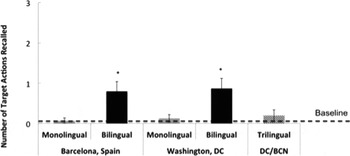
A post-hoc Dunnett's test was employed to compare each experimental group to the baseline control group. There was no difference between the monolingual groups in Washington DC (M = .13, SD = .35) or Barcelona (M = .07, SD = .26) and the baseline control group (M = .17, SD = .39; p = .82 and p = .89, respectively). There were, however, significant differences between the bilingual groups in Washington DC (M = .88, SD = .99, p = .02) and Barcelona (M = .80, SD = .980; p = .03) and the baseline control group. This comparison indicates that only the bilingual experimental groups exhibited deferred imitation (see Figure 3).
Mean imitation scores across groups for 18-month-olds. An asterisk indicates that group performance significantly exceeds that of the baseline control.

Due to concerns about the lack of homogeneity, more conservative non-parametric tests were also conducted using Fisher's exact test. Imitation performance was examined dichotomously, assessing whether the infant did or did not perform any of the target actions. The results of the nonparametric analyses were identical to those obtained using standard parametric procedures. There was a significant difference between the monolingual and bilingual groups in Washington, DC (p = .025), a significant difference between the monolingual and bilingual groups in Barcelona (p = .035), and a significant difference between the monolingual and bilingual groups when the locations were combined (p = .002). When comparing the bilingual group in Washington, DC to the bilingual group in Barcelona, there was no significant difference (p = .500).
These results replicate those of Brito and Barr (Reference Brito and Barr2012) and support the hypothesis that experience with two languages enhances memory flexibility at 18-months of age. Examining differences in working memory ability, results indicated no difference between the two language groups on Hide the Pots working memory total score (t(54) = .343, p = .73), perseveration scores (t(49) = 1.26, p = .21), or correction scores (t(49) = .417, p = .68) (see Table 3). To test which individual factors were associated with imitation performance, we conducted a hierarchical regression analysis including infants in all experimental groups. The first model included infant outcome measures of working memory (Hide the Pots) and vocabulary (MCDI raw scores), and in the second model we added percent exposure to a second language (L2). Tests of multicollinearity indicated that very low levels of multicollinearity were present (range VIF 1.05–1.06). Neither of the infant outcome measures significantly predicted imitation performance in the first model. It was only in the second model when percent exposure to L2 was added to the two existing factors that a significant R-squared change was found (F(3,49) = 3.49, p = .022) and percent exposure to L2 contributed significantly to the regression model (β = .42, t = 3.17, p = .003), see Table 3. The results were the same when dominant language raw MCDI scores were used for the bilingual vocabulary scores in the analyses.
Hierarchical Regression Analysis for Variable predicting Deferred Imitation

Note: *p < .05, ** p < .01
Both bilingual groups (English–Spanish and Spanish–Catalan) were able to recall the target actions after a 30-minute delay and the relationship between bilingualism and memory flexibility was not related to working memory or productive vocabulary scores. Whether the two languages are similar (Spanish–Catalan) or more different (English–Spanish) did not seem to influence memory flexibility for the bilingual groups, suggesting that this enhanced capability or advantage is associated with the number of languages that the infant is exposed to and not necessarily the similarity or variation between the languages. The probability of hearing multiple languages in the bilingual city of Barcelona is higher for the Spanish/Catalan monolingual infants than the English monolingual infants, but surprisingly the recall performance of both monolingual groups (in Washington, DC and Barcelona) were no different from the baseline control group. This indicates that a certain amount of early exposure to both languages is necessary. The following experiment examined memory flexibility performance of infants exposed to three languages.
Experiment 2
If two languages increase memory flexibility, would three languages further increase an infant's ability to flexibly recall the previously seen target actions? Kavé and colleagues (Reference Kavé, Eyal, Shorek and Cohen-Mansfield2008) found that the number of languages a person masters throughout their lifespan significantly predicted general cognitive task performance in older adults, where trilinguals outperformed bilinguals, and multilinguals (individuals who reported speaking four languages or more) outperformed both bilinguals and trilinguals (Kavé, Eyal, Shorek & Cohen-Mansfield, Reference Kavé, Eyal, Shorek and Cohen-Mansfield2008). This effect was found even after controlling for level of education and observed within a group of individuals who received very little schooling. On the other hand, Poarch & van Hell (Reference Poarch and van Hell2012) found that both bilingual and trilingual children (ages 5–8) outperformed second-language learners and monolingual children on both the Simon task and the Attentional Networks Task (ANT), but there were no differences in performance between the bilingual and trilingual groups. In a follow-up analysis, we examined if an advantage in memory flexibility would be found for trilingual infants and if they would outperform both monolinguals and bilinguals.
Method
Participants
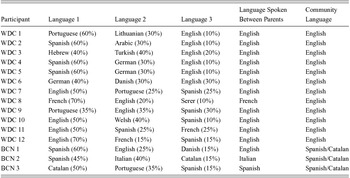
The sample includes fifteen trilingual infants (M = 18.50 months, SD = 0.39) recruited in Washington, DC (n = 12) and Barcelona, Spain (n = 3). The families were primarily middle- to- high-income (SEI M = 74.77 SD = 12.92) and parents were well educated (M = 18 years, SD = 0). There was no difference in SEI rank or parental educational attainment levels between the infants in the different locations. Trilingual infants were defined as those who had been exposed to three languages on a daily basis from birth. Average first language (L1) exposure for the trilingual group was 53% (range = 35–70%), average L2 exposure was 30% (range = 15–40%), and average L3 exposure was 18% (range = 10–30%), see Table 4.
Description of Languages

Note: WDC = Washington DC, USA; BCN = Barcelona, Spain.
Procedure
The study design, materials, procedure, and analysis were identical to those described in Experiment 1. A second independent coder scored 30% of the videos to determine reliability of the ratings; there was a perfect inter-rater reliability kappa of 1.
Results
Once again, a preliminary analysis yielded no associations between infant gender or puppet order and imitation performance; therefore the data were collapsed across these variables. Trilingual infants were compared to experimental and baseline infants from the first experiment. A t-test revealed no significant difference between the experimental trilingual group (M = .20, SD = .56) and the baseline control group (M = .17, SD = .39), t(25) = .175, p = .86, demonstrating that the trilingual group did not exhibit deferred imitation when tested in this memory generalization task (see Figure 3). This comparison is necessary to demonstrate successful recall: in DI tasks, the experimental group's imitation performance must surpass that of the baseline control group who has not seen the demonstration (Barr & Hayne, Reference Barr and Hayne2000; Meltzoff, Reference Meltzoff1990). A one-way ANOVA across bilingual status (monolingual, bilingual, trilingual) also yielded no difference between language groups on Hide the Pots working memory scores (p = .91), perseveration scores (p = .15), or correction scores (p = .87); see Table 5. There were also no differences between groups on raw MCDI vocabulary scores (combined or dominant language scores); see Table 2. Although the linguistic environment for the trilingual group is more variable than the bilingual group, the trilingual infants did not demonstrate flexible recall across the perceptually different stimuli. Like the monolingual groups in the first experiment, the trilingual group's average memory performance did not differ from the baseline control group.
Performance on the Hide the Pots Working Memory Task

General Discussion
Overall, the results of the current study suggest that advantages in memory flexibility are present for bilingual 18-month-olds, and that bilingual infants differ from both monolinguals and trilinguals of the same age. Although past studies have reported a bilingual advantage for working memory (Hernandez, Costa & Humphreys, Reference Hernandez, Costa and Humphreys2012; Morales, Calvo & Bialystok, Reference Morales, Calvo and Bialystok2013) there were no differences between the language groups on working memory scores assessed by the Hide the Pots task at this young age. Past studies (Bernier et al., Reference Bernier, Whipple and Carlson2010; Hughes & Ensor, Reference Hughes and Ensor2005) have used this task within a battery of measures and not as a stand-alone measure of working memory, which may have restricted the variability of scores needed to detect group differences. Although a narrow range of variability is a limitation, a measure to rule out basic abilities to hold information in mind was crucial to provide further evidence that these differences between language groups were attributed to the ability to generalize across perceptual cues and not differences in short-term or working memory capacity.
This bilingual advantage in memory flexibility persisted regardless of whether infants were exposed to two languages that were similar (Spanish–Catalan) or more different (English–Spanish). Young infants have been shown to be sensitive to rhythmic properties of language to discriminate between language pairs (Bosch & Sebastián-Gallés, Reference Bosch and Sebastián-Gallés1997; Nazzi et al., Reference Nazzi, Bertoncini and Mehler1998; Nazzi et al., Reference Nazzi, Jusczky and Johnson2000), and similarity at the lexical level has been suggested to influence the way the initial phonetic repertoire may be established (Sebastián-Gallés & Bosch, Reference Sebastián‐Gallés and Bosch2009; Albareda-Castellot et al., Reference Albareda-Castellot, Pons and Sebastián‐Gallés2011), yet in the present study we found no performance differences on the memory generalization task between the two bilingual groups. This result is consistent with previous work finding no differences in visual language discrimination outcomes based on bilingual language pair (Sebastián-Gallés et al., Reference Sebastián-Gallés, Albareda-Castellot, Weikum and Werker2012; Weikum, Vouloumanos, Navarro, Soto-Faraco, Sebastián-Gallés & Werker, Reference Weikum, Vouloumanos, Navarro, Soto-Faraco, Sebastián-Gallés and Werker2007). The present results replicate prior findings (Brito & Barr, Reference Brito and Barr2012; Reference Brito and Barr2014) but also extend the findings to infants living in a different cultural context (Barcelona, Spain) where both Catalan and Spanish are official languages and differences between language groups due to immigration are low (as indicated above only 7% of Spanish–Catalan bilingual families have a parent who was an immigrant, compared to 75% of Spanish–English bilinguals in Washington DC). Like previous studies examining executive attention and control in young children (Barac & Bialystok, Reference Barac and Bialystok2012; Yang, Yang & Lust, Reference Yang, Yang and Lust2011), we also find that bilingualism acts independently of variables like language similarity and cultural background on the memory generalization measure.
When examining the number of languages infants were exposed to early in development, specifically looking at trilingual infants, Experiment 2 indicated that 18-month-old trilingual infants were not able to recall the target actions when the stimuli differed from the time of encoding to the time of retrieval. If the processing of an additional language offers the infant more opportunity to encode information in a variety of language contexts and increases the ability to exploit relevant perceptual cues (Gervain & Werker, Reference Gervain and Werker2013), then why did trilinguals fail to show a generalization advantage? Our current findings were unexpected given that past studies have found cognitive advantages for trilingual participants (Kavé et al., Reference Kavé, Eyal, Shorek and Cohen-Mansfield2008; Poarch & van Hell, Reference Poarch and van Hell2012), and variability training studies have suggested that exposing infants to multiple contexts increases memory performance on a variety of paradigms including operant conditioning, habituation, deferred imitation and object permanence (for review see Barr & Brito, 2014; Wachs, Reference Wachs, Kail and Spear1984). For example, Hayne, Rovee-Collier and Perris (Reference Hayne, Rovee-Collier and Perris1987) assigned 3-month-olds to no variability training and variability training groups. Infants in the no variability group were trained for three days with a mobile with the same colored letter “A” (e.g., blue “A”s). Infants in the variability group were trained with black, green, and blue “A”s on 3 successive days. On the fourth day both groups were tested with a novel mobile (e.g., red “A”s). Infants in the variability group generalized and responded to the red “A”s, whereas the infants in the no variability group did not.
Wachs (Reference Wachs, Kail and Spear1984) argued, however, that it would be useful to use theoretical models of infant memory development and to test naturally occurring environmental variants, such as language status as has been attempted here. But how to interpret results when they differ from the experimental predictions? In the case of the present study, additional variation enhanced generalization performance for bilinguals but not trilinguals. Just as there was a threshold effect for the amount of bilingual exposure needed to show the bilingual advantage (Brito & Barr, Reference Brito and Barr2012; Spanish/Catalan monolinguals in Exp. 1), it is possible that the trilinguals either do not meet a threshold for complete exposure to two languages or that they may show a similar advantage with additional exposure to the three languages as they get older. Similarly, Videsott and colleagues found that attentional networks (i.e., alerting, orienting and conflict) were significantly related to language exposure and competence level in early multilingual children (Videsott, Della Rosa, Wiater, Franceschini & Abutalebi, Reference Videsott, Rosa, Wiater, Franceschini and Abutalebi2012). An alternate explanation may be that too much variability resulted in less pattern detection, creating an interference effect. While there are many open empirical questions, this line of research represents an initial attempt to start collaborative work initially suggested by Wachs (Reference Wachs, Kail and Spear1984) to begin to understand patterns of environmental variation on cognitive development.
There is growing evidence that hearing multiple languages early in development may modulate the attentional system (Bialystok, Craik & Luk, Reference Bialystok, Craik and Luk2012; Sebastián-Gallés et al., Reference Sebastián-Gallés, Albareda-Castellot, Weikum and Werker2012; Videsott et al., Reference Videsott, Rosa, Wiater, Franceschini and Abutalebi2012). For example, a link between bilingualism and enhanced perceptual attentiveness has emerged where bilingual 8-month-olds were better than monolinguals at perceiving visual differences and remembering these differences after a short delay (Sebastián-Gallés et al., Reference Sebastián-Gallés, Albareda-Castellot, Weikum and Werker2012). It is possible that these advantages in memory generalization demonstrated by bilingual infants may be attributable to changes in attentional processing or control. Advantages in overall attention may interact directly with memory performance in the deferred imitation task (see also Chun & Turk-Browne, Reference Chun and Turk-Browne2007, for similar arguments regarding interactions between memory and attention), as successful performance in the deferred imitation puppet task requires the infant to pay attention and prioritize the most important feature of the event over the peripheral details. There are also several limitations to the current study. First, the range of scores for the dependent measure (imitation score) was from 0–3, limiting the variability for memory performance. Furthermore, in order to avoid task interference, in future studies it would be best to administer the working memory task after deferred imitation test session. Future studies should examine a cohort of monolingual and bilingual infants longitudinally – including tasks related to attentional control and simple response inhibition in addition to declarative memory tasks, in order to examine the development of these cognitive domains in relation to bilingualism.
Although we did not find differences between the performances of the Spanish–English bilinguals compared to Spanish–Catalan bilinguals, this does not necessarily mean that exposure to particular language pairs is not influential. The language pairs we contrasted did not represent extreme cases; indeed, Spanish, Catalan and English are all members of the Indo-European family and therefore are relatively similar at the lexical and at the syntactic levels. Our focus on language rhythm and word form level (cognateness) does not preclude the potential relevance of other linguistic factors on cognitive development. Languages that are more disparate from one another (e.g., English and Japanese, greatly differing at the syntactic level and little overlap at the lexical level) may influence bilingual advantages in memory generalization and other non-linguistic cognitive tasks, but the association between linguistic environment and memory flexibility within the parameters of this study appear to be robust and dependent on exposure to two languages. Additionally, although an effort was made to recruit balanced trilinguals, most of the trilingual infants in this study heard two minority (or non-community) languages in the home from their parents and were exposed to the majority or community language (e.g., English in Washington, DC) outside of the home. At such a young age, it would be rare that exposure to the three languages could be equally distributed. The need to use all three languages would only account for a small proportion of time; and studies have found that code switching with trilinguals mainly involves two languages (Stavans, Reference Stavans1992; Stavans & Swisher, Reference Stavans and Swisher2006).
What is evident from the results of this study, and the dearth of studies examining trilingualism and cognitive development, is that being trilingual is not the same as being bilingual, and more research is necessary to elucidate the relationship between the number of languages an infant is exposed to and cognitive trajectories. In past multilingualism studies, the theoretical framework for bilingualism has been used to study trilinguals and most studies do not distinguish between bilingualism, trilingualism, or multilingualism (Cenoz & Genesee, Reference Cenoz and Genesee1998). Grosjean (Reference Grosjean1985; Reference Grosjean1992) proposed that bilinguals should not be thought of as the aggregate of two monolinguals but rather “a unique and specific linguistic configuration” (1985, p. 470). With this in mind, monolingual frameworks for language acquisition and cognitive development should not necessarily be directly applied to the study of bilingual processes. Likewise, bilingual frameworks may not work for trilingual studies either, as demonstrated by results showing different word-learning strategies for monolinguals, bilinguals, and trilinguals even from infancy (Byers-Heinlein & Werker, Reference Byers-Heinlein and Werker2009).
The current study and past studies (Brito & Barr, Reference Brito and Barr2012; Reference Brito and Barr2014) have demonstrated a link between bilingualism and enhanced memory flexibility. Evidence has been accumulated suggesting that early in development the brain is highly plastic and neural developmental trajectories in multiple domains are influenced by both environmental insult and positive stimulation (D’Souza & Karmiloff-Smith, Reference D’Souza and Karmiloff-Smith2011; Huttenlocher & Dabholkar, Reference Huttenlocher and Dabholkar1997). Consistent with the idea that early environmental variation has widespread effects on the rapidly developing brain, these studies suggest that early exposure to two languages is associated with advantages in the ability to flexibly apply memory and the underlying neural systems that support such processing. In the current study, we found no difference between the monolingual and trilingual groups. For the trilinguals, it is possible that more experience processing the three languages is necessary (Cummins, Reference Cummins1976; Reference Cummins1979; Poarch & van Hell, Reference Poarch and van Hell2012) and similarities between bilinguals and trilinguals would be more apparent later in development.