1. Introduction
Research carried out in the last fifteen years on bilingual acquisition and attrition has shown that some linguistic phenomena are more permeable to attrition effects, crosslinguistic interference or incomplete acquisition than others. The Interface Hypothesis, proposed by Sorace (Reference Sorace, Cornips and Corrigan2005), suggests that morphosyntactic aspects that are regulated by discursive or semantic factors are more difficult for bilingual speakers to control than other phenomena. Non-target-like syntactic behaviour is attested in bilingual child acquisition (Haznedar, Reference Haznedar, Belikova, Meroni and Umeda2007; Hulk & Müller, Reference Hulk and Müller2000; Müller & Hulk, Reference Müller and Hulk2001; Paradis & Navarro, Reference Paradis and Navarro2003; Serratrice, Sorace & Paoli, Reference Serratrice, Sorace and Paoli2004), adult L2 acquisition (Belletti, Bennati & Sorace, Reference Belletti, Bennati and Sorace2007; Iverson, Kempchinsky & Rothman, Reference Iverson, Kempchinsky and Rothman2008; Rothman, Reference Rothman, Baauw, Dirjkoningen and Pinto2007a; Sorace & Filiaci, Reference Sorace and Filiaci2006) as well as in L1 attrition and heritage bilingualism (Montrul, Reference Montrul2004; Rothman, Reference Rothman2007b; Tsimpli, Sorace, Heycock & Filiaci, Reference Tsimpli, Sorace, Heycock and Filiaci2004). However, whether the attested vulnerability is in fact related to some kind of permanent deficiency in interface coordination (Ivanov, Reference Ivanov, Bowles, Ionin, Montrul and Tremblay2009), which makes the acquisition of interface properties difficult or even impossible at the ultimate level, remains open to discussion. More recent studies have shown that advanced L2 learners are able to fully acquire interface-related structures (Ivanov, Reference Ivanov, Bowles, Ionin, Montrul and Tremblay2009; Rothman, Reference Rothman2009), thus contradicting the idea that interface-related phenomena are not acquired and used in a native-like manner. Nonetheless, many authors agree that interface properties are more complex and, therefore, harder to acquire. On the other hand, “narrow syntax” properties are proposed to be less complex to acquire and retain in second and bilingual acquisition, and in language attrition (Sorace, Reference Sorace2004). Specifically, studies which investigate syntactic features like verb placement in Germanic languages report a very low degree of attrition at this level. Håkansson (Reference Håkansson1995), for instance, reports that the “expatriate Swedes” she studied show attrition effects in noun phrase morphology but not in word order. Additionally, Schmid's (Reference Schmid2002) study indicates a low rate of attrition in the domain of verb placement in the speech corpus of the German Jewish attriters that she analysed. The English–German adult bilinguals studied by Altenberg (Reference Altenberg, Seliger and Vago1991) also demonstrate “a firm grasp of syntax” (p. 192) in their L1 German, especially in the domain of verb placement, even after forty years of residence in the US.
The present study examines the differential status of interface-related phenomena, by comparing the syntactic behaviour of bilingual attriters regarding two distinct phenomena: the use of topic objects, a property which involves both syntax and discourse (Avrutin, Reference Avrutin1999), on the one hand, and a narrow syntactic property (verb placement in German), on the other hand.
A review of the literature reveals subject expression to be the most frequently studied interface-related phenomena. Child, as well as adult bilinguals, who speak pairs of null-subject and non-null-subject languages have been shown to exhibit substantial difficulties in the domain of subject realization. For example, these bilinguals tend to accept overt subject pronouns in their null-subject language more frequently than monolinguals (Argyri & Sorace, Reference Argyri and Sorace2007; Montrul, Reference Montrul2004; Sorace, Serratrice, Filiaci & Baldo, Reference Sorace, Serratrice, Filiaci and Baldo2009; Tsimpli et al., Reference Tsimpli, Sorace, Heycock and Filiaci2004). The overuse of overt subject pronouns in the null-subject language, as well as the acceptability of preverbal subjects in pragmatically inappropriate contexts, shows the influence of the non-null-subject language over the pro-drop language. The contrary, i.e., overuse of null pronouns in contexts where overt realizations are required, for example in contrastive contexts, is less frequent (Lozano, Reference Lozano, Leung, Snape and Sharwood-Smith2009). In fact, there is no study which attests to the dominant influence of a language that allows null subjects and null objects over the non-pro-drop language in contexts of subject or object expression, i.e., the eventual target-deviant omission of the object or subject pronoun in sentences where it is required. Argyri and Sorace (Reference Argyri and Sorace2007), for instance, found crosslinguistic effects in older English–Greek bilingual children only from English to Greek, but not vice versa, concluding that crosslinguistic influence might be constrained by directionality (Argyri & Sorace, Reference Argyri and Sorace2007, p. 94).
The hypothesis that crosslinguistic influence occurs especially in the domains where a morphosyntactic construction, in a phase of acquisition, is regulated by the syntax–discourse interface was proposed by Hulk and Müller (Reference Hulk and Müller2000) and Müller and Hulk (Reference Müller and Hulk2001) and later transposed to other bilingual populations (e.g., heritage speakers). However, studies which investigate L2 learners who are native speakers of a null-subject language and learn another pro-drop language, have shown that in these cases the speakers also tend to overuse the overt pronoun in their L2 (Bini, Reference Bini and Liceras1993; Margaza & Bel, Reference Margaza, Bel, Grantham, Shea and Archibald2006). Margaza and Bel's (Reference Margaza, Bel, Grantham, Shea and Archibald2006) study shows that Greek speakers of L2 Spanish overuse overt subjects; while they do display knowledge of the [+null subject] value of Spanish syntax, they do not show a command of the pragmatic distribution of subjects in this language (Margaza & Bel, Reference Margaza, Bel, Grantham, Shea and Archibald2006, p. 92).
The amount (and quality) of input is another crucial variable in bilingualism, i.e., in bilingual language acquisition as well as language attrition. Studies focused on the role of input in bilingual language acquisition substantiate the idea that a bilingual child receiving less input in one language develops more vulnerability in this less used language. Regarding phenomena set at the syntax–discourse interface, the findings presented by Serratrice, Sorace, Filiaci and Baldo (Reference Sorace, Serratrice, Filiaci and Baldo2009) and Sorace et al. (Reference Sorace, Serratrice, Filiaci and Baldo2009) reinforce the idea that interface phenomena are sensitive to reduced input. The bilingual Italian–English children who live in a predominantly Italian setting make fewer errors in the distribution of null and overt pronouns than those who live in an English-speaking environment. A similar suggestion is made by Tsimpli et al. (Reference Tsimpli, Sorace, Heycock and Filiaci2004) regarding adults.
The studies on heritage bilingualism sustain the importance of the input factor. Heritage speakers are supposed to receive quantitatively less and qualitatively different input than native speakers, which may explain the distinctions heritage speakers show in their grammars in comparison to monolingual speakers (Montrul, Reference Montrul2004; Pires, Reference Pires and Flores2011; Pires & Rothman, Reference Rothman2009; Polinsky, Reference Polinsky2006).
Studies on language attrition have shown that in the extreme case of a complete loss of input, as in the case of adopted children (see Pallier, Dehaene, Poline, LeBihan, Argenti, Dupoux & Mehler, Reference Pallier, Dehaene, Poline, LeBihan, Argenti, Dupoux and Mehler2003; Ventureyra & Pallier, Reference Ventureyra, Pallier and Schmid2004) speakers tend to lose productive (and receptive) skills in their unused language totally. However, the age at which speakers lose the input of the language under attrition cannot be disregarded in this context. The studies on language attrition have shown that age appears to be one of the most important factors influencing the emergence of attrition (see Bylund, Reference Bylund2009, for an extensive overview). The loss of L1 or L2 input in prepubescent age gives rise to a significantly higher rate of attrition in the unused language than in cases of postpubescent input loss (see Flores, Reference Flores2010; Hansen & Shewell, Reference Hansen and Shewell2002; Kaufman, Reference Kaufman, Ammerlan, Hulsen, Strating and Yamur2001; Kaufman & Aronoff, Reference Kaufman, Aronoff, Seliger and Vago1991; Kuhberg, Reference Kuhberg1992; Tomiyama, Reference Tomiyama2000; Turian & Altenberg, Reference Altenberg, Seliger and Vago1991).
2. Language attrition in bilingual returnees
The participants of the present study are Portuguese second generation migrants, who grew up in Germany or Switzerland and moved to Portugal at a certain moment in their lives. In this context, the study analyses individuals who spent their childhood in a dominant language setting (German) which was not that of their home language (Portuguese), but who experienced a break with the majority language when they moved to their parents’ country of origin.
In analysing second generation returnees, this study is based on the assumption that second generation children acquire high (or even native-like) proficiency of the majority language, but that this proficiency might be affected over time due to the change of linguistic environment and a drastic reduction of the contact (input and output) with the (now minority) language. Hence, attrition is seen as “the gradual loss of a language by an individual” (Schmid, Reference Schmid2002, p. 7), a definition which presupposes that the speaker had full knowledge of the linguistic property under attrition before the attrition process began, since “attrition can only affect what was within the speaker's knowledge” (Sorace, Reference Sorace2004, p. 143).
Gradual reduction in proficiency is observed in all studies that focus on second generation returnees, especially when the return occurs in childhood. Several longitudinal studies document situations in which young children had acquired a language naturally, but begun to experience a loss of proficiency in that language once removed from its continuous input (Hansen, Reference Hansen, Noguchi and Fotos2001; Kuhberg, Reference Kuhberg1992; Mägiste, Reference Mägiste1979; Reetz-Kurashige, Reference Reetz-Kurashige and Hansen1999; Seliger, Reference Seliger, Seliger and Vago1991; Tomiyama, Reference Tomiyama2000; Yoshitomi, Reference Yoshitomi and Hansen1999).
Kuhberg (Reference Kuhberg1992), for instance, who analyses the German proficiency of two Turkish children returnees (aged seven and eleven years), observes a severe attrition process during the 15–20 months of data collection affecting word order and morphology. Tomiyama (Reference Tomiyama2000) documents the decline of language proficiency in a Japanese boy, who returned to Japan at the age of 8, after having lived in the United States for seven years. The author reports changes in English noun modification, plural and past tense morphemes. Seliger (Reference Seliger, Seliger and Vago1991) studies the proficiency of a bilingual girl, who grew up in the US and immigrated to Israel at age of six by focussing on word order in dative sentences in her L1 English and L2 Hebrew. He reports a three-stage attrition process in which the speaker gradually reduces a wider range of options to express datives in the attrited English to a single rule (which has an equivalent in the dominant language, Hebrew).
The analysis reported here is a follow-up to the study presented in Flores (Reference Flores2010), where semi-spontaneous oral data was analysed to investigate the syntactic competence of sixteen second generation returnees regarding their knowledge of German verb order. The participants were divided into two groups of 8, based on their age of input reduction (i.e., the age at which they moved to Portugal, leaving the dominant German environment). The group of the so-called “child returnees” included speakers who had lost prolonged German input during childhood (between ages seven and ten), while the group of “teenage returnees” was comprised of speakers who were eleven or older when they moved away from the German environment.
Focusing on verb placement in main and embedded clauses, the data showed that the speakers who had lost German input earlier than age eleven had significantly more syntactic deficits than the older returnees, who exhibited a stable knowledge of German verb placement rules, even in the case of speakers who had not used German for more than 20 years. These findings support the prediction that the development of our language faculty is constrained by age-related maturation factors by showing that grammatical knowledge is more likely to suffer from attrition if the speaker loses contact with a language before the age of 11/12. Thus, acquired knowledge needs to stabilize over time in order to become less vulnerable to language attrition.
In Flores (Reference Flores2010), only German verb placement, which is a property of narrow syntax, was focused on. The purpose of the present study is to look again at the data of the same speakers and to further analyse their performance regarding a linguistic aspect which is constrained by pragmatic conditions. On the basis of the discussion presented in the previous section, object expression appears to present a fruitful domain for investigation.
3. Object expression and verb placement
The omission of the direct object is a typical property of European Portuguese. The fact that it only occurs in sentences in which the (omitted) object is a topic and must be identified in the discourse context shows the pragmatic nature of this phenomenon.
Following Huang's (Reference Huang1984) proposal for Chinese, Raposo (Reference Raposo, Jaeggly and Silva-Corvalán1986) analyses the Portuguese null object as a variable, which is locally bound to a zero topic in an argument (A′) position, hosted in the domain of the Complementizer Phrase (CP). Null objects are syntactically licensed but their occurrences are governed by discourse-pragmatic factors. For Raposo (Reference Raposo1996, p. 16), “this construction is possible if there is a salient entity in the universe of discourse, made available either by previous conversation or by the pragmatic context of the utterance, and from which the content of the direct object gap may be recovered”. So, (1) is appropriate in a context in which a particular movie is the topic of the conversation.
(1)


German shares some of the properties of the so-called discourse-oriented languages (Huang, Reference Huang1984) in that it exhibits topic-drop, a zero-topic construction. Like the Portuguese null object, the occurrence of topic-drop is discourse-licensed, but the deletion of the Noun Phrase (NP) is conditioned by the verb-second (V2) effect: it occurs after the overt movement of the NP to the sentence-initial (topic) position. This movement satisfies the syntactic conditions of V2: if the first position is occupied by such a non-subject-topic NP, the subject must remain in a position below the verb. Additionally, the first position cannot be occupied by other constituents.
In the same given context, where a particular movie is the topic of the conversation, a zero-topic sentence can be derived in German, as shown in (2a). Assuming the traditional view that the first position of the German sentence is a topic position and that the topic moves to this position, the representation of (2a) would be (2b).
(2)

In sum, Portuguese and German exhibit similar processes of zero-topic realizations, but the German zero topic is far more limited than in the Portuguese case. In contrast to Portuguese, German shows the following restrictions:
(i) topic-drop only occurs in V2 sentences, i.e., it is restricted to root sentences;
(ii) topic-drop only occurs in the first position of the sentence;
(iii) only one constituent (i.e. one phrase) can be deleted.
In Portuguese, null objects may occur in embedded clauses and there is no V2 effect.
Hence, sentences (3a) and (3b) would be ungrammatical in German. If the zero topic is in the German pre-field position (SpecCP), this position cannot host the subject Joana or the adverbial phrase gestern “yesterday”. Thus, these must remain in the middle-field (the IP domain):
(3)

In contrast to the domain of object expression, German word order, more precisely verb placement, is a purely syntactic aspect lacking any pragmatic influence (Grewendorf, Reference Grewendorf1980). The position of the verb within the sentence is governed by strict syntactic rules. Most generative syntacticians classify German as an OV language (see Bierwisch, Reference Bierwisch1963; Platzack, Reference Platzack, Hellan and Koch Christensen1986), showing a head-final verbal phrase (VP) and tense phrase (TP).Footnote 1 Since German is also a V2 language, the landing site of the verb in the syntactic structure of the sentence is well defined. In root sentences the finite verb moves to the second position (the C position), as is shown in example (4a). In subordinate sentences, which are introduced by a complementizer, the C position is occupied. This hinders the finite verb from moving to C, so it remains in sentence-final (OV) position (see (4b)).
(4)

Portuguese is a VO language, so VP and TP are both head-initial. The verb moves from V to T, while there is no V2 effect. The word order is SVO in both embedded and main clauses.
4. The study
4.1 Participants
The participants in this study are second generation returnees, who were raised bilingually in a German speaking country (Germany or Switzerland) and moved to Portugal, their parents’ country of origin, at a certain point in their lives. The data was collected within the scope of a larger research project involving the participation of sixty Portuguese–German second generation returnees.Footnote 2 In a first stage, all sixty participants were submitted to an oral interview based on a detailed socio-biographical questionnaire, which was used both to collect oral speech data and to determine the biographical and linguistic background of the informants. The questionnaire was divided into three main parts: questions about the emigration phase (age of emigration, school career, and language use), return (age at return, reasons for return, opinion about return, and integration [difficulties] in the new environment), and the present situation. Here the interviewer focused on topics such as language use at the time of recording, personal motivation and attitude towards bilingualism and the use of German, language dominance, and language proficiency. All informants were asked to assess their German proficiency by giving points on a scale from 0 to 10 in different areas of language proficiency (writing, reading, speaking, understanding, vocabulary). In order to determine the type and the amount of contact with German, numerous questions focused on the forms of contact with the German language (e.g., through books and newsletters, TV, internet, friends, family, formal instruction in German, professional career).
For the present study, all participants who emigrated to Germany/Switzerland after the age of three were excluded in order to rule out cases of late second language acquisition. The 28 informants selected for this study were born in the host country or moved there very early in life (before the age of three). Since second generation migrants share a very particular process of language acquisition, the clear classification of their languages into first or second language is hard to determine. If we follow the factor order of acquisition, the first acquired language is commonly their heritage language, in this case Portuguese. It is the language spoken at home and within the adult migrant community. However, since all participants were born in Germany/Switzerland or emigrated at an early age, German was also acquired in an early phase of development (before the age of three).Footnote 3 Following the most common attempts to define bilingual language acquisition in terms of age of onset, the acquisition of two languages before the age of three can be classified as 2L1 (Meisel, Reference Meisel, Haznedar and Gavruseva2008, p. 59). The participants acquired Portuguese as the home language and German as the majority language, which quickly became their main language of socialization and their dominant language.
Since the aim of the present study is to compare the speakers’ performance in two distinct linguistic domains, and furthermore to relate this to not only the factor age but also the variable amount of contact, some rearrangements were made to the groupings used to generate the data presented in Flores (Reference Flores2010).
The informants were sorted into different groups, based on the variables age of return and amount of contact with german after return. Following Flores (Reference Flores2010), where the findings showed that the age limit of 11 is a critical phase for the outcome of attrition in the domain of verb placement, two main subgroups were established: a group of nine participants who had returned to Portugal before the age of 11 (Group 1) and another group of nine informants who had returned at a point between the age span 12 and 14 (Group 2). The eighteen participants included in Groups 1 and 2 showed great similarities in terms of language use and language dominance. At the time of testing all claimed to feel more comfortable in speaking Portuguese. Most of the participants said that they are no longer bilingual speakers, even though they confirm that German was their dominant language when they lived in Germany or Switzerland. On the self-assessment scale, all informants of these two groups rated their proficiency in German significantly lower than in Portuguese. When asked about their identity, these informants stated that they considered themselves Portuguese and no longer German or Swiss. They no longer dreamt, counted or said the “abc” in German. In all eighteen cases contact with German was now almost inexistent. None used German as the language of communication with friends or siblings at the time of recording. Two informants had begun to receive formal instruction in German as a foreign language at school/university two months ago. The others had not had any formal contact with German since leaving Germany/Switzerland. No participant read German literature or newspapers; however, some participants said that they did watch German TV at home sometimes. For the purposes of the present study, the speakers who do not use German productively in their daily life, having only a random and passive contact with this language, were classified as “speakers with non-frequent contact” with German. All participants of Group 1 and Group 2 fulfil these criteria.
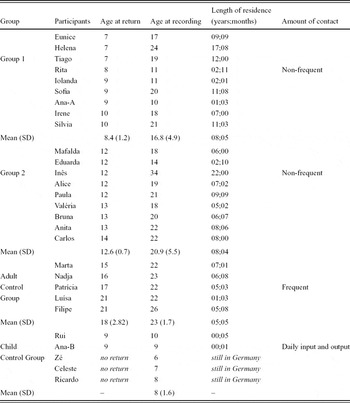
Group 1 includes nine participants.Footnote 4 Their age at return (AaRet) varies between 7 and 10 years (the mean AaRet is 8;4 years; standard deviation (SD) = 1.2). Their mean age at the time of recording (AaRec) is 16;8 (SD = 4.9). Within this group, the case of Ana is particularly interesting, since she was recorded at two different sessions. The first recording session took place one month after her return, when she was nine years old. At this time she was fluent in German and said that German was her dominant language. She felt comfortable in German and spoke German during the whole testing session. The data from this session was integrated in the database of the Child Control Group (marked as Ana-B). The second recording session occurred one year and three months later (here marked as Ana-A). By this time, Ana was fully integrated in the Portuguese school system. She had new Portuguese friends and had stopped speaking German. Initially she refused to speak German with the interviewer and frequently switched to Portuguese. German had been excluded from Ana's daily life since she had moved away from Germany and the changes in language usage reflect the accompanying changes in motivation, identity and language dominance.
The length of residence (LOR) of Group 1 ranges from 1;03 (year;month) to 17;08 (mean LOR = 8;05). This encompasses a wide time span; however, many studies on language attrition in childhood have shown that in prepubescent ages the effects of attrition tend to appear very early, i.e., some months after the change of the dominant environment. The children studied by Kaufman and Aronoff (Reference Kaufman, Aronoff, Seliger and Vago1991), Kuhberg (Reference Kuhberg1992) and Tomiyama (Reference Tomiyama2000), for instance, showed strong effects of attrition before completing two years of residence in the new environment. As will be shown, the case of Ana confirms that a few months without German input are sufficient to observe the first effects of language attrition.
At the moment of recording the participants of Group 2 were between 14 and 34 years old (mean AaRec = 20;9; SD = 5.5). All of them moved to Portugal at a point during the age span of 12–14 (mean AaRet = 12;6; SD = 0.7), after attending a minimum of 6 years of official German/Swiss school. In this group the mean LOR is 8;04 (between 2;10 and 22 years).
Additionally, two control groups were included, each one with five participants: a group of bilingual adult returnees, who did not experienced a break of contact with German, and another group of bilingual second generation children, who still live in Germany (or returned recently). The inclusion of two distinct controls aims at testing two different variables. On the one hand, it is important to compare the bilingual speakers who have lost daily contact with German with subjects who also returned to Portugal, but who did not experience a drastic change in input and use of German (Adult Control Group). On the other hand, the Child Control Group was included in order to control for the language proficiency of Portuguese–German migrant children when they are still living in the migration setting or at an initial phase of integration in the new environment. Clarification of whether second generation children show native-like knowledge of verb placement in German when they are (still) immersed in the German environment is indispensable in order to ensure that the syntactic instability that is found in the speech data of the returnees can be interpreted as a consequence of lack of exposure rather than as “the failure to acquire the language” (Andersen, Reference Andersen, Lambert and Freed1982, p. 85). The reduced number of participants in both control groups (only five per group) is due to the small amount of variation found among the controls.
The informants of the Adult Control Group were between 15 and 21 years old when they moved to Portugal (mean AaRet = 18; SD = 2.82). At the time of recording they were between 22 and 26 years old (mean AaRec = 23; SD = 1.7). The LOR varies between 1;03 and 7;01 in this group. Unlike the participants of Groups 1 and 2, these speakers maintain regular contact with German. They speak German with friends and siblings in their daily life. All five informants characterized themselves as fluent bilingual speakers and rated their German proficiency at the same level as their proficiency in Portuguese. All participants study, or have studied, German philology at a Portuguese university and/or they use German in their job. With respect to the variable amount of contact they were thus classified as “speakers with frequent contact” with German. In their cases the moment of return does not constitute a point of intensive change in language use. It should be mentioned here that the adult controls were older than the participants of Group 2 when they moved to Portugal. Therefore, we do not have a clear correspondence between the Adult Control Group and Group 2 with respect to the variable age at return.
The Child Control Group includes five children (age at time of recording between 7 and 10 years). All children are Portuguese second generation migrants, who grew up bilingually in Germany. They share the same process of bilingual language acquisition as the other participants during emigration, Portuguese being their home idiom and German the majority language. Three children are still living in Germany. The participants Ana-B and Rui came to Portugal (in both cases with their mother only) a few weeks or months before testing. When they were recorded, Ana-B had been living in the new environment for four weeks and Rui, for five months.
Table 1 displays the ages of the participants when they moved to Portugal and their ages at recording, as well as the length of residence and the amount of contact with German in Portugal.
Ages at return and at recording, length of stay in Portugal and amount of contact with German.

4.2 Data collection
The corpus consists of recorded oral speech, elicited through different oral production tasks, which were given to the informants at two or three different meetings (with an interval of two to three weeks between the meetings). In the first meeting an autobiographical interview was conducted. The interview was based on a detailed socio-biographical questionnaire concerning language learning, language use, language proficiency, bilingual identity and language choice. The interviewer was herself a bilingual speaker with a remigration background, which made it possible to conduct the interviews as conversations between people who share similar experiences of migration, bilingual language acquisition and remigration. In the second task, subjects were asked to comment on pictures that elicited their opinions on aspects of current affairs, such as education, medical assistance, pollution or public transportation. The participants were asked to compare their experiences in Germany/Switzerland and in Portugal in relation to these issues. The aim of these tasks was to elicit speech data which were as spontaneous as possible. In the third task, participants were shown pictures from a well-known Portuguese folk story and they were asked to narrate the story. In the last task, the participants had to describe a picture that showed a family scene. These last two tasks (story re-telling and picture description) aimed to complement the more spontaneous oral production data with more controlled and homogeneous data, by stimulating the use of fronted adverbs (like dann/then or später/later), requiring XPVS structures. The recorded speech was transcribed in the MS Word programme by the interviewer herself or an assistant (also a German–Portuguese bilingual speaker).
The informants were told to make an effort to talk only in German, but they could switch to Portuguese each time they experienced word retrieval difficulties. The participants followed this request most of the time. Switching occurred mostly by borrowing words from Portuguese into a German matrix sentence, as shown in example (5). Here the participant uses the Portuguese adverb muito and combines the German noun Programm with the typical Portuguese plural ending -s.Footnote 5
(5)

4.3 Hypotheses
Given the syntactic differences between German and Portuguese outlined above and the placing of the participants into different groups, based on the variables “age at return” and “amount of contact” with German after return, the present study allows us to test various hypotheses.
First, the languages in contact show significant differences concerning the syntactic phenomena under investigation. The differences in the domain of object expression are of particular interest. Portuguese allows null objects, i.e., the omission of the topic object in root and in embedded clauses, while German only has the (more restricted) phenomenon of topic-drop. Since it was Portuguese that became the dominant language of environment, contrary to other studies (see the discussion above), the dominant language in our case is the one that allows omissions in a wider range of contexts. This means that, in the case of crosslinguistic influence, these Portuguese–German bilingual speakers with German under attrition may omit topic objects in contexts in which omission is impossible in German, namely in the middle-field position of root sentences and in embedded clauses. If this is the case, crosslinguistic influence may not lead to the overuse of subjects and objects (as attested to in the studies mentioned above), but instead cause the opposite effect: the ungrammatical omission of topic objects in the target language.
Second, this study makes it possible to contrast the proficiency of the same speakers in two very distinct grammatical properties, verb position, a property of narrow syntax, on the one hand, and object expression, a domain which is influenced by pragmatic constraints, on the other hand. This allows us to check if bilingual speakers, who are in a situation of attrition as a consequence of reduced contact with one of their languages, show attrition effects in the domains which were outlined.
Third, the study presented in Flores (Reference Flores2010) showed that the age span between 10 and 12 years is a critical phase for language retention in the domain of word order. The participants who experienced a complete break with German input before this period reveal a high degree of attrition, while bilingual speakers who lose the input of one (of their two or more) languages after the age of 11/12 years appear to be impermeable to attrition effects in this domain. This study allows us to test whether this critical retention period also holds for object expression or if this domain continues to be vulnerable to attrition, even if the loss of input happens at a more advanced age. This last scenario would favour the idea that phenomena set at the syntax–discourse interface tend to be more vulnerable to attrition than other domains. On the other hand, if no significant differences are found in the proficiency of the returnees in both syntactic phenomena (word order and object expression), this would contradict the hypothesis that interface phenomena are more susceptible to attrition effects.
5. Results
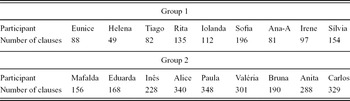
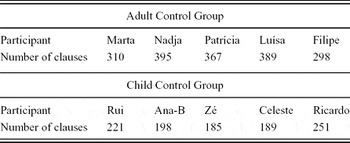
The coding, both for object expression and verb placement, includes whole clauses produced in German and the type of mixed sentences exemplified in (6) below, in which at least the verb and the subject are produced in German. Tables 2 and 3 show the number of counted sentences produced by each informant.
Total number of clauses produced by the participants of Group 1 and Group 2.

Total number of clauses produced by the participants of both control groups.

5.1 Object expression
For the purposes of this study, all sentences with a topic object were counted, i.e., all the sentences in which the object argument refers to an entity that had already been mentioned in the context of conversation. As a result three different types of object expression were identified. The first type refers to sentences where the topic object is explicitly realized, most commonly as a personal pronoun (e.g., es “it (acc.neut)”, sie “it (acc.fem)”, ihn “it (acc.masc)”), as the demonstrative das “this” or as an indefinite pronoun (e.g., welche, “some”, keinen “none”). In these cases the object pronoun can occur in the pre-field position (example (6a)) or in the middle-field position (example (6b)). All lexical DPs were excluded. In the figures, this type of occurrence is referred to as Pron_Obj.
(6)

The second type of context counted refers to the sentences with topic-drop, which are grammatical in colloquial German. Example (7) shows a topic-drop sentence from the database. In the figures these sentences are identified as Topic_drop:
(7)

Finally, all sentences where the object argument is ungrammatically deleted were quantified and marked as *Null_Obj. We refer to these occurrences as ungrammatical null object since they resemble the Portuguese null object constructions but are not grammatical in German. The most common occurrences involve root sentences in which the object is deleted from the middle-field position and not from the pre-field, as required by German topic-drop (see example (8a)). Another type of ungrammatical construction involves the omission of the topic object in subordinate sentences, as exemplified in (8b).
(8)

There are other constructions that may be confused with zero topics, namely the so-called “unspecified object sentences” (Raposo, Reference Raposo, Jaeggly and Silva-Corvalán1986). The “unspecified object” occurs with verbs like “to smoke” or “to eat”, among others, with the missing object interpreted “as a generic representative of the class of things that may be acted upon by the action described by the verb” (Raposo, Reference Raposo, Jaeggly and Silva-Corvalán1986, p. 376). German also has “unspecified objects” and, therefore, these constructions have been excluded from the present analysis.Footnote 7
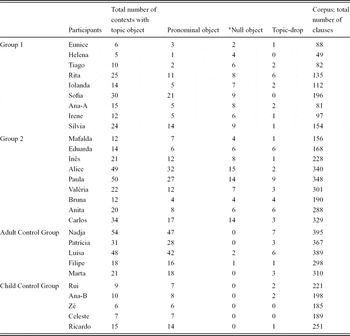
The individual results of the participants (in percentages) can be seen in Figure 1. Table 4 indicates the mean values and standard deviation per group. The individual raw counts are given in Table 5.
Object expression in German (in percentage).

Object expression. Mean values (in percentage), standard deviation (SD) and minimal/maximal values per group.

Object expression: individual results (raw counts).

As can be seen in Figure 1 and Tables 4 and 5, the results are very clear. A Kruskal-Wallis Test shows that there are significant differences between the four groups with regard to the pronominal realization of the topic object (χ3(3) = 19.328, p = .000) and its ungrammatical omission (χ3(3) = 20.727, p = .000). Only with respect to topic-drop did the groups not show any significant differences (χ3(3) = 1.027, n.s.).
The phenomenon of ungrammatical object omission in German is very expressive in Group 1. The mean value of omissions is about 41.5% (SD = 16.6). The values range between 20% and 70%. This means that all participants in this group omit the topic object in contexts where it is not allowed. In the cases of the participants Helena, Tiago, Ana-A, Iolanda and Irene the rate of omitted objects is even higher than the number of realized pronominal topics. However, if we compare the results of Group 1 with the results of Group 2, i.e., with the participants who returned after the age of 11, we conclude that the results of both groups are very similar. A non-parametric Mann-Whitney Test indicates that there are no significant differences between both groups regarding the realization of the pronominal object (Z = –1.239, n.s.), the ungrammatical object omission (Z = –1.860, n.s.) and the topic-drop phenomenon (Z = –.663, n.s.). The mean percentage of ungrammatical omissions within Group 2 is about 34.4% (SD = 5.2).
The following examples from the database show instances of target-deviant omissions in main clauses, in (9), and in embedded clauses, in (10).
(9)
(10)


The results of both control groups, i.e., the adult bilingual returnees with frequent German input and the bilingual children who still live in the majority German environment or who returned some months ago, contrast clearly with the data of Group 1 and Group 2. The mean rate of target-deviant object-drop is lower than 2% in the Adult Control Group. The values range from 0 to 5.6% of ungrammatical object omission. Three participants do not omit the topic in target-deviant contexts at all. One participant (Luísa) produces two sentences with ungrammatical object-drop in a total of 48 sentences; the other participant (Filipe) omits one object in a target-deviant context in a total of 18 contexts of topical object expression. In all three examples found in the database of these speakers the target-deviant omission of the object occurs in root sentences. No target-deviant object omission was found in the database of the Child Control Group. In this group, a total of 47 sentences with a pronominal topic object were produced. In 42 sentences the topic object was expressed as a pronoun, in five sentences the children omitted the topic object in the context of topic-drop, which is grammatical in colloquial German.
In sum, the analysis of object expression indicates that the participants who are not continually exposed to German exhibit deficits in the realization of the topic object in German by omitting the argument in target-deviant contexts. On the other hand, the bilingual speakers with frequent German input and output show target-like proficiency in this domain. Furthermore, it should be noted that the four groups do not differ significantly with respect to the production of German topic-drop sentences, a fact that reveals that all speakers have knowledge of this construction.
5.2 Object expression compared to word order
Now let us compare the previous results on object expression with the proficiency of the participants regarding word order. The analysis of verb placement in Group 1 and Group 2 are documented in detail in Flores (Reference Flores2010). In Flores (Reference Flores2010), the proficiency of Group 1, i.e., the participants who came to Portugal in childhood, was compared with the proficiency of the speakers who experienced the loss of continued German input after the age of 11 (Group 2). Three different verb placement contexts were considered: verb-second, verb-final placement in subordinate clauses and sentence-final placement of the non-finite verb in complex verb constructions. For the purposes of the present study, I will focus on the proficiency of the 28 participants with respect to verb-second and verb-final embedded clauses and compare the rate of target-deviant constructions with the values on object expression presented in the previous section. The analysis of verb-second focuses on all sentences of the database that do not start with the subject. If V2 is correctly produced, the verb is in the second position of the sentence, followed by the subject in the third position, as shown in example (11).
(11)

In contrast, the movement of the subject to a position to the left of the verb leads to ungrammatical V3 sentences (henceforward marked as *XPSV). Examples (12a) and (12b) show two ungrammatical XPSV sentences from the database.
(12)

In the domain of verb-final embedded clauses, target-like constructions are those sentences in which the verb remains in clause-final position; in target-deviant sentences the verb does not remain in final position, moving to a higher projection. This type of ungrammatical occurrence, exemplified in (13), is marked as *Vnfinal. An example of a correct Vfinal sentence is given in (14).
(13)
(14)


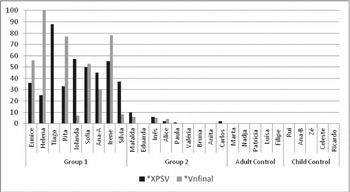
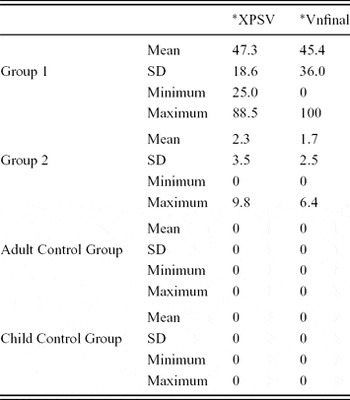
Figure 2 shows the rate of deviations in the domain of verb placement per participant/group, i.e., the realization of ungrammatical XPSV and Vnfinal sentences. Table 6 indicates the mean values (in percentages), standard deviation and minimal/maximal values per group.
Verb placement in V2 and Vfinal contexts (percentage of deviations): individual results per group.

Verb placement: target-deviant realizations in the contexts of verb-second and verb-final position. Mean values (in percentage), standard deviation (SD) and minimal/maximal values per group.

The results show a clear contrast between the participants in Group 1, i.e., the returnees who came to Portugal before the age of 11 and the participants in the other three groups. The participants in Group 1 produce a high rate of ungrammatical *XPSV sentences, with two elements to the left of the verb. The most frequent element in first position is an Adverbial Phrase (AdvP), as shown above in examples (12a, b), but target-deviant XPSV structures also occur with a topicalized object or with embedded clauses in the pre-field position. The mean value of ungrammatical *XPSV structures is about 47.3% (SD = 18.6), ranging from 25% to 88%. Similar results are obtained in embedded clauses, where the final verb should remain in verb-final position. The participants in Group 1 also show variability in this domain. The production of grammatical Vfinal sentences co-occurs with target-deviant *Vnfinal structures, where the verb moves to a higher projection instead of remaining in clause final position. The mean value of deviations is about 45.4% in this domain (SD = 36).
In the other groups, the rate of ungrammatical *XPSV and *Vnfinal is insignificant or inexistent. In Group 2 (the returnees who came to Portugal between the ages of 11 and 14 years) the mean value of target-deviant structures is about 2.3% concerning *XPSV and 1.7% regarding *Vnfinal. Five participants show instances of ungrammatical verb-third sentences (as in example (15a) below), however only in the case of Mafalda does the rate of ungrammatical *XPSV constructions reach 10.3% (4 ungrammatical vs. 37 grammatical V2 sentences). The other participants present a very low rate of deviations (about 5%). Only three participants in Group 2 produce target-deviant *Vnfinal sentences (see example (15b)), but the rate of deviations in this case is also very low. Mafalda, for instance, produces two ungrammatical *Vnfinal sentences (and 29 target-like constructions); Inês, two (vs. 40 target-like sentences), and Alice, one (vs. 27 grammatical verb-final sentences). In the case of both control groups, the participants do not make verb-final or V2 mistakes at all.
(15)

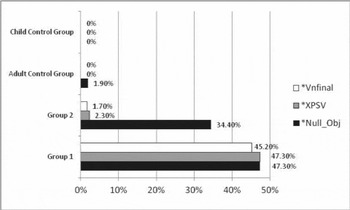
At this point in the analysis it is interesting to compare the proficiency of the participants in the domains of verb placement and object expression. Figure 3 presents the mean values of target-deviant realizations in both domains, per group.
Object expression and verb placement (target-deviant realizations): mean values per group.

The figure confirms that, in the case of Group 1, the high values of deviations found in the field of verb placement have a clear parallel in the domain of object expression. The rate of target-deviant realizations is very similar in the three analysed contexts: the mean rate of ungrammatical object-drop constructions is about 47.3%; the same rate of target-deviant construction refers to *XPSV sentences, and the mean rate of ungrammatical *Vnfinal sentences is about 45.4%. We can conclude that the bilingual speakers of this particular group show similar deficits with respect to the expression of the topic object and the placement of the finite verb in contexts which require verb-second or verb-final.
Before discussing the results of Group 2, which are particularly interesting, let us take a look at the control groups. As presented in the previous sections, the child controls show native-like competence in the domains of object expression and verb placement. None of the five participants produce target-deviant sentences with regard to verb-second or verb-final in subordinate clauses. Additionally, no occurrence of ungrammatical object-drop was found in this group. The Adult Control Group presents an insignificant mean rate of 2.2% of target-deviant object-drop. In the domain of verb placement, similar to the bilingual children who still live in Germany or returned recently, the adults who still have intensive contact with German do not show any instance of ungrammatical word order.
The most interesting findings come from the analysis of Group 2, the participants who have lost German input between the ages of 12 and 14 years. The group averages, presented in the previous section, showed no significant differences between Groups 1 and 2 with regard to object expression. The bilingual returnees who comprise Group 2 produce a mean rate of 34.5% of target-deviant object-drop constructions (SD = 5.2). However, when it comes to the domain of verb placement, the differences between Group 1 and Group 2 are much clearer. In Group 2, the mean rate of deviations is about 2.3% in the domain of verb-second (SD = 3.5) and about 1.7% in the domain of verb-final (SD = 2.5). A non-parametric Mann-Whitney test confirms that there are no statistical differences between Group 1 and Group 2 in the domain of ungrammatical object omission (Z = –1.860, n.s.), but that there are significant differences with regard to the target-deviant placement of the finite verb in root sentences (Z = –3.597, p = .000) and in embedded clauses (Z = –3.138, p = .002). The individual results of Group 2 confirm that all nine participants produce target-deviant object-drop sentences in German, but that they have a lower frequency of errors with regard to verb placement (see Figure 4). As can be seen, four participants make no V2 error, while in other cases the percentage of errors ranges between 1.6% and 9.8%. With regard to verb-final in embedded clauses, the majority of the participants do not make verb-final mistakes at all and the three speakers who do produce *Vnfinal (Inês, Alice and Mafalda), present a very low rate of deviations (between 3.6% and 6.4%).
Object expression and verb placement (target-deviant realizations): individual results of Group 2.

6. Discussion
With respect to object expression in German, the results show significant differences between two types of bilingual returnees: on the one hand, speakers who had changed their dominant linguistic environment but continued to use the language that was now the minority language productively in their daily life (participants of the Adult Control Group); on the other hand, returnees who had broken contact with the ex-migration language after moving to their home country (participants of Group 1 and Group 2). It appears that the amount of input with the (now) minority language is an important factor in this domain. The participants who are teachers of German, study German philology or work in German companies show no difficulties in expressing the topic argument grammatically in German. However, it has to be pointed out that the adult controls were older when they came to Portugal (between 15 and 21 years), so it is not possible to completely exclude the influence of the age factor in this case.
In contrast, a drastic reduction of input, as was experienced by the participants of the other two groups (Group 1 and Group 2), leads to instability in the domain of object expression. The participants tend to omit the topic object in contexts where omission is not allowed in German (in the middle-field position of root sentences and in embedded clauses). These ungrammatical object-drop constructions resemble Portuguese null object sentences, so crosslinguistic influence might play a role in this context. It appears that these speakers transfer the Portuguese null object into their attrited German. However, it has to be pointed out that these speakers also continue to produce topic-drop sentences, which are grammatical in spoken German. It would therefore be wrong to conclude that these speakers have substituted the German constraints on object omission for the Portuguese null object construction. It might be more appropriate to assume that the participants show variability in their use of topic object construction.
Furthermore, the results indicate that the participants who experienced a reduction of German input at an earlier age (Group 1) produce more ungrammatical object-drop sentences than the returnees who experienced reduced contact with German as adolescents (Group 2). However, the differences are not significant statistically These results contrast clearly with the data on verb placement, which show that the reduction of continued contact with German during childhood, i.e., before the age of 11/12, leads to attrition in this domain. The performance of the returnees included in Group 1 is characterized by a high level of variation. These participants continuously switch between the correct use of verb-second in root sentences and verb-final in embedded clauses and their ungrammatical counterparts (*XPSV; *Vnfinal). Conversely, the speakers of Group 2 exhibit a very stable competence regarding verb placement, even though they are also affected by a long-term lack of German input: the mean length of residence in this group (LOR = 8;04) is identical to that in Group 1 (LOR = 8;05). In Flores (Reference Flores2010), I argue that narrow syntax properties, like verb placement, are only marginally affected if the reduction of input occurs after the age span of 11–12. It appears that this grammatical knowledge stabilizes in the speakers’ mind, if s/he receives continued input up to the critical age, and becomes impervious to attrition. This conclusion corroborates the results of other attrition studies examining adults, which report a low degree of attrition in syntax and morphology if the loss/reduction of exposure occurs during adolescence or later (Hakuta & D'Andrea, Reference Hakuta and D'Andrea1992; Köpke, Reference Köpke1999; Schmid, Reference Schmid2002; Yagmur, Reference Yagmur1997). However, our data show that the same conclusion does not hold for the domain of object expression. In contrast to narrow syntax properties, object realization appears to be a domain which needs continued input over time in order to remain invulnerable to language attrition, since the speakers of Group 2 do not exhibit problems with verb placement but they do omit the topic object in ungrammatical contexts. Since we did not have a group of participants who came to Portugal after age 14 and shared similar experiences of drastic input reduction, we do not know if there is a stabilization phase for object expression after age 14. The research carried out to date within the field of language attrition shows that there is a change in attrition susceptibility at around age 12 (see Bylund, Reference Bylund2009, for discussion). The findings in the field of early bilingual and monolingual language acquisition contradict the idea that our mind is still stabilizing some type of linguistic knowledge at advanced age stages (after the age of 14 in our case). Thus, it seems very unlikely that the differences between Group 2 and the Adult Control Group are due to the age factor. It is more probable that they are linked to differences in language use. While one group of participants (Group 2) is characterized by infrequent contact with German, the other group of bilingual returnees (Adult Control Group) continues to have contact with German on a daily basis. The results show that there are, indeed, differences in the degree of vulnerability between narrow syntax properties and linguistic aspects set at the syntax–discourse interface. It appears that grammatical properties which are influenced by pragmatic constraints become vulnerable if bilingual speakers stop speaking one of their languages. The factor age might play a less important role in this domain than in the domains of narrow syntax (like verb placement in German), which seems to be particularly susceptible to maturational constraints related to age.
The present study also confirms that crosslinguistic influence might play a role in this context. Additionally, it shows that transfer at the syntax–discourse interface, namely in the domain of object expression, holds in two directions: it may lead to the overuse of overt pronouns when the pro-drop language is influenced by the non-pro-drop language, but also to the production of target-deviant topic omission if the attrited language is more restricted with respect to object-drop than the dominant language, as in the present case. In this, the findings of the present study do not confirm Argyri and Sorace's (Reference Argyri and Sorace2007) prediction of the uni-directionality of crosslinguistic effects at the syntax–discourse interface. Nevertheless, it should be pointed out that Argyri and Sorace's (Reference Argyri and Sorace2007) study focuses on eight-year-old bilingual children who have not experienced the same degree of drastic input reduction as the bilingual returnees investigated here.
Finally, the inclusion of a Child Control Group with participants who are still living in the migration country or left the German environment only some months previous to testing showed that, in the age span between 6 and 10 years, Portuguese migrant children living in Germany/Switzerland had acquired the properties under investigation completely. With enough input through life, they will retain the acquired knowledge, but the reduction of German input will most likely cause attrition effects, as shown by the particular case of the participant Ana.
Ana was tested a few weeks after arriving in Portugal, at which time she was fluent in German and exhibited a very stable knowledge of both verb placement and object expression. One year and three months later, Ana shows high deficits in both domains. She produces target-deviant *XPSV and *Vnfinal sentences and omits the topic object in inappropriate contexts. Since Ana came to Portugal at the age of nine, i.e., before the proposed age limit of 11/12 years, her case clearly confirms the proposal of a period during which the susceptibility to attrition is very high, as described in other attrition studies (Kuhberg, Reference Kuhberg1992; Tomiyama, Reference Tomiyama2000).
7. Conclusion
The present study has investigated the effects of attrition in the minority language (German) of second generation migrants, who have moved to Portugal after growing up in a dominant German setting. The aim of this study was to compare the proficiency of the participants in two different linguistic domains, verb placement and object expression, in order to verify whether the linguistic phenomenon set at the syntax and discourse interface (object expression) is more vulnerable to attrition than the purely syntactic aspect (verb placement). The results show that the phenomenon at the syntax–discourse interface is sensitive to reduced input. Narrow syntax, namely verb placement in German, on the contrary, appears to be more likely to suffer from attrition if the speaker loses contact with a language before the age of 11/12 years. If the reduction of contact occurs after this age period, the speaker maintains a very stable knowledge, which is not sensitive to reduced input. In this sense, the present study confirms differential vulnerability in two syntactic domains: phenomena constrained by discourse and purely syntactic aspects. While one domain is more permeable to input reduction, the other is primarily constrained by maturational factors.